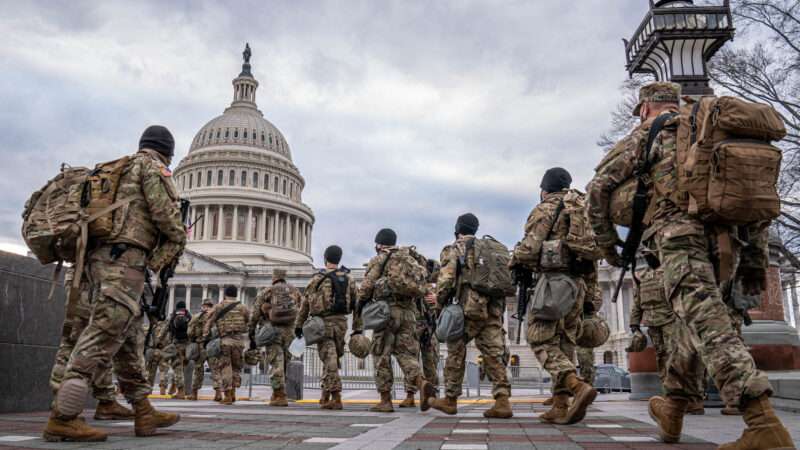
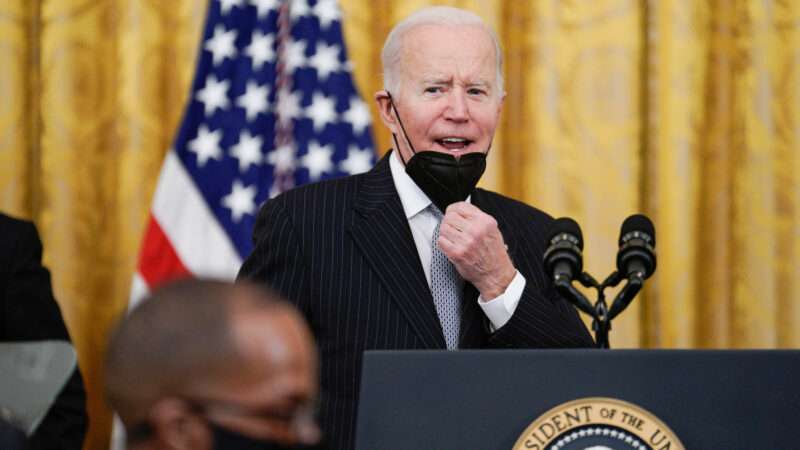
It’s no secret that public trust in institutions is in free fall. In 1958, when Americans were first asked by the National Election Study about their trust in the government, 73 percent of respondents said they could trust the government to do the right thing always or most of the time. In 2021, that number dwindled to 24 percent. The military, meanwhile, historically went unscathed—until now.
According to the Pew Research Center’s latest poll,only a quarter of Americans have a great deal of confidence that the military actually acts in the public’s best interest,a drop of 14 points since November 2020.
Andrew Bacevich, president of the Quincy Institute for Responsible Statecraft, cites a few explanations for this loss of confidence. “Rather than ‘above’ politics, the military is becoming subsumed into politics,” says Bacevich. He believes that there are three main reasons for this: the military’s mixed performance, its increased entanglement in partisan issues, and the politicization of everything, which means that “nothing is off limits” (not even the military).
“Trust in everything is down, and the obvious answer is that post-9/11 wars have not gone well,” the Atlantic Council’s Christopher Preble tells Reason. Preble also feels that the question’s oversimplification doesn’t fully capture the issue. He wonders whether the recent decline is in response to dishonest senior military officials or the armed forces as a whole, preferring to “drill down” into Pew’s specific meaning of the military. To Preble, there is a very obvious difference between “the boots on the ground and the brass.”
The Ronald Reagan Institute found, for the very first time since it began its national defense survey in 2018, that “a minority of Americans—only 45%—report having a great deal of trust and confidence in the military.” Probing further, it discovered that the most common reason behind why people had low trust in the military was due to political leadership, followed by service members and scandals within the military.
Americans haven’t lost all confidence in the military, but they are starting to realize that it’s no longer insulated from a broader loss of trust in institutions. A majority of Americans—74 percent—still express “at least a fair amount of confidence in the military to act in the public’s best interests.” However, having a “fair amount” of trust in the institution that is ensuring your safety and security isn’t exactly brag-worthy.
The hard truth is that not many Americans pay attention to the military until it affects them personally. But in August 2021, as the U.S. left Afghanistan in the middle of the night, Americans watched as two decades’ worth of progress in the country was wiped away almost instantly.
As soon as U.S. troops entered Afghanistan in 2001, the American public was repeatedly fed lies about how the mission was going smoothly. In 2013, during a press briefing, then–Army Lt. Gen. Mark Milley praised the Afghan forces: “This army and this police force have been very, very effective in combat against the insurgents every single day. And I think that’s an important story to be told across the board.” No wonder the public was stunned when, eight years after Milley’s comments, Afghan forces only lasted a matter of weeks when the U.S. left them to defend their country against the Taliban.
There is an inherent irony here that Preble has pointed out. “The most charitable thing that can be said is that individuals were shading the truth for a higher purpose,” he wrote. “They downplayed unpleasant facts to maintain a modicum of public support.” As it turns out, downplaying the truth doesn’t help you gain support.
Kelley Vlahos, editorial director of Responsible Statecraft and senior adviser at the Quincy Institute,wroteof a “silver lining” in this declining trust—”Americans won’t put the military on a pedestal again until it deserves it.” The erosion of public confidence in the military to do what’s best isn’t all that shocking. Now is the time for “critical thinking, moral courage, and a merit-based system in the military,” Vlahos argued.
When a group repeatedly hides the truth, glosses over issues, and misuses funds, it should be cause for concern. Other than scientists, the military remains more trusted than any other group included in Pew’s survey, but it’s finally facing the skepticism that it deserves.
Yesterday, two reporters of the Washington Post actually wrote that Justice Thomas is a “Black justice whose rulings often resemble the thinking of White conservatives.” No this barb did not appear in the opinion section. It appeared in the news section.
Today, the Post noted a retraction. Or is it a “clarification”? After #MaskGate I have no idea how journalism works anymore.
CLARIFICATION
A previous version of this story imprecisely referred to Justice Clarence Thomas’s opinions as often reflecting the thinking of White conservatives, rather than conservatives broadly. That reference has been removed.
Now, the passage reads:
Rep. Bennie G. Thompson (D-Miss.), a friend and ally of Clyburn’s for over 30 years, said even Clyburn’s critics respect his political instincts and his connection with a valuable but often disappointed subset of Democratic voters.
“Nobody that I’m aware of feels that opposing Clyburn’s nomination would be the wise thing to do,” he said. “If you know that a person has been vetted by Jim Clyburn, you know that person won’t go to the court and end up being a Clarence Thomas,” referring to the Black conservative justice.
I appreciate the “clarification,” but this story is still problematic. Why is it relevant to this story that Thomas is Black? The reason why is that Thompson called Thomas an Oreo. The initial version of the story dutifully reported that statement as fact. Now, the Post merely alludes to the implication. This sort of casual racism against conservatives is embedded so deeply in progressive culture. WaPo reporters and editors simply treat these barbs as fact.
David Lat’s Original Jurisdiction Substack is a vital resource to understand the Supreme Court vacancy. When I read David’s columns, I try to gather whose perspectives he is filtering. Today’s newsletter comes from #TeamKruger–literally. Apparently the Kruger network (likely Justice Stevens clerks, former DOJ employees, and academics) is unhappy that Childs and Jackson are getting too much oxygen. So they sent David missives that he converted into a college “open letter.” Apparently, Justice Kruger “would be mortified if she knew” her team lobbied for her. But they lobbied anyway. (Update: In an earlier version of this post, I wrote that #TeamKruger actually wrote the letter. I now realize David assembled different perspectives to form the letter).
First, #TeamKruger criticized Judge Childs’s “small army of operatives, politicians, and pundits pushing for her.” And, they write, Biden “should not choose a justice based on political favor-trading or political fallout.” You hear that Rep. Clyburn?
Second, #TeamKruger suggests that Biden cannot reliably count of Child’s vote. Rather, Biden would pick Childs because of “such niceties as a compelling personal story.” (And what really happened to her father!?) Plus Childs is a black woman who may exhibit conservativism! (The Washington Post could not be reached for comment):
If this were a 6-3 Court in the other direction, i.e., in favor of liberals, Judge Childs might be a great pick. With that kind of dominance, you’d have the luxury of picking someone based on such niceties as a compelling personal story and a non-Ivy educational background, and things like her lack of appellate experience, her being a decade older, and her conservatism in employment law and criminal law wouldn’t matter that much. You could lose her vote in the occasional case and still prevail.
Burn.
Third, #TeamKruger says that Childs, as well as Jackson, would have to “learn on the job.” (Elena Kagan could not be reached for comment).
Judge Jackson, who has been an appellate judge for less than a year, and Judge Childs, who has never been an appellate judge, haven’t had the opportunity to develop these skills in the same way. And the Supreme Court—at least for a liberal justice at this critical point in our nation’s history, with abortion, gun control, and affirmative action on the line—is no place for learning on the job.
Ouch.
I, for one, am enjoying this circular stabbing squad. And it will get uglier.
David Lat’s Original Jurisdiction Substack is a vital resource to understand the Supreme Court vacancy. When I read David’s columns, I try to gather whose perspectives he is filtering. Today’s newsletter comes from #TeamKruger–literally. Apparently the Kruger network (likely Justice Stevens clerks, former DOJ employees, and academics) is unhappy that Childs and Jackson are getting too much oxygen. So they sent David an “open letter.” Apparently, Justice Kruger “would be mortified if she knew” her team wrote this letter. But they wrote it anyway.
First, #TeamKruger criticized Judge Childs’s “small army of operatives, politicians, and pundits pushing for her.” And, they write, Biden “should not choose a justice based on political favor-trading or political fallout.” You hear that Rep. Clyburn?
Second, #TeamKruger suggests that Biden cannot reliably count of Child’s vote. Rather, Biden would pick Childs because of “such niceties as a compelling personal story.” (And what really happened to her father!?) Plus Childs is a black woman who may exhibit conservativism! (The Washington Post could not be reached for comment). This carefully-crafted sentence likely went through many committee reviews:
If this were a 6-3 Court in the other direction, i.e., in favor of liberals, Judge Childs might be a great pick. With that kind of dominance, you’d have the luxury of picking someone based on such niceties as a compelling personal story and a non-Ivy educational background, and things like her lack of appellate experience, her being a decade older, and her conservatism in employment law and criminal law wouldn’t matter that much. You could lose her vote in the occasional case and still prevail.
Burn.
Third, #TeamKruger says that Childs, as well as Jackson, would have to “learn on the job.” (Elena Kagan could not be reached for comment).
Judge Jackson, who has been an appellate judge for less than a year, and Judge Childs, who has never been an appellate judge, haven’t had the opportunity to develop these skills in the same way. And the Supreme Court—at least for a liberal justice at this critical point in our nation’s history, with abortion, gun control, and affirmative action on the line—is no place for learning on the job.
Ouch.
I, for one, am enjoying this circular stabbing squad. And it will get uglier.
In July 2020, a Cincinnati police officer using the pseudonym “M.R.” filed a complaint for injunctive relief in the Hamilton County Court of Common Pleas alleging that several people, whom he named as defendants, had publicly made the false claim that he is a white supremacist. Along with his complaint, M.R. filed a motion for a temporary restraining order and an affidavit in support of the motion. Respondent, Judge Megan E. Shanahan, allowed M.R. to proceed in the lawsuit using the pseudonym and partially sealed M.R.’s affidavit at his request…. The order stated:
The plaintiff, a police officer, is involved in the apprehension of very violent and dangerous criminals. The officer’s job duties expose the officer to physical harm. To require that a document with identifying information be available to the public would further risk injury to the officer and others. In the current climate, with the uptick in violent acts being perpetrated against law enforcement both on-duty and off, active and retired, the Court finds there is a real and serious threat of physical harm. In the present case, one defendant has threatened, in writing, to publish the officer’s personal identifying information and other information for the purpose of “doxing” the officer. The Court finds this to be a real and present threat.
Although Judge Shanahan did not expressly identify the evidence supporting her finding that M.R. had been threatened, she likely was referring to a social-media post that was attached as an exhibit to M.R.’s affidavit. The author of that post stated that he was thinking about publicizing M.R.’s name, address, and phone numbers but expressed concern about the legality of doing so. After exchanging messages with others, the poster ultimately stated that he would keep the information to himself, “[f]or now.”
Judge Shanahan’s second sealing order continued to allow M.R. to proceed pseudonymously but it modified the original order by making parts of M.R.’s affidavit available to the public. The partially redacted affidavit omitted all references to M.R.’s name and to the fact that M.R. has a wife and children. The exhibits to the affidavit remained sealed….
The court began by holding that the sealing of the affidavit was improper:
[Ohio Courts Rule of Superintendence] 45(E)(2) authorizes a court to restrict public access to a document only “if it finds by clear and convincing evidence that the presumption of allowing public access is outweighed by a higher interest.” … Judge Shanahan has not shown that the evidence clearly and convincingly justified restricting access to M.R.’s affidavit. To start, the social-media post the judge refers to did not express a clear intent to publicize M.R.’s name, address, and phone numbers. The poster posed a question about whether it would be legal for him to release information about M.R. Although the poster left open the possibility that he might release M.R.’s information, he suggested that he would not do so unless he was told that it was legal. Moreover, making M.R.’s affidavit publicly available would not increase the risk that the poster would publish M.R.’s name, address, and phone numbers, because the poster already has that information.
And even if the poster’s statement constituted a genuine threat to publicize M.R.’s information, Judge Shanahan has not shown that the publication would create a risk of injury to M.R. or his family within the meaning of Sup.R. 45(E)(2). See United States v. Cook (N.D.Miss.2020) (discussing “doxing” and concluding that “sharing public information, while potentially offensive and disagreeable, does not rise to the level of a true threat”). Although in her order restricting public access to M.R.’s affidavit Judge Shanahan cited real risks that police officers face, M.R. had not presented any evidence of a threat of physical harm directed at him or his family.
As a final matter, Judge Shanahan argues that the Enquirer and Volokh have not been harmed by the partial sealing of M.R.’s affidavit, because her courtroom remains open to the public and the Enquirer has published the name of the person it believes to be M.R. The issue, however, is not whether the Enquirer and Volokh have knowledge of M.R.’s identity or whether they can publish his name. The issue is whether documents filed in M.R.’s case are court records that must be accessible to the public. The Enquirer and Volokh do not need to prove that they have been injured to be entitled to relief in mandamus in these cases.
The Enquirer and Volokh have a clear legal right of public access to M.R.’s affidavit, and Judge Shanahan has a clear legal duty to provide that access. Accordingly, we grant a writ of mandamus in both cases ordering Judge Shanahan to make the affidavit fully accessible to the public….
And the court held that M.R. shouldn’t have been allowed to sue pseudonymously:
As to whether Judge Shanahan lacked authority to allow M.R. to use a pseudonym, the judge argues that the scope of our review is limited to whether she abused her discretion. In support, the judge points to several cases in which an appellate court reviewed whether a trial court had abused its discretion by granting or denying a party’s motion to proceed pseudonymously. It appears that when reviewing such orders on appeal, appellate courts regularly review them for an abuse of discretion.
But the cases before us are not appeals. They are original actions in which nonparties to the underlying litigation claim infringement of their constitutional and common-law rights. These cases require us to decide a legal question: Has M.R. overcome the constitutional and common-law presumption that he must litigate his lawsuit using his actual name? We cannot defer to Judge Shanahan’s answer to that question, because doing so would reverse the presumption of openness by requiring the Enquirer and Volokh to show that they have a right to see M.R.’s name on court filings. We therefore consider de novo whether it is appropriate for M.R. to proceed using a pseudonym….
It is the rare exception for a litigant to be allowed to proceed anonymously. A court may excuse a plaintiff from identifying himself only when his “privacy interests substantially outweigh the presumption of open judicial proceedings.” …
M.R. asked to remain anonymous based on his concern that someone had threatened to publish his personal information. Judge Shanahan found that this threat was real and could lead to an act of violence against M.R. or his family. But this potential threat against M.R. was insufficient to justify his use of a pseudonym. A plaintiff seeking to proceed anonymously for fear of retaliation must show that the filing of the lawsuit causes a risk of retaliation. M.R. did not establish that causal connection; he did not show that any risk of harm against him or his family would increase if he were required to prosecute his lawsuit using his name.
Moreover, M.R. did not show that the threat of his name, address, and phone numbers being published was the sort of threat that could justify the use of a pseudonym. The Ninth Circuit has identified three factors that courts should consider when a plaintiff alleges that the use of a pseudonym is necessary to protect against a threat of retaliation: “(1) the severity of the threatened harm, (2) the reasonableness of the anonymous party’s fears, and (3) the anonymous party’s vulnerability to such retaliation.” M.R. did not show that anyone actually threatened him or his family or that his concerns are reasonable….
As noted in a parenthetical above, a threat to publicize someone’s name, address, and phone numbers, though potentially “offensive and disagreeable,” does not create an inherent risk of injury to that person. Cook. M.R. and Judge Shanahan both cited real risks that police officers face, and they referred to current societal factors that may put law-enforcement officers at an even greater risk of harm. But these general risks do not show that M.R. “uniquely will face an increased threat of violence—above the generalized threat of violence that all police officers face—as a result of filing [his] lawsuit.” Doe v. McKesson (M.D.La.2017), vacated on other grounds; see also Doe v. McKesson (5th Cir.2019) (affirming the district court’s decision disallowing the use of a pseudonym), vacated on other grounds.
And finally, even if M.R. had identified a threat of harm attributable to the filing of his lawsuit, the weight of his privacy interest diminished significantly when he disclosed in his complaint that on June 25, 2020, Terhas White and Alissa Gilley filed citizen complaints against him with the Citizen Complaint Authority. M.R. acknowledged that those complaints—which disclose his name—are public records. And the Enquirer referred to the citizen complaints when it published four news articles identifying M.R. by name. Thus, M.R. himself did not completely conceal his identity in filing his lawsuit and undermined his claimed right to privacy. In addition, M.R.’s attorney disclosed M.R.’s identity in open court while seeking a civil protection order on behalf of M.R.’s wife.
Judge Shanahan suggests that the reporting of M.R.’s identity supports the continued use of a pseudonym, because it shows that the Enquirer and Volokh know his identity and have not been harmed. The judge argues that “[t]he only practical effect of [her] order allowing M.R. to proceed pseudonymously is that a member of the public cannot glean his identity with a simple search of the clerk’s website.” But that is exactly the point—the public (not just the relators in these cases) has a right to know who is using the court. Except in rare cases, the public has a right to learn that information from the court itself….
In July 2020, a Cincinnati police officer using the pseudonym “M.R.” filed a complaint for injunctive relief in the Hamilton County Court of Common Pleas alleging that several people, whom he named as defendants, had publicly made the false claim that he is a white supremacist. Along with his complaint, M.R. filed a motion for a temporary restraining order and an affidavit in support of the motion. Respondent, Judge Megan E. Shanahan, allowed M.R. to proceed in the lawsuit using the pseudonym and partially sealed M.R.’s affidavit at his request…. The order stated:
The plaintiff, a police officer, is involved in the apprehension of very violent and dangerous criminals. The officer’s job duties expose the officer to physical harm. To require that a document with identifying information be available to the public would further risk injury to the officer and others. In the current climate, with the uptick in violent acts being perpetrated against law enforcement both on-duty and off, active and retired, the Court finds there is a real and serious threat of physical harm. In the present case, one defendant has threatened, in writing, to publish the officer’s personal identifying information and other information for the purpose of “doxing” the officer. The Court finds this to be a real and present threat.
Although Judge Shanahan did not expressly identify the evidence supporting her finding that M.R. had been threatened, she likely was referring to a social-media post that was attached as an exhibit to M.R.’s affidavit. The author of that post stated that he was thinking about publicizing M.R.’s name, address, and phone numbers but expressed concern about the legality of doing so. After exchanging messages with others, the poster ultimately stated that he would keep the information to himself, “[f]or now.”
Judge Shanahan’s second sealing order continued to allow M.R. to proceed pseudonymously but it modified the original order by making parts of M.R.’s affidavit available to the public. The partially redacted affidavit omitted all references to M.R.’s name and to the fact that M.R. has a wife and children. The exhibits to the affidavit remained sealed….
The court began by holding that the sealing of the affidavit was improper:
[Ohio Courts Rule of Superintendence] 45(E)(2) authorizes a court to restrict public access to a document only “if it finds by clear and convincing evidence that the presumption of allowing public access is outweighed by a higher interest.” … Judge Shanahan has not shown that the evidence clearly and convincingly justified restricting access to M.R.’s affidavit. To start, the social-media post the judge refers to did not express a clear intent to publicize M.R.’s name, address, and phone numbers. The poster posed a question about whether it would be legal for him to release information about M.R. Although the poster left open the possibility that he might release M.R.’s information, he suggested that he would not do so unless he was told that it was legal. Moreover, making M.R.’s affidavit publicly available would not increase the risk that the poster would publish M.R.’s name, address, and phone numbers, because the poster already has that information.
And even if the poster’s statement constituted a genuine threat to publicize M.R.’s information, Judge Shanahan has not shown that the publication would create a risk of injury to M.R. or his family within the meaning of Sup.R. 45(E)(2). See United States v. Cook (N.D.Miss.2020) (discussing “doxing” and concluding that “sharing public information, while potentially offensive and disagreeable, does not rise to the level of a true threat”). Although in her order restricting public access to M.R.’s affidavit Judge Shanahan cited real risks that police officers face, M.R. had not presented any evidence of a threat of physical harm directed at him or his family.
As a final matter, Judge Shanahan argues that the Enquirer and Volokh have not been harmed by the partial sealing of M.R.’s affidavit, because her courtroom remains open to the public and the Enquirer has published the name of the person it believes to be M.R. The issue, however, is not whether the Enquirer and Volokh have knowledge of M.R.’s identity or whether they can publish his name. The issue is whether documents filed in M.R.’s case are court records that must be accessible to the public. The Enquirer and Volokh do not need to prove that they have been injured to be entitled to relief in mandamus in these cases.
The Enquirer and Volokh have a clear legal right of public access to M.R.’s affidavit, and Judge Shanahan has a clear legal duty to provide that access. Accordingly, we grant a writ of mandamus in both cases ordering Judge Shanahan to make the affidavit fully accessible to the public….
And the court held that M.R. shouldn’t have been allowed to sue pseudonymously:
As to whether Judge Shanahan lacked authority to allow M.R. to use a pseudonym, the judge argues that the scope of our review is limited to whether she abused her discretion. In support, the judge points to several cases in which an appellate court reviewed whether a trial court had abused its discretion by granting or denying a party’s motion to proceed pseudonymously. It appears that when reviewing such orders on appeal, appellate courts regularly review them for an abuse of discretion.
But the cases before us are not appeals. They are original actions in which nonparties to the underlying litigation claim infringement of their constitutional and common-law rights. These cases require us to decide a legal question: Has M.R. overcome the constitutional and common-law presumption that he must litigate his lawsuit using his actual name? We cannot defer to Judge Shanahan’s answer to that question, because doing so would reverse the presumption of openness by requiring the Enquirer and Volokh to show that they have a right to see M.R.’s name on court filings. We therefore consider de novo whether it is appropriate for M.R. to proceed using a pseudonym….
It is the rare exception for a litigant to be allowed to proceed anonymously. A court may excuse a plaintiff from identifying himself only when his “privacy interests substantially outweigh the presumption of open judicial proceedings.” …
M.R. asked to remain anonymous based on his concern that someone had threatened to publish his personal information. Judge Shanahan found that this threat was real and could lead to an act of violence against M.R. or his family. But this potential threat against M.R. was insufficient to justify his use of a pseudonym. A plaintiff seeking to proceed anonymously for fear of retaliation must show that the filing of the lawsuit causes a risk of retaliation. M.R. did not establish that causal connection; he did not show that any risk of harm against him or his family would increase if he were required to prosecute his lawsuit using his name.
Moreover, M.R. did not show that the threat of his name, address, and phone numbers being published was the sort of threat that could justify the use of a pseudonym. The Ninth Circuit has identified three factors that courts should consider when a plaintiff alleges that the use of a pseudonym is necessary to protect against a threat of retaliation: “(1) the severity of the threatened harm, (2) the reasonableness of the anonymous party’s fears, and (3) the anonymous party’s vulnerability to such retaliation.” M.R. did not show that anyone actually threatened him or his family or that his concerns are reasonable….
As noted in a parenthetical above, a threat to publicize someone’s name, address, and phone numbers, though potentially “offensive and disagreeable,” does not create an inherent risk of injury to that person. Cook. M.R. and Judge Shanahan both cited real risks that police officers face, and they referred to current societal factors that may put law-enforcement officers at an even greater risk of harm. But these general risks do not show that M.R. “uniquely will face an increased threat of violence—above the generalized threat of violence that all police officers face—as a result of filing [his] lawsuit.” Doe v. McKesson (M.D.La.2017), vacated on other grounds; see also Doe v. McKesson (5th Cir.2019) (affirming the district court’s decision disallowing the use of a pseudonym), vacated on other grounds.
And finally, even if M.R. had identified a threat of harm attributable to the filing of his lawsuit, the weight of his privacy interest diminished significantly when he disclosed in his complaint that on June 25, 2020, Terhas White and Alissa Gilley filed citizen complaints against him with the Citizen Complaint Authority. M.R. acknowledged that those complaints—which disclose his name—are public records. And the Enquirer referred to the citizen complaints when it published four news articles identifying M.R. by name. Thus, M.R. himself did not completely conceal his identity in filing his lawsuit and undermined his claimed right to privacy. In addition, M.R.’s attorney disclosed M.R.’s identity in open court while seeking a civil protection order on behalf of M.R.’s wife.
Judge Shanahan suggests that the reporting of M.R.’s identity supports the continued use of a pseudonym, because it shows that the Enquirer and Volokh know his identity and have not been harmed. The judge argues that “[t]he only practical effect of [her] order allowing M.R. to proceed pseudonymously is that a member of the public cannot glean his identity with a simple search of the clerk’s website.” But that is exactly the point—the public (not just the relators in these cases) has a right to know who is using the court. Except in rare cases, the public has a right to learn that information from the court itself….
What if we not only lost the war on COVID, but it was never really winnable? That’s increasingly what voters seem to believe—and for good reason, as a recent study suggests the limits of policymakers to control the virus through behavioral regulations.
In blue states like New Jersey and California, as well as liberal cities like Washington, D.C., elected officials have rolled back various pandemic policies over the last few weeks, leading to accusations of cynical political motives—that, as GOP Sen. Tom Cotton (Ark.) quipped, “the science hasn’t changed, the polling has.”
It seems fairly obvious that Democrats can sense a change in the political winds as case counts plummet across the country, and they are acting accordingly. As Josh Barro recently wrote in his newsletter, Democratic governors are “running to where the COVID ball is going.”
But after surveying the polls, Anderson suggests there’s something deeper going on, that it’s not so much that there’s been an abrupt change in whether voters, especially blue state voters, favor COVID restrictions, but instead that many of those voters have simply given up on the idea that COVID can ever be defeated. As Anderson puts it: “The turn away from COVID restrictions seems less about them having become deeply unpopular overnight, but rather that public opinion has soured on our ability to win the fight against COVID at all.” Two years in, the war on COVID increasingly feels like a quagmire, and voters are looking for an exit plan.
I use the phrase war on COVID on purpose, for there are clear echoes of both the war on drugs and the war on terror: long-running government campaigns championed by the political class and predicated on preserving public health and safety, which eventually proved futile at best, and deeply destructive and counterproductive at worst. Both involved a mix of largely symbolic acts, intended mostly to visibly demonstrate that something was being donem and more punitive initiatives that produced damaging effects that tended to fall heaviest on out groups with little political influence.
Those campaigns became permanent parts of the American political landscape in part because they offered ambitious bureaucrats and politicians paths to consolidate power, and in part because of the uneven distribution of their consequences. The first is obviously true for many COVID hawks, especially for public health authorities. But while the negative effects of COVID restrictions have certainly hit some groups harder than others (children, and children with learning disabilities in particular), the overall impact has been more widespread: Over the past two years, almost everyone in America has, at the very least, been inconvenienced or frustrated, if not worse, and for many, those inconveniences and frustrations have become fixtures of daily life.
Those inconveniences were a price that many Americans were willing to pay, especially at first. Early on, polls found support for staying at home, social distancing, masking, and even closures, especially in more left-leaning locales. But it now seems it was a price they were willing to pay only if those irritations produced demonstrable results.
And those results have not been forthcoming. Indeed, you can see the failure of COVID restrictions in a recent meta-analysis led by a John Hopkins University economist which reviewed 34 papers on the mortality effects of pandemic policy restrictions and found that non-pharmaceutical interventions (NPIs)—basically, mandatory behavioral controls, which include anything from masking to forced quarantines and business closures—had very little effect on COVID deaths.
The working paper does have some limitations: In particular, the most recent paper was published in June 2021, which means it doesn’t tell us much about COVID policy during the Delta or Omicron waves.
It also excludes most epidemiological research, since it relies on studies that track what has already happened rather than on studies exploring what might have happened using epidemiological models as counterfactuals. Essentially, it focuses on studies that use observational research rather than on studies comparing reality to public health simulations. Notably,this year’s Nobel Prize in Economics went to a group of economists who pioneered that sort of observation-based study methodology; it’s quite useful for, among other things, studying the effects of policy changes.
So this analysis isn’t the final word on pandemic restrictions. But what it suggests is that it’s quite difficult to find large observable effects on mortality from behavior-based COVID policies.
What I suspect is driving discontent with the war on COVID, however, is that you don’t need a meta-study to observe the futility of those restrictions. Two years into the pandemic, Americans have seen schools closed and reopened (and sometimes closed again), thousands of businesses shut down and return (sometimes in altered form), masking denigrated as useless then held up as essential, and mask mandates turned on and off and sometimes on again. It’s simply not obvious to many people that any of it worked very well to control the virus, or, if it did work somewhat, that it was worth the trade-offs. Masking rules, in particular, are self-evidently arbitrary and absurd, as anyone who has had to mask between a hostess stand and a table, or sat maskless at an airport bar surrounded by masked travelers, can see. Yet President Joe Biden continues to side with the interventionists, saying just this week that ending mask mandates now would be “premature.”
The irritations and frustrations, meanwhile, are clear and persistent, even as COVID waves continue to swell and crash. And so what voters, even in COVID-cautious blue states, increasingly seem to have concluded is that whatever it is we’re doing isn’t working—so why are we doing it?
The only thing that does seem obvious in this pandemic morass is that vaccines continue to be effective at preventing severe disease and death if you do catch COVID, which probably explains why most Americans, including a majority of Republicans, have gotten the jab. This may or may not represent victory, in the sense that the virus is still with us, and the disease’s death toll over the last two years is still staggeringly high. But it is an exit strategy from yet another failed government campaign—and right now, that’s what Americans appear to both want and need.
What if we not only lost the war on COVID, but it was never really winnable? That’s increasingly what voters seem to believe—and for good reason, as a recent study suggests the limits of policymakers to control the virus through behavioral regulations.
In blue states like New Jersey and California, as well as liberal cities like Washington, D.C., elected officials have rolled back various pandemic policies over the last few weeks, leading to accusations of cynical political motives—that, as GOP Sen. Tom Cotton (Ark.) quipped, “the science hasn’t changed, the polling has.”
It seems fairly obvious that Democrats can sense a change in the political winds as case counts plummet across the country, and they are acting accordingly. As Josh Barro recently wrote in his newsletter, Democratic governors are “running to where the COVID ball is going.”
But after surveying the polls, Anderson suggests there’s something deeper going on, that it’s not so much that there’s been an abrupt change in whether voters, especially blue state voters, favor COVID restrictions, but instead that many of those voters have simply given up on the idea that COVID can ever be defeated. As Anderson puts it: “The turn away from COVID restrictions seems less about them having become deeply unpopular overnight, but rather that public opinion has soured on our ability to win the fight against COVID at all.” Two years in, the war on COVID increasingly feels like a quagmire, and voters are looking for an exit plan.
I use the phrase war on COVID on purpose, for there are clear echoes of both the war on drugs and the war on terror: long-running government campaigns championed by the political class and predicated on preserving public health and safety, which eventually proved futile at best, and deeply destructive and counterproductive at worst. Both involved a mix of largely symbolic acts, intended mostly to visibly demonstrate that something was being donem and more punitive initiatives that produced damaging effects that tended to fall heaviest on out groups with little political influence.
Those campaigns became permanent parts of the American political landscape in part because they offered ambitious bureaucrats and politicians paths to consolidate power, and in part because of the uneven distribution of their consequences. The first is obviously true for many COVID hawks, especially for public health authorities. But while the negative effects of COVID restrictions have certainly hit some groups harder than others (children, and children with learning disabilities in particular), the overall impact has been more widespread: Over the past two years, almost everyone in America has, at the very least, been inconvenienced or frustrated, if not worse, and for many, those inconveniences and frustrations have become fixtures of daily life.
Those inconveniences were a price that many Americans were willing to pay, especially at first. Early on, polls found support for staying at home, social distancing, masking, and even closures, especially in more left-leaning locales. But it now seems it was a price they were willing to pay only if those irritations produced demonstrable results.
And those results have not been forthcoming. Indeed, you can see the failure of COVID restrictions in a recent meta-analysis led by a John Hopkins University economist which reviewed 34 papers on the mortality effects of pandemic policy restrictions and found that non-pharmaceutical interventions (NPIs)—basically, mandatory behavioral controls, which include anything from masking to forced quarantines and business closures—had very little effect on COVID deaths.
The working paper does have some limitations: In particular, the most recent paper was published in June 2021, which means it doesn’t tell us much about COVID policy during the Delta or Omicron waves.
It also excludes most epidemiological research, since it relies on studies that track what has already happened rather than on studies exploring what might have happened using epidemiological models as counterfactuals. Essentially, it focuses on studies that use observational research rather than on studies comparing reality to public health simulations. Notably,this year’s Nobel Prize in Economics went to a group of economists who pioneered that sort of observation-based study methodology; it’s quite useful for, among other things, studying the effects of policy changes.
So this analysis isn’t the final word on pandemic restrictions. But what it suggests is that it’s quite difficult to find large observable effects on mortality from behavior-based COVID policies.
What I suspect is driving discontent with the war on COVID, however, is that you don’t need a meta-study to observe the futility of those restrictions. Two years into the pandemic, Americans have seen schools closed and reopened (and sometimes closed again), thousands of businesses shut down and return (sometimes in altered form), masking denigrated as useless then held up as essential, and mask mandates turned on and off and sometimes on again. It’s simply not obvious to many people that any of it worked very well to control the virus, or, if it did work somewhat, that it was worth the trade-offs. Masking rules, in particular, are self-evidently arbitrary and absurd, as anyone who has had to mask between a hostess stand and a table, or sat maskless at an airport bar surrounded by masked travelers, can see. Yet President Joe Biden continues to side with the interventionists, saying just this week that ending mask mandates now would be “premature.”
The irritations and frustrations, meanwhile, are clear and persistent, even as COVID waves continue to swell and crash. And so what voters, even in COVID-cautious blue states, increasingly seem to have concluded is that whatever it is we’re doing isn’t working—so why are we doing it?
The only thing that does seem obvious in this pandemic morass is that vaccines continue to be effective at preventing severe disease and death if you do catch COVID, which probably explains why most Americans, including a majority of Republicans, have gotten the jab. This may or may not represent victory, in the sense that the virus is still with us, and the disease’s death toll over the last two years is still staggeringly high. But it is an exit strategy from yet another failed government campaign—and right now, that’s what Americans appear to both want and need.
The Justice Department is challenging a Missouri law that lets people sue law enforcement for gun rights violations. Under Missouri’s “Second Amendment Preservation Act,” Missouri law enforcement is barred from enforcing certain federal gun control measures—and people can sue police who do.
The law (H.B. 85), passed in 2021, has now earned the ire of the Biden administration. “A state cannot simply declare federal laws invalid,” said Principal Deputy Assistant Attorney General Brian M. Boynton.
H.B. 85 says that Missouri rejects several categories of federal gun provisions, which it considers to be “infringements on the people’s right to keep and bear arms.” These provisions include “any tax, levy, fee, or stamp imposed on firearms, firearm accessories, or ammunition not common to all other goods and services,” “any registration or tracking of firearms, firearm accessories, or ammunition” or the ownership of them, “any act forbidding the possession, ownership, use, or transfer of a firearm, firearm accessory, or ammunition by law-abiding citizens,” and “any act ordering the confiscation of firearms, firearm accessories, or ammunition from law-abiding citizens.”
H.B. 85 orders state and local law enforcement not to cooperate with the feds to enforce such measures and says Missourians can sue if they do.
“HB 85 puts those in Washington D.C. on notice that here in Missouri we support responsible, law-abiding gun owners, and that we oppose government overreach and any unlawful efforts to limit our access to firearms,” said Missouri Gov. Michael L. Parson in a statement last summer.
Since H.B. 85 was enacted, “dozens of state and local officers have resigned from federal joint-task forces” to enforce federal gun laws, according to the Department of Justice (DOJ).
“This act impedes criminal law enforcement operations in Missouri,” alleged Attorney General Merrick B. Garland in a Wednesday statement.
Which is, of course, the whole point—Missouri thinks that some federal firearms laws may violate the Second Amendment and doesn’t wish to help enforce them. The feds, however, say this opting out isn’t allowed.
In its new complaint, the DOJ argues that H.B. 85 is preempted by federal law and violates the Supremacy Clause of the U.S. Constitution (which says that “this Constitution, and the Laws of the United States which shall be made in Pursuance thereof…shall be the supreme Law of the Land…any Thing in the Constitution or Laws of any State to the Contrary notwithstanding”). It also suggests that the law discriminates against federal employees involved in gun control schemes by declaring them disqualified from future employment with “any political subdivision or law enforcement agency” in Missouri.
“Although a state may lawfully decline to assist with federal enforcement…a state may not directly regulate federal authority. H.B. 85 does exactly that by purporting to nullify, interfere with, and discriminate against federal law,” the DOJ argues, confusingly.
It’s asking the court to prohibit enforcement of H.B. 85 and clarify that Missouri cops can lawfully participate in investigating and enforcing measures that it says are not “infringements” but “well-established federal requirements for the registration and tracking of firearms and limitations on the possession of firearms by certain persons.”
The DOJ “seeks to attack Missourians’ Second Amendment rights,” said Missouri Attorney General Eric Schmitt in response. “Make no mistake, the law is on our side in this case, and I intend to beat the Biden Administration in court.”
Supporters of H.B. 85 “have argued that the new law is constitutional and does not prohibit federal agents from operating in Missouri,” notesThe New York Times.
The Times‘ language is a little weird here, couching this as simply an argument by supporters instead of a fact: It does not prohibit federal agents from enforcing federal laws in Missouri, it merely prescribes what Missouri law enforcement can do.
The Missouri law “is part of a broader movement to resist federal gun control,” reportedReason‘s Jacob Sullum last summer. He points out that the legal arguments used to support H.B. 85 are the same as those used to support sanctuary cities and rely on “the well-established anti-commandeering doctrine, which says the federal government cannot compel state and local officials to enforce its criminal laws or regulatory schemes.”
Sullum also noted at the time that the immediate impact of H.B. 85 would likely be small:
The restrictions do not apply to federal firearm offenses that are also crimes under Missouri law, and currently there is not much difference between those categories.
The main point of the law, according to its sponsors, is proactive. Should Congress pass the gun controls that President Joe Biden favors, such as a ban on the manufacture and unregistered possession of “assault weapons,” Missouri officials will be prohibited from assisting in their enforcement.
FREE MINDS
A Texas-style abortion law is advancing in Idaho. “The bill, SB 1309, would authorize the father, aunt, uncle, grandparent, or sibling of a fetus aborted after that point to file a civil lawsuit against the doctor at any time up to four years after the abortion, and get $20,000 minimum damages plus attorney fees. It has no other enforcement mechanism,” reports Boise’s KTVB.
“It’s unconstitutional on its face,” state Sen. Grant Burgoyne (D–Boise) said. “I think that the state of Idaho is in for another rough ride on…abortion litigation, and an expensive ride, and an unconstitutional ride.” The bill passed out of a Senate committee on Wednesday.
“Ken McClure, a lobbyist for the Idaho Medical Association, testified at length about legal problems his association sees in the bill, including authorizing repeated lawsuits with minimum damages over the same abortion while forbidding doctors from being awarded attorney fees if they’ve complied with the law and win the lawsuits,” notes KTVB.
FREE MARKETS
Juul antitrust lawsuit dismissed. The Federal Trade Commission’s attempt to end a partnership between tobacco company Altria and vaping company Juul has fizzled…for now. “An administrative law judge has dismissed a federal lawsuit alleging the company’s partnership with e-cigarette maker Juul Labs amounted to an anticompetitive agreement that hurt consumers,” ABC News reports.
The preliminary decision by the agency judge is subject to review by the Federal Trade Commission and will likely be appealed. The judge’s ruling was not immediately available at the time of Altria’s announcement. The company, whose brands include Marlboro cigarettes and Copenhagen smokeless tobacco, said it is expected to be posted online later this month.
FOLLOW-UPS
Ottawa police warn truckers. The Ottawa Police Service on Wednesday handed out written warnings to “Freedom Convoy” protesters in an apparent final attempt to avoid more extreme measures. “You must leave the area now. Anyone blocking streets, or assisting others in the blocking streets, are committing a criminal offence and you may be arrested,” the notice said. “You must immediately cease further unlawful activity or you will face charges.”
More criticism of the EARN IT Act (plus more tech regulation from its sponsor). “It probably won’t save any children, but it might mean the end of encrypted messaging,” writes J.D. Tuccille here at Reason:
Governments have never liked it when their subjects keep secrets from them and they really don’t like encryption technology, which makes it easier for people to conceal their messages from prying eyes. But the public hasn’t been buying the eavesdropping that politicians are selling. So, the powers-that-be moved on to claiming that they’re concerned about protecting the children and just incidentally restricting the use of techniques for protecting privacy. The EARN IT Act is the latest effort to invade our communications, and its advocates occasionally let the mask slip.
Under the current setup, companies can search for child sexual abuse material (CSAM) and if they find it they must report it to NCMEC (and remove it). This is good and useful and helps prevent the further spread. But under the 4th Amendment, if the government is mandating a search, then it would require a warrant before the search can happen. So, if the government mandates the search — and as various senators made clear in both their “myths and facts” document, and in the markup hearing, that’s exactly what they intend this bill to do — then anyone who is charged with evidence found via such a search would have an unfortunately strong response that the evidence was collected under state action, and, as such in order to survive a 4th Amendment review, would require a warrant.
In other words, it hands terrible criminals — those involved in the abuse of children — a way to suppress the evidence used against them on 4th Amendment grounds. Under such a regime that would make it more difficult to prosecute actual criminals. But, even worse, it would then create a perverse and dangerous precedent in which companies would be greatly encouraged not to use basic scanning tools to find, remove, and report [child pornography], because in doing so, it would no longer be usable in prosecutions.
On Wednesday, EARN IT Act sponsor Sen. Richard Blumenthal (D–Conn.) announced another piece of burdensome and overreaching tech regulation that’s ostensibly made “to protect the safety of children on the internet.”
Among other things, the “sweeping bill” would “demand that companies create tools to allow parents to track how much time their kids spend on a service, or to opt out of features such as autoplay that might extend time online,” notesThe Washington Post. “Companies would also have to offer parents and minors the ability to modify tech companies’ recommendation algorithms, allowing them to limit or ban certain types of content.”
• “A federal judge in Georgia has temporarily blocked the U.S. military from enforcing its Covid-19 vaccine mandate against an Air Force officer seeking a religious exemption,” NBC News reports. “The order was handed down a month after the unnamed officer, who is a Christian, filed a lawsuit alleging that the mandate violates her religious beliefs.”
• The sex worker–friendly social media platform Switter is shutting down. “The recent anti-sex work and anti-LGBTQIA+ legislative changes not only in Australia, but in the UK, US and other jurisdictions have made it impossible for us to appropriately and ethically maintain compliance for over 430,000+ users on a social media platform,” its founders said in a statement.
• Disney is launching a land for people who want to live Disney fantasies full time. “‘Storyliving by Disney’ will operate as part of the company’s theme parks division, developing a series of master-planned communities for residential living, designed by Disney’s creative staff and offering the same pampered tranquility found in its resorts,” notesThe Verge.
• The Institute for Justice has launched a shuttered home day care. More on the story, from Reason‘s Christian Britschgi, here.
Bianca is a single mom with 2 young kids. Until recently she was earning a living running a small, 2-4 kid, daycare out of her home. But city officials shut her down—citing concerns of nearby golfers that they could *hear* & *see* children in her backyard.https://t.co/jTikZpT3dN
• “The New Hampshire House of Representatives on Wednesday approved a bill to legalize marijuana through a state-run model. But pro-legalization advocates are sounding the alarm about the specifics of the proposal,” reportsMarijuana Moment.
The Justice Department is challenging a Missouri law that lets people sue law enforcement for gun rights violations. Under Missouri’s “Second Amendment Preservation Act,” Missouri law enforcement is barred from enforcing certain federal gun control measures—and people can sue police who do.
The law (H.B. 85), passed in 2021, has now earned the ire of the Biden administration. “A state cannot simply declare federal laws invalid,” said Principal Deputy Assistant Attorney General Brian M. Boynton.
H.B. 85 says that Missouri rejects several categories of federal gun provisions, which it considers to be “infringements on the people’s right to keep and bear arms.” These provisions include “any tax, levy, fee, or stamp imposed on firearms, firearm accessories, or ammunition not common to all other goods and services,” “any registration or tracking of firearms, firearm accessories, or ammunition” or the ownership of them, “any act forbidding the possession, ownership, use, or transfer of a firearm, firearm accessory, or ammunition by law-abiding citizens,” and “any act ordering the confiscation of firearms, firearm accessories, or ammunition from law-abiding citizens.”
H.B. 85 orders state and local law enforcement not to cooperate with the feds to enforce such measures and says Missourians can sue if they do.
“HB 85 puts those in Washington D.C. on notice that here in Missouri we support responsible, law-abiding gun owners, and that we oppose government overreach and any unlawful efforts to limit our access to firearms,” said Missouri Gov. Michael L. Parson in a statement last summer.
Since H.B. 85 was enacted, “dozens of state and local officers have resigned from federal joint-task forces” to enforce federal gun laws, according to the Department of Justice (DOJ).
“This act impedes criminal law enforcement operations in Missouri,” alleged Attorney General Merrick B. Garland in a Wednesday statement.
Which is, of course, the whole point—Missouri thinks that some federal firearms laws may violate the Second Amendment and doesn’t wish to help enforce them. The feds, however, say this opting out isn’t allowed.
In its new complaint, the DOJ argues that H.B. 85 is preempted by federal law and violates the Supremacy Clause of the U.S. Constitution (which says that “this Constitution, and the Laws of the United States which shall be made in Pursuance thereof…shall be the supreme Law of the Land…any Thing in the Constitution or Laws of any State to the Contrary notwithstanding”). It also suggests that the law discriminates against federal employees involved in gun control schemes by declaring them disqualified from future employment with “any political subdivision or law enforcement agency” in Missouri.
“Although a state may lawfully decline to assist with federal enforcement…a state may not directly regulate federal authority. H.B. 85 does exactly that by purporting to nullify, interfere with, and discriminate against federal law,” the DOJ argues, confusingly.
It’s asking the court to prohibit enforcement of H.B. 85 and clarify that Missouri cops can lawfully participate in investigating and enforcing measures that it says are not “infringements” but “well-established federal requirements for the registration and tracking of firearms and limitations on the possession of firearms by certain persons.”
The DOJ “seeks to attack Missourians’ Second Amendment rights,” said Missouri Attorney General Eric Schmitt in response. “Make no mistake, the law is on our side in this case, and I intend to beat the Biden Administration in court.”
Supporters of H.B. 85 “have argued that the new law is constitutional and does not prohibit federal agents from operating in Missouri,” notesThe New York Times.
The Times‘ language is a little weird here, couching this as simply an argument by supporters instead of a fact: It does not prohibit federal agents from enforcing federal laws in Missouri, it merely prescribes what Missouri law enforcement can do.
The Missouri law “is part of a broader movement to resist federal gun control,” reportedReason‘s Jacob Sullum last summer. He points out that the legal arguments used to support H.B. 85 are the same as those used to support sanctuary cities and rely on “the well-established anti-commandeering doctrine, which says the federal government cannot compel state and local officials to enforce its criminal laws or regulatory schemes.”
Sullum also noted at the time that the immediate impact of H.B. 85 would likely be small:
The restrictions do not apply to federal firearm offenses that are also crimes under Missouri law, and currently there is not much difference between those categories.
The main point of the law, according to its sponsors, is proactive. Should Congress pass the gun controls that President Joe Biden favors, such as a ban on the manufacture and unregistered possession of “assault weapons,” Missouri officials will be prohibited from assisting in their enforcement.
FREE MINDS
A Texas-style abortion law is advancing in Idaho. “The bill, SB 1309, would authorize the father, aunt, uncle, grandparent, or sibling of a fetus aborted after that point to file a civil lawsuit against the doctor at any time up to four years after the abortion, and get $20,000 minimum damages plus attorney fees. It has no other enforcement mechanism,” reports Boise’s KTVB.
“It’s unconstitutional on its face,” state Sen. Grant Burgoyne (D–Boise) said. “I think that the state of Idaho is in for another rough ride on…abortion litigation, and an expensive ride, and an unconstitutional ride.” The bill passed out of a Senate committee on Wednesday.
“Ken McClure, a lobbyist for the Idaho Medical Association, testified at length about legal problems his association sees in the bill, including authorizing repeated lawsuits with minimum damages over the same abortion while forbidding doctors from being awarded attorney fees if they’ve complied with the law and win the lawsuits,” notes KTVB.
FREE MARKETS
Juul antitrust lawsuit dismissed. The Federal Trade Commission’s attempt to end a partnership between tobacco company Altria and vaping company Juul has fizzled…for now. “An administrative law judge has dismissed a federal lawsuit alleging the company’s partnership with e-cigarette maker Juul Labs amounted to an anticompetitive agreement that hurt consumers,” ABC News reports.
The preliminary decision by the agency judge is subject to review by the Federal Trade Commission and will likely be appealed. The judge’s ruling was not immediately available at the time of Altria’s announcement. The company, whose brands include Marlboro cigarettes and Copenhagen smokeless tobacco, said it is expected to be posted online later this month.
FOLLOW-UPS
Ottawa police warn truckers. The Ottawa Police Service on Wednesday handed out written warnings to “Freedom Convoy” protesters in an apparent final attempt to avoid more extreme measures. “You must leave the area now. Anyone blocking streets, or assisting others in the blocking streets, are committing a criminal offence and you may be arrested,” the notice said. “You must immediately cease further unlawful activity or you will face charges.”
More criticism of the EARN IT Act (plus more tech regulation from its sponsor). “It probably won’t save any children, but it might mean the end of encrypted messaging,” writes J.D. Tuccille here at Reason:
Governments have never liked it when their subjects keep secrets from them and they really don’t like encryption technology, which makes it easier for people to conceal their messages from prying eyes. But the public hasn’t been buying the eavesdropping that politicians are selling. So, the powers-that-be moved on to claiming that they’re concerned about protecting the children and just incidentally restricting the use of techniques for protecting privacy. The EARN IT Act is the latest effort to invade our communications, and its advocates occasionally let the mask slip.
Under the current setup, companies can search for child sexual abuse material (CSAM) and if they find it they must report it to NCMEC (and remove it). This is good and useful and helps prevent the further spread. But under the 4th Amendment, if the government is mandating a search, then it would require a warrant before the search can happen. So, if the government mandates the search — and as various senators made clear in both their “myths and facts” document, and in the markup hearing, that’s exactly what they intend this bill to do — then anyone who is charged with evidence found via such a search would have an unfortunately strong response that the evidence was collected under state action, and, as such in order to survive a 4th Amendment review, would require a warrant.
In other words, it hands terrible criminals — those involved in the abuse of children — a way to suppress the evidence used against them on 4th Amendment grounds. Under such a regime that would make it more difficult to prosecute actual criminals. But, even worse, it would then create a perverse and dangerous precedent in which companies would be greatly encouraged not to use basic scanning tools to find, remove, and report [child pornography], because in doing so, it would no longer be usable in prosecutions.
On Wednesday, EARN IT Act sponsor Sen. Richard Blumenthal (D–Conn.) announced another piece of burdensome and overreaching tech regulation that’s ostensibly made “to protect the safety of children on the internet.”
Among other things, the “sweeping bill” would “demand that companies create tools to allow parents to track how much time their kids spend on a service, or to opt out of features such as autoplay that might extend time online,” notesThe Washington Post. “Companies would also have to offer parents and minors the ability to modify tech companies’ recommendation algorithms, allowing them to limit or ban certain types of content.”
• “A federal judge in Georgia has temporarily blocked the U.S. military from enforcing its Covid-19 vaccine mandate against an Air Force officer seeking a religious exemption,” NBC News reports. “The order was handed down a month after the unnamed officer, who is a Christian, filed a lawsuit alleging that the mandate violates her religious beliefs.”
• The sex worker–friendly social media platform Switter is shutting down. “The recent anti-sex work and anti-LGBTQIA+ legislative changes not only in Australia, but in the UK, US and other jurisdictions have made it impossible for us to appropriately and ethically maintain compliance for over 430,000+ users on a social media platform,” its founders said in a statement.
• Disney is launching a land for people who want to live Disney fantasies full time. “‘Storyliving by Disney’ will operate as part of the company’s theme parks division, developing a series of master-planned communities for residential living, designed by Disney’s creative staff and offering the same pampered tranquility found in its resorts,” notesThe Verge.
• The Institute for Justice has launched a shuttered home day care. More on the story, from Reason‘s Christian Britschgi, here.
Bianca is a single mom with 2 young kids. Until recently she was earning a living running a small, 2-4 kid, daycare out of her home. But city officials shut her down—citing concerns of nearby golfers that they could *hear* & *see* children in her backyard.https://t.co/jTikZpT3dN
• “The New Hampshire House of Representatives on Wednesday approved a bill to legalize marijuana through a state-run model. But pro-legalization advocates are sounding the alarm about the specifics of the proposal,” reportsMarijuana Moment.