Be Warned, Coronavirus Snitches: You Too May Be Snitched On

Hundreds of St. Louis citizens who snitched to the government about businesses that defied closure orders are discovering that their messages are not confidential and their identities are subject to sunshine laws.

As part of the effort to slow the spread of the coronavirus, some city and state leaders have forced businesses they deem “nonessential” to shut down. St. Louis County encouraged people to report any such businesses that are still open via an online form.

The county received more than 900 complaints. And the complaints, apparently, were not anonymous. Indeed, they’re public records subject to the state’s sunshine laws. Now people who are angry at the extent and duration of government shutdown orders are using those laws to expose the people who filed the complaints.

KSDK, a local NBC affiliate, reported in late April that a man named Jared Totsch received a copy of these tipsters’ records and shared them on Facebook. When a KDSK reporter reached out to him to point to him that these tipsters are now worried about retaliation, Totsch responded that was partly the point.

“I’d call it poetic justice, instant Karma, a dose of their own medicine,” he responded. “What goes around, comes around. They are now experiencing the same pain that they themselves helped to inflict on those they filed complaints against.”

KDSK interviewed a tipster named Patricia (the station withheld her last name) who was worried about retaliation. “I saw a lot of businesses that were non-essential that were open and had lines outside, parking lots filled as if the order didn’t matter to them,” she explained to the station. “And that was kinda frustrating.” She has personal reasons for being worried about the spread of the coronavirus—she has lupus, and two other people in her home have autoimmune issues, so they’re in a higher health risk category than many others.

The whole fight feels like waves of resentment coming from opposite directions. There are huge economic costs to these businesses if they’re forced to shut their doors. These shutdowns are going to lead to bankruptcies and destroyed livelihoods.

But yes, there are huge health risks to people like Patricia. Plans to try to restart the economy tend to involve keeping those who are in high-risk categories in quarantine while others carefully start returning to work.

The Reason Foundation (which publishes this site) recently released a working paper that tries to avoid these anger-inducing one-size-fits-all responses and focus instead on containing infection clusters. Patricia needs to keep herself safe, but that doesn’t mean those businesses she saw needed to be closed in order to achieve that goal.

If more people realized that government’s responses have trended more toward authoritarian blanket demands rather than actual risk assessments and properly targeted protection measures, we’d all be better off moving forward.

from Latest – Reason.com https://ift.tt/3c4BOGv
via IFTTT

Be Warned, Coronavirus Snitches: You Too May Be Snitched On

Hundreds of St. Louis citizens who snitched to the government about businesses that defied closure orders are discovering that their messages are not confidential and their identities are subject to sunshine laws.

As part of the effort to slow the spread of the coronavirus, some city and state leaders have forced businesses they deem “nonessential” to shut down. St. Louis County encouraged people to report any such businesses that are still open via an online form.

The county received more than 900 complaints. And the complaints, apparently, were not anonymous. Indeed, they’re public records subject to the state’s sunshine laws. Now people who are angry at the extent and duration of government shutdown orders are using those laws to expose the people who filed the complaints.

KSDK, a local NBC affiliate, reported in late April that a man named Jared Totsch received a copy of these tipsters’ records and shared them on Facebook. When a KDSK reporter reached out to him to point to him that these tipsters are now worried about retaliation, Totsch responded that was partly the point.

“I’d call it poetic justice, instant Karma, a dose of their own medicine,” he responded. “What goes around, comes around. They are now experiencing the same pain that they themselves helped to inflict on those they filed complaints against.”

KDSK interviewed a tipster named Patricia (the station withheld her last name) who was worried about retaliation. “I saw a lot of businesses that were non-essential that were open and had lines outside, parking lots filled as if the order didn’t matter to them,” she explained to the station. “And that was kinda frustrating.” She has personal reasons for being worried about the spread of the coronavirus—she has lupus, and two other people in her home have autoimmune issues, so they’re in a higher health risk category than many others.

The whole fight feels like waves of resentment coming from opposite directions. There are huge economic costs to these businesses if they’re forced to shut their doors. These shutdowns are going to lead to bankruptcies and destroyed livelihoods.

But yes, there are huge health risks to people like Patricia. Plans to try to restart the economy tend to involve keeping those who are in high-risk categories in quarantine while others carefully start returning to work.

The Reason Foundation (which publishes this site) recently released a working paper that tries to avoid these anger-inducing one-size-fits-all responses and focus instead on containing infection clusters. Patricia needs to keep herself safe, but that doesn’t mean those businesses she saw needed to be closed in order to achieve that goal.

If more people realized that government’s responses have trended more toward authoritarian blanket demands rather than actual risk assessments and properly targeted protection measures, we’d all be better off moving forward.

from Latest – Reason.com https://ift.tt/3c4BOGv
via IFTTT

8 Possible Reasons for the Huge International Differences in COVID-19 Deaths

If you’re trying to figure out why some places have been hit especially hard by the COVID-19 pandemic while others so far seem to be largely unscathed, there is no shortage of hypotheses. But for each seemingly plausible explanation, there are counterexamples that complicate the story.

Reporting Differences

We know that the true number of infections in any given place is far larger than the number of confirmed cases, although exactly how much larger is a matter of much dispute. We also know that deaths are undercounted, especially if they happen at home and involve people with other serious medical conditions who are never tested for the virus. While the first gap is apt to be much bigger than the second gap, the size of both is likely to vary from one country to another, depending on testing rates and reporting practices.

Still, those differences by themselves cannot account for the striking international  differences in COVID-19 deaths. “Even in places with abysmal record-keeping and broken health systems,” The New York Times notes, “mass burials or hospitals turning away sick people by the thousands would be hard to miss, and a number of places are just not seeing them—at least not yet.”

Stage of the Epidemic

Fewer than 50,000 COVID-19 cases and fewer than 2,000 deaths have been reported in the entire continent of Africa, which has a population of 1.3 billion. That amounts to fewer than two deaths per million people, compared to nearly 200 per million in Europe and a bit more than that in the United States—a huge difference, even allowing for underreporting.

Judging from the first confirmed cases, COVID-19 spread to Europe about three weeks before it hit Africa. Although the death rate in Africa is bound to rise as the epidemic progresses there, the difference in timing cannot fully account for the enormous difference in fatalities per capita. And Japan, where the first COVID-19 case was reported on January 16, a week before the first confirmed cases in Europe, has a far lower COVID-19 death rate, although not as low as Africa’s. South Korea, which reported its first COVID-19 case on January 20, likewise has a remarkably low death rate.

Age Demographics

Since COVID-19 fatality rates are dramatically higher among the elderly, one obvious explanation is age demographics. The population of Africa, where the median age is about 20, is much younger than the population of Europe, where the median age is about 43.

As the Times notes, however, some countries with young populations, such as Iran (median age: 32) and Ecuador (median age: 28) are seeing relatively high numbers of COVID-19 deaths, although not as many per capita as Europe. And Japan, which has an even higher median age (48) than Europe, again provides a puzzling counterexample.

Social Customs

“In Thailand and India, where virus numbers are relatively low, people greet each other at a distance, with palms joined together as in prayer,” the Times notes. “In Japan and South Korea, people bow, and long before the coronavirus arrived, they tended to wear face masks when feeling unwell.”

Then again, the Times says, “there are notable exceptions to the cultural distancing theory. In many parts of the Middle East, such as Iraq and the Persian Gulf countries, men often embrace or shake hands on meeting, yet most are not getting sick.” Iraq, which has a population half as big as neighboring Iran’s but a substantially lower median age (21 vs. 32), has reported less than 2 percent as many COVID-19 deaths.

Climate

Since the COVID-19 virus does not seem to like heat and light, the Times notes, it makes sense that it has made relatively little progress in tropical countries such as Chad and Guyana but is more pervasive in places with more temperate climates, such as Italy and the United States. Yet “some of the worst outbreaks in the developing world have been in places like the Amazonas region of Brazil, as tropical a place as any.”

Population Density

It’s no surprise that New York City, which has the highest population density by far of any city in the United States, has had many more COVID-19 deaths per capita than places where people live farther apart. Antibody tests conducted by the state health department in April suggested that more than a fifth of the city’s population had been infected. Yet densely populated cities such as Hong Kong, Seoul, Tokyo, Bangkok, New Delhi, and Lagos have not seen anything like the cases and deaths reported in New York.

Government Policies

“Lockdowns, with bans on religious conclaves and spectator sporting events, clearly work,” the Times declares, citing the World Health Organization. “More than a month after closing national borders, schools and most businesses, countries from Thailand to Jordan have seen new infections drop.” Yet “counter-intuitively, some countries where authorities reacted late and with spotty enforcement of lockdowns appear to have been spared. Cambodia and Laos both had brief spates of infections when few social distancing measures were in place but neither has recorded a new case in about three weeks.”

South Korea’s response to COVID-19—focused on early and wide testing, coupled with aggressive contact tracing and targeted quarantines—has been notably different from the American response, which was crippled by a government-engineered test shortage and has featured broad business closures and stay-at-home orders. Government-mandated social distancing in South Korea has been significantly less strict and less sweeping.

Likewise in Japan, where schools were closed but there were no American-style lockdowns, although the government recommended precautions such as avoiding unnecessary outings. In Sweden, another country that has eschewed a broad lockdown, the COVID-19 death rate is higher than in other Scandinavian countries but lower than in such countries as Italy, Spain, France, Belgium, the Netherlands, and the U.K.

Luck

Some places may be seeing worse epidemics because they happened to have more “super-spreaders”: carriers who infected an unusually large number of people at particular gatherings. The Times cites several examples, including the Diamond Princess cruise ship, a funeral in Albany, Georgia, and a church service in Daegu, South Korea.

New York City’s epidemic seems to have been seeded by many international travelers, mainly from Europe. Other things being equal, places with fewer visitors can be expected to have fewer chains of transmission. That might be part of the explanation for the striking differences between New York and California, where the virus seems to have been spreading by mid-January (judging from a COVID-19 death, apparently via local transmission, on February 6 in Santa Clara County).

“Far-flung nations, such as some in the South Pacific and parts of sub-Saharan Africa, have not been as inundated with visitors bringing the virus with them,” the Times notes. “Health experts in Africa cite limited travel from abroad as perhaps the main reason for the continent’s relatively low infection rate.”

from Latest – Reason.com https://ift.tt/3djjYA2
via IFTTT

8 Possible Reasons for the Huge International Differences in COVID-19 Deaths

If you’re trying to figure out why some places have been hit especially hard by the COVID-19 pandemic while others so far seem to be largely unscathed, there is no shortage of hypotheses. But for each seemingly plausible explanation, there are counterexamples that complicate the story.

Reporting Differences

We know that the true number of infections in any given place is far larger than the number of confirmed cases, although exactly how much larger is a matter of much dispute. We also know that deaths are undercounted, especially if they happen at home and involve people with other serious medical conditions who are never tested for the virus. While the first gap is apt to be much bigger than the second gap, the size of both is likely to vary from one country to another, depending on testing rates and reporting practices.

Still, those differences by themselves cannot account for the striking international  differences in COVID-19 deaths. “Even in places with abysmal record-keeping and broken health systems,” The New York Times notes, “mass burials or hospitals turning away sick people by the thousands would be hard to miss, and a number of places are just not seeing them—at least not yet.”

Stage of the Epidemic

Fewer than 50,000 COVID-19 cases and fewer than 2,000 deaths have been reported in the entire continent of Africa, which has a population of 1.3 billion. That amounts to fewer than two deaths per million people, compared to nearly 200 per million in Europe and a bit more than that in the United States—a huge difference, even allowing for underreporting.

Judging from the first confirmed cases, COVID-19 spread to Europe about three weeks before it hit Africa. Although the death rate in Africa is bound to rise as the epidemic progresses there, the difference in timing cannot fully account for the enormous difference in fatalities per capita. And Japan, where the first COVID-19 case was reported on January 16, a week before the first confirmed cases in Europe, has a far lower COVID-19 death rate, although not as low as Africa’s. South Korea, which reported its first COVID-19 case on January 20, likewise has a remarkably low death rate.

Age Demographics

Since COVID-19 fatality rates are dramatically higher among the elderly, one obvious explanation is age demographics. The population of Africa, where the median age is about 20, is much younger than the population of Europe, where the median age is about 43.

As the Times notes, however, some countries with young populations, such as Iran (median age: 32) and Ecuador (median age: 28) are seeing relatively high numbers of COVID-19 deaths, although not as many per capita as Europe. And Japan, which has an even higher median age (48) than Europe, again provides a puzzling counterexample.

Social Customs

“In Thailand and India, where virus numbers are relatively low, people greet each other at a distance, with palms joined together as in prayer,” the Times notes. “In Japan and South Korea, people bow, and long before the coronavirus arrived, they tended to wear face masks when feeling unwell.”

Then again, the Times says, “there are notable exceptions to the cultural distancing theory. In many parts of the Middle East, such as Iraq and the Persian Gulf countries, men often embrace or shake hands on meeting, yet most are not getting sick.” Iraq, which has a population half as big as neighboring Iran’s but a substantially lower median age (21 vs. 32), has reported less than 2 percent as many COVID-19 deaths.

Climate

Since the COVID-19 virus does not seem to like heat and light, the Times notes, it makes sense that it has made relatively little progress in tropical countries such as Chad and Guyana but is more pervasive in places with more temperate climates, such as Italy and the United States. Yet “some of the worst outbreaks in the developing world have been in places like the Amazonas region of Brazil, as tropical a place as any.”

Population Density

It’s no surprise that New York City, which has the highest population density by far of any city in the United States, has had many more COVID-19 deaths per capita than places where people live farther apart. Antibody tests conducted by the state health department in April suggested that more than a fifth of the city’s population had been infected. Yet densely populated cities such as Hong Kong, Seoul, Tokyo, Bangkok, New Delhi, and Lagos have not seen anything like the cases and deaths reported in New York.

Government Policies

“Lockdowns, with bans on religious conclaves and spectator sporting events, clearly work,” the Times declares, citing the World Health Organization. “More than a month after closing national borders, schools and most businesses, countries from Thailand to Jordan have seen new infections drop.” Yet “counter-intuitively, some countries where authorities reacted late and with spotty enforcement of lockdowns appear to have been spared. Cambodia and Laos both had brief spates of infections when few social distancing measures were in place but neither has recorded a new case in about three weeks.”

South Korea’s response to COVID-19—focused on early and wide testing, coupled with aggressive contact tracing and targeted quarantines—has been notably different from the American response, which was crippled by a government-engineered test shortage and has featured broad business closures and stay-at-home orders. Government-mandated social distancing in South Korea has been significantly less strict and less sweeping.

Likewise in Japan, where schools were closed but there were no American-style lockdowns, although the government recommended precautions such as avoiding unnecessary outings. In Sweden, another country that has eschewed a broad lockdown, the COVID-19 death rate is higher than in other Scandinavian countries but lower than in such countries as Italy, Spain, France, Belgium, the Netherlands, and the U.K.

Luck

Some places may be seeing worse epidemics because they happened to have more “super-spreaders”: carriers who infected an unusually large number of people at particular gatherings. The Times cites several examples, including the Diamond Princess cruise ship, a funeral in Albany, Georgia, and a church service in Daegu, South Korea.

New York City’s epidemic seems to have been seeded by many international travelers, mainly from Europe. Other things being equal, places with fewer visitors can be expected to have fewer chains of transmission. That might be part of the explanation for the striking differences between New York and California, where the virus seems to have been spreading by mid-January (judging from a COVID-19 death, apparently via local transmission, on February 6 in Santa Clara County).

“Far-flung nations, such as some in the South Pacific and parts of sub-Saharan Africa, have not been as inundated with visitors bringing the virus with them,” the Times notes. “Health experts in Africa cite limited travel from abroad as perhaps the main reason for the continent’s relatively low infection rate.”

from Latest – Reason.com https://ift.tt/3djjYA2
via IFTTT

Who Should Pay the Rent During a Pandemic?

May’s rent is due, and many are refusing to pay.

Across the country, tenants are staging rent strikes to protest what they feel is an unfair obligation to pay rent at a time when so many have been put out of work by the COVID-19 outbreak and related economic shutdowns.

Take the Tivoli Gardens building in Northwest D.C. One rent strike organizer there, the Washington City Paper reports, is a restaurant owner whose business has been shuttered during the pandemic. That obviously makes paying bills difficult.

On the other side of the dispute is the building’s owner, the Morris and Gwendolyn Cafritz Foundation. The foundation uses the income it gets from Tivoli Gardens and other rental properties to fund grants to local charities, including a number of housing aid groups who will no doubt see their resources strained by the current crisis.

Perhaps it’s incumbent on a well-endowed charitable foundation to give its tenants a break during these tough economic times. Perhaps it’s incumbent on tenants who can afford to pay rent to a charity to do so.

It’s one complicated situation among many in a country that was already suffering from a housing affordability crunch before the pandemic. The COVID-19 outbreak has raised difficult questions about how to keep everyone housed during a public health emergency, and who should have to pay to make that happen.

No one denies the scale of the problem. Nearly a third of the country’s renters didn’t pay their full rent on time in April (although 92 percent paid at least some of it eventually). The situation in May is expected to be worse, as government relief starts to ebb and jobless numbers keep climbing. Some 30 million people have applied for unemployment benefits since March.

The dire economic situation has sparked protests and rent strikes. The hope among activists is to convince city councils, state legislatures, and ultimately Congress to cancel rents nationwide for the duration of the crisis.

Close to 200,000 people have pledged not to pay their rent in May, according to a national rent strike campaign being organized by a coalition of advocacy groups. Media outlets from CityLab to Vice to The New York Times to The Wall Street Journal are full of stories about tenants who either can’t or won’t pay their rent.

These stories inevitably contrast unpayable rent with other pressing bills.

“Medication is important to me. Food is important. Rent is important….I just do the math. There is no way I can pay rent,” one tenant told The Atlantic. “I have to choose between paying rent or buying food for my family,” another told Vice. Gen described one rent strike organizer as having “little in savings, and what she does have she needs for necessities like food or her health [care] premium.”

Normally when you don’t pay your rent, you get evicted. But the pandemic has prompted many cities and most states to suspend evictions and foreclosures. The Coronavirus Aid, Relief, and Economic Security (CARES) Act, passed by Congress in late March, also suspends evictions and foreclosures at properties that have a federally backed mortgage.

There’s a public health rationale to these moratoriums: It’s hard for people to shelter in place when they’re being kicked out of their shelter. But there’s also a simple matter of opportunity.

“If you said, let’s go loot grocery stores, they shouldn’t make us pay for food in a crisis, you could loot the grocery store once, but they wouldn’t restock the shelves for you,” says Salim Furth, a researcher at George Mason University’s Mercatus Center. Landlords, by contrast, would “have a lot of trouble withdrawing their building from circulation, and for no real benefit.”

That has given activists and like-minded lawmakers an opening to push for more radical policies.

In late March, a group of state senators in New York introduced legislation that would cancel rents for tenants who have lost income because of the coronavirus. Property owners who lose income because of the legislation could in turn have some of their mortgage debt forgiven.

City councils from Seattle to Minneapolis have passed resolutions demanding that state and federal officials enact rent and mortgage forgiveness.

Rep. Ilhan Omar (D–Minn.) introduced a bill in April that would cancel rents and mortgages for everyone nationwide for the duration of the national emergency that President Donald Trump declared on March 13. Property owners and lenders could apply for government support to cover their lost income. Given the stringent conditions Omar’s bill would place on these relief funds—for example, landlords would have to give tenants a 10 percent equity stake in their buildings—it’s difficult to imagine many people accessing them.

For a lot of rent strike organizers, the movement to cancel rent is an ideological one.

For more moderate proponents of rent cancelation, the idea is to forestall a housing crisis once the immediate shutdown passes. Eviction moratoriums allow tenants to stay in their homes, even if they’ve failed to pay their rent. What they don’t do is relieve the obligation to pay rent or mortgage bills.

“Both property owners and renters are going to be vulnerable to foreclosure and eviction respectively after the crisis is over. They’re not going to have enough money to pay missed payments that’ve accumulated during the pandemic,” says Maryland Del. Vaughn Stewart (D–Montgomery County).

Last week, Stewart was one of some 40 state lawmakers to sign onto a letter to Maryland’s Republican governor, Larry Hogan, asking him to waive rent and mortgage payments.

The most common criticism of rent forgiveness policies is that they just shift those housing costs onto landlords—or, if they’re coupled with mortgage forgiveness, onto banks.

Stewart is pretty candid in acknowledging this.

“The libertarian critique of this idea, that you’re not really solving the problem, you’re just taking the problem and shifting the burden onto a different actor along the housing supply chain, I actually think that’s right,” he tells Reason, agreeing that rent and mortgage forgiveness will ultimately end up being eaten by lenders who could suffer liquidity problems.

But that’s preferable to leaving renters to their own devices, he argues, given that financial institutions are in a good position to get federal bailouts.

“A poor renter in my district who has lost their job and is now delivering groceries for Instacart, they are going to be worse at lobbying Congress for a bailout than Bank of America,” says Stewart. “As a result, we should put the burden on the party most likely to have their voice heard on Capitol Hill.”

Mortgage forgiveness would only go part of the way toward compensating landlords for lost rental income. They’d still be on the hook for property taxes, maintenance costs, and, in many cases, utilities.

Bloomberg columnist Noah Smith has argued that that’s ultimately OK, given that landlords have earned outsized returns on their properties compared to the risks they’ve taken on. “Letting landlords take a hit from coronavirus, as long as it doesn’t hurt banks, could therefore be the optimal policy,” he writes in a recent column. “It would represent a rare loss for a class of wealthy people who are used to not taking losses.”

Smith acknowledges that if “property companies fail, banks that lend to these companies will have to write off billions of dollars in loans.” But “the government could avert this by bailing out the banks and letting property companies simply fold,” he writes.

There’s a cold practical logic to shifting the nation’s housing costs onto banks in expectation of bailouts, says Furth.

“There’s this idea, not unfounded, that the federal government will pay for anything” right now, he says. “We’re running a really interesting experiment. If the money really is free and the world will pay us for the privilege of borrowing our money, yeah, why not print a few billion dollars?”

But that’s risky, he says. If interest rates go up and budget constraints turn out to be real, then the government could find itself in a position of not having enough money to pay for all the obligations it’s taken on. The coronavirus crisis could easily morph into a fiscal and financial crisis.

One alternative to rent cancelation would be increasing federal housing assistance. This would allow distressed renters to pay their bills while not depriving landlords or banks of expected income. The National Low Income Housing Coalition has called for Congress to pass a $100 billion package along those lines. This could do a better job of getting help to the people who are in most need right now, without the government making decisions about which contractual obligations should still apply or which interest groups should be made to bear which costs.

Stewart thinks government payments to renters would be the optimal policy, but he thinks it would have to be enacted by the federal government given the fiscal hit states have taken during the pandemic.

Unfortunately, this leads to one of the same problems as rent cancelation paired with bank bailouts: If budget constraints matter at all, then the feds are in no position to take on $100 billion in new spending right after passing a $2.3 trillion relief bill.

Even if no policies are passed at all, Furth argues, landlords have a strong incentive to work out deals with tenants affected by the pandemic.

“If I were landlord right now, I would not be so stupid as to go and evict formerly good tenants who suddenly lost their jobs. There’s a very good chance that those people will have their incomes come back,” he says. “There’s also a very good chance that the economy is going to be weak coming out of this. And if I’m a landlord, a vacancy is my nightmare.”

Fears that the post-crisis lifting of eviction moratoriums will result in waves of mass evictions are overblown, he says.

Already, many landlords have shown a willingness to work out deals with tenants. Some have said they’d cancel rent at their properties altogether. Others have offered rent reductions. In a survey conducted by the American Apartment Owners Association, 80 percent of landlords said they’d be willing to offer tenants rent forbearance.

State associations representing landlord are advising their members not to raise rent right now, and to work out payment plans with tenants.

Stewart says that leaving it to private parties to work out arrangements might work for folks with the resources and financial savvy to negotiate with their landlords. But a lot of poorer renters aren’t in a position to bargain, or will be dealing with more unscrupulous landlords.

“Any strategy that relies on all parties being financially sophisticated and acting in good faith is doomed to fail given the size of the crisis,” he says.

It’s true some landlords won’t be interested in cutting deals with tenants. Pursuing a policy of keeping everyone in their homes will nevertheless come at a huge fiscal cost—whether that money ends up going directly to renters or indirectly to banks—and will end up giving breaks not just to renters who are suffering but to renters who haven’t seen a loss of income.

The ultimate solution to the current housing crunch will be the return of economic activity. Once people are going back to work and paychecks are flowing as usual, the need for emergency measures will slowly disappear.

Housing costs will remain an issue, as they were before the pandemic. That’s something for city councils and state legislatures to return to working on, hopefully by repealing government restrictions on building new units.

from Latest – Reason.com https://ift.tt/2YwENUb
via IFTTT
How to Track COVID-19 Without Mass Surveillance

With lockdowns still in effect across the country, Americans are growing angry and restless. They want to resume their lives.

There’s a system that could make that possible without increasing the spread of COVID-19. It’s called “contact tracing,” and it involves tracking down every in-person interaction that infected individuals have had in the preceding days, and then testing, isolating, and repeating the process. Several countries have phone applications that use Bluetooth or GPS to generate a record of whom individuals have come into contact with. In Singapore, downloading contract-tracing apps is voluntary; China and Israel use GPS to enforce mandatory quarantines and isolation.

In the U.S., Apple and Google have partnered to create a contact-tracking app for iPhones and Android devices.

But these technologies are raising serious privacy concerns.

“It’s important that these systems are lawful and voluntary,” says Alan Butler, a lawyer with the Electronic Privacy Information Center (EPIC), which has been urging Congress to build privacy protections into any contact tracing system deployed in the United States. “It’s important that these systems minimize to the greatest extent possible the collection of personal information.” 

As in other countries, Butler says, these apps would be used in conjunction with manual data collection done via interviews with public health officials. And he cautions against systems deploying any apps that use GPS to track phones, like those being used in China and Israel. This, he says, “really changes the fundamental dynamic of…the relationship between the government and the citizen.”

Butler says that a better approach is to use a phone’s Bluetooth signal to enable virtual “handshakes” that exchange only randomized numerical identifiers, as opposed to more revealing personal information.

Attorney Peter van Valkenburgh is the director of research at Coin Center, a nonprofit advocacy group for cryptocurrency and decentralized computing technologies.

He praises aspects of Singapore’s Bluetooth-based TraceTogether app, which alerts users when they’ve been in proximity to someone who recently tested positive for COVID-19 without revealing that person’s identity.

But he objects to Singapore’s decision to store phone numbers in a central database.

“We’re not talking about a system that’s truly privacy-preserving, because there’s still this very valuable list of phone numbers that have been near other phone numbers,” says Valkenburgh. “You could mine that data, and if you were sort of malicious and dedicated, you could come up with just about as accurate a portrait of a person’s movement throughout their day” as you would with GPS.

Van Valkenburgh says that cryptocurrency developers, with their expertise in building privacy-preserving systems, could solve that problem. He cites a recent paper from the ZCash Foundation, where van Valkenburgh is a board member, that describes an anonymous and decentralized system for tracking COVID-19 test results. A record of Bluetooth handshakes would never leave a user’s phone until that user reported a positive result.

“The data is not shared at all unless and in the event that you are sick,” says van Valkenburgh. “And so that’s how we keep it private and local.”

He says another application of this technology could be in issuing “proof of immunity” certificates for individuals who have developed antibodies that protect them from COVID-19.

In this scenario, health officials would grant digital “tokens” of immunity to qualified individuals, who would then be allowed to engage in otherwise restricted activities such as going to restaurants, driving taxis, and walking around without a mask.

“The normal way of doing digital identity is to just have a big list of information about people,” says van Valkenburgh, who uses Facebook’s feed as an example. “The decentralized ledger would not include any personal identifiable information. It would just be these pseudonyms.”

But truly private and decentralized systems are harder to build, and it’s not clear that what van Valkenburgh envisions could be ready in the near term. Perhaps the system being developed by Apple and Google will have to be good enough.

The companies didn’t respond to our interview requests. But according to the initial proposal, the system relies on Bluetooth handshakes, not GPS, to preserve location privacy. The phone identifiers recycle daily and never leave the device, unless the user reports a positive case. And the whole system is completely voluntary, with “users decid[ing] whether to contribute to contact tracing.”

Apple and Google’s software would maintain a central record with identifying information from the phones of those who test positive, but it would stop there, keeping those who were merely exposed anonymous.

Yet even allowing devices to identify each other through Bluetooth is a step toward weaker security that the companies wouldn’t consider in the past.

“When we give up a little bit of privacy in favor of security or to address a crisis, we rarely gain that privacy back,” says van Valkenburgh. “Maybe if it turns out that we can’t build a solution that minimizes those privacy risks, we just shouldn’t have this. We should just say, look, there are other ways to fight a pandemic.”

The Apple-Google project is set for release in mid-May.

Produced by Zach Weissmueller. Graphics by Isaac Reese. Opening and closing graphic by Lex Villena. 

Music by Kai Engel licensed under a Creative Commons NonCommercial License

Photo credits: “Closed Barbershop,” Marcelo Wheelock/EFE/Newscom; “Google and Apple Collaborate,” Andre. M. Chang/ZUMA Press/Newscom; “Immunity Passport QR Code,” Wan Quanchao/Xinua News Agency/Newscom

from Latest – Reason.com https://ift.tt/3b3YEww
via IFTTT

Who Should Pay the Rent During a Pandemic?

May’s rent is due, and many are refusing to pay.

Across the country, tenants are staging rent strikes to protest what they feel is an unfair obligation to pay rent at a time when so many have been put out of work by the COVID-19 outbreak and related economic shutdowns.

Take the Tivoli Gardens building in Northwest D.C. One rent strike organizer there, the Washington City Paper reports, is a restaurant owner whose business has been shuttered during the pandemic. That obviously makes paying bills difficult.

On the other side of the dispute is the building’s owner, the Morris and Gwendolyn Cafritz Foundation. The foundation uses the income it gets from Tivoli Gardens and other rental properties to fund grants to local charities, including a number of housing aid groups who will no doubt see their resources strained by the current crisis.

Perhaps it’s incumbent on a well-endowed charitable foundation to give its tenants a break during these tough economic times. Perhaps it’s incumbent on tenants who can afford to pay rent to a charity to do so.

It’s one complicated situation among many in a country that was already suffering from a housing affordability crunch before the pandemic. The COVID-19 outbreak has raised difficult questions about how to keep everyone housed during a public health emergency, and who should have to pay to make that happen.

No one denies the scale of the problem. Nearly a third of the country’s renters didn’t pay their full rent on time in April (although 92 percent paid at least some of it eventually). The situation in May is expected to be worse, as government relief starts to ebb and jobless numbers keep climbing. Some 30 million people have applied for unemployment benefits since March.

The dire economic situation has sparked protests and rent strikes. The hope among activists is to convince city councils, state legislatures, and ultimately Congress to cancel rents nationwide for the duration of the crisis.

Close to 200,000 people have pledged not to pay their rent in May, according to a national rent strike campaign being organized by a coalition of advocacy groups. Media outlets from CityLab to Vice to The New York Times to The Wall Street Journal are full of stories about tenants who either can’t or won’t pay their rent.

These stories inevitably contrast unpayable rent with other pressing bills.

“Medication is important to me. Food is important. Rent is important….I just do the math. There is no way I can pay rent,” one tenant told The Atlantic. “I have to choose between paying rent or buying food for my family,” another told Vice. Gen described one rent strike organizer as having “little in savings, and what she does have she needs for necessities like food or her health [care] premium.”

Normally when you don’t pay your rent, you get evicted. But the pandemic has prompted many cities and most states to suspend evictions and foreclosures. The Coronavirus Aid, Relief, and Economic Security (CARES) Act, passed by Congress in late March, also suspends evictions and foreclosures at properties that have a federally backed mortgage.

There’s a public health rationale to these moratoriums: It’s hard for people to shelter in place when they’re being kicked out of their shelter. But there’s also a simple matter of opportunity.

“If you said, let’s go loot grocery stores, they shouldn’t make us pay for food in a crisis, you could loot the grocery store once, but they wouldn’t restock the shelves for you,” says Salim Furth, a researcher at George Mason University’s Mercatus Center. Landlords, by contrast, would “have a lot of trouble withdrawing their building from circulation, and for no real benefit.”

That has given activists and like-minded lawmakers an opening to push for more radical policies.

In late March, a group of state senators in New York introduced legislation that would cancel rents for tenants who have lost income because of the coronavirus. Property owners who lose income because of the legislation could in turn have some of their mortgage debt forgiven.

City councils from Seattle to Minneapolis have passed resolutions demanding that state and federal officials enact rent and mortgage forgiveness.

Rep. Ilhan Omar (D–Minn.) introduced a bill in April that would cancel rents and mortgages for everyone nationwide for the duration of the national emergency that President Donald Trump declared on March 13. Property owners and lenders could apply for government support to cover their lost income. Given the stringent conditions Omar’s bill would place on these relief funds—for example, landlords would have to give tenants a 10 percent equity stake in their buildings—it’s difficult to imagine many people accessing them.

For a lot of rent strike organizers, the movement to cancel rent is an ideological one.

For more moderate proponents of rent cancelation, the idea is to forestall a housing crisis once the immediate shutdown passes. Eviction moratoriums allow tenants to stay in their homes, even if they’ve failed to pay their rent. What they don’t do is relieve the obligation to pay rent or mortgage bills.

“Both property owners and renters are going to be vulnerable to foreclosure and eviction respectively after the crisis is over. They’re not going to have enough money to pay missed payments that’ve accumulated during the pandemic,” says Maryland Del. Vaughn Stewart (D–Montgomery County).

Last week, Stewart was one of some 40 state lawmakers to sign onto a letter to Maryland’s Republican governor, Larry Hogan, asking him to waive rent and mortgage payments.

The most common criticism of rent forgiveness policies is that they just shift those housing costs onto landlords—or, if they’re coupled with mortgage forgiveness, onto banks.

Stewart is pretty candid in acknowledging this.

“The libertarian critique of this idea, that you’re not really solving the problem, you’re just taking the problem and shifting the burden onto a different actor along the housing supply chain, I actually think that’s right,” he tells Reason, agreeing that rent and mortgage forgiveness will ultimately end up being eaten by lenders who could suffer liquidity problems.

But that’s preferable to leaving renters to their own devices, he argues, given that financial institutions are in a good position to get federal bailouts.

“A poor renter in my district who has lost their job and is now delivering groceries for Instacart, they are going to be worse at lobbying Congress for a bailout than Bank of America,” says Stewart. “As a result, we should put the burden on the party most likely to have their voice heard on Capitol Hill.”

Mortgage forgiveness would only go part of the way toward compensating landlords for lost rental income. They’d still be on the hook for property taxes, maintenance costs, and, in many cases, utilities.

Bloomberg columnist Noah Smith has argued that that’s ultimately OK, given that landlords have earned outsized returns on their properties compared to the risks they’ve taken on. “Letting landlords take a hit from coronavirus, as long as it doesn’t hurt banks, could therefore be the optimal policy,” he writes in a recent column. “It would represent a rare loss for a class of wealthy people who are used to not taking losses.”

Smith acknowledges that if “property companies fail, banks that lend to these companies will have to write off billions of dollars in loans.” But “the government could avert this by bailing out the banks and letting property companies simply fold,” he writes.

There’s a cold practical logic to shifting the nation’s housing costs onto banks in expectation of bailouts, says Furth.

“There’s this idea, not unfounded, that the federal government will pay for anything” right now, he says. “We’re running a really interesting experiment. If the money really is free and the world will pay us for the privilege of borrowing our money, yeah, why not print a few billion dollars?”

But that’s risky, he says. If interest rates go up and budget constraints turn out to be real, then the government could find itself in a position of not having enough money to pay for all the obligations it’s taken on. The coronavirus crisis could easily morph into a fiscal and financial crisis.

One alternative to rent cancelation would be increasing federal housing assistance. This would allow distressed renters to pay their bills while not depriving landlords or banks of expected income. The National Low Income Housing Coalition has called for Congress to pass a $100 billion package along those lines. This could do a better job of getting help to the people who are in most need right now, without the government making decisions about which contractual obligations should still apply or which interest groups should be made to bear which costs.

Stewart thinks government payments to renters would be the optimal policy, but he thinks it would have to be enacted by the federal government given the fiscal hit states have taken during the pandemic.

Unfortunately, this leads to one of the same problems as rent cancelation paired with bank bailouts: If budget constraints matter at all, then the feds are in no position to take on $100 billion in new spending right after passing a $2.3 trillion relief bill.

Even if no policies are passed at all, Furth argues, landlords have a strong incentive to work out deals with tenants affected by the pandemic.

“If I were landlord right now, I would not be so stupid as to go and evict formerly good tenants who suddenly lost their jobs. There’s a very good chance that those people will have their incomes come back,” he says. “There’s also a very good chance that the economy is going to be weak coming out of this. And if I’m a landlord, a vacancy is my nightmare.”

Fears that the post-crisis lifting of eviction moratoriums will result in waves of mass evictions are overblown, he says.

Already, many landlords have shown a willingness to work out deals with tenants. Some have said they’d cancel rent at their properties altogether. Others have offered rent reductions. In a survey conducted by the American Apartment Owners Association, 80 percent of landlords said they’d be willing to offer tenants rent forbearance.

State associations representing landlord are advising their members not to raise rent right now, and to work out payment plans with tenants.

Stewart says that leaving it to private parties to work out arrangements might work for folks with the resources and financial savvy to negotiate with their landlords. But a lot of poorer renters aren’t in a position to bargain, or will be dealing with more unscrupulous landlords.

“Any strategy that relies on all parties being financially sophisticated and acting in good faith is doomed to fail given the size of the crisis,” he says.

It’s true some landlords won’t be interested in cutting deals with tenants. Pursuing a policy of keeping everyone in their homes will nevertheless come at a huge fiscal cost—whether that money ends up going directly to renters or indirectly to banks—and will end up giving breaks not just to renters who are suffering but to renters who haven’t seen a loss of income.

The ultimate solution to the current housing crunch will be the return of economic activity. Once people are going back to work and paychecks are flowing as usual, the need for emergency measures will slowly disappear.

Housing costs will remain an issue, as they were before the pandemic. That’s something for city councils and state legislatures to return to working on, hopefully by repealing government restrictions on building new units.

from Latest – Reason.com https://ift.tt/2YwENUb
via IFTTT

How to Track COVID-19 Without Mass Surveillance

With lockdowns still in effect across the country, Americans are growing angry and restless. They want to resume their lives.

There’s a system that could make that possible without increasing the spread of COVID-19. It’s called “contact tracing,” and it involves tracking down every in-person interaction that infected individuals have had in the preceding days, and then testing, isolating, and repeating the process. Several countries have phone applications that use Bluetooth or GPS to generate a record of whom individuals have come into contact with. In Singapore, downloading contract-tracing apps is voluntary; China and Israel use GPS to enforce mandatory quarantines and isolation.

In the U.S., Apple and Google have partnered to create a contact-tracking app for iPhones and Android devices.

But these technologies are raising serious privacy concerns.

“It’s important that these systems are lawful and voluntary,” says Alan Butler, a lawyer with the Electronic Privacy Information Center (EPIC), which has been urging Congress to build privacy protections into any contact tracing system deployed in the United States. “It’s important that these systems minimize to the greatest extent possible the collection of personal information.” 

As in other countries, Butler says, these apps would be used in conjunction with manual data collection done via interviews with public health officials. And he cautions against systems deploying any apps that use GPS to track phones, like those being used in China and Israel. This, he says, “really changes the fundamental dynamic of…the relationship between the government and the citizen.”

Butler says that a better approach is to use a phone’s Bluetooth signal to enable virtual “handshakes” that exchange only randomized numerical identifiers, as opposed to more revealing personal information.

Attorney Peter van Valkenburgh is the director of research at Coin Center, a nonprofit advocacy group for cryptocurrency and decentralized computing technologies.

He praises aspects of Singapore’s Bluetooth-based TraceTogether app, which alerts users when they’ve been in proximity to someone who recently tested positive for COVID-19 without revealing that person’s identity.

But he objects to Singapore’s decision to store phone numbers in a central database.

“We’re not talking about a system that’s truly privacy-preserving, because there’s still this very valuable list of phone numbers that have been near other phone numbers,” says Valkenburgh. “You could mine that data, and if you were sort of malicious and dedicated, you could come up with just about as accurate a portrait of a person’s movement throughout their day” as you would with GPS.

Van Valkenburgh says that cryptocurrency developers, with their expertise in building privacy-preserving systems, could solve that problem. He cites a recent paper from the ZCash Foundation, where van Valkenburgh is a board member, that describes an anonymous and decentralized system for tracking COVID-19 test results. A record of Bluetooth handshakes would never leave a user’s phone until that user reported a positive result.

“The data is not shared at all unless and in the event that you are sick,” says van Valkenburgh. “And so that’s how we keep it private and local.”

He says another application of this technology could be in issuing “proof of immunity” certificates for individuals who have developed antibodies that protect them from COVID-19.

In this scenario, health officials would grant digital “tokens” of immunity to qualified individuals, who would then be allowed to engage in otherwise restricted activities such as going to restaurants, driving taxis, and walking around without a mask.

“The normal way of doing digital identity is to just have a big list of information about people,” says van Valkenburgh, who uses Facebook’s feed as an example. “The decentralized ledger would not include any personal identifiable information. It would just be these pseudonyms.”

But truly private and decentralized systems are harder to build, and it’s not clear that what van Valkenburgh envisions could be ready in the near term. Perhaps the system being developed by Apple and Google will have to be good enough.

The companies didn’t respond to our interview requests. But according to the initial proposal, the system relies on Bluetooth handshakes, not GPS, to preserve location privacy. The phone identifiers recycle daily and never leave the device, unless the user reports a positive case. And the whole system is completely voluntary, with “users decid[ing] whether to contribute to contact tracing.”

Apple and Google’s software would maintain a central record with identifying information from the phones of those who test positive, but it would stop there, keeping those who were merely exposed anonymous.

Yet even allowing devices to identify each other through Bluetooth is a step toward weaker security that the companies wouldn’t consider in the past.

“When we give up a little bit of privacy in favor of security or to address a crisis, we rarely gain that privacy back,” says van Valkenburgh. “Maybe if it turns out that we can’t build a solution that minimizes those privacy risks, we just shouldn’t have this. We should just say, look, there are other ways to fight a pandemic.”

The Apple-Google project is set for release in mid-May.

Produced by Zach Weissmueller. Graphics by Isaac Reese. Opening and closing graphic by Lex Villena. 

Music by Kai Engel licensed under a Creative Commons NonCommercial License

Photo credits: “Closed Barbershop,” Marcelo Wheelock/EFE/Newscom; “Google and Apple Collaborate,” Andre. M. Chang/ZUMA Press/Newscom; “Immunity Passport QR Code,” Wan Quanchao/Xinua News Agency/Newscom

from Latest – Reason.com https://ift.tt/3b3YEww
via IFTTT

Trump Administration Projects 200,000 American COVID-19 Deaths by June 1

“We’re going to lose anywhere from 75-, 80- to 100,000 people,” President Donald Trump said on Sunday during a Fox News COVID-19 town hall. That may be an underestimate, according to Centers for Disease Control and Prevention (CDC) projections that have been leaked to The New York Times.

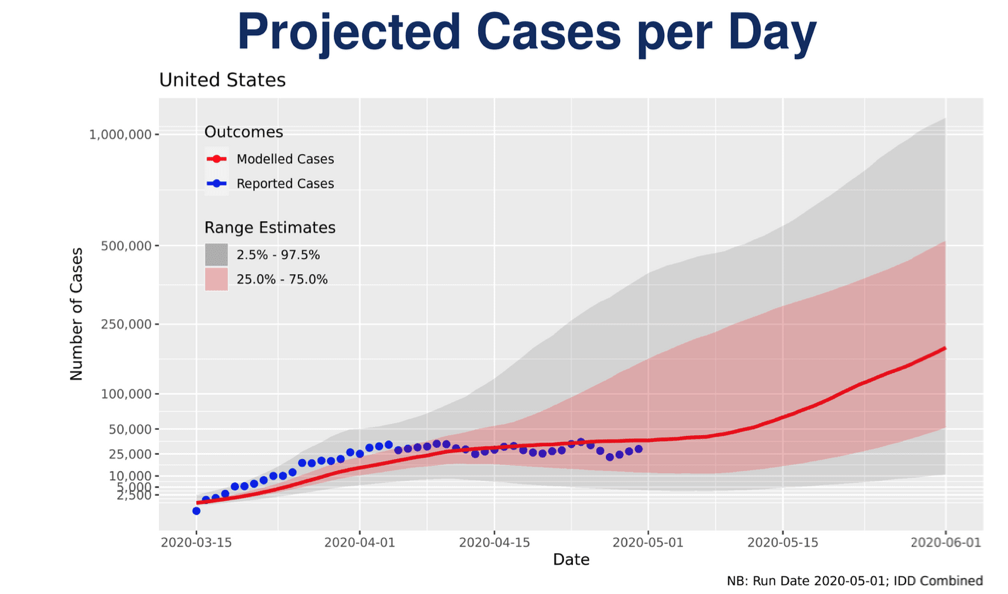
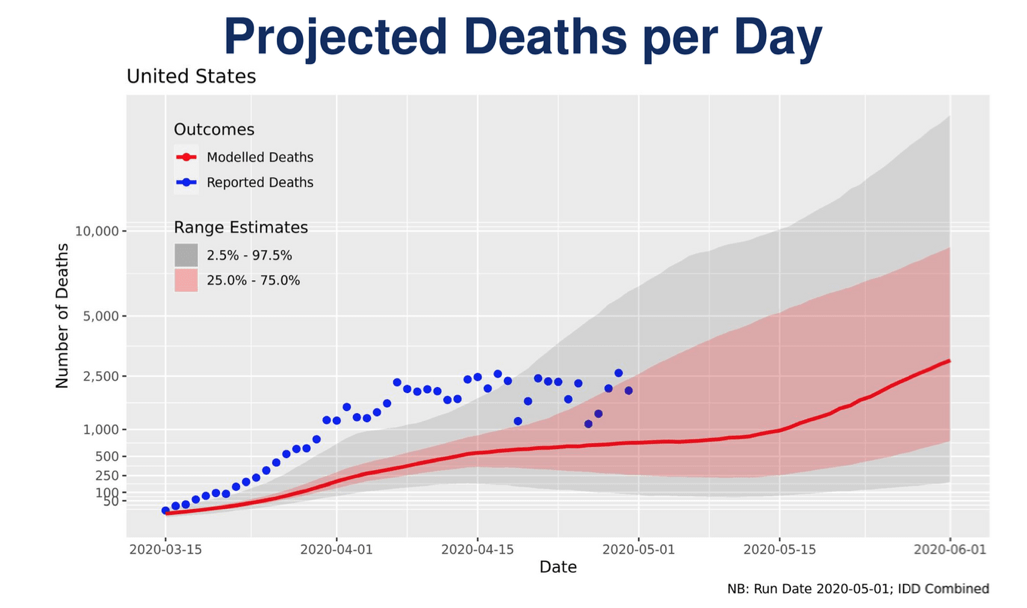
According to the leaked projections, daily U.S. deaths could rise from around 1,500 a day now to 3,000 by June 1, for a death total of 200,000 by the end of the month. The daily number of new COVID-19 infections would rise from 25,000 now to nearly 200,000 by then. Total confirmed cases currently stand at around 1.2 million and 70,000 deaths.

It is worth noting that the number of reported U.S. COVID-19 deaths have tended to be significantly higher than the CDC’s projections.

These internal Trump administration projections are even more pessimistic than the projections from the machine learning model developed by independent researcher Youyang Gu and his colleagues. That model estimates that U.S. COVID-19 deaths will likely exceed 100,000 by June 1.

Let’s hope that both of these forecasts will turn out to be badly wrong.

from Latest – Reason.com https://ift.tt/3djRLZx
via IFTTT

Trump Administration Projects 200,000 American COVID-19 Deaths by June 1

“We’re going to lose anywhere from 75-, 80- to 100,000 people,” President Donald Trump said on Sunday during a Fox News COVID-19 town hall. That may be an underestimate, according to Centers for Disease Control and Prevention (CDC) projections that have been leaked to The New York Times.

According to the leaked projections, daily U.S. deaths could rise from around 1,500 a day now to 3,000 by June 1, for a death total of 200,000 by the end of the month. The daily number of new COVID-19 infections would rise from 25,000 now to nearly 200,000 by then. Total confirmed cases currently stand at around 1.2 million and 70,000 deaths.

It is worth noting that the number of reported U.S. COVID-19 deaths have tended to be significantly higher than the CDC’s projections.

These internal Trump administration projections are even more pessimistic than the projections from the machine learning model developed by independent researcher Youyang Gu and his colleagues. That model estimates that U.S. COVID-19 deaths will likely exceed 100,000 by June 1.

Let’s hope that both of these forecasts will turn out to be badly wrong.

from Latest – Reason.com https://ift.tt/3djRLZx
via IFTTT