China Is Trying To Control Rising Semi Prices By Fining Auto Chip Manufacturers

China Is Trying To Control Rising Semi Prices By Fining Auto Chip Manufacturers

China is taking a page out of the Keynesian central banking playbook on how to micromanage an entire economy and is now reportedly fining auto chip sales companies for driving up prices. 

And, like central banks will soon find out, we expect China to find out the hard way that you can’t print, fine or tax your way to productivity. 

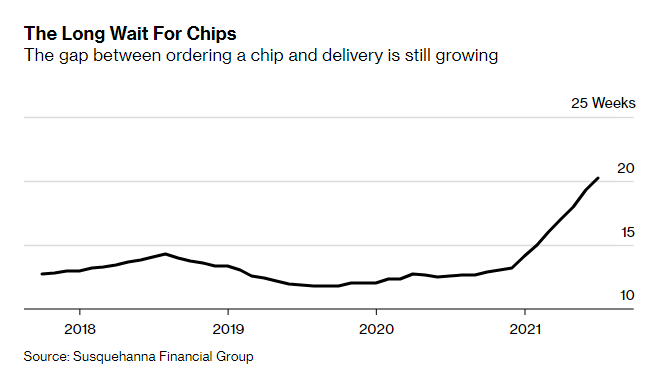
The price increases are likely a normal result of a shortage of supply in semiconductors, which has plagued auto manufacturers for the better part of the last year.

China’s State Administration for Market Regulations said it had fined three local companies a total of 2.5 million yuan, according to a report in Automotive News Europe. 

The companies fined included Shanghai Chengsheng Industrial, Shanghai Cheter and Shenzhen Yuchang Technologies. 

Further, the regulator said it would continue to “closely monitor” prices and “crackdown on illegal market behavior”. You know, like letting supply and demand set prices…

Recall, we noted just days ago how the semi shortage, combined with a Covid outbreak in South Asia, were causing auto manufacturers to slash production targets. 

Toyota is the latest legacy auto manufacturer to come out and announce it is revising its full year production forecast by about 300,000 units to 9 million units for the year, Bloomberg reported Friday morning.

The company is citing the Covid outbreaks in Southeast Asia that we have written about extensively, as well as continued shortages resulting from the semiconductor drought. 

Output will be lower by 70,000 units in September and 330,000 units in October, the automaker said. It says its outlook for November, only two months away, is still “unclear” despite “very strong” demand. 

We had cited Malaysian Covid outbreaks as throwing a wrench into the gears of already-stressed auto manufacturing plans for the summer. IHS predicts that 2.1 million units could wind up being lost in the third quarter of 2021 alone. 

Malaysia is home to names like Infineon Technologies AG, NXP Semiconductors NV and STMicroelectronics NV, who all have operating plants in the country. With Covid infections soaring locally, plans for lifting lockdowns and re-opening production looked as though they could fall by the wayside last month. Daily infections were up to 20,000 per day in August, up from just 5,000 per day in late June. 


Tyler Durden
Mon, 09/13/2021 – 02:45

via ZeroHedge News https://ift.tt/3hrnLiY Tyler Durden

Thousands Protest In Turkey Against COVID-19 Vaccine Passports

Thousands Protest In Turkey Against COVID-19 Vaccine Passports

Authored by Lorenz Duchamps via The Epoch Times,

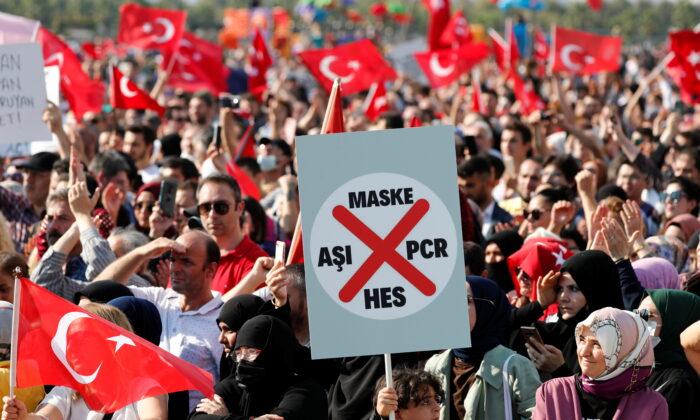
Thousands of people gathered in the Maltepe district of Istanbul in Turkey on Saturday to protest against COVID-19-related restrictions, including vaccine mandates, saying the restrictions infringe on their rights.

Nearly 3,000 people attended the rally, which was permitted by the governor’s office and started at 2 p.m. local time, Turkish news agency Diken reported.

Demonstrators organized the protest in the wake of new measures that passed government and will go into effect starting Sept. 13—requiring proof of vaccination or a negative COVID-19 test for all users of intercity planes, buses, and trains, as well as for those attending large events such as concerts or theater performances.

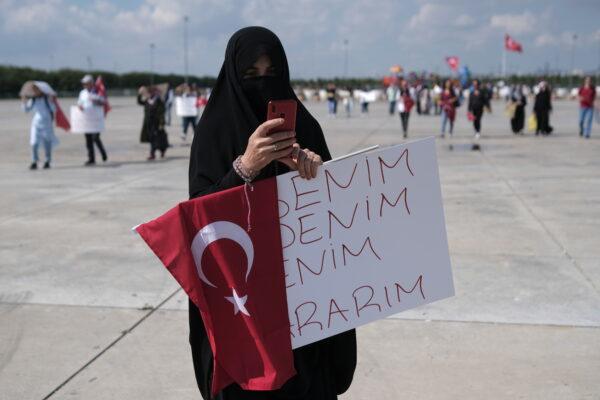
According to videos and photos of the rally, a large crowd of people listened to speakers while holding placards that read: “The Turkish people will not become vaccine guinea pigs,” “Freedom is not free. We are ready to pay for it,” “My body, my decision,” and “The health ministry is not a vaccine marketing office.”

A woman holds a placard reading, “Freedom is not free. We are ready to pay for it,” during a protest against official COVID-19-related mandates including vaccinations, tests, and masks, in Istanbul, Turkey, on Sept. 11, 2021. (Murad Sezer/Reuters)

Representatives of 14 political parties were present for the rally, Diken reported. Participants in the demonstration, which was dubbed “The Great Awakening,” chanted slogans such as “big resignation” and “down with the murderers.”

A woman holds a placard reading, “My body, my decision,” during a protest against official COVID-19-related mandates including vaccinations, tests, and masks, in Istanbul, Turkey, on Sept. 11, 2021. (Murad Sezer/Reuters)

“This pandemic is just going on with even more restrictions on our freedoms and there’s no end to it,” said Erdem Boz, a 40-year-old software developer. “Masks, vaccines, PCR tests might all become mandatory. We’re here to voice our discontent with this.”

“We’re against all these mandates,” said Aynur Buyruk Bilen, a member of the so-called Plandemic Resistance Movement.

“I think that the vaccines aren’t complete and that it’s an experimental liquid,” he added.

Starting on Sept. 13, all unvaccinated school employees are required to take a PCR test twice per week. Masks and social distancing are required in public.

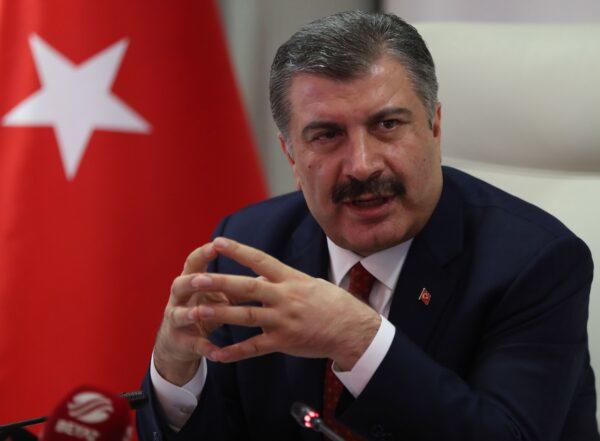
Turkish Health Minister Fahrettin Koca said on Twitter on the day of the protest that vaccines are “the ultimate solution” and that mandating such rules is “essential.”

Turkish Health Minister Fahrettin Koca holds a press conference in Ankara, Turkey, on March 16, 2020. (Adem Altan/AFP via Getty Images)

According to data collected by the Turkish Health Ministry, more than 51 million people in Turkey have received their first doses of the COVID-19 vaccine under the country’s national program. Nearly 40 million people are fully inoculated as part of the program that started in January.

New daily cases in Turkey average around 23,000, prompting a warning from Koca earlier this month, saying that right now the pandemic is only “for the unvaccinated.”

Tyler Durden
Mon, 09/13/2021 – 02:00

via ZeroHedge News https://ift.tt/3z5XCfC Tyler Durden

Why Americans Were Never Told Why They Were Attacked On 9/11

Why Americans Were Never Told Why They Were Attacked On 9/11

Authored by Joe Lauria via Consortium News,

After a Russian commercial airliner was downed over Egypt’s Sinai in October 2015, Western media reported that the Islamic State bombing was retaliation against Russian airstrikes in Syria. The killing of 224 people, mostly Russian tourists on holiday, was matter-of-factly treated as an act of war by a fanatical group without an air force resorting to terrorism as a way to strike back.

Yet, Western militaries have killed infinitely more innocent civilians in the Middle East than Russia has. Then why won’t Western officials and media cite retaliation for that Western violence as a cause of terrorist attacks on New York, Paris and Brussels?

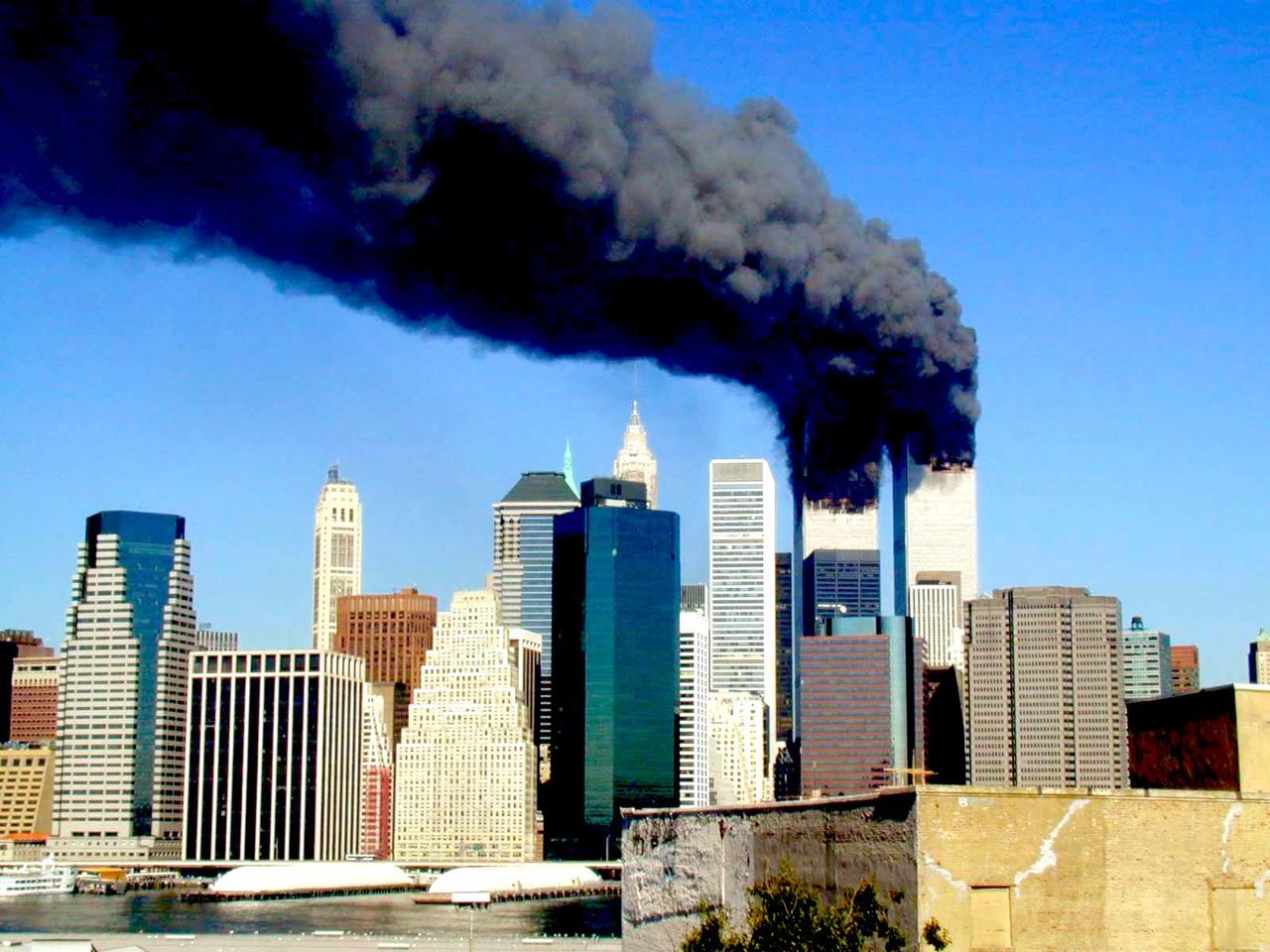
Wikimedia Commons

Instead, there’s a fierce determination not to make the same kinds of linkages that the press made so easily when it was Russia on the receiving end of terror. [See Consortium Newss Obama Ignores Russian Terror Victims.]

For example, throughout four hours of Sky News’ coverage of the July 7, 2005 attacks in London, only the briefest mention was made about a possible motive for that horrific assault on three Underground trains and a bus, killing 52 people. But the attacks came just two years after Britain’s participation in the murderous invasion of Iraq.

Prime Minister Tony Blair, one of the Iraq War’s architects, condemned the loss of innocent life in London and linked the attacks to a G-8 summit he’d opened that morning. A TV host then read and belittled a 10-second claim of responsibility from a self-proclaimed Al Qaeda affiliate in Germany saying that the Iraq invasion was to blame. There was no more discussion about it.

To explain why these attacks happen is not to condone or justify terrorist outrages against innocent civilians. It is simply a responsibility of journalism, especially when the “why” is no mystery. It was fully explained by Mohammad Sidique Khan, one of the four London suicide bombers. Though speaking for only a tiny fraction of Muslims, he said in a videotaped recording before the attack:

“Your democratically-elected governments continuously perpetuate atrocities against my people all over the world. And your support of them makes you directly responsible, just as I am directly responsible for protecting and avenging my Muslim brothers and sisters. Until we feel security you will be our targets and until you stop the bombing, gassing, imprisonment and torture of my people we will not stop this fight. We are at war and I am a soldier. Now you too will taste the reality of this situation.”

The Islamic State published the following reason for carrying out the November 2015 Paris attacks:

“Let France and all nations following its path know that they will continue to be at the top of the target list for the Islamic State and that the scent of death will not leave their nostrils as long as they partake part in the crusader campaign … and boast about their war against Islam in France, and their strikes against Muslims in the lands of the Caliphate with their jets.”

Claiming It’s a State of Mind

Ignoring such clear statements of intent, we are instead served bromides by the likes of the State Department about the Brussels bombings, saying it is impossible “to get into the minds of those who carry out these attacks.”

Mind reading isn’t required, however. The Islamic State explicitly told us in a press statement why it did the Brussels attacks: “We promise black days for all crusader nations allied in their war against the Islamic State, in response to their aggressions against it.”

Yet, still struggling to explain why it happened, the State Department said, “I think it reflects more of an effort to inflict on who they see as Western or Westerners … fear that they can carry out these kinds of attacks and to attempt to lash out.”

The statement ascribed the motive to a state of mind: “I don’t know if this is about establishing a caliphate beyond the territorial gains that they’ve tried to make in Iraq and Syria, but it’s another aspect of Daesh’s kind of warped ideology that they’re carrying out these attacks on Europe and elsewhere if they can. … Whether it’s the hopes or the dreams or the aspirations of a certain people never justifies violence.”

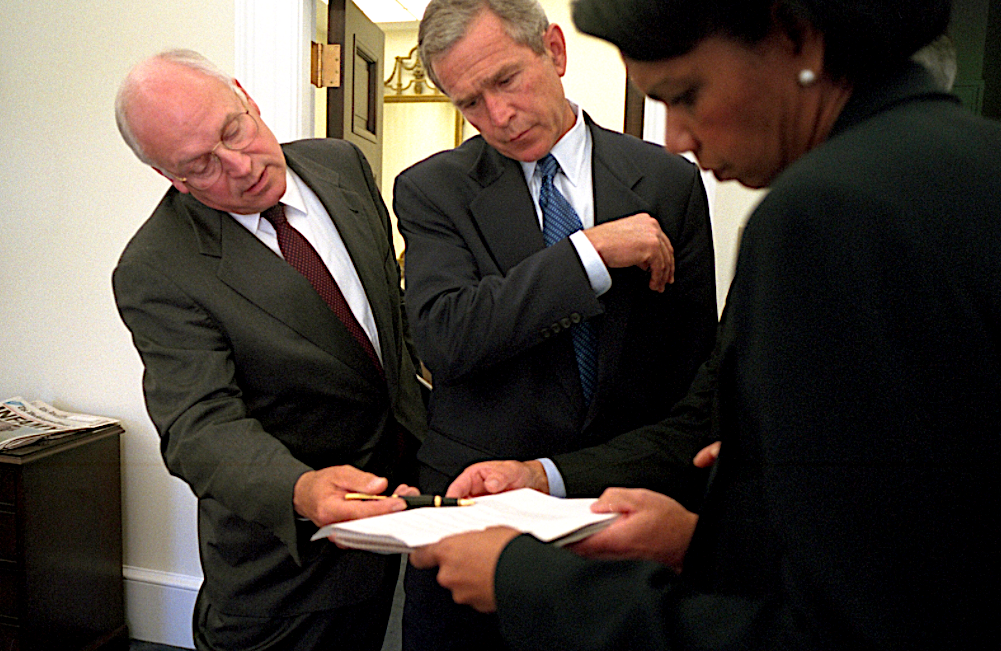
Sept. 12, 2001: President George W. Bush, center, with Vice President Dick Cheney and National Security Advisor Condoleezza Rice looking over a brief together in the White House. (U.S. National Archives)

After 9/11, President George W. Bush infamously said the US was attacked because “they hate our freedoms.” It’s a perfect example of a Western view that ascribes motives to Easterners without allowing them to speak for themselves or taking them seriously when they do.

Explaining his motive behind 9/11, Osama bin Laden, in his Letter to America, expressed anger about U.S. troops stationed on Saudi soil. Bin Laden asked: “Why are we fighting and opposing you? The answer is very simple: Because you attacked us and continue to attack us.” (Today the US has dozens of bases in seven countries in the region.) 

During a Republican presidential debate in 2008 Rudy Giuliani, who was New York mayor on 9/11, became incensed and demanded Ron Paul withdraw his remark that the U.S. was attacked because of US violent interventions in Muslim countries.

“Have you ever read about the reasons they attacked us?” Paul said. “They attacked us because we have been over there. We’ve been bombing Iraq for ten years. I’m suggesting we listen to the people who attacked us and the reason they did it.

“That’s an extraordinary statement,” responded Giuliani. “As someone who lived through the attack of Sept. 11, that we invited the attack, because we were attacking Iraq. I don’t think I’ve ever heard that before. And I’ve heard some pretty absurd explanations for Sept. 11.”

The audience had never heard it either, as they heartily cheered Giuliani. “And I would ask the Congressman to withdraw that comment and tell us that he didn’t really mean that,” Giuliani said.

“I believe very sincerely when the CIA teach and speak about blowback,” Paul responded. “If we think that we can do what we want around the world and not incite hatred, then we have a problem. They don’t come here to attack us because we are rich and we are free. They attack us because we are over there.

So why won’t Western officials and corporate media take the jihadists’ statements of intent at face value? Why won’t they really tell us why we are attacked?

It seems to be an effort to cover up a long and ever more intense history of Western military and political intervention in the Middle East and the violent reactions it provokes, reactions that put innocent Western lives at risk. Indirect Western culpability in these terrorist acts is routinely suppressed, let alone evidence of direct Western involvement with terrorism.

Some government officials and journalists might delude themselves into believing that Western intervention in the Middle East is an attempt to protect civilians and spread democracy to the region, instead of bringing chaos and death to further the West’s strategic and economic aims. Other officials must know better.

1920-1950: A Century of Intervention Begins

A few might know the mostly hidden history of duplicitous and often reckless Western actions in the Middle East. It is hidden only to most Westerners, however. So it is worth looking in considerable detail at this appalling record of interference in the lives of millions of Muslims and peoples of other faiths to appreciate the full weight it exerts on the region. It can help explain anti-Western anger that spurs a few radicals to commit atrocities in the West.

The history is an unbroken string of interventions from the end of the First World War until today. It began after the war when Britain and France double-crossed the Arabs on promised independence for aiding them in victory over the Ottoman Empire. The secret 1916 Sykes-Picot accord divided the region between the European powers behind the Arabs’ backs. London and Paris created artificial nations from Ottoman provinces to be controlled by their installed kings and rulers with direct intervention when necessary.

What has followed for 100 years has been continuous efforts by Britain and France, superseded by the United States after the Second World War, to manage Western dominance over a rebellious region. The new Soviet government revealed the Sykes-Picot terms in November 1917 in Izvestia. When the war was over, the Arabs revolted against British and French duplicity. London and Paris then ruthlessly crushed the uprisings for independence.

France defeated a proclaimed Syrian government in a single day, July 24, 1920, at the Battle of Maysalun. Five years later there was a second Syrian revolt, replete with assassinations and sabotage, which took two years to suppress. If you walk through the souk in Old Damascus and look up at the corrugated iron roof you see tiny specks of daylight peeking through. Those are bullet holes from French war planes that massacred civilians below.

Britain put down a series of independence revolts in Iraq between 1920 and 1922, first with 100,000 British and Indian troops and then mostly with the first use of air power in counterinsurgency. Thousands of Arabs were killed. Britain also helped its installed King Abdullah put down rebellions in Jordan in 1921 and 1923.

London then faced an Arab revolt in Palestine lasting from 1936 to 1939, which it brutally crushed, killing about 4,000 Arabs. The next decade, Israeli terrorists drove the British out of Palestine in 1947, one of the rare instances when terrorists attained their political goals.

Germany and Italy, late to the Empire game, were next to invade North Africa and the Middle East at the start of the Second World War. They were driven out by British imperial forces (largely Indian) with U.S. help. Britain invaded and defeated nominally independent Iraq, which had sided with the Axis. With the Soviet Union, Britain also invaded and occupied Iran.

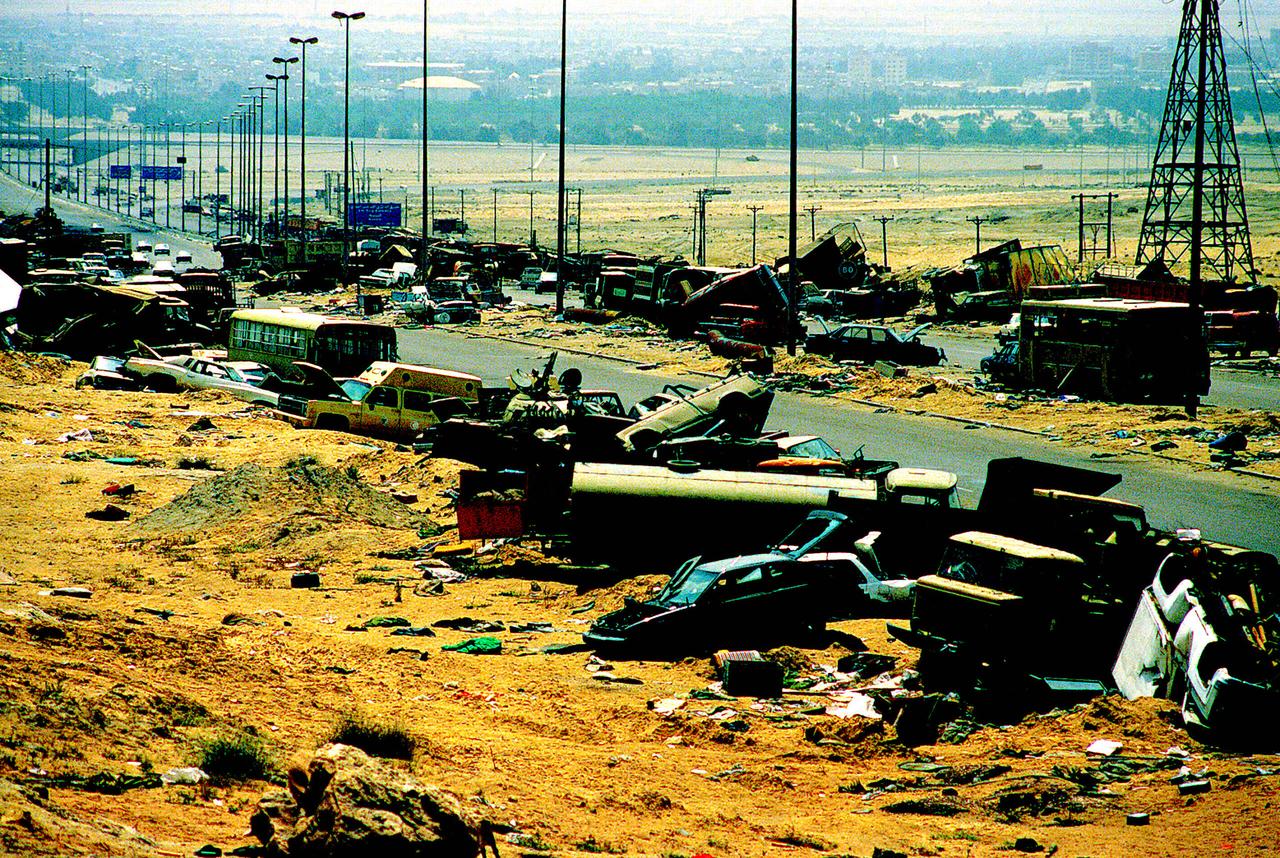
April 18,1991: Demolished vehicles line Highway 80, also known as the “Highway of Death”, the route fleeing Iraqi forces took as they retreated fom Kuwait during Operation Desert Storm. (Joe Coleman, Air Force Magazine, Wikimedia Commons)

After the war, the U.S. assumed regional dominance under the guise of fending off Soviet regional influence. Just three years after Syrian independence from France, the two-year old Central Intelligence Agency engineered a Syrian coup in 1949 against a democratic, secular government. Why? Because it had balked at approving a Saudi pipeline plan that the U.S. favored. Washington installed Husni al-Za’im, a military dictator, who approved the plan.

1950s: Syria Then and Now

Before the major invasion and air wars in Iraq and Libya of the past 15 years, the 1950s was the era of America’s most frequent, and mostly covert, involvement in the Middle East. The first coup of the Central Intelligence Agency was in Syria in March 1949. The Eisenhower administration then wanted to contain both Soviet influence and Arab nationalism, which revived the quest for an independent Arab nation. After a series of coups and counter-coups, Syria returned to democracy in 1955, leaning towards the Soviets.

A 1957 Eisenhower administration coup attempt in Syria, in which Jordan and Iraq were to invade the country after manufacturing a pretext, went horribly wrong, provoking a crisis that spun out of Washington’s control and brought the U.S. and Soviets to the brink of war.

Turkey put 50,000 troops on the Syrian border, threatening to invade. Soviet premier Nikita Khrushchev threatened Turkey with an implied nuclear attack and the U.S. got Ankara to back off. This sounds eerily familiar to what happened last month when Turkey again threatened to invade Syria and the U.S. put on the brakes. The main difference is that Saudi Arabia in 1957 was opposed to the invasion of Syria, while it was ready to join it last month. [See Consortiumnews.com’s Risking Nuclear War for Al Qaeda?]

In the 1950s, the U.S. also began its association with Islamic religious extremism to counter Soviet influence and contain secular Arab nationalism. “We should do everything possible to stress the ‘holy war’ aspect,” President Eisenhower told his Secretary of State John Foster Dulles. After the Cold War, religious extremists, some still tied to the West, became themselves the excuse for U.S. intervention.

Read the rest at Consortium News

Tyler Durden
Sun, 09/12/2021 – 23:30

via ZeroHedge News https://ift.tt/3Em21iy Tyler Durden

Chinese Tech Names Slide On Report Beijing Seeks To Break Up Alipay; Hang Seng Tech Index Tumbles

Chinese Tech Names Slide On Report Beijing Seeks To Break Up Alipay; Hang Seng Tech Index Tumbles

Just when it seemed safe to poke out beyond the shell and buy some badly beaten down Chinese tech names, Chairman Xi had another surprise.

Today’s reason why tech names are tumbling again after staging a modest rebound on Friday is a report in the Financial Times, according to which China seeks to break up Ant Group’s financial giant, Alipay, and create a separate app for its loans business.

Citing two unidentified people familiar with the plan, regulators plan to split into an independent app the back end of its two lending businesses Huabei and Jiebei from the rest of its financial operations and bring in new shareholders. There is a plan to spin off Ant’s user data that underpins its lending decisions to a new credit scoring joint-venture which will be partly state-owned.

For the time being Jack Ma’s team would run the new venture, the FT says citing an unidentified a person close to the company. However, the implication is that eventually the state will take control.s

As a reminder, Ant already set up a new entity for consumer loan business which will include Huabei and Jiebei and started operations in June, but it appears that’s not enough for Beijing, whose regulators told Ant to go back to its origin of being a payments service provider and reform its lending business. Separately, WSJ reported in April that Ant was discussing with regulators the possibility of transferring some of its app-based financial services to another of its apps, called Ant Fortune, citing people familiar with the matter

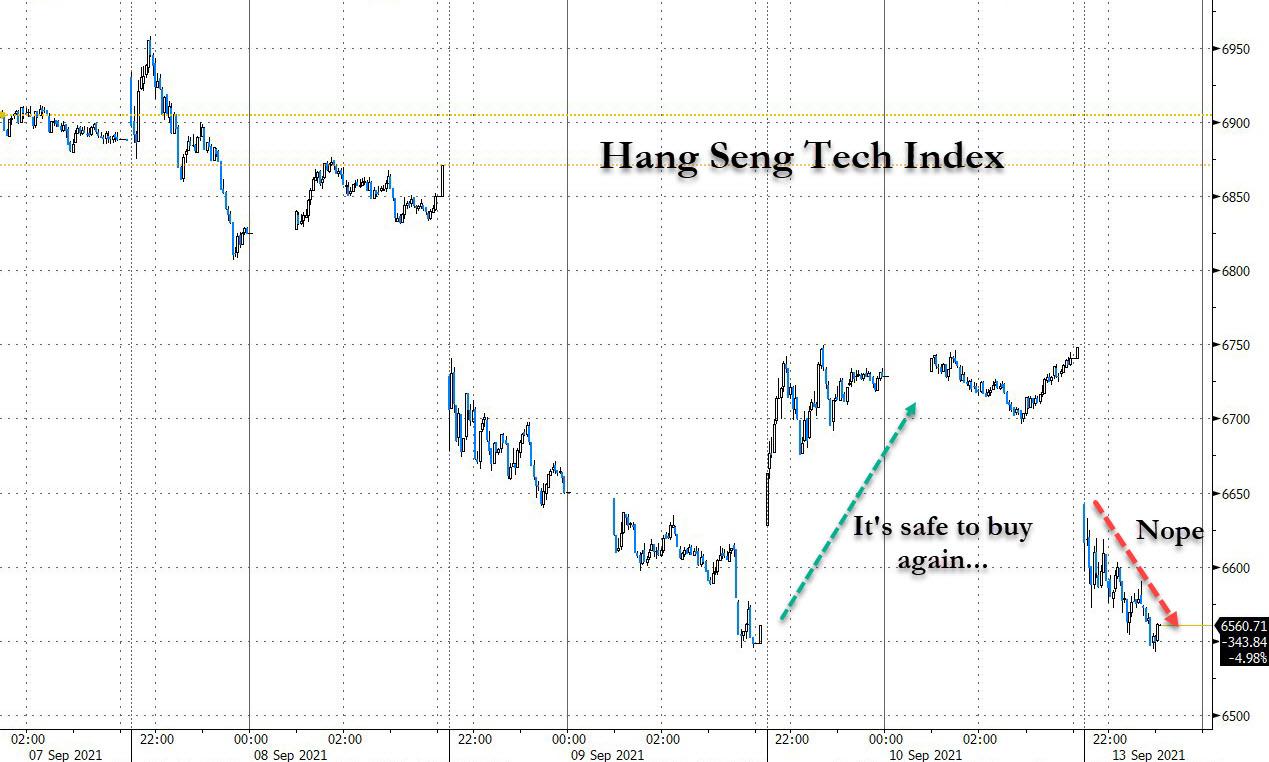
In response to the latest crackdown, the Hang Seng Tech Index – which soared on Friday on speculation that Beijing was finally done destroying its tech conglomerates, plunged as much as 3% in Hong Kong.

The biggest decliners of the index are Trip.Com -5.8%, Zhongan online -5.5%; Alibaba fells as much as 4.5% after the report, while Tencent dropped as much as 3.6%. Meanwhile, Meituan dropped as much as 5.4% after Beijing tells platform companies to protect the working conditon of gig economy workers. Adding insult to injuryt, Fitch on Friday downgraded Meituan by a notch to BBB-, the lowest investment- grade rating, due to “the greater regulatory uncertainty” facing the company.

Finally, the 21st Century Business Herald reported that MIIT hosted a conference with tech giants including Alibaba, Tencent, Bytedance, Baidu, Huawei and Xiaomi on Thursday and ordered them to open their platforms to each other before deadline. According to the report, the government will step up regulation on websites blocking competitors’ content.

Tyler Durden
Sun, 09/12/2021 – 23:27

via ZeroHedge News https://ift.tt/3k2TZD2 Tyler Durden

Palm Beach Developer Tries To Flip Island Mansion For $120 Million, 41% More Than It Sold For In July

Palm Beach Developer Tries To Flip Island Mansion For $120 Million, 41% More Than It Sold For In July

The South Florida housing market is sizzling with hot money from the North East, pushing up homes values sky high over the last year. One example of the mania is in Palm Beach, where a private island was bought in July and was relisted months later for a whopping 41% premium, according to WSJ

One of Miami’s top real estate developers, Todd Michael Glaser, is taking advantage of the bubble, fueled by Wall Street bankers and other elites who have the economic mobility to leave the Northeast for the Sunshine State. 

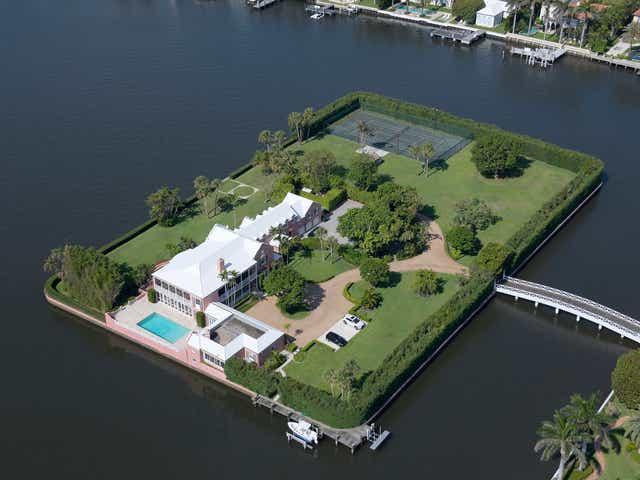
Glaser purchased 10 Tarpon Way, also known as 10 Tarpon Isle, for approximately $85 million in July and has since relisted the tiny 2.5-acre island for $120 million, or $35 million more than he paid a few months ago. The island was created by dredging crews in the 1930s and is only accessible by bridge. Glaser bought the island from private investor William M. Toll and his wife, Eileen, who paid $7.6 million for the property in 1998.

Tarpon Island 

The real estate developer said potential buyers have two options: pay the $120 million now or wait ten months for a new renovation for $200 million. 

Concept Drawing Of New Renovation

He said with all the hot money flowing into the Palm Beach area, “a $100 million house isn’t that crazy anymore, believe it or not,” adding that in the last 18 months, eight $100 million homes have been sold. 

If a potential buyer wants to wait ten months and pay an additional $80 million. The developer will completely redesign the mansion by doubling it to 25,000 sqft, with 14 bedrooms, in addition to a hair salon, gym, and spa. A new pool, octagonal tennis pavilion, and a golf practice area will be installed on the outside. 

Some ask how long will this speculation fever last as the Federal Reserve could embark on tapering its extensive bond-buying program later this year or early 2022. 

One real estate expert believes the peak of the South Florida housing market could be nearing:

Dr. Ken Johnson, a real estate economist with Florida Atlantic University’s College of Business, told local news WPLG that a peak in the housing cycle could have already arrived, but he believes a crash is not in the mix because demand still outpaces supply. 

It remains to be seen if some greater fool will pay the $120 million for the island mansion or $200 million tens months later after renovations. 

Tyler Durden
Sun, 09/12/2021 – 23:00

via ZeroHedge News https://ift.tt/3llv4K7 Tyler Durden

Biden’s Total Financial Surveillance

Biden’s Total Financial Surveillance

Authored by Matt Welch via Reason.com,

What if every one of your non-cash financial transactions was automatically reported to a beefed-up, audit-hungry IRS?

Imagine living in a world where every one of your noncash financial transactions—a restaurant meal, a Venmo transfer to a friend, maybe some bitcoin bought on the dips—was automatically reported to a beefed-up, audit-hungry IRS.

That dystopia will become a reality if President Joe Biden gets his way.

Biden, Treasury Secretary Janet Yellen, and key Capitol Hill allies such as Sen. Elizabeth Warren (D–Mass.) are pushing a vast, intrusive financial surveillance system in the name of closing the “tax gap.”

But don’t worry: There’s no need to fear if you’ve got nothing to hide.

“For already compliant taxpayers, the only effect of this regime is to provide easy access to summary information on financial accounts and to decrease the likelihood of costly ‘no fault’ examinations,” the Treasury Department said this May in a nakedly authoritarian document called “The American Families Plan Tax Compliance Agenda.”

But “for noncompliant taxpayers,” the department continues, “this regime would encourage voluntary compliance as evaders realize that the risk of evasion being detected has risen noticeably.”

The administration’s proposed “comprehensive financial account reporting regime” would dramatically increase the types of financial institutions and transactions exposed to the feds’ prying eyes. “All business and personal accounts from financial institutions, including bank, loan, and investment accounts,” would be forced to “report gross inflows and outflows” to the IRS. And not just bank accounts: The dragnet would now include PayPal, settlement companies, and “crypto asset exchanges,” for starters.

The new domestic surveillance program, which requires congressional approval, is one prong of a tripartite strategy for transforming the entire global financial system into a harmonious, haven-free collection funnel to the IRS. The second part, which has taken up the bulk of Biden’s multilateral diplomacy thus far, is getting the industrialized world to agree on a global minimum corporate tax of 15 percent, while setting up a system to prevent multinational companies from registering their profits in the lowest-tax jurisdictions.

Cutting corporate taxes is “a self-defeating competition,” Yellen said in April, “and neither President Biden nor I are interested in participating in it anymore. We want to change the game.”

In July, representatives from 130 countries, including finance ministers from the G-20 representing the world’s richest democracies, agreed in principle to a worldwide minimum corporate tax. “We have a chance now to build a global and domestic tax system,” Yellen crowed. “The race to the bottom is one step closer to coming to an end.”

The agreement still has a significant obstacle to overcome—namely, the legislatures of 130 countries, including the U.S. Congress. But Yellen has some cause to be cocky, because the third prong of Washington’s strategy has already been constructed.

In 2009, President Barack Obama promised to generate $210 billion in new tax revenue over 10 years by cracking down on “overseas tax loopholes.” While the corporate-tax element of the plan was quickly killed by lobbyists, the individual component remained in the form of the 2010 Foreign Account Tax Compliance Act (FATCA). Built on a foundation of American exceptionalism (the U.S. is one of only two countries that tax citizens living abroad), FATCA imposed onerous new annual reporting requirements on Americans with more than $10,000 in overseas financial institutions. The law brazenly threatened international banks if they didn’t rat out their U.S. clients to the IRS.

The results were predictable: Expats were locked out of banking services, record numbers of mostly middle-class Americans renounced their U.S. citizenship, and IRS collections went essentially unchanged. But for a very small political price (no one much cares about the estimated 9 million Americans living abroad), Washington was able to bend an entire global financial system to its will.

An IRS with the ability to compel global transaction data sounds like something out of a Philip K. Dick novel. Yet here we are—unless we consciously cover our tracks.

“Another concern is that [the] information reporting regime will shift taxpayers toward a greater use of cash,” the Treasury Department’s compliance plan frets. It also notes that cryptocurrencies “already pose a significant detection problem by facilitating illegal activity broadly including tax evasion.” Cash and crypto may be the last currencies compatible with privacy.

“I promised to lead the world to deliver a foreign policy for the middle class, and today, we are doing just that,” Biden said after the 130-country agreement. Just as long as the middle class has nothing to hide.

Tyler Durden
Sun, 09/12/2021 – 22:30

via ZeroHedge News https://ift.tt/2VF9sQm Tyler Durden

Journalism Schools Produce ‘Useless’ Degrees, Leaving Graduates Deep In Debt

Journalism Schools Produce ‘Useless’ Degrees, Leaving Graduates Deep In Debt

The WSJ’s education reporters have been on a roll lately, publishing a deeply reported series of stories about the unintended consequences of the fact that there’s no lending cap on the federal government’s “Grad Plus” student loan program. By allowing students with little to no income to borrow unlimited funds to further their education in the graduate domain (while leaving taxpayers on the hook for losses), pricey graduate degree programs have proliferated like the clap. And surprisingly, only a small fraction of these programs allow the average graduate to comfortably pay off their loans without financial help from their parents.

Back in June, WSJ published its initial deep-dive into high priced “useless” masters degrees offered by elite Ivy League Universities. The a few weeks after that, it followed up with a deep-dive on second- and third-tier law and MBA programs, which boomed in popularity over the past twenty to thirty years, only for many graduates to realize that six-figure jobs are mostly reserved for graduates from the top-tier programs.

Now, WSJ is targeting another universe of “useless” degrees: the  master’s degree in journalism. Expensive programs for what is by all accounts a dying discipline abound, with the “leading” programs found at Columbia, Northwestern and USC. Roughly a dozen other expensive programs continue to enroll students across the US. Together, they produce thousands of graduates a year for an industry that has seen the number of available jobs shrink practically every year for the last two decades.

While students borrow heavily, starting salaries from even USC and Northwestern are shockingly low at just $42K for the median graduate. Columbia’s median number is stil just $49K (accounting for the dozen or so graduates every year who find decent-paying jobs at one of the country’s top national outlets, like WSJ, Bloomberg or the NYT).

Interestingly, the University of Missouri, which has perhaps the best-known journalism program among America’s public universities, leaves its graduate journalism students with much smaller debt loads (around $21K) with median earnings of $50.5K right out the gate. The dean of Northwestern’s graduate J-school said ballooning debt for graduate students “keeps him me up at night.”

“Graduate student debt is the thing that keeps me up at night,” Mr. Whitaker said. He attributed some of the earnings differential to the fact that undergraduates often complete their degrees with multiple internships and years of experience on student publications.

One student who attended Medill shortly after finishing her undergrad career wishes she had been made aware told WSJ she wouldn’t have gone if she understood how much trouble she would have paying off her student loans.

Katie Dzwierzynski said she was flattered when Medill offered her a scholarship of a few thousand dollars a decade ago. She lived at home to save money, and borrowed nearly $70,000 to cover the rest of her costs.

She now earns about $65,000 writing newsletters and summarizing healthcare news for companies. Most months, Ms. Dzwierzynski, has made her loan payments, around $500, but sometimes she could only cobble together half that amount while the interest continued to grow. Her student-loan balance now stands at $79,000, including $62,000 from Medill.

Ms. Dzwierzynski, 32 years old, said she understood that she would be going into significant debt for the degree but didn’t know how little she would likely earn.

Another student said that while they feel “fulfilled” in their new job, finances are definitely a worry. But if President Biden (or President Kamala) offer student debt relief.

Mr. Rhodes took a 40% pay cut from their New York job, but said they are more fulfilled in their new role. Still, the loans loom large. The federal government paused payments during the pandemic, but when that lifts early next year, the 28-year-old intends to enroll in a repayment plan limiting monthly payments to a set share of their income. After 20 or 25 years, the remaining debt could be erased, and taxed as income.

Mr. Rhodes, who also has $33,000 in loans for their bachelor’s degree from the University of Central Florida, is holding out hope for President Biden to forgive at least some student debt.

“I am admittedly stressed about finances,” Mr. Rhodes said. “But if there’s any time to take on this kind of debt, it might be when it is potentially going to be erased.”

He has a point. If anything, just the prospect of student debt forgiveness from the Dems might encourage more risk-tolerant (or risk-ignorant) young students to go for it, and try to live their fantasy of becoming the next Bob Woodward.

Ironically, as the power, prestige and financial backing of the media industry have diminished, public trust in the media has fallen to its lowest level in the history of the American Republic. One recent report found the US ranks last globally in media trust, despite its “free” press.

The real issue here isn’t so much the money, but the fact that Bob Woodward didn’t go to J-School. Michael Lewis took on the issue in a piece for the New Republic published all the way back in 1993, before the collapse of the media industry.

With a nip here and a tuck there, the inadequately schooled journalist could easily make the Columbia School of Journalism sound like a seven-month extension of this anecdote. Perhaps I am that journalist. The essential point here is that the desperate futility of journalism instruction becomes clearer the closer one gets to the deed. At journalism school, one does not simply report a story. One develops a “search strategy for mass communication” (see chart above). The principal text used at Columbia, in a section called “Truth Telling,” offers the mathematical formula: Story=Truth + X. “The story is never the full truth,” it intones. “There is always an X, a missing ingredient. Actually there is not an X but a series — X1,X2,X3,X4….” This sort of irrelevant blather infects the entire curriculum. Here, for instance, is how the Columbia course bulletin describes one of the two main core courses, “Critical Issues in Journalism”:

At the end of the day, it’s not only the academics that staff these programs who are complicit in fleecing the next generation of would-be “journalists”. The elite media brands that tap their students for unpaid (or low-paid) labor, helping to give credence to the school’s marketing, are also, in a way, responsible.

Tyler Durden
Sun, 09/12/2021 – 22:00

via ZeroHedge News https://ift.tt/3EeyHKu Tyler Durden

Pentagon Researching Microbe Mining Of Rare Earth Minerals To Cut Reliance On China

Pentagon Researching Microbe Mining Of Rare Earth Minerals To Cut Reliance On China

Authored by Dave DeCamp via AntiWar.com,

The Pentagon’s Defense Advanced Research Projects Agency (DARPA) has launched a project to research the extraction of rare earth minerals for military technologies using microscopic bugs in an effort to reduce reliance on China.

The technology to mine rare earth minerals using microbes doesn’t exist yet, and DARPA is researching if doing so is worth it on an industrial scale. “From a DARPA perspective, we’re looking at: what are some of the barriers for the US to maintain dominance in rare earth processing,” Stefanie Tompkins, the director of DARPA, told Defense News.

Source: American Geosciences Institute

DARPA launched the project in July, known as Environmental Microbes as a BioEngineering Resource. It seeks to expand supplies of 17 elements used in magnets for electric motors, high-temperature ceramics, and lasers.

The DARPA project is just one example of how the US military is focusing on research to counter China.

In its $715 billion budget request for 2022, the Pentagon allocated $112 billion for research, development, testing, and evaluation, known as RDT&E. The research will focus on advanced weapons, such as artificial intelligence, robotics, space and cyber capabilities, and hypersonic missiles.

The Pentagon has identified China as the top “pacing threat” facing the US. Hawks in Congress don’t believe the massive $715 billion budget is enough to face China and Russia. The House Armed Services Committee recently voted to add $24 billion to President Biden’s Pentagon budget.

Tyler Durden
Sun, 09/12/2021 – 21:30

via ZeroHedge News https://ift.tt/3z32Pot Tyler Durden

“Once The Situation Gets Out Of Control”- Chinese State Media Vows Its Military “Will Show Up At US Doorstep” And Will Win

“Once The Situation Gets Out Of Control”- Chinese State Media Vows Its Military “Will Show Up At US Doorstep” And Will Win

China’s state-run Global Times tabloid, which is viewed as representing the view of Beijing if with a hyperbolic slant, published an op-ed from its editorial board on Wednesday vowing that China’s military will soon confront the U.S. in a hostile exchange, American Military News reported.

“The US will definitely see the PLA show up at its doorstep in the not-too-distant future,” the op-ed said. “The two sides’ warships and aircraft on the seas will carry huge mutual strategic hostility, and the two countries will not yield to each other.”

“Once the situation gets out of control and triggers military clash between China and the US, we must give full play to our home field advantage. China will definitely win once there is a war,” the Global Times op-ed said.

The op-ed came in response to U.S. Navy guided-missile destroyer USS Benfold conducting a freedom of navigation operation near the Mischief Reef in the Spratly Islands of the South China Sea on Wednesday, and follows China’s recent abrupt change in protocol according to which starting Sept 1, all foreign vessels (read US warships) must “report their information” when passing through what China views as its “territorial waters” and which most of China’s neighbors and Western nations consider contested.

What the US has done is a naked provocation, and this is obvious to all,” the Global Times op-ed said, adding that the ship “posed a threat” to the “many Chinese people and facilities” on the island.

The op-ed further called on China to take action. “Only by making the US have a taste of its own medicine can we touch the nerves of the US and its allies, and reshape the Western world’s understanding of US bullying in the South China Sea,” it said.

In response, the U.S. Navy 7th Fleet said the U.S. warship sailed in accordance with international law “within 12 miles of Mischief Reef,” an area that China has heavily militarized and reportedly began flying military flights out of earlier this year.

“The land reclamation efforts, installations, and structures built on Mischief Reef do not change this characterization under international law. By engaging in normal operations within 12 nautical miles of Mischief Reef, the United States demonstrated that vessels may lawfully exercise high-seas freedoms in those areas,” the U.S. Navy said.

While the U.S. does recognize China’s claim to the Spratly Island, it rejects any claim China makes beyond a 12-nautical mile limit of the Spratly Islands. Mischief Reef is among the seven island reefs China claims as its own and has been militarizing in recent years. China established 9,000-foot runways on three islands in the South China Sea to accommodate any aircraft in its fleet, including its nuclear-capable H-6 bombers.

Earlier this year, Washington Times obtained satellite images showing PLA KJ-500 airborne warning and control planes, Y-9 transport planes, and Z-8 helicopters on the islands, indicating a now-permanent presence on the islands.

The U.S. has repeatedly denounced China’s militarization of artificial islands in the South China Sea, as well as its construction of military bases and other industrial facilities in the region, and aggressive behavior toward other nations’ ships in the region.

China claims most of the mineral-rich South China Sea, including areas that reach the shores of its smaller neighbors. Brunei, Malaysia, the Philippines, Vietnam and Taiwan also have overlapping claims to the maritime region.

Meanwhile, the U.S. has vowed to continue its freedom of navigation operations to ensure free passage in the South China Sea despite China’s threats. In July 2020, the U.S. released its first official statement rejecting most of China’s territorial claims in the South China Sea as “unlawful.”

The document rejects China’s claims to certain territories, such as James Shoal, located 50 nautical miles from Malaysia, as well as other specific territories off the coasts of Vietnam, Indonesia, and the Philippines. China has claimed some of these territories in its “Nine-Dashed Line” claim announced in 2009, despite these territories being located up to 1,000 nautical miles away from China’s coast.

The U.S. position aligns with a 2016 Arbitral Tribunal decision, in which it rejected China’s claims as baseless against international law. Secretary of State Antony Blinken praised the decision on its fifth anniversary earlier this year, which China swiftly denounced.

Tyler Durden
Sun, 09/12/2021 – 21:00

via ZeroHedge News https://ift.tt/3A6tfXZ Tyler Durden

It’s Time To Acknowledge Anti-White Racism

It’s Time To Acknowledge Anti-White Racism

Authored by Lynn Uzzell via RealClearPolitics.com,m

Recently, Michael Tesler commented on “The Rise of White Identity Politics.” Tesler’s analysis draws on years of research into racialized politics, and he shows convincingly that there is a rise in white identity politics and that this rise is tied to “perceptions of anti-white discrimination.” However, when trying to explain why perceptions of anti-white bias might also be on the rise, his analysis falls flat. Supposedly, it has something to do with Republicans and Donald Trump.

Never once does the author speculate whether “perceptions” of such discrimination might be on the rise because anti-white racism is becoming increasingly common. In other words, perhaps white Americans are accurately perceiving a real phenomenon that is now pervasive in schools and the workplace.

Anti-White Racism, by Definition

As any student of George Orwell knows, no authoritarian government can ever gain complete control unless it commandeers people’s thinking through the manipulation of language. Thus, the dystopian powers in “1984” deliberately turned the meaning of words upside-down in a process known as double-think.
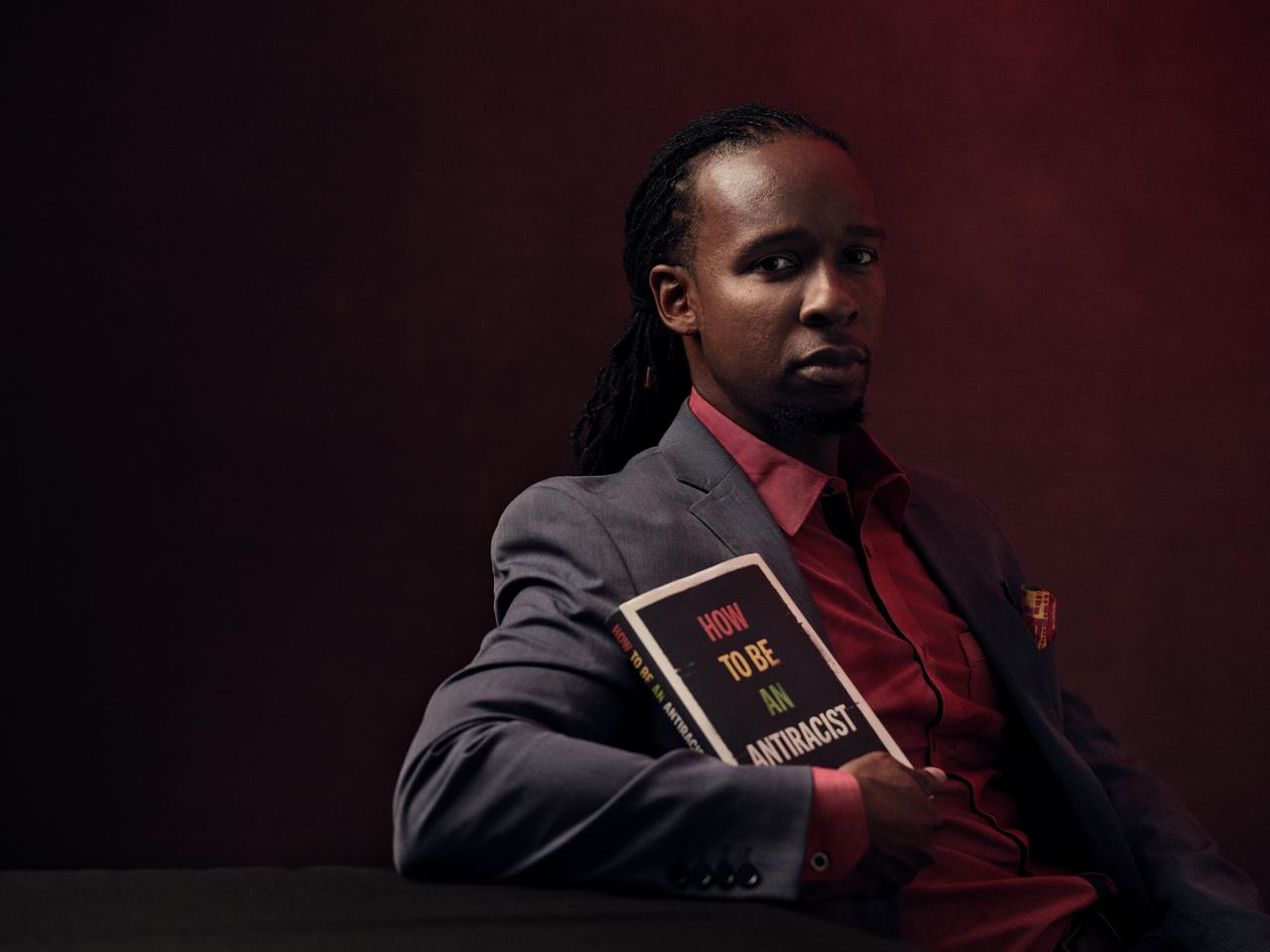
The same process is happening today with the words used to discuss racism. In true Orwellian fashion, Ibram X. Kendi (pictured) insists that the only way to fight racism is to embrace racial discrimination in perpetuity. This “anti-racism,” as he calls it, is as likely to stamp out genuine racism as Orwell’s Ministry of Truth was apt to stamp out falsehoods.

In order to understand what is going on, we must call to mind the traditional definition of racism: the stereotyping, denigrating, marginalizing, or excluding of persons on the basis of race. Look up any definition of racism prior to the racial awokening taking place in the last decade, and it will be: 1) race neutral; and 2) involve some act of free will—relating to word, deed, or belief.

The definition of racism has undergone a radical change in a short time. According to the new eighth-grade curriculum for the Albemarle County (Va.) School District, racism now means: “The marginalization and/or oppression of people of color based on a socially constructed racial hierarchy that privileges white people.”

Perhaps the most jarring aspect of this new definition is that it is no longer race-neutral. It is now impossible, by definition, for white people to be the victims of racism. The definition itself constructs a “racial hierarchy” whereby only people of color may be victimized, and only “white people” may marginalize or oppress.

But there is something even more insidious about the new definition. Since the “marginalization and/or oppression of people of color” is no longer committed by word, thought, or deed — but is based instead on an inescapable “socially constructed racial hierarchy” that always “privileges white people” — it means that white people are engaging in racism simply by being white (and hence privileged) within this impersonal system of marginalization and oppression.

A person of color is a victim of racism, by definition. A person identified as white is a racist, by definition. Therefore, not only does the new definition fail to capture the full meaning of racism; the definition is itself an example of the anti-white racism being taught to our children.

Teaching Anti-White Racism as American History

Anti-white racism is also seeping into history lessons, most notably through the curriculum adapted from the New York Times’ 1619 Project.When the 1619 Project was first published, it attracted immediate criticism. Five eminent historians criticized it for its bias and factual errors. Others criticized it for emphasizing only what was blameworthy about America’s history and omitting what was praiseworthy.

While these concerns are certainly valid, there is another serious problem that has received scant attention: The account is a surprisingly racist version of U.S. history.

The lead article for the 1619 Project is by Nikole Hannah-Jones, who has been writing anti-white screeds at least since she was a college sophomore. In a letter to her college paper, she alleged: “The white race is the biggest murderer, rapist, pillager, and thief of the modern world.” Not only were the white people in America’s past “barbaric devils,” but the “descendants of these savage people” continue to harm “the Black community” to this day. Non-white peoples, by contrast, were uniformly portrayed as both virtuous and victimized.

Of course, nobody should be held accountable for the hyperboles or inanities one might espouse as an undergraduate; few of us could bear the brunt of such an examination. The sophomoric scribblings of young Nicole Hannah would be irrelevant except that the pattern in her writing has not changed. What we find in her Pulitzer Prize-winning contribution to the 1619 Project is more moderate in tone and more sophisticated in composition, but otherwise it is the same racialized dualism she espoused in college.

In Hannah-Jones’ article, an important part of the lesson plan adapted for schools, the word “white” is used to describe people or communities 77 times. In 35 cases, “white” people are described as holding some kind of power or privilege (almost always unearned or illegitimate). In 32 cases, the word is associated with oppression, injustice, and cruelty (“white enslavers,” “widespread white violence,” “systemic white suppression of black life,” etc.).

In this telling of history, “white Americans” during the darkest days of Jim Crow held the same racist ideology as Jefferson and his “fellow white colonists.” With 32 instances of specifically “white” barbarity, it is impossible to ignore the gratuitous overuse of this racial category when describing everything that is diabolical in this country’s history. Nowhere do we read about a “white” American acting for the good, except a single instance in which certain “white Republicans” joined forces with the black community after the Civil War.

We find the polar opposite when examining the 136 references to “black” people in this article. The word is used 72 times to describe victimization by violence or injustice (always at the hands of “whites”) and 49 times in laudable terms. There is not a single instance in which “black” is used to describe a person or deed deserving of criticism.

While only a textual analysis can provide the big picture, individual passages drive home the racist message more explicitly. “For the most part,” according to this history, “black Americans fought [to secure rights] alone. Yet we never fought only for ourselves.” The article teaches schoolchildren that “black Americans, more than any other group, embrace the democratic ideals of a common good.” Children also learn: “Our founding fathers may not have actually believed in the ideals they espoused, but black people did.”

Hannah-Jones’ composition is American history in black and white. It teaches that “blackness” is everything that ennobles this country and “whiteness” is everything that debases it. There was a time in the Jim Crow South, to their everlasting shame, when schools taught children lessons in white supremacy masked as American history. The 1619 Project has introduced a new form of black supremacy to American history, and it has been adopted by over 4,500 schools.

Anti-White Racism in the Workplace

Anyone who has been paying attention to corporate culture in America cannot but have noticed the increasing pressures to “diversify” the hiring and promotion process, often by explicitly demanding that white (especially white male) employees be held back.

The Economist has reported on the “dizzying number of equity-related” hiring commitments promised by American businesses. Facebook alone “has promised to hire 30% more black people in leadership positions.” Since other businesses across America have made similar commitments, we can expect the competition to hire and promote black professionals will drive their value to stratospheric heights, while the perceived value of white professionals will plummet.

A recent training program at Bank of America made the consequences of such commitments unmistakably clear. It instructed “white employees in particular” to “cede power to people of color.” There was no word that any member of Bank of America’s board of directors had offered to step down to make room for a replacement of color. Demands for self-denial are always made by persons who already hold seats of power and privilege (and who have no intention of giving them up). It is ever the less privileged employees who are expected to submit to degradation based on their race or sex.

Thus far, the discontent arising among marginalized employees is only being discussed in whispers. Anne Applebaum recently interviewed a couple of men who believe they were punished at work “because a white, male boss felt he had to publicly sacrifice another white man in order to protect his own position.” Yet Americans are reluctant to speak out about anti-white racism, lest they be accused of being anti-black.

Racism of any kind is never a single, defining act. It is death by a thousand cuts, and these cuts to white employees have become ubiquitous.

I know of a book project that had been under contract for two years before being scuttled. The press rejected the volume of collected essays, in part, because the 14 contributing authors were not sufficiently “diverse.” The acquisition editor at the press defended the judgment of one of its anonymous reviewers: “Books coming out right now simply have to address the systemic whiteness and maleness that pervades the academy, and particularly political science.”

This demand came despite a shortage of “scholars of color” who write on the particular subject the book addresses. Nevertheless, it was deemed essential that the volume’s contributors find some way to dilute their “whiteness” (in the subjective gaze of one anonymous reviewer) before the press would consent to publish on this topic.

The Dangers of Anti-White Racism, and the Solution

Skeptics inclined to dismiss the seriousness of anti-white racism will likely counter that the examples I’ve described are milquetoast; they’re not nearly as horrific as the anti-black racism of the Jim Crow South. Of course they’re not. Anti-white racism is not that bad now, nor is it reasonable to expect it will get that bad in the foreseeable future.

Nevertheless, racism of any kind is an evil in itself; anti-white racism is today a greater problem, at least in the white-collar world, than anti-black racism; and its continued prevalence and severity is likely to spawn a backlash that will further enflame racial enmity.

For anyone who may be skeptical that anti-white racism is now worse than anti-black racism, consider this: Overt acts of anti-black discrimination today are socially, politically, and professionally unimaginable. Anti-white discrimination, on the other hand, has become almost an institutional requirement. Schools and businesses seem fearful lest they are accused of not doing enough to stereotype, denigrate, marginalize, and suppress “whiteness.”

In addition to the ubiquity of the evil itself, this racism is bound to provoke a backlash. The more that citizens identifying as “white” perceive themselves as under attack, the more likely they will be to coalesce politically as a form of defense. Hence, it is predictable that we would find, as Tesler has reported, undercurrents of white identity politics at the polls and, at the fringes, a rise in white supremacy and white nationalism.

Yet, if Tesler and others are serious about combating this scourge of white identity politics, it will require a better understanding of its causes than they seem willing to explore. As long as anti-white racism is so flagrant, it is useless to hope that Americans won’t notice or won’t respond to it. Only by first acknowledging the rise in anti-white racism can we start thinking creatively about combating both the evil itself and the evils it spawns.

Any permanent solution to America’s enduring problems with racism will ultimately have to come from the victims rather than the perpetrators. We have minimal influence over the minds and hearts of the bigots. However, as I’ve written before, if the targets of racism would identify as non-racial, they cease cooperating with the bigotry of racial sorting.

It is not only anti-white racism that can be defeated by this strategy. Racial renunciation is emerging as a rallying cry from public intellectuals with diverse skin tones. Whether it’s known as “race abolitionism” or “unlearning race,” Kmele FosterThomas Chatterton WilliamsKenny Xu and Christian WatsonErec SmithPaul Rossi, and Angel Eduardo have all been powerful spokesmen for real change. In what is perhaps the best descriptor of this goal, Jason D. Hill has argued that black Americans, in particular, “are ideal candidates for racial self-emancipation.” There is a budding recognition that people of all complexions would benefit from renouncing the divisive racial categories imposed on us by others.

If Americans can ever learn to internalize these three words, “I am non-racial,” it would free them from feelings of personal outrage when confronted by the racism of others. If they begin insisting that their bosses and teachers recognize their non-racial designation, they free themselves from the most overt forms of their discrimination. Eventually, there will come a day when racism will lose its grip on the minds and hearts of Americans.

*  *  *

Lynn Uzzell is Visiting Assistant Professor of Politics at Washington and Lee University. She specializes in the Constitutional Convention of 1787 and the political thought of James Madison.

Tyler Durden
Sun, 09/12/2021 – 20:30

via ZeroHedge News https://ift.tt/3A63rLj Tyler Durden