OnlyFans Seeks To Raise Funding Round At Over $1 Billion Valuation

OnlyFans Seeks To Raise Funding Round At Over $1 Billion Valuation

OnlyFans, an online site where adult “entertainers” and celebrities charge onlookers for access to videos and photos, is now raising funding at a valuation of more than $1 billion. 

The company is profitable, according to Bloomberg, who cited people with knowledge of the matter. With new investors, the company is trying to shake off its reputation for pornography and make a pivot to a more mainstream platform.

Good luck with that.

OnlyFans “Creator” Abby Cremonini

The site is best known for being home to top earners like rapper Bhad Bhabie, Cardi B and former porn star Mia Khalifa. It also hosts celebrities like professional boxer Floyd Mayweather. 

“I’m looking forward to sharing a glimpse into my life and some never-before-seen content while getting to know top fans,” Mayweather said after joining the site.

OnlyFans is hoping it can broaden its reach by allowing more celebrities and athletes to connect with fans. In turn, the site hopes it can generate more ad revenue from potential clients who would shy away from the site’s current reputation. 

OnlyFans founder and Chief Executive Officer Tim Stokely said earlier this month: “Athletes are a creator genre we’re seeing a lot of growth in.”

OnlyFans “Creator” Mia Khalifa

The company handled more than $2 billion in sales last year. Since it takes a 20% fee from sales, that would equate to about $400 million in revenue. 

The site is growing at a rate of over 100% per year and has paid out over $3 billion to earners on its platform. It has 1.25 million creators and over 130 million registered users. 

The site was founded in 2016 and its popularity grew extensively during the pandemic, as drunken bar hookups social activities were curtailed on account of Covid lockdowns. 

Tyler Durden
Fri, 06/18/2021 – 08:50

via ZeroHedge News https://ift.tt/3wDkUcd Tyler Durden

Rabo: To Inflate AND Not To Inflate, That Is The Question

Rabo: To Inflate AND Not To Inflate, That Is The Question

Authored by Michael Every via Rabobank,

The markets sent a clear message yesterday: they don’t buy all the inflation story. How else does one interpret US-year Treasury yields reversing Wednesday’s 10bp jump to fall below 1.50% again, and 30-year yields plunging 17bp intra-day, closing down 12bp? Or the broad DXY dollar index jumping for a second day? Or commodities continuing to tumble, with US corn futures down nearly 7%, soybeans -6.7%, and wheat -3.4%?

The mere threat of acting on rates to a minimal degree two and a half years from now –and an unexpected rise in US initial claims– prompted the bond market to recall that beneath our Covid- and supply-chain distortions still lies the New Normal. That’s a backdrop which as recently as 2019 had everyone worrying about secular stagnation; and it suggests Fed rate hikes into an economy which even their own economic projections show can run ultra-low unemployment rates AND low GDP growth AND low inflation would be a policy error, just like the last US tightening cycles where the yield curve flattened towards inversion.

As importantly, the Fed won’t sell all the inflation story. Massive QE is staying in place given that despite long-term dot-plottery we are still “substantially” short of clarity on when any tapering will happen. This is not the sign of a central bank that believes that absent asset-price inflation there is much of an economic game in town.

Yet one can also see the Fed does not like one form of asset price inflation at all: in commodities. Can you imagine for a solitary moment how the Fed would react if S&P futures were down 7% on the day in response to their perceived hawkishness, rather than corn? Or if house prices were suddenly 44% off a ridiculous peak, rather than just lumber prices? In this, the Fed and the PBOC are of one mind: let’s keep commodity prices stable at a “reasonable” level. The alternative is a far-too evident, pocket-book-walloping inflation for consumers and businesses. Central banks clearly want house prices going up – but not lumber, iron ore, steel, copper, concrete, glass, or plastic; nor the wheat, butter, meat, and vegetables that go into the BLT a builder might have in their lunch-box.

Here we come to a quandary touched on before, and related to the New Normal, QE, and Build Back Better: how to get capital to flow where governments and central banks want it to, creating only ‘healthy’ inflation.

It’s easy to throw trillions into the financial system via QE – but it does not flow into productive investment and then to wages. It is now clear even to those who never read Kalecki arguing the same thing a century ago, that without *structural reforms* you just get asset-price inflation. Yet central banks want to hypothecate which kinds of assets get inflated: equities – yes; housing – yes; rude-named cryptocurrencies – no; commodities – no. That is despite the fact that commodities are key inputs into one of the assets on the ‘allowed’ list. Obviously, this can’t work for long, meaning commodities won’t stay down if real demand stays up.

On which note, the current Congressional dynamic and US stock-market addiction means it would arguably take a major correction in asset prices (and I do not mean corn or wheat) to get enough votes for such stimulus to pass. As the old joke about an would-be insurance scam has the prospective policy-holder asking: “So how do you start a flood?”

Meanwhile, let’s presume there isn’t one. What next, to get liquidity where needed? How about extending the current ECB and PBOC schemes to incentivise banks to lend where desired. Well, imagine a bank is incentivised to lend $500m to a firm because what it does is seen as important to the state; but the firm’s CEO realises there are higher profit margins elsewhere and lends that money on, or buys or makes a different product, or speculates on land via the back-door. All of which happens all the time in one economy I could mention.

Could we not leap to decentralised finance, where blockchain tech allows central banks to lend directly to firms? This could make loans to each firm not fully fungible: here is $500m for firm X to buy inputs Y and Z in order to make product A at price B. Mission accomplished! Except this is how Soviet planned economies worked! Funds were made available from the central bank to firms only as part of state five-year plans, with specified details of how the *non-fungible* currency had to be spent. And the result was economic ruin and empty shelves due to repressed inflation – because what does a central bank know about how to manage every firm in every sector in the entire economy?

In short, the Fed might think it is sitting pretty right now, but attempts to both inflate and not inflate asset prices are doomed to failure however one looks at it – and this will be made much clearer if we see a major US fiscal stimulus. Indeed, the whip-saw market action we have seen in the last two trading sessions is just a warm-up for what comes next. (And that is before we look at issues like US equity options expiry today.)

Meanwhile, I have not even mentioned the mess at troubled Chinese giant Huarong, which is selling off assets and has been dropped from the MSCI EM equity index; but I will note that the same MSCI who happily introduced Western investors to the delights of this Huarong volatility yesterday flagged that they are now considering the launch of a new cryptocurrency index.

And geopolitics is making that same point as above on a different front. The US Commerce Secretary has stated there are discussions with allies about adopting a standardized approach to mitigation measures against the use of apps originating from “foreign adversaries”, forcing them to keep all user data in the West, or perhaps not collecting it at all – which sounds like more of the rhetoric we heard at the G7 and NATO and the EU-US summit. Tick, tock, tick, tock TikTok (and others)?

Happy Friday!

Tyler Durden
Fri, 06/18/2021 – 08:30

via ZeroHedge News https://ift.tt/3vDitFB Tyler Durden

Stocks Accelerate Losses As Fed’s Bullard Admits “Tilted More Hawkish”

Stocks Accelerate Losses As Fed’s Bullard Admits “Tilted More Hawkish”

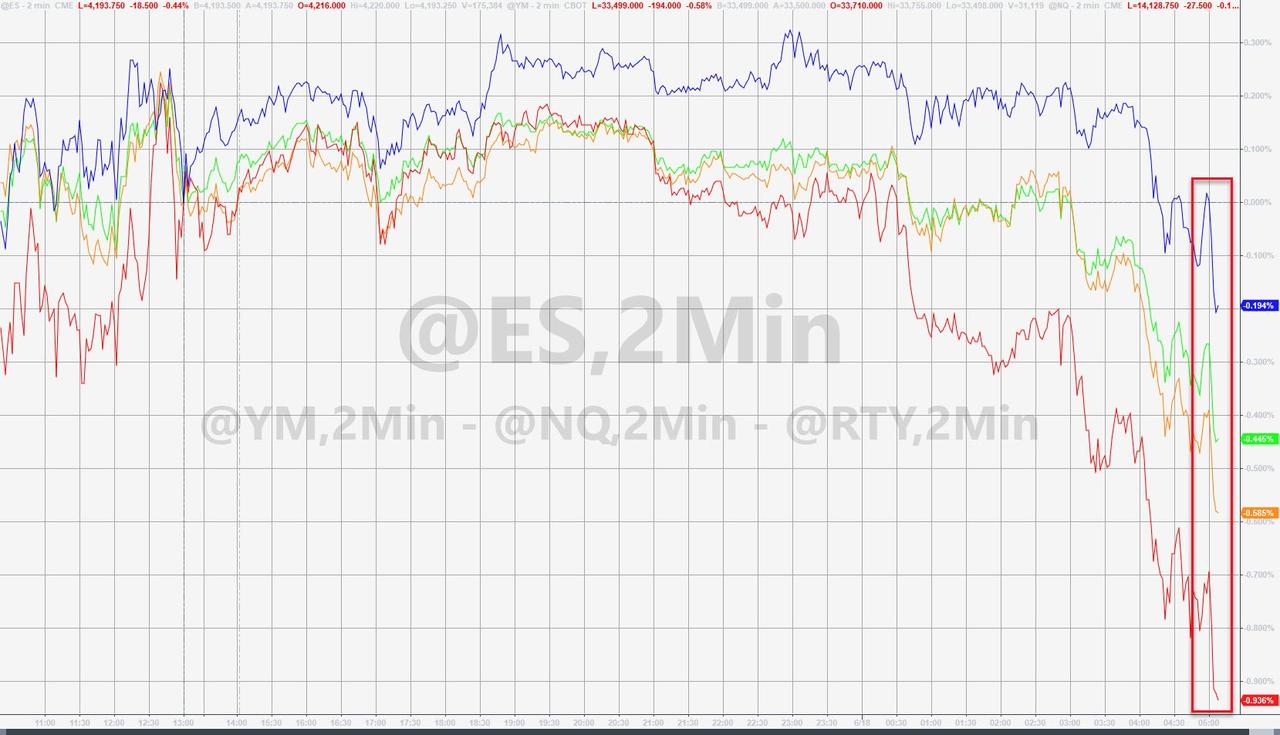
US equity futures were already sliding this morning as option expirations loomed, but when St.Louis Fed Chair Jim Bullard appeared on CNBC and admitted that “it’s natural that [The Fed] has tilted a little bit more hawkish,” losses accelerated…

Bullard then added some more FUD by admitting that there “is some upside risk on the inflation forecast,” and confirmed that “Fed Chair Powell has opened the taper discussion this week.”

So much for transitory!!

Tyler Durden
Fri, 06/18/2021 – 08:09

via ZeroHedge News https://ift.tt/3q720YR Tyler Durden

Wuhan, Weapons, & Burned Spies: CCP Defector Identified, Gave ‘Terabytes’ Of Dirt To US Govt.

Wuhan, Weapons, & Burned Spies: CCP Defector Identified, Gave ‘Terabytes’ Of Dirt To US Govt.

Authored by Jennifer Van Laar via RedState,

We now know the name of the Chinese defector who has been working with the Defense Intelligence Agency (DIA) for a few months and what his position within the Chinese military and government was, among other details.

(AP Photo/Andrew Harnik, FILE)

Matthew Brazil and Jeff Stein at Spy Talk reported on the “rumor,” and gave the name and background of the rumored defector:

Chinese-language anti-communist media and Twitter are abuzz this week with rumors that a vice minister of State Security, Dong Jingwei (董经纬) defected in mid-February, flying from Hong Kong to the United States with his daughter, Dong Yang.

Dong is, or was, a longtime official in China’s Ministry of State Security (MSS), also known as the Guoanbu. His publicly available background indicates that he was responsible for the Ministry’s counterintelligence efforts in China, i.e., spy-catching, since being promoted to vice minister in April 2018. If the stories are true, Dong would be the highest-level defector in the history of the People’s Republic of China.

RedState’s sources confirmed that the defector is, in fact, Dong, that he was in charge of counterintelligence efforts in China, and that he flew to the United States in mid-February, allegedly to visit his daughter at a university in California. When Dong landed in California he contacted DIA officials and told them about his plans to defect and the information he’d brought with him. Dong then “hid in plain sight” for about two weeks before disappearing into DIA custody.

According to Spy Talk, Dong’s name came up during the Sino-American Summit held in Alaska in March 2021:

In a tweet on Wednesday, Han [Dr. Han Lianchao, a Chinese defector], citing an unnamed source, alleged that China’s foreign minister Wang Yi and Communist Party foreign affairs boss Yang Jiechi demanded that the Americans return Dong and Secretary of State Anthony Blinken refused.

RedState’s sources say that Chinese officials did demand that the United States return Dong, but Blinken didn’t exactly refuse; at that time Blinken wasn’t aware that Dong was with the US government, the sources say, and told China that the US didn’t have Dong.

It’s only in the last three to four weeks that anyone outside DIA knew about the defector, according to RedState’s sources. Prior to that time, DIA was vetting the information provided and confronting Langley officials with what they’d learned without divulging the source. 

Experts quoted in the Spy Talk piece essentially say that the defection is just a rumor and that rumors happen all the time, but that if it’s true it’s a big deal but “not game-changing.” Based on conversations with sources familiar with the information Dong has already provided and its quantity and reliability, that’s simply not the case. Not only does Dong have detailed information about China’s special weapons systems, the Chinese military’s operation of the Wuhan Institute of Virology and the origins of SARS-CoV-2, and the Chinese government’s assets and sources within the United States; Dong has extremely embarrassing and damaging information about our intelligence community and government officials in the “terabytes of data” he’s provided to the DIA.

Some of the information provided by Dong was reported on by the Washington Free Beacon earlier this week:

Hundreds of Chinese nationals are the subject of a federal probe after law enforcement officials flagged their travel at the start of the COVID-19 pandemic. The Chinese nationals returned to the United States earlier than expected in January 2020, often having modified their travel plans.

The episode is recounted in an internal report that circulated among various national security and law enforcement agencies on June 3. That report surmises that the Chinese students returned to the United States earlier than expected in order to avoid future travel restrictions caused by the COVID-19 pandemic.

“The team examined 58,000 inbound Chinese F/J visa holders in the [Passenger Name Record] database and identified 396 individuals whose return travel was [scheduled] after January 2020 but had returned in January 2020,” the report reads.

The Free Beacon reports that U.S. intelligence officials haven’t come to a conclusion about whether or not the students being investigated were spies, but RedState is told that whether or not one wants to use the term “spy,” those students were sent back to the United States with specific information-gathering directives with the purpose of helping Beijing understand the US government’s response to the pandemic at a much deeper level than they could through publicly-available documents. Those students (spies) were charged with reporting back on public policy changes, economic response and damage, impacts on the healthcare system (equipment/hospital bed shortages, etc), supply chain impacts (including how long it took things like semiconductors from China to reach the United States), civil unrest, and more.

In addition, Dong has provided DIA with the following information:

  • Early pathogenic studies of the virus we now know as SARS-CoV-2
  • Models of predicted COVID-19 spread and damage to the US and the world
  • Financial records detailing which exact organizations and governments funded the research on SARS-CoV-2 and other biological warfare research
  • Names of US citizens who provide intel to China
  • Names of Chinese spies working in the US or attending US universities
  • Financial records showing US businessmen and public officials who’ve received money from the Chinese government
  • Details of meetings US government officials had (perhaps unwittingly) with Chinese spies and members of Russia’s SVR
  • How the Chinese government gained access to a CIA communications system, leading to the death of dozens of Chinese people who were working with the CIA

Dong also has provided DIA with copies of the contents of the hard drive on Hunter Biden’s laptop, showing the information the Chinese government has about Hunter’s pornography problem and about his (and Joe’s) business dealings with Chinese entities. Some of the files on Dong has provided shine a light on just how it was that the sale of Henniges Automotive (and their stealth technology) to Chinese military manufacturer AVIC Auto was approved.

Again, according to sources, Dong told DIA debriefers that at least a third of Chinese students attending US universities are PLA assets or part of the Thousand Talents Plan and that many of the students are here under pseudonyms. One reason for using pseudonyms is that many of these students are the children of high-ranking military and party leaders.

As we initially reported, DIA has high confidence in the veracity of Dong’s claims. The fact that since our original report, which was pooh-poohed by Langley apologists, the New York Times published a rare interview with Dr. Shi Zhengli (the WIV “Bat Woman”), ABC News has started an “investigation” into COVID-19 origins, and now the actual name of the defector has been published in an anti-Trump, CIA-friendly blog, demonstrates what sources told RedState today: “This defector has the rest of the intelligence community and the LEO community scared sh**less.”

*  *  *

Join RedState VIP to support our conservative journalism and to use the promo code AMERICAFIRST to get 25% off VIP membership!

Tyler Durden
Fri, 06/18/2021 – 07:59

via ZeroHedge News https://ift.tt/3gzfWYu Tyler Durden

3 Trillion Reasons To Brace For Today’s Record-Breaking Quad Witch Chaos

3 Trillion Reasons To Brace For Today’s Record-Breaking Quad Witch Chaos

At the start of the week, we warned of the potential for upheaval in markets that today’s near-record-breaking options-expiration (and quad witch) could cause as a massive amount of gamma and delta expire and are de-risked, in the process eliminating one of the natural downside stock buffers (see “4 Reasons Why The Market Doldrums End With Next Friday’s Op-Ex“).

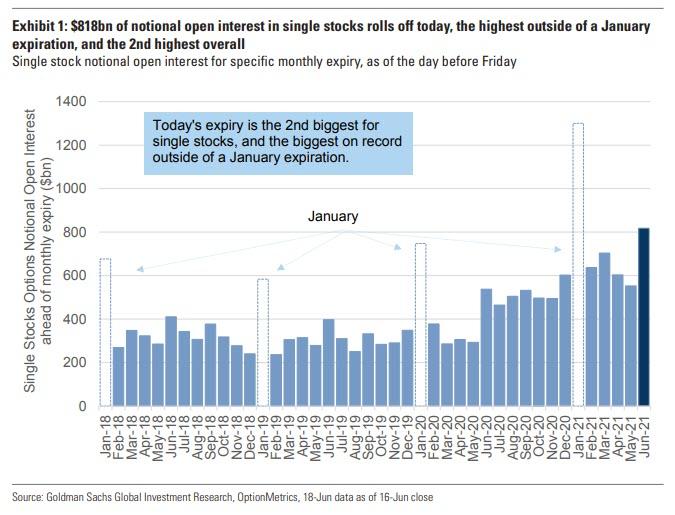
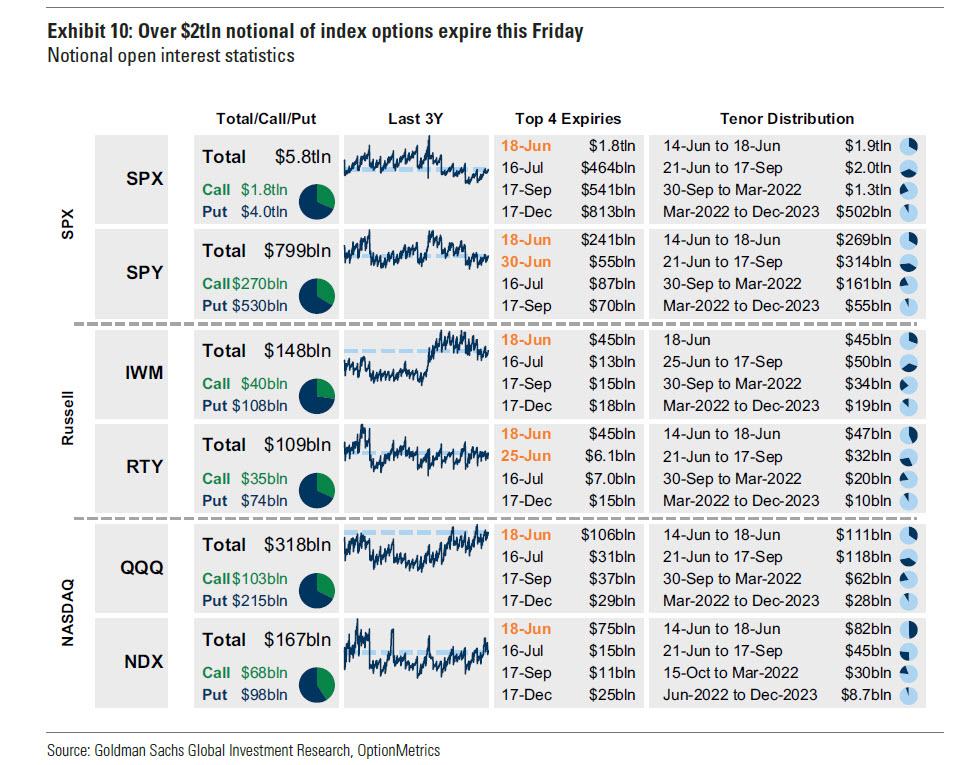
Anyone who ‘traded’ yesterday’s markets knows that is true and today could be even more wild as Goldman points out that today will be the second largest single stock options expiration in history, with $818bn of single stock options set to expire (only Jan-2021 was larger).

Broadly, total open interest on single stocks has increased to nearly $3tn, the highest level since January of this year, as daily options trading activity continues to exceed shares traded (single stock options volumes have been 104% of shares volumes over the past month). Volumes are concentrated in short term contracts, with 71% of all contracts traded in options with less than 2 weeks to expiry; this compares to the long-term average of 57%.

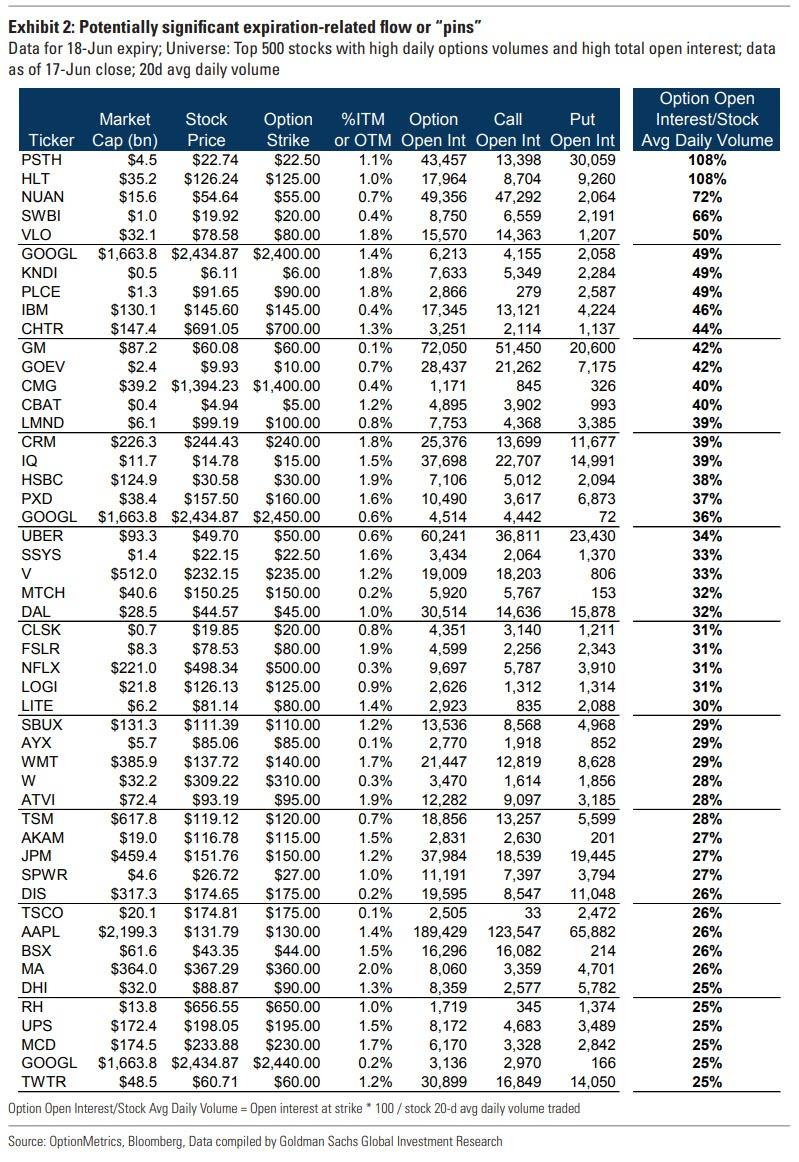
Additionally, Goldman’s Derivatives Research Group notes that today’s expiry could be important for stocks with large open interest in at-the-money (ATM) options; market makers delta-hedging their unusually large options portfolios will be active. This flow is likely to dampen volatility in some names while exacerbating stock price moves in others. Names to focus on include HLT, VLO, IBM, GM, GOOGL and CRM.

Specifically, Goldman warns that open interest in ATM options expiring on Friday may impact stock trading.

At major expirations, options traders track situations where a large amount of open interest is set to expire. In situations where there is a significant amount of expiring open interest in at-the-money strikes (strike prices at or very near the current stock price), delta-hedging activity can impact the underlying stock’s trading that day. If market makers or other options traders who delta-hedge their positions are net long ATM options, expiration-related flow could have the effect of dampening stock price movements, causing the stock price to settle near the strike with large open interest. This situation is often referred to as a “pin” and can be an ideal situation for a large investor trying to enter/exit a stock position. Alternatively, if delta-hedgers are net short ATM options (have a “negative gamma” position), their hedging activity could exacerbate stock price moves.

The following stocks are where option activity could have big impact

Stocks where a large percentage of contracts, relative to their average daily volume traded, expire today, potentially leading to “pinning”. Expiration-related trades may cause trading activity to pick up for stocks with a significant amount of ATM open interest.

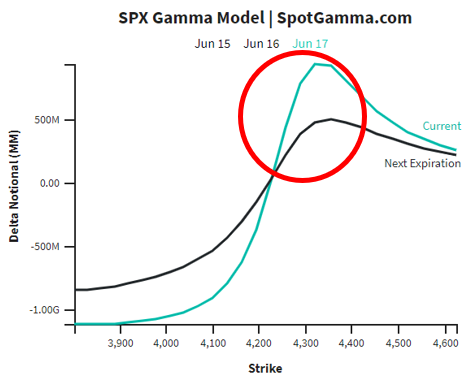
At the index level, SpotGamma notes, the level of gamma & delta reduction is what we are watching for now.

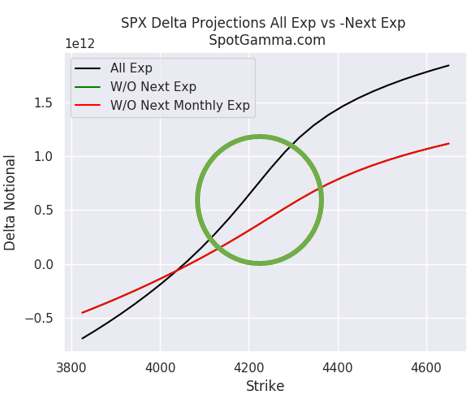
The amount of delta & gamma that expires is quite dependent on where markets are at the time of expiration (9:30 AM EST for SPX, 4PM for everything else). You can see that at 4200 (the 0 gamma point) there is not much change – but the issue for the bullish case is the sizeable delta that expires today.

As you can see on the chart below, there is a sizeable amount of SPX delta that expires. The implication here is that dealers may have a substantial amount of long delta hedges (ie long futures) to unwind.

On net our view here is simple: volatility is set to expand. Whether that manifests in a rip higher, or a drop lower remains to be seen. As long as markets hold the Volatility Trigger level (around 4195 for SPX) then we give bulls the benefit of the doubt. Below there is high risk as markets could enter a nasty cycle of reflexive gamma selling.

Tyler Durden
Fri, 06/18/2021 – 07:28

via ZeroHedge News https://ift.tt/3gAcX1W Tyler Durden

Tropical Storm Claudette Expected To Form Imminently, Takes Aim At US Gulf States

Tropical Storm Claudette Expected To Form Imminently, Takes Aim At US Gulf States

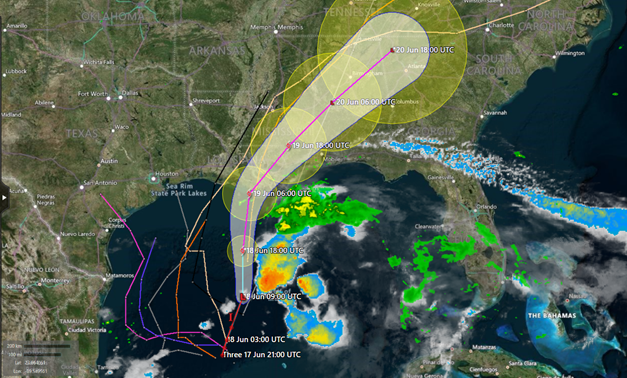
Tropical Storm Claudette is likely to form Friday and impact the Gulf Coast of the US this weekend while much of the Western half of the US is plagued with once-in-a-generation megadrought and scorching temperatures. 

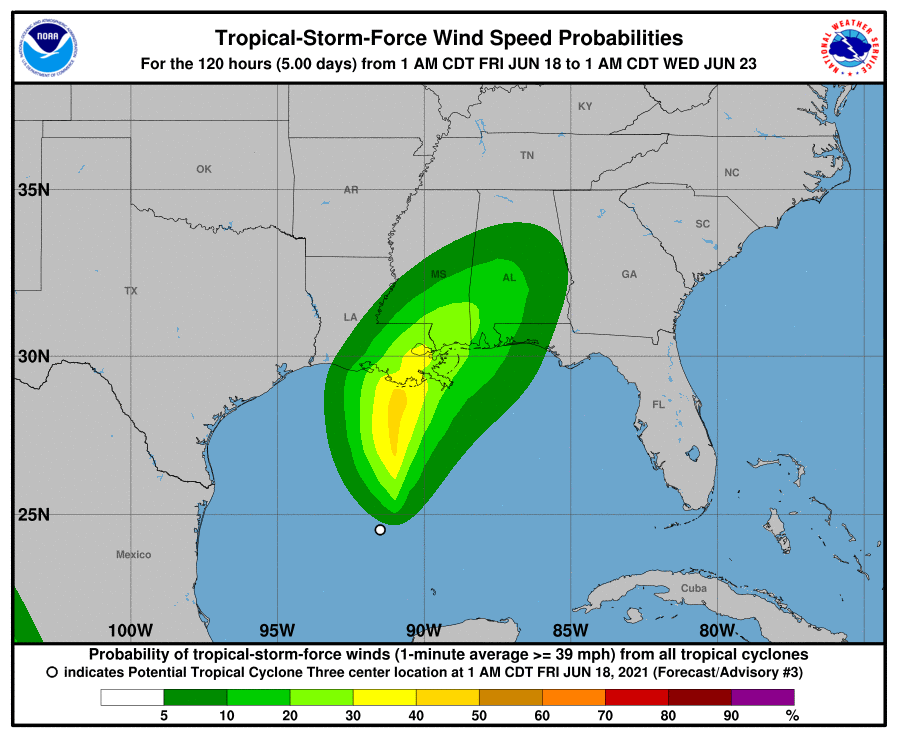
The National Hurricane Center (NHC) issued tropical storm warnings for the central Gulf Coast with impacts expected to begin tonight. 

“The system is moving toward the north near 14 mph, and this general motion is expected for the next day or so,” the NHC said. 

“On the forecast track, the system will approach the north-central Gulf Coast tonight or early Saturday. A slow northeastward motion across the southeastern United States is likely after landfall through the weekend. Some strengthening is forecast, and a subtropical or tropical storm is likely to form over the west-central or the northwestern Gulf of Mexico later today.”

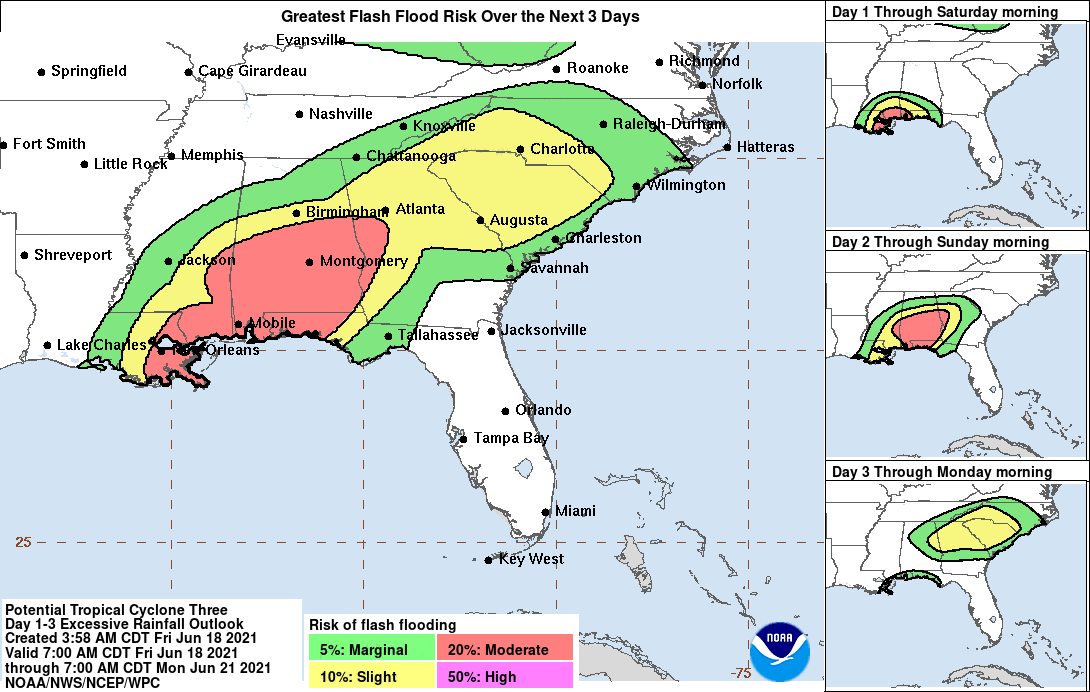
CNN meteorologist Robert Shackelford said the storm might develop into a Tropical Cyclone 3, which is forecasted to create flash flood risks for Louisiana, Mississippi, Alabama, and the Florida Panhandle starting Friday evening and through the weekend. 

Tropical storm winds are expected. 

More than six million people are under a tropical storm warning from Louisiana, to the Alabama-Florida border. 

Chevron Corp. has already pulled non-essential workers from its platforms in the Gulf ahead of the potential tropical storm.

“In preparation for the tropical weather, we have transported all non-essential personnel from our Chevron-operated Big Foot, Jack / St. Malo, and Tahiti platforms. All personnel on our Genesis facility have also been moved onshore,” Chevron spokesperson Tyler Kruzich told CNN. 

On Monday, the NHC identified three disturbances, but by Wednesday, the agency focused on the tropical threat developing in the western Gulf of Mexico and fast approaching US Gulf states. 

    Tyler Durden
    Fri, 06/18/2021 – 07:00

    via ZeroHedge News https://ift.tt/3cTjjHx Tyler Durden

    “Giant Mistake” – CDC Delays Emergency Meeting On Post-Vax Heart Inflammation Due To Juneteenth

    “Giant Mistake” – CDC Delays Emergency Meeting On Post-Vax Heart Inflammation Due To Juneteenth

    Authored by Zachary Stieber via The Epoch Times,

    The Centers for Disease Control and Prevention (CDC) has pushed back an emergency meeting on post-vaccination heart inflammation seen in Americans, primarily young people, because of a new federal holiday.

    President Joe Biden signed a bill on Thursday making June 19 a new holiday, Juneteenth. Shortly afterwards, the CDC said its June 18 meeting “is being rescheduled due to the observation of the Juneteenth National Independence Day holiday.”

    A federal office said Thursday that because June 19 falls on a Saturday this year, the observation will take place on Friday.

    The meeting, which was deemed an emergency when announced last week, will now be folded into a June 23 to June 25 virtual meeting, the CDC said.

    The agency did not immediately respond to a request for comment.

    CDC officials planned to present to the agency’s vaccine advisory panel updated information on myocarditis and pericarditis in people who have received a COVID-19 vaccine.

    A CDC official told members of the Food and Drug Administration’s vaccine advisory committee on June 10 that more than 800 reports of post-vaccination heart inflammation have been submitted to the Vaccine Adverse Event Reporting System, a passive reporting system run jointly by the administration and the CDC.

    That included 475 among those 30 or younger, of which 226 have been verified as meeting the CDC’s working case definition.

    The CDC’s move drew criticism from some.

    “Giant mistake in my view. The CDC director should have the ability to keep the meeting on the calendar,” Dr. Walid Gellad, professor of medicine at the University of Pittsburg’s School of Medicine, said on Twitter.

    “There are perception issues here that are important to consider. Many people are worried about this potential” adverse event.

    Syringes with the Pfizer-BioNTech COVID-19 vaccine are placed on a tray in Las Vegas, Nev., on May 21, 2021. (Ethan Miller/Getty Images)

    Earlier Thursday, Dr. Rochelle Walensky, the CDC’s director, told reporters in a virtual briefing that the CDC’s vaccine advisory panel would be meeting the following day to review data on post-vaccination myocarditis and pericarditis reports.

    “These cases are rare, and the vast majority have fully resolved with rest and supportive care. CDC will present details about more than 300 confirmed cases of myocarditis and pericarditis reported to CDC and FDA among the over 20 million adolescents and young adults vaccinated in the United States,” she said.

    The panel “will hear a risk-benefit analysis regarding COVID-19 vaccination versus the potential rare side effects across all age groups,” she added later.

    Some health experts had believed the advisory panel might recommend young people avoid getting a COVID-19 vaccine built on messenger RNA technology. Both the Pfizer and Moderna jabs use mRNA.

    “Looking at the data I think that one may recommend only one dose of an mRNA vaccine for young people, forgo mRNA vaccines or use an Ad vectored vaccine,” Dr. Carlos del Rio, professor of medicine in the Division of Infectious Diseases at Emory University School of Medicine, said in a recent tweet.

    Tyler Durden
    Fri, 06/18/2021 – 06:30

    via ZeroHedge News https://ift.tt/3vDoRMM Tyler Durden

    Coiled Futures Set To Pounce During Today’ Massive Op-Ex

    Coiled Futures Set To Pounce During Today’ Massive Op-Ex

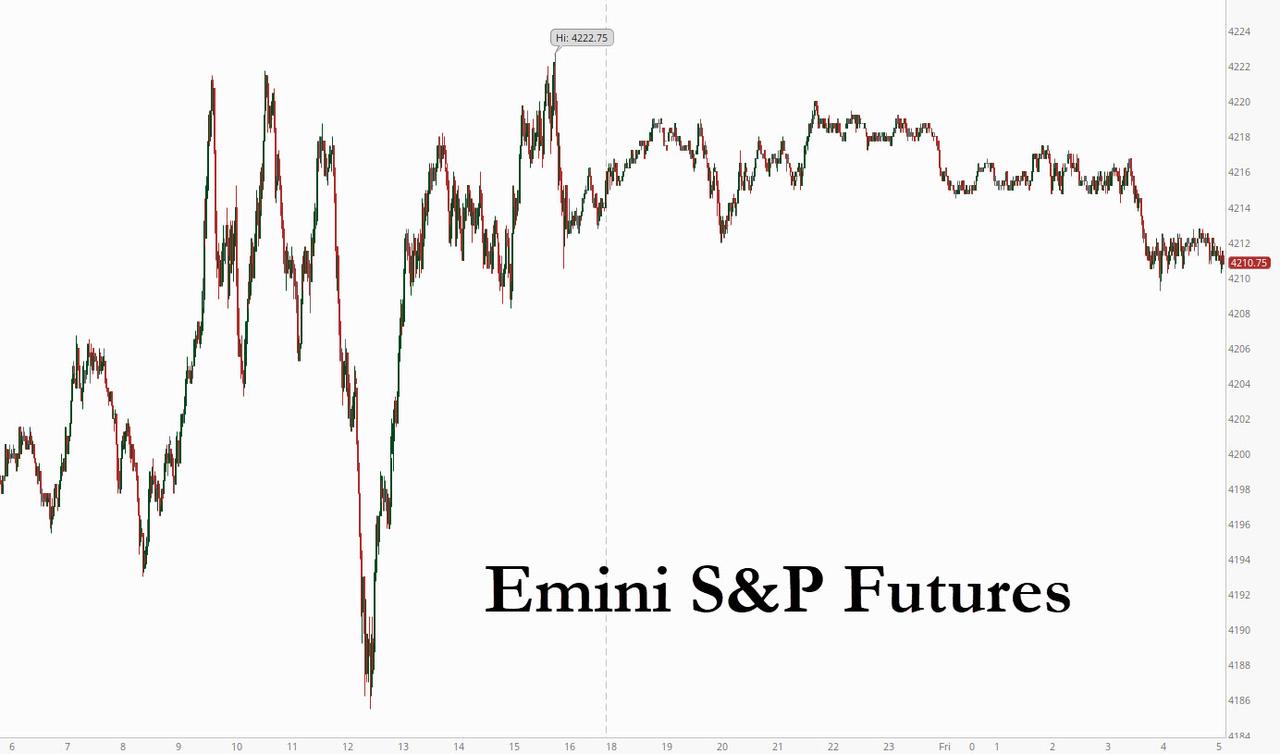
    With traders on edge ahead of today’ massive quad (or triple for the anal purists) witching opex, in which over $2.2 trillion in index option gamma is set to expire potentially unleashing a burst of volatility across risk assets…
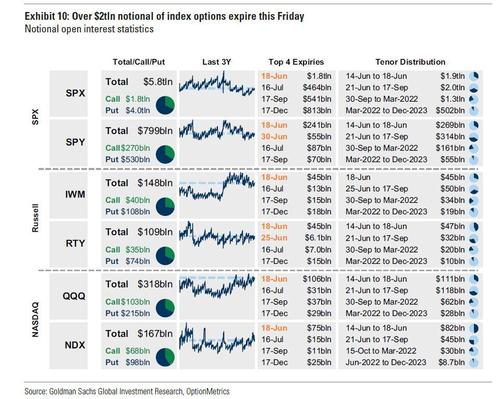
    … worlds stocks were stuck just below record highs on Friday, with investors left looking for direction after digesting the U.S. Federal Reserve’s more hawkish stance (which has since been re-evaluated as bullish), while S&P futures are deathly calm with the emini trading unchanged following Thursday’ turbulent session, which saw the unwind of reflation trades resulting in a huge divergence between soaring growth (QQQ) and sliding value (IWM) stocks as markets repriced inflation expectations and as yields tumbled following Wednesday’ hawkish shock.
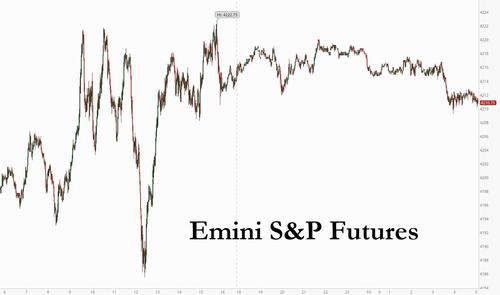
    A plunge in yields resulting from sharply lower commodity prices and an easing in reflation trades, pushed tech stocks sharply higher on Thursday, lifting the Nasdaq Composite up 0.87%. But worries about inflation and higher rates weighed on the broader market, with the S&P 500 edging down 0.04%. The Dow Jones Industrial Average fell 0.62%.

    The MSCI world equity index was off 0.13% at 713.97 points after hitting a record high of 722.32 on Tuesday. Treasury yields resumed sliding with the 10Y dropping as low as 1.47% as traders pulled back longer-term inflation expectations. The stark reversal in sentiment took place as popular trades linked to hotter inflation retreated after the Fed signaled it was preparing for earlier interest-rate increases, helping to rein in speculation that price pressures could get out of hand. In short the narrative changed from taper is bad to taper is good… just as we expected it would.

    “The reflation trade as driven by higher commodity prices and partially a cyclical rebound has unwound a bit,” according to Sebastien Galy, senior macro strategist at Nordea Asset Management. “There is rising evidence that different parts of the commodity space are correcting as the overshoot in prices in various sectors of the economy are settling down.”

    Of course, we expect the narrative to reverse quickly should today’s opex unwind yesterday’s reversal but until then, the pan-European STOXX index eased 0.19% to 458.50 points, barely below Monday’s record high of 460.51. Stocks in London fell 0.4% after data showed British retail sales fell unexpectedly last month as a lifting of lockdown restrictions encouraged spending in restaurants rather than shops, with Tesco down 1.8%. Britain’s biggest retailer reported a sharp slowdown in underlying UK sales growth in its first quarter, reflecting a tough comparison with the same quarter last year when consumers stocked up in the country’s first COVID-19 lockdown.

    “I would not expect too much of a change,” Michael Hewson, chief market analyst at CMC Markets, said of the market. “What has the Fed said that is particularly upsetting in terms of the outlook for interest rates and monetary policy? We are still talking 18 months’ time. It suggests the economy is improving and that is a good thing,” Hewson said, echoing what we said yesterday.

    Earlier in the session, the MSCI index of Asia-Pacific shares ex-Japan was flat after falling for four sessions. Chinese blue-chip A shares were also little changed, along with Japan’s Nikkei. China’s economic planning agency and the market watchdog once again vowed to closely monitor prices of coal and other commodities, and firmly crack down on hoarding and price speculation, according to an NDRC statement, in which it said that this year’s surge in the price of coal and other commodities has had a “negative impact” on the real economy.

    In FX, the dollar was heading for its best week in nearly nine months as investors priced in a sooner-than-expected ending to extraordinary U.S. monetary stimulus. The Bloomberg Dollar Spot Index was little changed Friday. Among Group-of-10 currencies the yen led gains as the Bank of Japan maintained its policy rate and said it would extend its Covid support program.

    No major data is expected and corporate news was thin, leaving investors to continue pondering what the Fed’s comments will mean for the assets they hold in coming months.

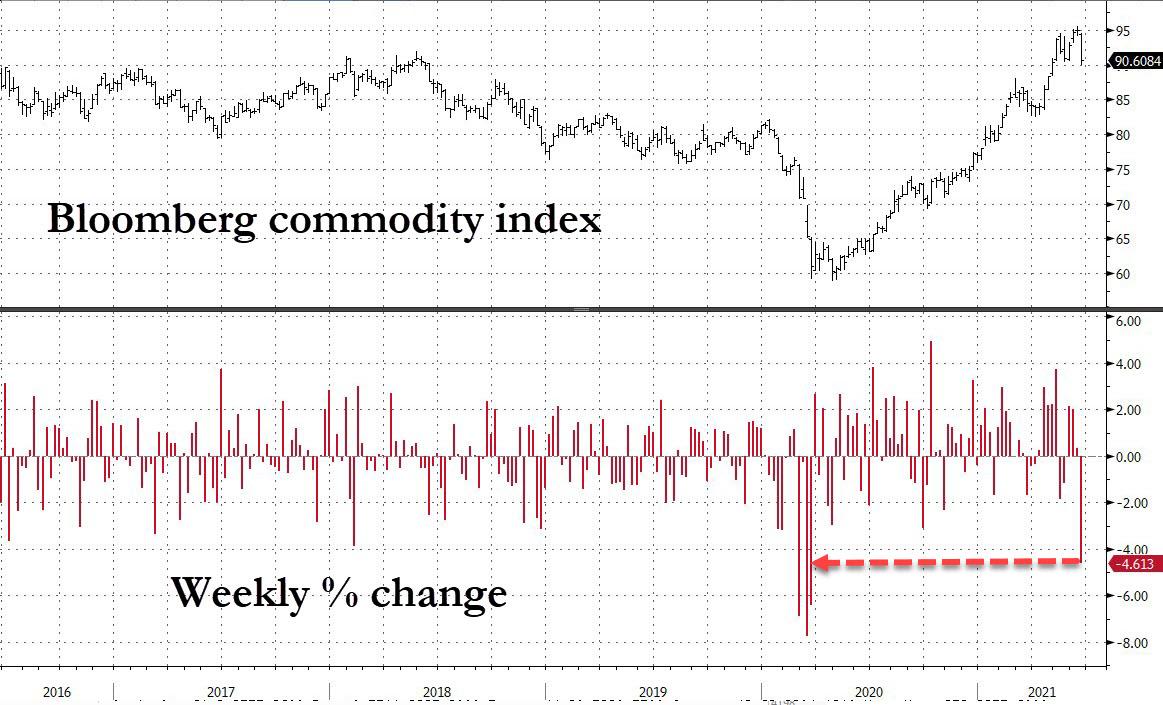
    Markets that are clearly benefiting from the reopening are seeing a pullback, with copper heading for its worst week in more than a year. The Bloomberg Commodity Index is on course for its steepest weekly slump since March 2020.
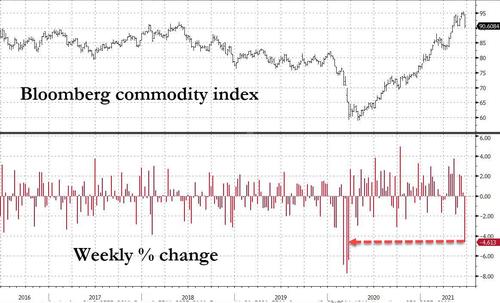
    Elsewhere in commodities, gold prices, which plunged following the Fed comments, edged higher but were still set for their worst week since March 2020. Spot gold was last up 1% at $1,790 per ounce. Oil fell for a second day, with Brent crude slipping from this week’s 2018 high. Strength in the greenback pushed oil lower for a second straight session, while spot gold remained down around 5% for the week after the Fed dented the yellow metal’s safe haven appeal. Global benchmark Brent crude was down 0.68% at $72.63 a barrel after settling at its highest price since April 2019 on Wednesday. U.S. West Texas Intermediate crude, which touched its highest level since October 2018 on Wednesday, shed 0.42% to $70.74.

    In terms of the day ahead there isn’t much on the calendar, but data releases include German PPI and UK retail sales for May. Otherwise, a presidential election is taking place in Iran.


    Market Snapshot

    • S&P 500 futures little changed at 4,222.25
    • STOXX Europe 600 down 0.1% to 458.64
    • MXAP down 0.2% to 207.77
    • MXAPJ little changed at 696.85
    • Nikkei down 0.2% to 28,964.08
    • Topix down 0.9% to 1,946.56
    • Hang Seng Index up 0.8% to 28,801.27
    • Shanghai Composite little changed at 3,525.10
    • Sensex down 0.3% to 52,167.66
    • Australia S&P/ASX 200 up 0.1% to 7,368.85
    • Kospi little changed at 3,267.93
    • Brent Futures down 0.5% to $72.68/bbl
    • Gold spot up 1.0% to $1,791.51
    • U.S. Dollar Index little changed at 91.89
    • German 10Y yield fell 0.4 bps to -0.199%
    • Euro little changed at $1.1917

    Top Overnight News from Bloomberg


    Quick look at global markets courtesy of newssquawk

    Asian equity markets were sluggish following the mixed lead from Wall Street where the mood was indecisive amid an unwinding of inflation hedges, looming quadruple witching and following weaker than expected US data, although tech outperformed and the NDX posted a fresh record high helped by a pullback in yields. ASX 200 (+0.3%) was led higher by tech as the sector found inspiration from US peers although upside in the broader market was limited by commodity-related losses with energy names dragged after WTI crude briefly dipped beneath USD 70/bbl. Nikkei 225 (Unch.) lacked conviction amid an unsurprising BoJ policy conclusion in which the BoJ maintained policy settings as expected and extended pandemic relief measures by six months beyond the September deadline as was flagged by source reports, although Eisai was the biggest gainer due to a global strategic collaboration with Bristol Myers Squib in which Eisai will receive USD 650mln and also be entitled to as much as USD 2.45bln in milestones. Hang Seng (+0.7%) and Shanghai Comp. (-0.5%) were varied with the mainland bourse weakened by lingering tensions with the West, while outperformance in Hong Kong was driven by tech and retailers as JD.com celebrated its birthday with the 6.18 shopping festival and with Anta Sports also lifted after forecasts of a minimum 110% jump in H1 net.

    Top Asian News

    • BOJ Flags Novel Step to Aid Post-Covid Climate Change Efforts
    • China Mulls Full Abandonment of Birth Restrictions by 2025: DJ
    • Thailand to Ease Covid-19 Curbs, Approves Phuket Reopening
    • China EV Stocks Rise on Optimism Over Tax, Sales, Chip Drive

    In FX, the DXY was flat overnight but held on to most of its post-FOMC gains having tested the 92.00 level to the upside, with the greenback unfazed despite the recent pullback in yields and disappointing US data in which Philly Fed Business Index missed forecasts and Jobless Claimants numbers were higher than expected. EUR/USD suffered from the USD strength and briefly gave up the 1.1900 status, while the latest central bank commentary had little bearing on the single currency, in which ECB’s Weidmann called for the PEPP to end soon and ECB’s Visco noted the path of the global recovery is still uncertain and that large supply and demand issues caused by the pandemic, coupled with the pickup in commodity prices, will complicate the assessment of the inflationary outlook. GBP/USD was pressured and eyes 1.39 to the downside amid the weight of a firmer USD and with the currency not helped by Chancellor Sunak’s refusal to provide help for businesses hit by extended COVID restrictions. USD/JPY and JPY-crosses were subdued after the prior day’s slump and following an uneventful BoJ policy decision where the central bank maintained policy settings and extended its pandemic-relief programme as expected, while antipodeans drifted lower ahead of the European entrance to market following the recent downturn across the commodities complex.


    Commodities were mixed overnight with WTI crude futures despondent following the prior day’s heavy selling pressure alongside a broad slump across the commodities complex as the greenback extended on gains and amid suggestions from the US that progress was achieved in Iran talks although challenges remain. There were also updates overnight from the NHC which announced a tropical storm warning will likely be required for a portion of the northern Gulf of Mexico, while Chevron (CVX) withdrew staff from offshore facilities in the area due to the potential tropical storm and Occidental Petroleum was also implementing storm procedures. Gold nursed some losses overnight although the recovery was insignificant compared to the circa USD 90/oz drop suffered since the FOMC and copper’s attempts to recoup losses were also limited by the tentative mood across risk assets.

    US Event Calendar

    • Nothing major scheduled

    DB’ Jim Reid concludes the overnight wrap

    The oldest international football fixture in the world takes place today at the Euros. 149 years after it was first played England vs Scotland will divide us here in the U.K.. My father’s ancestry was a mix of Scottish and Dutch and until I was about 9 I supported Scotland. However at that age I started to realise I’d never been to Scotland, had a load of friends who supported England and started to disagree with most things my Dad said. So I changed my allegiances. Not quite Zola Budd but still. I would say that the 1982 Scotland World Cup song “We had a dream” (look it up on YouTube) is one of the best football songs and was one of the first records I bought. Luckily as I changed, England songs occasionally got even better with “World in motion” and “Three Lions”.

    After the inflationists again placed one in the back of the net following the hawkish shift from the Federal Reserve on Wednesday, the disinflationists made an immediate and stunning comeback last night and hit a screamer into the top corner. US Treasuries had a incredible day in the circumstance as investors grew in confidence that the Fed had removed some of the tail risk of a much higher-inflation outcome in the future. So although the data still points to building price pressures, and the market continues to price in an earlier hike than the Fed is currently implying (by end-2022 rather than in 2023), the moves in various assets yesterday marked another vote of confidence that the Fed would prove able to keep those pressures contained. Or on a more sinister interpretation that they are making a hawkish policy error. Not my thoughts but the market pricing certainly demands attention.

    By the close of trade, yields on 10yr Treasuries were down -7.1bps to 1.504% (1.470% at the lows), mostly reversing the +8.3bps move the previous day.Inflation breakevens declined -2.8bps, which in turn took them to a 3-month low of 2.29%. Indeed, the 10yr breakeven now stands over -30bps lower compared to its intraday high of 2.594% we saw after the release of the bumper April CPI report back in May. 30 year Treasuries rallied -11.5bps to 2.09% (2.05 at one point) the lowest level in 4 months, with the 5yr-30yr yield curve flattening the most over 2 days since late February. So the back end thinks less of the ability for the Fed to honour AIT than they did before the FOMC.

    Furthermore, in a sign of how investors are recalibrating the risks, the traditional inflation hedge of gold (-2.10%) moved sharply lower for a second day running, which brings its losses over the last 2-days to -4.60%, thus marking its worst 2-day performance this calendar year.

    These aftershocks from the Fed continued to be felt elsewhere yesterday, with the US dollar index (+0.83%) reaching a 2-month high, having risen in 4 of the last 5 sessions. However, yet more data pointed to inflationary outcomes in the future, with the Philadelphia Fed’s manufacturing business outlook survey seeing the prices paid diffusion index rise to 80.7, which is its highest since 1979, while the current prices received index was up to 49.7, which is the highest since 1980. So the big question for markets now is whether two hikes in 2023 will prove enough to keep inflation at target, or whether the Fed will be forced to move by end-2022 as investors are currently pricing in or even earlier.

    Equity indices put in a mixed performance in spite of the sizeable moves elsewhere. The S&P 500 finishing just below unchanged (-0.04%), as the index remained less than 1% away from its all-time closing high from Monday. In terms of the sectoral moves, tech stocks were the biggest outperformers on both sides of the Atlantic, with the NASDAQ up +0.87% to an all-time high as lower yields helped. Small-cap stocks struggled however, with the Russell 2000 (-1.18%) falling for a 4th day running. The largest tech stocks outperformed once again with the NYFANG index (+1.81%) reaching its highest close since April, however it remains over -6% lower than its mid-February highs. The drop in yields and commodity prices revived the growth-over-cyclical trade as banks (-4.26%), energy (-3.49%) and materials (-2.20%) were the worst performers in the US. Meanwhile in Europe the STOXX 600 (-0.12%) failed to sustain its run of 9 successive gains as it lost ground after reaching a succession of record highs. If yesterday had seen a 10th gain in a row (as it was very briefly on track for in the afternoon) that would have been the longest winning run since 2006.

    Asian markets are also mixed this morning with the Nikkei (+0.08%) and Kospi (+0.07%) flattish while the Hang Seng (+0.59%) is up and the Shanghai Comp (-0.49%) down. The Shanghai Comp is likely being driven by yesterday’s news that the Federal Communication Commission has proposed a ban on products from Huawei and four other Chinese electronics companies, including surveillance cameras widely used by schools. Meanwhile, we have also had the BoJ policy decision this morning with the central bank maintaining its policy rate and keeping its 10y yield target unchanged. The BoJ did extend its lending measures introduced during the pandemic by six months to March 2022 though. Further, in a surprise move the central bank said that it will introduce a new funding measure to support climate change initiatives and will offer details at next month’s meeting. Elsewhere, futures on the S&P 500 are up +0.07% while the US dollar is trading largely unchanged in early trade today. In terms of overnight data releases Japan’s May CPI came in at -0.1% yoy (vs. -0.2% yoy expected) while core CPI printed at +0.1% yoy (vs. unchanged expected).

    Elsewhere in markets yesterday there were a number of central bank meetings in various countries, though the decisions in Switzerland, Norway, Turkey and Indonesia all saw rates left unchanged. Back in Europe, sovereign bonds caught up with the selloff in the US the previous day, with yields on bunds (+5.5bps), OATs (+2.2bps) and BTPs (+4.1bps) all moving higher but off their tights as Treasuries reversed course. And there was also a reasonably big selloff in commodities too as referenced above, with Brent crude (-1.76%) and WTI (-1.54%) oil prices falling back from their 2-year highs, whilst copper (-4.72%), corn (-5.94%) and wheat (-3.58%) lost ground as well, in addition to gold as mentioned above. It was the biggest one day drop for copper since this past October, as the large moves in yields and the dollar weighed hard on the industrial bellwether. Overnight, commodities are recouping some of yesterday’s losses with Copper (+0.61%), DCE iron ore (+1.78%) and SHF steel rebar (+1.96%) all up. Futures on corn (+0.80%), soybeans (+1.88%) and wheat (+1.13%) are also up. Nonetheless, crude oil prices have taken another leg lower and are down a further c. -0.75%.

    On the pandemic, the UK continued to be a source of concern as 11,007 cases were reported yesterday, which is the highest daily total since February 19th, whilst the numbers admitted to hospital over the last week are up +43% on the previous one. That said, there was some better news from the UK in that 80% of the adult population have now received a first vaccine dose. The vast majority of new cases in the UK are a result of the delta variant, which has not been seen in as large quantities in the US so far, however yesterday Illinois reported 64 new delta cases – its most in one day so far. In the last reading of CDC data, the delta variant made up just under 3% of total cases as the alpha variant remains the most prevalent currently.

    Wrapping up with yesterday’s data, the weekly initial jobless claims from the US for the week through June 12 unexpectedly rose to 412k (vs. 360k expected), up from their post-pandemic low the previous week. That also breaks a run of 6 successive weekly declines in the measure. Separately, in the Philadelphia Fed’s manufacturing business outlook survey for June (which we mentioned above on the prices measures), the general activity index fell to 30.7 (vs. 31.0 expected).

    In terms of the day ahead there isn’t much on the calendar, but data releases include German PPI and UK retail sales for May. Otherwise, a presidential election is taking place in Iran.
    Tyler Durden
    Fri, 06/18/2021 – 05:56

    via ZeroHedge News https://ift.tt/3cONQWW Tyler Durden

    Hospitals See Surge In Double-Lung Transplants As COVID “Honeycombs” Organs

    Hospitals See Surge In Double-Lung Transplants As COVID “Honeycombs” Organs

    As scientists start to assess the impact that COVID-19 has had on patients and the American medical system more broadly, Bloomberg reports that hospitals across the US have seen a surge in patients receiving single- and double-lung transplants.

    Transplants are necessary for only the most serious COVID-19 cases. In these patients – pretty much always patients with comorbidities – COVID-19 ravages the lung tissue, leaving nodules in the lungs incapable of absorbing oxygen from the air and transmitting it to the blood stream. For many patients, the grueling procedure may be the only solution after experiencing the worst lung damage caused by the virus – when the body fails to properly respond to, and heal from, the hyper-inflammatory response provoked by COVID-19.

    John Micklus’s battle with Covid-19 began last Christmas and ended five weeks later with lungs so irreversibly damaged that doctors said there was nothing they could do to save him.

    “The doctor’s recommendation was to get my affairs in order,” Micklus said. The 62-year-old called his wife from his hospital bed in southern Maryland. She, in turn, desperately called several physicians, and eventually learned of one last option: A double-lung transplant.

    Micklus was transferred to the University of Maryland Medical Center in Baltimore, where a rigorous assessment qualified him to receive lungs from a matched donor days later. He was discharged from the hospital on March 30, marking the center’s second successful lung transplant in a Covid survivor.

    Micklus and other double-lung transplant survivors suffered from a phenomenon that scientists call the “honeycomb change.”

    All of that can cause the deposition of yellow fibrotic scar tissue, creating a “honeycomb change” that makes the lungs completely solid, said David Kleiner, who heads autopsy pathology in the National Institutes of Health Clinical Center in Bethesda, Maryland.

    The process irreversibly destroys the tiny grape-like air sacs through which gas is exchanged in the lungs, Kleiner said in a lecture on Covid autopsies in July. “Patients really only survive to that fibrotic stage if they are intubated,” he said, adding that the harmful scarring can occur within a couple of weeks of lung injury.

    A study published in the Lancet, the premier UK medical journal, aggregated what the scientific community has learned about the phenomenon. The report determined that “lung transplantation is the only option for survival in some patients with severe, unresolving COVID-19-associated ARDS.”

    Between May 1 and Sept 30, 2020, 12 patients with COVID-19-associated ARDS underwent bilateral lung transplantation at six high-volume transplant centres in the USA (eight recipients at three centres), Italy (two recipients at one centre), Austria (one recipient), and India (one recipient). The median age of recipients was 48 years (IQR 41–51); three of the 12 patients were female. Chest imaging before transplantation showed severe lung damage that did not improve despite prolonged mechanical ventilation and extracorporeal membrane oxygenation. The lung transplant procedure was technically challenging, with severe pleural adhesions, hilar lymphadenopathy, and increased intraoperative transfusion requirements. Pathology of the explanted lungs showed extensive, ongoing acute lung injury with features of lung fibrosis. There was no recurrence of SARS-CoV-2 in the allografts. All patients with COVID-19 could be weaned off extracorporeal support and showed short-term survival similar to that of transplant recipients without COVID-19.

    Without the procedure, patients can’t survive without a ventilator or a machine that oxygenates the blood via an artificial lung – an expensive proposition. The procedure is intense: Bloomberg described three patients, ages 28, 43 and 62, whose surgeries each took about 9.5 hours and two weeks of post-op recovery care.

    Lung transplantation – especially a double-lung transplant – is still an expensive and risky proposition, and not everyone will succeed in finding a donor. But breakthroughs are making the procedure more manageable for surgeons.

    Still, lung transplantation will likely remain a last resort, as even a lengthy rehab stint would be preferable to taking the risks of a transplant.

    Doctors in Japan reported in April the world’s first “living donor” transplant in a Covid patient who received lung segments from her son and husband. The procedure at Kyoto University Hospital took a team of 30 medical personnel about 11 hours to perform.

    “We demonstrated that we now have an option of lung transplants” from living donors, Hiroshi Date, a thoracic surgeon at the hospital who led the operation, told reporters.

    Reed, who is also a professor of pulmonary and critical care medicine at the University of Maryland, said transplant surgery shouldn’t be seen as a way to speed up post-Covid recovery. Lung recipients need to take more than a dozen medications for the rest of their lives to prevent organ rejection and infections, and many of the drugs come with toxic side effects.

    “You would probably rather have a long run of slow rehab and have your own lungs in there than to get a transplant,” Reed said in an interview over Zoom. “But for people that are likely going to die in two years and for people who are essentially crippled by their lungs, it can be just amazing.”

    Fortunately, COVID-19 vaccines supposedly offer “100% protection” against “severe” COVID-19 symptoms. Though patients with comorbiditis may still be at risk as variants like the “delta” strain continue to spread.

    Tyler Durden
    Fri, 06/18/2021 – 05:45

    via ZeroHedge News https://ift.tt/2UeQ3EO Tyler Durden

    Jeff Bezos-Backed Company To Build Fusion Plant In UK

    Jeff Bezos-Backed Company To Build Fusion Plant In UK

    Authored by Irina Slav via OilPrice.com,

    Canadian General Fusion, a company backed by Amazon, is set to build a demonstration nuclear fusion reactor in Oxfordshire, the BBC reports, adding the facility will be 70 percent the size of a commercial reactor.

    The news comes a couple of weeks after the UK government said it would start work to create a regulatory framework for supporting research and development of nuclear fusion technology to enable the delivery of clean and safe energy.

    Nuclear fusion has been garnering growing attention amid government efforts to pursue an energy transition away from fossil fuels and towards renewable sources of energy.

    To date, the biggest project aiming to recreate the process by which the Sun generates energy is ITER in France, which is planned to begin operation in 2035, after a series of delays.

    Another, very different, fusion project is taking place in California.

    The researchers behind the General Atomics DIII-D National Fusion Facility recently published a paper suggesting a “compact nuclear fusion plant” concept can achieve 200 megawatts (MW) of net electricity after the energy cost of the fusion process through the use of relatively tiny, self-sustaining tokamaks powered by pressurized plasma, rather than the mega-tokamak of the ITER project.

    In the UK, the Atomic Energy Authority is building the Spherical Tokamak for Energy Production (STEP), a prototype fusion power plant it plans to be operational by 2040.

    Last month, the AEA announced a breakthrough that would allow the components of the fusion reactor to last longer despite the intense heat produced during the fusion process, potentially bringing commercially viable fusion closer to reality.

    China is also working on nuclear fusion.

    In May, researchers working on the country’s artificial sun project announced they had achieved plasma of 120 million degrees Celsius for close to two minutes. The duration of the successful experiment shows hope, but it also shows the long road nuclear fusion has yet to go to reach commercial viability.

    Tyler Durden
    Fri, 06/18/2021 – 05:00

    via ZeroHedge News https://ift.tt/35y5Y3j Tyler Durden