Hickman: A Signal To Buy 30-Year Bonds

Hickman: A Signal To Buy 30-Year Bonds

Authored by Lance Roberts via RealInvestmentAdvice.com,

A technical indicator with a reliable history is signaling that 30-year Treasury yields will soon decline.

A relative strength index (RSI) can be measured for any price series and represents how much and frequency gains are occurring versus losses. The index is used as a contrary or turning-point indicator. After periods of strong, persistent selling, buying is expected and vice versa.

It isn’t a complicated calculation. The RSI takes the average price change of days with gains compared to the average price change of days with losses over the last x days. This is converted into an oscillator that can take any position between 0 and 100. When prices (or yields) are rising fast and persistently, the oscillator will approach 100; when selling occurs with lower prices, it will approach 0. The oscillator spends most of its time in the middle, say between 30 and 70. Extreme readings (close to 0 or 100) happen rarely. We can study these extremes historically to see how useful the index is at identifying major turning points in markets.

The RSI On The 30-year U.S. Treasury Yield

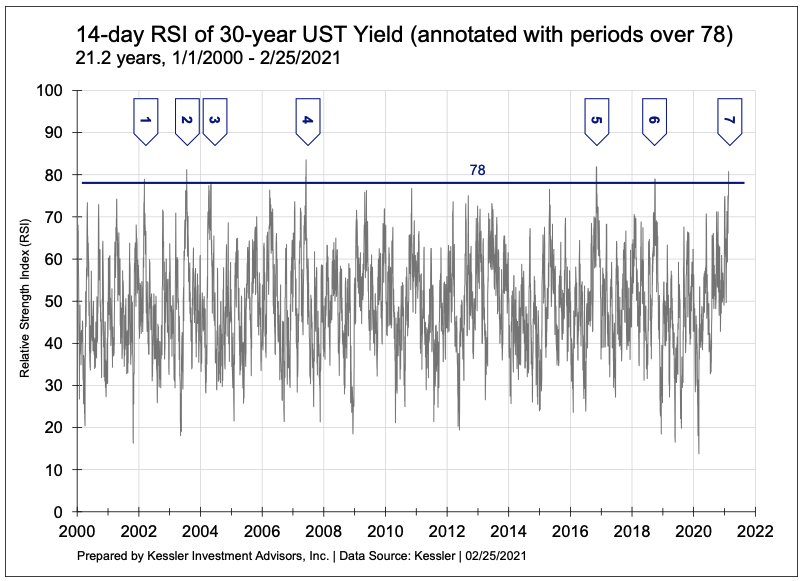
For this analysis, I looked at the RSI on 30-year U.S. Treasury yields measured with a 14-day average (the x in the description above). This is the longest and most conservative daily average generally used. I looked at historical times where the RSI equaled or was greater than it was at the close of Wednesday, 2/24/2021, at 78.

A reading of 78 (or more) is rare, happening in just seven periods going back to 2000, about once every three years. You can see them in the chart below. Focus on the high extremes that rise to or above the blue threshold line of 78.

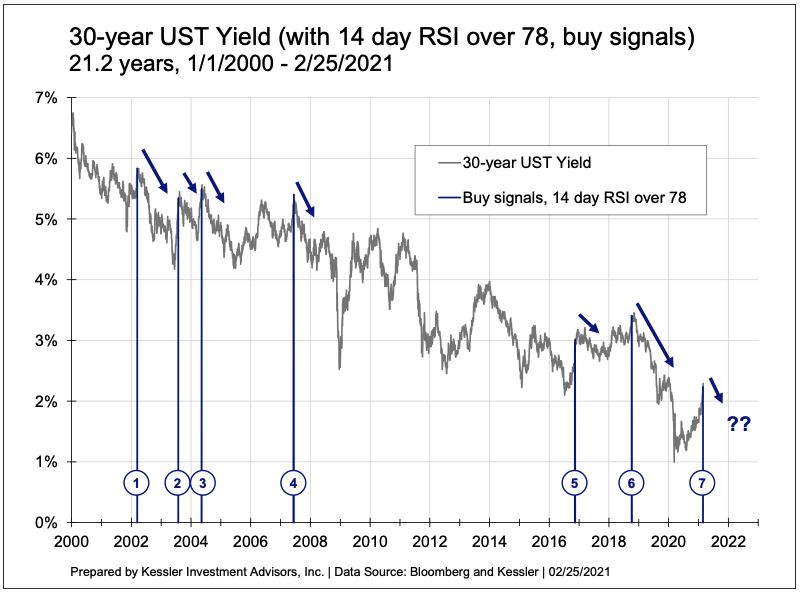
We can translate these points to the 30-year U.S. Treasury yield. Look where the blue vertical lines (RSI over 78) intersect the gray line (30-year UST yields). The blue arrows show that yields fell (prices rose) after these buy signals, suggesting a buy signal now.

But those signals didn’t happen at the yield peaks; they occurred before. The question is how far before and how much more did yields rise after the signal? In other words, assuming this signal triggered on Wednesday, 2/24/2021, how long will it be until yields peak, and how much could yields rise in the meantime?

A Good Signal To Buy 30-Year Bonds.

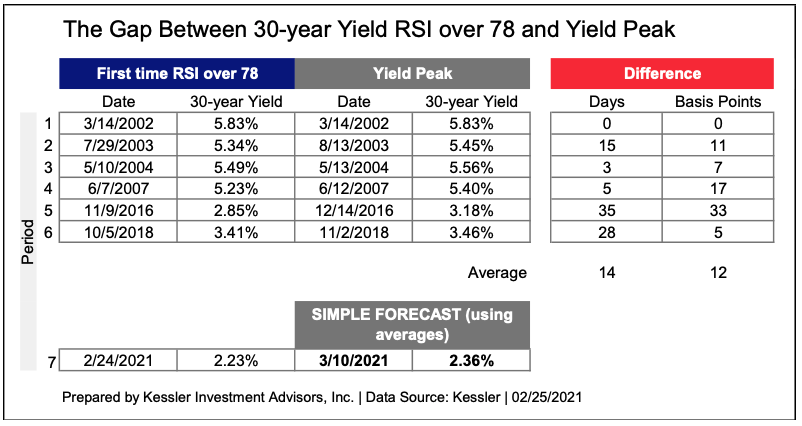
The table below summarizes the answers to those questions. The signal triggered between 0 and 35 days before and between 0 and 33 basis points (0.33%) below the peak in yields. This averages 14 days before and 12 basis points below the peak, which suggests a yield peak on 03/10/2021 at 2.36%. This is much too specific a prediction for markets, but it gives an idea of where we might be in this 30-year yield backup.

It looks to be about over.

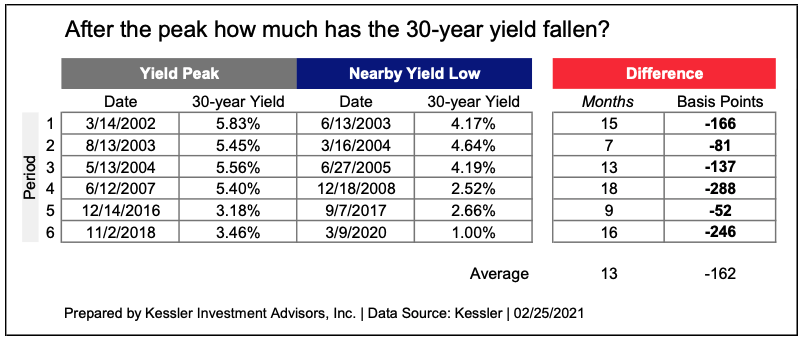
The yield movements down from the peaks predicted by the RSI have been significant; they led to significant gains in long-term U.S. Treasury bonds.

One should never rely on technical indicators alone. But this analysis, combined with an overly rosy expectation of COVID-19 disappearing and the economics beyond that, suggests an opportunity in U.S. Treasury bonds

Tyler Durden
Mon, 03/08/2021 – 06:30

via ZeroHedge News https://ift.tt/30AJUTr Tyler Durden

“Betting On A Dream”: Could Tesla Be The Canary In The ETF Liquidity Coal Mine?

“Betting On A Dream”: Could Tesla Be The Canary In The ETF Liquidity Coal Mine?

All eyes are going to be on Tesla this year. 

The stock has been smashed over the last few weeks amidst a broader sentiment heat-check for NASDAQ names, high flying technology stocks and, well, just other speculative garbage. 

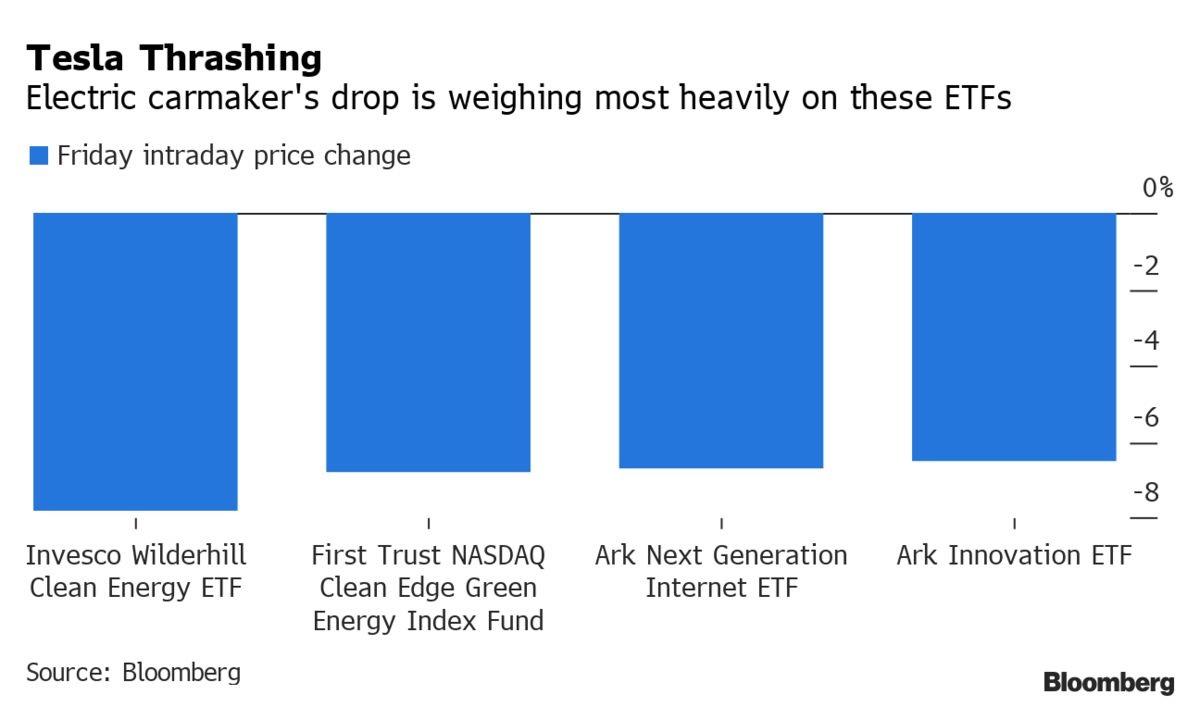
Over the last month, Tesla has fallen from about $868 to $598, a plunge of about 31%. But it isn’t just Tesla investors that are feeling the pain: with the stock having risen in popularity over the last 18 months, Tesla is now tied to numerous ETFs that it winds up pulling lower when it underperforms. In fact, Bloomberg notes that “at one point on Friday, every one of the 54 U.S.-based ETFs that have assets under management exceeding $1 billion and more than 1% invested in Tesla had fallen.”

The most notable ETF is ARKK, which we have profiled at length, and exhaustively. Manager Cathie Wood had been buying shares of Tesla for the ETF as it plunged over the last couple weeks. 

Analysts are warning that one stock having as much of an impact as Tesla does could very quickly lead to things “going haywire”, should it plunge further.

Mohit Bajaj, director of ETFs for WallachBeth Capital, told Bloomberg: “Any fund that holds a large weight in a single stock, if there is selling of that fund, it will pressure the stock, and vice versa — especially on down days when bids tend to disappear. We are seeing heavy pressure in some of these names that had such a huge run last year.”

James Pillow, managing director at Moors & Cabot Inc., added: “High-flying stocks are great to own when there’s still wind beneath them. But when that breadth thrust is withdrawn because of liquidity, they often fall much faster than they rose. Holding such high fliers is a significant risk to concentrated portfolios, and frankly it’s a risk for the confidence in the entire stock market.”

Arthur Hogan, chief market strategist at National Securities Corp., concluded: “Tesla is the poster child for betting on a dream. When you start looking at things and saying, ‘This is going to be the greatest fill-in-the-blank ever,’ and then running up its valuation, you have to understand, there are no one-way trades. Trees don’t grow to the sky. So when something goes parabolic, it tends to come back down to Earth at some juncture.”

In other words, what goes up quickly, can come down even quicker. 


Tyler Durden
Mon, 03/08/2021 – 05:45

via ZeroHedge News https://ift.tt/3sX9s9g Tyler Durden

Super Fast Commodity Price Cycle Is A Harbinger Of Sudden Jump In Inflation

Super Fast Commodity Price Cycle Is A Harbinger Of Sudden Jump In Inflation

Authored by Joe Carson, former chief economist at Alliance Bernstein,

A super-fast rise in commodity prices is underway. It should not be a surprise that as the world economy re-opens, commodity prices start to rise to reflect more robust demand conditions. But what has been surprising is the speed and breadth of the increase.

The current commodity cycle shows an economic cycle’s characteristics underway for a few years, not just getting started. That creates the potential for a quicker cost-push price cycle for products that coincides with an uptick in service prices, resulting in a lift in general inflation sooner and by more than what is currently expected by the markets and policymakers.

Manufacturing & Commodity Cycle

The Institute of Supply Management (ISM) reported that its composite index of prices for the manufacturing sector increased four percentage points to 86%. That represents the highest reading since July 2008. Although numerically the same, the economic and commodity price environments between 2008 and 2021 are fundamentally different.

February 2021 represents the early months of an economic recovery, while in 2008, the economic cycle which had been running for several years had already turned down. Also, high oil prices dominated the commodity cycle of 2008. Oil in July 2008 averaged $133, a record high and nearly double year-ago levels. In 2021, ISM”s February report listed 50 commodities rising in price, and the cost of oil was $59 a barrel, up from $50 one year earlier.

Broad-based commodity cycles have more significant momentum and staying power, unlike those driven by a single item, such as the case of 2008.

The sharp and broad-based rise in commodity prices is evident in the Bureau of Labor Statistics (BLS) producer price report. Prices for crude goods, excluding food and energy, have risen 25% in the past year.

Other than the sharp bounce in 2010, following the record plunge in 2009, the recent 12-month increase in core crude prices represents the most abrupt and substantial increase for the start of an economic recovery in 50 years.

Consumer products represent a little more than a third of the basket of goods and services that make up the consumer price index. But products (or goods) are the cyclical component, and any uptick in prices would coincide with upward pressure on service prices.

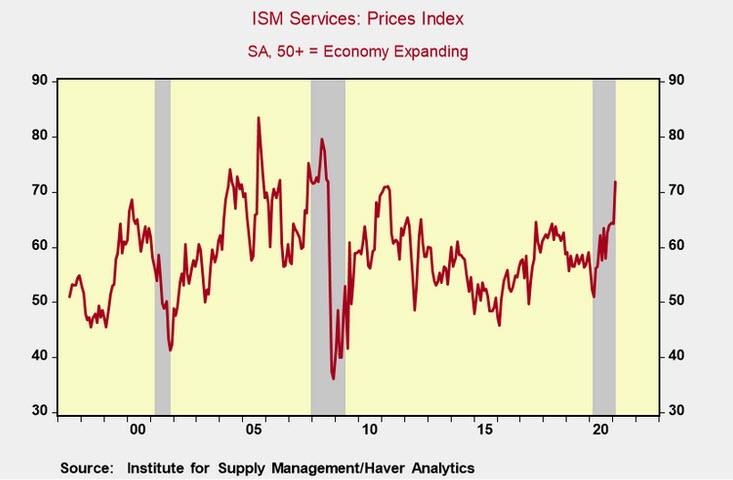
In February, the ISM price index for the service industries jumped 7 points to 72%. The ISM service sector survey started in 1997, so it does not have its brother’s (manufacturing survey) long history. Nonetheless, in the past 25 years, no business cycle started with a higher price index reading for the service sector.

The price information coming from surveys of manufacturers and service firms paint a broader uptick in general inflation, much more than what expressed in Federal Reserve officials’ future price expectations. Based on current trends, consumer price inflation could easily top 3% in 2021. And while policymakers may characterize the inflation uptick as transitory, broad inflation cycles are not transitory and require monetary tightening to reverse.

Tyler Durden
Mon, 03/08/2021 – 05:00

via ZeroHedge News https://ift.tt/30jtyhM Tyler Durden

Putin & Assad’s Revenge: Ballistic Missiles Pummel “Stolen” Syrian Oil Convoy & Refinery

Putin & Assad’s Revenge: Ballistic Missiles Pummel “Stolen” Syrian Oil Convoy & Refinery

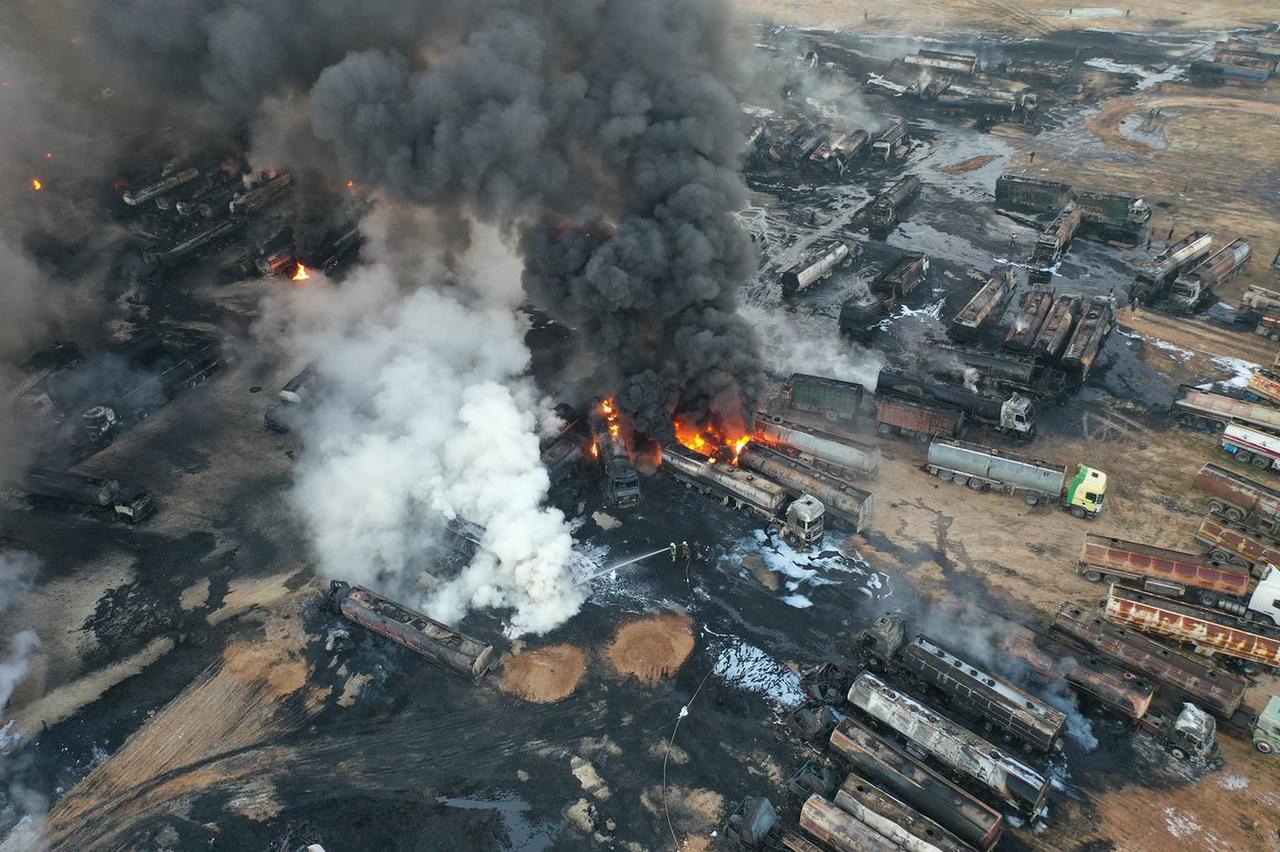
Multiple major missile strikes reportedly on a convoy of oil tanker trucks and a refinery in northern Syria lit up the night sky on Friday. Initially there was confusion as to who was behind the devastating attack which obliterated multiple dozens of oil tanker trucks.

Stunning video of massive fireballs near the towns of al-Bab and Jarablus, close to the Turkish border, circulated widely on social media with contradictory accounts of just who launched the attack. However, sources seem to be in agreement that the initial explosions were so large it had to be the result of ballistic missile strikes.

This led to accusations that either the Russian military or the Syrian government was behind it in retaliation to halt convoys of “stolen oil” taken from Syrian national territory.

Damascus and Russia have long condemned a Turkish “land grab” along the northern border, as well as US occupation of the country’s oil and gas rich northeast Deir Ezzor and al-Hasakah regions. 

Via AP

“A source in the Turkish military, which controls swaths of northwest Syria where Turkish troops have a presence, said missile attacks had caused the blasts, which also wounded 11 people,” Al Jazeera reports in the attack aftermath.

And The Associated Press described of the ‘mystery strikes’ the following on Sunday:

A suspected missile strike on an oil-loading facility used by Turkey-backed opposition forces in northern Syria sparked a massive blaze across a large area where oil tankers are normally parked, aerial and satellite images show.

Syrian opposition groups and at least one war monitor blamed Russia for the strike Friday night near the towns of Jarablus and al-Bab, near the border with Turkey. In a report, the Syrian Observatory for Human Rights, based in Britain, said Russian warships in the Mediterranean had fired three missiles that struck primitive oil refineries and tanker trucks in the region.

The missile strikes occurred late at night and the fires appeared to have been raging into the daylight hours.

Regional and anti-government news sources have been consistently pointing to Russian and Syrian government strikes…

There’s yet to be any confirmation or claim of responsibility either from Russia’s Defense Ministry or from the Assad government. 

There were multiple dead and wounded from the attack, as one Mideast news source documented:

The Britain-based monitor “documented the deaths of four people, while 24 others sustained various injuries and burns” in the attacks near the towns of Jarablus and Al-Bab. At least one Syrian rebel was among the dead, said Observatory head Rami Abdul Rahman.

Rescue workers spent hours trying to extinguish the fire which spread to about 180 oil tankers, according to the war monitor.

“The fires are the largest yet from a missile attack on makeshift refineries,” the Observatory said.

And crucially the report observed that “Oil installations in Turkey-controlled parts of Aleppo have come under repeated attack in recent months although Moscow and the Syrian regime have not claimed responsibility.”

Washington has also been conspicuously silent concerning the major attack. If indeed it turns out to have been a Russian or Syrian Army operation involving ballistic missiles, it will mark a hugely provocative ‘signaling’ to the White House that it must reverse course on its ‘oil and gas occupation’ in northeast Syria.

Tyler Durden
Mon, 03/08/2021 – 04:15

via ZeroHedge News https://ift.tt/30t7cKx Tyler Durden

Why Africa Hasn’t Kickstarted Its Renewable Energy Boom

Why Africa Hasn’t Kickstarted Its Renewable Energy Boom

Authored by Irina Slav via OilPrice.com,

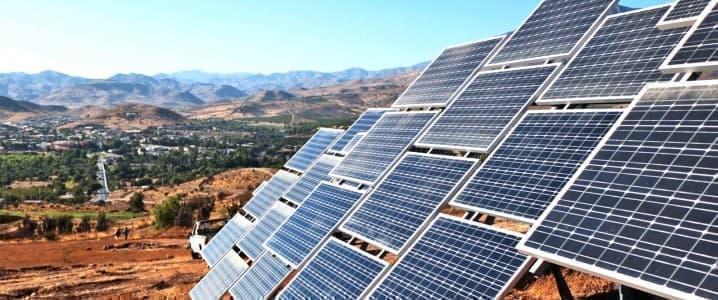
Africa has a solar energy potential of as much as 1,000 GW and wind potential of 110 GW, not to mention 350 GW in hydropower potential and 15 GW of geothermal potential. And yet, all this huge potential remains largely untapped, even though solar and wind farms are getting so cheap, they are said to be on par with coal in some parts of the world. The situation will likely be surprising for those who only follow upbeat headlines, but people with some knowledge of how renewables actually work and how businesses in general work will not be surprised by the state of affairs in Africa—and other developing regions of the world.

Solar and wind farms generate electricity by capturing the light of the sun or the energy of the wind and converting it into electricity. This electricity then needs to be transmitted to where it will be used or stored. It is at this point that one of the challenges specific to Africa rears its head: transmission.

Many African countries simply lack transmission infrastructure extensive enough to accommodate utility-scale solar and wind installations economically. After all, a company cannot just build a solar farm at a random spot only because it is near the existing infrastructure. Solar and wind farms require optimal conditions to perform well.

And the problem is not confined to utility-scale installations either, according to Intelligent Power Generation’s chief executive Toby Gill. Gill spoke to Oilprice about the renewables challenge for African countries and noted the example of Kenya—one of the African countries with a well-developed grid. Despite this well-developed grid, Gill noted, Kenya was finding it challenging to realize its solar and wind potential, even via distributed mini-grids, which are more economical than expanding the central grid. The reason: it is still economically unviable.

“As of two years ago, the cost for a micro-grid provider to connect one household to their grid was around $1000 dollars,” Gill noted.

“When you then consider the average customer is paying less than $1-2 per day for their electricity use, the payback period for these energy companies becomes untenable.”

This is where it’s worth remembering that businesses, even renewable energy businesses delivering cheap power from the sun and the wind to households, need to turn in a profit to continue doing it. And to turn in a profit, these companies need customers capable of paying what this energy—plus the infrastructure that transports it to them—costs. Generation installations are cheap, Gill says, but they are not the only part of a grid involving renewables.

“It is not the p/kWh of wind, solar, or hydro that is the limiting factor, nor does it come down the mixture of wind, solar, energy storage and fuel-based power to deliver secure and reliable power,” he told Oilprice.

“It is the fact that the cost of deploying and installing the electricity infrastructure is too high relative to the revenue potential of the customers.”

And yet, with the downward trend in the industry, maybe at some point distributed generation will become more widely affordable. There are already successful projects in this segment in some parts of Africa, according to Fieldfisher partner and head of Africa Group, Cecily Davis.

Davis told Oilprice there are successful mini-grid projects in Uganda, Ethiopia, and Sierra Leone. Some of these projects are subsidized by the European Union and the UK and aim to bring reliable electricity to people who are currently living off the grid.

“Mini-grids are considered the most commercially viable option for servicing areas that are too expensive to consider extending the main grid to, but have enough demand and population density to support commercial viability,” Davis told Oilprice.

“They are proving to be extremely successful, however they lack the generating capacity of large wind or solar installations and are electrifying rural Africa one community at a time.”

One community at a time is certainly better than no community at no time, yet there have been ambitions to boost different African countries’ renewable power capacity at a larger scale. These ambitions have hit snags that have nothing to do with the cost of generation or transmission.

One of the snags is the oil curse. Fieldfisher’s Davis points to Algeria as a case in point: a country strongly dependent on its oil and gas revenues now trying to pivot to solar power and finding it hard, precisely because of its dependence on oil and gas revenues, which have plummeted during the pandemic. The case is very much identical to that of Saudi Arabia, which still has grand plans for a renewable energy shift, to be financed with oil money.

“It is unfortunate that a number of African countries, particularly in North and West Africa, have become so reliant on oil and gas that they find themselves in a bind when it comes to investing in renewable energy projects,” Davis said.

“If they scale back fossil fuels, they lose the tax revenue to pay for other infrastructure; if they maintain oil and gas production, that makes it harder for renewable energy to compete.”

Then there is the political challenge: a lot of African governments jumped on the renewables bandwagon and made ambitious plans to make their countries entirely reliant on renewable energy. However, they overshot the deadlines and were then forced to accept it could not happen as fast as they would like. The political factor makes investors wary of funding solar, wind, or hydropower projects in many parts of the continent.

Africa is flirting with renewable energy, and it’s finding out this is an expensive flirt. It could turn into a relationship, but for this, wealth needs to increase. Renewable energy is cheap to generate, but it is not that cheap to transmit and store if you have yet to build the grid—even the micro-grid—and the storage facilities for this.

Tyler Durden
Mon, 03/08/2021 – 03:30

via ZeroHedge News https://ift.tt/2PIhoNo Tyler Durden

These Are The ‘Greenest’ Countries In The World

These Are The ‘Greenest’ Countries In The World

From widening wealth disparity to the environmental ramifications of economic development – the growing focus on global sustainability is a clear sign of the times.

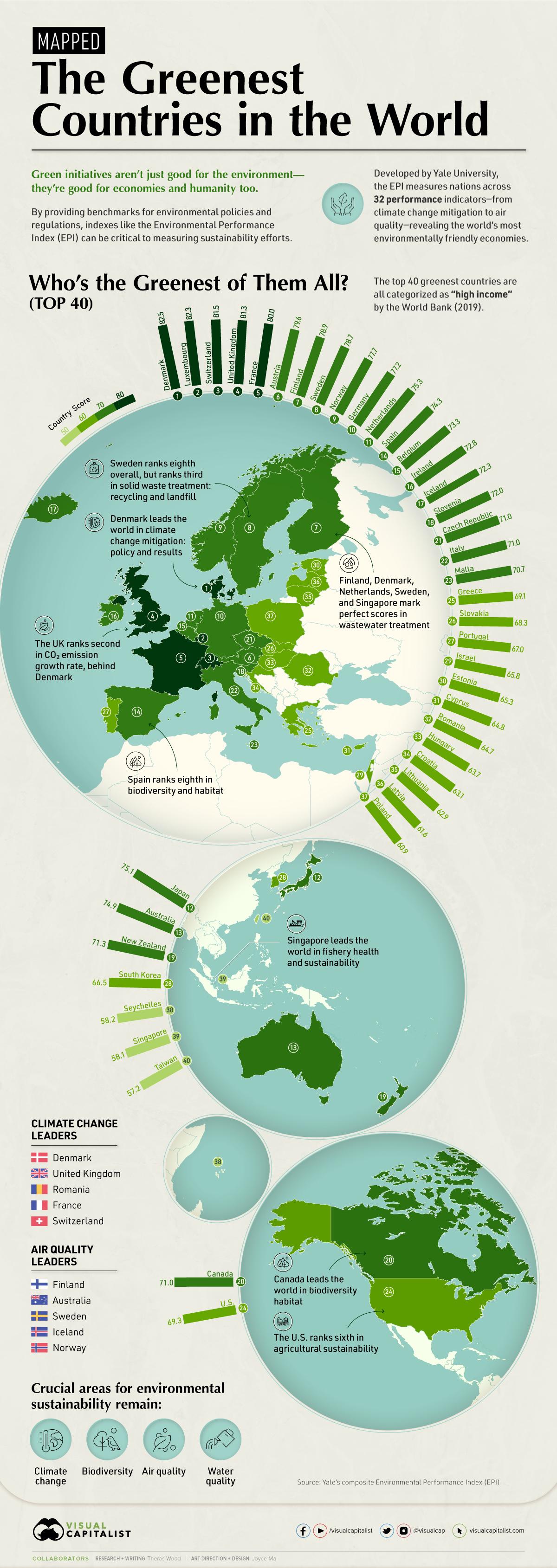
Research reveals that when a sustainable ethos is applied to policy and business, it typically bodes well for economies and people alike. By providing benchmarks for those decisions, indexes like Yale’s Environmental Performance Index (EPI) can be critical to measuring national sustainability efforts.

As Visual Capitalist’s Therese Wood details, the below map interprets the EPI ranking of 180 economies across 32 environmental health indicators by narrowing in on the top 40 greenest countries.

Who’s the Greenest of them All?

Despite the decades-long trend of globalization, national environmental policies have proved to be widely divergent. The EPI report confirms that those policies—and their positive results—are highly correlated with national wealth.

This is evidenced in the global EPI distributions, seen below:

Regional grouping in the report include: Global West, Asia-Pacific, Eastern Europe, Former Soviet States, Greater Middle East, Latin America & Caribbean, Southern Asia, and Sub-Saharan Africa

Scandinavian countries, which tend to have a high GDP per capita, show strong and consistent results across EPI parameters. Denmark for instance—which ranks first overall—leads the world in slowing its growth in CO2 emissions. Meanwhile, neighbor Sweden leads in landfill and recycling treatment, while wastewater treatment is led by a handful of countries within and beyond Scandinavia including Denmark, Finland, the Netherlands, Singapore, and Sweden.

In North America, Canada claims top spot in the biodiversity and habitat category, while the U.S. ranks sixth in agricultural diversity globally. In Asia, Singapore leads the world in fishery health and sustainability.

Ultimately, it appears the world’s greenest countries tend to focus on all areas of sustainability, while laggard countries show more uneven performance across categories.

What Does “Green” Mean?

Each high-level performance indicator with the EPI, like “environmental health”, is broken into subsections. Nations are scored on each subsector on a scale up to 100. As a result, multiple countries can rank first in any given category.

By evaluating national sustainability on a scale that is unrelated to other nations, we get a clearer idea of comparative national progress, beyond a basic ranking.

For instance, 30 countries tie for first in marine protection, all with scores of 100. This shows that many economies are prioritizing this area of sustainability.

The EPI categories and subsectors are shown in the diagram below:

Each section is weighted differently, and is reflected as a percentage within the index. For example, Ecosystem Vitality accounts for 60% of the EPI, Climate Change makes up 24% of a country’s score, and CO2 emission reduction is weighted at 13.2%.

The Cost of Being Green

Infrastructure costs are one reason why wealthier nations tend to fare better across sustainability measures. Everything from air pollution reduction and water treatment, to hazardous waste control and mitigation of public health crises are especially expensive—but have a huge potential impact on citizens.

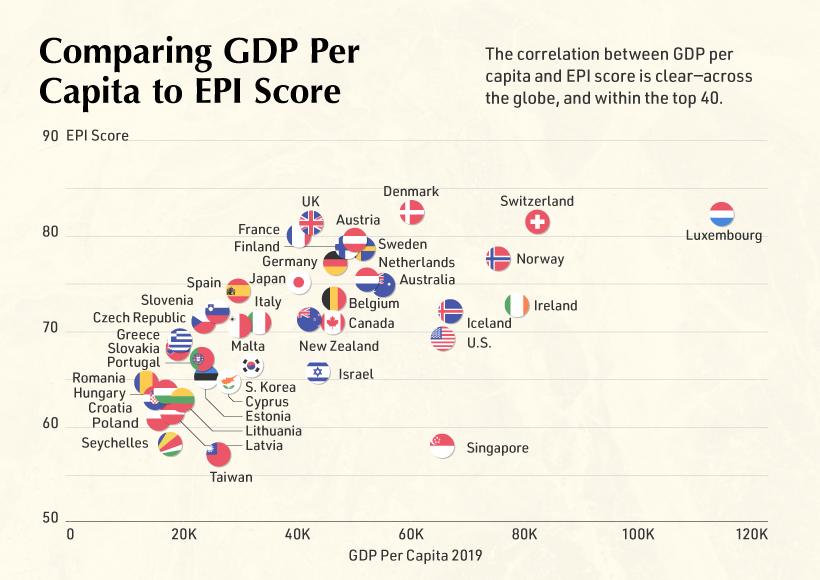
This trend can be seen the scatterplot, which demonstrates the distribution of economies evaluated by the EPI:

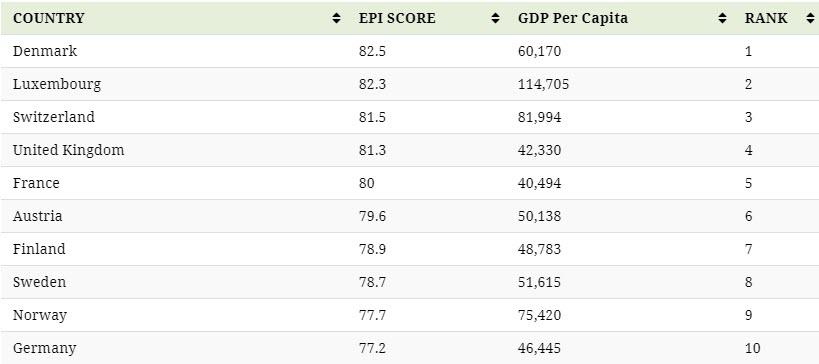
For a more detailed look, the table below highlights the GDP per capita of each of the top 40 greenest countries, based on data from the World Bank and Statista:

Despite the strong correlation between GDP per capita and EPI score, developing countries do not have to abandon sustainability efforts. China for instance leads the world in the adoption of electric vehicle technology.

Post-Pandemic Outlook

Although some rankings can seem prosaic, indexes like the EPI provide a helpful benchmark for economies to compare efforts. It also allows governments to iterate and build upon environmental strategies and investments by highlighting what is and isn’t working.

CO2 emissions, for instance, are a major driver of climate change. Although the global economic stall has led to a temporary dip of CO2 emissions in early 2020 (a slower growth rate than the 11% expected rise), global emissions still continue.

However, the EPI shows that investments have impact. High-level sustainability efforts—political commitment, media coverage, regulations—can deliver results, even at the grassroots level.

Tyler Durden
Mon, 03/08/2021 – 02:45

via ZeroHedge News https://ift.tt/3kVlBst Tyler Durden

US, EU Sanctions On Russia A Reckless Triumph Of Absurdity

US, EU Sanctions On Russia A Reckless Triumph Of Absurdity

Via The Strategic Culture Foundation,

The cynical, bankrupt basis for sanctioning Russia makes the Western states’ words and actions a reckless provocation.

The United States and European Union this week imposed a new round of sanctions on Russia in a coordinated move. The move is a reckless provocation and was condemned by Moscow as a “hostile act”. It is a further retrograde step towards increasing Cold War-style tensions and the danger of confrontation.

Russia’s foreign ministry excoriated the Western sanctions as “triumph of absurdity over reason”.

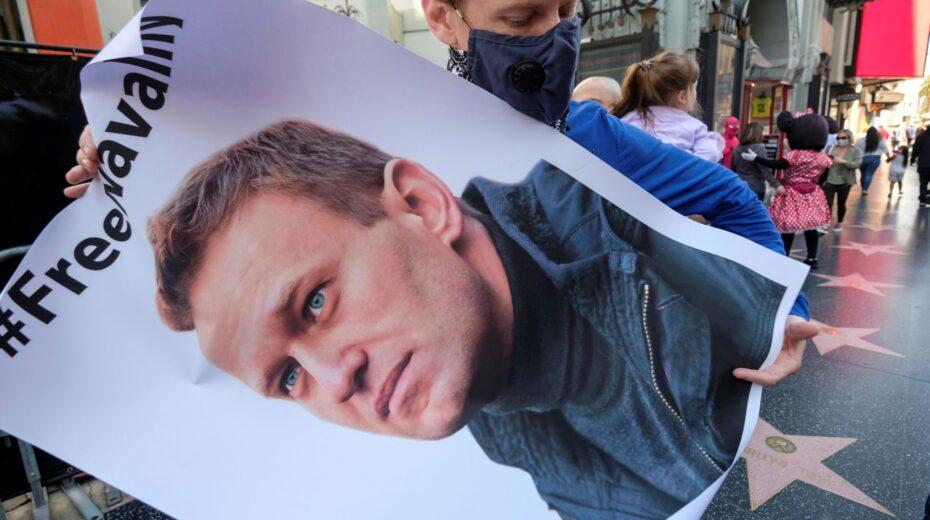
Washington and Brussels both invoked the case of opposition figure Alexei Navalny as the basis for the latest strictures. Despite wholly lacking evidence, the U.S. and European allies support his bizarre and frankly incredible claims that he was the victim of a poison-assassination plot ordered by the Russian President Vladimir Putin. That Western stance is in itself highly provocative, effectively elevating a dubious blogger and gadfly figure above the status of head of state. There is also evidence that Navalny’s activities are sponsored by Western governments and that he is an asset for foreign intelligence agencies. His brand of mercurial politics is tainted with obnoxious racist views and xenophobia. Polls show that his following among Russian civilians is no more than two per cent of Russia’s 145 million population.

Secondly, Washington and Brussels are demanding that Navalny must be released immediately from prison. The convicted fraudster was sent to jail last month after his suspended sentence for an original conviction in 2014 was revoked due to patent violations of parole terms when he stayed in Germany for five months last year. It was during that period that he and Western supporters propagated the media narrative of his alleged poison-assassination. On returning to Russia in January, the Russian prison authorities were entitled to cancel his suspended sentence, according to the country’s own laws. This is a matter of Russia’s courts and sovereignty. For Western states to demand Navalny’s release and then to slap sanctions on Russia for “refusing” their demands is an outrageous infringement of Russia’s state authority and sovereignty.

Another risible reason cited by the United States is the claim that Russia is in breach of the Chemical Weapons Convention treaty (signed in 1993 by 165 nations) because of the alleged use of a nerve agent. So, without any proof of the alleged nerve agent being used, the Americans have gone on to charge Russia of violating the Chemical Weapons Convention. The fact is Russia has fully complied with the convention and verifiably destroyed its residual stockpile of chemical arms in 2017. Here’s the kicker: the United States while being a signatory to the convention has still not complied with decommissioning its stockpile of such weapons.

In any case, there is sound reason to believe that the Navalny case is only a Trojan Horse construct to permit the United States and its European allies to pursue a policy of hampering Russia. It is notable that the latest sanctions include financial measures targeting Russian scientific and defense industries. As senior Russian lawmaker Leonid Slutsky points out: “Human rights protection [purporting to Navalny] has nothing to do with this. The aim is to curb the development of Russian science and the defense industry.”

Here is another demonstration of why the Western “concern” for human rights in Russia is a cynical pretext.

American President Joe Biden in an early phone call with Russian counterpart Vladimir Putin, shortly after his inauguration on January 20, said that he raised stern concerns about Navalny and human rights.

Last week, Biden held his first phone call with Saudi Arabia’s King Salman. Their conversation was said to be cordial with Biden valorizing the “strategic alliance” between the United States and Saudi kingdom.

Just as Biden was praising the Saudi monarchy, the U.S. intelligence services released a report which again confirmed that the king’s son and heir to the throne, Crown Prince Mohammed bin Salman, was directly implicated in the murder of journalist Jamal Khashoggi. This conclusion implicating the crown prince has already been reached by the UN special rapporteur Agnes Callamard, as well by Turkish intelligence, among others.

In 2018, Khashoggi was lured to the Saudi consulate in Istanbul where he was brutally murdered and his body carved up with a bone saw. The team of killers included close aides of the Saudi crown prince. The evidence convincingly points to the monarch’s complicity.

Jamal Khashoggi was working as a journalist for the Washington Post. He had residence status in the United States and was well regarded by Washington-based think-tanks for his intelligent criticism of human rights abuses in Saudi Arabia.

Yet in his conversation with the Saudi King, it was reported that Biden did not bring up the case of Khashoggi, and only made vague, perfunctory mention of the many other human rights violations in the autocratic oil kingdom.

Along with Biden’s silence we can add that of the European Union. Soon after the Khashoggi murder, there were grumblings among some EU members to cut exports of weapons to Saudi Arabia. Today, the EU makes no such protests, having resumed lucrative business-as-usual. There are no calls for justice over the barbaric killing.

The difference between the U.S. and EU’s vociferous “concern” over the minor and dubious case of Navalny compared with their inaction over the glaring case of Jamal Khashoggi goes to show their rank hypocrisy and duplicity. The cynical, bankrupt basis for sanctioning Russia makes the Western states’ words and actions a triumph of absurdity over reason, and a reckless provocation.

Tyler Durden
Mon, 03/08/2021 – 02:00

via ZeroHedge News https://ift.tt/2PMw6mF Tyler Durden

Welcome To The Inversion

Welcome To The Inversion

Authored by Robert Gore via Straight Line Logic blog,

Getting along by going along with the patently absurd…
A seamless web, they all believe because they all believe.

– The Gordian Knot, Robert Gore, 2000

If it seems like the world has turned upside down it’s because it has. Right is wrong and wrong is right. Truth is lies and lies are truth. Knowledge is ignorance and ignorance is knowledge. Success is failure and failure is success. Reality is illusion and illusion is reality.

It would be comforting to say that this inversion is a plot by nefarious others. Comforting, but not true, in the pre-inversion meaning of the word true. Rather it stems from answers to questions that confront everyone. To think for yourself or believe with the group? To stand alone or cower with the crowd? It’s the conflict between the individual and the collective, and between what’s true and what’s believed.

We live in an age of fear. It’s not fear of germs, war, poverty or any other tangible threat that most besets humanity. It’s the fear of being disliked and ostracized by the group.

If every age has its emblematic technology, ours is social media, with its cloying likes and thumbs up and its vicious cancellations, doxing, and deplatforming. No longer must you wander through life plagued by that nagging insecurity—am I liked? Now you can keep virtual score: you not only know if you’re liked or disliked, you know how much and by whom. Unfortunately, that knowledge doesn’t seem to help; the scoreboards only amplify the insecurity. What was once an occasionally troubling question, privately asked of one’s self, has become a widely held, public obsession.

The official Covid-19 response is the apotheosis of inversion and probably the one that runs it off the rails. There’s a model that has repeatedly erred predicting infection and death rates by orders of magnitude. Use it! Politicians and bureaucrats, the two most power-hungry groups on the planet, are clamoring for unlimited powers to destroy jobs, businesses, economies, lives, and liberty. Give it to ’em, no questions asked! Sunshine, Vitamin D, fresh air, and exercise prevent diseases and lessen their symptoms’ severity. Lock ’em up! Lockdowns aren’t working. Lock ’em up harder! Masks don’t prevent or hinder viral transmission, their packaging says so. Double, triple, or better yet, quadruple mask! At high cycle thresholds, the PCR test throws off many false positives, inflating case counts. Crank up the cycle thresholds until Biden gets in office! Cheap medicines hydroxychloroquine, and ivermectin both prevent and cure the disease, provided it’s not too far advanced. Discourage their use! They work better than expensive vaccines. Make vaccinations mandatory! Scores of reputable and eminent doctors and scientists are questioning and criticizing the protocols. Censor them and follow our shapeshifting science! Death counts are inflated because hospitals have a financial incentive to attribute deaths to Covid-19 and anybody who has tested positive and subsequently dies of whatever cause is labeled a Covid-19 death. If they scare people into saving just one life…. The cure is far worse than the disease. Shut up or we’ll shut you up! There’s always germs out there and they constantly mutate, this horseshit could last forever. New Normal, Great Reset. It will last forever, and it will get worse, won’t it? We’ll circle back on that.

Peer pressure is the fundamental force of the social universe. Anyone who’s part of a collective will be pressured to accept its consensus on matters trivial and important. Congruence between what a collective believes and truth is happenstance. The larger the group, the higher the chance of incongruence.

Groups don’t think, they perpetuate and enforce belief. Collectives collectivize what passes for thought, none more so than governments. There’s always the danger that someone might ask why those who rule get to club everyone else into submission. Rulers either suppress that question or try to provide a nominal justification. If they have the clubs, what are they worried about?

The ruling caste is always small compared to the ruled. No matter how many clubs it has and how overmatched the subjects may be, the ruling caste knows its position is more secure if their subjects believe their propaganda and consent to their rule. The underpinnings of frightened compliance with, “Do as you’re told or else!” are rickety compared to a chorus chanting in unison “We’re all in this together!” or some such rot.

None are so enslaved as those chained to group belief. Truth is irrelevant, group acceptance paramount. Belief is unquestioned and unchallenged, truth the shunned and hated enemy. Governments have promoted this inversion for centuries, always telling the same lies. Faith in government may be the strongest and longest-lived secular religion, and it’s certainly the one most resistant to questions, investigation, or contrary evidence.

The script never varies. We’re good, they’re bad, exterminate them. Conquest, domination, and empire are our nation’s greatness. Need not greed: those who earn it are selfish for trying to keep it; we’re virtuous for taking it away. Our pieces of paper are good as gold. Your squalor has nothing to do with our opulent lifestyles; be grateful for your bread and circuses. Dissidence must be suppressed; opposition is traitorous. Ruination and death are everyone’s fault but ours. You just weren’t good enough to live up to our ideals.

Inversions can only last so long. People consciously or unconsciously reject them, and reality doesn’t invert. A small coterie in Washington may believe they run a global empire, but Russia and China refuse to kowtow, even nominal allies are backing away, and the costs of maintaining its crumbling empire are helping drive the US into bankruptcy. What US cheerleaders call the best military in the world hasn’t won a significant war since World War II and its fighting forces are being ideologically culled or indoctrinated in wokesterism, systematically rendering it even less fit to fight.

The censors no longer hide their censorship. There are stories that cannot be reported, questions that cannot not be asked, investigations that cannot be launched, platforms that cannot be allowed, and issues that cannot be discussed within the captured media. It cried foul when Donald Trump made “fake news” a catch phrase, but it caught on because it confirmed what millions know: much of today’s “news” is fraudulent propaganda.

After a month-and-a-half of one-party rule it’s clear that suppression is only going to get worse. Among those who intellectually stand outside the collective, suppression neither decreases belief in what is suppressed nor increases belief in the party line. They know the truth lies in what’s being kept from them.

Subconsciously, even adherents to the party line never completely believe it. Fully “woke,” you may “know” that Western civilization is a discredited product of the white male patriarchy. However, do you throw yourself from the top of a tall building because the properties of gravity were first described by white English patriarch Isaac Newton?

Psychological dissonance plagues true believers. What are they going to believe: dogma or their own senses and thought processes, such as they are? It’s the root cause of their psychic brittleness: the inability to answer questions or engage in debate, the insistence on ostensible agreement, and the need to suppress anyone who doesn’t go along.

The fragility that tries to adjust reality to belief runs head-on into the desire among those whose behaviors are to be adjusted to live their own lives as they see fit, not to mention reality itself. America’s divide is between those who want to be left alone and those who want to tell them what to do. It’s so much easier for the latter if they can impose at least the appearance of consent on the former through suppression, fraud, or force.

Reality doesn’t invert, no matter how many people believe otherwise. Governments and central banks will debase their fiat debt instruments until the illusion that they’re worth something is discarded. They have every incentive to do so and it’s happening now as governments go broke. Empires crumble because they require more energy and resources to maintain than they generate. The American empire will be no exception. The more production is taxed. regulated, and otherwise penalized, the less production you get. The more indolence is rewarded, the more indolence you get. As government’s power expands, people’s freedom shrinks. You can make people engineers or brain surgeons based on their race, ethnicity, gender, sexual preference or any other irrelevant factor, but it increases the likelihood that the bridge collapses and the patient dies on the operating table.

A society that corrupts science, the basis for discovering, describing, and employing reality, is doomed. Honest science requires free inquiry and debate. It is a never-ending process of proposing, testing, evaluating, revising and discarding hypotheses for new ones with more explanatory and predictive power. There is no such thing as settled science. The claims that there is with regards to climate, coronaviruses, or any other scientific issue are nothing more than admissions that the purported science is propaganda. Unchallenged science is a contradiction in terms; challenge is the lifeblood of science.

So add science that isn’t science to the long list of inversions that collectively could spell humanity’s doom. Consequences don’t recognize wishful thinking or political diktat. Climate and coronavirus dogma masquerading as science is the Trojan horse ushering in the great reset of a new world order. Global governance, state-approved science, political and cultural canons enforced with jihadist zeal, top down economic command and control, the eradication of any vestiges of liberty, and billions of unthinking adherents will destroy rather than build, compounding today’s inversions and creating new ones.

The danger to all this is individuals who think and act for themselves, those who are woke to the woke, so to speak. The key to standing on the outside, critically examining what’s within, is to abandon any desire to be on the inside. The docile dreck and their puppet-masters within are usually sufficient inducement to stay outside. Once that decision is made, independence of thought is almost assured. (Those who see the inside for what it is and still want in are corrupt beyond redemption.)

Challenge dogma and propaganda and you’re a dissident. Not always a comfortable position, but the dissidents will have the best shot at surviving the coming collapse. The insiders will suffer shattering disillusionment as reality obliterates cherished belief…and the insiders.

The historically unprecedented scale of present inversions guarantees upheaval and change beyond reckoning when reality’s full force can no longer be denied or subverted. Even those who see things as they are and regard themselves as fully prepared will be shocked by what’s to come. At least they will retain the existential essentials of observational power and logic as they sort through the smoldering intellectual landscape, discard the inversions, and get on with the rebuilding.
Tyler Durden
Mon, 03/08/2021 – 00:00

via ZeroHedge News https://ift.tt/3qm6b1r Tyler Durden

China’s 7,500-Mile Undersea ‘Peace Pipe’ To Connect Belt And Road Countries 

China’s 7,500-Mile Undersea ‘Peace Pipe’ To Connect Belt And Road Countries 

The Trump administration spent the last several years bashing China’s Belt and Road Initiative (BRI) and called it a ‘debt trap’, and urged countries worldwide to resist allowing China to build infrastructure projects in their respected countries. With the Biden administration now in power, there has yet to be a visible protest from the White House of Beijing’s new plan to construct a 7,500-mile submarine communications cable from Pakistan to Africa to Europe.

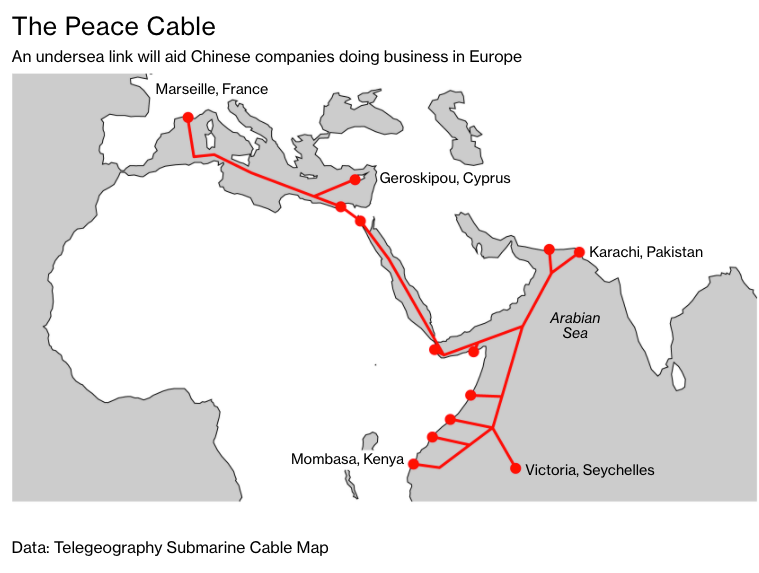
The high-speed, 7,500-mile Pakistan and East Africa Connecting Europe (PEACE) subsea communication cable system will offer high-capacity, low-latency routes connecting China, Europe, and Africa. In addition to France, the cable will land in Malta, Cyprus, Egypt, Djibouti, Kenya, Pakistan, and other countries with ultimate connectivity to China. 

Some of the countries listed above are part of the BRI. China’s motive behind the new undersea project is to provide high-speed internet connectivity to Chinese companies doing business in Europe and Africa.

“This is a plan to project power beyond China toward Europe and Africa,” Jean-Luc Vuillemin, the head of international networks at Orange SA, the French telecommunications that will operate the PEACE cable landing station in Marseille, France, told Bloomberg

More interesting, Huawei Technologies Co. is the third-largest investor in Hengtong Optic-Electric Co., the company building the PEACE pipe. Huawei is expected to provide critical telecommunications equipment for the project – some of Huawei telecommunications equipment has been cited as a national security risk by the US. 

Despite the Trump administration’s hard stance against the BRI and Huawei and other Chinese companies – the Biden administration has yet to visibly criticize China’s new ambitions to construct a global undersea cable network. Much of the internet around the world is transmitted in 400 undersea cables stretching worldwide, controlled mostly by US companies. Chinese encroachment on the US’ dominance would likely usher in a response from the White House. 

Bloomberg sources said the French government is prepared to take flak from US officials over the PEACE cable. 

“It could look to mollify the US by keeping certain types of traffic off the cable,” another source said. 

French President Emmanuel Macron told the Atlantic Council in February that France doesn’t want to isolate itself from China. German Chancellor Angela Merkel also had similar remarks last month. 

Some European leaders objected to requests by the past administration to “decouple” from China despite security risks. According to security experts, risks are brewing that China could create backdoors into the PEACE pipe to siphon data. 

“Any time that you have your data traveling over their switches, their cables—these are the source of redirecting traffic and eavesdropping,” said Robert Spalding, a senior fellow at the Hudson Institute policy group in Washington. “It’s just common sense.”

China’s attempt to control the world’s internet could be realized in the next couple of decades. The Institute of Peace and Conflict Studies and the Netherlands-based Leiden Asia Center estimates China could be the owner of at least 20% of undersea communication cables worldwide by the end of the decade. 

The great power competition between the world’s two largest economies is now spilling into the internet’s physical layers. 

Tyler Durden
Sun, 03/07/2021 – 23:30

via ZeroHedge News https://ift.tt/38jrue4 Tyler Durden

So Much For A ‘National Healing’

So Much For A ‘National Healing’

Authored by Peter R. Quinones via The Libertarian Institute,

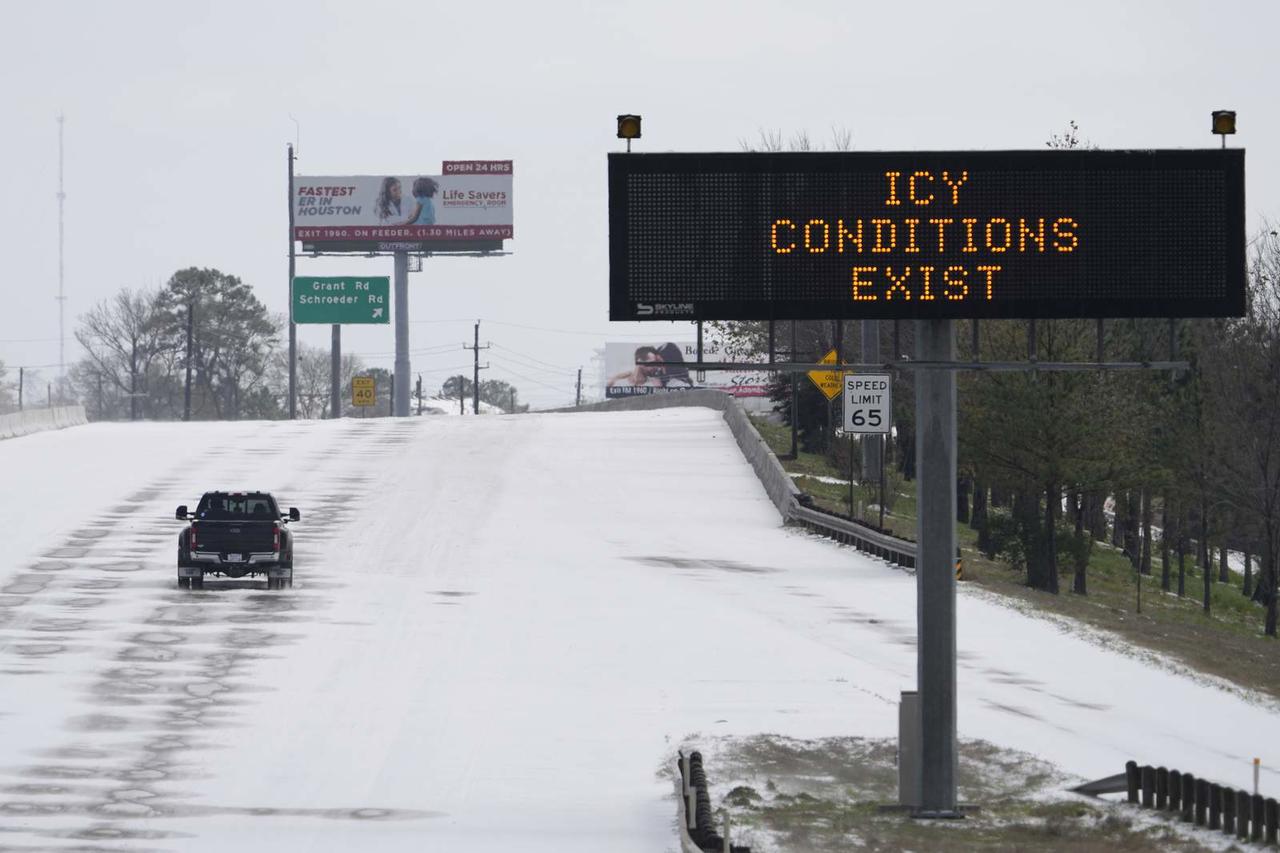
We were told the nation was in desperate need of “healing” because a large portion of the population wanted Donald Trump to “lead” the country. And if you believe that the “national healing would begin” because the “adults” are in the White House…well, you’re a dupe. The response by the corporate press and their supporters to the first freeze to happen in Texas in decades should put to rest any thoughts that the elites, especially the journalists, desire unity. Mass power outages were experienced throughout Texas and the establishment didn’t even attempt to hide their joy.

The situation many Texans faced over that week couldn’t be because freezes like this are so rare in Texas that the grid is not designed to handle the overload in demand or the freezing of its physical infrastructure. No, that can’t be it. The only reason millions of “bumbling hicks” were forced to endure power outages is because so many of them believe CNN and MSNBC are “fake news” and this belief caused them to vote for Trump. It’s amazing to me that a segment of the population that is so anti-religion adopts such a “wrath of God” or “Karma’s a bitch” stance so often when it comes to their adversaries.

I know many people who live in Texas and have been in constant contact with them. Thankfully they’re fine. But, was I shocked by this incident? As someone who lived through “Snowmageddon” in Atlanta in 2014, the answer to that is…hardly. In that year Atlanta was shut down by two inches of snow. Seriously, look it up. The snow started in the middle of the work day – roughly 11:30 AM EST – at which time school buses were loaded to take kids home and everyone left work. If you are at all familiar with Atlanta traffic, on a normal day we do not need multiple accidents to experience the second worst commute in the United States. It’s just every day congestion.

Now, imagine everyone within the city limits and surrounding areas leaving work at the same time. Add in two inches of snow which many people are not used to driving in and it was like a scene from The Walking Dead. People slept in their cars on the freeways and side streets, with many not able to get home for 24 hours. And guess what? The coastal elites went to social media and their news outlets to talk about what a bunch of hicks we were.

Why did Snowmageddon happen? It was a perfect storm of events that all occurred at once. If the storm had occurred at 3 AM, the majority of people would’ve been peacefully sleeping and the number of people trapped in cars would’ve been minimal. Atlanta wasn’t prepared because what happened during Snowmageddon had never before occurred. Apply that “not the norm” occurrence to the freeze in Texas and you have your answer to the state’s recent problems. Atlanta now has snow plows, but more importantly, schools close and businesses are asked to not open if there’s a threat of a midday snow storm.

I expect the freeze in Texas will cause the local and state governments there to have similar plans in place so that the power outages, with all the associated impacts, will not occur in the future. Or they’ll devise some scheme that will mitigate how widespread the outages will be.

Even if they don’t construct a plan for the future, the fact that the “enemy class” is using the freeze as an opportunity for ad hominem attacks against Texans should tell you everything you need to know about their so-called plans to “heal the divides.” If anything, I expect the attacks to escalate and hope they do. Popcorn futures are booming!

Tyler Durden
Sun, 03/07/2021 – 23:00

via ZeroHedge News https://ift.tt/38iX3oq Tyler Durden