A confluence of factors led to this week’s sell-off in markets. In the lead up to this week’s market top we saw all the classic signs: Weakening participation, highly overbought readings, vast technical extensions, historic valuations accompanied by extreme complacency and bear capitulations.
And make no mistake: This sell off was intense. $NDX dropped 10% within 2 days off of all time highs, one of the fastest and steepest drops from all time highs in history if not the most in history. High flying tech stocks such as $AAPL and $TSLA dropped 20% and 26% in 2 days as well.
A mere flesh wound in what was an unstoppable rally or signs of the end or the beginning of the end?
I’m discussing these issues and more of the macro context in a new edition of Straight Talk. As announced this week I’ve moved Straight Talk to a podcast format and in the next few days/weeks I’ll make sure it gets listed in your favorite podcast directories such as Apple Poscats, Spotify and Google Podcasts and perhaps others as well so you can follow new episodes from there as well.
For now here’s the newest edition of Straight Talk:
As I discuss some charts in the episode I post some here for reference.
Namely:
The $VIX. In August I published $VIX 46 when $VIX was trading at 22 calling for a breakout to come with a target for 46. While the target has not been reached as of this writing we did get a major breakout and the $VIX hit 38 on Friday an over 70% move from the original post:
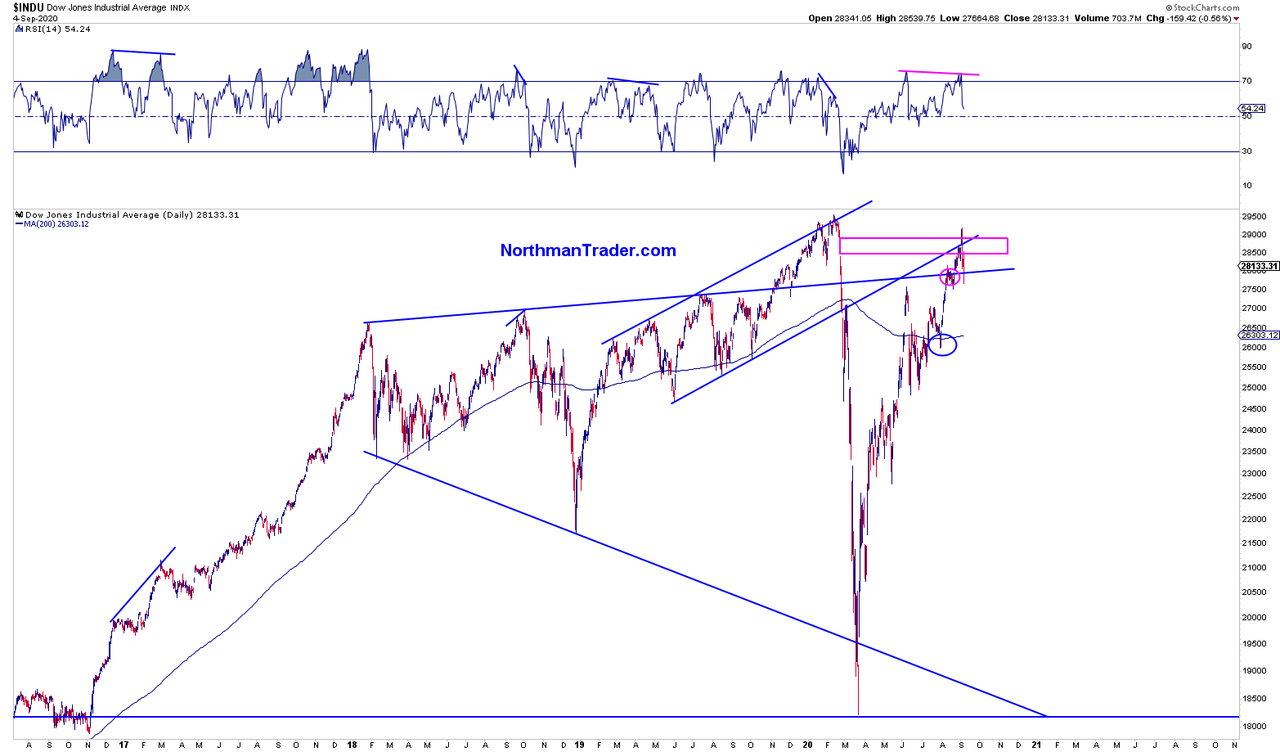
Also in August I mentioned the $DJIA having potential of its February gap and this gap was filled this week and it produced a rejection from here:
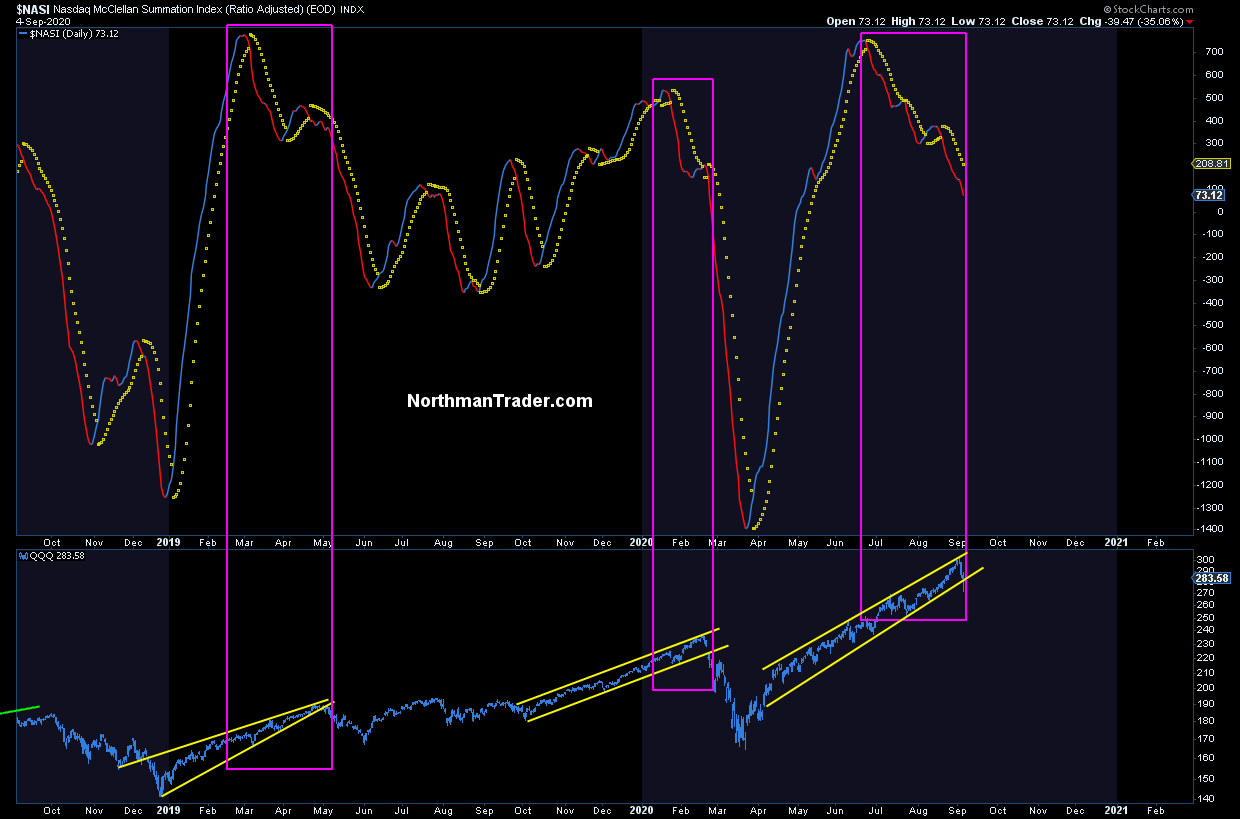
Also in August I kept talking about the weakening signals underneath and a warning sign on tech specifically the $NASI pointing to a coming correction in tech:
And I kept talking about the lack of confirmation in the value line geometric index $XVG with its message:
I repeat: New highs in select indices have been highly deceiving. They were driven by a few mega cap stocks.
The $XVG index suggests a border market still in a bear market.
Based on that measure $SPX would be trading at 2,600 were it not for mega cap expansions in 6/7 stocks. pic.twitter.com/UFSi7HchgD
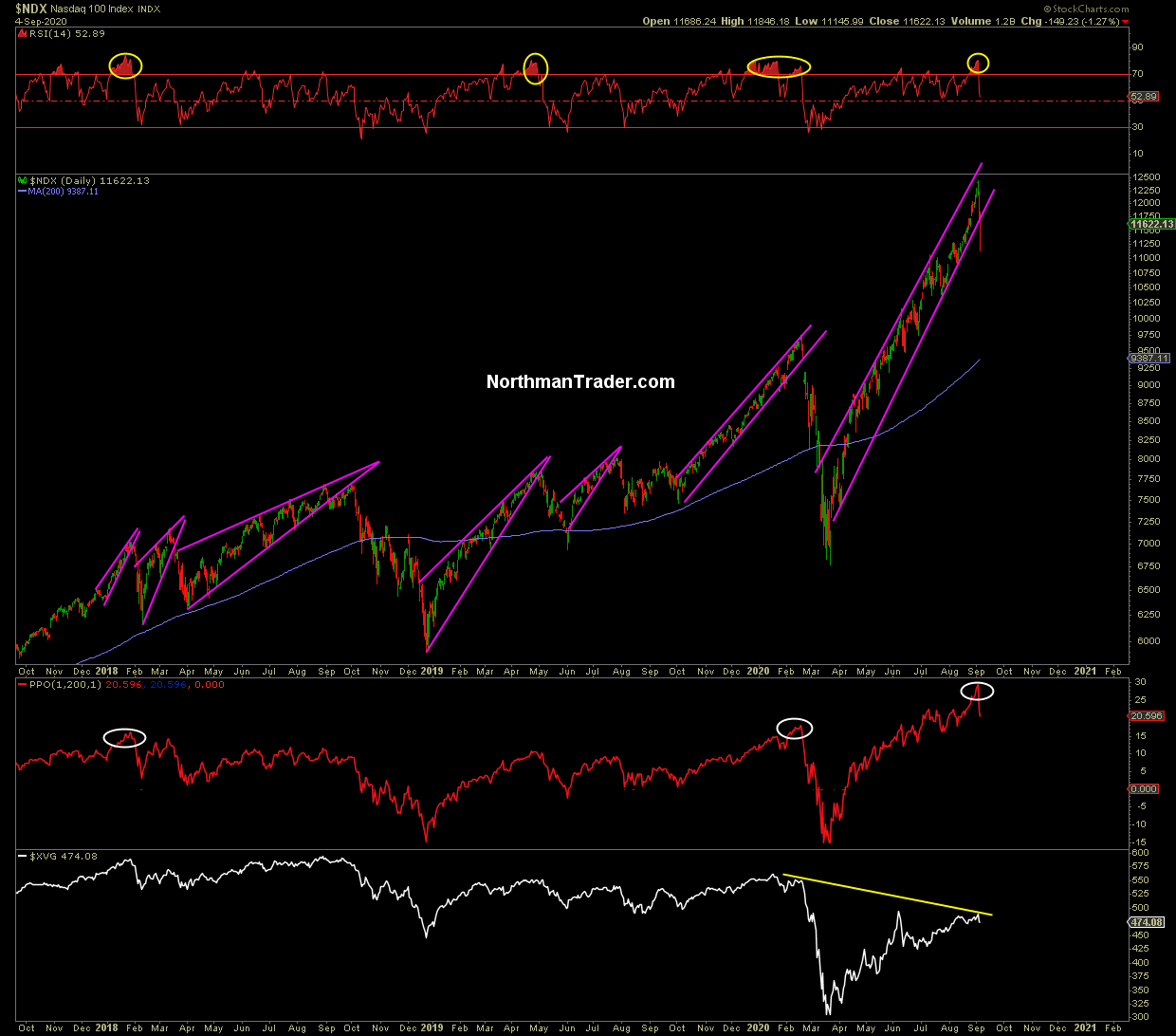
While indices kept driving to new highs in ever more extended patterns, similar to rallies we’ve seen before with this being the most extended since the year 2000. $SPX traded the highest above its 200MA and $NDX reached prices 33% above its 200MA:
All this as put/call ratios hit historic lows:
I repeat: New highs in select indices have been highly deceiving. They were driven by a few mega cap stocks.
The $XVG index suggests a border market still in a bear market.
Based on that measure $SPX would be trading at 2,600 were it not for mega cap expansions in 6/7 stocks. pic.twitter.com/UFSi7HchgD
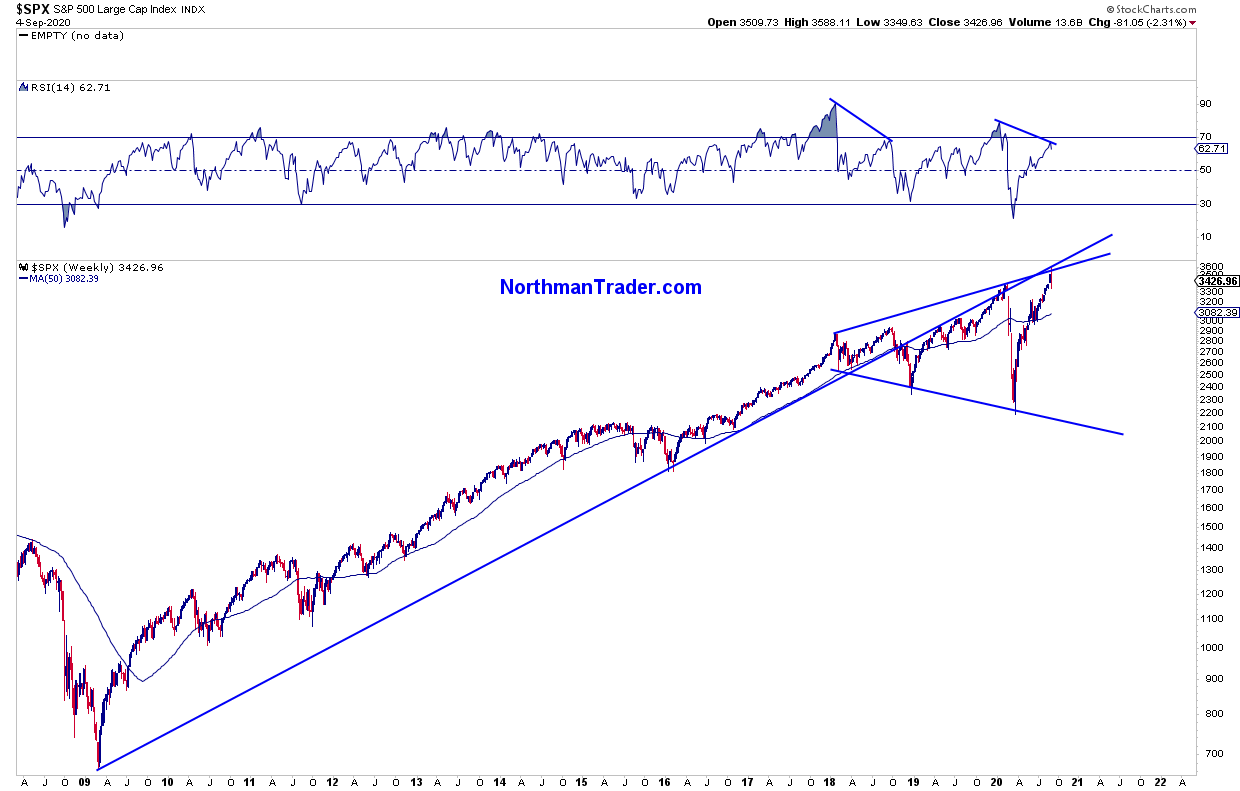
And finally as outlined in Bear Capitulation and Panic Buying $SPX was reaching historic resistance as evidence by 2 key trend lines, both were hit this week and $SPX rejected from there:
In the context of history is this a coincidence that this all happened to come together at the beginning of September?
After all, following the market top in March of 2000 the subsequent counter rally peaked on September 1 and the top in 1929 ended on September 3rd, as did now this rally. This rally topping on September 2nd and in pre-market on September 3rd could all be a coincidence of course, but only time will tell.
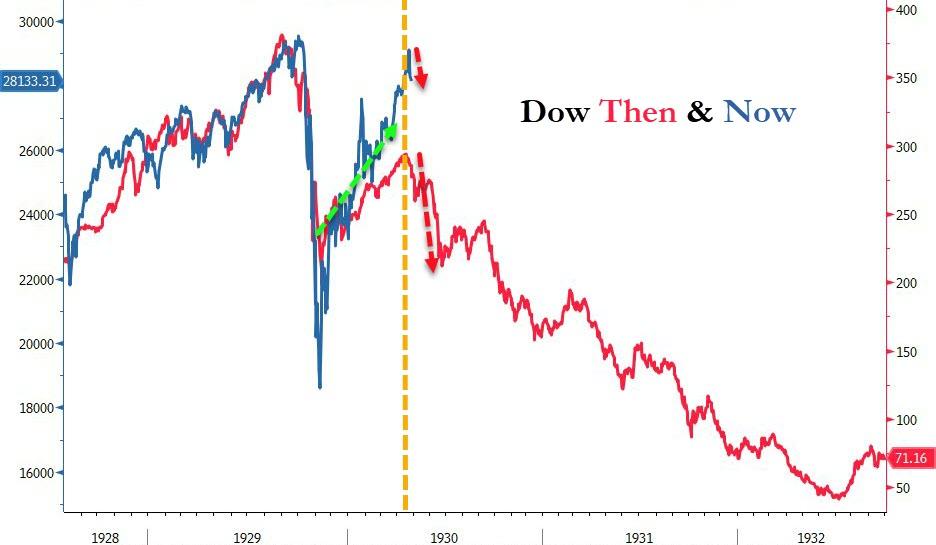
The similarity in structure though between the historic run leading to the top in 1929 and the last 13 years is striking:
Pretty wild actually. Not sure if it means anything, but the structural similarity, despite all the differences in time and global technology is pretty impressive. pic.twitter.com/GHs15JDT81
I’ll be publishing a detailed analysis of the technicals and implications tomorrow Sunday September 5th in the latest edition of Market Videos (if not signed up yet you can do so via the link)
For now I hope you enjoy the discussion in Straight Talk: Bear Raid.
* * *
For the latest public analysis please visit NorthmanTrader. To subscribe to our market products please visit Services.
via ZeroHedge News https://ift.tt/2RbGjqd Tyler Durden
Police Arrest 27 After Another Violent Protest In Portland Tyler Durden
Sat, 09/05/2020 – 14:35
Portland police made multiple arrests overnight on Friday during what one independent journalist described as a “violent Antifa riot”. Nearly 100 days have passed since the unrest started, and it looks like the seemingly professional class of demonstrators keeping the unrest alive aren’t slowing down at all.
The night after the suspect in a fatal shooting – a suspect who once described himself on camera as “100% Antifa” – was himself gunned down after pulling a gun on the cops who came to arrest him, violent rioters in Portland once again came out to attack federal property.
According to Reuters, police arrested 27 people, mostly on charges of interfering with law enforcement or disorderly conduct. Many were arrested for throwing projectiles at officers.
“Officers began to make targeted arrests and in some cases moved the crowd back and kept them out of the street,” according to a press released issued on Saturday.
Here’s a more in-depth description of the protest from the AP, which said a few hundred demonstrators participated. The demonstrators ultimately tried to target the Portland Police Association building.
A few hundred demonstrators had met at Kenton Park before making their way to the Portland Police Association building, where officers warned protesters to stay off the streets and private property. Those who refused could be subject to citation, arrest, the use of tear gas, crowd-control agents or impact munitions, police said.
Around midnight, police ran down the street, pushing protesters out of the area, knocking people down and arresting those who they say were not following orders — as some people were being detained, they were pinned to the ground and blood could be seen marking the pavement. Law enforcement officers used smoke devices and shot impact munitions and stun grenades while trying to get the crowd to disperse, The Oregonian reported.
The Portland Police Bureau issued a statement Saturday morning, saying some officers reported that rocks, a full beverage can and water bottles had been thrown at them, prompting police to declare the gathering an unlawful assembly.
Police said at one woman who was detained was bleeding from an abrasion on her head, and she was treated by medics at the scene before being transported by an ambulance. The Portland Police Bureau said she jumped out of the ambulance and ran away before it left the scene, however.
Most of those arrested were arrested on suspicion of interfering with a peace officer or disorderly conduct, police said.
Portland wasn’t alone: violence, vandalism and looting swept across Rochester and NYC last night, too.
But protesters claimed they had a right to keep coming out following the new revelations of the killing of Daniel Prude revealed on Wednesday, while President Trump signed a memo threatening to cut federal funding to “lawless” cities, including Portland, unless they bring the street violence under control.
And Ngo, the faithful chronicler of the unrest sweeping across the US since the killing of George Floyd, shared video of the latest round of protests from last night, including one scene where protesters nearly hit their “comrades” with thrown projectiles as they were being taken into custody.
Portland Police arrest antifa rioters overnight. One of them is crying. Their comrades continue throwing projectiles at police, nearly hitting those being arrested on the ground. #PortlandRiotspic.twitter.com/s2e5k5h7eX
One woman who was arrested at the “violent” protest reportedly escaped from an ambulance.
Based on known details released by @PortlandPolice, this appears to be the woman arrested at the violent antifa protest who escaped from the ambulance overnight. pic.twitter.com/FfCHRbGxix
And for all the ‘blue checks’ who insist on soliciting donations to “bail funds”, here’s where that money is going to.;
Breaking: Kevin Phomma was arrested by Portland Police after he allegedly attacked cops w/bear mace at an #antifa riot. His $33,000 bail was quickly paid.
We imagine they’ll be back again on Saturday, as the cycle of unrest continues and Democratic mayors move to “defy” President Trump over his threat to cut federal funding.
Finally, as we’ve said before, it’s important to remember that the violence we are seeing is in mostly white cities by mostly white people. Minneapolis is 19% black. Seattle is 7% black and Portland is 6% black. Kenosha is 10% black and close to 80% white. Even LA, which has a larger population of blacks, hasn’t seen riots erupt like Portland, even after the city suffered yet another police shooting of a black man.
via ZeroHedge News https://ift.tt/326O9Yt Tyler Durden
If you think that price inflation runs at about 1.6% you have fallen for the BLS’s CPI myth. Two independent analysts using different methods — the Chapwood Index and Shadowstats.com – prove that prices are rising at a far faster rate, more like 10% annually and have been doing so since 2010.
This article discusses the consequences of price inflation suppression, particularly in the light of Jerome Powell’s Jackson Hole speech when he downgraded the importance of price inflation in the Fed’s policy objectives in favour of targeting employment.
It concludes that the reconciliation between the BLS CPI figure and the true rate of price inflation is inevitable and will be catastrophic for the Fed’s policy of suppressing interest rates, its maximisation of the “wealth effect” of inflated financial asset prices, and for the dollar itself.
Monetary inflation takes off
Last week saw a virtual Jackson Hole conference, where Jerome Powell downgraded inflation targeting in favour of the other Fed mandate, employment. And Andrew Bailey, Governor of the Bank of England, claimed “We are not out of firepower by any means…. to be honest it looks from today’s vantage point that we were too cautious about our remaining firepower pre-Covid”.
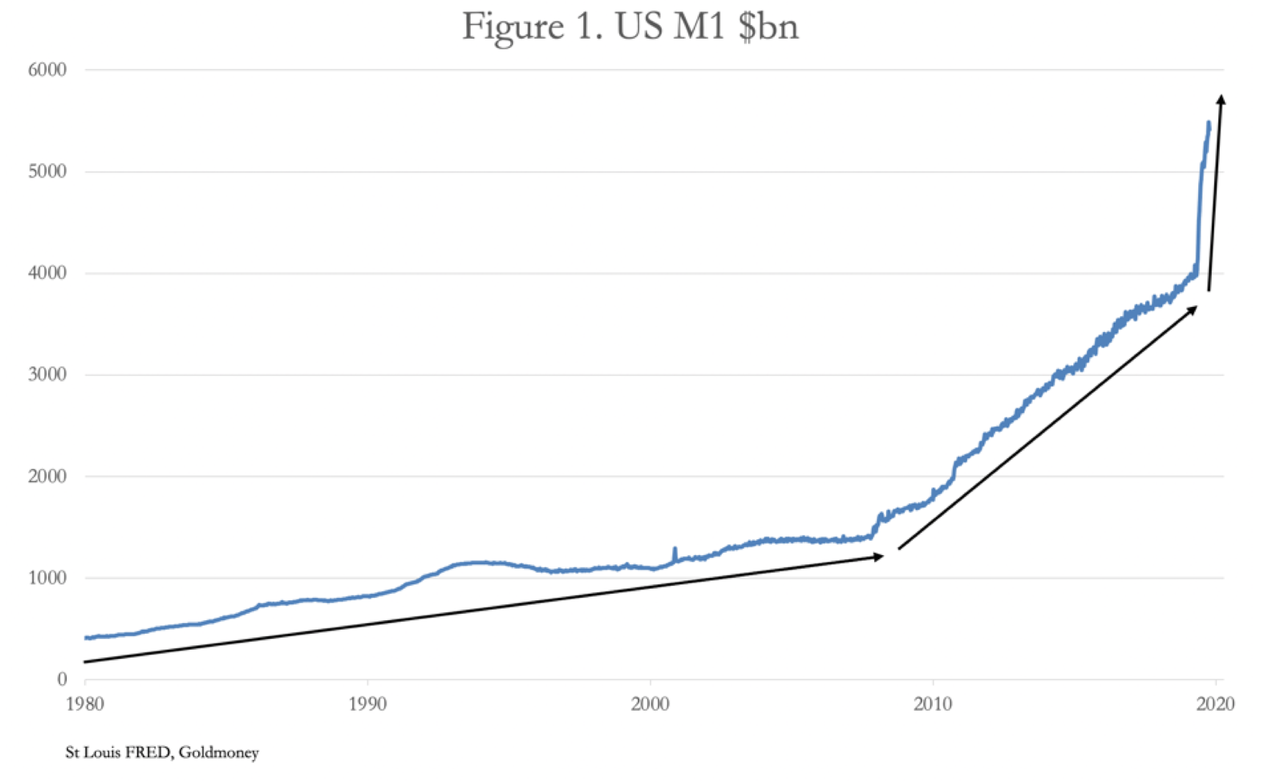
Both men were tearing up earlier scripts. Since they will likely tear up these as well there is little point in examining them further. For the fact is that all the major central banks are trapped in problems of their own making, and some time ago they lost control of their destinies. Figure 1 below encapsulates the problem.
M1 is the US narrow money indicator. Over 28 years from 1980, it grew at a simple average annual rate of 8.8% per annum. From 2008 to last February, following the Lehman crisis it grew at an average annual rate of 16.6%, From 24 February in six months it has grown by 34%, which is an average annual rate of 68%. What Powell effectively admitted at Jackson Hole was that M1 annualised growth of 68% was not enough to ensure the US economy would recover. He would have had to downplay the effect on prices to create leeway for further increases in the rate of monetary growth.
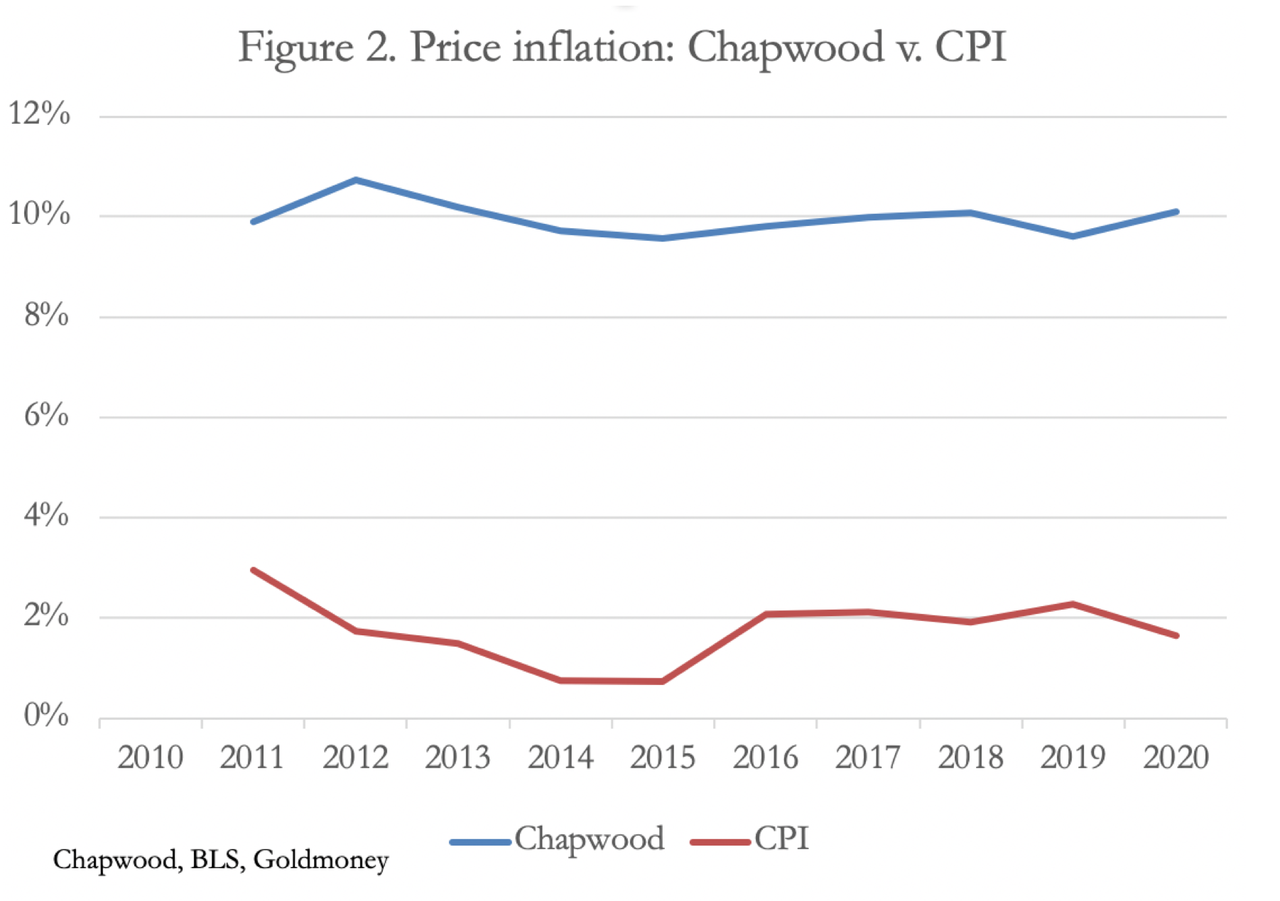
The Fed is evidently trapped by its inflationary policies. And the US Bureau of Labour Statistics, which calculates US consumer price indices, will have to work even harder to suppress the evidence of price inflation. Over the last ten years they have recorded an average annual rate of price inflation of 1.69% measured for US cities (CPI-U), and for the first half of 2020 they say it was 0.83%, or 1.66% annualised. To maintain this fiction has been a remarkable feat of statistical management, when compared with the unadulterated fifty city figures collected by the Chapwood Index.[i] Figure 2 shows the gap between the BLS’s CPI and Chapwood’s unadulterated estimates.
It is not our purpose to imply that the Chapwood Index of prices is an accurate representation of price inflation. We can talk about the general level of prices in a theoretical sense, but in practice it cannot be measured because each consumer has a different price experience. It is only when one subscribes to the macroeconomics version of economics and talk of unworldly aggregates that a figure is calculated. But if you remove the changes in the BLS’s calculation methods since 1980, you end up with a similar rate of price inflation to that of the Chapwood index, which is confirmed by John Williams at Shadowstats.com.
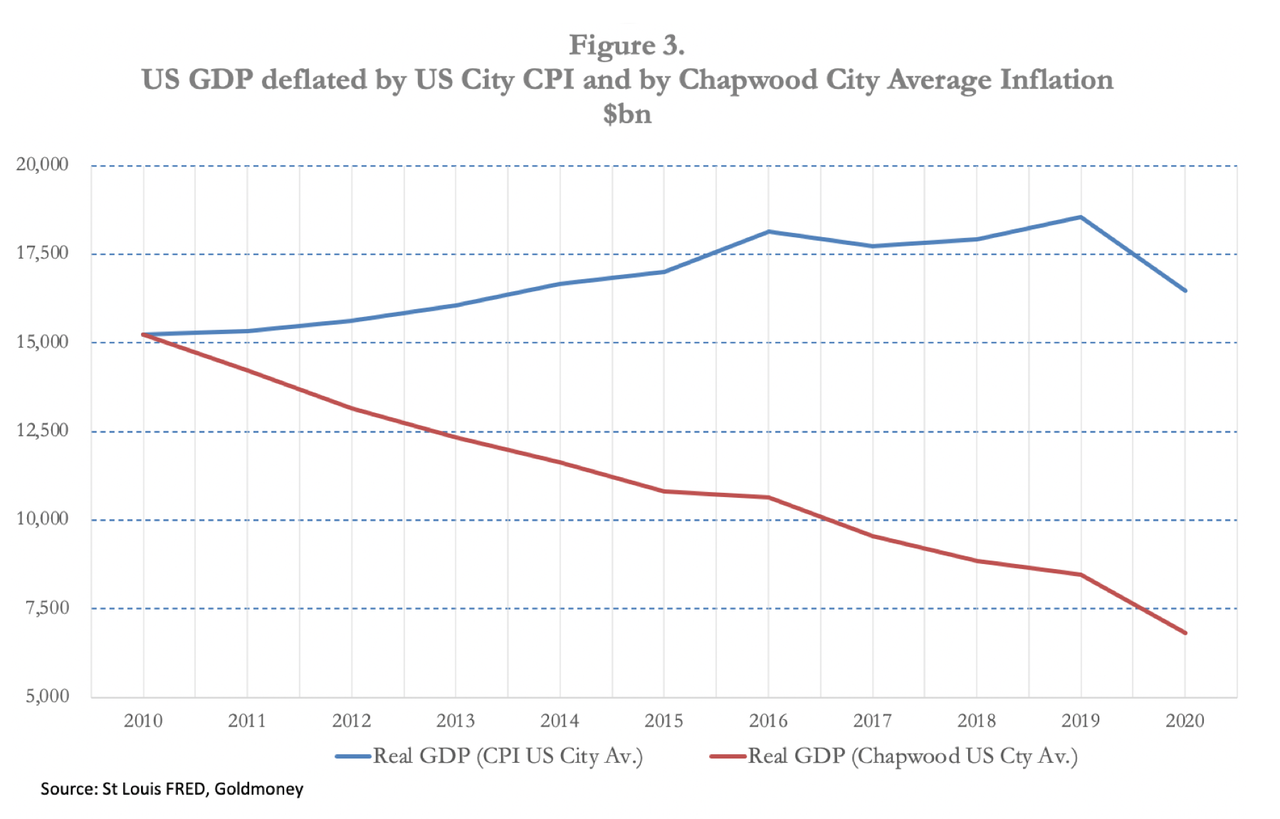
Now let us reconsider Jay Powell’s and Andrew Bailey’s Jackson Hole speeches in this light. Instead of an average rate of annual price inflation over the last ten years of 1.69%, Chapwood tells us that that average is 10.1%, varying between 13.4% in Sacramento and 7.1% in Albuquerque. It is against this background that Powell proposes to downgrade the Fed’s inflation mandate. Given M1 monetary inflation averaged 16% between the Lehman crisis and last February (see Figure 1) the price effect recorded by Chapwood is not surprising. But it gets worse for Powell. If we accept Chapwood’s numbers as being realistic and use them to deflate nominal GDP, we can see that the US economy has been in a slump for the last ten years: adjusted GDP has contracted by 65% since 2010. This is illustrated in Figure 3.
The only offset is the Fed’s much vaunted wealth effect that comes from speculating in financial assets. But that relief is only available to American investors and those employed in financial and related services, disadvantaging the poor and unemployed who inhabit Main Street, the non-financial economy. It is in this context, perhaps, that we should view the current civil unrest and racial strife in America.
Waking up to reality
Nobody in the investment and media mainstreams, let alone at the Fed, appears to understand the extent of statistical distortions and the consequences. We can count them all, including economics professors and senior figures in the investment game, among the 999,999 out of the proverbial million who don’t understand money and the consequences of its debasement.
The other side of the slump in real GDP illustrated in Figure 3 is the transfer of wealth from producers and consumers in the non-financial economy. If, as implied by a Chapwood GDP deflator, GDP has declined by 65% in real terms since the Lehman crisis, then we can say that gives us an approximation of the net wealth transfer through monetary inflation from producers and consumers to the state, the Fed, the commercial banks and their favoured customers.
If macroeconomists think that inflation stimulates demand, apart from initial artificial and final catastrophic effects perhaps, they are wrong: it kills it. The element of monetary debasement that ends up in government hands, taken from the productive non-financial sector along with all taxes, is wasted because a government produces little more than interference with an otherwise working economy. The true purpose of monetary inflation is not to improve our lives but to finance government deficits.
The element of bank credit inflation which ends up with the banking system’s favoured customers, comprised mainly of the large lumbering zombie corporations of yesteryear, disadvantages the more dynamic entrepreneurial businesses among the small and medium size sectors to the extent they are denied similar credit terms. The element of monetary inflation that ends up fuelling speculation in the financial economy is robbed from the liquidity balances and earnings of producers and consumers without their knowledge or consent. Monetary inflation is virtually impossible for the robbed to detect, not being revealed by accounting methods.
Despite M1 money supply accelerating, deflation remains a common fear, prompted doubtless by commercial banks being reluctant to extend credit at a time of increasing loan risk. But the Fed is already concerned that the commercial banks will not pass on its monetary policies, which is why it is bypassing them by buying corporate bonds and commercial mortgage backed securities through BlackRock. Other similar schemes are sure to follow. But it always amounts to supporting yesterday’s businesses, which the markets would otherwise likely judge to be today’s failures.
Clearly, any tendency for bank credit to contract will be countered by the Fed through further and appropriately aggressive expansion of narrow money, for which Powell was clearing the decks at Jackson Hole. It could lead to an even faster rate of M1 growth than the annualised 68% since February. Those who worry about the deflation of bank credit are therefore premature in their analysis and obviously believe in monetary inflation as an economic cure-all. But in real terms the US economy is already contracting because monetary inflation is leading to far faster price rises than is generally realised. Monetary inflation as a policy was only going to make things worse.
It is also a myth that monetary inflation is helpful to businesses. While an artificial and temporary cheapening of domestic manufacturing costs is lauded by neo-Keynesians, businesses need monetary stability in order to calculate the value of future payments: a healthy economy depends on business calculation which relies on the certainty of price stability. It is not good enough to say that suppressing interest rates benefit businesses: it is only true for over-indebted zombie businesses which with state aid can survive a little longer. But that is an artificial boost in their fortunes at the expense of a hidden inflation tax on everyone else. Not only does inflation coupled with the suppression of interest rates promote and sustain these commercial failures, but by doing so it also restricts the redistribution of all forms of capital into more productive use.
If the effects of monetary inflation become apparent to actors in the non-financial economy, they begin a process of reducing their monetary liquidity, knowing that money will buy less in the future than at the present. Until now, economic actors appear to place greater credence in the BLS’s inflation figures than from their own experience; but that cannot last. When the effect on prices of an annualised expansion of narrow M1 money of 68% becomes apparent it is likely to undermine widespread complacency. And when people realise that the general level of prices is rising despite the slump in economic activity, they will begin to dump all forms of dollar liquidity they possess in return for goods, driving price inflation even higher than increased money quantities would suggest. The transition from the false stability of prices as measured by government statistics into a final crack-up boom when money is dumped as worthless need not take long: all it needs is a trigger.
Shutting our eyes to this reality is nonsensical. The BLS’s CPI figures will prove to be defined by a vulgarity suggested by its own acronym. And when markets rumble it, the Fed will be unable to contain US Treasury yields at anything like current low levels. If we take the Chapwood price inflation figures for this year, then the current yield on the 10-year US Treasury bond is minus 9.45%, which must be close to a record in the annals of US monetary history.
Let us assume, for a moment, that financial markets adjust to price inflation rates closer to the Chapwood figures, which have already accelerated from an annual average of 9.6% for 2019 to 10.1% in the first half of 2020. US Treasury yields would initially rise at the short end of the curve to reflect that figure, perhaps with a margin over it. With the government’s budget deficit sure to exceed $3 trillion in the current fiscal year (to October) and perhaps double that next, the 2019 interest bill of $383bn on existing debt and the higher rate for US Treasury bond roll-overs plus the interest on new debt, total annual funding costs are likely to rapidly approach a trillion dollars . It is a debt trap sprung firmly shut and investors will take that into account.
An out of control budget deficit will continue to be funded through quantitative easing — there’s no other way. But a rise in bond yields will also have a catastrophic effect on equities, on their valuations as financial assets, on the cost of new and rolled-over corporate debt, and on valuations for loan collateral. The much-vaunted wealth effect, which has concealed the collapse in real GDP since the Lehman crisis, will quickly evaporate. Because the Fed has gone all in on using monetary inflation to sustain a financial bubble, it has also tied the dollar’s future to it, so its bursting is bound to have a profoundly negative effect on the dollar’s purchasing power.
The inflation problem is about to get worse
We have now established that the Fed is committed to accelerating the increase in the money quantity. We have also established that its monetary policies combined with statistical price manipulation has had the opposite effect of that intended, so much so that since the Lehman crisis the US economy has contracted in real terms by more than half, which any competent sociologist will tell you leads to civil unrest — plainly evidenced today.
We have reached a high point in macroeconomic madness.
It’s about to get worse.
Despite the post-Lehman acceleration of money supply, last September the repo market blew up on the day when Deutsche Bank sold its prime brokerage to BNP, the French global systemically important bank — a G-SIB. It may or may not have been the trigger for ongoing problems in the repo market, but clearly, there were liquidity issues in the US’s financial and banking system at that time.
It came on top of last year’s contraction in international trade, due in large measure to trade tensions between America and China with knock-on effects for China’s trading partners, such as Germany. Non-banks, principally insurance companies, pension funds and hedge funds acting directly or through agencies had accumulated large positions in fx swaps, ripping out interest differentials between euros and yen on one side, and a rising dollar on the other. The G-SIBs, particularly JPMorgan, had no excess reserves available to finance further non-bank speculation in this market. The turn of the cycle of bank credit expansion was upon us due to these liquidity issues, instead of the normal end of cycle problem of over-geared bank balance sheets facing escalating lending risk. However, thanks to covid-19 lending risk is now rising rapidly.
The S&P500 index crashed by fully one-third between mid-February and 23 March, as institutional investors suddenly realised the deflationary consequences of liquidity shortages in the banking system. It took the Fed’s cut in its funds rate from 1% to 0% on 16 March and its statement on 23 March, when it promised new QE and infinite monetary support for businesses and households, to relieve the liquidity problem.
At the same time came the covid-19 lockdowns. China had imposed lockdowns in Hubei Province in January, but from early March the rest of the world started to go into lockdown, with the UK going into lockdown on 23 March. In the US a number of states announced lockdowns from 17 March, with New York locking down on 22 March. The Fed’s actions, cutting its funds rate on 16 March and announcing infinite QE on 23 March were both timely and a financial watershed.
In all the mayhem of lockdowns it is easy to forget that the collapse of overnight liquidity was already a six-month old evolving crisis, marking a cyclical turning point in the expansion of bank credit. Unlike Lehman, which reflected a cycle of excessive property speculation, this one has its roots in a downturn in global and now domestic trade, as well as a global currency imbalance in favour of the dollar. According to US Treasury TIC figures, at end-June 2019, which are the most recent available estimates, foreigners owned $20,534 bn of US securities. To this must be added bills and cash, which on the most recent TIC report (June 2020) totalled a further $6,227 bn. Therefore, putting to one side the different dates of record and higher equity valuations today, foreign ownership of dollars is roughly $27 trillion, which equates to 125% of US GDP in 2019.
Foreign ownership amounts to such a large figure relative to GDP due to the dollar’s reserve status, foreign participation in funding US budget deficits and anticipation of an expansion of future trade. But as we have seen, global trade began to contract in 2019, which if continued, reduces the need to hold dollars. And we can be certain that if foreign holders take the view that the US economy is in a slump, beyond their requirements for marginal liquidity there is no reason for them to hold dollars at all because they can always buy them when actually needed.
Consequently, the US is vulnerable to foreign liquidation of securities, comprised of US Treasuries and other bonds, together with portfolio investments amounting to 20% of total US long-term securities extant.[v] So far, on a net basis foreigners appear to have stopped or slowed their net buying of US securities and cash dollars. Some positions will have been unwound by US hedge funds and other entities operating in the fx swap market rather than foreigners, driving the dollar’s trade weighted lower by about ten per cent so far from its 23 March high. But foreigners appear to have not yet began to sell dollars in meaningful quantities. When they do, they will be selling US Treasury and corporate bonds and liquidating equity portfolios as well. And if they do so at a time when there are insufficient domestic buyers to absorb their selling, these markets will crash along the dollar, which will be sold as well.
In the short-term, the course of financial asset prices and of the dollar’s exchange value will in large measure be determined by non-Americans. [As a side note, the last time a currency and financial assets became so intertwined was in the Mississippi bubble. The Irish-French banker, Richard Cantillon, made his second fortune in the latter part of 1719 by shorting the livre currency before the peak in the shares in late-February 1720. A similar pattern could be emerging today in the relationship between fiat money and financial assets, with the dollar weakening before US financial assets][vi]
Pricking the bubble
We know that the two versions of price inflation, that of the BLS and Chapwood (which accords with Shadowstats) are far apart. The finance sector is pricing financial assets on the basis of the BLS’s CPI and therefore accepts the Fed’s monetary policy of keeping short-term interest rates close to the zero bound. But rising prices for metallic money, gold and silver, indicate that the policies of suppressing apparent price inflation and interest rates are running into trouble.
We know, therefore, that the financial asset bubble itself is on a last hurrah, and its imploding deflation, driven initially perhaps by a resolving of the tension between the BLS’s CPI and the true rate of price inflation, is only a matter of time. We can identify a few key reasons likely to trigger the bursting of the financial asset bubble:
A growing realisation that the covid-19 shutdowns are additional to the credit cycle and liquidity problems that surfaced in September 2019 and that a post-covid-19 recovery will be followed by a deeper and more intractable slump.
Liquidity problems in the banking system and for its non-financial customers, together with the escalation of bad debts are leading towards bank failures. Fortunately, US banks are generally less leveraged than those elsewhere. But Eurozone, Japanese, Chinese and some UK G-SIB banks pose exceptional systemic risks, making their continued survival as independent commercial banks unlikely beyond the near term.
Foreign selling of US financial assets and the repatriation of their funds.
The first two bullet points will simply guarantee a further escalation in the rate of monetary inflation as the partnership of central banks and state treasury departments desperately attempt to contain a deteriorating situation. But foreign repatriation of funds will hit the dollar hardest, making it lose purchasing power against other currencies as financial asset values collapse. The euro, yen and Chinese yuan will appear perversely strong for a brief period, with their central banks desperate to contain the rises in their own currencies in the belief they are deflationary.
The sheer scale of dollar inflation will also mean that global commodity and raw material prices will rise, signalling that the dollar’s purchasing power is falling.
Empirical evidence in these situations indicates that an inflating currency is hit first in the foreign exchanges, before the domestic population discovers what is happening to their money. There is then followed by a growing panic among domestic users to dump money. In the best documented monetary collapses, such as Germany’s of 1923, cash was increasingly demanded in order to be spent as soon as possible, and evidence from Venezuela suggests this is still true today. However, more sophisticated financial systems have eliminated cash for most transactions, replacing it with credit and debit cards as well as other forms of electronic money. Internet banking and shopping further speeds up the process of turning money into goods.
This has the effect of speeding up the spending process significantly, leading to a more rapid loss of purchasing power compared with a currency whose users first make a trip to their bank to encash their deposits before heading for the shops. Additionally, a generation of cryptocurrency-savvy millennials have been forewarned of the consequences of fiat money inflation and stand prepared to ditch currencies earlier than their equivalents would have been in the past.
Taking these factors into account, the collapse in purchasing power of a currency which has been deployed to save financial assets and failed, once the general public finally understands the consequences, will likely be surprisingly rapid. In 1923 Germany, the final collapse took roughly six months. In 2020 America it could take as little as a few weeks.
Other currencies that refer to the dollar for their relative values are sure to suffer the same fate, not helped by the fact that their central banks have been pursuing similar monetary policies and will likely cooperate with each other to the bitter end.
via ZeroHedge News https://ift.tt/3buqjc0 Tyler Durden
Consumer Reports Slams Tesla’s $8,000 Full Self Driving Vaporware In Scathing New Review Tyler Durden
Sat, 09/05/2020 – 13:45
Tesla’s full self driving (FSD) concept has been at the intersection of a textbook case study in selling vaporware mixed with a poignant statement about the gullibility of Tesla consumers all wrapped up in a commentary about how regulators, both in the world of public securities and highway safety, have become irrelevant.
In short, it’s a product that doesn’t exist.
Tesla has been collecting $8,000 for something called “Full-Self Driving” based on the promise that the car will be able to drive itself, 24/7/365, at some point in the future. But for now, those putting down deposits for the future promises have been left with a series of unimpressive features like Autopilot, which have become an industry standard (i.e. lane assist, parking assist) with other major auto manufacturers.
In some cases, people who were paying for FSD weren’t even getting the hardware they were being promised. And nobody has seemed to notice and/or care.
Until now.
Consumer Reports released a scathing article on Friday, noting what many of us have been screaming from rooftops for years: “The $8,000 [full self driving] option doesn’t make the car self-driving”. CR says “consumers should be wary” about shelling out the money for a product that doesn’t exist:
The features might be cutting edge, even cool, but we think buyers should be wary of shelling out $8,000 for what electric car company Tesla calls its Full Self-Driving Capability option.
Tesla claims every new vehicle it builds includes all the hardware necessary to be fully autonomous, and the company says that through future over-the-air software updates, its cars should eventually be capable of driving themselves.
But for now, Full Self-Driving Capability, which includes features that can assist the driver with parking, changing lanes on the highway, and even coming to a complete halt at traffic lights and stop signs, remains a misnomer.
“Owners should not rely on Tesla’s driver assistance features to necessarily add safety or to make driving easier, based on Consumer Reports’ extensive testing and experience,” the article warns.
Jake Fisher, senior director of auto testing at Consumer Reports, said: “Despite the name, the Full Self-Driving Capability suite requires significant driver attention to ensure that these developing-technology features don’t introduce new safety risks to the driver, or other vehicles out on the road.”
He continued: “Not only that, in our evaluations we determined that several of the features don’t provide much in the way of real benefits to customers, despite the extremely high purchase price.”
“Most features within Tesla’s Full Self-Driving Capability suite worked inconsistently,” the report continues. Consumer Reports says of Autopark:
“Sometimes it would recognize a parking space as suitable, and we’d park in it. But when we drove by the same space again later, it was as if the parking spot didn’t exist. It also often didn’t park straight between the parking lines.”
The article also torched Tesla’s “Smart Summon”:
Smart Summon, which allows the car to drive remotely to a location within a private parking lot, would sometimes drive on the wrong side of parking lot driving lanes, and it didn’t always stop at stop signs in the lot.
The article also called Tesla’s “Navigate on Autopilot” inconsistent, stating the system would ignore exist ramps and drive in the carpool lane. Consumer Reports also said control around traffic lights and stop signs was dangerous: “At times, it also drove through stop signs, slammed on the brakes for yield signs even when the merge was clear, and stopped at every exit while going around a traffic circle,” the review read.
William Wallace, manager of safety policy for Consumer Reports, concluded: “Tesla has repeatedly rolled out crude beta features, some of which can put people’s safety at risk and shouldn’t be used anywhere but on a private test track or proving ground.”
We have to ask again: how long is the NHTSA going to allow this? We have documented a litany of accidents involving Tesla’s supposed “Full Self Driving”, the latest of which can be found here. How many more people have to die before regulators take notice?
Consumer Reports says Tesla did not respond when approached for comments and questions.
You can read the full article here and watch Consumer Reports’ full video review of FSD here:
via ZeroHedge News https://ift.tt/3588myJ Tyler Durden
India Passes 4 Million Cases, 300 Arrested At Melbourne Anti-Lockdown Protest: Live Updates Tyler Durden
Sat, 09/05/2020 – 13:20
Summary:
India passes 4 million cases
Aussie police arrest 300 people at Melbourne anti-lockdown protest
Mexico cases climb
Brazil still No. 2 highest case count with 4.09 million
Iraqi health care system on the brink as country suffers record spike in cases
Italy tries to stop soccer fans from returning to stadiums
* * *
As we noted just the other day, India is on the cusp of passing Brazil to become the country with the second-largest number of confirmed cases of COVID-19. It took yet another step closer late this week as it crossed the 4 million-case threshold.
Now the world’s new virus epicenter, having recorded more cases than any other country during the month of August, as India’s outbreak appeared to accelerate due to an ambitious government-sponsored mass-testing, India added 86,432 infections in 24 hours, pushing the total tally to 4.02 million, according to data released by India’s health ministry Saturday. Over 69,500 people have died from the novel pathogen, making it the third-largest by number of Covid-19 deaths.
Brazil, on the other hand, has confirmed 4,091,801 infections while the United States has 6,200,186 confirmed cases, according to the data from Johns Hopkins University.
India’s health ministry on Saturday also reported 1,089 deaths for a total of 69,561.
The world’s second-most populous country imposed the world’s biggest lockdown as early as March, but began relaxing it in phases from June after millions of Indians were thrust into poverty, sparking a wave of social unrest that rattled the country’s population centers, before spreading throughout India’s vast countryside.
The virus has followed a similar pattern. The increased testing comes as India moves to loosen even more restrictions to try and revive its faltering economy. It’s widely expected that India will eventually surpass both Brazil and the US.
Some other important developments in the global COVID-19 pandemic occurred overnight:
Police in the Australian city of Melbourne arrested about 300 people protesting against the city’s ongoing coronavirus lockdown, which has endured despite showing minimal effectiveness in quashing the region’s still-relatively-tame outbreak. Victoria State, which includes Melbourne as its capital, Australia’s coronavirus hotspot said its death toll rose by 59 – though not all cases actually died over the past day – and there were 81 new cases. 50 of these deaths were people in aged-care facilities who died in July and August, the state health department said.
Mexico saw confirmed cases climbed to 623,090, while deaths reached 66,851.
Iraq has recorded its highest single-day rise in COVID-19 cases since the start of the pandemic, prompting authorities to warn hospitals might “lose control” as new serious cases overwhelm the region’s meager health-care resources, which are heavily centralized in hospitals.
According to the Iraqi health ministry, 5,036 new infections were confirmed within 24 hours on Friday, bringing the total number of cases across the country to 252,075. Of these, 7,359 have died.
The health ministry attributed the spike to recent “large gatherings” – many related to an important holiday in Shia Islam – that violated social distancing recommendations.
Italy’s government is lobbying against the return of football fans to stadiums as the number of newly reported cases begins to climb. Former prime minister Silvio Berlusconi is in a stable condition two days after being admitted to a nearby hospital with serious COVID-19 symptoms.
“This instils cautious but reasonable optimism,” said spokesman Alberto Zangrillo in a brief statement. Italy’s longest-serving postwar leader is 83.
Around the world, some 26.5 million people have been diagnosed with the virus, while another 872,000 have died. More than 17.6 million people have recovered.
New Jersey yesterday announced that its rate of transmission had popped back above “1”, meaning that the outbreak is spreading once again. Though this has happened several times since the last outbreak slowed.
via ZeroHedge News https://ift.tt/3gZNwUx Tyler Durden
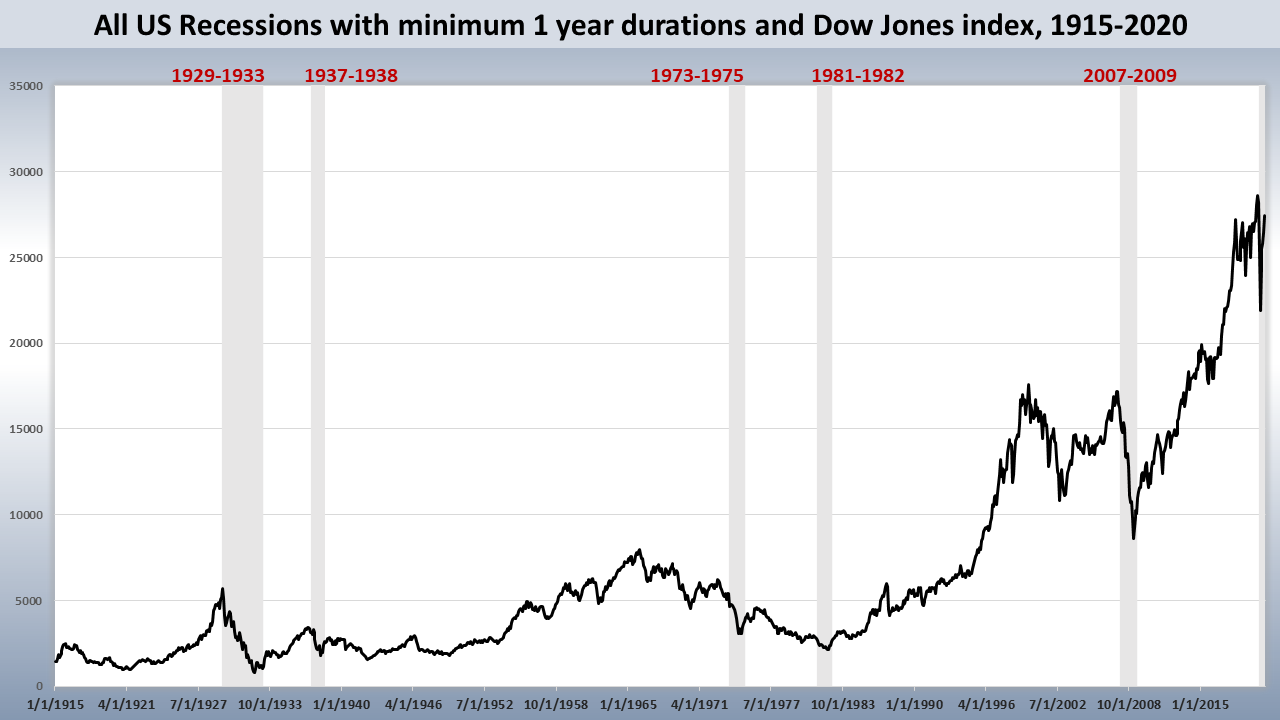
Based on new empirical research findings, the Dow Jones 30 (Dow) composite index is likely to soon peak. It will then begin a steady decline to new lows in 2020 or 2021.
According to the SCPA (Statistical Crash Probability Analyses) algorithm, the probability is 90% for the Dow to reach new lows before the current US recession ends. The algorithm’s forecast assumes that the 2020 recession will last until at least March of 2021.
The Forecast
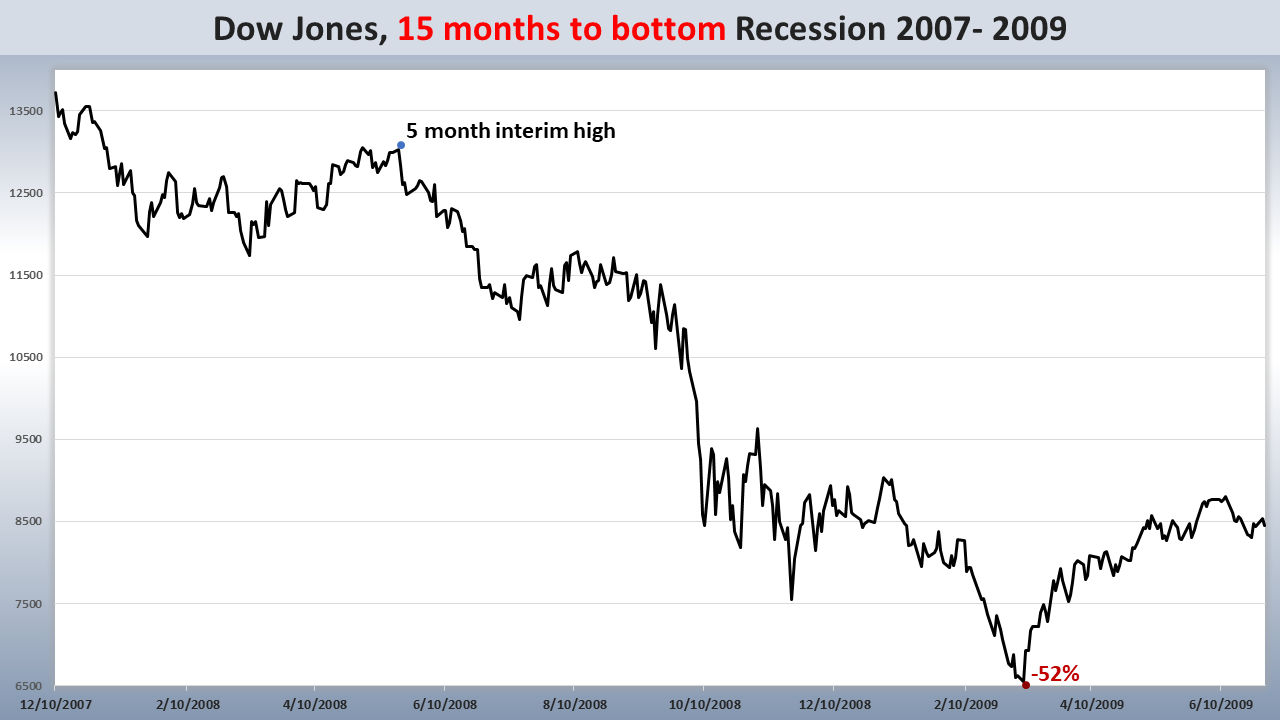
The forecast, based on SCPA research of the Dow’s performance during the five US recessions from 1929 to 2007. Each recession lasted a minimum of one year. The chart below depicts the five recessions.
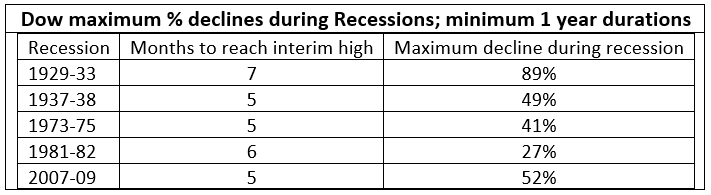
The research findings revealed that the Dow:
initially declined after each of the five recessions began
rallied to interim highs within five to seven months after the recessions had begun
fell to new recession lows after reaching the temporary highs
The Charts
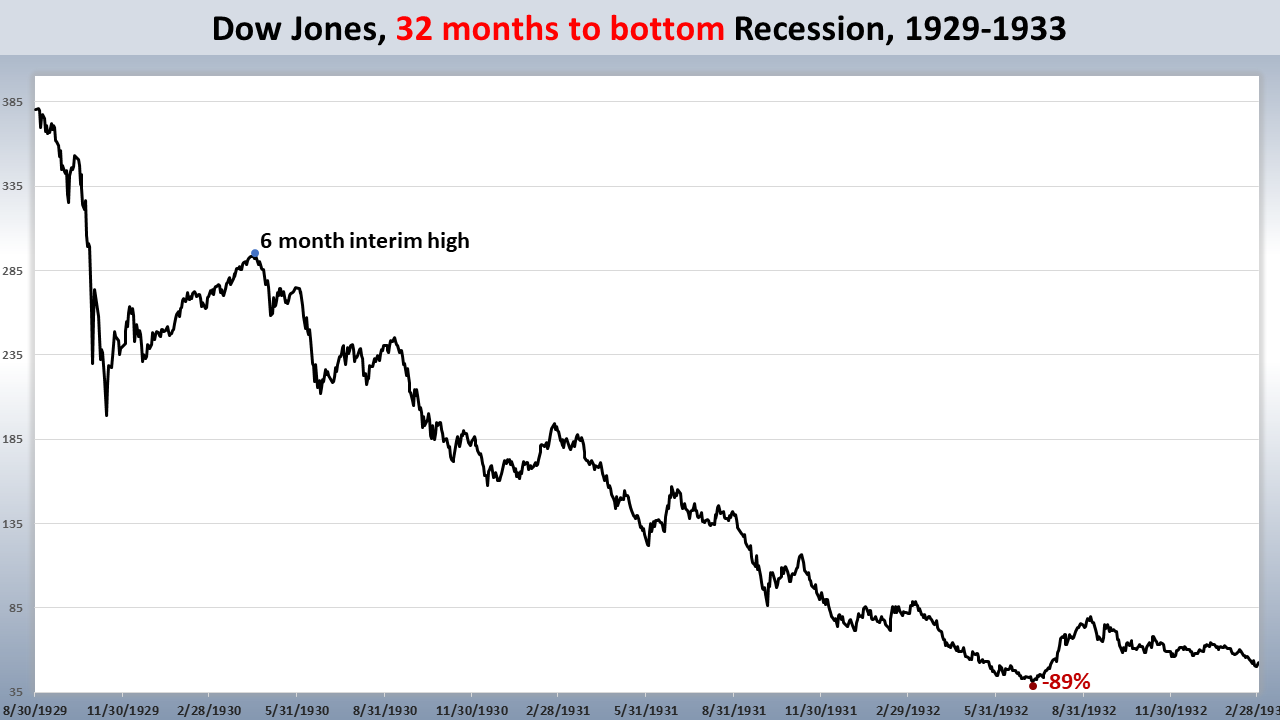
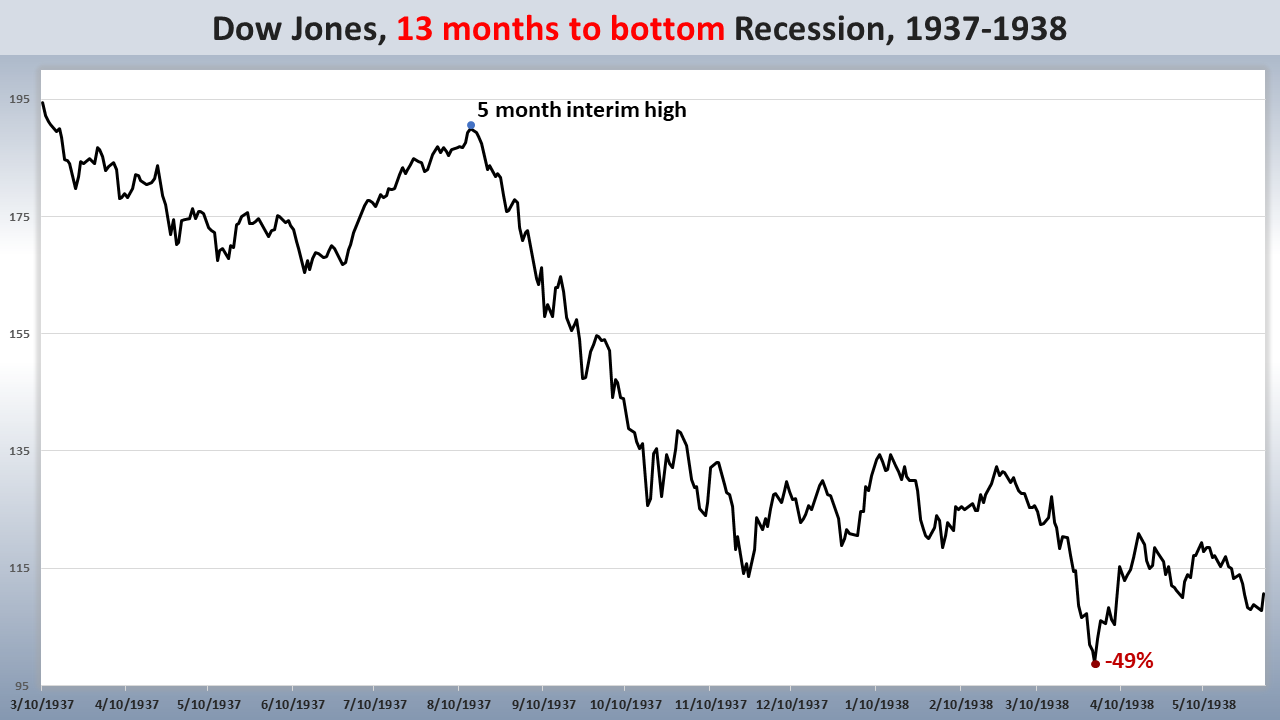
The five charts below break out the performance of the Dow for each of the recessions.
The chart below for the Dow Jones depicts that the index closed at its post-crash high on September 2, 2020.
The Probability
Based on SCPA, the probability is 100% for the Dow to have already reached its post-crash high, or by September 2020. Such will be the seventh month since the recession began. Coincidentally, the SCPA has forecasted the post-crash high to occur for a dozen other countries by September 18, 2020, as well.
Conclusion
The Dow’s big question for the recession of 2020 is will it last a minimum of one year? If the answer is yes, the SCPA’s probability is 90% for the Dow to pierce its March 23, 2020 low before the 2020 recession ends. The calculation of the 90% probability came from computing the average of the following:
As of the March 23 low, the Dow had declined by 36.5%. For four of the prior five (80%) recessions, the minimum decline ranged from 41% to 89% before the economic downturn concluded.
The Dow for all five (100%) of the prior recessions reached its recession low after the seventh month of the recession.
From the findings published on August 27, 2020, in “Probability of V-Shape Recovery Low, Depression High,” the probability is 99% for the current recession to last at least one year. The findings were comprised of Deloitte’s forecasts for the US economy from 2020 through 2025. The empirical data for the US economy dates back to 1929.
With the probability almost 100% for the Dow Jones composite index to reach a new low in 2020 or 2021, and before the recession ends, investors need to be defensive.
via ZeroHedge News https://ift.tt/358QIej Tyler Durden
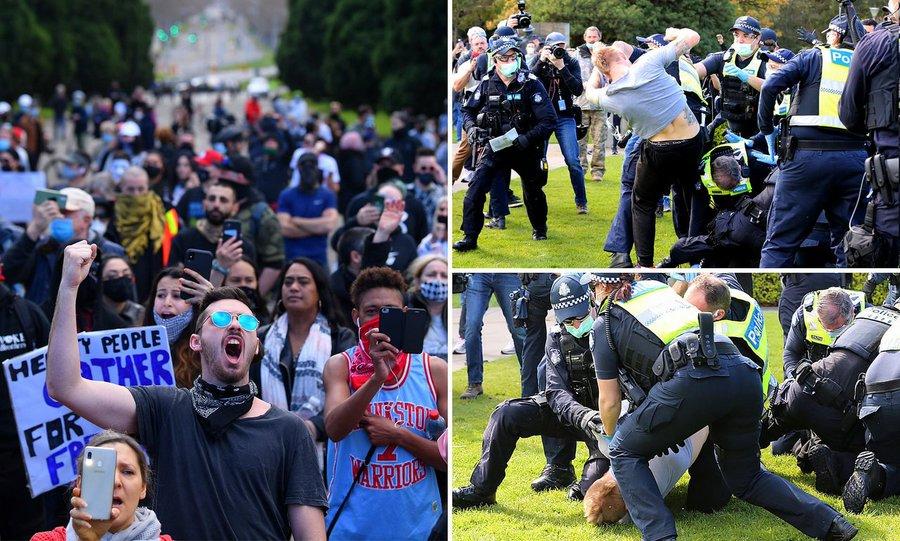
Social unrest surged Saturday across Melbourne and Sydney, as hundreds of protesters took to the streets, defying arcane coronavirus lockdowns that have been in effect for nearly five weeks following a spike in virus cases and deaths.
Anti-lockdown groups gathered at the Shrine of Remembrance, a war memorial in Melbourne, Victoria, Australia, with some demonstrators wearing no masks, holding signs, and were heard chanting “freedom” and “human rights matter,” reported Reuters.
“It is not safe, it is not smart, it is not lawful. In fact, it is absolutely selfish for people to be out there protesting,” Victorian Premier Daniel Andrews told reporters after the demonstrations.
Dozens were arrested at the protests in Melbourne and Sydney; hundreds of others were issued violations for breaching the stay-at-home public health order.
“As a result of the protest, a police officer received lacerations to the head after being assaulted by an individual who was in attendance,” Victoria Police said in a statement.
The statement continued, “Our investigations into this protest will continue, and we expect to issue further fines once the identity of individuals has been confirmed.”
Australian Broadcasting Corporation (ABC) quoted one woman at the Shrine of Remembrance who said, “there’s no epidemic — it’s just a pretext to keep us in lockdown.”
Reuters reported several other protests in Sydney and one in Byron Bay in the state of New South Wales. All demonstrations were in breach of local restrictions on large gatherings, which prompted local police to respond with riot police units.
Lockdown anger has erupted with protesters violently clashing with the riot squad in wild scenes across the city. Police promised a swift and firm response, and they delivered, in a show of force rarely seen in Melbourne. https://t.co/AVvaWLotVs@paul_dowsley#7NEWSpic.twitter.com/A4bdaxR88v
Many anti-lockdown protesters were concerned that stay-at-home orders have become a form of control that restricts people from living their lives. Others were worried that the latest restrictions would result in a more profound decline in the economy.
“Our economy is going to crash because if we don’t start opening up borders and letting people have freedom of choice to do what they want to do, how are we going to exist?” one protester told ABC.
Australia officially entered a recession at the beginning of Sept., the first time in three decades, as deep economic scarring and soaring unemployment rate could result in a much slower recovery.
Tony Abbott, the former Australian prime minister, was heard Tues. (Sept. 1) as saying virus “hysteria” and draconian lockdowns are perpetuating the economic slowdown and have created a “something for nothing mindset” among younger generations living on furlough.
“Much of the media has indulged virus-hysteria with the occasional virus-linked death of a younger person highlighted to show that deadly threat isn’t confined to the very old or the already-very-sick or those exposed to massive viral loads,” Abbott said.
Abbott accused Andrews of being a ‘health dictator’ by placing five million Melburnians under “house arrest.” He said politicians need to stop acting like “trauma doctors” and start adopting the mindset of “health economists” – as reckless money printing to sustain the country’s economy during lockdowns isn’t sustainable.
“From a health perspective, this pandemic has been serious. From an economic perspective, it’s been disastrous,” he said.
So the question we ask readers is what could incite further unrest? Well, it could be mandatory coronavirus vaccinations.
This all comes just days after massive anti-lockdown protests in Germany. A backlash to the latest increase in restrictions in the US could be just around the corner.
via ZeroHedge News https://ift.tt/2F4J4H4 Tyler Durden
It looks like we are headed for the most chaotic presidential election in modern U.S. history. According to some estimates, somewhere around 40 percent of all U.S. voters will vote by mail this year. That means that tens of millions of votes will be going through the postal system, and that has the potential to create all sorts of problems. For one thing, it is going to take a lot of extra time to open those ballots and count them.
For states that allow mail-in votes to be counted in advance, that shouldn’t delay final results by too much, but in other states we are facing the possibility of a nightmare scenario. There are certain states that are not allowed to start counting any ballots until the polls close on election day, and that includes key swing states such as Wisconsin, Michigan and Pennsylvania…
In several states not accustomed to high volumes of mail-in voting, including Rust Belt swing states Wisconsin, Michigan and Pennsylvania, election officials cannot start counting ballots until voting ends on election night. Other swing states, such as Minnesota, allow absentee ballots to be postmarked up to Election Day.
So as we all watch the election results come in on the night of November 3rd, what we will be getting will only be partial results.
And at this point the mainstream media is assuming that the votes that are cast in person will heavily favor President Trump, and so they are warning us that there could be a “red mirage” scenario in which it appears that Trump is easily winning an election that he has actually lost.
Of course if Trump builds a huge lead on election night, he is likely to declare victory, and Facebook has already stated that they intend to “flag” any such attempt…
Facebook plans to flag any attempt by the Trump campaign to declare a premature victory in the presidential race on the platform, the company announced on Thursday.
The social media giant, which has come in for heavy criticism for failing to police foreign and domestic elections propaganda on its network, also said it would not accept any new political ads in the final week of the 2020 presidential race.
This is one of the reasons why I have always been strongly against mail-in voting. Our nation is likely to be thrown into a state of chaos in November because it is going to take so long to count all the votes. President Trump and his supporters will be absolutely convinced that they have won the election if they have a big lead on election night, and Joe Biden and his supporters will be absolutely convinced that they will be victorious once all of the mail-in votes are finally counted. And then no matter what the final result is, about half the country will not be willing to accept it as legitimate.
This is going to be such a disaster, but nobody can do anything about it now. All we can do is watch this slow-motion train wreck play out.
Biden supporters are already pointing to a recent poll which shows that Biden voters are far more likely to vote by mail than Trump supporters are…
Forty-seven percent of voters who plan to vote for Biden say they are likely to vote by mail, according to a USA TODAY/Suffolk University poll released Wednesday. That’s more than double the 21% of voters backing Trump who say they are likely to vote by mail. The poll found 56% of Republicans say they intend to vote on Election Day, compared with 26% of Democrats.
If all of the votes were counted and released at one time, this wouldn’t be so much of a problem.
But instead most of the results that we will get on election night will be from in-person voting, and most of the mail-in votes will be counted some time later.
At this point, everyone should be able to see that this is almost certainly not going to end well.
So many Trump voters prefer to vote the old-fashioned way, while many Democrats are very eager to vote by mail, and this has created a huge disparity in ballot requests in some of the most critical swing states. Just check out these numbers…
In Pennsylvania – a state Trump won in 2016 but where polling shows him behind – nearly 900,000 Democrats have requested a mail ballot for the election, more than twice the 347,000 Republicans who have done so. In North Carolina, another state Trump won in 2016 but where he and Biden are in a close race, nearly 313,000 Democrats requested mail ballots compared with nearly 93,000 Republicans.
We are seeing similar numbers in other states, and this is one of the reasons why Joe Biden will not concede no matter how large Trump’s lead on election night is.
This thing could end up dragging out for an extended period of time, and that is extremely unfortunate.
And the truth is that we may never even know the true winner of the 2020 election. Voting by mail opens up so many opportunities for fraud, and large numbers of ballots never even get delivered to the intended voters in the first place. As Breitbart has reported, 17 percent of the ballots that were sent out to registered voters in Nevada for their primary in June came back as “undeliverable”…
Last month, the Trump campaign filed suit against Nevada for their universal mail-in voting plans that would allow votes submitted after election day to count for the election. More than 223,000 mail-in ballots sent to registered voters in Las Vegas, Nevada, for their June primary bounced as “undeliverable” — 17 percent of the total 1,325,934 mail-in ballots that were sent out in the county.
Over the next couple of months, tens of millions of ballots are going to be floating around out there, and many will end up in the hands of people that should not have them. For example, Hulk Hogan says that one of his friends just received a ballot that was addressed to his dog…
Crazy stuff, a friend of mine just got a mail in ballot for his dog Nugget? Now even dogs can vote!
How does something like that happen?
Another thing to watch out for is “ballot harvesting”. Democrats have become masters of this practice, and they used it with devastating effectiveness in California in 2018. Now they are deploying this tactic all over the nation, and very alarming incidents of abuse are already being reported…
Furthermore, a citizen journalist reported that Democrats were harvesting mail-in ballots from nursing homes in Texas by fraudulently submitting ballot applications in bulk.
The journalist said that at least 32 applications supposedly from elderly voters were all submitted with the exact same handwriting, and were all submitted using the same pre-printed envelope with the same-style stamp.
In the end, we should all want a legitimate outcome. The integrity of our elections is of paramount importance, and the will of the American people should be respected.
But I don’t think that any of us will ever be able to feel good about the outcome of this election no matter who ends up winning.
Needless to say, the losing side is likely to be absolutely enraged over an election that they feel has been stolen from them, and that is likely to make the current chaos in our streets even worse.
At this point, even the Washington Post is warning that this election is likely to end “catastrophically”…
Perspective: The election will likely spark violence — and a constitutional crisis.
In every scenario except a Biden landslide, our simulation ended catastrophically.
For once, I actually agree with the Washington Post.
I have a hard time trying to imagine how this election could possibly end well.
Right now, Trump and his supporters are convinced that Trump will win, and Biden and his supporters are convinced that Biden will win.
One side is going to be bitterly, bitterly disappointed, and they will almost certainly feel like the election was not won legitimately.
There is going to be so much anger, and when it explodes it is going to be very frightening to watch.
FBI Raids Pennsylvania Nursing Home Which Saw A Whopping 447 COVID-19 Infections Tyler Durden
Sat, 09/05/2020 – 11:20
A nursing home which has seen at least 73 residents die of COVID-19 and more than 400 residents and staff infected has been raided by the FBI late this week after being flagged for rampant health violations, including administering experimental doses of hydroxychloroquine to about half its 435 residents in an attempt to stave off the outbreak, despite not having state health authorities or families’ approval to do so.
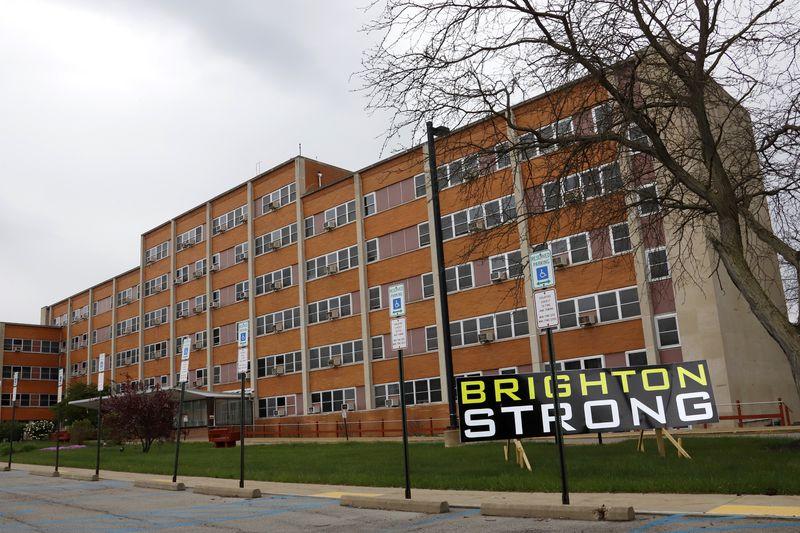
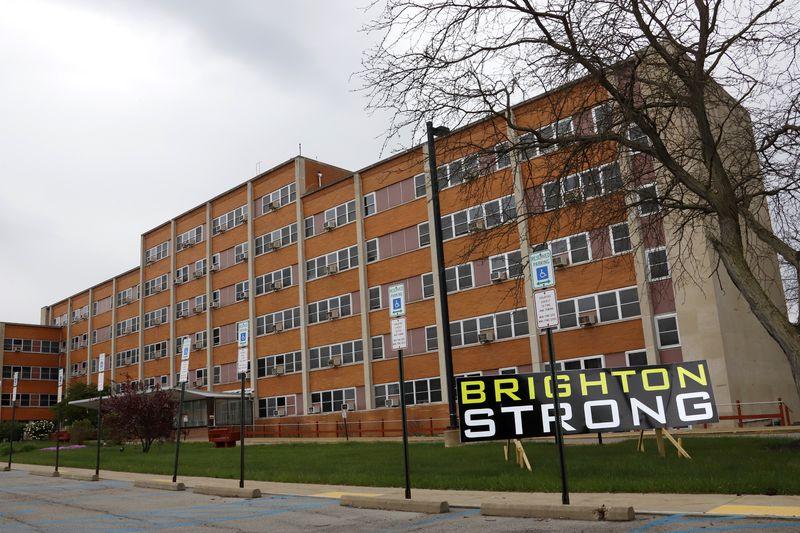
Brighton Rehabilitation and Wellness Center, located northeast of Pittsburgh, drove headlines last spring into the summer for seeing the single biggest coronavirus outbreak numbers of any facility in the state.
Brighton Rehabilitation and Wellness Center in Brighton Township, Pa. Image: AP
Over three weeks ago Pennsylvania Attorney General Josh Shapiro launched a criminal investigation related to unsafe “conditions and practices” of the nursing home, namely according to a prior statement, that it failed to meet a “high threshold of certain circumstances when the caretaker of a person fails to properly provide for their health, safety and welfare.”
In other press statements “neglect” of patients has been central to the allegations, including abandoning patients for long periods of time, without access to clean clothes, or simple needs like tissues and enough water to drink.
According to police records, local law enforcement had at some point stopped responding to calls to the facility, given the danger to police of potentially catching the virus.
#BREAKING: The Brighton Twp Police Chief no longer allows his officers to physically respond to calls @ Brighton Rehab and Wellness ever since the outbreak. Officers take calls over the phone. The PD received their highest # of incident calls from that facility. @KDKApic.twitter.com/d9P2X5qKOl
Investigators from the Pennsylvania Attorney’s general office assisted in Thursday’s FBI raid, including at another nearby hard hit care center, the Mt. Lebanon Rehabilitation and Wellness Center outside Pittsburgh.
Essentially all of Brighton’s elder residents caught the disease as well as many staff over a few month period, totaling a whopping 447 residents and staff testing positive, according to Pennsylvania Department of Health data. One staff member had died as well in addition to the 73 deceased residents.
FBI at the facility Thursday, KDKA/CBS-2 Pittsburgh
In April NBC News wrote that the entirety of the residents and staff were “presumed infected”:
The Pennsylvania nursing home where all 750 residents and staffers may be infected with the coronavirus was hit last year with a “below average grade” by state inspectors who warned that lax sanitary conditions could lead to the “spread of infection and diseases,” Medicare records revealed.
Even months prior to the coronavirus pandemic, health authorities were investigating the facility over widespread reports that patients were living in filth and being mistreated:
The report [from Sept. 2019] “identified repeated deficiencies related to proper infection control procedures not maintained during dressage change, improper storage of soiled linens and failure to provide appropriate facilities for hand washing which created the potential for cross contamination and the potential spread of infections and diseases.”
The facility in reaction to the investigation appeared to point the finger at the failed response of state and federal health officials, however, stating: “We will leave the readers to determine why some politicians seek ‘investigations’ into people and facilities instead of looking at governmental response to better their directives.”
via ZeroHedge News https://ift.tt/3m3OXFo Tyler Durden
At the recent Jackson Hole Economic Summit, Jerome Powell unveiled the Fed’s new monetary policy designed to create inflation. In today’s #Macroview, we will discuss the 5-reasons why the Fed will not get inflation, and why deflation is the bigger risk.
The current assumption is that the Fed’s new policy will lead to higher inflation.
“The new policy regime is an important evolution in our thinking about how to achieve our goals and another step toward greater transparency, The policy change positions us for success in achieving our maximum employment and price stability goals in the future.” – Fed Reserve Bank of NY, John Williams, via WSJ
What exactly is this new policy? Well, that’s the interesting part, no one actually knows. However, as noted by the WSJ:
“The Fed said it would now seek to hit its 2% inflation target on average, and that it wouldn’t raise rates just to ward off the theoretical threat of inflation posed by a strong job market. The Fed, however, didn’t say how it would determine the average, and several regional Fed officials suggested that a 2.5% jobless rate was as much as they would tolerate. At the same time, with the economy in deep trouble, there is little expectation inflation will test the Fed’s target for years.”
So, to be clear, the Fed’s new policy is simply to “average the inflation rate” over a period of time and let the unemployment rate fall to as low as 2.5%. The last time the unemployment rate was at 2.5% was for one quarter in 1953 just before the 1954 recession set in.
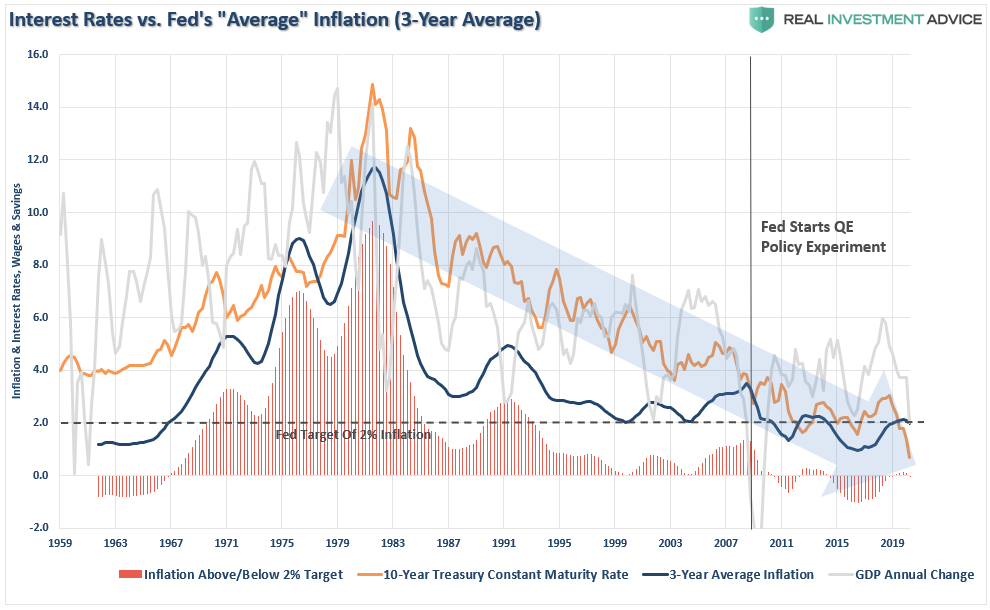
40-Years Of Falling Inflation
The entire premise behind the Fed’s “new policy,” and by being extremely vague about it, is to allow the Fed to maintain, and engage in, “ultra-accommodative” policies without any real limits. However, as shown below, the Fed’s monetary policies have not been successful at creating stronger economic growth or inflationary pressures.
Furthermore, while Wall Street is “buzzing” with talk of surging inflation, the reality is such is not likely to be the case. As we discuss below, the Fed’s policies are actually “deflationary” in nature.
Why Printing Money Won’t Create Inflation
“The Fed is printing money like crazy which is going to lead to inflation.”
For the last 12-years, this belief has remained a constant in the market. It stems from the idea that increasing the money supply is inflationary as it decreases the value of the dollar. There is indeed truth in that statement when considered in isolation. However, when the money supply is increasing, without an increase in economic activity, it becomes deflationary.
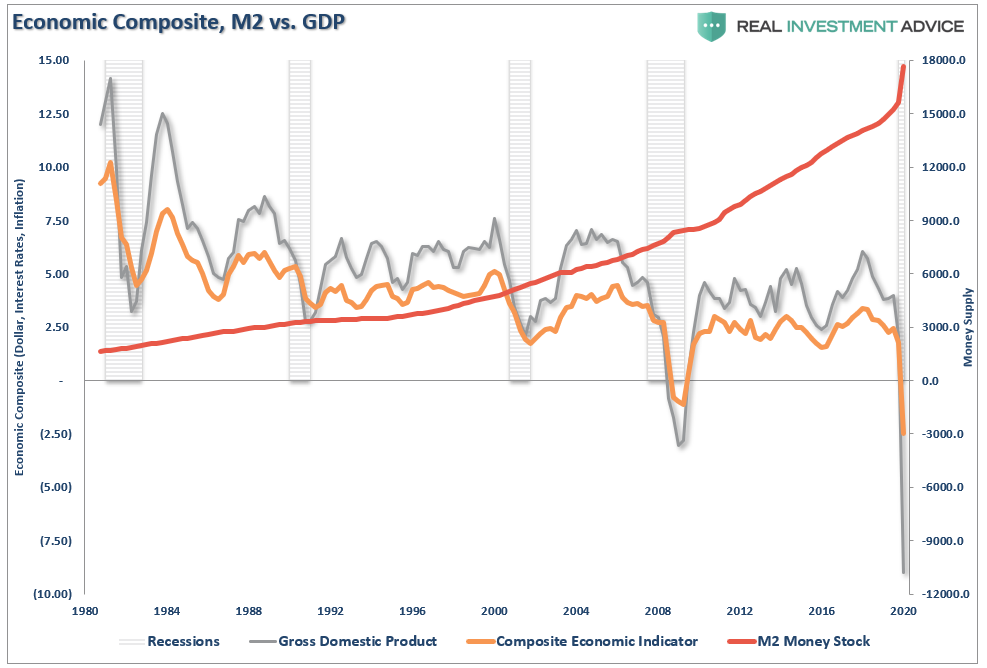
The chart below compares the money supply to GDP growth and our composite economic indicator which is comprised of inflation, wages, and interest rates which all have a direct correlation to economic activity.
Importantly, since 1980 as the money supply increased, economic activity slowed.
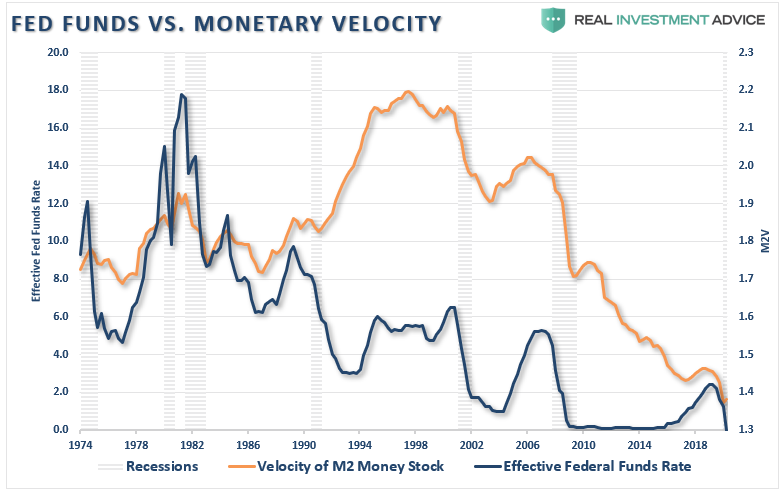
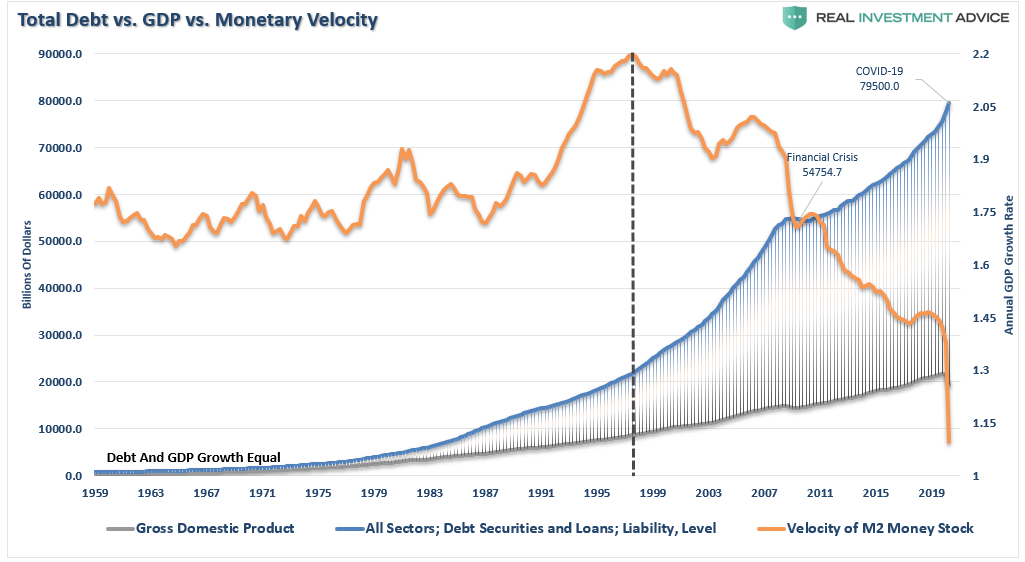
This is where monetary velocity becomes important.
Monetary Velocity
What the Federal Reserve has failed to grasp is that monetary policy is “deflationary” when “debt” is required to fund it.
How do we know this? Monetary velocity tells the story.
What is “monetary velocity?”
“The velocity of money is important for measuring the rate at which money in circulation is used for purchasing goods and services. Velocity is useful in gauging the health and vitality of the economy. High money velocity is usually associated with a healthy, expanding economy. Low money velocity is usually associated with recessions and contractions.” – Investopedia
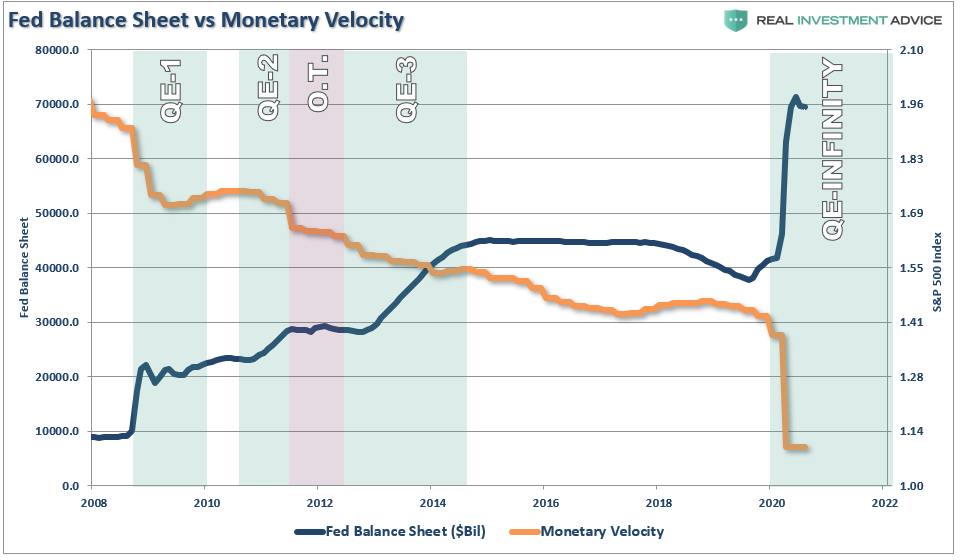
With each monetary policy intervention, the velocity of money has slowed along with the breadth and strength of economic activity.
However, it isn’t just the expansion of the Fed’s balance sheet which is undermining the strength of the economy. It is also the ongoing suppression of interest rates to try and stimulate economic activity.
In 2000, the Fed “crossed the Rubicon,” whereby lowering interest rates did not stimulate economic activity. Instead, the “debt burden” detracted from it.
To illustrate the last point, we can compare monetary velocity to the deficit.
To no surprise, monetary velocity increases when the deficit reverses to a surplus. Such allows revenues to move into productive investments rather than debt service.
The problem for the Fed is the misunderstanding of the derivation of organic economic inflation
Why Inflating Asset Prices Won’t Create Inflation
The one thing the Fed has done very successfully is to create “boom and bust” cycles within the economy which has continued to erode the economic prosperity of the masses.
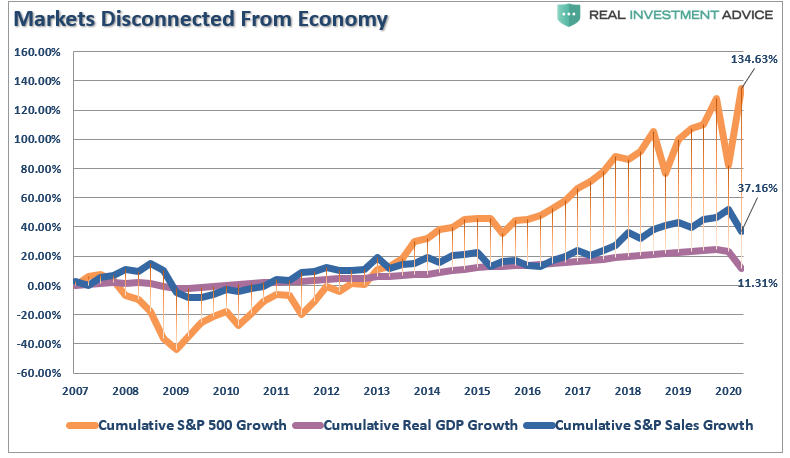
The only reason Central Bank liquidity “seems” to be a success is when viewed through the lens of the stock market. Through the end of the Q2-2020, using quarterly data, the stock market has returned almost 135% from the 2007 peak. Such is more than 12x the growth in GDP and 3.6x the increase in corporate revenue. (I have used SALES growth in the chart below as it is what happens at the top line of income statements and is not AS subject to manipulation.)
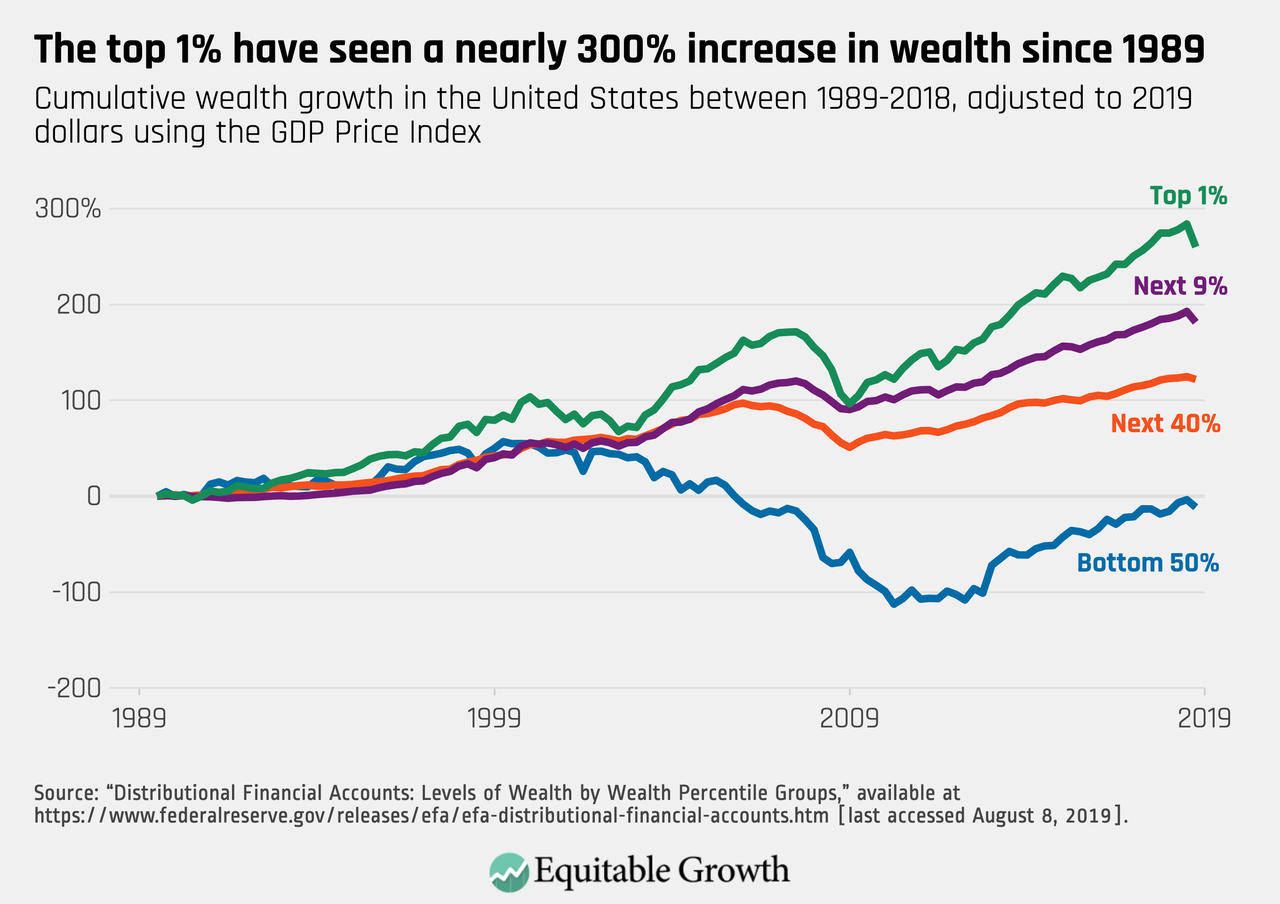
Unfortunately, the “wealth effect” impact has only benefited a relatively small percentage of the overall economy. Currently, the Top 10% of income earners own nearly 87% of the stock market. The rest are just struggling to make ends meet.
In order for the Fed to achieve actual inflation, they need an economy that is growing strongly enough to generate increased production to support stronger consumption. Only when there are self-sustaining increases in consumption can you achieve higher sustained rates of inflation.
Creating a “wealth gap” where 10% have the ability to consume while the bottom 90% struggle to make ends meet, continues to apply deflationary pressures on the economy as a whole.
Why Full Employment Won’t Create Inflation
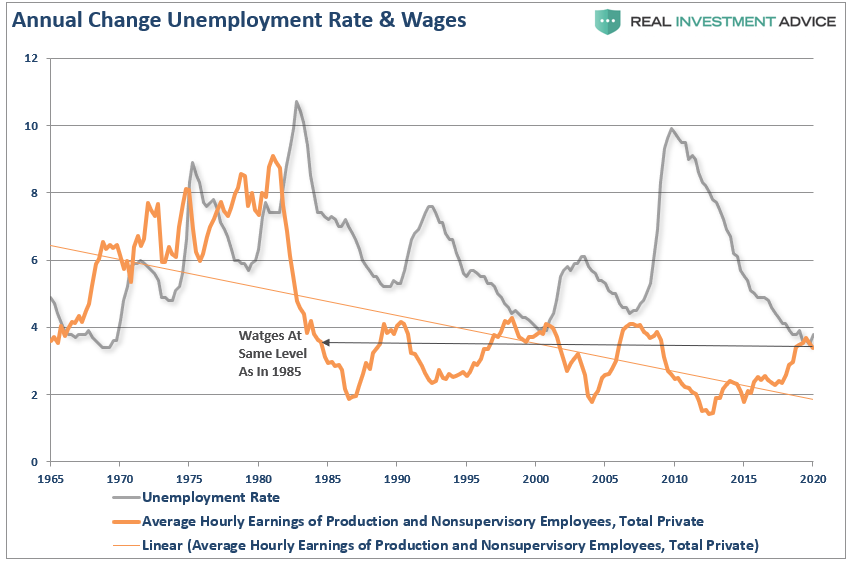
However, let’s assume for a moment that the economy returns back to the same historically low unemployment rate we were enjoying at the end of 2019. As shown in the chart
This is crucially important to understand why the Fed’s actions are “deflationary.”
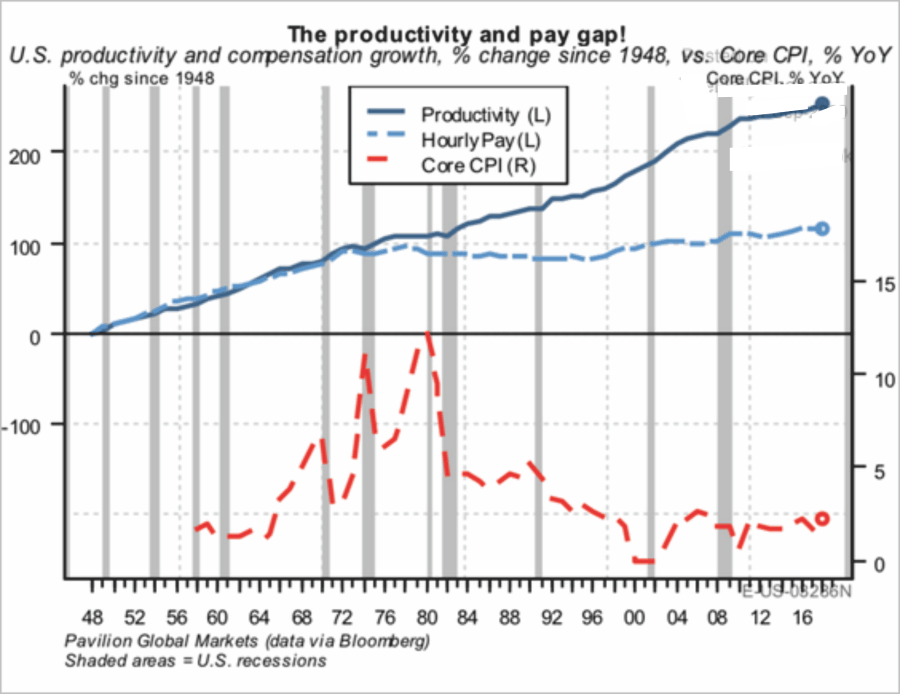
As noted, in order to generate “real inflation,” economic growth must be strong enough to support employment that exceeds the rate of population growth. That employment must ALSO be productive (manufacturing based) employment which leads to higher wages. (Service jobs are deflationary as they go to the lower cost of labor.) Higher wages lead to increased consumption which allows producers to increase prices (inflation) over time.
This has not been the case for nearly 40-years as technology continues to reduce the demand for labor by increasing productivity. This is the “dark side” of technology that no one wants to talk about.
Why Debt Won’t Create Inflation
However, this cannot be achieved in an economy saddled by $75 Trillion in debt which diverts income from consumption to debt service. This is why “monetary velocity” began to decline as total debt passed the point of being “productive” to become “destructive.”
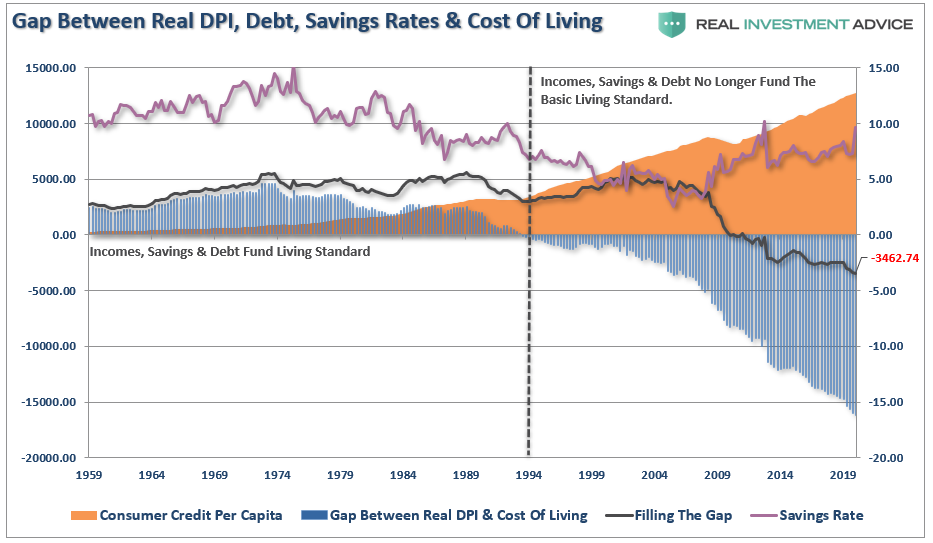
The decline in velocity coincides with the point that consumers were forced into debt to sustain their standard of living.
The problem for the Federal Reserve is that due to the massive levels of debt, interest rates MUST remain low. Any uptick in rates quickly slows economic activity, forcing the Fed to lower rates and support it.
With the economy set to push a $4.2 Trillion deficit in 2020, the deflationary pressure alone from the deficit will continue to erode economic activity. As noted, even if the Fed does manage to get a spark of inflation, which would push interest rates higher, the debt burden will lead to an economic recession and deflationary pressures.
Why Sending Money To Households Won’t Create Inflation
If the Government keeps sending money to households, it is going to create inflation.
Such is the underlying sentiment behind a universal basic income and its impact on economic growth. Unfortunately, it simply isn’t true.
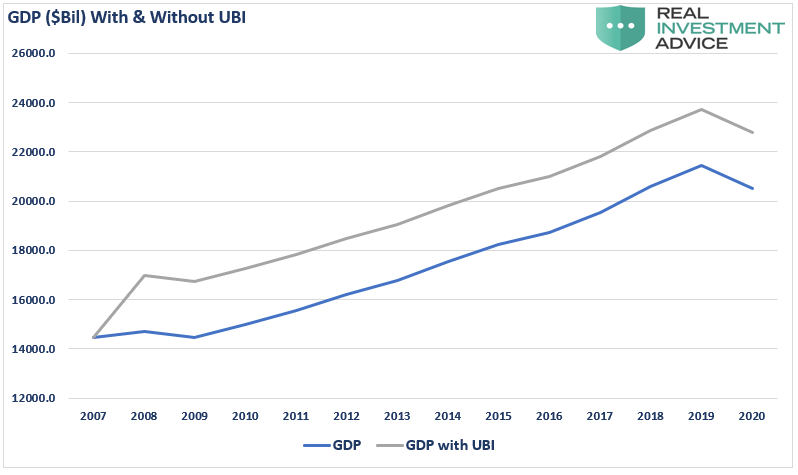
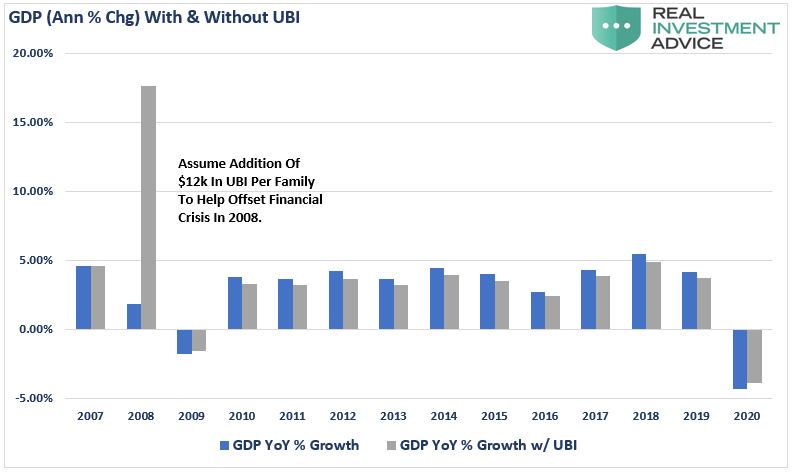
Let’s run a hypothetical example using GDP from 2007 to the present. (I am using estimates of -4.3% for 2020 GDP growth) In 2008, in response to the “Financial Crisis,” Congress passes a bill providing $1000/month ($12,000 annually) to 190 million families in the U.S.
The chart below shows the economy’s annual GDP growth trend assuming the entire UBI program shows up in economic growth. For those supporting programs like UBI, it certainly appears as if GDP is permanently elevated to a higher level.
However, that is an illusion. When you look at the annual rate of change in economic growth, which is how we measure GDP for economic purposes, a different picture emerges. In 2008, when the $12,000 arrives at households, GDP spikes, printing a 17% growth rate versus the actual 1.81% rate.
Beginning in 2009, however, the benefit disappears.
The reason is that after UBI is injected into the system, the economy normalizes to the new level after the first year. Also, notice that GDP grows at a slightly slower rate as the dollar changes to GDP at higher levels print a lower growth rate.
Not Unprecedented
The Federal Reserve’s new policy tool is nothing more than a “do anything” excuse. The reality is the Fed has no actual ability to create employment, control inflation, or create economic prosperity. The only thing they do have the ability to continue to create is the “wealth gap.”
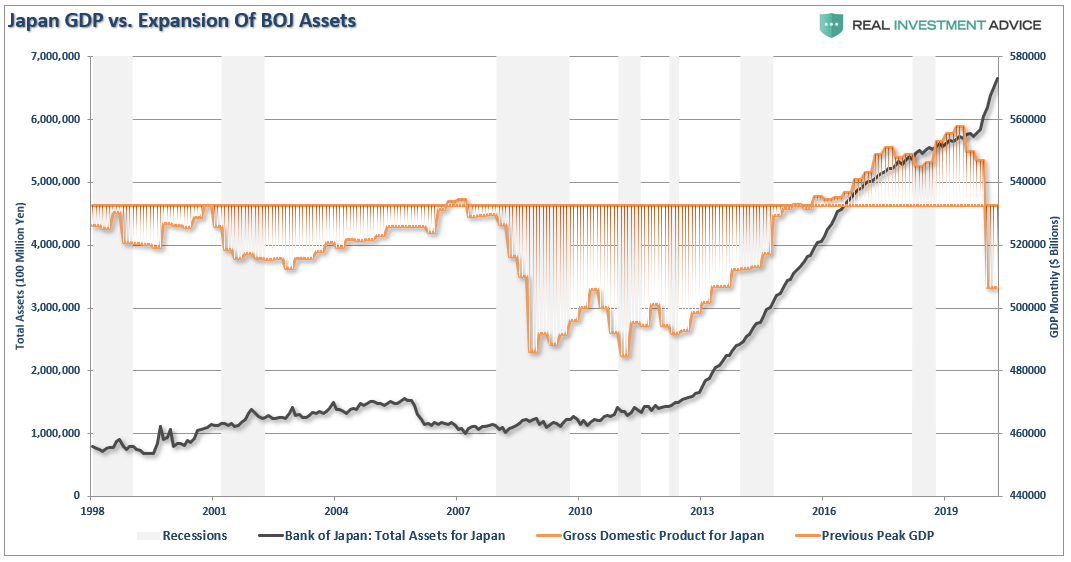
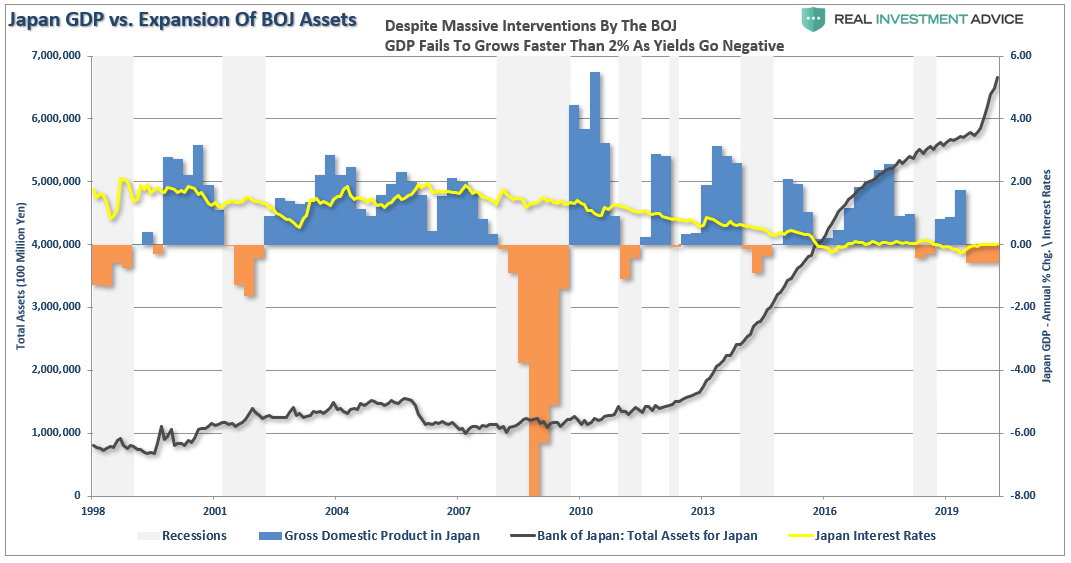
While many suggest the current situation is “unprecedented,” it really isn’t. Japan has been an ongoing experiment for nearly 30-years with the same economic outcome the U.S. is currently experiencing.
Furthermore, we have much more akin to Japan than many would like to believe.
A decline in savings rates
An aging demographic
A heavily indebted economy
A decline in exports
Slowing domestic economic growth rates.
An underemployed younger demographic.
An inelastic supply-demand curve
Weak industrial production
Dependence on productivity increases
The lynchpin to Japan, and the U.S., remains demographics and interest rates. As the aging population grows becoming a net drag on “savings,” the dependency on the “social welfare net” will continue to expand. The “pension problem” is only the tip of the iceberg.
Failure To Launch
Since the financial crisis, Japan has been running a massive “quantitative easing” program which, on a relative basis, is more than 3-times the size of that in the U.S. However, while stock markets have performed well with Central Bank interventions, economic prosperity is less than it was prior to the turn of the century.
Furthermore, despite the BOJ’s balance sheet consuming 80% of the ETF markets, not to mention a sizable chunk of the corporate and government debt market, Japan has been plagued by rolling recessions, low inflation, and low-interest rates.(Japan’s 10-year Treasury rate fell into negative territory for the second time in recent years.)
While financial engineering clearly props up asset prices, I think Japan is a very good example that financial engineering not only does nothing for an economy over the medium to longer-term, it actually has negative consequences.” – Doug Kass
Summary
There is no evidence the Fed’s “new policy” tool will create inflation, lead to stronger economic growth, or generate better economic equality.
What we are pretty sure of is that their “new policy” is very much the same as the “old policy,” which will likely continue to foster economic inequality, inflated assets, and a further widening of the “wealth gap.”
Most telling is the inability of the current economists who maintain our monetary and fiscal policies to realize the problem of trying to “cure a debt problem with more debt.”
The Keynesian view that “more money in people’s pockets” will drive up consumer spending, with a boost to GDP being the result, has been wrong. It hasn’t happened in 40 years.
We fear the Fed’s new policy will only lead to further social instability and populism. Such has been the result in every other country which has run such programs of unbridled debts and deficits.
As Dr. Woody Brock aptly argues:
“It is truly ‘American Gridlock’ as the real crisis lies between the choices of ‘austerity’ and continued government ‘largesse.’ One choice leads to long-term economic prosperity for all; the other doesn’t.”
Take your pick.
via ZeroHedge News https://ift.tt/32XRI2k Tyler Durden