White House Plans To Cut Off Sales Of American Chip Technology To China

White House Plans To Cut Off Sales Of American Chip Technology To China

Just hours after Beijing lifted more trade-war restrictions on importing US farm products due to the outbreak…

…the White House has paid President Xi back by launching an economic assault on Huawei and other Chinese telecom companies that threatens to revive the trade war and strain the relationship between Beijing and Washington in the middle of a global pandemic.

Despite all of this, Nasdaq futs are up strongly pre-open, confirming what we already knew: this Fed-assisted market cares about only one thing, and it’s not fundamentals. Still, American companies that produce chips and the technology to make them could lose access to a major market.

As the Pentagon scrambles to pressure its European partners not to allow the use of Huawei parts in their domestic 5G networks, reports from the last few days have claimed the White House is preparing to ratchet up the economic  pressure on Huawei. Now, WSJ is reporting that Washington’s wrath could hammer the entire Chinese telecom sector as the administration is considering a complete ban on selling American chip-making equipment and technology to Chinese firms.

Once again, the Commerce Department is on the front lines of the pressure campaign: The department is reportedly drafting changes to the ‘foreign direct product rule’, which restricts the use of US technology by foreign companies for national security reasons.

As WSJ explains, the policy would be part of a broader effort to cut China off from foreign technology that they haven’t yet managed to replicate or steal. Chip-manufacturing technology is one such area where Chinese companies like Huawei are still dependent on American suppliers. Jet engine technology is another.

Still, the proposal shows the blunt tools the Trump administration is prepared to use in its bid to cut China off from America’s semiconductor sector. Semiconductor technology is a key area where China has struggled to cut its reliance on foreign suppliers despite years of effort. Semiconductors rank among China’s largest imports from the U.S.

“They don’t want any fab in the world to produce anything for Huawei – that’s the goal,” one person said, speaking of the chip fabrication plants that likely would be affected by the new trade limits.

The Trump administration also is considering cutting off China from jet-engine technology, another area where Beijing has struggled to shed reliance on U.S. and European manufacturers.

[…]

U.S. chip-manufacturing tool makers, such as Applied Materials Inc. AMAT -0.77% and Lam Research Corp., LRCX -0.67% are among the biggest in the industry. The equipment they make is some of the most expensive machinery in the world. Setting up a modern chip factory typically costs many billions of dollars, and new restrictions on U.S. equipment could drive customers toward alternatives.

“It would be a huge disincentive for any fab to use U.S. equipment because there would be a limitation on that versus Japanese or Chinese equipment,” one of the people said.

The changes has reportedly been ‘under discussion’ for weeks. Furthermore, this policy would accompany a separate ruling that would restrict chip sales to Huawei, as we’ve reported in recent days.

We suspect we’ll be hearing more about this soon.


Tyler Durden

Mon, 02/17/2020 – 07:57

via ZeroHedge News https://ift.tt/2SUG57d Tyler Durden
DC Book Event

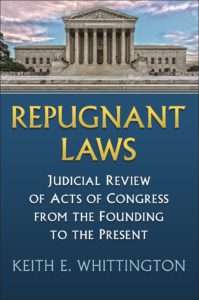
I’m pleased to note that on Friday, February 21, at 9:00am, the American Enterprise Institute will be hosting a book forum on my recent book, Repugnant Laws: Judicial Review of Acts of Congress from the Founding to the Present. Adam White will be providing commentary.

The book provides a political history of how the U.S. Supreme Court has limited—and facilitated—congressional power across its history. Along with the book, I’ve released a new comprehensive of dataset of cases in which the Court has substantively evaluated the constitutionality of an application of an act of Congress.

The event is open to the public, and registration for those in the DC area can be found here.  If you prefer to watch the video from the comfort of your secure bunker in an undisclosed location, you can do so live or on video a few hours later.

from Latest – Reason.com https://ift.tt/2V59RIS
via IFTTT

DC Book Event

I’m pleased to note that on Friday, February 21, at 9:00am, the American Enterprise Institute will be hosting a book forum on my recent book, Repugnant Laws: Judicial Review of Acts of Congress from the Founding to the Present. Adam White will be providing commentary.
The book provides a political history of how the U.S. Supreme Court has limited—and facilitated—congressional power across its history. Along with the book, I’ve released a new comprehensive of dataset of cases in which the Court has substantively evaluated the constitutionality of an application of an act of Congress.

The event is open to the public, and registration for those in the DC area can be found here.  If you prefer to watch the video from the comfort of your secure bunker in an undisclosed location, you can do so live or on video a few hours later.

from Latest – Reason.com https://ift.tt/2V59RIS
via IFTTT

14 ‘Diamond Princess’ Passengers Test Positive During Flight Back To US; Tokyo Marathon Cancelled

14 ‘Diamond Princess’ Passengers Test Positive During Flight Back To US; Tokyo Marathon Cancelled

It’s like the ‘Alien’ franchise: The evacuation ship always carries the monster.

Unfortunately, in this instance, the monster is an invisible, inaudible yet highly infectious virus. And instead of the Nostromo, we have two chartered Boeing 747s.

According to the New York Post, 14 Americans among the more than 300 US citizen passengers being evacuated from the cruise ship ‘Diamond Princess’ after nearly two weeks of quarantine have tested positive for the virus. Officials said they didn’t learn of the positive tests until the flight was about to take off.

Ahead of the flight, the State Department said that 40 Americans who had tested positive wouldn’t be eligible for the evacuation flight, and would instead be entrusted to Japanese authorities. Of course, all of the Americans who traveled on the evacuation flights had to agree to a two week quarantine after returning to the US.

The sick individuals were reportedly “isolated” during the flight (but in a closed environment like an airplane during flight, how secure could they possibly be?).

“These individuals were moved in the most expeditious and safe manner to a specialized containment area on the evacuation aircraft to isolate them in accordance with standard protocols,” the statement said. “During the flights, these individuals will continue to be isolated from the other passengers.”

One of the evacuation flights is headed to Travis Air Force Base in California, and another for Lackland Air Force Base in Texas. At this time, it’s unclear which plane the infected are traveling on, where they are going, or where they’ll be treated.

In other news, Japanese health authorities have decided to cancel a major public sporting event despite there only being 65 confirmed cases of the virus in Japan (outside the Diamond Princess): The Tokyo Marathon, which was set to begin later this month, has been cancelled

The annual event attracts hundreds of thousands of spectators to watch more than 20,000 runners compete in one of the six ‘World Marathon Majors’.

Many international events and trade shows have been cancelled because of the outbreak, including events like the Mobile world Conference in Barcelona, an area with zero confirmed COVID-19 infections, and the Beijing Autoshow, which was cancelled Monday morning, according to Reuters.

But the Tokyo Marathon is an important attraction for Tokyo’s tourism industry. Furthermore, it doesn’t bode well for another high-profile sporting event: The 2020 Summer Olympics in Tokyo.

At this point, we suspect the biggest tail risk for global markets involving Japan would be a decision to cancel or postpone the Olympics (it’s not like they can simply pick another venue). That would ignite a wave of hysteria and uproar that even these Fed-assisted markets likely wouldn’t be able to withstand.


Tyler Durden

Mon, 02/17/2020 – 07:34

via ZeroHedge News https://ift.tt/2wp4Gtg Tyler Durden

Armed Thieves Steal Truckload Of Toilet Paper In Hong Kong Amid Worsening Shortage Of Basic Goods

Armed Thieves Steal Truckload Of Toilet Paper In Hong Kong Amid Worsening Shortage Of Basic Goods

Looks like the sh*t is really about to hit the fan in Hong Kong…and we mean that literally.

In a shocking indication of just how bad shortages of basic goods have gotten as mainland China expands its lockdown to more than 700 million people and Hong Kong closes some of its borders, a gang of armed thieves in Hong Kong stole a truckload of toilet paper in a daring robbery last night.

Police say the truck driver was taken by surprise and held up by a man with a knife, while two others loaded the toilet paper into their getaway vehicle.

Don’t worry: We suspect they may have left a “paper” trail.


Tyler Durden

Mon, 02/17/2020 – 06:15

via ZeroHedge News https://ift.tt/2wjfk4x Tyler Durden

24 Killed In Brutal Terror Attack On Burkina Faso Church; Local Pastor Targeted

24 Killed In Brutal Terror Attack On Burkina Faso Church; Local Pastor Targeted

Gunmen killed at least 24 people and wounded 18 more during an attack on a protestant church in the village of Pansi, in the north of Burkina Faso, announced the governor of the Sahel region, Colonel Salfo Kaboré.

A group of “armed terrorists” burst into the village of Pansi, in Yagha, a volatile province near the Niger border, “and attacked the peaceful local population after having identified them and separated them from non-residents,” Colonel Salfo Kabore said in a statement sent to AFP.

The Sunday attack occurred during weekly church service, according to the AFP.

A group of “armed terrorists” burst into the village of Pansi, in Yagha province “and attacked the peaceful local population after having identified them and separated them from non-residents”, Colonel Salfo Kabore said in a statement sent to AFP.

Neighbors in the nearby town of Sebba told reporters that Pansi villagers had fled there for safety.

Burkina Faso is one of the poorest countries in the world, and it’s also home to a brutal jihadist insurgency which is growing across the Sahel region.

Since 2015, around 750 people have been killed in Burkina, and around 600,000 people have fled their homes as Christian churches have been attacked, amid other acts of Jihadi violence. The north of the country has a mixed population of Christians and Muslims, and for ages the two groups lived harmoniously side by side. But as radicalization and Islamic extremism have swept the area, their easy peace has come to an end.

This isn’t even the first violent attack on a church this month: On Feb. 10, suspected jihadists in Sebba took seven people hostage inside the home of a pastor. Later, five bodies were found, including the body of the pastor, according to the local governor. Reports circling on twitter claim the pastor of the church attacked on Sunday was targeted by the attackers.

Due to a weak military and almost nonexistent rule of law, attacks like this happen frequently in the region. More than 4,000 people in Burkina have been killed in acts of violence perpetrated by Islamic extremist terrorists over the past year.

That’s a staggering number.


Tyler Durden

Mon, 02/17/2020 – 05:57

via ZeroHedge News https://ift.tt/38BuTmq Tyler Durden

Steal This Intellectual Property

In 1971 the yippie radical Abbie Hoffman wrote a book advocating resistance to government, capitalism, and the “Pig Nation.” Steal This Book advocated shoplifting, squatting, and other methods of living off other people for free. The title and the contents made the manuscript hard to peddle. But when it finally got a publisher it sold well in bookstores, which was good for Hoffman financially. It turns out that most people want to live off other people not by stealing but by paying a fair price earned by their own labors. Hoffman remarked, “It’s embarrassing when you try to overthrow the government”—and capitalism—”and you wind up on the Best Seller’s List.”

I want you to steal what the lawyers self-interestedly call “intellectual property”: Hoffman’s book or my books or E=mc2 or the Alzheimer’s drug that the Food and Drug Administration is “testing” in its usual bogus and unethical fashion. I want the Chinese to steal “our” intellectual property, so that consumers worldwide get stuff cheaply. I want everybody to steal every idea, book, chemical formula, Stephen Foster lyric—all of it. Steal, steal, steal. You have my official economic permission.

What?! A liberal (in the classical sense) wants people to steal? You bet. Here’s why. An idea, after it is produced, has no opportunity cost. If one more person reads Hamlet, there’s no less of it available for the next person. That’s not true of, say, your house. If the neighbors treat your house as common property, there’s less of it for you to use. George is in the bathroom right now. Sorry.

It’s true of your labor, which also has an opportunity cost—an alternate use necessarily forgone—to you. If you become a slave, you can’t use your own self. The master in Kentucky gets those hours in the field away from the little cabin floor, yet he doesn’t pay you for their opportunity cost.

The correct price for such scarce items is their opportunity cost, because then, as Adam Smith said, “As every individual…endeavors as much as he can both to employ his capital [and labor and land and other items with opportunity cost so] that its produce may be of the greatest value, every individual necessarily labors to render the annual revenue of the society as great as he can.”

But ideas have no opportunity cost. So the optimal price, socially speaking, is zero. That’s the correct application of the invisible hand. It’s like the Brooklyn Bridge. On the day it opened on May 24, 1883, the correct price to charge another walker across the bridge was zero. The additional walker causes trivial wear to the bridge, and unless the bridge was congested, she causes no opportunity cost.

“Aha!” you reply. “But what about the cost to make the bridge in the first place, or the cost of supporting Shakespeare while he writes Hamlet, or the cost of research and, umm, marketing costs such as trips for doctors and their families for conferences in Hawaii to get a new drug for Alzheimer’s? And you call yourself an economist!”

Yes, all that is true. If people are going to get the bridge or Hamlet or the drug, someone has to pay for it. There’s no free lunch. It’s the central dilemma in any system of rights for intellectual property, or anything else with costs up front but no opportunity cost in use.

There’s no trick solution that works qualitatively, such as “have a patent system.” Too bad. Life is hard. But the rules that apply to property with an opportunity cost simply don’t apply to ideas.

Mathematically speaking, assuming you want to maximize national income, there’s a solution. In principle, for each particular example of a cancer drug or a romance novel or an idea for a printed circuit, there’s an optimal price. To get the highest total national income, all you have to do is find out what term of years for a patent or copyright is optimal for that particular example. That “solution” is like the economist’s solution for opening the can of beans left to a shipwrecked survivor. (To open it, assume you have a can opener.) It’s the same as the “solution” to the numerous market imperfections that, say, the economist Joseph Stiglitz believes he sees all around him. To fix them, says Stiglitz, assume you have a perfect government.

An irritating case of not understanding the dilemma is the practice by the National Bureau of Economic Research (NBER) of erecting a paywall to charge for its papers written in the national interest. The considerable charge earns a trivial portion of the costs of producing the papers. Stiglitz’s salary is way larger than what’s collected. And once the paper is written, the marginal social cost of releasing it is, of course, zero. So according to the principles of pricing figured out in economics a century ago, which Stiglitz teaches at Princeton, the price should be zero. I tried a couple of times to get my friends on the board of the NBER to relent in their anti-economic practice, but they were beyond embarrassment. Being the NBER means you don’t have to take seriously either the national or the economic.

There’s a more serious counterpoint, made by the economist Steven Horwitz of Ball State University. Namely, that a pastrami sandwich made just the disgusting way you like it, with ketchup, once produced and about to be handed over to you at the deli, also has no opportunity cost. The reply to Horwitz is to retreat to constitutional principles. Namely, the system that gives the best overall result. We want sandwiches to be produced even in the disgusting way you want them, and in order to get the deli to do so we need to have a rule that you have to pay for it.

Another counterpoint is the trade secret. After you’ve thought of it, the social cost of giving it up is zero. Are you required to give it up? No, on a still deeper constitutional principle: the right not to be enslaved. No wonder Aristotle got that exact point wrong in a society in which the nonslaves deemed slavery to be just fine.

We liberals since the 18th century have denied slavery. The U.S. copyright of fully 70 years from the death of the creator makes people pointlessly enslaved to the heirs of Walt Disney. In Hoffman’s 1987 trial for trespass while protesting the activities of the CIA at the University of Massachusetts, he quoted Tom Paine: “Every age and generation must be as free to act for itself, in all cases, as the ages and generations which preceded it. Man has no property in man, neither has any generation a property in the generations which are to follow.”

Right on, brother.

from Latest – Reason.com https://ift.tt/2SyLSjT
via IFTTT

Steal This Intellectual Property

In 1971 the yippie radical Abbie Hoffman wrote a book advocating resistance to government, capitalism, and the “Pig Nation.” Steal This Book advocated shoplifting, squatting, and other methods of living off other people for free. The title and the contents made the manuscript hard to peddle. But when it finally got a publisher it sold well in bookstores, which was good for Hoffman financially. It turns out that most people want to live off other people not by stealing but by paying a fair price earned by their own labors. Hoffman remarked, “It’s embarrassing when you try to overthrow the government”—and capitalism—”and you wind up on the Best Seller’s List.”

I want you to steal what the lawyers self-interestedly call “intellectual property”: Hoffman’s book or my books or E=mc2 or the Alzheimer’s drug that the Food and Drug Administration is “testing” in its usual bogus and unethical fashion. I want the Chinese to steal “our” intellectual property, so that consumers worldwide get stuff cheaply. I want everybody to steal every idea, book, chemical formula, Stephen Foster lyric—all of it. Steal, steal, steal. You have my official economic permission.

What?! A liberal (in the classical sense) wants people to steal? You bet. Here’s why. An idea, after it is produced, has no opportunity cost. If one more person reads Hamlet, there’s no less of it available for the next person. That’s not true of, say, your house. If the neighbors treat your house as common property, there’s less of it for you to use. George is in the bathroom right now. Sorry.

It’s true of your labor, which also has an opportunity cost—an alternate use necessarily forgone—to you. If you become a slave, you can’t use your own self. The master in Kentucky gets those hours in the field away from the little cabin floor, yet he doesn’t pay you for their opportunity cost.

The correct price for such scarce items is their opportunity cost, because then, as Adam Smith said, “As every individual…endeavors as much as he can both to employ his capital [and labor and land and other items with opportunity cost so] that its produce may be of the greatest value, every individual necessarily labors to render the annual revenue of the society as great as he can.”

But ideas have no opportunity cost. So the optimal price, socially speaking, is zero. That’s the correct application of the invisible hand. It’s like the Brooklyn Bridge. On the day it opened on May 24, 1883, the correct price to charge another walker across the bridge was zero. The additional walker causes trivial wear to the bridge, and unless the bridge was congested, she causes no opportunity cost.

“Aha!” you reply. “But what about the cost to make the bridge in the first place, or the cost of supporting Shakespeare while he writes Hamlet, or the cost of research and, umm, marketing costs such as trips for doctors and their families for conferences in Hawaii to get a new drug for Alzheimer’s? And you call yourself an economist!”

Yes, all that is true. If people are going to get the bridge or Hamlet or the drug, someone has to pay for it. There’s no free lunch. It’s the central dilemma in any system of rights for intellectual property, or anything else with costs up front but no opportunity cost in use.

There’s no trick solution that works qualitatively, such as “have a patent system.” Too bad. Life is hard. But the rules that apply to property with an opportunity cost simply don’t apply to ideas.

Mathematically speaking, assuming you want to maximize national income, there’s a solution. In principle, for each particular example of a cancer drug or a romance novel or an idea for a printed circuit, there’s an optimal price. To get the highest total national income, all you have to do is find out what term of years for a patent or copyright is optimal for that particular example. That “solution” is like the economist’s solution for opening the can of beans left to a shipwrecked survivor. (To open it, assume you have a can opener.) It’s the same as the “solution” to the numerous market imperfections that, say, the economist Joseph Stiglitz believes he sees all around him. To fix them, says Stiglitz, assume you have a perfect government.

An irritating case of not understanding the dilemma is the practice by the National Bureau of Economic Research (NBER) of erecting a paywall to charge for its papers written in the national interest. The considerable charge earns a trivial portion of the costs of producing the papers. Stiglitz’s salary is way larger than what’s collected. And once the paper is written, the marginal social cost of releasing it is, of course, zero. So according to the principles of pricing figured out in economics a century ago, which Stiglitz teaches at Princeton, the price should be zero. I tried a couple of times to get my friends on the board of the NBER to relent in their anti-economic practice, but they were beyond embarrassment. Being the NBER means you don’t have to take seriously either the national or the economic.

There’s a more serious counterpoint, made by the economist Steven Horwitz of Ball State University. Namely, that a pastrami sandwich made just the disgusting way you like it, with ketchup, once produced and about to be handed over to you at the deli, also has no opportunity cost. The reply to Horwitz is to retreat to constitutional principles. Namely, the system that gives the best overall result. We want sandwiches to be produced even in the disgusting way you want them, and in order to get the deli to do so we need to have a rule that you have to pay for it.

Another counterpoint is the trade secret. After you’ve thought of it, the social cost of giving it up is zero. Are you required to give it up? No, on a still deeper constitutional principle: the right not to be enslaved. No wonder Aristotle got that exact point wrong in a society in which the nonslaves deemed slavery to be just fine.

We liberals since the 18th century have denied slavery. The U.S. copyright of fully 70 years from the death of the creator makes people pointlessly enslaved to the heirs of Walt Disney. In Hoffman’s 1987 trial for trespass while protesting the activities of the CIA at the University of Massachusetts, he quoted Tom Paine: “Every age and generation must be as free to act for itself, in all cases, as the ages and generations which preceded it. Man has no property in man, neither has any generation a property in the generations which are to follow.”

Right on, brother.

from Latest – Reason.com https://ift.tt/2SyLSjT
via IFTTT