After AOC again attacked her in an interview with the Washington Post, Pelosi said during her regular press briefing on Wednesday that she is done talking in public about the New York City Congresswoman and her ‘girl gang’ of POC progressive lawmakers, the Hill reported.
Pelosi said she’d said what she wanted to say at a closed door caucus meeting, where she asked those in attendance to avoid attacking other party members with whom they don’t agree. The speaker shrugged off any offense that AOC, or the three other members of her ‘squad’, might have taken (for the record: that includes Massachusetts Rep. Ayanna Pressley, Michigan’s Rashida Tlaib and Minnesota’s Ilhan Omar.
Part of the impetus for Pelosi’s admonishment was a comment from AOC’s chief of staff comparing New Dems and Blue Dogs to pro-segregationist Southern Democrats.
“They took offense because I addressed, at the request of my members, an offensive tweet that came out of one of the members’ offices that referenced our Blue Dogs and our New Dems essentially as segregationists,” Pelosi said. “Our members took offense at that. I addressed that. How they’re interpreting and carrying it to another place is up to the.”
“But I’m not going to be discussing it any further,” Pelosi said. “I said what I’m going to say.”
Though AOC clarified this week that she doesn’t think Pelosi is a racist or has ‘racial animus’, in the interview with the Post published Wednesday, AOC accused Pelosi of ‘singling out’ women of color.
“When these comments first started, I kind of thought that she was keeping the progressive flank at more of an arm’s distance in order to protect more moderate members, which I understood,” Ocasio-Cortez said. “But the persistent singling out…it got to a point where it was just outright disrespectful…the explicit singling out of newly elected women of color.”
Pelosi said several Democrats had taken offense at the comment from AOC’s chief of staff, and asked her to do something to address it. Of course, this isn’t the first beef between Pelosi and arguably the only celebrity Democrat in the House. AOC kicked off her tenure in Congress by joining protests directed at Pelosi, and has repeatedly attacked more moderate Democrats for not backing Medicare for All and AOC’s green new deal.
And this likely won’t be their last spat, as AOC continues to drag the party further to the left, and into alignment with her socialist ideals. Pelosi explicitly rejected socialism and endorsed capitalism last year in a clip that was widely circulated by the fringe left. They will never forgive her for that.
via ZeroHedge News https://ift.tt/2LQ5Kfe Tyler Durden
An amended class-action lawsuit filed by a former student against Michigan State University (MSU) could pave the way for more class actions against universities and colleges that violate the due process rights of students accused of sexual misconduct.
Filed by former MSU student “John Doe,” the lawsuit claims Doe was “denied equal protection under the law as well as the most fundamental guarantees of due process,” when MSU suspended him for two years without giving him a hearing or the opportunity to cross-examine the female student who accused him of sexual assault.
Doe seeks to prove that MSU denied him his rights in order to placate the Department of Education’s Office of Civil Rights, which threatened to withhold funding from the university due to its handling of sexual assault cases, and in order to defuse criticism over “a widely publicized report alleging extraordinarily high levels of unredressed sexual assaults against female undergraduates at Michigan State.” The suit also says MSU denied Doe his rights in part to due to criticism of the university’s employment of Dr. Larry Nassar, the USA Gymnastics physician accused of molesting 250 female children.
Doe filed suit in the United States District Court for the Western District of Michigan, which is in the Sixth Circuit. A 2018 decision by the Court of Appeals for the Sixth Circuit stated that if a student is accused of misconduct, the university must hold a hearing before taking disciplinary action. If the university’s decision is based on the credibility of the accuser or witnesses, the defendant must also be allowed to cross-examine the witnesses and the accuser. “Not only does cross-examination allow the accused to identify inconsistencies in the other side’s story, but it also gives the fact-finder an opportunity to assess a witness’ demeanor and determine who can be trusted,” the court said.
Andrew Miltenberg, the lawyer representing Doe who specializes in Title IX cases, said that they are not seeking money, “but to vacate and expunge disciplinary records for anyone that was put on probation, expelled, or any other type of suspension at Michigan State under the same policy of not being able to question the accuser.” Miltenberg suggested there could potentially be 200 affected students who might benefit from Doe’s case.
The class-action aspect of this case differentiates it from similar cases. Miltenberg says that no one has seen a class action for cases like this because they are generally reserved for consumer issues. “It’s not so easy to do a class action because traditionally consumer issues lend themselves to a class action, like breast implant litigation and tobacco litigation.” He said if this case is successful, it could open the door for other students in Michigan, Ohio, Kentucky, and Tennessee to sue, as those states are in the jurisdiction of the Sixth Circuit.
“Practically any university in those four states would be subject to the Doe v. Baumruling. If their policy didn’t allow for a live hearing and the ability to confront a witness, you could go to any school and raise this same issue,” Miltenberg says. “The hope is that other circuits take note of this and say ‘Hey this makes sense, this is right.’ I think in that case, it would spread to those other jurisdictions.”
Miltenberg explained that the next step in the case is for MSU to respond to Doe’s lawsuit, which it has 14 days to do. There is a court conference in September to get the case certified as a class action—although Miltenberg says ideally it would get certified sooner.
“What I hope, more than money or financial damages, is that we stop any erosion of due process,” Miltenberg says. “Because it is a very slippery slope.”
The Detroit Free Pressreports that Miltenberg and his team are looking into cases dating back to 2011, “when the then-Obama administration sent a ‘Dear Colleague’ letter to universities upping the pressure to run sex assault investigations and spelling out what needed to be done.”
As Robby Soave notes, the letter “lowered the burden of proof to a ‘preponderance of the evidence’ standard, which meant that accused students could be found responsible for sexual misconduct if administrators were only 51 percent convinced of the charges,” and “it discouraged allowing the accused and accuser to cross-examine each other.”
In 2017 Education Secretary Betsy DeVos withdrew the “Dear Colleague” letter policy saying that “these documents have led to the deprivation of rights for many students—both accused students denied fair process and victims denied an adequate resolution of their complaints.”
from Latest – Reason.com https://ift.tt/2xHOErJ
via IFTTT
An amended class-action lawsuit filed by a former student against Michigan State University (MSU) could pave the way for more class actions against universities and colleges that violate the due process rights of students accused of sexual misconduct.
Filed by former MSU student “John Doe,” the lawsuit claims Doe was “denied equal protection under the law as well as the most fundamental guarantees of due process,” when MSU suspended him for two years without giving him a hearing or the opportunity to cross-examine the female student who accused him of sexual assault.
Doe seeks to prove that MSU denied him his rights in order to placate the Department of Education’s Office of Civil Rights, which threatened to withhold funding from the university due to its handling of sexual assault cases, and in order to defuse criticism over “a widely publicized report alleging extraordinarily high levels of unredressed sexual assaults against female undergraduates at Michigan State.” The suit also says MSU denied Doe his rights in part to due to criticism of the university’s employment of Dr. Larry Nassar, the USA Gymnastics physician accused of molesting 250 female children.
Doe filed suit in the United States District Court for the Western District of Michigan, which is in the Sixth Circuit. A 2018 decision by the Court of Appeals for the Sixth Circuit stated that if a student is accused of misconduct, the university must hold a hearing before taking disciplinary action. If the university’s decision is based on the credibility of the accuser or witnesses, the defendant must also be allowed to cross-examine the witnesses and the accuser. “Not only does cross-examination allow the accused to identify inconsistencies in the other side’s story, but it also gives the fact-finder an opportunity to assess a witness’ demeanor and determine who can be trusted,” the court said.
Andrew Miltenberg, the lawyer representing Doe who specializes in Title IX cases, said that they are not seeking money, “but to vacate and expunge disciplinary records for anyone that was put on probation, expelled, or any other type of suspension at Michigan State under the same policy of not being able to question the accuser.” Miltenberg suggested there could potentially be 200 affected students who might benefit from Doe’s case.
The class-action aspect of this case differentiates it from similar cases. Miltenberg says that no one has seen a class action for cases like this because they are generally reserved for consumer issues. “It’s not so easy to do a class action because traditionally consumer issues lend themselves to a class action, like breast implant litigation and tobacco litigation.” He said if this case is successful, it could open the door for other students in Michigan, Ohio, Kentucky, and Tennessee to sue, as those states are in the jurisdiction of the Sixth Circuit.
“Practically any university in those four states would be subject to the Doe v. Baumruling. If their policy didn’t allow for a live hearing and the ability to confront a witness, you could go to any school and raise this same issue,” Miltenberg says. “The hope is that other circuits take note of this and say ‘Hey this makes sense, this is right.’ I think in that case, it would spread to those other jurisdictions.”
Miltenberg explained that the next step in the case is for MSU to respond to Doe’s lawsuit, which it has 14 days to do. There is a court conference in September to get the case certified as a class action—although Miltenberg says ideally it would get certified sooner.
“What I hope, more than money or financial damages, is that we stop any erosion of due process,” Miltenberg says. “Because it is a very slippery slope.”
The Detroit Free Pressreports that Miltenberg and his team are looking into cases dating back to 2011, “when the then-Obama administration sent a ‘Dear Colleague’ letter to universities upping the pressure to run sex assault investigations and spelling out what needed to be done.”
As Robby Soave notes, the letter “lowered the burden of proof to a ‘preponderance of the evidence’ standard, which meant that accused students could be found responsible for sexual misconduct if administrators were only 51 percent convinced of the charges,” and “it discouraged allowing the accused and accuser to cross-examine each other.”
In 2017 Education Secretary Betsy DeVos withdrew the “Dear Colleague” letter policy saying that “these documents have led to the deprivation of rights for many students—both accused students denied fair process and victims denied an adequate resolution of their complaints.”
from Latest – Reason.com https://ift.tt/2xHOErJ
via IFTTT
An Arizona cop acquitted of murder in 2017 for killing a man crawling on his knees, begging for his life, in a hotel hallway, was temporarily rehired by the city he worked for so that he could claim a disability pension and file for a medical retirement that will pay him more than $2,500 a month for the rest of his life.
Former Mesa Police Officer Philip Mitchell Brailsford drew national attention and outrage in December 2017 when a jury found him not guilty of second-degree murder in the fatal shooting of Daniel Shaver. Brailsford shot Shaver in a confrontation in a hotel hallway in 2016 after police were called there by somebody who had seen Shaver holding a gun in his room.
The gun turned out to be a pellet gun, but police apparently didn’t know that. During the response, police ordered Shaver, who was unarmed, out into the hallway on his knees and ordered him to crawl in their direction while keeping his hands up, and they continued to bark confusing orders at him. As Shaver, clearly terrified, attempted to comply, at one point he gestured behind himself, possibly to pull up his pants, and Brailsford immediately opened fire, killing him.
The shooting was captured on police body camera footage, but it wasn’t released to the public until after the jury acquitted Brailsford. (You can watch the footage here.)
A jury might have decided not to convict Brailsford, but the Mesa Police Department fired him after the shooting for violations of department policy. That turned out not to be the end of Brailsford’s career in Mesa. ABC15 in Arizona reports that Brailsford appealed his termination and arranged for a special deal with the city to be rehired temporarily so that he could apply for a disability pension and retire for medical reasons.
Here’s the kicker: The justification for Brailsford’s medical disability and retirement is a claim that he has Post-Traumatic Stress Disorder (PTSD) from shooting and killing Shaver and the resulting prosecution, one of Brailsford’s lawyers told ABC15. This medical condition qualifies him for a monthly pension check of $2,569.21 for the rest of his life, which the taxpayers of Mesa are on the hook for. Brailsford is currently 28 years old. Furthermore, the City of Mesa agreed to spend up to $3 million to help Brailsford defend himself and pay lawsuit settlements.
The city has also agreed to give Brailsford a “neutral recommendation” for future employment references. Thank heavens for Google searches, right?
Read more about the shooting here. I predicted back in 2017 that Brailsford would try to get his job back. But I neglected to consider that he’d use the shooting to arrange for medical retirement.
from Latest – Reason.com https://ift.tt/2SdepcX
via IFTTT
An Arizona cop acquitted of murder in 2017 for killing a man crawling on his knees, begging for his life, in a hotel hallway, was temporarily rehired by the city he worked for so that he could claim a disability pension and file for a medical retirement that will pay him more than $2,500 a month for the rest of his life.
Former Mesa Police Officer Philip Mitchell Brailsford drew national attention and outrage in December 2017 when a jury found him not guilty of second-degree murder in the fatal shooting of Daniel Shaver. Brailsford shot Shaver in a confrontation in a hotel hallway in 2016 after police were called there by somebody who had seen Shaver holding a gun in his room.
The gun turned out to be a pellet gun, but police apparently didn’t know that. During the response, police ordered Shaver, who was unarmed, out into the hallway on his knees and ordered him to crawl in their direction while keeping his hands up, and they continued to bark confusing orders at him. As Shaver, clearly terrified, attempted to comply, at one point he gestured behind himself, possibly to pull up his pants, and Brailsford immediately opened fire, killing him.
The shooting was captured on police body camera footage, but it wasn’t released to the public until after the jury acquitted Brailsford. (You can watch the footage here.)
A jury might have decided not to convict Brailsford, but the Mesa Police Department fired him after the shooting for violations of department policy. That turned out not to be the end of Brailsford’s career in Mesa. ABC15 in Arizona reports that Brailsford appealed his termination and arranged for a special deal with the city to be rehired temporarily so that he could apply for a disability pension and retire for medical reasons.
Here’s the kicker: The justification for Brailsford’s medical disability and retirement is a claim that he has Post-Traumatic Stress Disorder (PTSD) from shooting and killing Shaver and the resulting prosecution, one of Brailsford’s lawyers told ABC15. This medical condition qualifies him for a monthly pension check of $2,569.21 for the rest of his life, which the taxpayers of Mesa are on the hook for. Brailsford is currently 28 years old. Furthermore, the City of Mesa agreed to spend up to $3 million to help Brailsford defend himself and pay lawsuit settlements.
The city has also agreed to give Brailsford a “neutral recommendation” for future employment references. Thank heavens for Google searches, right?
Read more about the shooting here. I predicted back in 2017 that Brailsford would try to get his job back. But I neglected to consider that he’d use the shooting to arrange for medical retirement.
from Latest – Reason.com https://ift.tt/2SdepcX
via IFTTT
Of all the distinctions that investors might make in the coming few years, one that I expect will serve investors particularly well is the distinction between how the market responds to monetary policy when investors are inclined toward speculation, versus how the market responds when investors are inclined toward risk-aversion.
Be very careful not to assume that ‘easy money’ means ‘rising market.’ Easy money amplifies speculation, provided that investors are already inclined to speculate. But if investors are inclined toward risk-aversion, safe, low-interest rate liquidity isn’t an ‘inferior’ asset at all; it’s a preferred one. As a result, creating more of the stuff simply doesn’t promote speculation.
The fact is that with the exception of 1967 and 1996, every initial easing of monetary policy by the Federal Reserve has been associated with an oncoming or ongoing recession.
Investors should recognize that there is a certain amount of information content in those initial rate cuts. Specifically, when the Federal Reserve shifts from tightening (or normalizing) monetary policy and instead begins a fresh round of rate cuts, it’s a clear indication that something in the economy has gone wrong.
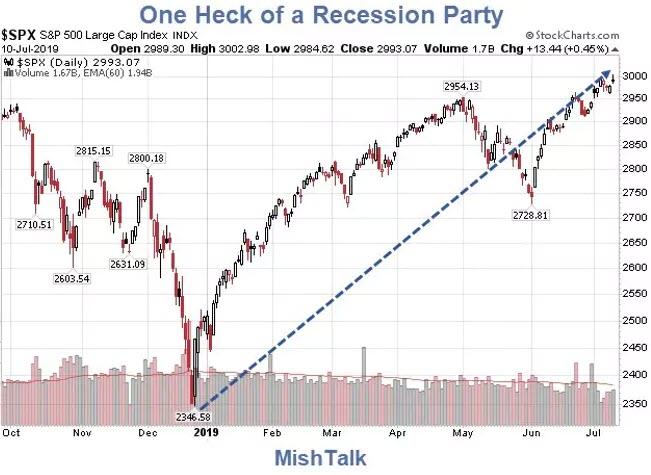
The misplaced exuberance of investors is something my friend Danielle DiMartino Booth calls a “Recession Party.” We doubt this party will end well. Blind faith that rate cuts are always positive for the stock market is a mistake. This assumption is likely to be the hook that keeps investors holding on through a 60-65% market collapse over the completion of this market cycle.
Chuck Prince Still Dancing – July 10, 2007
Chuck Prince, then CEO of Citygroup, said there was no end to the buyout boom:
“When the music stops, in terms of liquidity, things will be complicated. But as long as the music is playing, you’ve got to get up and dance. We’re still dancing”.
Richard Bove, an analyst with Punk Ziegel & Co., doesn’t dispute that Citigroup has issues, but solvency is not one of them, he said.
“These numbers indicate that this bank is both liquid and well-capitalized,” Bove wrote. “At the end of the third quarter, Citigroup posted $2.355 trillion in assets. This was more than any other American bank and possibly more than any bank in the world.”
Notice how Bove cleverly pointed out the asset side of the equation while conveniently forgetting about liabilities. Let’s rework Bove’s statement to see the other side of the story.
“At the end of the third quarter, Citigroup posted $2.227 trillion in liabilities. This was more than any other American bank and possibly more than any bank in the world. A mere 5.4% decline in the value of Citigroup’s assets would make Citigroup insolvent.”
Citigroup’s assets look great in a vacuum. However, those assets do not look so great in relation to liabilities. Leverage has never been greater, and much of that leverage is now in exactly the wrong places: residential and commercial real estate.
Citigroup CEO Chuck Prince’s next “dance step” is likely to be out the door.
Prophetic Words
Looking back, I am rather proud of that last sentence.
The party is over and the music has stopped for Chuck Prince. His last dance is a two-step out the door. Citi’s Prince Plans to Resign
Prince’s retirement solves nothing actually. And of all the issues at Citigroup, capital levels is the most critical one. With capital concerns come side issues such as a Question of Solvency at Citigroup.
We all got up to dance,
Oh, but we never got the chance!
`cause the players tried to take the field;
The marching band refused to yield.
Do you recall what was revealed
The day the music died?
Party On
I ended my November 1, 2007 Question of Solvency article with this thought:
“Solvency is the issue here, and I am not just talking about Citigroup. I am talking about solvency of the system itself. Rate cuts fueled this mess. Rates cuts cannot be the answer.”
The music is still playing. Party on dudes.
Still like those negative-yielding junk bonds?
via ZeroHedge News https://ift.tt/2JsKOJG Tyler Durden
It is rare for Wall Street analysts to break the echo chamber of the intellectual Trump #resistance – after all, “Orange man crazy, his tweets make no sense” remains all the rage among those who are paid 7 figures for their (mostly wrong) economic insight; it wouldn’t look good if Trump, breaking through the barriers of political correctness and obfuscation, exposes “deep” economic and financial truths on twitter. For free.
One person who has no fear in defying Wall Street convention is also one of its biggest perma-bears (which it comes to equities, and the opposite for bonds), SocGen’s Albert Edwards, who in his latest letter brings attention to the barrage of recent tweets from President Trump indicating that “his tolerance for the strong dollar has just about run out.”
As we observed roughly two weeks ago, the dollar had resumed its rise even ahead of the stellar payrolls report, largely due to the prospect of yet another round of Draghi “whatever it takes” jawboning and even easier ECB policy – sending eurozone bond yields to record lows.
So as the global economy falls ever closer towards outright deflation, Edwards predicts that “the global currency war will explode into life. Countries will fight to avoid deflation in the next recession and competitive devaluation will be the tool of choice.” Indeed this was the solution Ben Bernanke suggested in his famous 2002 speech about how to avoid ending up like Japan, to wit:
“Although a policy of intervening to affect the exchange value of the dollar is nowhere on the horizon today (ie 2002), it’s worth noting that there have been times when exchange rate policy has been an effective weapon against deflation. A striking example from US history is Franklin Roosevelt’s 40% devaluation of the dollar against gold in 1933-34, enforced by a program of gold purchases and domestic money creation. The devaluation and the rapid increase in money supply it permitted ended the U.S. deflation remarkably quickly. Indeed, consumer price inflation in the United States, year on year, went from -10.3 % in 1932 to -5.1% in 1933 to +3.4% in 1934. The economy grew strongly, and by the way, 1934 was one of the best years of the century for the stock market. If nothing else, the episode illustrates that monetary actions can have powerful effects on the economy, even when the nominal interest rate is at or near zero, as was the case at the time of Roosevelt’s devaluation.”
While Edwards is hardly the first analyst to suggest that the US will intervene directly in devaluing the dollar – BofA did so three weeks ago – the SocGen strategist is certainly the one to present the most comprehensive case why what may be the final lap in the race to the currency bottom has just begun.
Specifically, Edwards begins by pointing out that while the primary target of Trump’s trade war ire has conventionally been China, he should be focusing on Japan, and perhaps even more so, Europe – and Germany in particular. As the SocGen strategist writes, “it would not have missed President Trumps attention that while the US recorded an overall $625bn trade deficit in 2018, the eurozone ran a huge $600bn surplus (over 4% of GDP). By contrast China and Japan ran surpluses of only $100bn and a $10bn respectively.”
In other words, “when it comes to global trade imbalances China and Japan are not the problem” – according to Edwards, it’s the Eurozone.
Which is not to say that Trump has missed what Europe is doing; quite the contrary, and he is getting rather angry with the ECB: “They have been getting away with this for years, along with China and others, Trump said in a tweet, noting a weaker euro would make it unfairly easier for them to compete against the USA.”
In this context, Trump’s response to any further ECB easing will likely “cause an explosion of anger.” And, as Edwards controversially adds, “you know what? I think Trump has a good point.”
Of course, Trump was reacting to the weakening of the euro in response to ECB President Mario Draghi trialling yet more monetary easing. In response to Trumps tweet, Draghi pushed back on the idea that the ECB was deliberately weakening the exchange rate. He told the audience at the ECBs annual forum in Sintra, Portugal, “We have our remit, we have our mandate. Our mandate is price stability defined as a rate of inflation which is close to, but below, 2% over the medium term.” He also reiterated that the eurozones central bank is “ready to use all the instruments that are necessary to fulfill this mandate. And we don’t target the exchange rate,” he said to applause from the crowd.
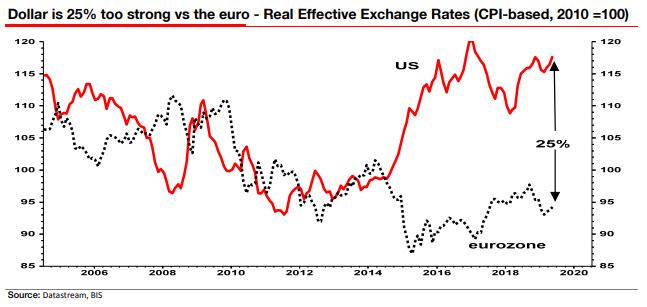
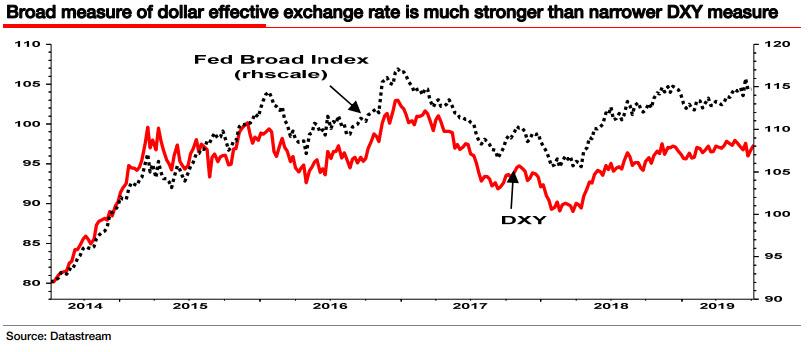
The applause was short-lived however, and may soon turn to tears, and not just in Europe but Japan too: as Edwards explains further, “there is no doubt that the dollar is overvalued, not just against the euro but against a basket of currencies. But so too is the Chinese renminbi (although the gap versus the US has narrowed as the Chinese have allowed the bilateral rate to slide towards $7.0/Rmb). But if you really want to see a major currency that is cheap, it is the yen and not the euro that stands out as anomalously undervalued (see chart below).”
So why, Edwards asks, is it the euro’s weakness that is particularly irritating to President Trump at the moment? Well for one thing, while China’s formerly giant current account surplus has almost disappeared, collapsing from $300BN in 2015, it is now expected to be a deficit of $20BN this year, while Japan is expected to post a $30BN deficit, it is the Eurozone which collectively will post a massive $600BN surplus.
When we talk about the burgeoning eurozone external surplus, we all really know that is shorthand for Germany – and so does President Trump. Germanys overall current account surplus dominates the eurozone surplus and has been topping a massive 8% of its own GDP recently (although projected by the OECD to decline to 7.3% GDP this year). To be sure other European countries run bigger surpluses the Netherlands and Switzerland at 11% and 10% of their own GDP respectively. But these are small countries, and nobody really cares about them in terms of global macro imbalances. They do care about Germany though.
Additionally, with an external imbalance recently topping 8% of GDP, “Germany now runs the biggest single dollar trade and current account surplus in the world.” But Germanys external macro imbalance has been unusually large since around 2004. What has changed? Why is it only in recent years that it has been attracting such aggressive attention and not just from the current Trump Administration, but within the EU itself? (As Edwards reminds us, the EC previously launched investigations into the macro damage Germany’s external imbalance is causing.)
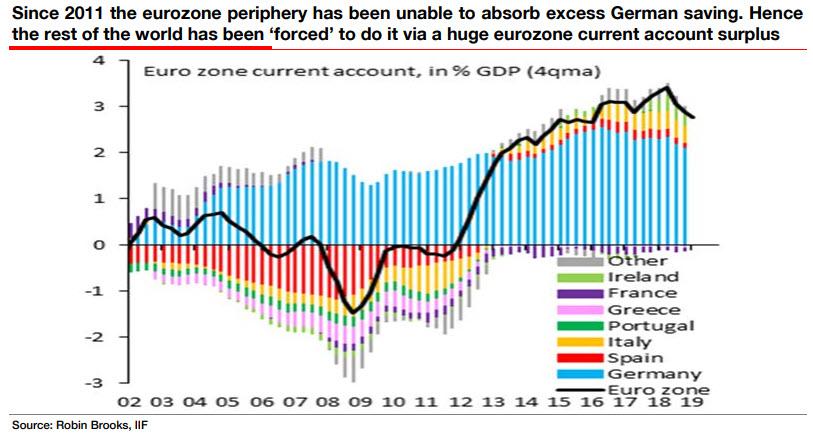
The answer is that for many years, Germany’s gargantuan external surplus was more or less given a pass up until the eurozone crisis of 2011. That, as Edwards notes, was because the eurozone periphery was the mirror image of Germanys huge current account surplus (see chart below). Inappropriately loose monetary policy was foisted on the periphery by the one-size-fits-all monetary policy and resulted in credit bubbles in those economies. The periphery borrowed heavily from an obliging Germany who recycled their domestic savings surplus into the hands of domestic periphery consumers. The periphery acted as a sponge, soaking up German excess saving – and the overall eurozone, by and large, remained broadly in external balance with the rest of the world. Germany’s huge surplus was nobodys concern but the eurozones.
That has now changed, and the problem for the rest of the world now is that under stringent post-eurozone crisis austerity, the eurozone periphery sponge has been totally squeezed out and the rest of the world is being now forced to soak up excess German saving (ie the mirror image of the current account surplus). The eurozone periphery could even be thought of as a giant economic plaster, previously covering up a wound. That plaster has now been ripped off and wound is now flowing copiously and drowning the rest of the world in surplus savings.
So what happens next?
Since there are no new economic laws under the sun, the solution to this problem from the point of view of correcting the eurozone external imbalance is a substantially looser fiscal policy and a somewhat tighter monetary policy.
But as SocGen correctly points out, “while fiscal hawks still dominate thinking within the eurozone, nothing can change.” To be sure the appointment of Christine Lagarde as the new ECB President may mark a shift in thinking, but Edwards just cannot see a European Commission (EC) abandoning its dogma. Indeed, the ECs recent run-in with Italy demonstrates its ideological inflexibility.
* * *
So what does all of that have to do with the global currency war?
Simple: according to Edwards, the problem going forward is “it won’t just be Japan and the eurozone that will be trying to devalue their way far from the deflation quagmire, but also the US.” Specifically, US authorities under the lead of President Trump will embrace Ben Bernanke’s 2002 advice of a competitive devaluation similar to that seen in 1933/4 like a long-lost friend (perhaps Trump will seek to reappoint Bernanke if he needs a Fed chairman for the final round of currency debasement).
At this point, Edwards conducts a thought experiment:
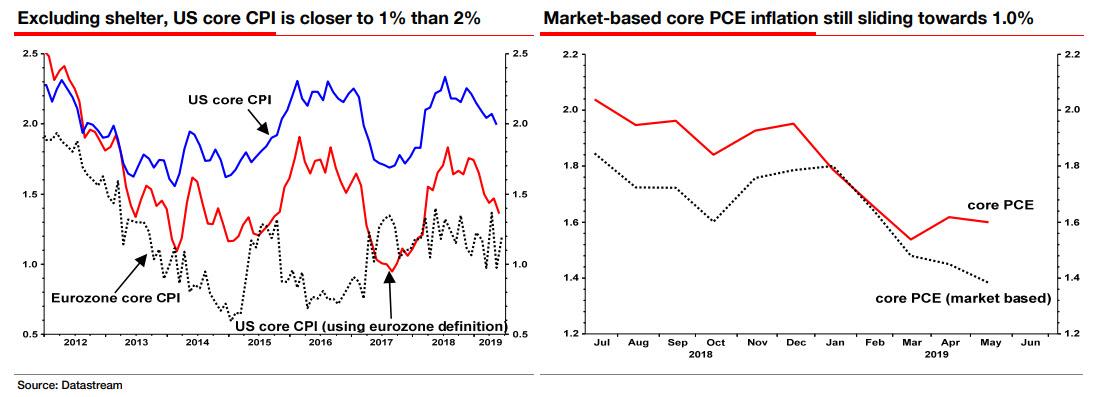
Let us imagine for a moment that the US slides into outright recession before the end of 2020 as most commentators believe. We have highlighted previously how underlying consumer price inflation is running considerably below the 2% suggested by the core CPI or the 1.6% of the core PCE deflator (core defined here as ex food and energy). We monitor closely the US core CPI excluding the bulk of the shelter component (ie excluding owner equivalent rent but not actual rent). This puts the US core CPI on the same basis as the eurozone core CPI. Both series are running between 1-1½% currently, but the US measure is decelerating sharply (see lefthand chart below). Similarly the Feds preferred target measure of consumer price inflation, namely the core PCE deflator (Personal Consumption Expenditure) is also decelerating sharply if one looks only at items that can be explicitly measured (rather than estimated) in the market-based core PCE measure.
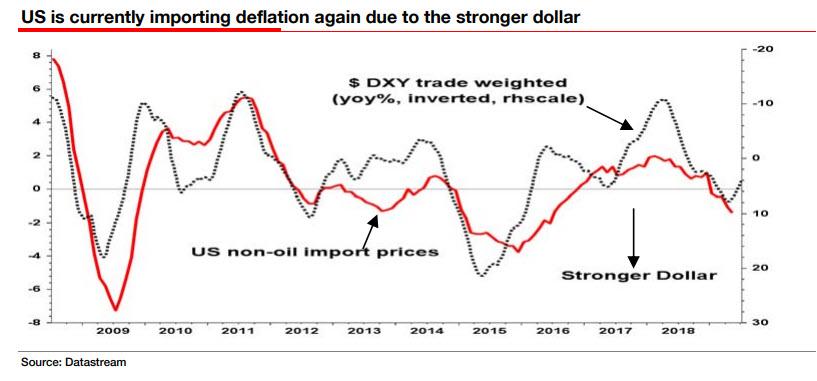
Another side effect of conventional economics – and a strong dollar – is that US non-petroleum import prices are declining again, which as both Edwards, we we several weeks ago, pointed out, “the US is importing other countries deflation. Not cool.“
Which then brings us back to Edwards’ favorite talking point: predicting near-term gloom, and sure enough…
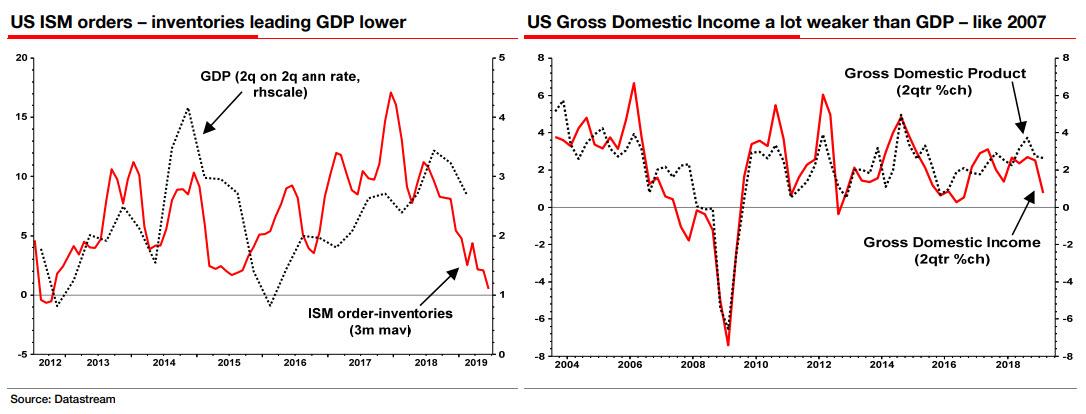
A US recession and outright deflation could be closer than many suppose. The recent slide in US ISM manufacturing new orders relative to inventories warns us of a sharp and imminent GDP slowdown as does the recent weakness in Gross Domestic Income. The NY Fed Nowcast stands at only 1.5% for Q2 and 1.7% for Q3. The US economy is at stall speed and may even already be sliding into recession and outright deflation.
Which then brings us to the US “reaction function”, and Edwards’ belief that “the US will soon be forced by events to join the eurozone and Japan in aggressively fighting deflation. I expect that in addition to President Trump using auto tariffs as a weapon in the intensifying currency war against the eurozone (Germany), he will instruct the US Treasury (via the NY Fed) to intervene directly and unilaterally to drive the dollar lower – much lower.”
Just as Bank of America predicted several weeks ago.
In fact, Edwards writes that he is surprised the US “has not done so already, but any additional ECB easing will surely be the straw that will break the camels back. And unlike in the eurozone, it is absolutely clear and unambiguous in the US who has the call on FX intervention: it is the Administration and not the Washington Federal Reserve.”
But wait, there’s more, because in addition to the US directly intervening in FX markets, one last policy tool that SocGen believes will be weaponized is negative Fed Funds:
With both the ECB and BoJ key policy rates already negative, it would be madness for the US Administration not to fight the global currency war on this battlefield in addition to all the others.
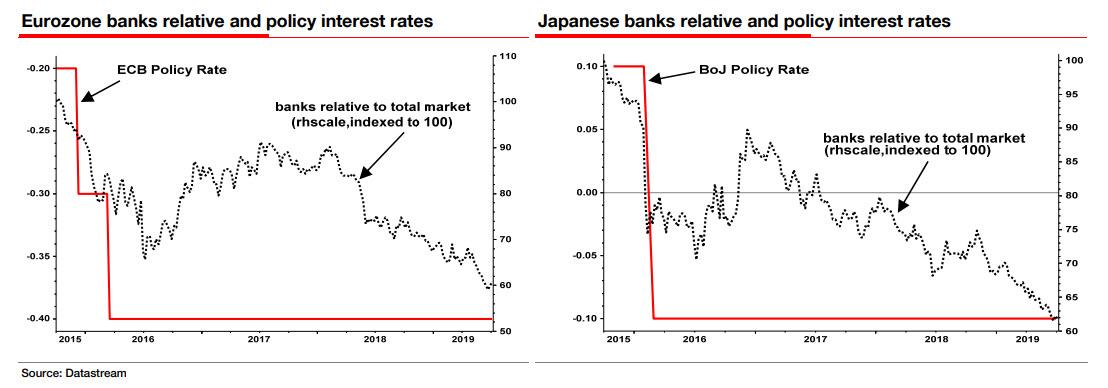
Wait, isn’t it against the Fed’s mandate to pursue negative rates? Yes… but when has that stopped a central bank (see the ECB). As Edwards counters, one of the main arguments heard against the Fed taking Fed Funds deeplynegative is the damaging impact it would have on banking sector margins. Certainly in both the eurozone and in Japan there was a huge initial backlash for bank stocks as negative interest rates were announced. But then, as the SocGen strategist adds, after a recovery in the sector on hopes that the central banks would not pursue this policy further, “the slide has resumed as growth has floundered and the prospect of even more negative rates becomes a scary reality.”
That said, this time will be different, and Edwards’ answer to concerns about the damage negative Fed Funds would have on US bank margins is that “this is 2019, not 2007/8. Although the investment community has not anticipated the depth of the next global recession and equity market collapse, I do not expect banks to be the centre of the unfolding crisis which will likely be focused on holders of US corporate paper, especially investment grade, and equities.”
We are told that unlike 2007, neither investment nor commercial banks warehouse inventory of these instruments. There will no doubt be much money to be lost by the banks in the souring of leveraged loans, ordinary commercial loans and property loans, but I do not believe that banks will be the apex of the next crisis as they were in 2007/8. Hence they will not be the priority for policymakers.
For once a dose of optimism from Edwards? Well, perhaps not, as he next proposes that “banks in the US could soon be looking a lot more like those in Europe.” Instead, a far bigger priority in the next global economic downturn will be US policymakers fighting deflation rather than maintaining US bank profitability:
one of the lessons of Japan in the 1990s and the eurozone more recently is that it is economic stagnation and outright deflation that leads to problems in the banking sector, and not the other way around. And yes, the utilisation of negative interest rates is definitely not good news for banks, but it is better than allowing outright deflation to unfold with negative trend nominal GDP, corporate profits and household income growth wreaking havoc on bank balance sheets as over-leveraged borrowers see their real debt loads explode.
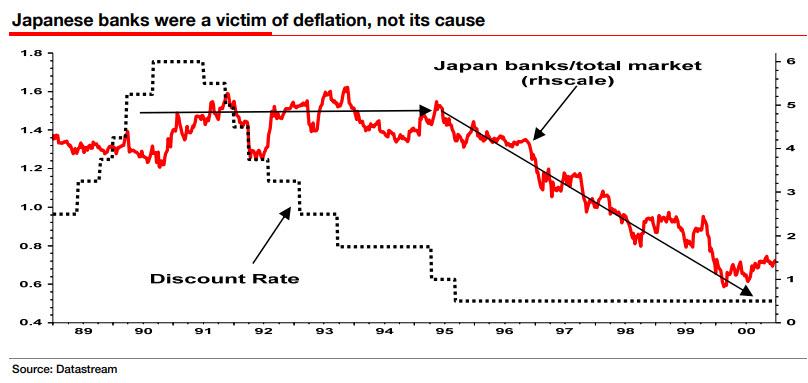
To confirm that point, Socgen points out that “Japanese banks did not start underperforming the overall equity market until well into the lost decade of the 1990s, and only after Japan had actually
tipped into outright deflation”. Indeed, Japanese banks were not the problem: “they were a symptom of the problem, which was the economy slipping into outright deflation.”
Finally, Edwards reminds Japan watchers that the catalyst that tipped the country into outright deflation in the 1990s was a persistently strong yen, and he goes on to point out that “President Trump is not about to make that same mistake. Personally, I am surprised he has put up with the ECB winning the competitive devaluation game for so long. Expect the dollar to fall – bigly.”
His gloomy – what else – conclusion: “The ECB have just fired the starting gun. This will turn nasty.“
via ZeroHedge News https://ift.tt/2Li80fY Tyler Durden
During a hearing that observers and participants called “historic,” a House subcommittee yesterday considered how to resolve the conflict between federal marijuana prohibition and state laws that allow medical or recreational use of the drug. Although there was broad agreement about the need for reform, the hearing before the House Judiciary Committee’s Subcommittee on Crime, Terrorism, and Homeland Security highlighted differences over strategy and rhetoric.
“Marijuana decriminalization may be one of the very few issues upon which bipartisan agreement can still be reached in this session,” said Rep. Tom McClintock (R-Calif.). “It ought to be crystal clear to everyone that our laws have not accomplished their goals.”
But Rep. Matt Gaetz (R-Fla.), a co-sponsor of the reform bill known as the Strengthening the Tenth Amendment Through Entrusting States (STATES) Act, questioned the wisdom of tying federal marijuana reform to the broader issue of “racial justice,” as reflected in the title of the hearing (“Marijuana Laws in America: Racial Justice and the Need for Reform”), especially if it involves fiscal provisions aimed at compensating for the racially disproportionate impact of the war on weed. The Marijuana Justice Act that Sen. Cory Booker (D-N.J.) introduced in 2017, for instance, includes financial penalties for states that disproportionately arrest members of minority groups for marijuana offenses and a “Community Reinvestment Fund” that would spend $500 million a year.
“My deep concern is that concerns over how far to go on some of the restorative elements in our policy could divide our movement,” Gaetz said. “If we further divide out the movement, then I fear that we’ll continue to fall victim to that which has plagued other Congresses, where we don’t get anything done.”
One of the witnesses, Baltimore State’s Attorney Marilyn Mosby, argued that “the restorative elements” are essential. “We need to reinvest in those individuals and those communities that have been disproportionately impacted,” Mosby told the committee. “The STATES Act does not do that, and that’s one of the reasons why I’m opposed to it.”
While the roots of pot prohibition were indisputably racist and the burdens of that policy clearly fall more heavily on people with dark skin, I tend to agree that portraying marijuana reform as a “racial justice” issue, while it may appeal to left-leaning members of Congress, will tend to alienate potential Republican allies. Playing up the federalism angle, as the STATES Act conspicuously does, is more likely to attract the Republican support that Democrats will need to get legislation approved by both houses of Congress.
Another omission from the STATES Act is more troubling: It does not actually repeal the federal ban on marijuana. Instead of removing marijuana from Schedule I of the Controlled Substances Act—a category that is supposedly reserved for drugs with high abuse potential and no recognized medical applications that cannot be used safely even under a doctor’s supervision—the bill says the CSA’s marijuana provisions “shall not apply to any person acting in compliance with State law relating to the manufacture, production, possession, distribution, dispensation, administration, or delivery of marihuana.”
Keeping marijuana in Schedule I while allowing exceptions for state-legal conduct leaves unresolved major problems created by the federal ban, including barriers to medical research and the highly burdensome tax provision that requires state-licensed cannabis suppliers to count business expenses as part of their income. It also might not fully address the reluctance of banks to serve businesses that sell a Schedule I drug.
“I’ve been working on this issue for 40 years, and it’s just crazy that we don’t just get it all done,” said Rep. Steve Cohen (D-Tenn.). “I appreciate Mr. Gaetz’s work on the issue—and I understand incremental[ism]—but after 40 years, it’s time to just zap straight up, get it all done, Schedule I gone.”
Disagreements aside, the bipartisan consensus about the failure of prohibition was striking. “I’ve long believed that the criminalization of marijuana has been a mistake, and the racially disparate enforcement of marijuana laws has only compounded this mistake,” said House Judiciary Committee Chairman Jerrold Nadler (D-N.Y.) “Applying criminal penalties with their attendant collateral consequences for marijuana offenses is unjust and harmful to our society. The use of marijuana should be viewed instead as an issue of personal choice and public health.”
from Latest – Reason.com https://ift.tt/2LMdyyE
via IFTTT
During a hearing that observers and participants called “historic,” a House subcommittee yesterday considered how to resolve the conflict between federal marijuana prohibition and state laws that allow medical or recreational use of the drug. Although there was broad agreement about the need for reform, the hearing before the House Judiciary Committee’s Subcommittee on Crime, Terrorism, and Homeland Security highlighted differences over strategy and rhetoric.
“Marijuana decriminalization may be one of the very few issues upon which bipartisan agreement can still be reached in this session,” said Rep. Tom McClintock (R-Calif.). “It ought to be crystal clear to everyone that our laws have not accomplished their goals.”
But Rep. Matt Gaetz (R-Fla.), a co-sponsor of the reform bill known as the Strengthening the Tenth Amendment Through Entrusting States (STATES) Act, questioned the wisdom of tying federal marijuana reform to the broader issue of “racial justice,” as reflected in the title of the hearing (“Marijuana Laws in America: Racial Justice and the Need for Reform”), especially if it involves fiscal provisions aimed at compensating for the racially disproportionate impact of the war on weed. The Marijuana Justice Act that Sen. Cory Booker (D-N.J.) introduced in 2017, for instance, includes financial penalties for states that disproportionately arrest members of minority groups for marijuana offenses and a “Community Reinvestment Fund” that would spend $500 million a year.
“My deep concern is that concerns over how far to go on some of the restorative elements in our policy could divide our movement,” Gaetz said. “If we further divide out the movement, then I fear that we’ll continue to fall victim to that which has plagued other Congresses, where we don’t get anything done.”
One of the witnesses, Baltimore State’s Attorney Marilyn Mosby, argued that “the restorative elements” are essential. “We need to reinvest in those individuals and those communities that have been disproportionately impacted,” Mosby told the committee. “The STATES Act does not do that, and that’s one of the reasons why I’m opposed to it.”
While the roots of pot prohibition were indisputably racist and the burdens of that policy clearly fall more heavily on people with dark skin, I tend to agree that portraying marijuana reform as a “racial justice” issue, while it may appeal to left-leaning members of Congress, will tend to alienate potential Republican allies. Playing up the federalism angle, as the STATES Act conspicuously does, is more likely to attract the Republican support that Democrats will need to get legislation approved by both houses of Congress.
Another omission from the STATES Act is more troubling: It does not actually repeal the federal ban on marijuana. Instead of removing marijuana from Schedule I of the Controlled Substances Act—a category that is supposedly reserved for drugs with high abuse potential and no recognized medical applications that cannot be used safely even under a doctor’s supervision—the bill says the CSA’s marijuana provisions “shall not apply to any person acting in compliance with State law relating to the manufacture, production, possession, distribution, dispensation, administration, or delivery of marihuana.”
Keeping marijuana in Schedule I while allowing exceptions for state-legal conduct leaves unresolved major problems created by the federal ban, including barriers to medical research and the highly burdensome tax provision that requires state-licensed cannabis suppliers to count business expenses as part of their income. It also might not fully address the reluctance of banks to serve businesses that sell a Schedule I drug.
“I’ve been working on this issue for 40 years, and it’s just crazy that we don’t just get it all done,” said Rep. Steve Cohen (D-Tenn.). “I appreciate Mr. Gaetz’s work on the issue—and I understand incremental[ism]—but after 40 years, it’s time to just zap straight up, get it all done, Schedule I gone.”
Disagreements aside, the bipartisan consensus about the failure of prohibition was striking. “I’ve long believed that the criminalization of marijuana has been a mistake, and the racially disparate enforcement of marijuana laws has only compounded this mistake,” said House Judiciary Committee Chairman Jerrold Nadler (D-N.Y.) “Applying criminal penalties with their attendant collateral consequences for marijuana offenses is unjust and harmful to our society. The use of marijuana should be viewed instead as an issue of personal choice and public health.”
from Latest – Reason.com https://ift.tt/2LMdyyE
via IFTTT
President Donald Trump called together cabinet members on Monday to help him cheerlead his administration’s record on environmental issues. During his rambling remarks in the White House East Room about his administration’s “environmental leadership,” the president asserted, “We’re working hard, maybe harder than all previous administrations, maybe almost all of them.”
The president’s claims received considerable pushback from environmental activists and academics. Sierra Club executive director Michael Brune declared in astatement, “No amount of speeches, lies, or stunts will ever change the fact that Donald Trump has the worst record on the environment and climate of any president in American history.” David G. Victor, the director of theLaboratory on International Law and Regulation at the University of California, San Diego, described the president’s speech to theNew York Times as “a true ‘1984’ moment,” a reference to George Orwell’s classic novel of totalitarian dystopiaNineteen-Eighty Four, which observed, “If all others accepted the lie which the Party imposed—if all records told the same tale—then the lie passed into history and became truth.”
Given the president’s penchant for “truthful hyperbole,” it’s worth taking a look at a few of the claims made during his environmental show-and-tell to see if they were as bad as those “rectified” by Orwell’sMinistry of Truth.
“Since 2000, our nation’s energy-related carbon emissions have declined more than any other country on Earth,” Trump said. This is a rather odd example of the president’s “environmental leadership” since he remainshighly skeptical that carbon dioxide emissions from burning fossil fuels are causing significant climate change.
The New York Times accurately characterized this claim as “boast[ing] that carbon dioxide emissions in the United States have gone down over the past decade, ‘more than any other country on earth.'” Actually, the president’s baseline was the year 2000, not the past decade. The Times goes on to report that “while it is true that carbon emissions have declined by over 10 percent in that time, over a dozen other countries—including most of the European Union—have seen declines of more than twice that.”
Let’s untangle these claims and counterclaims a bit. In absolute terms, the president is right. While noting a 3.1 percent uptick in emissions in 2018, the International Energy Agency’s 2018 report observes, that “emissions in the United States remain around their 1990 levels, 14 percent and 800 megatons of carbon dioxide below their peak in 2000. This is the largest absolute decline among all countries since 2000.”
But what is going on with the percentage reductions in emissions between countries on which the Times chooses to focus? The Energy Information Administration (EIA)reports that by 2017 (latest figures), energy-related U.S. carbon dioxide emissions had declined 12.4 percent since 2000. The president could have “boasted” a greater overall 14.2 percent reduction if he had instead chosen 2005 as his baseline. In January 2019, the EIA reported that U.S. carbon dioxide emissionsbumped up during 2018, making the overall decline since 2005 about 13 percent. The agency projects that emissions will fall slightly during 2019 and 2020.
So, in percentage terms, are U.S. reductions larger than those of any other country on earth? Not according to data compiled the European Commission’sEmissions Database for Global Atmospheric Research(EDGAR). For example, carbon dioxide emissions from fossil fuels (similar to the notion of “energy-related”) from the 28 countries of the European Union (EU-28) have fallen by 14 percent since 2000. Using 2005 as the baseline, EU-28 emissions have declined by about 16.5 percent. The EDGAR database also reports that U.S. emissions have declined from 2000 and 2005 by 14.1 and 14.5 percent respectively. In other words, the EU-28 countries have done slightly better than the U.S. at cutting carbon dioxide emissions between 2005 and 2017.
What about the Times‘ report that a dozen countries have seen declines of more than twice those in the U.S.? Using 2005 as the baseline, a spot check of the EDGAR database finds that the United Kingdom’s carbon dioxide emissions dropped by 32.5 percent; Spain’s by 23.5 percent; Italy’s by 27.6 percent, Denmark’s by 34.8 percent, and France’s by 17.2 percent.
So the president’s claim that “every single one of the signatories to the Paris Climate Accord lags behind America in overall emissions reductions” is, if one is counting absolute emissions reductions, true, but misleading. But since the U.K. and France emit in total about 400 and 340 megatons of carbon dioxide respectively, it would be impossible for those countries to match the absolute U.S. reduction of 800 megatons of carbon.
Still, it is the case that many Paris Agreement signatories are so far failing to meet the obligations they made in theirnationally determined contributions. It is also worth noting that since 2005, emissions from China surged by 174 percent while those of Japan and Russia rose 3.6 and 1.8 percent respectively.
Let’s parse a couple more of the president’s claims to “environmental leadership.” During his speech, Trump said, “From day one my administration has made it a top priority to ensure that America is among the very cleanest air and cleanest water on the planet.” As evidence, he asserted that the U.S. is “ranked number one in the world for access to clean drinking water” and that air pollution in the form of “particulate matter—is six times lower here than the global average.”
One go-to resource for tracking global environmental trends is the Environmental Performance Index (EPI), created by Yale and Columbia Universities. Based on 2016 data, the EPI does place the United States in the number 1 spot, along with nine other countries. While certainly better than Switzerland—languishing at number 11—being number 1 does not particularly distinguish the U.S. from other top scorers including Canada, Finland, the United Kingdom, and Spain. And as some critics have noted, President Trump did not take office until January 20, 2017.
Interestingly, earlier declarations by the president that the U.S. has the cleanest air provoked critics to cite EPI data showing that our country actually ranks 88th in the world with respect to particulate matter air (PM 2.5, or atmospheric particulate matter with diameters of less than 2.5 micrometers) pollution. That is true as far is it goes, but critics failed to point out that 86 of the countries ranked ahead of the U.S. on this measure of air pollution are ranked as number 1. Among the countries improbably ranking number 1 are Algeria, Cuba, Burkina Faso, Haiti, Morocco, the Philippines, Sudan, and Venezuela.
In any case, World Bank data on PM 2.5 particulates show that the mean global average annual exposure is 45.5 micrograms per cubic meter of air, whereas the comparable U.S. figure is 7 micrograms per cubic meter. In other words, the president is right that average U.S. exposure is six times lower here than the global average.
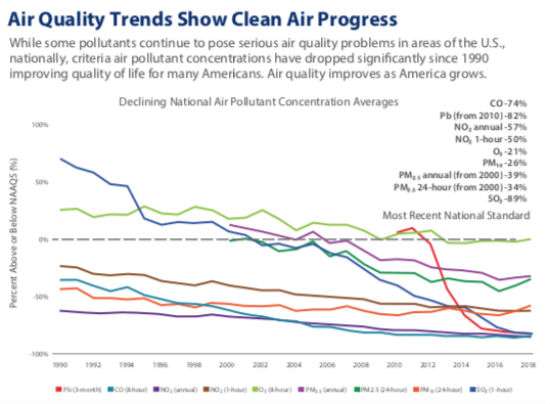
At the White House event, Environmental Protection Agency administrator Andrew Wheeler cited some heartening data concerning long term air pollution trends in the U.S.
Wheeler pointed out that “from 1970 to 2018, the combined emissions of the six criteria air pollutants dropped by 74 percent, while the U.S. economy grew by 275 percent.
Note an uptick in some pollutants during the last year or so.
In his remarks, the president claimed that the Green New Deal (GND) proposal that is being co-sponsored by 94 Democratic members of the House of Representatives and 12 Democratic senators would cost $100 trillion to implement. The president most likely derived this figure by rounding up the results of a spitball study done by the American Action Forum back in February. It is worth noting that the Forum found that the vast majority of costs associated with the Green New Deal have nothing to do with fixing the climate but instead arise from enacting vast new progressive social and economic programs, including a jobs guarantee and universal health care.
Rep. Alexandria Ocasio-Cortez (D–N.Y.) recently estimated her Green New Deal proposal would only cost $10 trillion to implement by 2030. (My own spitball estimate is that achieving the GND’s deep decarbonization goals—no progressive social policy overlays—would cost between $7 and $13 trillion by 2030.)
The Times is likely right that the event was mostly motivated by the politics of the 2020 presidential campaign. According to the most recent Gallup poll, 59 percent of Americans think Trump is doing a poor job of protecting the nation’s environment.
Ultimately, the East Room exercise consisted of citing some cobbled together good news statistics for which the president questionably claimed the credit. They are not so much wrong, as contextless.
from Latest – Reason.com https://ift.tt/2XN6BzW
via IFTTT