Checking In On The Four Intersecting Cycles

Authored by Charles Hugh Smith via OfTwoMinds blog,

If you think this is a robust, resilient, stable system, please check your Ibogaine / Hopium / Delusionol intake.

Correspondent James D. recently asked for an update on the four intersecting cycles I’ve been writing about for the past 10 years. Here’s the chart I prepared back in 2008 of four long-term cycles:

1. Generational (political/social)

2. Price inflation/wage stagnation (economic)

3. Credit/debt expansion/contraction (financial)

4. Relative affordability of energy (resources)

Here are four of the many dozens of essays I’ve written on these topics over the past decade:

Long Cycles: Cheaper Goods, Costlier Capital, Income Disparity Increases (August 1, 2008)

Beyond the False Dawn: Global Crisis 2020-2022 (February 18, 2011)

A Disintegrative Winter: The Debt and Anti-Status Quo Super-Cycle Has Turned (December 5, 2016)

We’re in a Boiling-Point Crisis of Exploitive Elites (June 19, 2017)

The key point that’s not communicated in the chart is there are dynamics that interact with each of these cycles. For example, demographics are influencing each of these trends in self-reinforcing ways.

Governments are borrowing more to fund the promises made to seniors decades ago when there were relatively few retirees compared to the working populace. Now that the ratio of those collecting government benefits to workers is 1-to-2 (one retiree for every worker), the system is buckling.

The “solution” is to borrow increasing sums from future taxpayers to fund pay-as-you-go healthcare and pension programs for retirees.

Technology is another dynamic that is actively influencing all these cycles in self-reinforcing ways. As technology is substituted for human labor, wages stagnate and the size of the populace paying taxes dwindles accordingly. The “solution” is once again to borrow more to substitute for declining purchasing power.

The dynamics driving wealth/income inequality and the rise of politically/financially dominant elites are also powering these cycles. As Peter Turchin has explained–a topic covered in my essay When Did Our Elites Become Self-Serving Parasites? (October 4, 2016)– social disunity / discord rises when the number of people promised a spot in the elite far exceeds the actual number of slots available.

In summary, the four cycles are intact and poised to intersect in a very messy fashion within the next decade. various centralized efforts have been made to paper over the secular stagnation, political polarization, brewing generational wars, resistance to globalism, rising cost of capital, decay of opportunity, soaring debts, rising dominance of speculation / malinvestment /mis-allocation of capital, diminishing returns on centralization, the marriage of Orwell, Huxley and Kafka in officially sanctioned propaganda, increasingly dysfunctional and self-serving institutions and the rising costs of energy, but every one of these makeshift efforts further erodes the resilience of the overall system and increases systemic fragility and vulnerability to self-reinforcing failures of key subsystems.

Here are a few charts that illustrate the trends / cycles:

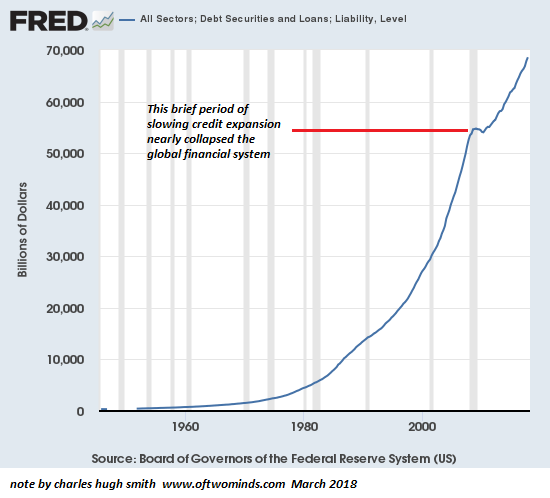
Total systemic debt: note that the tiny wobble in credit expansion in 2008 nearly collapsed the entire global financial system.
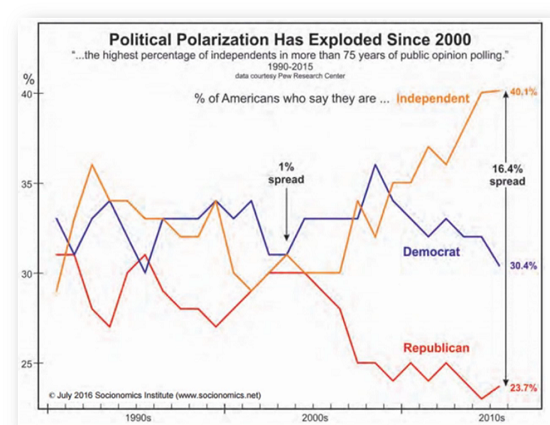
Here’s political polarization: notice any common ground?
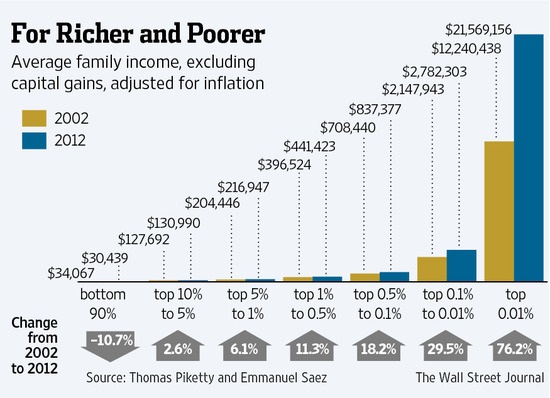
The elites that are safely protected by the moat of the status quo are doing just fine while the disgruntled debt-serfs who were promised security and rising wages/wealth are massing beyond the moat.
Meanwhile, asset bubbles and soaring debt are the status quo’s go-to fix for every problem:
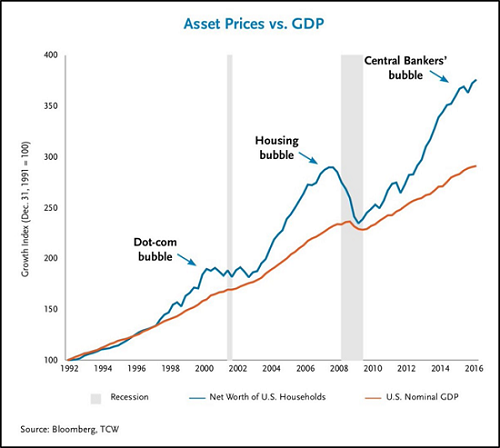
If you think this is a robust, resilient, stable system, please check your Ibogaine / Hopium / Delusionol intake.

*  *  *

My new book Money and Work Unchained is $9.95 for the Kindle ebook and $20 for the print edition. Read the first section for free in PDF format. If you found value in this content, please join me in seeking solutions by becoming a $1/month patron of my work via patreon.com.

via RSS http://ift.tt/2GrWBon Tyler Durden

Discovery of Police Corruption Freed Dozens of Imprisoned Americans in 2017

Leaving prisonIn 2017, 84 Americans were freed from prison after revelations of government misconduct helped prove them innocent. That sets a record, according to an annual report on exonerations in America.

It’s actually only part of the picture. An additional 96 defendants in Chicago and Baltimore were released last year in “group exonerations” as a result of two very high-profile police corruption cases.

The details are part of the National Registry of Exonerations’ annual report, a project by the University of California Irvine Newkirk Center for Science and Society, the University of Michigan Law School, and the Michigan State University College of Law. All in all, 139 exonerations were added to their registry for 2017, a drop from 171 in 2016. Though the total number of exonerations came down, a record number of people were exonerated due to official misconduct, mistaken eyewitness identification, false confessions, and perjury or false accusations.

There has been a significant decline in exoneration for drug crimes—just 16 this year—and that’s because a backlog of cases from Harris County, Texas, has finally been cleared. In Harris County, the district attorney’s office discovered hundreds of cases where defendants pleaded guilty to drug possession but subsequent crime lab tests discovered no actual illegal substances in the drugs. The county has been working since 2014 to go through all these cases and free people imprisoned for substances that turned out to not be illegal.

These stats do not include the group exonerations in Chicago and Baltimore, because the National Registry treats them separately from targeted exonerations of individuals who have had to prove their innocence from behind bars. Around 1,800 people were freed in such group exonerations from 1989 to 2017; the number of targeted exonerations in that period is 2,161.

Some other interesting stats:

  • Defendants who were exonerated in 2017 served an average of 10.6 years in prison before being freed, adding up to a total of 1,478 total years of life lost.
  • Ledura Watkins, 61, was convicted of murder in 1976 in Detroit. After serving 41 years in prison, he was exonerated and released in June after details came out about faulty forensic evidence and police and prosecutor misconduct. His case represents the longest sentence served by anybody on the registry.
  • The registry keeps tabs of several different types of official misconduct that lead to innocent people being imprisoned. Among the behaviors that led to this record-setting year, the most common form was concealing evidence.
  • Of the 51 cases where a person convicted of homicide was subsequently exonerated in 2017, 43 involved official misconduct in some fashion. That’s 84 percent.
  • There were 29 exonerations involving false confessions in 2017, another record. Almost half the cases took place in the Chicago area, many involving a Chicago detective accused of abusing suspects during interrogations. Eleven exonerations were a result of false confessions connected to that one detective.
  • In 66 exonerations—almost half the total—the underlying crime didn’t even happen. Sixteen of these were drug possession cases, 11 were child sex abuse cases, and nine were murder cases. One severe case in Louisiana saw Rodricus Crawford convicted of first-degree murder and sentenced to death after his infant boy was found dead in his home in 2012. Police and prosecutors insisted Crawford had killed the boy, but the conviction was reversed when the defense was able to provide enough evidence that the boy died of bronchopneumonia.
  • Feeding into the problem of people being convicted of crimes that didn’t even happen, there were a record 87 exonerations connected to witnesses who perjured themselves or otherwise falsely accused the defendant. In 40 cases, a defendant was accused and convicted of a crime that didn’t even take place.

The Registry of Exonerations’ reporting only goes back to 1989. But this week they’ve also unveiled a database of 369 exonerations that they have been able to track down that took place prior to 1989, going all the way back to 1920. Exonerations were much less frequent, but the circumstances around them were similar to what we see today—faulty eyewitnesses, bad forensics science, official misconduct.

“Fifty or a hundred years ago, an innocent defendant in prison had no one to turn to,” said Michigan State University law professor Barbara O’Brien, editor of the registry, in a press release. “The main reason we’re seeing more exonerations now is that they can seek help from innocence organizations and prosecutors’ offices who are committed to fixing wrongful convictions and are increasingly working together.”

The report notes that organizations devoted to helping people prove their innocence participated in 54 exonerations last year—another record. On Monday, I moderated a panel at South by Southwest in Austin that included Rebecca Brown, policy director of the Innocence Project. Brown discussed reforms that can help keep innocent people from getting caught up in the justice system, and he talked about what can be done to help those who have been exonerated. An audio recording of the panel can be heard here.

from Hit & Run http://ift.tt/2ImxCDz
via IFTTT

Iconic Physicist Stephen Hawking Has Died

StephenHawkingAlessandrozoccDreamtimeThat fact that physicist Stephen Hawking is an icon of our era was made plain during the production of La Damnation de Faust that my wife and I saw at the Paris Opera in 2015. A dancer trundled silently about the stage playing the role of the wheelchair-bound physicist as Faust made his pact with the devil and ended up in Hell (which was apparently Mars). The opera preposterously concluded with the apotheosis of Hawking standing unsupported as a Mars rover cruises across the stage. The singing was superb, but the staging was, well, unfortunate.

Among Hawking’s distinctive contributions to physics and cosmology is his work on black holes. Black holes are celestial objects with a gravitational field so strong that light cannot escape them; they are believed to be created by the collapse of very massive stars. Sagitarrius A, a black hole with more than 4.1 million times the mass of the Sun, is at the center of the Milky Way. Among other things, Hawking figured out that black holes do emit particles and therefore would “evaporate” over time. Hawking declared that he’d like the formula for this Hawking radiation engraved on his tombstone:

HawkingEquation

Hawking was diagnosed with a motor-neuron disease at age 21. It eventually confined him to a powered wheel chair. When he lost the power of speech in 1985, he famously turned to a text-to-speech system that produced his, well, iconic “robot” voice. His 1988 book, A Brief History of Time, brought his thinking on cosmology to the wider public, eventually selling more than 10 million copies. In the words of his friend Martin Rees, “the concept of an imprisoned mind roaming the cosmos” grabbed people’s imagination.

Clearly brilliant, and ferociously brave in overcoming the physical limitations inflicted by his illness, Hawking did sometimes endorse some fashionable apocalyptic views. While acknowledging that “the potential benefits of creating intelligence are huge,” Hawking was worried artificial intelligence could turn out to be “the worst thing ever to happen to humanity.” In addition, he thought that humanity should avoid contact with extraterrestrial civilizations because they could be “rapacious marauders roaming the cosmos in search of resources to plunder, and planets to conquer and colonize.” Cooler heads are less concerned about alien invasions.

In any case, the world was a better place because Stephen Hawking was in it. He will be missed.

from Hit & Run http://ift.tt/2pbOvsO
via IFTTT

Mississippi Sheriff’s Department Gets Sued, ACLU Finds a Bunch of ‘White Pride’ Emails

In the same Mississippi county that’s currently being sued for running discriminatory, unconstitutional roadblocks in black neighborhoods, the former sheriff forwarded a chain message about “white pride” containing a long list of racial slurs around the office.

The American Civil Liberties Union (ACLU) of Mississippi revealed the 2009 email, subject line “‘White’ Pride,” in a tranche of exhibits that it says show a culture of casual discrimination and lax discipline. Then-Sheriff Toby Trowbridge forwarded it to several other Madison County deputies.

The message is a sloppy chain message containing many common tropes among aggrieved white people, such as “How come there’s no White History Month?”

Here’s some of the lowlights:

Last year, the ACLU and the law firm of Simpson Thacher & Bartlett filed a class-action civil rights lawsuit against Madison County, alleging it has subjected its residents to more than a decade of brazenly illegal and discriminatory policing—warrantless home invasions, unconstitutional roadblocks that appear only in black neighborhoods, and aggressive “jump out” squads that target young black men doing nothing more than walking down the street.

At the roadblocks, deputies run licenses for outstanding warrants and court fines as well as look for probable cause to perform searches. They also in some cases stop pedestrians. The ACLU argues that setting up roadblocks for general crime control purposes violates the Fourth Amendment on its face, even without the added discriminatory element.

Trowbridge stepped down from the sheriff’s department in 2012, but his successor, Randy Tucker, has continued the same roadblock policies, the ACLU argues.

As Reason detailed in an investigation last year, black residents of Madison County, just north of the state capital of Jackson, have felt under siege from the local sheriff’s department for generations, but they have been almost totally ignored by the county government.

“We’ve all had problems dealing with Madison County,” Quinnetta Thomas, the wife of one of the suit’s plaintiffs, told Reason. “My situation is one of the prime examples of how Madison County works. They stormed in and made us feel unsafe in our own home.”

Thomas captured video of a Madison County sheriff’s deputy with his hand around the neck of her husband, whose hands were handcuffed behind his back. According to Manning and Thomas, deputies barged into their home at 7 in the morning and demanded they sign a false witness statement about a nearby robbery.

In a press conference today, the ACLU of Mississippi and Simpson Thacher presented new statistical evidence showing black residents make up the bulk of arrests and citations issued by the Madison County Sheriff’s Department.

Despite making up 38 percent of the population of the county, black residents accounted for 77 percent of all arrests, 76 percent of all arrests at roadblocks, and 72 percent of all citations.

The ACLU also says data turned over by the sheriff’s department reveals that, on average, the per capita rate of police roadblocks in predominantly black census tracts in Madison County is double the rate in predominantly white census tracts.

“That data has been statistically studied and controlled for other factors, and we think it’s overwhelming,” Jonathan Youngwood, a lawyer at Simpson Thacher, said at the press conference.

In testimony from depositions in the case, several former sheriff’s department employees said that they heard deputies using racial slurs and that the deputies in question were never disciplined.

One of the other documents turned over to the ACLU and Simpson Thacher is the template case sheet for the department’s narcotics unit. All of the fields on the form are blank, except three that are automatically filled in: “black,” “male,” and “arrested.”

Another one of the plaintiffs in the case, Lawrence Blackmon, says that when he asked the deputies at his door to show him a warrant, he was handcuffed and held at gunpoint in his apartment. They then allegedly searched his apartment from top to bottom, never producing a warrant.

“There is a toxic culture that allows for a suspect-first, citizen-second mentality among many deputies,” Blackmon said at the press conference.

Sheriff Tucker told The Clarion-Ledger last May that his department intends to “vigorously fight” the lawsuit. “Our deputies are professional law enforcement officials who enforce Mississippi laws,” he told the paper. “If a law is broken, appropriate action is taken regardless of the race of the one breaking said law. As always, we have fairly and diligently executed the duties for which we are required.”

from Hit & Run http://ift.tt/2pc64ZE
via IFTTT

Goldilocks Gone: Yields, Stocks, Dollar Down… Russia, China Tensions Up

Worst streak of declining retail sales since 2015, Russia-UK tensions, tumbling GDP expectations, and trade-war escalation and retaliation looming was apparently enough to kill goldilocks.

All those yummy goldilocks Dow gains from Friday’s payrolls data… gone…


Dow broke back below its 50% retracement level of the Fed Fiasco…


But The Dow remains underwater for the month (and the year)…


The S&P 500 fell back to its 50DMA…


Bank stocks have erased all their goldilocks gains…maybe Cohn matters after all


Tesla Tanked…

VIX rose above 17 – breaking above its 50DMA… (another mini-flash-crash today)…


Treasury yields are all lower than pre-payrolls (2Y unch)…


7, 10, and 30Y yields are all lower since the Jan CPI print…


Breakevens and Bond Yields tumbled the last few days – erasing the January CPI spike…


Notably the yield curve (in this case 2s30s) plunged back towards the lowest levels of the year… 2s30s actually closed at its lowest since October 2007…


The Dollar Index was down for the 4th straight day…


Ugly day for the Ruble…


Crude continues to underperform and gold clung to gains. Copper jumped after better than expected China production data…


Cryptos had another tough day after the Google ban and more chatter ahead of next week’s G-20 over coordinated regulatory crackdowns…


Gold has moved back into the lead year-to-date as The Dow drops back into the red for 2018…

We leave it to David Rosenberg ( @EconguyRosie) to conclude:

How do you spell s-t-a-g-n-a-t-i-o-n?

Core consumer prices +3.2% SAAR and real retail sales -4.4% SAAR over the past three months. Time for a hard-asset portfolio. Notice the CRB index up today with the stock market getting clobbered?

via RSS http://ift.tt/2paBQGG Tyler Durden

Trump Plans To Fire Jeff Sessions: Report

As if the abrupt firing of Secretary of State Rex Tillerson – and countless others in recent weeks and months – wasn’t enough of a surprise, President Donald Trump on Tuesday told an incredulous group of reporters that Tillerson’s head wouldn’t be the last to roll. The moment had all the hallmarks of a paradigm shift: with his approval rating at post-election highs (according to Rasmussen), an emboldened Trump is reworking the famous phrase “let Trump be Trump” by being more assertive on policy and personnel.

Sessions

And today, Vanity Fair reported that Trump is planning to fire Attorney General Jeff Sessions  – a decision that would certainly complicate Robert Mueller’s investigation (perhaps that’s the intention). According to the report, the leading candidate to replace Sessions would be EPA administrator Scott Pruitt.

Perhaps most consequential for Robert Mueller’s investigation, sources said Trump has discussed a plan to fire Attorney General Jeff Sessions. According to two Republicans in regular contact with the White House, there have been talks that Trump could replace Sessions with E.P.A. Administrator Scott Pruitt, who would not be recused from overseeing the Russia probe. Also, because Pruitt is already a Cabinet secretary, he would not have to go through another Senate confirmation hearing.

In another (perhaps expected) revelation, Sherman reports that Trump has been quietly grumbling about Jared Kushner and Ivanka Trump, telling advisors that he wished they’d move back to New York City as Kushner being stripped of his temporary security clearance has become a hindrance to performing his duties as a senior advisor to the president.

Then there is the question of Jared Kushner and Ivanka Trump’s futures. Trump has told people for months that he wants them to go back to New York. “Trump wants them out of there. He thinks they’ve been getting hit too hard,” a friend of the president said. But Javanka are digging in, sources said. “They’ve damaged us so much already. What else can they say about us?” Kushner recently said, according to a person who spoke with him. “And if we go back to New York, they’ll keep attacking. So what do we have to lose?” In recent days, the couple have argued for their continued relevance by cooperating with pieces in The New York Times and The Washington Post. Sources said that if Kelly is forced out, Jared and Ivanka will fight to stay on.

And that’s not all: Earlier this week, it was reported that Trump is preparing to also fire HR McMaster, his National Security Adviser. McMaster was appointed hastily in the aftermath of Mike Flynn’s firing, and has refused to parrot the president’s views about whether Russia interfered in the 2016 election, earning him the ire of Breitbart and most of the “alt-right.”

That news followed another report earlier this month suggesting that Chief of Staff John Kelly and Defense Secretary James Mattis had struck a deal to push out McMaster and install one of their proteges.

To summarize: the firing of Rex Tillerson was just the first in a series of terminations planned by what now appears to be a far more confident and empowered Trump. And judging by the market’s reaction today, risk assets are finally starting to get concerned.

via RSS http://ift.tt/2IqlW2N Tyler Durden

FRA-OIS Blows Out Above 50bps For The First Time Since 2012

Over the weekend, when we noted the ongoing blow out in the Libor-OIS spread, we asked whether a dollar funding crisis is emerging , now that this traditional indicator of monetary tightness and systemic credit stress has blown out to levels last seen during the European sovereign debt crisis of 2011.

One day later, Bank of America’s rates strategist Mark Cabana used the same chart as his “chart of the day”, noting that “the 3-month USD LIBOR-OIS spread recently widened sharply to levels not seen since the European peripheral crisis in 2011-12.”

Noting that while it is hardly indicative of “heightened bank credit concerns, but rather reflects a number of factors that have worsened the supply-demand backdrop and impacted the price of funding”, BofA then said it expects the widening in 3m LIBOR-OIS will likely get modestly worse before it gets better due to structural shifts in money markets.

We are not expecting a quick retracement due to (1) a possible acceleration in offshore corporate cash repatriation, (2) uncertainty over how quickly a new marginal buyer will emerge or issuer diversification will occur and (3) ongoing reserve draining. We expect higher overall front-end borrowing rates to persist for some time, but do not expect this tightening in conditions to materially impact the Fed’s gradual rate hiking path.

According to Bank of America, the recent 3m L-OIS spread widening to four factors, in order of priority:

  • Elevated front-end supply: Following the Congressional agreement to suspend the debt limit on 8 February the US Treasury has issued a whopping net $283bn of Treasury bill supply inclusive of the settlements this week (Chart 2). For context, the amount of supply over the past five weeks has exceeded the net bill supply in 2017 by over two times. The elevated front-end supply has caused Treasury bills to cheapen notably vs OIS (Chart 3). This has supported a cheapening of other money market products and forced banks to raise their borrowing rates to attract funding, especially since financial CP outstanding recently hit the highest since MMF reform (Chart 4).
  • Repatriation: As discussed here, many corporates are likely in the process of building liquidity ahead of a draw down in large cash pools overseas. One way to evidence this activity is through offshore USD MMF. AUM in offshore prime USD MMF increased from $240bn to $320bn after the 2016 election likely as expectations for repatriation built (Chart 5). As the tax law moved to completion late last year offshore USD MMF fund managers became defensive anticipating future corporate outflows (Chart 6).
  • Defensive positioning: Onshore institutional prime MMF WAMs have recently declined reflecting defensive posturing amid elevated front-end supply and in anticipation of the March FOMC rate rise (Chart 7).
  • Reserve draining: The Fed’s balance sheet unwind and recent build in the Treasury’s cash balance will serve to drain excess reserves and tighten funding.

Meanwhile, going back to our most recent post on the Libor-OIS spread, we noted that while the overall move wider was expected, the speed of the blow out has taken most analysts by surprise, and the result has been a scramble to explain not only the reasons behind the move, but its sharp severity. Abd while this is a simplification of the various catalysts behind the spike in Libor-OIS, here is a quick summary of what is going on – the expansion of Libor-OIS and basis swaps have been impacted by a complex array of factors, which include:

  1. an increase in short-term bond (T-bill) issuance
  2. rising outflow pressures on dollar deposits in the US owing to rising short-term rates
  3. repatriation to cope with US Tax Cuts and Jobs Act (TCJA) and new trade policies, and concerns on dollar liquidity outside the US
  4. risk premium for uncertainty of US monetary policy
  5. recently elevated credit spreads (CDS) of banks
  6. demand for funds in preparation for market stress

To be sure, in recent posts…

… we have taken a detailed look at each of these components, of which 1 thru 3 are the most widely accepted, while bullets at 4 through 6 are within the realm of increasingly troubling speculation, and suggest that not all is well with the market, in fact quite the contrary, and would imply that contrary to what BofA and various other commentators have suggested, bank credit concerns are indeed becoming a relevant issue.

Still, as we explained on Sunday, whatever the cause of the ongoing blow out in Libor-OIS, this move is having defined, and adverse, consequences on both dollar funding and hedging costs. This alone will have a severe impact on foreign banks, because as DB wrote recently, “the rise in dollar funding costs will damage the profitability of hedged investing and lending by [foreign] financial institutions. Most of the bond investors we have talked with shared a strong interest (and concern) in this topic.” However, the most immediate consequence is that it is now more economical for Japanese investors to buy 30Y JGBs, with their paltry nominal yields, than to purchase FX-hedged 30Y US Treasuries which as of this moment yield less than matched Japanese securities. The same logic can be applied to German Bunds, as the calculus has made it increasingly unattractive for European investors to buy FX-hedged Treasuries.

Meanwhile, in the forward space, the latest jump higher in 3-month USD Libor prompted a fresh wave of selling across Mar18 eurodollar futures…

with the higher fix pushing FRA/OIS over 50bp for the first time since 2012.

And while Libor-OIS is moving fast, the FRA/OIS has widened even more dramatically, rising as much as 8bp above spot Libor-OIS in recent days.

Aside from reflecting expectations of a wider Libor-OIS, the FRA/OIS widening could have been driven by the fact that large traders used Eurodollars instead of fed funds futures to express views of a more aggressive Fed cycle and a higher terminal rate. An evidence of this is that FRA/OIS moved considerably wider the day after the January jobs report and also after the January CPI report.

As previously, we urge readers to keep a close eye on this sharp move wider, because whether it is due to relatively innocuous reasons such as the 4 listed by BofA, or the three far more troubling ones, namely i) the risk premium for uncertainty of US monetary policy, ii) recently elevated credit spreads (CDS) of banks and iii) demand for funds in preparation for market stress, dollar funding is becoming increasingly problematic, and absent a sharp tightening in the Libor-OIS and FRA-OIS spread, while bank credit concerns may not have been the catalyst for the sharp spike, it will be banks that are eventually impacted by what is increasingly emerging as an acute tightening in short-term funding markets and/or a global dollar shortage.

What happens next is critical. 

As BofA notes, it is difficult to imagine levels moving materially higher than 50bp due to the presence of central bank liquidity swap lines. The Fed currently maintains bilateral FX swap lines with the ECB, BoJ, and other major central banks. The price to access these swap lines has three parts: (1) OIS of borrowing tenor +50bp; (2) haircut on the posted collateral; and (3) associated stigma. As such OIS +50 should serve as a soft upper bound on how high funding costs can rise though it is certainly possible the 3m L-OIS spread could rise to 60bp after collateral haircuts and stigma concerns are taken into consideration.

As such, should either L-OIS, or FRA-OIS move notably wider beyond 50bps, and should CB swap lines remain unused, it may be time to throw away all those explanations you have read that say “don’t panic” the move is perfectly normal, and to consider the alternative.

Finally, the move in Libor alone will soon start attracting attention as it is the benchmark rate for several hundred trillions in floating-rate debt.

It is worth noting that the Fed itself is monitoring the rise in LIBOR and is trying to understand what exactly is driving it (in their most recent dealer survey the Fed specifically asked about the 3m L-OIS spread widening). The Fed is certainly aware that the around 35bp increase in 3m LIBOR-OIS since mid-November equates to roughly 1.4 hikes. However, according to BofA, the Fed is probably monitoring LIBOR in the context of broader financial conditions and is not yet sufficiently concerned by the recent tightening to adjust policy. Indeed, the Chicago Fed financial conditions index has tightened, but still shows conditions are much easier vs when the Fed started tightening policy in 2015.

The Fed would likely be much more concerned about the rise in LIBOR if it reflected heighted bank credit concerns rather than structural supply/demand dynamics at the front end of the rates curve… which may well be the case if as noted above, the blowout persists beyond 50bps.

They will also likely become concerned with financial conditions only if it spills over into broader corporate  borrowing/investment activity or begins to wane on consumer or business confidence. Overall, consensus believes that the rise in LIBOR is not yet sufficient to derail the Fed from their “gradual tightening cycle”, but they will likely be more attuned to financial conditions given the recent rise.

via RSS http://ift.tt/2IsX9uT Tyler Durden

BTFD Or STFR?

Authored by Michael Lebowitz via RealInvestmentAdvice.com,

“Stability breeds instability.” – Hyman Minsky

The answer to the title of this article, the polite version of which is “Buy The Dip or Sell The Rally”, may well be the most important question facing stock investors this year and possibly for years to come. The bull market, now almost ten years old, has been supported by a number of technical pillars. Of these, three of the more significant ones are the “BTFD” mentality, shorting volatility (often referred to as vol), and corporate share buybacks. We are strongly of the opinion that when these technical pillars fail, the stock market will as well. It is important to note that while we wait on technical indicators for price guidance, there is a preponderance of fundamental warnings that should also be considered.

Expanding on Minsky’s theory, former Federal Reserve governor Laurence Meyer clarified the concept stating that “a period of stability induces behavioral responses that erode margins of safety, reduce liquidity, raise cash flow commitments relative to income and profits, and raise the price of risky relative to safe assets–all combining to weaken the ability of the economy to withstand even modest adverse shocks.”

Short Volatility

Over the last ten years, volatility has been transformed from a purely quantitative barometer of perceived future stability and a key input for options pricing to a full-fledged investment vehicle. It has gone from an obscure gauge of price movements, like the tachometer on the dashboard of your car, used mainly by sophisticated investors to one of the pistons in the engine helping propel markets. Since the financial crisis, investors and traders have learned that shorting volatility can provide significant and durable returns to help supplement low yields in traditional asset classes. The recent spike in volatility from all-time lows instantly put an end to this myth.

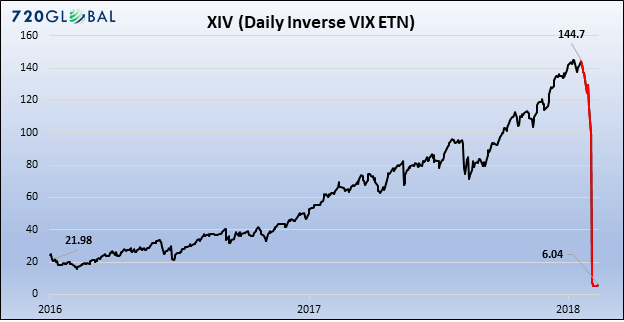
Many of those shorting vol, via a plethora of exchanged-traded funds and notes (ETF’s and ETN’s) that were designed to profit as market volatility dropped, were badly uninformed about how vol is computed or its longer-term history. The graph below charts the steady price increase in XIV, a short volatility ETN, since 2016 and the rapid evaporation of gains that occurred over just a few days.

A majority of short volatility ETF/ETN holders were of the mindset that the Fed, through its extraordinary interest rate and QE policies and its implicit statements supporting the market, would never let the markets fall again. They erroneously believed the Fed had once-and-for-all ushered in an unprecedented era of stability. There is no question that a lack of volatility, or perceived market stability, in recent years was unlike any other historical period. Given this prevailing mindset, why not short fear and go long stability?

This is exactly what many investors did. As more money chased the easy profits of short volatility strategies, investors were indirectly and unknowingly propelling the market higher in a self-reinforcing fashion. Ironically, as investors went “long stability” (short vol) they were making the markets inherently less stable. These poorly constructed securities came to a punishing end during the first week of February when the VIX index increased by over 100% on February 5th and wiped out or severely impaired those short volatility. XIV has since been delisted closing out at a final observed price of $6.04 per share.

This important technical pillar of equity strength has been permanently damaged and will likely provide much less support going forward.

Buybacks

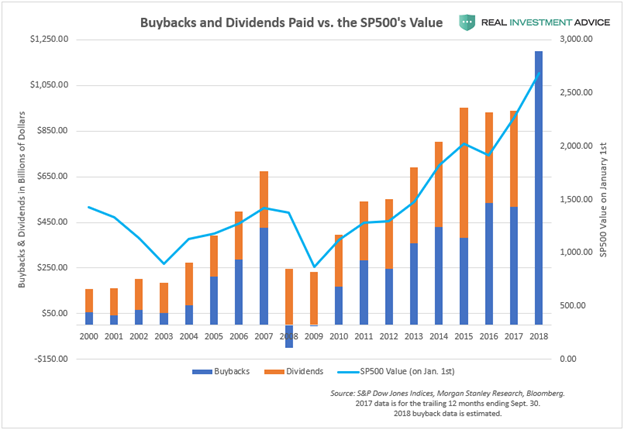
Another major pillar of support for equity prices is corporate buybacks. The graph below shows the correlation between buybacks and the S&P 500 since 2000 (note that 2018 is an estimate).

Further support for this theory comes from Goldman Sachs who claims that corporations have been the biggest class of buyer of equities since 2010 easily surpassing ETF’s, foreign investors, mutual funds, households and pension funds.

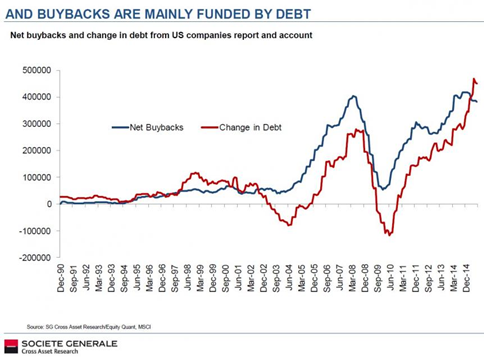
There is currently nothing that leads us to believe that corporations will stop buying their shares back, and if anything the recent tax reform further supports this trend. While buybacks currently show no signs of slowing, the recent increase in interest rates may make buybacks more difficult to conduct as debt has been a main source of funds for buybacks as shown below. Furthermore, higher interest rates may cause the credit rating agencies to downgrade companies who have accumulated large debt loads which would add to the cost of issuing debt and make buybacks more challenging. While this pillar of the bull market is still standing tall, it is worth following.

BTFD

Since the lows of 2009, BTFD or “buy-the-dip” has gone from a catchy acronym to a most trusted investment strategy.  Those that have followed this advice and bought when the market has shown temporary weakness are batting 1,000%.

When individuals, financial institutions, corporations, and even some central banks have a “can’t lose” strategy, sustainable market support is generated. The initially tentative investor response of BTFD has become emboldened over time and eventually turned in to a muscle memory-like reaction.

We believe it will take a series of market dips followed by rallies that do not quite get back to recent highs to erode confidence in the BTFD strategy. A period of such price action, sequential lower highs and lower lows, will cause “easy” profits to turn in to losses. As doubt and anxiety rise with losses mounting, it will challenge investor beliefs and with it remove critical support underlying the bull market.

Beginning in late January, the S&P 500 fell about ten percent and subsequently recovered about 75% of it. If the equity market fails to reclaim the January highs, then this would begin to look like a textbook technical topping formation. It is not unusual for a topping process to develop at a time of extreme optimism as is currently being experienced.

If, however, the market pushes to record highs, the BTFD’ers will have again been rewarded. Investor confidence reinforced, and the timeline for a major correction would be extended into the future.

When BTFD fails, we suspect investors will slowly gravitate to an STFR (Sell the Rally) mentality. Contrary to BTFD, they will sell or establish short positions when the market rallies. That transition, however, will only occur after much pain has been felt by those whose optimism gradually gives way to the reality of having incurred a series of losses.

Summary

Despite fundamental warnings and the collapse of the short volatility trade, we must give the bull market trend and its two remaining key pillars the benefit of the doubt. We believe it is reasonable to maintain long positions but only while remaining cautious and nimble. Watch closely for signs of lower highs and lower lows as well as indications that buybacks may be slowing down.

This bull market, like all others that have preceded it, will eventually fail and years of gains will be erased. Those focused on building wealth will once again face tough choices. Do you continue to trust in the crumbling pillars of the bull market or do you exhibit prudence and protect what you have and wait for the future when prices are much lower and valuations far more reasonable?

We leave you with a few words from Lance Roberts

“The Fed has not put an “end” to bear markets.  In fact, they have likely only succeeded in ensuring the next bear market will be larger than the last.”

via RSS http://ift.tt/2Dv8LtS Tyler Durden

Does the ‘Moral Hazard’ of Lifesaving Naloxone Justify Making It Hard to Get?

A couple of years ago, Maine’s Republican governor, Paul LePage, vetoed a bill allowing pharmacists to dispense naloxone, an opiod antagonist that can save people’s lives by reversing overdoses, without a prescription. “Naloxone does not truly save lives; it merely extends them until the next overdose,” LePage wrote in his veto letter. “Creating a situation where an addict has a heroin needle in one hand and a shot of naloxone in the other produces a sense of normalcy and security around heroin use that serves only to perpetuate the cycle of addiction.”

Maine legislators, who overrode LePage’s veto, apparently disagreed with his objections. But a paper recently published by the National Bureau of Economic Research lends empirical support to LePage’s argument about naloxone’s impact on risky behavior, if not moral support to the implication that drug use should be as dangerous as possible for the sake of deterrence.

University of Virginia economist Jennifer Doleac and University of Wisconsin at Madison economist Anita Mukherjee wondered whether wider availability of naloxone, in addition to reversing overdoses that would otherwise be fatal, might encourage opioid use by making it less dangerous. Depending on how big that effect is, Doleac and Mukherjee write, “expanding Naloxone access might not in fact reduce mortality.” Although “the risk of death per opioid use falls,” they say, “an increase in the number or potency of uses means the expected effect on mortality is ambiguous.”

Economists call this kind of effect “moral hazard”: When people are protected from the consequences of their risky behavior, they may be more inclined to take risks. A classic example is seat belts, which protect motorists from potentially fatal injuries but may thereby encourage riskier driving. While “the moral hazard from seatbelts” seems to be “small relative to the safety-improving effect of seatbelts,” Doleac and Mukherjee observe, research suggests that “automobile insurance, which also incentivizes riskier driving through moral hazard, causes a large increase in traffic fatalities.” They also note evidence that new HIV treatments encourage riskier sexual practices.

To investigate the net impact of naloxone, Doleac and Mukherjee looked at what happened after states adopted laws aimed at encouraging its use by making it available without a doctor’s prescription or by providing legal immunity to people who prescribe or administer it. Every state had enacted some such law by 2017. Over all, Doleac and Mukherjee found, the adoption of naloxone laws was associated with an increase in opioid-related theft, an increase in opioid-related emergency room visits, and no reduction in opioid-related deaths. “While Naloxone has great potential as a harm-reduction strategy,” they conclude, “our analysis is consistent with the hypothesis that broadening access to Naloxone encourages riskier behaviors with respect to opioid abuse.”

The increase in opioid-related theft, which amounts to something like five more thefts per 1 million residents, was neither large nor statistically significant by the conventional standard. Doleac and Mukherjee say the results “suggest that any social costs of Naloxone laws—in terms of additional property crime—are small.” By contrast, the increase in opioid-related E.R. visits, 266 per 100,000 residents in each quarter, “is large and consistent with the hypothesis that Naloxone access increases the abuse of opioid drugs.”

More E.R. visits do not necessarily translate into more deaths, since increased use of naloxone means any given overdose, whether or not it results in a trip to the hospital, is less likely to be fatal. “On average across all urban areas, we find that these laws have no signicant impact on the opioid-related death rate,” Doleac and Mukherjee report. “Thus, while the risk per use has gone down due to Naloxone access, the number of uses increases enough that we find no net effect on opioid-related mortality.”

That overall finding masks regional differences. In the Midwest, Doleac and Mukherjee say, naloxone laws were associated with a 14 percent increase in opioid-related deaths. Mortality also rose in the South, while it fell in the West and Northeast, but none of those changes was statistically significant. In rural areas outside of the Midwest, naloxone laws were associated with declines in opioid-related deaths, although the results were “generally statistically insignificant.” The analysis also finds reduced mortality in the 25 largest cities, an encouraging but still statistically insignificant finding.

Dolerac and Mukherjee suggest one reason for the variability might be the availability of drug treatment. “It appears that Naloxone access increases opioid-related mortality in places with limited treatment and decreases it in places with more treatment,” they write. “We do not have enough statistical power to be sure that these effects are statistically different from one another, but this pattern is consistent with the hypothesis that broadening Naloxone access has less detrimental effects in places with more resources available to help those suffering from addiction.”

Dolerac and Mukherjee’s main finding, that greater access to naloxone was not associated with a decrease in opioid-related deaths, contrasts with the conclusions of an NBER paper published last year. In that study, University of Colorado at Denver economist Daniel Rees and his co-authors found that the adoption of naloxone laws was associated with a decrease in opioid-related deaths of 9 to 11 percent. Rees et al. used annual state-level data through 2014, while Doleac and Mukherjee used monthly city- and county-level data through 2015.

Assuming that Doleac and Mukherjee’s results hold up, do they prove Paul LePage right? “Our findings do not necessarily imply that we should stop making Naloxone available to individuals suffering from opioid addiction, or those who are at risk of overdose,” they write. “They do imply that the public health community should acknowledge and prepare for the behavioral effects we find here.”

More to the point, the collectivist calculus of public health tends to obscure the moral issue raised by legal obstacles that make naloxone harder to obtain. The morally relevant level of analysis is not “society as a whole” but the individual who wants naloxone and the state that stands in his way. Naloxone indisputably saves people’s lives, and it would unconscionable to block access to it based on speculation about how the availability of that lifesaving option might affect other people’s behavior. That is like banning seat belts or HIV treatment because the extra assurance they provide might encourage some people to behave more recklessly.

This is the logic of prohibition, which endangers the lives of drug users to deter people who otherwise might join them. One way it does that is by making drug potency unpredictable, which makes overdoses more likely, thereby increasing the need for naloxone. LePage is not wrong to think that making naloxone hard to get is consistent with this plan. He is wrong to think the plan is morally defensible.

from Hit & Run http://ift.tt/2Gq032R
via IFTTT

London Mayor Tries To Justify Mass Censorship By Reading Mean-Tweets

London Mayor Sadiq Kahn read a list of half-dozen racist tweets about himself to a crowd at the annual SXSW festival in Austin, TX Monday.

as

I say kill the mayor of London and you’ll be rid of one Muslim terrorist,” Khan quoted to the audience. “I’d pay for someone to execute Sadiq Khan.

Kahn, the first Muslim mayor of a Western capital, implored tech companies to censor “hate speech,” – which has recently become a catchall from everything from death threats to opposing longstanding symbols of actual oppression, such as hijabs. 

The London mayor said he didn’t want to be “portrayed as a victim” or “ask for sympathy.” Instead, he wants to tech companies to police people’s feelings by going further in “making the internet free of hate speech.” 

“But ask yourself this: What happens when young boys and girls from minority backgrounds see this kind of thing on their timelines or experience this themselves?” said Khan.

Khan said that tweets like the ones addressed to him send a message to these children that if they don’t look a certain way or subscribe to the same establishment beliefs, they will grow up thinking there’s no path for them in high-profile careers.

“We simply must do more to protect people online,” Khan said.

Khan urged companies like Facebook and Twitter to show “a stronger duty of care” so that “social-media platforms can live up to their promises to connect, unify, and democratize the sharing of information and be places where everyone feels welcomed and valued.” –Business Insider

Too bad for those offended by mass censorship in the name of creating an all-encompassing safe space. European officials, meanwhile continue to turn a blind eye as migrants to rape, pillage and plunder with near impunity due to “cultural differences” (not hate). 

Germany began enforcing strict “hate speech” laws on January 1, giving companies such as Facebook, Twitter and YouTube 24 hours after a complaint to remove postings containing hate speech. Failure to remove the offending posts in time so will expose the platforms to fines of up to 50 million euros ($60 million USD).

as

The new law was passed last June and went into effect in October – however social media companies were given until January 1 to prepare to maintain an “effective and transparent procedure for dealing with complaints” which users can submit freely. Upon receiving a complaint, social media companies have 24 hours to block or remove “obviously illegal content” – and up to a week in “complex cases.”

The new law isn’t just for the big three (Facebook, YouTube and Twitter) either: 

Social platform giants such as Facebook, YouTube and Twitter were couched as the initial targets for the law, but Spiegal Online suggests the government is looking to apply the law more widely — including to content on networks such as Reddit, Tumblr, Flickr, Vimeo, VK and Gab. –TechCrunch

German lawmaker Beatrix von Storch’s Twitter account was blocked in January after she lashed out at New Year’s greetings sent by Cologne police in Arabic.

as

“What the hell is happening in this country? Why does an official police site tweet in Arabic,” wrote the Alternative for Germany (AfD) conservative party member. 

As we wrote in January, Social media giants face a gigantic task – which some might say is impossible. It is estimated that around 38.1 million Germans alone will use social media in 2018.

as

Now, consider that every single flagged post from millions of users must be evaluated before the post is removed or blocked. This will require Artificial Intelligence (AI) or some other sort of algo. And as algos begin to identify and remove “hate speech,” people will adapt to the filters and begin to find ways around it – changing terms, spellings, and using coded language to communicate.

What if – bear with us – parents taught their children that sometimes mean people say mean things, and one simply needs to have the internal fortitude to overcome offensive statements instead of employing mass censorship?

as

via RSS http://ift.tt/2FANOmT Tyler Durden