Xu is the son of Chinese immigrants. Some of the most interesting parts of his book retell his experiences grappling with failing to live up to model-minority expectations. Just 24 years old, he writes passionately about the long history of legal discrimination against Chinese and Japanese people in America and what he says are increasingly harsh attacks on traditional definitions of merit and achievement that disproportionately hurt Asian Americans. He’s a critic of Harvard’s controversial admissions practices, which he says discriminate against Asians in an ill-fated attempt to pump up representation by blacks and Latinos.
In a fiery and intense conversation with Nick Gillespie, Xu also talks about the roles of religion and family in his life and the life of the Asian American community more broadly.
Bonds Bloodbath, Dollar Dumped As Omicron Anxiety Ebbs & Flows
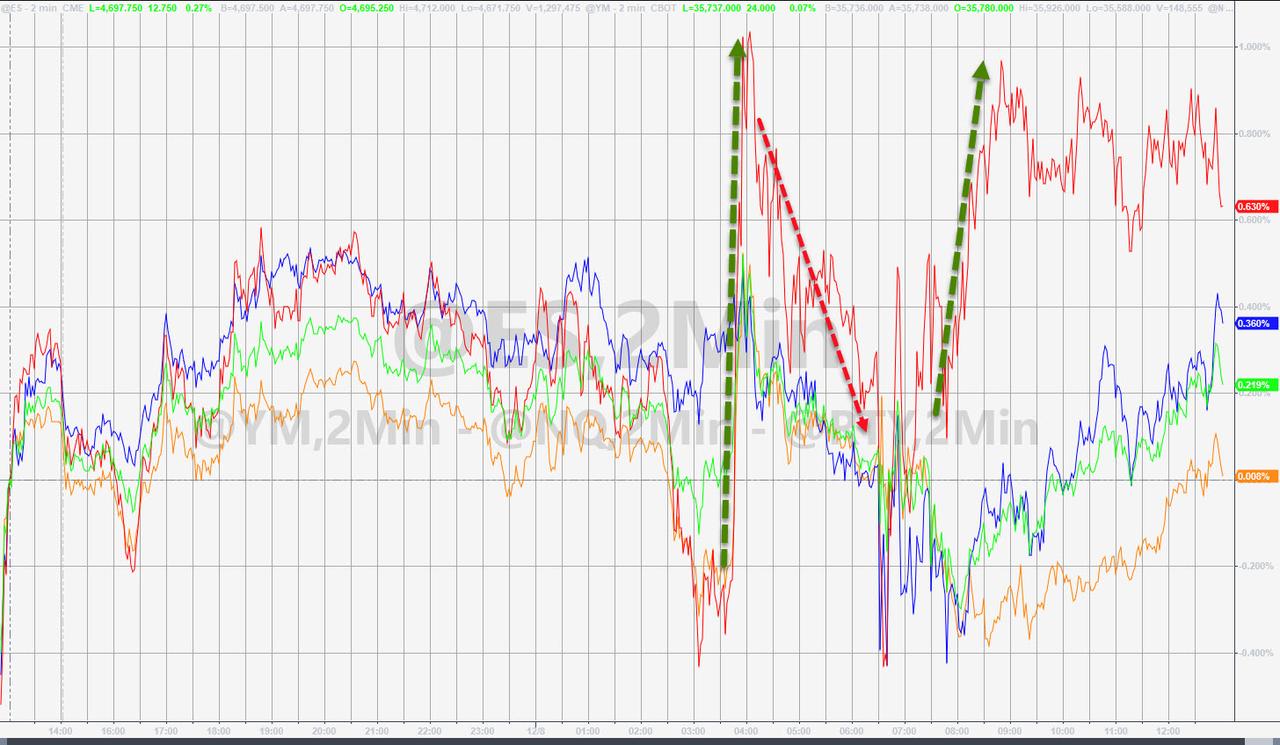
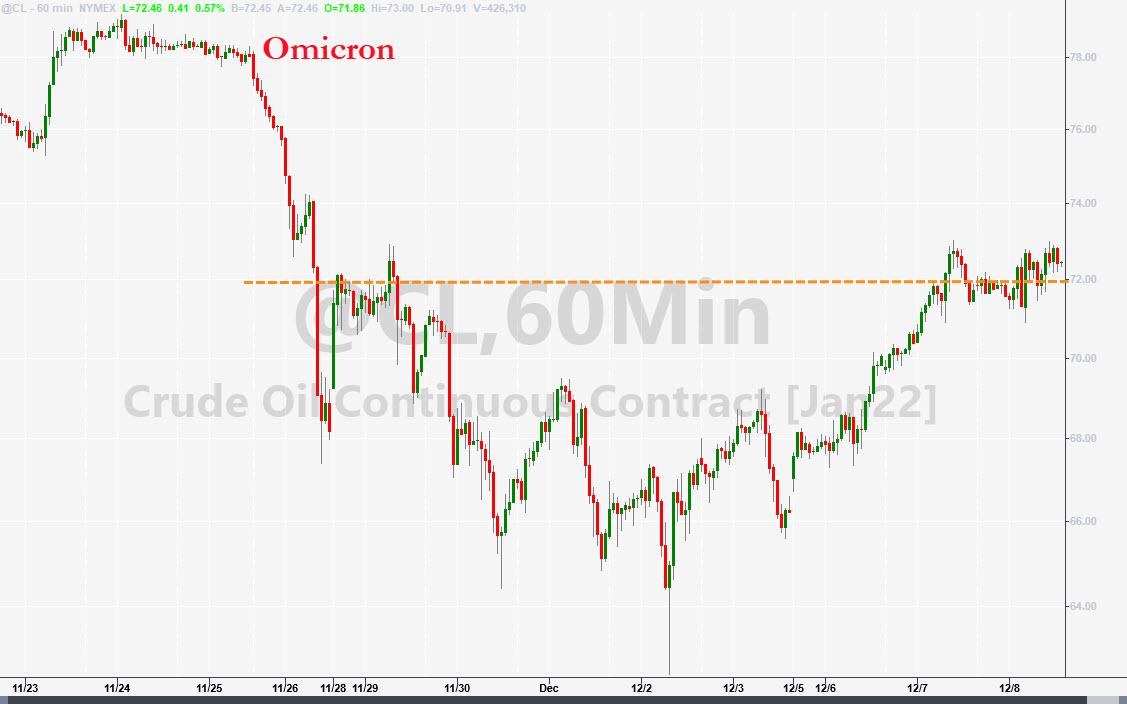
Anxiety over Omicron was higher overnight from South African data showing Pfizer vaxx efficacy weakened against Omicron… but then the CEO of the company that makes billions from the vaccine – and is protected from any liabilities – said, all you need is a 3rd jab and that will save you all from Omicron… and the market rejoiced.
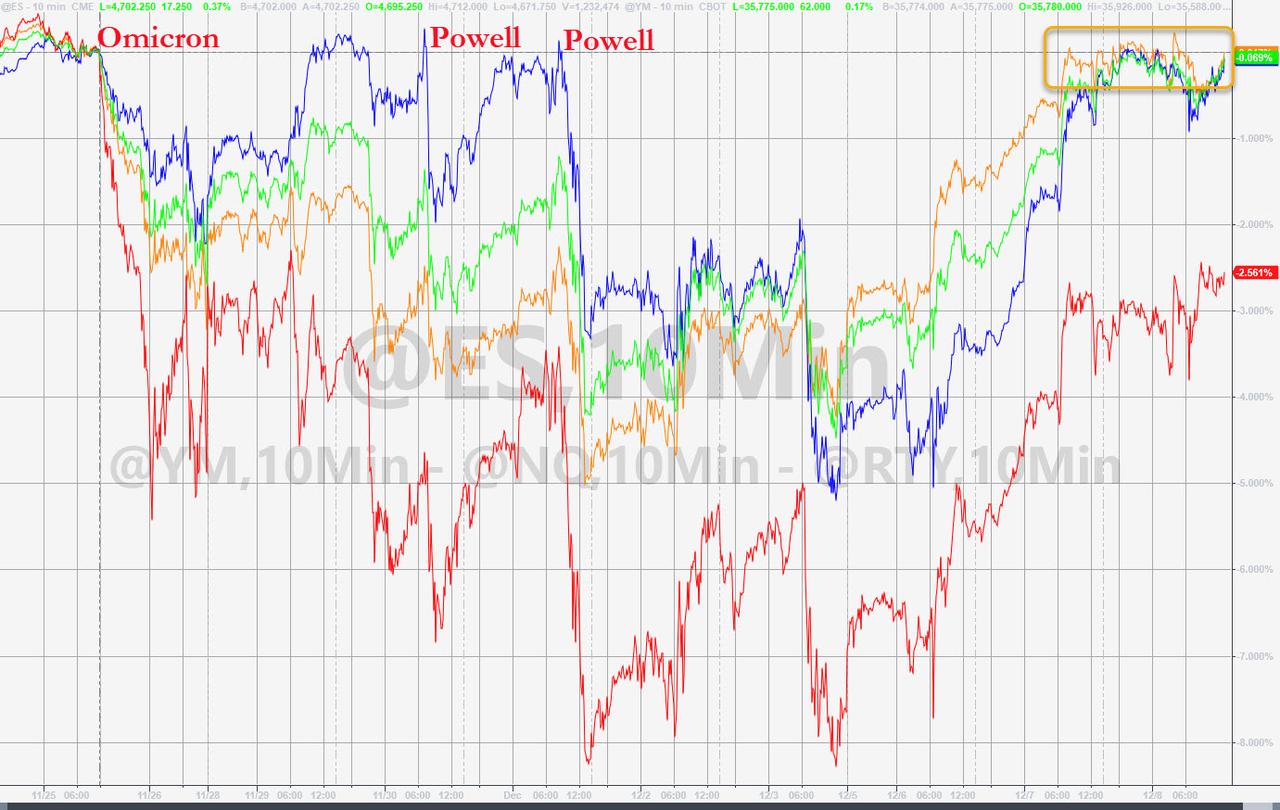
Small Caps outperformed today but traded in a truly chaotic manner. The Dow ended the day unchanged-ish and S&P and Nasdaq modestly higher…
Notably, the major US equity indices remain unable to extend gains above pre-Omicron levels…
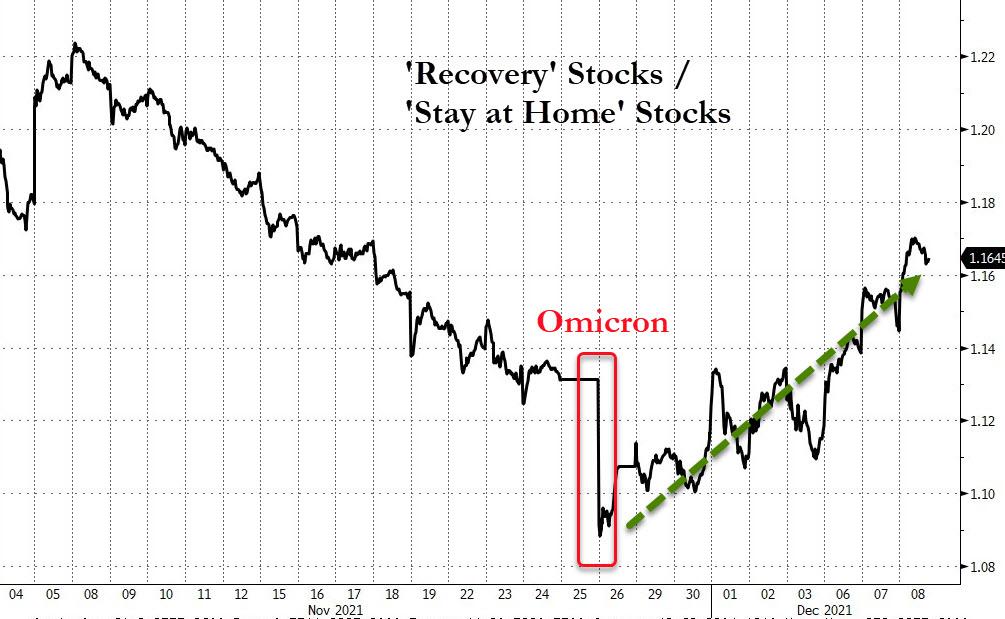
‘Recovery’ stocks continue to charge higher relative to ‘Stay at Home’ stocks…
Source: Bloomberg
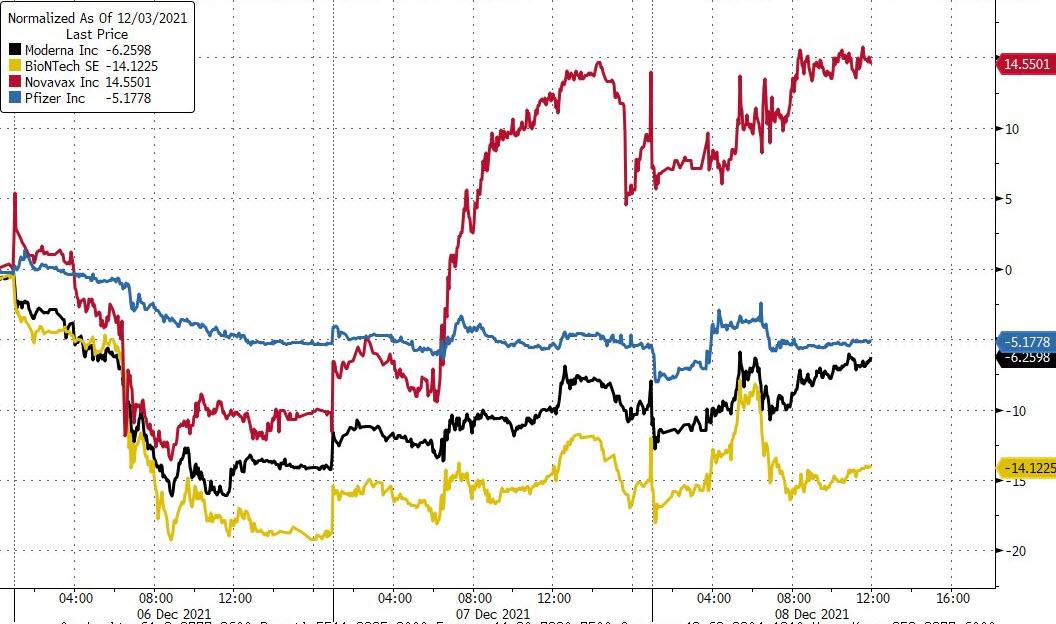
Despite all the jawboning, Pfizer, BioNtech and Moderna are all down on the week…
Source: Bloomberg
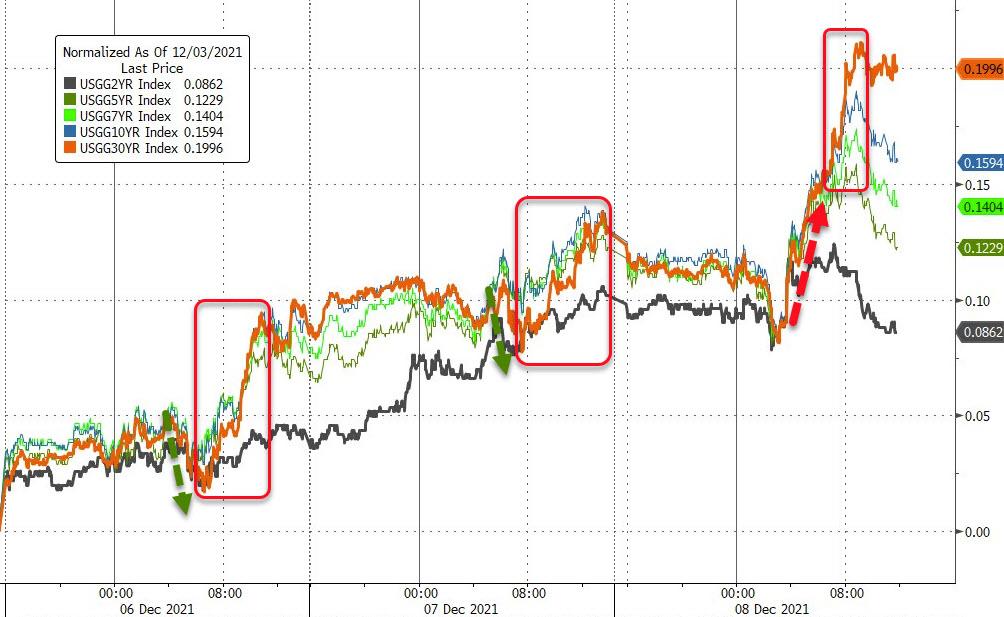
Bond yields exploded higher today (amid a very heavy calendar). 30Y Yields are up 20bps this week while 2Y is only up 8bps…
Source: Bloomberg
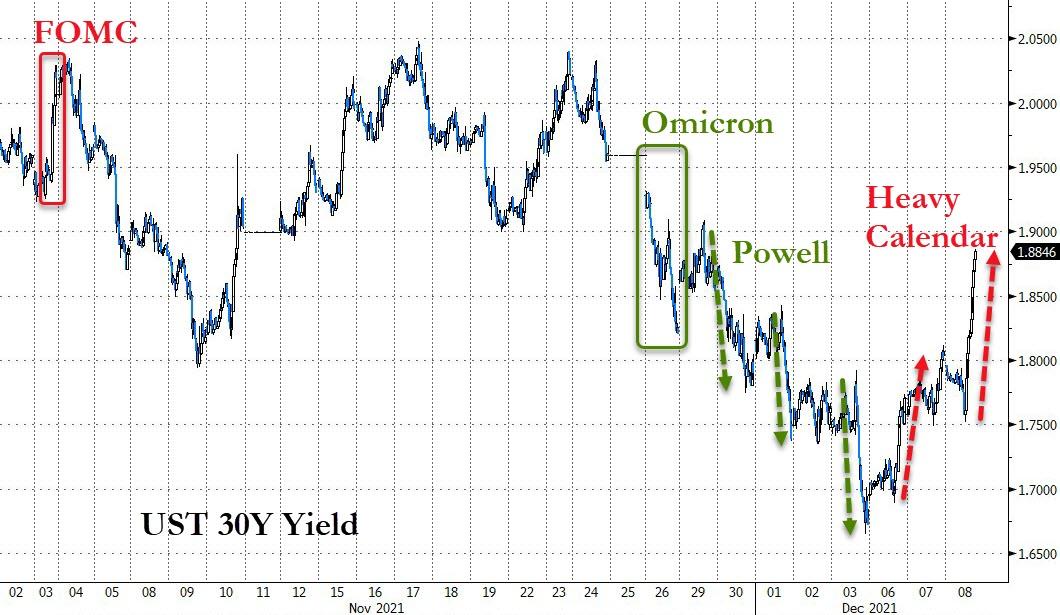
30Y Yields remain well below 2.00% (pre-Omicron) levels, but today was a decent squeeze to say the least as 30Y spiked over 13bps from low to high yield…
Source: Bloomberg
Or put another way… everything was beautiful for the bond bulls… and then it wasn’t…
The yield curve steepened dramatically today (2s30s’ biggest steepening day in 2 months), but remains notably flatter – and expecting a policy mistake – since Powell went hawktard…
Source: Bloomberg
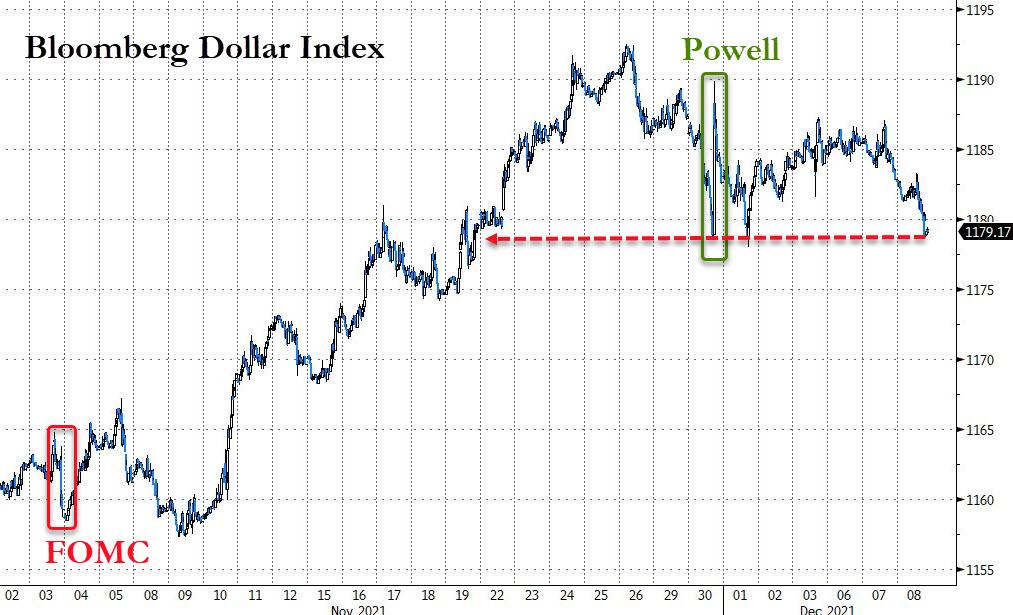
The dollar dumped to its lowest close in 3 weeks…
Source: Bloomberg
Cryptos continued to tread water post the weekend plunge…
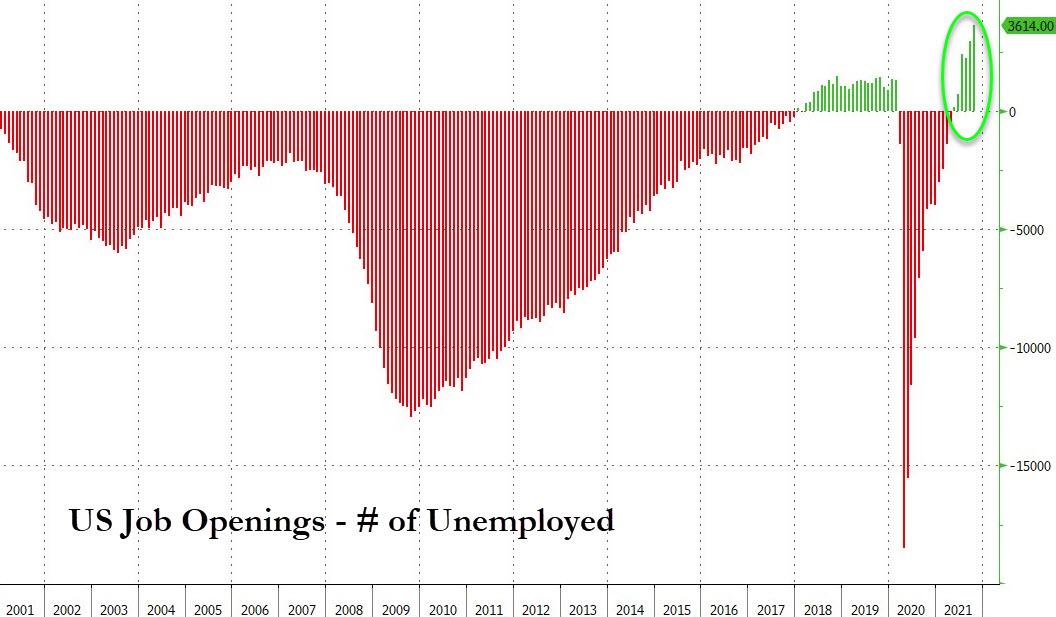
Finally, the number of U.S. job openings exceeded the number of unemployed Americans by the most on record in October…
But we’re still printing 10s of billions a month and holding rates at ZIRP?
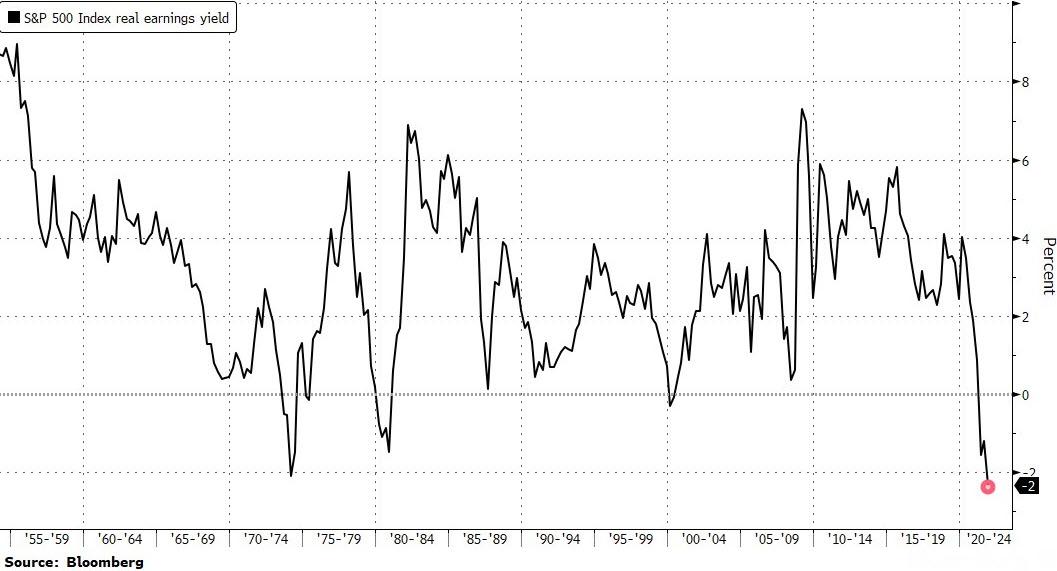
So what happens when Powell pulls the plug? Who knows but it’s worth noting that the real earnings yield for the S&P 500 Index hasn’t been so deep into negative territory since 1947… and BofA strategists warn that this portends downside risks for stocks.
There have been only four historical instances of negative real earnings yield, all of which resulted in bear markets, the strategists led by Savita Subramanian wrote in a note to clients, advising investors to seek refuge in inflation havens, such as energy, financials and real estate. Without continued earnings growth, stock investors will be losers in inflation-adjusted terms, undermining the so-called TINA argument that “there is no alternative” to equities right now.
Yesterday, a federal district court in Georgia issued a national injunction against the Biden Administration’s COVID-19 vaccination requirement for federal contractors. Last week, in separate litigation, a district court in Kentucky also enjoined the mandate, although this injunction was limited to the plaintiff states in that case.
The primary basis for the court’s decision in Georgia v. Bidenis that President Biden’s executive order requiring federal contractors to mandate COVID-19 vaccinations exceeds the President’s authority over federal contracting under the Procurement Act. Wrote Judge R. Stan Baker:
The President expressly relied on the Federal Property and Administrative Services Act, 40 U.S.C. § 101 et seq. (hereinafter, the “Procurement Act”), for his authority to issue EO 14042 “in order to promote economy and efficiency in procurement by contracting with sources that provide adequate COVID-19 safeguards for their workforce.” 86 Fed. Reg. 50,985–88. The Procurement Act was “designed to centralize Government property management and to introduce into the public procurement process the same flexibility that characterizes such transactions in the private sector. These goals can be found in the terms ‘economy’ and ‘efficiency’ which appear in the statute and dominate the sparse record of the congressional deliberations.” Am. Fed’n of Labor and Congress of Indus. Orgs. v. Kahn, 618 F.2d 784, 787–88 (D.C. Cir. 1979). In Kahn, the Court of Appeals for the District of Columbia Circuit examined the history of and apparent congressional intent behind the Procurement Act, and stated its belief that, “by emphasizing the leadership role of the President in setting Government-wide procurement policy on matters common to all agencies, Congress intended that the President play a direct and active part in supervising the Government’s management functions.” Id. at 788. The court acknowledged that, “To define the President’s powers under Section 205(a) [(40 U.S.C. § 121(a))], some content must be injected into the general phrases ‘not inconsistent with’ the [Procurement Act] and ‘to effectuate the provisions’ of the Act.” Id. After considering the Procurement Act’s emphasis on promoting “economy” and “efficiency” and ensuring contracts are awarded on terms that are “most advantageous to the Government, price and other factors considered,” the Kahn court stated that the Procurement Act “grants the President particularly direct and broad-ranging authority over those larger administrative and management issues that involve the Government as a whole. And that direct presidential authority should be used in order to achieve a flexible management system capable of making sophisticated judgments in pursuit of economy and efficiency.” Id. at 789.
Applying the Kahn standard (in the absence of controlling Eleventh Circuit precedent on the scope of the President’s authority under the Procurement Act), Judge Baker concluded that it was difficult to characterize the vaccination requirement as a measure concerning the “economy” and “efficiency” of federal contracts. Rather, as the White House’s own statements have made clear, this measure is primarily intended as a public health measure.
As a matter of first impression, Judge Baker’s arguments have some force. It is hard to characterize a broad vaccination requirement that applies to all federal contractors as a procurement measure, particularly given the lack of exemptions or accommodations included in other vaccine measures (such as the OSHA ETS, which exempts remote employees, those that work outside, etc.). Rather, the measure seems to be transparent effort leverage federal contracts so as to increase COVID vaccination rates (which is certainly a worthy goal). It is, in effect, an effort to leverage federal spending for regulatory purposes. As such, it would seem reasonable to question this mandate as the sort of power Congress delegated to the President through the Procurement Act.
The problem, however, is that this is not a question of first impression. There is a reasonable amount of D.C. Circuit caselaw applying Kahn, and Judge Baker claims that to be “looking to the Kahn court for guidance” in how to resolve this case. WHile Judge Baker found that the vaccine mandate “goes far beyond addressing administrative and management issues in order to promote efficiency and economy in procurement and contracting, and instead, in application, works as a regulation of public health,” the D.C. Circuit’s Kahn caselaw is far more deferential to the executive branch.
In UAW-Labor Employment and Training Corp. v. Chao (2003), for example, the D.C. Circuit upheld a requirement that federal contractors post notices informing workers of their rights not to join a union or pay union dues. While such a requirement may be a good idea, it is not any more related to the “economy” and “efficiency” of federal procurement than is a vaccine requirement. (To the contrary, one could at least argue that ensuring workers are vaccinated reduces the risks of labor shortages and the like.) While this decision does not bind a federal district court in another circuit, it is a bit odd for a district court to claim it is following the lead of another circuit and then fail to do so.
Although purporting to “tread lightly when issuing njunctive relief,” Judge Baker ordered a nationwide injunction. The judge concluded this was justified because one of the plaintiffs (Associated Builders and Contractors) is a trade association with members nationwide. As he noted, “given the breadth of ABC’s membership, the number of contracts Plaintiffs will be involved with, and the fact that EO 14042 applies to subcontractors and others, limiting the relief to only those before the Court would prove unwieldy and would only cause more confusion.” I am not sure I am persuaded on this point, but this a far more serious argument than was offered in the Louisiana decision enjoining the CMS vaccine requirement for health care workers.
The Biden Administration will promptly appeal both rulings enjoining the COVID-19 vaccination requirement for contractors.
On Sunday, a Facebook post from the Dallas Police Department went viral. It depicts a police dog, Ballentine, who is a member of the department’s interdiction unit, operating out of Dallas’ Love Field Airport. The caption praises Ballentine for sniffing out more than $100,000 in cash from a traveler’s bag.
What is left out of the description is what, if anything, the traveler did wrong.
When contacted by Reason, Dallas police declined to give any specifics. The only comment provided was a statement that the squad “seized $106,829.00, from a 25-year-old female who is a resident of Chicago, IL., but was travelling on a domestic flight… [Her suitcase] contained nothing but blankets and two large bubble envelopes containing the currency. The individual was not arrested at this time. However, the money was seized and will be subject to the civil asset forfeiture process.”
Civil asset forfeiture is the practice by which law enforcement may take certain goods, including cash, if they are suspected to be tied to criminal activity. But in practice, officials do not even have to prove that a crime has been, or would be, committed. Legally, there is no limit on the amount of cash a traveler can carry on domestic flights, but forfeiture allows authorities to seize any amount they deem suspicious.
In most cases, the owner of the seized property faces no recourse but to file suit against the particular agency. Texas is no exception: According to the Institute for Justice (IJ), a libertarian public interest law firm, the standard of proof in Texas for police to seize property is simply “preponderance of the evidence,” while “an innocent owner bears the burden of proving that she was not involved in any crimes associated with her property before she can get it back.”
Texas law enforcement agencies additionally have a “strong incentive” to seize property, as they are entitled to a significant percentage of the proceeds. In fact, IJ is currently suing Harris County, which encompasses Houston, over its application of the state’s asset forfeiture law.
Cops regularly use civil asset forfeiture to boost their own budgets while depriving innocent people of their property. Earlier this year, a Nevada Highway Patrol Officer confiscated a man’s life savings during a routine traffic stop, even after admitting that it was “not illegal to carry currency.” In Georgia, the state government agency charged with enforcing tax crimes misappropriated more than $5 million in seized funds between 2015 and 2020. And for years in Oklahoma, district attorneys used forfeitures like their own personal piggy banks, living for free in seized houses and paying off student loans with seized cash.
Jennifer McDonald, who works at IJ and authored the report “Jetway Robbery? Homeland Security and Cash Seizures at Airports,” tells Reason that this Dallas case is “pretty typical” of forfeitures. According to IJ’s research, McDonald says there is “very little evidence in the data that there is strong criminality tied to these seizures. In most cases, nobody is even arrested…If somebody is truly laundering money, or trafficking drug proceeds, or whatever it is that law enforcement alleges, wouldn’t you think that there should at least be an arrest going on?”
As for the 25-year-old woman from Chicago, she was not detained and was allowed to continue on to her destination. Yet in order to recoup her seized funds, she will likely have to travel back to Dallas, retain an attorney, and argue in court that the money was not involved in criminal activity. In essence, she will have to prove a negative, and she will have to shoulder the costs for doing so, despitehaving already lost more than $100,000.
The fact that a person, with little warning, can have her property seized without being charged with a crime is bad enough. The idea that to get that property back, the burden would then fall to her to prove her own innocence, against a crime that was not charged, is unconscionable. Since Dallas police did not charge this traveler with a crime, they should give the money back—and then Texas legislators should rip out the state’s forfeiture laws by the roots.
“Say tomorrow, you get a phone call from Joe Biden,” askedWall Street Journal tech columnist Joanna Stern to Tesla CEO Elon Musk in a Monday night forum. “And he asks: What are your needs from this [$2 trillion spending] bill? How do you answer him?”
“We don’t think about it at all, really,” Musk said, channeling Don Draper to the tune of the audience’s uneasy laughter. “It might be better if the bill doesn’t pass,” Musk added. “The federal budget deficit is insane…something’s gotta give, you can’t just spend $3 trillion more than you own every year and don’t expect something bad to happen.”
“With this bill, there is a lot of support for E.V.s [electric vehicles]…and it helps Tesla,” Stern told Musk. So if the bill shouldn’t pass, Stern asked, “what do you think the role of government should be?”
“I think the role of the government should be that of a referee, but not a player on the field,” replied Musk. “Government should try to get out of the way and not impede progress.” He continued:
The rules and regulations keep increasing every year. Rules and regulations are immortal, they don’t die. Occasionally you see some law with a sunset provision, but really, otherwise, the vast majority of rules and regulations live forever….Eventually it just takes longer and longer and it’s harder to do things. There’s not really an effective garbage collection system for removing rules and regulations. And so gradually this hardens the arteries of civilization, where you’re able to do less and less over time. So I think government should be trying really hard to get rid of rules and regulations that perhaps had merit at some time but don’t have merit currently.”
“Honestly, I would just can this whole bill. Don’t pass it,” Musk said forcefully.
The Build Back Better bill, which legislators in Congress are hoping to cram through this month or next, would include $12,500 tax credits for U.S.-made electric vehicles made in unionized factories, up from the $7,500 currently offered. Critics note that Musk has no reason to support the E.V. provision because Tesla factories are not unionized. But there are other good reasons for him to oppose these provisions: E.V. adoption and the creation of charging stations are plugging along just fine as is, no (market-distorting, union-favoring) government intervention needed—a point specifically made by Musk, who noted that the federal government does not pay for gas stations and does not need to build E.V. charging stations. “I’m literally saying get rid of all subsidies,” clarified Musk. (It’s worth noting that the charging station subsidies were included in the infrastructure bill passed last month, so the details of the two eye poppingly pricey bills are getting somewhat conflated.)
It’s nice to hear Musk denouncing government intervention, but he has unquestionably benefited handsomely from government subsidies in the past, so this looks a bit like he’s pulling the ladder up behind him to stymie encroaching competitors.
“Tesla Motors Inc., SolarCity Corp. and Space Exploration Technologies Corp., known as SpaceX, together have benefited from an estimated $4.9 billion in government support,” according to a 2015 Los Angeles Times‘ investigation. “Musk and his companies’ investors enjoy most of the financial upside of the government support, while taxpayers shoulder the cost.” And, more recently, both SpaceX and Amazon’s Project Kuiper have publicly jousted, siccing the Federal Communications Commission on the other, all while suckling at the government teat to get millions in subsidies for satellite internet projects.
Still, Musk’s own suspect motivations for ending these subsidies don’t make the substance of his comments less true. When taken with his other government-skeptical statements—”it does not make sense to take the job of capital allocation away from people with a demonstrated great skill in capital allocation and give it to an entity that has demonstrated very poor skill in capital allocation”—it seems like Musk may have unseated free speech–loving warlockJack Dorsey as America’s richest, staunchest government skeptic.
After all, “the government is simply the biggest corporation, with a monopoly on violence and where you have no recourse,” said Musk, when asked if billionaires like him should have their wealth seized via taxation and redistributed by the federal government. Where’s the lie?
Yesterday, a federal district court in Georgia issued a national injunction against the Biden Administration’s COVID-19 vaccination requirement for federal contractors. Last week, in separate litigation, a district court in Kentucky also enjoined the mandate, although this injunction was limited to the plaintiff states in that case.
The primary basis for the court’s decision in Georgia v. Bidenis that President Biden’s executive order requiring federal contractors to mandate COVID-19 vaccinations exceeds the President’s authority over federal contracting under the Procurement Act. Wrote Judge R. Stan Baker:
The President expressly relied on the Federal Property and Administrative Services Act, 40 U.S.C. § 101 et seq. (hereinafter, the “Procurement Act”), for his authority to issue EO 14042 “in order to promote economy and efficiency in procurement by contracting with sources that provide adequate COVID-19 safeguards for their workforce.” 86 Fed. Reg. 50,985–88. The Procurement Act was “designed to centralize Government property management and to introduce into the public procurement process the same flexibility that characterizes such transactions in the private sector. These goals can be found in the terms ‘economy’ and ‘efficiency’ which appear in the statute and dominate the sparse record of the congressional deliberations.” Am. Fed’n of Labor and Congress of Indus. Orgs. v. Kahn, 618 F.2d 784, 787–88 (D.C. Cir. 1979). In Kahn, the Court of Appeals for the District of Columbia Circuit examined the history of and apparent congressional intent behind the Procurement Act, and stated its belief that, “by emphasizing the leadership role of the President in setting Government-wide procurement policy on matters common to all agencies, Congress intended that the President play a direct and active part in supervising the Government’s management functions.” Id. at 788. The court acknowledged that, “To define the President’s powers under Section 205(a) [(40 U.S.C. § 121(a))], some content must be injected into the general phrases ‘not inconsistent with’ the [Procurement Act] and ‘to effectuate the provisions’ of the Act.” Id. After considering the Procurement Act’s emphasis on promoting “economy” and “efficiency” and ensuring contracts are awarded on terms that are “most advantageous to the Government, price and other factors considered,” the Kahn court stated that the Procurement Act “grants the President particularly direct and broad-ranging authority over those larger administrative and management issues that involve the Government as a whole. And that direct presidential authority should be used in order to achieve a flexible management system capable of making sophisticated judgments in pursuit of economy and efficiency.” Id. at 789.
Applying the Kahn standard (in the absence of controlling Eleventh Circuit precedent on the scope of the President’s authority under the Procurement Act), Judge Baker concluded that it was difficult to characterize the vaccination requirement as a measure concerning the “economy” and “efficiency” of federal contracts. Rather, as the White House’s own statements have made clear, this measure is primarily intended as a public health measure.
As a matter of first impression, Judge Baker’s arguments have some force. It is hard to characterize a broad vaccination requirement that applies to all federal contractors as a procurement measure, particularly given the lack of exemptions or accommodations included in other vaccine measures (such as the OSHA ETS, which exempts remote employees, those that work outside, etc.). Rather, the measure seems to be transparent effort leverage federal contracts so as to increase COVID vaccination rates (which is certainly a worthy goal). It is, in effect, an effort to leverage federal spending for regulatory purposes. As such, it would seem reasonable to question this mandate as the sort of power Congress delegated to the President through the Procurement Act.
The problem, however, is that this is not a question of first impression. There is a reasonable amount of D.C. Circuit caselaw applying Kahn, and Judge Baker claims that to be “looking to the Kahn court for guidance” in how to resolve this case. WHile Judge Baker found that the vaccine mandate “goes far beyond addressing administrative and management issues in order to promote efficiency and economy in procurement and contracting, and instead, in application, works as a regulation of public health,” the D.C. Circuit’s Kahn caselaw is far more deferential to the executive branch.
In UAW-Labor Employment and Training Corp. v. Chao (2003), for example, the D.C. Circuit upheld a requirement that federal contractors post notices informing workers of their rights not to join a union or pay union dues. While such a requirement may be a good idea, it is not any more related to the “economy” and “efficiency” of federal procurement than is a vaccine requirement. (To the contrary, one could at least argue that ensuring workers are vaccinated reduces the risks of labor shortages and the like.) While this decision does not bind a federal district court in another circuit, it is a bit odd for a district court to claim it is following the lead of another circuit and then fail to do so.
Although purporting to “tread lightly when issuing njunctive relief,” Judge Baker ordered a nationwide injunction. The judge concluded this was justified because one of the plaintiffs (Associated Builders and Contractors) is a trade association with members nationwide. As he noted, “given the breadth of ABC’s membership, the number of contracts Plaintiffs will be involved with, and the fact that EO 14042 applies to subcontractors and others, limiting the relief to only those before the Court would prove unwieldy and would only cause more confusion.” I am not sure I am persuaded on this point, but this a far more serious argument than was offered in the Louisiana decision enjoining the CMS vaccine requirement for health care workers.
The Biden Administration will promptly appeal both rulings enjoining the COVID-19 vaccination requirement for contractors.
On Sunday, a Facebook post from the Dallas Police Department went viral. It depicts a police dog, Ballentine, who is a member of the department’s interdiction unit, operating out of Dallas’ Love Field Airport. The caption praises Ballentine for sniffing out more than $100,000 in cash from a traveler’s bag.
What is left out of the description is what, if anything, the traveler did wrong.
When contacted by Reason, Dallas police declined to give any specifics. The only comment provided was a statement that the squad “seized $106,829.00, from a 25-year-old female who is a resident of Chicago, IL., but was travelling on a domestic flight… [Her suitcase] contained nothing but blankets and two large bubble envelopes containing the currency. The individual was not arrested at this time. However, the money was seized and will be subject to the civil asset forfeiture process.”
Civil asset forfeiture is the practice by which law enforcement may take certain goods, including cash, if they are suspected to be tied to criminal activity. But in practice, officials do not even have to prove that a crime has been, or would be, committed. Legally, there is no limit on the amount of cash a traveler can carry on domestic flights, but forfeiture allows authorities to seize any amount they deem suspicious.
In most cases, the owner of the seized property faces no recourse but to file suit against the particular agency. Texas is no exception: According to the Institute for Justice (IJ), a libertarian public interest law firm, the standard of proof in Texas for police to seize property is simply “preponderance of the evidence,” while “an innocent owner bears the burden of proving that she was not involved in any crimes associated with her property before she can get it back.”
Texas law enforcement agencies additionally have a “strong incentive” to seize property, as they are entitled to a significant percentage of the proceeds. In fact, IJ is currently suing Harris County, which encompasses Houston, over its application of the state’s asset forfeiture law.
Cops regularly use civil asset forfeiture to boost their own budgets while depriving innocent people of their property. Earlier this year, a Nevada Highway Patrol Officer confiscated a man’s life savings during a routine traffic stop, even after admitting that it was “not illegal to carry currency.” In Georgia, the state government agency charged with enforcing tax crimes misappropriated more than $5 million in seized funds between 2015 and 2020. And for years in Oklahoma, district attorneys used forfeitures like their own personal piggy banks, living for free in seized houses and paying off student loans with seized cash.
Jennifer McDonald, who works at IJ and authored the report “Jetway Robbery? Homeland Security and Cash Seizures at Airports,” tells Reason that this Dallas case is “pretty typical” of forfeitures. According to IJ’s research, McDonald says there is “very little evidence in the data that there is strong criminality tied to these seizures. In most cases, nobody is even arrested…If somebody is truly laundering money, or trafficking drug proceeds, or whatever it is that law enforcement alleges, wouldn’t you think that there should at least be an arrest going on?”
As for the 25-year-old woman from Chicago, she was not detained and was allowed to continue on to her destination. Yet in order to recoup her seized funds, she will likely have to travel back to Dallas, retain an attorney, and argue in court that the money was not involved in criminal activity. In essence, she will have to prove a negative, and she will have to shoulder the costs for doing so, despitehaving already lost more than $100,000.
The fact that a person, with little warning, can have her property seized without being charged with a crime is bad enough. The idea that to get that property back, the burden would then fall to her to prove her own innocence, against a crime that was not charged, is unconscionable. Since Dallas police did not charge this traveler with a crime, they should give the money back—and then Texas legislators should rip out the state’s forfeiture laws by the roots.
Russia Delivers Protest Note To US Embassy Warning “Dangerous Consequences” For Border “Provocations”
Russia’s Foreign Ministry has handed a “note of protest” to the US Embassy-Moscow just a day after the Biden-Putin talks which focused on the build-up of tensions centered on Ukraine, amid widespread accusations the Kremlin is mustering troops for an offensive in Donbass.
The note warns of “dangerous consequences” should any “provocations near Russia’s borders” ensue. It cites increased NATO combat aircraft and naval activities. “The military activity of the United States and NATO member states along the perimeter of Russia’s border, including flights by combat aircraft and dangerous maneuvers by naval ships, continues to spiral upwards,” Kremlin spokeswoman Maria Zakharova said in a written statement posted late in the day Wednesday, based on what was communicated in the note.
JUST IN – Russia sends warning to the U.S. Embassy in Moscow of “dangerous consequences” for any “provocations near Russia’s borders” just one day after Biden spoke with Putin.pic.twitter.com/2756NrBeV3
“The US military and its NATO allies have switched from attempts to test the system of our border protection to provocations against civilian aircraft, jeopardizing airspace safety and human lives. In connection with these provocative actions, the US embassy in Moscow was handed a note of protest on Wednesday, which warns of the dangerous consequences of such recklessness,” Zakharova said.
“The statement says that by retaining the right to respond in kind to the challenges from the United States and the US-led NATO members, Moscow calls for an in-depth dialogue on security guarantees and on ways to lower military and political tensions, including options to prevent collisions in the air and at sea.”
“Otherwise, we will deploy all the means at our disposal to prevent and remove the emerging threats,” the diplomat said.
In particular she called out dangerous maneuvers by NATO aircraft, often done without radio communication or warning, in the Black Sea region which threatens civilian airliners flying in and out of Russian airspace.
“This violates the fundamental principles of international air navigation in accordance with the 1944 Chicago Convention on International Civil Aviation, as well as other requirements of international law,” she explained.
Zakharova pointed out that the protest handed to the US enumerated recent incidents, “which have not led to a tragedy only by a lucky chance and thanks to the prompt reaction by Russian pilots and air traffic controllers.”
In particular, the note of protest refers to the incidents of October 6 and 13, as well as of December 3, when US military aircraft came dangerously close to civil flights.
With this “protest” – it appears the Biden-Putin meeting may have done little to de-escalate the current atmosphere of tit-for-tat accusations and soaring tensions.
Meanwhile US mainstream media have begun beating the drums of war, as stories of “Russian aggression” persist, also as some US officials are predicting Putin will give the order to invade Ukraine by the end of January.
“Say tomorrow, you get a phone call from Joe Biden,” askedWall Street Journal tech columnist Joanna Stern to Tesla CEO Elon Musk in a Monday night forum. “And he asks: What are your needs from this [$2 trillion spending] bill? How do you answer him?”
“We don’t think about it at all, really,” Musk said, channeling Don Draper to the tune of the audience’s uneasy laughter. “It might be better if the bill doesn’t pass,” Musk added. “The federal budget deficit is insane…something’s gotta give, you can’t just spend $3 trillion more than you own every year and don’t expect something bad to happen.”
“With this bill, there is a lot of support for E.V.s [electric vehicles]…and it helps Tesla,” Stern told Musk. So if the bill shouldn’t pass, Stern asked, “what do you think the role of government should be?”
“I think the role of the government should be that of a referee, but not a player on the field,” replied Musk. “Government should try to get out of the way and not impede progress.” He continued:
The rules and regulations keep increasing every year. Rules and regulations are immortal, they don’t die. Occasionally you see some law with a sunset provision, but really, otherwise, the vast majority of rules and regulations live forever….Eventually it just takes longer and longer and it’s harder to do things. There’s not really an effective garbage collection system for removing rules and regulations. And so gradually this hardens the arteries of civilization, where you’re able to do less and less over time. So I think government should be trying really hard to get rid of rules and regulations that perhaps had merit at some time but don’t have merit currently.”
“Honestly, I would just can this whole bill. Don’t pass it,” Musk said forcefully.
The Build Back Better bill, which legislators in Congress are hoping to cram through this month or next, would include $12,500 tax credits for U.S.-made electric vehicles made in unionized factories, up from the $7,500 currently offered. Critics note that Musk has no reason to support the E.V. provision because Tesla factories are not unionized. But there are other good reasons for him to oppose these provisions: E.V. adoption and the creation of charging stations are plugging along just fine as is, no (market-distorting, union-favoring) government intervention needed—a point specifically made by Musk, who noted that the federal government does not pay for gas stations and does not need to build E.V. charging stations. “I’m literally saying get rid of all subsidies,” clarified Musk. (It’s worth noting that the charging station subsidies were included in the infrastructure bill passed last month, so the details of the two eye poppingly pricey bills are getting somewhat conflated.)
It’s nice to hear Musk denouncing government intervention, but he has unquestionably benefited handsomely from government subsidies in the past, so this looks a bit like he’s pulling the ladder up behind him to stymie encroaching competitors.
“Tesla Motors Inc., SolarCity Corp. and Space Exploration Technologies Corp., known as SpaceX, together have benefited from an estimated $4.9 billion in government support,” according to a 2015 Los Angeles Times‘ investigation. “Musk and his companies’ investors enjoy most of the financial upside of the government support, while taxpayers shoulder the cost.” And, more recently, both SpaceX and Amazon’s Project Kuiper have publicly jousted, siccing the Federal Communications Commission on the other, all while suckling at the government teat to get millions in subsidies for satellite internet projects.
Still, Musk’s own suspect motivations for ending these subsidies don’t make the substance of his comments less true. When taken with his other government-skeptical statements—”it does not make sense to take the job of capital allocation away from people with a demonstrated great skill in capital allocation and give it to an entity that has demonstrated very poor skill in capital allocation”—it seems like Musk may have unseated free speech–loving warlockJack Dorsey as America’s richest, staunchest government skeptic.
After all, “the government is simply the biggest corporation, with a monopoly on violence and where you have no recourse,” said Musk, when asked if billionaires like him should have their wealth seized via taxation and redistributed by the federal government. Where’s the lie?
Supply headwinds facing the trucking industry were front and center at an investor conference on Wednesday and Thursday. While executives said driver recruiting and broader supply chain bottlenecks are ever so slightly easing, the procurement of equipment has gotten tougher.
“I would predict at this juncture, in our looking out at the trailer OEMs (original equipment manufacturers) and the tractor OEMs, that it could even be more difficult in 2022 on production and delivery than it was in 2021,” said Mark Rourke, CEO and president of Schneider National, at the Stephens Annual Investment Conference held in Nashville, Tennessee.
Lack of trailers becoming the new driver shortage?
Equipment purchasing for truckload carriers will be below normal replacement in 2021 given semiconductor and parts shortages as well as COVID-related labor issues that are plaguing the OEMs.
Derek Leathers, Werner Enterprises chairman, president and CEO, said current tractor and trailer orderbooks extend well beyond the OEMs’ manufacturing capacity for all of next year, meaning the industry fleet, which has gotten older and smaller during the pandemic, won’t be increasing anytime soon.
“I think you see continued contraction or at best case stabilization in ’22 but with an older fleet,” Leathers said.
Werner’s average truck age was 1.8 years heading into the pandemic with trailers 4 years old on average. While a recent acquisition skewed average ages slightly higher, an inability to get all of the replacement equipment wanted has really pushed those averages up, to 2.1 years and 4.4 years, respectively.
Leathers said Werner wants to refresh equipment but “there’s no line of sight to when that moment is, it’s certainly not in ’22.”
“The best-case scenario is you may see some return to normalcy by third quarter ’22 and that’s way too late to have any impact on the year in terms of additional capacity. So I think we have a structural cap that’s different than anything we’ve seen historically.”
Eric Fuller, president and CEO at U.S. Xpress, also pointed to the third quarter as the earliest date for relief. He said the OEMs are guiding to “a few more months” for tractors that should have already been delivered.
“A number of the OEMS are going back to some of their larger orders and reducing the amount of tractors they’re actually going to be able to produce in 2022,” Fuller said. “I think the trailer situation is worse. In some cases, to get a significant order we’re being told it could be multiple years … 24 months, 36 months.”
Trailer manufacturer Wabash said it would build only 50,000 dry van trailers next year compared to more than 57,000 in 2019. The company’s backlog, which extends into 2023, has increased to more than $2.3 billion from $1.9 billion at the close of the third quarter. It’s in the process of converting refrigerated manufacturing capacity to dry van production lines but that won’t be completed until early 2023.
Management from J.B. Hunt said delays in equipment deliveries will result in holding onto trade-ins longer than originally anticipated, which will drive its cost of service higher. The increased maintenance expenses associated with running older equipment will be an incremental component of its customer’s rate structure in 2022.
Less-than-truckload carrier Yellow noted a lack of trailers throughout the supply chain as trailing equipment sits longer at shipper facilities that are dealing with issues recruiting and retaining workers.
Yellow CEO Darren Hawkins said he’s most concerned about being able to take delivery of the trailers Yellow has ordered for 2022. He said the company can postpone planned trailer retirements if needed but noted that overall trailer utilization has become a material burden on operations.
“We do not have access to our own equipment as readily as what we’ve seen in the past,” Hawkins said. “And then when you do get that equipment, it’s in the wrong part of the country and we’re having to reposition it.”
Yellow would normally use the rails to reposition trailers but given current network congestion, they have more freight than they can handle.
“I have not seen it ease. I actually feel like demand is expanding for our services,” Hawkins added.
He said Yellow is focused on making timely freight pickups as that is its customers’ biggest concern. “They’re not as focused on transit times as they are getting their freight picked up and getting it into a system and being able to tell their customers that it’s actually in transit.”
Driver hiring issues have eased … kind of
Most trucking executives said that multiple rounds of pay increases and sign-on bonuses, as well as the end of enhanced unemployment benefits in September, have helped driver recruiting, but only on the margins.
Fuller noted that August was the toughest month for driver hiring, with only slight improvement since. “If August was a 10, it’s a 9.5 [now].”
J.B. Hunt said difficulties sourcing drivers have plateaued but at a high level.
“For drivers, we’re at a high watermark and we’re holding,” Shelley Simpson, chief commercial officer and EVP of people, commented. She said driver recruitment hasn’t really kept the company from bringing on new business because it can utilize its digital 360 freight platform for capacity and backfill with permanent resources later.
But she said the labor headwinds extend beyond drivers. Difficulty finding workers throughout all levels, from maintenance techs to office employees, has been a burden for the company.
“In the past, we were able to tweak pay or turn pay and that typically would fix 95% of the problem. Today, that’s not the case when it comes to labor,” Simpson continued.
The American Trucking Associations’ estimate of the current driver shortfall is approximately 80,000. But the organization sees that number moving to more than 160,000 by 2030.
“It’s the most difficult driver market I’ve ever seen,” Leathers said. “Has it stabilized at very difficult? That seems to be the case. So it’s staying very difficult but it doesn’t seem to be worsening.”
Searching for a cure
Werner has been bringing on drivers through its academies. It had four additional driver schools operating at the end of the third quarter, 17 in total. The company will have 22 open by the end of the first quarter. Driver sourcing costs and labor expenses incurred as a result of equipment downtime due to parts shortages led Werner to miss third-quarter expectations.
When asked about potential solutions to the driver issue, Leathers said he sees the most potential in opening the driver pool to include candidates as young as 18 years old. He said the plan to reduce driver ages would be “one of the largest advancements for safety” the industry has seen in a while.
“These are true apprenticeships. This is not, ‘You’re 18 years old and here’s the keys to a truck and good luck.’” He said the current proposal for preparing these individuals would require multiple months of training with experienced drivers as well as curfew restrictions. He believes it would also allow the industry to recruit people “from the front of the class.”
“What do you get at age 21? If you wait to 21 because you think that there’s something magical about the number, you get the people that were unsuccessful as an electrician, a plumber, a roofer or welder versus going to the front of the class and getting the best and brightest and putting them in a multi-month apprenticeship.”
He said relaxing hours of service rules wouldn’t be fair to the driver. “They should not bear on their backs our inefficiencies,” Leathers said, referring to the increase in the amount of dwell time drivers are experiencing due to congestion throughout the supply chain.
Leathers doesn’t think increased vehicle or cargo weights will help either “at a time when our nation’s infrastructure is already crumbling.” He said it will take at least a decade until recently approved infrastructure money results in material improvements to the highways.
“For the state licensing, you have to then verify where this schooling took place and the accreditation of that school, which has a minimum number of hours, a minimum curriculum. It isn’t just, ‘I just took the written test, let me go out and take a test and I get a CDL.’ So it radically changes that entry point into the industry.”