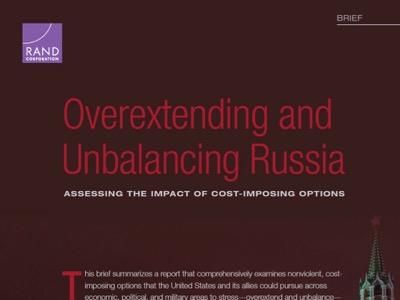
The conclusions of the latest confidential report by the Rand Corporation were recently made public in a « Brief ». They explain how to wage a new Cold War against Russia. Certain recommendations have already been implemented, but this systemic exposure enables us to understand their true objective.
Force the adversary to expand recklessly in order to unbalance him, and then destroy him. This is not the description of a judo hold, but a plan against Russia elaborated by the Rand Corporation, the most influential think tank in the USA. With a staff of thousands of experts, Rand presents itself as the world’s most reliable source for Intelligence and political analysis for the leaders of the United States and their allies.
The Rand Corp prides itself on having contributed to the elaboration of the long-term strategy which enabled the United States to win the Cold War, by forcing the Soviet Union to consume its own economic resources in the strategic confrontation. It is this model which was the inspiration for the new plan, Overextending and Unbalancing Russia, published by Rand. According to their analysts, Russia remains a powerful adversary for the United States in certain fundamental sectors. To handle this opposition, the USA and their allies will have to pursue a joint long-term strategy which exploits Russia’s vulnerabilities. So Rand analyses the various means with which to unbalance Russia, indicating for each the probabilities of success, the benefits, the cost, and the risks for the USA.
Rand analysts estimate that Russia’s greatest vulnerability is that of its economy, due to its heavy dependency on oil and gas exports. The income from these exports can be reduced by strengthening sanctions and increasing the energy exports of the United States. The goal is to oblige Europe to diminish its importation of Russian natural gas, and replace it by liquefied natural gas transported by sea from other countries.
Another way of destabilising the Russian economy in the long run is to encourage the emigration of qualified personnel, particularly young Russians with a high level of education. In the ideological and information sectors, it would be necessary to encourage internal contestation and at the same time, to undermine Russia’s image on the exterior, by excluding it from international forums and boycotting the international sporting events that it organises.
In the geopolitical sector, arming Ukraine would enable the USA to exploit the central point of Russia’s exterior vulnerability, but this would have to be carefully calculated in order to hold Russia under pressure without slipping into a major conflict, which it would win.
In the military sector, the USA could enjoy high benefits, with low costs and risks, by increasing the number of land-based troops from the NATO countries working in an anti-Russian function. The USA can enjoy high probabilities of success and high benefits, with moderate risks, especially by investing mainly in strategic bombers and long-range attack missiles directed against Russia.
Leaving the INF Treaty and deploying in Europe new intermediate-range nuclear missiles pointed at Russia would lead to high probabilities of success, but would also present high risks. By calibrating each option to gain the desired effect – conclude the Rand analysts – Russia would end up by paying the hardest price in a confrontation, but the USA would also have to invest huge resources, which would therefore no longer be available for other objectives. This is also prior warning of a coming major increase in USA/NATO military spending, to the disadvantage of social budgets.
This is the future that is planned out for us by the Rand Corporation, the most influential think tank of the Deep State – in other words the underground centre of real power gripped by the economic, financial, and military oligarchies – which determines the strategic choices not only of the USA, but all of the Western world.
The « options » set out by the plan are in reality no more than variants of the same war strategy, of which the price in sacrifices and risks is paid by us all.
* * *
via ZeroHedge News http://bit.ly/2VLY3bz Tyler Durden
It used to be bad enough that the SEC wouldn’t show up to “regulate” until schemes like Madoff and Enron had already collapsed on their own. Now, the inefficiency at the agency looks to have gone one step further, as we are finding out the SEC “never collects” much of the money that it seeks in fines from wrongdoers, according to the Wall Street Journal.
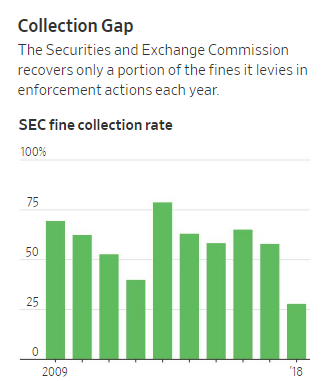
The SEC took in just 55% of the $20 billion in fines it sought through settlements or judgments in the five years that ended September 2018, according to agency statistics. In the five years prior to that, the SEC collected on just 60% of the $14.6 billion in fines it issued. And 2018 has been far worse. The commission took in just 28% of the almost $4 billion that it fined, marking the lowest rate in a decade, resulting from a $1.7 billion settlement with Petrobras that “may never require payment to the SEC”.
Instead, the settlement allows the company to give the money to Brazilian authorities and other regulators.
Those who were behind ponzi schemes or those who went to prison on criminal charges are the unlikeliest to pay fines. And the main challenge for the SEC is that they don’t have the right to seize property or assets to get payment. Instead, they have to rely on filing liens against defendants or going to court to get contempt orders.
Brad Bennett, a former enforcement director at the Financial Industry Regulatory Authority said: “It’s difficult, and they have to be especially persistent to get the numbers up.”
The Government Accountability Office criticized the SEC in 2014 for lapses in its recordkeeping that understated the amounts owed by defendants by “at least $42 million”. But don’t worry, according to the report, the commission has been “building a new computer system to track unpaid fines” since then. Ignoring that this was more than a half decade ago, perhaps someone could have informed the SEC that electronic spreadsheets have been around for nearly 4 decades.
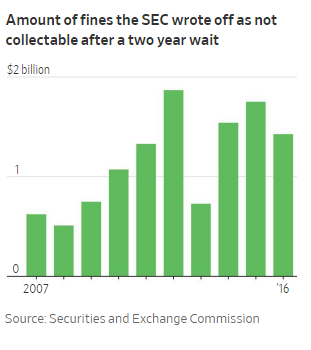
Instead, the agency has written off more than $10 billion in fines since 2019, including monetary penalties and disgorgement. At the end of 2018, the agency was owed about $1.5 billion but only expected to collect $228 million, according to its financial statements.
John Nester, an SEC spokesman, said: “We have a committed group of attorneys and paralegals in the dedicated office of collections who work hard to collect these funds, many of which will be distributed to harmed investors.”
The SEC often measures its success by how much it can levy in fines and how much it can collect. In the case of the Petrobras settlement, the SEC is taking credit for a fine that it will likely never collect. Excluding the case from 2018 data, the SEC’s collection rate would’ve been closer to about 51%.
And it is an arduous process. For example, in April the SEC asked a federal judge in Georgia to enforce a five-year-old judgment against an advisor who is required to pay more than $360,000. The defendant, Ernie Montford, has been paying the SEC monthly from his Social Security income, but that has only yielded about $21,000 so far.
Montford, 71 years old, said: “The SEC stomps on little firms like mine. If I could have paid more, I would have paid them.”
The CFTC, for comparison, boosted its recovery rate in 2018 after years of volatile performance. It collected $857 million in 2018, topping 90% of the fines that it issued. That amount collected may include cash tied to cases that were concluded in prior years, according to the way the CFTC reports its numbers. In 2016, the agency reported collecting about 479 million, or 37% of the fines that it ordered.
Michael Shaub, a professor of accounting and accounting ethics at Texas A&M University, concluded: “From a public-policy perspective, people would rather see bad guys fund the SEC than good guys.”
via ZeroHedge News http://bit.ly/2wgaVw9 Tyler Durden
The United States Navy wants to archive 350 billion social media posts in order to conduct “research.”
What exactly does the military want to study? “Modes of collective expression.”
The Department of the Navy has posted a solicitation asking contractors to bid on a project that would amass a staggering 350 billion social media posts dating from 2014 through 2016. The data will be taken from a single social media platform – but the solicitation does not specify which one. -RT
“We seek to acquire a large-scale global historical archive of social media data, providing the full text of all public social media posts, across all countries and languages covered by the social media platform,” the contract synopsis reads. The Navy said that the archive would be used in “ongoing research efforts” into “the evolution of linguistic communities” and “emerging modes of collective expression, over time and across countries.”
This is simply spying and the research will be used for propaganda purposes, and that is blatantly obvious at this point. The intentions are far from benign.
The archive will draw from publicly available social media posts and “no private communications or private user data” will be included in the database. However, all records must include the time and date at which each message was sent and the public user handle associated with the message.Additionally, each record in the archive must include all publicly available meta-data, including country, language, hashtags, location, handle, timestamp, and URLs, that were associated with the original posting.-RT
So basically, most of your information is going to be stored by the U.S. military. The data must be collected from at least 200 million unique users in at least 100 countries, with no single country accounting for more than 30 percent of users, according to the contract.
The U.S. government has previously expressed interest in collecting social media data for more tracking and spying on Americans. Last year, the U.S. Department of Homeland Security issued a notice asking contractors to bid on a database that tracks 290,000 global news sources in over 100 languages. The contract also mentioned the ability to keep tabs on“influencers,” leading some reports to speculate that theproposed database could be used to monitor journalists.
There is no way anyone could say we live in the land of the free anymore. It’s delusional to think we have any power at all. Freedom of speech is almost gone, gun rights are on the chopping block, and journalists will soon be punished by the military for not toeing the line and reporting on the official narrative (some have already been.) Censorship and manipulation are completely out of control. We are rapidly heading toward the dystopian nightmare George Orwell warned about.
via ZeroHedge News http://bit.ly/2HxaIef Tyler Durden
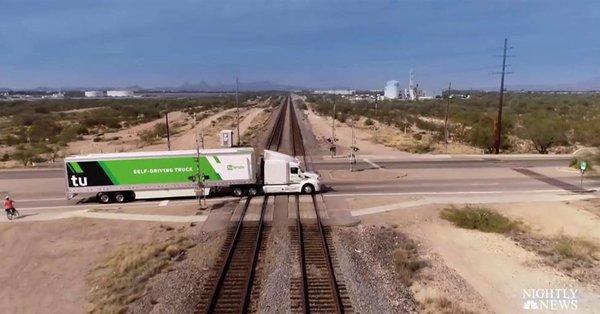
The US Postal Service (USPS) has awarded TuSimple, a global self-driving truck company, a contract to haul mail across the country with self-driving trucks, a move that could save the money-losing government agency millions of dollars per year if implemented, reported a TuSimple press release.
The two-week pilot started Tuesday will haul USPS trailers about 1,000 miles between USPS’s Phoenix, Arizona, and Dallas, Texas distribution facilities. The 22-hour trip is often outsourced to third-party trucking companies that use multiple drivers.
During the test, a safety engineer and driver will monitor TuSimple’s autonomous truck as it traverses I-10, I-20 and I-30 corridors through Arizona, New Mexico, and Texas.
“It is exciting to think that before many people will ride in a robo-taxi, their mail and packages may be carried in a self-driving truck,” said Dr. Xiaodi Hou, Founder, President and Chief Technology Officer, TuSimple. “Performing for the USPS on this pilot in this particular commercial corridor gives us specific use cases to help us validate our system, and expedite the technological development and commercialization progress.”
The USPS, which has been a money pit for taxpayers, lost nearly $4 billion in 2018, could finish 2019 with a $7 billion loss. With letter volume in terminal decline, the agency is trying to automate its transportation fleet as one way to cut expenses.
“We are conducting research and testing as part of our efforts to operate a future class of vehicles which will incorporate new technology to accommodate a diverse mail mix, enhance safety, improve service, reduce emissions, and produce operational savings,” a postal service spokeswoman told The Wall Street Journal in an email.
Several years ago, autonomous mobile robots caught the attention of the USPS Office of Inspector General, who said autonomous vehicles have the potential to cut costs, increase efficiency, and enable new services. While delivery robots are still technologically immature to be fully scalable across major cities, autonomous long-haul trucking could be more realistic in the next several years.
Automation has the potential to reshape the US economy in the 2020s. The rapid adoption of new automation technologies across the entire economy could eliminate 20% to 25% of current jobs, hitting the middle class the hardest. The automation wave has started, middle America should be absolutely terrified that robots could soon replace them in the next 10 years.
via ZeroHedge News http://bit.ly/2Eq3arW Tyler Durden
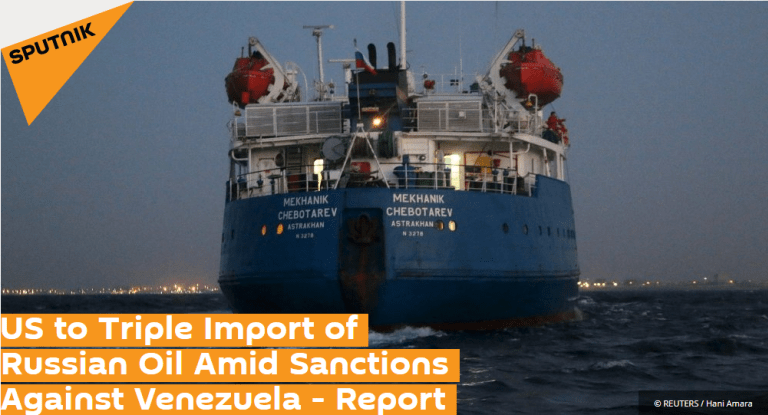
The market needs to be fed. And refiners will buy whoever has the best cargo at the best price. It is only politicians who don’t understand that you can’t dictate to the markets.
Now refiners in the U.S. have been under pressure with rising oil prices but Russian oil isn’t brought in to supply the tight gasoline market. Russian Urals grade is considered heavy-sour which is better for refining into diesel and other heavier grades.
Source: Bloomberg
And it is being sent right to the refineries that normally process Venezuela’s very heavy crude (PADD 3 – Gulf Coast).
Don’t think for a second that this is some kind of Trumpian quid pro quo or anything. That he promised Putin a few ducats to look the other way in Venezuela. I know stupid libs of the Young Turk variety will think this. So will the Q-tards in the MAGA crowd.
But, no. This is simply normal market action that a bunch of clueless morons in D.C. can’t control. Refiners need feedstock to refine or they go out of business.
Russian Urals regularly trades at a discount to Brent crude because there is no good benchmark for it. Remember, both West Texas Intermediate and Brent are light-sweet grades.
Only the Dubai and Shanghai oil futures exchanges list contracts for deliveries of heavy sour.
So, it’s no surprise to me to see it being a direct substitute for Venezuelan crude while the U.S. embargoes it.
If the Russians gain the market share lost by Venezuela while, at the same time, providing the financial infrastructure — payment clearing, insurance, etc. — for Venezuela to sell their oil to other markets, like India, what, in the end is the net effect of all this sanctioning and war-mongering?
Nothing, of course. But you can’t tell that to insane authoritarians like John Bolton. These are men who can only think in terms of primary effects and overly-discount the market’s ability to overcome obstacles. And so, they get frustrated by secondary effects, like the simple substitution of Russian oil for Venezuelan oil by domestic refiners.
Wait a couple more months and you’ll see Ted Cruz (R – Exxon/Mobil) introduce new sanctions via CAATSA against the Russian shipping companies bringing the oil to the Gulf Coast as a matter of ‘national security.’
He’ll be joined by Lindsay Graham and the rest of the braying Repuglican jackals and it’ll be used to force Trump to cave on some other issue of the day.
You can’t reason with insane people. And the longer they are in power the more they force sane people to act stupidly to do rational business. We’ll see more stories like this as Trump’s war on markets continues until he either breaks them or they break him.
The Pentagon has admitted that they have been investigating UFOs through a secret government initiative known as the “Advanced Aerospace Threat Identification Program (AATIP),” which the Defense department told the New York Post “did pursue research and investigation into unidentified aerial phenomena.“
image: ‘Project Blue Book’
The DoD says that it shut down AATIP in 2012, however spokesman Christopher Sherwood told the Post that the department still investigates potential alien aircraft sightings.
“The Department of Defense is always concerned about maintaining positive identification of all aircraft in our operating environment, as well as identifying any foreign capability that may be a threat to the homeland,” said Sherwood.
“The department will continue to investigate, through normal procedures, reports of unidentified aircraft encountered by US military aviators in order to ensure defense of the homeland and protection against strategic surprise by our nation’s adversaries.”
Nick Pope, who secretly investigated UFOs for the British government during the 1990s, called the DOD’s comments a “bombshell revelation.”
Pope, a former UK defense official-turned-author, said, “Previous official statements were ambiguous and left the door open to the possibility that AATIP was simply concerned with next-generation aviation threats from aircraft, missiles and drones — as skeptics claimed.
“This new admission makes it clear that they really did study what the public would call ‘UFOs,’ ” he said.
“It also shows the British influence, because UAP was the term we used in the Ministry of Defence to get away from the pop culture baggage that came with the term ‘UFO.’ ” –New York Post
AATIP’s existence was revealed in 2017, when former Senate Majority Leader Harry Reid (D-NV) claimed to have arranged for the program’s $22 million annual funding. Reid told the New York Times that it was “one of the good things I did in my congressional service.”
The New York Times published the article after the DoD released a 33-second DoD video released by the AATIP, featuring an airborne object being chased off the coast of San Diego by two navy jets in 2004.
On Sunday we reported on an op-ed written by Christopher Mellon in The Hill, on the fact that since 2015, “dozens of Navy F-18 fighter jets have encountered Unidentified Aerial Phenomenon (UAPs) – once commonly referred to as UFOs – off the East Coast of the United States, some not far from the nation’s capital. Encounters have been reported by other military aircraft and civilian airliners elsewhere in the U.S. and abroad, too, including videos shot by airline passengers.”
What these UAPs were and who was flying them – whether friends, foes or unknown forces – remains a mystery. Yet careful examination of the data inevitably leads to one possible, disturbing conclusion: A potential adversary of the United States has mastered technologies we do not yet understand, to achieve capabilities we cannot yet match.
It is long past time for Congress to discover the answers to those questions, and to share at least some of its conclusions with the public. –The Hill
So what’s really out there?
via ZeroHedge News http://bit.ly/30BVRqB Tyler Durden
Bloated governments around the world are faced with worsening fiscal conditions. Strapped for cash, they continue to squeeze every drop of wealth that’s within their reach through money printing and higher taxes. Today, we ask Jeff Thomas to weigh in on how to ensure you don’t become collateral damage in the next crisis.
International Man: We see this trend playing out around the world in the US, across Europe and in third world countries. Desperate governments are always in need of more capital. What does that mean for people who earn money and want to keep it?
Jeff Thomas: The most direct answer is that, if they’re going to survive the situation with their skin on, they’re going to have to rethink the way they hold on to wealth. But more broadly, they’re going to need to understand that the crisis that’s headed their way is not going to look the same as the mini-crashes that occurred in 2000 and 2008. This one is going to be far more devastating for some jurisdictions such as the EU, US and Canada. In those jurisdictions, this will be an endgame situation. Historically, whenever this occurs, the big players – governments included – tend to scrape all the chips off the table, ignoring any previous rules of the game. At such a time, no government, no banking institution, no investment fund is to be trusted.
This will mean that any monetary exposure the individual has with regard to these entities, should be regarded as sacrificial. By this, I mean that any exposed wealth is not necessarily certain to be lost entirely, but it’s quite possible. So any wealth that’s subject to the control of these institutions should be assumed to be wealth that may, suddenly and without warning, be confiscated or otherwise lost.
The greatest difficulty in this is that traditional investments and stores of wealth may no longer be viable, and the individual will have to prepare for this eventuality now, before this occurs.
International Man: To a large extent, everyone is forced to use and earn in US dollars, euros, pesos, etc. These are all paper currencies that are centrally controlled by governments looking to spend more and finance it with the printing press. How do people get what they earn outside of that system?
Jeff Thomas: The answer to this comes in two parts. If the individual only does one, he may still lose everything he’s got. He has to do both if he’s to protect himself. The first part is that, if he lives in one of the endangered jurisdictions, he’ll need to expatriate his wealth to a safer location – a jurisdiction that’s less likely to head south in a crisis. In any crisis, there are always some jurisdictions that remain stable. These jurisdictions actually thrive in a crisis, as the money flows to them rapidly. There’s an old saying that says, “Money tends to go where it’s treated best,” and that’s especially true in a crisis. So, whilst some jurisdictions will be in crisis, others will actually prosper – and therefore be safer – than they were before.
The second part is that, once you’ve liquidated all of your holdings that you can, at home, and have successfully expatriated the proceeds to a safer location, you want to get them into a form that’s as safe as possible. Unfortunately, in a crash, banks worldwide are likely to close without warning. In some jurisdictions, they’ll re-open once they’re assured that there will be no run on the banks, but in the interim, your access to your wealth may be frozen. In an overseas bank, this is better than losing it entirely, as you might have, back home, but it does limit your options for an indeterminate period. Therefore, once your wealth is expatriated, you’ll want to convert much of it out of cash. Real estate is an excellent choice in an overseas jurisdiction, as your home government cannot confiscate it. For one country to take land in another country is an act of war.
The other choice is to buy precious metals and store them in the best facility you can, in the safest jurisdiction you can. In a crisis, the value of precious metals always rises, as does the demand for them. In such a facility it’s also possible to store cash. Unlike a bank, a storage facility doesn’t have the right to confiscate your wealth or to refuse you the right to withdraw it. That means that, as monetary events unfold, you retain the ability to control your wealth.
International Man: In an effort to end America’s Great Depression, President Roosevelt made gold ownership illegal in 1933 – forcing people to turn in their gold in exchange for paper money. How do hard assets like gold, other precious metals and real estate stack up against any future attempts by a government to confiscate or tax it?
Jeff Thomas: In any crisis, there are no guarantees. The best you can do is avoid being the low-hanging fruit. If you live in, say, New York, and all your real estate ownership is in the US and all your cash is in New York banks, you’re as exposed as you can get. The objective is to make it as difficult to take your wealth as possible. If all your wealth is in another country (or countries), your home country has to deal with another country’s laws and go through their courts in order to take what’s yours. Your objective is to make your wealth so difficult to go after that you’re too much trouble to bother with.
I should mention that this approach is working well, as we speak, for those who are employing it. However, it may become essential in a crisis.
Another fact to bear in mind is that, whilst politicians are forever complaining about those countries that respect wealth, those same politicians need a place to keep their own wealth in a crisis. Politicians who know what’s coming want to be sure that safer jurisdictions exist, and although they may rail publicly about those jurisdictions, they’ll privately want to be assured that they themselves will be able to use those same jurisdictions as their own back door.
International Man: What should people consider in their decision to move their wealth and assets outside the control of unfavorable governments?
Jeff Thomas: First, be aware that time is limited. We may have a year or two before it’s necessary, but a market crash could happen at any time. It’s always better to be a year too early than a day too late. Second, I always advise people to select the safest jurisdiction they can find that’s not too far to get to, if an emergency were to occur. For example, Singapore is an excellent choice, but for North Americans, it’s halfway round the world.
Once you’ve selected your best option for an accessible jurisdiction, seek out a storage facility within that jurisdiction that’s not also a banking institution. The OECD, FATCA, etc., are in a great position to blackmail banks, but they can’t do the same to non-banking institutions. That’s one more layer of protection for you.
If the laws of that jurisdiction protect you well, that means that a storage facility within that jurisdiction is protected by those same laws. Again, one more layer.
International Man: What do you look for in a place that might be safe for your money?
Jeff Thomas: I begin with those countries that have no direct taxation of any kind – no income tax, property tax, sales tax, capital gains tax, inheritance tax, etc. (Remember – it’s much harder for any government to create a new form of taxation than to simply raise an existing tax). Also, as regards precious metals ownership, look for an absence of taxes or duties that apply to the purchase, ownership, storage or sale of precious metals. This ensures not only an absence of taxes; it also ensures an absence of governmental interference in what you do with your wealth. You can act quickly if you need to without having red tape tie you up.
Second, you’d want a jurisdiction whose government has a consistent history for economic stability that caters to international investors. This is critical. It means that if that country’s economy is dependent upon foreign investment, the political leaders can’t change the rules on you without destroying their own careers. You want them to need you to do well, so that they can remain in their jobs. That’s your insurance policy when times are hard and political temptations are great.
Finally, if you’re able to do so, financially, you’d want to have a bolt hole – a property in a jurisdiction that’s either going to be minimally affected by the coming crisis or will be positively affected. That’s something you’d need to create in advance, as, if conditions turned sour in your home country, you’d want to have your Alamo ready for you. You’d just pack a carry-on and go to the airport, knowing your destination was waiting for you. Making your wealth safe in a crisis won’t help much if you can’t get to it and get your family safe.
I’m not predicting an “end-of-the-world” scenario here, but it would be wise to anticipate significant unrest that may be brief or periodic. Ideally, you’d want to sit that out someplace safer.
* * *
Unfortunately, there’s little any individual can practically do to change the trajectory of broke governments in need of more cash. There are still steps you can take to ensure you survive the turmoil with your money intact. We’ve eliminated the guess work and found an ideal solution that will help keep your savings safe and within your control… even during the worst of times. As you’ll see, it’s one of International Man contributor Jeff Thomas’ preferred options. Click here to find out more.
via ZeroHedge News http://bit.ly/2HPpps1 Tyler Durden
The very embattled Huawei Technologies has accused a former employee of poaching workers and stealing their proprietary intellectual property in order to launch a competing firm backed by Microsoft and Dell.
In a December 2017 lawsuit, Huawei alleged in 2017 that Yiren “Ronnie” Huang stole technology and recruited 14 of its employees. Huang was hired in 2010 as a principal engineer for the Chinese company’s solid-state drive (SSD) storage group. In June, 2013, Huang left Huawei subsidiary Futurewei along with several others, before incorporating competing CNEX Labs.
“Huang used information he obtained through his employment at FutureWei along with FutureWei’s resources and technology in drafting these patent applications,” Huawei alleged in its complaint.
The San Jose-based CNEX shot back, filing a countersuit in 2018 claiming that Huawei engaged in a multiyear conspiracy to steal their solid-state drive storage technology, which included the assistance of a Chinese university, according to the Wall Street Journal.
In a pretrial hearing last month, CNEX attorneys alleged that Mr. Xu directed a Huawei engineer to analyze CNEX’s technical information.
CNEX said the engineer met with CNEX officials in June 2016, posing as a potential customer to obtain trade secret information, according to a transcript of the April 17 hearing, which was conducted by the court via teleconference. Afterward, the engineer produced a report about CNEX’s technology and submitted it to a competitive-intelligence database maintained by HiSilicon, Huawei’s chip-development unit, according to a CNEX lawyer who cited the engineer’s deposition, the transcript shows.
Mr. Xu also was briefed on an arrangement between Huawei and China’s Xiamen University, according to CNEX lawyers, who said the partnership was part of a plot to misappropriate CNEX’s trade secrets. –Wall Street Journal
CNEX lawyers said that in 2017, Xiamen University tried to obtain a computer memory board under the guise of purely academic research purposes, which CNEX provided under a licensing agreement with a strict nondisclosure provision.
“What was hidden from CNEX was that Xiamen was working with Huawei and had entered into an agreement separately with Huawei to provide them with all of their research test reports,” said CNEX lawyer Eugene Mar. The Chinese company then fed the results of the Xiamen study into various chip projects, one of which is scheduled for release later this year.
A Huawei lawyer acknowledged that Mr. Xu “was in the chain of command that had requested” information about CNEX, and confirmed that a CNEX document had been put into HiSilicon’s competitive intelligence database, known as its “D-box directory,” according to the transcript of the April 17 hearing.
Huawei insists that nothing was stolen, and that the engineer had met with CNEX after he was invited to discuss “their products and their open source technology,” according to the transcripts.
Huang, who had worked in the field for decades including at Cisco, was hired at Huawei’s FutureWei unit in Santa Clara, California, in January 2011. His job was to oversee a group researching various storage technologies that could be integrated into Huawei’s networking products.
Huang says the position was a ruse by Huawei to steal his inventions as part of an “ongoing effort for Chinese technological dominance.” He stayed with the firm for more than two years, and formed CNEX with two former Marvell Technology Group Ltd. executives less than a week after he left FutureWei. –Bloomberg
“Huawei is attempting to use the U.S. federal court system in Texas to steal intellectual property created and developed by American semiconductor innovators,” said CNEX General Counsel Matthew Gloss, who added that the trial “will shed light on the systematic and wide-ranging methods Huawei has used to steal emerging and foundational data center technology expected to support tomorrow’s 5G networks.”
On April 2, District Court Judge Amos Mazzant ruled that CNEX doesn’t have to turn over ownership of Huang’s patents and applications.
The trading of barbs comes amid sensitive trade negotiations between the US and China. After the Trump administration blacklisted Huawei – which it has accused of assisting Beijing in espionage – a slew of technology firms and telecom companies around the world have scrapped plans to sell Huawei handsets and other devices.
via ZeroHedge News http://bit.ly/2X6lBta Tyler Durden
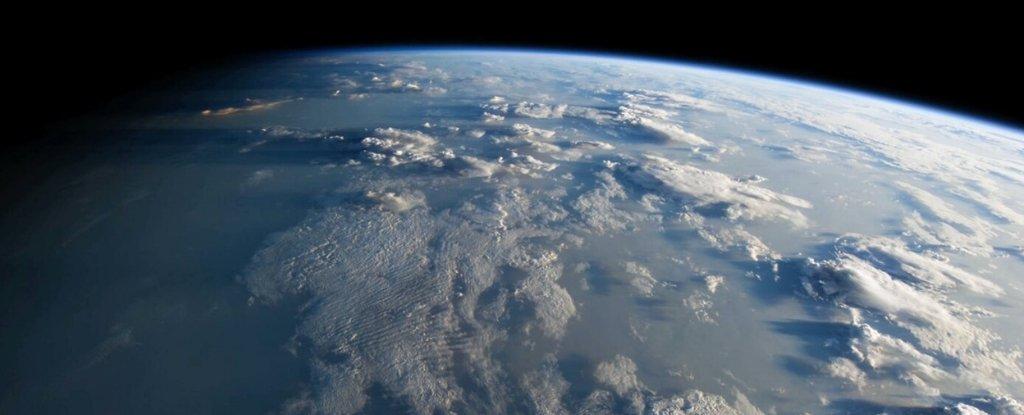
It’s been exactly one year since US scientists reported a mysterious surge in ozone-destroying chemicals, known as chlorofluorocarbons (CFCs).
Banned in 1987 under the globally signed Montreal Protocol, there was only one explanation: somewhere out there, in an unknown location, someone must have gone rogue, setting back progress on the ozone hole by a decade or more.
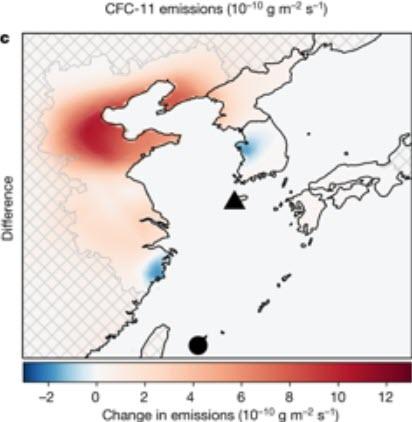
After much speculation, the whereabouts and magnitude of these harmful emissions has been confirmed in scientific research. As earlier reporting in The New York Timeshad already suggested, they seem to be coming from the northeast coast of mainland China.
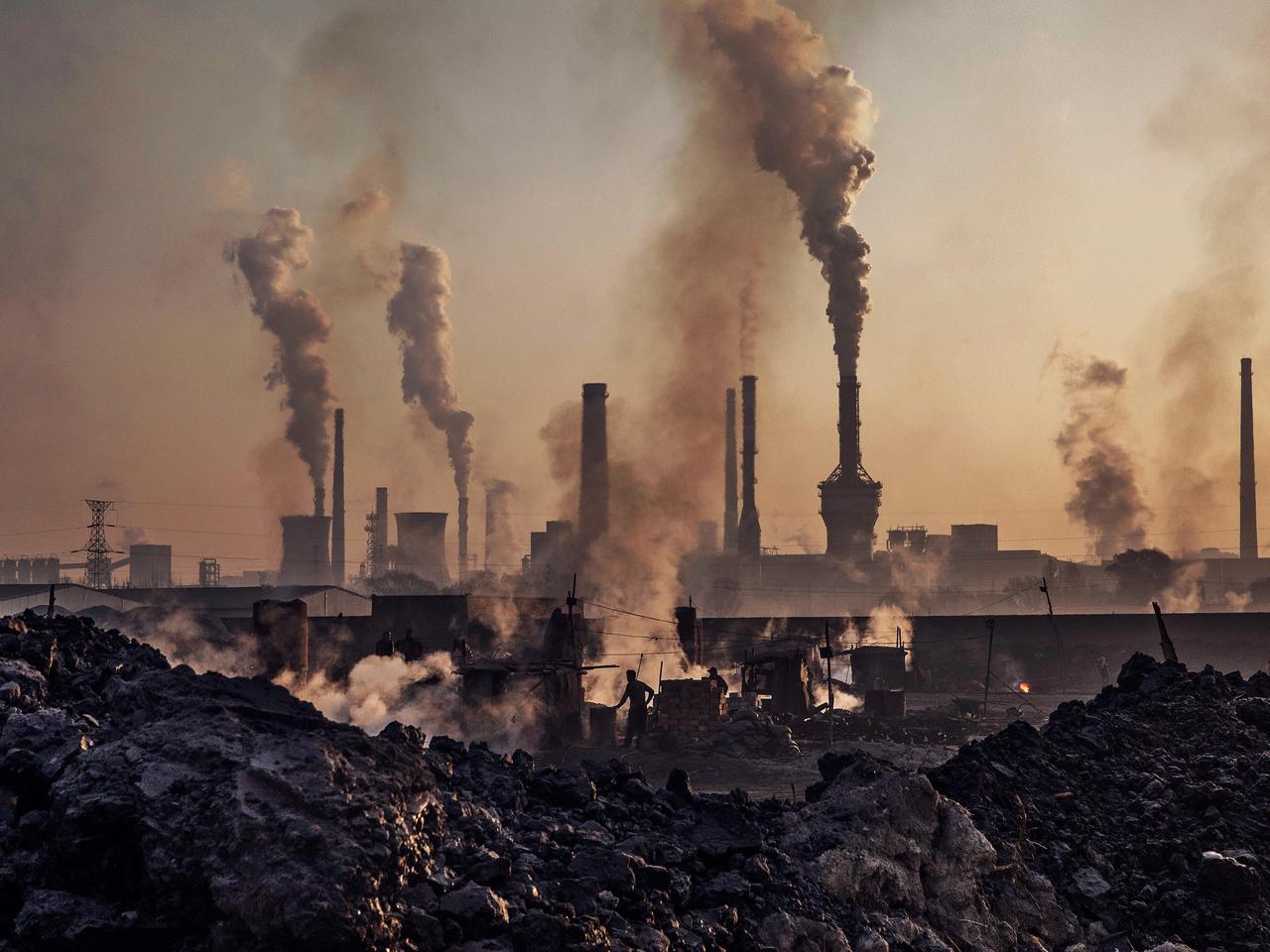
Since the Montreal Protocol was declared a success in 2013, this highly industrial region has continued to emit, whether accidentally or not, CFC-11: the second most abundant chlorofluorocarbon in the atmosphere. Between the periods of 2008-2012 and 2014-2017, in fact, CFC-11 emissions increased here by roughly 110 percent.
“This increase accounts for a substantial fraction (at least 40 to 60 per cent) of the global rise in CFC-11 emissions,” an international team of researchers writes in a new report.
“We find no evidence for a significant increase in CFC-11 emissions from any other eastern Asian countries or other regions of the world where there are available data for the detection of regional emissions.”
These violations are likely going unreported because even though CFC-11 is illegal, it is also one of the cheapest ways to produce new foam insulation in refrigerators and buildings.
After tracking down documents and international sources, journalists at The New York Times and independent investigators discovered that in some factories in China, illegal CFC use has been slipping through the cracks for years.
The examples given are based in Xingfu, a rural industrial town in China’s Shandong province, and incidentally, that is the very same province that the scientists landed on too.
Gathering atmospheric observations from locations in South Korea and Japan, the researchers compared global monitoring data and atmospheric chemical movements to figure out whether these emissions came from eastern Asia – the area most suspected as the source of CFC-11.
Along with Shandong, the nearby province of Hebei was also implicated. Both regions are big industrial producers heavily involved in the nation’s manufacturing, and while the chemical may not actually be produced here, it’s certainly being emitted at alarming rates somewhere nearby.
“To bring about such an increase … would require new emissions from the disposal and destruction of refrigerators more than 10 times higher than recently estimated for the whole of China between 2014 and 2017,” the authors write, “or a larger and more rapid increase in emissions from the demolition of old buildings than was previously predicted for the entire world over a 20-year period (2020–2040).”
Whether these factories know what they’re doing or not (and the NYT report certainly suggests they understand), their actions pose a serious threat not only to the ozone layer, but also to the climate crisis. CFC-11 has a powerful heat-trapping effect in the atmosphere, so if emissions continue as they are, experts say it would be equivalent to the amount of CO2 produced by 16 coal-fired power stations every year.
China currently produces about one-third of the world’s polyurethane foam, and the emissions so far may only represent a fraction of what has already been manufactured. The rest of the CFC-11 may still be trapped inside a slowly-emitting foam bank, and the only way to know for sure is to find the ones responsible.
Unfortunately, the new research is unable to zoom in any closer on the culprit, so it is still unclear whether these emissions are widespread across both these Chinese regions, or scattered among just a few sources. For now, the hunt continues.
A new wave of investments in automation could stimulate the economy after the next recession. By 2030, automation may eliminate 20% to 25% of current jobs (equivalent to 40 million displaced workers), crushing the bottom 90% of Americans the hardest. Some of these investments include the automation of shipping terminals, reported Bloomberg.
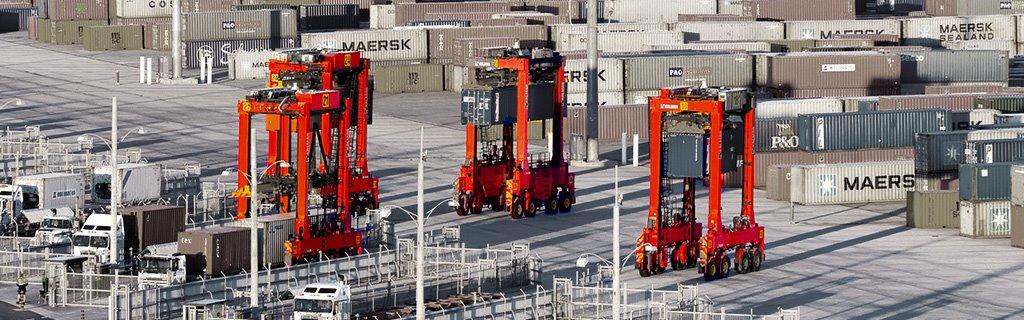
At Pier 400 in Los Angeles, North America’s largest shipping terminal, about 1,700 diesel vehicles pass through the facility daily. The terminal is managed by APM Terminals, a segment of A.P. Moller-Maersk A/S, is expected to replace diesel and gasoline engines with electric, and use autonomous software to replace the workforce.
APM has already started to transform Pier 400 into a smart port, which will be several year processes of establishing robots throughout the facility to move containers more efficiently. To do this, APM recently ordered an electric, automated carrier from Finnish manufacturer Kalmar Global, that can perform three tasks: a crane, top-loader, and truck. Not only would the human element be eliminated from the equation, but also 65,000 miles driven by diesel motors would be replaced with electric engines.
The benefits of automation at the port will flow to the highly skilled workers—as well as APM. As a result, automation could significantly increase income inequality in the surrounding community because of the newly displaced workers, stripped of their jobs by robots.
Anthony Armijo, has worked at the terminal for 15 years said, “I just don’t understand what we’re going to be doing in the future,” he said. “I’m an American citizen. You would think they would have a way for us to make a living.”
Automation and clean-energy initiatives are expected to disrupt hundreds, if not thousands, of jobs, at the terminal by 2021.
“Automation is the path of history,” said Dan Sperling, a member of California’s Air Resources Board and professor of civil engineering and environmental science at the University of California, Davis. “The questions are how much automation really makes sense, and how do you deal with the disruption to the workers?”
Wim Lagaay, president and chief executive officer of APM North America, views automation as a way to stay competitive in the global economy.
“If you don’t have a competitive port, you don’t have volumes, you have nothing,” he said. “Jobs will change, jobs will be created, jobs will be eliminated.”
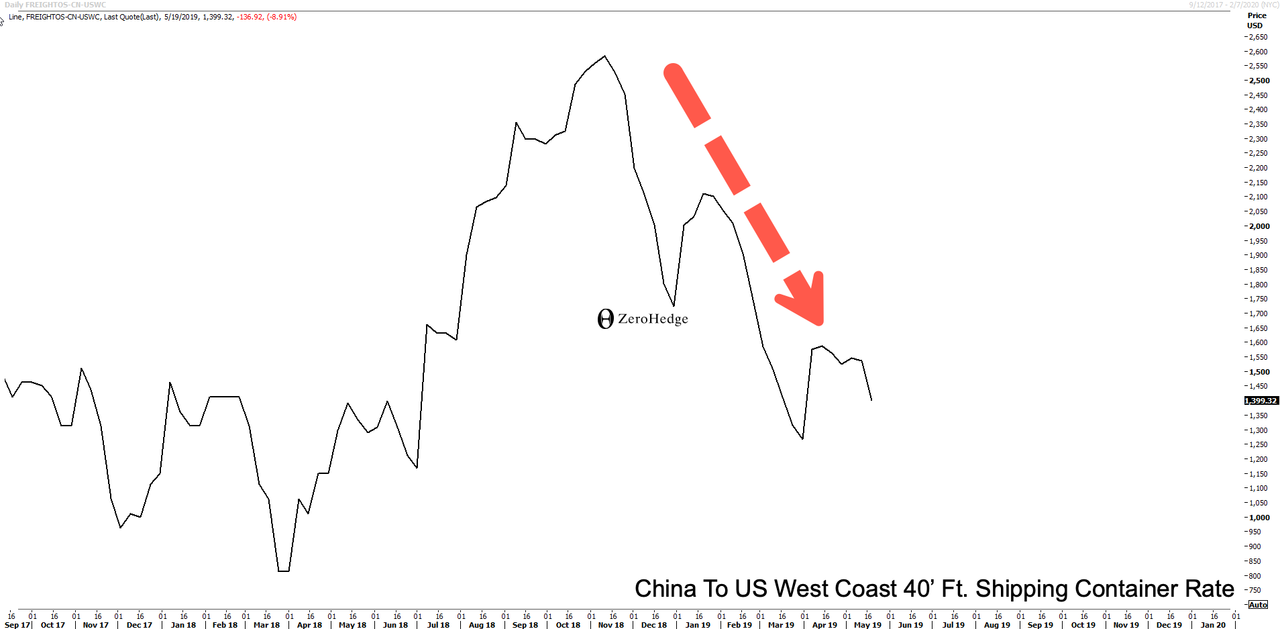
The deepening trade war has led to a slowdown in trade volume at the terminal. Exports to China through Los Angeles and Long Beach crashed by 35%, and imports from China dropped 11.5% in 1Q19, versus 1Q18.
Automation will help the terminal survive the trade war by lowering operating costs, increase productivity, and allow the facility to work 24/7.
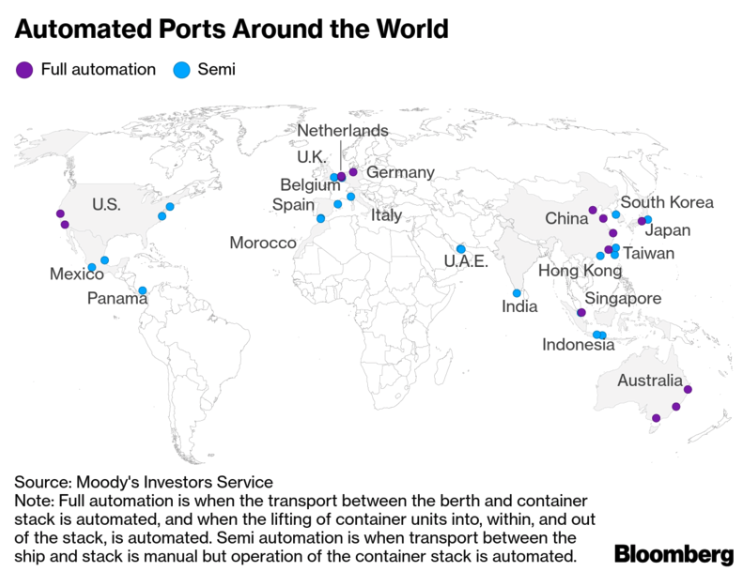
Moody’s Investors Service shows that only 5 of the 44 shipping terminals that are either semi-automated or fully automated are located in the US.
West Coast ports have increased cost pressures and struggle to stay competitive, given their per container costs are 165% higher than East Coast and Gulf Coast ports, according to the Pacific Maritime Association.
The $1.5 billion, fully automated system at Pier 400 will be completed in 2021, will handle more freight and make the terminal more competitive, while cutting pollution.
“The reality is, if you want to be competitive, you do have to go towards automation,” said Lee Klaskow, a Bloomberg Intelligence analyst.
The next phase of automation has begun, and it will accelerate for the next decade. Waves of automation have reshaped the economy in the past, take, for example, agricultural automation allowed farmers to shift to factories, and industrial automation enabled factory workers to migrate to the service sector. Each time, the impact of automation on the economy has created increased volatility in the marketplace.
via ZeroHedge News http://bit.ly/2Wo3bGU Tyler Durden