Small Businesses “Losing Confidence In The Economy” On Record Labor Shortages, Soaring Inflation, Sliding Margins

Small Businesses “Losing Confidence In The Economy” On Record Labor Shortages, Soaring Inflation, Sliding Margins

Small business owners grew less confident in the economic recovery in July amid labor shortages that hit a fresh, 48-year record high, according to the latest NFIB survey released on Tuesday.  The NFIB Small Business Optimism Index decreased in July to 99.7, a drop of 2.8 points, reversing June’s 2.9-point gain.

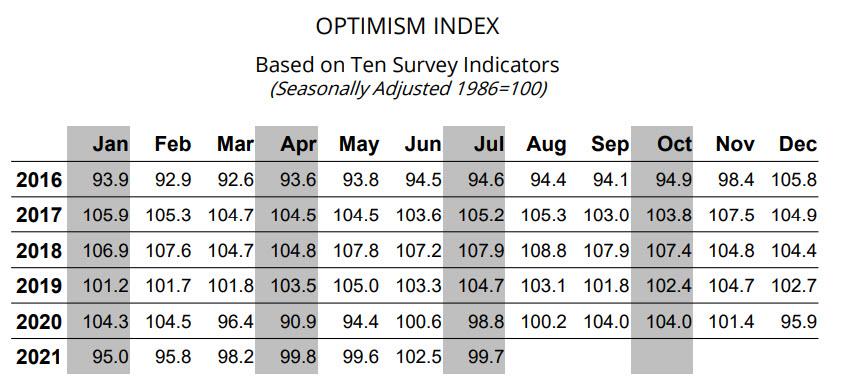
Six of the 10 components tracked by the survey declined, three improved, and one was unchanged. The NFIB Uncertainty Index decreased seven points to 76, indicating owners’ views are held with more certainty than in earlier months.

“Small business owners are losing confidence in the strength of the economy and expect a slowdown in job creation,” said NFIB Chief Economist Bill Dunkelberg.

“As owners look for qualified workers, they are also reporting that supply chain disruptions are having an impact on their businesses. Ultimately, owners could sell more if they could acquire more supplies and inventories from their supply chains.”

Dunkelberg’s view coincides with that of a growing number of economists who warn that while the economy is projected to expand this year at its fastest pace since the 1980s, it is starting to cool off as the impact from trillions in fiscal stimulus fades. Supply chain bottlenecks continue to dent manufacturing growth, and consumer sentiment has declined recently amid concerns about inflation.

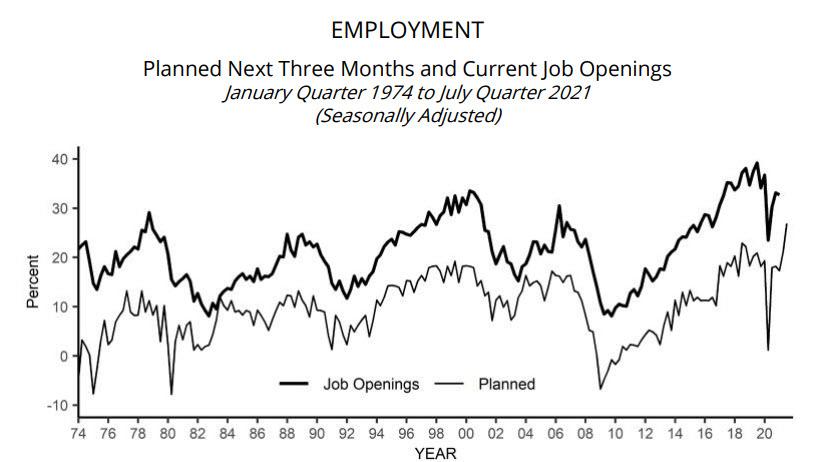
The continuing chaos in the labor market remains the biggest sticking point in small business confidence: while a new record high 49% of small business owners reported unfilled job openings in July on a seasonally adjusted basis amid a historic labor shortage, this is no longer translating into stronger hiring plans, as a net 27% of businesses plan to create new jobs in the next three months, down one point from the month prior, the NFIB survey showed.
“As owners look for qualified workers, they are also reporting that supply chain disruptions are having an impact on their businesses,” Dunkelberg said. “Ultimately, owners could sell more if they could acquire more supplies and inventories from their supply chains.”

Some 57% of respondents said they had few or no qualified applicants for open jobs in July, up one point from June.

This inability to operate businesses in optimal conditions, is also translating in the first drop in actual compensation since last December: In July 38% of respondents said raised compensation, down from 39% in June, even if compensation plans continue to rise modestly.

The quality of labor ranked as businesses’ “single most important problem,” with 26% of respondents selecting it among 10 issues, near the survey high of 27%, the NFIB said in its latest optimism survey.

Last but not least, inflation is also impacting sentiment, with some 44% of businesses planning to increase prices in the next three months, which was unchanged from June’s record high reading.
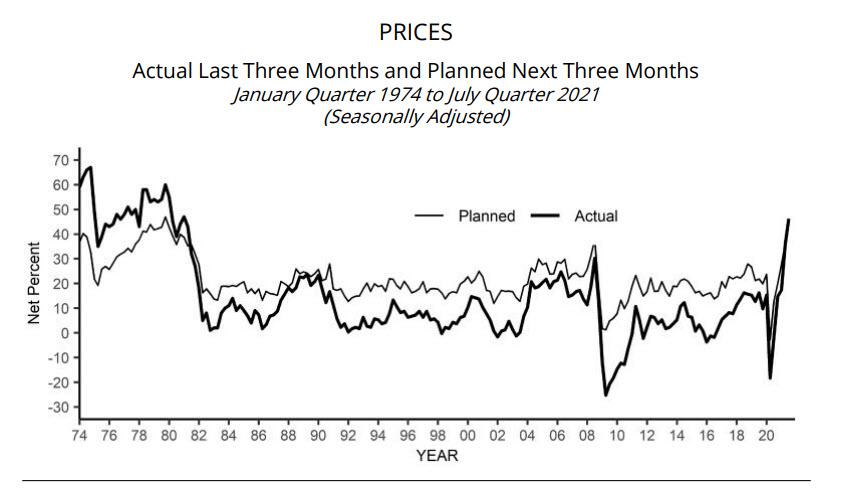
In July, 52% of owners reported raising average selling prices, two points higher than June. Price increases in wholesale and retail trades posted significant declines. The largest increases in price-raising activity were in the non-professional services and transportation.

A net 46% of owners (seasonally adjusted) reported raising average selling prices. Unadjusted, 5% reported lower average selling prices and 52% reported higher average prices. Price hikes were the most frequent in wholesale (73% higher, 0% lower), manufacturing (61% higher, 6% lower), and retail (57% higher, 7% lower). Seasonally adjusted, a net 44% plan price hikes. This is inflation, the question is for how long?

Other key findings include:

  • Sales expectations over the next three months decreased 11 points to a net negative 4% of owners.
  • Owners expecting better business conditions over the next six months decreased eight points to a net negative 20%.
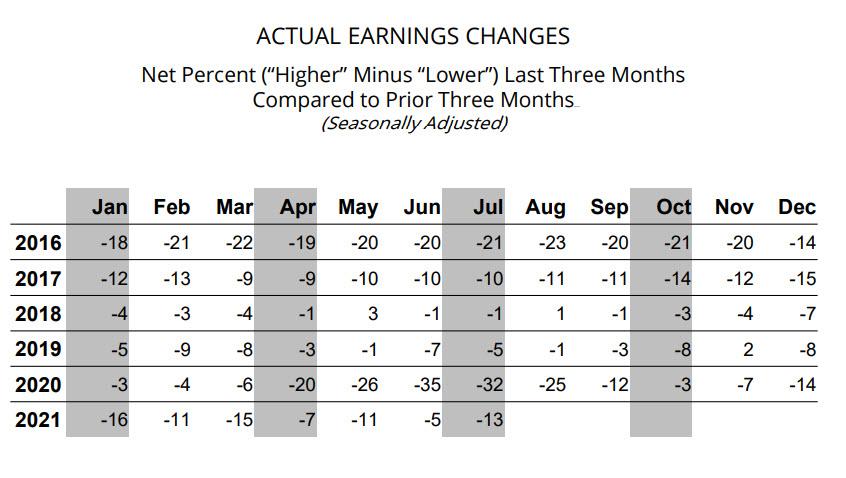
  • Earnings trends over the past three months decreased eight points to a net negative 13%.

Fifty-five percent of owners reported capital outlays in the last six months, up two points from June but historically a below average reading. Of those making expenditures, 39% reported spending on new equipment, 23% acquired vehicles, and 14% improved or expanded facilities. Six percent of owners acquired new buildings or land for expansion and 11% spent money for new fixtures and furniture. Twenty-six percent of owners are planning capital outlays in the next few months. At some point, owners will have to step up capital spending to acquire and improve the quality of capital available to support new hires.

A net 5% of all owners (seasonally adjusted) reported higher nominal sales in the past three months, down four points from June. The net percent of owners expecting higher real sales volumes declined 11 points to a net negative 4%, a stubbornly negative view but based on their realities.

The percent of owners reporting inventory increases declined seven points to a net negative 6%. A net 12% of owners view current inventory stocks as “too low” in July, up one point from June and a 48-year record high reading. A net 6% of owners plan inventory investment in the coming months, down five points from June and also a historically high reading.

A net 38% of owners (seasonally adjusted) reported raising compensation, down one point from June’s record high of 39%. A net 27% plan to raise compensation in the next three months, up one point from June and a 48-year record high reading.

Lat but not least, the frequency of reports of positive profit trends declined eight points to a net negative 13%…
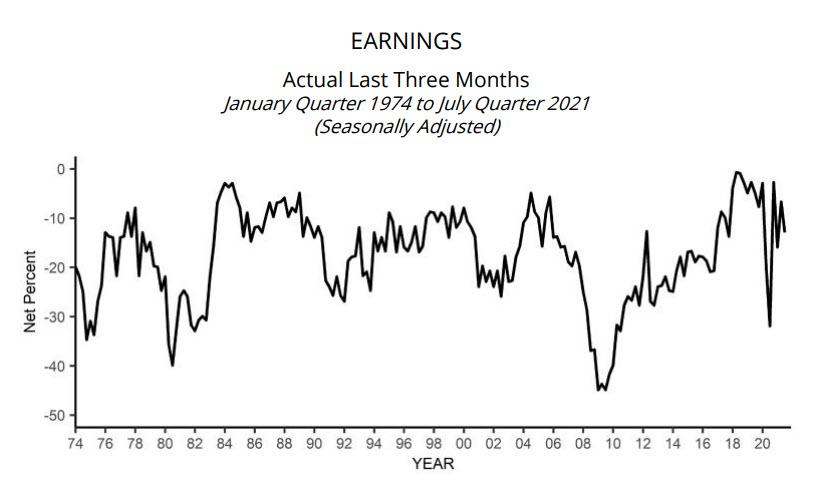
… the lowest level since March as small businesses are hit by margin compression.
Among those small employers reporting lower profits, 32% blamed weaker sales, 31% cited a rise in the cost of materials, 10% cited labor costs, 7% cited lower prices, 6% cited the usual seasonal change, and 3% cited higher taxes or regulatory costs. For owners reporting higher profits, 62% credited sales volumes, 20% cited usual seasonal change, and 7% cited higher prices.

Tyler Durden
Tue, 08/10/2021 – 10:50

via ZeroHedge News https://ift.tt/3sdMGuM Tyler Durden
The Biggest Risk

The Biggest Risk

Authored by Lance Roberts via RealInvestmentAdvice.com,

A test of the 200-dma is coming. The only questions are when and what will cause it?

Two weeks ago in the Real Investment Report (subscribe for free email delivery), I discussed the rather long span of 6-straight positive return months.

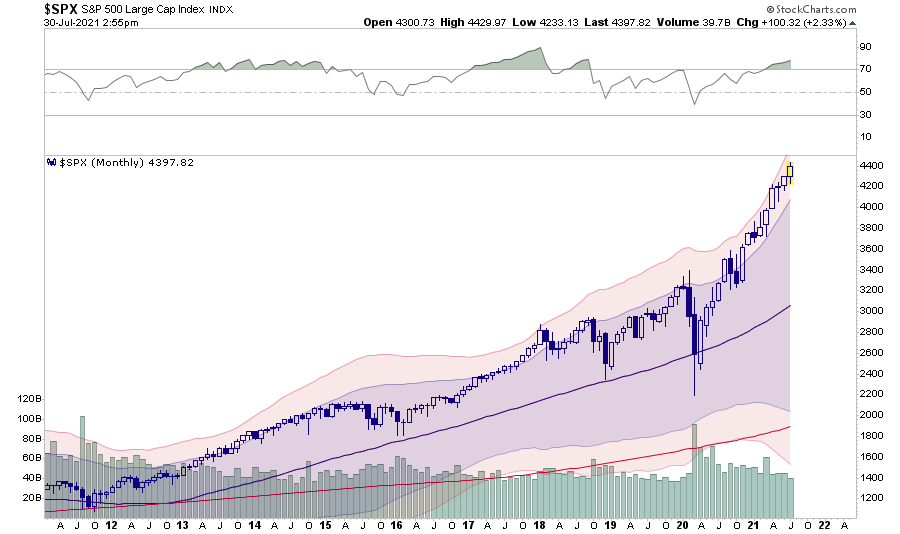
“An additional ‘red flag’ is the S&P 500 has had positive returns for 6-straight months. As shown in the 10-year monthly chart below, such streaks are a rarity, and when they do occur, they are usually met by a month, or more, of negative returns.

(It is also worth noting that when the 12-Month RSI is this overbought, larger corrective processes have occurred.)

The problem with monthly data is that it is very slow to turn. While such deviations can last a while, the critical point is they do not last forever.

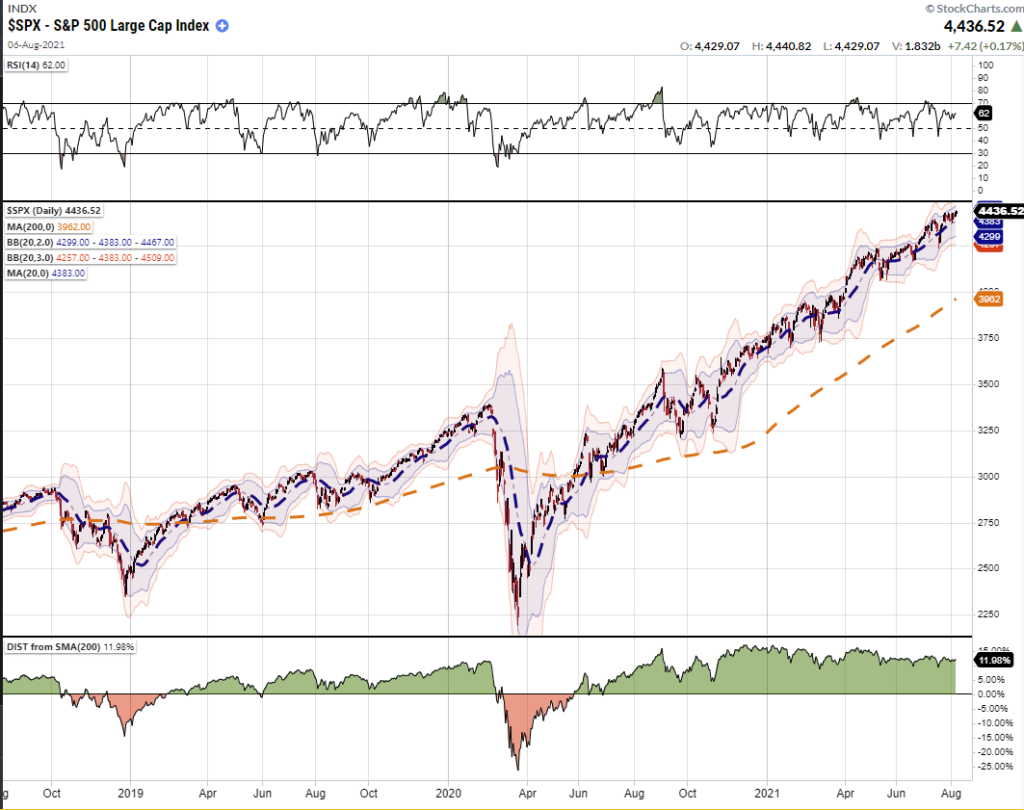
I got several email questions about the current deviation of the market from the 200-dma. Currently, the market has well deviated from a widely watched level of support.

While the current level of deviation is not the highest on record, it is very close.

Is this something we should be immediately concerned about?

Using daily data back to 1960, I constructed some different variations on the theme of deviations from the 200-dma to try and answer that question.

Why Is The 200-DMA Important

Let’s start with the basics.

The 200-day moving average, as denoted in the chart above, is a technical indicator used to analyze long-term trends. The line represents the average closing price over the last 200 days. Each day, the average changes as the latest data point are added, and the first removed creating a new average price.

Given the 200-dma represents a longer-term holding period for stocks today, it is a more important indicator for “risk” management and capital preservation. As IBD notes:

“Making a decision on when to sell stocks to lock in a profit can be very tough, especially when you’ve amassed long or short-term capital gains. Watching the stock’s behavior at the 200-day moving average can help you decide when it’s time to take at least some partial profits.”

One of the bigger mistakes that investors repeatedly make is not having a “sell discipline.” They often hold a stock that is losing money hoping it will come back which weighs on portfolio performance due to “opportunity cost.” Or, often worse, they turn a large gain into a loss trying to avoid paying “capital gains” tax.

These are easy mistakes to correct using the 200-dma and can improve portfolio performance over time.

Deviations Above The 200-DMA

In the short term, fundamentals don’t matter. Such is because over a few days, weeks, or even months, what drives prices higher or lower is the psychology of investors. As such, we can look at technical deviations to determine how exuberant or not the market currently is.

For moving averages to exist, prices must trade both above and below that average. As such, moving averages act like gravity on prices. When prices deviate too far from the moving average, eventually, prices will revert to, or beyond, that average.

“Reversion to the mean is the iron rule of the financial markets” – John C. Bogle

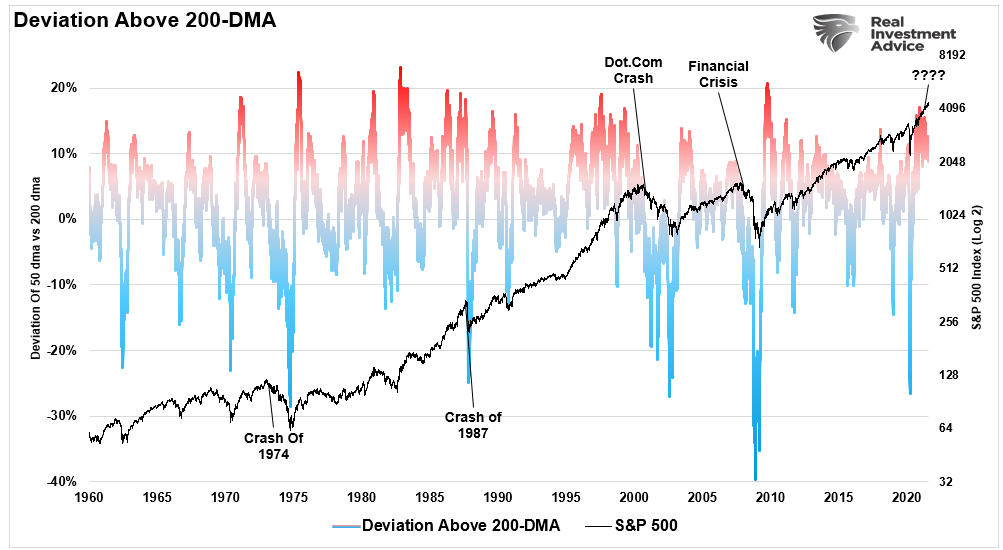
We can visualize the reversion in the chart below of the S&P 500 index versus its 200-dma. With the index currently more than 11% above its 200-dma, such should be a short-term warning to investors. Looking back historically whenever deviations exceed 10% above the 200-dma, a correction generally ensues.

Deviations Of Averages

Since last November, the market has exhibited a period of extremely low volatility. During that period, the 50-dma has acted as an important support for the market as speculative buyers use minor “dips” to chase markets. Interestingly, these spurts of “dip buying” create a short-lived advance, price stagnation, and then a retest of the 50-dma.

Of course, the suppressed level of volatility is always a warning. As discussed just recently“Stability Leads To Instability.” To wit:

Given the volatility index is a function of the options market, we can also view these alternating periods of ‘stability/instability’ by looking at the daily price changes of the index itself.

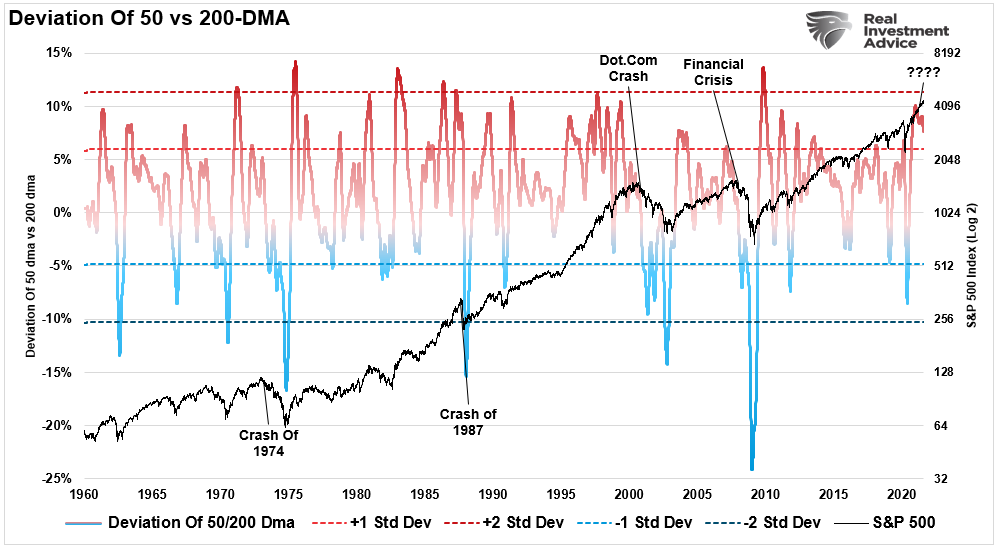
The following chart says much the same. Currently, the 50-day moving average is also significantly deviated above the 200-dma. Such suggests that not only will prices retest the 50-dma, but there is a rising probability that price will revert to the 200-dma.

Notably, technical deviations in the short term do NOT mean the market will “crash” tomorrow. Markets can remain deviated for quite some time. However, when the deviations begin to diverge from the price index negatively, such has previously preceded more important corrections and bear markets.

It is something worth paying attention to.

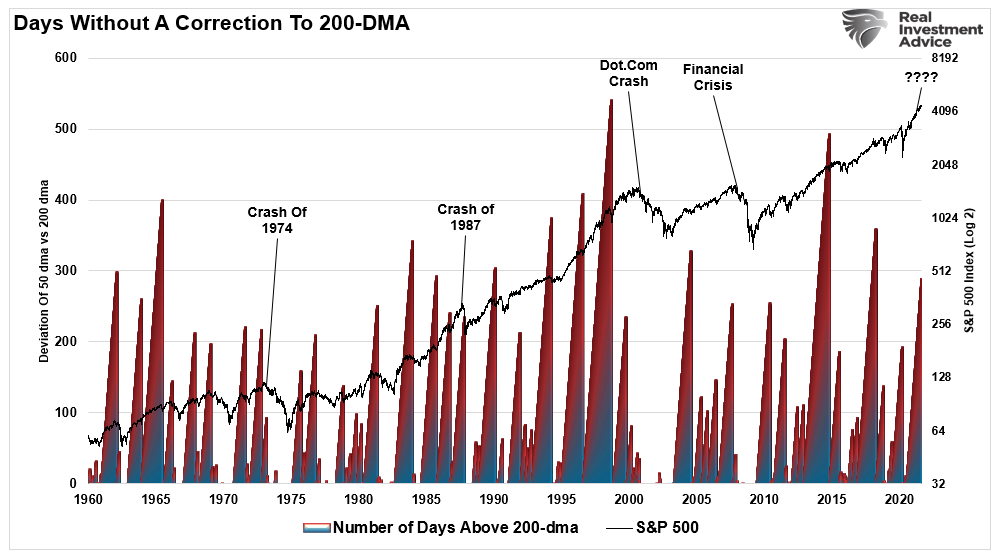
A Long Time Without A Test Of The 200-DMA

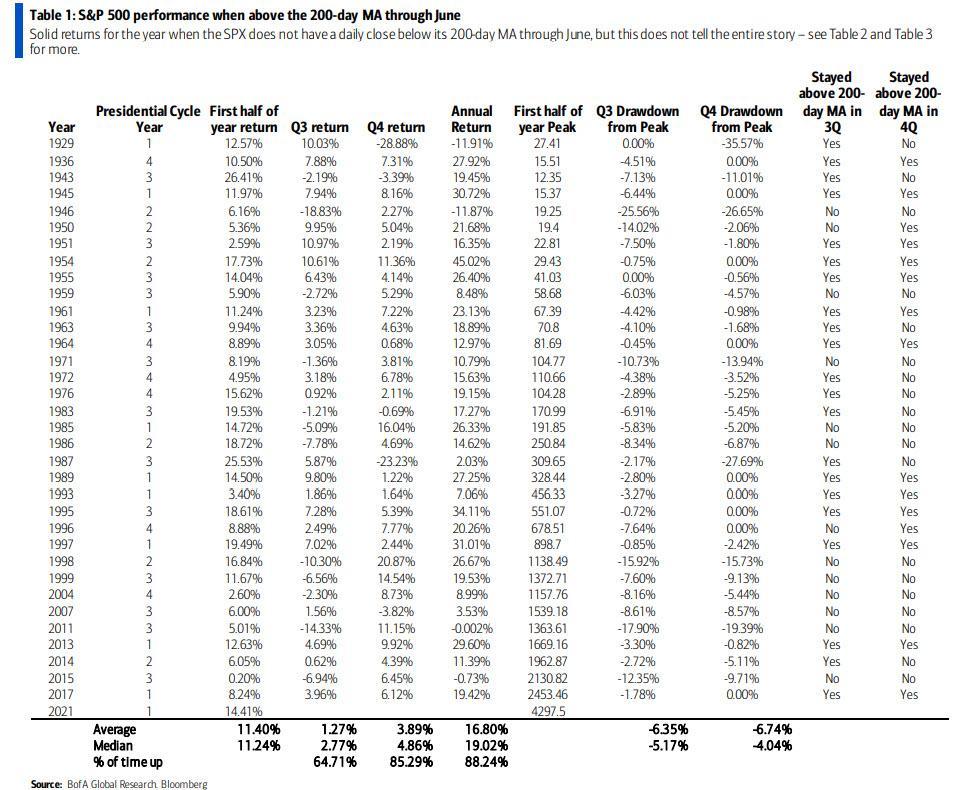
In a recent note from BofA (via Zerohedge):

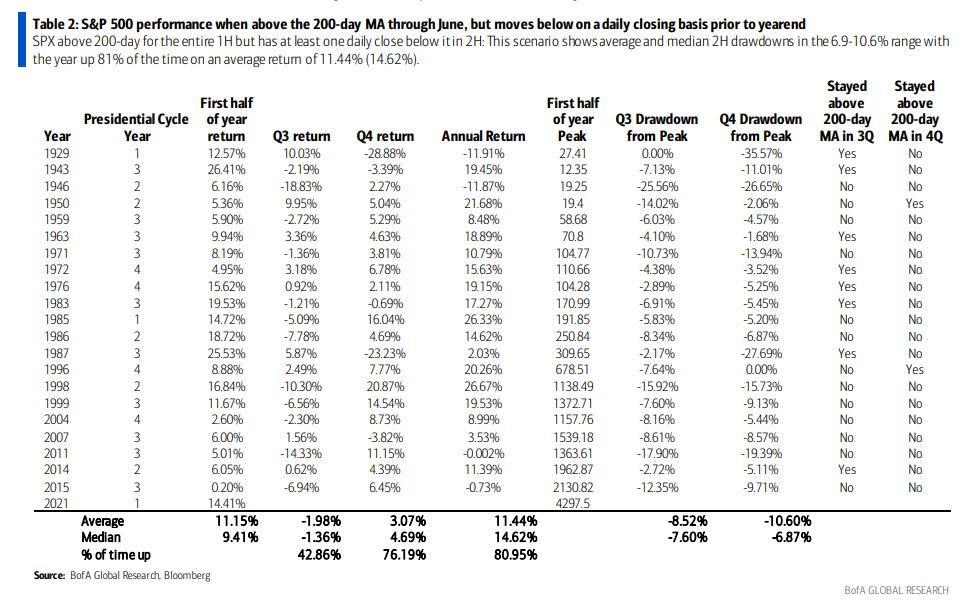
  • The SPX has not had a daily close below its 200-day moving average (MA) in 2021. This has happened through June in 35 out of 93 years (38% of the time) from 1929-2021. For years the SPX did not close below its 200-day MA through June, the average first half (1H) return is 11.40% (11.24%). That extends to an average annual return of 16.80% (19.02% median). The SPX is up 88% of the time for the year in which that occurs. But, SPX above 200-day MA for entire year only occured 13 times

  • The SPX stayed above its 200-day MA for an entire calendar year only 13 times (14% of the time) going back to 1929. This means the SPX revisited its 200-day MA in the second half of the year in 21 out the 35 years in years where the SPX did not close below its 200-day in the first half.

Coming In The Second Half?

  • SPX more likely to test its 200-day MA in 2H 2021. History reveals it is difficult for the SPX to stay above its 200-day MA for an entire calendar year. This scenario shows average and median 2H drawdowns in the 6.9-10.6% range. However, the year remains up 81% of the time on an average return of 11.44% (14.62%). Such means the SPX could end 2021 near current levels if a move below the 200-day MA occurs.

As BofA concludes:

“If the SPX stays above its 200-day, 2021 would mark the 14th year it did so since 1929.

In other words, it is possible the S&P could remain above the 200-dma for the rest of the year. The visualization of such deviations suggests an elevated risk it won’t.

The Fly In The Ointment

As we have discussed over the last couple of weeks, the biggest single risk to the market currently is the Fed. As noted in “Awaiting The Fed:”

“Jerome Powell has already set the table for tapering bond purchases by noting ‘substantial progress’ towards the Fed’s goal of full employment and price stability. The July jobs report, on the surface, was robust, providing that evidence.

We think the Fed may openly discuss the issue of reducing its monetary support at the upcoming ‘Jackson Hole Summit.’ Such could even include a general timeline to the reduction process in an attempt to maintain market stability.”

Our view was supported by  Raghuram Rajan for Project Syndicate

Fed Chair Jerome Powell’s announcement last week that the economy had made progress toward the point where the Fed might end its $120 billion monthly bond-buying program was good news. Phasing out quantitative easing (QE) is the first step toward monetary-policy normalization, which itself is necessary to alleviate the pressure on asset managers to produce impossible returns in a low-yield environment.”

The Biggest Risk

The biggest risk for the financial markets remains the contraction of liquidity fueling the rise in asset prices. Given the economy is already slowing, as forecasted by falling yields and flattening yield curve, the overly bullish, extended, deviated, and overvaluation of markets is problematic.

Investors are currently highly leveraged and over-allocated to equity risk. The low volatility regime of markets has given rise to more extreme levels of complacency which will fuel a “rush for the exits” when something breaks.

For investors, pay attention to 50-dma. If it is violated with conviction, a test of the 200-dma will not be far behind.

As Jason Zweig previously penned:

Where ignorance is bliss, ‘tis folly to be wise,” wrote the British poet Thomas Gray. One of these days, perhaps sooner rather than later, stocks will stop going up. The importance of understanding what you own will reassert itself. For the time being, though, investors who used to think of themselves as wise may continue to look foolish.”

Tyler Durden
Tue, 08/10/2021 – 10:30

via ZeroHedge News https://ift.tt/3xza3ju Tyler Durden

SoftBank Disappoints As Masa Refuses To Commit To More Buybacks After Lackluster Earnings

SoftBank Disappoints As Masa Refuses To Commit To More Buybacks After Lackluster Earnings

Yesterday, as SoftBank’s quarterly earnings report looming on the horizon, the FT published a deeply reported story in which a handful of SoftBank insiders sounded the alarm about the company playing fast and loose with its investments, and its handling of compliance-related issues. With the firm reeling from the blowup in Chinese stocks (it owns a massive stake in Alibaba, and has invested in Didi and other publicly traded Chinese firms, expectations for Tuesday’s earnings were low to begin with. Yet, the firm still managed to disappoint.

SoftBank reported a 39% decline in Q1 net profit. The decline was due in large part to the absence of the one-off profits from the merger of Spring and T-Mobile, which was a major boon for SoftBank. Despite several notable disasters, both Vision Funds managed to record profits for the quarter.

Regarding China, Vision Fund CFO Navneet Govil said “our broader thesis in China is unchanged: It’s still a large, growing and compelling economic opportunity.”

But China wasn’t the only driver of SoftBank’s investment losses: a 20% drop in the value of South Korean e-commerce giant Coupang resulted in more than $4 billion of losses for Vision Fund II this quarter.

To be sure, the firm’s quarterly profit would have been erased if the results of China’s crackdown on Didi had been factored into the quarterly earnings. The crackdown started just days after the quarter ended. One analyst pointed to this concentration in bets as a major hurdle for SoftBank long term.

“The problem with the Vision Fund SoftBank is that their largest investments so far have been middling to poor – WeWork, Uber, Didi,” Boodry said. “Those three alone are a quarter of the fund. That’s a huge performance hurdle for the rest of the fund to overcome.”

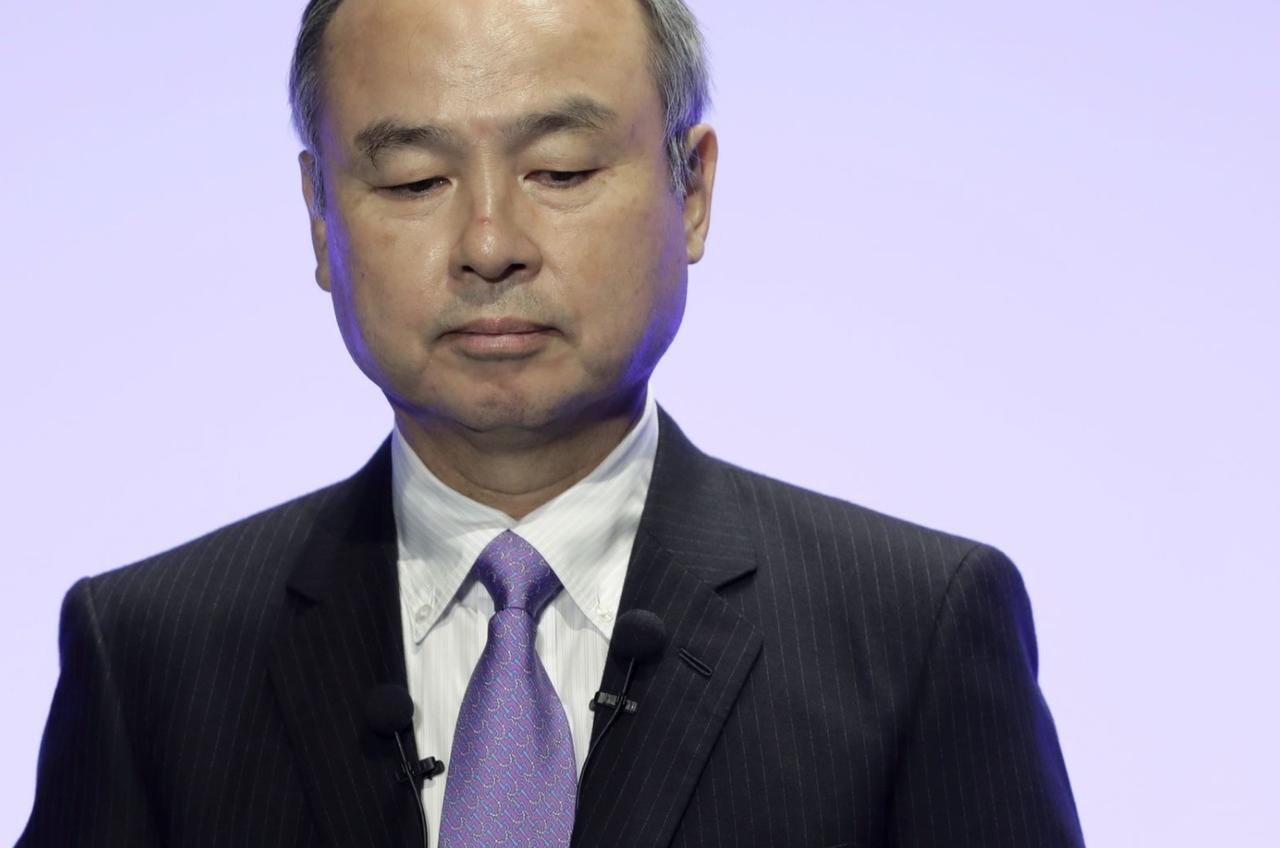
SoftBank chairman Masayoshi Son also appeared to confirm criticisms that SoftBank cut too many compliance and regulatory corners by announcing that he would pour billions of dollars of his own wealth into SoftBank’s Vision Fund II (which is already 100% comprised of SoftBank money), despite concerns about potential conflicts. 

Son can invest up to $2.6 billion and will own 17.25% of the equity. He will have a similar arrangement with SoftBank’s Latin America fund.

Asked about the firm’s outlook on China following the government crackdown, Masa said that SoftBank would halt its investments in China while it waits to see how the regulatory situation plays out. Ultimately, Masa expects everything will clear up after a year or two.

“Until the situation is clearer we want to wait and see,” Son said. “In a year or two I believe new rules will create a new situation.”

Given the firm’s reliance on its portfolio of investments, SoftBank’s earnings are often volatile quarter to quarter. During the fiscal year that ended in March, the firm reported the largest annual net profit of any Japanese company.

But the biggest disappointment for SoftBank shareholders (who have watched the value of their SoftBank shares decline by nearly 30% since the start of the year) was the fact that Masa refused to commit to more share buybacks.

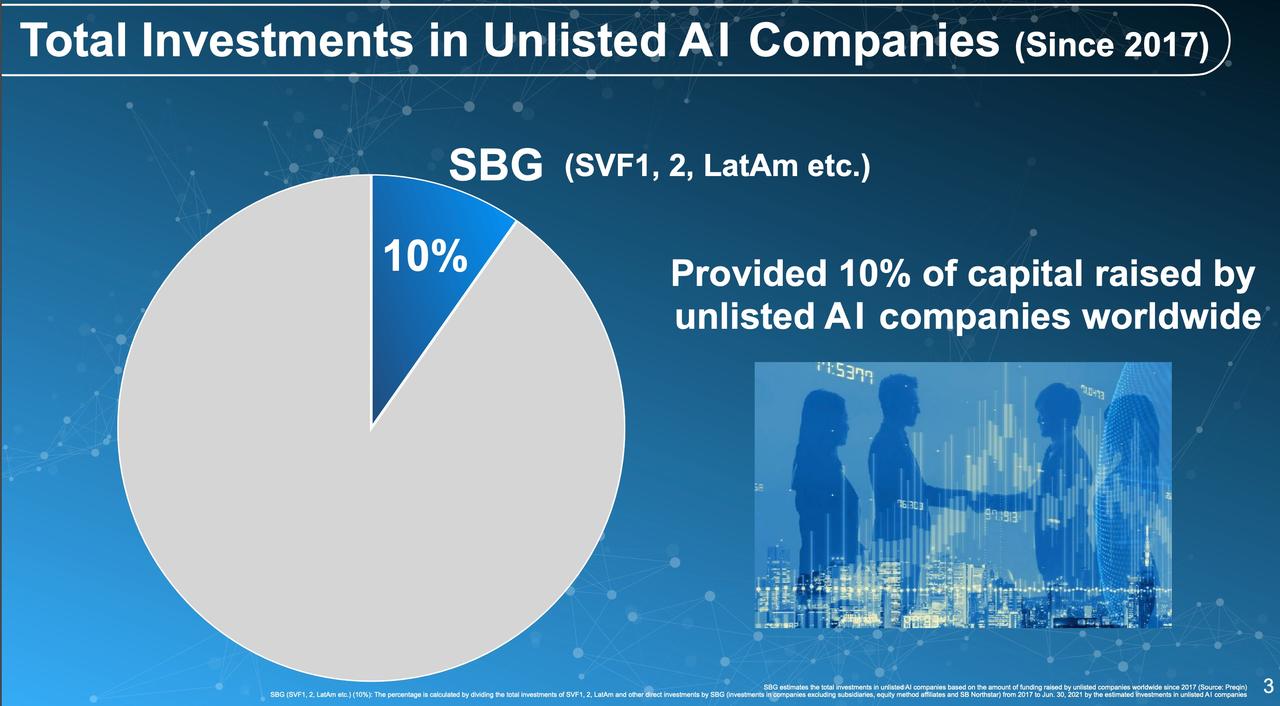
During the post-earnings press briefing, Son declared SoftBank the world’s “top investor in artificial intelligence” accounting for 10% of the capital in unlisted AI startups. The investors in second- or third-place don’t even come close.

Masa has repeatedly warned that the “AI revolution” is coming, and that SoftBank is poised to take advantage of this phenomenon.

“If AI fails, SoftBank would fail, that’s a risk,” Son said.

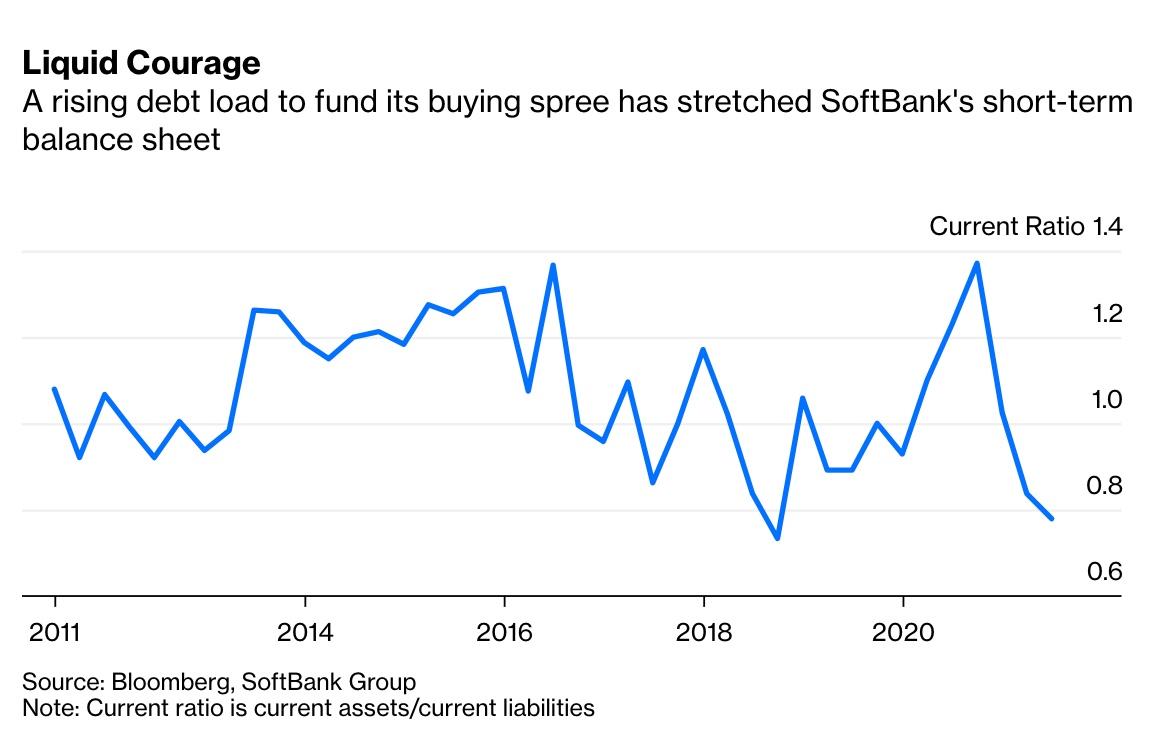
Another alarming detail from the quarterly earnings was SoftBank’s current ratio, a measurement of a firm’s current assets divided by current liabilities. A number less than one means more debts are coming due than there is liquid cash available to pay them. Because of this, the Bloomberg columnist warned that SoftBank needs to “stop buying and start selling.”

Source: Bloomberg

But with Masa now injecting billions of dollars of his own money (his own fortune has been leveraged against the value of his SoftBank shares, creating the potential for a damaging negative feedback loop if the firm’s share price continues to sink) into VFII, signaling that more dealmaking will likely follow.

Tyler Durden
Tue, 08/10/2021 – 10:15

via ZeroHedge News https://ift.tt/3CzwRTR Tyler Durden

Bipartisan Infrastructure Deal Set To Pass Senate In Tuesday Vote, Here’s What’s In It

Bipartisan Infrastructure Deal Set To Pass Senate In Tuesday Vote, Here’s What’s In It

After 50 hours of congressional debate over a 2,700 page, $1.2 trillion infrastructure bill, the US Senate is expected to pass the “once-in-a-generation” legislation, before it’s kicked back to the House of Representatives – where Speaker Nancy Pelosi (D-CA), has vowed to shelve it until the Senate also passes a separate $3.5 trillion partisan budget.

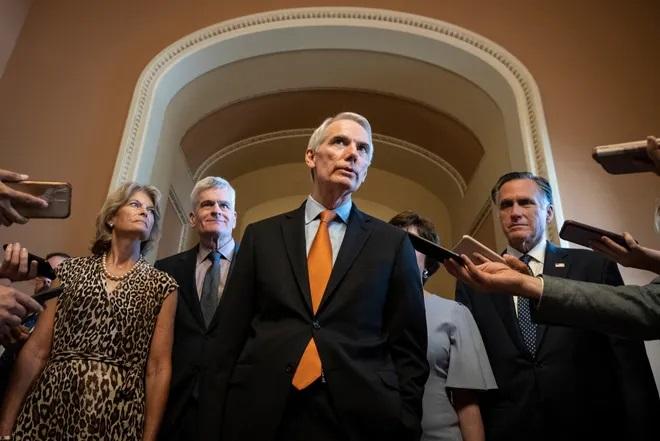
Lead GOP negotiators, Sens. Lisa Murkowski, Bill Cassidy, Rob Portman, Susan Collins and Mitt Romney

The infrastructure bill includes $550 billion in direct federal spending on a range pf projects, while reauthorizing spending on existing federal public-works programs. Breaking it down, the new spending includes just $110 billion for traditional ‘infrastructure,’ – meaning roads, bridges, and major projects. According to the White House, 20% of major highways and roads need repair, along with 45,000 bridges which are considered to be in poor condition. $55 billion of that will go towards water infrastructure.

$66 billion for trains – which will be used to upgrade passenger and freight rail, along with grants for intercity and high-speed train services.

$65 billion will go towards high-speed internet to millions living in rural and low-income communities. Companies which receive government funding as part of this allocation will be required to provide lower-priced plans, as well as allow customers to compare costs.

$73 billion for clean energy – which is far less than the Biden administration’s $100 billion goal. It will allocate billions towards new power transmission lines with higher-voltage capacities, as well as measures to electrify public transportation and $7.5 billion to build more electric car chargers (largely powered by coal). $21 billion will go towards ‘cleaning up soil and groundwater’ in older mines and gas fields.

Lawmakers are of course patting themselves on the back for their ability to come to an agreement, after nearly 70 senators from both parties voted to advance the measure over the weekend towards today’s final vote, scheduled for 11 a.m. And despite criticism from former President Trump, Republican bigwigs – including Senate Minority Leader Mitch McConnell (R-KY), are on board.

“It’s an issue where traditionally Republicans and Democrats have been able to come together and say, ‘We may disagree on taxes and healthcare and all sorts of other things, but on this issue of having strong infrastructure, we can come together,’” said Sen. Rob Portman (R-OH), the GOP’s lead negotiator on the deal.

“This bill will rebuild crumbling roads and bridges and tunnels across the country, it will provide clean drinking water in American homes and address harmful contaminants, it will increase connectivity in our communities to bring broadband to even the most rural parts of our country,” said Sen. Jeanne Shaheen, one of the architects of the plan.

Not everyone’s a fan

As soon as the $1.2 trillion plan clears the Senate, Democrats are expected to immediately take up a $3.5 trillion partisan budget – which, as long as all Democrats (including moderates Manchin and Sinema) agree, can be passed via a fast-track budget reconciliation process that doesn’t require Republican support.

Critics, including Sen. Marsha Blackburn (R-TN) and Senate Candidate J.D. Vance have slammed the legislation as a “gateway to socialism” and a “disaster for our country.”

Meanwhile, the infrastructure bill will give a minimal boost to the US economy, according to leading economists cited by the Wall Street Journal

The bipartisan infrastructure bill is unlikely to have a big impact on growth in the next few years, economists say. Longer term, though, investments in highways, ports and broadband could make the economy more efficient and productive.

The short-term boost to growth will be relatively limited for two reasons, economists say. For one, the bill represents just $550 billion in new spending—compared with nearly $6 trillion that Congress has approved in the past year-and-a-half to battle the Covid-19 pandemic and its economic fallout.

Second, the infrastructure spending will take place over five to 10 years starting in 2022, a longer timeline than pandemic-era initiatives like stimulus checks, extra unemployment benefits and small-business support programs. That will make its direct effects on employment and demand less noticeable.

Alec Phillips, chief political economist for Goldman Sachs Research, said the infrastructure bill could add around 0.2 percentage point to gross domestic product growth next year, and 0.3 percentage point in 2023.

What’s more, the infrastructure bill includes a pilot program for a national miles-driven tax, contradicting previous comments by President Biden that it wasn’t on the table, according to the Washington Times.

Tucked within the 2,702-page infrastructure bill is obscure language requiring the Department of Transportation to test the feasibility of taxing drivers for the number of miles they travel.

The tax would be broad enough to target any “passenger motor vehicles,” including light and medium-to-heavy duty trucks.”

The bill also requires Treasury Secretary Janet Yellen and Transportation Secretary Pete Buttigieg (or their successors) to report to Congress about the findings of the program within three years of its creation.

Sen. Chuck Grassley (R-IA), however, was quick to note on Tuesday morning that there is ‘no mileage tax or amnesty’ in the infrastructure bill.

Right Chuck, that comes next. 

Tyler Durden
Tue, 08/10/2021 – 09:55

via ZeroHedge News https://ift.tt/3jzWPxG Tyler Durden

Failing Conventionally

Failing Conventionally

By Michael Every of Rabobank

Failing Conventionally

85 years ago, the economist Keynes noted cynically in The General Theory of Employment, Interest, and Money that:

“It is the long-term investor, he who most promotes the public interest, who will in practice come in for most criticism, wherever investment funds are managed by committees or boards or banks. For it is in the essence of his behaviour that he should be eccentric, unconventional and rash in the eyes of average opinion. If he is successful, that will only confirm the general belief in his rashness; and if in the short run he is unsuccessful, which is very likely, he will not receive much mercy. Worldly wisdom teaches that it is better for reputation to fail conventionally than to succeed unconventionally.

In other words, it’s better not to deviate from the market consensus or benchmark, even if that consensus or benchmark is wrong, because even if everything then goes wrong, at least you can say that *you* were not to blame individually – “the market” was.

85 years later, with advances in technology, society, and political geography few would have believed possible, what has changed in that investment mentality? In an age that champions diversity, do we have any greater freedom to take strong off-benchmark/consensus views, or do we still herd towards them regardless of knowing that a series of exculpatory individual “Whocouldanooed?”s after a crash does not compensate for the damage done by everyone being collectively wrong? Sadly, it’s a timeless question, but one prompted in particular by headlines today.

We have Carson Block, the CIO of Muddy Waters Capital, quoted on Bloomberg saying: I think that investors for the past decade were basically pulling the wool over their own eyes on the capriciousness of the policy environment in China. So that’s coming home now to bite a number of investors. But it’s just one of many risks that you really need to take into account but investors have not.” I won’t dive into any more of Das Kapital today in response.

A step up in importance on the “Whocouldanooed?” scale is Covid-19. 18 months ago, risk-reward/fat-tail-risk thinkers were screaming at TV screens in frustration listening to the WHO tell us patiently this wasn’t a pandemic, and global travel should continue as normal “because markets”; and today the strategy is ‘vaccines (or bust)’ in developed economies – with no focus on the fat-tail bust part. By contrast, China is taking a hardline zero Covid stance. Indeed, yesterday three Chinese research groups released a report titled “America Ranked First?! The Truth about America’s Fight against Covid-19”, which: vilifies Bloomberg’s ranking of the US as #1 in the Covid Resilience Ranking; describes the US Covid objective as to “save the stock market, not to save lives”; and states “The freedom of movement and ‘normal functioning’ of society advocated by Bloomberg’s rankings are not about the safety of the American people. They are only about the need for the free flow of capital, and the desire for excessive profits.” So somebody else brought up Das Kapital for me! This underlines the broader Bloomberg point when it writes “China’s Covid-Zero Strategy Risks Leaving It Isolated for Years.” Have investors got enough wool left if so?   

But far more existentially on the “Whocouldanooed?” scale, we have a story summarised by The Guardian as: “Major climate changes inevitable and irreversible – IPCC’s starkest warning yet” In short, the climate gurus say human activity is changing the Earth’s climate in “unprecedented” ways, with some shifts now inevitable and “irreversible”; and within the next two decades, global temperatures are likely to rise by more than the 1.5C above pre-industrial level 2015 Paris climate agreement red line, bringing “widespread devastation and extreme weather”. Specifically, the IPCC states the 1.5C level is very likely to be exceeded under a sustained very high Green House Gas (GHG) emission scenario; likely to be exceeded if GHG emissions are intermediate to high; more likely than not to be exceeded if GHG emissions are low; and still more likely than not to be reached and briefly exceeded even if GHG emissions are very low, with only a hope that temperatures might dip slightly lower again by the end of this century.

In short, the IPCC says the mildest end of the worst-case climate scenario spectrum is now a given, meaning life-changing shifts for many of us, unless we see the kind of GHG emission falls experienced during the height of Covid lockdowns,…also meaning truly life-changing shifts for many of us. Imagine the implied shifts required not just in technology, but in the pattern and price of ‘allowable’ green activity, and if/how markets, or governments, make those choices. In the meanwhile, we are doing all we can to re-open from Covid as quickly as possible, pushing up GHG emissions again,…while saying Build Back Better a lot.  

One can understand how energizing –and polarizing– this debate is. We also need to see how a risk/reward framework of thinking about what to do cannot produce an answer without massive structural changes one way or the other – but against a backdrop in which markets aim to just keep on “failing conventionally.”

Underlining the issue perfectly, the collective financial and intellectual might of Bloomberg goes with the morning headline of “HEATING UP” today – but it is talking about Bostic and Rosegren of the Fed calling for QE tapering to start as soon as September. The IPCC story implying a more than 50-50 probability of life on earth as we understand it today changing irrevocably for the worst gets second billing. “Because markets.” Because $120bn a month…for now.

Again, this is not to focus on the details of the climate issue specifically – we have huge, unresolved structural issues all over, as I have pointed out in the last few Dailies. It is instead to underline that too much conventional thinking on all sides fails collectively too much of the time.

Markets will ultimately have to catch up to that failure one way or another: only some parts are already starting to. In the meantime, collectively-failing conventional traders are focused on US CPI tomorrow, US fiscal stimulus on infrastructure as soon as today(?),…and perhaps the crypto-controlling measures attached to it.

Does anyone have any spare wool?

Tyler Durden
Tue, 08/10/2021 – 09:43

via ZeroHedge News https://ift.tt/2VzJgGT Tyler Durden

Maskless Rashida Tlaib Parties At Crowded Wedding On Same Day She Slammed Sen. Rand Paul Over Virus Concerns

Maskless Rashida Tlaib Parties At Crowded Wedding On Same Day She Slammed Sen. Rand Paul Over Virus Concerns

A maskless Rep. Rashida Tlaib was the star of a wedding on Sunday this weekend in a Covid “orange” zone – on the same day she called out Senator Rand Paul for not doing enough to combat the virus.

In what is another unsurprising instance of complete and total liberal hypocrisy when it comes to the pandemic, Tlaib was captured on the Instagram story of Bassam Saleh, a Dearborn, Michigan band that plays weddings, Fox News reported.

The location of the wedding was tagged at Ford Community & Performing Arts Center, a venue in Dearborn, Michigan. That venue is located in Wayne County, which Fox notes is a “orange” zone, meaning that it has “substantial” Covid transmission. 

On the very same day the video was taken, Tlaib railed against Senator Rand Paul for not doing enough to protect his constituents from the virus, stating: “The KY Senator is throwing a tantrum as his state is being swallowed whole by this virus, again. People are getting sick and dying 98 counties in Kentucky have a high incidence rate of COVID-19. He needs to put politics aside, and put people first. Start resisting the virus.”

It is yet another instance of “do as I say, not as I do” by the very same government officials who feel just fine and dandy absconding with your civil rights while they do anything and everything they want. 

While the left continues to rail on the narrative of wearing masks, locking down and distancing, their actions this summer have revealed the obvious belief that they are above the rules made for the rest of us peons – and that maybe the virus isn’t something to be deathly afraid of (despite what the media tells us), after all. 

Tyler Durden
Tue, 08/10/2021 – 09:20

via ZeroHedge News https://ift.tt/3fSggRk Tyler Durden

Watch: French Police Patrol Cafés Asking To See Citizens’ Vaccine Papers

Watch: French Police Patrol Cafés Asking To See Citizens’ Vaccine Papers

Authored by Steve Watson via Summit News,

Video has emerged out of Paris, France, showing police patrolling cafes and bars demanding to see people’s credentials and making sure they are not breaking the law by enjoying themselves while unvaccinated.

Reuters reporter Antony Paone shared the video noting “The first checks of Police started as a preventive measure at Paris in cafes and restaurants where the Pass Sanitaire is mandatory as of today. Fines of 135 euros and verbal warnings from next week, up to 9,000 euros in the event of a repeat offense.”

Watch:

Other footage also emerged of private security, train staff and business owners checking the passes which confirm vaccination, a negative test, or (for the time being) recent recovery from the virus on people’s phones:

‘Proof of vaccination please.’

This is what a hi-tech dictatorship looks like in 2021.

And that is exactly why most cafes and restaurants in France currently look like this:

As we reported last month, French President Emmanuel Macron announced that those who don’t have a ‘Pass Sanitaire’ will be banned from participating in basic life activities such as visiting restaurants and using public transport.

The move quickly prompted citizens to take to the streets, with riot police called in to put the protests down:

The protests forced Macron to back down on imposing the mandatory vaccine passports for entry to shopping malls, but they are now in place for practically everywhere else.

As we previously documented, under the the draconian law, people in France who enter a bar or restaurant without a COVID pass face 6 months in jail, while business owners who fail to check their status face a 1 year prison sentence and a €45,000 fine.

Make no mistake, this tyranny is imminently coming to Britain, the U.S. and beyond unless people stand up en mass and reject it, and even then it may be too late.

*  *  *

Brand new merch now available! Get it at https://www.pjwshop.com/

In the age of mass Silicon Valley censorship It is crucial that we stay in touch. We need you to sign up for our free newsletter here. Support our sponsor – Turbo Force – a supercharged boost of clean energy without the comedown. Also, we urgently need your financial support here.

Tyler Durden
Tue, 08/10/2021 – 09:00

via ZeroHedge News https://ift.tt/3ixCKsM Tyler Durden

90% Of Patients Treated With Experimental Israeli COVID Drug Discharged Within 5 Days

90% Of Patients Treated With Experimental Israeli COVID Drug Discharged Within 5 Days

Finally, it looks like the world might be on the verge of obtaining a therapeutic drug that’s actually effective at helping patients infected with COVID. But you probably won’t hear anything about this latest breakthrough from the American media, which covered the race for a vaccine with breathless enthusiasm.

According to a report in the Jerusalem Post, some 93% of 90 seriously ill coronavirus patients treated in several Greek hospitals with a new drug developed by a team at Tel Aviv’s Sourasky Medical Center were discharged in five days or fewer during the Phase II trial of the new therapeutic.

The Phase II trial confirmed the results of Phase I, which was conducted in Israel last winter. That trial found that 29 out of 30 patients in moderate to serious condition recover within days, while no cases of serious side effects have yet been detected.

“The main goal of this study was to verify that the drug is safe,” Prof. Nadir Arber said. “To this day we have not registered any significant side effect in any patient from both groups.”

The trial was conducted in Athens because Israel didn’t have enough sick patients. The principal investigator was identified as Greece’s coronavirus commissioner, Prof. Sotiris Tsiodras.

Arber and his team developed the drug around amolecule that the professor has been studying for 25 years called CD24, which is naturally present in the body.

“It is important to remember that 19 out of 20 COVID-19 patients do not need any therapy,” Arber said. “After a window of five to 12 days, some 5% of the patients start to deteriorate.”

By now, even lay people may understand that the reason COVID patients deteriorate is due to a natural bodily reaction to something called the cytokine storm. The cytokine storm occurs because the body’s immune system goes ballistic. In many cases, the reaction actually contributes to the death or serious illness of the patient. The new therapeutic works by suppressing this reaction using the CD24 protein.

“This is precision medicine,” he said. “We are very happy that we have found a tool to tackle the physiology of the disease.”

“Steroids for example shut down the entire immune system,” he further explained. “We are balancing the part responsible for the cytokine storms using the endogenous mechanism of the body, meaning tools offered by the body itself.”

The scientists are preparing to begin the Phase 3 trial, which they hope to complete by the end of the year. That probably couldn’t happen quickly enough, since the world is already waking up to the fact that the vaccines originally marketed as more than 90% effective are actually helping the virus to mutate into more virulent strains.

Tyler Durden
Tue, 08/10/2021 – 08:40

via ZeroHedge News https://ift.tt/3AoL1VO Tyler Durden

Investigating Missing Details In the Democrat’s $3.5 Trillion Anti-Poverty, Climate Plan

Investigating Missing Details In the Democrat’s $3.5 Trillion Anti-Poverty, Climate Plan

Authored by Mike Shedlock via MishTalk.com,

Let’s go over the nebulous details of the $3.5 trillion Democrat plan for America.

What’s in the Plan?

  • $726 billion for the Health, Labor, Education and Pensions Committee with expansive instructions to address some of Democrats’ top priorities. Those areas include universal pre-K for 3- and 4-year-olds, child care for working families, tuition-free community college, funding for historically black colleges and universities and an expansion of the Pell Grant for higher education.

  • $107 billion for the Judiciary Committee, including instructions to address “lawful permanent status for qualified immigrants.”

  • $135 billion for the Committee on Agriculture Nutrition and Forestry, including instructions to address forest fires, reduce carbon emissions and address drought concerns.

  • $332 billion for the Banking Committee, including instructions to invest in public housing, the Housing Trust Fund, housing affordability and equity and community land trusts.

  • $198 billion for the Energy and Natural Resources Committee, including instructions largely related to clean energy development.

Largely a Mystery 

The above details are from the NPR post Senate Democrats Roll Child Care And Immigration Into A $3.5T Budget Framework dated today

I total the above items as $1.498 trillion. Where’s the other $2.002 trillion hiding?

The WSJ reports Senate Democrats Outline $3.5 Trillion Antipoverty, Climate Plan

Senate Democrats released an outline of the $3.5 trillion antipoverty and climate plan they hope to approve this fall, further detailing their ambitions for the major legislative effort that they intend to approve without Republican support.

The plan, which is set to offer universal prekindergarten, two free years of community college, and expanded Medicare to cover hearing, dental and vision care, is the second of two major packages encapsulating President Biden’s agenda that lawmakers are pushing through Congress this year. The first, the roughly $1 trillion infrastructure plan, is nearing final passage in the Senate.

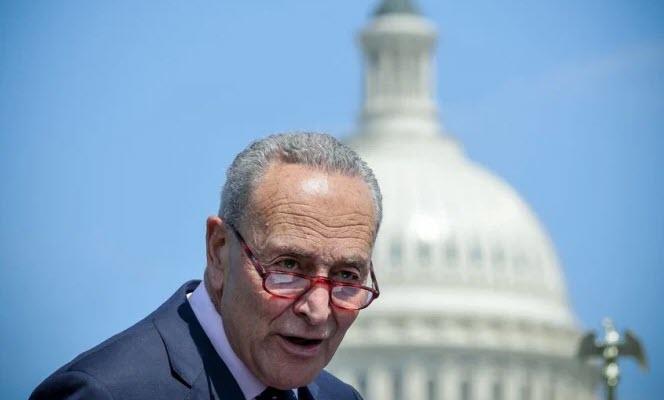
Democrats are planning to raise taxes on corporations and high-income households to cover the cost of the $3.5 trillion plan, which also calls for a federal paid leave benefit, a series of energy tax incentives, and a program to push the U.S. to receive 80% of its electricity from clean sources by 2030. The plan outlined by Senate Majority Leader Chuck Schumer (D., N.Y.) on Monday also includes offering a pathway to lawful permanent status for certain migrants to the U.S. and lowering the price of prescription drugs

The legislation could “give tens of millions of families a leg up,” Mr. Schumer wrote in a letter to Senate Democrats Monday morning.

If you click on the first link it takes you an article written July 14. The “Plan” is a link to a $1.8 trillion package proposed on April 28.

Where’s the Outline? 

Supposedly, there’s an outline. But I cannot find it. It seems we have no more details today than we had on April 28.

The WSJ does have what’s NOT in the outline.

The outline doesn’t include a measure to increase the U.S. government’s borrowing limit, indicating that Democrats will seek to raise the debt ceiling with GOP support in the coming weeks. Treasury Secretary Janet Yellen said Monday that Congress should raise the debt limit on a bipartisan basis.

Approval of the Outline

We don’t really have an outline but we do have procedures for approving it.

Mr. Schumer wrote in the letter to Senate Democrats that the Senate will take up the budget plan for the bill, a key first step toward crafting the overall package, after the Senate wraps up the $1 trillion bipartisan infrastructure bill. Mr. Schumer has said that the Senate won’t break for its August recess until it has passed both the infrastructure plan and the budget outline for the $3.5 trillion plan.

Approving the outline for the bill, called a budget resolution, will help unlock a special process called reconciliation that will allow Democrats to advance the broad set of party priorities without any Republican support in the Senate. Mr. Schumer set a target of Sept. 15 for committees to submit their pieces of the legislation.

While all 50 Senate Democrats have rallied around approving the budget resolution, achieving unanimity on the legislation itself will be a more complicated political task. Some moderate Democrats have raised concerns about both the potential cost of the legislation and the tax increases proposed to pay for it. Sen. Kyrsten Sinema (D., Ariz.) said last month that she opposed a bill that costs $3.5 trillion.

Even Price is a Mystery

I originally titled titled this post “The $3.5 Trillion Antipoverty, Climate Plan is a Mystery, Except for the Price

All we really have is a bunch of floating ideas with no real outline that anyone can produce. 

The floating ideas are coupled with dissent from two key Democrats as to how much they are willing to pay.

The dissent over price actually means that everything is a mystery. Meanwhile progressives push for energy import taxes to make the US 80% clean energy by 2030.

I propose that item would create instant stagflation if it somehow passes.

AOC Goes After Senator Krysten Sinema With a “No Climate, No Deal” Threat

Both AOC and Speaker Nancy Pelosi said the infrastructure bill will not pass stand alone. In addition, AOC threatened to kill the whole thing over climate. 

For details, please see AOC Goes After Senator Krysten Sinema With a “No Climate, No Deal” Threat

On August 5, I  noted Senator Manchin Urges Fed to Immediately Taper to Halt Inflation and Avoid Tax Hikes

Manchin is concerned about inflation. The above article is in reference to the Fed, but he has also expressed concerns over the pricetag.

Written vs Verbal Outline

All 50 Democrats have to agree to anything to produce a deal. Perhaps this explains why everyone seems to think there is an outline but no one can actually point to it.

And while the Senate is struggling to come up with a written outline, Nancy Pelosi and the House is on a 7-Week Break.

My July 26 post still stands, The Stagflation Threat is Very Real but Congress Holds the Key. And It’s as current as the nebulous outline no one can seem to produce.

Tyler Durden
Tue, 08/10/2021 – 08:21

via ZeroHedge News https://ift.tt/3s3uhAJ Tyler Durden

Local Sales Of China-Made Teslas Collapse In July

Local Sales Of China-Made Teslas Collapse In July

Following months of uncertainty regarding Tesla’s relationship with the CCP, things still look to be a little shaky in Asia for the automaker.

This morning it was reported that Tesla sold 32,968 China-made vehicles – this includes vehicles sold in China and vehicles exported – according to the China Passenger Car Association (CPCA). This was below the 33,155 vehicles sold in June; a number that we pointed out could have been a sign that the ship had steadied between Tesla and China – and that demand was once again rising.

But July’s numbers seem to indicate little, if any, growth in demand between June and July. 

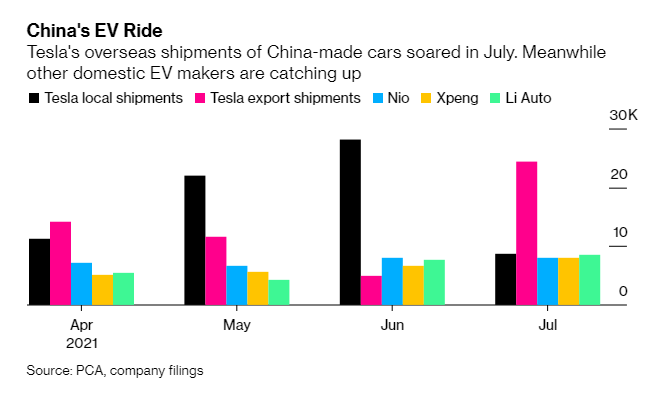
Shipments of locally made vehicles sold in China plunged, to 8.621 cars from 28,138 in June. There is generally cyclicality for automaker sales wherein the beginning of a quarter (July) comes in markedly lower than the end of the previous quarter (June).

Source: BBG

PCA Secretary General Cui Dongshu said during a briefing Tuesday: “Tesla tends to be aggressive in exports regardless of the domestic market in July. The fact that Tesla’s domestic deliveries didn’t reach 10,000 is normal and fine.”

24,347 of the 32,968 cars made in China were manufactured for export. 

Tesla fell between BYD, who sold 50,387 China-made EVs and GM/SAIC, who sold 27.347 EVs.

While the numbers may appear to be “normal” on the surfact, it is hardly the robust vote of confidence that would have investors sleeping soundly assured that all is well and the China story is no longer going to be a factor.

Bernstein analysts led by Toni Sacconaghi said earlier this month, according to Bloomberg: “We think current demand for Tesla is fine in China, but that Tesla has over/forward built capacity relative to the U.S., which is triggering price cuts and exports. Domestic competition is likely to make it difficult to Tesla to fully capture its fair share or sustain similar levels of profitability.”

Tyler Durden
Tue, 08/10/2021 – 08:07

via ZeroHedge News https://ift.tt/3jBpZN4 Tyler Durden