Judges and Justices Should Be Independent, Trump Says, As Long As They Side With Him


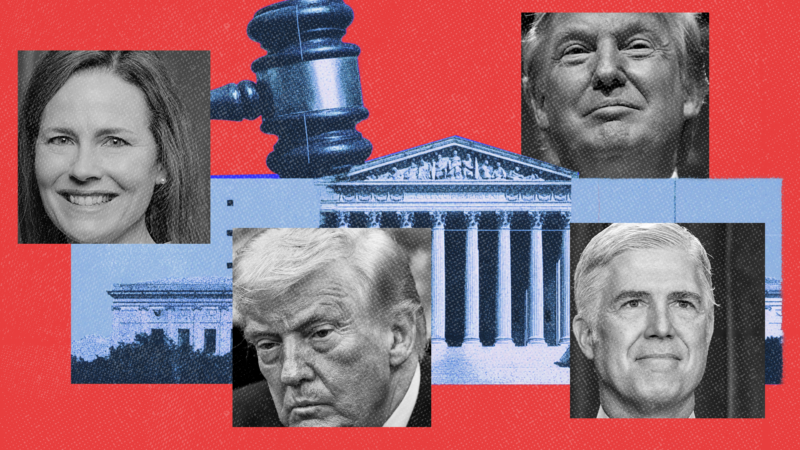
Photos of President Donald Trump, Justice Amy Coney Barrett, and Justice Neil Gorsuch against a backdrop of the Supreme Court building | Eric Lee/Zuma Press/Aaron Schwartz/CNP/Polaris/Newscom/Midjourney

This week President Donald Trump reiterated his complaints about federal judges who rule against him, laying into the justices who rejected his “emergency” tariffs last month and lower courts that have hindered him in one way or another. Unlike his previous tirades in this vein, his recent comments acknowledge that there is such a thing as judicial independence. But Trump made it clear that he values that quality only to the extent that it corresponds with his own interests.

“The Courts treat Republicans, and me, so unfairly, always seeming to protect those who should not be protected,” Trump whined in a Truth Social post on Sunday night. He cited a ruling by James Boasberg, chief judge of the U.S. District Court for the District of Columbia, who last week blocked grand jury subpoenas seeking evidence to support allegations that Federal Reserve Chairman Jerome Powell misused public funds while overseeing renovation of the central bank’s headquarters in Washington, D.C.

Trump has repeatedly criticized Powell’s policies and wants to replace him with a chairman who is more inclined to deliver the interest rate cuts he favors. But under federal law, the president can remove someone from the Federal Reserve’s Board of Governors only “for cause”—a constraint at the center of Trump v. Cook, a case that the Supreme Court is considering. Trump’s claims about the Federal Reserve renovation, which underlie the subpoenas that Boasberg quashed, seem to be aimed at meeting that standard.

“There is abundant evidence that the subpoenas’ dominant (if not sole) purpose is to harass and pressure Powell either to yield to the President or to resign and make way for a Fed Chair who will,” Boasberg wrote. “The Government has offered no evidence whatsoever that Powell committed any crime other than displeasing the President.”

With that ruling, Boasberg committed the same crime. “How is this absolutely terrible Federal Reserve Chairman, Jerome ‘Too Late’ Powell, not even allowed to be investigated for the horrible job he does?” Trump wondered. “How is he allowed to be Billions of Dollars over budget, and years behind schedule, on the simple renovation of the small Federal Reserve Complex in Washington, D.C., where he created an absolute disaster—a money pit, and embarrassment to our Country for the whole World to see!”

Contrary to Trump’s gloss, the project, which is supposed to be completed by the end of next year, is about $700 million over budget. The Federal Reserve attributes the overruns to several factors, including soil contamination, an asbestos removal challenge that was more extensive than anticipated, rising labor costs, and material expenses boosted by pandemic-related supply disruptions and Trump’s tariffs.

Whatever you make of that account, there is no evidence that the spending constitutes a crime, which is the point that Boasberg was making. And in criticizing the judge’s decision, Trump gave the game away by citing Powell’s “horrible performance” in setting interest rates, a policy critique that has nothing to do with a violation of any criminal law.

Boasberg, a Barack Obama appointee, has been a thorn in Trump’s side since last March, when he issued a temporary restraining order that blocked Trump’s attempt to summarily deport alleged members of the Venezuelan gang Tren de Aragua under the Alien Enemies Act (AEA). After that intervention, Trump condemned Boasberg as a “Radical Left Lunatic of a Judge, a troublemaker and agitator” who “should be IMPEACHED!!!”

Contrary to the charge that Boasberg had intervened purely for political or ideological reasons, Trump’s use of the AEA subsequently encountered resistance from the Supreme Court, a Trump-appointed judge in Texas, and the U.S. Court of Appeals for the 5th Circuit, which is not known for its radical left agitation. Trump nevertheless continues to portray Boasberg as “a Wacky, Nasty, Crooked, and totally Out of Control Judge” who “suffers from the highest level of Trump Derangement Syndrome” and “has been ‘after’ my people, and me, for years.”

Boasberg is “a disgrace” to “our Legal Process,” Trump said, because he “has displayed open, flagrant, and extreme partisan bias and contempt against Republicans and the Trump Administration. To preserve the integrity of the Judiciary, he should be removed from all cases pertaining to us, and suffer serious disciplinary action, as should numerous other Corrupt Judges that, unfortunately, our Country has had to endure! What Boasberg has done on the ‘Too Late’ Powell case, and many others, has little to do with the Law, and everything to do with Politics. He is exactly what Judges should not be!”

Judges, in other words, should be guided by the law and the facts, not by partisan  considerations. Except when that principle works against Trump.

Immediately after castigating Boasberg, Trump reiterated his disappointment with the Supreme Court’s February 20 decision in Learning Resources v. Trump, which rejected his claim of essentially unlimited tariff authority under the International Emergency Economic Powers Act (IEEPA). That “unfortunate and unwarranted TARIFF decision,” he said, epitomized “our Highly Politicized Court System.”

The logic here is hard to follow, so bear with me. In Learning Resources, the Supreme Court held that IEEPA does not authorize tariffs at all. The majority included Chief Justice John Roberts, a George W. Bush appointee, and two justices nominated by Trump himself: Neil Gorsuch and Amy Coney Barrett.

The day of that decision, Trump said Gorsuch and Barrett were “an embarrassment to their families” because they had revealed themselves as “fools and lapdogs for the RINOs and the radical-left Democrats.” Did it make sense to describe that decision, which hinged on statutory interpretation informed by the separation of powers, as a reflection of “radical-left” thinking? No, it did not. But as Trump saw it, Gorsuch and Barrett had clearly been “swayed by foreign interests and a political movement that is far smaller than people would ever think.”

Unlike Boasberg, Gorsuch and Barrett were not “Radical Left Lunatic[s]”—an epithet that reflects Trump’s habit of deploying wildly inaccurate ideological labels against people who irk him. Gorsuch and Barrett nevertheless were kowtowing to “radical-left Democrats.” But why would they do that?

Trump suggested an answer in another Truth Social post on Sunday, which he appended to his rant about Boasberg. Justices like Gorsuch and Barrett “go out of their way, with bad and wrongful rulings and intentions, to prove how ‘honest,’ ‘independent,’ and ‘legitimate’ they are,” he said. That seems like the opposite of a “Highly Politicized Court System,” since it means that justices are willing to rule against the president who appointed them if they think that is what the law requires. But in Trump’s view, that is exactly the problem.

In their eagerness to demonstrate their independence, Trump complained, such justices “openly disrespect the Presidents who nominate them.” Although “the Court knew where I stood” and “how badly I wanted this Victory for our Country,” Gorsuch and Barrett had the temerity to disagree with Trump’s highly dubious interpretation of IEEPA.

Democratic appointees are different in that respect, Trump said: “The Democrats on the Court always ‘stick together,’ no matter how strong a case is put before them.” Or as he put it the day of the tariff decision, those justices “will automatically vote no,” because “they’re against anything that makes America strong, healthy, and great again.” They are therefore a “disgrace to our nation,” since “they’re an automatic no, no matter how good a case you have.”And that is obviously bad, for the same reason it is bad when Democratic appointees on lower courts rule against Trump: According to him, they are making decisions based on their political allegiances rather than the merits of the case.

Trump, in short, thinks judges should not be guided by loyalty to the president who appointed them or his party, unless that president is Trump. The main point is that Trump should always win, which is a clear enough principle but not one that is consistent with the rule of law.

The post Judges and Justices Should Be Independent, Trump Says, As Long As They Side With Him appeared first on Reason.com.

from Latest – Reason.com https://ift.tt/QDfItGr
via IFTTT
Trump Just Released a Framework To Govern AI. Here Are 7 Key Takeaways.


Abstract illustration | Midjourney

Only weeks after designating Anthropic a supply chain risk, the Trump administration is returning to a pro-AI stance with Friday’s release of the National AI Legislative Framework. 

The framework, which was commissioned via executive order in December, includes seven pillars to advance American AI development. Here are some of the top takeaways:  

1. Clarifying Prohibited AI-Generated Content To Avoid Excessive Litigation

The first pillar directs Congress to build upon the bipartisan TAKE IT DOWN Act, which outlaws the nonconsensual online publication of intimate photos and videos, including those created with AI. While well-intentioned, Reason’s Elizabeth Nolan Brown has warned that it can be “easily wielded as a jawboning tool to get tech platforms to do an administration’s bidding.” At the same time, the administration cautions Congress against “ambiguous standards about permissible content” and “open-ended liability” to avoid excessive litigation. 

2. Enabling AI Data Centers To Provide Their Own Power 

The second pillar is a bit of a double-edged sword. On the one hand, it directs Congress to “ensure that residential ratepayers do not experience increased electricity costs” as a consequence of AI. On the other, it recommends streamlining federal permitting to allow AI developers to more easily deploy on-site power generation to avoid straining the grid. To this end, Sen. Tom Cotton (R–Ark.) introduced the DATA Act in January to exempt these electrical utilities from federal regulation.

3. Deferring to the Judiciary on Copyright 

In a remarkable degree of deference to the judicial branch, especially for the Trump administration, the framework recommends that Congress allow courts to sort out whether the training of AI models on copyrighted material violates copyright laws. (A federal judge recognized Anthropic’s right to train its large language models on lawfully acquired copyrighted materials last June.) It also recognizes the potential need for federal legislation on the unauthorized use of somebody’s likeness for commercial purposes, e.g., using an AI-generated avatar of a famous actor to promote a product without his permission, but says “Congress should prevent persons from abusing such a framework to stifle free speech online.” However, Sen. Chris Coons’ (D–Del.) bipartisan NO FAKES Act would do just that by holding platforms liable for hosting such replicas.  

4. Preventing Government Censorship

Surprisingly, given the administration’s demonstrated hostility to the First Amendment, the framework calls on Congress to empower “Americans to seek redress from the Federal Government for agency efforts to…dictate the information provided by an AI platform.” This is rather ironic, considering the administration’s recent attempt to compel certain outputs from Anthropic and then designating it a supply chain risk after it refused to do so. 

5. Preventing Regulatory Proliferation  

The framework requests that federal datasets be made AI-accessible “for industry and academia” (“the public” would suffice)—providing business and researchers access to a wealth of taxpayer-funded information that may be used to better understand and solve problems—and establishing regulatory sandboxes for AI experimentation. This section also requests that Congress “not create any new federal rulemaking body to regulate AI.” This recommendation contrasts with New York’s RAISE Act, signed into law by Democratic Gov. Kathy Hochul in December, which created the Office of AI Transparency within the Department of Financial Services to regulate large developers’ deployment of frontier AI models. 

6. Collecting Information on AI’s Labor Market Effects 

Recommends that Congress ensure existing education and workforce training programs “affirmatively incorporate AI training” through nonregulatory means. (Considering daily workplace use of AI has tripled since 2023, this is an obvious recommendation that hardly needs to be made.) It also suggests that Congress “expand Federal efforts to study trends in task-level workforce realignment.” While this is vague, such data could conceivably be leveraged to prohibit or penalize private companies for incorporating AI into their businesses, as one New York bill seeks to do. 

7. Preempting Onerous State Laws 

Perhaps the most important recommendation is for Congress to “preempt state AI laws that impose undue burdens to ensure a minimally burdensome national standard,” as President Donald Trump has sought to circuitously accomplish by conditioning certain federal broadband funding on the nonenforcement of onerous state AI laws and regulations via his December executive order. Specifically, such legislation should preempt state regulations concerning AI development; use of AI for otherwise lawful activities, effectively recognizing Americans’ right to compute (which a New Hampshire bill is seeking to achieve at the state level); and prohibit the penalization of AI developers for unlawful use by third parties. And to do all of these things while respecting “key principles of federalism” by not interfering with states’ police powers, zoning laws, or regulations on local government use of AI. 

Adam Thierer, senior fellow at the R Street Institute, regards Trump’s AI framework as evidence of the president’s “try-first” approach to AI policy, as opposed to the “regulate-first” vision described in Sen. Marsha Blackburn’s (R–Tenn.) TRUMP AMERICA AI Act. This bill, which includes the Kids Online Safety Act and the NO FAKES Act, would dramatically hinder AI development by imposing a punitive liability regime on AI developers and deployers. Neil Chilson, head of AI policy at the Abundance Institute, says the “serious framework” is “a clear continuation of Trump’s belief that America should lead in AI and that the way to do that is to remove barriers.” Both Thierer and Chilson say it’s time for Congress to act, and that’s just what it appears to be doing. 

Republican leaders in the House, including Speaker Mike Johnson (R–La.), released a statement shortly following the publication of the framework, saying that “House Republicans look forward to working across the aisle to enact a national framework that unleashes the full potential of AI, cements the U.S. as the global leader, and provides important protections for American families.” Given Democratic representatives’ denunciation of Trump’s AI Action Plan and Democratic senators’ opposition to the previously considered AI moratorium, Johnson’s statement may be more aspirational than realistic.

The post Trump Just Released a Framework To Govern AI. Here Are 7 Key Takeaways. appeared first on Reason.com.

from Latest – Reason.com https://ift.tt/84YwrRK
via IFTTT

Cesar Chavez’s Other Crimes


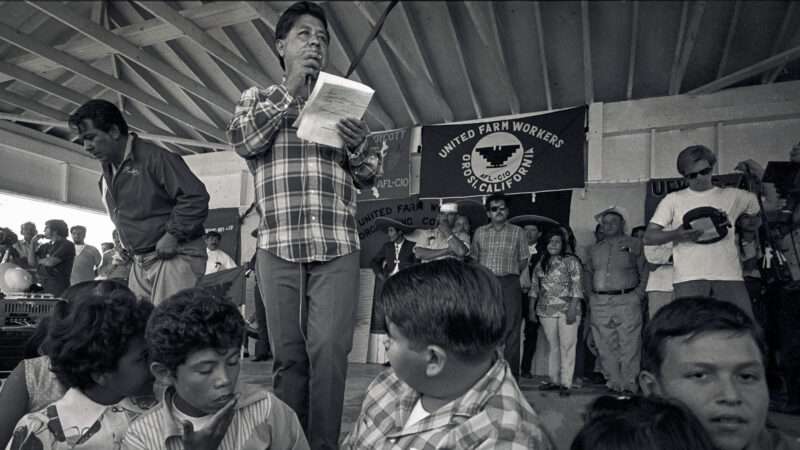
Cesar Chavez | Stephen Shames/Polaris/Newscom

Cesar Chavez (1927–1993), the California-based labor icon who helped create the United Farm Workers of America (UFM) and led high-profile boycotts against table grapes and iceberg lettuce, has been accused of rape and sexual abuse in a major New York Times investigation. Two women told the Times that Chavez “sexually abused them for years when they were girls, from around 1972 to 1977,” and 95-year-old Dolores Huerta, a co-founder of the UFW who had four children with Chavez’s brother Richard, issued a statement denouncing César, saying he “manipulated and pressured” her into having sex on two occasions, including one in which she “was forced, against my will, and in an environment where I felt trapped.” Both encounters, she says, resulted in children whose paternity was hidden and who were raised by “other families.”

The response to the allegations has been swift. The union he co-founded has announced it “will not be taking part in any Cesar Chavez Day activities,” a “federal commemorative holiday” proclaimed in 2014 and slated for March 31 this year. It is also creating an “external, confidential, independent channel for those who may have experienced harm caused by Cesar Chavez during the early days of the UFW’s history.” States such as California, which created its own Chavez holiday, are working to rename it, and colleges and communities featuring statues and buildings named after him are covering statues and discussing plans to remove references to him.

Cover of November 1979 issue of Reason

But long before this week’s disturbing allegations came to light, Reason investigated a “network of nonprofit, tax-exempt organizations set up and run by Chavez and other UFW officials” that managed to pull in millions of taxpayers while refusing virtually all requests for transparency and traditional accounting. The 1979 cover story “Who’s Bankrolling the UFW?” stood apart from the widespread canonization of Cesar Chavez as a secular saint whose supporters “fought tearfully through…crowds for a chance to shake his hand or just touch him on the shoulder.”

As Wikipedia notes, Chavez, born in Yuma, Arizona, “imbued his campaigns with Roman Catholic symbolism, including public processions, Masses, and fasts,” making it easy for supporters to conflate him with a religious figure with an unimpeachable moral life and agenda. He often invoked Gandhi as an inspiration, to great effect, especially among the media, which rarely dug into the way that Chavez actually ran things.

The same was true for politicians, including California Gov. Jerry Brown, who once studied to be a Jesuit priest and was running the state when Chavez and the UFW created an organization called the National Farmworker Service Center (NFSC) that received almost $2 million in federal grants. Brown, wrote Patty Newman for Reason, “waived his right as governor to see and sign federal grants to anyone in the state of California. Thus he gave to Chavez—the man who nominated Brown for president at the 1976 Democratic convention—carte blanche approval of anything requested.”

Digging into the NFSC’s activities, Newman found that the group’s credit union not only received a $349,115 taxpayer bailout but that it was gouging the very farm workers it supposedly existed to serve. “UFW’s Farmworker Credit Union charges borrowers, not one percent per annum, but one percent per month (12 percent per year),” wrote Newman. “And 12 percent is certainly no bargain for the farmworkers, especially when most credit unions have been charging between 9 and 10 percent.”

The Reason story led to national coverage of UFW- and Chavez-related activities, including a Chicago Tribune story that validated concerns that a federal grant was illegally being “used to build a microwave communications system to serve the union and another was being used to pay the salaries of union headquarters workers.” The Justice Department used the story to open an investigation into the UFW in 1981 as well.

By most accounts, membership in the UFW peaked at around 80,000 in the 1970s before starting a long and mostly uninterrupted decline to fewer than 5,000. Part of the decline was surely due to the sorts of taxpayer grifts described by Reason‘s Newman, which meant the union was spending less and less of its time on basic organizing and negotiating better conditions for its members. And why would workers want to be part of a group that not only charged them dues but charged higher-than-market interest rates?

But a big part of the decline in membership is surely attributable to Chavez’s imperious management style, which included more than financial impropriety and the newly revealed sexual improprieties. In a scorching 2009 review for the defunct Left Business Observer of a book called Beyond the Fields: César Chávez, the UFW, and Struggle for Justice in the 21st Century, economist Michael D. Yates writes that, “with the union’s successes, Chávez began to think of himself as a holy person, Christ-like and above reproach.” By the end of the 1970s, Chavez had become friendly with Charles Dederich, the controversial creator of the disreputable drug-rehab program Synanon, infamous for its use of a practice called “The Game,” where members were subjected to constant psychological abuse.

“César took to the ‘game’ like Stalin to the secret police, and he used it for the same purpose—to consolidate his power in the union,” wrote Yates. The UFW effectively became a cult of personality rather than an organization lobbying for better wages and conditions. Yates also has harsh words for Dolores Huerta. “Huerta has never repudiated Chávez’s dictatorial, hateful, and ruinous behavior,” wrote Yates. “She could have, and it might have made a difference. Instead, she was and still [in 2009] is a Chávez apologist. Shaw reports that she was unhappy with the treatment of women in the union. She says that women need to have power. She doesn’t say for what. Had she been union president, I doubt things would have turned out much different.”

At the conclusion of his piece, Yates, a longtime editor at the socialist Monthly Review and the author of Why Unions Matter, makes the most devastating analysis of Cesar Chavez and the UFW imaginable, especially from the left side of the political spectrum:

Under Chávez’s autocratic leadership, the union dissolved the boycott staff, firing its leader and accusing him of being a communist; purged its staff, using the most disgusting means imaginable; refused to entertain any local union autonomy and democracy; denied the election of actual farm workers to the union board; ruined the careers, and in some cases, the jobs, of rank-and-file union dissidents; lost almost all of its collective bargaining agreements, and began a long and ugly descent into corruption.

Today, farm workers in California are no better off than they were before the union came on the scene.

That is a damning indictment of Chavez and his union, and one that existed years before The New York Times published its bombshell report.

Among the many lessons to be drawn from the Chavez story is this one: All saints, secular or religious, must be held accountable for the miracles they are reputed to perform. For centuries, the Catholic Church insisted that a “Devil’s advocate” participate in the process of canonizing someone as a saint. The role of the advocate was to be openly skeptical of the candidate’s character, biography, and especially, evidence for the miracles at the heart of sainthood.

Regardless of one’s own ideology and heart’s desire, we do best in matters of public policy and governance—and journalism—when we are especially tough on those we want to believe are too good for this world.


Related: In 2014, Reason‘s Zach Weissmueller reported on workers at California-based Gerawan Farms who tried to decertify representation by the UFW, which had won a union election in 1990 but never negotiated a completed contract.

“A group of Gerawan employees, less than eager to relinquish 3 percent of wages to an absent union, began petitioning for an election to decertify the union,” explained Weissmueller. “More than 90 percent of employees don’t want to be represented by the union,” the worker who started the decertification process told the Los Angeles City Council. “I think the right thing is to support the workers, not the UFW.” Eventually, the California Agricultural Labor Relations Board (ALRB) was forced by the state Supreme Court to count the votes in 2018, with the final tally being 197 in favor of the union and 1,100 against it. For unrelated reasons, Gerawan Farms went bankrupt in 2023.

The post Cesar Chavez's Other Crimes appeared first on Reason.com.

from Latest – Reason.com https://ift.tt/Pi31I2W
via IFTTT

Judge Blocks Lawyer’s Distribution of Animation That Allegedly Shows “Uncommanded Discharge” of Sig Sauer Pistol

From today’s decision in Sig Sauer, Inc. v. Bagnell by Judge Victor Bolden (D. Conn.):

Jeffrey Bagnell, an attorney, commissioned High Impact, a graphics company, to create an animation purporting to show how a P320 pistol could misfire absent a trigger pull (“uncommanded discharge” or the “Animation”). He later posted that Animation to YouTube and published it on his firm’s website. Part of Mr. Bagnell’s business involves representing plaintiffs who claim that they have been injured by uncommanded discharges from P320s.

Sig Sauer … alleg[es] that the Animation constitutes false advertising by inaccurately portraying the firearm’s internal components and safety features…. Jeffrey S. Bagnell … is hereby ORDERED to refrain permanently from using this version of the Animation for advertising purposes, whether on the Bagnell Firm website or in any other form on any other platform, and whether on the Internet or in any other media….

The court concludes that the animation constitutes “commercial speech” for First Amendment purposes and for federal false advertising law (Lanham Act) purposes:

A statement constitutes commercial advertising or promotion under the Lanham Act if it is “(1) commercial speech, (2) made for the purpose of influencing consumers to buy defendant’s goods or services, and (3) … disseminated sufficiently to the relevant purchasing public.” First, it has been “well established that lawyer advertising is commercial speech.” … Second, the animation was made for the purpose of influencing potential clients. The Defendants admitted that his website is a communication to potential clients about himself, his law practice, his rates, and how to contact him…. That website’s home page repeatedly and prominently highlights the Defendants’ work for plaintiffs in cases against SIG Sauer, as well as the press received and the television interviews done about that work. On this record, based on these facts and admissions, the Animation was posted for the purpose of influencing consumers to purchase the Defendants’ legal services….

The Defendants argue that the Animation cannot be classified as commercial speech because its publication did not have a solely economic purpose. Instead, they were purportedly attempting to raise awareness about a public safety concern. But “[a]dvertisers should not be permitted to immunize false or misleading product information from government regulation simply by including references to public issues.” Bolger v. Youngs Drug Prods. Corp. (1983) ….

“[H]ybrid” communication with commercial and noncommercial purposes “may nonetheless be ‘commercial’ where (1) it is an advertisement; (2) it refers to a specific product or service; and (3) the speaker has an economic motivation for the speech.” Because this Animation was an advertisement, it clearly refers to Sig Sauer’s P320 product, and the Defendants do not contest that they had, at least, a partial economic motivation to commission and publish the Animation—regardless of whether the Defendants had social and economic purposes for creating it—the Animation still constitutes commercial advertising under § 43(a). And, “[i]n light of the greater potential for deception or confusion in the context of certain advertising messages, content-based restrictions on commercial speech may be permissible.” …

The court concluded that the “Animation is literally false as a factual matter”; here is just a short excerpt—see the full opinion for more, including photographs:

The P320 is a striker-fired pistol, meaning that a pull of the trigger initiates a sequence of internal components to move, culminating in the releasing of a compressed spring, which drives a pin forward to impact the cartridge, causing the gun to fire. The Animation, which is approximately five minutes long, claims to show how vibrations or sudden movements could cause the P320 to fire absent a trigger pull.

It opens with a written message that the P320 contains a “mechanism of failure,” suggesting that the following sequence is that mechanism. The Animation then depicts a CT scan of a P320 before moving into fully animated renderings of the internal components of the firearm combined with text guidance. According to the Animation, “[n]ormal operation requires [a] trigger pull to discharge a firearm,” but it is possible for the P320 to have a “defective discharge” with “no trigger pull.”

But Sig Sauer has demonstrated that it would not be possible for the P320 to have the “mechanism of failure” specifically depicted in the Animation, and identified five literally false statements within the video about specific components of the pistol.

First, the Animation falsely depicts malformed versions of two P320 components: the sear and the striker foot. The Animation depicts the sear as lumpy and uneven and depicts both components has having “inset surfaces,” which could lead to an unsafe “rollover condition.” In reality, as Sig Sauer’s expert witness, Robert Miller, demonstrated at trial, both components are flat with straight edges, making “rollover” impossible….

Second, the Animation falsely depicts the slide’s ability to move up away from the frame, allowing the striker foot to walk up off the sear and fire without a trigger pull. As Mr. Miller explained, such movement is not physically possible and was accomplished in the Animation only by having two steel parts—the slide and frame rail—merge into each other in an obscured part of the Animation….

Third, the Animation falsely depicts the striker’s safety geometry. There are two key differences between the striker’s so-called safety notch depicted in the Animation and the actual P320 striker safety notch. The Animation falsely depicts the notch’s vertical wall as straight rather than angled, and the Animation omits an undercut at the junction between the vertical wall and the horizontal plane of the safety notch….

Fourth, Mr. Miller’s review of the Animation revealed a distortion of the striker safety lock that makes the lock appear less stable in the Animation than it is in reality….

Fifth, the Animation falsely represents the dimensions of the striker foot and striker housing by depicting “[e]xcessive space” between the two components….

In sum, the Animation contains five literally false statements that distort the firearm’s components and safety features to support a claim that sudden impact or vibration leads to unintentional discharge. The “mechanism of failure” depicted by the animation thus would not be possible given the P320’s actual composition…

And the court concluded that false commercial speech such as this can be restrained by a permanent injunction after trial:

As to any alleged First Amendment right issue, in particular, an alleged prior restraint on speech, this case is in a different procedural posture from the context of a preliminary injunction, before an evidentiary hearing and this Court’s factual findings above with respect to the Animation’s falsity. See, e.g., Br. of Amici Curiae ACLU, ACLU of Connecticut, and ACLU of New Hampshire in Opp’n to Pl.’s Renewed Mot. for Prelim. Inj. at 3, ECF No. 96 (“[A]lthough false or misleading commercial speech is unprotected by the First Amendment, SIG’s preliminary injunction would restrain speech that has not been fully adjudicated to be false or misleading in any context.”).

Indeed, “[c]ommercial speech that is false or misleading is afforded no First Amendment protection at all.” Moreover, this permanent injunction merely prevents the Defendants from publishing this version of the Animation for advertising purposes. Such a narrow injunction does nothing to prevent the Defendants from continuing to practice law, represent plaintiffs against Sig Sauer, publicly express opinions about Sig Sauer or its products, or using even this version of the Animation in the context of other litigation. {To be clear, this Court takes no position whatsoever as to the admissibility of this version of the Animation in a court of law. That issue is one within the discretion of any court addressing this version of the Animation in the context of a specific case.}

Instead, the Defendants are (and will be) barred only from publishing this literally false animation about the P320, which, on this record, does not accurately explain how an uncommanded discharge could happen. {Significantly, nothing in this Ruling and Order can and should be construed as precluding the use of Animation depicting an uncommanded discharge of the P320, which can be adequately supported by the facts.} …

Anthony D. Mirenda and Caroline Holliday (Foley Hoag) and James R. Smart (Koch, Garg, Walker & Smart, LLP) represent Sig Sauer.

The post Judge Blocks Lawyer's Distribution of Animation That Allegedly Shows "Uncommanded Discharge" of Sig Sauer Pistol appeared first on Reason.com.

from Latest – Reason.com https://ift.tt/LfI7xqw
via IFTTT

Short Circuit: An inexhaustive weekly compendium of rulings from the federal courts of appeal

Please enjoy the latest edition of Short Circuit, a weekly feature written by a bunch of people at the Institute for Justice.

America turns 250 this year, which is outstanding. But you know who else turns 250 this year? A whole lot of state declarations of rights. And that is a thing to celebrate, too, which we’ll do on Friday, April 10 with our friends at the Liberty & Law Center at Scalia Law School in Arlington, Va. You should come, too. Register here! And in the meantime, check out our blog series on state declarations, this week focusing on Delaware.

New on the Short Circuit podcast: An interesting lease between boyfriend and girlfriend proves decisive in a forfeiture case.

  1. Within days of President Trump beginning his second term, OMB orders a sweeping freeze to all federal financial assistance programs. The following day, 22 states sue, alleging that the freeze is unlawful. The following day, OMB rescinds the memo announcing the policy. Feds: So the lawsuit is moot. First Circuit: Then why did the White House Press Secretary post, “This is NOT a rescission of the federal funding freeze. It is simply a rescission of the OMB memo”? The case is live and the preliminary injunction against the freeze is affirmed. But the part of the injunction actually requiring disbursement of the money is vacated.
  2. This First Circuit case is not that big of a deal. But it’s about escheatment, and there’s a guy on the Short Circuit staff who really loves telling people that the word “cheater” is derived from the word “escheator” because of the widespread (seemingly correct) belief that the king’s escheators were more interested in gobbling up property for profit than anything else. So, there you go. Tell your friends.
  3. After teen is shot and killed in Boston park in 1974, vicenarian suspect flees to the Midwest and evades detection using different aliases—before eventually being indicted for the murder in 1997 and convicted in 2004. Suspect: I didn’t get a speedy trial. Massachusetts: … because you were on the lam. First Circuit: The speedy-trial clock starts with the 1997 indictment, and you didn’t argue that the 1997–2004 gap was too long. No habeas for you.
  4. Three people sue Diddy under pseudonyms, alleging that the rapper sexually assaulted them. Second Circuit (unpublished): They need to reveal their names under our ten-factor test that balances the presumption of openness and need for anonymity.
  5. Possessing no penological purpose, prison policeman purposefully pummels pretrial prisoner’s penis. Permissible? Second Circuit: Preposterous.
  6. New York prisoner calmly and repeatedly requests to be taken off his medication for schizoaffective disorder. Doctor grants the request because the prisoner is showing no signs of psychosis. Following an altercation with prison officers, the prisoner is placed in disciplinary housing for a month before his sentence expires and he is released. The following day, the now-ex-prisoner stabs his mother. He then sues the doctors and prison officials for violating his Eighth Amendment rights by showing deliberate indifference to his medical needs. Second Circuit (over a dissent): Send the case to trial.
  7. This habeas petitioner is going to get a chance to show that the Philly police officer integral to his murder conviction harbored impermissible bias (i.e., petitioner was dating the officer’s niece, to the officer’s great chagrin). Per the Third Circuit (unpublished, over a dissent), trial counsel maybe ought to have looked into that a bit more.
  8. During “reception and evaluation” period, all new inmates entering South Carolina prison system are confined to their cells nearly 24/7 for two to three months. Fourth Circuit: No qualified immunity for prison staffers whose adherence to the policy caused this plaintiff, who was unable to do his physical therapy exercises for his recently repaired broken legs and feet, to suffer mightily. (Less clear is why the inmate was made to do the intake period twice for a total of 10 months.) But there’s insufficient evidence the head of the prison system could have known a zero-out-of-cell-exercise policy could cause such suffering. [Staff note: A hearty tip of the hat to law-student counsel.]
  9. Long-time Short Circuit readers (and podcast listeners) will remember the seemingly endless litigation over a suit filed by a Baton Rouge police officer against Black Lives Matter activist DeRay McKesson (and, initially, against “Black Lives Matter” as, like, a concept). Those readers might have been sad that the saga seemed like it was coming to an end, but fear not: The Fifth Circuit (over a dissent) tells us it must go on!
  10. After getting alert from an automated license plate reader for vehicle associated with someone with an outstanding warrant, police officer in Gautier, Miss. pulls the man over and arrests him. Yikes! Officer finds a Glock in the car that’s been converted into an illegal machine gun. An unreasonable search? Fifth Circuit: License plate reader wasn’t a search because, at least here, the LPRs aren’t so numerous to allow cops to follow people around with them.
  11. Concerned about a lack of accountability for perceived misconduct by a member of the president’s immediate family, man leaves voicemail for FBI agent involved with the investigation: “The last thing you’ll ever hear are the horrified shrieks of your widows and orphans. … We’re going to slaughter your whole fucking family. … That’s what happens when you cover up for fucking pedophiles, you fucking piece of shit!” 1A protected speech? Jury: No. Fifth Circuit (unpublished): Conviction affirmed.
  12. Eighteen-year-old Roblox user in Texas keeps telling other Roblox users in the chat (some of whom, perhaps unbeknownst to him, are ISIS supporters and recruiters) that he’s going to do some jihad, including some statements that sure look like he’s going to shoot up a music festival in Austin. His internet search history includes “Festivals happening near me” and “Lone wolf terrorists isis.” District court: No reasonable jury could conclude these were true threats. Fifth Circuit: To a jury this must go. Indictment undismissed.
  13. Sixth Circuit (unpublished): These Glasgow, Ky. officers possibly violated the Constitution by tasing and knee-striking a meth-addled suspect until they got him in cuffs. (He dies.) The parties don’t agree on how much he resisted or how serious his alleged crimes, and there is some “troubling evidence” that officers disregarded their training. But qualified immunity. The law wasn’t clearly established, and we’re not going to establish anything.
  14. Ohio-based ICE agent responsible for supervising illegal immigrants (he can have them deported, imprisoned, ankle-monitored, etc., etc.) repeatedly shows up at home, work, etc. of woman he’s supervising for sex against her will. Sixth Circuit: Throw in the kidnapping, witness tampering, five other victims, etc., etc., and you earned that 12-year sentence.
  15. What happens when a Tennessee man bent on revenge against his town teams up with incompetent lawyers? Sixth Circuit: Sanctions for the man for his frivolous lawsuits; and Sixth Circuit: Sanctions against the lawyers for their AI-hallucination-filled briefs.
  16. Allegation: During 2020 civil unrest, Minneapolis cop fires projectile from a “less-lethal 40mm launcher” into a crowd and hits a protestor in the back of the head. She sits down and blacks out and now suffers from memory loss and headaches. Eighth Circuit: The city was basically a war zone that night; she wasn’t “seized” for Fourth Amendment purposes. Dissent: Those launchers are for incapacitation, not dispersal—indeed they are forbidden for dispersal. Sure seems like a seizure.
  17. Activists protesting a pipeline construction in northern Minnesota ignore “No Trespassing” sign, scale first of two fences at the site, and enter a “No Man’s Land”-area where they attempt to lock themselves to equipment to prevent its use. Mayhem ensues between them and officers, with pepperballs flying. Eventually they are all arrested. Protestor: I was shot in the head several times. Eighth Circuit: That’s a seizure, but it wasn’t excessive. Concurrence: Yeah, but the officer said he didn’t mean to. Probably not even a seizure.
  18. The Forest Service transferred 2,500 acres of federal land—including Chí’chil Biłdagoteel, a.k.a. Oak Flat, an Apache ceremonial religious ground that sits on the world’s third-largest deposit of copper ore—to a private mining company. Ninth Circuit (2024) (en banc): Which doesn’t violate tribal members’ rights under the Free Exercise Clause or RFRA. Plaintiffs: Mahmoud changes things. Ninth Circuit (2026): It does not.
  19. During traffic stop, Denver police discover driver is a gang-member felon with outstanding warrants, and they arrest him. After detaining him, they do a “protective sweep” of the car on the ground they may be in danger from the passenger—his girlfriend who owned the car and was being polite and cooperative. Police find a gun, and driver is convicted of being a felon in possession. Tenth Circuit: Search was illegal because merely dating a gang member doesn’t make a person dangerous. Dissent: Seems reasonable to me to do a protective search when arresting a gang member in a dangerous neighborhood at night.
  20. Three Eleventh Circuit judges, three opinions, one bottom line: Florida mom should have the chance to amend her complaint to allege that her insurer was indeed her children’s primary insurer, such that the company shouldn’t have denied coverage for the $420,269 in hospital bills (yikes!) that her twin infants incurred in the ICU.
  21. And in en banc news, the Fourth Circuit will reconsider its decision that several advocacy organizations, including one that is required by federal statute to protect the interests of people with mental illness, lack standing to challenge allegedly grievous defects in South Carolina’s juvenile-detention system.
  22. And in more en banc news, the Seventh Circuit will not reconsider its decision that prisoners facing transfer to disciplinary segregation get bargain-basement due-process rights. Three-judge dissent: This cements a circuit split and is wrong.
  23. And in additional en banc news, the Eleventh Circuit will not reconsider its decision to dismiss Donald Trump’s defamation suit against CNN for using the phrase “Big Lie” to describe his claims about the 2020 election.

Victory! In 2021, Jacksonville, N.C. officials effectively banned food trucks from nearly 90 percent of the city, admittedly to protect brick-and-mortar restaurants from competition. But we’re pleased to report that this week, the city council voted unanimously to repeal the ordinance’s three most irredeemable restrictions and mandates. Huzzah! Now IJ client Nicole Gonzalez can welcome trucks back to her property, and IJ clients (and Marine Corps vets) Tony Proctor and Octavius Raymond can keep selling their tasty eats, including to Marines venturing off nearby Camp Lejeune. The lawsuit will continue, however, to ensure that the state’s policymakers know that not only is protectionism unwise, it is also unconstitutional. Click here to learn more.

The post Short Circuit: An inexhaustive weekly compendium of rulings from the federal courts of appeal appeared first on Reason.com.

from Latest – Reason.com https://ift.tt/zWwnZOX
via IFTTT

My New Liberalism.Org Article on How “Immigration Restrictions Restrict Americans’ Liberties”

Today, Liberalism.Org posted my first essay as a regular contributor to their project. It is entitled “Immigration Restrictions Restrict Americans’ Liberties.” Liberalism.Org is a new initiative of the Institute for Humane Studies, led by Jason Kuznicki, formerly of the Cato Institute. Its purpose is to explore, promote, and revitalize liberal political thought in an era where illiberal and anti-liberal movements of various types are on the rise. Jason provides an overview of the project and its purposes here

I will be contributing new essays to the project (published at their website) several times per year, most likely focusing on issues related to immigration, democratic theory, and constitutional law. The other regular contributors are prominent libertarian or libertarian-leaning thinkers. They include Radley Balko (leading expert on criminal law and law enforcement issues), Janet Bufton (prominent Canadian classical liberal thinker and political commentator), Prof. Michael Munger (Duke University), Sarah Skwire (Liberty Fund), and Prof. Matt Zwolinski (U of San Diego, coauthor of  The Individualists: Radical, Reactionaries, and the Struggle for the Soul of Libertarianism). It is an honor to be associated with this impressive group, and I look forward to working with them.

Here is an excerpt from my first article:

The biggest victims of immigration restrictions are the would-be migrants, who are consigned to a lifetime of poverty and oppression simply because they were born in the wrong place, to the wrong parents. But the horrific experience of the second Trump administration highlights how restrictionism also poses a grave threat to the liberty and welfare of native-born citizens. While some of the harms caused to natives are specific to the policies of this administration, many are inherent in the very nature of exclusion and deportation, and they occur even under more conventional presidents. The ultimate solution is to end all or most immigration restrictions, or at least to severely curb them.

Since Trump returned to office in January 2025, Immigration and Customs Enforcement (ICE) and other immigration enforcement officers have killed at least three U.S. citizens (two in Minnesota and one in Texas), wounded numerous others, and detained hundreds illegally, after mistaking them for undocumented immigrants. ProPublica found some 170 cases of illegal detention of citizens through October 2025, but that is almost certainly a severe underestimate, given that the federal government does not keep statistics on such cases, and ProPublica could only include those they were able to track down. ICE and other agencies also make extensive use of racial profiling, which leads to detention and harassment of numerous U.S. citizens who look like they may be Hispanic or belong to other nonwhite groups, and thus potentially suspect. The enormous extent of racial and ethnic profiling by ICE is shown by the fact that immigration arrests in Los Angeles County declined by 66 percent after a federal court order barring the use of such tactics; the ruling was eventually blocked by the Supreme Court.

For all too many natives, immigration restrictions are literally a matter of life and death. The disproportionate role of immigrants in scientific and medical innovation indicates that large-scale exclusion prevents or at least postpones a wide range of life-saving innovations, thereby costing many American lives. A recent National Bureau of Economic Research study found that a 25 percent increase in immigration rates would likely save about 5,000 lives per year simply by virtue of the fact that immigrants are disproportionately employed in the healthcare and elder care industries, and increased immigration would provide elderly people with more of the care they desperately need, in a society with an aging population.

The immigration restrictions of the second Trump administration have inflicted even greater harm on U.S. citizens because they have been so egregious, including ramping up mass deportation efforts, greatly increasing the number of ICE agents (from 10,000 to 22,000) and expanding detention facilities. But it’s important to recognize that grave damage is inflicted even under more conventional presidents, even if it is less visible and garners fewer headlines. Illegal detention and deportation of U.S. citizens long predates Trump. Northwestern University political scientist Jacqueline Stevens estimates that the federal government detained or deported more than 20,000 U.S. citizens from 2003 to 2010, at a time when George W. Bush and Barack Obama—two relatively pro-immigration presidents—occupied the White House.

Racial profiling by immigration enforcers is also not unique to the Trump era. In 2014, the Obama administration decided to perpetuate the use of racial profiling by federal immigration enforcers in areas within 100 miles of a “border,” a designation that covers areas where some two-thirds of the population lives, as well as several entire states, including New Jersey, Michigan, and Florida. Obama officials reasoned that large-scale immigration enforcement could not work without such racial and ethnic discrimination….

Some of these negative effects can be mitigated by limiting immigration restrictions, rather than ending them completely. For example, we can abolish ICE and bar all or most interior deportations, limiting federal deportation operations to actual border areas near the Canadian and Mexican frontiers. This would significantly reduce the threat deportation poses to natives’ civil liberties. But those effects would still be present in border areas, where millions of native-born citizens live, including many who are vulnerable to racial profiling and other abuses.

We can also try to reduce negative economic and fiscal impacts of immigration restrictions by letting in those migrants most likely to contribute to growth and innovation, while keeping out others. But governments are unlikely to do a good job with such selection. Many of the biggest immigrant innovators and entrepreneurs arrive as children or young adults, making it difficult or impossible to predict their impact in advance….

These realities don’t mean that incremental immigration policy improvements are useless. Incrementally reducing immigration restrictions can still diminish the economic and social damage they cause. And incremental cutbacks to the apparatus of exclusion and deportation, such as abolishing ICE, can reduce the threat to U.S. citizens’ civil liberties. We should not let the best be the enemy of the good. But we should also not forget that the best should be our ultimate objective. 

The post My New Liberalism.Org Article on How "Immigration Restrictions Restrict Americans' Liberties" appeared first on Reason.com.

from Latest – Reason.com https://ift.tt/1rfs6tl
via IFTTT

As Trump Talks of ‘Taking Cuba,’ Real Change Requires More Than Replacing Its Leader


Blackout in Cuba | Jiang Biao / Xinhua News Agency/Newscom

After three months of a U.S.-imposed oil blockade, Cuba’s energy system has collapsed, pushing the country into a full-blown national crisis. At one point this week, over 10 million people—almost the entire population—were left without electricity. Even now, roughly half the country remains in the dark.

This didn’t come out of nowhere. Cuba has long depended on imported oil to keep the country running. Before the blockade, the island consumed about 100,000 barrels of oil a day: around 40,000 produced domestically, 30,000 supplied by Venezuela at a discount, and the rest coming from countries like Mexico and Russia. After the U.S. capture of Venezuelan leader Nicolás Maduro, oil shipments from Venezuela stopped, and the system began to unravel. Washington then escalated further, threatening tariffs on any country that continued supplying fuel to the island. Mexico completely halted its deliveries. A Colombian tanker was intercepted. The island was effectively cut off.

The consequences have been immediate. Gasoline now sells for about $35 a gallon on the black market. Flights are being canceled because planes can’t refuel for return trips. Hotels sit empty. Food distribution has stalled. People are resorting to burning wood just to heat water.

The government has responded the only way it can: rationing. School hours have been reduced. Transportation services have been cut. Trash collection is halted, leaving garbage piling up in the streets. Hospital operations have scaled back. Gas sales are restricted to those with special permission. These are signs of a system under strain.

Cubans, for their part, are showing that strain more openly. What began as small nighttime protests, with people banging pots and pans from their homes, has grown into something more serious. People have taken to the streets, even ransacking a local Communist Party headquarters. 

President Miguel Díaz-Canel has responded with intensified anti-U.S. rhetoric, accusing Washington of waging a “ferocious war” and threatening the island “almost daily.” At the same time, he has acknowledged that Cuba has been holding secret meetings with U.S. officials, hoping to ease tensions before things spiral further.

If anything, the pressure is only intensifying.

After the dramatic capture of Maduro in January, Cuba has increasingly looked like the next target. And Trump has made that explicit. 

“I do believe I’ll be having the honor of taking Cuba,” Trump told reporters in the White House on Monday. “Taking Cuba. I mean, whether I free it, take it—I think I could do anything I want with it, if you want to know the truth.”

For now, there is no indication of an imminent military invasion. A top U.S. general told Reuters that the military isn’t preparing for one just yet. But Washington’s demands are clear. According to reports, U.S. officials have told Cuba that any transition would require removing Díaz-Canel from power. Secretary of State Marco Rubio reinforced the message, saying the country needs “new people in charge.”

That raises another question: Would removing Díaz-Canel change anything?

Removing Díaz-Canel might deliver a symbolic victory, a claim that the U.S. has toppled another dictator. But Cuba’s system isn’t built around a single figure. Power is concentrated in a tightly controlled political structure. That becomes even clearer when looking beyond Díaz-Canel. For example, there has been no mention of removing Raúl Castro, Fidel Castro’s brother, who remains a central figure behind the scenes, or of sidelining his family, which is gaining influence. Rubio has even reportedly bypassed official Cuban government channels to communicate with Castro’s grandson and caretaker—an indication that “the Trump administration still sees the 94-year-old as the island’s true decision-maker,” Axios reports. Nor has there been any talk of dismantling the system of repression, including the release of political prisoners. 

We’ve seen this before, most recently in Venezuela. After Maduro’s capture, many expected a democratic transition. Instead, rather than backing the opposition that won Venezuela’s 2024 election, the U.S. has supported Delcy Rodríguez, Maduro’s former vice president, as interim leader. A self-identified communist, Rodríguez has been accused of corruption and human rights violations and is deeply embedded in the same system that drove Venezuela’s collapse. Once in power, she consolidated control among regime loyalists and called for crackdowns against anyone who supported the “armed attack by the United States.” People were detained simply for shouting “freedom,” Reason‘s Autumn Billings wrote.

In other words, it’s less of a transition than the same regime under new management.

Swapping out the face at the top doesn’t dismantle the communist regime underneath. Real change would mean restoring liberties, allowing genuine democratic elections, releasing political prisoners, and reforming the broader apparatus of power. So far, there is little indication that any of that is part of the plan.

The post As Trump Talks of 'Taking Cuba,' Real Change Requires More Than Replacing Its Leader appeared first on Reason.com.

from Latest – Reason.com https://ift.tt/uJHM7sN
via IFTTT

Court Declines Pro Se Litigant’s Request for Certain Disability Accommodations

From Judge John Tuchi’s order last week in Doe v. City of Scottsdale (D. Ariz.):

Plaintiff filed a motion for “reasonable accommodations pursuant to Title II of the Americans with Disabilities Act … and Section 504 of the Rehabilitation Act … to ensure equal access to the Court and effective participation in pretrial proceedings.” Plaintiff requests the Court make the following accommodations: (1) to conduct pretrial matters in writing only, or to the extent in-person hearings are required, to hear the parties by telephone or video-disabled conference only; (2) to permit Plaintiff “to seek written clarification” of orders before the Court issues her adverse consequences; (3) to refrain from issuing sanctions in the event Plaintiff’s filings demonstrate “deviations in formatting, length, or explanatory detail”; and (4) limiting discovery, depositions, and meet-and-confer procedures to written format only.

The Court acknowledges that Plaintiff prefers to participate in this matter through writing, and the Court will keep that preference in mind. Ultimately, though, the Court has inherent authority to manage its docket, maintain decorum of the parties before it, and promulgate and enforce rules for the management of litigation. The Court observes that its general administration of matters does typically occur in writing or by telephone, but it declines to restrain its authority to address the parties in-person to the extent it becomes warranted or necessary.

As is customary, every action taken by the Court is documented on the record to which Plaintiff can refer as needed. The Court always endeavors to make its expectations and directives of the parties clear and plain. While Plaintiff may deem it necessary to file documents seeking relief or moving to clarify an order, she should not regard her ability to file those documents as a wholesale ticket to inundate the Court with frivolity on the account of wanting to provide “explanatory detail.” Plaintiff basically requests that she file anything without regard for reason or consequence. That is not the way this works. Documents filed with the Court must arise from either rule or law, not merely from a party’s whim. Even as a pro se litigant, Plaintiff must comply with the Federal Rules of Civil Procedure, the Local Rules of Civil Procedure for the District of Arizona, or the rules of this Court.

Similarly, the Court will not cabin discovery or inter-party communication methods to writing only. As often is the case, the parties may find email to be the most effective and convenient way to communicate, and Plaintiff is welcome to explore this possibility with the opposing parties as appropriate. And, as Plaintiff herself recognizes, most discovery is conducted in writing, such as interrogatories and requests for admission. There are times, though, when discovery occurs outside the four corners of a piece of paper. Examples include inspection of land pursuant to a request for production, physical or mental examinations of a party, or oral depositions. “The Federal Rules of Civil Procedure generally allow a party to select the method or methods of discovery and the order of discovery methods used,” and the Court declines to prospectively limit any party’s discovery at this stage of the proceedings.

Turning now to Plaintiff’s Complaint, the Court observes that it is 159 pages long and contains over 900 paragraphs of allegations and 46 claims restating some variation of a single claim arising under the Fourteenth Amendment and 42 U.S.C § 1983. Federal Rule of Civil Procedure 8(a)(2) requires a pleading to contain a “short and plain statement of the claim showing that the pleader is entitled to relief” and demands “simplicity, directness, and clarity.” There is nothing short and plain about the Complaint, and its sheer volume and tediousness renders it incomprehensible.

Accordingly, Plaintiffs’ Complaint must be dismissed for failure to comply with the pleading requirements set forth in the Federal Rules of Civil Procedure. When, as here, a defective complaint might be cured, a party is entitled an opportunity to amend it before the action is dismissed. Therefore, Plaintiff may, if she so chooses, amend her pleading to make clear her allegations in short, plain statements for each claim for relief, identify which specific defendants are responsible for the conduct giving rise to each claim, the damages resulting from that conduct, and the basis for this Court’s jurisdiction. Those statements should be made “in numbered paragraphs, each limited as far as practicable to a single set of circumstances.”

Plaintiff’s motion doesn’t go into detail as to the nature of her alleged disability, other than to allege that her disabilities “affect[] information processing and communication under high-stress or unstructured oral conditions.”

The post Court Declines Pro Se Litigant's Request for Certain Disability Accommodations appeared first on Reason.com.

from Latest – Reason.com https://ift.tt/9jQ1bwL
via IFTTT

Same Lies, New War: Trump and the Iraq Playbook


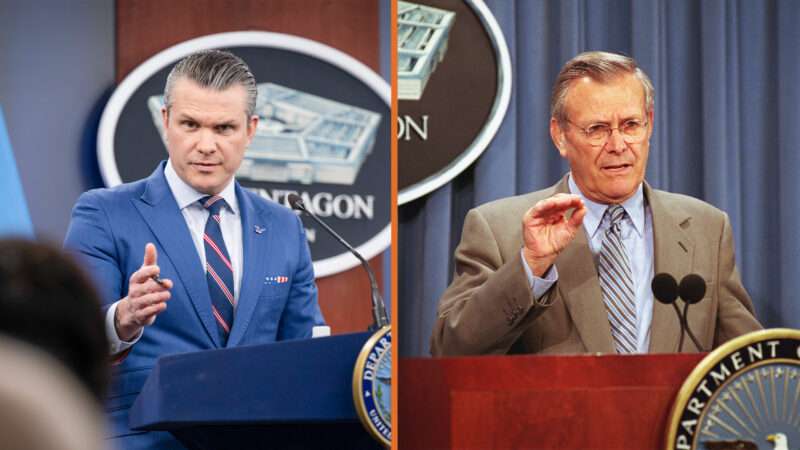
In a side-by-side image, Pete Hegseth and Donald Rumsfeld address reporters. | Illustration: Polaris/Agence Quebec Presse/Newscom

When he ran for president, part of Donald Trump’s appeal stemmed from his opposition to war, in sharp contrast with much of the rest of the Republican Party. “The war in Iraq was a big, fat mistake,” he proclaimed during a 2016 debate. “George Bush made a mistake. We can make mistakes. But that one was a beauty. We should have never been in Iraq. We have destabilized the Middle East.”

Trump said this while sharing the stage with candidates who had supported the war, including Bush’s younger brother. For all his faults—and it was clear even at the time that he was no true peacenik—it was refreshing for a major Republican candidate to acknowledge something that, despite being party heresy, was by then abundantly apparent: Iraq was a mistake, it did destabilize the Middle East, and that failure should inform U.S. foreign policy for generations.

But despite running again in 2024 as the “candidate of peace,” Trump is embroiling the U.S. in yet another ill-advised war in the Middle East, bombing Iran at the end of February and declining to rule out the possibility of deploying troops. In the process, he and his administration are making many of the exact same mistakes that got us into Iraq in the first place.

At the outset, Trump boasted that the campaign would “take four weeks or less.”

“Iran cannot outlast us,” Defense Secretary Pete Hegseth added. “You can say four weeks, but it could be six, it could be eight, it could be three. Ultimately, we set the pace and the tempo.”

Perhaps that braggadocio could be comforting, conveying confidence that the war really will be over soon. The only problem is that when the Bush administration made the case for invading Iraq and ousting Saddam Hussein, then–Defense Secretary Donald Rumsfeld made a nearly identical pledge.

“I can’t tell you if the use of force in Iraq today would last five days, or five weeks or five months, but it certainly isn’t going to last any longer than that,” Rumsfeld said in November 2002.

Instead, American soldiers spent much of the next two decades [wrong link] there; toppling Hussein created such a vacuum of power that even when we withdrew from the country in 2011, then-President Barack Obama ended up redeploying troops in 2014 to counter the rise of ISIS.

The current administration has insisted it didn’t have a choice. “If we didn’t hit within two weeks, they would have had a nuclear weapon,” Trump said after the strikes.

“Within a week they were going to attack us, 100 percent,” he later added.

Of course, Trump said after bombing Iran in June 2025 that “Iran’s key nuclear enrichment facilities have been completely and totally obliterated.” And yet within just a few months, Iran had apparently rebuilt such that it was mere days away from possessing a nuclear weapon.

The claim was also contradicted by Trump’s own Defense Intelligence Agency, which concluded last year that Iran could “develop a militarily-viable ICBM [intercontinental ballistic missile] by 2035 should Tehran decide to pursue the capability.”

This, too, echoes the Bush administration’s case for war, as advanced by then–Secretary of State Colin Powell.

“Saddam Hussein has chemical weapons,” Powell told the United Nations Security Council in February 2003. “We have no indication that Saddam Hussein has ever abandoned his nuclear weapons program. On the contrary, we have more than a decade of proof that he remains determined to acquire nuclear weapons.”

“America must not ignore the threat gathering against us,” Bush warned. “Facing clear evidence of peril, we cannot wait for the final proof—the smoking gun—that could come in the form of a mushroom cloud.”

In fact, their information was inaccurate. “It turned out, as we discovered later, that a lot of sources that had been attested to by the intelligence community were wrong,” Powell later admitted, calling his U.N. testimony a “blot” on his record.

The U.S. should only ever go to war with the approval of Congress, after a full presentation of the facts to the American people. Trump, meanwhile, authorized military action in clear violation of the Constitution.

It’s bad enough that Trump’s record never matched his antiwar rhetoric. Worse still is for him to try selling a new Middle Eastern war with the same tired arguments he once implicitly ran against.

The post Same Lies, New War: Trump and the Iraq Playbook appeared first on Reason.com.

from Latest – Reason.com https://ift.tt/rVUHhf8
via IFTTT

$10K Fine for Lawyer Who Filed Brief Apparently Containing Many Hallucinations

From Doiban v. Oregon Liquor & Cannabis Comm’n, decided by Oregon Court of Appeals Judge Scott Shorr, joined by Judges Steven Powers and Ryan O’Connor:

Petitioner’s opening brief contains fabricated case citations, purported quotations that do not exist anywhere in Oregon case law (attributed to various cases, some fabricated and others not), and inaccurate descriptions of the proposition for which certain cases stand…. {“[T]here are at least 15 citations to cases that are fabricated” and “at least nine purported quotations—attributed to various cases, some fabricated and others not—that do not exist anywhere in Oregon case law.” … [P]etitioner [also] “included citations to actual cases; however, there are multiple instances in which the description of the proposition for which the cases are cited is not accurate.”} [W]e sanction petitioner’s counsel $10,000….

While the panel was preparing for oral argument on the merits of this matter, it came to the court’s attention that in petitioner’s opening brief there were case citations to nonexistent cases and quotations that did not exist anywhere in Oregon case law. At the beginning of the scheduled oral argument, the Presiding Judge of the panel asked petitioner’s counsel for an explanation about the fabricated law contained in the brief. That questioning was followed up with the attached show cause order requesting a more detailed explanation….

The following information is based on the representations of counsel contained in their responses, which we accept for the purpose of determining the sanctions. However, we do not necessarily accept all of the representations as fact….

[In a written response,] Petitioner’s counsel apologized and acknowledged that the brief fell short of the standards of his office and of the profession. Counsel also explained the circumstances surrounding the submission of the opening brief. He noted that, at the time of filing, early November 2024, he was having serious health issues that had been present for some time. He had already filed numerous motions to extend the deadline to file the brief and stated that he “had exhausted the available extensions due to previous motions to extend.” {Although counsel had filed many extensions of time, counsel had not been informed that no further time extensions would be granted for the filing of his opening brief—the record contains no such communication from the court. Regardless, we do not think that is relevant to counsel’s ultimate decision to file a brief filled with fabricated citations.}

He delegated certain legal research tasks to staff and did not personally verify the citations and quotations prior to submitting the brief. He stated that he “relied on what [he] believed at the time to be legitimate legal authority, but later discovered was inaccurate citations found through an unverified search engine being used by staff for legal research” and that that “resulted in errors and inaccurate legal authority unintentionally being included throughout Appellant’s Opening Brief.”

Petitioner’s counsel explained that his office has a clear policy and practice against using artificial intelligence (AI) to draft legal documents or conduct legal research; AI is permitted for basic administrative tasks such as creating argument outlines, organizing case notes, and transcribing conversations. For the brief in question, AI was used to create an outline of the arguments that needed to be made; however, he explained that the actual drafting of the brief, including legal analysis, arguments, and writing, was done by counsel and his staff without further AI assistance.

Counsel further explained that after creating the outline, his staff used Westlaw and Lexis to try to find supporting case law. After finding limited cases on point, his staff turned to search engines such as Google and Safari and started searching for cases on point about the particular subject matter of the case, which led to what appeared to be legitimate legal analysis—”a link that discussed Oregon case law using legal citation format and legal terminology.” Counsel’s staff believed that those citations were real cases from legitimate sources and copied the case citations and some of the language directly into the brief. Counsel and his staff did not verify any of those citations in Westlaw or Lexis before filing the brief. Counsel has tried but has been unable to locate the direct source again after over a year has passed from originally incorporating the case citations into the brief. Counsel reports that “if one asks Google’s search engine whether many of the fabricated cases are real, it will generate a response using its artificial intelligence search engine, affirming that the fabricated case are in fact real.”

Counsel represents that he and the law firm have taken steps to address the errors, ensure accountability, and prevent any recurrence. Those steps include (1) review of “all citations and authorities contained in any filing with any court” by an attorney or other qualified staff, (2) restriction of “all legal citation to only Westlaw Precision and LexisNexis,” or cases that are in the Pacific Reporters or other published and verified legal precedent, and (3) implementation of a system of increased review to allow “additional time for each pleading so that no pleading is rushed” and each is read over for completeness and accuracy….

Petitioner’s counsel asserts that there was no intentional concealment of the citation issues because he acknowledged the errors to the court at oral argument in November 2025, and attempted to demonstrate good faith compliance with obligations outlined in the rules of professional conduct. The problem with that stance, however, is that the fabricated citations were called to counsel’s attention by respondent’s counsel in an email dated April 3, 2025, before respondent’s answering brief was filed. In addition, the answering brief, filed on April 16, 2025, contains a footnote stating that there were case citations in the opening brief that “counsel has been unable to locate by name, reporter citations, or quoted text.”

Petitioner’s counsel reportedly did not respond to the email from respondent’s counsel and did not address the fabricated citations and quotations in the reply brief, or otherwise seek to correct the citations. That is, petitioner’s counsel did not address the nonexistent citations and quotations in any manner for seven months until in-person questioning by the court, despite having been made aware of them. And, when given the opportunity to explain, counsel did not provide any explanation for the lack of correction during that lengthy time period.

For that reason, we conclude that petitioner’s counsel minimized the gravity of the situation—at least until face-to-face with our court—and we conclude that sanctions are warranted….

In Ringo [a previous hallucination sanction case], we concluded that “monetary sanctions, payable by [the] respondents’ counsel, in the amount of $500 for each false citation, and $1,000 for each false quotation or statement of law” were appropriate, after having examined the decisions of other courts facing similar circumstances. In that case, that formula resulted in a total monetary sanction of $2,000…. Applying the formula we used in Ringo, the monetary sanctions here would be a minimum of $16,500— $500 for each of the 15 fabricated citations and $1,000 for each of the nine fabricated quotations. {Given our decision to cap the monetary sanction, we have not spent additional court resources on calculating the number of incorrect propositions of law contained in the opening brief.}

We conclude that under the circumstances here, we will cap the sanction at $10,000. We do so for several reasons: petitioner’s counsel’s response to our show cause order was due and was filed prior to the issuance of our decision in Ringo; petitioner’s counsel provided a detailed explanation of how the false citations and quotations came to be in the brief; and petitioner’s counsel has acknowledged the need for and reportedly implemented new office procedures to prevent another occurrence in the future.

A significant sanction, however, is still appropriate because counsel at least should have known, well before our decision in Ringo, that submitting a brief with unchecked and ultimately fabricated citations may breach an attorney’s duties of professionalism, truthfulness, and candor to the court. Here, that has cost the court and respondent’s counsel substantial time and expense, pulling them and us away from other work in our justice system.

Whether an attorney relies on a partner or associate for an initial draft of a brief or, instead, overly relies on a computer, which may be risky but perhaps not improper on its own, prior to filing, the attorney signing the final filed brief is certifying that the citations therein are accurate and not contrived from thin air. The advent of generative AI did not change that principle although the software’s unreliability and tendency to fabricate might have brought more to light the transgressions of that principle….

The post $10K Fine for Lawyer Who Filed Brief Apparently Containing Many Hallucinations appeared first on Reason.com.

from Latest – Reason.com https://ift.tt/h3sKoDz
via IFTTT