Qatar’s Al Jazeera Launches Right-Wing News Platform For Americans “Who Feel Left Out” Of MSM

Qatar’s Al Jazeera Launches Right-Wing News Platform For Americans “Who Feel Left Out” Of MSM

Upon the announcement this week that Qatar-based Al Jazeera plans to open a US conservative news platform it seemed the near universal reaction on social media was to say simply, weird

“Al Jazeera, the Qatar-based news network that has previously sought to become a liberal media force in the US, is launching a platform to target conservatives, it was revealed on Tuesday,” The Guardian reports.

The Al Jazeera outlet will be called Rightly, and apparently aims to imitate and partake of Fox News’ longtime success as leading the US mainstream. Rightly plans to cater to center-right Americans and is headed by Fox News’ Scott Norvell. Its target audience has been further described as Republicans who “feel left out of mainstream media,” Politico noted, in perhaps a hint it also seeks to tap into pro-Trump support.

Via Reuters

Much of the stir on social media after Tuesday’s announcement was focused around Liberals being outraged over the move, questioning why America would need another ‘center-right’ publication. But the more interesting angle is the fact that Al Jazeera is backed by the Qatari government.

The outlet with its headquarters in Doha often escapes scrutiny as a state-funded news source, despite decades ago the Bush administration essentially going to battle with the foreign outlet over its critical Iraq War coverage. We can only imagine the fierce reaction and pushback if this were instead Russia attempting to establish a ‘conservative news outlet’ on US soil.

Recall too that Al Jazeera was key in pushing the early ‘Arab Spring’ narrative which rapidly turned into regime change wars the West-Gulf military alliance pushed in places like Libya and Syria. At every step of the way the outlet reflected the perspective of Qatar’s Sunni monarchy (namely, the House of Al Thani).

The Hill notes in a review of Al Jazeera’s struggles to find a niche in the US political landscape

Al Jazeera, which is financially backed by the Qatari government, has had mixed success in its past U.S.-focused efforts. In 2013, the company launched an American-focused media brand by acquiring Al Gore’s Current TV for $500 million and rebranding it as Al Jazeera America. The effort was shuttered in January 2016 after struggling with poor ratings and staff discord.

A “soft launch” of an initial show will begin Thursday according to a press release

Rightly will soft launch with its first show, “Right Now with Stephen Kent,” on February 25th. The show, hosted by one of the rising stars in Millennial political circles in the United States, will stream on Rightly social media and podcast platforms. Additional Rightly programming will be announced in the coming months.
 
“Right Now with Stephen Kent” will be an in-studio interview program in which the show’s host, Stephen Kent, will get beyond talking points and retweets to engage current newsmakers, opinion leaders and incisive commentators from across the political spectrum in a discussion about the issues animating right-of-center Americans today.

Al Jazeera English – which is its flagship international channel – has remained popular in the US (also online via AJPlus videos) even after the prior US-focused TV channel ‘Al Jazeera America’ shut down in 2016.

Tyler Durden
Thu, 02/25/2021 – 05:45

via ZeroHedge News https://ift.tt/3knQZQa Tyler Durden

Tesla Temporarily Suspends Production At Model 3 Plant In Fremont

Tesla Temporarily Suspends Production At Model 3 Plant In Fremont

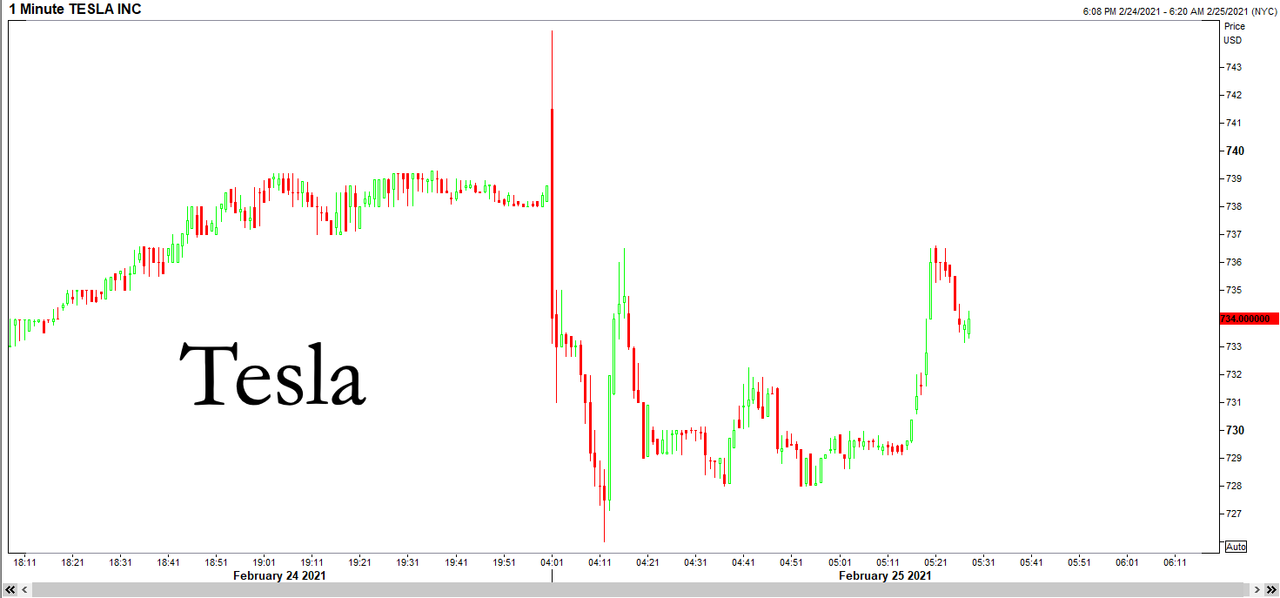
Just as Cathie Wood at ARK Invest was buying the dip in Tesla earlier this week, shares of the electric car company are down again, this time due to a temporary halt in production at its California factory. 

Sources told Bloomberg that workers at the Model 3 production line in Fremont said production would be down from Feb. 22 until Mar. 7. During the down period, employees would be paid between Feb. 22 and Feb. 23 and not paid for Feb. 28, March 1, 2, and 3. Many employees were advised to use vacation time during the downtime. 

Production outages for automakers happen from time to time. Tesla said in its latest Form 10-K that “increased demand for personal electronics has created a shortfall of microchip supply, and it is yet unknown how we may be impacted.” 

“For example, a global shortage of microchips has been reported since early 2021, and the impact to us is yet unknown. The unavailability of any component or supplier could result in production delays, idle manufacturing facilities…,” the filing read.

The Palo Alto, California-based electric carmaker didn’t respond to Bloomberg about the production halt reasons. 

Shares of Tesla in the premarket are trading down between $727 – $733.

Besides production halts, Tesla’s investment in Bitcoin will add even more risk to the stock. 

“That’s more than all they made on EV vehicles in 2020, but that continues to be the double-edged sword. It’s going to add risk to the story, and we’re seeing that in terms of the volatility,” Wedbush Securities Managing Director Dan Ives told Yahoo Finance Live on Monday.

Perhaps Tesla has joined the likes of GM, Nissan and Ford who have suspended some production due to semi shortages. 

Tyler Durden
Thu, 02/25/2021 – 05:42

via ZeroHedge News https://ift.tt/2NTYmmd Tyler Durden

Brickbat: Gunning for a Ban

handgun_1161x653

The Canadian parliament is expected to pass a bill that would allow cities to ban handguns. The bill would also make it easier to revoke gun licenses and make it easier for friends and family members to have police remove someone’s guns. “We are not targeting law-abiding citizens who own guns to go hunting or for sport shooting,” said Prime Minister Justin Trudeau. “The measures we’re proposing are concrete and practical. And they have one goal and one goal only: protecting you, your family and your community.”

from Latest – Reason.com https://ift.tt/37NMM3f
via IFTTT

Brickbat: Gunning for a Ban

handgun_1161x653

The Canadian parliament is expected to pass a bill that would allow cities to ban handguns. The bill would also make it easier to revoke gun licenses and make it easier for friends and family members to have police remove someone’s guns. “We are not targeting law-abiding citizens who own guns to go hunting or for sport shooting,” said Prime Minister Justin Trudeau. “The measures we’re proposing are concrete and practical. And they have one goal and one goal only: protecting you, your family and your community.”

from Latest – Reason.com https://ift.tt/37NMM3f
via IFTTT

Twitter Says It Purged Dozens Of Accounts For “Undermining Faith In NATO”

Twitter Says It Purged Dozens Of Accounts For “Undermining Faith In NATO”

Twitter has announced it recently suspended dozens of accounts for undermining confidence in NATO. It was part of a broader purge of almost 400 Twitter accounts believed to have “ties to Russia, Armenia and Iran” state actors which were found to have “breached its platform manipulation policies,” according to Reuters.

And further Twitter said according to the Reuters that100 accounts with Russian ties were removed for amplifying narratives that undermined faith in NATO and targeted the United States and the European Union.”

That’s right, amid numerous examples of recent Twitter overreach and Silicon Valley’s blatant attempts to crush speech deemed politically inconvenient or out of bounds, this one is arguably the most bizarre and blatant yet – the offending accounts were deemed to have not upheld “faith” in the NATO military alliance. (Did we miss the “oath” that was supposed to be taken upon setting up an account?…)

Some of the accounts appear to have been suspended in prior months, with Twitter now disclosing its fuller investigation results and rationale for taking action against the accounts.

Here’s the official Twitter statement according to its full context:

“Today we’re disclosing two separate networks that have Russian ties. Our first investigation found and removed a network of 69 fake accounts that can be reliably tied to Russian state actors. A number of these accounts amplified narratives that were aligned with the Russian government, while another subset of the network focused on undermining faith in the NATO alliance and its stability. As part of our second investigation in this region, we removed 31 accounts from two networks that show signs of being affiliated with the Internet Research Agency (IRA) and Russian government-linked actors. These accounts amplified narratives that had been previously associated with the IRA and other Russian influence efforts targeting the United States and European Union.”

In follow-up reporting by Russia’s RT detailing some of the prominent accounts impacted by the ban, it’s since been revealed thatOne of the accounts targeted belonged to the Valdai Discussion Club. A leading Russian think tank, it hosts an annual event in Sochi, which has attracted dignitaries such as ex-Afghan leader Hamid Karzai, one time Finnish President Tarja Halonen, erstwhile South African President Thabo Mbeki, former Italian Prime Minister Romano Prodi and China’s richest man, Jack Ma.”

Valdai however has multiple accounts it operates, and this isn’t the first time it’s been targeted by a Twitter purge of state-affiliated ‘nefarious’ actors. 

“In addition, according to Twitter, 31 accounts were deleted for being allegedly associated with the Internet Research Agency, which some in the West claim is a state-connected hacker factory, and other Russian government structures. The company added that some of these were engaged in criticism of the EU,” RT wrote further.

Twitter’s latest “purge” has caught the attention of the Russian government, with Foreign Ministry spokeswoman Maria Zakharova on Tuesday saying the Kremlin will launch its own investigation. Russia has recently passed legislation opening up US social media companies to fines, sanctions, or even the possibility of being blocked inside Russia should they be found to have engaged in unfair targeting of Russian users or entities (though it remains largely symbolic given it’s unlikely the Kremlin would outright ban these apps which remain hugely popular among the Russian population).

She referenced the latest events surrounding Navalny to highlight Twitter’s hypocrisy and overly broad punitive measure: “Millions of users can fall under [this term]. Even Navalny and his associates – they certainly influence the US and the EU, given the speed with which anti-Russian sanctions have been rubber stamped,” she said. “We will assess the grounds for blocking and give an expert response,” Zakharova added.

Tyler Durden
Thu, 02/25/2021 – 04:15

via ZeroHedge News https://ift.tt/2MopSYJ Tyler Durden

Swiss To Vote In Referendum On Government’s Emergency COVID-19 Measures

Swiss To Vote In Referendum On Government’s Emergency COVID-19 Measures

Via 21stCenturyWire.com,

After mounting a national campaign, and the work of determined local organisations, Swiss campaigners have managed to trigger a referendum for ending the government’s destructive COVID regulations. If successful, this will also be a blow for the extremists at the World Economic Forum in Davos, Switzerland, who have been pushing the idea of a global economic shutdown since the beginning of the alleged ‘global pandemic.’

Among other things, the peoples’ revolt is pushing back against the government’s coercive attempt to enforce a “compulsory system with poorly tested vaccines.”

In the meantime, the government has announced that it will start to ease some national mitigation measures from March 1st.

Euro News reports…

Swiss campaigners have triggered a referendum on ending the government’s COVID-19 restrictions.

The association Freunden der Verfassung (Friends of the Constitution) has filed a petition to the Federal Chancellery with 90,000 signatures.

Swiss law means any petition that is backed by more than 50,000 people will go to a national referendum.

The association has argued the government’s legislation, passed by parliament in September 2020, is “dangerous, unethical, and unnecessary”.

Last month, Swiss authorities announced plans to shut restaurants, bars, sports facilities, and cultural institutions until the end of February.

But Friends of the Constitution say the move is “disproportionate” and “demonstrably ineffective”. The association’s spokesperson, Christoph Pfluger, is a known critic of the country’s COVID-19 measures.

Opponents also say the bill focuses too much on financial measures that the government can already regulate by federal decrees, without the need for emergency powers.

Others believe the law gives the government too much power to enforce a “compulsory system with poorly tested vaccines”, something that the Federal Council has repeatedly denied.

“People and companies who have been pushed to the brink by the irresponsible dictates of the Federal Council must be helped,” the group said in a statement.

Any referendum vote on the government’s measures will take place after June 2021, when the law will have been in force for nine months.

Tyler Durden
Thu, 02/25/2021 – 03:30

via ZeroHedge News https://ift.tt/3soSQXz Tyler Durden

​​​​​​​IATA Revises Forecast, Warns Summer Air Travel Will “Remain Weak”

​​​​​​​IATA Revises Forecast, Warns Summer Air Travel Will “Remain Weak”

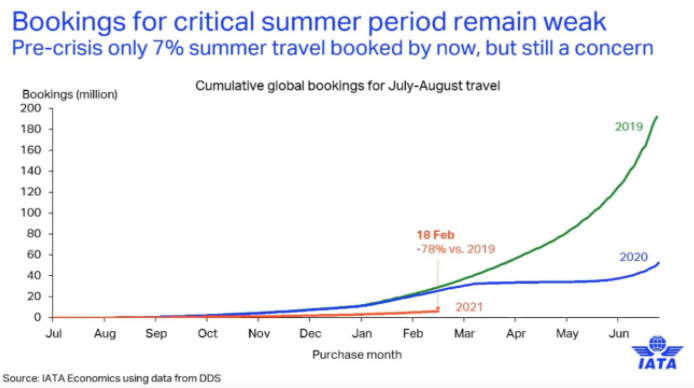
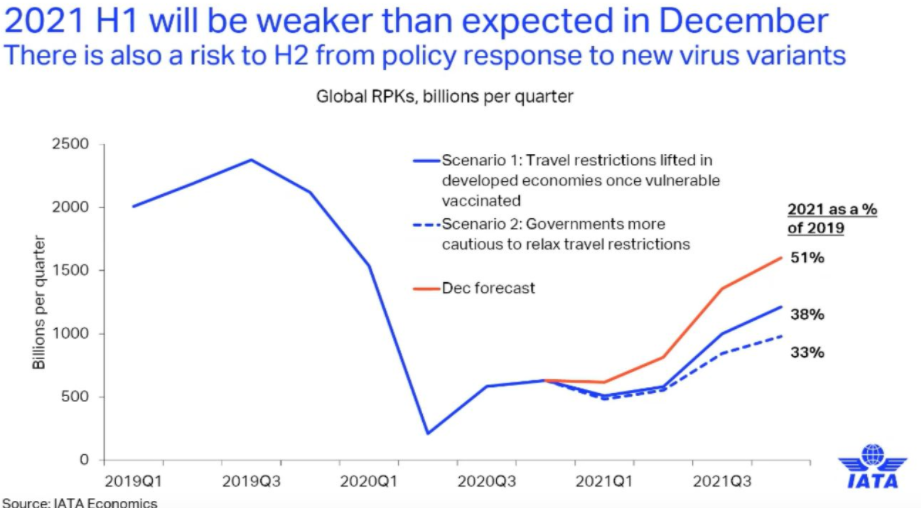
The International Air Transport Association (IATA) just wrapped up a media briefing around 0830 ET. The big takeaway from the world’s airlines’ trade association is that air travel trends in the first half of 2021 will be weaker than initially forecasted from December. 

IATA said booking remains stubbornly “weak” for the summer period. The association is very concerned that only 7% of summer travel bookings have been set, indicating that global travel and tourism will continue to remain weak in the coming months. Even with a vaccine rollout, the airline industry has yet to experience a “V-shaped” recovery. 

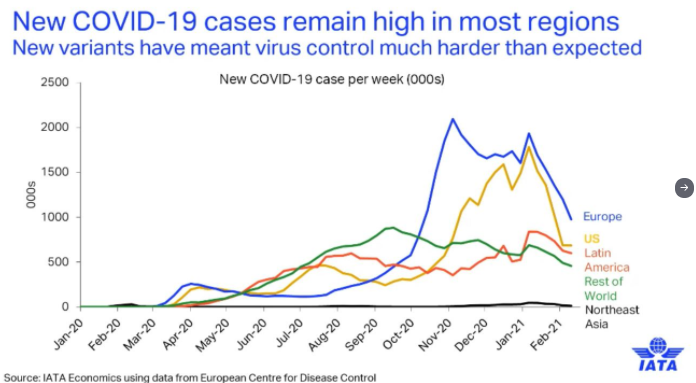
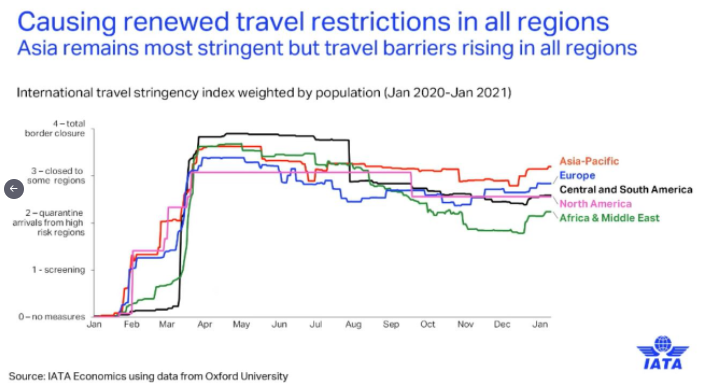
The association shows a chart of global COVID-19 cases slumping.

But the group pointed out travel restrictions in many regions of the world remain harsh.

“IATA raises concerns about uncertainty when governments vaccinate vulnerable populations, travel industry body sees more cautious approach to re-opening up,” said SCMP’s Danny Lee

Lee said, “IATA revises its forecasts and see the difference in charting two different scenarios Vs. pre-crisis levels.” 

IATA said additional rounds of stimulus will be needed for airlines as the recovery wanes. With continued cash burns, mounting debt, many airlines will go into 2022 with “too much debt,” IATA chief economist said. 

Under current conditions, some airlines might not survive and may restructure or be forced to merge with others. 

IATA warns without the lifting of global flight restrictions, additional risks persist for airlines. 

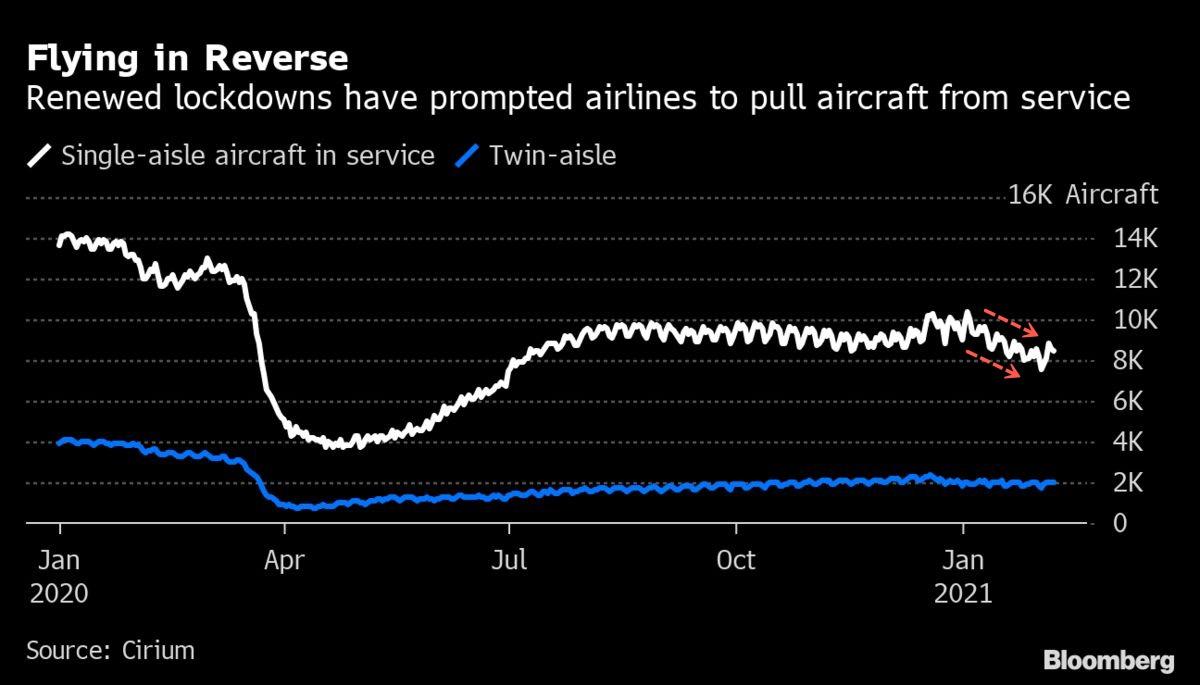
The association’s warning comes as the number of single-aisle aircraft in service has plunged since the beginning of the year. Cirium’s data showed single-aisle aircraft in service fell below the 8.8k mark on Feb. 5, a drop of 15% compared with Jan. 3 figures. 

Source: Bloomberg 

The outlook for a rebound in travel and tourism this year has severely dimmed in the last couple of months. After the air travel industry experienced the worst year on record, last year (2020), with one billion fewer international arrivals, recovery might not be in the cards for a few years. 

United Nations World Tourism Organization recently said 2021 prospects for a travel and tourism rebound have worsened. 

“In October, 79% of experts polled by the agency believed a 2021 rebound was possible. Only 50% said they believed that in January, and some 41% didn’t think travel would reach pre-pandemic levels until 2024 or beyond,” WSJ said.

For example, US hotel demand recovery is not expected to return to 2019 levels until 2023. Room prices might not fully recover until 2025. 

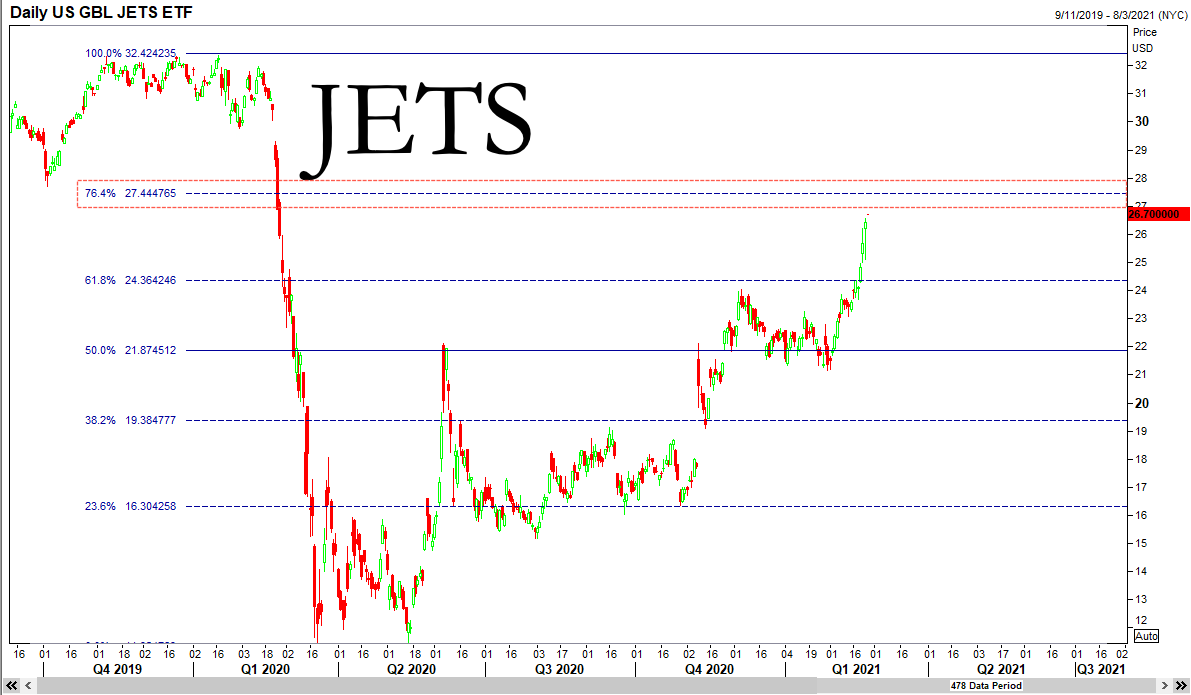
While a “V-shaped” recovery in air travel seems unlikely in the first half, Robinhood traders continue piling into airline stocks like there’s no tomorrow. 

JETS ETF is approaching a significant resistance level at the 27.70 mark, also seen by some technical traders as the 76.4 Fibonacci retracement level. 

Tyler Durden
Thu, 02/25/2021 – 02:45

via ZeroHedge News https://ift.tt/3aP2xsz Tyler Durden

UK Health Authorities Announce Not A Single Case Of Flu Detected This Year

UK Health Authorities Announce Not A Single Case Of Flu Detected This Year

Authored by Paul Joseph Watson via Summit News,

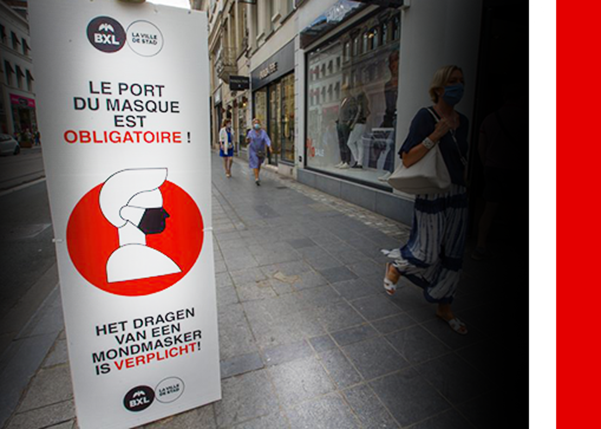
Health authorities in England have announced that not a single case of influenza has been detected this year, with one professor suggesting that mask wearing should be kept in place during winter to drive down flu deaths to “zero.”

“The social restrictions brought in to curb transmission of coronavirus, combined with an increased uptake of flu vaccine, have both been credited with driving down infections,” reports the Independent.

Of the 685,243 samples tested at the PHE’s laboratories since the first week of January, not a single flu infection was discovered.

Professor Christina Pagel went on to suggest that some of the measures brought in to fight coronavirus could be kept in place to combat flu infections.

Asserting that “we can reduce flu deaths to pretty much zero,” Pagel said it is “worth encouraging people to wear masks” on public transport and in other busy environments every winter.

As we previously highlighted, other health experts have suggested that flu cases are so dramatically low because influenza cases are being falsely counted as COVID cases.

Last month, top epidemiologist Knut Wittkowski asserted that, “Influenza has been renamed COVID-19 in large part.”

According to the CDC, the cumulative positive influenza test rate from late September into the week of December 19th was just 0.2%, compared to 8.7% from a year before.

According to Wittkowski, former Head of Biostatistics, Epidemiology and Research Design at Rockefeller University, this was because many flu infections are being incorrectly labeled as coronavirus cases.

“There may be quite a number of influenza cases included in the ‘presumed COVID-19’ category of people who have COVID-19 symptoms (which Influenza symptoms can be mistaken for), but are not tested for SARS RNA,” Wittkowski told Just the News.

Numbers published in April last year by the UK’s Office of National Statistics also showed that there had been three times more deaths from flu and pneumonia than coronavirus.

“The number of deaths from flu and pneumonia – at more than 32,000 – is three times higher than the total number of coronavirus deaths this year,” reported the BBC.

*  *  *

In the age of mass Silicon Valley censorship It is crucial that we stay in touch. I need you to sign up for my free newsletter here. Support my sponsor – Turbo Force – a supercharged boost of clean energy without the comedown. Also, I urgently need your financial support here.

Tyler Durden
Thu, 02/25/2021 – 02:00

via ZeroHedge News https://ift.tt/3bAXprg Tyler Durden

The Minimum Wage Is Terrible for America’s Most Vulnerable Workers

cewitness052791

In his autobiography, “Up From the Projects,” the late economist Walter Williams explained his move away from the belief that minimum wages help the poor. His change of heart on the topic began when one of his UCLA professors asked him whether he cared more about the intentions behind the minimum wage or its effects.

Williams devoted much of his professional career to studying minimum wages and documenting their negative effects, particularly on young Black people. While Williams had the good sense to learn that good intentions alone are insufficient to produce good public policy, many others have failed to learn this lesson.

The latest illustration is an attempt to jack up the minimum wage to $15 per hour as part of another COVID-19 relief bill. Rep. Ro Khanna, D-Calif., recently declared on CNN’s “Inside Politics” that small businesses wouldn’t struggle under a federal mandate to pay employees $15 an hour, even during a recession. To support his claim, he pointed out that Target and Amazon, two of the greatest beneficiaries of the lockdown, raised their lowest hourly wage to $15 voluntarily. He later asserted that he doesn’t want small businesses that are underpaying workers and that $15 is very reasonable. How he knows this is a mystery, but this arrogance demonstrates an ignorance of basic economics.

Walter Williams summarized the general position of economists on this issue in an article titled “Minimum Wage, Maximum Follies.” He wrote, “While there is a debate over the magnitude of the effects, the weight of research by academic scholars points to the conclusion that unemployment for some population groups is directly related to legal minimum wages. The unemployment effects of the minimum-wage law are felt disproportionately by nonwhites.”

Minimum wages reduce the employment of low-skilled workers—a group disproportionately represented by immigrants, inner-city minorities, and young people. Some workers lose jobs altogether, while others see their hours reduced. This doesn’t mean that there are no beneficiaries of higher minimum wages. Economic theory predicts that some workers who are currently employed will retain their jobs with no reduction in hours, even after the minimum wage is increased. For those workers, the increase means higher take-home pay, although the jobs themselves might become more demanding or less secure.

So, what do we know about raising the federal minimum wage to $15, even gradually? In theory, we know a lot, but the empirical evidence is limited since so few states and localities have tried it. There are, however, some noteworthy attempts to get a good grasp of what might happen.

First, the Congressional Budget Office estimates that a $15 minimum wage by 2025 would eliminate 1.4 million jobs over that period. The CBO also forecasts that this increase could decrease business income, increase consumer prices and tap the brakes on the economy.

Second, economists at the University of Washington studied the employment effects of Seattle’s move to gradually increase its minimum wage to $15. Seattle, already a high-wage city, first raised its minimum wage to $13 in 2016 and hiked it to $15 in 2021.

Summing up the findings in Seattle, Michael Strain writes in Bloomberg: “The economists found that this led to a 9% reduction in low-wage jobs. The pay increase it generated didn’t make up for the reduction in employment, and earnings fell for low-wage workers overall. The economists’ subsequent research found that the gains from the higher minimum wage accrued to more experienced workers.” As I noted, there are some winners (those who are already relatively better) and some losers (those already worse off).

In a recent Twitter thread, one of the authors of the study, Jake Vigdor, noted that the following pattern emerges for employers dealing with higher labor costs: “1) Don’t lay people off 2) Cut back hours 3) Cut back hiring 4) As workers quit, restore hours for those who remain.” He also warns that the negative employment effects are somewhat understated in the study because it ignores “a subset of the workforce: those who didn’t have jobs at baseline, before the wage increase.”

Workers who didn’t have a job at the time of the increase and won’t get one after may pay the steepest (and unseen or overlooked) cost of the minimum wage. As Williams explained in his autobiography, “Early work experiences not only provide the pride and self-confidence that comes from financial semi-independence but also teach youngsters attitudes and habits that will make them more valuable and successful workers in the future.”

COPYRIGHT 2021 CREATORS.COM

from Latest – Reason.com https://ift.tt/3qWJG4g
via IFTTT

The Minimum Wage Is Terrible for America’s Most Vulnerable Workers

cewitness052791

In his autobiography, “Up From the Projects,” the late economist Walter Williams explained his move away from the belief that minimum wages help the poor. His change of heart on the topic began when one of his UCLA professors asked him whether he cared more about the intentions behind the minimum wage or its effects.

Williams devoted much of his professional career to studying minimum wages and documenting their negative effects, particularly on young Black people. While Williams had the good sense to learn that good intentions alone are insufficient to produce good public policy, many others have failed to learn this lesson.

The latest illustration is an attempt to jack up the minimum wage to $15 per hour as part of another COVID-19 relief bill. Rep. Ro Khanna, D-Calif., recently declared on CNN’s “Inside Politics” that small businesses wouldn’t struggle under a federal mandate to pay employees $15 an hour, even during a recession. To support his claim, he pointed out that Target and Amazon, two of the greatest beneficiaries of the lockdown, raised their lowest hourly wage to $15 voluntarily. He later asserted that he doesn’t want small businesses that are underpaying workers and that $15 is very reasonable. How he knows this is a mystery, but this arrogance demonstrates an ignorance of basic economics.

Walter Williams summarized the general position of economists on this issue in an article titled “Minimum Wage, Maximum Follies.” He wrote, “While there is a debate over the magnitude of the effects, the weight of research by academic scholars points to the conclusion that unemployment for some population groups is directly related to legal minimum wages. The unemployment effects of the minimum-wage law are felt disproportionately by nonwhites.”

Minimum wages reduce the employment of low-skilled workers—a group disproportionately represented by immigrants, inner-city minorities, and young people. Some workers lose jobs altogether, while others see their hours reduced. This doesn’t mean that there are no beneficiaries of higher minimum wages. Economic theory predicts that some workers who are currently employed will retain their jobs with no reduction in hours, even after the minimum wage is increased. For those workers, the increase means higher take-home pay, although the jobs themselves might become more demanding or less secure.

So, what do we know about raising the federal minimum wage to $15, even gradually? In theory, we know a lot, but the empirical evidence is limited since so few states and localities have tried it. There are, however, some noteworthy attempts to get a good grasp of what might happen.

First, the Congressional Budget Office estimates that a $15 minimum wage by 2025 would eliminate 1.4 million jobs over that period. The CBO also forecasts that this increase could decrease business income, increase consumer prices and tap the brakes on the economy.

Second, economists at the University of Washington studied the employment effects of Seattle’s move to gradually increase its minimum wage to $15. Seattle, already a high-wage city, first raised its minimum wage to $13 in 2016 and hiked it to $15 in 2021.

Summing up the findings in Seattle, Michael Strain writes in Bloomberg: “The economists found that this led to a 9% reduction in low-wage jobs. The pay increase it generated didn’t make up for the reduction in employment, and earnings fell for low-wage workers overall. The economists’ subsequent research found that the gains from the higher minimum wage accrued to more experienced workers.” As I noted, there are some winners (those who are already relatively better) and some losers (those already worse off).

In a recent Twitter thread, one of the authors of the study, Jake Vigdor, noted that the following pattern emerges for employers dealing with higher labor costs: “1) Don’t lay people off 2) Cut back hours 3) Cut back hiring 4) As workers quit, restore hours for those who remain.” He also warns that the negative employment effects are somewhat understated in the study because it ignores “a subset of the workforce: those who didn’t have jobs at baseline, before the wage increase.”

Workers who didn’t have a job at the time of the increase and won’t get one after may pay the steepest (and unseen or overlooked) cost of the minimum wage. As Williams explained in his autobiography, “Early work experiences not only provide the pride and self-confidence that comes from financial semi-independence but also teach youngsters attitudes and habits that will make them more valuable and successful workers in the future.”

COPYRIGHT 2021 CREATORS.COM

from Latest – Reason.com https://ift.tt/3qWJG4g
via IFTTT