Rutte Says Post-Ukraine Peace To Include NATO Boots By Air, Land & Sea

Rutte Says Post-Ukraine Peace To Include NATO Boots By Air, Land & Sea

NATO Secretary General Mark Rutte said the so-called “coalition of the willing” will deploy forces across Ukraine – on land, at sea, and in the air – once a peace agreement with Russia is signed, making clear that Western boots, jets, and naval assets would follow any ceasefire.

Rutte said Ukraine needs binding commitments and security guarantees in order to prevent future Russian aggression. This is to include the deployment of European forces and a “crucial” US “backstop“. His words are consistent with the Western position – and specifically the European view – on what a final Ukraine peace deal would require.

via Reuters

The Kremlin has as expected consistently rejected this ‘option’ as a non-starter, given this is why Russia went to war in the first place: to stop a NATO troop outpost right on its border, and constant NATO expansion.

What Moscow will find doubly alarming is that Rutte issued the words directly before Ukraine’s Verkhovna Rada (the unicameral parliament of Ukraine). Other NATO states, Rutte laid out, would continue to assist through additional channels in a support role to Western boots on the ground.

But Russia has again warned that foreign boots on the ground in Ukraine would warrant a military response, and that they could be targets for future Russian action. All of this contradicts Russia’s ‘red lines’ for what it says is acceptable.

Foreign Minister Sergey Lavrov has been even more blunt, stating that security guarantees for Ukraine based on “foreign military intervention on some part of Ukrainian territory” would be unacceptable to the level that a post-war “peacekeeping” mission would fast spiraling into the next flashpoint.

According to more of Rutte’s words, summarized via The Guardian:

  • Rutte also urged for more equal “burden-sharing” as some allies “are doing a lot” and a few are “doing nothing”. He stressed the positive contributions of countries including Norway, Holland, Germany, Denmark, Canada and Sweden.

  • Rutte said Russia’s full-scale invasion, launched in February 2022, was “crazy” and said its continuing assault on Ukraine is targeting civilian infrastructure, creating “chaos” for innocent civilians.

  • Rutte said Ukraine is ready “to play ball” and come to a deal – acceptable to Kyiv – with the Russian side, but added that the massive Russian attack last night was a “really bad signal” ahead of future negotiations.

Yet, Russia will not “play ball” on these terms, and this signals that US-Russia negotiations continue to be stuck, going nowhere substantial, but the reality remains – at least the two sides are being candid and are communicating.

A ‘helping-hand’ or ensuring Ukraine’s long demise

This represents Europe keeping up its intractable position, also as territorial concessions are a prime point of disagreement. US officials have at times signaled their view that European leaders are more hostile to peace, or even thwarting it, amid Trump’s apparent good-faith efforts to bring a resolution to the war which is about to enter its fifth year, after hundreds of thousands have perished. Still, Trump could bring pressure on Kiev – including halting all arms deliveries, and forcing it to make serious land concessions – but there’s as yet no evidence he’s done this in any meaningful way.

Tyler Durden
Wed, 02/04/2026 – 02:45

via ZeroHedge News https://ift.tt/cQwgkTP Tyler Durden

More Europe? Draghi Pushes For Federalization As Answer To Europe’s Decline

More Europe? Draghi Pushes For Federalization As Answer To Europe’s Decline

Authored by Thomas Brooke via Remix News,

Former Italian prime minister and former European Central Bank president Mario Draghi has urged European Union member states to move toward a more federal structure, warning that Europe risks economic and geopolitical decline unless national governments surrender more powers to Brussels.

Speaking while receiving an honorary doctorate at KU Leuven in Belgium on Monday, Draghi argued that Europe faces a future in which it risks becoming “subordinated, divided, and deindustrialised at once” as global power shifts further toward the United States and China.

Draghi said the collapse of the current economic world order leaves Europe exposed unless it acts collectively, declaring that “the collapse of this order is not itself the threat… the threat is what may replace it.”

He argued Europe must choose between remaining dependent on global powers or transforming into a political force capable of defending its own interests.

“Of all those who today find themselves squeezed between the United States and China, only Europeans have the option of becoming a true power themselves,” Draghi said.

The tone is reminiscent of previous Eurocrats who have used geopolitics and economic crises to call for “more Europe.”

“We must decide: do we simply remain a large market, subject to the priorities of others? Or do we take the necessary steps to become a power?” Draghi asked.

He argued that Europe commands influence only when powers are centralized at the EU level, pointing to areas such as trade policy, competition law, the single market, and monetary policy.

“Where Europe has federated on trade, on competition, on the single market, on monetary policy, we are respected as a power and negotiate as one,” he said. It should be noted that many Europeans considered these areas to be highly bureaucratic, and vie to push through a “one-size-fits-all policy” on nations.

He claimed that fragmentation in defense, foreign policy, and industrial strategy leaves Europe vulnerable.

“Where we have not… we are treated as a loose assembly of middle-sized states to be divided and dealt with accordingly,” he said.

He added that economic strength alone cannot protect Europe if it remains militarily dependent on the United States.

“A Europe unified on trade but fragmented on defense will find its commercial power leveraged against its security dependence, as is happening now,” Draghi warned.

The former ECB president also criticized both Washington and Beijing, saying Europe now faces pressure from both sides. He described a United States that “emphasizes the costs it has borne while ignoring the benefits it has reaped,” while warning that China “controls critical nodes in global supply chains and is willing to exploit that leverage.”

Draghi also suggested Washington now openly benefits from European political fragmentation, saying the U.S. imposes tariffs on Europe, threatens European interests, and “makes it clear, for the first time, that they consider European political fragmentation to serve their own interests.”

His remarks are likely to intensify criticism from Eurosceptic politicians and commentators who argue Europe’s economic stagnation and political tensions stem not from insufficient integration but from excessive centralization and regulation by Brussels.

They contend that further transfers of power away from national governments would deepen voter alienation and further weaken democratic accountability across the bloc.

Read more here…

Tyler Durden
Wed, 02/04/2026 – 02:00

via ZeroHedge News https://ift.tt/HRPtzmq Tyler Durden

The Indo-US Trade Deal Might Sharply Shift The Direction Of The Global Systemic Transition

The Indo-US Trade Deal Might Sharply Shift The Direction Of The Global Systemic Transition

Authored by Andrew Korybko,

Trump unexpectedly announced an Indo-US trade deal on Monday whereby US tariffs on Indian imports will drop to 18% while India will reduce its tariffs on US imports to zero. He also said that Modi agreed to stop buying Russian oil, which he’ll replace with US and possibly Venezuelan oil, while also pledging to buy $500 billion of American energy, technology, agricultural goods, coal, and other products. For his part, Modi confirmed that a deal had indeed been reached, but he didn’t confirm the details.

If Trump accurately conveyed them, and he was reportedly wrong in claiming late last year that India had already stopped buying Russian oil, then the Indo-US trade deal would certainly be historic.

For starters, a little less than half of the Indian population (42%) is employed in the agricultural industry, so tariff-free US imports of such products could ruin some of their livelihoods and lead to these rural folk moving to the cities. The potential socio-economic turbulence could lead to political unrest if improperly managed.

That could be offset if more investment from the US and the EU, which reached a trade deal with India last month, provides new employment opportunities. While a gamble, Modi might have calculated that it’s worth taking these risks for macroeconomic, regional security, and geo-economic reasons.

The first aims to turbocharge India’s GDP growth, which was already expected to be 7.4% this year despite the US’ 50% tariffs at the time, thus helping it become the world’s third-largest economy by 2030 or earlier.

As for the regional security dimension, this relates to restoring India’s role as the US’ top South Asian partner via economic diplomacy after rival Pakistan replaced it last year, thus averting the scenario of the US weaponizing Pakistan and their shared junior Bangladeshi partner as proxies for derailing India’s rise. The aforesaid economic diplomacy segues into the tertiary geo-economic reason that can be speculated as accounting for why Modi might have made such significant compromises for a deal with Trump.

The US’ punitive 25% tariffs for continuing to import discounted Russian oil are no longer worth the economic cost now that the US is offering India similarly priced Venezuelan oil. Meanwhile, the US’ threatened 25% tariffs for doing business with Iran and concerns about its stability render the North-South Transport Corridor through its territory en route to Russia unviable for the time being. The effect of this geo-economic pressure might have understandably pushed India to prioritize a deal with the US.

If Trump’s details about his deal with Modi are correct, then India is recalibrating its grand strategy in the Western direction, albeit due to economic coercion.

Potential implications of this policy shift could be a reduced focus on BRICS, decelerated diversification from the dollarmore defense deals with the US, and resultant difficulty in maintaining its incipient rapprochement with China.

Russia would also be thrown into a grand strategic dilemma if India does indeed stop importing its discounted oil.

In order to stabilize its budgetary revenue and the ruble, Russia could either rely on China to replace its lost Indian oil market at the risk of becoming too dependent on it or agree to tough compromises with the US over Ukraine for phased sanctions relief that would gradually return its oil to the global market.

The consequences would sharply shift the global systemic transition in China’s or the US’ favor, and if the Indo-US trade deal prompts Russia to make this epochal choice, then it would truly be historic.

Tyler Durden
Tue, 02/03/2026 – 23:25

via ZeroHedge News https://ift.tt/ajvDWQd Tyler Durden

Don Lemon’s Arrest Looks Like an Assault on Freedom of the Press


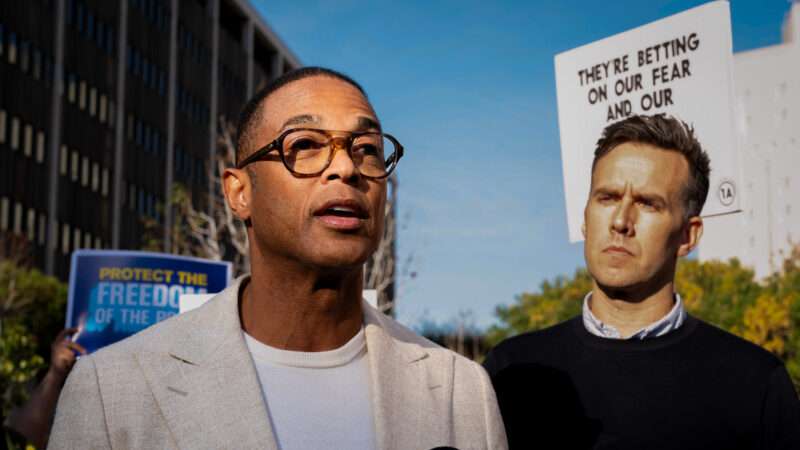
Don Lemon | Ghawam Kouchaki/Zuma Press/Newscom

Don Lemon and Georgia Fort, two journalists who covered a protest that disrupted services at a St. Paul church on January 18, were arrested last week on federal charges punishable by up to a decade in prison. While the protest itself entailed trespassing coupled with disorderly conduct, the attempt to treat reporting on the event as a federal felony looks like a thinly veiled assault on freedom of the press.

Opponents of the Immigration and Customs Enforcement (ICE) crackdown in Minnesota targeted Cities Church because one of its pastors, David Easterwood, directs enforcement and removal operations at ICE’s field office in St. Paul. Was that a good reason to interrupt a service at his church and self-righteously harangue the congregants to the point that many of them fled?

No, it was not. Even if Easterwood had been there, the demonstration would have been misguided, misdirected, obnoxious, morally objectionable, and plainly illegal, especially after the protesters were asked to leave and refused to do so. But that does not mean Lemon and Fort should be held criminally liable for the conduct of the people they were covering.

Lemon, a former CNN anchor and longtime critic of President Donald Trump who hosts a YouTube show, and Fort, a local reporter who runs a livestreaming news outlet, covered an organizational meeting that preceded the protest, agreed not to divulge the protest’s location ahead of time, and recorded the event itself. According to a federal indictment filed last Thursday, those actions made them “co-conspirators.”

Lemon and Fort allegedly conspired with the protest’s organizers to “injure, oppress, threaten, or intimidate” the Cities Church worshipers “in the free exercise or enjoyment” of their religious freedom—a crime that carries a maximum penalty of 10 years in prison. The evidence supporting that charge seems skimpy.

At one point, the indictment says, Lemon and Fort “approached the pastor” running the service, Jonathan Parnell, and “largely surrounded him.” They “stood in close proximity to the pastor,” allegedly “in an attempt to oppress and intimidate him,” and “physically obstructed his freedom of movement” while Lemon “peppered him with questions to promote the operation’s message.”

That is one way to describe Lemon’s interaction with Parnell. Here is another way: Lemon interviewed the pastor about his response to the protest.

Lemon’s questions were clearly sympathetic to the protesters. But the interview looks a lot more like journalism, however biased, than a conspiracy to violate someone’s constitutional rights.

The indictment says Fort “stood in front” of “a minivan full of children” outside the church while interviewing a protest organizer. Although Fort’s behavior may have been inconsiderate, that interview likewise does not easily fit within the statute that the Justice Department is invoking.

The indictment also charges Lemon and Fort with violating a federal law that applies to someone who, “by force or threat of force or by physical obstruction, intentionally injures, intimidates, or interferes with” a person exercising his religious freedom at a place of worship. Again, that description does not seem consistent with their conduct or their avowed intent.

Those difficulties help explain why a federal magistrate judge who approved arrest warrants for three protesters declined to approve warrants for Lemon and Fort. When federal prosecutors asked Patrick Schiltz, a George W. Bush appointee who serves as chief judge of the U.S. District Court in Minnesota, to override that decision, he saw “no evidence” that the journalists at the scene “engaged in any criminal behavior or conspired to do so.”

You can fault Lemon for implicitly condoning this protest, which he acknowledged was intended to be “traumatic and uncomfortable,” and for erroneously suggesting that it was protected by the First Amendment. But those misjudgments are not the same as actively participating in what the indictment calls “a coordinated takeover-style attack” on the church.

If the evidence is not driving the case against Lemon, what is? The White House’s gloating take on his arrest suggests his real offense was political.

© Copyright 2026 by Creators Syndicate Inc.

The post Don Lemon's Arrest Looks Like an Assault on Freedom of the Press appeared first on Reason.com.

from Latest – Reason.com https://ift.tt/1FB9HLQ
via IFTTT

Don Lemon’s Arrest Looks Like an Assault on Freedom of the Press


Don Lemon | Ghawam Kouchaki/Zuma Press/Newscom

Don Lemon and Georgia Fort, two journalists who covered a protest that disrupted services at a St. Paul church on January 18, were arrested last week on federal charges punishable by up to a decade in prison. While the protest itself entailed trespassing coupled with disorderly conduct, the attempt to treat reporting on the event as a federal felony looks like a thinly veiled assault on freedom of the press.

Opponents of the Immigration and Customs Enforcement (ICE) crackdown in Minnesota targeted Cities Church because one of its pastors, David Easterwood, directs enforcement and removal operations at ICE’s field office in St. Paul. Was that a good reason to interrupt a service at his church and self-righteously harangue the congregants to the point that many of them fled?

No, it was not. Even if Easterwood had been there, the demonstration would have been misguided, misdirected, obnoxious, morally objectionable, and plainly illegal, especially after the protesters were asked to leave and refused to do so. But that does not mean Lemon and Fort should be held criminally liable for the conduct of the people they were covering.

Lemon, a former CNN anchor and longtime critic of President Donald Trump who hosts a YouTube show, and Fort, a local reporter who runs a livestreaming news outlet, covered an organizational meeting that preceded the protest, agreed not to divulge the protest’s location ahead of time, and recorded the event itself. According to a federal indictment filed last Thursday, those actions made them “co-conspirators.”

Lemon and Fort allegedly conspired with the protest’s organizers to “injure, oppress, threaten, or intimidate” the Cities Church worshipers “in the free exercise or enjoyment” of their religious freedom—a crime that carries a maximum penalty of 10 years in prison. The evidence supporting that charge seems skimpy.

At one point, the indictment says, Lemon and Fort “approached the pastor” running the service, Jonathan Parnell, and “largely surrounded him.” They “stood in close proximity to the pastor,” allegedly “in an attempt to oppress and intimidate him,” and “physically obstructed his freedom of movement” while Lemon “peppered him with questions to promote the operation’s message.”

That is one way to describe Lemon’s interaction with Parnell. Here is another way: Lemon interviewed the pastor about his response to the protest.

Lemon’s questions were clearly sympathetic to the protesters. But the interview looks a lot more like journalism, however biased, than a conspiracy to violate someone’s constitutional rights.

The indictment says Fort “stood in front” of “a minivan full of children” outside the church while interviewing a protest organizer. Although Fort’s behavior may have been inconsiderate, that interview likewise does not easily fit within the statute that the Justice Department is invoking.

The indictment also charges Lemon and Fort with violating a federal law that applies to someone who, “by force or threat of force or by physical obstruction, intentionally injures, intimidates, or interferes with” a person exercising his religious freedom at a place of worship. Again, that description does not seem consistent with their conduct or their avowed intent.

Those difficulties help explain why a federal magistrate judge who approved arrest warrants for three protesters declined to approve warrants for Lemon and Fort. When federal prosecutors asked Patrick Schiltz, a George W. Bush appointee who serves as chief judge of the U.S. District Court in Minnesota, to override that decision, he saw “no evidence” that the journalists at the scene “engaged in any criminal behavior or conspired to do so.”

You can fault Lemon for implicitly condoning this protest, which he acknowledged was intended to be “traumatic and uncomfortable,” and for erroneously suggesting that it was protected by the First Amendment. But those misjudgments are not the same as actively participating in what the indictment calls “a coordinated takeover-style attack” on the church.

If the evidence is not driving the case against Lemon, what is? The White House’s gloating take on his arrest suggests his real offense was political.

© Copyright 2026 by Creators Syndicate Inc.

The post Don Lemon's Arrest Looks Like an Assault on Freedom of the Press appeared first on Reason.com.

from Latest – Reason.com https://ift.tt/1FB9HLQ
via IFTTT

AI’s Next Frontier Is Physical As Humanoid Robots Begin March On Assembly Lines And Beyond

AI’s Next Frontier Is Physical As Humanoid Robots Begin March On Assembly Lines And Beyond

Humanoid robotics is transitioning from prototype to production by late 2026 and into 2027. The market, currently valued at roughly $3 billion, is projected to expand to $40 billion under Barclays’ base-case outlook, with upside scenarios reaching $200 billion as physical AI scales across labor-intensive sectors.

In one of the latest Barclays Eagle Eye newsletters, the firm’s internal thematic research for clients highlighted humanoid robotics, with several examples of these bots moving past pilot programs to industrial production lines.

The research note stated:

Industrial robots have been part of growing automation for half a century, welding car parts, sorting mail, moving packages in warehouses and even flipping burgers in recent years. However, they have been limited in mobility and confined to a narrow set of tasks because they lacked one critical skill: understanding context.

For example, when a humanoid robot was asked to water plants, it could confuse humans with plants. But thanks to recent advances in AI, humanoid robots are now learning to read situations and act accordingly, making them far more scalable than fleets of specialized machines.

A robot equipped with arms, legs and visual reasoning can adapt and perform multiple tasks safely, replacing a dozen single-task robots. German carmaker BMW has put humanoid robots on the line in its Spartanburg plant, where they perform multiple precision-required tasks, such as loading sheet-metal parts into welding fixtures.

. . .  

The cost for one unit has collapsed from about $3 million a decade ago to $100,000 today.

The plunge in production costs for these humanoid robots suggests that, as the global population ages, urbanization continues, and worker preferences change, companies will find use cases for these bots to replace low-skilled labor.

As adoption accelerates, Barclays estimates the humanoid robotics market could expand from roughly $3 billion today to as much as $200 billion by 2035. Initial demand is expected to be concentrated in industrial firms, automakers, ports, and warehousing, where labor substitution and productivity gains are most immediate. Humanoids for households will be a story for the early 2030s.

In a separate note, Barclays analyst Zornitsa Todorova recounts the biggest takeaways from her discussion about bots at the World Economic Forum in Davos last month:

The key takeaway from our panel: humanoid robots could generate powerful near-term tailwinds for industrials, not only for companies building the hardware, but also for those looking to deploy these systems across manufacturing, logistics, agriculture, defence and, as the technology matures, healthcare and elderly care.

Beyond manufacturing, logistics, and agriculture, humanoid robots will soon be entering the modern battlefield – like it or not – this trend cannot be stopped.

Some of the leading robotics companies, including Boston Dynamics, Agility Robotics, ANYbotics, Clearpath Robotics, Open Robotics, and Unitree, have already signed an open letter stating that the robotics industry should not be weaponized. 

Figure AI CEO Brett Adcock recently told investors, “We will not place humanoids in military or defense applications, nor any roles that require inflicting harm on humans.”

This leaves us with Foundation Robotics, a US-based robotics startup developing humanoid robots for industrial and military applications. The company has identified a significant gap in defense use cases for humanoids and is training its Phantom MK1 for offensive operations. 

Foundation is positioning itself as a leader in military humanoid robotics. CEO Sankaet Pathak recently confirmed this move in comments to tech blog Humanoids Daily, emphasizing the company’s defense-first mindset.

Its philosophy is reinforced by co-founder Mike LeBlanc, who recently said the team designed the Phantom MK1 to enter and breach rooms and other high-risk environments ahead of human operators. As LeBlanc put it, the goal here is simple: do not send a Marine where a robot can go first.

Like it or not, the rest of the world, whether China, Russia, or Ukraine, is already pursuing a dual-use robotics strategy. The rise of humanoid robotics on the modern battlefield is unavoidable. 

While many US robotics firms emphasize safeguards and ethical constraints, other countries are rapidly integrating robotics, large language models, FPV drones, and AI-driven systems into warfare. What we are seeing today in Ukraine – on both sides – is a preview of what war in the 2030s may look like, and it is deeply unsettling.

Tyler Durden
Tue, 02/03/2026 – 23:00

via ZeroHedge News https://ift.tt/C2V1ZPk Tyler Durden

Epstein, Western Decline, & The Moral Collapse Of The Elites

Epstein, Western Decline, & The Moral Collapse Of The Elites

Authored by Lucas Leiroz,

January 2026 marks a rupture. It is no longer possible to treat the Epstein case as a sexual scandal involving powerful individuals. What has now come to light – documents, images, records, explicit connections – has pushed the debate to another level. This is no longer about “abuses,” “excesses,” or “individual crimes.” What has been exposed points to systematic, organized, ritualized practices. And that changes everything.

For years, the public was conditioned to accept a narrative of ambiguity. There were always doubts, always a lack of “definitive proof,” always a call for caution. That time is over. The material released leaves no room for ingenuousness. When evidence emerges of extreme violence against children, of practices that go beyond any conventional criminal category, the discussion ceases to be legal and becomes civilizational.

What is at stake is no longer who “visited the island” or who “caught a ride on Epstein’s plane.” What is at stake is the fact that networks of this kind only exist when they are backed by deep institutional protection. There is no ritual pedophilia, no human trafficking on a transnational scale, no systematic production of extreme material without political, police, judicial, and media cover. This is not conspiracy: it is the logic of power.

From this point on, the West can no longer hide behind the idea of gradual decline. It is not merely cultural degeneration or a loss of values.

It is something darker: an elite that operates outside any recognizable moral limits and yet continues to govern. People directly or indirectly involved with this world continue to decide elections, wars, economic policies, and the fate of entire societies.

Another decisive element is that we still do not know who is behind the leak. This uncertainty is central. It may be a move by Donald Trump or by sectors aligned with him, attempting to definitively destroy their internal enemies and reorganize power in the United States in a minimally positive direction. It may be the opposite: a controlled release of material intended to pressure Trump into serving the interests of the Democrats and the Deep State.

And the uncomfortable truth, impossible to ignore, is that all of this may still be part of an even deeper and more macabre plan by the Deep State – encompassing both Democrats and Republicans – to “resolve the Epstein issue” through a brutal campaign of collective desensitization, “normalizing” in public opinion the idea that the Western elite is composed of pedophiles, satanists, and cannibals.

This reinforces a critical point: the truth only came out because it stopped being useful to keep it hidden.

For decades, all of this was known behind the scenes. The silence was not the result of investigative failure, but of a high-level decision.

The press stayed silent. The agencies stayed silent. The courts stayed silent.

The system worked exactly as it was supposed to, all in order to protect itself.

Western societies now face a dilemma that cannot be resolved through elections, parliamentary commissions, or encouraging speeches. How can one continue to accept the authority of institutions that shielded this level of horror? How can respect be maintained for laws applied selectively by people who live above them? How can one speak of “Western values” after this?

The problem is that the modern West has forgotten how to react to anything that is vile and essentially evil. In Western societies, the people no longer know how to deal with absolute evil – especially when it is located at the top of society. Everything becomes procedure, everything becomes mediation, everything becomes technical language. Meanwhile, social trust evaporates.

This is no longer about left and right, liberalism and conservatism. It is about a rupture between people and elites.

Between societies that still retain some sense of limits and a ruling class that operates as if it were outside the common human species.

If there is anything positive in this moment, it is the end of naivety.

It is no longer possible to pretend that the system is “sick but recoverable.” What remained of the Western (anti-)civilizational project has been corroded from within. What comes next is still uncertain – and will be contested by all possible and necessary means.

But one thing is clear: after Epstein, nothing can continue as before. Anyone who acts as if nothing has changed either does not understand the gravity of what has come to light or is pretending not to understand.

Tyler Durden
Tue, 02/03/2026 – 22:35

via ZeroHedge News https://ift.tt/HbFdJYi Tyler Durden

Illegal Biolabs In Vegas & California Linked To Chinese National With Alleged Military-Civil Fusion Ties

Illegal Biolabs In Vegas & California Linked To Chinese National With Alleged Military-Civil Fusion Ties

Authored by The Bureau’s Sam Cooper

Federal and local authorities are investigating suspected illegal biological laboratories in Las Vegas and California’s Central Valley linked to a Chinese national accused by Congressional investigators of ties to a PRC military-civil fusion enterprise, who spent a decade operating what Canadian courts found was a systematic technology-theft operation from British Columbia before fleeing south with a $330 million fraud judgment against him.

The FBI and Las Vegas Metropolitan Police Department executed search warrants over the weekend at two residences connected to Jiabei “Jesse” Zhu, a 62-year-old Chinese citizen already under federal indictment for operating an illegal biolab in Reedley, California that contained labeled samples of at least 20 infectious agents including HIV, tuberculosis, and what the House Select Committee on the Chinese Communist Party described as “the deadliest known form of malaria.”

Las Vegas Metro Sheriff Kevin McMahill confirmed Monday that investigators recovered over 1,000 samples of biological material “consistent in appearance” with items found in the California facility.

“This can’t keep happening,” Congressman Kevin Kiley said after the Las Vegas raid, calling for immediate hearings on bipartisan legislation he introduced with Representatives Costa and David Valadao. “The illegal bio lab just raided in Las Vegas was operated by the same LLC and Chinese nationals as the one discovered in Reedley.”

In the Reedley case, investigators discovered nearly 1,000 bioengineered laboratory mice, infectious agents including E. Coli, malaria, various chemicals, medical waste, blood, tissue, serum, body fluid samples, and illegal pregnancy tests, Congressman Jim Costa noted, citing the Select Committee’s review.

Property records show both the Reedley warehouse and the Las Vegas homes are owned by the same limited-liability company whose officers include Zhu and his business partner Zhaoyan Wang, both Chinese citizens facing federal trial in April 2026 on charges of distributing hundreds of thousands of misbranded COVID-19 and other testing kits.

The House Select Committee on the Chinese Communist Party’s investigation frames Zhu as a Chinese citizen from Canada “associated with PRC-government linked companies” and with direct ties to state enterprises and military-civil fusion networks.

Photos from their review show freezers packed with numerous small bottles and sample containers holding what the caption identifies as blood and other fluids, plus sealed bags labeled with apparent drug shorthand (for example “MDMA,” “Coca,” and “Met”), suggesting the freezers were being used to store both biological materials and suspected narcotics-related items.

The report states that in the early 2000s, Zhu served as vice chairman of Henan Pioneer Aide Biological Engineering Company Limited, a PRC state-controlled enterprise whose corporate ownership structure the Committee mapped to show interlacing with state-linked financing channels running through China Development Bank and its affiliated funds, the National Council for Social Security Fund, and the State-owned Assets Supervision and Administration Commission.

The report explicitly flags Chinese military exposure, noting that beneficial owners operated through passthrough joint-venture companies including Henan Investment Group Company Limited, which the Committee describes as “involved in military-civil fusion.”

The Select Committee documented that Zhu’s work in cattle genetics connected to strategic PRC priorities.

As Zhu stated in documents obtained from the Reedley Biolab, “the Company is looking to seize the opportunity to develop the operational platform for the rapid growth in the Chinese dairy industry, fulfilling [PRC] Premier [and CCP Politburo Member] Wen Jiabao’s wish to ‘provide every Chinese, especially children, sufficient milk every day.’”

At that time, China faced a pressing milk crisis.

Long before federal agents discovered thousands of vials in Reedley in December 2022, Zhu had established himself in British Columbia as the architect of a sprawling transnational operation touching everything from cattle sex-sorting technology to the genetic production—or fraudulent representation of such—of prized Wagyu cattle famous for producing Kobe beef, leaving Canadian courts documenting systematic fraud spanning from Beijing to Quebec.

Court testimony established that Zhu, operating from Vancouver while maintaining direct control of a Beijing-based biotech entity, built a network across four countries involving genetic manipulation of cattle embryos, reverse-engineering of American proprietary technology, falsification of production records, and maintenance of what one witness described as “two sets of books”—one to report to the American licensor, another reflecting actual operations.

As sole shareholder and director of Vancouver-based International Newtech Development Incorporated since 1994, court testimony established Zhu operated through at least nine entities: four Canadian companies, five Chinese entities, Cayman Islands holding companies, and U.S. subsidiaries. Those U.S. subsidiaries included IND Lifetech (California) Inc., incorporated in 2007 and operated from Fresno—the same California city where federal authorities would discover his illegal biolab fifteen years later.

At the operational center sat Beijing IND Embryontech Co. Ltd., a company Zhu identified himself as directing in a March 2008 sworn affidavit, confirming he was “the boss” of the Beijing entity. The court record establishes Zhu maintained direct corporate presence and control in the capital of the People’s Republic of China while simultaneously holding Canadian citizenship and residing in British Columbia.

The 2012 British Columbia trial judgment upheld claims by XY LLC, a Colorado-based biotechnology firm, that JingJing Genetics and associated Zhu-controlled entities systematically deceived the company and vastly under-reported production to deprive XY of substantial royalties owed under licensing agreements for proprietary cattle sex-sorting technology. Senior engineer Kevin Xu, who worked for the IND group in both Canada and China from 2006 to 2014, testified that Zhu directly instructed him to copy specific XY proprietary components and send damaged nozzle tips to Chinese manufacturers as early as 2008 with instructions to reverse-engineer and replicate them.

On January 1, 2008—as litigation intensified—all JingJing shares were sold to Zhu’s brother-in-law and a friend, both China residents, in a transaction the court found was designed to evade liability. In Quebec, financial manager Selen Zhou testified their embryo production lab began producing Wagyu cattle embryos, but a lab doctor testified he was never told about this switch and continued signing export certificates for Holstein embryos. The court found the lab was actually continuing to produce Holstein IVF embryos using XY’s licensed technology, not Wagyu as falsified production records indicated.

The court found this pattern of coordinated deception, reverse-engineering of proprietary technology, falsification of production records, concealment of assets through sham transactions, and corporate maneuvering across multiple jurisdictions constituted what the judge characterized as “fraud on an epic scale.” The resulting $330 million Canadian dollar judgment reflected systematic technology diversion from North America to Chinese manufacturing partners under Zhu’s centralized direction. Then Zhu fled to the United States.

The Reedley facility received millions in unexplained wire transfers from Chinese banks while the supposed business—selling medical test kits—consisted entirely of importing counterfeit kits from China for resale, according to American lawmakers.

“While the supposed purpose of the lab was to sell test kits, in fact all the company did was buy counterfeit kits from China and re-sell them in the United States,” Kiley stated.

The CDC’s response triggered sharp Congressional criticism. The agency initially refused to take phone calls from local officials and declined to test samples with unknown contents. “At first, the CDC refused to investigate, and even hung-up on local officials who asked for help,” Kiley recounted. “After Rep. Costa got involved, the CDC did an inspection and found ‘at least 20 potentially infectious agents, including HIV, Tuberculosis, and the deadliest known form of Malaria.’ Yet the CDC did not bother to test any samples, even those with unknown contents.”

*   *   * 

Congressman Kevin Kiley (R-CA) expanded more on the insane illegal bio lab story:  

The illegal bio lab just raided in Las Vegas was operated by the same LLC and Chinese nationals as the one discovered in Reedley, CA. Here’s what we know about the Reedley lab from a highly disturbing report I requested by the Select Committee on the Chinese Communist Party.

It was run by an international fugitive from China named Jiabei “Jesse” Zhu. After running various state-connected companies in China, he moved to Canada, where he set up dozens of corporations to “steal valuable American intellectual property and unlawfully transfer” it to China. The Supreme Court of British Columbia found he committed “fraud on an epic scale,” resulting in a $330 million judgment. He then fled to America, assumed the alias David He, and set up several more companies, including the one behind the bio lab. He was indicted in 2023 and has been in custody ever since, but his partner and other associates have not been.

The Reedley lab was discovered in December of 2022, when a code inspector came upon a suspicious warehouse. Inside, she found many Chinese nationals “wearing white lab coats, glasses, masks, and latex gloves,” along with “thousands of vials of biological substances” and 1,000 mice. It was later learned these were “transgenic” mice “genetically engineered to catch and carry the COVID-19 virus.” A further inspection found “blood, tissue and other bodily fluid samples and serums” along with thousands of vials of “suspected biological material.” Some of the vials were labeled with the names of infectious agents, while others were labeled in a “code” that was never deciphered.

At first, the CDC refused to investigate, and even hung-up on local officials who asked for help. After Rep. Costa got involved, the CDC did an inspection and found “at least 20 potentially infectious agents, including HIV, Tuberculosis, and the deadliest known form of Malaria.” Yet the CDC did not bother to test any samples, even those with unknown contents, making it “impossible for the Select Committee to fully assess the potential risks that this specific facility posed to the community.” The Select Committee report calls this “baffling.” Later, local officials discovered a refrigerator in the lab labeled “Ebola.”

While the supposed purpose of the lab was to sell test kits, in fact all the company did was buy counterfeit kits from China and re-sell them in the United States. Thus, there was a “lack of apparent legitimate (or even profit-motivated criminal) motive in the operation of the illegal facility.”  Meanwhile, Jesse Zhu, its operator, was “receiving unexplained payments via wire transfer” from Chinese banks.

The report concluded that “no one knows whether there are other unknown biolabs because there is no monitoring system in place.” Now we know that there was at least one other, but we still don’t know how many more. That is why it is critical for Congress to pass my bipartisan legislation, authored with Rep. Costa and Rep. Valadao, to find these labs and shut them all down.

Tyler Durden
Tue, 02/03/2026 – 21:45

via ZeroHedge News https://ift.tt/oV18vbK Tyler Durden

China’s Rare Earth ‘Monopoly’ – And Why Markets Will Break It

China’s Rare Earth ‘Monopoly’ – And Why Markets Will Break It

Authored by Walter Donway via The Epoch Times (emphasis ours),

Commentary

With its recent announcement of a trade deal with China, the White House intended to reassure markets, manufacturers, and the military that China would not sever the supply lines of “rare earths” to the United States. Among other concessions, Beijing committed itself to avoid restricting exports of rare earth elements and related critical minerals essential to advanced manufacturing, clean “green” energy, and modern weapons systems. The agreement was described as a win for American economic strength and national security. But the very need for such a promise reveals an uncomfortable truth: the United States, long the world’s leading industrial power, has become dependent on the goodwill of a strategic rival for materials central to its economy and its defense.

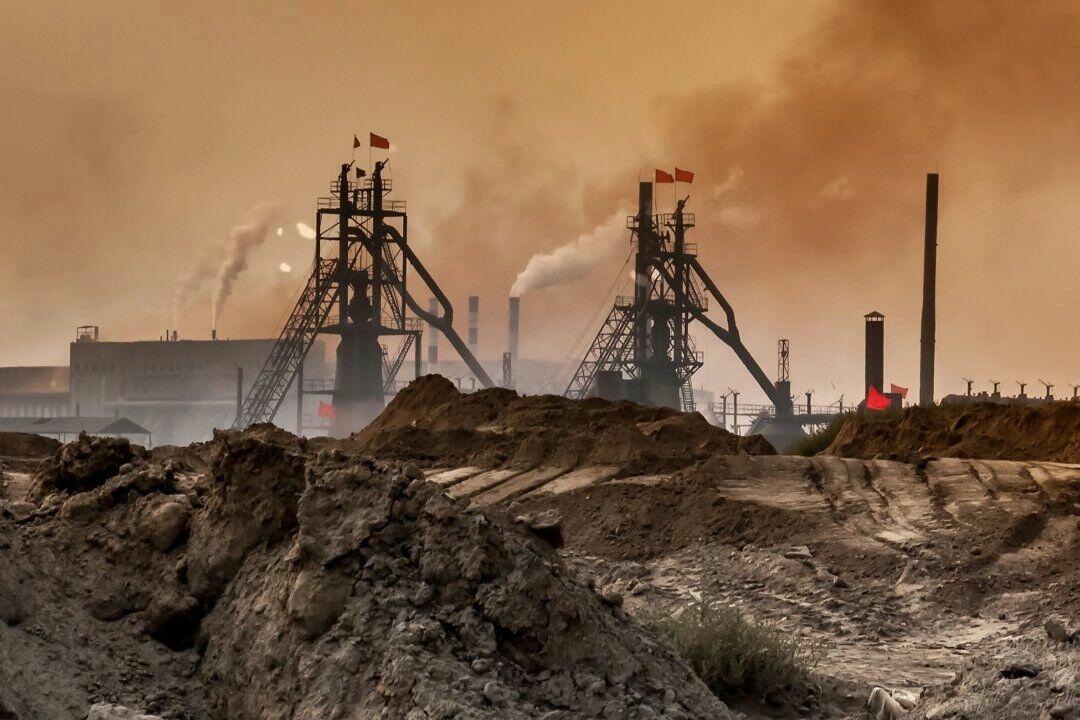
Environmental impact is visible near an industrial plant in Baotou, Inner Mongolia, China, on Feb. 4, 2016. ebenart/Shutterstock

That dependence did not arise because rare earth minerals are scarce. They are not. Nor did it arise because China alone possesses the technical capacity to mine or refine them. It arose from a long chain of economic and political decisions—made largely in free societies—that concentrated production in a country willing to accept costs others would not.

Understanding how that happened is essential to understanding why China’s apparent monopoly is far less “coercive,” and far less durable, than it looks.

Not Rare, Just Hell to Process

Rare earth elements are a group of seventeen metals mostly in the first row below the main periodic table in the lanthanide series (elements 57–71), plus Scandium (Sc, #21) and Yttrium (Y, #39), which share similar properties and are found in the same deposits as the lanthanides. They are “transition metals” with distinctive magnetic and fluorescent characteristics. The first was identified in 1787, and by 1947 all had been identified. (“Earths” is an archaic term for oxides, the form in which these elements are found.)

Think of these elements not as bulk materials but as metallurgical spices, used in tiny quantities to produce dramatic improvements in performance. Add neodymium to iron and boron and get the strongest permanent magnet known. Add yttrium to turbine alloys and jet engines can tolerate extraordinary heat. Europium makes modern display screens possible; terbium enables efficient electric motorssamarium strengthens guidance systems and sensors.

Despite their name, rare earths are widespread. Significant deposits exist in the United States, Australia, Brazil, India, and elsewhere. What makes them challenging is not their scarcity but their processing. The essential problem is that they are chemically almost identical, so how do you devise subtly different processes to separate them? More generally, they are chemically stubborn—for example, often intermingled with radioactive materials, and require dozens—sometimes more than a hundred—separation and purification steps. Each step consumes energy and produces toxic waste, making rare earth refining among the most environmentally punishing metallurgical processes in the modern economy.

The crux of the matter is straightforward. Mining rare earths is manageable. Processing them cleanly and at scale is hard, expensive, and politically fraught.

How China Built Dominance

China’s rise to dominance in rare earths was neither accidental nor inevitable. Beginning in the 1980s and accelerating through the 1990s and 2000s, China’s one-party dictatorship made a deliberate choice to invest heavily in mining and processing capacity. It did so under the conditions of a command economy that differed starkly from those in the West. Environmental controls were lax or poorly enforced. Local opposition carried little weight. State support absorbed losses and encouraged long-term specialization.

The outcome was leadership—at a price paid largely by Chinese communities and ecosystems. In Inner Mongolia, the world’s largest rare-earth mining region, toxic tailings ponds and contaminated water became infamous. Workers there suffered severe health issues from chronic exposure to toxic dust, heavy metals, and radioactive materials. There were—and are—high rates of respiratory, bone, and other diseases, compounded by environmental devastation and working conditions in the heavily polluting industry. Those costs, however, paid by workers and nearby communities for decades, translated into lower global prices. Western manufacturers benefited as consumer electronics became cheaper, and electric motors became smaller and more efficient. Companies like Apple could embed rare earth magnets throughout their products because the marginal cost was low. Magnets made of rare earth alloys like neodymium, the strongest by weight we know, give that satisfyingly decisive “click” when your laptop closes—and have uses in EVs, phones, and defense systems.

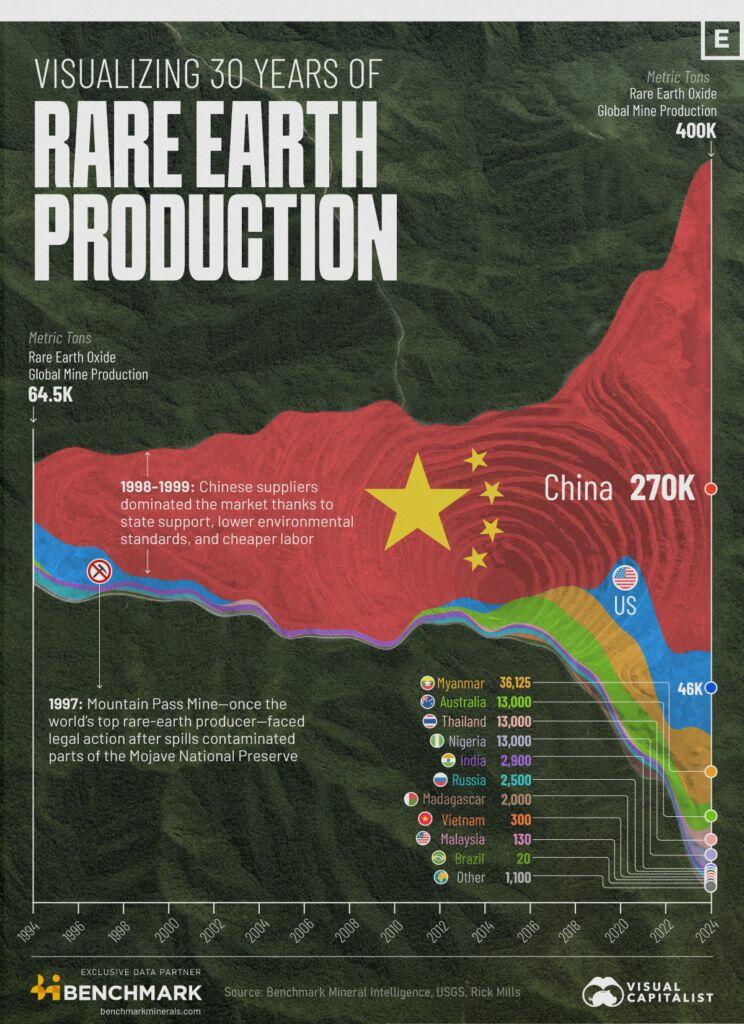
Over time, markets adapted rationally to these price signals. Western processing facilities closed. The United States, once a major producer, allowed its separation capacity to disappear. Even when rare earths were mined in California or Australia, the ore was shipped to China for refining. By the early 2020s, China accounted for roughly 70 percent of global rare-earth mining and more than 90 percent of processing and finished metal production.

Laissez-faire indifference did not produce this concentration. It owed as well to asymmetric regulation. Western governments imposed strict pollution controls and heavy liability that raised domestic costs, while China tolerated environmental and human damage in pursuit of strategic advantage. Markets responded to prices and rules as they existed, and production flowed—over time—to where it was cheapest and easiest to operate, even when that ease was politically manufactured. In this sense, China’s dominance was market-mediated, but politically orchestrated.

(In fact, a few analysts warned for years that China’s tolerance for environmental damage and state-directed investment would translate into strategic leverage. They included Jack Lifton of Technology Metals Research, Dudley Kingsnorth of Industrial Minerals Company of Australia, and researchers at the Congressional Research Service and RAND Corporation—warnings that were widely noted but largely discounted at the time.)

From Specialization to Vulnerability

For years, this arrangement appeared stable. Rare earths are used in surprisingly small quantities, even at scale, and the total global market is modest—comparable in value to the North American avocado market. Shortages were rare. Prices generally trended downward. Supply chains became hyper-specialized, optimized for cost rather than resilience.

The strategic implications were visible, but easy for businessmen and politicians alike to ignore—until China began to test its leverage.

In 2010, during a diplomatic dispute with Japan, Chinese rare-earth exports suddenly slowed. Prices spiked. Panic followed. Although China denied imposing a formal embargo, the message was unmistakable.

A decade later, amid rising trade tensions with the United States, Beijing made its intentions clearer. Export controls were tightenedLicensing requirements expanded. Restrictions on rare-earth processing technologies were imposed.

By 2025, China was openly treating rare earths as a strategic asset, one that could be weaponized in response to tariffs, sanctions, or military pressure. The risks could no longer be ignored. Modern defense systems depend heavily on rare earths. An F-35 fighter jet contains hundreds of pounds of rare-earth materials. Missiles, radar, satellites, and secure communications systems all rely on specialized magnets and alloys for which there are no easy substitutes.

And 2026 continues the uncomfortable dilemma. The United States has the resources, capital, and technical expertise to rebuild domestic capacity—but not quickly. Processing facilities take years to permit and construct. Skilled labor must be trained. Supply chains must be reassembled. In the short run, dependence remained. Trump’s sudden tariff war, framed by Beijing as yet another affront to China’s long-promised redemption from its “century of humiliation,” sharpened the confrontation between what the Chinese Communist Party perceives as a resurgent Middle Kingdom and a declining hegemon.

All of this helps explain the White House’s eagerness to secure Chinese assurances. The deal bought time. It did not solve the problem.

Coercive Monopolies Are Fragile

It is tempting to describe China’s position as a market failure or a natural monopoly. Neither description is quite right. China’s dominance is better understood as a coercive monopoly—one sustained not by insurmountable efficiencies, but by political and regulatory asymmetries. It exists because the command economy of one country accepted environmental and social costs that others rejected, and because governments elsewhere constrained domestic production without fully accounting for strategic consequences.

Coercive monopolies are inherently unstable. They persist only so long as the costs of entry exceed the perceived risks of dependence. Once that balance shifts, the monopoly begins to erode. China’s own actions are now accelerating that shift.

Export restrictions and licensing regimes raise prices and introduce entrepreneurial uncertainty. Those effects are painful in the short term, but they also activate powerful counterforces. Higher prices make alternative supply economically viable. Unreliable supply makes diversification valuable. Strategic risk becomes something investors and manufacturers are willing to pay to avoid. This is the market logic that China cannot escape. By tightening its grip, Beijing invites others to loosen it.

From the American Institute for Economic Research (AIER)

Tyler Durden
Tue, 02/03/2026 – 20:55

via ZeroHedge News https://ift.tt/Ywipr2j Tyler Durden

Sixth Circuit Throws Out DOJ Misconduct Complaint Against Judge Boasberg

Sixth Circuit Throws Out DOJ Misconduct Complaint Against Judge Boasberg

The Sixth Circuit Court of Appeals has dismissed a Department of Justice misconduct complaint targeting U.S. District Judge James Boasberg.

Boasberg, an Obama appointee, has been under fire from the right for multiple partisan rulings against the Trump administration and for approving warrants in former special counsel Jack Smith’s Arctic Frost investigation that allowed investigators to seize the phone records of Republican members of Congress, a decision widely seen as a politically motivated assault on lawmakers aligned with the president.

The misconduct complaint stemmed from remarks Boasberg reportedly made at the March 2025 Judicial Conference. According to the complaint, he warned Chief Justice John Roberts that the Trump administration intended to “disregard rulings of federal courts” and provoke “a constitutional crisis.”

The Trump administration argued those comments crossed ethical lines and violated the judicial code of conduct.

The complaint also pointed to Boasberg’s 2025 ruling blocking Trump’s plan to deport Venezuelan nationals to El Salvador’s CECOT prison under the Alien Enemies Act. That decision fueled accusations that Boasberg harbored an ideological bias against Trump’s immigration enforcement priorities.

Sixth Circuit Chief Judge Jeffrey S. Sutton formally dismissed the misconduct complaint on December 19, 2025, though the decision did not become public until this week. 

In his decision, Sutton emphasized that the federal government provided no credible evidence of the alleged comments. He wrote that the allegations lacked any corroborating source, and “a recycling of unadorned allegations with no reference to a source does not corroborate them.” Sutton added that “a repetition of uncorroborated statements rarely supplies a basis for a valid misconduct complaint.”

Even if the comments attributed to Boasberg were verified, Sutton argued, the Trump administration failed to demonstrate how they violated the Codes of Judicial Conduct. He described the Judicial Conference of the United States as “the policymaking body for the judiciary,” composed of a diverse group of federal judges from across the country appointed by different presidents. The conference addresses a broad spectrum of judicial issues, from budgets and courthouse maintenance to workplace conduct, judicial security, and judicial independence.

Sutton noted that candid discussions among federal judicial leaders on matters of common concern are a core function of the Judicial Conference. “A key point of the Judicial Conference and the related meetings is to facilitate candid conversations about judicial administration among leaders of the federal judiciary about matters of common concern,” he wrote. 

“Confirming the point, the Chief Justice’s 2024 year-end report raised general concerns about threats to judicial independence, security concerns for judges, and respect for court orders throughout American history,” Sutton added. That report, in his view, validated the appropriateness of similar concerns being voiced at the Judicial Conference.

The White House was not happy with the ruling.

Left-wing, activist judges have gone totally rogue,” a White House official told Fox News Digital. “They’re undermining the rule of law in service of their own radical agenda. It needs to stop. And the White House fully embraces impeachment efforts.” 

The White House official also argued President Donald Trump needs the freedom to “lawfully implement the agenda the American people elected him on.” The official argued that judges who repeatedly hand down partisan rulings cross a line from interpreting the law to shaping policy, turning the bench into a political weapon. In doing so, the official said, those judges undermine public trust and surrender any legitimate claim to impartiality. The administration has made clear it views activist judges as a fundamental threat to its ability to govern. 

The dismissal of the misconduct complaint hardly ends Boasberg’s troubles. The White House may still pursue other avenues, and he could still face impeachment. During a Senate Judiciary Committee hearing last month, Sen. Ted Cruz urged the House to begin impeachment proceedings against Boasberg over his controversial gag orders in 2023. 

Tyler Durden
Tue, 02/03/2026 – 20:30

via ZeroHedge News https://ift.tt/qSjd18w Tyler Durden