China Says It Foiled Major Taiwan Spy Network As Taipei Denounces “Malicious Political Stunt” Tyler Durden
Mon, 10/12/2020 – 22:20
In what could be used as a possible pretext for war or at least as huge leverage amid increased threats, state broadcaster China Central Television (CCT) claimed in Sunday reporting that Beijing national security authorities have recently exposed and rounded up hundreds of “espionage cases” in a special operation targeting “infiltration and sabotage” of the mainland by Taiwan’s intelligence agencies.
The mass dragnet operation led to the detention of Taiwanese spies and assets, and uncovering of sophisticated networks in what CCTV has dubbed the “Thunder 2020” operation, the report claimed, which set off a firestorm in Taipei. Taiwan has since angrily denounced the claims as nothing but a “malicious political stunt”.
This included CCTV’s main current affairs show airing bizarre footage of a Taiwanese businessman “confessing” that he spied on People’s Liberation Army exercises at a stadium last year in Shenzhen, making multiple videos of the make-shift staging ground at the sensitive moment of the Hong Kong crisis, as also reported in Bloomberg. Specifically it appears a group which could be in the “hundreds” are charged with gaining Chinese military intelligence related to the Hong Kong crackdown.
CCTV photo of spy suspect Lee Meng-Chu, who was detained in Shenzhen last year.
Identified as Lee Meng-chu, he was accused of “spying into state secrets for an overseas organization and endangering national security,” according to the state TV program. Part of the alleged ‘evidence’ is that he shared his spy photos with Taiwan connected chat groups. He was also alleged to have communicated Chinese state secrets, but again it appears to involve taking photos at a stadium which happened to also have warnings posted saying “no photographs”.
At a moment the Hong Kong protests raged, resulting in a mainland crackdown crisis for which Chinese national troops were mustered in case they were needed, the Financial Times apparently reported the movement of PLA troops based on the alleged Taiwan spy network. However, this also appears a mere case of citizen-journalism driven by clear public interest, which Beijing is labeling ‘espionage’.
Addressing the public confession on state TV, officials of Taiwan’s government condemned the whole spectacle, saying, “The CCP must stop putting words in others’ mouths and framing a case against Taiwanese,” according to Bloomberg.
Broadly, it appears those among the accused acting as ‘spies’ were part of Taiwanese activism showing solidarity with the plight of the Hong Kong pro-independence movement last year, prior to the movement’s squelching by the controversial China-backed national security law which went into effect over the summer.
China’s @CCTV claimed in its prime time show tonight that they have uncovered “several hundred #Taiwan spy cases.” One of the so-called “#Taiwan spy” featured in the program tonight was Lee Meng-Chu, who disappeared after being captured by #China‘s… https://t.co/TnkA5GVyT7
Interestingly, or perhaps quite intentionally, the bombshell accusations by the mainland came just a day after Taiwan’s President Tsai Ing-wen extended a rare olive branch at a moment of military tensions, calling for “meaningful dialogue” with China.
The other big, persistent charge is that of “collusion” between Taiwan and Washington, based especially on weapons sales and fears that formal diplomatic relations could be restored in the near future.
via ZeroHedge News https://ift.tt/3dqaqUT Tyler Durden
The Armenian-Azerbaijani war in the Nagorno-Karabakh region does not show signs of nearing its end despite the humanitarian ceasefire launched in the region. The ceasefire started in the Nagorno-Karabakh region at 12:00 local time on October 10. The ceasefire deal was reached by the Azerbaijani and Armenian sides following long talks in Moscow a day ago. Russia played a key role in forcing the sides to make steps towards the de-escalation.
Azerbaijan and Armenia also formally agreed to begin substantive negotiations of a peaceful settlement of a military conflict over the disputed region of Nagorno-Karabakh that erupted on September 27. These talks will be mediated by the Organization for Security and co-operation in Europe’s Minsk Group of international negotiators. Following the ceasefire agreement, Azerbaijani President Ilham Aliyev said that the first phase of the military operation in the Nagorno-Karabakh region is completed. The Russian diplomatic intervention allowed to put an end to the hottest phase of the military confrontation and force the sides to halt active offensive operations on the ground.
Despite this, the situation on the ground remained very tense. Almost immediately after the start of the ceasefire regime, the sides simultaneously accused each other of violating the ceasefire and of shelling civilian and military targets, and repeated these claims on October 11 and October 12.
Meanwhile, Armenia and Azerbaijan released a new batch of fresh and few days old footage showcasing casualties of each other and making loud statements. In particular, pro-Azerbaijani sources claimed that at least two more S-300 systems of Armenia were destroyed in Karabakh. The released videos accompanying these claims include the moments of the alleged destruction of 35D6 (ST-68U) radars and a S-300 missile launcher of the Armenian military with Israeli IAI Harop loitering munitions near the village of Khojaly in the Khojaly District and the village of Qubadlı in the Kashatagh District.
The 35D6 is a vehicle-carried three-dimensional air surveillance radar system. The range of the radar’s primary functions includes the detection of low-flying targets protected with active and or passive jamming screens, and also the performance of air traffic control. It can be operated as a separate installation as well as a part of the S-300 air-defense system. Nonetheless, if it was the S-300 batteries, as Azerbaijani sources insist, it still remains unclear what these long-range air defense systems were doing so close to the frontline.
Meanwhile, the Armenian military reported that its forces repelled large Azerbaijani attacks in the northeastern and southern parts of the region. The hottest area of the frontline is the town of Hardut. Azerbaijani President Aliyev officially announced that his forces captured it a few days ago. Nonetheless, videos from the ground show that in fact most of the town remained in the hands of the Armenians. Another part of it is now a gray zone, which is not controlled by any side. According to Armenian sources, Azerbaijani troops, supported by Turkish special forces and Syrian militants, tried to capture the town just a few hours before the start of the ceasefire. After this failed attack, Azerbaijani combat drones and artillery units delivered powerful strikes on Hardut and nearby villages, but were not able to force Armenian troops to retreat.
The Armenian Defense Ministry insists that the Turkish Air Force is leading the aerial operations of Azerbaijan. “Turkish aerial command centers, flying within the Turkish airspace, are commanding the Turkish UAV’s operating in the Azerbaijani air force. UAVs, accompanied by six F-16 units, are directly attacking the peaceful population and civilian infrastructure of Artsakh,” the defense ministry spokesman said.
In its own turn, the Azerbaijani side says that it’s just taking the necessary steps to respond to Armenian violations of the ceasefire and strikes on Azerbaijani settlements. The most widely covered incident of this kind took place on October 11, when an alleged Armenian ballistic missile hit Ganja city.
The active offensive phase of the Armenian-Azerbaijani war was put on pause, but the conflict itself does not seem to be nearing its end. Without the real political will of the Azerbaijani and Armenian leadership to reach a ceasefire, the de-escalation of the conflict, without direct intervention of some third party, remains unlikely. Instead, the war has chances to resume with new power in the coming days.
via ZeroHedge News https://ift.tt/3nLkRaf Tyler Durden
No Stimulus, No Problem: One Bank Sees “No Armageddon” Without A New Stimulus Deal Tyler Durden
Mon, 10/12/2020 – 21:40
In recent weeks, many have opined – this website included – that with the US economy careening into a double dip recession (or perhaps depression), it is imperative that Congress and the White House cast aside their differences and pass a substantial, $1.5-$2 trillion stimulus bill or else the US middle class will be hammered as the spending and consumption tailwind from the previous covid rescue bills fades away.
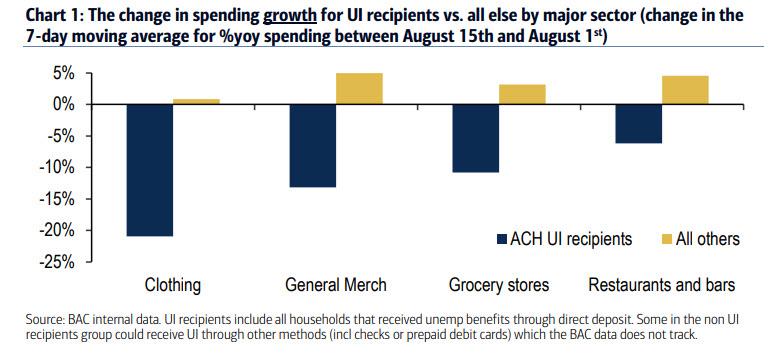
Furthermore as reported previously, there already has been a sharp slowdown in spending among groups who were recipients of expanded Unemployment Insurance benefits – which faded away on July 31 – as the chart from Bank of America shows:
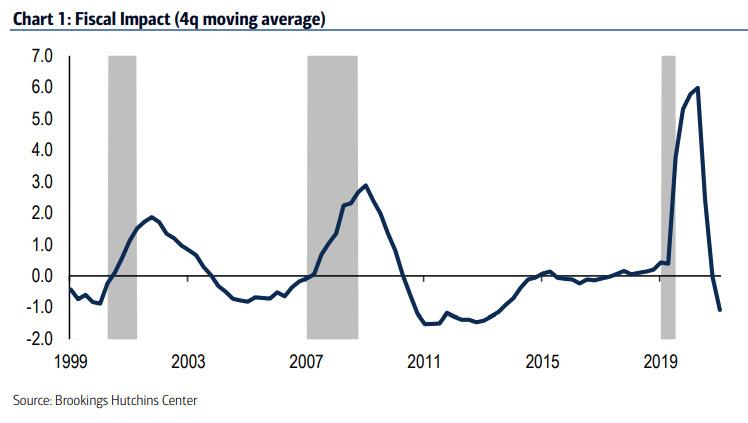
And while there are various other nuances, we concluded several weeks ago that absent a new stimulus, not only will the delayed aftereffects of the existing stimulus come back to haunt the economy…
… but the lack of new spending will result in a massive double whammy crashing the economy in 2021, which averted a full blown meltdown in Q2, but will find itself scrambling in the coming quarters as the mother of all double dips emerges, and which incidentally is also why the market has been sliding for the past two weeks as the reality of an indefinite stimulus-free future looms all too real.
The question, of course, is when will the trapdoor below the US economy open up, resulting in another collapse in output?
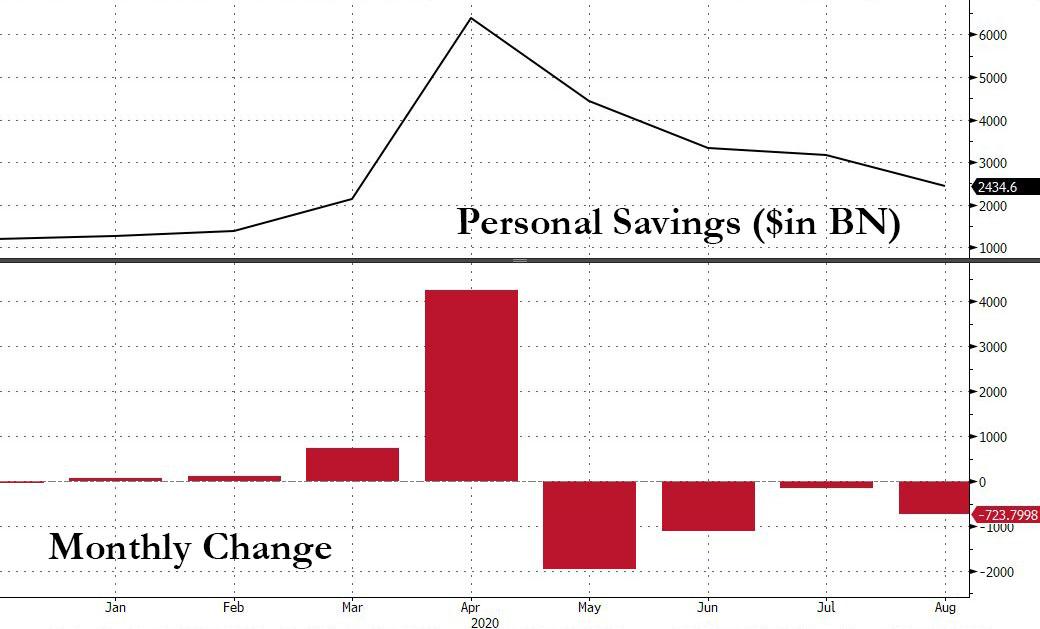
In a subsequent post following the latest personal income and spending data, we noted that in August – the month when the fiscal cliff hit – US consumer spending actually rose even as personal income contracted largely due to the end of the $600/week supplemental unemployment insurance benefits. As a result of this pick-up in spending coupled with shrinking incomes, US personal savings tumbled by an annualized $723 billion to $2.435 trillion, the lowest since March and far below the $6.4 trillion peak in annualized personal savings hit in April.
And while this meant that the personal savings rate declined sharply once again to 14.1% from a high of record 33% in the immediate aftermath of the covid crash, meaning that a whopping 60% of the personal savings built up in the aftermath of the covid fiscal stimulus tide have now been used up, it meant that Americans still have several months of accumulated savings to last them for the next several months.
We then said that as Congress continues to debate and pretend that a new fiscal stimulus bill is just over the corner, the massive savings buffer that was built up in the aftermath of the covid crisis, and which funded much of personal consumer spending in the past two months is now shrinking fast and at this rate personal savings will be back to pre-covid levels in 2-3 month. At that point we concluded that “it is safe to say that unless a new fiscal deal is in place, US consumption will crater unless somehow the millions of unemployed workers who still desperately rely on government stimulus find a job.”
And yet, not everyone agrees that lack of a stimulus would be dire (at least in the immediate term).
While conceding that last week’s developments effectively answered “no” to the question whether a new fiscal stimulus would emerge in the short term, Morgan Stanley wrote on Sunday that “it’s possible that a stimulus delay wouldn’t fully develop into the economic challenge it has the potential to be” and adds that the bank’s economists “now see evidence that US consumption can carry on for longer without fiscal support, given built-up excess household savings.”
Maybe… maybe not. After all, this was precisely the issue we discussed two weeks ago when we concluded that the rate at which savings are being burned is too high and may not last more than 2-3 months, before US consumers face anew crisis.
However, for Morgan Stanley that may be sufficient, and as the bank’s chief US policy strategist Michael Zezas wrote, “this is good news as there are many viable political paths towards stimulus over the next three months. We see three out of the four most likely post-election party configurations delivering stimulus by early 2021.”
Picking up on this, MS’ chief economist Ellen Zentner wrote last week that “progress in the Congress on stimulus negotiations has stalled, and to borrow the words of our policy strategists: inaction speaks louder than words – our strategists no longer see a proactive stimulus in 2020 in the base case.”
Yet in the face of fading fiscal support, “the savings cushion built up from April-July should help smooth consumption, putting real PCE on track to reach pre-Covid levels in 2Q21. We estimate from April through July the US consumer built up a cumulative $12.5tr (annualized) in excess savings (savings above the monthly pre-Covid average).” That said, “the willingness of consumers to draw upon these savings in the coming months is yet to be known, but we believe it will provide an important stop-gap to the loss of government transfers.“
Zentner underscored this point in a Bloomberg interview in which she said that the US economy would certainly “take a hit” without further federal stimulus, but will not head into an “economic armageddon” because while fiscal benefits expired in July spending increased in August and September, thanks to the long tail of the stimulus.
Why is all of this relevant? Because now the biggest question of all is how long can US consumers survive (in some cases literally) without more stimulus, a question whose answer may determine the next president. And while excess savings may allow US households to continue recent spending levels into November and December, it is only a matter of time before these tumble and Congress is forced to pass another stimulus, regardless of their animosity toward Trump and Republicans, even in a contested election context, even if there is no Blue Sweep.
Perhaps the biggest take home here is that Trump, who judging by his latest tweets is suddenly desperate to pass a stimulus deal even if it means meeting the Democrats’ ask of $2.2 trillion, may want to slow down. After all, bailing out insolvent pensions in blue states may generate far more resentment and have much more dire consequences for Trump’s re-election chances than asking Americans to wait an extra month or two before the next inevitable stimulus round is agreed upon by Congress and the next president, whoever he may be (or she, in the case of Kamala Harris). Ironically, the odds of Trump being that president may rise if he refuses to concede to Democrat demands for a giga stimulus, and merely holds firm until after the election.
via ZeroHedge News https://ift.tt/3lS58Vt Tyler Durden
SoftBank’s Vision Fund Plans SPAC, Vows It Is Not Behind Nasdaq Melt-up Tyler Durden
Mon, 10/12/2020 – 21:20
SPACs (it stands for Special Purpose Acquisition Vehicle) raised a ton of money over the summer as the craze that seemingly started with Bill Ackman and Chamath Palihapitiya (already on his third SPAC). It’s already drawing in big-name celebrity investors (Shaq is in the process of launching one), which might evoke unflattering parallels to the ICO bubble of 2018.
On Monday, Rajeev Misra, the head of SoftBank’s ill-fated Vision Fund and Vision Fund 2 (which almost entirely comprises money from SoftBank’s balance sheet) told a Bloomberg reporter during an interview at the Milken Institute’s virtual conference that the Japanese telecoms giant with a VC arm attached is planning to announce its own SPAC within the next 2 weeks.
Twitter users responded to the news with humor, much of it directed at the retail investors who will seemingly inevitably be left holding the bag.
SoftBank was a progenitor of the Silicon Valley valuation mania that peaked with the IPO flops of Uber and Lyft. But it’s perhaps best known for the disaster that was the aborted WeWork IPO. SoftBank backed to a valuation of nearly $50 billion, only to see that number dwindle to less than $10 billion (according to leaked reports) as institutional investors refused to pay anything near that valuation.
With SoftBank hopping on every other investment bankwagon, why not this, too?
Of course, and why not?
Bloomberg: SoftBank’s Vision Fund Plans to Unveil a SPAC in Next Two Weeks
SB could even cite the SPAC success of one of its portfolio companies, Opendoor (which was taken public via one of Palihapitiya’s SPACs) as inspiration.
The amount of money SoftBank expects to dedicate to the SPAC wasn’t revealed, but Misra said the company would try to recruit some outside investors to back the deal.
SPACs have been around for decades, but many are just becoming familiar with the idea. Basically, a sponsor, typically an investor with expertise in a given industry (tech, for example) raises money from institutional backers then enlists underwriters to sell shares of a “blank check” company to the public.
The buyers of these shares aren’t aware of the target when they buy; they’re essentially betting on the sponsor’s reputation. Money raised in the IPO goes into an interest-bearing trust account, and can only be used to hand money back to investors, or complete an acquisition.
Typically, SPAC sponsors have a target in mind before they list. But the beauty of SPACs is they allow investors to quickly raise massive amounts of cash and complete a deal without all of the messy oversight and red tape that typically accompanies an IPO.
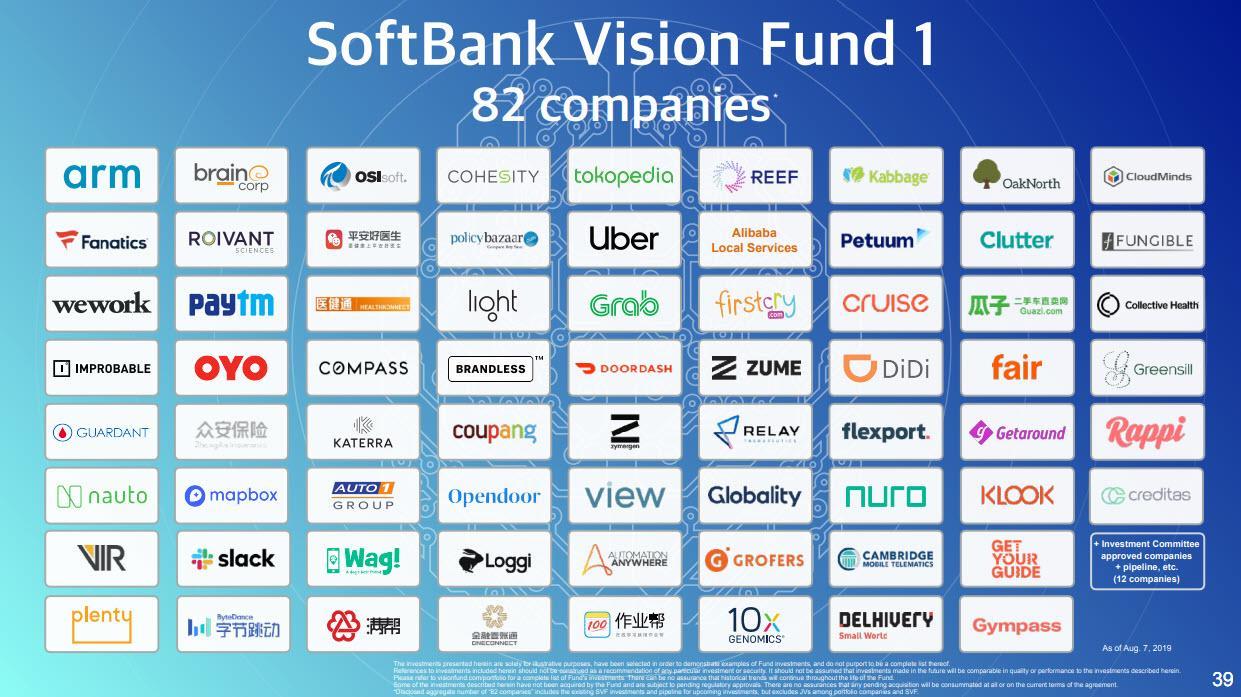
Money for the SPAC would be taken from SoftBank’s Vision Fund 2. Previously, SB’s VF1 backed some 80 companies, including WeWork, Uber, Wag and the Pizza robot (formally known as Zume).
But its disastrous losses last year prompted most of its backers to cut ties with SoftBank, which is probably why Misra now sees a SPAC as a suitable option for the fund.
Moving on: Back in September, we identified SoftBank as the rumored “Nasdaq Whale”, the mammoth trader sinking billions of dollars into Nasdaq 100 call options to force dealer buying of the underlying and drive the Nasdaq on a torrid, but entirely manipulated, summer rally that drove the tech heavy index to fresh all time highs.
When asked about the incident, Misra claimed the press reports had greatly exaggerated SoftBank’s role. He chalked SoftBank’s call-buying up to “diversification”, using the proceeds from sales of some of its Alibaba stake (it also recently agreed to sell Arm to chipmaker rival Nvidia).
Some attributed a recent run-up in the value of tech stocks to SoftBank’s purchases. Misra dismissed that idea in the interview Monday.
“Are we buying a few billion of other stocks to diversify away from the Alibaba we sold in the past six months?” Misra asked.
“We’re still sitting on a lot of cash. It’s a liquidity-management strategy, it’s a diversification strategy.”
“Nobody buying $10 billion of Nasdaq over a few weeks is going to move the Nasdaq. We’re not even a dolphin; forget being a whale.”
Misra must be relying on the ignorance of his audience here, because $10 billion in Nasdaq calls – with a notional value far higher – purchased strategically and during relatively illiquid periods in the trading day could potentially induce dramatic swings in markets.
As speculation turns to the object of SoftBank’s desire, one twitter user remarked that SoftBank may have finally found a way to reshape one of its most embarrassing failures.
Total proceeds from special purpose acquisition companies raised $10 billion in August after a record of $10.5 billion in July, compared to a total of $17 billion funding from traditional initial listings for the past two months, according to data from Refinitiv. More than $40 billion via SPAC deals has already been raised on US stock exchanges this year.
Then again, perhaps SoftBank Chairman Masayoshi Son sees an opportunity to immediately restore his sullied reputation by turning around one of the most ill-conceived of the last decade’s richly funded startups: Quibi.
via ZeroHedge News https://ift.tt/36XBIke Tyler Durden
Johnson & Johnson Latest To Halt COVID-19 Vaccine Trial Over Unspecified Illness Tyler Durden
Mon, 10/12/2020 – 21:14
Yet another high-profile Phase 3 vaccine trial has been temporarily halted after one of the participants developed a suspicious illness.
According to a report published Monday night by STAT News, Johnson & Johnson has informed participants and researchers that its 60,000-person trial would be temporarily paused as the company and the Data and Safety Monitoring Board, the organization overseeing all the US COVID-19 trials.
JNJ confirmed the pause when contacted by STAT, though it offered no details about the illness or the patient.
Contacted by STAT, J&J confirmed the study pause, saying it was due to “an unexplained illness in a study participant.”
The company declined to provide further details. “We must respect this participant’s privacy. We’re also learning more about this participant’s illness, and it’s important to have all the facts before we share additional information,” the company said in a statement.
According to STAT, the DSMB was convened late Monday evening to start looking into the case. J&J said that in cases like this, “it is not always immediately apparent” whether the participant who experienced an adverse event received the experimental vaccine, or a placebo.
Pauses like these aren’t uncommon in vaccine trials.
“If we do a study of 60,000 people, that is a small village,” the source said. “In a small village there are a lot of medical events that happen.”
But these trials are drawing more scrutiny ever since the AstraZeneca-Oxford trial was put on hold by regulators in the UK after a participant was sickened with symptoms of what was believed to be transverse myelitis, a serious spinal issue. Trials resumed in the UK, India and elsewhere days later, but in the US, an AZ trial remains on hold due to an unspecified issue. Both AZ and US regulators have been suspiciously tight-lipped.
Already, public health officials in the US, Europe and around the world are worried about waning confidence in the vaccine, with some surveys showing that roughly half the public would rather not take it.
In a research note published earlier, analysts at Goldman Sachs wrote that trust in the vaccine could be a serious barrier to its ultimate eradication. “We think that the biggest challenge to ultimately lowering the disease burden and virus circulation to very low levels will be convincing the broad population to take the vaccine. Our base case assumes such broad uptake but this will likely require a safe and very effective vaccine, trust in the approval and rollout process, no out-of -pocket costs, and effective public and community campaigns.”
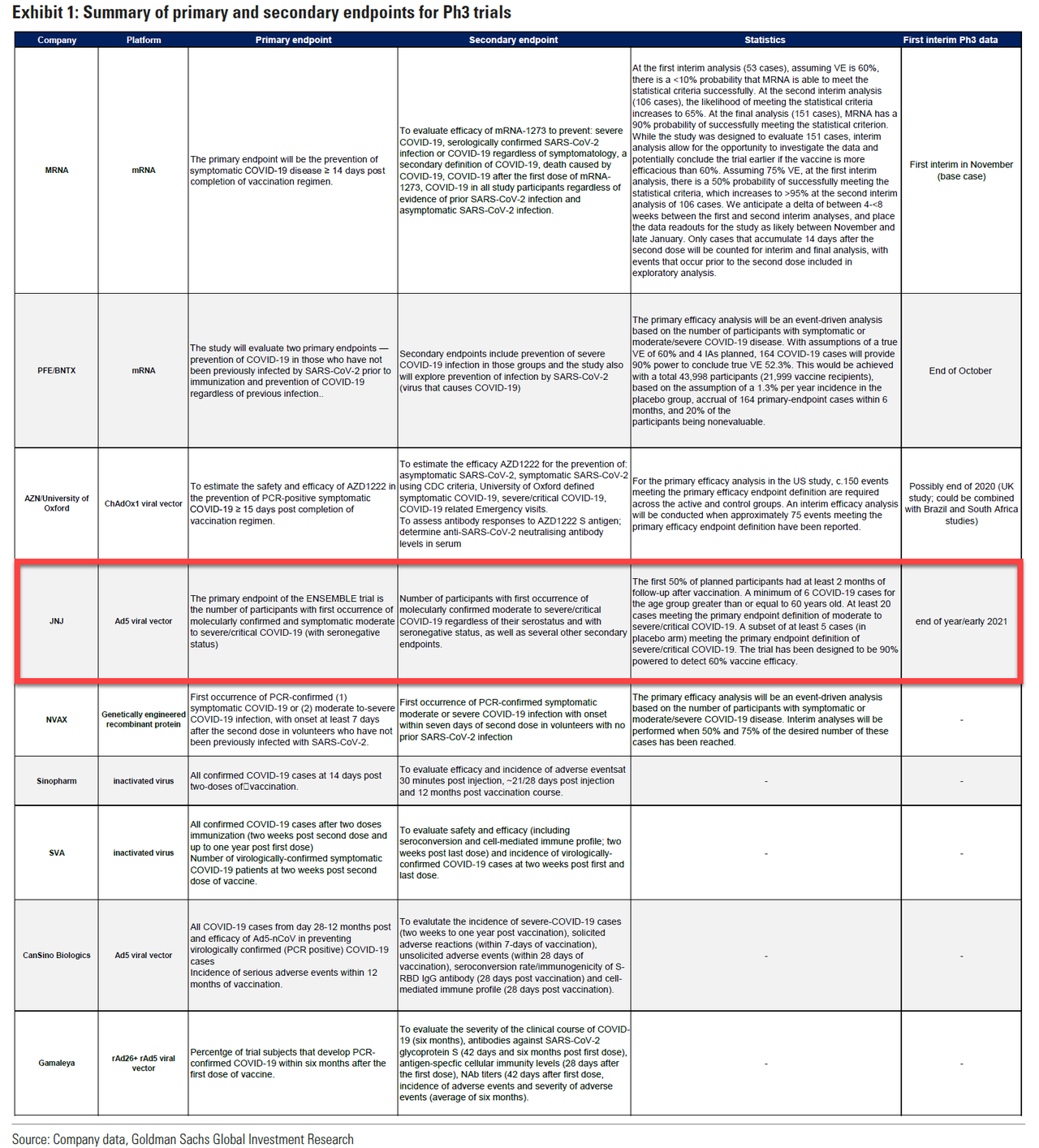
JNJ is using an adenovirus vector, like several other top vaccine projects.
Futures ticked lower on the news.
But there was no evidence of the intense selling pressure that followed news about the initial AstraZeneca-Oxford vaccine project halt.
via ZeroHedge News https://ift.tt/31hbea3 Tyler Durden
NBA Finals Game 6 Saw Ratings Crash 66% Despite Being Season Finale Tyler Durden
Mon, 10/12/2020 – 21:00
The last game of the NBA Finals – arguably the most important game of any NBA season – posted ratings that were about 66% lower than last year’s Game 6, according to Breitbart. It is the latest bad news in a stunning collapse in ratings for the league and, specifically, for the NBA Finals series this year.
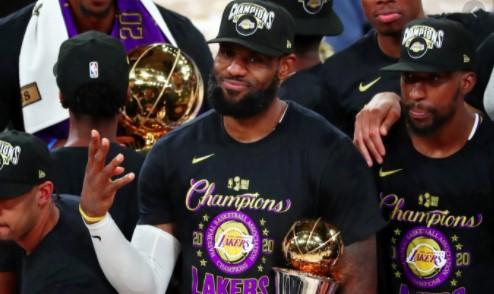
For comparison, Sunday night’s Seahawks versus Vikings regular season NFL game, featuring one team that hasn’t won a game all year, had nearly twice the views of the game where LeBron James clinched his fourth NBA Championship, according to ShowBuzzDaily.
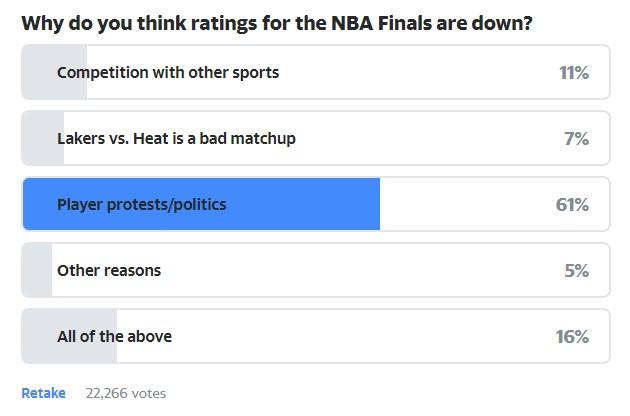
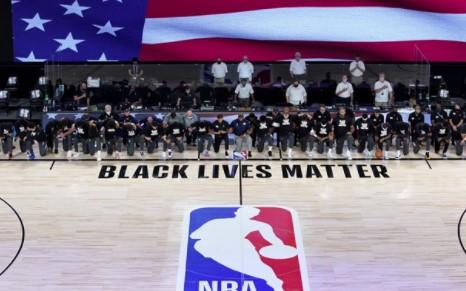
Recall, just days ago we noted that “Player Protests/Politics” were cited as a driving force as to why people were abandoning watching the NBA. In a recent poll on Yahoo Sports with 22,266 responses, people were asked why they thought the NBA’s ratings had dropped off. Player protests/politics was the overwhelming favorite, at 61%, as to why people are turning away from the NBA.
We also noted that Game 3 of the finals averaged just a 3.1 rating and 5.94 million viewers, making it “the least watched and lowest rated NBA Finals game on record,”according to Yahoo Sports. Days prior to that, we noted that Game 2 also saw a ratings collapse of 68% to all time lows.
Game 1 was the lowest viewed finals opener in history.
There really doesn’t seem to be much of a spin that the NBA can put on the terrible ratings, other than the league has simply lost the interest of many who would have once tuned in. In fact, one of the league’s most “outspoken” voices on oppression and racism, LeBron James, should have been the feature draw for this year’s finals.
Instead, it appears that he was exactly what is turning viewers away.
We have also been documenting the recent ratings collapse that the NFL has suffered in the midst of turning its league into a political movement over the last few months.
In early October the NFL reached out to players, telling them “not to worry” about the decline in ratings. Also in denial, they blamed the Presidential race for the drop in ratings, telling players: “The 2020 presidential election and other national news events are driving substantial consumption of cable news, taking meaningful share of audience from all other programming. Historically, NFL viewership has declined in each of the past six presidential elections.”
via ZeroHedge News https://ift.tt/3lE4zOB Tyler Durden
This is what that ‘terror’ looks like in real-life for a brain-washed media crying “nooooo!” when WH Chief of Staff Mark Meadows dares to remove his mask over 10 feet away from them…
There is everything to fear, especially fear itself, America!
And what is it you should be so terrified of? Here are the new CDC reported fatality rates explained for average joes…
WARNING – trigger alert for those who do ‘old math’ and not new ‘political math’…
“If you accidentally thought for yourself, you’d realize the actual COVID-19 fatality rate is many times lower than the original predictions that were used to justify the lockdowns…
…but let’s not do the math… because we’ve got an election coming up!”
Sometime to have to laugh, or you’ll just cry!
via ZeroHedge News https://ift.tt/3jTdlYx Tyler Durden
The mainstream media have always skewed left in the modern era, but that didn’t mean they were parasitic vampires who fed on the misfortune of others. When Ronald Reagan – the most conservative modern president elected prior to Donald Trump — was wounded by a would-be assassin’s bullet in 1981, the media reported the event as a matter of national and historic significance. There was no glee and no speculation about President Reagan’s karmic responsibility for his near-death experience.
As a young liberal myself then, I experienced the horror of seeing our president shot on camera and the joy of seeing our president and his wife, Nancy, wave from the window of his hospital room several days later. The shooting was a moment of unifying grief, and the rapid recovery was a moment of triumph, not just for President Reagan, but for our people as a whole. Politics be damned.
Fast-forward four decades. Welcome to “Twilight of the Media: The Week of the Vampires.” When Donald Trump revealed that he had tested positive for coronavirus, the media spoke with almost one voice: Trump got what he deserved. That was the beginning of a week that represents what one can only hope is the low point in media distortion and Fake News, but may also justifiably be described as “situation normal.” It certainly made clear to me and many others what is at stake on Nov. 3.
Pundits often claim that the 2020 election will be a referendum on Donald Trump, but that is not the case. It should now be apparent — if it wasn’t already — that the upcoming election is a referendum on the media, and their dangerous role as self-appointed arbiters of the truth. And if the media wins, Katie bar the door.
Like the shadows on the wall of Plato’s Cave, the spectral emanations of the Fake News Media tell us a version of the truth, but it is a truth that has been refracted through a distorting lens that makes everything normal look ugly and everything “Trump” look evil.
It is hard for anyone who is not chained to a rock to fathom how millions of people can accept the anti-Trump narrative that is projected 24/7 from the studios of CNN, MSNBC, CBS, NBC and the rest. Don’t these millions of people — these “likely voters,” according to multiple polls – have any perspective?
Well, no, they don’t.
The problem is that so many people – smart people! – are captive audiences of the incredibly biased and hate-filled “news” coverage typified by CNN. By not exercising their God-given right to turn the channel, they are kept blissfully unaware that they are being deprived of vital information that doesn’t feed the Never Trump narrative.
Take the recent release of till-now-hidden documents revealing that the CIA, the FBI and President Obama all knew in 2016 that Hillary Clinton had a plan (as far back as July 28 of that year) “to vilify Donald Trump by stirring up a scandal claiming interference by the Russian security service” — and those sworn government officials said nothing whle furthering the Trmp collusion narrative.
Among other things, that news discredits the two-year long special counsel probe, justifies the firing of FBI Director James Comey, and means Donald Trump was right all along when he called the Russia Hoax the greatest political scandal in U.S. history.
Except the majority of the American public probably never even heard about these newly declassified documents. The three major traditional nightly news shows on CBS, ABC and NBC knew that the story vindicated President Trump and would hurt Joe Biden, yet they didn’t run it. And when CNN or MSNBC referenced the documents, they magically turned them into weapons against Trump. For instance, when Jake Tapper interviewed former CIA chief John Brennan, whose handwritten notes were the smoking gun that confirmed Clinton had manufactured the plot to destroy Trump, Brennan had the audacity to claim that it was Trump who was playing politics.
If the media can keep a story of this much significance buried, then clearly they are — just as President Trump claimed — acting as “the enemy of the people.”
But let’s get back to the president’s diagnosis with COVID, and his speedy recovery from it. It is a case study in media manipulation.
The New York Times was typical when it declared that “If [Trump] becomes sick, it could raise questions about whether he should remain on the ballot at all.” MSNBC’s Joy Reid raised the possibility that Trump might be faking COVID to get out of future debates with Joe Biden! Tapper condemned the president for his “wanton disregard for human life.”
When it was apparent that the president did not intend to cooperate with the “divine retribution” narrative, when it was increasingly evident that he might even recover quickly from the Chinese virus, the radicals in newsrooms upped the ante. Trump was a “super-spreader.” Not only that, he was a ghoul who had engineered the deaths of more than 200,000 Americans and must somehow be held accountable. There was talk yet again of impeachment. There was talk of invoking the 25th Amendment. Anything to make Trump look bad.
One of the most despicable moments in media malevolence came when President Trump reached out to the American people to thank them for their love and concern as he received treatment at Walter Reed National Military Medical Center. Hundreds of decent, caring people had gathered outside the hospital for days with signs of support for their president and just to gather in prayer for him. Again, millions of Americans probably never saw the scene or only heard slanted reports that these must be racist right-wing wackos who hadn’t got the memo about Trump being a menace to society.
But on Sunday, Oct. 4, the vigil suddenly became big news. Not because it represented an outpouring of love for our president, but because — according to the Fake News Media — Trump had used the crowd and the Secret Service for a self-aggrandizing “photo op” when he briefly left the hospital and drove past the well-wishers to thank them for their support.
Photo op is an interesting expression. You might well wonder what the difference is between a photo op and a historic moment when a figure of note has his photograph taken as a cherished record of the event. The answer is that if it involves Trump, it’s a photo op.
When I first heard about this impromptu gathering at Walter Reed, I sought out coverage of the event on the Internet. Thank God for Right Side Broadcasting, a little outfit based in Auburn, Ala., that has traveled the countryside since 2015 to cover President Trump’s rallies and appearances when major networks couldn’t be bothered. I watched as RSBN hosts interviewed those in attendance about why they were there and why Donald Trump meant so much to them.
These were the people whom the president wanted to thank — not a bunch of white supremacists at all. There were Filipinos for Trump, Somalians for Trump, Latinos for Trump, Vietnamese for Trump, Blacks for Trump. It was the American melting pot, and no network had any interest in showing them. It was CNN and MSNBC that turned them into props, not the president. As long as they were filmed from across the street, they could be characterized as hateful racists, plus our nation’s elite reporters would not have to get up close to all those “smelly,” maskless Trump voters who were no doubt carriers of COVID or some other disease.
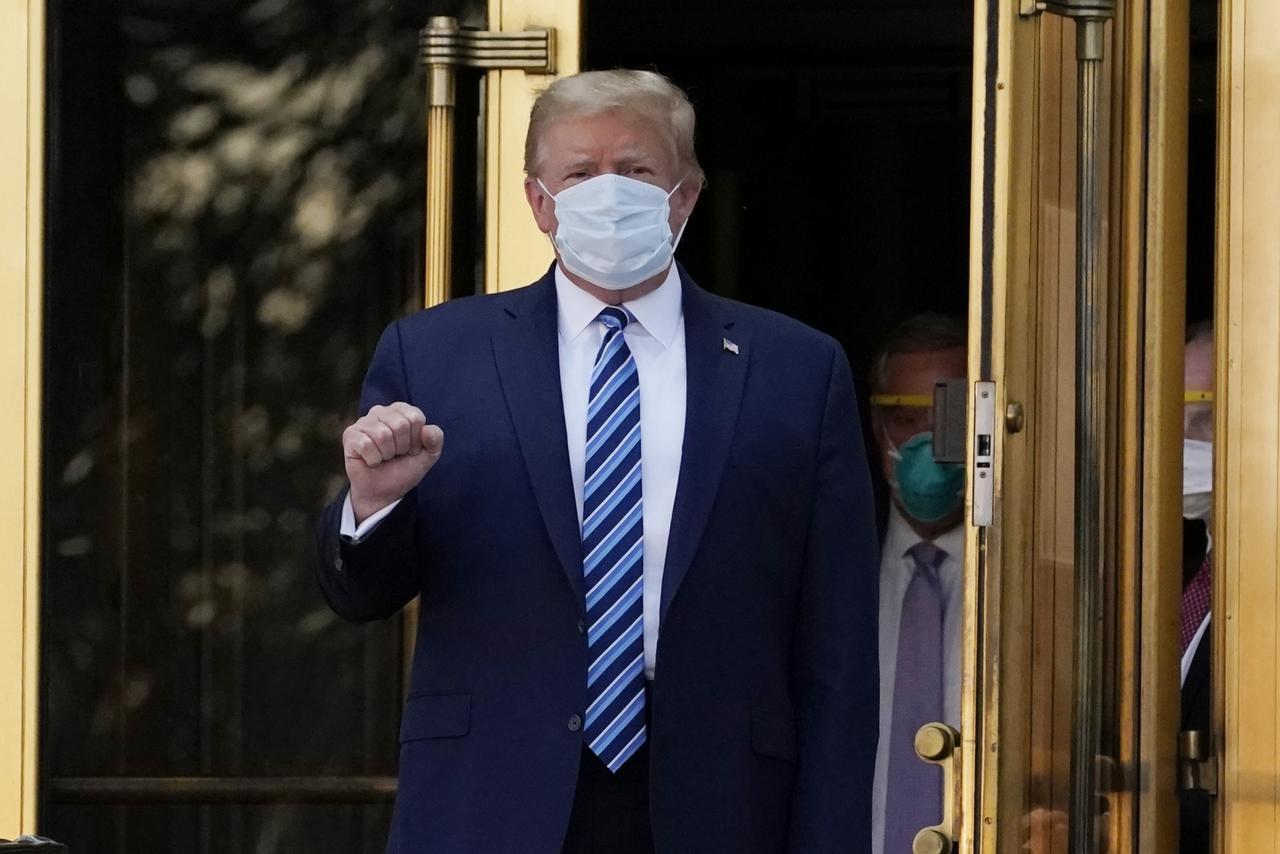
One day later, the president was found by his doctors to be healthy enough to return home to the White House. This was the final straw, and the fourth estate broke under its weight. Worst of all was the moment when President Trump rose, phoenix-like, out of the ashes of his pundit-celebrated “date with destiny.” God was supposed to punish him with a slow and miserable death for not wearing a mask, but instead the president flew away in a helicopter and returned to the White House with a message for everyone who had been living in fear of COVID for the past nine months: Don’t be afraid. “Don’t let coronavirus dominate you.”
How dare he! If people had died from coronavirus, then certainly we must be afraid of it, the media voices told us. How dare he ride Marine One back to the White House? “A photo op and a power trip. A literal power trip,” said CNN’s Brian Stelter about the helicopter ride, and then he compared the moment to “what strongmen do in autocratic regimes” — as if the White House press corps had not seen the president ride Marine One hundreds of times before. That set the tone for the critiques that would follow. When President Trump waved from atop the steps of the White House and saluted Marine One as it departed, his one-time aide Anthony Scaramucci called it an American Mussolini moment. “We’ve never had a president stand on that balcony and do what he just did,” Scaramucci said inexplicably. Say what? Is waving now considered a symbol of fascism?
It was Steve Bannon who first classified the mainstream media as “the opposition party.” He was right, and if the media bloodsuckers have their way, then Trump will be defeated decisively on Nov. 3. But if that happens, it doesn’t tell us anything about Trump. What it really means is that the American public is no longer in charge. How can they be when they are entirely dependent on the shadowy half-truths and outright lies of the mainstream media to make decisions?
I wrote a book called “The Media Matrix” to describe the veil of deception that controls our social and political conversation these days, but at the time I still thought the American public could fight back and reclaim control. Now I’m not so sure. It was Marshall McLuhan who said many years ago that the medium is the message, and in the case of the 24/7 news coverage on TV and Internet, the message is power — raw, unfiltered, corrupting. President Trump exposed it, but in the end he may not be able to defeat it.
via ZeroHedge News https://ift.tt/2FmVla4 Tyler Durden
Why Did Leon Black Pay Jeffrey Epstein $50 Million? Tyler Durden
Mon, 10/12/2020 – 19:40
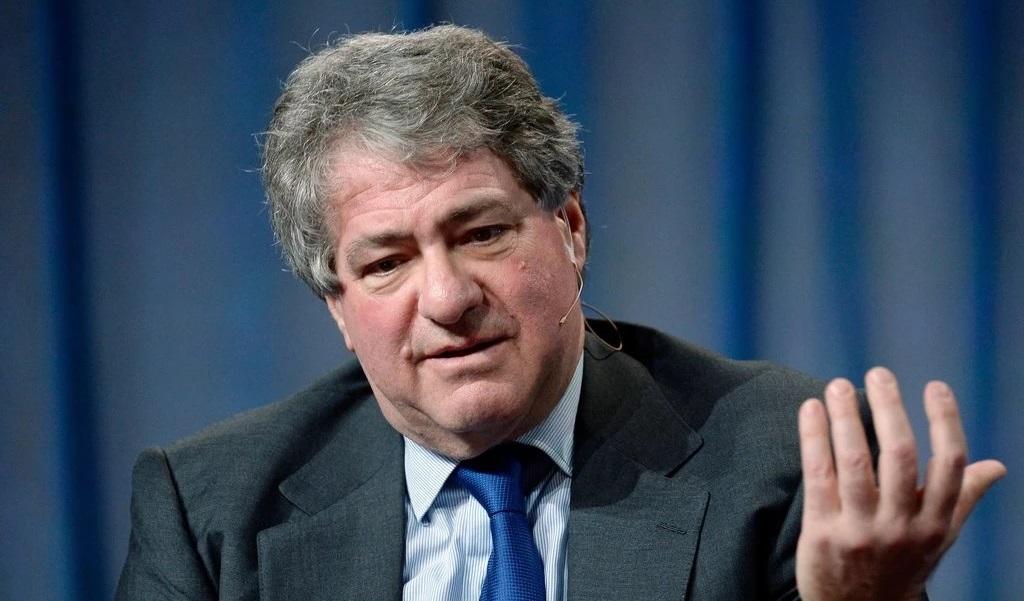
Billionaire Leon Black gave his longtime pal Jeffrey Epstein $50 million dollarsafter the deceased financier got out of prison for pedophilia.
The transfer of funds was made in at least two payments, one of which Deutsche Bank flagged as unusual, according to the New York Times, citing ‘two people familiar with the matter.’
Epstein served as a director on the Leon Black Family Foundation for over a decade, and also accepted a $10 million donation for his Gratitude America foundation from Black’s “BV70 LLC” charity.
“It is true that I paid Mr Epstein millions of dollars annually for his work,” said Black in a Monday letter responding to the Times report. “It also is worth noting that all of Mr Epstein’s advice was vetted by leading auditors, law firms and other professional advisors” Black added – noting that he had ‘once’ picnicked on Epstein’s private island with his family, and that he visited the dead pedophile ‘from time to time’ at his Manhattan townhouse.
Black’s spokeswoman claims the two stopped communicating after a “fee dispute” in 2018, and that Black “deeply regrets having any involvement with him.”
“There has never been an allegation by anyone, including The New York Times, that Mr Black engaged in any wrongdoing or inappropriate conduct,” she added.
In August, US Virgin Islands attorney general Denise N. George notified a local court that she would issue civil subpoenas to Black, founder of Apollo Global Management, as well as several entities he’s tied to. The subpoenas sought financial statements and tax returns – including those for Black Family Partners and Elysium Management – which oversee some of Black’s $9 billion fortune.
Black and his entities paid millions in fees to Epstein’s “Southern Trust Company,” which he established in the Virgin Islands in 2013, according to the Times.
Other subpoenas will go to Apollo as well as entities that help manage Black’s extensive art collection, according to an August report in the Times. It is unclear whether those subpoenas have been issued.
In a 2019 letter to Apollo investors, Black claimed to have had a “limited relationship” with Epstein (who managed his family’s foundation), and was “completely unaware” of conduct claimed in new allegations against the pedophile.
$50 million seems like a lot for someone he had a “limited relationship” with, while it remains unclear exactly what services Epstein performed for such a princely sum.
via ZeroHedge News https://ift.tt/3nM0xG3 Tyler Durden
Waymo just announced its plans to deploy vehicles without backup safety drivers, making a major milestone in a sector that has witnessed many ups and downs and stops and starts. The company, the self-driving unit of Google’s parent Alphabet, said it will soon expand its driverless ride-hailing service to include the general public in Phoenix, Arizona.
“Beginning today, October 8, we’re excited to open up our fully driverless offering to Waymo One riders. Members of the public service can now take friends and family along on their rides and share their experience with the world,” the company said in a blog post.
For now, Waymo’s service will still be limited to Phoenix, but the company hopes for that to change in the future. Waymo, and other autonomous vehicle developers, chose Arizona for testing due to an apparent lack of restrictions and regulatory hurdles.
Still, offering rides to all customers is a huge advantage over its competitors. Being first always helps with reputation – and revenue. Waymo’s competitors are still in the testing phase.
The company’s CEO John Krafcik said in a statement that Waymo is looking for the opportunity to bring its driverless services to the company’s home state of California next.
Waymo started its driverless car development in 2017.
The following year, the company joined with carmaker Jaguar and announced a deal that included up to 20,000 Jaguar I-PACE electric vehicles in its upcoming autonomous fleet.
The partnership, worth up to $1.5 billion, is a further mark of Waymo’s ambition in the race against time to beat Uber to the definitive self-driving finish line for a driverless ride-hailing service. Jaguars are set to join the Chrysler Pacifica, which has already been used extensively in testing for the company’s autonomous driving technologies.
Waymo had previously said it was discussing collaboration with Honda; however, that relationship failed to blossom and Honda recently declared its intention to bring its own fully autonomous vehicle to the market by 2025.
Waymo is competing with several other players to deploy such vehicles for the masses, but it’s not as easy as they all thought it would be years ago. Pandemic also slowed down the progress.
Ford is also collaborating with Germany’s Volkswagen and Argo AI to introduce autonomous vehicle technology in the U.S. and Europe. Due to the pandemic, Ford said it will delay its launch plans until 2022.
Another of Detroit’s Big Three, General Motors, unveiled its first driverless vehicle in January and announced it would start delivering the first vehicle in the next five years.
Last September, Hyundai said that it would form a $4-billion joint venture with Aptiv to advance the development of production-ready autonomous driving systems. The company announced it would start mass production of driverless cars in 2024.
As for Uber, sued by Waymo for stealing its trade secrets and settled for $245 million, it’s self-driving division, Advanced Technologies Group (ATG), has had a tough time since a fatal crash involving one of its self-driving cars in 2019.
via ZeroHedge News https://ift.tt/34NOShf Tyler Durden