Belarus President Alexander Lukashenko has run the formerly Soviet country since 1994, but his latest victory, following a Potemkin election on August 9, may be the beginning of the end for the man European media often call “Europe’s last dictator.” Within days of the vote, formerly loyal factory workers refused to allow him to speak, employees of state-run media walked off the job, and citizens packed the streets to demand Lukashenko step down.
from Latest – Reason.com https://ift.tt/3lpkkZF
via IFTTT
Regeneron Rallies After Seeking Emergency-Use Approval For Antibody Cocktail Taken By Trump Tyler Durden
Thu, 10/08/2020 – 06:26
Shares of Regeneron are ripping higher Thursday in premarket trading, building on its gains from Wednesday evening, after the company submitted its COVID-19 antibody cocktail to the FDA for emergency-use approval.
The news follows President Trump’s full-throated endorsement of the therapy, which the president credited for his speedy recovery, calling the treatment a “cure” for COVID-19.
Trump last night declared that he wants everyone who needs the treatment to get it, and added that the White House wants to “make it free for everyone.”
Of course, Regeneron isn’t the first drugmaker to file for an EUA from the FDA: Eli Lilly asked for approval for its antibody cocktail, which it said had been found to reduce viral load, symptoms and hospitalizations in patients.
via ZeroHedge News https://ift.tt/3dlmiI1 Tyler Durden
Belarus President Alexander Lukashenko has run the formerly Soviet country since 1994, but his latest victory, following a Potemkin election on August 9, may be the beginning of the end for the man European media often call “Europe’s last dictator.” Within days of the vote, formerly loyal factory workers refused to allow him to speak, employees of state-run media walked off the job, and citizens packed the streets to demand Lukashenko step down.
from Latest – Reason.com https://ift.tt/3lpkkZF
via IFTTT
Mysterious Robot Spy Vessel Found Near UK Submarine Base Tyler Durden
Thu, 10/08/2020 – 05:45
A mysterious autonomous surface vessel recently washed ashore on the Isle of Tiree in Scotland, not far from the UK’s nuclear submarine base at Faslane, reported Forbes.
The local HM Coastguard Rescue Team shared three pictures of the vessel on their Facebook page on Sept. 28, urging anyone with information about the “object’s origin and owner” to contact them:
The team were called today to reports of an object in the water, once on scene we secured the item. We are currently trying to find out some more information as to the origin and owner of the object. If anyone has any information please get in touch. Remember if you see something out of place on the coast please dial 9️⃣9️⃣9️⃣ and ask for the Coastguard. – HM Coastguard Rescue Team’s Facebook page
Forbes said the vessel is a Wave Glider, manufactured by US defense contractor Liquid Robotics, is capable of traveling thousands of miles with mission endurance of one year. The vessel is currently in use with the US Navy and Britain’s Royal Navy and other government agencies and scientific researchers.
Forbes makes it clear the Wave Glider found was likely on a spy mission:
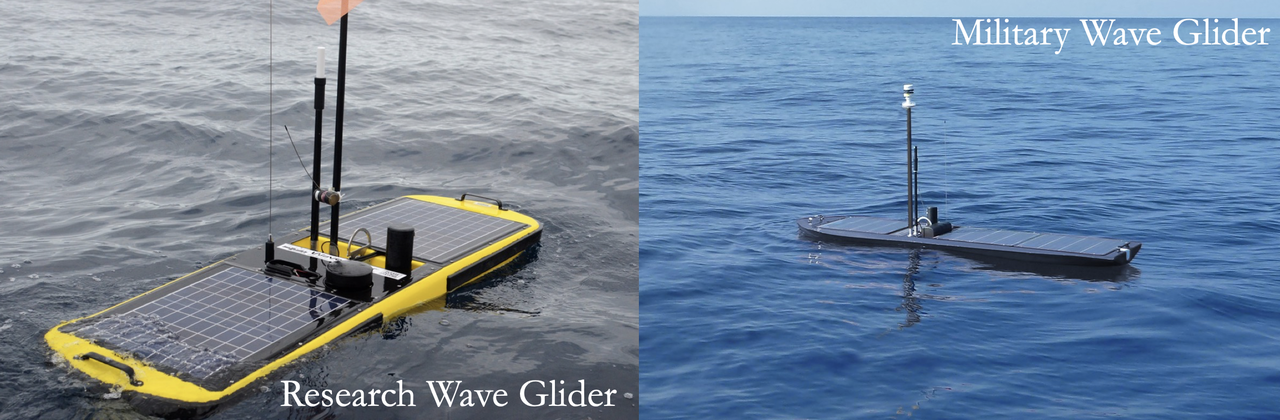
There are a couple of unusual features about this particular Wave Glider which suggest a military rather than scientific mission. One is that is grey rather than the usual bright yellow, with no pennant to make it easier to see. There are no navigation lights, which are compulsory for any vessel sailing at night under UK law, or a radar reflector. Without these aids, the glider, which lies flat on the water, would be extremely difficult to spot. – Forbes
Spot the differences in Wave Gliders…
Forbes contacted Britain’s Ministry of Defence (MoD) and asked about the vessel’s owner. An MoD spokesman responded by saying: “The vessel is not ours.” Neither did the US Navy nor Liquid Robotics respond to Forbes’ request to speak about the issue.
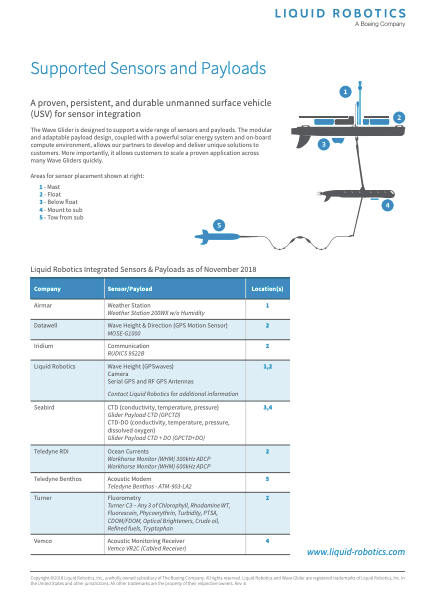
Forbes said the “biggest users” of Wave Glider are the military. Here’s a tear-off sheet via Liquid Robotics of support sensors and payloads of the vessel:
Now the question remains, what was the mysterious autonomous spy boat doing so close to the main highway for UK submarine operations from Faslane?
via ZeroHedge News https://ift.tt/2SIGUA5 Tyler Durden
Over six thousand scientists and doctors have signed a petition against coronavirus lockdown measures, urging that those not in the at risk category should be able to get on with their lives as normal, and that lockdown rules in both the US and UK are causing ‘irreparable damage’.
Those who have signed include professors from the world’s leading universities.
Oxford University professor Dr Sunetra Gupta was one of the authors of the open letter that was sent with the petition, along with Harvard University’s Dr Martin Kulldorff and Stanford’s Dr Jay Bhattacharya.
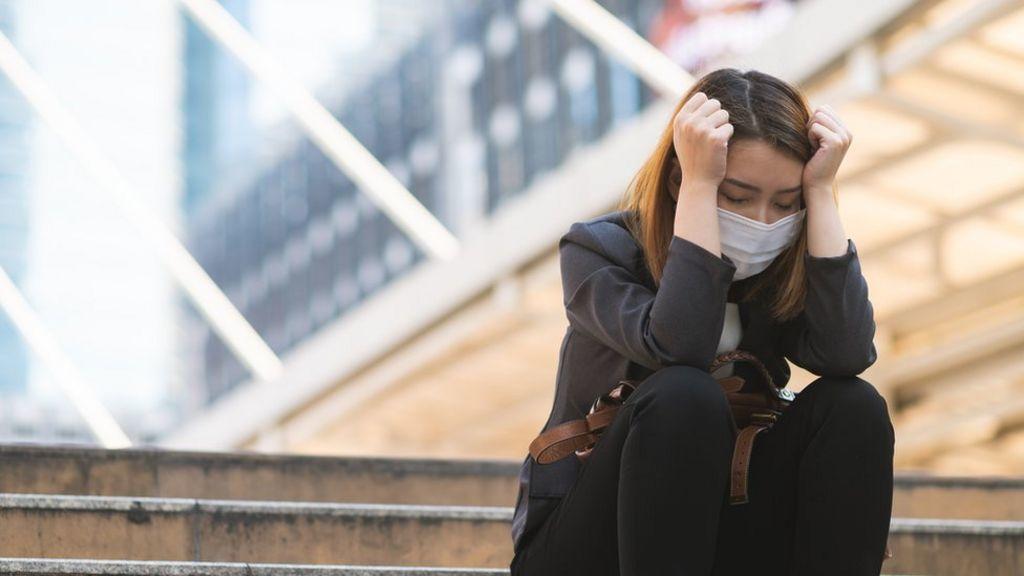
It declares that social distancing and mask mandates are causing ‘damaging physical and mental health impacts.’
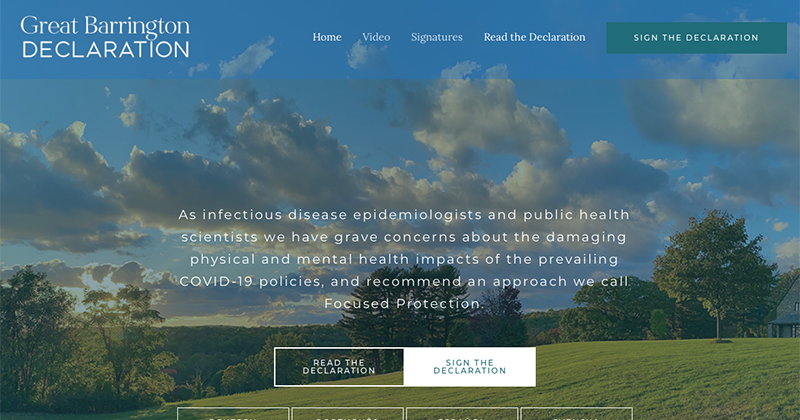
The petition, dubbed the Great Barrington Declaration after the town in Massachusetts where it was written, has been signed by close to 73,000 members of the public at time of writing, as well as over 4,700 medical and public health scientists and around 3,200 medical practitioners.
“Those who are not vulnerable should immediately be allowed to resume life as normal,” it notes, adding “Keeping these [lockdown] measures in place until a vaccine is available will cause irreparable damage, with the underprivileged disproportionately harmed.”
“Current lockdown policies are producing devastating effects on short and long-term public health,” the declaration also declares.
It continues, “The results (to name a few) include lower childhood vaccination rates, worsening cardiovascular [heart] disease outcomes, fewer cancer screenings and deteriorating mental health – leading to greater excess mortality in years to come, with the working class and younger members of society carrying the heaviest burden.”
“Keeping students out of school is a grave injustice,” the declaration adds.
“Those who are not vulnerable should immediately be allowed to resume life as normal, it concludes, explaining that “Simple hygiene measures, such as hand washing and staying home when sick should be practiced by everyone to reduce the herd immunity threshold.”
“Schools and universities should be open for in-person teaching. Extracurricular activities, such as sports, should be resumed. Young low-risk adults should work normally, rather than from home,” it emphasises.
Finally, the declaration demands that normal life should resume, stating that “Restaurants and other businesses should open. Arts, music, sport and other cultural activities should resume. People who are more at risk may participate if they wish, while society as a whole enjoys the protection conferred upon the vulnerable by those who have built up herd immunity.”
The declaration echoes President Trump’s words earlier this week when he returned to the White House and asked Americans not to live in fear or let let the virus dominate their everyday lives:
The declaration dovetails with other research that has concluded lockdowns will conservatively “destroy at least seven times more years of human life” than they save.
Germany’s Minister of Economic Cooperation and Development, Gerd Muller, has warned that lockdown measures throughout the globe will end up killing more people than the Coronavirus itself.
In an interview with German newspaper Handelsblatt, Muller warned that the response to the global pandemic has resulted in “one of the biggest” hunger and poverty crises in history.
Muller’s comments come five months after a leaked study from inside the German Ministry of the Interior revealed that the impact of the country’s lockdown could end up killing more people than the coronavirus due to victims of other serious illnesses not receiving treatment.
As we have previously highlighted, in the UK there have already been up to 10,000 excess deaths as a result of seriously ill people avoiding hospitals due to COVID-19 or not having their hospital treatments cancelled.
Professor Richard Sullivan also warned that there will be more excess cancer deaths in the UK than total coronavirus deaths due to people’s access to screenings and treatment being restricted as a result of the lockdown.
His comments were echoed by Peter Nilsson, a Swedish professor of internal medicine and epidemiology at Lund University, who said, “It’s so important to understand that the deaths of COVID-19 will be far less than the deaths caused by societal lockdown when the economy is ruined.”
According to Professor Karol Sikora, an NHS consultant oncologist, there could be 50,000 excess deaths from cancer as a result of routine screenings being suspended during the lockdown in the UK.
In addition, a study published in The Lancet that notes “physical distancing, school closures, trade restrictions, and country lockdowns” are worsening global child malnutrition.
Experts have also warned that there will be 1.4 million deaths globally from untreated TB infections due to the lockdown.
As we further previously highlighted, a data analyst consortium in South Africa found that the economic consequences of the country’s lockdown will lead to 29 times more people dying than the coronavirus itself.
Hundreds of doctors are also on record as opposing lockdown measures, warning that they will cause more death than the coronavirus itself.
Despite citizens across the world being told to observe the lockdown to “save lives,” numerous experts who are now warning that the lockdown could end up costing more lives are being ignored or smeared by the media.
As infectious disease epidemiologists and public health scientists we have grave concerns about the damaging physical and mental health impacts of the prevailing COVID-19 policies, and recommend an approach we call Focused Protection.
Coming from both the left and right, and around the world, we have devoted our careers to protecting people. Current lockdown policies are producing devastating effects on short and long-term public health. The results (to name a few) include lower childhood vaccination rates, worsening cardiovascular disease outcomes, fewer cancer screenings and deteriorating mental health – leading to greater excess mortality in years to come, with the working class and younger members of society carrying the heaviest burden. Keeping students out of school is a grave injustice.
Keeping these measures in place until a vaccine is available will cause irreparable damage, with the underprivileged disproportionately harmed.
Fortunately, our understanding of the virus is growing. We know that vulnerability to death from COVID-19 is more than a thousand-fold higher in the old and infirm than the young. Indeed, for children, COVID-19 is less dangerous than many other harms, including influenza.
As immunity builds in the population, the risk of infection to all – including the vulnerable – falls. We know that all populations will eventually reach herd immunity – i.e. the point at which the rate of new infections is stable – and that this can be assisted by (but is not dependent upon) a vaccine. Our goal should therefore be to minimize mortality and social harm until we reach herd immunity.
The most compassionate approach that balances the risks and benefits of reaching herd immunity, is to allow those who are at minimal risk of death to live their lives normally to build up immunity to the virus through natural infection, while better protecting those who are at highest risk. We call this Focused Protection.
Adopting measures to protect the vulnerable should be the central aim of public health responses to COVID-19. By way of example, nursing homes should use staff with acquired immunity and perform frequent PCR testing of other staff and all visitors. Staff rotation should be minimized. Retired people living at home should have groceries and other essentials delivered to their home. When possible, they should meet family members outside rather than inside. A comprehensive and detailed list of measures, including approaches to multi-generational households, can be implemented, and is well within the scope and capability of public health professionals.
Those who are not vulnerable should immediately be allowed to resume life as normal. Simple hygiene measures, such as hand washing and staying home when sick should be practiced by everyone to reduce the herd immunity threshold. Schools and universities should be open for in-person teaching. Extracurricular activities, such as sports, should be resumed. Young low-risk adults should work normally, rather than from home. Restaurants and other businesses should open. Arts, music, sport and other cultural activities should resume. People who are more at risk may participate if they wish, while society as a whole enjoys the protection conferred upon the vulnerable by those who have built up herd immunity.
via ZeroHedge News https://ift.tt/3iIByQ5 Tyler Durden
Over six thousand scientists and doctors have signed a petition against coronavirus lockdown measures, urging that those not in the at risk category should be able to get on with their lives as normal, and that lockdown rules in both the US and UK are causing ‘irreparable damage’.
Those who have signed include professors from the world’s leading universities.
Oxford University professor Dr Sunetra Gupta was one of the authors of the open letter that was sent with the petition, along with Harvard University’s Dr Martin Kulldorff and Stanford’s Dr Jay Bhattacharya.
It declares that social distancing and mask mandates are causing ‘damaging physical and mental health impacts.’
The petition, dubbed the Great Barrington Declaration after the town in Massachusetts where it was written, has been signed by close to 73,000 members of the public at time of writing, as well as over 4,700 medical and public health scientists and around 3,200 medical practitioners.
“Those who are not vulnerable should immediately be allowed to resume life as normal,” it notes, adding “Keeping these [lockdown] measures in place until a vaccine is available will cause irreparable damage, with the underprivileged disproportionately harmed.”
“Current lockdown policies are producing devastating effects on short and long-term public health,” the declaration also declares.
It continues, “The results (to name a few) include lower childhood vaccination rates, worsening cardiovascular [heart] disease outcomes, fewer cancer screenings and deteriorating mental health – leading to greater excess mortality in years to come, with the working class and younger members of society carrying the heaviest burden.”
“Keeping students out of school is a grave injustice,” the declaration adds.
“Those who are not vulnerable should immediately be allowed to resume life as normal, it concludes, explaining that “Simple hygiene measures, such as hand washing and staying home when sick should be practiced by everyone to reduce the herd immunity threshold.”
“Schools and universities should be open for in-person teaching. Extracurricular activities, such as sports, should be resumed. Young low-risk adults should work normally, rather than from home,” it emphasises.
Finally, the declaration demands that normal life should resume, stating that “Restaurants and other businesses should open. Arts, music, sport and other cultural activities should resume. People who are more at risk may participate if they wish, while society as a whole enjoys the protection conferred upon the vulnerable by those who have built up herd immunity.”
The declaration echoes President Trump’s words earlier this week when he returned to the White House and asked Americans not to live in fear or let let the virus dominate their everyday lives:
The declaration dovetails with other research that has concluded lockdowns will conservatively “destroy at least seven times more years of human life” than they save.
Germany’s Minister of Economic Cooperation and Development, Gerd Muller, has warned that lockdown measures throughout the globe will end up killing more people than the Coronavirus itself.
In an interview with German newspaper Handelsblatt, Muller warned that the response to the global pandemic has resulted in “one of the biggest” hunger and poverty crises in history.
Muller’s comments come five months after a leaked study from inside the German Ministry of the Interior revealed that the impact of the country’s lockdown could end up killing more people than the coronavirus due to victims of other serious illnesses not receiving treatment.
As we have previously highlighted, in the UK there have already been up to 10,000 excess deaths as a result of seriously ill people avoiding hospitals due to COVID-19 or not having their hospital treatments cancelled.
Professor Richard Sullivan also warned that there will be more excess cancer deaths in the UK than total coronavirus deaths due to people’s access to screenings and treatment being restricted as a result of the lockdown.
His comments were echoed by Peter Nilsson, a Swedish professor of internal medicine and epidemiology at Lund University, who said, “It’s so important to understand that the deaths of COVID-19 will be far less than the deaths caused by societal lockdown when the economy is ruined.”
According to Professor Karol Sikora, an NHS consultant oncologist, there could be 50,000 excess deaths from cancer as a result of routine screenings being suspended during the lockdown in the UK.
In addition, a study published in The Lancet that notes “physical distancing, school closures, trade restrictions, and country lockdowns” are worsening global child malnutrition.
Experts have also warned that there will be 1.4 million deaths globally from untreated TB infections due to the lockdown.
As we further previously highlighted, a data analyst consortium in South Africa found that the economic consequences of the country’s lockdown will lead to 29 times more people dying than the coronavirus itself.
Hundreds of doctors are also on record as opposing lockdown measures, warning that they will cause more death than the coronavirus itself.
Despite citizens across the world being told to observe the lockdown to “save lives,” numerous experts who are now warning that the lockdown could end up costing more lives are being ignored or smeared by the media.
As infectious disease epidemiologists and public health scientists we have grave concerns about the damaging physical and mental health impacts of the prevailing COVID-19 policies, and recommend an approach we call Focused Protection.
Coming from both the left and right, and around the world, we have devoted our careers to protecting people. Current lockdown policies are producing devastating effects on short and long-term public health. The results (to name a few) include lower childhood vaccination rates, worsening cardiovascular disease outcomes, fewer cancer screenings and deteriorating mental health – leading to greater excess mortality in years to come, with the working class and younger members of society carrying the heaviest burden. Keeping students out of school is a grave injustice.
Keeping these measures in place until a vaccine is available will cause irreparable damage, with the underprivileged disproportionately harmed.
Fortunately, our understanding of the virus is growing. We know that vulnerability to death from COVID-19 is more than a thousand-fold higher in the old and infirm than the young. Indeed, for children, COVID-19 is less dangerous than many other harms, including influenza.
As immunity builds in the population, the risk of infection to all – including the vulnerable – falls. We know that all populations will eventually reach herd immunity – i.e. the point at which the rate of new infections is stable – and that this can be assisted by (but is not dependent upon) a vaccine. Our goal should therefore be to minimize mortality and social harm until we reach herd immunity.
The most compassionate approach that balances the risks and benefits of reaching herd immunity, is to allow those who are at minimal risk of death to live their lives normally to build up immunity to the virus through natural infection, while better protecting those who are at highest risk. We call this Focused Protection.
Adopting measures to protect the vulnerable should be the central aim of public health responses to COVID-19. By way of example, nursing homes should use staff with acquired immunity and perform frequent PCR testing of other staff and all visitors. Staff rotation should be minimized. Retired people living at home should have groceries and other essentials delivered to their home. When possible, they should meet family members outside rather than inside. A comprehensive and detailed list of measures, including approaches to multi-generational households, can be implemented, and is well within the scope and capability of public health professionals.
Those who are not vulnerable should immediately be allowed to resume life as normal. Simple hygiene measures, such as hand washing and staying home when sick should be practiced by everyone to reduce the herd immunity threshold. Schools and universities should be open for in-person teaching. Extracurricular activities, such as sports, should be resumed. Young low-risk adults should work normally, rather than from home. Restaurants and other businesses should open. Arts, music, sport and other cultural activities should resume. People who are more at risk may participate if they wish, while society as a whole enjoys the protection conferred upon the vulnerable by those who have built up herd immunity.
via ZeroHedge News https://ift.tt/3iIByQ5 Tyler Durden
The war against Bitcoin going mainstream just took a big step forward in Britain.
That’s because on Tuesday, Britain’s main financial watchdog said it would going to ban the sale of products that track the price of cryptocurrencies because, according to Reuters, “most people lose money on them”.
The Financial Conduct Authority said there is “no reliable basis for valuing cryptoassets” that act as the underlying for derivatives and exchange-traded notes.
The FCA had already alluded to the idea in a public consultation on the industry last year and the regulator claims it the ban will save retail investors $69 million. The ban is scheduled to take effect on January 6, 2021.
The regulator pointed out that there is a “prevalence of market abuse and financial crime, along with extreme volatility in prices, and lack of legitimate need to invest” with products like Bitcoin.
Sheldon Mills, interim executive director for strategy and competition at the FCA, commented to Reuters: “Significant price volatility, combined with the inherent difficulties of valuing cryptoassets reliably, places retail consumers at a high risk of suffering losses from trading crypto-derivatives.”
“We remain of the view that the price of cryptoassets is determined by sentiment and speculative behavior.” He continued: “We have evidence of this happening on a significant scale.”
The FCA points out that the products are most popular with young male investors and that most respondents it reached out to were against the idea of a ban. But since when do what the people want matter to regulators?
via ZeroHedge News https://ift.tt/3iEjy9C Tyler Durden
Three more officers of the Los Angeles Police Department have been charged with falsifying information they placed into a state gang database. “In all three cases, the defendants are accused of writing on the (interview) card that a person admitted to being a gang member even though body-worn camera video showed the defendants either never asked the individuals about their gang membership or the individuals denied gang membership if they were asked,” according to prosecutors. A total of six officers so far have been charged with entering false information into that database.
from Latest – Reason.com https://ift.tt/36ImRKl
via IFTTT
Three more officers of the Los Angeles Police Department have been charged with falsifying information they placed into a state gang database. “In all three cases, the defendants are accused of writing on the (interview) card that a person admitted to being a gang member even though body-worn camera video showed the defendants either never asked the individuals about their gang membership or the individuals denied gang membership if they were asked,” according to prosecutors. A total of six officers so far have been charged with entering false information into that database.
from Latest – Reason.com https://ift.tt/36ImRKl
via IFTTT
The counterargument is that regulatory fears are not the biggest reason orders are so low. The biggest reason is that shipowners — particularly in the wake of COVID — fear a demand-crushing global economic crisis in the years ahead.
In this version of the future, owners abstain from new ship contracts, but there’s still less cargo demand than vessel capacity as the global crisis hits. Rates fall.
Needless to say, it makes a lot more sense for a shipping CEO, particularly a CEO of a listed company, to highlight the decarbonization headwind to new vessel supply when speaking publicly — not economic fears. But what are shipping leaders really thinking?
And the survey says …
The annual Global Maritime Issues survey released Tuesday by the Global Maritime Forum (GMF) provides a clue. If you want a high-level industry perspective, this is it. Over 200 decision-makers responded; about half were shipowners and more than half were CEOs. The GMF conducts the survey in cooperation with risk adviser Marsh and the International Union of Marine Insurance.
Respondents ranked which issues they believe would have the biggest impact over the next decade. They also judged the most likely to occur and industy preparedness.
This is the third year of the survey. Each year, “global economic crisis” has topped the impact ranking. The difference is: Each year, respondents have deemed it more likely to happen than in the previous survey.
Redrawing the ‘issues map’
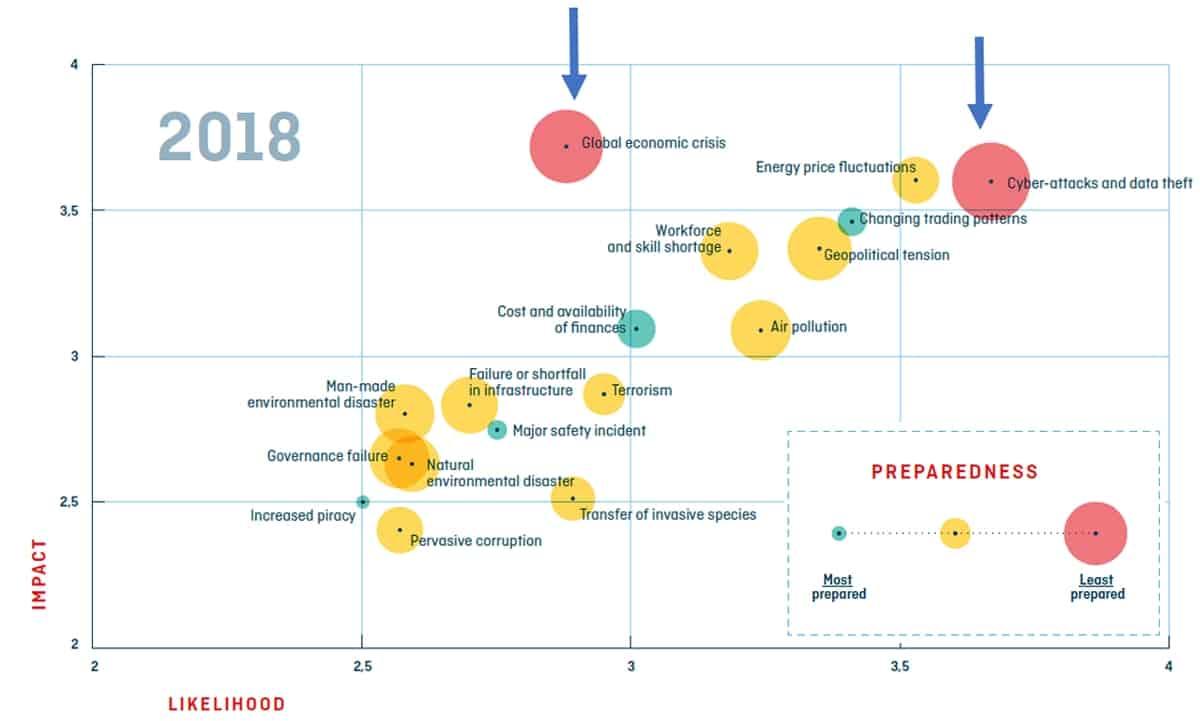
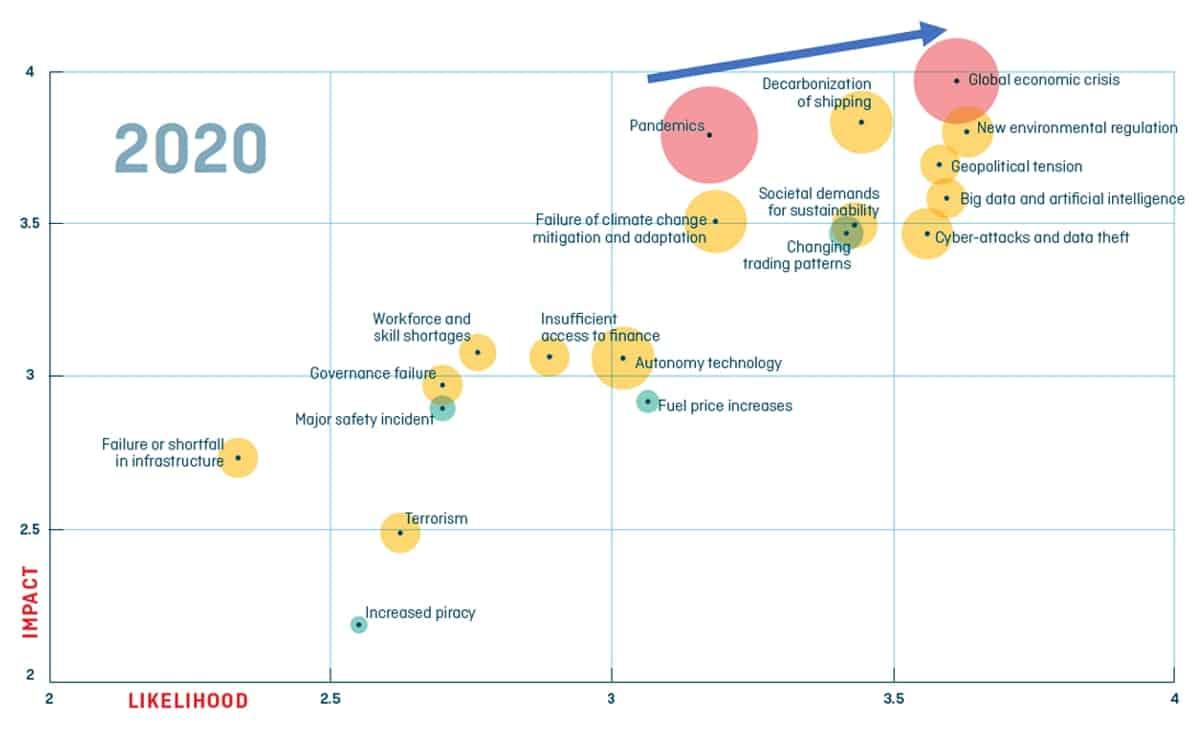
The survey publishes an “issues map” to visually display shipping’s concerns. The map shows impact on a scale of 1-4 on the vertical axis; likelihood from 1-4 on the horizontal axis. The size and color of the plot point portray preparedness. A big red dot represents “least prepared,” a small green dot “most prepared,” with a medium-size yellow dot in the middle.
The bigger the red dot and the closer it sits to the upper-right corner, the more shipowners are afraid. In 2018, the dot representing “global economic crisis” was big and to the top, but not to the right. Respondents considered “cyber-attacks and data theft” much more likely.
The 2019 map was much different — a lot more red implying a lot more perceived unpreparedness. The economic-crisis marker grew bigger and moved to the right (i.e., more likely). Other issues, such as decarbonization and fuel-price increases, came to the fore, while concerns over cyberattacks were down.
The newly released 2020 map shows a major shift in sentiment. The economic-crisis marker shifted far to the right on the likelihood axis and up even further on the impact axis. Pandemics were added to the risk landscape, and the big fear in 2018 — cyberattacks — dropped further in the rankings. In addition, respondents saw a higher likelihood of insufficient access to ship finance.
To put concerns into numerical terms, survey respondents’ view of the likelihood of a global economic crisis in the next 10 years increased from 2.88 on a scale of 1-4 in 2018 to 3.59 this year.
COVID effect on capacity growth
The survey was conducted between late April and June, and respondent commentaries were collected between June and August. That timing — in the middle of a pandemic — heavily swayed the answers.
“An overwhelming majority, 93%, said the pandemic made a global economic crisis much more likely,”noted Marcus Baker, global specialty head of marine and cargo at Marsh, during a web presentation on the results Tuesday.
Comments from respondents pointed to the likelihood of “more bankruptcies, consolidations, scrapping of older tonnage and a lower rate of newbuildings,” he said.
Even if owners wanted to order ships, they would have more difficulty finding the money to do so. “When we talked about [lack of] access to finance, almost half of our respondents said that was more likely compared to last year,” said Baker.
COVID effect on decarbonization drive
Economic fears might be curbing new orders more than regulatory fears, but regulatory uncertainty is alive and well.
In this year’s impact rankings, decarbonization ranked second and new environmental rules fourth. In the likelihood ranking, new environmental rules ranked first (above global economic crisis, which came in second) and decarbonization sixth.
According to GMF Head of Research Kasper Søgaard, “The answers were quite split. On the negative side, concerns were raised about whether there will be a lack of resources in an economic crisis to invest in cleaner ships and new fuels.
“But there were others who noted the potential to align the need to invest, especially on the government side to create economic activity, with the need to build a more sustainable shipping industry and support the decarbonization of shipping.
“It’s a mixed picture. On one hand, if our industry is making less money and needs to deal with the urgent issues of the day, will we have the capital and long-term investment horizon to make these investments?
“On the positive side, pressure seems to be growing in terms of decarbonization in the financial sector, from customers and from governments. So, there may be an opportunity to actually accelerate this.
“Time will tell,” said Søgaard. “Both views are out there. But there is definitely not a sense that this [decarbonization] is becoming any less important. On the contrary.”
via ZeroHedge News https://ift.tt/30LhCpE Tyler Durden