Senate Republicans Have Introduced Their Own Police Reform Bill

tim scott

Senate Republicans unveiled their legislation today to address nationwide calls for police reform. The bill would incentivize police to ban chokeholds and create a national database on incidents where police seriously injure or kill someone.

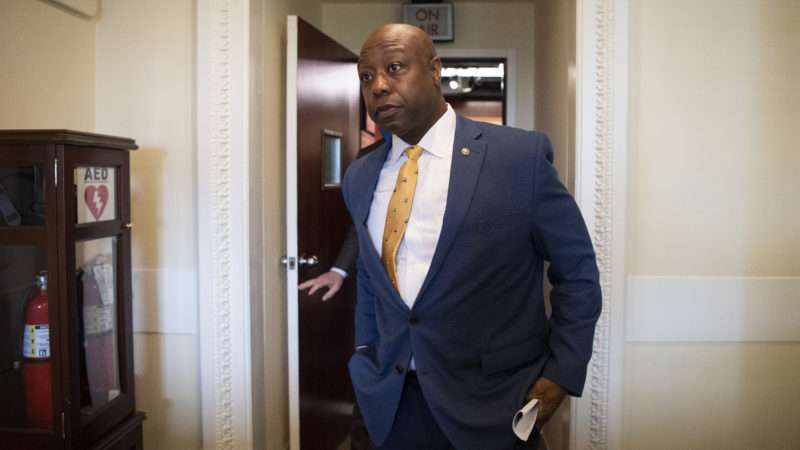
Sen. Tim Scott (R–S.C.) introduced the bill, the Just and Unifying Solutions to Invigorate Communities Everywhere (JUSTICE) Act. The JUSTICE Act would, among other things, increase the penalties for filing a false police report and incentivize departments to create systems to share disciplinary records with each other to stop problem officers from being rehired. Another section, the Breonna Taylor Notification Act—named after a Louisville woman who was killed in a botched no-knock raid in March—would require states to collect and report data on the use of no-knock raids.

Most of the provisions rely on either extending or withholding federal grants to incentivize local and state police departments to participate. The bill goes neither as far as civil liberties groups and activists demand, nor as far as the Democrats’ modest policing reform bill, but it contains several provisions that have bipartisan support.

For example, the legislation would make lynching a federal crime. It would also make it illegal for a federal law enforcement officer to have sex with people in custody. The so-called “law enforcement consent loophole” came to public attention after a 2018 BuzzFeed investigation about an 18-year-old New York City woman who said she was raped by two NYPD officers while handcuffed. The officers claimed it was consensual.

At a press conference on Capitol Hill this morning, Scott said the bill reflects both an acknowledgment of minority communities’ anger, which erupted into nationwide protests following the police killing of George Floyd in Minneapolis, and a rejection of the idea that police departments are systemically racist. 

“Too often we’re having a discussion in this nation about, are you supporting the law enforcement community or communities of color?” Scott said. “This is a false binary choice.”

“If you support America, you support restoring the confidence that communities of color have in institutions of authority,” Scott continued. “If you support America, you know that the overwhelming number of officers in this nation want to do their job and go home to their families. This legislation encompasses that spirit.”

Scott, the only black Republican senator, has often shared his own experiences of being pulled over by police or being asked to show his ID by Capitol Police.

Notably, the bill does not contain any provisions on qualified immunity, a legal doctrine that often shields police from liability in civil rights lawsuits. Groups across the ideological spectrum have been calling for qualified immunity to be repealed, but the White House, where Donald Trump is fighting for reelection as a “law and order” president, has indicated that it has no interest in reducing legal protections for police officers.

In the House, Rep. Justin Amash (L–Mich.) has introduced a standalone bill to repeal qualified immunity, which has attracted numerous Democrat co-sponsors but only one Republican.

Vanita Gupta, the president of the Leadership Conference on Civil and Human Rights and the former head of the Department of Justice’s Civil Rights Division, said in a press release that Senate Republicans’ legislation “falls painfully short in addressing longstanding issues of police misconduct and state-sanctioned violence.” 

“The legislation fails to pay down the immeasurable debt to justice created by our legacy of systemic racism,” she said. “While we appreciate Senator Scott’s efforts, the proposal does not go nearly far enough to offer the bold, comprehensive changes necessary to achieve the transformation and increased police accountability that this moment demands.”

Senate majority leader Mitch McConnell (R–Ky.) said this morning that he will bring up Scott’s bill for an initial procedural vote on the Senate floor next week, after voting on the confirmation of two appointees to federal circuit courts.

The bill will need 60 votes, including at least seven from Democrats, to proceed, but Senate Democrats have already signaled their displeasure with the legislation. 

“We’ve only had the bill for a few hours and are reviewing it,” Senate minority leader Chuck Schumer (D–N.Y.) said on the Senate floor. “But what’s clear is that the Senate Republican proposal on policing does not rise to the moment.”

from Latest – Reason.com https://ift.tt/2AzZBRn
via IFTTT
NBC Said Google Is Demonetizing The Federalist for Spreading Fake News, Google Says the NBC Report Is Fake News

belphotos258699

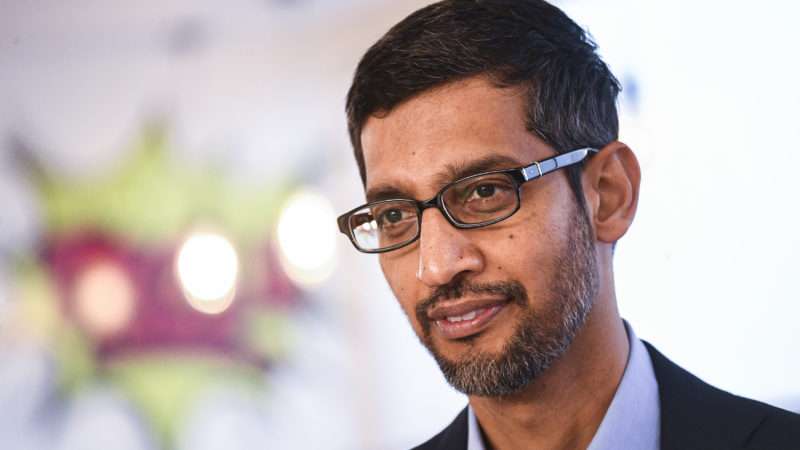
On Tuesday, NBC claimed that Google had made the decision to demonetize The Federalist after NBC’s own News Verification Unit presented the search engine with evidence the conservative website was spreading misinformation related to recent anti-police brutality protests.

But it turned out that the news outlet spreading misinformation was actually NBC. In a statement, Google denied that it had stripped The Federalist of the ability to generate money from ads. “The Federalist was never demonetized,” wrote Google Communications. “We worked with them to address issues on their site related to the comments section.”

This directly contradicted the NBC story, which initially suggested that Google had found fault with The Federalist‘s articles. The actual problem, according to Google, was comments on the articles, not the articles themselves. The Federalist temporarily deleted its comments section, resolving the issue. (Disclaimer: I am friends with Ben Domenech, publisher of The Federalist, and have appeared on his radio show.)

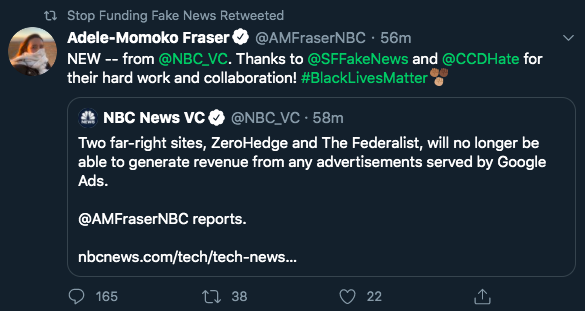
The NBC story—penned by Adele-Momoko Fraser, a producer with the ironically named News Verification Unit—is a perfect example of activist journalism getting the facts wrong and obscuring the truth in order to arrive at an agenda-driven conclusion. Fraser wrote that Google had punished The Federalist “after the company was notified of research conducted by the Center for Countering Digital Hate, a British nonprofit that combats online hate and misinformation.” Fraser further noted that “Google blocked The Federalist from its advertising platform after the NBC News Verification Unit brought the project to its attention.”

The “project” was little more than a tweet thread by an activist group. The Center for Countering Digital Hate and its project, Stop Funding Fake News, are progressive workshops that engage in public advocacy campaigns to pressure companies to stop advertising on right-wing websites.

Their beef with The Federalist, according to the Stop Funding Fake News website, was that the conservative publication had falsely claimed, “CNN/New York Times reports were ‘lying’ about white supremacist violence.” The Federalist article in question was this one by John Daniel Davison, titled “The Media Are Lying To You About Everything, Including the Riots.” The tone is hyperbolic—no, the media aren’t lying about absolutely everything—and one could disagree with some of Davison’s examples, but the article isn’t a particularly compelling example of fake news, let alone racist fake news.

That a lefty social media campaign would target The Federalist isn’t surprising. The truly bizarre aspect of all this is NBC’s involvement. According to Fraser’s own characterization of events, it was NBC that informed Google of the social media campaign. That makes it sound like Fraser was working in concert with the Center for Countering Digital Hate. Since the chief complaint against The Federalist was that Davison’s article had criticized mainstream media groups, including NBC, it looks like a retaliatory strike.

Fraser subsequently clarified that she “obtained the research exclusively” but did not “collaborate” with Stop Funding Fake News. Her first tweet, now deleted, implies something quite different:

In any case, Fraser had to revise the article several times to add clarifications from Google that her central thesis was wrong. She also removed the section about NBC being the entity that informed Google about The Federalist‘s alleged failings. Not all of these changes are acknowledged. (Fraser did not respond to a request for comment.)

But the damage was already done: Conservatives exploded with outrage on social media, directing much of their ire at Google. It has become quite popular on the right to believe that Big Tech—Google, Facebook, Twitter, and YouTube in particular—is silencing conservatives and that the government should do something about this. Increasingly, the “something” is to revise Section 230, the federal statute that gives tech platforms some liability protection. Getting rid of Section 230 would probably make social media companies more squeamish about publishing edgy or controversial content, thus undermining free speech protections for everyone—including and perhaps especially conservatives—but the right’s anti-tech crusaders frequently overlook this.

Sure enough, Sen. Josh Hawley (R–Mo.), one of the leaders of the conservative effort to regulate Big Tech, took this opportunity to propose legislation that would allow The Federalist to sue Google for unequal treatment.

People have every right to complain about Google but, as a private company, Google is not obligated to treat all of its users equally. People on the right often grasp this intuitively when the issue is slightly different: Many conservative writers do not want a Christian bakery to be compelled to bake cakes for gay weddings, for instance. But if it’s wrong for the government to force a private company to do business with an LGBT couple, it should also be wrong to force a private company to do business with The Federalist.

One can find hypocrisies in every direction. Anyone who wants to argue that an outlet like The Federalist should not be held responsible for its comment section is actually making a philosophical case for Section 230, which extends precisely this protection to large platforms. In general, the internet works best when the government takes a hands-off approach, allowing all sorts of viewpoints to flourish. Still, if Google would like to avoid losing its own protection, the company might think twice about arguing that outlets like The Federalist should be held to a harsher standard.

That said, this does not look like a fight that Google actually wanted. It’s not an example of anti-conservative bias: The same thing happened to the website techdirt last year. The underlying issue was a trivial and routine one, and it was blown completely out of proportion by NBC’s sloppy hatchet job. A “news verification unit” not only failed to verify the news, but took an active role in spreading disinformation—the very crime of which they had falsely accused others. At a time when newsrooms are deciding how to deal with their employees’ increasingly vocal sympathy for progressive causes—often giving in to their demands—the NBC story should serve as a powerful reminder of the perils of swapping journalism for activism.

from Latest – Reason.com https://ift.tt/3dabTNm
via IFTTT

Anonymous Reactions to Bostock

I have written quite a bit about Blue Monday, but haven’t yet offered my own analysis of Bostock. Quite deliberately. I need some time to carefully consider and reflect on each aspect of the majority opinion, and the two dissents. In the interim, I’d like to provide a sampling of the emails I’ve received about the case.

The first email expresses what many rank-and-file conservative lawyers shared with me: a feeling of disappointment and letdown.

I’ll be honest, after yesterday I was feeling quite disheartened about the conservative legal movement. I felt like I had been promised so much more (mainly, truly conservative judges) if I gave the GOP my vote year after year. I’m so glad to know I’m not the only one. It’s encouraging to know the scholars and professors leading our conservative legal movement still hold to our principles.

The second email worries how Bostock will be used by Chief Justice Kagan in the future to reach progressive results under the false “flag” of textualism:

I find Bostock demoralizing- Gorsuch has just given Kagan carte blanche to rewrite any law she wants and call it textualism. If Gorsuch can do it, then anyone can. If Gorsuch can rewrite Title VII in this way, then we can rewrite anything to say whatever results we want and say it’s textualist. Gorsuch just put a textualist gloss on purposivism. If Congress wants to rewrite Title VII, good! That’s their job. But Gorsuch just sent us Fed Soc types back dramatically. The law is not a semantic game, but that’s what Gorsuch just said it was.

The third e-mail speaks to our current political realities.

Gorsuch’s majority opinion was a double kill-shot and will make him the last of the self-described textualists on the Court. In the short term, he disembowled Trump’s last shot at re-election, so Justices Ginsburg and perhaps Breyer will be replaced by President Biden. In the long term, two things will happen. First, no GOP White House will ever trust a textualist again. Instead, Republicans will do what Democrats have always done: look for someone who shares their policy preferences. Second, Bostick will convince the rising generation of legal conservatives to largely abandon textualism. Not because textualism led to a liberal outcome, but because Gorsuch did so with reasoning that was embarrassingly thin. In the end it makes textualism seem like the emperor with no clothes. So the rising generation will splinter, some turning to natural rights, some looking to the common good, and some just trying to bring about naked policy preferences. In James Fenimore Cooper’s classic novel, the Mohicans were reduced to one lone man because of external pressures: disease and war. Gorsuch will be the last of the Court’s textualists. But this extinction is entirely self-inflicted.

I can speculate on one direct consequence of Bostock. Conservative legal groups that appealed to popular audiences will soon have more difficulty raising funds. And in that vacuum other groups will emerge who are not focused on textualism and originalism, but on social conservatism as a direct goal.

Tenure affords me the protections to speak out freely about those outside and inside my own camp. Not everyone has that luxury. Indeed, internecine squabbles are often the most difficult: it is far easier to criticize an opponent than to criticize a friend whom you rely on. But I can assure you that change, and dissension is afoot.

from Latest – Reason.com https://ift.tt/2YIvejE
via IFTTT

Facebook ‘Solves’ Censorship Controversy By Allowing Users To Block All Political Ads

Facebook ‘Solves’ Censorship Controversy By Allowing Users To Block All Political Ads

Tyler Durden

Wed, 06/17/2020 – 12:31

As controversy rages over major social media platforms intervening when it comes to users expressing political viewpoints, and with the Trump administration lately escalating its burgeoning feud with Silicon Valley over tech giants’ “liability shields”, Facebook has announced it will now allow users to block political ads altogether.

The decision comes amid pressure especially from Democrats and the Left to get Facebook to fact-check political ads to root out alleged “disinformation”. Instead the company has opted to roll out a feature allowing its some two billion individual users to essentially turn off or mute “all social issue, electoral or political ads from candidates and Super PACs.” 

The ‘opt out’ feature will be available on Instagram as well, and seeks to ease the pressure of the question of social media platforms becoming ‘arbiters of truth’. The move is a huge defeat for the Biden campaign, which called for censoring political posts nebulously deemed “disinformation” and “offensive”

AFP via Getty

The Biden campaign previously urged Facebook to “proactively stem the tide of false information” in an open letter to CEO Mark Zuckerberg, including fact-checking political ads two weeks head of any election.

Facebook has been resistant to this call, with the new feature unlikely to satisfy Democrats seeking to shut down what they see as pro-Trump “disinformation” as well as conservative sources.

Facebook announced what the feature will achieve in a post about it’s broader ‘get out the vote’ initiative

Starting today for some people and rolling out to everyone in the US over the next few weeks, people will be able to turn off all social issue, electoral or political ads from candidates, Super PACs or other organizations that have the “Paid for by” political disclaimer on them. You can do this on Facebook or Instagram directly from any political or social issue ad or through each platform’s ad settings.

But no doubt there will further be controversy over what constitutes “political”.

The company says users will be able to ‘flag’ content they think is political but still made it through the filters: “if you’ve selected this preference and still see an ad that you think is political, please click the upper right corner of the ad and report it to us,” the statement added.

The feature will be available for some users starting as early as Wednesday. 

via ZeroHedge News https://ift.tt/3hGp7VQ Tyler Durden

The Next Iteration. What Is Yield Curve Control?

The Next Iteration. What Is Yield Curve Control?

Tyler Durden

Wed, 06/17/2020 – 12:12

Authored by Michael Lebowitz and Jack Scott via RealInvestmentAdvice.com,

The next iteration of monetary policy may well be “yield curve” control?

Debt and interest rates have become the predominant driving force of our economy. Unfortunately, a majority of the debt is unproductive, resulting in declining long-run economic and productivity growth rates.

In the 1950s, each dollar of debt drove nearly 70 cents of economic growth. It has fallen ever since. Recently, each dollar of debt bought less than 30 cents of growth. That number has deteriorated further in the last few months.

The Fed, as manager of monetary policy, can use policy to either encourage long term prosperity or shorter-term economic activity. They have chosen the latter and, as a result, have dug themselves into quite a hole. Each dollar of debt drives less growth than the prior dollar of debt, thus requiring even more debt.

This article explores Yield Curve Control (YCC), a policy tool at the Fed’s disposal to keep digging even deeper into the hole.

The Hole

Government and corporate debt levels are currently increasing at unprecedented rates. Total non-financial debt rose nearly 12% in the first quarter. The amount will surely be much higher when second-quarter data is released.

The federal deficit in the current fiscal year is expected to top $4 trillion. To put that in context, it took 192 years between 1789 and 1981, for America to amass its first $1 trillion of debt.

Only halfway through the year, corporations exceeded $1 trillion of issuance, putting them on par with annual totals from the prior few years.

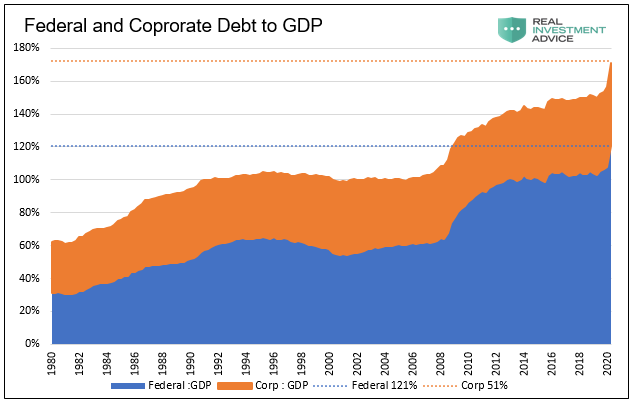
The graph below shows the ratio of non-financial corporate debt and federal debt to GDP. They both sit at record levels and will rise rapidly when second-quarter GDP is released.

As the ratio of debt to GDP increases, even more debt is needed tomorrow just to maintain current economic activity. For a Fed overly concerned about short-term economic activity, this dilemma creates a self-reinforcing problem. The situation is akin to a Ponzi scheme that needs constant feeding.

Given the Fed’s desire to avoid the slightest economic setback, surging debt levels means the Fed will have to become even more creative and active in managing interest rates. Are they prepared to impose negative interest rates on U.S. society? Although that tactic has been remarkably unproductive in Europe and Japan, the Fed has not formally ruled out negative rates.

Keep Digging

Fed Funds are at zero, and the Fed has not committed to negative interest rates. What else can the Fed do to keep debt flowing?

The Fed sets short term rates but can only indirectly influence long-term rates. Longer-term rates spanning from two-year maturities out to thirty years drive borrowing and consumption.

Quantitative Easing (QE) was introduced in 2008 when the Fed Funds rate hit zero. QE allows the Fed to purchase bonds in an effort to lower interest rates for longer-term maturities. During QE 1, 2, and 3, they bought Treasuries, mortgages, and agency bonds. Despite what one would think, on each occasion, longer-term rates rose. In the last month, they expanded their reach to include large-scale purchases of municipal bonds, corporate debt, and even junk-rated corporate bonds and ETFs.

Steering rates and setting rates are not the same. The question for the Fed is, how can they control interest rates for longer-term securities?

Yield Curve Control – A Bigger Shovel

QE 1, 2, and 3 ran systematically. The Fed set a predetermined amount and timing of QE in which to operate. It was useful in reducing the supply of Treasuries available and forcing investors into riskier assets like junk bonds and stocks. However, it did not allow the Fed to explicitly control the level of interest rates.

The Fed is now considering an enhancement to the way it manages QE. The “upgrade” is called yield curve control (YCC). YCC essentially allows the Fed to do unlimited amounts of QE with no time restraints. Embedded in YCC is the specific goal of targeting particular interest rates across the entire yield curve.

For example, assume the Fed set a 0.75% target yield on the 10-year U.S. Treasury note. They can then employ QE in any amount needed to buy 10-year notes when the rate exceeds that level. If successful, the rate would never exceed 0.75% as traders would learn not to fight the Fed.

It is essential to be clear about the definition of YCC. The Fed represents it as an option for helping them manage the economy through the difficulties the country currently faces. However, YCC is a euphemism for price controls. Price controls are government interference and regulation, establishing prices for specified goods and services.

In this instance, we are talking about the most fundamental component of any economic system, the price of money. Historically, in every case, the implications of price controls have been unfortunate.

Two examples of price controls leap out from recent history:

  • Those imposed on gasoline during the Arab oil embargo in 1973 and 1974 that created long lines of cars waiting to fill up at gas stations

  • Those set on electricity in the state of California, which contributed to rolling blackouts

Managing the Yield Curve

It is called yield curve control because the central bank effectively manages the shape of the yield curve. A steeper yield curve benefits the banks as they tend to borrow short term and lend long term. Larger profit margins increase their desire to lend and therefore stimulate debt-driven economic activity. Conversely, a flatter or inverted yield curve inhibits lending due to narrower bank profit margins, and consequently, it curtails debt issuance and economic activity.

The problem for the Fed is how they can steepen the yield curve to stimulate lending without letting longer-term rates rise too much? Under YCC, they may squirm out of one trap only to find themselves in a bigger trap. 

History

The Fed would not break new ground with YCC.  In fact, they would be reinitiating a previously used tactic. From 1942 to 1950, the Fed targeted rates to help manage funding costs for WWII. If you are interested in reading more on the U.S. experience with YCC, we suggest the following article from the Federal Reserve: How the Fed Managed the Treasury Yield Curve in the 1940s.

It is worth pointing out that after WWII ended, inflation spiked to double digits, yet the Fed held interest rates at artificially low levels. While bondholders may not have lost money on the bonds per se, they did lose dearly in their purchasing power, as shown below.

More recently, in 2016, Japan set a 0% yield target on its ten-year note. Currently, the bank of Australia is now targeting 0.25% for its three-year bond.

Summary

Federal Reserve Bank of New York President John Williams says that policymakers are “thinking very hard” about targeting specific yields on Treasury securities. Given what we have observed, it seems likely they will implement YCC and, in doing so, choose to keep digging and try to push problems out further into the future.

The problem with these actions is they engender anemic rates of economic growth. Equally concerning, they directly contribute to income inequality, a driving force for social unrest.

The policies the Fed staunchly defends are adverse to the healthy economic and social environment the country so desperately needs. While in crisis mode, investors will cheer them on unaware of the adverse effects it will have on the economy. As they say, there is no such thing as a free lunch.

via ZeroHedge News https://ift.tt/37FdUAg Tyler Durden

UK Prime Minister Boris Johnson In Car Wreck After Convoy “Targeted By A Protester”

UK Prime Minister Boris Johnson In Car Wreck After Convoy “Targeted By A Protester”

Tyler Durden

Wed, 06/17/2020 – 11:47

Given the world beheld scenes last week of Black Lives Matters protesters overrunning parliament square in London while vandalizing and defacing statues and monuments ranging from war memorials to Winston Churchill to even an Abraham Lincoln statue, with police appearing at times to sit back at let the destruction happen, it was only a matter of time before something like the below.

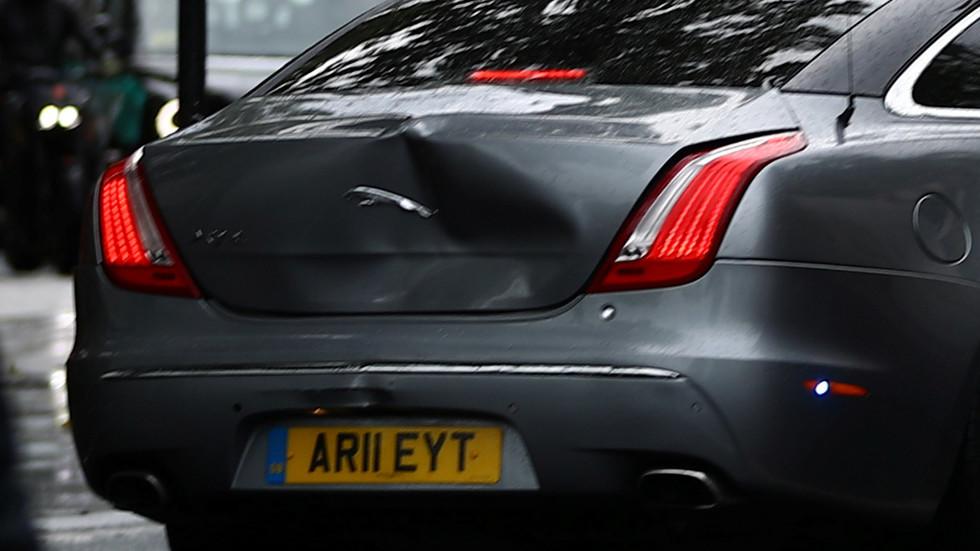
UK Prime Minister Boris Johnson was involved in a car wreck when a protester ran out in front of the convoy as it departed Westminster on Wednesday

The whole dangerous close call in which Johnson escaped unscathed was caught on video and happened in broad daylight. There were no reports of injuries despite clear damage to the vehicle carrying the prime minister.

The prime minister’s convoy had been making the short drive to Downing Street when the accident happened. 

Though one man is seen darting in front of the cars as they turned onto the street, reportedly a Kurdish protester demanding British action against Turkey, some reports suggested a group of demonstrators had surged toward the convoy just before the accident.

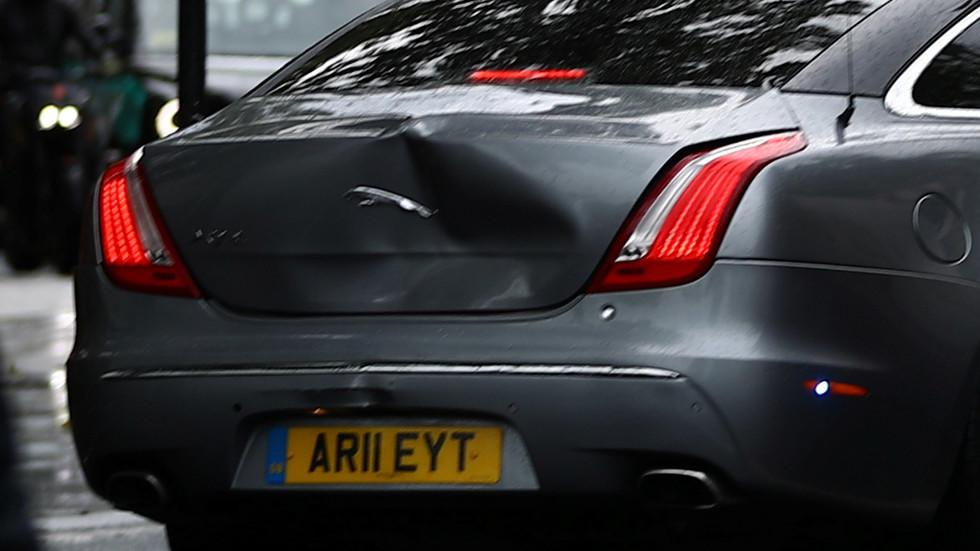
Boris Johnson’s vehicle after a collision as it departed the Houses of Parliament Wednesday, via Reuters.

Sky News reported that Johnson’s car had been “targeted by a protester” in an attempt to draw as much attention as possible.

The prime minister’s office confirmed that Johnson had indeed been inside the car, but that he was unhurt. “Yes, that was the PM’s car,” a spokesperson said. “I think the video speaks for itself as to what happened. No reports of anybody being injured.”

Media reports described a “minor fender-bender” but video showing a closer side angle reveals Johnson’s car suffered severe impact. 

A different angle shows that while damage was relatively minor, Johnson’s car was hit with significant impact.

Police immediately jumped on and apprehended the man seen charging the convoy to cause the wreck.

With over the past weeks various protests outside of key government buildings in both the UK and US getting increasingly out of control, and turning into chaotic scenes of rioting and vandalism, this latest incident is perhaps a ‘wake-up’ call for police at such sensitive sites to get the situation under control.

via ZeroHedge News https://ift.tt/30NEbLf Tyler Durden

It’s time to get rid of your $20 bills…

On May 12, 1703, the Russian army under Peter the Great captured an important Swedish fort on the Baltic Sea called Nyenskans.

It was a major victory for Peter in his war against the Swedish Empire. Russia was a rising power in the early 1700s, but Peter was in critical need of a Baltic seaport to be able to trade with the rest of Europe.

The capture of Nyenskans was so important that Peter decided to move his capital there. And he renamed it Saint Petersburg.

Technically he called it “Sankt-Pieter-Burch,” which is a Dutch/German spelling of the name; Peter  made tremendous efforts throughout his reign to westernize Russia, and naming his capital city in a European style was part of that effort.

Sankt-Pieter-Burch remained the capital of the Russian Empire for hundreds of years, until World War I broke out in 1914.

Germany had become Russia’s enemy. And the imperial government decided that they no longer wanted their capital city named in the German style.

So they renamed the city to Petrograd as a reflection of their updated view.

Lenin and the Bolsheviks took over Russia in 1917 and moved the capital to Moscow. And when Lenin died in 1924, the Soviet government renamed Petrograd to Leningrad.

It remained that way for nearly seven decades until communism finally collapsed in 1991… at which point the city renamed itself once again, back to St. Petersburg.

Frankly this happens all the time. Buildings, cities, provinces, and even entire countries from time to time change their names.

When values change, names change.

By 1991, Russians no longer felt like naming one of their most beautiful cities in honor of a Communist dictator… so they changed it. Big deal.

Zambia used to be called Northern Rhodesia. But after they gained independence they no longer wanted to be named after their imperialist ruler. That’s hardly controversial.

Similarly, nearly every major city in India changed its name in the 1990s and early 2000s; Bombay became Mumbai, Calcutta became Kolkata, Madras became Chennai, etc., all to shake off their colonial roots.

Again, this is perfectly reasonable.

There’s been a broad movement lately of people wanting to rename streets, bridges, airports, buildings, etc. And this too is hardly controversial.

Our social values are remarkably different than they were when many of those landmarks were built. And it’s not unusual for names to change to keep up with the times. There’s nothing wrong with that.

(There IS, however, supposed to be a peaceful, democratic procedure to change names and remove monuments. Only a fool with no intelligent argument resorts to violence and vandalism.)

The problem with renaming stuff, however, is that it can be a bottomless rabbit hole.

If we are supposed to judge everyone who has been dead for hundreds of years against the values that we hold dear today, then there really is no end.

Just look at the currency of the United States:

$1 bill? George Washington… who, despite being the single-most important factor in winning the American Revolution, also happened to be a slave owner.

$2 bill? Thomas Jefferson… also a slave owner.

$5 bill? Abraham Lincoln… who emancipated the slaves, yet also made numerous racist comments (like this quote from his first debate against Stephen Douglas in 1858:

“I, as well as Judge Douglas, am in favor of the race to which I belong having the superior position.”)

$10 bill? Alexander Hamilton. Yes, he has a catchy musical in his honor that promotes him as an abolitionist. But Hamilton married into a prominent slave-owning family, handled transactions regarding the purchase of slaves on the family’s behalf, and even once demanded that a runaway slave be returned to captivity.

$20 bill? Andrew Jackson. HARDCORE racist. Major slave owner. (which means he’ll probably be the first one to be replaced. So don’t stock up on too many $20 bills…)

$50 bill? Ulysses S. Grant… who actually fought (and won) the Civil War. Yet technically did own a slave at one point in his life.

$100 bill? Benjamin Franklin… also a slave owner.

It’s not hard to keep going.

The Commonwealth of Pennsylvania was named after the slave owner William Penn.

The Commonwealth of Virginia was named after the “virgin” Queen Elizabeth I of England, a blatant racist who wrote to the Lord Mayor of London in 1596 that ‘there are too many blackmoors’ in the city and expressed her “good pleasure to have those kind of people sent out of the land.”

The State of Louisiana is named after the King Louis XIV of France, who presided over the enslavement of countless natives across his global dominion.

And let’s not forget that the UNITED STATES OF AMERICA, along with two continents, are named after Amerigo Vespucci– a man who enslaved thousands of people.

Do we rename cities and states? Do we rename the country? (Perhaps we call the entire nation the Republic of CHAZ.)

Do we bother weighing someone’s accomplishments against their shortcomings, or do we condemn everyone for being out of step with our modern values?

We can also apply the same logic to science, literature, philosophy…

There are so many famous authors from the past who were racist, or misogynist, or raging anti-Semites. Do we stop reading them? Should the mob torch their books?

Even many of the most prominent minds from Ancient Greece would qualify as bigots today.

Should Aristotle (who believed in ‘natural born slaves’) be banned? Should we stop teaching the Pythagorean Theorem ?

Even Abraham– the common patriarch of Islam, Judaism, and Christianity– was a slave owner.

So, yes, it’s not unusual or controversial to rename anything. But to judge everyone from the past based on the values of today– there truly is no end to how much of history would need to be erased.

Source

from Sovereign Man https://ift.tt/37DJnTa
via IFTTT

The Myth Of The V-Shaped Recovery In One Chart

The Myth Of The V-Shaped Recovery In One Chart

Tyler Durden

Wed, 06/17/2020 – 11:31

Authored by Mike Shedlock via MishTalk,

Retail sales surged in May but manufacturing is another story.

The Fed’s Industrial Production and Capacity Utilization puts a big negative spotlight on the emerging V-shaped recovery thesis.

Industrial Production Highlights

  • Industrial production increased a weaker than expected  1.4% in May. The Econoday consensus was 2.9%.

  • A negative revision took April from -11.2% to -12.5% so essentially there was no rebound at all. 

  • Industrial production in May was 15.4% below its pre-pandemic level in February. 

  • Manufacturing output rose 3.8% in May but languishes near the lows in the Great Recession.

  •  At 92.6% of its 2012 average, the level of total industrial production was 15.3% lower in May than it was a year earlier. 

  • Capacity utilization for the industrial sector increased 0.8 percentage point to 64.8% in May, a rate that is 15.0 percentage points below its long-run (1972–2019) average and 1.9 percentage points below its trough during the Great Recession.

Manufacturing and Motor Vehicles and Parts

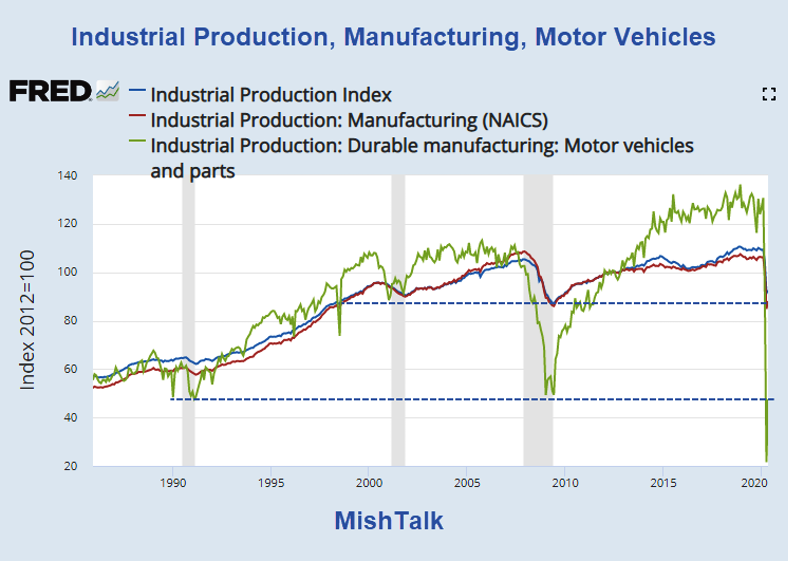
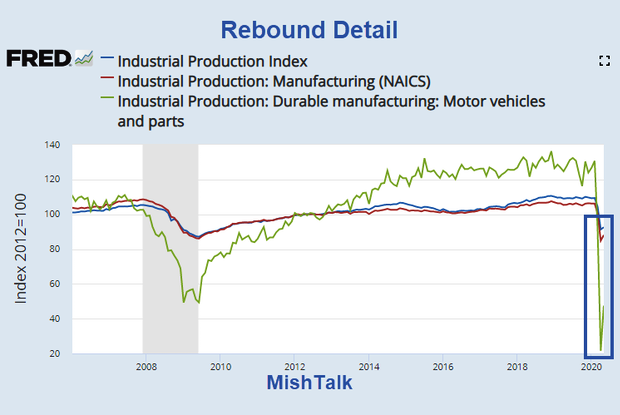
  • Motor vehicles and parts production has “rebounded” to a level “below” the bottom of the 1990 recession.

  • Manufacturing is at a 1988 level

Rebound Detail

V-Shape Recovery?

These numbers are not remotely close to anything one would ever associate with a V-shaped recovery.

Retail Sales vs Industrial Production

Earlier today I reported Retail Sales Surge Most on Record But Number is Misleading

  • Retail sales surged a greater than expected 17.7% in May but the numbers are still well below the pre-pandemic levels.

  • Despite the surge, sales numbers are back to levels seen in late 2015 and early 2016. 

Stimulus Checks

People got money and spent it, but they also skipped mortgage payments and credit card payments.

What happens when the checks run out?

Those Out of a Job

There are still 20 million people out of work.

It is foolish to believe they will all be back working the same number of hours at the end of June.

Fed vs Kudlow

True State of the Economy

Today’s dismal industrial production numbers put a better spotlight than retail sales on the true state of the economy.

Off to the Races Not

There are too many things that can go wrong and many of them will. 

It will take years for this economy to recover.

via ZeroHedge News https://ift.tt/3fxaMsH Tyler Durden

Pepsi Retires Aunt Jemima Brand Due To “Racist Past”

Pepsi Retires Aunt Jemima Brand Due To “Racist Past”

Tyler Durden

Wed, 06/17/2020 – 11:09

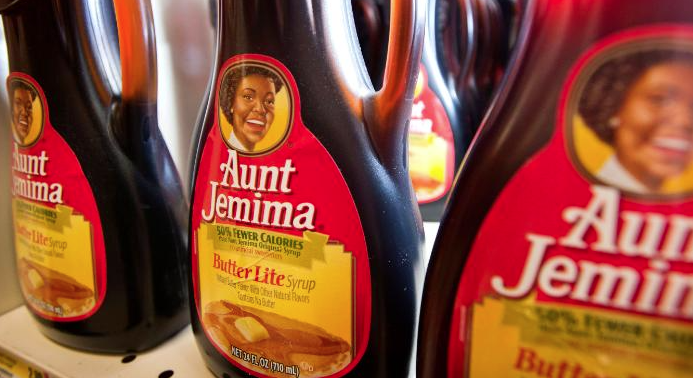
Aunt Jemima survived 130 years: the Great Depression, two World Wars, the Civil Rights movement, Vietnam and 9/11. But the brand has finally been cast aside by Quaker Oats – which is owned by Pepsi – due to its “racist past” at the hands of today’s relentless cancel culture.

PepisCo’s packaged-foods unit said Wednesday it would remove imagery of the black woman from the Aunt Jemima brand’s pancake mixes, syrups and other products, and change its name. The company didn’t disclose the new name, but said packaging changes will appear throughout the fourth quarter.

The company told CNN: “As we work to make progress toward racial equality through several initiatives, we also must take a hard look at our portfolio of brands and ensure they reflect our values and meet our consumers’ expectations.”

The appearance of Aunt Jemima has changed over the years, the article notes. Its name is “based off the song ‘Old Aunt Jemima’ from a minstrel show performer and reportedly sung by slaves,” according to CNN. The logo was based on Nancy Green, who was a cook and missionary worker that NBC later disclosed had been born into slavery. 

“We recognize Aunt Jemima’s origins are based on a racial stereotype. While work has been done over the years to update the brand in a manner intended to be appropriate and respectful, we realize those changes are not enough,” said Kristin Kroepfl, chief marketing officer at PepsiCo’s Quaker Foods North America business. The unit also sells Quaker Oats and Rice-A-Roni.

Despite its iconic history, there have been recurring calls to change the logo for years, with Cornell University professor Riché Richardson one of the latest voices to speak out against it in 2015. He called the logo “very much linked to Southern racism.” 

He also said the logo was based on a “devoted and submissive servant who eagerly nurtured the children of her white master and mistress while neglecting her own.” In 2017, the husband of B. Smith called the logo the epitome of “female humiliation.”

But today the brand is just described by the company as standing for “warmth, nourishment and trust — qualities you’ll find in loving moms from diverse backgrounds who want the very best for their families.”

Gladys Knight was even a spokesperson for the brand in the 1990s, during such time the logo evolved. But that apparently is woefully insufficient in this day and age. Quaker Oats said: “While work has been done over the years to update the brand in a manner intended to be appropriate and respectful, we realize those changes are not enough.”

So it’s best to simply deleted over a century of history and pretend it never existed.

Additionally, the company announced that the Aunt Jemima brand will donate $5 million over the next five years “create meaningful, ongoing support and engagement in the Black community.”

As one user on social media pointed out, the lag time from satire to reality has sadly now become just 5 days.

via ZeroHedge News https://ift.tt/2YGQer6 Tyler Durden

Bankrupt Hertz Stock Soars After SEC “Has Issues” With ‘Worthless’ Share Offering

Bankrupt Hertz Stock Soars After SEC “Has Issues” With ‘Worthless’ Share Offering

Tyler Durden

Wed, 06/17/2020 – 11:02

Farcical-er and farcical-er…

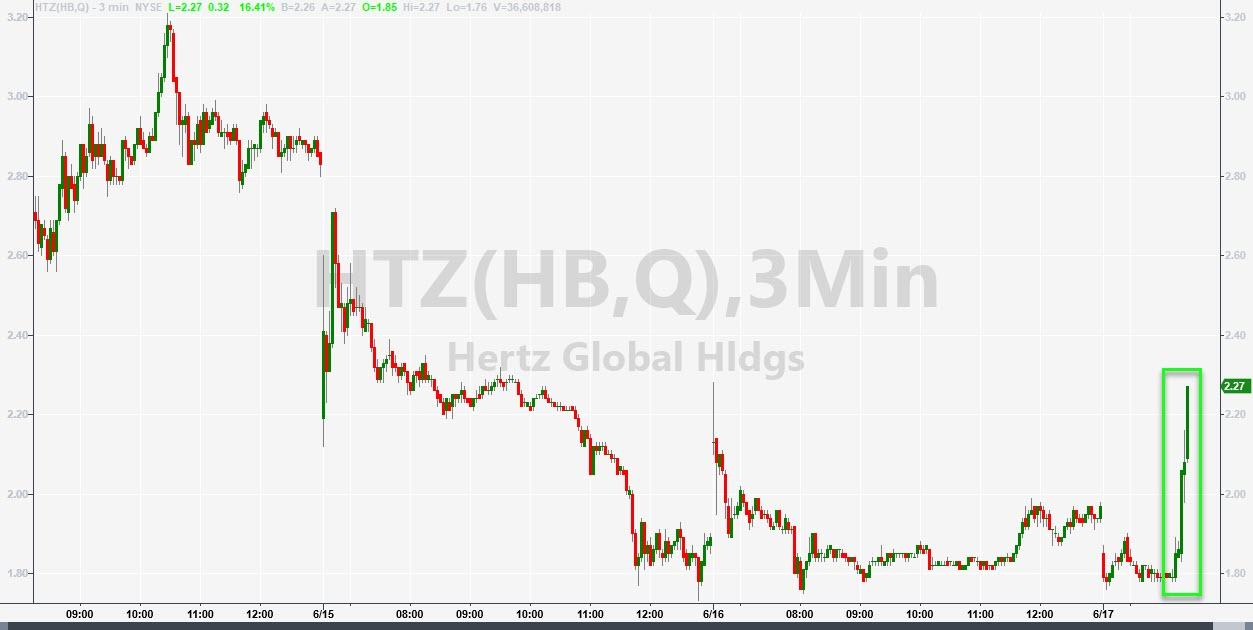
Hertz stock is soaring this morning after comments by SEC Chair sparked ‘optimism’ among the muppet gallery…

SEC Chair Jay Clayton told CNBC this morning that the SEC told Hertz, which filed for bankruptcy during the pandemic, the agency has issues with its plan to sell stock.

“In this particular situation we have let the company know that we have comments on their disclosure,” Clayton said on CNBC’s “Squawk on the Street” on Wednesday.

In most cases when you let a company know that the SEC has comments on their disclosure they do not go forward until those comments are resolved.”

So it would appear the market is taking that as “good news” for the worthless stock since it will not be diluted by a stock offering… and that’s why someone is panic-buying HTZ stock.

You cannot make this stuff up!

We suspect it will not last!

via ZeroHedge News https://ift.tt/3hDWloI Tyler Durden