Futures Jump On China Trade-Deal Optimism Ahead Of Quad-Witch Friday
Tyler Durden
Fri, 06/19/2020 – 07:46
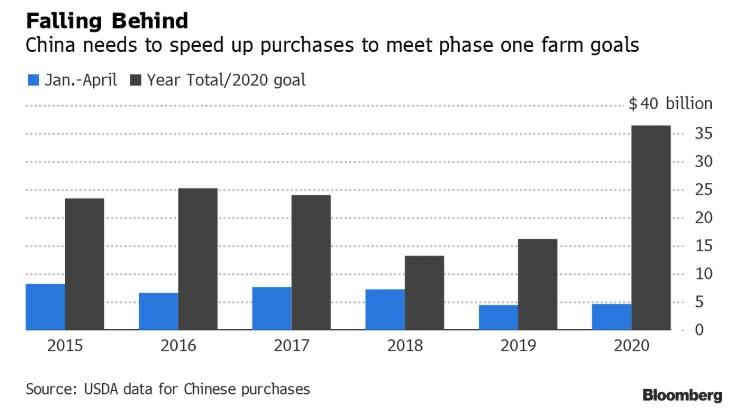
What do you get when you mix reopening optimism with stimulus hopes and throw in some good old “2019-style” US-China trade optimism? You get a session like overnight, where headed into what is usually an especially volatile quad-expiration day, at the curious time of 2:34am ET, or just before the European open, Bloomberg reported that with the Phase 1 trade deal largely forgotten, China planned to accelerate purchases of American farm goods to comply with the phase one trade deal with the U.S. following talks in Hawaii this week: “the world’s top soybean importer intends to step up buying of everything from soybeans to corn and ethanol after purchases fell behind due to coronavirus disruptions” Bloomberg reported citing sources, and that’s all last year’s trade war algos needed to push futures to overnight highs.
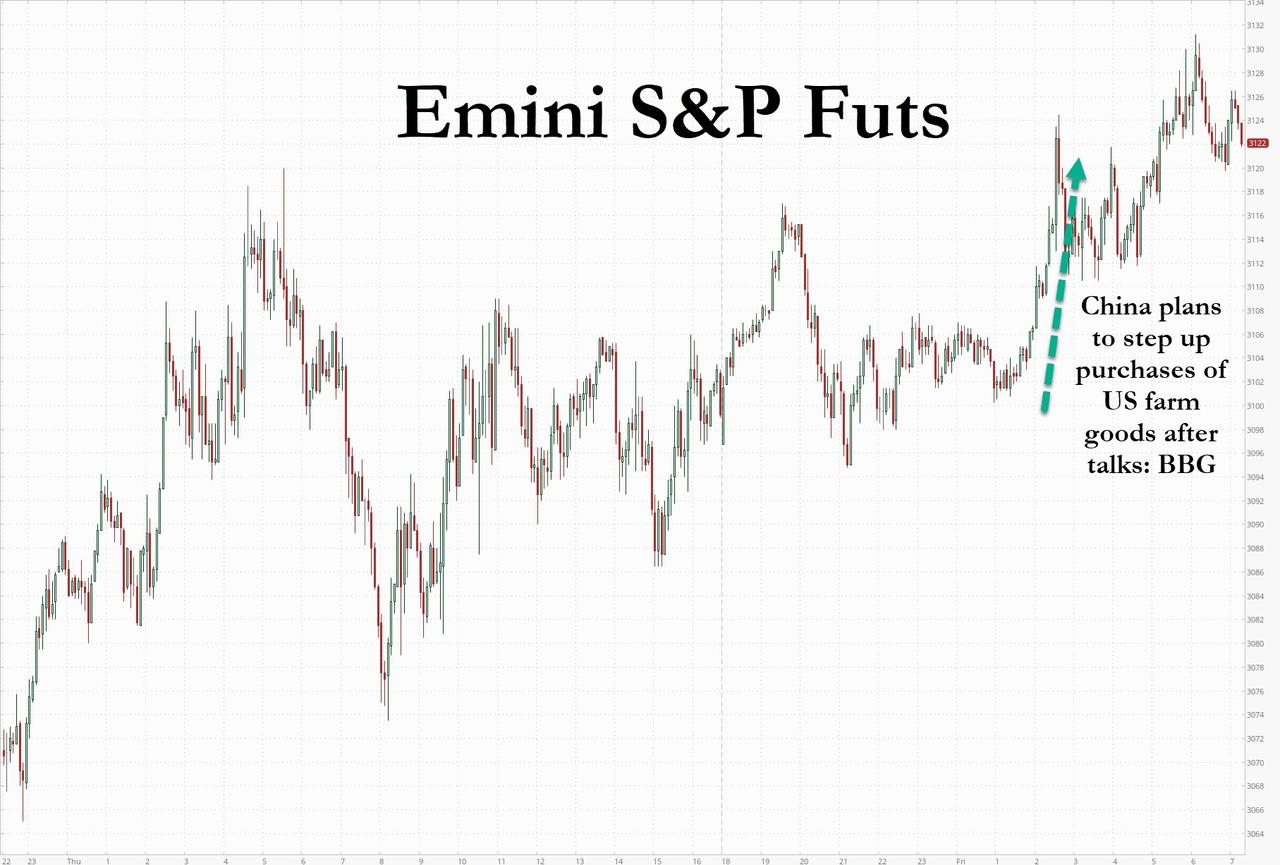
As a result of the report promising a “return” to the trade deal, which is laughably unachievable…
… but was enough to fool the algos, S&P index futures rose about 1% on Friday as investors also bet on a bounce back in post-pandemic economic activity, shrugging off the daily increase in new coronavirus infections in several states. Oil major Exxon Mobil rose 1.7% in premarket trading and Chevron gained 0.4% as Brent crude rose above $42 a barrel amid signs of gradual recovery in demand and oil producers’ promise to meet supply cuts. AMC Entertainment jumped 7.6% on plans to reopen theaters at about 450 locations in the United States next month and the company expects returning to full-seating capacity around Thanksgiving.
Meanwhile, on the virus front, on Thursday California, Florida and North Carolina imposed a mandatory mask use on Thursday as at least six states set daily records for new coronavirus cases. Mainland China also reported 32 new cases of infections, an uptick from a day earlier. Risk of a resurgence of the virus outbreak has led to choppy trading sessions this week, but the three main stock indexes are set to wrap up the week higher after a strong retail sales report for May and signs of additional official stimulus.
The S&P 500 ended marginally higher on Thursday while the Nasdaq posted its sixteenth rise in the past 19 sessions. The benchmark S&P 500 and the blue-chip Dow are now about 8% and 12% below their respective record closing highs hit in February, while the Nasdaq is about 0.5% below its all-time closing high on June 10.
In Europe, attention turned to negotiations over the EU’s proposed €750 billion program to help economies rebound from lockdowns, which sent the Stoxx 600 Index up as much as 1%. Wirecard AG shares bucked the trend, continuing their free-fall as the German payments company faced a potential cash crunch.
Attention will turn to the European Council summit of EU leaders, which will be taking place via videoconference from this morning. One of the main items on the agenda is the EU recovery fund, while there’ll also be discussions on the bloc’s long-term budget for the next 7 years. In terms of what to expect, hopes of a breakthrough on the recovery fund have been managed downwards recently, and the signs are instead pointing to an agreement no sooner than an as-yet unscheduled summit meeting in July. And with unanimity between the member states required for an agreement, the question will be how the so-called ‘Frugal Four’ of Sweden, the Netherlands, Denmark and Austria (all of which ran budget surpluses going into the pandemic) can move on board with the proposals. In an FT article on Tuesday, their four PMs said that they “support the creation of a time-limited emergency recovery fund”, so the question is whether they’ll be on board with grants as opposed to loans to the different member states. A negative outcome would be if there were a bunch of red lines or if we saw signs of reduced commitment to a large fund as the economic indicators recover. A more positive outcome would be if there were flexibility between the various positions.
Asian stocks also gained, led by energy and IT, after ending flat in the last session. Most markets in the region were up, with India’s S&P BSE Sensex Index gaining 1.1% and Shanghai Composite rising 1%, while Singapore’s Straits Times Index dropped 0.7%. Trading volume for MSCI Asia Pacific Index members was 18% above the monthly average for this time of the day. The Topix was little changed, with Management Solutions rising and Alpha Systems falling the most. The Shanghai Composite Index rose 1%, with Maoye Commercial Co Ltd and Hangzhou Jiebai Group posting the biggest advances.
While the overnight ramp has eased potential downside pressures somewhat, markets are expected to become more volatile during Friday’s session on account of quad witching, as investors unwind interests in futures and options contracts prior to expiration.

“Investors need to be prepared,” said Chris Gaffney, president of world markets at TIAA Bank. “When we see the run-up like we’ve seen and you have investors trying to protect their portfolios, protect the gains and having the uncertainty still out there, you’ve got some big options positions in the markets right now and the decisions to roll them or not on that day is what drives the volatility.”
In FX, the Bloomberg dollar index slipped following news that China plans to accelerate purchases of American farm goods to comply with the phase one trade deal with the US,yet still headed for gains this week, supported by investors seeking haven currencies on rising concern that a second wave of coronavirus infections will delay a global economic recovery. G-10 currencies moved within tight ranges on Friday; the yen was little changed on the day but rose against almost all its major peers on the week amid a resurgence of the virus outbreak in Beijing and a jump in hospitalizations in some U.S. states. Mexico reported a record daily rise in cases in data released Thursday night.
In rates, Treasuries are lower led by long end, leaving 20- to 30-year yields cheaper by ~1bp vs Thursday’s close. Session lows were reached during Asia session as U.S. stock futures advanced. Market continues to show signs of fatigue with futures volumes still well below par.
In commodities, WTI and Brent future continues marching higher in early European trade as the complex was buoyed by overall risk appetite following reports that China will be stepping up purchase of US farms goods, whilst the contracts are also supported after yesterday’s JMMC meeting where Iraq and Kazakhstan submitted their proposals to compensate for overproduction, although the committee have delayed the press conference to next week as Nigeria and Angola have not yet submitted their compliance proposals.
Looking at the day ahead now, the main highlight will probably be the aforementioned European Council meeting. Otherwise, the data highlights include UK retail sales and public finance data for May, Germany’s PPI reading for May, along with April data on the Euro Area current account balance and Canadian retail sales. From central banks, the Russian central bank will be deciding on rates, while the Fed’s Powell, Quarles, Mester and Rosengren will be speaking. CarMax is reporting earnings.
Market Snapshot
- S&P 500 futures up 0.6% to 3,128.75
- STOXX Europe 600 up 0.5% to 365.27
- MXAP up 0.2% to 159.33
- MXAPJ up 0.5% to 513.91
- Nikkei up 0.6% to 22,478.79
- Topix down 0.02% to 1,582.80
- Hang Seng Index up 0.7% to 24,643.89
- Shanghai Composite up 1% to 2,967.63
- Sensex up 1% to 34,546.83
- Australia S&P/ASX 200 up 0.1% to 5,942.60
- Kospi up 0.4% to 2,141.32
- German 10Y yield rose 0.3 bps to -0.404%
- Euro up 0.1% to $1.1218
- Italian 10Y yield fell 3.6 bps to 1.251%
- Spanish 10Y yield unchanged at 0.516%
- Brent futures up 2.9% to $42.72/bbl
- Gold spot up 0.4% to $1,729.41
- U.S. Dollar Index little changed at 97.41
Top Overnight News
- European Central Bank President Christine Lagarde and German Chancellor Angela Merkel warned European Union leaders meeting Friday by video conference that if they fail to agree on a stimulus package the consequences could be dire
- China plans to accelerate purchases of American farm goods to comply with the phase one trade deal with the U.S. following talks in Hawaii this week
- U.K. government debt rose above 100% of gross domestic product in May for the first time since 1963, reflecting a precipitous drop in economic output and a surge in spending to counter the fallout from the coronavirus pandemic.
- Globally, companies are rushing to the bond market to raise more money than ever before.
Asian equity markets attempted to shrug-off Wall Street’s pre-quadruple witching indecision with a slightly upbeat tone seen in the region. ASX 200 (+0.1%) was higher with initial outperformance in Australia spearheaded by a surge in the consumer discretionary sector following a record jump in preliminary sales data, while advances in the Nikkei 225 (+0.5%) were limited by uninspiring currency moves and after early momentum was stalled by resistance around the 22550 level. Hang Seng (+0.7%) and Shanghai Comp. (+1.0%) were mixed amid the overall non-committal tone seen across global markets and as US-China frictions lingered with US President suggesting the US maintains the option of a complete decoupling from China and US Assistant Secretary of State Stilwell noted China’s attitude in Hawaii talks cannot be described as forthcoming and that the relationship between the sides is said to be tense overall, although the mainland indices remained afloat following the PBoC’s liquidity efforts in which it utilized both 7-day and 14-day reverse repos for a 2nd consecutive day. Finally, 10yr JGBs are flat with demand hampered as Japanese stocks remained afloat and amid the lack of BoJ presence in the market, although downside was also stemmed by a floor just above the 152.00 level.
Top Asian News
- Liquor Maker Moutai Briefly Becomes China’s Biggest Stock
- Yum China Is Said to File for $2 Billion Hong Kong Listing
- Reliance Says It’s Net-Debt Free After $15 Billion Jio Deals
- China’s $3.5 Trillion Wealth Product Market Suffers Losses
Stocks in Europe continue to gain ground on the final trading session of the week [Euro Stoxx 50 +1.3%] as the region mimic the positive APAC performance overnight – whilst sentiment was bolstered amid reports China will be accelerating its US ag purchases under the Phase One trade deal. As a reminder, today marks the Q2 quad witching (full schedule on the newsquawk headline feed), and thus the stock markets could see increased volume and volatility – with analysts at Goldman Sachs suggesting S&P 500 option expiries of almost USD 2bln in the pipeline. Back to Europe, major bourses see broad-based gains with UK’s FTSE (+1.2%) the marginal top performer on Sterling dynamics, having initially kicked the session off as a laggard. Sectors are in the green across the with clear outperformance in Energy amid as the sector benefits from the gains in the complex, whilst Material names see notable underperformance. The breakdown meanwhile provides little by way of a clear risk tone. In terms of individual movers, focus remains on Wirecard (-50%) as shares continue to erode having opened with losses deeper than 20% amid news Management Board Member Jan Marsalek has been suspended on a revocable basis, couple with reports of a rogue employee falsified documents which were related to Wirecard. Lufthansa (+1.2%) eased off best levels after pilot union VC stated the state aid package is needed for the Co’s survival, following reports that the aid envelop could be rolled back.
Top European News
- Lagarde Warns EU Leaders of Market Risks if No Stimulus Deal
- Investors Fear BOE Slowed Crisis Response Too Soon as Risks Loom
- A $21 Billion Debt Program in Denmark Has Bankers Confused
- Mask Maker GVS Surges in Milan Debut After $558 Million IPO
In FX, not quite the biggest G10 movers, but marginally divergent against the buoyant US Dollar as the DXY remains elevated near 97.500 after rebounding to a fresh mtd high on Thursday at 97.586. The Aussie is hovering just above 0.6870 in wake of a record rise in retail sales that almost reversed April’s steep decline and compensating for more angst between the nation and China amidst accusations over cyber-attacks. However, the Pound remains depressed despite UK consumption exceeding expectations in May, with Cable teetering on the 1.2400 handle and Eur/Gbp towards the upper end of a 0.9007-39 range as Government debt tops 100% of GDP for the first time since 1963.
- CHF/EUR/CAD/JPY/NZD – All rangy vs the Greenback, as the Franc continues to straddle 0.9600, while the Euro has tentatively reclaimed 1.1200+ status and may derive underlying support ahead of yesterday’s 1.1186 low given decent 1.1200-1.1195 option expiry interest (1.2 bn) in the run up to the post-EC Recovery Fund videoconference press statement (for more on this see our primer on the headline feed at 8.20BST). Elsewhere, the Loonie is gleaning traction within 1.3615-1.3569 parameters from a firmer rebound in crude prices awaiting Canadian retail sales data and the Yen is still relatively restrained either side of 107.00 as it maintains a tight inverse correlation with the Buck on risk factors offset against JGB-UST yield differentials/curve dynamics. Back down under, the Kiwi is lagging in the low 0.6400 zone and facing Aud/Nzd headwinds on the aforementioned modest Aussie outperformance as the cross trades near top of a 1.0700-1.0656 band.
- SCANDI/EM – Some support for the Nok, Rub and Mxn via the oil complex with WTI and Brent back over Usd 40 and approaching Usd 43/brl respectively, but the Rouble will be eyeing the CBR for rate guidance beyond the looming 100 bp cut anticipated and well telegraphed by the Governor before turning attention to May economic indicators at 11.30BST and 17.00BST respectively. Meanwhile, the Cnh is firmer and testing 7.0650 vs the Usd following reports that China has agreed to revert to Phase 1 trade deal compliant levels of US farm imports.
In commodities, WTI and Brent crude future continue marching higher in early European trade as the complex is buoyed by overall risk appetite following reports that China will be stepping up purchase of US farms goods, whilst the contracts are also supported after yesterday’s JMMC meeting where Iraq and Kazakhstan submitted their proposals to compensate for overproduction, although the committee have delayed the press conference to next week as Nigeria and Angola have not yet submitted their compliance proposals. That being said, Energy Intel stated that the mood at the JMMC wasn’t very positive according to delegates. News-flow has been light for the complex during European trade but traders will be eyeing further COVID-19, US-China or OPEC-related headlines. In the absence of that, the weekly Baker Hughes rig count rounds off the schedule. WTI July has reclaimed a USD 40/bbl handle (vs. low 38.75/bbl), whilst Brent August extended its footing over USD 42/bbl (vs. low 41.50/bbl) and currently eyes the next round number to the upside. Elsewhere, spot gold gained impetus early-doors as the DXY retreated in early trade, but the yellow metal has since waned off highs to stabilise around USD 1730/oz from a low of 1721/oz. Meanwhile, copper prices rise with the overall risk appetite and as copper front-month futures surpass the USD 2.6/lb mark to a current high of USD 2.6340/lb.
US Event Calendar
- 8:30am: Current Account Balance, est. $102.9b deficit, prior $109.8b deficit
DB’s Jim Reid concludes the overnight wrap
There’s been an element of Groundhog Day about this week with the same themes looping over like a stuck radio station. It’s clear that the virus is still spreading in some important areas but at the same time the market’s technicals continue to be strong, especially with all the liquidity around.
In terms of the pandemic, the main news continues to be the possible Covid-19 resurgence in the US. California and Florida both registered their largest one day rise yesterday with 3649 and 3207 respectively. The rise in California amounts to a 2.2% pickup, higher than the 7 day average of 2%, but the state continues to have better figures under the surface with hospitilisations only rising by 0.5%. The Florida case rise corresponds to a 3.9% increase, above the previous 7-day average of 3%. In a reversal of sorts, NY Governor Cuomo floated an idea of a quarantine for all travelers from Florida. NY residents have been asked to self-quarantine for 14 days when traveling to Florida since early in the pandemic. In Texas, the number of hospitalisations rose for a 7th straight day, up by a further 5%, while cases rose by 3.6%, well above the 7-day average of 3.0%.
Outside of the US, Germany reported 908 new cases (up 0.5%), the largest one day rise since 19 May, though it is unknown whether this is related to the meat plant that we mentioned yesterday. Highlighting just how low German case growth has been over the last month, only 2 days (including yesterday) in the last 30 have seen cases rise more than 700 in a day. Elsewhere, daily increases in LatAm and India have been mired in the 3-4% range for weeks now. Thankfully these countries have registered lower recorded deaths per million of the population even if data recording may not be as thorough in all places. See the “view report” button for the global/main US states case and fatality tables.
The data releases out yesterday didn’t provide much optimism either, with the weekly initial jobless claims from the US (one of the most up-to-date pieces of high-frequency data we have right now) declining to 1.508m in the week ending June 13, well above the 1.290m reading expected. Though this was the 11th week in a row that the numbers have fallen, the decline of just -58k from the previous week is the smallest since the numbers peaked back in late March, posing a concerning sign that progress in the labour market could be slowing. Meanwhile the number of continuing claims in the week ending June 6 were also higher than expected, falling to 20.544m (vs. 19.850m expected), with the insured unemployment rate remaining at 14.1%, thanks to the previous week’s numbers being revised down by three-tenths. Overall, it paints a picture of rather slower improvements in the labour market than many hoped for after the unexpectedly good jobs report for May.
Against this backdrop of lingering virus concerns and ambivalent data, global equities continued to tread water in low volume markets. The S&P 500 just barely rose on the day (+0.06%), while the STOXX 600 in Europe fell by -0.71%. Tech stocks held up well though, with the NASDAQ managing to eke out a +0.33% advance. For the second day in a row S&P volumes were well below average, yesterday was nearly 25% below the last month’s daily average. This drops comes as options and futures contracts are set to expire today, in what is colloquially known as the “quadruple witching”. Elsewhere, sovereign bonds rallied for the most part as investors looked for safe havens, with yields on 10yr Treasuries falling by -3.0bp, as bunds (-1.5bps), OATs (-2.7bps), and BTPs (-3.7bps) also advanced. Meanwhile the dollar strengthened +0.27% to a 2-week high.
Today, attention will turn to the European Council summit of EU leaders, which will be taking place via videoconference from this morning. One of the main items on the agenda is the EU recovery fund, while there’ll also be discussions on the bloc’s long-term budget for the next 7 years. In terms of what to expect, hopes of a breakthrough on the recovery fund have been managed downwards recently, and the signs are instead pointing to an agreement no sooner than an as-yet unscheduled summit meeting in July. And with unanimity between the member states required for an agreement, the question will be how the so-called ‘Frugal Four’ of Sweden, the Netherlands, Denmark and Austria (all of which ran budget surpluses going into the pandemic) can move on board with the proposals. In an FT article on Tuesday, their four PMs said that they “support the creation of a time-limited emergency recovery fund”, so the question is whether they’ll be on board with grants as opposed to loans to the different member states. A negative outcome would be if there were a bunch of red lines or if we saw signs of reduced commitment to a large fund as the economic indicators recover. A more positive outcome would be if there were flexibility between the various positions.
Overnight it’s been another fairly uneventful session in Asia with newsflow fairly light. The Nikkei (+0.46%), Shanghai Comp (+0.39%) and ASX (+0.75%) have all posted gains – the latter boosted by strong retail sales numbers – while the Hang Seng (-0.07%) and Kospi (-0.37%) are flat to slightly down. S&P 500 futures have posted modest gains, while bond markets have been muted. The only other data this morning came from Japan where the May CPI print came at +0.1% yoy (vs. +0.2% yoy expected), core CPI printed at -0.2% yoy (vs. -0.1% yoy expected) and core-core CPI printed in line with expectations at +0.4% yoy.
Back to yesterday and here in the UK, the main news was that the Bank of England decided to expand their QE programme by a further £100bn, in line with consensus expectations. However, in contrast to sovereign debt in the rest of Europe, gilts sold off in the aftermath, with 10yr yields up +3.8bps as there were a number of hawkish takeaways from the decision. For starters, the BoE said that since liquidity conditions had stabilised, “purchases could now be conducted at a slower pace than during the earlier period of dysfunction.” There also wasn’t a discussion of negative rates at the meeting, while the Chief Economist Andy Haldane dissented from the majority and voted to keep QE unchanged. Nevertheless, downside risks to the growth outlook remain, and looking forward our UK economists think more action from the BoE might be needed to ensure financial conditions remain easy and gilt yields stable, not least as the post-Brexit transition period concludes at the end of the year. As a result, their view is that the chance of further easing – via more QE in Q4 – remains high.
In terms of yesterday’s other data, the Philadelphia Fed’s business outlook survey surprised to the upside, with the general business activity indicator rising to 27.5 (vs. -21.4 expected). Meanwhile the Conference Board’s leading economic index rose +2.8% in May (vs. +2.4% expected).
Before we look at what today will bring, we’ve just released a new podcast from the latest edition of Konzept (link here). The title is Online Grocery – Fad or fate? Before the pandemic, online food ordering (both grocery delivery and meal kits) was already seeing steady growth, but since the outbreak, it’s taken off. While some people may revert back to their old habits when the pandemic recedes, many have been introduced to the concept and will continue to enjoy the benefits. You can listen to the podcast here, and can also subscribe to Podzept on Spotify, Google and Apple Podcasts.
To the day ahead now, and the main highlight will probably be the aforementioned European Council meeting. Otherwise, the data highlights include UK retail sales and public finance data for May, Germany’s PPI reading for May, along with April data on the Euro Area current account balance and Canadian retail sales. From central banks, the Russian central bank will be deciding on rates, while the Fed’s Powell, Quarles, Mester and Rosengren will be speaking.
via ZeroHedge News https://ift.tt/2AOHzuw Tyler Durden