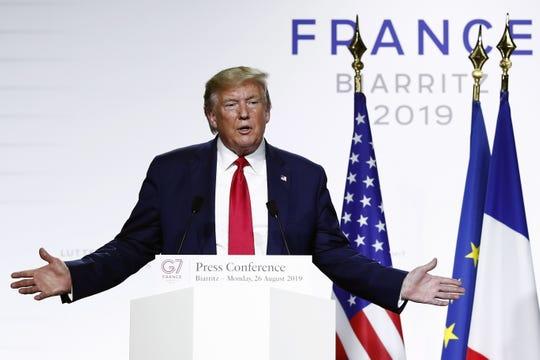
Iran Deploys 2 Warships To Escort Commercial Ships As Zarif Flies To Beijing After G-7

The threshold to an armed conflict around the Persian Gulf just got even smaller.

On Monday, Iran said it had deployed two warships – a destroyer and a helicopter carrier – to protect the country’s commercial vessels around the Gulf of Aden, located between the Arabian Peninsula and Africa, and Persian Gulf region amid a growing US-driven military build-up in the volatile region, which recently culminated with several tanker seizures on both sides, the navy times reports.
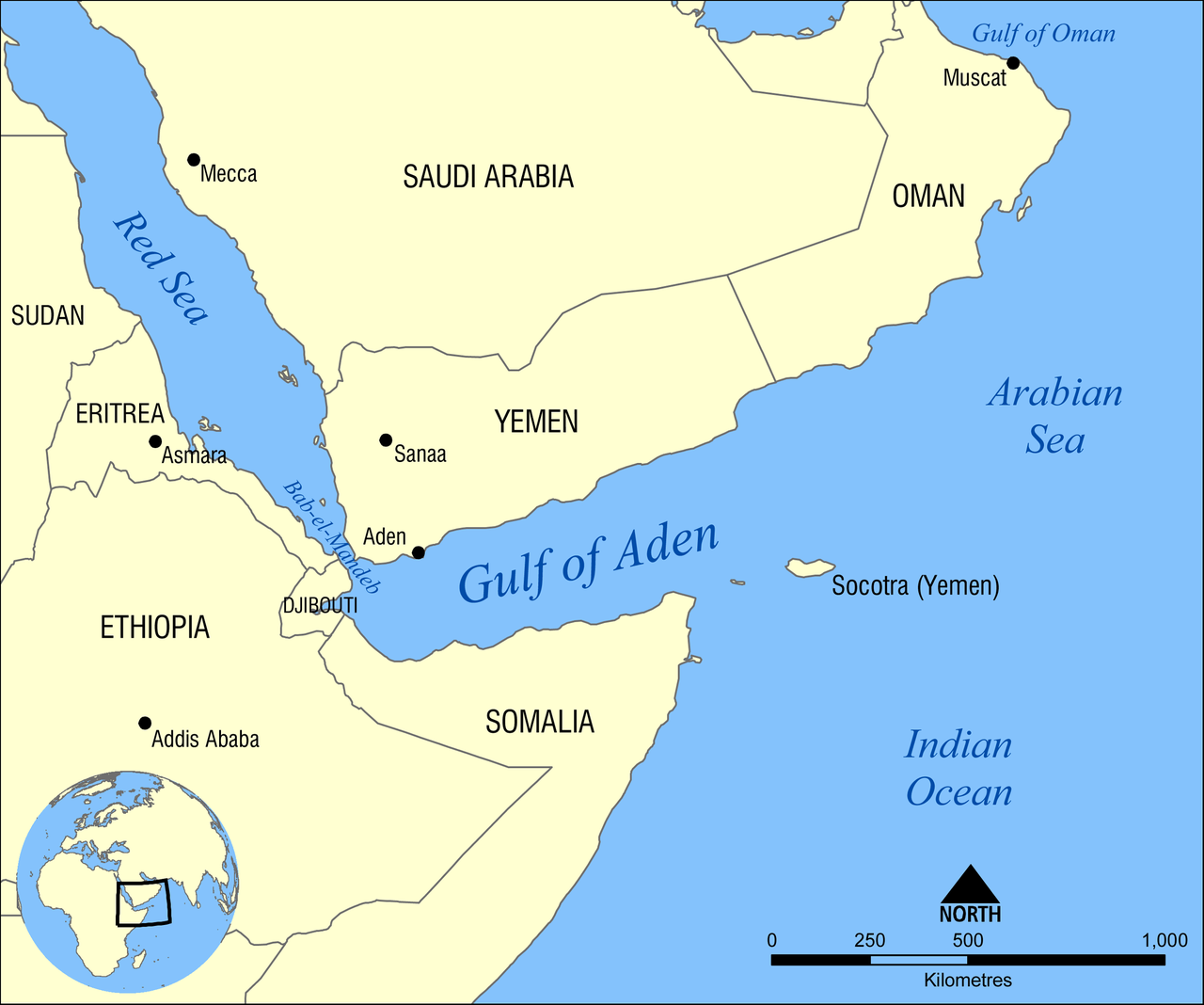
Iran’s brand new destroyer Sahand and the supply ship/replenishment carrier Kharg whiuch has a helicopter pad and services as lositics support,  were deployed to the Gulf of Aden and Sea of Oman and tasked with escorting ships in international waters.

The “Sahand” commissioned in December 2018, is Iran’s most advanced home-made warship. It has a stealth hull and can travel a further than the previous class destroyers without refueling. It is equipped with surface-to-surface and surface-to-air missiles as well as anti-aircraft batteries and radar and radar evading capabilities.

Iranian naval forces attend a Dec. 1 inauguration ceremony for the destroyer Sahand, in Bandar Abbas, Iran

Tehran’s decision to escort its cargo vessels comes at a time of escalating tensions in the Gulf, with US and UK warships operating in and around the Persian Gulf under the “defensive” premise that Iran is the aggressor behind June’s attacks on two tankers in the Strait of Hormuz. Accusing Tehran of ‘sponsoring terrorism’ and running a secret nuclear program, Washington has beefed up its military in the region with more troops and hardware, including an aircraft carrier and bombers.

In early July, the Iranian tanker Adrian Darya, previously known as Grace 1, was seized off the coast of Gibraltar for allegedly carrying oil to Syria in violation of EU sanctions. It was later released, despite US demands that it be detained again. In retaliation, Iran detained a British oil tanker in the Persian Gulf; it remains in Tehran’s custody.

The United States’ most devoted ally in Europe, the UK, is the only country, so far, to support Trump’s call for an international anti-Iran armada in the region. It has sent three new warships to reinforce its presence there in recent weeks, with the stated goal of protecting shipping lanes.

Meanwhile, after Iran’s foreign minister Javad Zarif made a surprise appearance at the G-7 summit in Biarritz over the weekend where he failed to achieve any notable diplomatic breakthroughs, he then darted off to Beijing, where he met with China’s Foreign Minister Wang Yi in Beijing. This was s the third time the Iranian FM has visited China this year, as the Iranian tries to reinforce Chinese support of Iran in its conflict with the US.

Iran and China need to join forces to counter unilateralism and “contempt for international law,” Zarif told his Chinese counterpart at a meeting in Beijing on Monday. WHile Zarif did not mention the U.S. directly in opening remarks to Wang Yi at a state guesthouse, he appeared to be referencing the administration of President Donald Trump.

China has been a close Iranian economic partner and is among the signatories to the 2015 nuclear accord, which has been unraveling since President Donald Trump pulled the U.S. out of the agreement.

“Unilateralism is on the rise. Rejection of international law, not just lack of respect for international law but in fact contempt for international law, is on the rise and we need to work together,” Zarif said, after making an impromptu five-hour visit Sunday to the seaside resort of Biarritz, where he met with French President Emmanuel Macron and French, German and British diplomats.

He said he planned to brief Wang on “the latest developments as well as my tour of Europe and my discussions in Biarritz with our French colleagues” in the nuclear agreement.

Wang said in his opening remarks that “unilateralism is rising and power politics is emerging. Facing this situation, China as a responsible country agrees to work with Iran and other countries to work together for multilateralism, the basic rules of international politics and uphold the rightful interests of each country.”

During his trip to China, which has emerged as an obvious ally in Iran’s feud with Trump, Zarif was said to focus on security in the Strait of Hormuz. It is unclear if he was successful, however if one more Chinese warships unexpectedly appear in the Persian Gulf, we will know the answer.

via ZeroHedge News https://ift.tt/2ZjZsMM Tyler Durden

The Great Failure Of The Climate Models

Authored by Patrick Michaels and Caleb Stewart Rossiter via The Washington Examiner,

Computer models of the climate are at the heart of calls to ban the cheap, reliable energy that powers our thriving economy and promotes healthier, longer lives. For decades, these models have projected dramatic warming from small, fossil-fueled increases in atmospheric concentrations of carbon dioxide, with catastrophic consequences.

Yet, the real-world data aren’t cooperating. They show only slight warming, mostly at night and in winter. According to the United Nations’ Intergovernmental Panel on Climate Change, there has been no systematic increase in the frequency of extreme weather events, and the ongoing rise in sea level that began with the end of the ice age continues with no great increase in magnitude. The constancy of land-based records is obvious in data from the National Oceanic and Atmospheric Administration.

Should we trust these computer models of doom? Let’s find out by comparing the actual temperatures since 1979 with what the 32 families of climate models used in the latest U.N. report on climate science predicted they would be.

Atmospheric scientist John Christy developed a global temperature record of the lower atmosphere using highly accurate satellite soundings. NASA honored him for this achievement, and he was an author for a previous edition of the U.N. report. He told a House Science Committee hearing in March 2017 that the U.N. climate models have failed badly.

Christy compared the average model projections since 1979 to the most reliable observations — those made by satellites and weather balloons over the vast tropics. The result? In the upper levels of the lower atmosphere, the models predicted seven times as much warming as has been observed. Overprediction also occurred at all other levels. Christy recently concluded that, on average, the projected heating by the models is three times what has been observed.

This is a critical error. Getting the tropical climate right is essential to understanding climate worldwide. Most of the atmospheric moisture originates in the tropical ocean, and the difference between surface and upper atmospheric temperature determines how much of the moisture rises into the atmosphere. That’s important. Most of earth’s agriculture is dependent upon the transfer of moisture from the tropics to temperate regions.

Christy is not looking at surface temperatures, as measured by thermometers at weather stations. Instead, he is looking at temperatures measured from calibrated thermistors carried by weather balloons and data from satellites. Why didn’t he simply look down here, where we all live? Because the records of the surface temperatures have been badly compromised.

Globally averaged thermometers show two periods of warming since 1900: a half-degree from natural causes in the first half of the 20th century, before there was an increase in industrial carbon dioxide that was enough to produce it, and another half-degree in the last quarter of the century.

The latest U.N. science compendium asserts that the latter half-degree is at least half manmade. But the thermometer records showed that the warming stopped from 2000 to 2014. Until they didn’t.

In two of the four global surface series, data were adjusted in two ways that wiped out the “pause” that had been observed.

The first adjustment changed how the temperature of the ocean surface is calculated, by replacing satellite data with drifting buoys and temperatures in ships’ water intake. The size of the ship determines how deep the intake tube is, and steel ships warm up tremendously under sunny, hot conditions. The buoy temperatures, which are measured by precise electronic thermistors, were adjusted upwards to match the questionable ship data. Given that the buoy network became more extensive during the pause, that’s guaranteed to put some artificial warming in the data.

The second big adjustment was over the Arctic Ocean, where there aren’t any weather stations. In this revision, temperatures were estimated from nearby land stations. This runs afoul of basic physics.

Even in warm summers, there’s plenty of ice over much of the Arctic Ocean. Now, for example, when the sea ice is nearing its annual minimum, it still extends part way down Greenland’s east coast. As long as the ice-water mix is well-stirred (like a glass of ice water), the surface temperature stays at the freezing point until all the ice melts. So, extending land readings over the Arctic Ocean adds nonexistent warming to the record.

Further, both global and United States data have been frequently adjusted. There is nothing scientifically wrong with adjusting data to correct for changes in the way temperatures are observed and for changes in the thermometers. But each serial adjustment has tended to make the early years colder, which increases the warming trend. That’s wildly improbable.

In addition, thermometers are housed in standardized instrument shelters, which are to be kept a specified shade of white. Shelters in poorer countries are not repainted as often, and darker stations absorb more of the sun’s energy. It’s no surprise that poor tropical countries show the largest warming from this effect.

All this is to say that the weather balloon and satellite temperatures used in Christy’s testimony are the best data we have, and they show that the U.N.’s climate models just aren’t ready for prime time.

via ZeroHedge News https://ift.tt/2NEUKlI Tyler Durden

Trump Says Russia Should Be Part Of G7, Blames Obama For Being “Outsmarted” By Putin

Could the Group of Seven countries again become the Group of Eight – as it was known between 1997 and 2014 when Russia was included among the summit of the top IMF-designated advanced economies in the world?

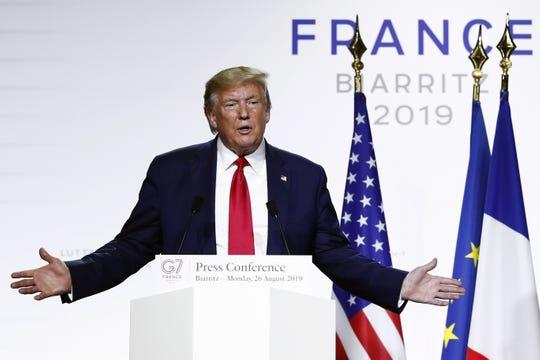
Trump re-upped his position that it should eventually happen, as he described before reporters at the close of the G7 in Biarritz, France on Monday:

There were a lot of things that we were discussing and it would have been easy if Russia were in the room… Yesterday we were discussing four or five matters, and Russia was literally involved in all of those… matters.

Image source: EPA-EFE

Currently the G7 includes Canada, France, Germany, Italy, Japan, the United Kingdom, and the United States. President Trump said he’d “certainly” invite Russian President Vladimir Putin to next year’s G7 summit as a guest.

After 2014 Russia was essentially booted from the summit as relations with the Obama White House broke down over the Ukraine crisis and the Crimea issue.

As part of his remarks about Russia, Trump did indicate that Putin would very unlikely agree to attending merely with “guest” status. 

“Those are tough circumstances. He was a part of G8, and all of a sudden he’s out,” Trump explained. “That’s a pretty tough thing for him. He’s a proud person.”

Trump then sparred with a reporter over assertions that Obama had been “outsmarted” by Putin regarding Crimea, which led to Russia taking control of the vital strategic territory.

“President Obama was helping Ukraine. Crimea was annexed during his term… President Obama was pure and simply outsmarted… it could have been stopped,” Trump said.

Meanwhile, though ‘RussiaGate’ has been conspicuously absent from the 24/7 coverage it once received for the prior couple years, Trump’s daring to admit that a number of global issues “would have been easier” if Russia’s leader had been in the room was met with widespread scorn in the mainstream media. 

Journalists claimed one key G7 dinner was “ruined” over Trump’s insistence that Russia would be vital to discussions:

During the seaside meal, French president Emmanuel Macron and European Council president Donald Tusk opposed Trump’s demands. A diplomat present told the publication that the evening was tense: “Most of the other leaders insisted on this being a family, a club, a community of liberal democracies and for that reason they said you cannot allow president Putin — who does not represent that — back in.”

Apparently Italian prime minister Giuseppe Conte, who formally announced his resignation early this week, was the only G7 leader present to back Trump’s proposal. 

via ZeroHedge News https://ift.tt/33WOPyd Tyler Durden

Dr.Doom Exposes The Anatomy Of The Coming Recession

Authored by Nouriel Roubini via Project Syndicate,

There are three negative supply shocks that could trigger a global recession by 2020. All of them reflect political factors affecting international relations, two involve China, and the United States is at the center of each. Moreover, none of them is amenable to the traditional tools of countercyclical macroeconomic policy.

The first potential shock stems from the Sino-American trade and currency war, which escalated earlier this month when US President Donald Trump’s administration threatened additional tariffs on Chinese exports, and formally labeled China a currency manipulator.

The second concerns the slow-brewing cold war between the US and China over technology. In a rivalry that has all the hallmarks of a “Thucydides Trap,” China and America are vying for dominance over the industries of the future: artificial intelligence (AI), robotics, 5G, and so forth. The US has placed the Chinese telecom giant Huawei on an “entity list” reserved for foreign companies deemed to pose a national-security threat. And although Huawei has received temporary exemptions allowing it to continue using US components, the Trump administration this week announced that it was adding an additional 46 Huawei affiliates to the list.

The third major risk concerns oil supplies. Although oil prices have fallen in recent weeks, and a recession triggered by a trade, currency, and tech war would depress energy demand and drive prices lower, America’s confrontation with Iran could have the opposite effect. Should that conflict escalate into a military conflict, global oil prices could spike and bring on a recession, as happened during previous Middle East conflagrations in 1973, 1979, and 1990.

All three of these potential shocks would have a stagflationary effect, increasing the price of imported consumer goods, intermediate inputs, technological components, and energy, while reducing output by disrupting global supply chains. Worse, the Sino-American conflict is already fueling a broader process of deglobalization, because countries and firms can no longer count on the long-term stability of these integrated value chains. As trade in goods, services, capital, labor, information, data, and technology becomes increasingly balkanized, global production costs will rise across all industries.

Moreover, the trade and currency war and the competition over technology will amplify one another. Consider the case of Huawei, which is currently a global leader in 5G equipment. This technology will soon be the standard form of connectivity for most critical civilian and military infrastructure, not to mention basic consumer goods that are connected through the emerging Internet of Things. The presence of a 5G chip implies that anything from a toaster to a coffee maker could become a listening device. This means that if Huawei is widely perceived as a national-security threat, so would thousands of Chinese consumer-goods exports.

It is easy to imagine how today’s situation could lead to a full-scale implosion of the open global trading system. The question, then, is whether monetary and fiscal policymakers are prepared for a sustained – or even permanent – negative supply shock.

Following the stagflationary shocks of the 1970s, monetary policymakers responded by tightening monetary policy. Today, however, major central banks such as the US Federal Reserve are already pursuing monetary-policy easing, because inflation and inflation expectations remain low. Any inflationary pressure from an oil shock will be perceived by central banks as merely a price-level effect, rather than as a persistent increase in inflation.

Over time, negative supply shocks tend also to become temporary negative demand shocks that reduce both growth and inflation, by depressing consumption and capital expenditures. Indeed, under current conditions, US and global corporate capital spending is severely depressed, owing to uncertainties about the likelihood, severity, and persistence of the three potential shocks.

In fact, with firms in the US, Europe, China, and other parts of Asia having reined in capital expenditures, the global tech, manufacturing, and industrial sector is already in a recession. The only reason why that hasn’t yet translated into a global slump is that private consumption has remained strong. Should the price of imported goods rise further as a result of any of these negative supply shocks, real (inflation-adjusted) disposable household income growth would take a hit, as would consumer confidence, likely tipping the global economy into a recession.

Given the potential for a negative aggregate demand shock in the short run, central banks are right to ease policy rates. But fiscal policymakers should also be preparing a similar short-term response. A sharp decline in growth and aggregate demand would call for countercyclical fiscal easing to prevent the recession from becoming too severe.

In the medium term, though, the optimal response would not be to accommodate the negative supply shocks, but rather to adjust to them without further easing. After all, the negative supply shocks from a trade and technology war would be more or less permanent, as would the reduction in potential growth. The same applies to Brexit: leaving the European Union will saddle the United Kingdom with a permanent negative supply shock, and thus permanently lower potential growth.

Such shocks cannot be reversed through monetary or fiscal policymaking. Although they can be managed in the short term, attempts to accommodate them permanently would eventually lead to both inflation and inflation expectations rising well above central banks’ targets. In the 1970s, central banks accommodated two major oil shocks. The result was persistently rising inflation and inflation expectations, unsustainable fiscal deficits, and public-debt accumulation.

Finally, there is an important difference between the 2008 global financial crisis and the negative supply shocks that could hit the global economy today. Because the former was mostly a large negative aggregate demand shock that depressed growth and inflation, it was appropriately met with monetary and fiscal stimulus. But this time, the world would be confronting sustained negative supply shocks that would require a very different kind of policy response over the medium term. Trying to undo the damage through never-ending monetary and fiscal stimulus will not be a sensible option.

via ZeroHedge News https://ift.tt/2Pf4ohB Tyler Durden

Olive Garden, Fake News, and the Rise of ‘Conspicuous Non-Consumption’

It sucks to be Olive Garden right now. The fast-casual restaurant chain is busy fending off an online boycott campaign based on the mistaken notion that it and its parent company, Darden, are big supporters of Donald Trump and his bid to get reelected in 2020.

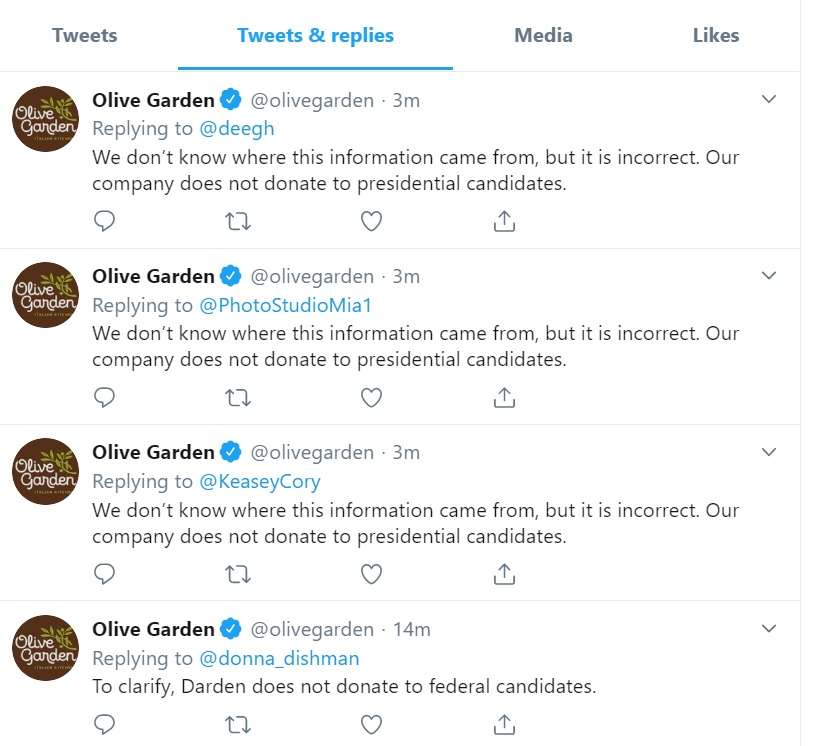
The origin of the fake news is a tweet, since deleted and disowned, by a California college professor who is a self-proclaimed member of #TheResistance but who claims she was hacked. “Olive Garden is funding Trump’s re-election in 2020,” read the original tweet, which appeared on Sunday, August 25, and amassed over 50,000 retweets in about 24 hours. “It would be terrible if you shared this and Olive Garden lost business.” As of this writing, #BoycottOliveGarden is still flourishing on Twitter and the restaurant’s official feed is busy responding to misinformation that is every bit as bottomless as its soup, salad, and breadsticks.

The Olive Garden story sits at the intersection of fake news and what might be called conspicuous non-consumption. As with the recent outrage over one of the major shareholders of Equinox gyms and SoulCycle holding a fundraiser for Donald Trump, opponents of the president have been calling for an absolute boycott. That Olive Garden and Darden, which also operates other chains such as Longhorn Steakhouse and The Daily Grille, doesn’t actually support Trump is no small matter, but it may be one that really doesn’t matter very much, at least to most consumers. There’s no reason to believe that Equinox and SoulCycle will see any significant downturn, and it seems unlikely that Olive Garden’s receipts will suffer, either.

But this episode underscores two realities that are somewhat at odds with one another. First is the basic fact that politically motivated consumer boycotts rarely achieve their goals of punishing a corporation via reduced sales or decreased shareholder value. When they are effective in changing corporate behavior, such as attacks in the 1990s on Nike for using child labor, it’s because they use a company’s image and professed ideals against itself. Second is the idea that virtually all economic activity these days is symbolic and thus open to political and ideological motivation. In almost every case, consumers have all sorts of options, meaning we can easily direct our dollars toward businesses that we think share our values. If we don’t like Walmart for whatever reason, we can shop at Target instead. If we find Chick Fil A objectionable because its owners don’t support marriage equality, we can go to Popeye’s (whose owners apparently don’t have a position on that issue). And on and on.

This is thus the golden age of corporate social responsibility, with an increasing number of companies devoting time and energy to more than their bottom lines (read Reason‘s 2005 debate among Whole Foods CEO John Mackey, Nobel laureate Milton Friedman, and Cypress Semiconductor’s T.J. Rodgers for a prescient take on the matter).

The flip side is that such intentional consumption is absolutely exhausting. Which is one more reason why ideologically motivated boycotts, especially when they are based on observably false premises, tend to wither and curdle on the plate, not unlike Olive Garden’s fettuccine alfredo. Politicizing every purchase makes an intuitive sort of sense, but as with politicizing everything all the time, becomes so tedious it can cause a sort of nihilism that ultimately undermines our ability to make important distinctions in our lives.

from Latest – Reason.com https://ift.tt/2PbZn9t
via IFTTT

Israel Warns Any Hezbollah Attack Will Bring “Reprisal On Whole Lebanese State”

There’s been a flurry of threats and counter-threats after pro-Iran allies in Lebanon, Syria and Iraq were all hit in suspected Israeli strikes in the space of less than 24 hours, signalling a new aggression out of Tel Aviv and willingness to risk yet another major Middle East war. Indeed Lebanon’s southern border with Israel is heating up once again in the worst tensions since the devastating 2006 war. 

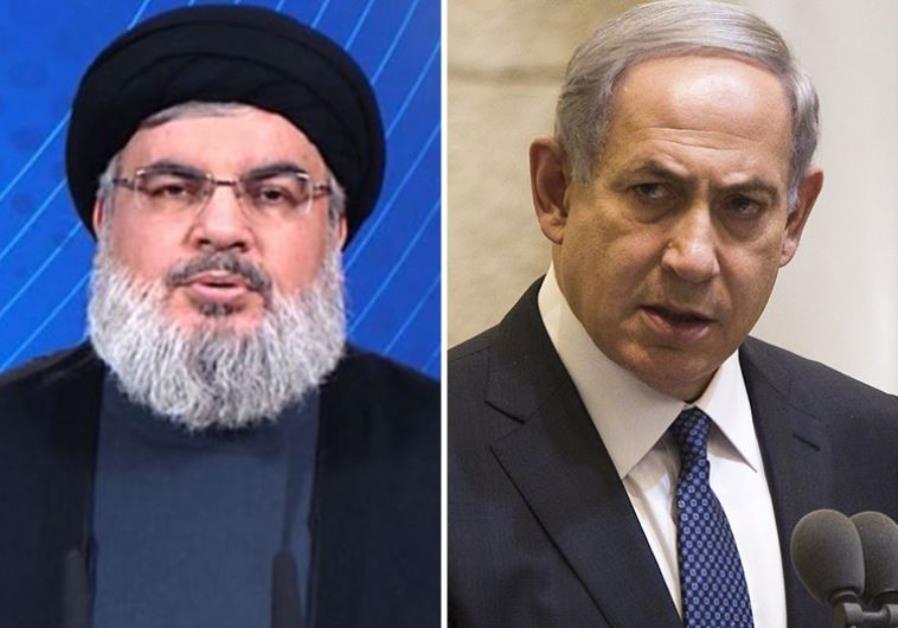
Hezbollah secretary general Hassan Nasrallah has vowed to shoot down any Israeli aircraft violating Lebanon’s sovereign airspace after early Sunday a pair of drones targeted Hezbollah offices in south Beirut, and further after a follow-up drone strike reached deep into Lebanon, killing a Palestinian paramilitary commander (of the PFLP-GC) in the Bekaa Valley.

“Hezbollah will endeavor to down all Israeli drones, which may violate Lebanon’s airspace,” Nasrallah pledged in a televised speech. “The era of the Israeli military’s undeterred attacks on Lebanon has come to an end. Hezbollah will tolerate no more Israeli drones penetrating Lebanese airspace,” Nasrallah said. 

Simultaneously, Lebanese President Michel Aoun on Monday said the drone strikes amount to a “declaration of war” and convened an emergency meeting of the country’s top military and security chiefs. 

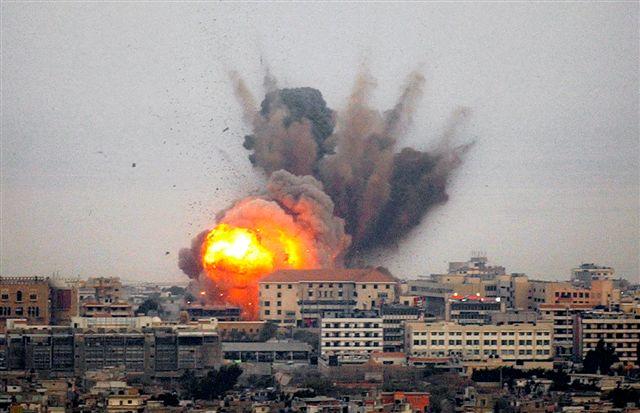
Meanwhile in a potential return to the precise lead-up to the month-long 2006 war, which saw the Israel Defense Forces conduct a heavy bombing campaign across southern Lebanon all the way into Beirut, including the international airport, Tel Aviv is now signaling its forces won’t differentiate between Hezbollah and the Lebanese state.

This according to Axios’ Barak Ravid, who described a phone call between Pompeo and Lebanese Prime Minister Saad Hariri:

Israeli officials tell me Netanyahu told Pompeo in their phone call on Sunday that he should convey to Hariri that if Hezbollah attacks Israel, Israel won’t differentiate between Hezbollah and the Lebanese government and will retaliate against the Lebanese state as a whole.

Pompeo had over the weekend expressed support for Israel’s ability to “defend itself” from the encroaching “Iran threat”. Specifically during the latest weekend Israeli strikes on Syria officials claimed to have thwarted an Iran-backed “killer drone attack” being planned. 

In 2006 Israel waged “total war” on Lebanon, bombing cities, villages, roads, and infrastructure in its failed attempt to root out Hezbollah. 

Meanwhile, during the evening hours (local time) along the Israeli-Lebanon border the IDF has reportedly been releasing flares over the area amid concerns Hezbollah could be ready to launch an attack. 

Nasrallah during his Sunday speech warned that the Israeli military would soon face a reprisal attack. 

“I say to the Israeli army along the border, from tonight be ready and wait for us,” he said. “What happened yesterday will not pass.”

“We will not allow the clock to be turned back. We will not allow Lebanon to be violated by bombardment, killing or explosions, nor the violation of sanctities. This for us is a red line,” Nasrallah said.

He was specifically echoing words used by Israeli officials during the 2006 war, who said they would unleash destruction on Lebanon which would “turn back the clock” on its national development. 

via ZeroHedge News https://ift.tt/321huQQ Tyler Durden

Olive Garden, Fake News, and the Rise of ‘Conspicuous Non-Consumption’

It sucks to be Olive Garden right now. The fast-casual restaurant chain is busy fending off an online boycott campaign based on the mistaken notion that it and its parent company, Darden, are big supporters of Donald Trump and his bid to get reelected in 2020.

The origin of the fake news is a tweet, since deleted and disowned, by a California college professor who is a self-proclaimed member of #TheResistance but who claims she was hacked. “Olive Garden is funding Trump’s re-election in 2020,” read the original tweet, which appeared on Sunday, August 25, and amassed over 50,000 retweets in about 24 hours. “It would be terrible if you shared this and Olive Garden lost business.” As of this writing, #BoycottOliveGarden is still flourishing on Twitter and the restaurant’s official feed is busy responding to misinformation that is every bit as bottomless as its soup, salad, and breadsticks.

The Olive Garden story sits at the intersection of fake news and what might be called conspicuous non-consumption. As with the recent outrage over one of the major shareholders of Equinox gyms and SoulCycle holding a fundraiser for Donald Trump, opponents of the president have been calling for an absolute boycott. That Olive Garden and Darden, which also operates other chains such as Longhorn Steakhouse and The Daily Grille, doesn’t actually support Trump is no small matter, but it may be one that really doesn’t matter very much, at least to most consumers. There’s no reason to believe that Equinox and SoulCycle will see any significant downturn, and it seems unlikely that Olive Garden’s receipts will suffer, either.

But this episode underscores two realities that are somewhat at odds with one another. First is the basic fact that politically motivated consumer boycotts rarely achieve their goals of punishing a corporation via reduced sales or decreased shareholder value. When they are effective in changing corporate behavior, such as attacks in the 1990s on Nike for using child labor, it’s because they use a company’s image and professed ideals against itself. Second is the idea that virtually all economic activity these days is symbolic and thus open to political and ideological motivation. In almost every case, consumers have all sorts of options, meaning we can easily direct our dollars toward businesses that we think share our values. If we don’t like Walmart for whatever reason, we can shop at Target instead. If we find Chick Fil A objectionable because its owners don’t support marriage equality, we can go to Popeye’s (whose owners apparently don’t have a position on that issue). And on and on.

This is thus the golden age of corporate social responsibility, with an increasing number of companies devoting time and energy to more than their bottom lines (read Reason‘s 2005 debate among Whole Foods CEO John Mackey, Nobel laureate Milton Friedman, and Cypress Semiconductor’s T.J. Rodgers for a prescient take on the matter).

The flip side is that such intentional consumption is absolutely exhausting. Which is one more reason why ideologically motivated boycotts, especially when they are based on observably false premises, tend to wither and curdle on the plate, not unlike Olive Garden’s fettuccine alfredo. Politicizing every purchase makes an intuitive sort of sense, but as with politicizing everything all the time, becomes so tedious it can cause a sort of nihilism that ultimately undermines our ability to make important distinctions in our lives.

from Latest – Reason.com https://ift.tt/2PbZn9t
via IFTTT

Americans Under The Age Of 39 Have Completely Different Values Than The Generations That Came Before Them

Authored by Michael Snyder via The End of The American Dream blog,

America’s values are shifting at a pace that is unlike anything that we have ever seen before.  During the 2020 election season, we are going to hear a lot about “the generation gap”, and the numbers clearly tell us that this gap is very, very real.  And as older generations of Americans slowly die off, it appears inevitable that the values that are dominant among younger generations of Americans are going to become the values of the country as a whole.  Essentially, “American values” are going to mean something completely different from what they meant to previous generations, and that should absolutely terrify all of us.

A Wall Street Journal/NBC News survey that was just released has some very revealing results.  Among other things, those conducting the survey asked respondents about the importance of “patriotism” and “religion”, and the differences between the age groups were quite striking

Among people 55 and older, for example, nearly 80% said patriotism was very important, compared with 42% of those ages 18-38—the millennial generation and older members of Gen-Z. Two-thirds of the older group cited religion as very important, compared with fewer than one-third of the younger group.

“There’s an emerging America where issues like children, religion and patriotism are far less important. And in America, it’s the emerging generation that calls the shots about where the country is headed,” said Republican pollster Bill McInturff, who conducted the survey with Democratic pollster Jeff Horwitt.

In addition, well over 50 percent of Baby Boomers rated “having children” as “very important”, while just over 30 percent of Americans under the age of 39 did.

God, family and country are clearly not as important to Americans as they used to be, and that has enormous implications for our future.  When all of the age groups in the Wall Street Journal/NBC News survey are combined and the results are compared to 21 years ago, we can clearly see the seismic shift that has taken place

Some 61% in the new survey cited patriotism as very important to them, down 9 percentage points from 1998, while 50% cited religion, down 12 points. Some 43% placed a high value on having children, down 16 points from 1998.

America also used to be a “capitalist nation” that firmly rejected socialism, but now that is rapidly changing too.

According to ABC News, a recent Gallup survey discovered that 58 percent of U.S. adults under the age of 35 believe that some version of socialism “would be good for the country”….

While more than half of Americans rejected socialism in a recent Gallup poll, 43% surveyed said some version of it would be good for the country. That sentiment was held by 58% of respondents ages 18 to 34, compared with just 36% of those 55 and older.

Whether you and I like it or not, this is the direction that our nation is heading.  Given enough time, those young people would eventually be running everything.

America is clearly shifting to the left, and another survey made this even clearer.  When asked to choose the best president of their lifetimes, a whopping 62 percentof American Millennials picked Barack Obama as their first or second choice…

Millennials (born 1981 to 1996) were the most likely to choose Obama, with 62 percent naming him as their first or second choice. Reagan was the top pick for Generation X (1965 to 1980), baby boomers (1946 to 1964) and the silent generation (1928 to 1945).

Unsurprisingly, party identification was very closely tied to a person’s answer. Obama was the first or second pick of 71 percent of Democrats but only 13 percent of Republicans.

Reagan was the clear favorite among Republicans with 57 percent (12 percent among Democrats). Trump was the second pick for Republicans at 40 percent. Only 3 percent of Democrats named Trump.

Of course Barack Obama remains wildly popular among young people, and so if Michelle Obama decided to run in 2020 she would have an overwhelming amount of support among younger voters.

This “generation gap” is also huge when it comes to social issues.

Today, young adults are overwhelmingly in favor of gay marriage, and at this point we have almost even reached a “tipping point” with evangelical Christians.  For example, just check out the results from this very shocking survey

Overall, white evangelical Protestants continue to stand out for their opposition to same-sex-marriage: 35% of white evangelical Protestants favor same-sex marriage, compared with a 59% majority who are opposed. But younger white evangelicals have grown more supportive: 47% of white evangelical Millennials and Gen Xers – age cohorts born after 1964 – favor same-sex marriage, up from 29% in March 2016. Views among older white evangelicals (Boomers and Silents) have shown virtually no change over the past year (26% now, 25% then).

If we are still having a “culture war”, one side is definitely winning by a landslide.

The primary reason why all of this is happening is quite obvious.  For most of our history, the United States has been an overwhelmingly Christian nation.  But in recent decades that has begun to change dramatically, and the shift has been most pronounced among young adults.

According to a survey that was conducted a while back by PRRI, 39 percent of all young adults in America are now “religiously unaffiliated”, but all the way back in 1986 that number was sitting at just 10 percent…

Today, nearly four in ten (39%) young adults (ages 18-29) are religiously unaffiliated—three times the unaffiliated rate (13%) among seniors (ages 65 and older). While previous generations were also more likely to be religiously unaffiliated in their twenties, young adults today are nearly four times as likely as young adults a generation ago to identify as religiously unaffiliated. In 1986, for example, only 10% of young adults claimed no religious affiliation.

And of course many of our “religious institutions” have also shifted dramatically to the left during that same time frame.

Ultimately, it is quite easy to see what we need to do.  If we ever want to turn America back in the right direction, we need to return to the values and principles that this nation was founded upon.

But that is much easier said than done.

The sad truth is that America’s young adults have firmly rejected the values that we once held so dear.  They want to take this country down an entirely different path, and given enough time they would have the numbers to firmly be in control.

via ZeroHedge News https://ift.tt/2KXgB6w Tyler Durden

Joe Walsh Isn’t Running on the Issues

Joe Walsh, the former one-term congressman from Illinois and current conservative talk radio host, announced on Sunday that he will challenge President Donald Trump for the Republican presidential nomination in 2020.

“I’m running because he’s unfit; somebody needs to step up and there needs to be an alternative. The country is sick of this guy’s tantrum—he’s a child,” Walsh said on ABC’s This Week. 

“What are we really getting done?” he asked host George Stephanopoulos. “We haven’t built one foot of a wall. This president, who said ‘I’m gonna eliminate the debt in eight years,’ has increased the debt at a faster clip than Obama.”

Walsh has been particularly vocal about the latter point. Writing in The New York Times, he said that the only time the bulk of his conservative audience parted with Trump was when the president “ballooned the deficit” after signing the omnibus spending bill in 2017. “Fiscal responsibility is an issue the American electorate cares about, but that our elected officials disregard from the top down — including the Tea Party in the Trump era.”

Trump did indeed campaign on reducing the national debt within eight years, which is why Republicans like Walsh—who says he voted for Trump—have become increasingly jaded as they’ve watched the debt and the deficit expand at a rapid pace. In 2018, a bipartisan budget deal approved $1.3 trillion in spending, sending the national debt past $22 trillion. Just last month, Trump heralded another bipartisan spending deal⁠—one that suspends debt ceilings until 2021 and is set to add $1.7 trillion to the national debt over the next decade.

Walsh seems serious about reining in excessive spending, but he hasn’t announced a plan for doing so. He told Stephanopoulos that Trump’s rhetoric is more pressing than the issues.

“This is not about issues,” he said. “I would not be thinking about primarying this president if I was upset with his position on the debt and the deficit.”

For Walsh, that might be a tough sell, as the conservative radio firebrand has his own history of incendiary remarks and politically charged insults. Not unlike Trump, he promoted the “birther” theory that alleged former President Obama was born abroad, and he was temporarily removed from the radio in 2014 after using a series of racial slurs.

He also propagated the false claim that Obama is Muslim, tweeted that the former president was elected “because he’s black,” and echoed Trump’s sentiment that Haiti is a “shithole country.”

Walsh apologized on This Week. “I helped create Trump, and George, that’s not an easy thing to say,” he said. “I went beyond the policy and the idea differences and I got personal and I got hateful. I said some ugly things about President Obama that I regret.”

from Latest – Reason.com https://ift.tt/2HoeaHK
via IFTTT

Joe Walsh Isn’t Running on the Issues

Joe Walsh, the former one-term congressman from Illinois and current conservative talk radio host, announced on Sunday that he will challenge President Donald Trump for the Republican presidential nomination in 2020.

“I’m running because he’s unfit; somebody needs to step up and there needs to be an alternative. The country is sick of this guy’s tantrum—he’s a child,” Walsh said on ABC’s This Week. 

“What are we really getting done?” he asked host George Stephanopoulos. “We haven’t built one foot of a wall. This president, who said ‘I’m gonna eliminate the debt in eight years,’ has increased the debt at a faster clip than Obama.”

Walsh has been particularly vocal about the latter point. Writing in The New York Times, he said that the only time the bulk of his conservative audience parted with Trump was when the president “ballooned the deficit” after signing the omnibus spending bill in 2017. “Fiscal responsibility is an issue the American electorate cares about, but that our elected officials disregard from the top down — including the Tea Party in the Trump era.”

Trump did indeed campaign on reducing the national debt within eight years, which is why Republicans like Walsh—who says he voted for Trump—have become increasingly jaded as they’ve watched the debt and the deficit expand at a rapid pace. In 2018, a bipartisan budget deal approved $1.3 trillion in spending, sending the national debt past $22 trillion. Just last month, Trump heralded another bipartisan spending deal⁠—one that suspends debt ceilings until 2021 and is set to add $1.7 trillion to the national debt over the next decade.

Walsh seems serious about reining in excessive spending, but he hasn’t announced a plan for doing so. He told Stephanopoulos that Trump’s rhetoric is more pressing than the issues.

“This is not about issues,” he said. “I would not be thinking about primarying this president if I was upset with his position on the debt and the deficit.”

For Walsh, that might be a tough sell, as the conservative radio firebrand has his own history of incendiary remarks and politically charged insults. Not unlike Trump, he promoted the “birther” theory that alleged former President Obama was born abroad, and he was temporarily removed from the radio in 2014 after using a series of racial slurs.

He also propagated the false claim that Obama is Muslim, tweeted that the former president was elected “because he’s black,” and echoed Trump’s sentiment that Haiti is a “shithole country.”

Walsh apologized on This Week. “I helped create Trump, and George, that’s not an easy thing to say,” he said. “I went beyond the policy and the idea differences and I got personal and I got hateful. I said some ugly things about President Obama that I regret.”

from Latest – Reason.com https://ift.tt/2HoeaHK
via IFTTT