Saudis, Russians Consider Pausing Oil Production Increases In Retaliation To Biden SPR Release

Saudis, Russians Consider Pausing Oil Production Increases In Retaliation To Biden SPR Release

When commenting on yesterday’s SPR release announcement by the Biden admin and several assorted hanger-on nations – which has backfired spectacularly sending the price of oil soaring now that the rumor can no longer be sold so the news has to be bought in line with every single SPR release in the past…

… we said that not only was the release far to smmal, but that in retaliation for the SPR release, “OPEC could easily consider halting its production hikes to offset the detrimental SPR impact of lower oil prices on the needed recovery in global oil capex, likely justifying such action as prudent in the face of COVID demand risks.

Well, fast forward just a few hours when moments ago the WSJ reported that the leaders of OPEC+ and the world’s two top oil producers Saudi Arabia and Russia, are considering a pause to their recent efforts to provide the world with more crude, citing to people familiar with those discussions. The move, as expected, is in retaliation to Washington releasing tens of millions of barrels of oil in an effort to lower prices.

As a reminder, OPEC+ is meeting next week to review the long-term deal they reached earlier this year to boost their collective oil output – the deal involves boosting output by 400,000 barrels a day each month through next year, until the group hits its pre-pandemic pumping level and follows a sharp cut in output in 2020 as demand evaporated amid Covid-19 lockdowns.

However, it now appears that OPEC+ may change its mind and not raise output at all; and while Biden is quick to note that oil prices have hovered near multiyear highs, OPEC and other forecasting agencies have struggled to predict demand amid the on-again-off-again nature of Covid-19 restrictions. Several countries in Europe, for instance, are moving ahead with, or considering, fresh restrictions that could sap economic activity—and by extension demand for oil.

Meanwhile, the elephant in the room – the Biden-led crude release of up to 70 million barrels threatens to further scramble the supply-demand balance. As a result, and to compensate for the new supply, the WSJ confirmed our prediction and writes that Riyadh and Moscow are now considering a pause of the group’s monthly collective increase, even as US lackey, UAE – an OPEC member that has clashed with Saudi Arabia over OPEC policy in the past, and Kuwait are resisting a pause. Then again, what Russia and Saudi Arabia want, they will get.

Saudi Arabia sees the released crude as potentially swelling global supply and threatening to reduce prices, according to people familiar with the country’s thinking.

The question then is what will Biden do after a potential escalation in the oil war, and whether the US will halt oil exports in counter-retaliation. Such a move, as Goldman explained yesterday, would lead to a historic surge in oil prices and all hell breaking loose. This is what we said yesterday:

One final point: while not even the Biden admin is dumb enough to consider it, some have speculated that once the SPR release is shown to be a total disaster, Biden may implement an oil export ban. The problem: this would have catastrophic consequences. As Goldman explains, a US export ban would significantly disrupt the US and global oil markets, and potentially be a counterproductive tool to attempt to lower oil prices.

The US exports 3 mb/d of crude and domestic pipelines would not be able to reroute these volumes to US refiners, which further don’t have enough capacity to process this much crude. This would leave excess US crude supply quickly reaching tank tops and forcing shut-in production, with investment and production soon to enter significant declines. At the same time, the global market would be deprived of 3 mb/d of US supply (light sweet crude that is Brent like in quality). Brent prices would therefore need to spike to push demand lower as there is simply not enough spare capacity (nor suitable crude) to replace US lost exports.

Finally, with the US an importer of gasoline from Europe, US gasoline prices would spike to curtail domestic demand, creating a negative hit to US economic activity.

Come to think of it, this is precisely what Biden will do next.


Tyler Durden
Wed, 11/24/2021 – 10:29

via ZeroHedge News https://ift.tt/3CMAwN6 Tyler Durden
New Home Sales Data Suffers Huge Downward Revisions, Inventories Hit 13-Year-High

New Home Sales Data Suffers Huge Downward Revisions, Inventories Hit 13-Year-High

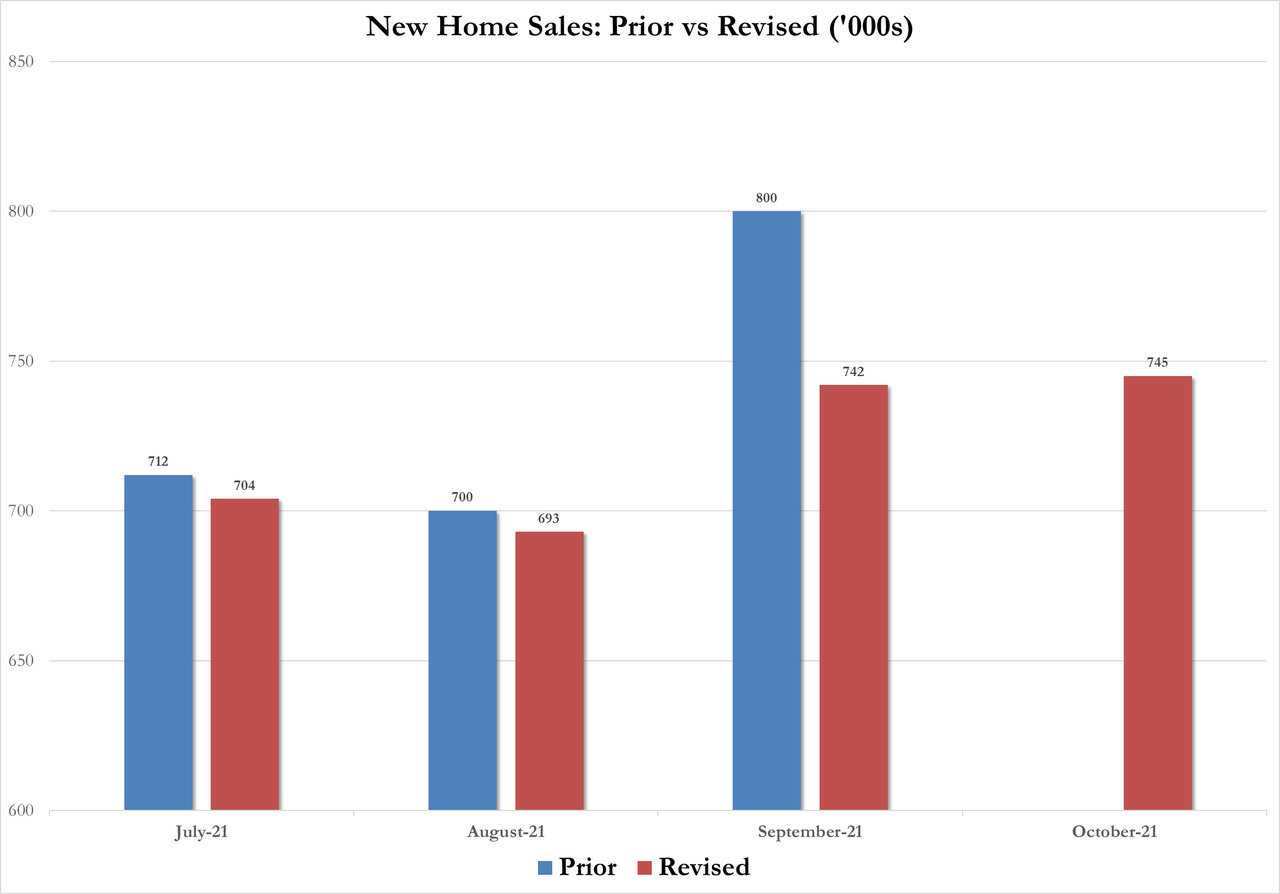
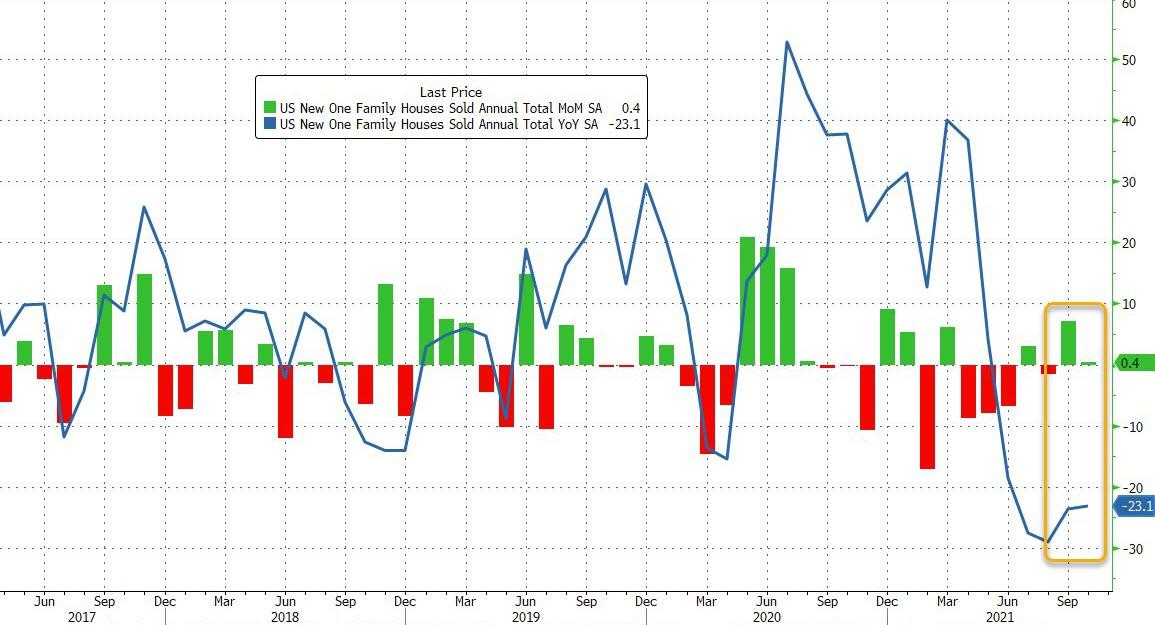
New home sale rose 0.4% MoM (better than the expected unchanged print), but this hid the dramatic downward revisions of prior data (September’s +14.1% MoM spike smacked down to +7.1% MoM). New home sales remain down over 23% YoY…

Source: Bloomberg

The downward revisions dominated the narrative…

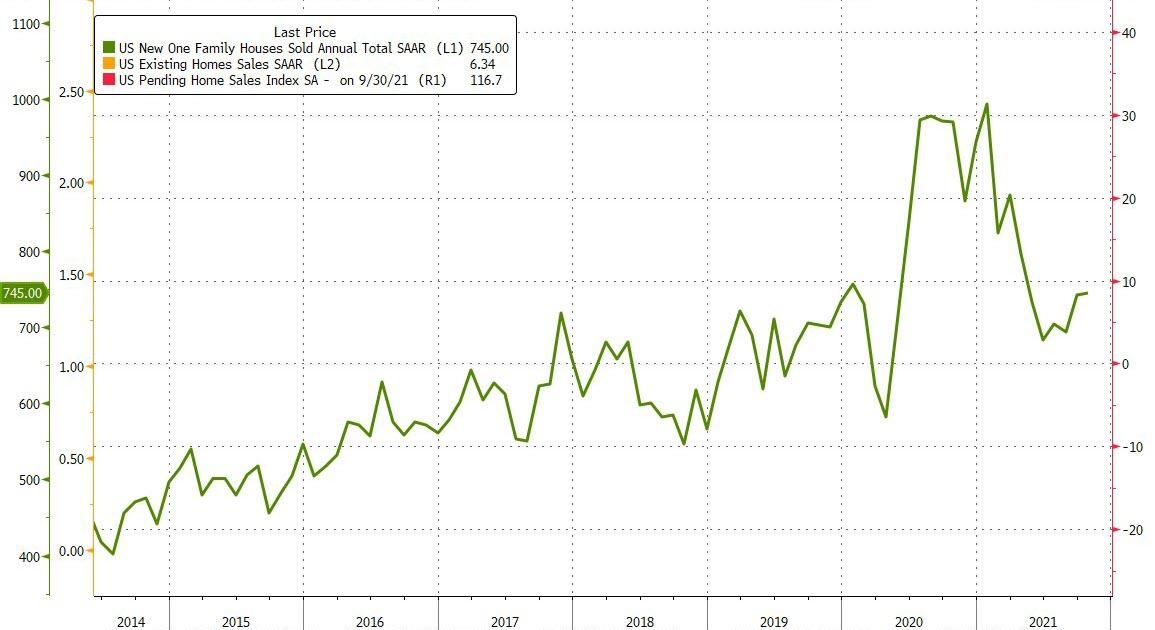
This pushed the New Home Sales SAAR to 745k – the highest since April.

Source: Bloomberg

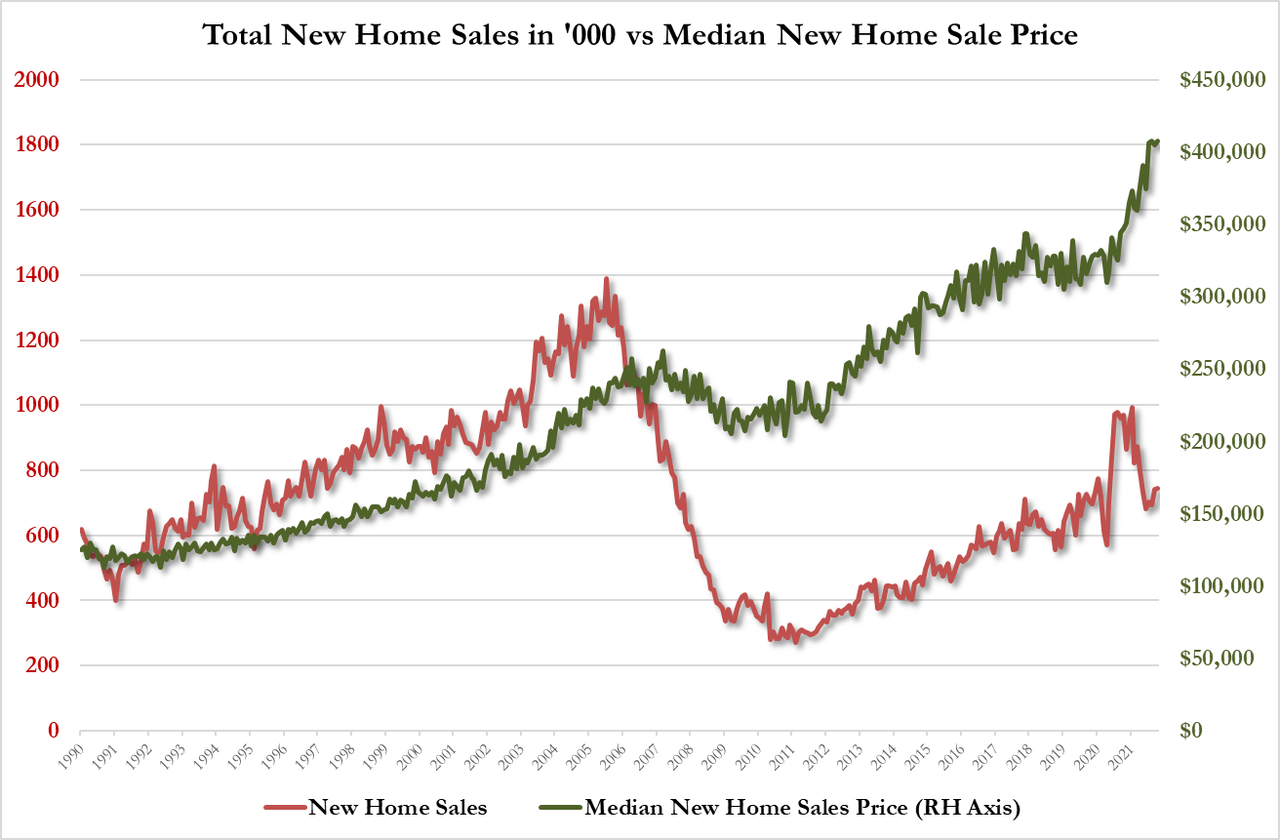
There were 389,000 new homes for sale as of the end of October, the most in 13 years — though 28% of those houses were not yet started. At the current sales pace, it would take 6.3 months to exhaust the supply of new homes, compared with 3.6 months at the start of the year.

Sales SAAR has been dropping as prices have soared…

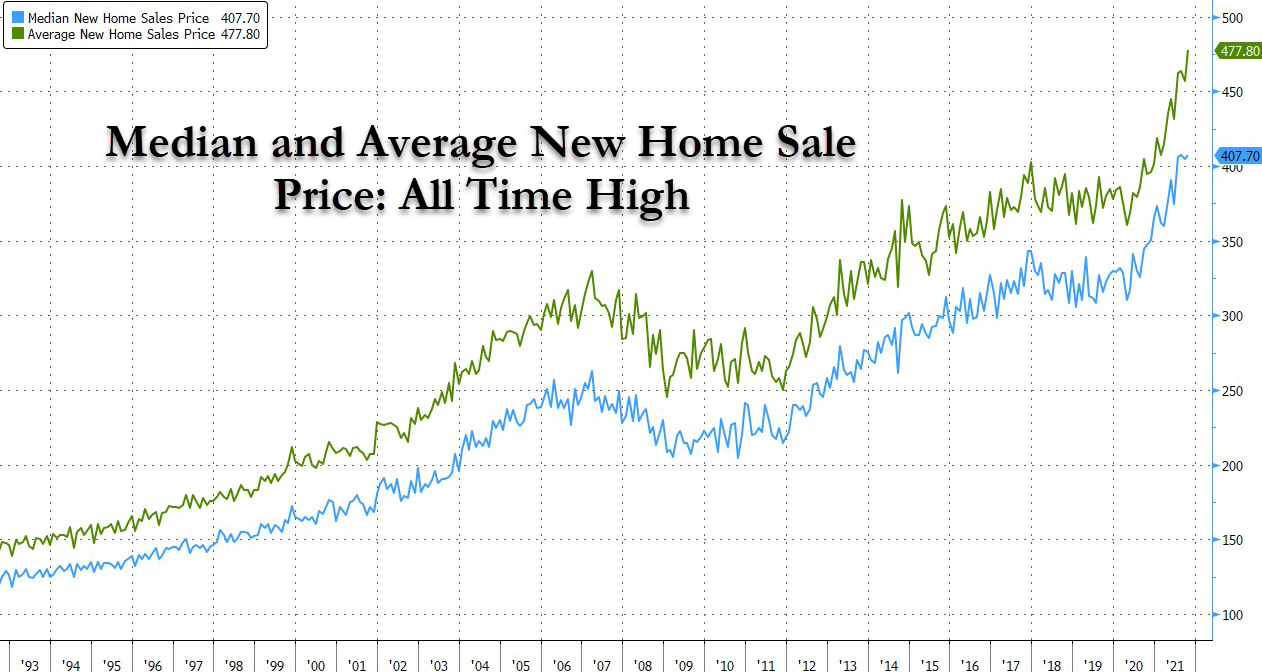
As Mean and Median home prices hit record highs…

How are you going to let these homeowners down gently Mr.Powell?

Tyler Durden
Wed, 11/24/2021 – 10:28

via ZeroHedge News https://ift.tt/3l6Szr5 Tyler Durden

UMich Sentiment Holds At 10-Year Lows, Inflation Expectations At 13 Year High

UMich Sentiment Holds At 10-Year Lows, Inflation Expectations At 13 Year High

After plunging to decade-lows in preliminary data, analysts expected practically no bounce at all for the final November print of University Of Michigan’s Sentiment survey, but in fact the data did bounce a little.

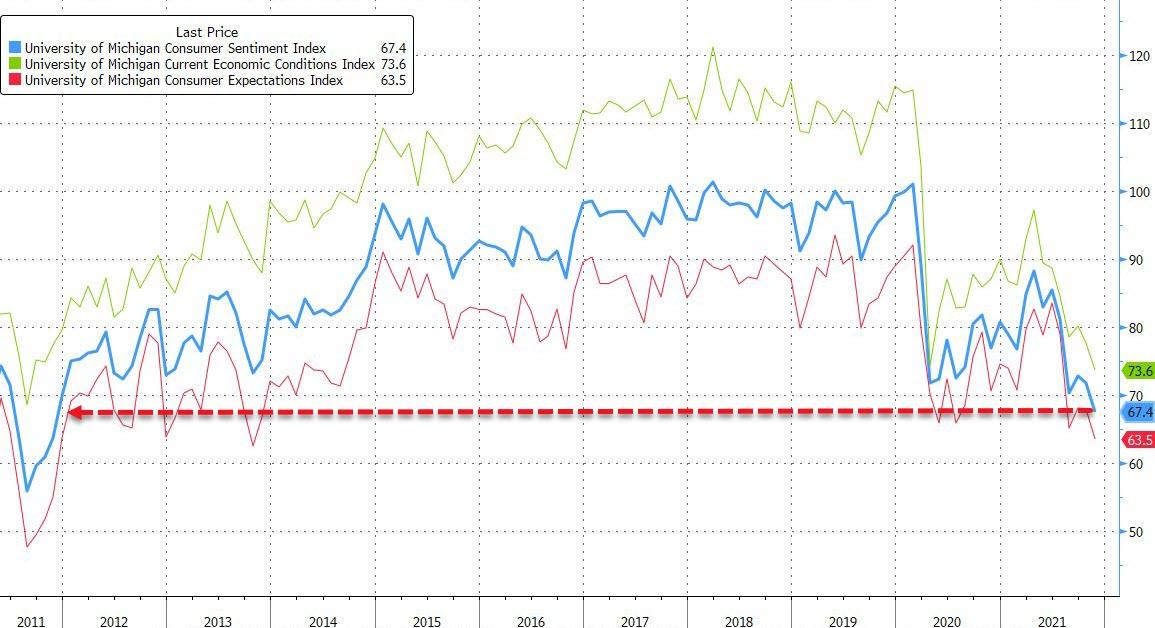
  • The headline print rose from 66.8 prelim to 67.4 final but remains well below the 71.7 October print.

  • Current Conditions rose from 73.2 prelim to 73.6 final for November (still below October’s 77.7).

  • Expectations also rebounded modestly from 62.8 to 63.5 final, but well below the 67.9 final print from October.

However, despite the intramonth bounce (which was small), headline sentiment remains at its lowest since 2011…

Source: Bloomberg

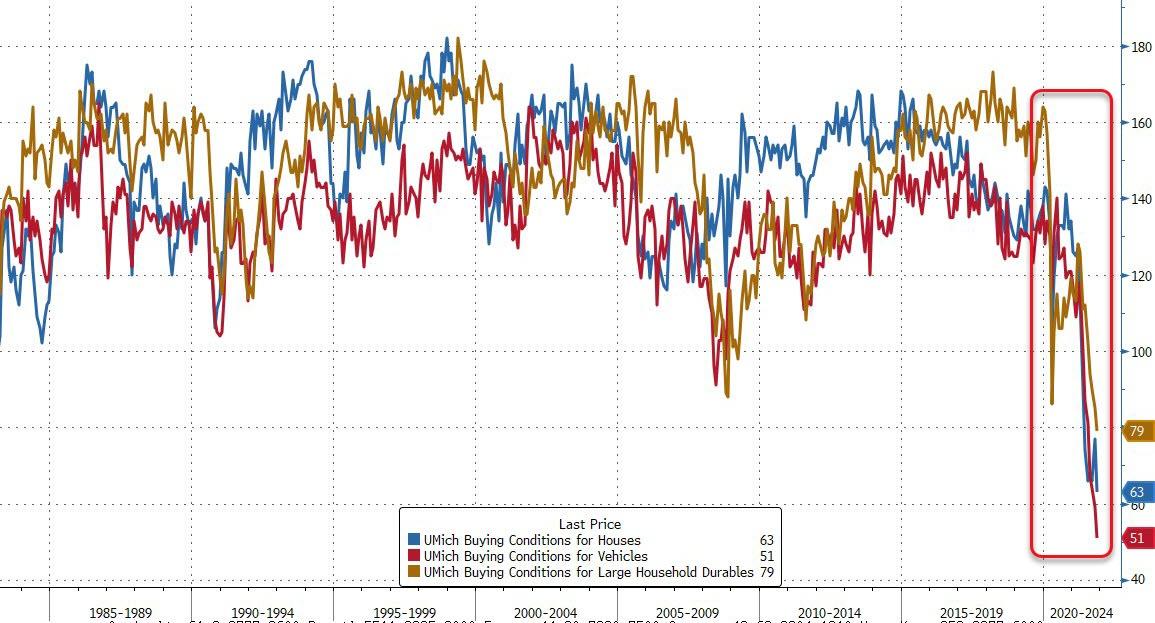
Buying Attitudes all dropped in November to record lows…

Source: Bloomberg

Finally, and perhaps most importantly, Americans’ expectations for the future path of inflation remain at their highest since 2008 fro the short-term and medium-term picked up as the month proceeded…

Source: Bloomberg

Not what Brainard wanted to see!

Tyler Durden
Wed, 11/24/2021 – 10:18

via ZeroHedge News https://ift.tt/30VIohM Tyler Durden

Fed’s Favorite Inflation Indicator At 30-Year-High As Savings Rate Plunges To Pre-COVID Levels

Fed’s Favorite Inflation Indicator At 30-Year-High As Savings Rate Plunges To Pre-COVID Levels

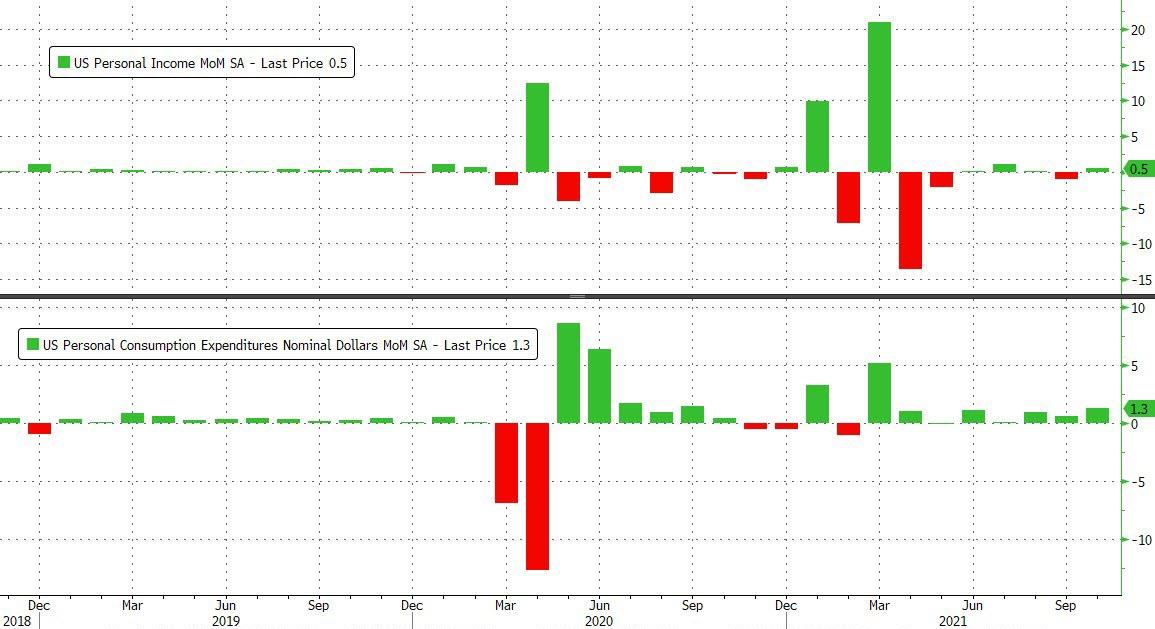
Despite sentiment slumping and buying attitudes crashing, retail sales outperformed this month (thanks to inflation driving nominal prices higher) and analysts expected spending to surge faster than incomes once again and they did with incomes rising 0.5% MoM (+0.2% MoM exp) and spending jumping 1.3% MoM (+1.0% MoM exp).

Source: Bloomberg

Purchases of goods and services, unadjusted for changes in prices, increased 1.3% following a 0.6% gain in September, Commerce Department figures showed Wednesday.

On the income side, Private worker wages rise to match all time high at 8.4% Y/Y, Government worker wages drop to 11.0%, the lowest since March 2021

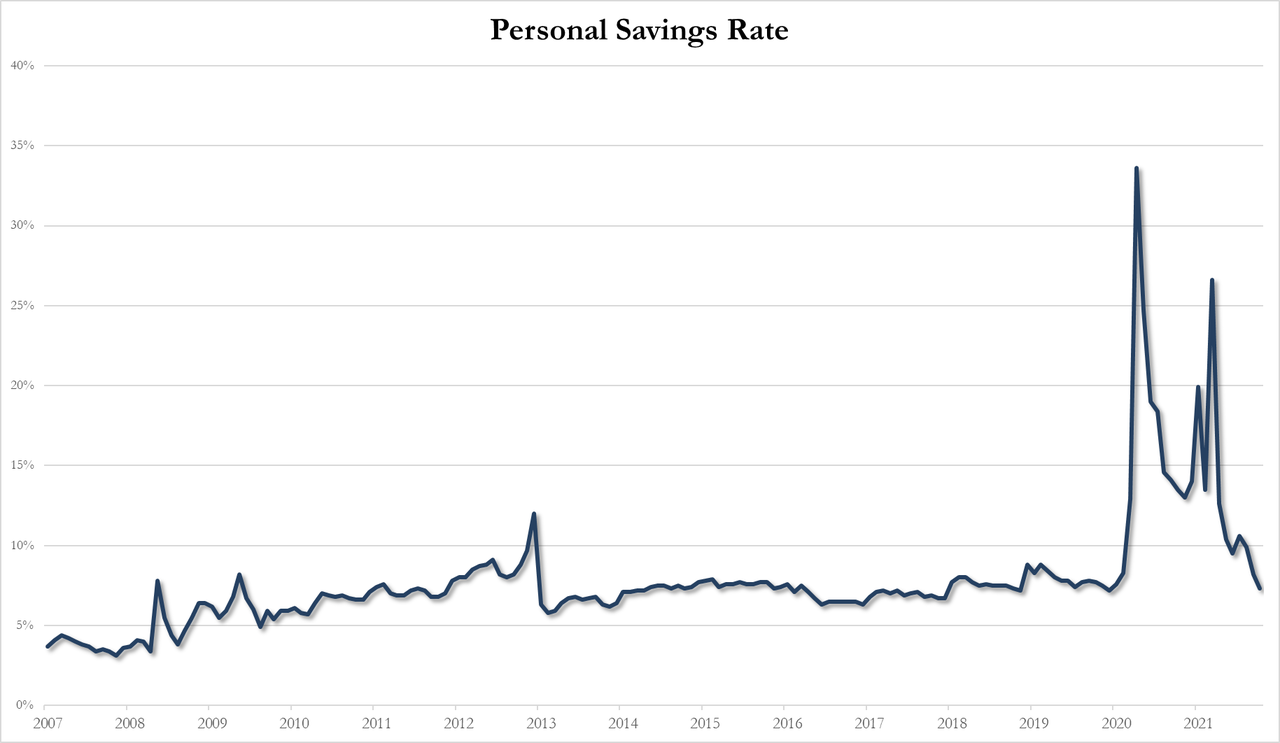
All of which means the Personal Savings Rate tumbled back to pre-COVID levels: 7.3% in Oct. was 7.6% in Jan…

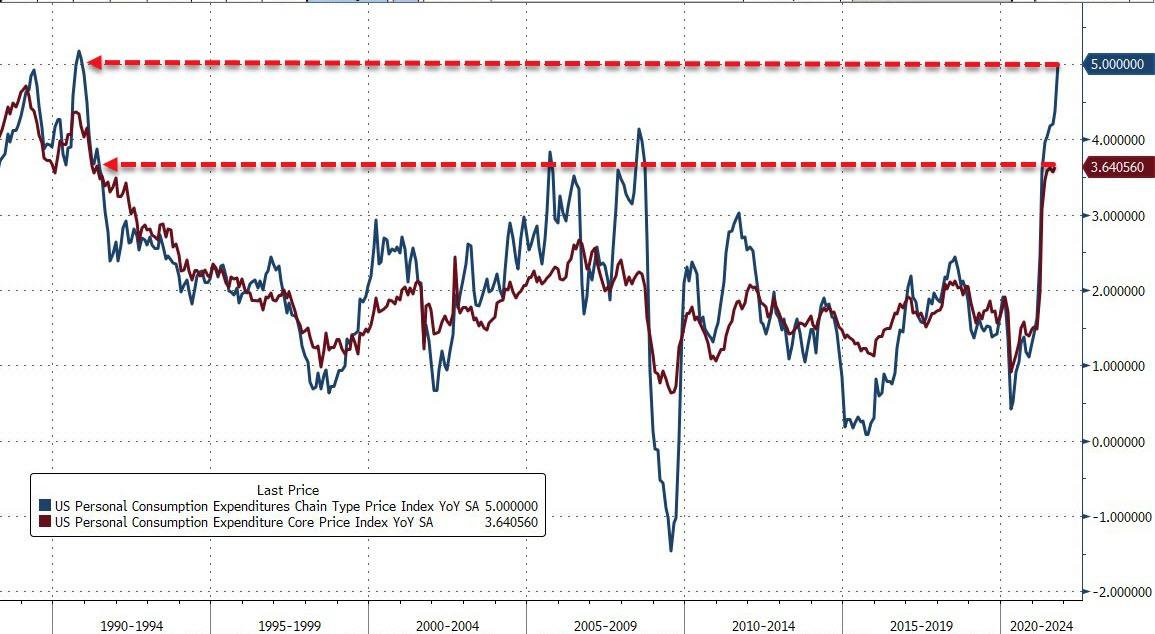
Finally, and perhaps most importantly, The Fed’s favorite inflation indicator – Core PCE Deflator – which jumped to its highest since 1991 (and headline PCE rose 5.0% YoY)…

Source: Bloomberg

Get back to work Mr.Powell!

Tyler Durden
Wed, 11/24/2021 – 10:08

via ZeroHedge News https://ift.tt/3xnL4kv Tyler Durden

The Build Back Better Bill Will Give You $12,000 for Buying an Electric Car. Unless It’s a Tesla.


zumaamericasthirtytwo925260

Last Friday, the House of Representatives passed the Build Back Better Act, President Joe Biden’s signature legislation. Despite being much smaller than it was when initially proposed, the bill is still stuffed with Democratic wish list items, including policies on climate change, child care, family leave, and immigration. The bill is expected to face opposition, and likely some pruning, when it reaches the Senate. One proposal jumps out as an obvious contender for the chopping block.

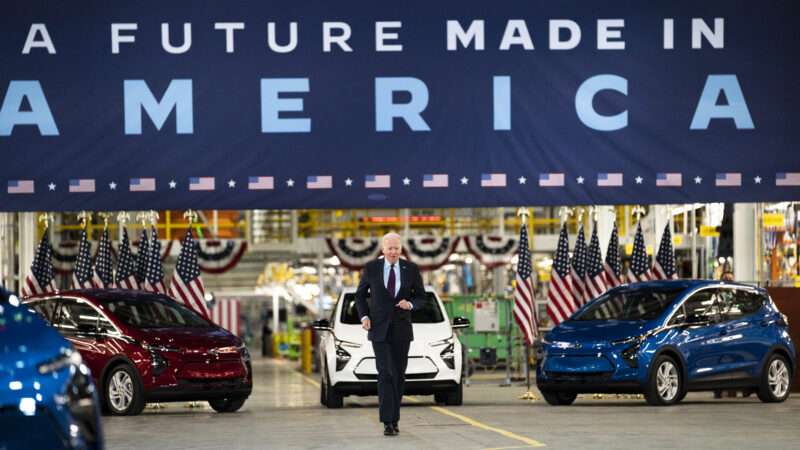
As part of Biden’s plan to rein in carbon emissions, the bill contains a provision that would provide a $7,500 tax rebate to any consumer who purchases an electric vehicle, including both all-electric and plug-in hybrids. However, that amount increases by $4,500 if the car was manufactured in a unionized U.S. factory, as well as by an additional $500 if the vehicle contains a U.S.-made battery.

Ostensibly, this provision is part of Biden’s “Buy American” policy of incentivizing or mandating that purchases be made domestically. In practice, the order has simply carried over the protectionism of the Trump trade policy and increased costs to taxpayers. The electric vehicle credit proposal, though, is much more egregious, in that it not only incentivizes a particular type of product but incentivizes particular brands, as well.

If enacted as written, the bonus $4,500 in electric vehicle credits could only apply to cars made by Ford, General Motors, and Stellantis (formerly Fiat Chrysler). In other words, a driver who wants to purchase a hybrid Toyota Camry does not qualify for the extra money, even though the car is manufactured in Kentucky. But if that same shopper elects to purchase a Chevrolet Bolt, which recently halted production because the batteries were catching fire, they would receive the extra rebate. As a matter of fact, out of more than 50 electric vehicles currently on the market, the only cars which currently qualify for the extra money are two variations of the Bolt.

This is what is most pernicious about this policy: Rather than simply a blanket advantage for American companies (which would be bad enough), it is a clear giveaway to the United Auto Workers (UAW) labor union. In October, when Biden visited a UAW job training center, he bragged about the electric vehicle proposal, saying “I want those jobs here in Michigan”—rather than in states like Tennessee or Kentucky, where UAW membership is less of a certainty.

In fact, it is clear that the union aspect of the policy was more important than the actual consumer incentive. As The Wall Street Journal reported last week, Rep. Dan Kildee (D-Mich.), the provision’s co-author, stated that he included the bonus funding after being advised by General Motors and UAW “about the importance of including an explicitly pro-union component.”

As a means of lessening not only carbon emissions, but also exhaust pollution, shifting to electric vehicles is a perfectly laudable step (though by no means a silver bullet). But when the transition is accomplished by executive fiat rather than consumer choice or market incentive, it risks undermining the entire goal. And in this instance, customers are being nudged for political reasons: a kickback to a key constituency of Biden’s party.

The post The Build Back Better Bill Will Give You $12,000 for Buying an Electric Car. Unless It's a Tesla. appeared first on Reason.com.

from Latest – Reason.com https://ift.tt/3DOGtdr
via IFTTT

Musk Dumps Another $1.05 Billion In TSLA Stock, Reaches Halfway Point To Liquidate 10% Stake  

Musk Dumps Another $1.05 Billion In TSLA Stock, Reaches Halfway Point To Liquidate 10% Stake  

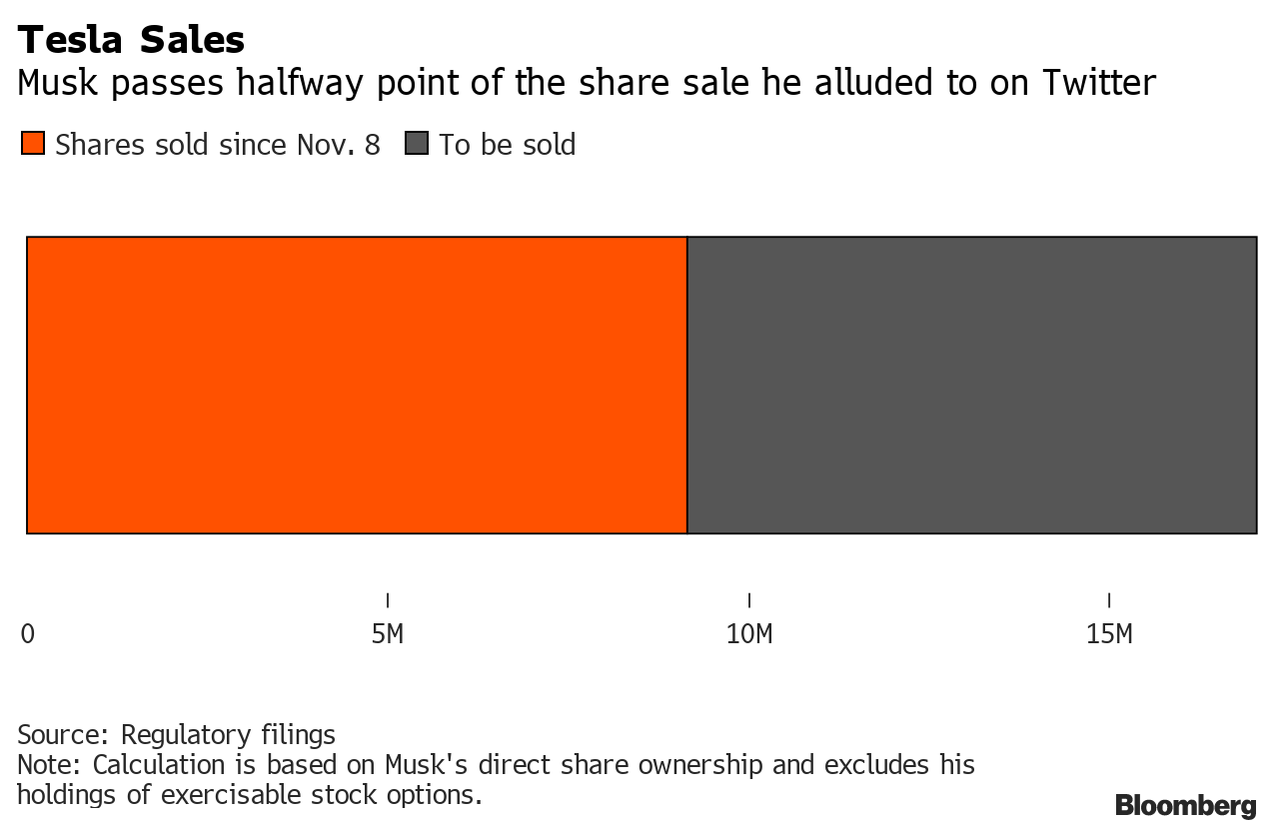
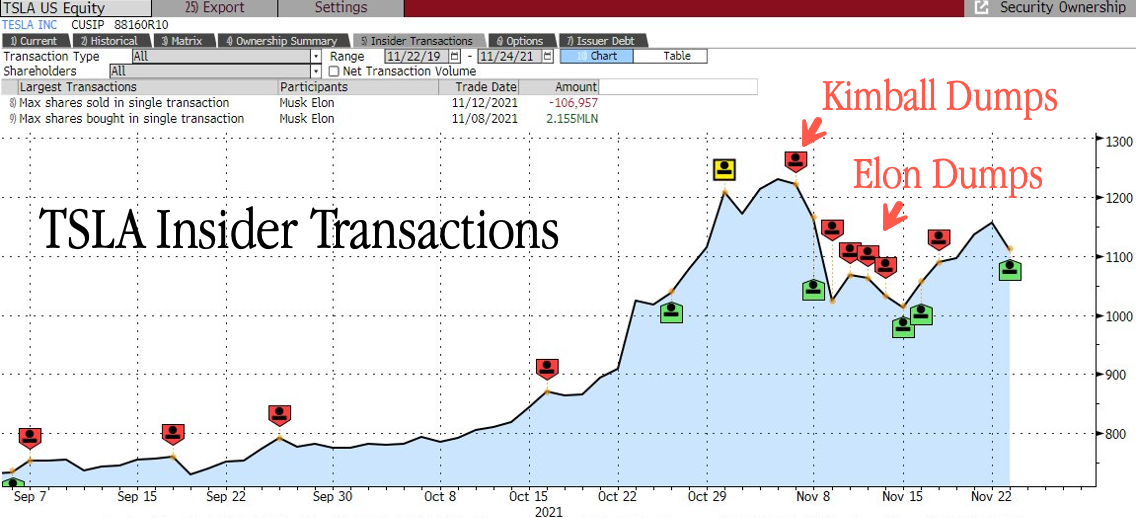
Bloomberg reports that Tesla Inc. Chief Executive Elon Musk has reached the halfway point of disposing of 10% of his stake in the electric-car company. 

According to new US securities filings, Musk dumped another 934,091 shares for $1.05 billion. The stock sale covered taxes related to Musk exercising an additional 2.15 million stock options. 

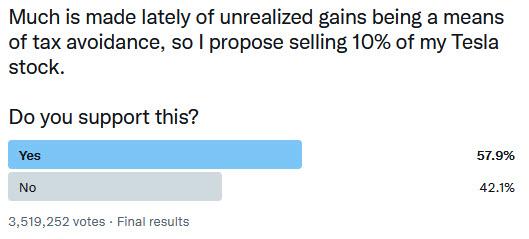
Since Musk tweeted on Nov. 6 that we would sell 10% of his stock if users of the social-media platform approved. He’s liquidated 9.2 million shares worth about $9.9 billion – now at the halfway point of liquidating his 10% stake. 

We noted earlier this month the Twitter poll gave Musk the cover to dump billions of dollars of stock, while blaming the Democrats’ proposed unrealized capital gains tax as the catalyst behind the sale.

Incidentally, such an idiotic, socialist tax will never pass through Congress but is the perfect strawman for Musk to become far more liquid to the tune of billions, because as Scott Galloway said, echoing our own comments Musk will use “Twitter results as cloud cover to monetize $TSLA at prices he knows aren’t sustainable without outright telling the market he’s lost faith in its valuation.”

For those wondering if Musk is done selling; He’s not. To reach the 10% limit, 17 million shares or about 1.7% of the company’s outstanding stock would need to be liquidated. If his exercisable options are factored in, he might have even more to sell. 

Before the Twitter poll, Elon’s brother, Kimball Musk, front ran his brother by dumping stock. It seems like selling stock is a whole family affair.

Famous short-seller Michael Burry of The Big Short jabbed Musk earlier this month and said that the Tesla CEO might need to sell his shares because he had 88 million of them pledged as loan collateral. 

All we know at this moment is Musk is not done selling stock. He will have to develop new tricks and gimmicks to keep the Tesla cult pleased while the stock underperforms. 

Tyler Durden
Wed, 11/24/2021 – 09:47

via ZeroHedge News https://ift.tt/3oXVdAH Tyler Durden

The Build Back Better Bill Will Give You $12,000 for Buying an Electric Car. Unless It’s a Tesla.


zumaamericasthirtytwo925260

Last Friday, the House of Representatives passed the Build Back Better Act, President Joe Biden’s signature legislation. Despite being much smaller than it was when initially proposed, the bill is still stuffed with Democratic wish list items, including policies on climate change, child care, family leave, and immigration. The bill is expected to face opposition, and likely some pruning, when it reaches the Senate. One proposal jumps out as an obvious contender for the chopping block.

As part of Biden’s plan to rein in carbon emissions, the bill contains a provision that would provide a $7,500 tax rebate to any consumer who purchases an electric vehicle, including both all-electric and plug-in hybrids. However, that amount increases by $4,500 if the car was manufactured in a unionized U.S. factory, as well as by an additional $500 if the vehicle contains a U.S.-made battery.

Ostensibly, this provision is part of Biden’s “Buy American” policy of incentivizing or mandating that purchases be made domestically. In practice, the order has simply carried over the protectionism of the Trump trade policy and increased costs to taxpayers. The electric vehicle credit proposal, though, is much more egregious, in that it not only incentivizes a particular type of product but incentivizes particular brands, as well.

If enacted as written, the bonus $4,500 in electric vehicle credits could only apply to cars made by Ford, General Motors, and Stellantis (formerly Fiat Chrysler). In other words, a driver who wants to purchase a hybrid Toyota Camry does not qualify for the extra money, even though the car is manufactured in Kentucky. But if that same shopper elects to purchase a Chevrolet Bolt, which recently halted production because the batteries were catching fire, they would receive the extra rebate. As a matter of fact, out of more than 50 electric vehicles currently on the market, the only cars which currently qualify for the extra money are two variations of the Bolt.

This is what is most pernicious about this policy: Rather than simply a blanket advantage for American companies (which would be bad enough), it is a clear giveaway to the United Auto Workers (UAW) labor union. In October, when Biden visited a UAW job training center, he bragged about the electric vehicle proposal, saying “I want those jobs here in Michigan”—rather than in states like Tennessee or Kentucky, where UAW membership is less of a certainty.

In fact, it is clear that the union aspect of the policy was more important than the actual consumer incentive. As The Wall Street Journal reported last week, Rep. Dan Kildee (D-Mich.), the provision’s co-author, stated that he included the bonus funding after being advised by General Motors and UAW “about the importance of including an explicitly pro-union component.”

As a means of lessening not only carbon emissions, but also exhaust pollution, shifting to electric vehicles is a perfectly laudable step (though by no means a silver bullet). But when the transition is accomplished by executive fiat rather than consumer choice or market incentive, it risks undermining the entire goal. And in this instance, customers are being nudged for political reasons: a kickback to a key constituency of Biden’s party.

The post The Build Back Better Bill Will Give You $12,000 for Buying an Electric Car. Unless It's a Tesla. appeared first on Reason.com.

from Latest – Reason.com https://ift.tt/3DOGtdr
via IFTTT

Watch: Fauci Claims His Critics Are “Killing People”

Watch: Fauci Claims His Critics Are “Killing People”

Authored by Steve Watson via Summit News,

Anthony Fauci, who continues to appear on TV every day two years into the pandemic, declared Tuesday that anyone who criticises him is “killing people.”

In an MSNBC interview, Fauci proclaimed “I’m not in it for a popularity contest. I’ve devoted my entire professional career of 50 years to try and essentially safeguard and preserve the health and lives of the American people and as an infectious disease doctor who deals with outbreak, that gets really extended to the rest of the world.”

“That’s what I do,” Fauci further declared, adding “The praise or the arrows and slings are really irrelevant. I do what science drives you to do, and that’s what I do. And you know, I’m not in it for a popularity contest. I’m trying to save lives.”

In between gain of function funding and torturing dogs, he cares about lives.

Fauci continued, “And the people who weaponize lies are killing people. So the only question I have is that when you show Tucker Carlson and Peter Navarro criticizing me, I consider that a badge of honor.”

He added, “I just wanted to make that statement. People throw up those people that make ridiculous statements. They’re telling people to do things that they’re going to die from and telling me I should go to jail. As they say in my old neighborhood in Brooklyn, give me a break, will ya.”

Watch:

The arrogance is plain to see once again.

Fauci’s critics are pointing out his lies over funding dangerous experiments with coronaviruses, his flip flops over health policies such as masking and lock downs, and his constant moving the goalposts when it comes to vaccine efficacy, in tandem with an obvious casual lack of regard for freedom.

In an interview with Glenn Beck this week, Senator Rand Paul noted that “Fauci not only has a casual disregard for science, but also for individual liberty. You combine the two — ignoring the science, and then having no regard at all for individual liberty — and you have a really dangerous situation. But it’s also dangerous because we’ve centralized the authority.” 

Paul further explained, “I have opinions on where the virus came from. I have opinions on how to treat it. But they’re my opinions, you don’t have to take them. If you agree with me, you can listen to my opinions. With Dr. Fauci, it’s not the same. He has opinions, but he wants you to be forced to do as he says. So it is the difference between coercion and freedom. And in freedom, there are many choices. But the real danger is, as we centralize authority, ultimately you get authoritarianism. And I think that he could easily be a medical dictator, if he were allowed to be.”

Watch:

*  *  *

Brand new merch now available! Get it at https://www.pjwshop.com/ 

In the age of mass Silicon Valley censorship It is crucial that we stay in touch. We need you to sign up for our free newsletter here. Support our sponsor – Turbo Force – a supercharged boost of clean energy without the comedown. Also, we urgently need your financial support here.

Tyler Durden
Wed, 11/24/2021 – 09:30

via ZeroHedge News https://ift.tt/3DQ52qE Tyler Durden

Olaf Scholz To Become Germany’s Next Chancellor After Clinching “Traffic Light” Deal

Olaf Scholz To Become Germany’s Next Chancellor After Clinching “Traffic Light” Deal

After weeks of negotiations, the Germans have made a show of functioning democracy despite rumors that vaccinations will soon be made mandatory across Europe’s largest economy. According to the FT and a handful of other media outlets, the leaders of Germany’s three biggest parties are expected to form a “traffic light” coalition.

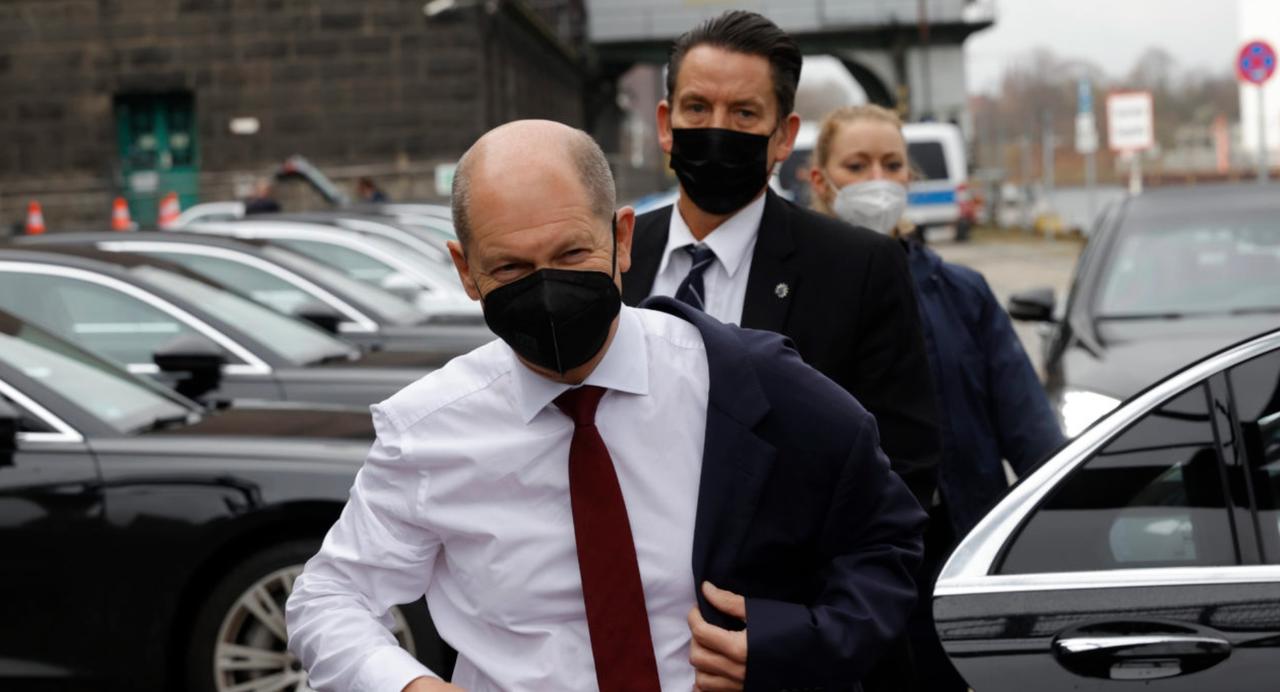
Assuming it is approved by the rank and file of all three parties, the deal will eventually lead to Social Democrat Olaf Scholz taking over as chancellor from the CDU’s Angela Merkel when her nearly two-decade reign comes to an end.

Fortunately, despite mockery in the German press about the degree to which the SPD and the FDP (the Free Democrats) have gone to show a united front, it looks like the peace has generally held, and talks that took more than 5 weeks and involved nearly 300 negotiators have finally reached a conclusion. As we said above, the new government will leave Scholz to take over as chancellor from Merkel, while the FDP’s leader Christian Lindner will be set to become the new finance minister, something many analysts believed would be required to win the FDP rank-and-file’s support for a deal.

Finally, the Greens are expected to be “rewarded” with two major ministries for their own leaders, Robert Habeck and Annalena Baerbock: A new economy and climate ministry for the former, and the prestigious foreign ministry for the latter.

The new government’s most urgent priority will be to stem a pandemic that is threatening to overrun Germany’s hospitals. Authorities reported 66,884 new coronavirus infections over the past 24 hours, a new record, while the incidence rate per 100K people over the last 7 days has exceeded 400 for the first time since the COVID outbreak began.

The “traffic light” coalition was named for the sake of the parties’ three colors – red for the SPD, yellow for the liberal Free Democrats FDP and green for the Greens.

According to the FT, this will be the first such alliance on a national level in Germany’s history and is expected to end squabbling over climate change at the top of its agenda. A key goal will be to bring forward Germany’s phase-out of coal, which is presently set for 2038.

All three parties said their chief negotiators would meet in Berlin on Wednesday for a final round of talks before unveiling their coalition agreement at 1500 local time.

After initially serving as mayor of Hamburg, Scholz became finance minister in 2018 and initially pursued the same fiscally cautious policies as his predecessor Wolfgang Schäuble. However, when the pandemic hit, he opened the spending taps to help industry and business in what was widely regarded as Europe’s most generous emergency aid program. Some praised the deal as a testament to Scholz’s skills as a negotiator.

Following the September elections, the Social Democrats finished first past the gate, leaving Scholz in pole position to lead the new government.

The SPD and FDP will hold party conferences to approve the coalition deal while the Greens will put it to a vote of all the party’s members. If all three parties give the deal the “green light” – so to speak – the new government will be sworn in by the Bundestag early next month.

Tyler Durden
Wed, 11/24/2021 – 09:15

via ZeroHedge News https://ift.tt/30XwhRC Tyler Durden

Rabobank: As The “Haves” Become “Have Yachts”, The Dollar Tree Is Now The Dollar-Twenty-Five Tree

Rabobank: As The “Haves” Become “Have Yachts”, The Dollar Tree Is Now The Dollar-Twenty-Five Tree

By Michael Every of Rabobank

Bazooka Joe (Jerome and Jamie)

Tuesday was what now passes for normal in global ‘markets’. For example, the currency of a major trading and geostrategic economy, Turkey, collapsed 16% on the day at one point, from what were already exceptionally low levels. For younger emerging market analysts afraid to make big calls on where FX can head even over the longer term, and clinging to ‘spot plus/minus’ – Exhibit A. The lira is down 40% this year and a third in November alone, as Turkey’s president promises “an economic war of independence.” From what/whom? “Unrealistic and completely detached from economic fundamentals,” was being bandied about at one point in official circles.

Unfortunately, one doesn’t know exactly where that applies. Look at the White House’s coordinated release of just 50m barrels of oil from its Strategic Petroleum Reserve (SPR), which saw energy prices handily up on the day. Hardly a bazooka, Joe: and neither was the ‘laugh-a-minute’ Energy Secretary not being able to answer a question about what US daily oil consumption is. Energy analysts point out this SPR policy can’t work against an official move away from funding fossil fuel production; and the US threw some late sanctions against Nord Stream 2, reversing the previous reversal, which contributed to a surge in European energy prices too.

Meanwhile, the US ultra-cheap goods store, the Dollar Tree, is now the Dollar-Twenty-Five Tree due to rising inflation. This is at least a change from the deflationary spiral of dismal British ‘pound stores’ becoming ‘99p stores’ and ‘98p stores’ in the New Normal, as the ‘haves’ became ‘have yachts’: but I doubt the people who rely on shopping in them will see this as an upgrade.

Yet here are two labour market stories you, and markets, may have missed. First, the strike at John Deere has seen a six-year pay deal signed: workers get a 10% raise, and 5% in years three and five; a 3% bonus in years two, four, and six; an $8,500 signing bonus; a preserved pension option for new employees; and no-premium health insurance eligibility sooner. It may just be an outlier for those 10,000 workers, but it is the kind of deal that means you don’t need a dollar-twenty-five store….if the price of energy, food, and rent are under control.

Second, an informal US Twitter real-estate survey asking “Have you or someone you know used profits from crypto and/or NFTs to help with the down payment of a home purchase?” saw 385 votes, and *20%* of respondents indicate, yes, they had. Twitter is not the US public in user-numbers (37m) or tech-savvy (and ideological lunacy). But if just 2% of the US public have enough crypto/digital flatulence/penguins-in-sunglasses to contribute to a house down-payment, then it shows two things: we are getting two bubbles for the price of one; and the drop in the US labor force participation rate may be structural.

For the Fed, that could mean having to use a far larger bazooka: I don’t mean against asset bubbles, which Bazooka Joe was designed to blow – just the unruly workers. Ironically, crypto/NFTs could be a rallying banner for non-workers of the world to unite, using “fictitious” capital as the ultimate Marxist revolutionary tool against the late-stage financial-capitalist system. Lenin would certainly have approved of this destabilising race to the top/bottom given he argued “The best way to destroy the capitalist system is to debauch the currency.” Or produce new ones named after stomach infections. One can imagine if he was alive today, he would be Tweeting and trolling non-stop. And probably launching ‘Bolshie-coin’. Oh, the fun he and Musk would be having, in-between their plans for world domination!

On which note, India looks like it may finally act against crypto, or at least most of them, using a bazooka on the regulatory front. The US Senate wants answers from Tether about its business asap too.

Another bazooka belongs to J P Morgan CEO Jamie Dimon – who may have just fired it into his own foot. When your bank has just been allowed to own 100% of its China securities business at a time when the ideological shift to Common Prosperity sees official reposting of claims that “the capital market will no longer become a paradise for capitalists to get rich overnight,” your press office does not want to see Bloomberg headlines such as: ‘Dimon Says JPMorgan Is Likely to Outlast China’s Communist Party’. However, the CEO is quoted as quipping, “I made a joke the other day that the Communist Party is celebrating its 100th year – so is JPMorgan. I’d make a bet that we last longer….I can’t say that in China. They are probably listening anyway.” He will be here all week and is available for weddings and bar-mitzvahs: and Beijing is renowned for its sense of humor.

Dimon also added that while China’s unfair trade practices which the White House raises are valid, they ‘should have been addressed earlier,’ and the bank cannot leave countries just because it disagrees with a policy. Lenin would have fully expected to hear Wall Street say that given his view that “the capitalists will sell us the rope with which we will hang them.” Except today the capitalists no longer produce rope, so create complex mezzanine financing structures to channel you the money to buy it from those who still do. Lenin also argued that having one large State Bank to guide the economy was “nine tenths of the socialist apparatus…socialism is unthinkable without large-scale banking.” Which applies all over, if you are of the 37m people on US Twitter.

On a relatively much smaller scale, the RBNZ today hiked rates 25bp to 0.75% as expected, arguing that the employment level was “above the maximum sustainable level,” and not sounding too about the risks of “transitory” inflation becoming more generalised. How much more ammunition will they use, ask worried mortgage borrowers? More, “over time”, seems to be the general answer. At least NZD is not soaring – because USD is instead, showing us who has all the serious monetary artillery, even if they won’t necessarily use it.

Where finally, and more darkly, the US has sent two patrol boats to support the Ukrainian navy. However, they are of the not-enough-oil-barrels variety, both boats being a militarily token ‘Shooty McShootface’. On the other side, Moscow is allegedly encouraging the Russian population of the Ukrainian enclaves it already holds to sign up for military service and is releasing prisoners if they agree to do so; it is also using the same kind of diplomatic language as it did before moving against Georgia in 2008. As the ice hardens the ground (which better suits tanks, by the way), so attitudes seem to be matching.

In geopolitics, politics, economics, and markets, this is not the time for token popguns, whichever direction you think we should go on policy. Whether it is time for bazookas is open to question.

Tyler Durden
Wed, 11/24/2021 – 08:57

via ZeroHedge News https://ift.tt/3D0w9OF Tyler Durden