Gazprom Plant Connected To Russia-China Gas Pipeline Shuttered Due To Fire

Gazprom Plant Connected To Russia-China Gas Pipeline Shuttered Due To Fire

China’s energy crunch has resulted in power rationing in more than half of the provinces and affected the world’s biggest production base for electronic gadgets to semiconductors to appliances, among other things. Beijing has ordered energy firms to “secure supplies at all costs” as winter fast approaches to avoid shortages. But as we learn this morning, a Gazprom gas processing plant, connected to Russia’s sole gas pipeline to China, shuttered operations following a fire at the facility, according to Bloomberg

Irina Dmitruk, the spokeswoman for the Gazprom unit, said the blaze at the Amur processing facility in eastern Siberia was extinguished around 0500 London time. 

Bloomberg’s top energy analyst Javier Blas tweeted what appears to be a video of the fire at the processing plant. He said, “still unclear what’s the damage.” 

However, Blas tweeted: “Gazprom is saying that the main equipment at the plant was not damage, and that gas exports toward China continue in line with requests.” Still, a full damage assessment report has not been released. 

The Power of Siberia began operations in late 2019, before the Amur plant was launched. The facility processes natural gas from Gazprom’s Chayanda field and is used as feedstock for petrochemical production. 

Instances like these outline the fragility of the fossil fuel industry. If processing or pipelines are shut down amid energy crunches in Europe and Asia, it would be absolutely devastating, considering both continents have very low stockpiles of fossil fuels ahead of the winter season. 

Tyler Durden
Fri, 10/08/2021 – 11:50

via ZeroHedge News https://ift.tt/3DtyWk1 Tyler Durden

Digital Cancer – Will Facebook Go The Way Of Big Tobacco?

Digital Cancer – Will Facebook Go The Way Of Big Tobacco?

Authored by Bill Blain via MorningPorridge.com,

“There is something rotten in the state of Denmark…”

The market has apparently shrugged off the platform outages and whistleblower testimony on Facebook’s prioritisation of profits over people. Or is Facebook mortally wounded and a regulatory quietus inevitable? Can the social media genie be put back in the bottle?
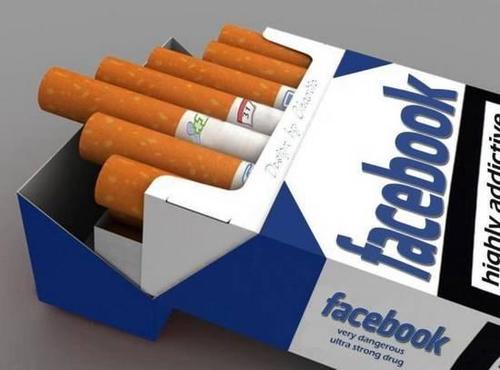
The big story this week should be Facebook. Whistleblower Frances Haugen was in the papers earlier this week saying she didn’t want to kill Facebook, but make it safer… Then she did a pretty brutal hatchet job on the firm in her US Senate testimony – describing a corporate culture that won’t change unless it is forced to. She blamed founder (and Global Business Personality most likely to be an actual Bond Villain), Mark Zuckerberg by name, accusing him of “profits over people”.

Her comments about the company increasingly caught in a negative feedback loop of employee dis-satisfaction and client disengagement were fascinating in themselves – and speak of a company we should be worried about – although the main threat is regulatory.

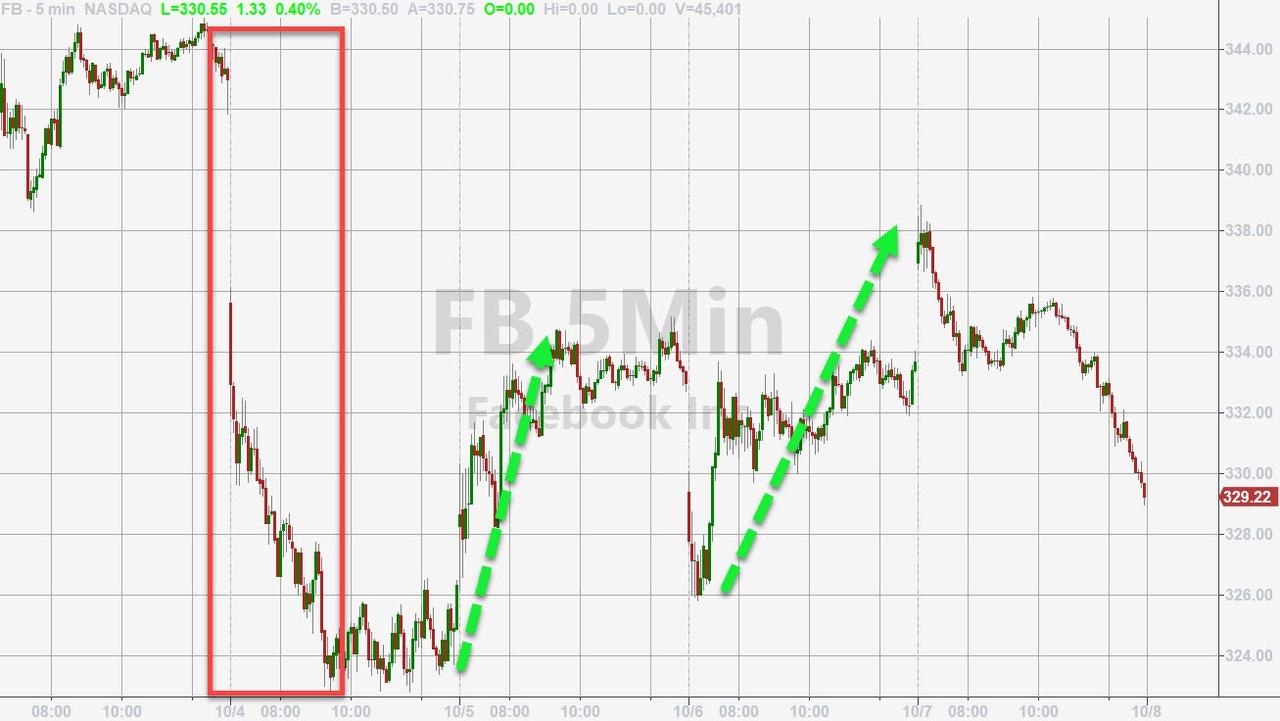
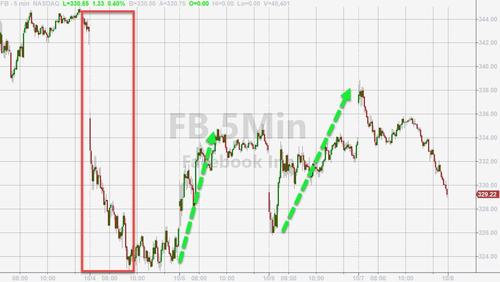
But, take a look at the following day’s stock price action and you wouldn’t know there was a problem. The market is ignoring the existential threat to Facebook – shrugging off any doubt. Instead the stock climbed from its low after Monday’s 6 hour unexplained platform outage – which itself is another reason to wonder what the devil is really going on in Menlo Park.
But first… a digression on corporate failure:

The one thing we can say for certain about being caught up in the death-throes of a corporate is its never anyone else’s fault. Sometimes – very rarely – it’s a single “no-see-um” unpredictable event that causes a company to spiral into oblivion. As hard as I tried, I could only think of one: Barings Bank in the 1990s, brought down by the actions of a single rogue trader.

Every single other corporate collapse leaves a trail of forensic clues as to why its end became inevitable.

More often than not it’s something fundamentally mistaken or rotten at the failing firm’s core that investors should have noticed, analysed, understood and sold out on. It might be accounting fraud like Enron and Wirecard– the first of which ultimately brought down their accountants Arthur Andersen for failing in their duties, and the second of which has made German regulatory oversight a laughing stock! (Both of which are lessons: don’t trust professionals like bean counters, bureaucrats and especially not rating agencies. Key mantra: you’ve naebody to blame but yourself if you don’t keep doing the diligence.)

Or it might be recognising a brilliantly performing investment is actually a Ponzi scheme like Madoff – before it unravels. It may be sniffing out bad actors like Robert Maxwell raiding the pension fund, or Asil Nasir stealing Polly Peck’s company assets. It might be recognising overexpansion and bubbles – like Evergrande. It might be understanding dangerous politics – again Evergrande.

It might be spotting the outright lies spouted by the Theranos pair. It might be not being sucked in by bluff and bluster about massive riches just over the horizon – a common factor since the South Sea bubble, encompassing Gold Mines that never hit the motherload, and all the way to dot.coms with no profit potential. It might be that greedy management that cause company values to collapse – like has happened to Boeing, although it hasn’t gone bust yet.

Occasionally I get it right… I called the implausibility of WeWork’s profit expectations spot on. I called Tesla wrong – I expected it would fail, swamped by debt. Instead, it’s equity rose so high it was able to refinance itself.

Bubbles fuel bubbles. I remain unconvinced on the viability of many disruptive firms to ever achieve meaningful profits, and believe the “adoption” of cryptocurrencies is fuelled entirely by the desperate hopes of get-rich-quick speculators praying someone else will ultimately buy them. (Which is why the con artists behind them keep reminding the greater fools to HODL while they exit…)

So…. What about Facebook?

There is something rotten in the state of Menlo Park, and I’m trying to work out what it might be…. The charge is it fosters, enables and disseminates false information that causes actual damage and hurt to platform users. The testimony suggests it’s a proven case.

I am trying to work out if Facebook’s deathblow might have already been delivered in Washington – or will it continue to dodge regulatory bullets? If its a proven social ill it is doomed. If so, then Facebook’s approaching quietus is going to be very, very different from all the cases I’ve listed above. It will likely be a judicial killing, but you can bet the stock price will have shattered long before the long-drop trapdoor opens.

It begs a host of questions, including: can you hang a concept?

The concept in question is Facebook’s dominance in the field of being able to sell our digital selves to the highest bidder.. If Facebook isn’t doing it – someone else likely will. At its heart is privacy and who owns our digital selves? I’m not pleased to think Zuckerberg owns mine…

This morning I’ve tried to unthink everything I previously thought about Facebook, its revenues, the model and its personalities to work out the essentials of what Facebook has actually become.

I started from the basic proposition – no one gives anything valuable away for free.

That’s been implicit with Facebook since its inception. In return for free access, they get your valuable data. We perceived the model as 2 headed, the essentially harmless Dr Jekyll and the somewhat evil Mr Hyde:

  • It’s a “harmless” addictive social pastime. Who can resist pretty kitten pictures, checking your messages and seeing what your chums are doing on FB?

  • The money comes from monetising these platforms – they are designed to categorise, profile and sell us. It’s a money making machine that works out what we are, our needs and desires and then sells these to whomever will pay the most for access.

Now we are beginning to understand the social harms and distortions from the addiction and the information it feeds us. Now we recognise the unintended consequences of digital access – fake news fed to the most likely believers.

The whistleblower revelations expose the platforms for what Facebook has allowed them to become: digital cancer. Simply put, Facebook is guilty of peddling addictive social platforms in the pursuit of profit over the protection of the public.

It struck me its broadly similar to the Tobacco Companies.

For all the tobacco firms once told us how manly, how medically proven cigarettes were – we now realise they were peddling poison. They have rightly been cracked down upon. The algorithmic addictions Facebook feeds its money making machine are no different from a tar-laden cigarette.

It was 1962 when the Royal College of Physicians finally exposed the Tobacco industry lie that cigarettes were good. It then took years for advertising bans to be enforced. “Voluntary agreements” with the tobacco Barrons proved hollow shams. It took 10 years to put health warnings on packets. Lunch cancer deaths continued to rise for decades. 20 years after the news smoking was bad broke, players were still wearing tobacco logos at Wimbledon.

Can we now close the door on Facebook, and the explosion in social media has opened to targeted fake news, advertising, digital coercion and other social ills? Can we ever control the way in which conspiracy is marketed and sold across Facebook and its clones? Or lessen the anxieties it creates?

I suspect that genie is out the bottle and is not going back in.

But, the market will wake up and listen… Facebook now looks a proven social ill – any firm that claims it’s an ESG focused investor should be carefully considering whether Facebook meets their ethical investment parameters. Any firm advertising on Facebook should be taking a long hard look at it… and do it before government does it for them.

Tyler Durden
Fri, 10/08/2021 – 11:30

via ZeroHedge News https://ift.tt/3lnyw8i Tyler Durden

Morgan Stanley Doubles Down On Doom: Calls For “Fire And Ice” Correction

Morgan Stanley Doubles Down On Doom: Calls For “Fire And Ice” Correction

Three weeks ago, when the markets were gripped by a brief but sharp selloff over fears of Evergrande default contagtion (which certainly remains on the table), Morgan Stanley’s Mike Wilson took the opportunity to pour some fuel on the fire, or rather “ice”, and warned that odds of a “destructive” 20% correction are rising.

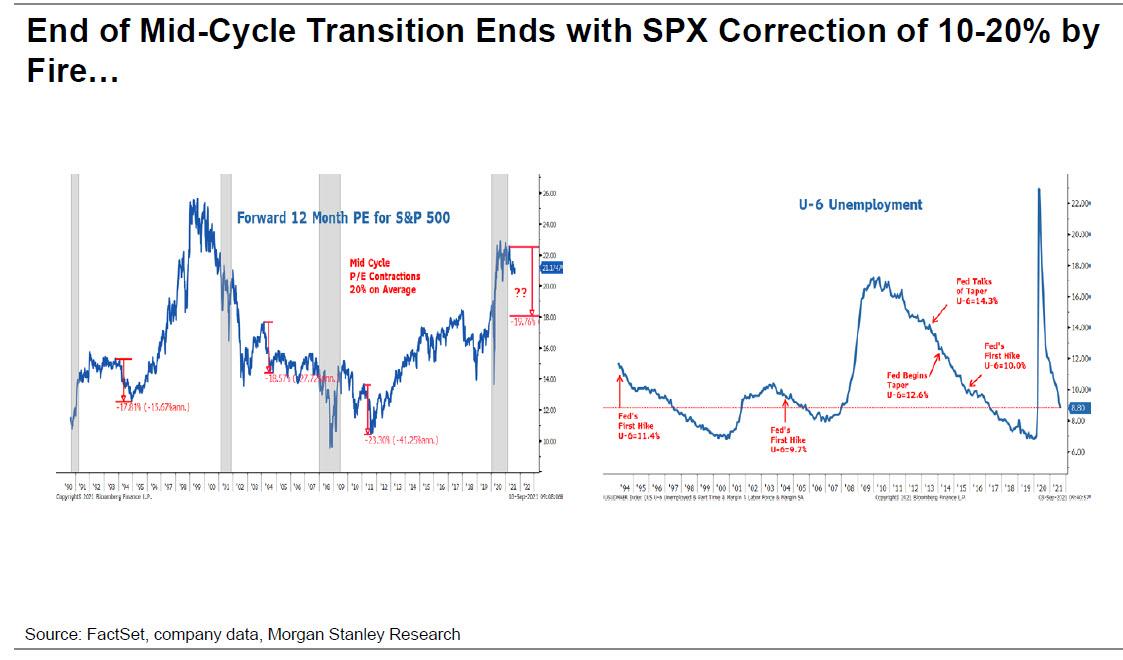
As a reminder, for much of the summer, Wilson had been predicting that the current market meltup would end either in “fire”, i.e. a sharp market correction…

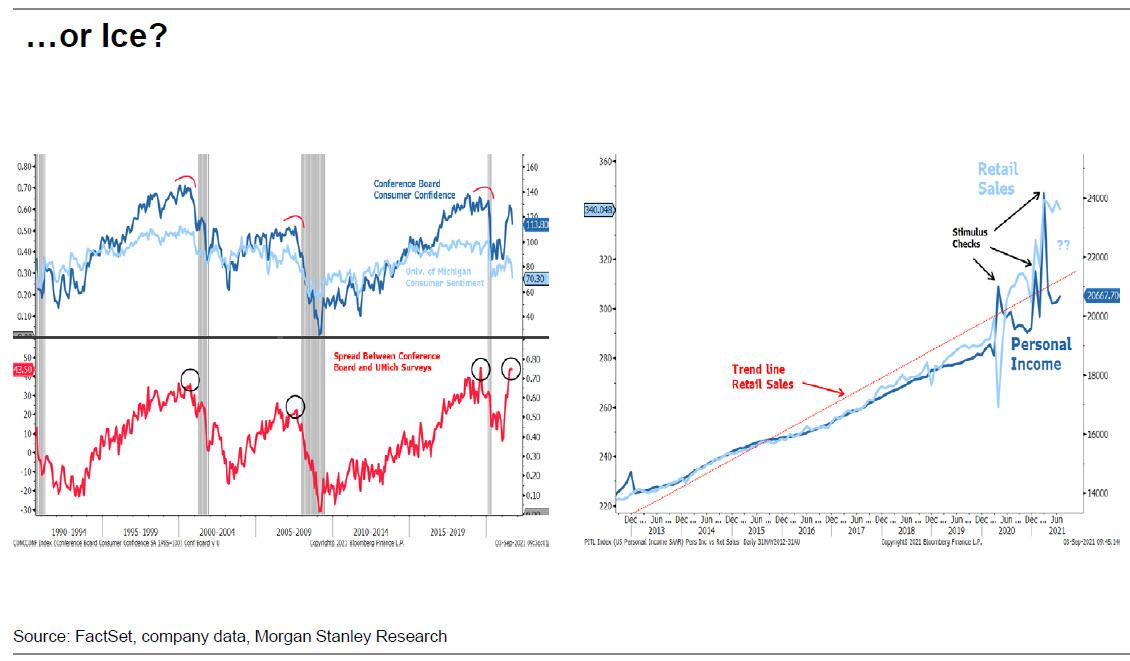
or or “Ice”, with consumer spending grinding to a halt…

Pointing to his two gloomy predictions during the “Evergrande Monday” plunge, Wilson wrote that “the ice scenario would be worse for markets and we are leaning in that direction given the fall in consumer confidence and reset lower in PMIs we expect.” This is what he said, in the context of his longer running thesis that the “mid-cycle” is about to have a painful correction as we gradually transition into late cycle:

The typical mid-cycle “fire” outcome would lead to a modest and healthy 10% correction in the S&P 500. However, the “ice” scenario is starting to look more likely, and could result in a more destructive outcome – i.e. a 20%+ correction. As a result, we continue to recommend a barbell of more defensively oriented quality (Healthcare and Staples) to protect from the “ice” scenario while keeping a leg in Financials to participate in the “fire” outcome as higher rates materialize.

And just so it was clear that Wilson stubbornly refused to join the bullish bandwagon, he said that “with our year end target 10% below current levels, our view is clear: the mid-cycle transition will end with the rolling correction finally hitting the S&P 500.”

Fast forward to today when with stocks once again barreling higher, Wilson doubled down on his bearish view and in the latest Morgan Stanley strategy data pack, writes that “we are now calling for Fire AND Ice.” Here, he again recaps the two possible mid-cycle correction outcomes he had been envisioning:

  • Fire: tightening financial conditions as the Fed signals tapering is coming
  • Ice: growth disappointment particularly on the earnings side

And so, in a reversal from what he said last month, Wilson now thinks “it’s increasingly likely these scenarios happen together and we get a >10% correction. The Fed will likely announce its taper plans at its next FOMC meeting just as we expect a disappointment in earnings to materialize.”

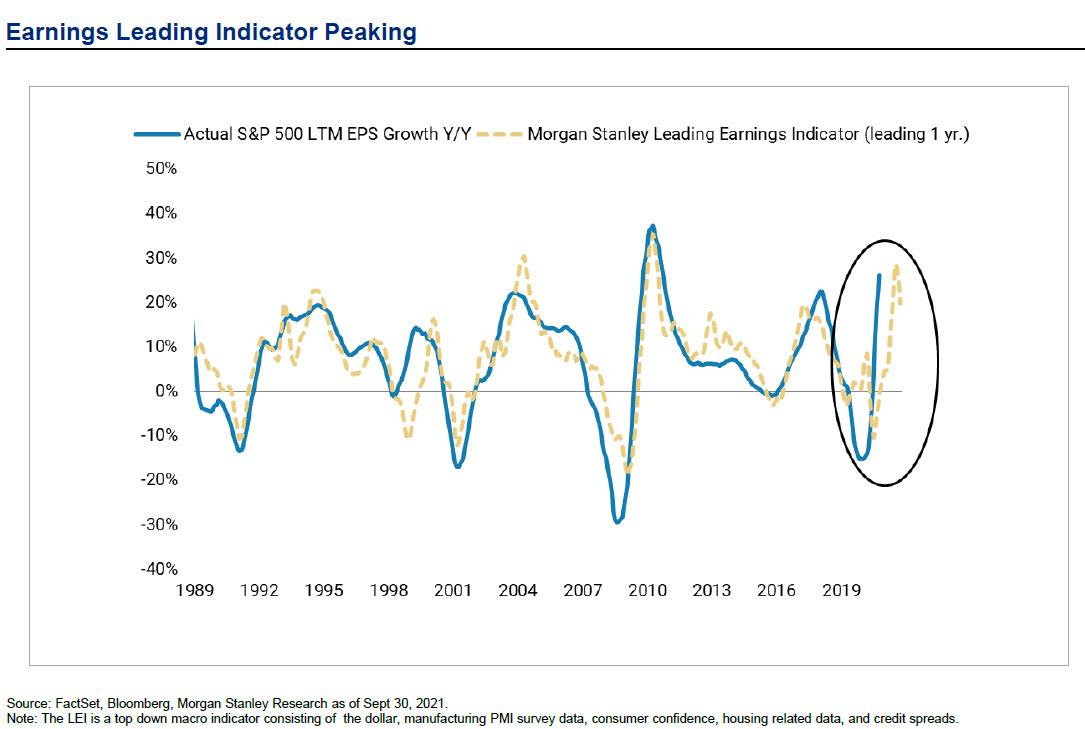
And since much digital ink has been spilled discussing the impact of the coming taper, we will focus on his second warning, namely the coming trouble for corporate earnings, which echoes what we said more than a month ago…

… and which Wilson distills simply as “Earnings Trouble Ahead.”

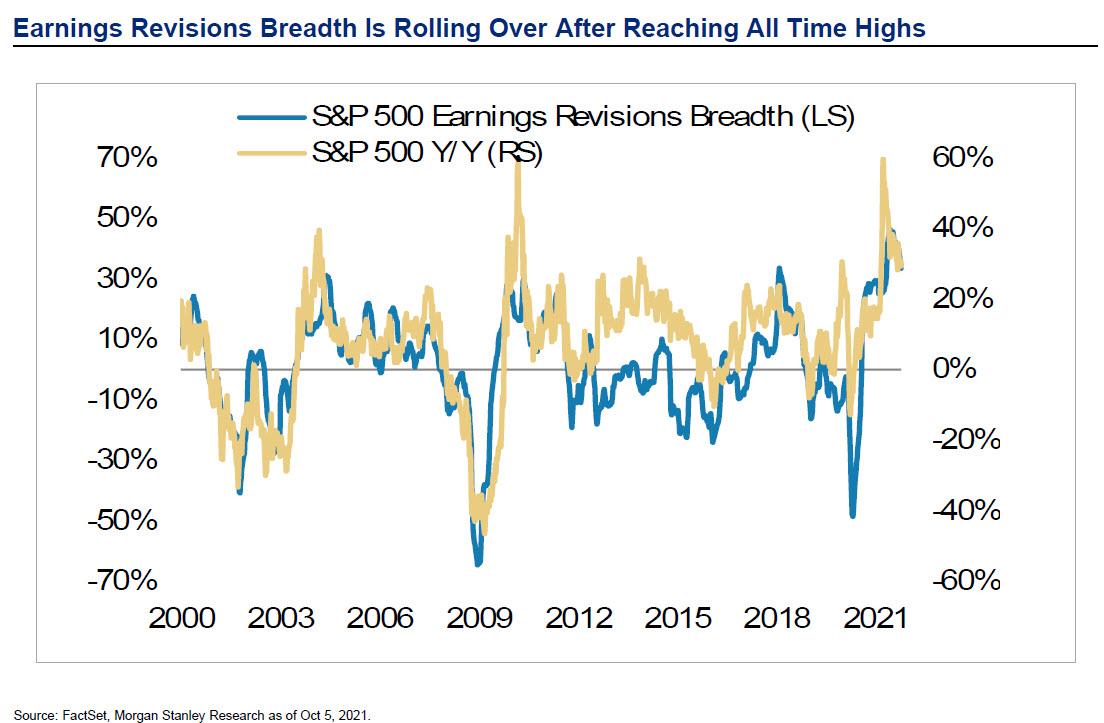
Here, the strategist points to the large number of companies flagging serious supply chain issues in off-cycle earnings reports over the past month and notes that “both forward earnings estimates and price de-rated after many of these reports.”

Jumping to the punchline, Wilson thinks this will be a pervasive dynamic during 3Q reporting season and it will “trigger downside in earnings revisions at the index level – a headwind for price.”

Finally, looking beyond 3Q, he sees the earnings risk coming more from (1) the inability of companies to pass on pricing (2) margin risk related more to higher wages and (3) a reversion (lower) in goods consumption.

Tyler Durden
Fri, 10/08/2021 – 11:10

via ZeroHedge News https://ift.tt/3BqAP0a Tyler Durden

At Least 50 Killed As ISIS Carries Out Second Major Afghan Mosque Attack This Week

At Least 50 Killed As ISIS Carries Out Second Major Afghan Mosque Attack This Week

As the Taliban continues to struggle to device a functioning government administration that can provide adequate security and stability, while keeping the electricity flowing and food prices stable (among the most pressing needs confronting the Afghan people), yet another mosque was attacked Friday – the second major mosque attack in the country within a week.

Even as the Taliban retaliated against ISIS-K, the suspected perpetrators, by launching a deadly raid on an ISIS-K hideout, the insurgent group that sees itself as the biggest rival to Taliban rule was apparently bold enough to carry out another attack: per the NYT, a blast struck a Shiite mosque in the northern city of Kunduz Province in the middle of Friday prayers.

Taliban spokesman Zabihullah Mujahid, a Taliban spokesman, confirmed the explosion and said there were casualties, but refused to provide an exact figure on casualties, saying the Taliban is still investigating, the AFP reported that at least 50 were killed in the attack, making it the biggest since the attack on the Kabul Airport that killed 13 US marines and some 200 Afghans.

Both the Taliban and ISIS are Sunni fundamentalist groups, but ISIS has a much longer record of targeting Shiite Muslims in Afghanistan and elsewhere, focusing mostly on the Hazara ethnic minority, which is Shiite.

With this third major attack (plus plenty of others that have likely fallen below the radar), ISIS is clearly ramping up its campaign against the Taliban as it seeks to strike while it’s enemy is hobbled. Afghanistan’s economy is suffering as foreign funding and assets allegedly belonging to the US-backed former government have been frozen, while the Taliban have been excluded from the global dollar-based financial system, relying instead on “aid” from China and Russia in the short term.

The Taliban’s No. 1 promise to the Afghan people is that, after 40 years of war, it will bring stability and safety to a population scarred by four decades of nearly-continuous war. Attacks like these are greatly helping to undermine the legitimacy of the Islamic Emirate of Afghanistan (as the Taliban are calling it) before the new nation can even stand on its own two feet.

Tyler Durden
Fri, 10/08/2021 – 10:56

via ZeroHedge News https://ift.tt/302D8Zj Tyler Durden

Beijing Will Have “Full Ability” To Invade Taiwan By 2025, Defense Minister Warns

Beijing Will Have “Full Ability” To Invade Taiwan By 2025, Defense Minister Warns

Authored by Dorothy Li via the Epoch Times

The regime in Beijing will be fully capable of mounting a full-scale invasion of Taiwan by 2025, the island’s defense minister warned on Oct. 6.

The remarks follow four days of escalated Chinese military pressure targeting Taiwan, which saw nearly 150 warplanes fly into the island’s air defense zone.

“It is the toughest situation I have seen in more than 40 years of my military life,” Defense Minister Chiu Kuo-cheng said at a parliamentary committee hearing on Oct. 6. “For me as a military man, the urgency is right in front of me.”

While the Chinese Communist Party currently has the ability to invade Taiwan, the costs of doing so may be too high, Chiu told reporters. But by 2025, Beijing would be able to do so at a minimal cost and thus have the “full ability” to mount an invasion, he said.

The Chinese regime views the self-ruled island as one of its territories, to be taken by force if necessary.

Chiu’s remarks were made before a parliamentary committee reviewing an $8.6 billion spending plan to build and mass-produce homegrown missiles and ships for the next five years. The proposal would be in addition to the 2022 military budget of $13.4 billion, implemented in response to Beijing’s increased military spending and increased air force and navy activities near Taiwan.

The defense ministry noted in its spending proposal that more than 600 Chinese military aircraft have flown into its air defense zone thus far in 2021, almost doubling the 380 incursions of 2020, according to state news agency CNA.

In March, Adm. Philip Davidson, then-head of U.S. Indo-Pacific Command, said during a Senate hearing that the Chinese regime could invade Taiwan “in the next six years.” The admiral expressed his concern that Beijing’s growing assertiveness posed a threat to the United States in the Indo-Pacific, an area which he described as the “most consequential region for America’s future.”

Taiwan President Tsai Ing-wen said in an essay published on Oct. 5 that failure to defend the island would cause “catastrophic” consequences for regional peace and democracy.

“It would signal that in today’s global contest of values, authoritarianism has the upper hand over democracy,” Tsai wrote, regarding a potential fall of Taiwan.

On Oct. 5, President Joe Biden said that he had spoken with Chinese leader Xi Jinping about Taiwan and that they agreed to abide by the “Taiwan agreement.”

“We agree. We will abide by the Taiwan agreement. That’s where we are, and I made it clear that I don’t think he should be doing anything other than abiding by the agreement,” Biden told reporters.

Biden appeared to be referring to Washington’s long-standing “one-China policy,” under which it officially recognizes Beijing rather than Taipei, and the Taiwan Relations Act, which makes clear that the U.S. decision to establish diplomatic ties with Beijing instead of Taiwan rests upon the expectation that the future of Taiwan will be determined by peaceful means.

In contrast, the Chinese regime stands by its own “one-China principle,” under which Beijing asserts sovereignty over Taiwan. The Chinese regime has a known track record of demanding other governments adopt its stance on Taiwan, which the United States hasn’t accepted.

Tyler Durden
Fri, 10/08/2021 – 10:36

via ZeroHedge News https://ift.tt/3AAeITT Tyler Durden

Who’s Hiring And Who’s Firing In September… And What Was Behind The Dismal Jobs Print

Who’s Hiring And Who’s Firing In September… And What Was Behind The Dismal Jobs Print

If one looks at the weeds of today’s jobs report which showed just 194K jobs added, the lowest monthly increase in 2021 and missing all but one of the 72 economist forecasts, it was hardly the stinker the headline number suggested. For one, the unemployment rate slumped to 4.8% from 5.2% as the number of unemployed workers (counted by the Household Survey) plunged by 710K while the number of employed rose 526K, even as the civilian labor force declined by 183K. Another positive aspect is that hourly earnings rose 0.6% from the previous month, up from 0.4% in August. Then there were the prior revisions which added a total of 169K in the previous two months.

But despite these mitigating factors, the focus was on the headline print (which comes from the Establishment Survey) and which was, for lack of a better word, dismal, and not far from where the Fed would reconsider a November taper announcement (certainly pay attention to what FOMC members will say in the coming weeks, at least those who don’t day trader).

Drilling down into the headline jobs print, we find several notable highlights:

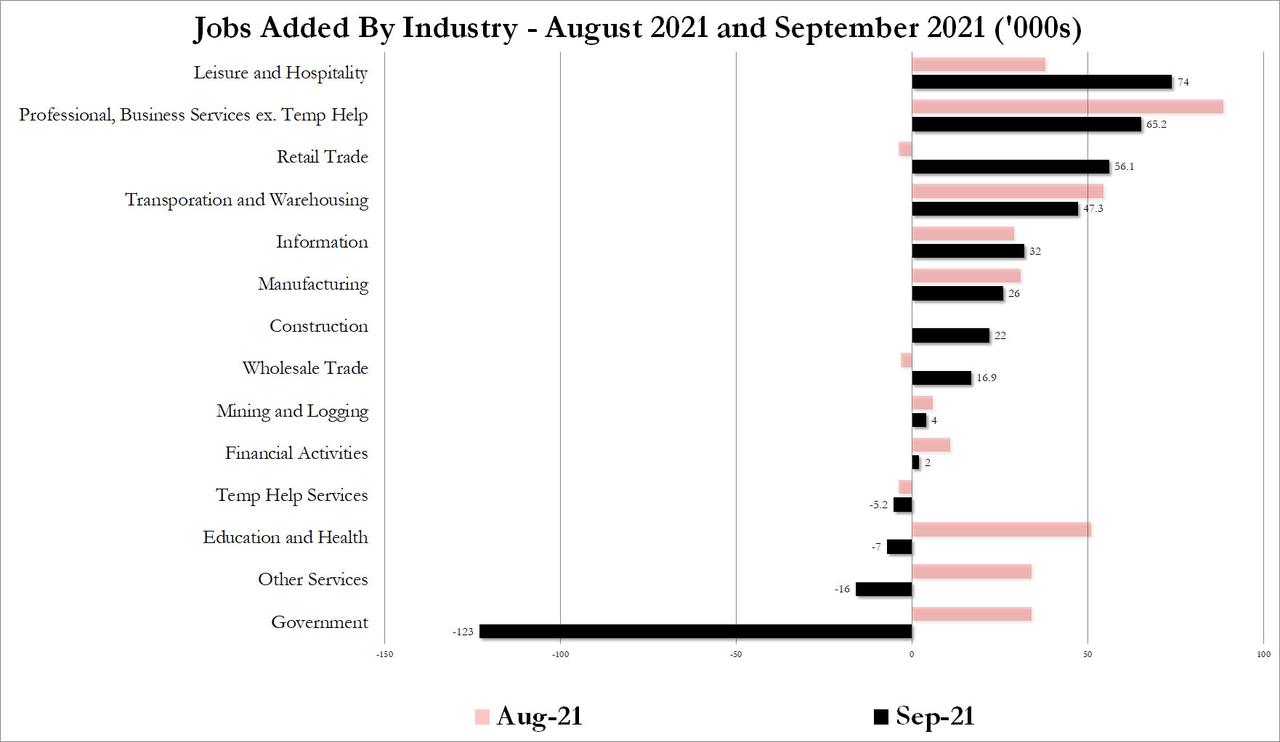
First, the number of private payrolls, at +317K, was actually not that bad, and was virtually unchanged from last month’s 332K (post revision and 243K pre). Expect upward revisions next month as the BLS “normalizes” its seasonal adjustment rate. Of note here, while leisure and hospitality hiring was depressed in August and September due to the delta wave, at least it was above zero. Recall that the original August jobs report showed 0 gains for the sector, a number which has since risen to 38,000. In September, another 74,000 jobs were added with continued job growth in arts, entertainment, and recreation (+43,000) and while still below the run rate of the previous several months, the number is not as bad as previously feared.

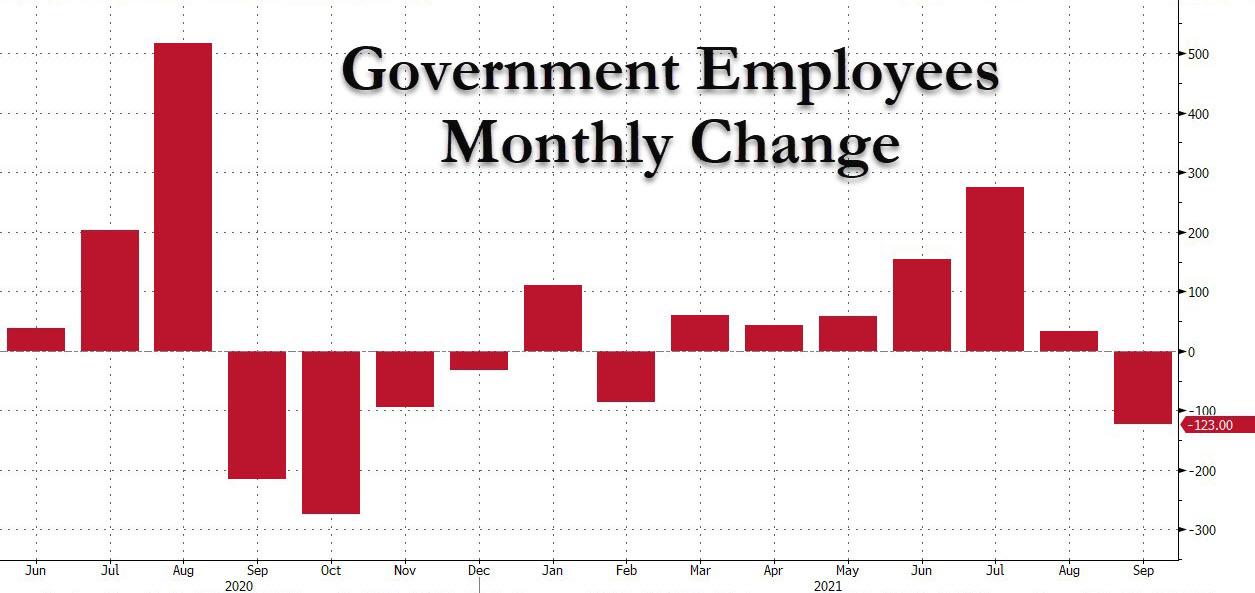
Second, and most important, the single biggest contributor to the lousy jobs report was the shocking drop in government workers, which tumbled by 133K. This was the biggest monthly decline since Oct 2020.

This number was entirely due to a loss of 144K government education jobs. Commenting on the plunge in local government teacher, the BLS said that “hiring this September was lower than usual, resulting in a decline after seasonal adjustment. Recent employment changes are challenging to interpret, as pandemic- related staffing fluctuations in public and private education have distorted the normal seasonal hiring and layoff patterns.”

What this likely means is that next month the BLS will revise its seasonal adjustment model to account for the easing in the pandemic, and reverse much if not all of this report’s drop. And if it doesn’t, it means that even more jobs will come on line in October and November. In any case, if one excludes the plunge in local education, the jobs report was hardly terrible.

With these caveats in mind, here is who was hiring and firing in September.

  • Professional and business services added 60,000 jobs in September. Employment continued to increase in architectural and engineering services (+15,000), management and technical consulting services (+15,000), and computer systems design and related services (+9,000). Employment in professional and business services is 385,000 below its level in February 2020.
  • Employment in retail trade rose by 56,000, following 2 months of little change. Over the month, employment gains occurred in clothing and clothing accessories stores (+27,000), general merchandise stores (+16,000), and building material and garden supply stores (+16,000). These gains were partially offset by a loss in food and beverage stores (-12,000). Retail trade employment is 202,000 lower than its level in February 2020.
  • Employment in transportation and warehousing increased by 47,000 in September, in line with gains in the prior 2 months. In September, job gains continued in warehousing and storage (+16,000), couriers and messengers (+13,000), and air transportation (+10,000). Employment in transportation and warehousing is 72,000 above its pre-pandemic level in February 2020.
  • Employment in the information industry increased by 32,000 in September. Gains occurred in motion picture and sound recording industries (+14,000); in publishing industries, except Internet (+11,000); and in data processing, hosting, and related services (+6,000). Employment in information is down by 108,000 since February 2020.
  • In September, social assistance added 30,000 jobs, led by a gain in child day care services (+18,000). Employment in social assistance is 204,000 lower than in February 2020.
  • Employment in manufacturing increased by 26,000 in September, with gains in fabricated metal products (+8,000), machinery (+6,000), and printing and related support activities (+4,000). These gains were partially offset by a decline of 6,000 in motor vehicles and parts. Manufacturing employment is down by 353,000 since February 2020.
  • Construction employment rose by 22,000 in September but has shown little net change thus far this year. Employment in construction is 201,000 below its February 2020 level.
  • In September, employment in wholesale trade increased by 17,000, almost entirely in the durable goods component (+16,000). Employment in wholesale trade is down by 159,000 since February 2020.
  • Mining employment continued to trend up in September (+5,000), reflecting growth in support activities for mining (+4,000). Mining employment has risen by 59,000 since a trough in August 2020 but is 93,000 below a peak in January 2019.
  • Employment in local government education decreased by 144,000 and by 17,000 in state government education. Employment changed little in private education (-19,000). Most back-to-school hiring typically occurs in September. Hiring this September was lower than usual, resulting in a decline after seasonal adjustment. Recent employment changes are challenging to interpret, as pandemic- related staffing fluctuations in public and private education have distorted the normal seasonal hiring and layoff patterns. Since February 2020, employment is down by 310,000 in local government education, by 194,000 in state government education, and by 172,000 in private education.
  • Employment in health care changed little in September (-18,000). Job losses occurred in nursing and residential care facilities (-38,000) and hospitals (-8,000), while ambulatory health care services added jobs (+28,000). Employment in health care is down by 524,000 since February 2020, with nursing and residential care facilities accounting for about four-fifths of the loss.  

And visually:

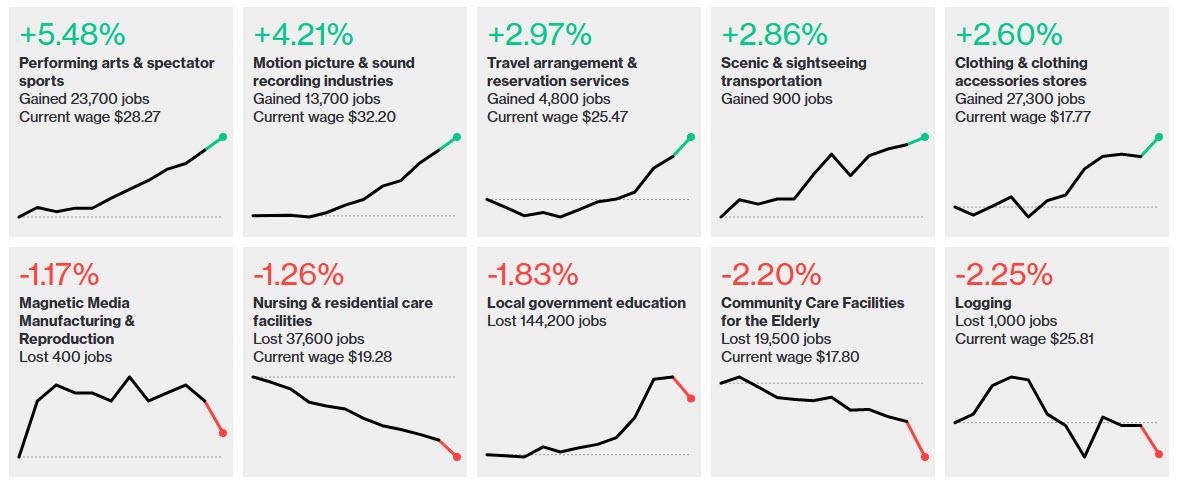
Finally, courtesy of Bloomberg, here are the industries with the highest and lowest rates of employment growth for the most recent month.

Tyler Durden
Fri, 10/08/2021 – 10:15

via ZeroHedge News https://ift.tt/3mzbZVE Tyler Durden

“Proceed With Caution At Your Own Peril” – Merck’s COVID ‘Super Drug’ Poses Serious Health Risks, Scientists Warn

“Proceed With Caution At Your Own Peril” – Merck’s COVID ‘Super Drug’ Poses Serious Health Risks, Scientists Warn

As it turns out, all the scientists and doctors who insisted that Merck’s “revolutionary” COVID drug molnupiravir is extremely safe weren’t faithfully adhering to “the science” after all. Because according to a report published Thursday by Barron’s, some scientists are worried that the drug – which purportedly cut hospitalizations in half during a study that was cut short – could cause cancer or birth defects.

So much for having a “strong safety profile,” as Dr. Scott Gottlieb claimed in an interview on the day Merck first publicized the research.

It’s perfectly understandable why Merck might choose to play down this safety risk: assuming it’s approved, the drug is widely expected to be one of “the most lucrative drugs ever” – which is one reason why Merck’s shares soared into double-digit territory after the announcement.

As we reported earlier this week, Merck and its “partner” Ridgeback Biotherapeutics will profit immensely by charging customers up to 40x what it costs to make the drug, which Ridgeback originally licensed from Emory University for an “undisclosed sum”. The drug was developed with funding from the federal government.

According to Barron’s, some scientists who have studied the drug believe that its method of suppressing the virus could potentially run amok within the body.

Some scientists who have studied the drug warn, however, that the method it uses to kill the virus that causes Covid-19 carries potential dangers that could limit the drug’s usefulness.

Molnupiravir works by incorporating itself into the genetic material of the virus, and then causing a huge number of mutations as the virus replicates, effectively killing it. In some lab tests, the drug has also shown the ability to integrate into the genetic material of mammalian cells, causing mutations as those cells replicate.

If that were to happen in the cells of a patient being treated with molnupiravir, it could theoretically lead to cancer or birth defects.

In particular, Raymond Schinazi, a professor of pediatrics and the director of biochemical pharmacology at Emory who studied the drug while it was being developed, and published a number of papers on NHC, the compound that’s the active ingredient in the drug. He published a paper that showed the drug can produce a reaction like the one described above, and insisted it shouldn’t be given to young people – especially pregnant women – without more data.

Schinazi told Barron’s that he did not believe that molnupiravir should be given to pregnant women, or to young people of reproductive age, until more data is available. Merck’s trials of molnupiravir have excluded pregnant women; the scientists running the trial asked male participants to “abstain from heterosexual intercourse” while taking the drug, according to the federal government website that tracks clinical trials.

Barron’s even shared a paper published in the Journal of Infectious Diseases in May by Schinazi and scientists at the University of North Carolina which reported that NHC can cause mutations in animal cell cultures in a lab test designed to detect such mutations – something Merck claims it has tested for. The paper’s authors concluded that the risks for molnupiravir “may not be zero”.

Merck told Barron’s that it has run “extensive tests” on animals which it says show that this shouldn’t be an issue. “The totality of the data from these studies indicates that molnupiravir is not mutagenic or genotoxic in in-vivo mammalian systems,” a Merck spokesman said.

Still, scientists and doctors who have studied NHC say that Merck needs to “be careful,” and it’s not just Schinazi warning about the drug’s potential risks.

Dr. Shuntai Zhou, a scientist at the Swanstrom Lab at UNC, said “there is a concern that this will cause long-term mutation effects, even cancer.”

Zhou says that he is certain that the drug will integrate itself into the DNA of mammalian hosts. “Biochemistry won’t lie,” he says. “This drug will be incorporated in the DNA.”

Merck hasn’t yet released any data from its animal studies, but the scientists believe that it would take long-term studies to show that the drug is truly totally safe.

“Proceed with caution and at your own peril,” wrote Raymond Schinazi, a professor of pediatrics and the director of the division of biochemical pharmacology at the Emory University School of Medicine, who has studied NHC for decades, in an email to Barron’s.

Analysts are already warning that these questions about the drug’s safety suggest the reaction in Merck’s shares was a little “overblown”, to say the least. Investors apparently were so eager for a new “pandemic panacea” (now that the mRNA jabs have proven to be much less effective than advertised) that they didn’t ask too many questions about safety, or even question the paucity of data. One analyst for SVB Leerink Dr. Geoffrey Porges described investors’ reaction from Friday as “wishful thinking”.

Even once the FDA authorizes the drug, Dr. Porges believes it will come with strict limitations on who can and can’t use it. “I think it is effectively going to be a controlled substance”, Dr. Porges said, adding that the risks to pregnant women, or women who may soon become pregnant, could present thorny problems for the FDA’s advisory committee reviewing the drug.

Given that the safety risks of the drug seem well-documented already, Wall Street’s gushing about the drug’s prospects – “it really is THAT good”, one analyst insisted – seems like an idiotic blunder in retrospect. The product of what one might call “magical thinking”.

Tyler Durden
Fri, 10/08/2021 – 09:56

via ZeroHedge News https://ift.tt/3lnStfu Tyler Durden

Peter Schiff: This Is A Real Twilight Zone

Peter Schiff: This Is A Real Twilight Zone

Via SchiffGold.com,

Peter Schiff says we’re living in a financial twilight zone.

Despite signs of persistent high inflation, gold continues to languish. Peter talked about what’s going in this bizarro economy during his podcast.

Inflation continues to spiral upward. The August core personal consumption expenditures price index increased 0.3% for the month and was up 3.6% from a year ago. This measure excludes food and energy costs and is a favorite Federal Reserve metric. The index is at its highest level since 1991 and led Fed Chair Jerome Powell to call persistent inflation “frustrating.”

Oil is close to $80 a barrel and climbing. Other energy costs are rising quickly.

Many commodity prices are skyrocketing.

The US is threatening to default if Congress can’t get the debt ceiling raised. Janet Yellen warned that the dollar could lose its reserve status.

This is a real twilight zone. The price of gold should be soaring. The dollar should be getting killed. None of that is happening.”

Peter said he thinks one of the reasons gold and gold stocks are not responding positively to this inflationary environment is because investors are frustrated that they’re not responding to this inflationary environment.

I think a lot of other people are very frustrated because they were right and they’re not getting paid.”

People who loaded up on gold and gold stocks a couple of years ago did so because they expected a lot of inflation. The Federal Reserve obliged and showered the world with trillions of freshly minted dollars.

I pointed out, and I was one of the only people who was doing it back then [at the beginning of COVID], that the real effect of COVID was going to be a double-whammy on inflation. Because COVID was going to have the effect of reducing the supply of goods, thanks to fewer people producing goods, while increasing the demand for those goods because of all the extra money the governments were going to print to stimulate the economy and try to protect everybody from the adverse effects of COVID. And so, it was the perfect storm of inflation.”

We’re seeing the manifestation of this today. And some people are finally starting to see the writing on the wall.

St. Louis Fed President James Bullard admitted he was concerned that inflation is here to stay.

I am concerned that the risks are to the upside, that we will continue to get higher than anticipated inflation and that this higher inflation will persist into 2022. It will dissipate somewhat but not down to where we would like it to be in 2022.”

As Peter pointed out, that flies in the face of the repeated assurances from Powell that the Fed will not let inflation run persistently above 2%.  Powell has said the Fed has tools it can use to keep rising prices in check. This is why gold and silver have suffered despite rising inflationary pressures. The markets assume the Fed will act. Investors believe the Fed will tighten monetary policy to battle rising prices.

Everybody believes the Fed, that they will not tolerate the high inflation. So, the more evidence that the markets see that inflation is worse than thought, the more they sell the gold stocks. Because that inflation data provides them with more evidence that the Fed is going to tighten — that the Fed is going to fight off inflation and succeed. It’s going to win this battle.”

Why do people believe this? Because Jerome Powell says so.

And for some reason, no matter how wrong Fed governors have been in the past — remember Ben Bernanke ‘don’t worry about subprime; it’s contained.’ So, the Fed was completely wrong there — yet for some reason, none of the Fed’s credibility is lost. And so, when Powell says. ‘Don’t worry, inflation is transitory, and if it’s not we’ve got the tools. We’re going to fight it,’ the market believes it. And so, all this inflation, all the evidence that it’s getting worse, instead of buying gold and buying gold stocks, they’re selling gold and dumping gold stocks expecting the Fed to do something.”

But Bullard has let the cat out of the bag. He’s given us a peek at the cards Powell is holding.

I’ve been saying it’s a bluff. He’s got no intention of raising interest rates and fighting inflation. But of course, the one thing he can’t do is admit that. So, he’s got nothing in his hand. And so he has to bluff. So, he pretends he’s going to fight inflation. But I keep pointing out that if the Fed could fight inflation, it already would have!”

If the Fed is afraid to fight inflation now – how will it fight it later when it’s even worse?

In this podcast, Peter also talks about how the digital revolution has made gold more valuable than ever, the possibility the Fed’s composition will change for the worse, Janet Yellen and the debt ceiling, and more.

Tyler Durden
Fri, 10/08/2021 – 09:34

via ZeroHedge News https://ift.tt/3lnskNP Tyler Durden

BOE Says Asset Valuations “Appear Elevated” Due To “Search For Yield” And “Higher Risk Taking”

BOE Says Asset Valuations “Appear Elevated” Due To “Search For Yield” And “Higher Risk Taking”

The Bank of England was out with a warning on Friday that asset valuations “appear elevated” and that investors may simply be on a “search for yield” thanks to distortions caused in markets from 18 months of Covid stimulus efforts.

We’re not sure this even means anything any more, to be honest. The likes of former Fed Chair Janet Yellen and well known investors like Carl Icahn have been questioning asset valuations in the U.S. for the better part of the last decade, though the markets barely seemed to notice on their way to nearly doubling since the cautionary statements. 

But nonetheless, the Bank of England questioned the effects of recent stimulus on Friday, stating: “Following the Covid shock, central banks cut interest rates and undertook asset purchases to support economic activity and prevent an unwarranted tightening of financial conditions for corporates and households. Since then, risky asset prices have increased and, in a number of markets, asset valuations appear elevated relative to historical norms. This partly reflects the improved economic outlook, but may also reflect a ‘search for yield’ and higher risk‐taking in a low interest rate environment.”

The BOE didn’t come out and say exactly which parts of the market were expensive, but at this point, blindfolded readers can throw a dart at any asset class and likely arrive at an accurate answer. 

And the BOE’s statements come despite a major disconnect between U.S. and U.K. valuations. MarketWatch commented on Friday: “U.S. companies are trading on a price-to-earnings ratio for next year of 20.6, compared to just 11.8 for the U.K.”

Asset valuations could “correct sharply” in the event that “market participants re-evaluate the prospect for growth, inflation of interest rates”, the report said.

“There are signs of continued loosening in underwriting standards and increased risk-taking in some investment banking businesses,” the BOE also said, according to Reuters

The Central Bank also commented on potential coming shocks from Evergrande’s blowup: “A disorderly failure could pose risks to the wider property sector in China with potential spillovers internationally.”

Finally, the BOE commented on crypto markets, noting that they have become increasingly integrated into the financial system though starting that “direct risks” are limited. 

“The U.K. banking system is resilient to the direct effects of a severe downturn in China and Hong Kong, and sharp adjustments in global asset prices,” MarketWatch concluded. 

Sure they are. Brrr…

Tyler Durden
Fri, 10/08/2021 – 09:15

via ZeroHedge News https://ift.tt/2YuUH3w Tyler Durden

Cruz: “COVID Has Shown Democrats Are Authoritarian Jackbooted Thugs”

Cruz: “COVID Has Shown Democrats Are Authoritarian Jackbooted Thugs”

Authored by Steve Watson via Summit News,

Texas Senator Ted Cruz charged Wednesday that the COVID crisis has revealed the real character of Democrats in power, calling them “jackbooted thugs” and warning that “There is no decision about your life that they will not try to control.”

Cruz made the comments during an interview with Sean Hannity, in which the Senator addressed the attempts of Biden’s Justice Department to paint up concerned parents in the U.S. as “domestic terrorists” for questioning vaccine mandates and radical critical race theory being made a part of their kids’ education curriculum.

Cruz urged that “In any crisis someone’s character is revealed, and COVID really has shown the character of the Democrats. They are authoritarians, they are jackbooted thugs. There is no decision about your life that they will not try to control whether that is a vaccine mandate, regardless of your choices.”

“Gavin Newsom, trying to order every school kid in California to take, to get a vaccine regardless of their parents’ wishes or whether it comes to silencing free speech,” Cruz added, referring to the governor’s authoritarian actions on the west coast.

Cruz continued, “At the Attorney General’s memorandum this week, he directed the FBI and the Department of Justice to go after parents who are going to school boards, who were expressing dismay that critical race, the toxic stew of lies that divides us based on race, that teaches kids that America is inherently racist, that all white people are racist, that seeks to turn us into hating each other on racial lines, parents are understandably upset about that.”

“And the Attorney General told the Department of Justice, that those parents at school boards should be treated as ‘threats’ and as ‘domestic terrorists’ and directed the FBI to use all the forces of the federal government against them today,” the Senator added.

Cruz also pointed out that Biden officials refuse to call out Antifa or BLM rioters as extremists, and instead believe that “moms at a PTA meeting” are the real threat, noting “it’s nuts.”

Watch:

Biden’s latest move to cement CRT in American schools has come with the appointment of Precious McKesson, chair of the Nebraska Democratic Party’s Black Caucus, as a Special Assistant in the DOE’s office of Communications and Outreach.

McKesson is an avid supporter of CRT, previously having claimed that it is an established “40-year-old academic framework” and that it is Republicans who are intent on dividing the country by not embracing “diversity and equity” through CRT.

Republicans pointed out the irony of the appointment, with Congressman Jim Banks of Indiana, a member of the House’s Education and Labor Committee noting “The Biden administration claims CRT doesn’t exist, then appoints a CRT activist to the Department of Education and sics the FBI on parents who oppose their poisonous ideology.”

Labelling the appointment as a “slap in the face to parents across the country,” Banks further noted “The backlash against CRT started because Democrats are obsessed with inserting politics in the classroom, where it doesn’t belong.”

Senator Roger Marshall of Kansas added, “At a time when President Biden’s Justice Department is targeting school parents for simply voicing their concerns and objection to the teaching of radical curriculum in our nation’s schools, it is shocking, but not surprising, that they’ve moved to confirm another CRT advocate to a high rank within the Department of Education.”

*  *  *

Brand new merch now available! Get it at https://www.pjwshop.com/

In the age of mass Silicon Valley censorship It is crucial that we stay in touch. We need you to sign up for our free newsletter here. Support our sponsor – Turbo Force – a supercharged boost of clean energy without the comedown. Also, we urgently need your financial support here.

Tyler Durden
Fri, 10/08/2021 – 08:58

via ZeroHedge News https://ift.tt/3FucEAf Tyler Durden