The ARKK Pain Trade Continues

The ARKK Pain Trade Continues

Heading into Monday’s cash open, Cathie Wood was on track as having the worst stretch for her ETFs in a year. 

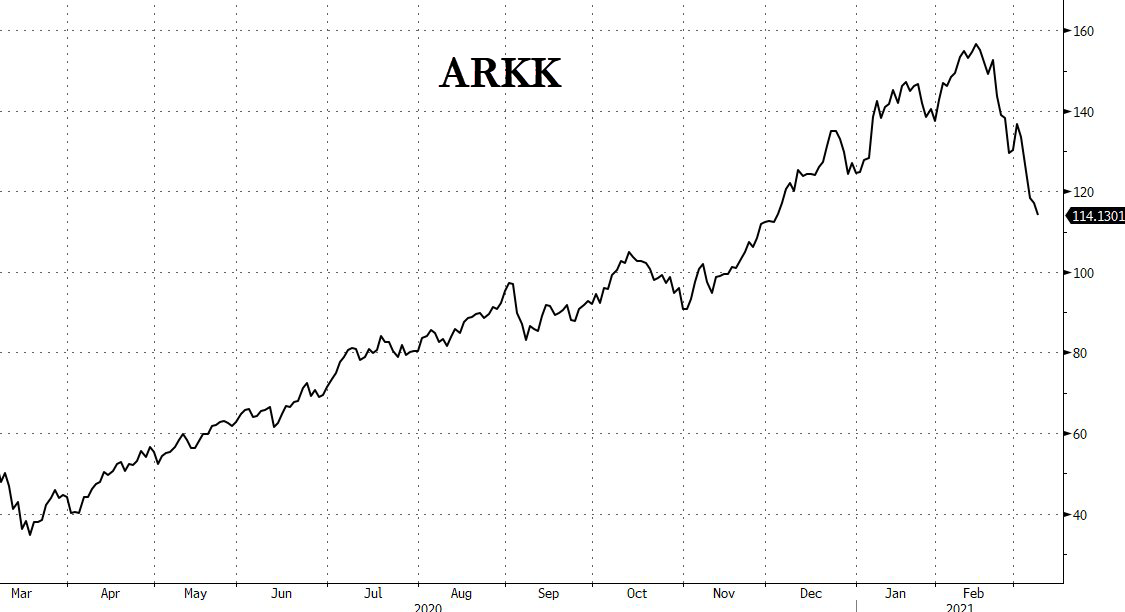
Her main ETF was about 25% off its recent highs heading into the open. Despite the NASDAQ trying to rally early in the session, by 1PM on the east coast, ARK’s Innovation ETF was near lows of the day, down 3.3%, amid a broader technology-related selloff. 

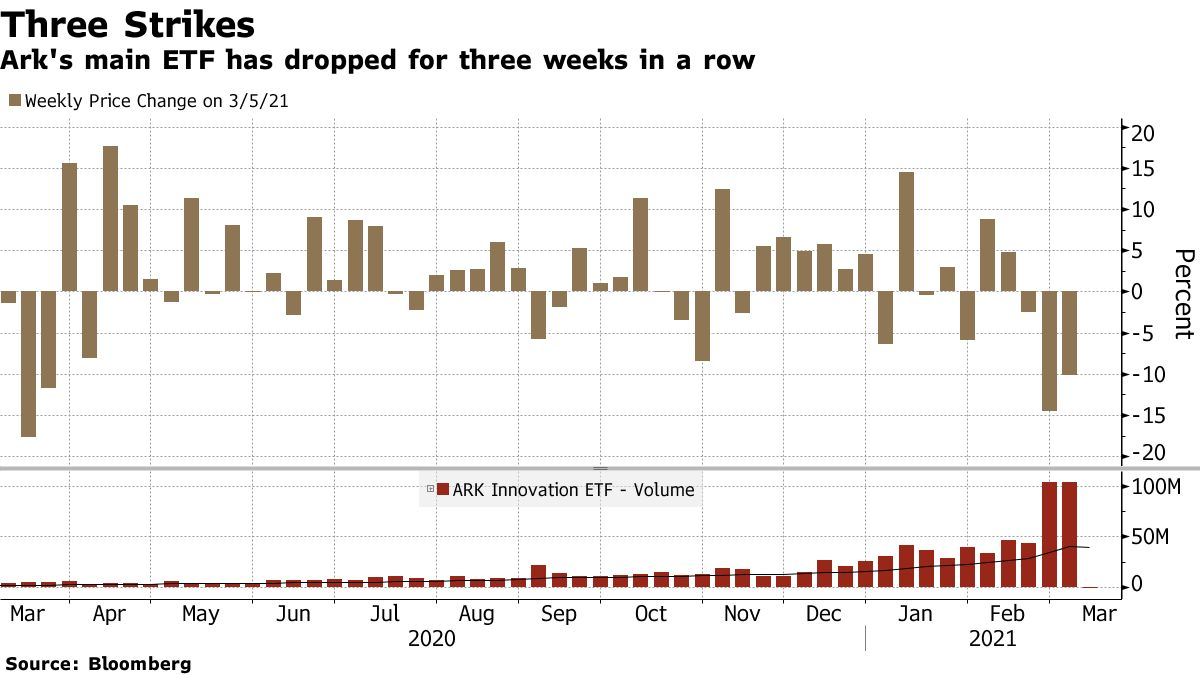
This has now become “the longest stretch of weekly losses for the Ark Innovation ETF” since the Covid selloff last year, according to Bloomberg

Top holdings of the ARKK fund are also suffering: Tesla, despite making an odd and quite unnatural looking bounce early in the session, turned red and is down about 2% mid day. Square and Teledoc health are also lower by 2.76% and 3.5%, respectively, mid-day. 

It marks a continued drubbing for the poster child of speculative “technology” plays. 

Recall, we noted that all of ARK’s funds saw outflows on Friday of last week. And as ARK’s trade updates last week seemed to disclose, Wood’s strategy doesn’t appear to be changing. As we have been pointing out, that strategy appears to be selling large, liquid big cap names and rotating the cash into smaller, speculative, small cap names. 

This can obviously become a negative feedback loop if the “strategy” continues and ARKK continues to plunge. 

Recall, last week, well known FinTwit personality @Keubiko penned an article called “Raiders of the Lost ARKK”, which laid out exactly how ARK’s flagship ETF could find itself in hot water, quickly and without much notice as a result of compounding liquidity issues. 

“It will be important to watch the daily flows in and out of this ETF, as outflows are currently modest relative to fund size, but could pick up pace if growth stocks continue to sell off,” Keubiko writes. “It appears that, like Janus, the ARK phenomenon is yet another example of the same mistake that investors have been making for decades: plowing into investments and funds AFTER they have had an epic run.”

Tyler Durden
Mon, 03/08/2021 – 13:19

via ZeroHedge News https://ift.tt/38nErDx Tyler Durden

Biden Admin Silences DHS Over Border Crisis As Viral Video Shows Flood Of Migrants Streaming Into Arizona

Biden Admin Silences DHS Over Border Crisis As Viral Video Shows Flood Of Migrants Streaming Into Arizona

The Biden administration has told the Department of Homeland Security not to speak freely about the growing border crisis, according to Breitbart, which spoke with a “senior-level law enforcement source” within DHS who spoke on condition of anonymity.

“The situation with media relations now is night and day compared to the last administration,” said the official. “We have been advised not to speak on immigration issues at the border and to rely on DHS’s Office of Public Affairs and the White House Press Office to handle messaging.”

The verbal order applies to senior law enforcement leaders within DHS and has no formal expiration date. It comes as the administration is struggling to manage the growing crisis caused by changes in border security and immigration policies leading to a spike in illegal crossings at the border.

As local communities along the border continue to grapple with the release of migrants into their communities, the administration is facing criticism even amongst their own ranks, Breitbart reported.

The report comes after senior members of the Biden administration – DHS Secretary Alejandro Mayorkas and Susan Rice – visited several cities in Texas to observe the border crisis first hand. Members of the press were not allowed to accompany the officials‘ visit to Border Patrol stations and a Health and Human Services detention facility for unaccompanied minors. 

According to a source familiar with the DHS media restrictions, the prohibition is designed “to prevent the imagery of overcrowded facilities from circulating.”

Meanwhile, a viral video tweeted on Sunday by Sen. Ron Johnson (R-WI) reveals: “The tip of the iceberg near Yuma, AZ as immigrants begin to flood into the US responding to @JoeBiden ’s open border, catch and release policy.”

Meanwhile, Yuma Sector Border Patrol agents and the Yuma County Sheriff’s Office broke up yet another human trafficking operation, where they found 18 migrants packed into a smuggling stash house – arresting the migrants and transporting them to the Yuma Station for processing, according to Breitbarti.

 Last month, Border Patrol agents in Arizona arrested 11 Iranians who illegally crossed the US-Mexico border. Five women and six men from the “special interest” country were traveling as a group.

Tyler Durden
Mon, 03/08/2021 – 13:00

via ZeroHedge News https://ift.tt/3eo9brQ Tyler Durden

Liquidity Tsunami Foiled: Why This Has Major Implications For Markets

Liquidity Tsunami Foiled: Why This Has Major Implications For Markets

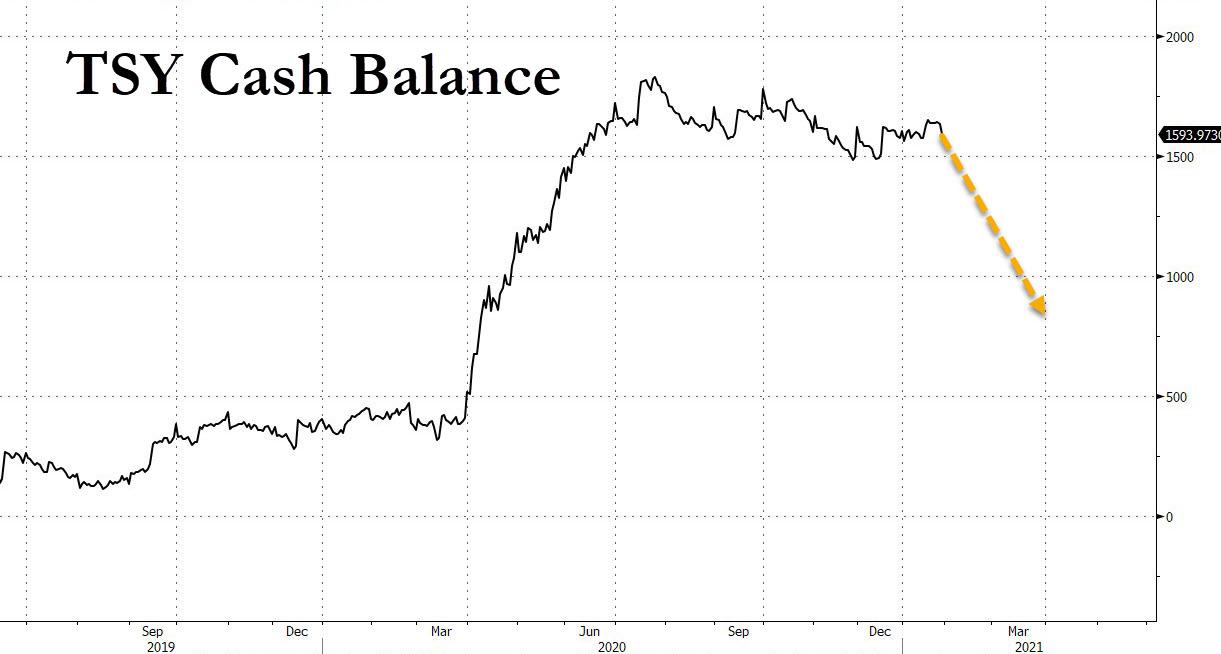
Exactly one month ago we explained that the US economy and capital markets were about to be flooded with a $1.1 trillion liquidity wave as the Treasury drew down the amount of cash held in the Treasury General Account which would plunge to just $800 billion by March 31, down a record $929BN from $1.729 trillion at Dec 31, 2020.

In other words as of early February, the Treasury expected the decline in the TGA cash balance this quarter – which is being spent to fund last December’s fiscal stimulus – to be the main driver of funding needs (for an intro primer on this topic, please see “U.S. Treasury’s cash drawdown – and why markets care“).

This matters, because as we and repo guru Zoltan Pozsar explained (here and here), this massive flood of liquidity entering the market would trigger a multi-faceted domino effect across assets, potentially pushing funding rates (FRA-OIS, repo, etc) negative, even as the glut of “safe collateral” hit demand for longer-duration, resulting in curve steepening and higher yields in longer-dated paper. And since the market is now extremely sensitive to any yield increases – reflationary or otherwise – a paradox emerged: despite over $1 trillion in liquidity hitting the market, the impact on risk assets would be largely negative.

That said, all of this however was predicated on one thing: that the Treasury’s funding needs would remain unchanged for the quarter (and beyond), which also implied that no further stimulus would pass during the first calendar quarter, and that the Treasury’s cash balance target would remain $800BN at Mar 31, all else equal.

But that it no longer the case: as of this weekend, Joe Biden’s $1.9 trillion – technically $1.8 trillion – stimulus plan passed the Senate and it’s now just a matter of fine tuning it in the House before it is signed into law. Said otherwise, it is now just a matter of day before the Treasury’s funding needs change dramatically, and the Treasury’s borrowing forecast as of Feb 1 is no longer applicable.

This has huge consequences for the market, which first was slow to adapt to the initial liquidity tsunami scenario and is now just as slow to realize that it has now been foiled.

As Wrightson ICAP economist Lou Crandall writes this morning, as Congress gets closer to passing a $1.9 trillion of stimulus, the Treasury won’t need to raise much new money to finance the plan. “This also means that the government’s cash surplus problem is about to resolve itself.

“The Treasury’s current coupon offerings are generating more than $2.7 trillion of new cash on an annualized basis, and it is still sitting on a large stockpile of surplus cash left over from last year’s preemptive borrowing spree” Crandall wrote. 

But, since it now “seems clear that the Treasury no longer needs to pay down bills at a rapid pace” as it needs to start prefunding the $1.9 trillion stimulus, Wrightson estimates the Treasury will start increasing the sizes of its bill offerings “in the very near future,” possibly as soon as Thursday’s regular announcement (and sees cumulative increases totaling $10b in the 4-, 6-, 8- and 17-week maturities, $6b for the 3- and 6-month bills, and unchanged one-year bill offerings).

In effect, this means that the liquidity drain that was envisioned for this quarter by the Treasury is not only no longer happening but is about to be reversed as the Treasury reassess its funding needs and restart building up its cash buffer!

In practical terms, this means that the pace of the Treasury’s weekly bill paydown will collapse from $55BN to “negligible levels” by the first half of April. And sure enough, this is already being observed in the market, where Treasury bill yields have backed up and securities maturing through April 1 are yielding 0.02% to 0.03%. It also means that expectations for negative GC Repo yields can be cast aside and that the short-end of the curve will now widen in coming days.

And since there will no longer be a flood of liquidity that dealers will have to absorb, it also means that there will be far more capacity for regular coupon securities. In short: a flattening of the curve is imminent, as are lower 10Y yields… and by extension higher stock prices as this move will likely be viewed (incorrectly) by algos and quants as a disinflationary trade.

Tyler Durden
Mon, 03/08/2021 – 12:40

via ZeroHedge News https://ift.tt/3sZNand Tyler Durden

The Narrative Of Inflation Amid Depopulation

The Narrative Of Inflation Amid Depopulation

Authored by Chris Hamilton via Econimica blog,

Next to language, money is the most important medium through which modern society communicates. The Federal Reserve is responsible for signaling how fast this money should be created or destroyed via its federal funds interest rate. When demand is high and capacity/supply low, the Fed should ideally make rates low to support growth of loans to boost capacity/supply. When demand is low and capacity/supply high…the opposite. Instead, the Fed is doing the inverse…trying to focus on getting consumers to use more credit/debt (think record low mortgage rates) to create more demand and necessitate higher capacity (think homebuilders).

In a ridiculously difficult chart to decipher below (so I’m told), I highlight the year over year change in working age population (yellow shaded area), year over year change in employees among them (grey shaded area), housing permits (blue line), and the 30 year mortgage rate (white line…driven by the Federal Reserve’s federal funds rate and MBS purchasing). The current situation of soaring permits against declining working age population and tanking employees among them…overridden by the speculative fervor created by record low mortgage rates is a case in point.

But in an economy, the production and consumption of goods and services are used to fulfill the wants and needs of those living within it. Very basically, the major driver of economic growth is the growth of that population of consumers, their income, savings, and access to credit. If that population is growing at 1.5% annually then you can add an additional 1.5%+ growth for maintaining &/or building out greater production, supply chain, housing, infrastructure, etc to support that larger consumer base.  This essentially gets us to a 3% growth in GDP.

So what is happening when there is little, no, or negative population (consumer) growth but GDP growth is still being targeted at 1.5% or 3% or (as in China’s case) 6%? What the Fed is trying to do is get a zero population growth (trending to declining population) economy to “grow” via cheaper debt, more debt, and serial bubble blowing. If I was a PhD at the Fed, I’m pretty sure I’d make it sound more complicated and mysterious…but I’m not and it isn’t.

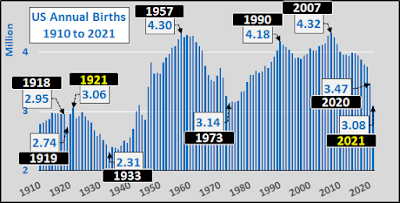
Anyway, couple of interesting factoids I thought I’d put out today that may be tangentially of interest. If Brookings Institute (and many others) are correct in their research that 2021 births are likely to decline somewhere between 300-500k due to the pandemic…2021 births will essentially be back at the same total number of births as 1921…exactly 100 years ago, in the wake of the influenza pandemic (chart below).

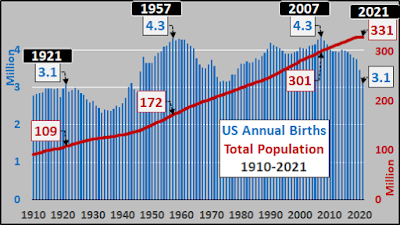
Putting this round trip in births into perspective, over those same 100 years, the total US population has more than tripled (below).

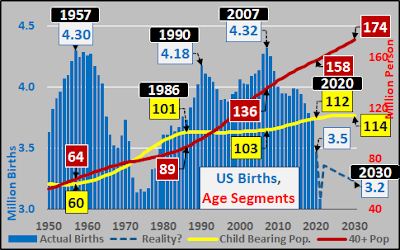
Narrowing in from 1950 to present…it should be clear the growing total population is not seeing likewise growth of births (below). Why?

The answer is humankind is different than almost every other species on planet earth, and the female of our species has a relatively truncated period of fertility comprising only about 30% of their lifecycle. Most other species females period of fertility are nearer 75%+ of their lifespan  This means that the significantly larger human population means little for childbearing, and only by narrowing in on the 15 to 40 year-olds can we see what is really going on. The yellow line below is the US childbearing population which has been flat since the mid 1980’s…while the rest of the population has been living decades longer than their predecessors. Couple the flat childbearing population with a falling fertility rate among them and thus the US is looking at a secular collapse in births and subsequent decline in young amid a soaring elderly population.

Below, since ZIRP was initiated, encouraging soaring marketable federal debt, the opposite reaction has been observed among young adults with tanking marriages and collapsing births.

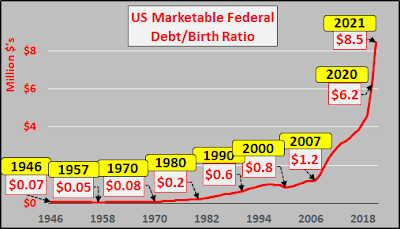
Putting that soaring debt into view on a per birth ratio, (below). We are looking at ever fewer children (future adults) responsible for repaying/servicing/inflating ever more debt on a radically rising basis.

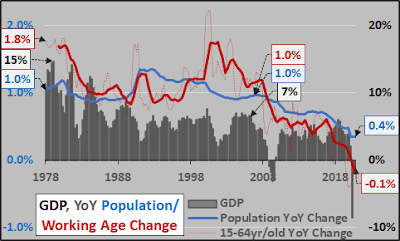
So, when I show the year over year change (qtrly basis) of the total population versus GDP since 1960, it should be clear why we need the economy to grow ever less in order to serve us…because there is ever less growth to be served by the economy (below)! 2020 growth was 1/7th that seen in 1960 (yes, on a % basis).

And when I include the year over year change in the working age population (15-64yr/olds…red line below), well, we now have outright declining annual demand from the segment of the population that drives the economy…so flat’ish GDP should about be adequate to take care of flattish demand? But the Fed would  call that recession and provide more interest rate cuts, more QE, more acronyms yet to be invented to goose activity to suit the needs of the financial system.

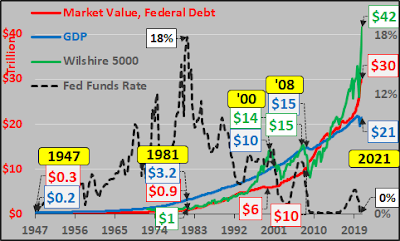
So, the Federal Reserve is targeting 2%+ GDP growth (really, significantly higher) against minimal population growth (minimal rising demand) because the economy is no longer about serving our needs…it is now we and the distorted/manipulated economy that is serving the needs of the federalized financial Ponzi scheme. As the chart below highlights, as the Federal Reserve has pushed rates ever lower, this ever cheaper/greater debt has not served the people or GDP…instead it has rewarded the minority asset holders for being asset holders…simultaneously punished the majority non-asset holders for not holding assets.

It’s usually at this point people start to ask what’s it all about…what is the end game? Since the Fed is privately owned by the largest banks in the world (and they are owned by the 1% of the 1%)…why do these people need more money? I think the simple answer is they don’t need more money. This isn’t about turning their hundreds of millions into billions or billions into tens of billions. I detail the US domestic demographic, economic, financial picture HERE…but no, there seems a different point to all this than making the fabulously wealthy wealthier…suggested HERE.

Summary

The US (and world, at large) is looking at an unexpected and increasingly large decline in births, young, and working age adults. The declining child bearing populations coupled with increasingly negative fertility rates are resulting in an inverted pyramid of continued growth among elderly propagating the collapsing population of young. The result is we appear to be at a tipping point that will result in a realignment of nearly the entire demographic, social, political, economic, and financial systems we’ve come to know and expect. This realignment is likely to be like a magnetic field realignment built around de-growth, managed decline, and resulting in large surplus and general overcapacity.

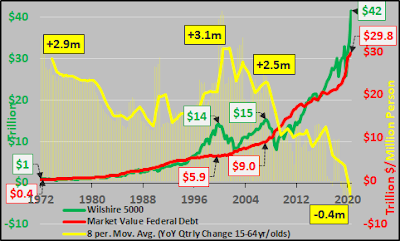
Extra Credit for those curious on market valuations…never have investors paid more for less potential growth among consumers (and never, ever have investors paid anything for a declining base of consumers…so FUBAR…but that is where the Fed has led us, so what else you gonna do?). Below, Wilshire 5000 (green line, representing all publicly traded US equities), market value of federal debt (red line, as per Dallas Fed), and year over year change in working age population (yellow line).

Tyler Durden
Mon, 03/08/2021 – 12:19

via ZeroHedge News https://ift.tt/30uFdKt Tyler Durden

Goldman Now Sees Most Advanced Economies Reaching Herd Immunity In 3 Months

Goldman Now Sees Most Advanced Economies Reaching Herd Immunity In 3 Months

The drop in global new infections has stalled in the past month, in part because more contagious variants are now spreading widely. This pattern can be clearly observed in the US, where the seven-day average of new cases in the US is decreasing albeit at a slowing rate, around 60,000, while the seven day average in Europe remains at around 62,000. As BofA notes, the increasing spread of new, more contagious variants appears to be slowing the effect from restrictions and the vaccine roll-out.

On a more positive note, however, hospitalizations and deaths continue to decline. While some of this improvement probably reflects lags, another reason proposed by Goldman is that the most vulnerable populations in advanced economies such as the US and UK are now largely protected.  And as vaccine supply and eligibility broaden, the share of the population with at least some immunity is likely to rise rapidly in coming months.

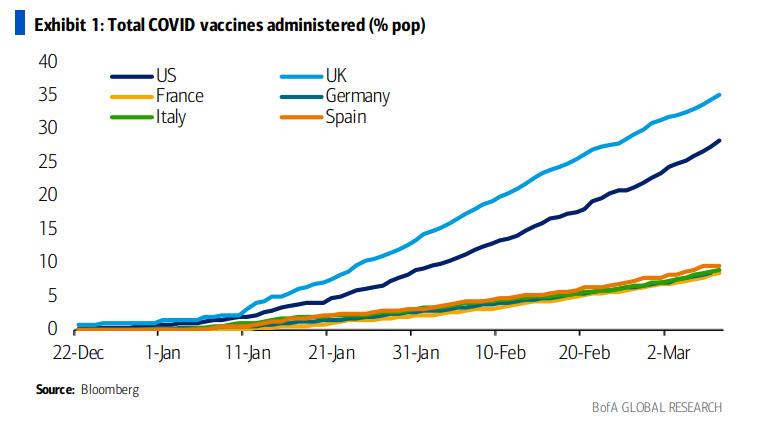
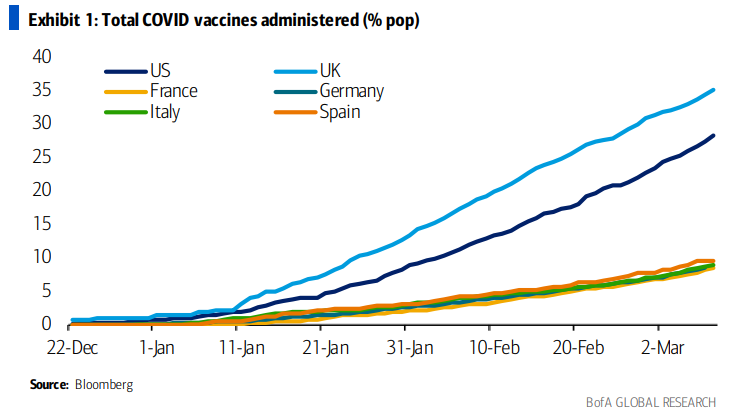
As shown in the chart below, vaccines administered around the globe continues to rise with BofA calculating that the US administered 15 million vaccines over the past week, increasing the total to 90.4 million; Europe administered 13 million doses this past week, for a total of 73.8m (and according to preliminary data from a study conducted at the University of Oxford, the Covid-19 vaccine developed by AstraZeneca/Oxford to be effective against the Brazilian variant of the virus)

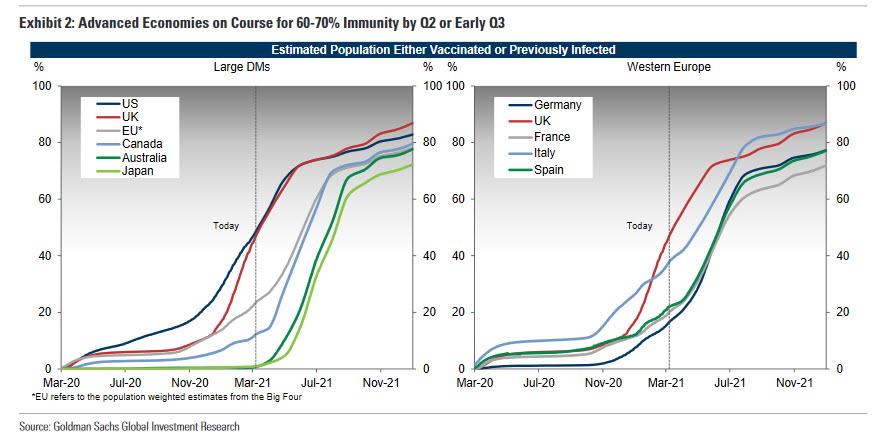
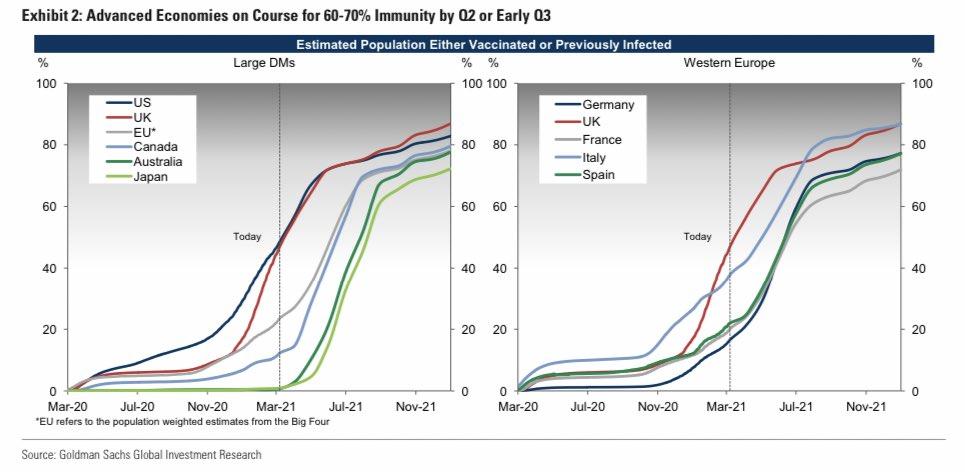
Putting this all together, Goldman now estimates that most advanced economies should cross the point at which 60-70% of the population are immune by Q2 or early Q3, with continental Europe a few months behind the US and UK. In other words, regardless of the CDC’s attempt to provoke a low-burning panic over new virus variants, Goldman believes that herd immunity will be hit in the next 3-4 months.

Keep all this in mind as various authorities do everything in their power to cling on to lockdown measures which are increasingly a political tool to perpetuate an overarching government presence in every aspect of daily lives, instead of a means to improving people’s lives.

It was none other than Billionaire Paul Singer, unafraid of being steamrolled by “cancel culture” who said it best: the recovery will be stymied by virus variants and policies “that sometimes seem governed by short-term political pressures rather than what is best for society, short and long term.”


Tyler Durden
Mon, 03/08/2021 – 12:02

via ZeroHedge News https://ift.tt/2OBKSM5 Tyler Durden

Markets Not Holding Back On Rate Hike Bets

Markets Not Holding Back On Rate Hike Bets

By Bloomberg commentator Laura Cooper

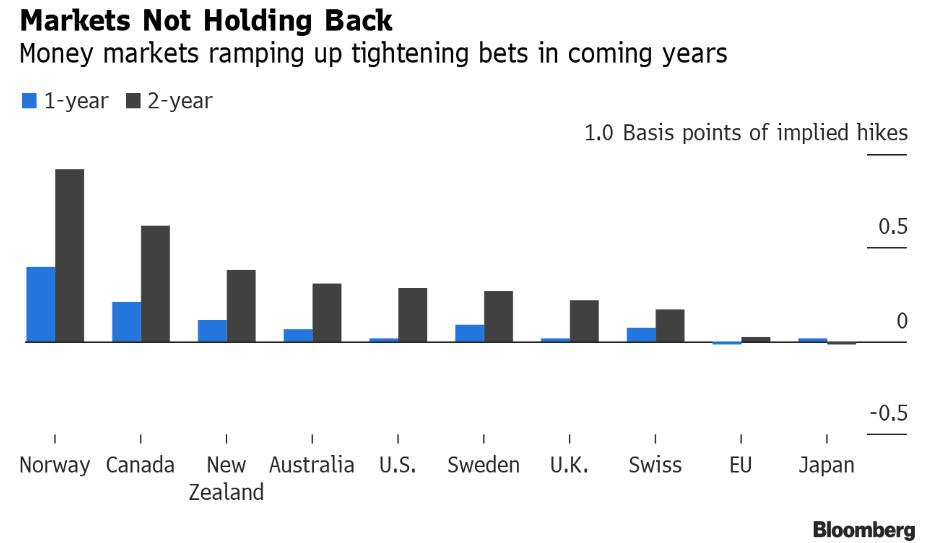
Markets grappling with central bank reaction functions aren’t holding back on tightening bets. Rate hike expectations over the coming year have risen across major advanced economies as markets reprice growth prospects. Yet the upbeat growth narrative isn’t warranted everywhere — with policy makers likely to push back against premature tightening bets.

The global reflation trade emanating from the U.S.-led fiscal impulse and vaccine rollouts is evident in money markets’ implied trajectories for policy tightening. Norway leads G-10 hiking bets followed by Canada and New Zealand. Except, policy makers here have maintained their dovish stance given uncertain economic prospects — it sets up for markets to reprice upbeat bets, with policy makers likely to push back in the week ahead.

The challenge facing policy makers is multi-fold. The European recovery is lagging on account of sluggish vaccine rollouts, extended lockdowns and a weaker fiscal impulse than the U.S. The U.K. recovery prospects are challenged by post-pandemic uncertainty, with BoE’s Andrew Bailey confirming as much today. And while the Nordics could be better positioned to match market expectations after experiencing a shallower output decline than peers, Canada continues to struggle in vaccine rollouts. And it’s unlikely many of these central banks will precede the Fed.

After years of struggling to generate demand side price pressures, markets pricing in tightening outside of the U.S. could be getting ahead of themselves. One thing is becoming clear – market bets on synchronized global growth, and subsequent rate hikes, look overdone with a spillover to respective assets ahead.

Tyler Durden
Mon, 03/08/2021 – 11:40

via ZeroHedge News https://ift.tt/3ejXuSV Tyler Durden

Texas AG Ken Paxton Calls For Probe Of Natgas Spike During Polar Vortex Chaos

Texas AG Ken Paxton Calls For Probe Of Natgas Spike During Polar Vortex Chaos

Texas Attorney General Ken Paxton published a statement Monday that read his office will be probing the cause of natural gas price spikes during the deep freeze that nearly collapsed the state’s power grid, leaving millions of customers without power for days. 

“As we learn more about what drove pricing spikes during the recent winter storm disaster, I am expanding the scope of my investigation to include the natural gas industry as well as electricity providers,” Paxton said in a statement, viewed by Environment & Energy’s Edward Klump

Readers may recall in a piece titled “Energy Trader: We’ve Officially Hit “Holy S*it Levels,”” we outlined the cause for the natgas price spike was due to wellheads and other infrastructure freezing. 

“…which literally cut off nattie supply amid wellhead freeze-offs, cutting production receipts just when they’re most needed by customers’ demand for heating, we said that since the winter blast is expected to last for the duration of the week, it is likely that nattie prices across the plains states could hit GME batshit levels.”

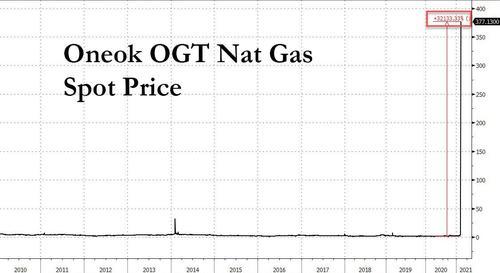
There were many accounts of natgas prices soaring thousands of percent. In particular, the Oneok OGT natgas spot exploded 32,000% in a few days.

The reason Paxton wants to investigate the source of why natgas prices soared is due to power plants weren’t able to receive any gas and caused a massive spike in power prices. Customers who were on variable cost plans saw their energy bills rocket into the thousands of dollars. It also caused a humanitarian crisis for the state, transforming it into a third-world country overnight. 

Last week, Paxton filed a lawsuit against electricity retailer Griddy, claiming it mislead customers over variable cost plans. 

Tyler Durden
Mon, 03/08/2021 – 11:32

via ZeroHedge News https://ift.tt/3t05qx0 Tyler Durden

CDC Says “Fully Vaccinated” People Can Stop Wearing Masks, Distancing In Private

CDC Says “Fully Vaccinated” People Can Stop Wearing Masks, Distancing In Private

Update (1100ET): As federal health officials including Dr. Fauci chide states for easing COVID restrictions, the CDC has just released new guidelines proclaiming that fully vaccinated people can spend time together indoors without masks or social-distancing.

The CDC’s highly anticipated report cites early evidence suggesting vaccinated people are less likely to have asymptomatic infections, and are less likely to transmit the virus to other people.

This is huge news for grandparents who have refrained from seeing children and grandchildren for the past year, as those who are presumably under the protection of a vaccine may now safely visit indoors with unvaccinated people from a single household, so long as none of the unvaccinated household members are considered a severe COVID risk. This means older individuals may visit with their younger, unvaccinated peers, so long as they visit with one family unit, or one individual, at a time.

For the record, according to the CDC guidelines, an individual is considered person is “fully vaccinated” two weeks after receiving the final dose of the Pfizer-BioNTech or Moderna jabs, or the single-shot vaccine from J&.J. Fully vaccinated people should continue exercising standard precautions while in public, the agency said.

“While the new guidance is a positive step, many more people need to be fully vaccinated before everyone can stop taking most COVID-19 precautions,” the CDC wrote in its report. “It is important that, until then, everyone continues to adhere to important mitigation measures to protect the large number of people who remain unvaccinated.”

Summarizing the contents of the report, those who are fully vaccinated are now allowed to…

  • Visit with other fully vaccinated people indoors without wearing masks or physical distancing.
  • Visit indoors with unvaccinated people from a single household who are considered low risk for severe disease without needing to wear masks or practice social distancing.
  • Refrain from quarantine and testing following a confirmed exposure to the virus (unless symptoms develop).

Read the full report below:

Public Health Recommendation for Fully Vaccinated 3-7-21 3 Pm Clean by Joseph Adinolfi Jr. on Scribd

Speaking on CNBC, reporter Meg Tirrell noted that the CDC needed a “carrot” to encourage more eligible adults to get vaccinated. Previously, those who have been vaccinated have been expected to follow all the same precautions as those who haven’t. Now, it appears, that is finally beginning to change.

In other COVID news, UK Prime Minister Boris Johnson said Monday that the number of Britons who have been vaccinated has surpassed 1/3rd of the adult population, while Italy has just surpassed 100K confirmed COVID deaths.

* * *

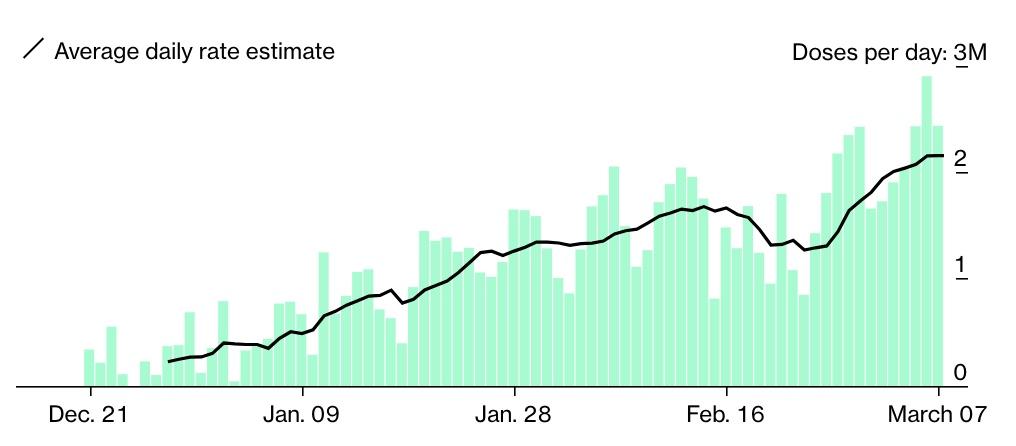
As it continues to lead Europe (and trail the UK) in the race to vaccinate its population, the US has notched yet another milestone in the battle against COVID-19: a record 2.9MM vaccine jabs were doled within 24 hours on Saturday, the largest daily tally yet. However, some experts, including Dr. Anthony Fauci, are worried about the possibility of a “fourth wave” of COVID infections, potentially driven by “mutant” strains, which comprise a growing share of new infections.

Over the past week, the average daily number of new doses in the US has been 2.2MM doses/day, the highest 7-day average yet, according to Bloomberg.

Globally, the US is on track to become the second developed western nation to see its total vaccines administered eclipse more than 30% of its population, a milestone first achieved by the UK. Meanwhile, more than 17% of Americans have received both vaccine shots.

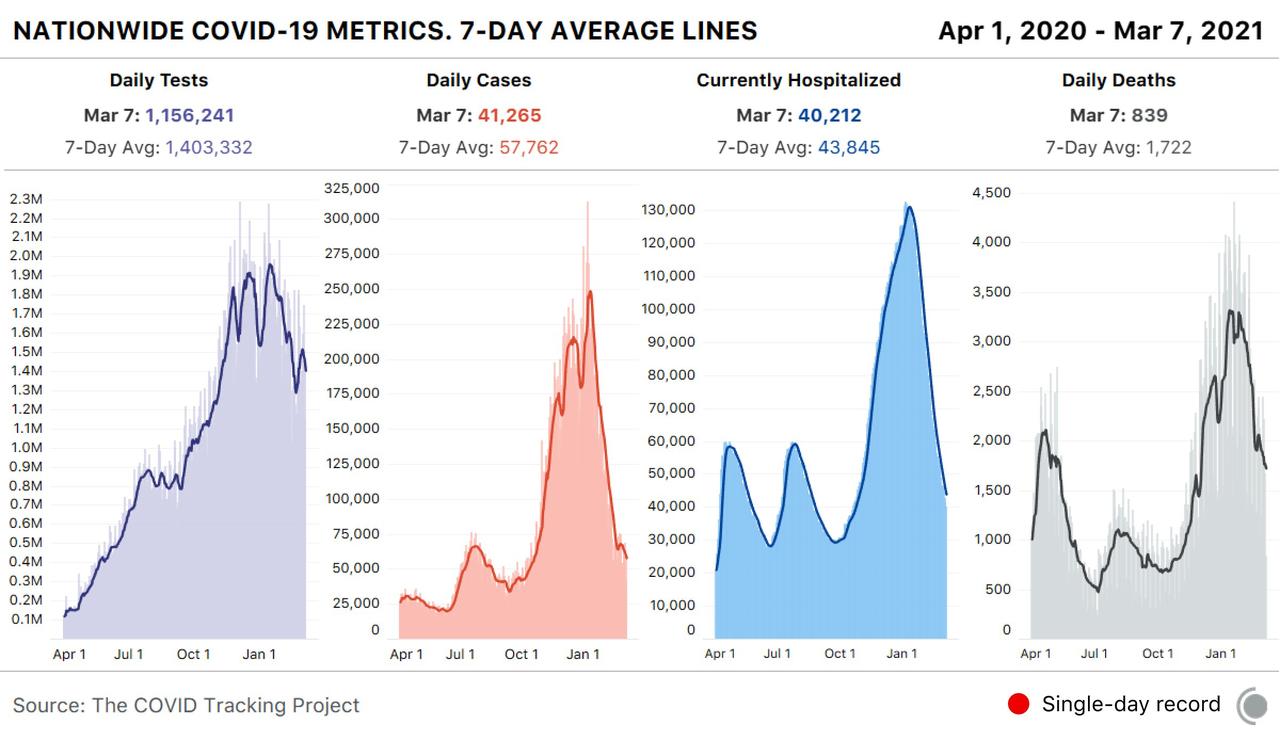
Following a brief uptick last week that stoked worries about a possible plateau, the number of new daily cases reported in the US is moving lower once again, with the daily average returning to levels unseen since October on Sunday. Total US COVID hospitalizations have fallen to 40.2K, which, like cases, is at the lowest level since October. Hospitalizations have fallen 70% from their peak in late January, less than 2 months ago. New cases have fallen by roughly the same level.

In total, the US is on the cusp of reaching 29MM total COVID cases, while the global tally nears 117MM.

Some 107MM doses of the three FDA-approved vaccines have been shipped to states across the US, per the CDC.

All of this vaccine optimism has led Goldman Sachs’ analysts to project that most advanced economies will pass the 70% threshold for herd immunity by early Q3, even as Europe lags the US and UK, and European Commission Chairwoman Ursula von der Leyen insists that the bloc is tired of being scapegoated for its slow vaccine rollout.

Deaths have slowed, too, but not nearly as quickly as new cases. As the number of patients hospitalized with COVID across the US has dropped sharply, another 839 new deaths were reported across the US yesterday, roughly even with levels from late last year.

But while the immunization outlook appears bright, some experts are still worried that COVID mutations and human complacency may conspire to usher in a “fourth wave” of the virus later this year. While cases continue to drop, Dr. Anthony Fauci has continued to criticize states that have decided to lift restrictions “prematurely” (according to the CDC), warning that the growing prevalence of the mutated strain of COVID first detected in the UK could cause a resurgence in new cases. Late last week, Dr. Fauci warned that “when you have that much of viral activity in a plateau, it almost invariably means that you are at risk for another spike.”

Gov. Cuomo announced over the weekend that NY restaurants (outside of NYC) can soon reopen dining rooms to 75% capacity. And earlier Monday morning, the New York Times reported that NYC will start welcoming high school students back to classrooms on March 22. NYC’s school system, by far the largest in the country, has more than 1MM students enrolled, with nearly 300K students in high school.

According to the plan, which is expected to be formally announced by Mayor de Blasio on Monday, roughly half of the city’s 488 high schools will offer full-time instruction to most, or all, of in-person students (i.e. students who opted last year to return to classrooms as quickly as possible), while the other half will offer hybrid instruction. The city will also restart high school sports for all students, including those who have opted to continue learning remotely. The sports season will run through the summer this year, rather than ending with the school year. Student-athletes will be required to wear masks at all times.

Even with the return of as many as 55K high school students who signed up for in-person classes last fall, only about a third of all city students will be receiving any in-person instruction. The remaining 700K students in the city system have chosen to continue receiving instruction remotely, in large part because of lingering concerns about the health risks.

As more states push forward with reopening measures (even California is loosening some restrictions, while Texas has led the charge to drop all restrictions), Dr. Fauci isn’t the only high-profile public health official warning about a potential “fourth wave” of the virus. Writing in a WSJ editorial published online last night, Dr. Scott Gottlieb warned that mutant strains of the virus could cause a resurgence of hospitalizations and deaths if the country isn’t careful.  Even if cases continue to fall through the summer, the presence of the new COVID variants threatens a resurgence in the fall and winter, once the traditional “flu season” risks becoming “COVID season”. “The path to normalcy won’t be linear. As summer approaches, things will likely loosen up, but we may need to reinstate stricter precautions in the fall or winter. Not everyone will choose to get vaccinated, and new variants may leave more of us vulnerable,” Gottlieb wrote.

Speaking Sunday on CBS’s “Face the Nation”, Dr. Fauci said COVID infections remain “very high” and a rush to lift virus-related restrictions risks triggering another surge.

New mutant strains have caused global COVID cases to plateau over the last two weeks. During the last week in February, after six weeks of decline, new cases rose week-over-week, with the level reported last week remaining roughly flat.

Tyler Durden
Mon, 03/08/2021 – 11:17

via ZeroHedge News https://ift.tt/3qts52Q Tyler Durden

Retail Investors Are Long Confidence And Short Experience

Retail Investors Are Long Confidence And Short Experience

Authored by Lance Roberts via RealInvestmentAdvice.com,

In a “market mania,” retail investors are generally “long confidence” and “short experience” as the bubble inflates. While we often believe each “time” is different, it rarely is. It is only the outcomes that are inevitably the same.

I recently penned an article about Charles Mackay’s book “Extraordinary Popular Delusions And The Madness Of Crowds.” As noted, that book was an early study in crowd psychology. To wit:

“Essential is the understanding of the role psychology plays in the formation and expansion of financial manias. From the 1711 ‘South Sea Bubble’ to the 2000 ‘Dot.com crash,’ all bubbles formed from a similar ‘panic’ by investors to chase ongoing speculation.”

A recent UBS survey revealed some fascinating insights about retail traders and the current speculation level in the market.

Seen This Before

William Bernstein, who updated Mackay’s work, suggests that:

“Bubbles are characterized by extreme predictions, tend to dominate conversations and induce people to leave their jobs. The warnings of bubble skeptics get invariably met with scorn and derision.”

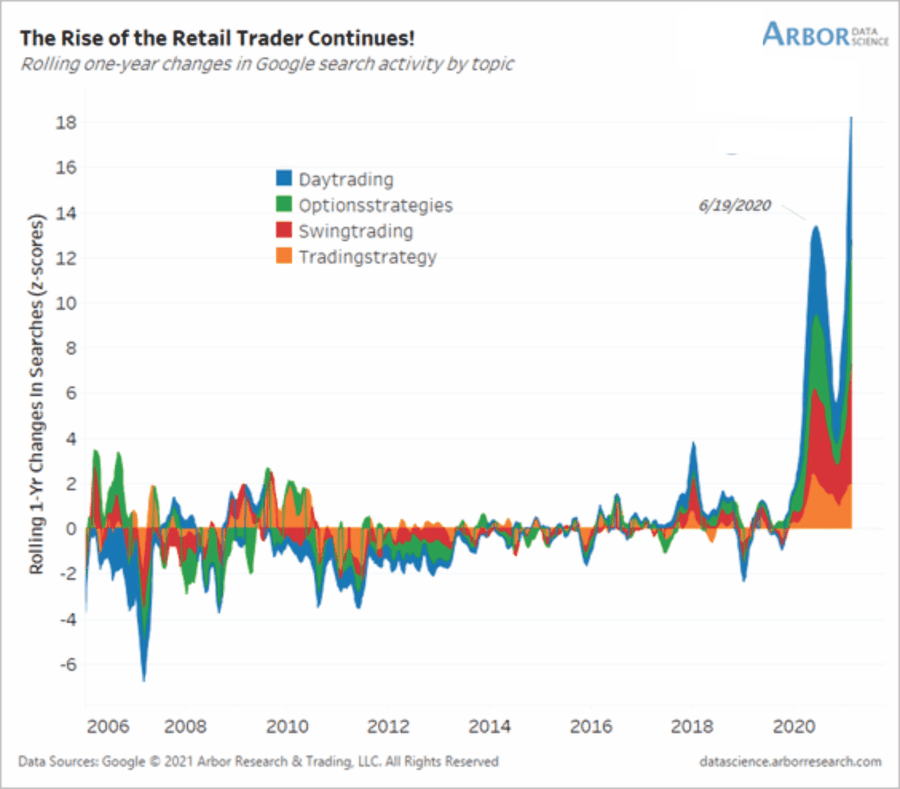
The number of individuals searching “google” for how to “trade stocks has spiked since the pandemic lows.

For anyone who has lived through two “real” bear markets, the imagery of people trying to learn how to “daytrade” their way to riches is familiar. From E*Trade commercials to “day trading companies,” people were leaving their jobs to trade stocks. Kind of like this couple:

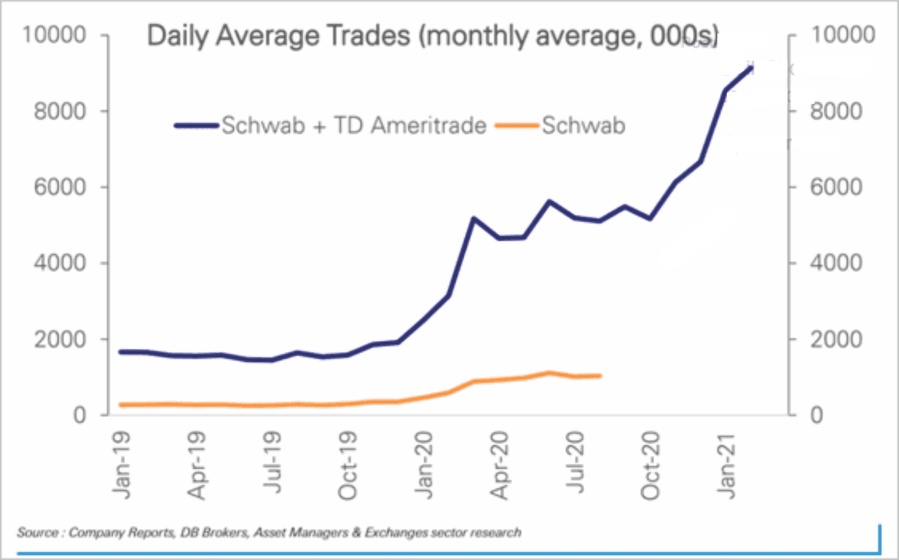
Such is just one example of many internet commentaries driving investors to “trade” stocks. Not surprisingly, we have seen a surge in securities’ daily trading volumes since the beginning of the pandemic.

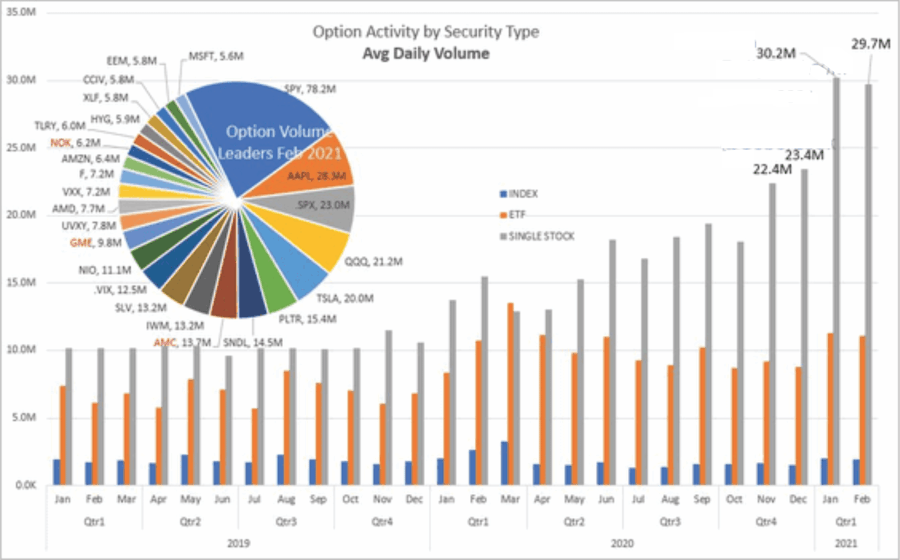
Importantly, these investors are not just buying equities but are using some of the risky vehicles to “leverage” the returns. As shown, option trading volumes have swelled.

None of this is new, different, or unique.

The same thing happened in late 1999. That commercial aired just 2-months shy of the beginning of the “Dot.com” bust. As we see today, investors believed “investing was as easy as 1-2-3.”

Why this trip down memory lane? (Other than the fact the commercials are hilarious to watch.) Because this is typical of the exuberance seen at the peaks of bull market cycles.

Long Confidence

Along with David Dodd, Benjamin Graham attempted a precise definition of investing and speculation in their seminal work Security Analysis (1934).

An investment operation is one which, upon thorough analysis, promises safety of principal and a satisfactory return. Operations not meeting these requirements are speculative.”

There is also a significant passage in Graham’s The Intelligent Investor:

“The distinction between investment and speculation in common stocks has always been a useful one and its disappearance is a cause for concern. We have often said that Wall Street as an institution would be well advised to reinstate this distinction and to emphasize it in all its dealings with the public. Otherwise the stock exchanges may some day be blamed for heavy speculative losses, which those who suffered them had not been properly warned against.”

It should not be surprising we see such rampant “speculative” behavior in the markets. After a decade of monetary injections, investors believe there is an “insurance” policy against losses. This insurance policy is most commonly known as the “Fed Put.”

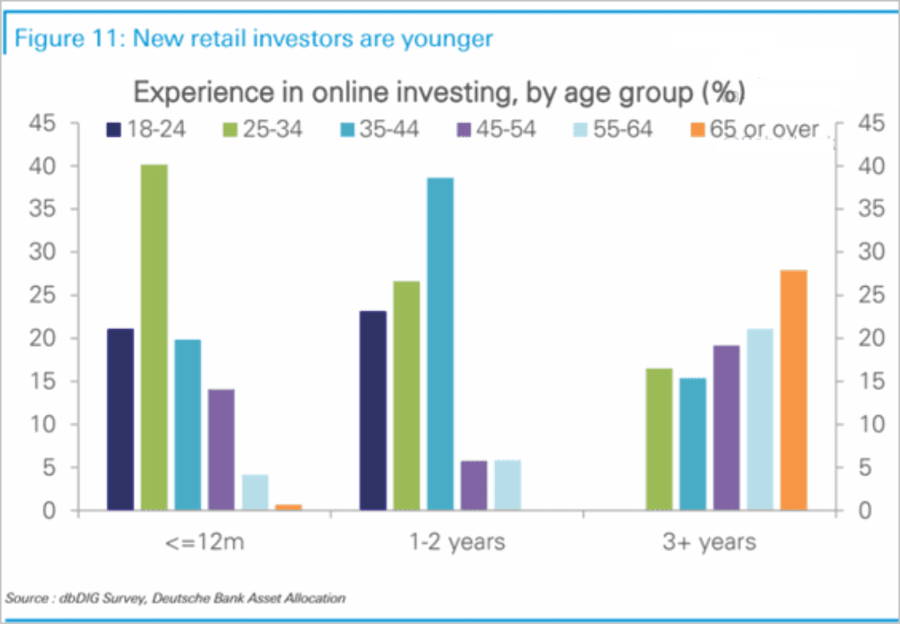
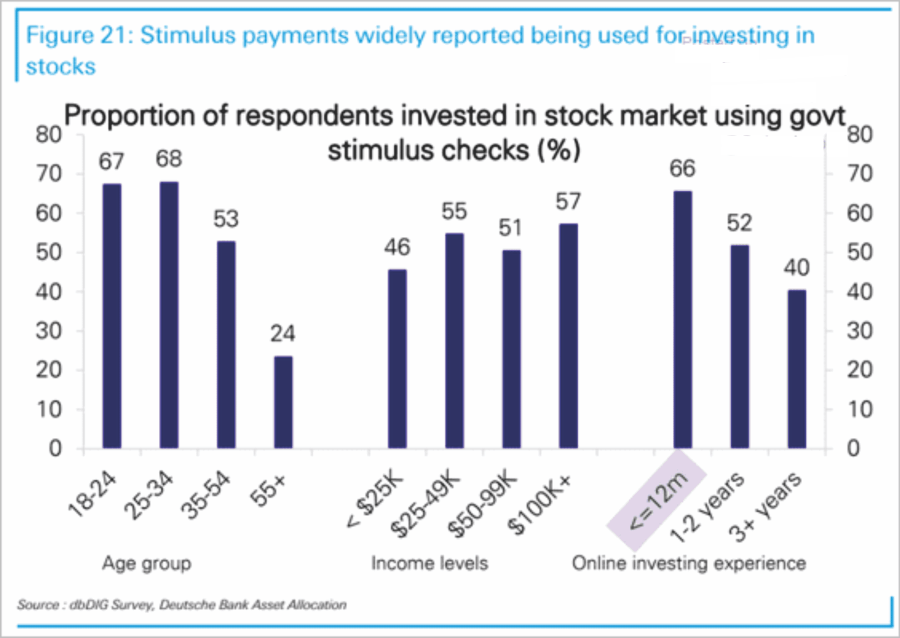
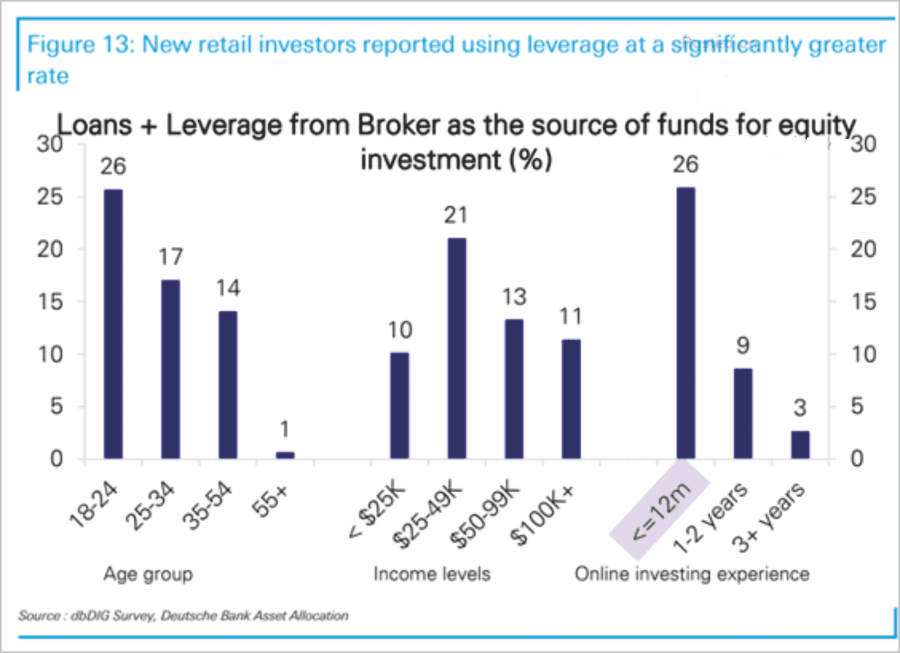
It should not be surprising, since the “Fed Put” began following the “Financial Crisis,” it is primarily young investors lulled into that complacency. Armed with only a couple of years of investing experience and a fresh “stimulus” check, the “casino” is open.

Confirmation Bias

One of the signs that you have entered into a mania phase is when people have trouble absorbing non-conforming information. Confirmation bias” is a psychological behavior where individuals disregard any information which conflicts with their current beliefs. While that bias has always been problematic for investors, in recent years, it has worse as individuals lock themselves inside “social media echo chambers.”

There are currently many signs of exuberance in the market. Most notably, the surge in speculative “call option” buying. While there are many complexities and risks, such is not a concern to young investors with little or no experience in trading options.

Nor is it an issue to leverage up accounts using “margin loans.”

I suspect that most of the individuals surveyed, who are trading on margin, do not understand what happens when prices decline. As noted previously:

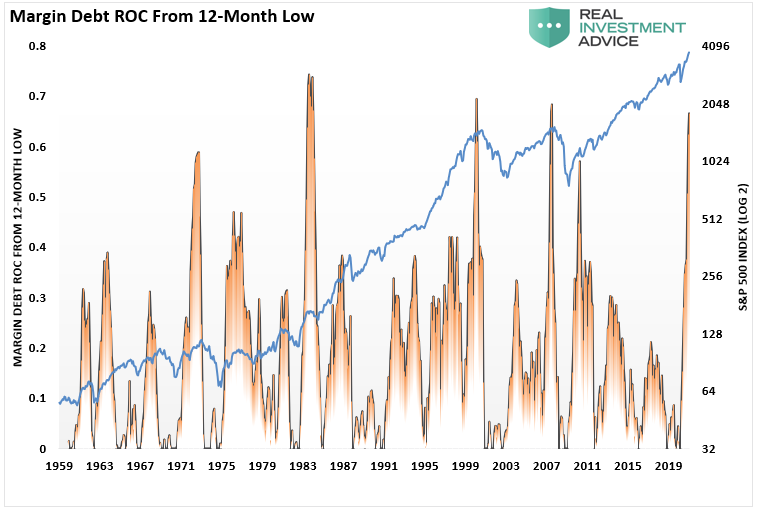
“Margin debt is not a technical indicator for trading markets. What margin debt represents is the amount of speculation that is occurring in the market. In other words, margin debt is the ‘gasoline,’ which drives markets higher as the leverage provides for the additional purchasing power of assets. However, ‘leverage’ also works in reverse as it supplies the accelerant for more significant declines as lenders ‘force’ the sale of assets to cover credit lines without regard to the borrower’s position.”

The last sentence is the most important. The issue with margin debt is the unwinding of leverage is NOT at the investor’s discretion. It is at the discretion of the broker-dealers that extended the leverage. (In other words, if you don’t sell to cover, the broker-dealer will do it for you.)

Just to put this into perspective, the rate of increase in margin debt is at historical extremes. Such has previously not worked out well for investors.

Blind Leading The Blind

As shown, one of the most troubling aspects of where individuals are getting their investing guidance. The youngest and least experienced investors use social media as the “most important” source of information. Considering most social media users are the younger generation, this is the very definition of the “blind leading the blind.”

Jason Zweig summed up the problem with this very well:

“As surely as the sun rises in the east, promoters will be touting these returns. A small-stock fund manager who’s up 40% over the past year can hype that gain in ads and on social media; 40% is a big, beautiful number! Only by reading the fine print would you be reminded that a 40% return underperformed the average by more than 10 percentage points.

You knew I would tell you this but I’m saying it anyway. These returns won’t last indefinitely. Enjoy them while they last, but you’d be crazy to count on such giant gains becoming common.

At times like these, grounding yourself in realistic expectations is more important than ever. Working in the garden also reminds me that market cycles, like nature’s seasons, can be extended — but not rescinded.”

The biggest problem for most young investors is the lack of research on the stocks they buy. They are only buying them “because they were going up.”

However, as Jason notes, when the “season does change,” the “fundamentals” will matter, and they tend to matter a lot. Such is something that most won’t learn from “social media” influencers.

A Man With Experience

There is an old WallStreet axiom which states:

“A man with money meets a man with experience. The man with the experience leaves with the money, while the man with money leaves with experience.”

Such is the truth about markets and investing.

Experience tends to be a brutal teacher, but it is only through experience that we learn how to build wealth successfully over the long-term.

As Ray Dalio once quipped:

“The biggest mistake investors make is to believe that what happened in the recent past is likely to persist. They assume that something that was a good investment in the recent past is still a good investment. Typically, high past returns simply imply that an asset has become more expensive and is a poorer, not better, investment.”

Such is why every great investor in history, in different forms, has one basic investing rule in common:

“Don’t lose money.” 

The reason is simple; if you lose your capital, you are out of the game.

Many young investors will eventually gain a lot of experience by giving most of their money away to those with experience.

It is one of the oldest stories on Wall Street.

Tyler Durden
Mon, 03/08/2021 – 11:06

via ZeroHedge News https://ift.tt/3l3aUnN Tyler Durden

Greensill Files For Administration – Who’s Left Holding The Bag?

Greensill Files For Administration – Who’s Left Holding The Bag?

As was expected, and detailed most recently here, Greensill Capital has filed for administration, in the latest stage of the unravelling of a SoftBank-backed company that had sought a $7bn valuation last year.

The FT reports that lawyers for Greensill appeared before a UK court on Monday in a move that potentially paves the way for the US investor Apollo Global Management to buy some parts of the ailing finance group’s business.

Greensill has “fallen into severe financial distress” and can no longer pay its debts, lawyers for the company said in court documents.

Greensill’s lawyers said on Monday that company was thrown into crisis last week after its main insurer refused to renew a $4.6bn contract which “caused the real crunch” though we suspect that Credit Suisse freezing $10bn of funds linked to the firm did not help.

The big question now – especially with the ECB sniffing around – is: who will be left holding the bag?

Bronte Capital’s John Hempton has some ideas:

There has been much fabulous reporting in the lead-up to the collapse of Greensill, the eponymously named Australian domiciled but London headquartered supply chain financier. But if you want guidance start with anything by Duncan Mavin (from the Wall Street Journal) or Robert Smith sometimes with Olaf Storbeck (at the Financial Times).

The excellent work of these journalists is now on the front page above the fold. It is not everyday a globally significant financial institution fails, and it is rarer still that this collapse happens within a couple of percent of all time highs in markets.

There has been remarkably little coverage of where the losses (which will be enormous) will sit.

I do not know either. But I am a short-seller at heart and trying to work this out seems like a core task for me. 

I will start my speculations at home in Australia.

In late November 2020 I wrote a letter to the Australian Prudential Regulatory Authority (APRA) about the credit risk that Insurance Australia Group was taking on Greensill. Here is that letter (which given outcomes looks rather on point). 

This letter is slightly modified, correcting punctuation and having some redactions.

Greensill and Insurance Australia  Group 

First – you need to know what Greensill and Lex Greensill are.

Lex is a controversial and aggressive factoring/supply chain/trade finance financier. Possibly the most controversial one in the world.

He is an Australian – bought up on a farm near Bundaberg in Queensland – and the parent company is Australian domiciled and still has a Bundaberg address.

The enterprise however is vast – and – by far – the biggest company headquartered in Bundaberg.

The official version piles on the humble origins.

https://www.greensill.com/about/meet-lex-greensill/

The unofficial versions focus a little on the indulgences, the family jets etc. Though apparently (and according to one of the articles attached) he is selling the fleet of private jets (four of them) as he takes money from Softbank.

Greensill is controversial. They financed the fraudulent NMC Health.

More publicly they were involved in the collapse of the GAM funds that was widely publicised.

In that case the fund manager Tim Hayward overloaded his fund with Greensill paper at valuations some considered questionable.

Since Hayward’s fund collapsed there have needed to be new large-scale sources of finance.

The biggest of these is that Greensill bought control of a tiny (and failing) German bank, recapitalised it, took a huge pile of brokered deposits (by paying about 100-120bps over) and either bought Greensill receivables or pledged bank assets to get letter of credit capacity to support Greensill activities.

The annual report for the bank (alas in German) is attached. The bank assets are largely “insured” but we cannot tell who they are insured by.

What we can see is the Credit Suisse fund that has deep Greensill relations (and is also the subject of this excellent article in the WSJ – https://www.wsj.com/articles/softbank-backed-greensill-looks-to-raise-fresh-capital-11602173906).

I have attached a letter from the Credit Suisse Supply Chain Finance Fund. A good way to start would be to get EVERY letter and prospectus from this fund and any other Credit Suisse fund with a decent Greensill exposure.

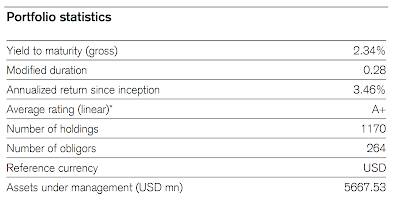
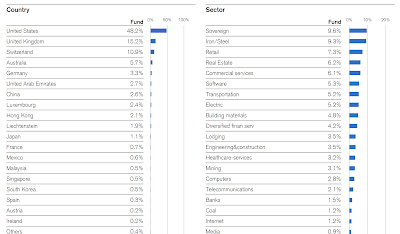
The fund is USD5667 in size – as per this cut-and-paste.
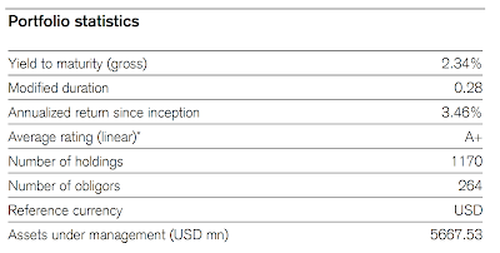
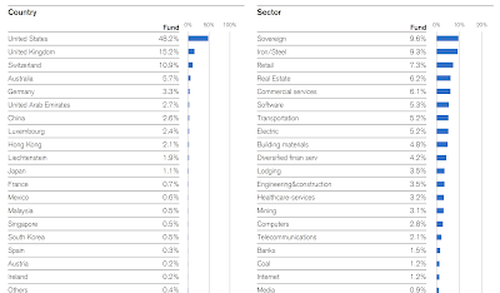
Other than 10 percent US Treasury holding it is diversified as to the countries that the assets are from and the industries that they are in.

But it is not diversified as to the the source of these assets (Greensill, Greensill and Greensill as far as I can tell) or the source of the insurance on these assets.
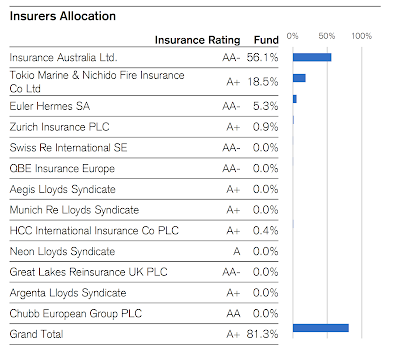
It is 56.1 percent Insurance Australia Ltd as per the following.
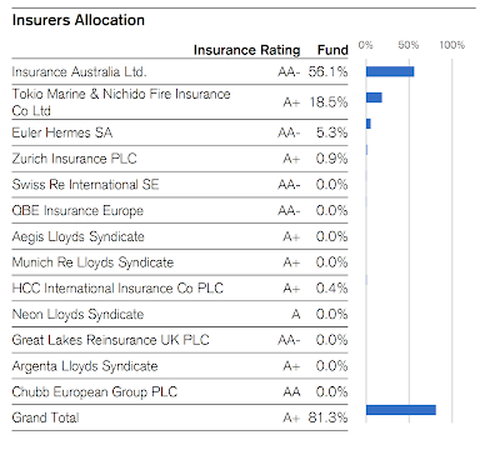
Now that is USD3.18 billion in exposure – just through one fund. That is AUD4.4 billion.

hat is just the Insurance Australia exposure I can find.

I am assured the bank assets are also largely insured – but I cannot find who the insurer is.

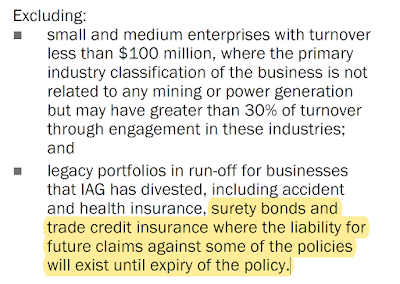
So you would think that this is a disclosable large exposure to a single controversial financier. But the only statement in the IAG annual report is as follows:
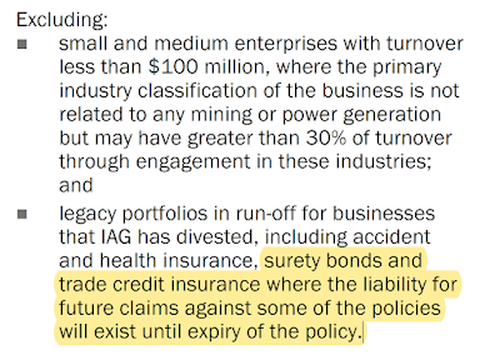
That is it. They say it is in run-off. They feel no need to disclose a multi-billion dollar exposure to a questionable credit/s.

The only problem is that no insurer (other than Tokio Marine) seems to insure for them any more and the amount insured is rising fast.

I think the insurance is written at a broker in Sydney:

https://tbcco.com.au/

This entity used to be owned by IAG and Tokio Marine – but IAG sold their bit to Tokio Marine. However the insured amounts keep going up (at least the bits I can find) even though IAG say the thing is in run-off.

I have some hypotheses. Either

  1. An amount – at least 4.4 billion – but possibly much higher – is insured by IAG. Given the size (say 50 plus billion) and controversy of Greensill this is potentially a solvency risk for IAG.

  2. Greensill is faking IAG insurance policies – and the amounts are not insured by IAG but Greensill says they are. In which case the German Bank (taking all those insured bonds) is facing solvency risk – and you should be talking to your German counterpart.

  3. The Credit Suisse documents are fake. I think this unlikely but cannot dismiss it.

Either way it is one of the uglier situations I have seen lately.

John

APRA (and to the extent I talked to them the Australian Securities Commission) dealt with me professionally. I was originally not short any company mentioned, but I did not want to restrict my ability to trade. They asked me a few precise questions but gave me no indication as to whether they took these issues seriously or what they were thinking. I wanted no insight to their thoughts and they gave me none.

But Sarah Danckert in the Age has reported (quoting multiple sources) that APRA has been interested in the situation since November. So I  guess my letter had the desired effect although for all I know APRA may have already had the situation in-hand.

Anyway it is clear that IAG had a large and thinly disclosed Greensill risk.

The collapse of Greensill and the role of the insurers

Tom Braithwaite in the Financial Times (and others) have reported that the proximate cause of the collapse of Greensill was that these insurance policies were not renewed. This led to a chain of events whereby Credit Suisse funds stopped accepting Greensill assurances and BaFin (the German regulator) took over Greensill Bank.

The best bits of information however come from an Australian court case.

Late at night and in emergency sitting the Supreme Court of NSW (a first-instance court despite its title) heard an urgent after-hours application for an interlocutory mandatory injunction compelling insurer to issue a trade credit insurance policy. 

This was always a long shot. The policy terms require 180 days notice to terminate or the insurer might be forced to renew. 

The argument Greensill made to the court was that maybe 179 or 178 days of notice was given, not 180 days and that Insurance Australia Group should be forced to renew USD4.6 billion in credit insurance for which it had no reinsurance coverage.

Understandably at a last-ditch 7PM hearing a single judge wasn’t prepared to bankrupt a major Australian insurer by forcing renewal.

You can find the judgement here.

Greensill duly collapsed as they told the Judge that it would.

That said, the question of whether Greensill can force renewal of those policies is still open and is still going to court. All the judge decided was that at short notice and on only an “arguable” case he wasn’t going to issue a mandatory injunction. 

So there will be a court case to come. And the court case will reveal new details and make important decisions.

The alleged rogue underwriter and what is at stake?

Jenny Wiggins and Hans van Leeuwen in the Australian Financial Review tell a story about a fired underwriter who had exceeded his authority by binding insurers  to contracts insuring Greensill to the tune of about $10 billon. (From the context I read this as 10 billion US dollars rather than Australian dollars). The core quote is:

BCC director Toby Guy wrote to Greensill chief executive Lex Greensill and Greensill Bank director Markus Nunnerich on August 4, telling them that Mr Brereton had exceeded his authority in approving customer limits to Greensill between July 2019 and July 2020 when he signed numerous comprehensive trade credit insurance policies worth about $10 billion. He was dismissed on July 8, 2020.Many insurance policies have terms that require insurance companies to renew and there is complex law around this. I am neither a la

There are several things to observe here.

First BCC is that Sydney based insurance broker I mentioned in the letter to ASIC. It bound insurance policies for both Insurance Australia Group and Tokio Marine. 

Second the 10 billion dollars in policies are substantially larger than the policies disclosed in any  Credit Suisse documents – so I am guessing that they include the policies that purported to protect the assets of Greensill’s German  Bank.

Third, and most importantly, the policies were written until July 2020. This is important because most insurance policies cover 12 months, and many credit insurance policies are longer. If BCC was writing  policies until July 2020 some of them are likely still in force.

If that is the case Insurance Australia Group and Tokio Marine are staring down the barrel of some very large losses.

Insurance Australia Group is a minnow. Large losses on this scale could reasonably bankrupt it. Tokio Marine is a relative giant and large losses will hurt but not mortally wound it.

Fortunately for Insurance Australia Group they sold their interest in BCC some time ago to Tokio Marine so their exposure may not be large.

That said  – if they are eventually forced to renew exposures on old policies (as per the argument Greensill put at the late night court case) then IAG may incur some very large losses, especially as they appear not to have renewed their reinsurance (as disclosed in NSW Supreme Court).

You may think I am drawing a long bow here, but Insurance Australia Group recently lost a major case on pandemic caused business interruption insurance and were forced to raise AUD865 million in extra capital to remedy their “mistake”. The mistake  was contract wording.

That said it will be up to the courts (and most certainly not me) to work out the extent to which Tokio Marine and AIG are left holding the Greensill bag.

A plea for disclosure

Insurance Australia Group disclosure on Greensill has been appalling. There are exposures potentially large enough to bankrupt them that were undisclosed. Robert Smith, Michael Pooler and Olaf Storbeck in  the Financial Times describe the problem as a “rogue underwriter“.  To quote:

One insurer has already laid the blame for the scale of cover it extended to the company at the feet of a rogue underwriter.

“This is similar to what blew up AIG in 2008,” says one person close to the brewing disputes, in reference to the complexity of the contracts involved.

A rogue trader can kill a bank as per Barings, but the situation with insurance is even more stark. Rogue underwriters crashed AIG – previously the largest market cap insurer in the world.

Given the scale of the issue and the fact that key details have been partially disclosed in court I think it is time for a more public airing than this blog post.

I do not know the disclosure rules in Japan (applying to Tokio Marine) but the continuous disclosure rules that apply to ASX rules seem to impose some duties on Insurance Australia Group and potentially its directors.

What if the liabilities for Greensill losses do not fall on insurers?

It is possible that insurers will duck much of the liability to make good Greensill losses. If policies were written as late as July 2020 (as per the above quoted financial review article) it is unlikely insurers will avoid all liability, but depending on what policy was written when, and depending on the wording of those policies they may duck most liability.

So then someone else may be left holding the bag.

I think there is a good chance that someone will be Credit Suisse Financial Group.

Here is the final letter to clients of one of the credit funds

Here is the core client pitch:

The fund seeks to generate stable and uncorrelated returns by investing in notes with a maturity of typically less than one year which are backed by buyer confirmed trade receivables/ buyer payment undertakings, supplier payment undertakings and account receivables (”Receivables”). The underlying credit risk of the notes is insured by highly rated insurance companies. The Fund aims for a target return of 1.50% p.a. above the 3-month USD LIBOR and a short term maturity profile.

The highlighted section is  a doozy. It says that the underlying credit risk of the notes is insured by highly rated insurance companies.

Well it either is or it isn’t.

If it is insured Insurance Australia and Tokio are in a world of pain.

If it is not insured then one might expect extensive litigation and potentially large losses at Credit Suisse. 

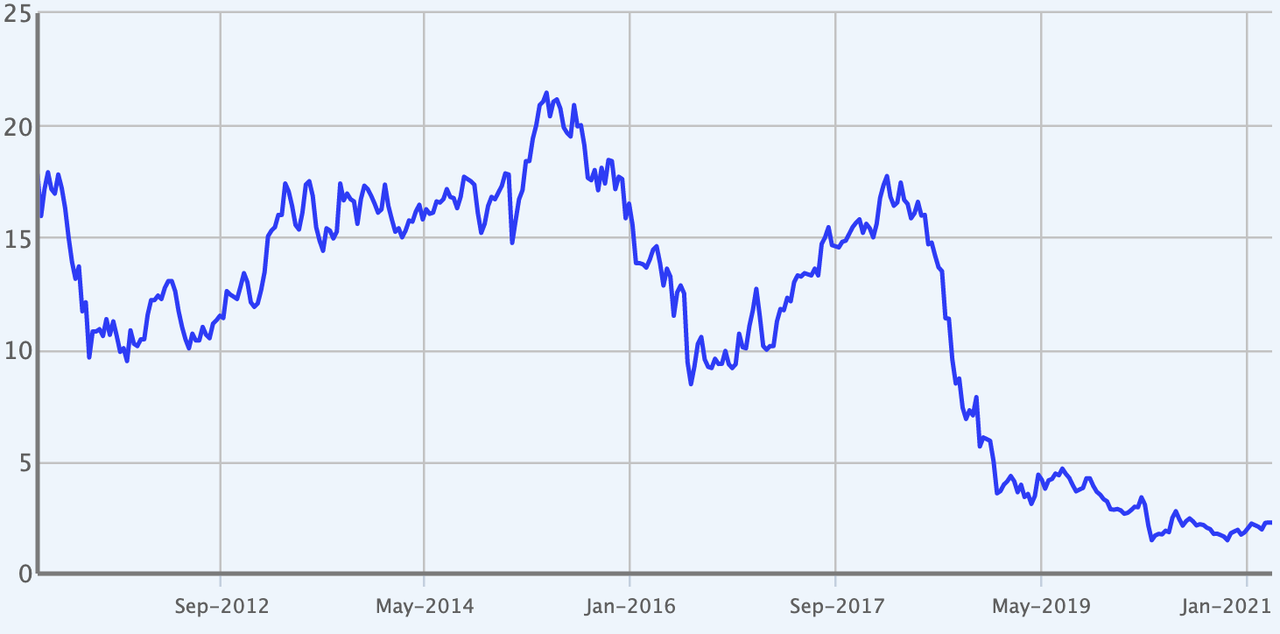
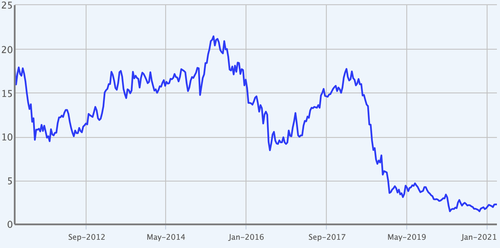
GAM, who previously had a fund exposed to Greensill and has barely recovered.  Here is a ten year stock chart. The decline from 15 Swiss Franc to under 5 Swiss Franc per share is Greensill related.
So who is holding the bag?

Well, genuinely I do not know. It could be Insurance Australia Group or Tokio Marine. It could be German taxpayers (through the subsidiary bank) and Credit Suisse.

I figure I know the winners though. Lawyers. Lots and lots of lawyers.

And maybe a short seller or two if we pick the shorts right. You can presume I have some position in most of the companies mentioned.
Tyler Durden
Mon, 03/08/2021 – 10:30

via ZeroHedge News https://ift.tt/3bw49rH Tyler Durden