Will Venezuela Go To War Over Oil?

Will Venezuela Go To War Over Oil?

By Viktor Katona of Oilprice.com

January 2021 is still far from over yet the pages of Oilprice already boast 6 articles about Guyana being the hottest drilling spot in the world. This is hardly surprising, considering the hot streak that ExxonMobil had over the past 5 years, with new companies coming in and stepping up the drilling game. The interest globally attributed to Guyana has aggravated Venezuela’s long-standing grievances over the disputed Essequibo province – before 2015 the Venezuela vs Guyana oil standoff was akin to a David vs Goliath story but now, with Guyana building up its oil reserves tally and continuing to attract new investors, the balance has become a lot more nuanced. Amidst all of this, Venezuelan President Nicolás Maduro has pledged to reconquer Essequibo.  At first glance, the proposition that Venezuela should go to war over a disputed territory, let alone with Guyana, seems rather dubious. Venezuela boasts the world’s largest proven oil reserves, totalling roughly 304 Bbbls (see Graph 1), i.e. more than all of North America combined, more than Iraq and Iran combined. Guyana’s reserves are a fraction of that, barely reaching 3% with its 9-10 Bbbls. However, behind the dry facade of data and statistics, there lies an entire universe of human emotions, oftentimes led astray due to their subjective nature and in this particular realm, Caracas is the one frustrated and concerned. Guyana is adding one major discovery after another (the recent failure of Hassa-1 notwithstanding), whilst the Venezuelan national oil company PDVSA keeps on struggling to make ends meet.

Graph 1. Venezuela’s Proven Oil Reserves 1980-2019 (billion barrels).
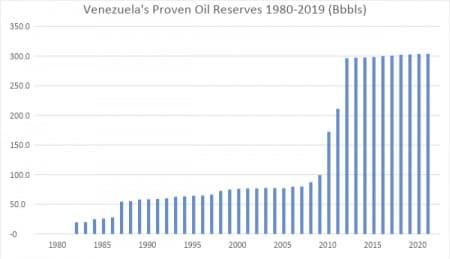
Source: BP Statistical Survey 2020. 

The dispute over Guayana Esequiba (alternatively dubbed the Essequibo Region) is one of the most complex remaining, mixing colonial legacies with modern-day grievances. It all began in 1840 when the British Empire demarcated the heretofore undisputed and unsettled frontier between British Guiana and Venezuela, by means the “Schomburgk Line”. To no one’s surprise Venezuela rejected the British claim, however, unwilling as they were to get mired in a protracted conflict, both sides agreed to disagree in 1850 and vowed not to colonize the then-largely uninhabited region. Despite arbitrations and negotiations, the question of who should control the Essequibo Region remained unsolved by the time of Guyana declaring itself independent in 1966. Caracas recognized the independent Guyana, however only its territories located to the east of the Essequibo River, maintaining its claim that all the territories to the west are part of Venezuela.

One of the most protracted territorial disputes globally, the discovery of oil offshore Guyana might have been the factor missing to propel the issue forward. ExxonMobil, the operator of Guyana’s Stabroek offshore block, was subject to maritime harassment by the Venezuelan Navy and had one of its surveying vessels detained in 2013. However, when Exxon discovered the Liza field in 2015, closer to the Guyanese-Surinamese frontier and hence were beyond the Venezuelan maritime claim, the stakes turned really high. Guyana had official proof that its offshore was not sub-commercial as was previously thought (initially companies appraised the shallow waters of Guyana and found no commercial deposits) and with the help of a US major could now count on high-level backing for its border case.

With every new discovery on the Stabroek block, Venezuela’s opposition to Guyana taking the left bank of the Essequibo River was becoming increasingly untenable. Concurrently, the good neighbor relations of the Chavez era when Guyana was member to the continent-wide Petrocaribe movement and even participated in barter deals to satisfy its crude needs, went downhill fairly quickly.
Yet there is another factor that most certainly contributed to Caracas now striking such a belligerent tone – US sanctions against Venezuela. Not only did the tightening of screws on President Maduro’s political allies and relatives blunt the political prospects of Juan Guaido, it also led to the entry of Venezuela’s military (that remained loyal to Maduro amidst the worst humanitarian suffering) into the Latin American country’s oil industry. 

Any future US administration will most probably seek to safeguard ExxonMobil’s assets in Guyana. A first sign of this – in the first days of 2021 the commander of the US Southern Command arrived in Guyana for a 3-day visit, to celebrate the launch of joint US-Guyanese coast exercises. According to top-ranking officials in the Guyanese army, Georgetown is intent on fortifying its military ties with the United States, including but not limited to arms purchases. Concurrently, Venezuela formed a new parliament which will no longer be controlled by the Guiado-style opposition – the pro-Maduro National Assembly will inevitably become more aggressive in its narrative and overall behavior. Part of the aggression might result from the UN Court of Justice’s ongoing review of the Essequibo case, the decision of which was already declined by Caracas before its actual deliverance. 

So, will there be a war between Venezuela and Guyana? Such a scenario seems unlikely now.

First, Maduro might wait to see what the new Biden Administration has to offer, how will it tackle the Venezuelan conundrum.

Second, there is very little reason to heat up tensions now, when no final decision had been taken, the peak of confrontation should be around 2023/2024 when the ICJ is assumed to deliver its opinion on the legal status of the Essequibo Region.

Third, even if the ICJ rules in favor of Guyana which seems quite likely, Venezuela remains unlikely to trigger a military response, for fear of actual US retaliation. It is one thing to foil an amateurish coup attempt by a private military company (Operation Gideon in May 2020), an altogether different one to deal directly with the US military. 

Tyler Durden
Mon, 01/25/2021 – 11:46

via ZeroHedge News https://ift.tt/2LToKMx Tyler Durden
California Gov Lifts COVID Stay-At-Home Order; Dr. Fauci Worries Jabs Won’t Stop Mutant Strains: Live Updates

California Gov Lifts COVID Stay-At-Home Order; Dr. Fauci Worries Jabs Won’t Stop Mutant Strains: Live Updates

Summary:

  • California Gov is lifting stay at home orders
  • Dr. Fauci criticizes US COVID approach, worries vaccines wont’ stop mutations
  • US cases, deaths, hospitalizations decline
  • Biden signs COVID travel bans
  • BoJo approves border crackdown
  • South Africa approves AZ vaccine for vaccinations
  • Macron expected to announce 3rd French lockdown
  • Oxford plans first trial of new COVID drug

* * *

It’s already mid-morning on Monday and it’s already turning out to be an interesting week for COVID-19 news. Following a WEF panel earlier this morning where Dr. Fauci heaped blame for any failures in fighting COVID on President Trump, California Gov Gavin Newsom on Monday said he plans to lift some regional stay at home orders.

Newsom is expected on Monday to lift regional coronavirus stay-at-home orders across California, a change that could allow restaurants and gyms in many counties to reopen outdoor dining and any other services.

All counties would return to the colored tier system that assigns local risk levels based on case numbers and rates of positive COVID cases. Most counties will go into the “widespread” risk tier, which permits hair salons to offer limited services indoors but restricts many other nonessential businesses . The change is expected to take effect immediately after Newsom’s announcement.

It’s not yet clear whether the decision will lead to easing of stay-at-home rules in Los Angeles County, which has become a national hotbed of the coronavirus, with hospitals overwhelmed by patients. In less than one month, more than 5K people have died of COVID-19 in the county alone.

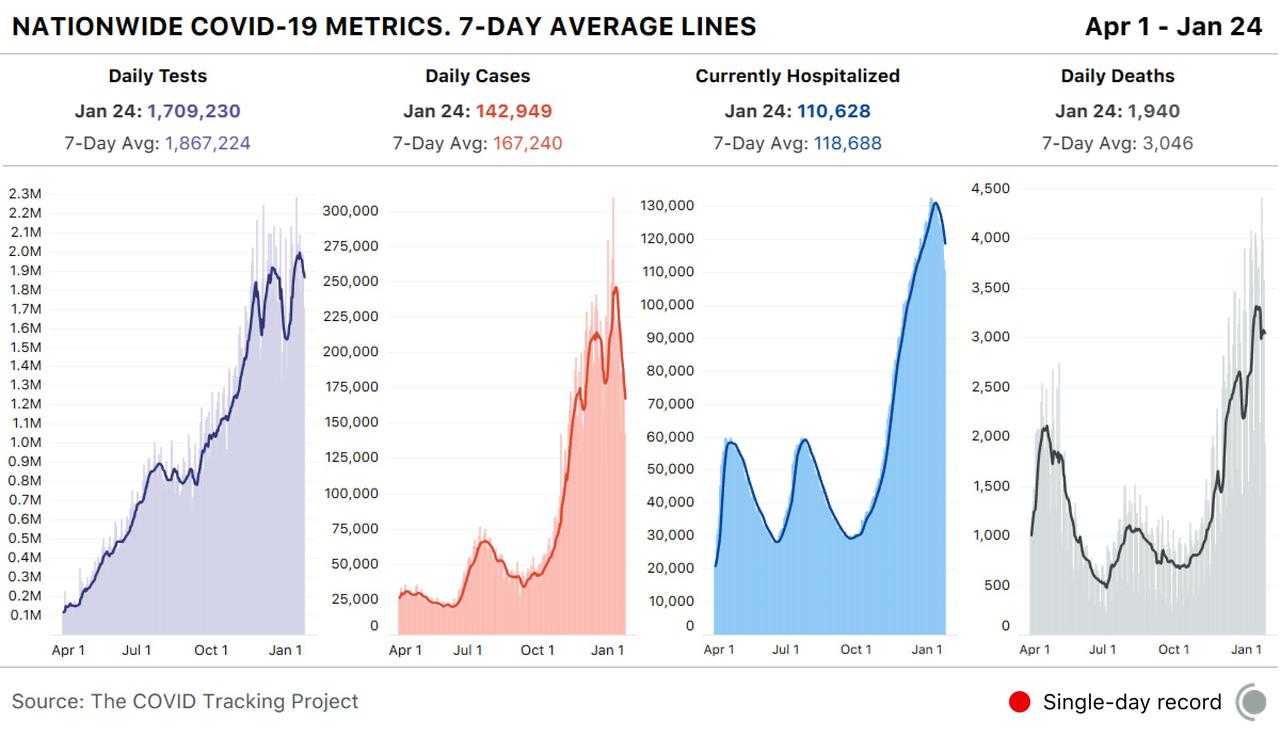
In the US, cases, hospitalizations and new deaths have been falling across the board.

Last week, Dr. Fauci led the US delegation back to the WHO like a conquering hero, announcing that under the Biden Administration, the US would cooperate with the organization’s plan to distribute vaccine doses globally, while halting President Trump’s attempt to leave the UN-funded NGO.

Well, on Monday, Dr. Fauci joined a panel led by Bloomberg News CEO John Micklethwaite and a handful of other experts at the (virtual) WEF to discuss the global response to the COVID pandemic one year after the virus came bursting out of Wuhan, infecting the rest of the world.

Oddly, the WEF decided to name its panel “the Great Reset”, as if the same people weren’t still running the global response to the COVID-19 pandemic. But the subtext was clear: With President Trump gone, the world can get back to the fundamentals of battling COVID-19.

In the latest attempt to slander President Trump, the good doctor said during Monday’s forum that the US’s response to COVID-19 didn’t have a “science” focus, which “cost it dearly”, Dr. Fauci said, in the latest attempt to insinuate that President Trump – and Trump alone – is responsible for the 400K+ confirmed COVID deaths.

Fauci complained that the Trump administration had “a considerable amount of mixed messaging on what needed to be done from top down.” Like when Dr. Fauci first told people not to wear masks, before changing his mind? Or when he opposed travel bans, before changing his mind on that also?

Or, how about more recently, when he flip-flopped for banning travelers from South Africa?

When it comes to the South African strain, Dr. Fauci warned that the decline in vaccine efficacy could pose serious problems in the future.

He then blamed the fact that these public health issues had become “politically charged”. When public health issues become politically charged, like wearing a mask or not becomes a political statement, “you can’t imagine how destructive it is to any unified health message,” Dr. Fauci said.

The Pandemic “shed a very bright light” on America’s weaknesses, he added, without going into too much details.

Moving on, Dr. Fauci said he was worried about what might happen if people start to delay the second dose of their COVID vaccines, with Dr. Fauci insisting that the vaccines won’t achieve full efficacy without both doses.

Readers can watch the entire panel below:

Looking ahead, Dr. Fauci said the big question looking forward is figuring out whether the vaccines that have been developed in the West will be effective in stopping mutated versions of the vaccine. But the most important thing is that patients receive both doses of the vaccine, since full efficacy won’t kick in until the booster dose has been delivered.

Here’s some more COVID news for overnight and Monday morning:

US President Biden will sign an order on Monday to ban entry to most non-US citizens who have travelled to UK, Ireland, Brazil and South Africa. It was also reported that the CDC will sign an order requiring mask use on all flights, trains and ride-sharing vehicles, while it will not grant waivers for airlines seeking exemptions from COVID-19 testing requirements for all international flights. (Newswires)

Pfizer (PFE) will ship fewer COVID-19 vaccine vials to account for ‘extra’ doses in each vial and will account a 6th dose in each vial towards its prior commitment of supplying 200mln doses by end-July after it received FDA approval to change the vaccine’s formal authorization language to acknowledge an additional dose for a total 6 doses per vial. (New York Times)

UK PM Johnson is to approve a new border crackdown on Tuesday which could ban entry into the UK for nationals of COVID-19 hotpots, while there are also proposals for those arriving from hotspots including British citizens to be escorted to isolation hotels upon arrival where they will need to quarantine at their own expense.

Oxford University researchers are planning the first, large high-quality trial of ivermectin which is a low-cost drug that claimed to reduce deaths by 80% among patients in hospitals, although other scientists were sceptical of the data which was from a combination of 11 prior trials and said that more results would be required before it could be considered as a treatment. (The Times)

French President Macron may announce a 3rd national lockdown on Wednesday night which could take effect from the end of the week and last at least 3 weeks, amid concerns of a new wave of COVID-19 infections driven by the UK variant. (Journal du Dimanche)

* * *
In other news, while the world frets about the South African COVID variat, the country’s health regulators have just approved AstraZeneca’s vaccine for use in the country, marking the first vaccine approved in South Africa.

Tyler Durden
Mon, 01/25/2021 – 11:32

via ZeroHedge News https://ift.tt/3a4uvii Tyler Durden

Markets Are Breaking Left And Right As Stocks Tumble

Markets Are Breaking Left And Right As Stocks Tumble

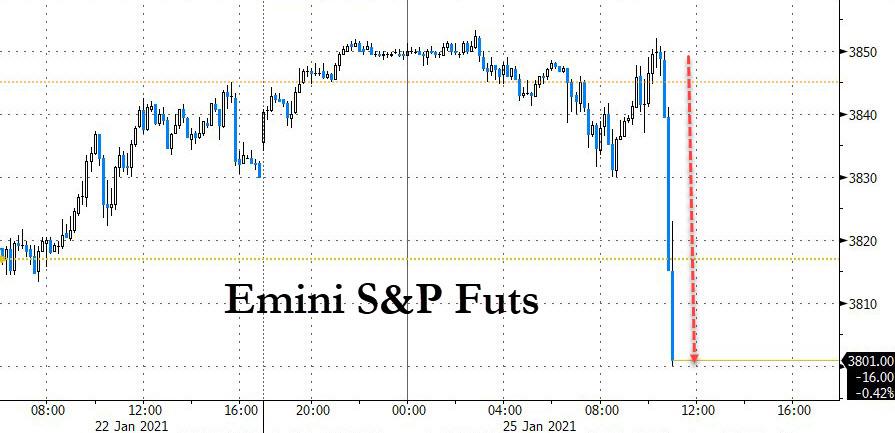
Whether it is due to the absolute insanity taking place among the most shorted names, or the broader market suddenly tumbling (perhaps as the PPT forgot to keep an eye on the S&P transfixed by the action in GME), Downdetector and Bloomberg report that a slew of trading platforms are reporting problems on Monday, and while some have been resolved while others are ongoing.

  • Robinhood is experiencing issues with crypto trading
  • Vanguard tweeted it understands some clients are experiencing issues accessing their accounts
  • TD Ameritrade says it is aware of an issue impacting a small number of clients on the thinkorswim platform, a company spokesperson said
  • Charles Schwab announced it worked to resolve an issue
  • There was a slowdown in Merrill logins earlier Monday, but the situation has been resolved, according to a Bank of America spokesperson
  • E*Trade users reported problems Monday, according to Downdetector

Meanwhile, aside from the ridiculous action in penny stocks and supershorts, the broader market has just tumbled.

Tyler Durden
Mon, 01/25/2021 – 11:17

via ZeroHedge News https://ift.tt/36aqLuB Tyler Durden

Supreme Court Dismisses Suits Over Trump Finances

Supreme Court Dismisses Suits Over Trump Finances

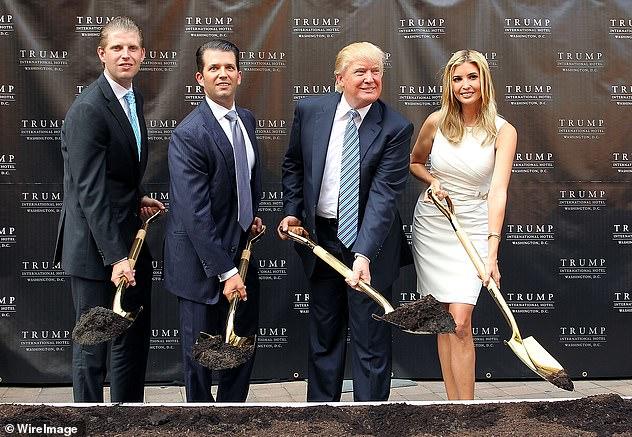
The US Supreme Court on Monday ordered the dismissal of a pair of lawsuits accusing former President Trump of illegally profiting from his presidency, after several foreign and state government officials patronized his properties – including the Trump International Hotel in Washington, located a few blocks from the White House.

The plaintiffs included hotels, restaurants and the attorneys general of Maryland and the District of Columbia, and accused Trump of violating the Constitution’s two emoluments clauses, according to Bloomberg Law, which notes that “One clause bars a president from accepting benefits from foreign governments without congressional consent, while the other bars receipt of any benefit other than a salary from the U.S. government or a state.”

The cases were dismissed after both sides agreed that the disputes had become legally moot after Trump’s term in office ended on January 20th.

One of the key questions in the cases was who, if anyone, had standing to sue to enforce the emoluments clauses. According to the report, lower courts in both cases said the plaintiffs had legal standing, while the Supreme Court set aside those rulings as part of its Monday order – a step urged by the Trump DOJ.

The cases are Trump v. Citizens for Responsibility and Ethics in Washington, 20-330, and Trump v. District of Columbia, 20-331 (via Bloomberg)

Meanwhile, Trump’s post-presidency legal woes appear to be ramping up, as Manhattan District Attorney, Cyrus Vance, expanded his office’s criminal investigation into the Trump organization’s finances last week.

According to the Daily Mail, prosecutors have begun looking into a 212-acre property north of New York City called Seven Springs, which NY Attorney General Letitia James is looking at as part of a probe over whether Eric Trump and various corporate entities artificially inflated property values.  A 2012 document values the property at $291 million, while local realtors say it’s worth more like $50 million or less. The Trump organization bought it in 1995 for $7.75 million.

The organization then put part of the property into a land trust via conservation easement, which would leave that portion – 158 acres – untouched and undeveloped, ostensibly resulting in a tax break based on the value of the property. The higher the valuation, the larger the tax deduction.

It [the 158 acres] was appraised at $21.1 million, according to the filings but now investigators are looking to see whether the value was artificially inflated. 

‘Valuations of Seven Springs were used to claim an apparent $21.1 million tax deduction for donating a conservation easement on the property in tax year 2015, and in submissions to financial institutions as a component of Mr. Trump’s net worth,’ according to court filings in the New York attorney general’s investigation. –Daily Mail

The probe into Trump’s finance originated after Vane opened an investigation into hush-money payments made to two women prior to the 2016 election, who claimed they had sexual relations with Trump.

Vance notably came under fire in 2018 over a 2015 decision not to pursue charges against Harvey Weinstein – after an attorney for the movie mogul gave Vance $24,000, while another attorney sent $10,000 following the decision.

Tyler Durden
Mon, 01/25/2021 – 10:58

via ZeroHedge News https://ift.tt/2MoqzAI Tyler Durden

Hedge Fund CIO: “It’s An Orgy”

Hedge Fund CIO: “It’s An Orgy”

By Eric Peters, CIO of One River Asset Management

“The big boys are no longer bullish,” bellowed Biggie Too in baritone. “The big boys are now bubble bullish,” continued the chief investment strategist for one of Wall Street’s Too-Big-To-Fail affairs. “They ask Biggie, why can’t the S&P trade 5,500?” said Too, easing into third person. “And Biggie asks ’em back: We got 6% GDP and 1% rates, who’s gonna short this?” he said. “You do the math, you gonna tell Biggie to short this thang?” asked Too. And I shrugged, having long since learned to recognize when Biggie’s question is the answer.

“No one’s gonna short the S&P unless 6% GDP falls to 4%, or 1% rates jump to 2%,” barked Biggie. “Ain’t happening in Jan,” whispered Too. “Too much Covid, too little vaccine, too much money, too few places to put it,” he said, riffing. “You think Powell’s gonna do a 2013 taper tantrum right now?” laughed Biggie. “No chance, everyone knows it. And that’s the only thang that scares Biggie,” said Too, smiling, breaking into a slow groove. “So tell me why ain’t this thing already up 10%? Why’s LQD soft? EMFX too?” winked Biggie.

“You know we gonna get a 15-20% budget deficit in 2021 right?” asked Biggie, not waiting for an answer. “And you know we gonna have a Fed balance sheet that’s 40% of GDP?” asked Too, on a roll. “And they just wrote $600 checks and now they’re gonna write $1,400 checks right?” he asked. I nodded. “You know that when these kinds of numbers keep rising they get real hard to roll back, right?” asked Biggie. “You know this is the kind of thing that sparks the Mamma of all Bubbles?” he asked. “And you know inflation will mark its end?”

Gatsby: “The 1920s followed the pandemic,” explained the CIO. “People don’t tend to draw that connection, but the reality is that throughout history, such catastrophes lead to periods where people lose their minds,” he said. “This time around, the government is providing the bridge, funding the collapse in demand. Who knows for how long? It could be 3yrs in total.” Here we are, approaching another March with lockdowns looming. “You see signs of political insanity, all sorts of speculation too, Robinhood. And today, everything happens faster, time compresses.”

Treadmills:

“Anyone being intellectually honest about Covid should admit the stimulus will be with us for a long time,” explained the CIO. “Mass vaccinations will take longer than anyone thinks – it’ll take until late summer or early autumn to bring Covid’s prevalence down,” he said. “Then come the mutations.” Which make it appear likely we’ll need to tweak the vaccines. “So we may enter a cycle where it takes nearly a year to vaccinate the population and each year we need new vaccines, which means this will restrain the economy for a couple more years.”
 
Caligula:

“It’s an orgy,” said the CIO. “A money illusion, sucking everyone in,” he continued, acknowledging that a fiat system is itself a monetary mirage. “In a market like this, you use your marked-to-market profits to double down, then to double down again,” he explained, all SPAC’d up with nowhere to go. “And it feels like we’re entering the illusory-illusion phase, where prices keep running ahead of the money supply expansion – where things keep going up as long as the Ponzi unit of account continues expanding,” he said. “It only ends when liquidity tightens.”

“This is the hyper-aggressive stage of the market cycle where the smartest value guys start warning,” continued the same CIO. “Klarman, Marks, Grantham.” They remind us that asset prices must ultimately be anchored to fundamentals. “They’re not wrong of course, but they’re usually early, and the foundation for this speculative boom remains intact,” he said. “They argue valuations are extreme, and they’re right. But they can always get more extreme, and what you learn from past cycles is that valuations and fundamentals can diverge for ages.”

Tyler Durden
Mon, 01/25/2021 – 10:37

via ZeroHedge News https://ift.tt/3a4kuBI Tyler Durden

Sarah Huckabee Sanders Announces Run For Governor Of Arkansas

Sarah Huckabee Sanders Announces Run For Governor Of Arkansas

Since she left the West Wing, Sarah Huckabee Sanders, it has been assumed, would be running for office in her home state, perhaps as a senator, or maybe even the governorship, an office once held by her father, Mike Huckabee, and former president Bill Clinton.

On Monday, Sanders made it official by releasing a lengthy video announcing her candidacy for the governorship.

Although President Trump is still banned from twitter, former Secretary of State Mike Pompeo tweeted his endorsement of Sanders’ bid for the governor’s mansion in Little Rock.

Sanders, the former White House press secretary, left her job in the West Wing back in 2019, with the expectation that she would be heading back to Little Rock, where she grew up, to start preparing for a run.

Still,  her announcement shows how much she expects voters in deep-red Arkansas to embrace her, and her legacy of working for President Trump.

Sanders is joining a Republican primary that already includes two statewide elected leaders: Lt. Gov. Tim Griffin and Attorney General Leslie Rutledge. They’re all running to succeed current Gov. Asa Hutchinson, a Republican who is unable to run next year due to term limits.

No Democrats have announced a bid.

A she noted in the video, Sanders was the first working mother and only the third woman to serve as White House press secretary.

The race could soon get even more crowded if GOP State Sen. Jim Hendren, a nephew of Hutchinson’s, is considering a run for the seat.
Though Sanders has a much higher profile than any of the candidates, she remains an unknown on many of the state’s biggest issues, though in her announcement she called for reducing state income taxes and cutting funding to so-called “sanctuary cities”.

Tyler Durden
Mon, 01/25/2021 – 10:20

via ZeroHedge News https://ift.tt/2MmBP0y Tyler Durden

Daytrading Army Unleashes Furious Cascade Of Short Squeeze Meltups

Daytrading Army Unleashes Furious Cascade Of Short Squeeze Meltups

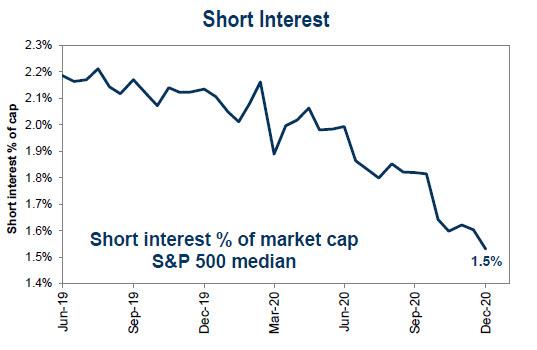
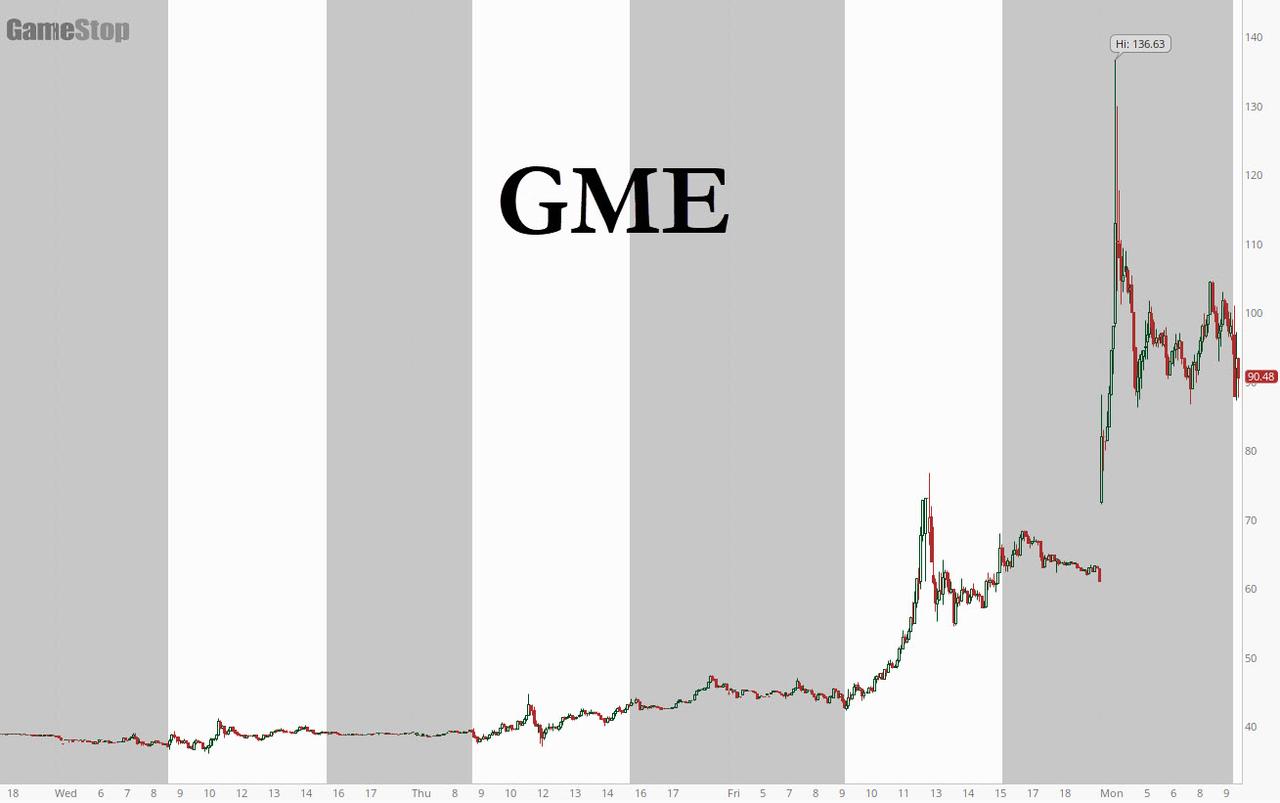
In another insane day for small-cap stocks, which has seen the relentless forced short squeeze in GME continue, more than doubling the stock in the premarket before settling up some 40% higher…

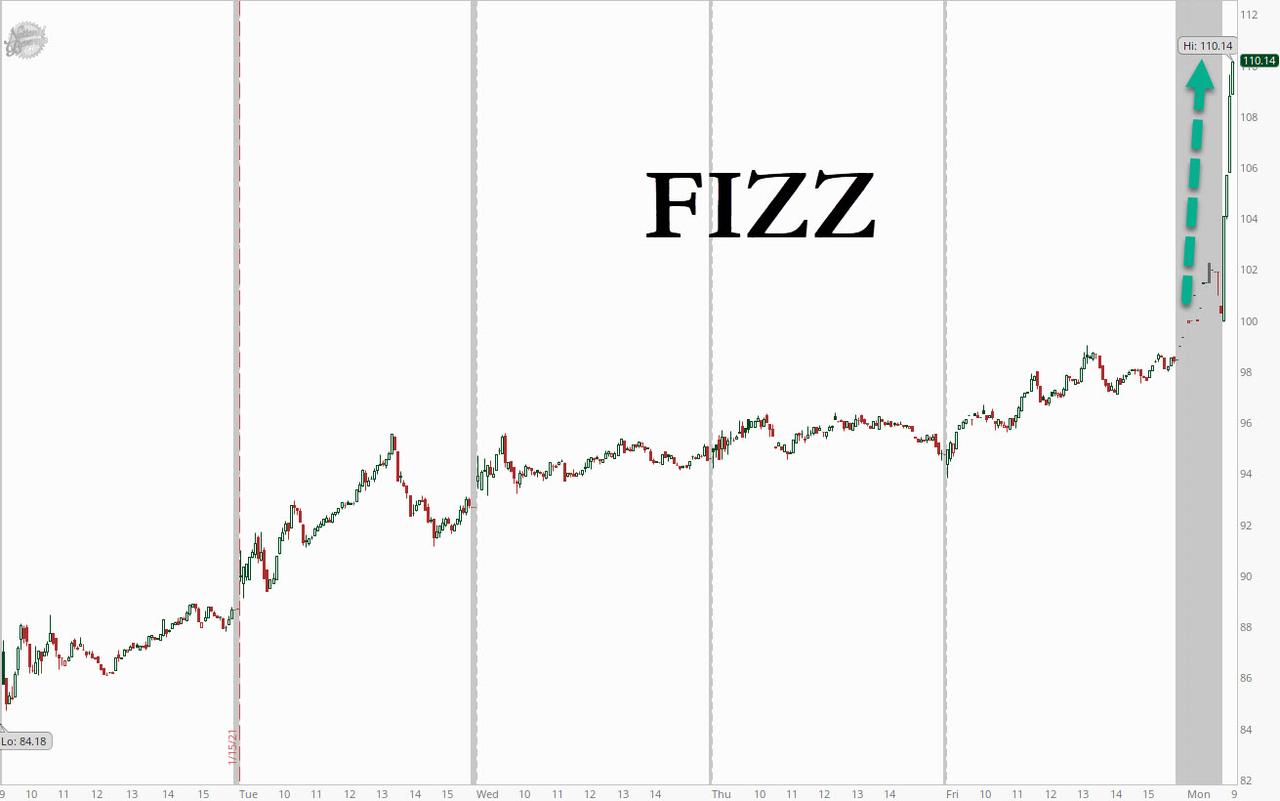
… with the squeeze now moving to the second most shorted stock (as per our Friday preview) namely FIZZ…

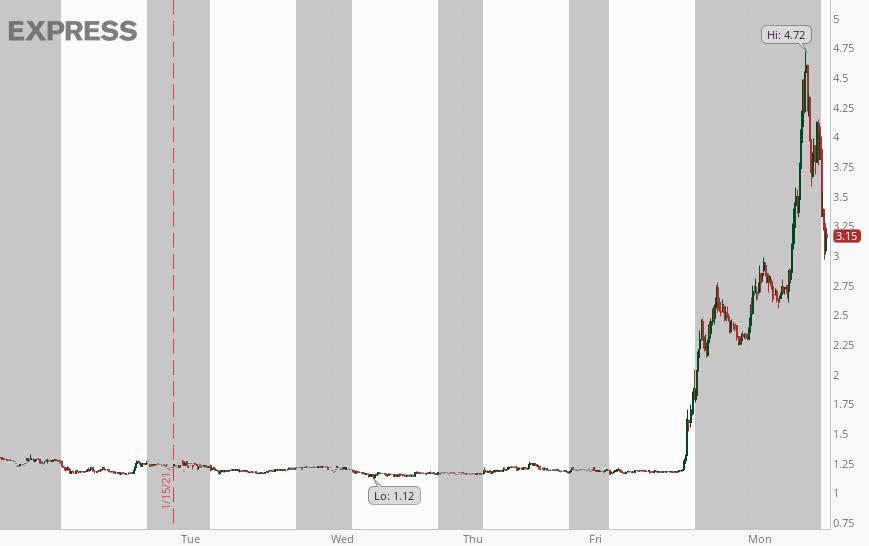
… this morning Bloomberg points out that in addition to the buying frenzy among the most shorted stocks – which we have said ever since 2013 is the only “strategy” that makes sense in this insane market – the retail daytrading horde is now also ramping penny stocks, starting with BlackBerry, the maker of the once ubiquitous smartphone, and retailer Express, which were some of the better-known names rallying after plugs on social media stock trading forums.

To wit, BB surged as much as 41% on volume already more than double the three-month daily average and gaining for a seventh session; the stock soared past a nine-year high (this happens just days after company insiders unloaded a boatload of shares).

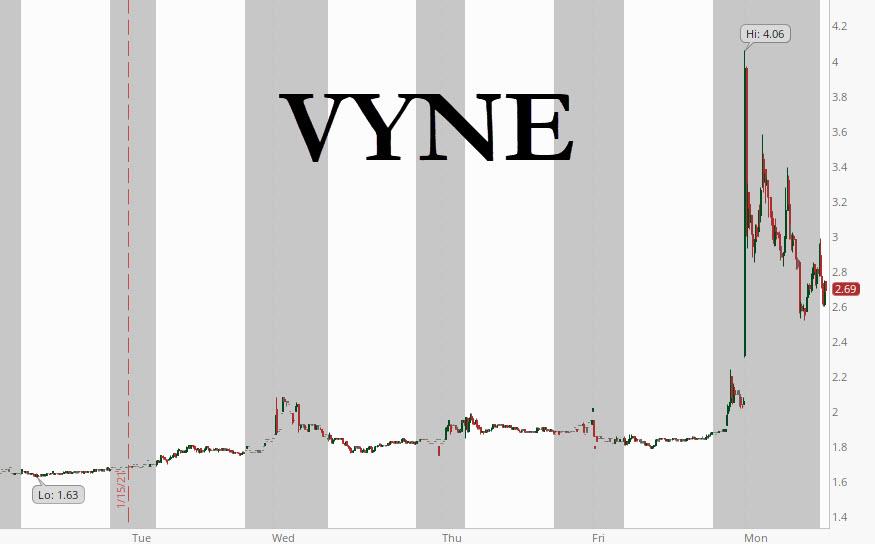
Shares of lesser-known small cap health-care companies were also soaring, including Vyne Therapeutics, Atossa Therapeutics, Senseonics Holdings and Zomedica all climbed in Monday’s trading.

Some more examples:

  • EXPR soared 123% as over 73 million shares traded hands, extending gains into the third day

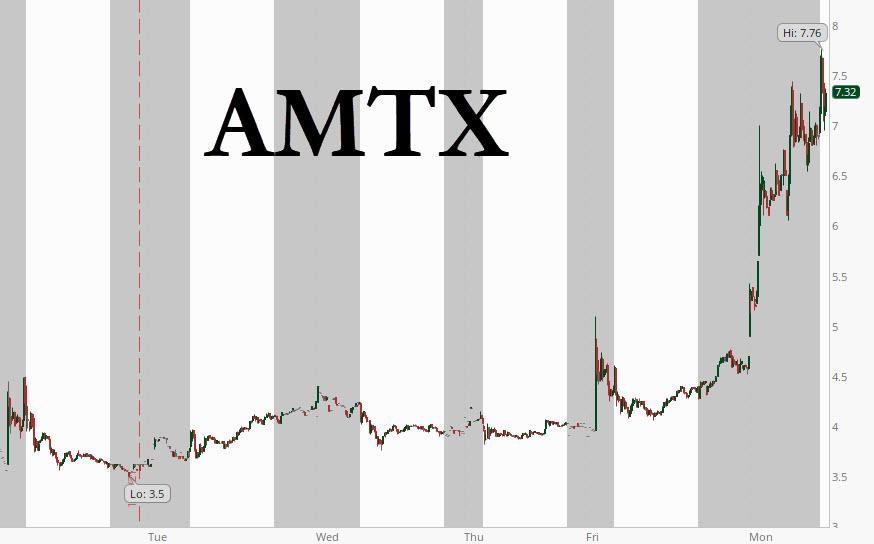
  • AMTX (a Biofuel name ) jumped 76%, trading volume was more than 5 million shares

  • VYNE gained 59% on volume of over 20 million shares; the stock appeared on Robinhood chatrooms after the maker of skin medicines revealed a contract on Thursday but didn’t provide any financial details

  • ATOS rose 34%; the stock was touted on Reddit ahead of a presentation from the drug developer on Tuesday at the Precision Medicine World Conference where the focus will be on Covid-19 therapies
  • SENS added 28%; the stock had advanced 437% since Dec. 22 through last week after gaining social-media steam
  • Another newly minted retail favorite, ZOM climbed 14% after reaching a distribution pact on its first product; the stock had gained 398% between Dec. 22 and Friday

And so on. Expect a continuation of these insane moves until the Fed finally does something, which probably won’t happen for a long time…

Tyler Durden
Mon, 01/25/2021 – 10:02

via ZeroHedge News https://ift.tt/3sSwb7b Tyler Durden

Antifa Trashes Tacoma After Viral Video Of Cop Driving Through Crowd

Antifa Trashes Tacoma After Viral Video Of Cop Driving Through Crowd

Antifa anarchists in Tacoma, Washington set fires and vandalized buildings on Sunday after a video of a police officer plowing through a crowd of illegal street racers went viral over the weekend.

Videos of the mayhem were all over Twitter Sunday night, as hundreds of people took to the streets near the incident – damaging at least two police cars and forcing several city buildings to be evacuated, according to the NY Post.

An unlawful assembly was declared around 9:20 p.m. Sunday night.

Protesters assembled outside of the Pierre County Jail, chanting “Free them all!”

Meanwhile, protesters are planning on this being a nightly thing…

How long until a new autonomous zone is created and a soundcloud rapper starts passing out semiautomatic weapons out of the back of his Tesla?

Tyler Durden
Mon, 01/25/2021 – 09:47

via ZeroHedge News https://ift.tt/2M5jh5h Tyler Durden

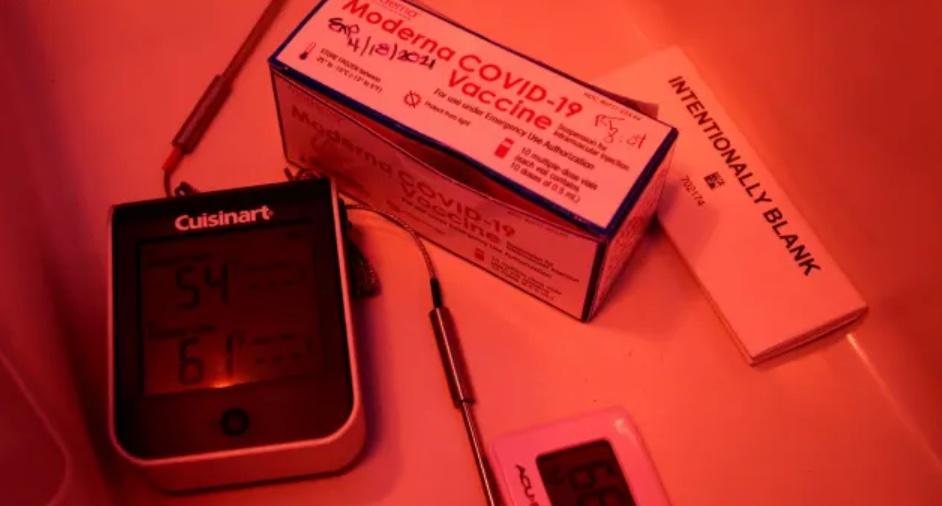
Moderna Jab Not Effective Against “Mutant” South African COVID Strain

Moderna Jab Not Effective Against “Mutant” South African COVID Strain

Moderna’s latest trial data includes some good news…and some bad news.

The good news is that the biotech company’s original COVID jab is effective against two mutations of SARS-CoV-2 which were first isolated in the UK and South Africa, respectively.

The bad news is that, at least when it comes to the South African variant, Moderna’s jab is much less effective than scientists had expected. That’s a bad sign, because it suggests the vaccines might not perform as well, particularly in elderly patients, or that the immunity they provide might not last as long, as various strains of the virus continue to mutate.

However, perhaps due to the optimistic tone of the press release, investors took the news as a positive and bid Moderna shares higher.

Here’s some more details from the FT:

Laboratory tests show Moderna’s Covid-19 jab still works against the variant named 501.V2, which emerged in South Africa, and B.1.1.7, which was first discovered in the UK, the company said. But it warned that the neutralising antibody response to 501.V2 was sixfold lower than to the original variant, raising concerns that immunity to it may wane significantly, particularly in older people.

Moderna has launched a series of trials intended to test its vaccine’s efficacy against several different mutant strains.

But don’t worry, because even though Moderna’s CEO acknowledges that this is an extremely serious situation and the company is preparing for the worst-case scenario, everything is going to be okay.

Stéphane Bancel, Moderna CEO, said the company was preparing for a “worst-case scenario,” even though he had “zero concerns” about the vaccine’s efficacy in the coming months.  “If something needs to be done in the summer, we’ll do something, but we cannot be late,” he told the Financial Times. “We don’t want the virus to win, we want the human race to win.”

That doesn’t exactly sound reassuring.  As it turns out, Moderna is the first vaccine maker in the West to announce a trial for a booster against a new variant, after having its initial jab authorised across the world including in the US, the EU and the UK. Its messengerRNA technology can be quickly adapted for new variants.

The company is working with the US National Institutes of Health on the trials. Mr Bancel said a few thousand trial participants would be given a booster shot, divided into two groups: one to receive the original vaccine again, and another to get a new vaccine formulated to target 501.V2. The trial will also test to see what dose is needed for a booster.

Read the full press release below:

CAMBRIDGE, Mass.–(BUSINESS WIRE)–Jan. 25, 2021– Moderna Inc. (Nasdaq: MRNA), a biotechnology company pioneering messenger RNA (mRNA) therapeutics and vaccines, today announced results from in vitro neutralization studies of sera from individuals vaccinated with Moderna COVID-19 Vaccine showing activity against emerging strains of SARS-CoV-2. Vaccination with the Moderna COVID-19 Vaccine produced neutralizing titers against all key emerging variants tested, including B.1.1.7 and B.1.351, first identified in the UK and Republic of South Africa, respectively. The study showed no significant impact on neutralizing titers against the B.1.1.7 variant relative to prior variants. A six-fold reduction in neutralizing titers was observed with the B.1.351 variant relative to prior variants. Despite this reduction, neutralizing titer levels with B.1.351 remain above levels that are expected to be protective. This study was conducted in collaboration with the Vaccine Research Center (VRC) at the National Institute of Allergy and Infectious Diseases (NIAID), part of the National Institutes of Health (NIH). The manuscript has been submitted as a preprint to bioRxiv and will be submitted for peer-reviewed publication.

The two-dose regimen of the Moderna COVID-19 Vaccine at the 100 µg dose is expected to be protective against emerging strains detected to date. Nonetheless, Moderna today announced its clinical strategy to proactively address the pandemic as the virus continues to evolve. First, the Company will test an additional booster dose of its COVID-19 Vaccine (mRNA-1273) to study the ability to further increase neutralizing titers against emerging strains beyond the existing primary vaccination series. Second, the Company is advancing an emerging variant booster candidate (mRNA-1273.351) against the B.1.351 variant first identified in the Republic of South Africa. The Company is advancing mRNA-1273.351 into preclinical studies and a Phase 1 study in the U.S. to evaluate the immunological benefit of boosting with strain-specific spike proteins. Moderna expects that its mRNA-based booster vaccine (whether mRNA-1273 or mRNA-1273.351) will be able to further boost neutralizing titers in combination with all of the leading vaccine candidates.

“As we seek to defeat the COVID-19 virus, which has created a worldwide pandemic, we believe it is imperative to be proactive as the virus evolves. We are encouraged by these new data, which reinforce our confidence that the Moderna COVID-19 Vaccine should be protective against these newly detected variants,” said Stéphane Bancel, Chief Executive Officer of Moderna. “Out of an abundance of caution and leveraging the flexibility of our mRNA platform, we are advancing an emerging variant booster candidate against the variant first identified in the Republic of South Africa into the clinic to determine if it will be more effective to boost titers against this and potentially future variants.”

First detected in September 2020 in the United Kingdom, the SARS-CoV-2 B.1.1.7 variant has seventeen mutations in the viral genome with eight mutations located in the spike (S) protein. The B.1.351 variant, first detected in South Africa, has ten mutations located in the spike (S) protein. Both variants have spread at a rapid rate and are associated with increased transmission and a higher viral burden after infection1,2.

The in vitro study assessed the ability of mRNA-1273 to elicit potently neutralizing antibodies against the new SARS-CoV-2 variants, using sera from eight Phase 1 clinical trial participants (aged 18-55 years) who received two 100 µg doses of mRNA-1273, and separately using sera from non-human primates (NHPs) immunized with two doses of 30 µg or 100 µg of mRNA-1273.

For the B.1.1.7 variant, neutralizing antibody titers remained high and were generally consistent with neutralizing titers relative to prior variants. No significant impact on neutralization was observed from either the full set of mutations found in the B.1.1.7 variant or from specific key mutations of concern. Although these mutations have been reported to lessen neutralization from convalescent sera and to increase infectivity, sera from the Phase 1 participants and NHPs immunized with mRNA-1273 were able to neutralize the B.1.1.7 variant to the same level as prior variants.

For the B.1.351 variant, vaccination with the Moderna COVID-19 Vaccine produces neutralizing antibody titers that remain above the neutralizing titers that were shown to protect NHPs against wildtype viral challenge. While the Company expects these levels of neutralizing antibodies to be protective, pseudovirus neutralizing antibody titers were approximately 6-fold lower relative to prior variants. These lower titers may suggest a potential risk of earlier waning of immunity to the new B.1.351 strains.

Tyler Durden
Mon, 01/25/2021 – 09:31

via ZeroHedge News https://ift.tt/3og4iSY Tyler Durden

Key Events This Busy Week: Earnings Deluge, Biden Stimulus, Fed And Forum

Key Events This Busy Week: Earnings Deluge, Biden Stimulus, Fed And Forum

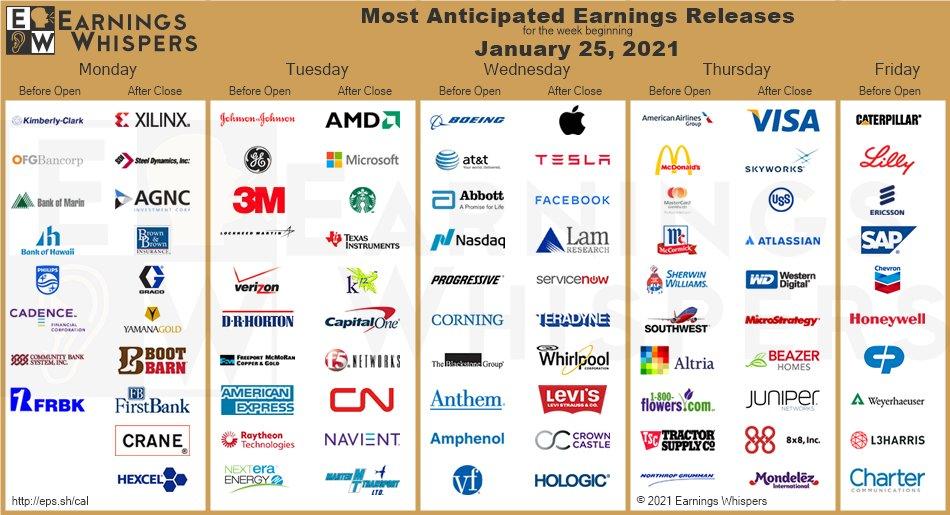
It’s shaping up as a very eventful week again, with the Fed’s latest monetary policy decision on Wednesday expected to be a highlight. Indeed Wednesday is a blockbuster day with Apple, Tesla and Facebook reporting to “add to the fun” as Deutsche’s Jim Reid puts it. 122 S&P 500 companies report in total over the coming 5 days in the first blockbuster week for earnings.

In terms of economic data releases, a number of countries release their Q4 GDP readings for the first time.  In politics Congress will start the high level negotiations on Biden’s proposed stimulus package. House speaker Pelosi has suggested she wants to pass something through reconciliation within two weeks. However the realities will likely extend this timeline. Nonetheless plenty of opportunities for headlines now. Staying with politics, the Italian government has a Senate vote this week (likely Wednesday or Thursday) on the annual report of its justice minister. A loss would raise the stakes for PM Conte and although fresh elections are unlikely, the uncertainty is building as to what happens next to his administration. Indeed, Italian daily Corriere della Sera has reported that Conte may quit if he loses.

Although the annual meeting of the World Economic Forum at Davos – this year titled “The Great Reset” – won’t be taking place as normal this week, a virtual event will see a number of global leaders and central bankers gather to discuss important policy issues. Attendees include Chinese President Xi Jinping, German Chancellor Merkel, French President Macron, BoJ Governor Kuroda, ECB President Lagarde and BoE Governor Bailey.

In more detail on some of the upcoming events, in terms of the Fed, economists do not anticipate any material changes to the policy settings and message from the FOMC, after they adopted outcome-based forward guidance for asset purchases in December. Furthermore, they expect the statement to be untouched, aside from acknowledging a recent softening in the data. The big question on investors’ minds will be any timetable for tapering purchases, though Powell is likely to adopt a dovish tone on this, and reiterate that it’s premature to contemplate a potential timeline given the challenging near-term outlook and remaining uncertainties.

On the data side, the main highlight will be the first look at the Q4 GDP numbers for a number of countries, including the US (Thursday), France and Germany (both Friday). Given the lockdowns that were imposed in a number of European countries late last year, DB economists are forecasting a Q4 contraction in the key European economies, including a -1.5% quarter-on-quarter decline in Germany, and a -6.2% decline for France. The US should fare relatively better however, with economists forecasting Q4 growth at an annualized rate of +4.5%.

Of the 122 companies in the S&P 500 and the 42 in the STOXX 600, the highlights are Microsoft, Johnson & Johnson, LVMH, Novartis, Verizon Communications, NextEra Energy, Texas Instruments, Starbucks, American Express, General Electric, Lockheed Martin and UBS (tomorrow). Then on Wednesday we’ll hear from Apple, Tesla, Facebook, AT&T, Abbott Laboratories and Boeing. Thursday brings Visa, Mastercard, Comcast, Danaher, McDonald’s and Samsung. And finally Friday sees reports from Eli Lilly, Chevron, SAP, Charter Communications, Honeywell and Caterpillar.

Day-by-day calendar of events courtesy of Deutsche Bank:

Monday January 25

  • Data: Germany January Ifo business climate indicator, US December Chicago Fed national activity index, January Dallas Fed manufacturing index
  • Central Banks: ECB President Lagarde, ECB’s Panetta, Lane, PBoC Governor Yi Gang speak

Tuesday January 26

  • Data: UK November employment, US November FHFA house price index, January Conference Board consumer confidence, Richmond Fed manufacturing index
  • Central Banks: ECB’s Centeno speaks
  • Earnings: Microsoft, Johnson & Johnson, LVMH, Novartis, Verizon Communications, NextEra Energy, Texas Instruments, Starbucks, American Express, General Electric, Lockheed Martin, UBS
  • Other: IMF releases World Economic Outlook Update

Wednesday January 27

  • Data: Germany February GfK consumer confidence, US preliminary December durable goods orders, nondefence capital goods orders ex air, Japan December retail sales (23:50 UK time)
  • Central Banks: Federal Reserve monetary policy decision, ECB’s Lane speaks
  • Earnings: Apple, Tesla, Facebook, AT&T, Abbott Laboratories, Boeing

Thursday January 28

  • Data: Italy January consumer confidence index, Euro Area final January consumer confidence, Germany preliminary January CPI, US advance Q4 GDP, personal consumption, December leading index, new home sales, January Kansas City Fed manufacturing activity, weekly initial jobless claims, Japan December jobless rate (23:30 UK time), preliminary December industrial production (23:50 UK time)
  • Central Banks: ECB’s Schnabel speaks
  • Earnings: Visa, Mastercard, Comcast, Danaher, McDonald’s, Samsung

Friday January 29

  • Data: France preliminary Q4 GDP, Germany preliminary Q4 GDP, January unemployment change, Euro Area December M3 money supply, Canada November GDP, US December personal income, personal spending, pending home sales, January MNI Chicago PMI, final January University of Michigan consumer sentiment index, Q4 employment cost index
  • Central Banks: Fed’s Kaplan speaks
  • Earnings: Eli Lilly, Chevron, SAP, Charter Communications, Honeywell, Caterpillar

* * *

Finally, looking at the US economic data, Goldman writes that the key economic data releases this week are the durable goods report on Wednesday, Q4 GDP release and jobless claims on Thursday, and PCE inflation and the employment cost index on Friday. The January FOMC meeting is this week, with the release of the statement at 2:00 PM ET on Wednesday, followed by Chair Powell’s press conference at 2:30 PM.

Monday, January 25

  • 10:30 AM Dallas Fed manufacturing index, January (consensus 12.0, last 9.7)

Tuesday, January 26

  • 09:00 AM FHFA house price index, November (consensus +0.6%, last +1.5%)
  • 09:00 AM S&P/Case-Shiller 20-city home price index, November (GS +1.0%, consensus +0.98%, last +1.61%): We estimate the S&P/Case-Shiller 20-city home price index rose by 1.0% in November, following a 1.6% increase in October.
  • 10:00 AM Conference Board consumer confidence, January (GS 88.8, consensus 89.0, last 88.6): We estimate that the Conference Board consumer confidence index increased by 0.2pt to 88.8 in January. Our below-consensus forecast reflects weaker signals from other consumer confidence measures.
  • 10:00 AM Richmond Fed manufacturing index, January (consensus +17, last +19)

Wednesday, January 27

  • 08:30 AM Durable goods orders, December preliminary (GS flat, consensus +1.0%, last +1.0%): Durable goods orders ex-transportation, December preliminary (GS +0.7%, consensus +0.5%, last +0.4%); Core capital goods orders, December preliminary (GS +0.7%, consensus +0.5%, last +0.5%); Core capital goods shipments, December preliminary (GS +0.7%, consensus +0.6%, last +0.5%): We estimate durable goods orders were unchanged in the preliminary December report, reflecting an increase in Boeing cancellations that more than offset higher gross orders. However, we expect strength in the core readings, with a 0.7% increase in both orders and shipments of core capital goods. This forecast reflects the further rise in business equipment production in December as well as our expectation of industrial-sector resilience during the third wave.
  • 02:00 PM FOMC statement, January 26-27 meeting: As discussed in our FOMC preview, we expect the FOMC to make only modest changes to its post-meeting statement. Specifically, we expect the statement to acknowledge the recent negative growth news and worsening public health situation, but to stop short of suggesting any downgrade to the medium-term outlook.

Thursday, January 28

  • 08:30 AM GDP, Q4 advance (GS +4.2%, consensus +4.2%, last +33.4%); Personal consumption, Q4 advance (GS +2.4%, consensus +3.2%, last +41.0%): We estimate +4.2% annualized GDP growth in the advance reading for Q4, following +33.4% in Q3. Our forecast reflects a modest further rise in consumption (+2.4% annualized) that embeds a worsening drag on virus-sensitive spending categories in December. We expect another large rise in housing (+39%) and equipment (+21%) investment, as well as a +1.0pp contribution from inventories (qoq ar).
  • 08:30 AM Initial jobless claims, week ended January 23 (GS 870k, consensus 880k, last 900k); Continuing jobless claims, week ended January 16 (consensus 5,000k, last 5,054k): We estimate initial jobless claims declined to 870k in the week ended January 23.
  • 08:30 AM Advance goods trade balance, December (GS -$84.5bn, consensus -$83.5bn, last -$86.4bn): We estimate that the goods trade deficit decreased by $1.9bn to $84.5bn in December compared to the final November report, reflecting an increase in exports and lower imports.
  • 08:30 AM Wholesale inventories, December preliminary (last flat); Retail inventories, December (last +0.7%)
  • 10:00 AM New home sales, December (GS +3.0%, consensus +2.3%, last -11.0%); We estimate that new home sales rose by 3.0%, reflecting higher permits and starts.
  • 11:00 AM Kansas City Fed manufacturing index, January (consensus +12, last +14)

Friday, January 29

  • 08:30 AM Personal income, December (GS -0.1%, consensus +0.1%, last -1.1%); Personal spending, December (GS -0.5% consensus -0.4%, last -0.4%); PCE price index, December (GS +0.38%, consensus +0.3%, last +0.01%); Core PCE price index, December (GS +0.25%, consensus +0.1%, last +0.01%); PCE price index (yoy), December (GS +1.24%, consensus +1.2%, last +1.13%); Core PCE price index (yoy), December (GS +1.41%, consensus +1.3%, last +1.38%): Based on details in the PPI, CPI, and import prices reports, we estimate that the core PCE price index rose 0.25% in December, corresponding to a year-over-year rate of +1.41%. Additionally, we expect that the headline PCE price index increased 0.38% in December, corresponding to a year-over-year rate of +1.24%. We expect a 0.1% decline in personal income and a 0.5% decline in personal spending in December.
  • 08:30 AM Employment cost index, Q4 (GS +0.6%, consensus +0.5%, prior +0.5%): We estimate that the employment cost index rose 0.6% in Q4 (qoq sa), which would leave the year-on-year rate unchanged at +2.4%. Our forecast reflects a decline in labor market slack and the sequential pickup in the Atlanta Fed wage tracker. We also note scope for a possible compensation rebound in incentive-paid industries.
  • 09:45 AM Chicago PMI, January (GS 59.0, consensus 58.0, last 58.7): We estimate that the Chicago PMI edged up by 0.3pt to 59.0 in January, reflecting improvement in other manufacturing surveys and scope for a boost from the supplier deliveries component.
  • 10:00 AM Pending home sales, December (GS -1.0%, consensus -0.5%, last -2.6%): We estimate that pending home sales declined by 1.0% in December, reflecting a further deceleration in regional home sales data.
  • 10:00 AM University of Michigan consumer sentiment, January final (GS 79.5, consensus 79.2, last 79.2): We expect University of Michigan consumer sentiment to edge 0.3pt higher from the preliminary estimate for January, in which the index declined by 1.5pt. The report’s measure of 5- to 10-year inflation expectations increased by two-tenths to 2.7% in the preliminary report.
  • 01:00 PM Dallas Fed President Kaplan (FOMC non-voter) speaks: Dallas Fed President Robert Kaplan will speak at a forum hosted by the North Dallas Chamber of Commerce and Texas Oil & Gas Association.

Source: DB, Goldman, BofA

Tyler Durden
Mon, 01/25/2021 – 09:26

via ZeroHedge News https://ift.tt/2YdW1EI Tyler Durden