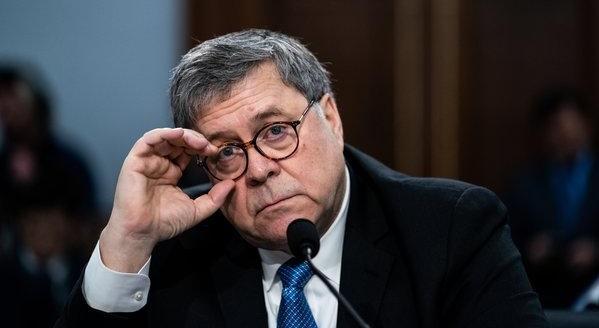
Attorney General William Barr said on Monday that the Trump administration can legally add a citizenship question to the 2020 census, which had been excluded for the first time in US history by President Obama.
Barr told the Associated Press that he has been in regular contact with President Trump over the matter.
“I agree with him that the Supreme Court decision was wrong,” said Barr – referring to the USSC’s June Decision to block the citizenship question, adding that there is “an opportunity potentially to cure the lack of clarity that was the problem and we might as well take a shot at doing that.”
According to the report, President Trump is likely to issue a presidential memorandum to the Commerce Department over the next several days ordering it to include the citizenship question.
Last week the Justice Department appeared to cave to legal pressure to keep the question off the census, only for President Trump to reverse course the next day – tweeting that the efforts to print the question would move forward.
“The tweet this morning was the first I had heard of the president’s position on this issue, just like the plaintiffs and Your Honor. I do not have a deeper understanding of what that means at this juncture other than what the president has tweeted,” DOJ attorney Joshua Gardner told a federal judge during a Wednesday teleconference, adding “But obviously, as you can imagine, I am doing my absolute best to figure out what’s going on.”
The DOJ on Sunday also announced that it would be replacing its entire legal team dealing with the citizenship issue – replacing them with other government attorneys.
Barr recuses from Epstein
On Monday, Barr told reporters that he had recused himself from the case involving billionaire pedophile Jeffrey Epstein, who was arrested over the weekend on charges of sex-trafficking minors, according to the Washington Times.
Barr says that he used to work for one of the law firms representing Epstein “long ago,” though he did not name the firm.
via ZeroHedge News https://ift.tt/2Xx6SeV Tyler Durden
Of course the two large earthquakes that we just witnessed in southern California were not along the San Andreas fault, and we should be extremely thankful for that. Because they happened in remote areas, those two quakes didn’t cause an enormous amount of damage, but they should still be taken as a warning. The magnitude 7.1 earthquake that rattled southern California on Friday night was felt in San Francisco, Las Vegas and northern Mexico simultaneously, but if a magnitude 9.0 earthquake suddenly hit the San Andreas fault it would be 707 times more powerful than the quake that we just witnessed, and it would happen in a very heavily populated area. Needless to say, the death and destruction would be unimaginable, and scientists keep telling us that southern California is way overdue for “the Big One” to strike.
So if you live in California right now, you have a decision to make.
Right now the crust of our planet is becoming exceedingly unstable, and the infamous Ring of Fire runs directly along the west coast of the United States.
Do you really want to keep pressing your luck? Yes, things had been rather quiet for the last couple of decades, but now California is starting to shake like a leaf. According to the Los Angeles Times, there have been at least 3,000 earthquakes in southern California since the 4th of July…
Since the Fourth, Caltech seismologists have detected at least 3,000 smaller earthquakes.
Those include 340 earthquakes with a magnitude greater than 3, 52 with a magnitude greater than 4, and six with a magnitude greater than 5, Hauksson said Saturday.
In total, this earthquake sequence is expected to generate about 34,000 aftershocks with a magnitude 1 or greater over the next six months, he said.
These days Caltech seismologist Lucy Jones has become “the go to expert” that everyone in the mainstream media wants to talk to about California earthquakes, and according to her there is a “nearly 11%” chance that southern California will get hit by another magnitude 7 or greater earthquake this week…
The odds that Southern California will experience another earthquake of magnitude 7 or greater in the next week are now nearly 11%, according to preliminary estimates from seismologists.
And the chances that a quake will surpass the 7.1 temblor that struck near Ridgecrest on Friday night are roughly 8% to 9%, said Caltech seismologist Lucy Jones.
Of course Jones previously told us that there was only a very small chance that the magnitude 6.4 Ridgecrest earthquake was a foreshock for a larger event, and yet that is precisely what happened.
Ultimately, just like everyone else, Jones is essentially giving us her best guess. It may be an educated guess, but it is still a guess.
And she is also telling us that the aftershocks from the magnitude 7.1 earthquake that we just witnessed could “last for years”…
Though such quakes would be more likely to occur in the next few days, the shaking could continue for quite some time.
“A magnitude 7 usually has aftershocks that last for years,” Jones said.
But aftershocks are not a reason to move out of the state of California.
Very small earthquakes are not going to change history, but when “the Big One” finally arrives, nothing will ever be the same again.
Earlier today, I came across a CNN headline which boldly declared that they had “debunked” the “myth” that a portion of southern California could one day go into the ocean.
Here’s some comforting words for every California resident contemplating a permanent relocation.
The USGS calls the the idea that the state will be swept out to sea “absolutely impossible.”
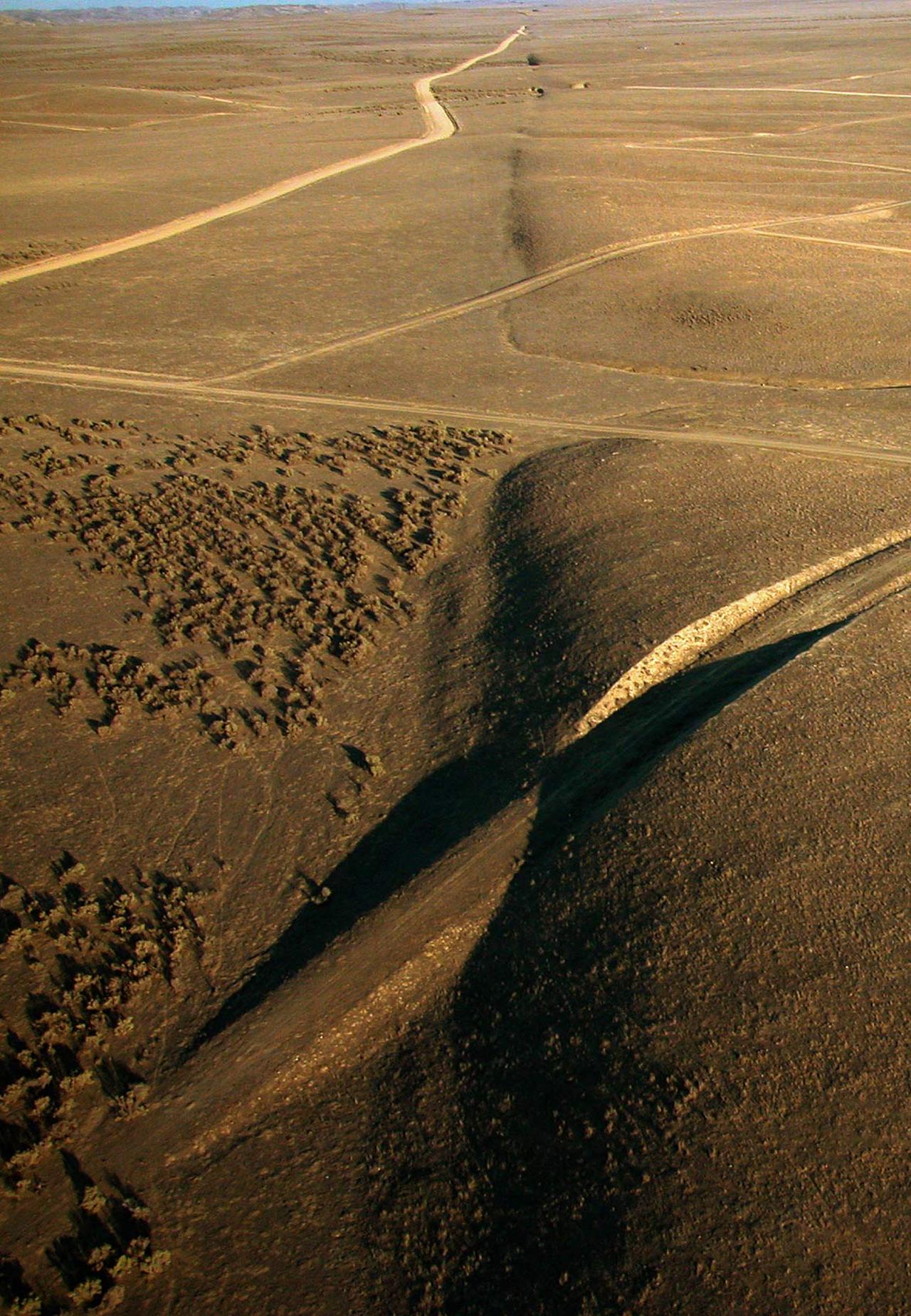
What will continue to happen however, is the slow — about two-inches-per-year slow — northward movement of southwestern California toward Alaska, as it slides past central and eastern California.
Wow, that is quite a powerful argument they laid out there.
I assume that what is being referred to here is the idea that a portion of California could snap off the continent like a cookie and sink into the ocean, and of course that isn’t going to happen.
However, much of southern California is barely above sea level, and scientists have discovered that past earthquakes have caused the ground in the region to sink by as much as three feet. If such an earthquake happened today, vast stretches of southern California could suddenly go underwater as the Pacific Ocean came pouring in.
So instead of talking about southern California “going into the ocean”, perhaps it would be more accurate for us to talk about “the Pacific Ocean going into southern California”.
Cal State Fullerton professor Matt Kirby was one of the lead researchers on the groundbreaking study that alerted all of us to this possibility, and he says that if a large enough earthquake happened today “you would see seawater rushing in”…
‘It´s something that would happen relatively instantaneously,’ Kirby said.
‘Probably today if it happened, you would see seawater rushing in.’
Southern California is essentially a time bomb, and it is absolutely riddled with fault lines. In fact, a Fox News article says that there are more than five hundred active fault lines in the region right now…
Like a major river, the San Andreas has many tributaries – faults big and small that fan out and fracture the state from top to bottom. As a result, most Californians live within thirty miles of an active fault line, of which there are more than five hundred.
So do you feel lucky?
Maybe you do, and that is fine.
But someday your luck will run out.
We have entered the time of “the perfect storm”, and major seismic events are going to become increasingly common. As sure as you are reading this article, someday the kind of earthquake that I am talking about will come to California, and the death toll will be off the charts.
Unfortunately, most Californians are not going to listen to the warnings. For example, one small business owner named Albert Adi told CNN that the risk of earthquakes is something he is willing to tolerate in order to live in a place “with beautiful weather and good job opportunities”…
Ultimately, he said, it’s just one of the tradeoffs of living in a place with beautiful weather and good job opportunities.
“It’s the risk you have to accept by living here in Southern California,” he said.
“Hopefully,” he added, “everything will work out.”
Blind hope is not a strategy.
Today, California is on the cutting edge of everything that is wrong with America. The state is at the forefront of our moral, social and political decay, and the filth being produced by our entertainment industry has infected the entire globe.
Unless you have an overwhelming reason to stay, I don’t know why anyone would possibly want to live on the west coast at this point.
A day of reckoning for the state of California is approaching very rapidly, and you don’t want to be there when that day finally arrives.
via ZeroHedge News https://ift.tt/2YFap7f Tyler Durden
If President Trump follows through on his threats to issue an executive order to try and force the ‘citizenship question’ on to the 2020 census, a majority of Americans would have his back.
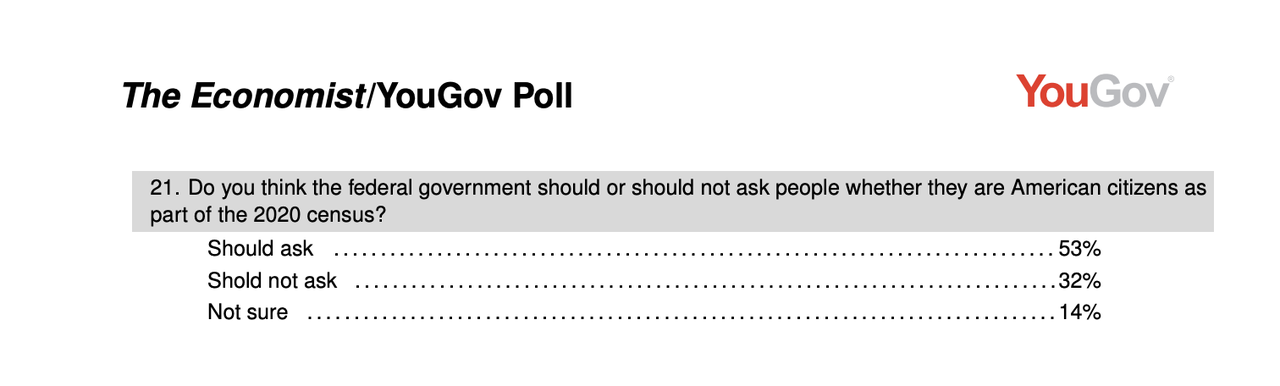
The latest Economist-YouGov poll found that 53% of Americans feel the census should include a question asking respondents whether or not they are citizens. Only 32% said they would oppose including such a question. Another 14% said they weren’t sure how to answer.
This was how the question from the Economist-YouGov poll was worded: “Do you think the federal government should, or should not, ask people whether they are American citizens as part of the 2020 census?”
The Supreme Court rejected including the question – or at least the way the Trump Administration would have worded it – on the 2020 census, but left the door open to another version, which Trump is reportedly considering, as the president revealed in a tweet last week.
The News Reports about the Department of Commerce dropping its quest to put the Citizenship Question on the Census is incorrect or, to state it differently, FAKE! We are absolutely moving forward, as we must, because of the importance of the answer to this question.
Legal expert and George Washington University Law professor John Banzhaf told the Washington Examiner that what Trump is suggesting in the tweet above could absolutely be accomplished.
“There are several rationales – including one based upon the Constitution itself – which could well still persuade the courts to permit a citizenship question on the census, especially if the explanation were included in the executive order now being considered, rather than in some new declaration by the Secretary of Commerce,” he said.
That’s simply not accurate. The fact is, Trump is only trying to follow what until recently had been an established norm. President Obama was the first president to exclude the question on citizenship, naturalization and nativity in almost 200 years. The Trump Administration is merely undoing Obama’s 8-year effort to distort the status quo.
via ZeroHedge News https://ift.tt/32fQEFF Tyler Durden
Buying and selling cryptocurrencies like bitcoin is illegal in Iran, a senior government official declared, according to a report by local news agency Tasnim News on July 8.
Nasser Hakimi, deputy governor for new technologies at the Central Bank of Iran (CBI), said that bitcoin trading is not legal in the country, citing a related prohibition by a local anti-money laundering (AML) authority, the Supreme Council of Combating and Preventing Money laundering and Financing of Terrorism Crimes.
In an interview with Tasnim News, Hakimi warned the public against legal and investment risks associated with cryptocurrency trading, outlining a high level of bitcoin’s volatility. Alongside, the official also expressed concerns about crypto advertisements, bringing awareness of promoted bitcoin pyramid schemes in the public.
The official has also reportedly raised the issue of the need to draw a distinction between the production of cryptocurrencies and its trading.
In late June, Iranian authorities announced that they start cutting power to cryptocurrency mining until new energy prices are adopted, with a local energy official reporting an abnormal spike of electricity consumption allegedly caused by increased mining of crypto. As such, local prosecutors seized around 1,000 bitcoin miners from two now-defunct farms in late June, BBC reported.
On July 6, Iranian Assistant Minister of Industry, Trade, and Supply stated that the United States Congress is allegedly working to stop Iran’s access to crypto and bitcoin mining in an attempt to prevent the country from using a tool for evading sanctions. As previously reported, bitcoin investment among Iranians has become increasingly popular due to a severe inflation of the local fiat currency, Iranian rial (IRR) amid the nuclear crisis deal.
via ZeroHedge News https://ift.tt/2ScxsUV Tyler Durden
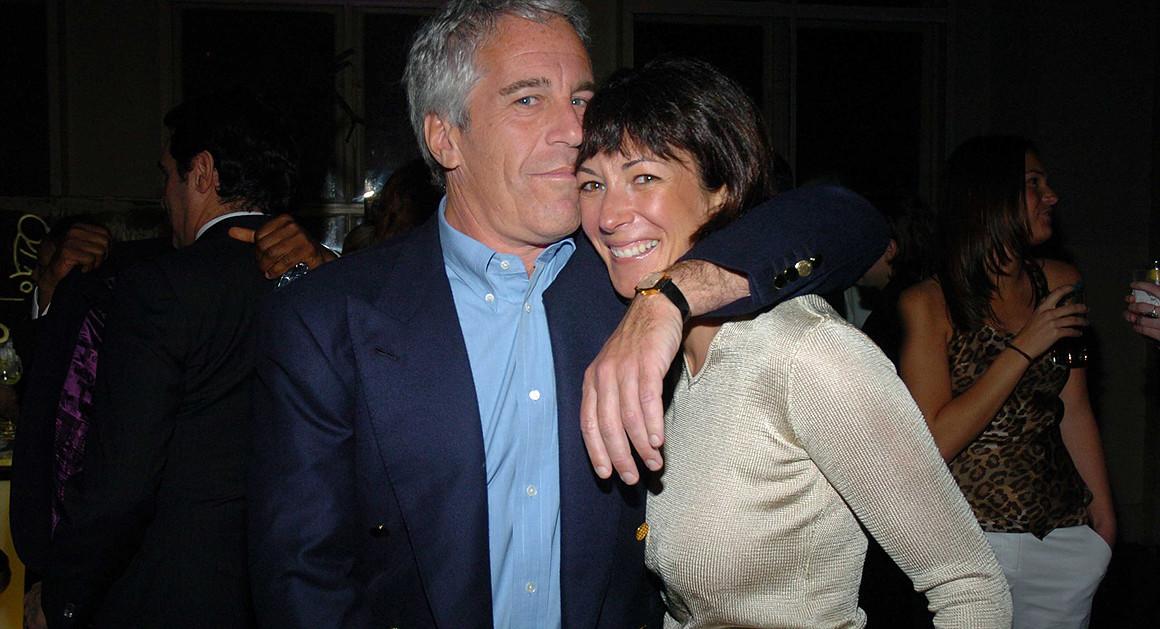
With the Saturday arrest of Jeffrey Epstein – who is reportedly offering to name elite pedophiles in exchange for leniency, a leaked copy of the billionaire sex predator’s “little black book” may provide some insight into some very rich individuals who should be nervous right about now.
The book was smuggled out of Epstein’s residence by his former house manager, Alfredo Rodriguez, who was busted trying to sell it in 2009 for $50,000 – only to get caught, charged with obstruction of justice, and die in prison after 18 months from a ‘long illness.’
According to an FBI affidavit, Rodriguez described the address book and the information contained within it as the “Holy Grail” or “Golden Nugget” to unraveling Epstein’s sprawling child-sex network. But despite having been subpoenaed for everything he had on his former boss, Rodriguez didn’t share it with the FBI or Palm Beach Police Department detectives investigating Epstein. Instead, he tried to make a $50,000 score by covertly peddling the black book to one of the attorneys launching lawsuits at Epstein on behalf of his victims. –Gawker
According to a 2015 Gawker article, Epstein’s little black book contains hundreds of names that a hobnobbing socialite billionaire might keep on hand, however around 50 of the entries were circled by Rodriguez – “including those of many of Epstein’s suspected victims and accomplices,” according to the report.
About 50 of the entries, including those of many of Epstein’s suspected victims and accomplices as well as Trump, Love, Barak, Dershowitz, and others, were circled by Rodriguez.
…
In addition to the names above, as well as scores of apparent underage victims in Florida, New Mexico, California, Paris, and the United Kingdom listed under the rubric of “massage,” the circled entries include:
Billionaire Leslie Wexner
Former New Mexico Governor Bruce King
Former New Mexico Governor and Democratic presidential hopeful Bill Richardson
Peter Soros, the nephew of George Soros
Former Miss Sweden and socialite New York City doctor Eva Andersson Dubin
Some of the circled entries include additional notes—one address in New York City, for instance, is marked as an “apt. for models,” and two names bear the marking “witness.” –Gawker
When asked why his name might have been circled, longtime Epstein associate Alan Dershowitz said in 2015: “I’ve never seen the book and I have no idea what it means. I was neither a victim nor a material witness—I never witnessed any crimes or participated in any crimes, and I can prove it.”
If you thought #MeToo was powerful, just wait for the fallout from this. There is more yet to come. I promise you that.
Dershowitz joined a 2017 motion brought by filmmaker and author Mike Cernovich to unseal records from a 2015 defamation casebrought by Epstein victim Virginia Roberts Giuffre against British socialite Ghislaine Maxwell. Giuffre says Maxwell helped Epstein traffic herself and other underage girls to sex parties at the billionaire pedophile’s many residences.
Trump, meanwhile, was reportedly the “only one” to help a prosecuting attorney representing one of Epstein’s alleged victims. The President is also said to have booted Epstein from his Mar-a-Lago club after he was found trying to recruit underage girls.
One theory on Epstein’s racket is described below by Twitter user @quantian1
(1/13) Let’s take as our starting points two givens.
(A.) You are a committed, unrepentant pedophile
(B.) Because of your old job in private banking, you are very connected to lots of very, very wealthy people
We’ll also assume a goal:
(Z.) You want to become very rich
(3/13) The second level though follows instantly: You don’t need to charge up front, just get them to have underage sex, and then blackmail them afterwards for hush money. Better ROI, but you’re still a liability, and producing and receiving big bribe money raises big questions.
(5/13) You don’t even have to do anything, and most people invited might even be totally unaware of the real purpose of the parties! But, sooner or later, some billionaire will get handsy, she’ll escort him to a room with a hidden camera, things happen. Morning after, you strike.
(7/13) The fund is offshore in a tax haven (check) and nobody will see the client list (check). Of course, you don’t really know anything about investing, instead making up some nonsense about currency trading (check), and nobody on Wall Street has ever traded with you (check)
(9/13) A $20 million wire from Billionaire X to you with no obvious reason will raise many questions, and the IRS will certainly want to know what you did to warrant it. A $5 million quarterly fee for managing $1 billion in assets? Nobody bats an eye.
(11/13) Occasionally you may also try this trick on other people: important political figures, mayors, prosecutors, etc. They don’t invest in the fund, but it’s nice to have them in your pocket. Others (academics, artists, etc.) can just be bought with money as a PR smokescreen.
(13/13) And the last piece of the puzzle is the evidence. You’d want it somewhere remote, but accessible: a place the US can’t touch but you have an excuse to visit all the time to update. Remember that offshore fund?
I bet there’s a *very* interesting safe deposit box there.
July 7 2019, just another tequila Sunday. There are elections here in Greece, and the right wing will take over. Bad idea, because it will bring out the left wing resistance that have remained subdued while Syriza reneged on all their promises, but they were left wing, and how does left protesting left work exactly? They didn’t know. Better lay low. No more.
From now on in, it’s women and children first. And there are so many pent up grievances. Youth unemployment is still at 40%. While ever more Greeks are evicted from their homes through Airbnb alone. This ain’t gonna go well. That strong economy the right promises will be there exclusively for their own richer supporters, at the ever-increasing cost of the poor.
The US women’s soccer team just became World Champions again. That’s the last time in a very long time. Because traditional soccer countries now also have women’s teams. There’s a very peculiar division at the bottom of this. In Europe and South America and Africa, soccer is a men’s game.
In the US, baseball, hockey, basketball and American football have spent millions making sure soccer was turned into, and perceived as, a girly sport. Just so the best male athletes would not turn there. So the US, colleges, universities, have this decades-long tradition of women’s soccer. But they have no such tradition for men, while almost the entire rest of the world does.
That’s why the US women’s soccer team will never win again, and it’s also why the men’s team never will. No culture, no tradition, even as they easily could have them. This was very obvious to me in my Montreal days. In summer, in just about every city park, there were community and family gatherings of South- and Central Americans, and they were all playing soccer.
Still, Canada stinks at the game on an international level. Why? Because the hockey people don’t want the competition for male athletes. They cut it down wherever they can. All they would have to do is take the most promising 100 10-year old kids just playing in the parks in one city, and get them into a program. Within 10 years they’d have a national team that’s an international contender. Kids from Peru, Chili, Brazil, 100 different countries, and throw in the European kids that are there anyway. But no.
Still, I was going to talk about Trump again. Just to piss off the people some more who -stupidly- accuse me of supporting Trump.
Though it is sort of the same thing: Greek PM Tsipras is set to lose (no results yet as I write this) because he never did what he promised. US soccer is set to lose because other domestic sports don’t want it to be successful. People are -mostly- blind.
First I saw this UK ambassador to Washington, one Sir Kim Darroch, has sent “secret” cables (memos) to his government about how Trump’s administration is supposedly “inept, insecure and incompetent”, as well as “uniquely dysfunctional” and “divided”. “We don’t really believe this administration is going to become substantially more normal; less dysfunctional; less unpredictable; less faction-riven; less diplomatically clumsy and inept.”
“Differences between the US and the UK on climate change, media freedoms and the death penalty might come to the fore as the countries seek to improve trading relations after Brexit, the memos said.” Oh, fcuking yeah, the UK is such a shining light on climate change and press freedom, right?! Who’s holding a certain journalist, one Julian Assange, in a maximum security prison again?
“Mr Trump’s publicly stated reason for calling off an airstrike against Tehran with 10 minutes to go – that it would cause 150 casualties – “doesn’t stand up”, Sir Kim said. Instead, he suggested the president was “never fully on board”. When I read that line, I thought Sir Kim was not-even-so secretly in favor of attacking Iran. Was that just me?
Oh, and earlier today I was wondering if they ever hand out these Sir and Dame titles to people who are poor or even destitute but who work 25 hours a day for the people around them, to make sure they can alleviate the suffering in their communities as much as they can. Or does that mummified “Queen” of theirs only bestow that “honor” on the upper classes? No, I do not care, I think I know the answer. Inglan is a bitch.
And if I’ve ever seen a dysfunctional, “inept, insecure and incompetent” government, it’s the one that these secret memos were sent to. From Cameron to May to soon Boris Johnson, let get real.
Then also today there were all these news reports about Jeffrey Epstein on how he’s finally being charged with abusing dozens of underage on his planes and his estates. This has been going on for decades (who was in charge during those years). What is the media focus? Trump, of course. But Epstein was thrown out of Mar-A-Lago I think 12 years ago for hitting on an underage girl. Does that mean we know for sure Trump was never involved? Nope.
But we do know that Bill Clinton flew 26 times in a few years on Epstein’s ‘Lolita Express’ bringing helpss girls so faraway places. So maybe he should be the main focus here, not Trump. Then again, it’s too late in the game now, isn’t it? US -and UK- media have bet all their money on the anti-Trump game. They have lost everything so far, and then they double down, everything on red style.
I’m thinking: guys, you lost, time to find a new game plan. But they don’t have the flexibility nor the intelligence required. Aaron Maté wrote another scathing -must read- essay on theMueller Report , putting its credibiltiy at the same level as the Steele dossier, but one half of America doesn’t even want to see that. It only wants to see more damning reports, damn evidence, about their favorite orange piñata.
And no, talking about that does not make me a Trump supporter. Let’s say I’m looking at that like it were a game of soccer, and I point out to you that the other team has absolutely nothing while they’re already 10-0 down (that’s a very big score in soccer).
But a third thing i saw today really made me think Trump can’t lose in 2020. The Guardian of all places had a review of a book entitled American Carnage: On the Front Lines of the Republican Civil War by Politico writer Tim Alberta, in which Trump effusively praises Alexandria Ocasio-Cortez, among other things by comparing her to Evita Peron.
“Trump says he first saw Ocasio-Cortez during her primary against Crowley, while watching TV with political advisers. “I see a young woman,” he says, “ranting and raving like a lunatic on a street corner, and I said: ‘That’s interesting, go back.’” Alberta then says Trump “became enamored” and “starstruck” by Ocasio-Cortez. “I called her Eva Perón,” Trump says. “I said, ‘That’s Eva Perón. That’s Evita.”
[..] Trump does row back on his praise, telling Alberta: “She’s got talent. Now, that’s the good news. The bad news: she doesn’t know anything. She’s got a good sense, an ‘it’ factor, which is pretty good, but she knows nothing. But with time, she has real potential.”
I still remain convinced that the one dimensional Trump haters, the same people who would accuse me of supporting him, don’t understand how or why that means he will win easily in 2020. Well, that, and they have nobody to put up against him. Joe Biden is not just a joke, he’s an old and stale joke. Kamala Harris is an attempt to cross Obama with Hillary. Bernie Sanders is a wonderful man, but he should be the campaign manager for a younger prospect, but who isn’t there.
And Tulsi Gabbard is being actively suppressed by the DNC, like Bernie Sanders four years ago. All the rest of the field are mere bystanders. It’s the exact same feeling of the GOP ‘contestants’ standing against Trump in 2016. They’re there to fill up space, and to create the illusion there’s an actual conversation or dialogue or contest happening.
Personally, I think it would be great if the Democrats have a valid candidate next year, at the level of Trump or better.
The Donald should have stayed in real estate. But instead he’s the President, and now everybody has to deal with that. And you don’t do that by continuing to blame him for everything that happens under the sun. That ‘tactic’ has failed for three years.
Those past 3 years of media bias against him, plus the Mueller report debacle, should have made this clear.
But what we see today is that neither the Democrats nor the press that supports them have anything to fight Trump with. While he compliments their main future asset for her talent, and for her likeness to a world-famous tragic actress-turned-politician and Broadway darling.
That’s why he’ll win.
via ZeroHedge News https://ift.tt/2S72Dkb Tyler Durden
Hiking Americans’ minimum wage to $15 per hour would give millions of Americans a raise but would kick a smaller share of people out of work (presumably never to return as their skills are now priced out of the market) according to a new report from the Congressional Budget Office.
Effects of the $15 Option on Employment and Income.
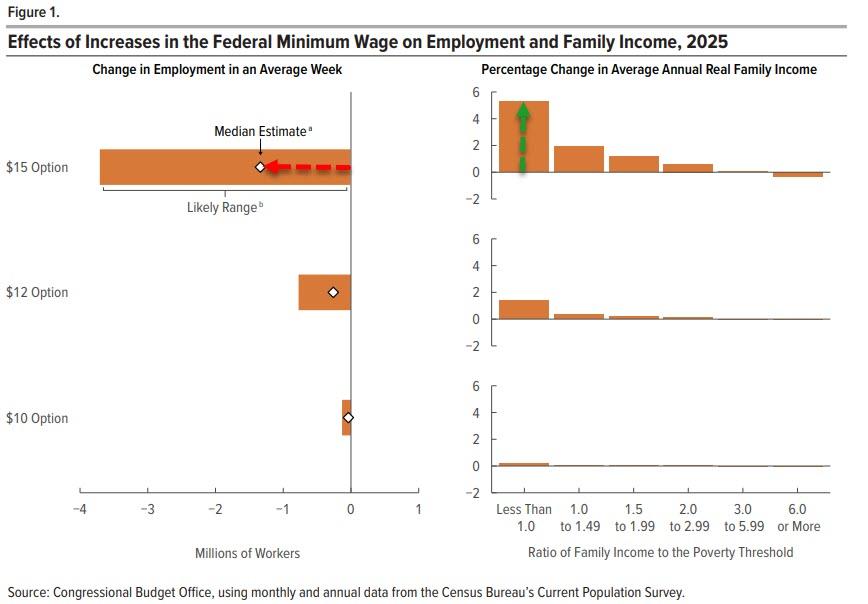
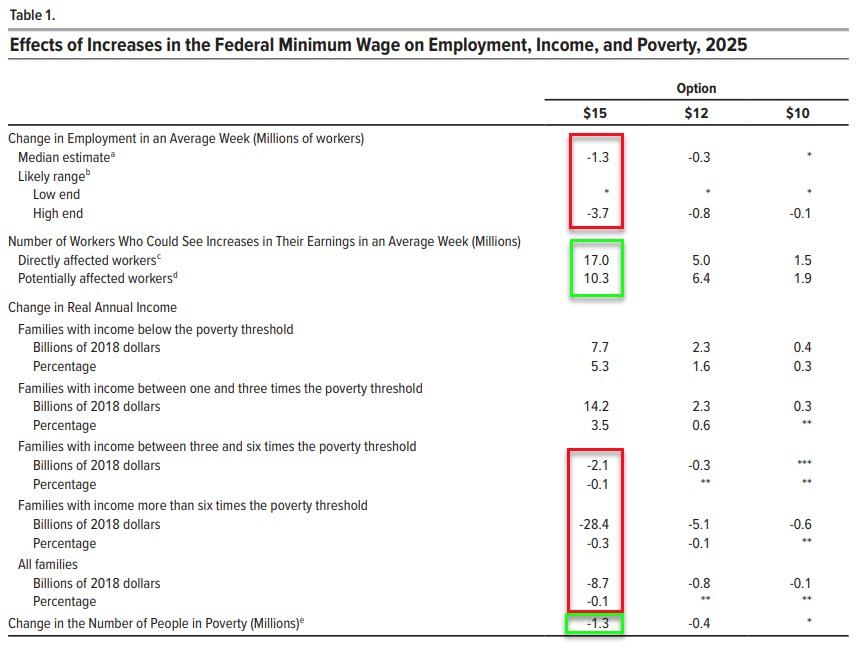
According to CBO’s median estimate, under the $15 option, 1.3 million workers who would otherwise be employed would be jobless in an average week in 2025. (That would equal a 0.8 percent reduction in the number of employed workers.) CBO estimates that there is about a two-thirds chance that the change in employment would lie between about zero and a reduction of 3.7 million workers.
In addition, in an average week in 2025, the $15 option would increase the wages of 17 million workers whose wages would otherwise be below $15 per hour, CBO estimates. The wages of many of the 10 million workers whose wages would be slightly above the new federal minimum would also increase.
The $15 option would affect family income in a variety of ways. In CBO’s estimation, it would:
Boost workers’ earnings through higher wages, though some of those higher earnings would be offset by higher rates of joblessness;
Reduce business income and raise prices as higher labor costs were absorbed by business owners and then passed on to consumers; and
Reduce the nation’s output slightly through the reduction in employment and a corresponding decline in the nation’s stock of capital (such as buildings, machines, and technologies).
On the basis of those effects and CBO’s estimate of the median effect on employment, the $15 option would reduce total real (inflation-adjusted) family income in 2025 by $9 billion, or 0.1 percent.
The effects of those income changes would vary across families. Changes in earnings would mainly affect low-income families, but many higher-income families would be affected, too. The loss in business income would be mostly borne by families well above the poverty line. All consumers would pay higher prices, but higher-income families, who spend more, would pay more of those costs. And the cost of effects on the overall economy would generally accrue to families in proportion to their income, which means they would largely be absorbed by families with income well above the poverty threshold.
Taking those effects into account, CBO estimates that families whose income would be below the poverty threshold under current law would receive an additional $8 billion in real family income in 2025 under this option. That would amount to a 5.3 percent increase in income, on average, for such families. That extra income would move, on net, roughly 1.3 million people out of poverty. Real income would fall by about $16 billion for families above the poverty line; that would reduce their total income by about 0.1 percent.
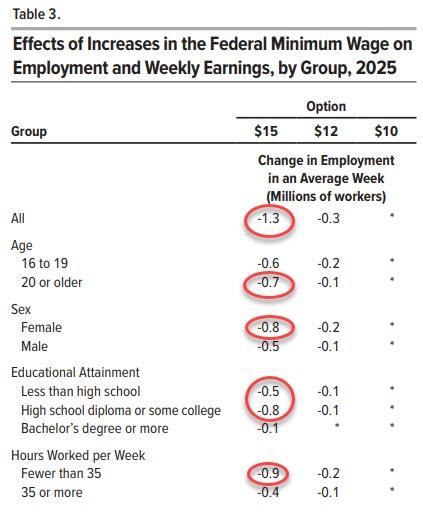
Workers who would be affected by an increase in the minimum wage – through either lost employment or higher earnings – tend to come from groups in which low wages (defined here as less than $19 per hour) are common. Teenagers and adults without a high school diploma are relatively likely to earn low wages, but because they make up small shares of the working population, those groups together account for only about 20 percent of low-wage workers. Women are more likely to have low-wage jobs than men. Part-time workers are also disproportionately represented in low-wage jobs, but most low-wage workers are employed full-time (see Table 2).
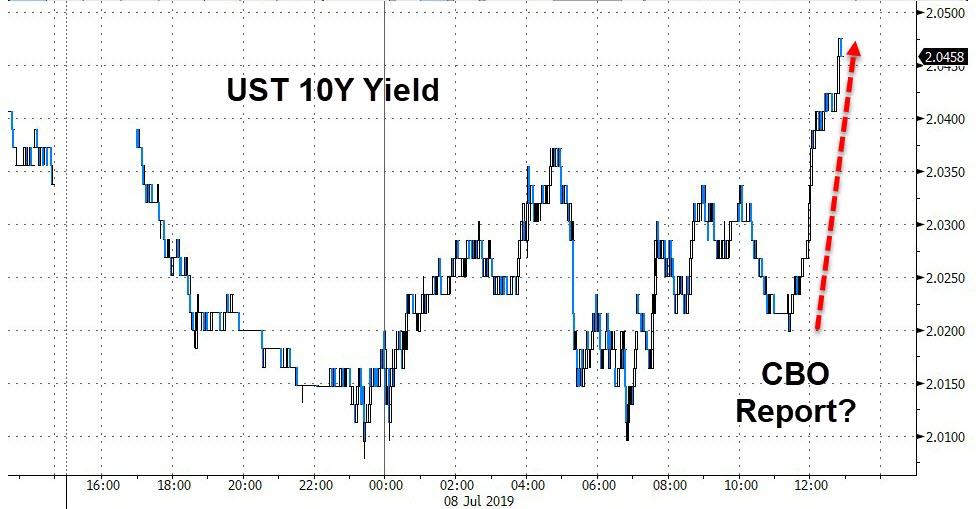
Additionally, CBO warns this shift in the law will cause price-hikes (effectively reducing any gains from the employers’ wage gains) and potentially creating enough inflation to spook bonds and send the cost of capital (e.g. for young black people to get mortgages to buy homes) soaring. Bonds seemed to react this afternoon when the report hit…
Of course, the left’s army of progressive panderers is extremely busy with the spin, happy to proclaim with confidence that CBO nailed it on the estimates of how many will get pay rises and be “lifted out of poverty” but seems to also slam the CBO’s gross lack of accuracy on the job loss estimates.
EPI is unequivocal: CBO report shows broad benefits from higher minimum wage:
The key fact coming out of the report is that CBO finds that the benefits to low wage workers of a $15 minimum wage far exceed the costs. The report finds that a $15 minimum wage would increase the wages of millions of low wage workers, increase the average incomes of low and lower-middle-income families, reduce poverty, shift money from corporate profits to the wages of low-wage workers, and reduce inequality.
None other than Paul Krugman jumped in via Twitter:
“…I agree with EPI that CBO has given too much weight to dubious research…
[CBO] may have erred on the side of political caution…
The fact is that even if CBO is overstating the job effects, this is actually a very pro-hike report. Remember that the job number is for average employment in a given week; it doesn’t mean that anything like that number would be unemployed for long periods.”
We frankly have no idea what that last sentence means but cherry picking the CBO results you want seems the opposite of what one would expect from an ivory tower academician.
Of course, Jared Bernstein had to pipe-in…
“My quick take on the new CBO report on the impact of raising the federal minimum wage. It’s yet more evidence that even big increases should be largely expected to have their intended effects: raise low pay, lower poverty, lower inequality.”
So let us explain, the bottom line is simple, around 17 million people (or up to 27.3 million) will end up with an extra pack of cigarettes per day while sacrificing 1.3 million (and potentially 3.7 million) who will end up losing everything (and never to return as their skill-base would now be priced out of the market) and prices will go up for everyone.
But then again, it’s all about shared sacrifice right? And besides, Dems can just unleash more Universal Basic Income gifts to the 1.3 million lost to this “Raise The Wage Act” proposal.
Full CBO Report below:
via ZeroHedge News https://ift.tt/2LgX5TV Tyler Durden
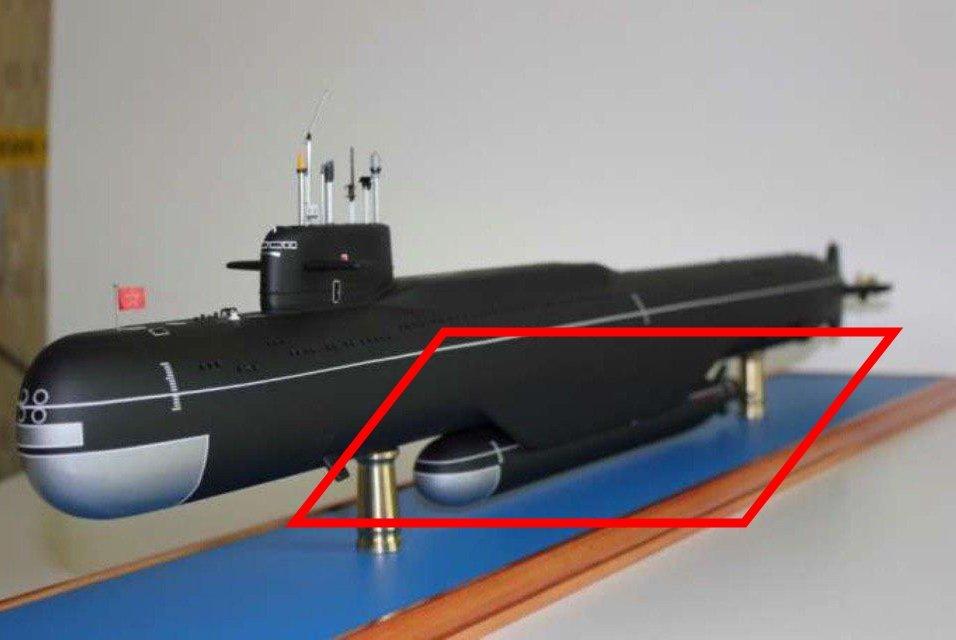
The fire started in the battery compartment, but did not affect the reactor, Defense Minister Sergey Shoigu reports to Vladimir Putin…
Tragic, and potentially disastrous for the immediate area if the reactor casing had opened but not something you’d call “a planetary catastrophe”.
Among other reports we’ve seen (not verified so grain of salt) is that seven of the dead were captains, meaning whatever they were up to was pretty important.
The fact the Russians are repairing and returning the boat to its mission would also point in that direction.
So what was the submarine or its submersible – capable of 20,000 foot dives – carrying?
The best guess I’ve seen is a high-yield, 100 – 200 megaton, cobalt thermonuclear bomb.
A bomb that size, two to four times more powerful than the biggest ever exploded, the Soviet Tsar Bomba (limited to 50 MT to allow the delivery plane a chance to escape) a bomb that size is awful enough but if it is encased in cobalt it becomes the most lethal munition ever built.
I must confess that, as a physics professor, some of my nightmares are extra geeky. My worst one is the C-bomb, a hydrogen bomb surrounded by large amounts of cobalt. When I first heard about this doomsday device in Stanley Kubrik’s dark nuclear satire Dr. Strangelove, I wasn’t sure if it was physically possible. Now, I unfortunately know better, and it seems like it Russia may be building it.
The idea is terrifyingly simple: Just encase a really powerful H-bomb in massive amounts of cobalt.
When it explodes, it makes the cobalt radioactive and spreads it around the area or the globe, depending on the design. The half-life of the radioactive cobalt produced is about five years, which is long enough to give the fallout plenty of time to settle before it decays and kills, but short enough to produce intense radiation for a lot longer than you’d last in a fallout shelter. There’s almost no upper limit to how much cobalt and explosive power you can put in nukes that are buried for deterrence or transported by sea, and climate simulations have shown how hydrogen bombs can potentially lift fallout high enough to enshroud the globe, so if someone really wanted to risk the extinction of humanity, starting a C-bomb arms race is arguably one of the most promising strategies.
Not that anyone in their right mind would ever do such a thing, I figured back when I first saw the film. Although U.S. General Douglas MacArthur did suggest dropping some small cobalt bombs on the Korean border in the 1950s to deter Chinese troops, his request was denied and, as far as we know, no C-bombs were ever built. I felt relieved that my geeky nightmare was indeed nothing but a bad dream.
It is this type of hydrogen bomb of which Albert Einstein said: “If successful, radioactive poisoning of the atmosphere, and hence annihilation of any life on earth will have been brought with in the range of technical possibilities.”
Following the November 2015 “leak” of a classified slide purporting to show a Russian nuclear-armed and nuclear-powered drone intended to create long-lasting “zones of extensive radiological contamination,” both Russian and Western observers have suggested that Moscow may be developing a cobalt bomb.
While the underwater detonation of a massive cobalt or “conventional” nuclear weapon might create zones of long-lasting contamination, Russian decision makers would have little confidence that these areas would be in the intended locations, undermining the strategic case for such attacks. These findings suggest that the Kremlin is not pursuing radiological “doomsday bombs,” even though the nuclear-powered drone on the slide seems to be a real research project.
People smarter than I are speculating this might be what’s going on up in the Arctic.
via ZeroHedge News https://ift.tt/2L8QURD Tyler Durden
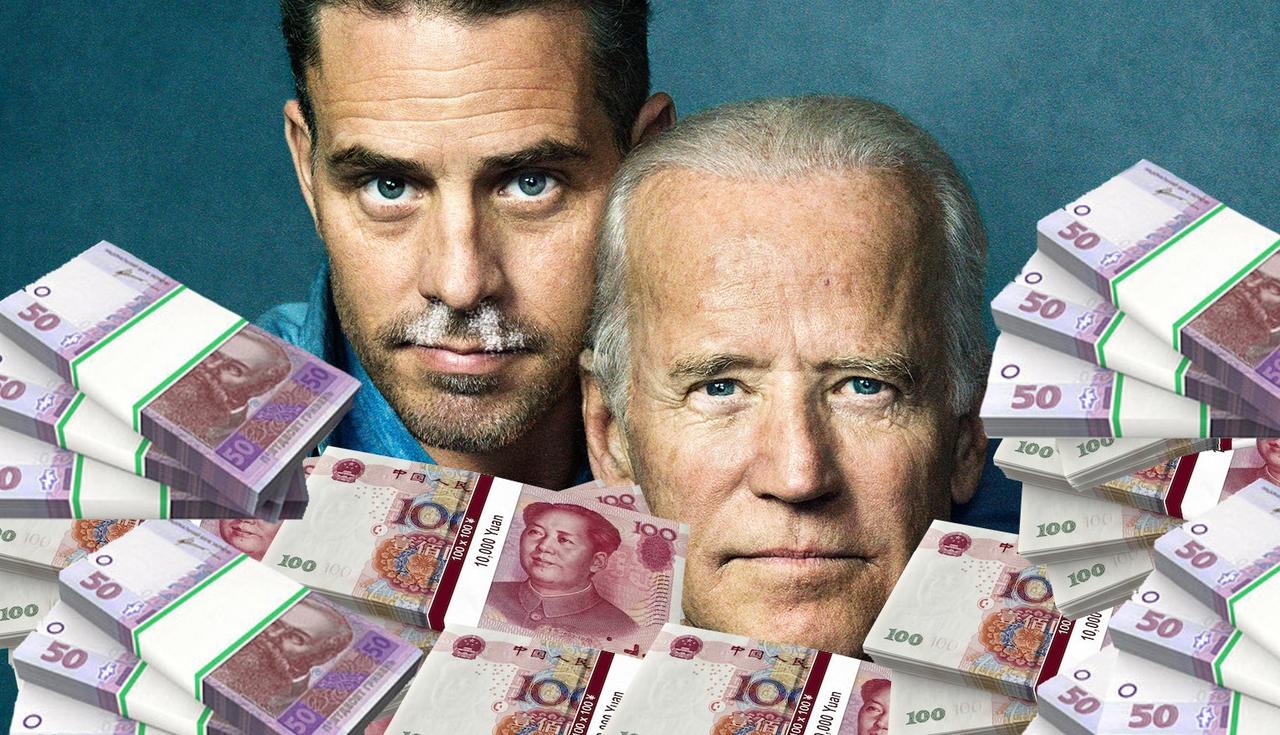
A Freedom of Information Act lawsuit was filed on behalf of investigative journalist John Solomon, who seeks State Department records of communications with Hunter Biden, Devon Archer, and entities they are linked to – including Burisma Holdings, Rosemont Seneca Partners and/or Blue Star Strategies.
According to investigations by journalist Peter Schweizer and others, the Bidens may have engaged in rampant nepotism, with Joe Biden accused of abusing his position as Vice President to help Hunter and his partners make millions of dollars in both Ukraine and China.
In a recent article in the New Yorker, Hunter opened up about being a crackhead and accepting a ‘bribe’ from a Chinese energy tycoon in the form of a 2.8 carat diamond worth thousands of dollars, which he says wasn’t a bribe.
The filing was made by the Southeastern Legal Foundation on behalf of Solomon, after the State Department failed to respond to a May 6, 2019 letter by the investigative journalist.
As Mr. Solomon has reported, U.S. banking records show that Hunter Biden’s American-based firm Rosemont Seneca Partners LLC, received regular transfers into one of its accounts (more than $166k/month) from the natural gas firm Burisma Holdings that employed Hunter Biden. All of this occurred during a period when Vice President Biden was the main U.S. official dealing with Ukraine and its tense relationship with Russia.
Two years after leaving office, Joe Biden couldn’t resist the temptation to brag to an audience of foreign policy specialists about the time as vice president that he strong-armed Ukraine into firing its top prosecutor. His threat was so severe that Ukraine would have lost $1 billion in U.S. loan guarantees sending Ukraine toward insolvency. So the question is – why? Why did Joe Biden demand the immediate firing of Prosecutor General Viktor Shokin? And what did the State Department know about Hunter Biden’s dealings in Ukraine and Ukraine’s investigations into those business dealings? –SLF
“[T]he now-completed Russia collusion investigation showed us, every American deserves the right to be presumed innocent until evidence is made public or a conviction is secured, especially when some matters of a case involve foreigners. The same presumption should be afforded to Joe Biden, Hunter Biden, Devon Archer and Burisma in the Ukraine case,” said Solomon.
“Nonetheless, some hard questions should be answered by Biden as he prepares, potentially, to run for president in 2020: Was it appropriate for your son and his firm to cash in on Ukraine while you served as point man for Ukraine policy? What work was performed for the money Hunter Biden’s firm received? Did you know about the Burisma probe? And when it was publicly announced that your son worked for Burisma, should you have recused yourself from leveraging a U.S. policy to pressure the prosecutor who very publicly pursued Burisma?”
The FOIA requests seek to answer the above questions. “Mr. Solomon’s questions, stemming from years-long investigative journalism, are powerful and legitimate inquiries into what the American public has a right to know about how and why Vice President Biden and the Obama administration conducted foreign policy in the last week of its tenure,” according to SLF executive director, Todd Young.
“The well-documented series of events involving Ukraine begs for public disclosure.”
via ZeroHedge News https://ift.tt/2GeB7gb Tyler Durden
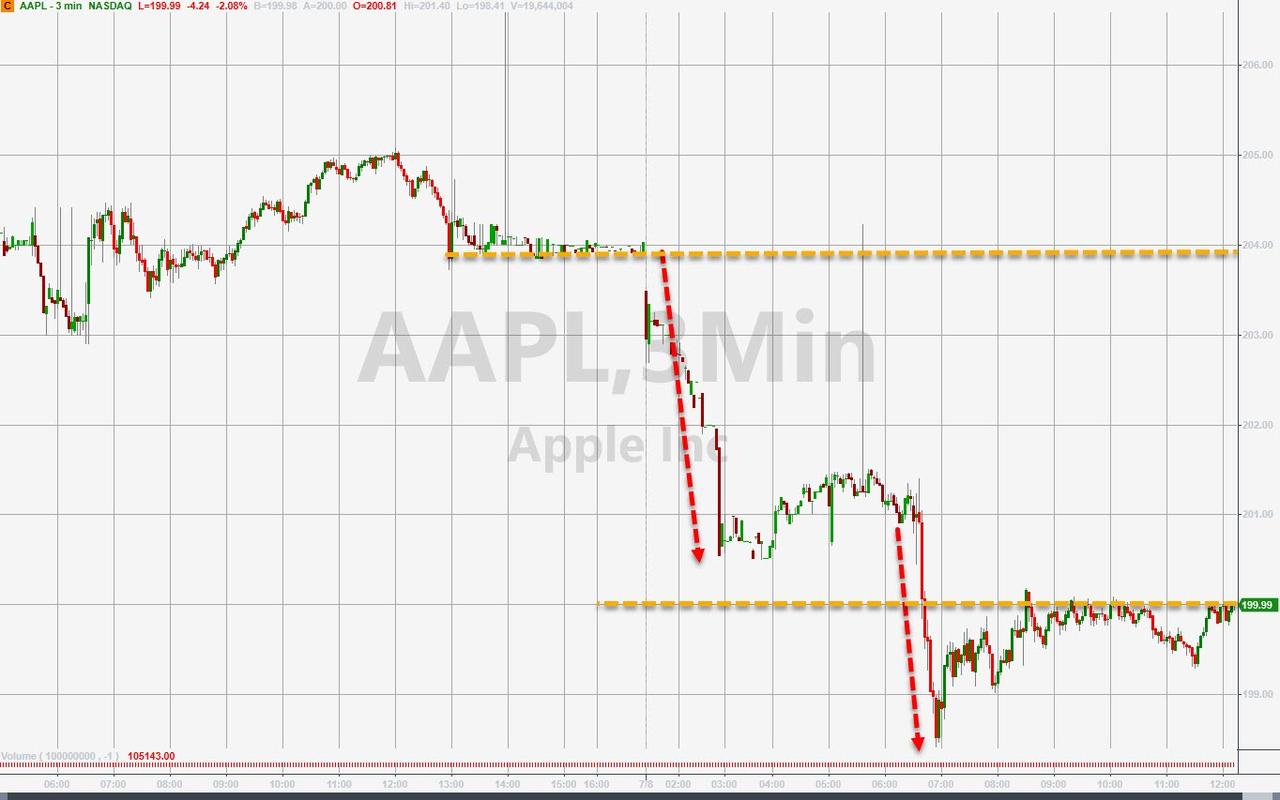
The biggest market news, on a slow news day ahead of Powell’s testimony to Congress, was the downgrade of AAPL – which for once actually sparked some selling (down over 2% and back below $200)…
Apple fell after Rosenblatt Securities downgraded the iPhone maker to sell. That brought the total number of bearish analysts up to five among the 57 ratings tracked by Bloomberg, the highest number since at least 1997.
This weighed down Nasdaq immediately…
On the day, The Dow (weighed down by Boeing) and S&P outperformed the major US peers but all major US equity indices were down…
NOTE – the machines tried to ignite momentum off the opening lows but, for once, it failed.
Defensive stocks dominated trading today (just as they did on Friday)…
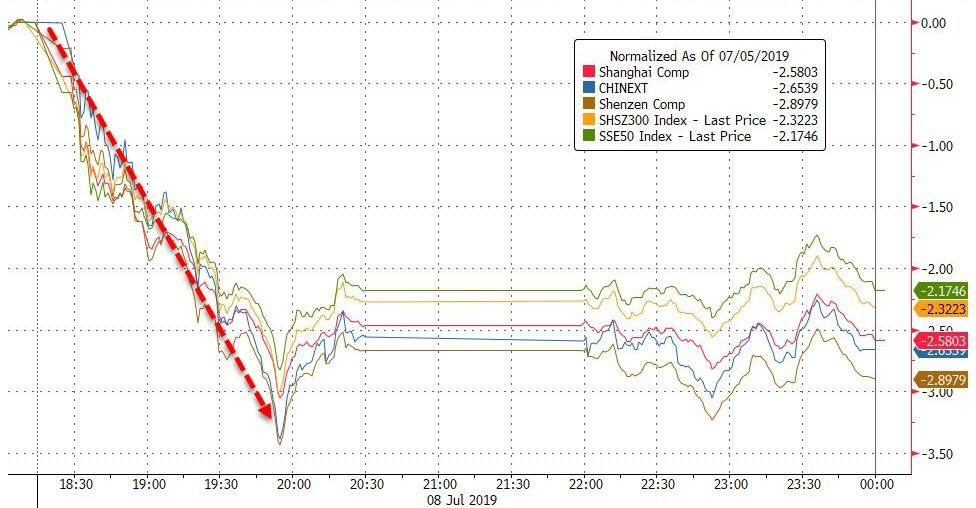
It was ugly overnight in China…
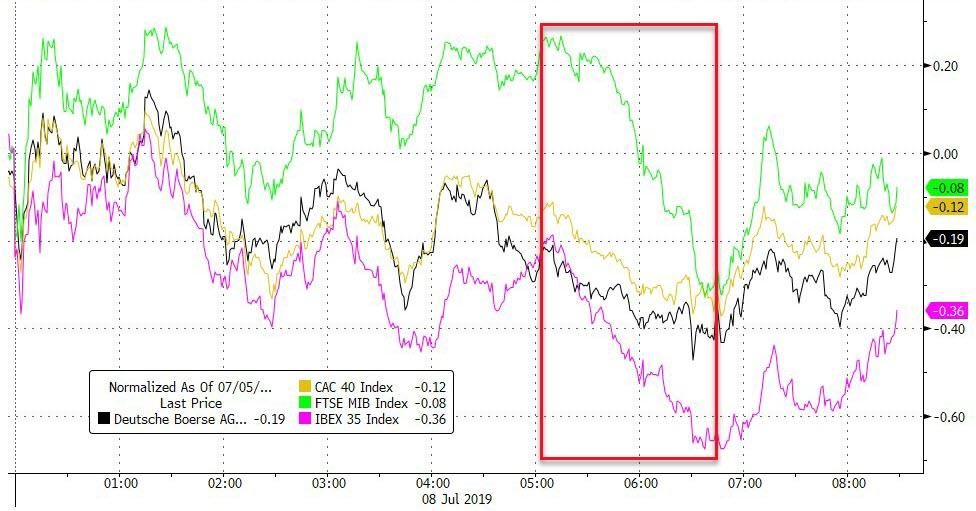
And European stocks were lower on the day…
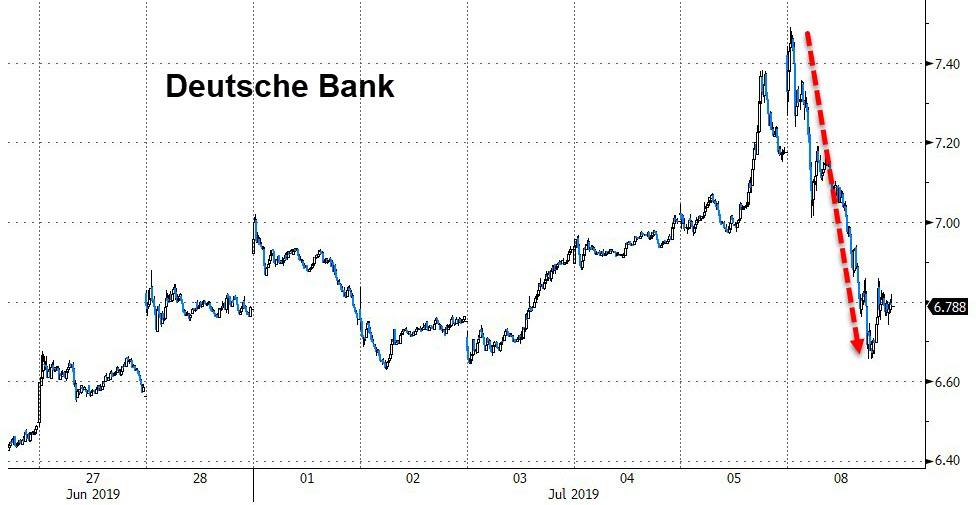
Weakness in Europe was not helped by the collapse of Deutsche Bank after its massive restructuring…
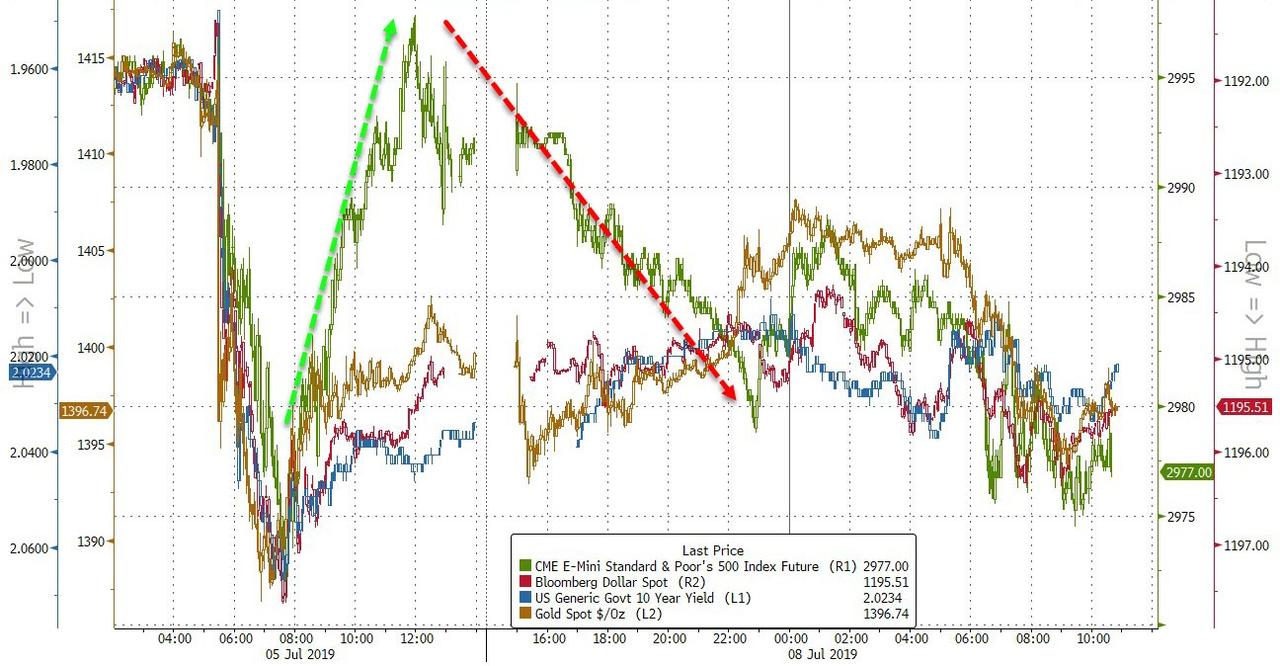
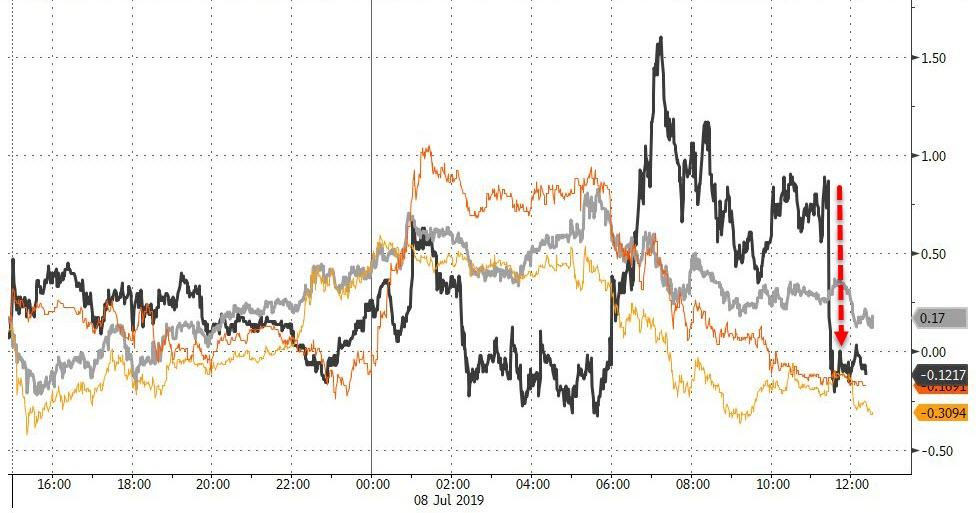
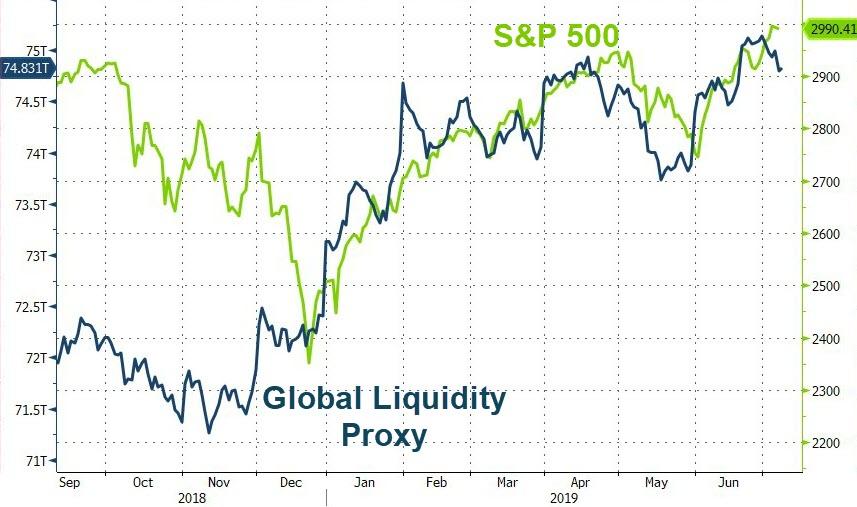
US equities erased all those ridiculous rebound gains and caught back down to bonds, gold, and the dollar…
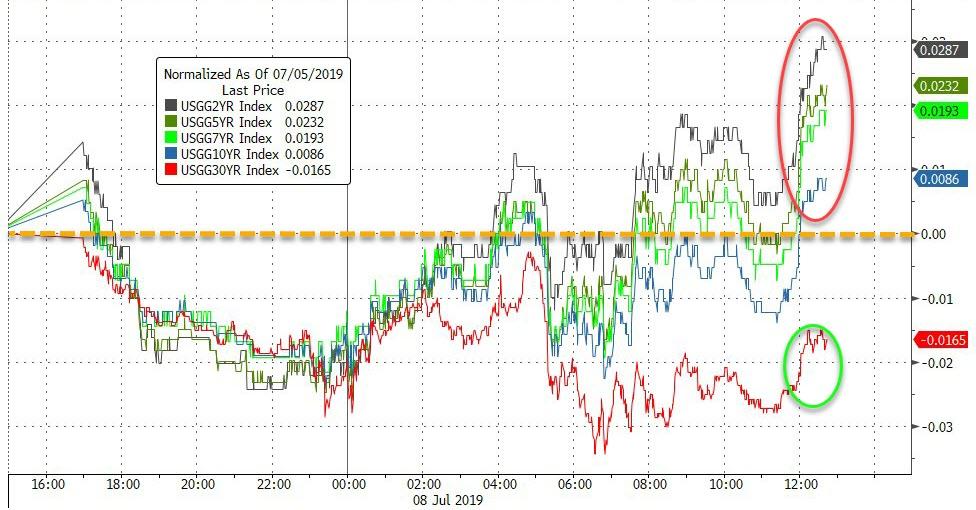
Most of the Treasury curve was modestly higher in yield today but the longer-end outperformed…
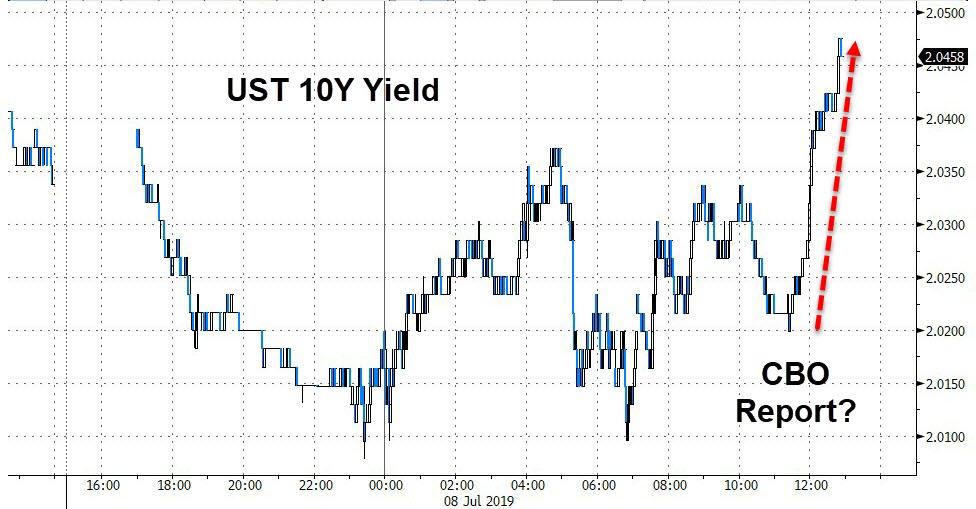
NOTE – yields spiked a little in the last hour as a CBO report on minimum wage hikes hit…
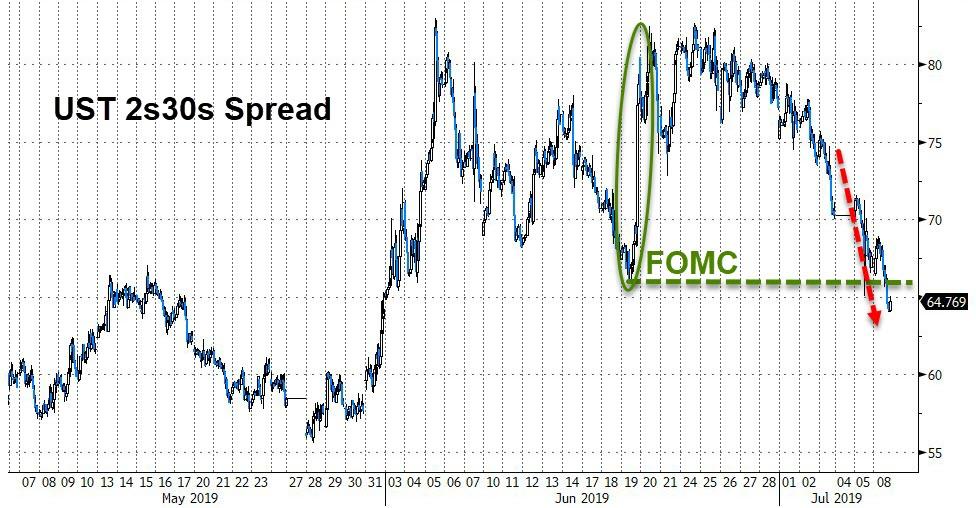
2s30s continues to flatten hard, now below the pre-FOMC levels…
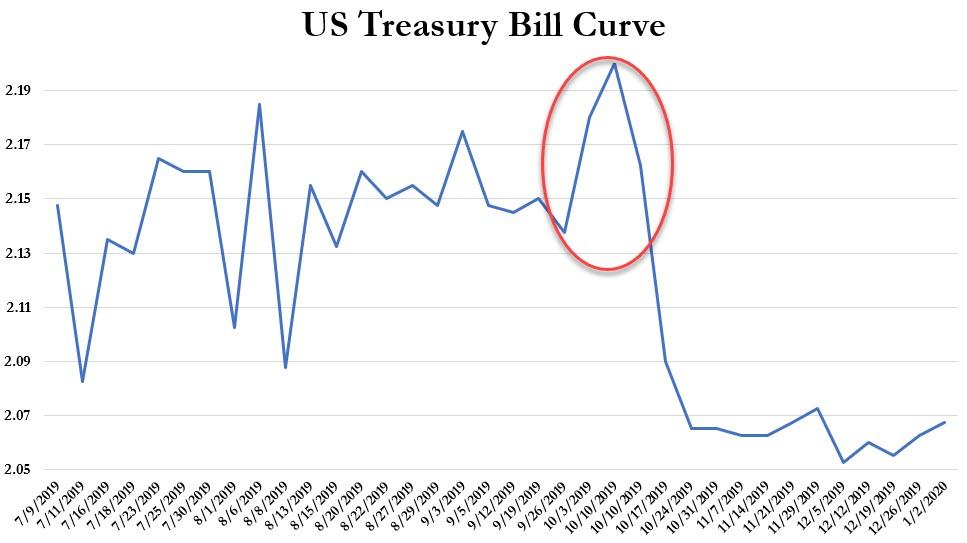
And Debt Ceiling anxiety is starting to impact the T-Bill curve…
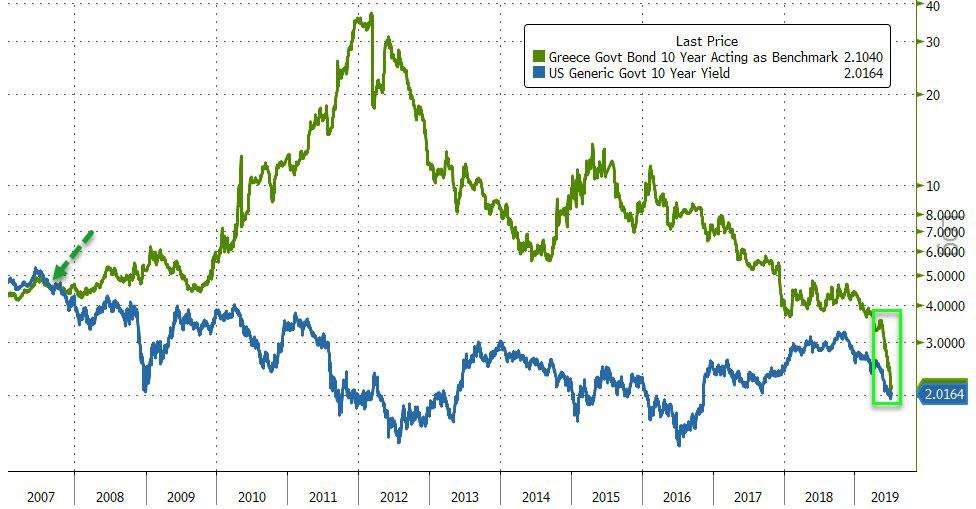
Before we leave bond-land completely, here’s a fun fact – Greek 10Y bond yields fell below US 10Y yields today for the first time since Oct 2007…
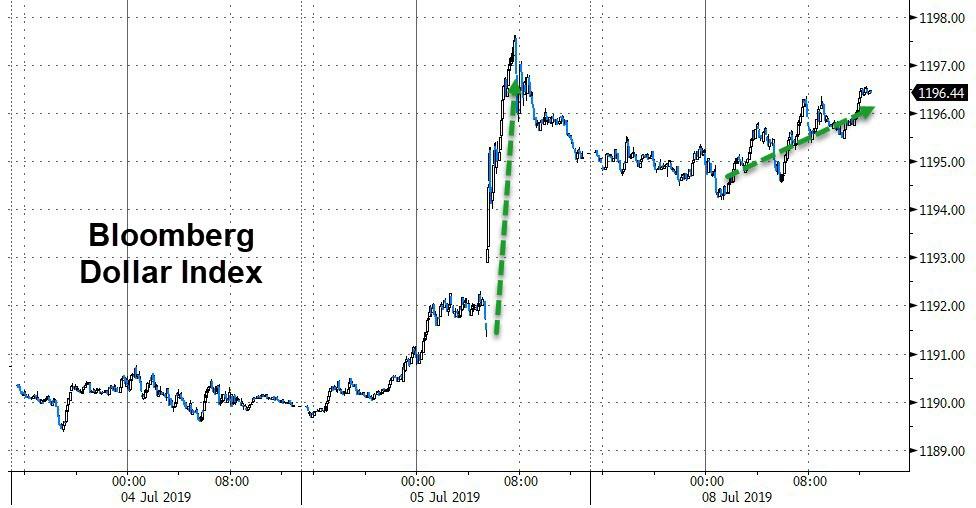
The dollar inched higher on the day but remains well off Friday’s spike highs…
The Turkish Lira tumbled after Erdogan fired the central bank chief…
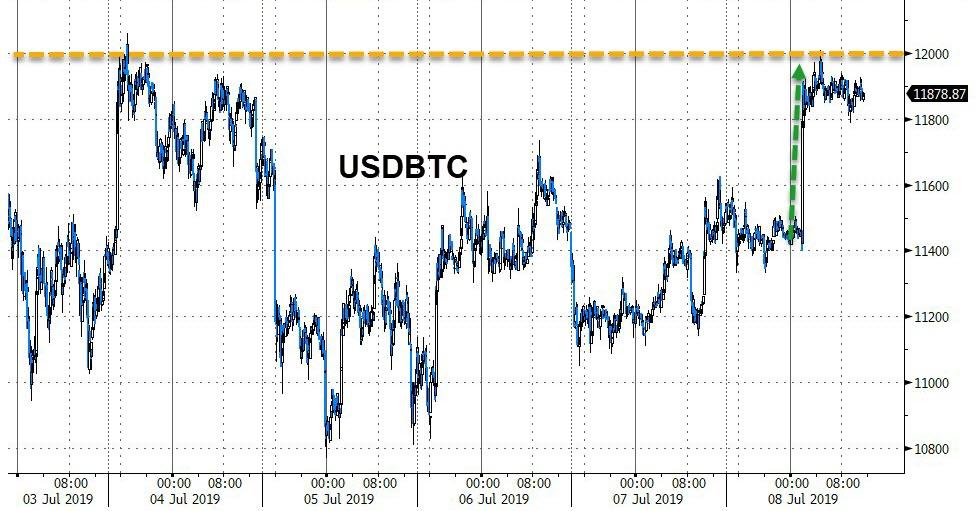
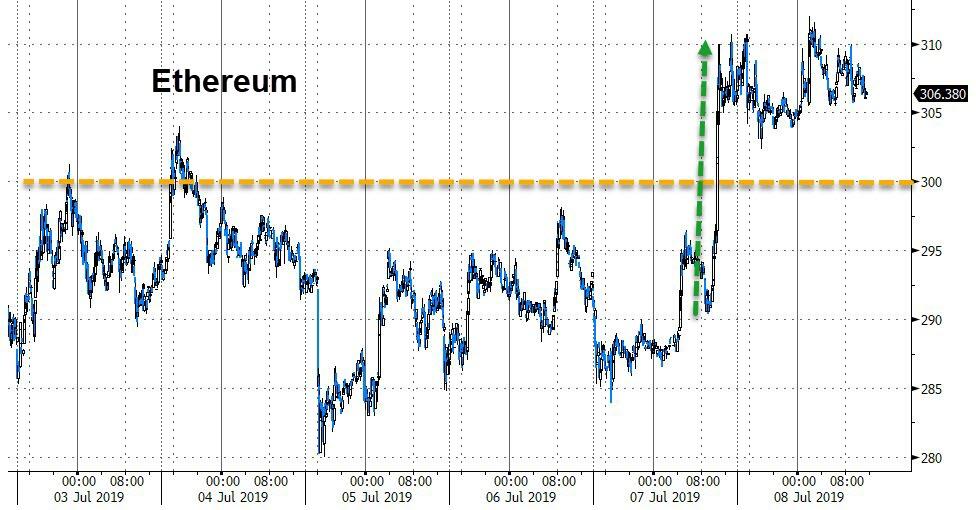
Big positive jolt overnight in cryptos pulled them all green from Friday with Bitcoin and Ethereum leading…
Bitcoin tagged $12,000 this morning but couldn’t quite hold it, for now…
And Ethereum broke back above $300
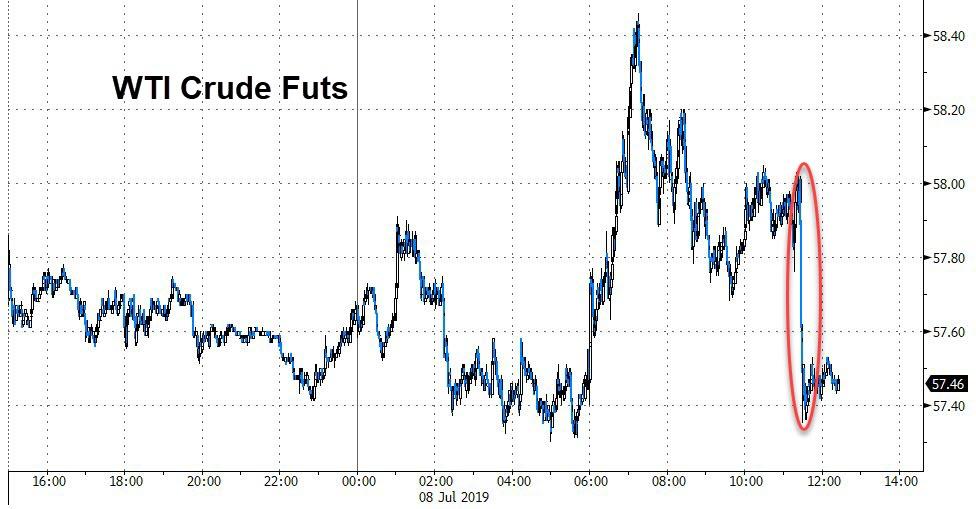
Silver surprised with some outperformance as copper and gold dipped…oil dropped notably into the NYMEX close…
Gold fell back below $1400…
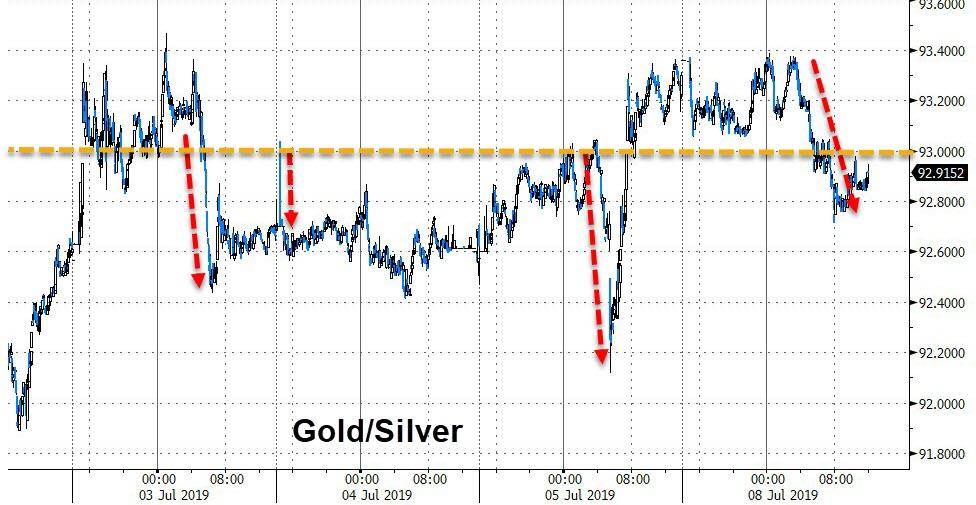
The Gold/Silver ration pulled back very modestly from 93x once again…
WTI snapped back below $58 as the NYMEX settle loomed…
Finally, in case you’re fed up with hearing about how awesome the economy is BUT we still need an “insurance cut” – here’s Gluskin-Sheff’s David Rosenberg to explain just how bad it actually is…
For those who “can’t see the recession”, it’s illustrated for you in this chart. The NY Fed model now pegs recession risk at 32.9%, a 12-year high. History shows there’s no turning back at this level. pic.twitter.com/hUteBhNOzr
Adding insult to injury was the OECD leading indicator, which dipped in May to 99 from 99.1 in April and 99.3 at the turn of the year. The overall level is now the lowest since the global economy was trying its utmost to climb out of the Great Recession in late summer 2009. pic.twitter.com/oQsNormL2j