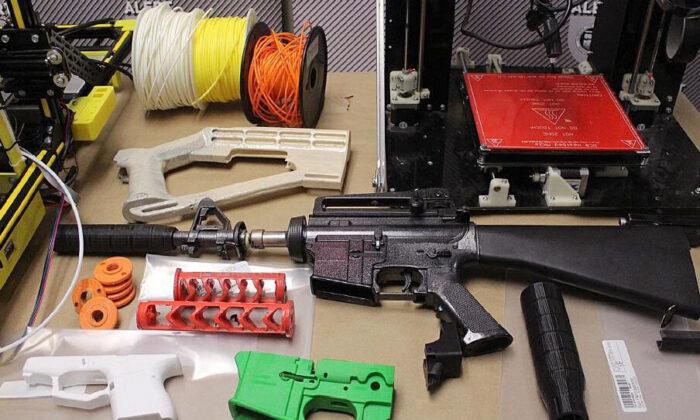
Sen. Ed Markey’s (D-Mass.) little-known 3D Printed Gun Safety Act (S. 2319) would criminalize sharing firearm schematics for 3D printers online.
3D printing describes a process that allows people to “print” 3D models for various items. These models range from small tools, art projects, and shapes up to functional firearms. Critics of the practice have called these 3D-printed firearms “ghost guns” because they lack serial numbers and are difficult for law enforcement to trace.
Despite their relative novelty, 3D-printed firearms have a rich legal history.
In 2018, Congress passed the Export Control Reform Act (ECRA), a foreign policy bill designed to restrict enemies’ access to U.S.-made munitions.
In March 2020, 22 states argued that 3D firearm schematics violated ECRA because they were accessible to foreign enemies. They brought suit against Defense Distributed (D.D.), a firm that provided schematics for 3D firearms. The plaintiffs argued that these schematics would cause them “irreparable injury.” Seattle District Judge Robert Lasnik agreed and issued an injunction against D.D. (pdf).
The Ninth Circuit Court of Appeals heard the case again this year on Apr. 27. The panel concluded in a split decision that courts had no say in the matter, asserting that “Congress expressly precluded judicial review … here,” and overturned the injunction against D.D. (pdf).
After this decision, the Justice Department proposed new regulations on 3D-printed guns. First, retailers would be required to run a background check on customers before selling kits containing necessary materials to print a firearm. Second, kits would be required to include a serial number on the frame or the receiver to make them more traceable. Finally, firearms dealers would be mandated to add a serial number to any guns they bought that did not have one.
Markey’s S.2319 would concretize federal rules against the distribution of 3D gun files. The bill alleges that these schematics “increase the risk that … felons, domestic abusers, and other people prohibited from possessing firearms under Federal law, will obtain a firearm through 3D printing.” Because these 3D guns are not traceable, S.2319 says, they are appealing to criminals.
S.2319 goes on to warn that such schematics “threaten to undermine the entire Federal firearms regulatory scheme and to endanger public safety and national security.” To address this alleged risk, the bill would make it “unlawful for any person to intentionally distribute … code that can automatically program a 3-dimensional printer or similar device to produce a firearm or complete a firearm from an unfinished frame or receiver.”
Sen. Robert Menendez (D-N.J.) joined Markey in introducing the bill in the Senate. In a press release, Markey said of the bill:
“With no background check required, untraceable and undetectable 3D printed guns serve as the ultimate gun-acquisition loophole. With the click of a mouse, anyone can download a computer file and use a 3D printer to manufacture a semi-automatic weapon. We cannot allow the online availability of downloadable firearms to add fuel to the fire that already is a massive gun violence public safety crisis.”
Menendez expressed the same concerns, saying: “With the click of a mouse, anyone with an internet connection and a 3D printer essentially has a license to print, shoot and kill. Undetectable and untraceable 3D-printed guns allow criminals to circumvent law enforcement and commit crimes. That’s why we must close the ‘3D Gun Loophole’ that allows dangerous individuals to exploit gaps in existing law to manufacture firearms at home they cannot otherwise legally obtain.”
s.2319 currently has 27 Democrat co-sponsors in the Senate. As of Monday, it remains in the Judiciary Committee. Still, with so many sponsors in the Senate, it is possible that Democrats may try to move the little-known bill out of committee for floor debate at some point. Even with the numerical Democratic majority, it would face a tough battle. Earlier this year, moderate Sen. Joe Manchin (D-W. Va.) said that he opposed Democratic gun control legislation in the House. If Manchin were to defect and join Republicans, then the bill would not pass without a Republican taking Manchin’s place and joining Democrats.
However, passing Congress would only be the first step for S.2319. Afterward, it would doubtless face legal challenges from D.D. and gun rights advocacy groups like Gun Owners of America.
In an interview with The Epoch Times, a spokesman for the Libertarian Party criticized the bill as impractical. He asked, “How would [the government] even enforce this law?” Later, he answered his own question, saying that “It would require Soviet- and CCP- levels of control [over citizens’ lives].” He also referenced litigation revolving around the issue of 3D schematics and doubted in the wake of this litigation that the bill could survive the courts. He referenced several cases and government settlements revolving around the issue.
In August 2017, D.D. sued the State Department and asked the U.S. Supreme Court to hear their case against it. D.D. claimed that the State Department barring their right to distribute 3D schematics online constituted a violation of the First Amendment. Though the Supreme Court declined to hear the case, the State Department eventually reached a settlement with D.D. that gave the firm a license to publish the schematics and a cash payment of $40,000. Heather Nauert, a spokesman for the State Department, said in a press conference that the agency agreed to this decision because “We were informed that we … have likely lost this case in court … on First Amendment grounds.”
In 1996, the Ninth Circuit Appellate Court ruled that source code was protected under the First Amendment (Bernstein v. U.S.). Because schematics like those provided by D.D. are a type of source code, standing U.S. law would prohibit restrictions like those found in S.2319.
Thus, the law would raise criticisms as a violation of the First Amendment. And indeed, the law’s authors had a preconception of this risk. The final clause in Sec. 3 of the bill says that “by making illegal the distribution of certain computer code that can be used … [to] create firearms … Congress seeks not to regulate the rights of computer programmers under the First Amendment to the Constitution of the United States, but rather to curb the pernicious effects of untraceable … firearms.”
Though the Supreme Court has refused to take the case in the past, it’s almost inevitable that S.2319 would go before the highest court if this legislation were passed. The result would be a huge landmark for gun control advocates if the Supreme Court upheld the law and a huge landmark for gun rights groups if the law were struck down. Either way, the legislation will have long-lasting national consequences if it is passed by Congress and signed into law.
Hedge Funds Dumped Chinese Stocks At A Record Pace, Setting Stage For A Furious Rebound
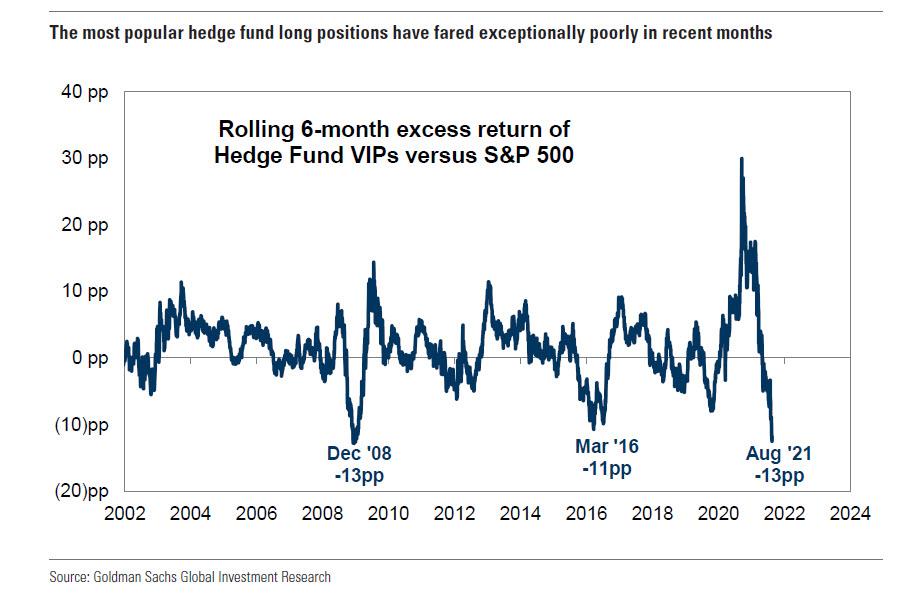
Late last week, when observing the stunning collapse in the most popular “hedge fund VIP” basket, whose 6 month performance now matches its worst stretch on record following the Lehman bankruptcy…
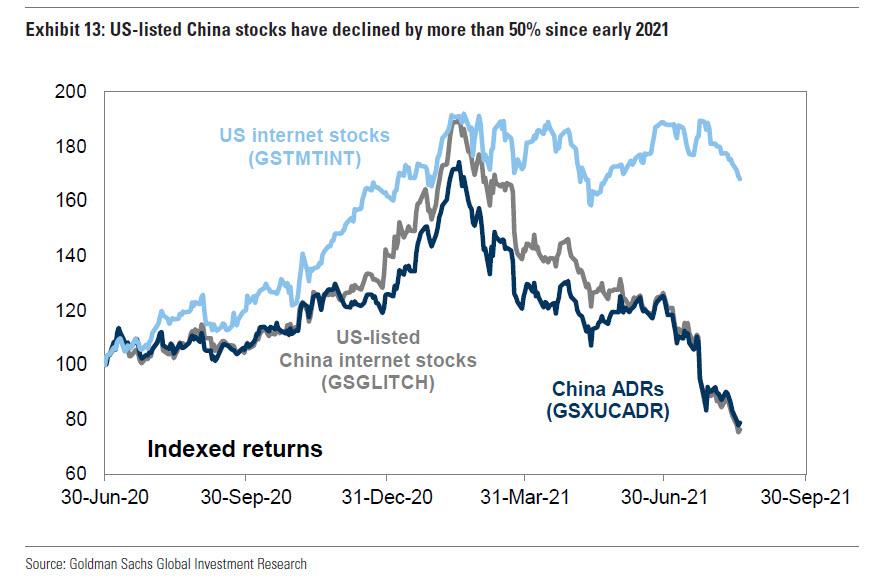
… we pointed to Chinese stocks one of the key culprits, with Goldman noting that one third of hedge funds in Goldman’s analysis held a China ADR in their long portfolio at the start of 3Q, contributing to the recent headwinds against hedge fund returns. Specifically, since the middle of February, a basket of China ADRs (GSXUCADR) has declined by 55%, with all but one of the stocks generating a negative return (UXIN being the exception) and 40 of the 46 stocks declining by more than 20%.
Naturally, with Chinese stocks continuing to slide, many were curious if hedge funds retained their Chinese exposure.
Well, courtesy of Goldman’s Prime Brokerage we now know the answer, and it is a decisive no. But first, some weekly performance stats from Goldman prime focusing on Asia hedge fund exposure:
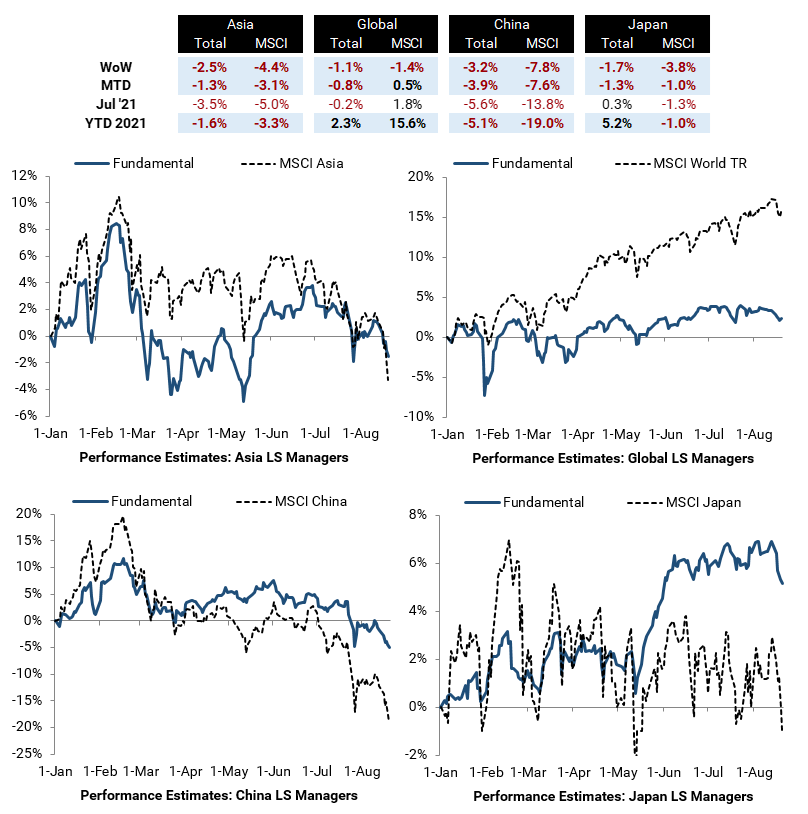
Performance Estimates (WoW as of 20th August 2021): Steep performance drawdowns last week as well as for the MTD period amid continued regulatory concerns
Asia Fundamental LS -2.4% vs. MXAP -4.4%
Asia managers were down -2.4% last week as MXAP was down -4.4%. Along with beta, the main drivers of negative returns were Asset selection, Volatility, country tilts (China) and Concentrated Longs.
MTD -1.3% vs. MXAP -3.1%.
YTD -1.6% vs. MXAP -3.3%.
China Fundamental LS -3.2% vs. MSCI China -7.8%
After a few relatively calm weeks at the beginning of the month, China managers experienced steep negative performance of -3.2% as MSCI China was down -7.8% last week. Main Drivers of negative performance were beta, Volatility, Concentrated and Crowded Longs and short term momentum.
MTD -3.9% vs. MSCI China -7.6%.
YTD -5.1% vs. MSCI China -19.0%.
In light of these massive drawdowns, it is then hardly surprising that trading flows were striking, and according to Goldman, last week saw the second highest weekly net selling for Asian equities in over 5 years, the highest ever selling for EM Asia, while Asian equities in total, saw record weekly net selling flows last week.
Asia was net sold WoW (-2.7 SD) with long sells exceeding short sells marginally in a ratio of 1.1 to 1.
DM Asia was net sold (-1.1 SD) driven by short sells exceeding long buys significantly
The record selling activity in EM Asia (-2.7 SD) was driven by long sells exceeding short sells in a ratio of 2.6 to 1.
10 out of 11 sectors were net sold last week – only Utilities was marginally net bought. The most net sold sectors were Consumer Discretionary, Communication Services and Info Tech.
MTD Flows for August also point to record monthly selling flows in the region with risk off activity in EM Asia.
Charts below focus on Chinese equities and show the cumulative trading flows by leg and type. Selling flows in the MTD period have been driven significantly more by ADRs, followed by A-shares and then by H shares.
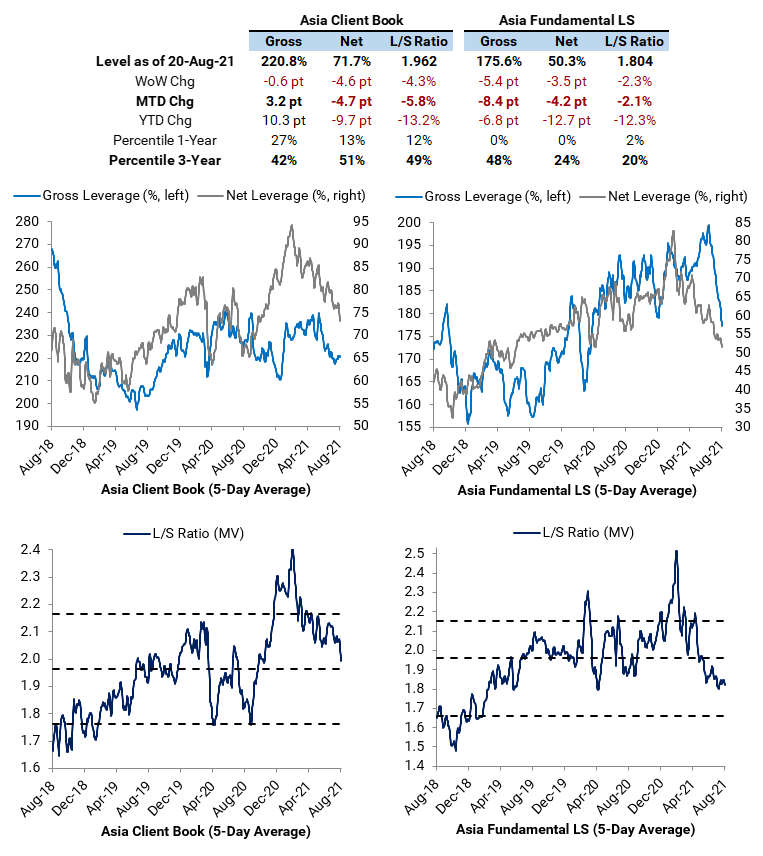
With flows a one-way street of selling, it is only logical that exposure likewise saw a major hit, with continued reduction in Gross and Net leverages for Asia fundamental managers, resulting current levels last seen in April 2020.
The numbers for the Asia Client Book (Delta-Adjusted) according to GS prime:
Leverage: Gross -0.6 pts to 220.8% (42nd percentile three-year), Net -4.6 pts to 71.7% (51st percentile three-year)
Long/Short ratio (MV) -4.3% to 1.962 (49th percentile three-year)
Asia Fundamental L/S
Both Gross and Net Leverages for Asia Fundamental managers continue on downward trend as seen in the recent past and are now at levels last seen in April 2020.
Net Leverage and L/S Ratios are at 24th and 20th percentile respectively for three year periods.
Leverage: Gross -5.4 pts to 175.6% (48th percentile three-year), Net -3.5 pts to 50.3% (24th percentile three-year)
Long/Short ratio (MV) -2.3% to 1.804 (20th percentile three-year)
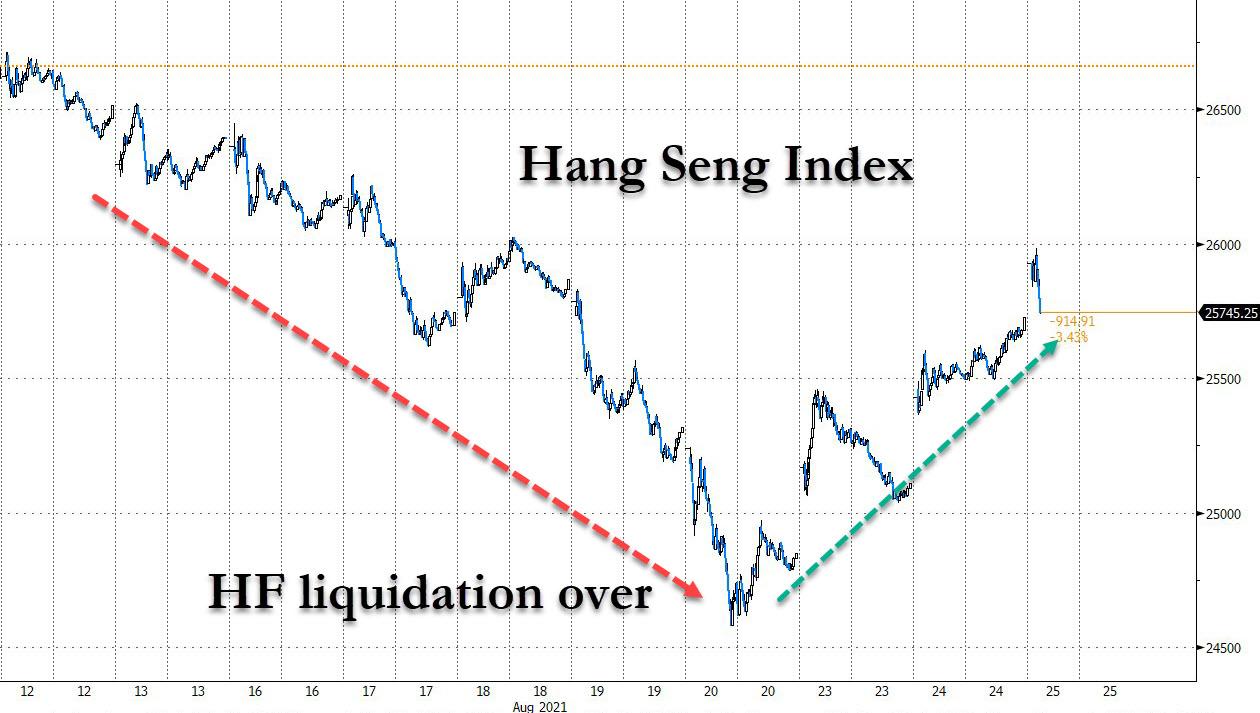
In short, last week is when hedge funds finally – and fully – capitulated in their Chinese (and Asian) exposure. And with little to no liquidation pressure left, it was obvious that Chinese stocks would ramp higher and on Wednesday equities stormed higher in Hong Kong, after the local Hang Seng index slid into to a bear market last Friday, surging for a third day while Chinese tech stocks also rebounded.
One of the more iconic casualties of the crackdowns — the Nasdaq Golden Dragon China Index – soared 8% overnight, after solid results from JD.com lured investors including Cathie Wood.
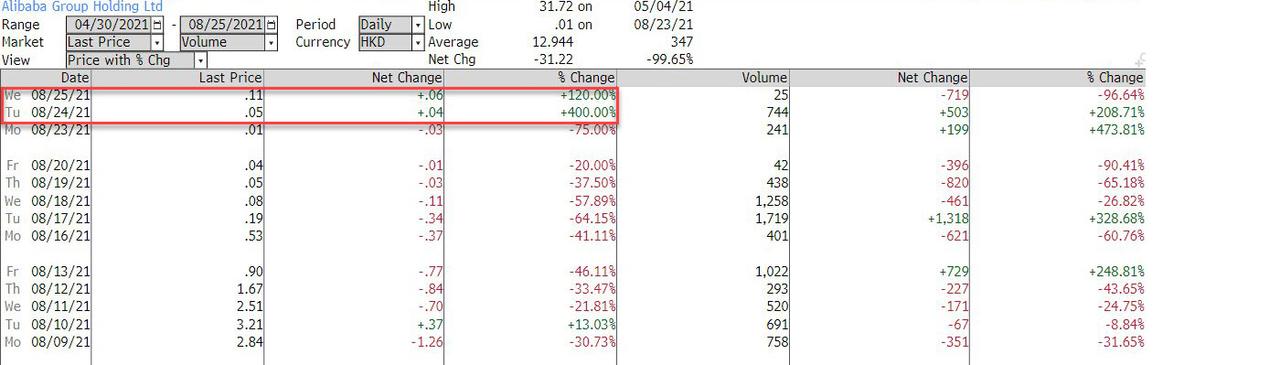
In fact, so furious is the rebound in Chinese tech that as Bloomberg’s Sofia Horta e Costa observed, investors are turning into speculative call-buying WSB daytraders, and are piling into bullish derivatives. To wit, sixteen of the company’s 20 most-traded Hong Kong stock options on Tuesday were calls, according to data compiled by Bloomberg.
One such contract, expiring Aug. 30 with a strike price of HK$200, jumped 400% on Tuesday (when Alibaba closed at HK$166.50 ) and saw another 120% of upside so far on Wednesday.
It was similar in the U.S., where about 700,000 call options changed hands, the most this year and more than double the volume of bearish puts. The trading activity follows a 21%, nine-day rout that dragged Alibaba to the lowest price since its 2019 Hong Kong listing, exacerbated by the abovementioned redemptions from China-focused funds.
Bottom line: with nobody left to sell, look for much more upside in Chinese tech names at least until Beijing pulls another shocker out of its sleeve and the liquidation returns with a vengeance.
On Monday, a group of nearly four dozen veteran organizations requested a meeting with President Joe Biden to discuss the evacuation of U.S. partners in Afghanistan and “fulfilling our commitment to our Afghan allies.”
“Failing to meet our obligations to these Afghans would not only be a national security risk – harming America’s reputation abroad and eroding the trust in our armed forces that is critical for future operations – it would also condemn veterans and survivors of the conflict in Afghanistan to a lifetime of moral injury,” the group wrote in their letter to Biden.
Forty-five organizations signed a letter to Biden, urging him to agree to a virtual meeting. The coalition wants to ensure there is a comprehensive plan to get all citizens and allies out of the country and say they want to assist in every way possible. In addition, the group wants Biden to ensure that all allies are granted emergency status to enter the United States and have access to resettlement benefits.
The Taliban seized the Afghan capital, Kabul, on Aug. 15 as the Afghan government collapsed and top government officials fled the country, prompting a frenzied evacuation of U.S. diplomats, citizens, and allies from the country.
After the closure of Bagram Airbase and withdrawal of all U.S. military troops, Biden was forced to deploy 6,000 troops to help secure the Kabul airport as thousands of Afghans flooded the airport to flee Taliban rule. Biden has faced sharp bipartisan criticism for his handling of the Afghanistan withdrawal.
Many, including veteran groups, have urged Biden to spare no resources to evacuate U.S. citizens and allies who supported the United States’ effort in Afghanistan. White House press secretary Jen Psaki said Monday that Biden’s top administration officials have reached out to the organizers of the letter and will meet with the coalition.
“We’ve been in regular contact with a wide range of veterans groups on Afghanistan and will continue to be, and we’re in touch with the organizers of this letter to arrange a meeting with senior White House officials to discuss this letter,” said Psaki, adding, “The VA [Veterans Affairs] is also working with VSOs and outside advocates on how to assist SIV [Special Immigrant Visa] applicants, which I know is a primary concern to a number of these groups, as it is to us.”
National security adviser Jake Sullivan told a reporter during the same press briefing Monday that the United States is working around the clock to get people out of Afghanistan.
“They [the U.S. military] have now facilitated the evacuation of more than 37,000 people out of the country since Aug. 14—American citizens, third-country nationals, our Afghan allies, and Afghans at risk of persecution or worse. In the last 24 hours alone, 28 U.S. military flights have evacuated approximately 10,400 people from Kabul.”
Supreme Court Rules Biden Admin Must Resume Trump’s “Remain In Mexico” Policy
The Supreme Court ruled late Tuesday against the Biden administration, upholding a lower court’s ruling to order the resumption of the “Remain in Mexico” policy implemented by the Trump administration,which requires people seeking asylum to wait in Mexico until their case is heard.
In a 6-3 vote, with the three liberal justices (Sonia Sotomayor, Elena Kagan, and Stephen Breyer) dissenting, the court rejected the administration’s plea to block the reinstatement of the program, which requires immigrants seeking asylum at the southern border to wait in Mexico while their applications are pending.
The order stated the Biden administration acted in an “arbitrary and capricious” manner when the Migrant Protection Protocols (MPP) program (the official name of the ‘Remain In Mexico’ program) was rescinded.
The Biden administration formally repealed the policy in June despite the crisis at the border (but in theory the policy ended the moment Biden entered The White House), and today’s Supreme Court decision rejected the administration’s bid to block U.S. District Judge Matthew Kacsmaryk’s ruling that revived the enforcement of the policy.
In a memorandum (pdf) to top immigration officials in June, Homeland Security Secretary Alejandro Mayorkas said a review determined the policy “does not adequately or sustainably enhance border management in such a way as to justify the program’s extensive operational burdens and other shortfalls.”
The Justice Department had asked the court last week to suspend the lower court’s order, saying the MPP “has been formally suspended for seven months and largely dormant for nearly nine months before that.”
As we detailed earlier in August, U.S. District Judge Matthew Kacsmaryk, a Trump appointee, found The Department of Homeland Security “failed to consider several critical factors” before axing the Trump era “Remain in Mexico” policy.
That included ignoring how the program was beginning to lead to some immigrants with asylum claims that lacked merit voluntarily returning home, he wrote in a 53-page ruling.
Kacsmaryk said the policy must be reinstated until it was “lawfully rescinded” and the administration had the capacity to hold all migrants.
Missouri Attorney General Eric Schmitt, another Republican, described the ruling as a “huge win for border security and the rule of law.”
As a reminder, The Epoch Times’ Zachary Stieber notes that the Trump administration established MPP in 2019 to deal with a surge in illegal immigration. Former President Donald Trump successfully partnered with Mexico to start the program, which saw the U.S. send some asylum seekers back to Mexico until their claims were heard.
Kirstjen Nielsen, who served as Homeland Security secretary during the Trump administration, said when the program was first implemented that it was in response to “a security and humanitarian crisis on the Southern border.”
“MPP will help restore a safe and orderly immigration process, decrease the number of those taking advantage of the immigration system, and the ability of smugglers and traffickers to prey on vulnerable populations, and reduce threats to life, national security, and public safety, while ensuring that vulnerable populations receive the protections they need,” she said in a statement at the time.
Biden and top officials this year have reversed or altered a number of key Trump-era immigration policies. The United States has seen a leap in illegal border crossings, culminating in a new 21-year-high in July.
What is Going on With Gun Control Right Now in 2021?
Just a general warning. The statements presented may start to sound like a conspiracy theory, but I promise you, dear reader, it is not.
There’s been much talk at the range recently about the new proposed gun control by the Biden Administration. Many people are perplexed. We get a ton of questions, emails, and phone calls asking, “Will this affect me?”, “What can I do?”, “Why are they doing this?” among others.
I want to answer these questions as best as I can. We’ve been in the firearms industry here at TMGN since 2013 and have had a shop & range since 2015, so we’ve seen tons of changes from different administrations. There is a clear agenda here, and I’m reasonably sure most gun owners are going to be a little unhappy with the information I’m about to deliver.
So, I guess the main question to answer first would be, how did we get here? Right now, we’re looking at two (maybe more, who knows what the future holds) rule changes coming from the Biden DOJ and the ATF. These rule changes are an example of the Biden Admin governing by executive fiat, as they know they don’t have the votes in the Senate to pass any of their gun control agenda. But let’s unpack this. This situation is a culmination of events starting way back.
NFA (National Firearms Act): The National Firearms Act of 1936. The NFA was the first major federal gun control act in American history. The NFA created a tax and registry for Suppressors (sometimes called silencers), Short Barrel Rifles & Shotguns (referred to as SBRs / SBSs respectively), and Machine Guns. If you wanted to own any of these items, you’d have to submit to a lengthy background check and pay a $200 tax. (Equivalent to $4400 in 1934) In return, you’d receive what’s known as a “tax stamp” showing that you were approved to own any of these “NFA items”.
FFL: Federal Firearms License, shortened to FFL is used interchangeably to refer to a Firearms licensee aka a Dealer, or the physical License that is given by the federal government for the ability to manufacture firearms and/or to sell them. FFLs are overseen by the ATF.
ATF Form 4473: The main form that people are required to fill out when purchasing a firearm. FFLs are required to hold this form on site for 20 years. The forms are used in the event a firearm is used in a crime, the ATF can “run a trace” on that firearm and figure out who it was last transferred to.
NICS: The National Instant Criminal Background Check System. The NICS conducts background checks on people who want to own a firearm or explosive, as required by law. When a person tries to buy a firearm, the seller, known as a Federal Firearms Licensee (FFL), contacts NICS electronically or by phone. The prospective buyer fills out the ATF form 4473, and the FFL relays that information to the NICS. The NICS staff performs a background check on the buyer. That background check verifies the buyer does not have a criminal record or isn’t otherwise ineligible to purchase or own a firearm.
1968 Gun Control Act: The creation of the system that we all know today. The GCA created the FFL system, banned mail-order guns, and more. This law has been updated a few times, most notably in 1993 with the Brady Handgun Violence Prevention Act, which created the NICS system we use today. The GCA replaced and updated the Federal Firearms Act, an older provision enacted in 1938.
2008 Heller Decision: In DC V Heller, the supreme court ruled that the 2nd Amendment protects an individual’s right to possess a firearm, unconnected with service in a militia, and use that firearm for traditionally lawful purposes. Before this, gun control advocates argued that the 2nd Amendment had more to do with state militias than individual firearm ownership. With this decision, the Supreme court said that view was incorrect.
Stabilizing Brace: Sometimes called a pistol brace. A Device designed to help shooters with limited mobility stabilize their firearm more easily. Attached to the rear of a gun, usually equipped with straps or some way to allow the shooter to use their forearm to help stabilize the firearm while shooting.
Bump Stock: Bump fire stocks are gun stocks that are specially designed to make bump firing easier, which assist semi-automatic firearms with somewhat mimicking the firing motion of fully automatic weapons but does not make the firearm automatic. Essentially, bump stocks assist rapid fire by “bumping” the trigger against one’s finger (as opposed to one’s finger pulling on the trigger) thus allowing the firearm’s recoil, plus constant forward pressure by the non-shooting arm, to actuate the trigger.
Ghost Gun: Made up term to make “homemade firearm.” It’s made to sound scary to those with little firearms knowledge. It has been common practice for people to build their guns. It’s also perfectly legal to do and has been for years, contrary to what corporate media outlets would like you to believe. If you make a firearm in your house for personal use, it’s legal and does not have to be serialized or registered. Although it still must conform to Federal firearms law and not violate the NFA.
So, where do we start?
The United States has a long history of gun control. But let’s not be complete pessimists here. On the bright side, the ability to carry a pistol concealed for self-defense has been significantly expanded in recent years and has been trending towards fewer restrictions nationwide since 1976 when Georgia established the “Shall issue” process we have today. (Shall issue is when you are guaranteed a permit should you complete the state’s process for acquiring said permit. whether that means taking a class or paying a fee. Inversely, States like Maryland and California use a process called “May Issue” where even if you complete the requirements for obtaining a permit, the state must still deem your “reason” for having said permit to be permissible. This has been declared unconstitutional in D.C. but that’s a story for a different time.)
What is ironic here is that if you were to look at crime statistics, most crimes committed with a firearm, said firearm is a handgun. Why? It’s simple. Criminals prefer smaller, more concealable firearms. It’s hard to conceal an AR15, regardless of barrel length. Ironically when anti pistol legislation is proposed, it’s much harder for the government to pass. So, the anti-gun lobby has (for now) given up on the issue. Instead, they’ve targeted the scary-looking modern sporting rifles of today. Most notably, the AR15. However, their aim does extend to most semi-automatic rifles that accept a detachable box magazine.
Now that we’ve established what they’re after, let’s talk about the events leading up to today.
On the evening of October 1st, 2017, Stephen Paddock opened fire upon the crowd attending the Route 91 Harvest music festival from the 32nd floor of the Mandalay Bay hotel. He killed 60 people and wounded 411. It was the deadliest mass shooting in the history of the United States. Paddock was able to achieve high rates of fire with a device known as a bump stock.
President Donald Trump ordered his Justice Department to find a way to ban the bump stock. The DOJ decided to classify the bump stock device as a machine gun in December of 2018, going into effect in March 2019. Since the only legal way to own a machine gun is to have a registered one on the NFA before 1986, bump stocks were effectively made illegal, and anyone in possession of one would be subject to 10 years imprisonment and a $250,000 fine.
The problem here is that a bump stock isn’t a machine gun. It’s not even a firearm at all. It’s a piece of molded plastic that uses the gun’s recoil, discharging a round to “bump” the trigger. It does not guarantee automatic fire, nor does it modify a semi-automatic rifle and “convert” it to full auto. The firearm itself would remain semi-automatic, and the bump stock would allow the user to fire faster, using the force of the recoil.
Most gun owners weren’t up in arms over the bump stock ban. Public opinion of the ban was positive. More comments supported the proposed rule change on the federal register than opposed it—a rare thing for gun control. Many gun owners viewed bump stocks as a novelty and wrote it off entirely. The issue, though, was much more complex. It had little to do with the bump stock itself and much more to do with reclassifying an item that was not a firearm itself under the NFA and effectively banning it with no recourse for gun owners.
Fast forward to 2020. In May, the ATF announced it was changing its 4473 form. The form change would go into effect in November of 2020. Most gun owners are familiar with this form, even if they don’t know it by name. It’s the form that is filled out anytime that you purchase a firearm from a firearms dealer. It holds all the information of the individual looking to buy a gun before the FFL performs a background check through the federal NICS system.
“Why is a simple form change relevant?” you might ask. Well, the ATF did update the form itself. But the ATF also changed the layout of the form dramatically. Before the change, the ATF had all the personal information for the individual filling out the form on the first page. The firearm information was located on a separate page. The change moved the buyer’s information and the firearm information (serial number, make, model, and more) to the first page. Here’s where we get into speculation a bit, but I promise, there’s a reason for it.
I believe that the ATF is setting up for eventually keeping a digital database of 4473s. They are currently forbidden to do this by law. The only way that they’re legally allowed to keep physical 4473 forms is at one of their facilities in Martinsburg, WV. That facility is so full of paperwork that recently, the floor just caved in.
What’s also important to know is that 4473 forms can (and should) be destroyed by dealers after 20 years. That means that the ATF will never keep those forms on file. Good FFLs do this. The only way for the ATF to acquire 4473 documents is if an FFL goes out of business, closes, or loses their license, they will need to turn over the forms that have not yet hit the 20 year mark. The ATF doesn’t like this. So eventually, I’m sure we’ll see a push for the ATF to digitize their data collection (hence the change to the 4473 form, as digitizing forms becomes much easier with all critical data on the first page).
A quick side note here is that the government should never know what firearms you own. It’s your constitutional right to own firearms. The same way it’s your constitutional right to speak your mind. You wouldn’t want the FBI to keep a database of your text messages, would you? Same concept. We also know from history that keeping a database of firearms owner information eventually leads to a registry. Gun registries ALWAYS precede confiscation. If you look at history, this is always the case. It’s better to not allow for a registry so that confiscation cannot occur because doing even light research on what happens to disarmed populations is a scary thing.
So let’s continue with what’s going on currently.
In Nov. of 2020, Joe Biden won the Presidential election. During his campaign, he had been known for extra inflammatory statements on gun control. Saying, “Yes, I’m coming for your assault weapon” and associating himself with Robert-Francis “Beto” O’Rourke, promising to nominate him as Gun Czar. Robert-Francis had famously said during a debate, “Hell yes, we’re coming for your AR15.” When speaking to union workers at a campaign stop, he told a worker who asked him about his gun control plans: “we’ll take your AR14s away”.
On December 18th, 2020, the ATF announced that it was planning to treat pistol braces as stocks and felt that they were being used to skirt the NFA and create unregistered Short Barrel Rifles. Gun owners came out in droves to comment on the Federal Register. A mere five days later, the ATF withdrew the pending rule change.
In 2021 things were quiet for the start of the year, President Biden primarily focusing on infrastructure, coronavirus, and taxes. That is until April 7th, 2021, when he held a press conference, announcing six actions that Biden is taking on gun control.
The Justice Dept. will make a rule to “help stop the proliferation of ghost guns.”
The DOJ will, after that, issue a rule about stabilizing braces.
The DOJ will publish model “Red Flag” legislation for states.
Biden will nominate David Chipman to serve as the Director of the ATF.
The DOJ will issue an annual report on firearms trafficking.
The Biden admin is investing in “evidence-based” community violence interventions.
At that moment, there was little information about any of the incoming rules. The only clear thing was that Biden’s nominee for the ATF would be David Chipman. David Chipman is a current gun-control activist and ex-ATF agent for those of you who don’t know. For all the Biden campaign sloganeering on “Healing a Divided Nation,” David Chipman has turned out to be one of the most divisive nominees yet, and one who has a clear ideological bias.
We know that David Chipman has a bias because during his confirmation hearings in May of 2021, He stated that he “supports a ban on AR15 style rifles.” He also has written numerous articles and made many public statements on his opposition to Americans owning firearms.
One of the most important things to know about David Chipman is that in 2017 he wrote an article for Giffords called “Legal and Lethal – 9 Products That Could Be the Next Bump Stock“. In the article, he speaks about how Congress must take action and ban things like High-Capacity Shotguns, AK & AR Style pistols, AR Pistol Arm Braces, 50 Caliber Rifles, Muzzleloaders, and more.
Shortly after David Chipman’s hearing, the DOJ announced its rule on “Ghost Guns.” Of course, It covers more than just people making firearms in their homes. The ATF decided firearm parts now need to be classified as firearms. Therefore, those parts need to have their background check done at the time of purchase. Their reason is that the gun control act of 1968 hasn’t been updated. At the time of writing, the GCA didn’t account for all the different parts that citizens could purchase separately. It’s estimated that if you took the average AR15 and applied this rule, the AR15 would have 12 or more regulated parts that would require a background check. Meaning that if you buy an AR15, under this new rule, you’d be buying 12 different legal firearms built into one legal firearm. Make sense? I don’t think so.
If you know anything about the history of the 1968 GCA, you know this is a total fabrication. A law prior called the Federal Firearms Act, which DID regulate parts, was replaced by the 1968 GCA. Congress found regulating firearm parts to be an “unworkable solution” and decided to regulate firearms by “frame or receiver,” not multiple parts.
The ATF is also looking to classify items that they feel are “readily assembled” into firearms themselves. The definition of this is extremely unclear. My guess is that they are targeting 80% kits. 80% Kits are uncompleted firearm receivers in an 80% done state, meaning that legally they aren’t considered firearms. The purchaser can complete these firearms themselves at home with some significant work, depending upon the kit and type of receiver. These kits are typically popular with hobbyists, not so much with criminals.
Lastly, this little lost detail that may be the most important of all: 4473 forms must be held INDEFINITELY by FFL holders, which means that FFLs can no longer destroy 4473 forms after 20 years.
Now here we are at the latest announcement, the ATF’s proposed rule on stabilizing braces.
On June 7th, 2021, the ATF announced its proposed rule change for “factoring criteria for firearms with attached stabilizing braces.” What they’ve done is create an overly complicated worksheet to ban all firearms with braces attached to them.
The proposed rule change goes like this: If your handgun has a brace on it, the ATF has a worksheet that determines if that brace, in its configuration on your pistol, creates a “short barrel rifle.” (Defined as a firearm with a stock and a barrel length of under 16 inches.) Essentially, the ATF thinks that people are using braces to skirt the NFA and create short barrel rifles without paying the tax and registering their guns on the NFA registry. So, they’ve made the most complicated worksheet imaginable, named Worksheet 4999, to figure this out. The worksheet takes things into account like weight, length of pull, optic or scope on your pistol, and use two hands to fire the gun (which all people do even when shooting non-braced firearms) many more criteria if you score too high, oops! You have an illegal firearm.
Probably the most egregious thing about Worksheet 4999 and the proposed rule change is that at the top of the sheet, there’s a disclaimer that essentially allows the ATF agent to deem your firearm as an illegal SBR regardless of if you pass the worksheet criteria and they feel that you are trying to circumvent the NFA. So even if you pass the worksheet, your agent may decide they feel like you’ve violated the law, and unfortunately, this rule change gives them the power to do so.
So, where does this all come together?
It’s obvious when you look at what’s happened and what’s been proposed where the Biden admin is headed for gun control. They are testing the waters right now with these two proposed rule changes, but I guarantee this is not the end. These current ideas have been taken right from the David Chipman “Legal and Lethal” playbook. There’s a part where Chipman writes this about semi-automatic rifles:
“The danger posed by firearms that enable shooters to continue firing in this manner is the same reason Congress chose to include machine guns in the NFA when it was originally enacted: these weapons enable a shooter to fire many bullets very quickly. Semi-automatic firearms equipped with large-capacity magazines do not, however, fall under the NFA. The NFA refers to machine guns as those firearms that discharge more than one shot without manual reloading, by a single function of the trigger. Firearms developed since the NFA and equipped with large capacity magazines rarely require manual reloading, but they can expel a lot of ammunition in a brief period. They do so by allowing a trigger to be pulled many times very easy and ensuring that there is almost always another bullet ready to go. Despite this, large-capacity magazines and semi-automatic firearms equipped with them (sometimes called “assault weapons”) are not regulated under the NFA, even though they pose an incredible danger to our communities.”
Take note here of Chipman’s idea that any semi-automatic rifle that can accept a “high-capacity magazine,” which I would assume is a magazine above ten rounds, is essentially a machine gun because they don’t need to be reloaded as often.
We should look to this article as essentially the playbook that the ATF will take in the future. They are words right from the potential Director’s own thoughts.
What potentially makes this situation more sinister is that they have the legal precedence to do so because of the bump stock ban. On top of that, the ATF’s next move of indefinite holds on 4473s, and the eventual argument for moving to a digital system means that you can bet that there will at some point be a push for a registry of who owns what.
As I said, it sounds like a conspiracy. The puzzle pieces are all laid out in front of you. It’s our duty as gun owners to fight back and secure our rights. We all need to leave comments on both proposed rule changes. Even if you’re a defeatist that doesn’t think that the comments will dissuade the ATF from stomping on your rights, keep in mind that groups will use your comments like Firearms Policy Coalition and Gun Owners of America to sue the ATF immediately should these changes take place.
This article has been a longer piece than usual, but I hope it’s helped you understand where we are today with gun rights. In the time it took you to read this article, you could have commented on both proposed rule changes, so please make your way to regulations.gov and make your voice heard!
Here’s How Afghanistan’s Economy Changed During 20 Years Of War
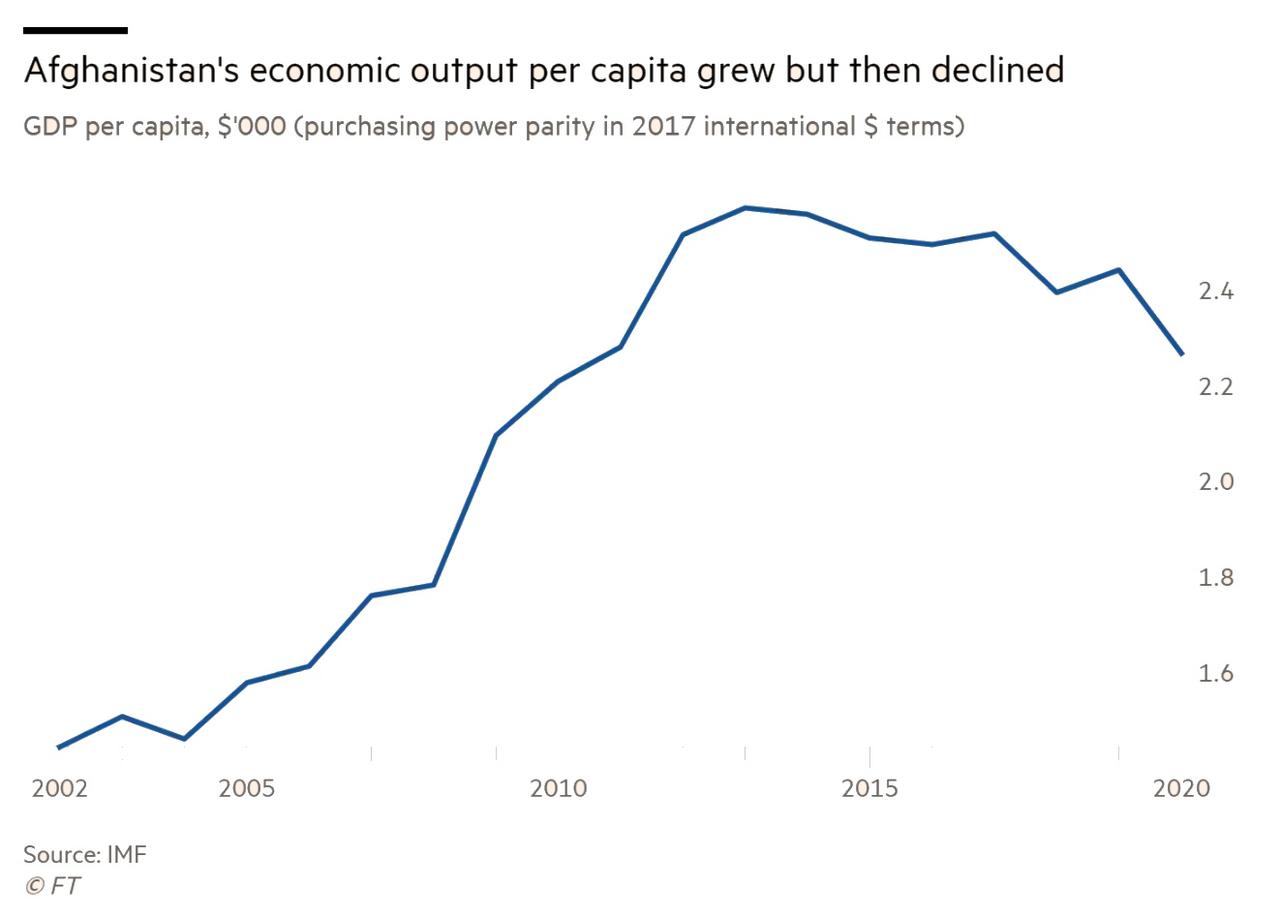
Amateur and professional bean counters are starting to take stock of what, exactly has changed during 20 years of war between the US and the Taliban. And while as China and Russia prepare to strengthen economic ties with the Taliban, the FT has published a mildly comprehensive rundown of how Afghanistan’s economic situation has changed since the US invasion began in 2001.
Speaking to the FT for a story about Afghanistan’s economic development, Gareth Price, senior research fellow at think-tank Chatham House, said that while Afghanistan had “changed dramatically” in social terms, “none of the main domestic generators of growth — notably mineral reserves — have been significantly tapped, aside from illegal mining”.
In other words, the Taliban has plenty of natural resources to plunder, and an eager buyer with China already making entrees to the Taliban (despite their obvious ideological conflict, just another example of China’s unyielding commitment to “true” socialism).
Living standards saw solid improvement during the early years of the US occupation, but the pace of improvement leveled off around 2010, when corruption in graft within the new Afghan government started getting really out of control.
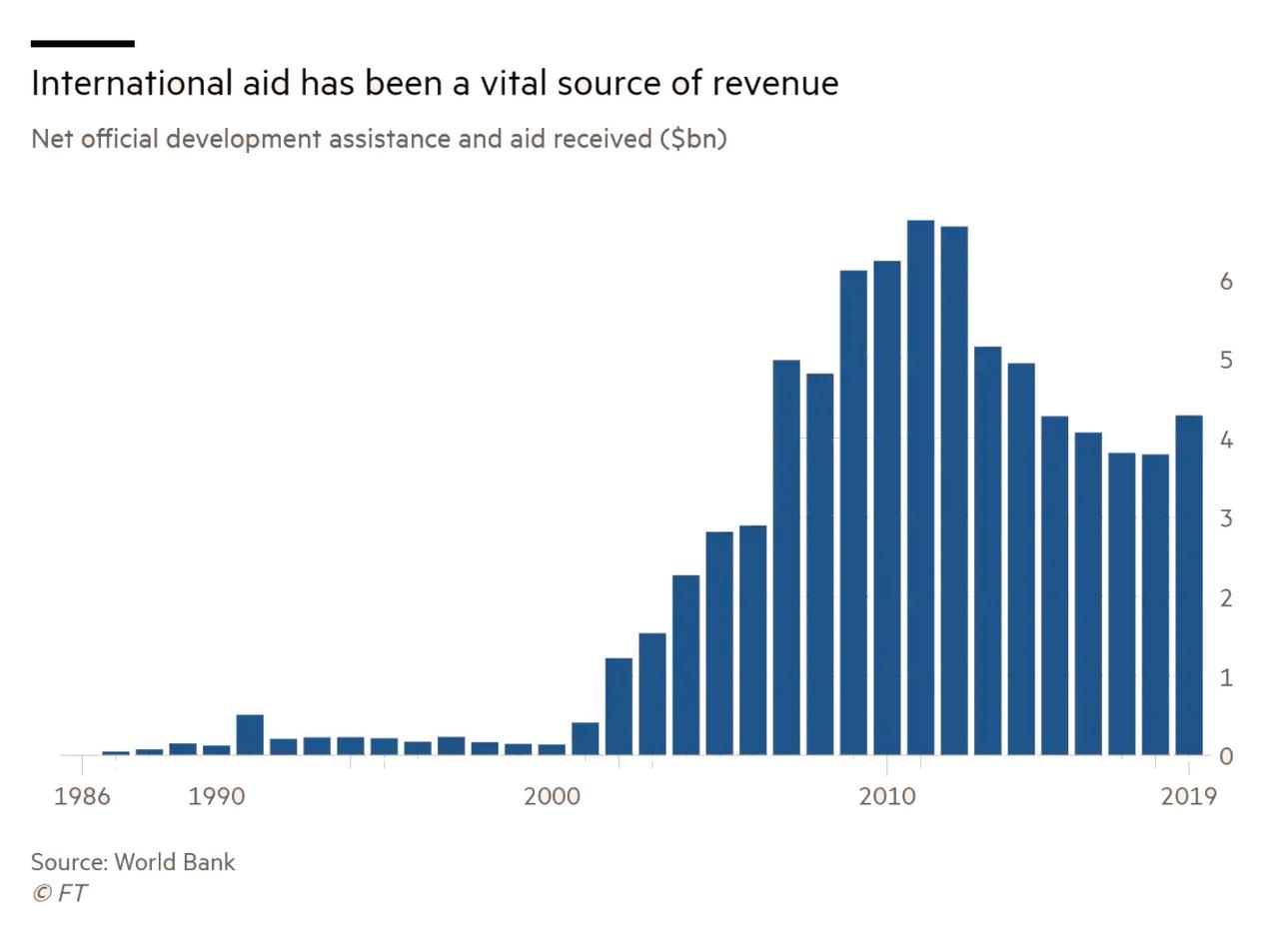
One of the biggest contributing factors: Aid flows fell from about 100% of GDP in 2009 to 42.9% in 2020 according to the World Bank, sending living standards lower as the services sector’s growth was constrained.
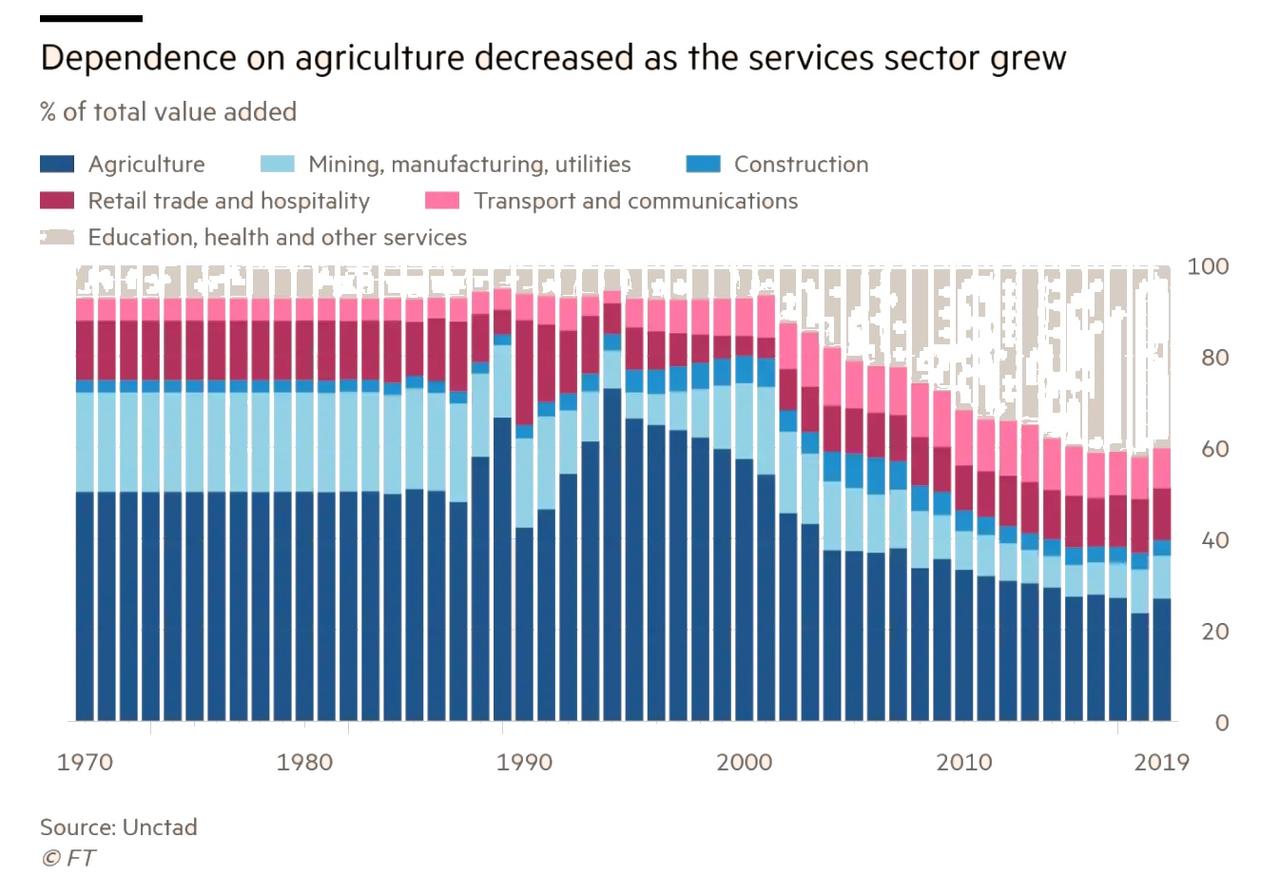
While services growth has remained somewhat stagnant, the country’s economy has continued to depend largely on agriculture. As of 2021, roughly half of its official exports are composed of grapes and other fresh fruit, although it’s importance has declined somewhat.
However, as one analyst pointed out, most of these figures should be taken with a grain of salt, since the illegal opium trade comprises a major portion of Afghanistan’s economy, along with other black-market trades from energy, to methamphetamine and other drugs.
While the Taliban are only just assuming control of much of Afghanistan’s legitimate economy, an editorial published last week in the NYT by a pair of Afghanistan experts alleged that the group has long controlled much of the country’s illegitimate, smuggling-based economy.
With this in mind, the Taliban’s advance has forced neighbors to confront a dilemma: They could either continue to trade, giving the Taliban more power and legitimacy, or deny themselves trade revenues and accept the financial pain. As pressure from China, Pakistan and Russia mounts, more countries will have little choice but to accept the status quo, with the Taliban returned to power in Kabul.
These days, it is a surprise when someone actually does something competently. It is often said that if you want something done right you have got to do it yourself, and today that is more true than ever. Just think about it. How often have you had a delivery delayed or messed up? How often have you had someone supposedly “fix” something but it isn’t actually fixed? How often have you purchased something that breaks shortly thereafter? And don’t even get me started on the complete and utter incompetence that we see in the tech industry. How hard could it possibly be to release a piece of software that is not riddled with all sorts of nightmarish bugs that need to be “patched” as soon as possible?
Sadly, in our upside down society some of the most incompetent people that you can imagine end up running entire organizations, and if you are particularly corrupt and useless you may get to be a politician.
By now, you are probably thinking that I am going to talk about Joe Biden in this article, and you are right.
In this era of extreme incompetence, it somehow seems appropriate that sleepy Joe is presiding over our “idiocracy”.
Barack Obama knew that this could happen. According to Politico, he once said that nobody should “underestimate Joe’s ability to **** things up”.
Everything that Biden touches seems to turn into a failure. Just look at the crisis on the border. It is the worst that it has ever been in our entire history, and we are being told that “morale is in the toilet” among our Border Patrol agents…
“Morale is in the toilet,” Jon Anfinsen, a spokesman for the Border Patrol’s union, told the Washington Examiner. “Morale is low because agents aren’t allowed to do their job — if our job is to be out patrolling the border in between the ports of entry and actively searching for people who have crossed illegally, but we’re not allowed to go do that job, it basically creates this defeated feeling in everyone.”
Thanks to Biden’s wonderful new policies, our Border Patrol agents have their hands tied and are not able to do their jobs, and as a result many of them show up to work “sort of downtrodden, almost dead inside”…
“Everyone shows up to work sort of downtrodden, almost dead inside, for lack of a better term,” Anfinsen stated. “They’re not allowed to [do] the job, and they know that people are getting away every single day, every hour.”
Of course it isn’t just on the border where Biden is completely and utterly failing.
He is doing such a “great job” with the economy that the term “Bidenflation” has been coined less than a year into his presidency.
And his response to the COVID pandemic has been a nightmare of historic proportions. If I were to tell you how I really feel about the decisions that he has been making during this pandemic, I would get censored into oblivion by the social media companies.
Right now, what everyone is talking about is how incompetent the Biden administration has been in handling the situation in Afghanistan.
The fall of Saigon in 1975 and the Iranian hostage crisis during the Carter administration both made America look really weak, but we have never seen anything like the debacle at the airport in Kabul.
The “terrorists” that we went it to destroy in 2001 now have us surrounded and cornered in half an airport, and there are still countless numbers of people that can’t get to the evacuation planes.
In fact, staff members that worked at the U.S. Embassy in Kabul feel like they have been completely betrayed by our government at this point…
Local staff members at the U.S. Embassy in Kabul are “deeply disheartened” by U.S. evacuation efforts and have expressed a sense of betrayal and distrust in the U.S. government, according to a State Department diplomatic cable obtained by NBC News.
The cable, which was sent Saturday, said memos were sent Wednesday inviting Afghan staff members at the embassy to head to Hamid Karzai International Airport in Kabul. It told them to take food and to prepare for difficult conditions.
When staffers went to the airport in response to that cable, they quickly found themselves in the middle of a nightmare…
Staffers reported being jostled, hit, spat on and cursed at by Taliban fighters at checkpoints near the airport, it said, adding that criminals were taking advantage of the chaos while the U.S. military tried to maintain order “in an extremely physical situation.”
Some staff members reported that they were almost separated from their children, while others collapsed in a crush of people and had to be taken to hospitals with injuries, the cable said. Others said they had collapsed on the road because of heat exhaustion, it said.
British forces have been leaving the airport and bringing back people that need to be evacuated, but for some reason the U.S. hasn’t done the same thing.
There are still thousands of Americans inside the country, and time is running out, because the Taliban won’t move the August 31 deadline…
The White House repeatedly refused to address the Taliban’s August 31 deadline to get US troops out of Afghanistan on Monday, dodging questions on the subject and snapping at reporters who asked how the government planned to save the remaining Americans stuck in Kabul.
The Taliban’s spokesman issued the sternest threat yet to Biden on Monday morning, saying there will be ‘consequences’ if US troops – who are holed up at the airport in Kabul evacuating tens of thousands of people and fending off an increasingly desperate crowd – don’t leave in the next eight days.
Biden should immediately resign, but he will never do that.
Of course there are others that also should share in the blame.
Just like much of the rest of our society, the brass at the Pentagon has been getting increasingly incompetent over the years, but up until recently it hasn’t been talked about too much.
But now that our failures in Afghanistan have been exposed for the whole world to see, the mainstream media is having a field day mocking them. For example, the following comes from the New York Post…
To the surprise of only the Biden administration and its top brass, the Taliban retook control of Afghanistan last week after 20 years of frivolous American adventurism. It was a spectacular failure of American diplomacy, statecraft, intelligence and, most of all, military capability. In short, mission very much not accomplished.
But that’s pretty much standard operating procedure for the nearly useless behemoth called the Pentagon, which hasn’t won a war since the kinder, gentler American government changed its name from the War Department to the Defense Department shortly after World War II.
So why don’t any of our top military officials ever get fired?
As Darren Beattie has pointed out, NFL head coaches are held to a much higher standard than our generals and admirals are…
Is the head coach always the problem with a bad NFL team? Obviously not. But a head coach is the highly-compensated captain of a $200 million operation, and his job is to win. Coaches who don’t win get fired, because being a perpetual, complacent loser is unacceptable.
The ongoing collapse of the U.S.-backed regime in Afghanistan is the geopolitical equivalent of an NFL team going 0-16 twenty seasons in a row. Perhaps it’s worse than that, in fact. The Afghanistan disaster is the equivalent of an NFL All-Pro team taking on a Division III liberal arts college, being shut out, and then crashing the team bus into a ditch.
If we were to start holding military officials accountable for their performance, firing Mark Milley would be a really good start.
I have absolutely no idea how someone like that got to be the chairman of the Joint Chiefs of Staff. Personally, I would not even trust him to mop the floors of the local Dairy Queen.
What is even more tragic is that millions upon millions of Americans unquestionably accept whatever our incompetent leaders tell them to believe without taking the time and effort to think for themselves and come to their own conclusions.
El Salvador Installs 200 Bitcoin ATMs As Crypto Set To Become Legal Tender
Back in June, we reported that El Salvador, the tiny Central American nation known as the home country of many of the migrants who wind up asking for amnesty at the southern border of the US, would become the first country in the world to recognize bitcoin as an official legal tender.
That was weeks ago. Now, the El Salvadoran government is preparing for its new era of relying on bitcoin as its primary means of transacting by installing 200 bitcoin ATMs – which are already popular in the US and in Europe.
Bukele, who is the principal figure behind the country’s push to adopt bitcoin, said El Salvadorans will soon be able to convert their bitcoin to US dollars immediately once bitcoin is recognized as legal tender. To help facilitate this, there will be 200 bitcoin ATMs and also 50 bank branches capable of allowing them to swap their crypto for fiat, and vice-versa.
The “Chivo ATMs” (named after the government’s official bitcoin wallet, also called “chivo”, which is a slang term for “cool”) will eventually be “everywhere” Bukele said, allowing El Salvadorans to withdraw cash or make deposits 24 hours a day without paying commissions or paying any fees. The app will also allow Salvadorans abroad to send money – both dollars and bitcoin instantly to their relatives in El Salvador, saving them the hefty commissions that companies like Western Union demand. Fee-free remittances are expected to save the country some $400MM per year.
Transactions will be commission free, he said, adding that there will also be 50 financial branches across the country for withdrawing or depositing money.
Those who refuse to use bitcoin will still have the option of using the US dollar, which will become the country’s other official currency.
“What if someone doesn’t want to use Bitcoin?” said Bukele. “Don’t download the [Chivo] app and continue living your normal life. Nobody is going to take your dollars…Someone can always queue up at Western Union and pay a commission.”
Bukele first announced his plans to make bitcoin legal tender at the Bitcoin 2021 conference in Miami. The bill swiftly passed through the country’s legislative assembly, and is now slated to take effect on Sept. 7.
On that day, Salvadorans will be able to download the government-backed Chivo digital wallet, and enter their ID number and receive $30 in bitcoin, according to comments from Finance Minister Alejandro Zelaya, who delivered an interview on a local TV station Monday. The government has also created a $150MM fund to back Bitcoin-to-dollar conversions, he said.
To help further strengthen El Salvador’s crypto economy, Bukele has also asked a state-owned geothermal power company to make its facilities available to bitcoin miners.
With crypto prices back on the rise, might the start of El Salvador’s big experiment have an impact on crypto markets? Or will Salvadorans overwhelmingly prefer transacting in US dollars instead of the digital currency?
A federal jury in Los Angeles on Aug. 23 convicted six southern California companies for taking part in a large-scale conspiracy to avoid paying $1.8 billion in customs duties by disguising aluminum imports as pallets.
China Zhongwang Holdings Chairman Liu Zhongtian poses for pictures just after traiding had started at the stock exchange in Hong Kong on May 8, 2009. (Mike Clarke/AFP via Getty Images)
The conspirators then sold the pallets to entities disguised to look like real customers with the intent of fraudulently inflating the value of China Zhongwang, the largest manufacturer of aluminum extrusions in Asia.
The six California companies, two aluminum firms, and four warehousing businesses were all related to each other. The jury found all six guilty of “one count of conspiracy, nine counts of wire fraud, and seven counts of passing false and fraudulent papers through a customhouse,” according to a press release from the Department of Justice.
“The aluminum sold to United States-based companies controlled by [Zhongtian] Liu was simply aluminum extrusions that were spot-welded together to make them appear to be functional pallets,” the DOJ said.
“In fact, there were no customers for the 2.2 million pallets imported by the Liu-controlled companies between 2011 and 2014, and no pallets were ever sold.”
Instead, two of the defendants in the case, China Zhongwang Holdings Ltd. and Liu, the company’s former president, stockpiled the pallets on nearly two million square feet of space owned by the defendant’s warehouse businesses: Scuderia Development LLC in Riverside; 1001 Doubleday LLC in Ontario; Von Karman—Main Street LLC in Irvine, and 10681 Production Avenue LLC in Fontana.
Since there was no demand for the pallets, Liu and China Zhongwang began to build and acquire facilities that could melt down the aluminum and turn it into a marketable commodity.
“The defendants facilitated their schemes by laundering hundreds of millions of dollars through shell companies to the U.S.-based aluminum companies controlled by Liu,” the DOJ said in the press release.
“The funds were then transferred to China Zhongwang and the other shell companies as payments for the aluminum.”
(L-R) China’s Liaoning province Deputy Governor Liu Guoqiang (L), China Zhongwang Holdings Chairman Liu Zhongtian and Hong Kong Stock Exchange Chairman Ronald Arculli (R) toast just after trading had started at the stock exchange in Hong Kong on May 8, 2009. (Mike Clarke/AFP via Getty Images)
China Zhongwang raised $1.26 billion in an initial public offering (IPO) in 2009 on the Hong Kong stock exchange. Liu was the majority owner of China Zhongwang at the time of the IPO.
Ford Is Again Hiking Its Production Targets For Its F-150 Lightning
While GM is dealing with nothing short of a total disaster with its Chevy Bolt and Tesla is focused on humanoid robots, Ford has been quietly garnering significant interest in its electric F-150 lightning.
In fact, interest has risen so much that Ford has doubled its production target for the vehicle ahead of its launch, which is supposed to be in 2022, according to Reuters. Ford is doling out $850 million to help it meet its launch target.
The company is going to attempt annual production of more than 80,000 vehicles in 2024, the report says, double its previous target of more than 40,000.
One source told Reuters: “They were pleasantly surprised by the demand for the Lightning.”
While Ford’s commercial customers were expected to push toward the shift to EVs, the company was uncertain as to whether or not individual customers would abandon their gas powered pickups for electric powered ones.
“We are excited with customer demand for the F-150 Lightning and already have 120,000 customer reservations, and we will continue to look for ways to break constraints and meet customer demand,” the company said in a statement.
Ford is planning on building about 15,000 of the model next year after its launch, and about 55,000 of the model in 2023, in a ramp up to its 2024 target.
Ford had already upped its production targets by 50% last November. This increase comes on top of that one.
Some, on Ford’s supply chain, are worried about whether or not the demand will truly meet Ford’s expectations. “It really puts suppliers in a dicey situation if the volume doesn’t come true,” one supplier told Reuters.