Futures Hit Fresh All Time High With Fed Meeting Looming

Futures Hit Fresh All Time High With Fed Meeting Looming

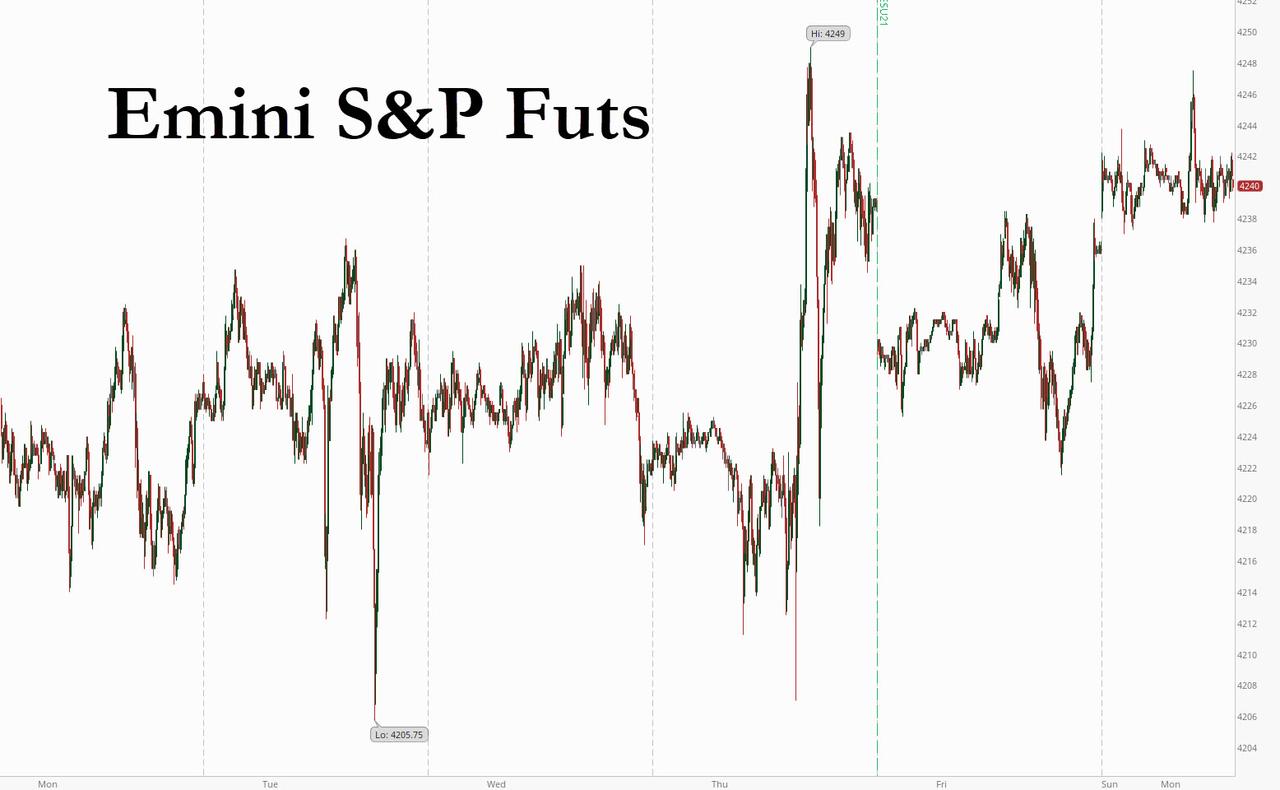
S&P futures hit a record high on Monday in a muted session which saw several Asian countries on holiday (China, Hong Kong and Taiwan are enjoying an extended weekend for the Dragon Boat Festival) as focus shifted to the Federal Reserve’s meeting this week, where the central bank is expected to maintain its accommodative stance on monetary policy although there is some debate whether the Fed will hint at tapering and/or hike its administered rates (IOER/RRP). At 730 a.m. ET, Dow e-minis were down 14 points, or 0.04%, S&P 500 e-minis were up 3 points, or 0.07%, to 4,239 and Nasdaq 100 e-minis were up 45 points, or 0.33%. 10Y yield rose as the rally in bonds lost steam while the dollar was flat, and the VIX traded below 16. Bitcoin traded near $40,000 after Musk tweeted over the weekend that Tesla had not sold more of the crypto.
In premarket moves, oil giants Chevron, Exxon, Marathon, Schlumberger, Occidental and Marathon Petroleum rose between 0.2% and 1.3% as crude prices hit their highest levels in more than two years. United Airlines Holdings and American Airlines Group rose 0.7% each after Citigroup raised its price target on the stocks. Some other notable premarket movers:

  • Retail favorite AMC Entertainment climbed in U.S. premarket trading, extending Friday’s 15% rally. Other meme stocks are also gaining. AMC traded at $50.70 in premarket trading, up 2.6% from Friday’s close of $49.40. The stock rose 3.1% last week after almost quadrupling over the previous two weeks, with the money- losing movie theater chain having become the new favorite of meme-stock investors
  • GameStop rises 1.7%, extending Friday’s 5.9% advance.
  • Among other meme stocks climbing on Monday, Clean Energy Fuels adds 4.4%, Jaguar Health +3.7%, Naked Brand +3.1%, Workhorse +2.3%

Recent data has indicated that the U.S. economy is regaining momentum but not overheating, taming worries about inflation and sending the S&P 500 to an all-time high.  While the Fed has reassured that any spike in inflation would be transitory, policymakers could begin discussing the tapering of bond buying at the Tuesday-Wednesday meeting. As a result investors will be closely looking for any signals from the Fed about a timetable for scaling back emergency monetary stimulus. Most analysts, however, don’t expect a decision before the central bank’s annual Jackson Hole, Wyoming, conference in August. To be sure, any shift in the Fed’s dovish rhetoric could upend equity markets. The benchmark has climbed 13% this year while the Dow and the Nasdaq have risen 12.6% and 9.2%, respectively.

“The overarching theme should be of an environment for investors to put cash to work,” Mizuho’s head of multi-asset strategy Peter Chatwell and colleagues wrote in a note to clients. “With this backdrop most asset classes should be able to at least hold ground, if not rally. We doubt any major change in Fed rhetoric will materialize before” the Jackson Hole symposium in August.

Ahead of the Fed, market euphoria was not confined just the US futures and spilled over across global markets, even though a sharp earlier advance in European equities led by shares in energy firms, faded as the session extended. The Stoxx Europe 600 Energy index rose 1.6% gaining the most among sectoral gauges in the region and tracking stronger oil prices. Renewable shares also climb after pledges made by G-7 leaders over the weekend. Oil hit a 32-month high as the rollout of coronavirus vaccines boosted demand expectations, while confidence faded over a quick return of Iranian crude supply. Here are some of the biggest European movers today:

  • TeamViewer shares jump as much as 6.7% after the company announced a new partnership with SAP.
  • Serco rises as much as 5.5% after the company raises its 2021 underlying profit guidance. Liberum (buy) says the outsourcing firm has continued its strong start to the year, especially in the U.K.
  • Ubisoft gains as much as 1.4% after the E3 video-game trade show kicked off at the weekend. The company gave a first look at new games, with Jefferies saying that sentiment toward both the known and new content reads positively.
  • Philips drops as much as 8.4% before paring losses after the company recalled ventilation devices used to treat sleep apnea and increased its cost estimate for addressing a defect that may potentially cause cancer.
  • Ferrari falls as much as 2.9% after Goldman Sachs downgraded to sell from buy due to an expected increase in capital expenditure and limited positive earnings revisions after an Ebit target was deferred.

Earlier in the session, Asian stocks were little changed as a number of the region’s markets were shut for a holiday. The MSCI Asia Pacific Index swung between a 0.2% gain and 0.1% loss after capping its first weekly decline in a month on Friday. Healthcare stocks provided the biggest support to the regional benchmark, while financials were a drag. Markets were closed in China, Hong Kong, Taiwan and Australia. “For this week, some cautious sentiments may linger ahead of the FOMC meeting as investors weigh the prospects on when the Fed may begin tapering discussions,” Yeap Jun Rong, a market strategist at IG Asia Pte., wrote in a note. The S&P 500 climbed to a new record and capped its third week of gains on Friday amid growing optimism that surging inflation won’t last long. Fed officials this week could project an interest-rate liftoff in 2023, but they won’t signal scaling back bond purchases until August or September, according to economists surveyed by Bloomberg. “The rotation from growth to value seems to be taking a pause over the past few weeks, as easing concerns on persistent inflation have garnered some interest back in growth,” Yeap wrote. Stocks rose in Japan while those in Indonesia and Thailand both dropped

In rates, The Treasury 10-year yield rose to 1.46% after hitting three-month lows on Thursday amid the biggest weekly slide since December. French and German government bond peers also reversed course with yields turning higher. Yields are cheaper by less than 1bp from across the curve; bunds, gilts outperform slightly while Italian bonds lag following large block seller in futures. Treasuries were slightly cheaper across the curve amid bearish trade recommendations by sell-side strategists following last week’s sharp bull-flattening rally. Focal points for U.S. trading this week include 20-year bond reopening Tuesday and Wednesday’s FOMC decision.

The dollar was steady in the wake of a Group-of-Seven leadership meeting that emphasized unity

In commodities, oil extended a run of three weekly gains, hitting a 32-month high with optimism building that economic reopenings will help propel summer demand in both the U.S. and Europe.Hedge funds boosted net-bullish positions to a nearly three-year high, according to the latest Commodity Futures Trading Commission data.

Bitcoin got a fresh jolt over the weekend after Elon Musk said Tesla would allow transactions with the cryptocurrency once mining is done with more clean energy. Bitcoin was trading near a two-week high by Monday morning.

On today’s calendar, there is little of note on the economic calendar. The NATO summit takes place in Brussels today ahead of tomorrow’s meeting between Biden and Putin.

Market Snapshot

  • S&P 500 futures up 0.1% to 4249.75
  • STOXX Europe 600 up 0.26% to 458.68
  • German 10Y yield rose 0.5bps to -0.268%
  • Euro little changed at $1.2114
  • Brent Futures up 1.18% to $73.55/bbl
  • Gold spot down 1.07% to $1,857.38
  • U.S. Dollar Index little changed at 90.51

Top Overnight news from Bloomberg

  • Group of Seven leaders debated how strongly to respond to China’s effort to win influence around the world and rebuke it over alleged forced labor practices — with U.S. President Joe Biden taking a more hawkish stance and some other leaders wary of the risk the group is seen as an outright anti-China bloc
  • The surge in the Covid-19 delta variant first identified in India has forced Boris Johnson and his team to rethink their blueprint for ending social distancing rules on June 21. Now, officials expect the premier to announce a delay of as long as four weeks to the easing of most rules when he sets out his decision to the nation on Monday evening.
  • Benjamin Netanyahu, famous for his ability to maneuver out of the tightest political binds, was unseated Sunday after 12 straight years in power by a brittle governing alliance whose ability to end years of political chaos will be challenged by stark internal divisions
  • Oil hit a 32-month high as the roll-out of coronavirus vaccines underpins an improved demand outlook in the U.S. and Europe
  • President Joe Biden said Russian President Vladimir Putin is correct that relations between their countries are at a nadir, suggesting that will be one of the few points of agreement when they meet Wednesday for their first summit.

Quick look at global markets courtesy of Newsquawk

Asian equity markets began the week quiet amid holiday-thinned conditions with the absence of key markets in the region as Australia was closed in observance of the Queen’s Birthday and with mainland China, Hong Kong and Taiwan on an extended weekend for the Dragon Boat Festival. In addition, participants got to digest last week’s G7 meeting where leaders called out China on human rights and agreed to a new global infrastructure initiative dubbed the Build Back Better World to rival China’s Belt & Road initiative. Furthermore, this week’s busy slate of central bank updates, including the FOMC and BoJ further contributed to the tentative mood. US equity futures traded with incremental gains overnight, and the NQ reclaimed a 14k handle. Nikkei 225 (+0.7%) moved above the 29k level after it coat-tailed on the recent upside in USD/JPY, which has resulted in outperformance among Japan’s exporters and with firm gains also in Toshiba after it ousted four executives in the fallout from the recent probe findings regarding collusion with government officials against foreign investors. The KOSPI (+0.1%) was flat with the largest automakers lackluster despite a near 58% jump in South Korea’s auto exports last month led by Hyundai Motor and Kia Motors, with their shipments higher by 73.8% and 70.8%, respectively. However, Hyundai also announced to temporarily suspend output in its US plant for three weeks due to chip shortages and maintenance. Conversely, Celltrion shares outperformed after its Phase 3 trial showed its antibody COVID-19 treatment Rekirona was safe and effective whereby it slowed severe symptoms of COVID-19 in more than 70% of patients. India’s NIFTY Index (U/C) underperformed somewhat on a pullback from record highs and with heavy pressure on Adani Group companies after the National Securities Depository froze three foreign accounts that have exposure to the group, which could be due to disclosure issues. Finally, 10yr JGBs traded sideways on both sides of the 152.00 level after it plateaued late last week, with demand hampered as Japanese stocks remained afloat due to the lack of BoJ bond purchases in the market with the central bank only seeking Treasury Discount Bills and Commercial Paper.

Top Asian News

  • Carlos Ghosn Escape Accomplices Plead Guilty in Tokyo Court
  • India’s RBI Tolerating Faster Inflation Amid Growth Focus
  • Thailand Misses Vaccine Target as Shortage Hits Mass Rollout

European cash and futures kick the risk-packed week off on a modestly firmer footing (Euro Stoxx 50 +0.4%) but have since waned off best levels after the DAX hit an all-time high (ATH) and the FTSE 100 hit levels last seen in February 2020. Nonetheless, the cash open contrasts the directionless European session experienced all last week. That being said, US equity futures see marginally less pronounced gains and trade closer to the flat-mark – but the NQ reclaimed 14k+ status overnight and tested its April peak/ATH around 14,060. From a central bank perspective, heading into the cash open, ECB-hawk Holzmann suggested it is too early to discuss the end of stimulus and that a transition from pandemic-era to ‘normal’ stimulus will be discussed in the Autumn, which did not do much in terms of immediate price action across EUR assets at the time; although, may help underpin sentiment against the backdrop of the ECB sources last week which suggested some diverging views on PEPP among the GC members. The macro focus this week undoubtedly falls on the FOMC decision on Wednesday for any signals regarding the potential start of the taper conversation. Back to Europe, most bourses are experiencing mild and broad-based gains with some underperformance experienced in the SMI (+0.1%) and FTSE MIB (+0.2%) – with the former’s gains hampered by a downbeat performance among its heavyweights Nestle, Roche, and Novartis, whilst the FTSE MIB is pressured by Ferrari (-1.0%) following a downgrade at Goldman Sachs. Turning to sectors, Oil & Gas is the clear outperformer as Shell (+2.0%) underpins the sector (14% weighting in the Stoxx 600 Oil & Gas Index) following source reports that it is reviewing the potential sale of its Permian Basin which could fetch over USD 10bln, but a deal is not guaranteed. Travel & Leisure meanwhile was the underperformer at the cash open as England’s lockdown is poised to be extended by four weeks – with a review to take place in two. The Basic Resources sector is now the laggard as LME base metals remain lackluster with a lack of Chinese demand amid the domestic holiday.

Top European News

  • Johnson Set to Delay Lifting Covid Rules as U.K. Cases Rise
  • Fed- Up Young Staff Fear They Need Offices to Save Their Careers
  • Hungary Likely to Back Quarterly Rate Hike, Pleschinger Says

In commodities, the Dollar is narrowly mixed against major counterparts and a bit more divergent vs EM currencies in the run up to Wednesday’s FOMC and some data that could impact along the way, including US PPI, Retail Sales and IP. However, the index has faded just shy of Friday’s 90.612 high and is now probing support or underlying bids under 90.500 within a 90.602-461 band in somewhat thinner trade due to several market holidays overnight (mainland China, HK, Australia and Taiwan).

  • NZD/AUD/EUR/CAD – A couple of positives for the Kiwi, as the aforementioned absence of Australian participants to mark the Queen’s Birthday kept the Aud/Nzd cross capped around 1.0800, while Nzd/Usd got an independent fillip via 2021/22 and 2022/32 GDP forecast upgrades from NZIER’s quarterly economist survey to stay firmly above 0.7100 between 0.7122-50 parameters. Conversely, Aud/Usd is only just staying afloat of 0.7700 ahead of RBA minutes. Elsewhere, the Euro is holding just above the 50 DMA vs the Buck (1.2093), but well below option expiry interest at 1.2150 (1.3 bn) and the Loonie is meandering from 1.2168-45 amidst strength in crude prices pre-Canadian manufacturing sales.
  • JPY/CHF/GBP – The Yen is straddling 109.70 in wake of firmer final Japanese ip data, while the Franc is hovering above 0.9000 and 1.0900 vs the Euro following a pick up in Swiss producer/import prices, but dip in sight deposits at domestic banks before attention turns to SNB and BoJ policy meetings later this week. In contrast, Sterling is flagging against the Buck and Euro amidst reports that UK PM Johnson will confirm a 4 week delay to lifting the remaining lockdown restrictions that were due on June 21, with Cable under 1.4100 and recent lows, while Eur/Gbp is probing 0.8600 to the upside after a post-ECB retreat as wrangling with the EU on the NI protocol continues.
  • SCANDI/EM/PM – Nok/Sek has traversed parity again, as the Norwegian Krona derives traction from Brent topping Usd 73.50 at one stage, while the Swedish Crown takes note of warnings from the Stability Board about considerable risks associated with high property prices. However, the Try has picked up right where it left off last week by reclaiming more losses, and perhaps with assistance from a narrower than anticipated Turkish current account deficit to compound the general technical retracement from record lows. On the flip-side, the Cnh has depreciated without guidance from the PBoC due to China’s Dragon Boat Festival and on recriminations out of Beijing over the G7’s human rights rebuke, while the Rub has handed back post-CBR rate hike gains and Zar reverses alongside Gold that is testing key support levels having failed to retain Usd 1900+/oz status. Specifically, technicians have been underlining the significance of Usd 1855 that aligns with a Fib retracement and is just beneath a recent trough at Usd 1856.18 from June 4.

US Event Calendar

  • Nothing major scheduled

DB’s Jim Reid concludes the overnight wrap

I had a lovely hot birthday weekend and although I double bogeyed the last at the end of a good round in a big tournament on Saturday, which ruined by mood in the evening, l’ve had my handicap cut to the lowest it’s ever been at the ripe old age of 47 after playing for 36 years! So there’s hope yet in old age. I’ve set myself an ambitious task to get as close as I possibly can to scratch before my knees, hips, back, shoulder, tennis elbow, bunions, stiff neck, and baldness finally catch up with my swing.

I’ve found in life that the only thing more complicated than unlocking a golf swing is working out bond markets in an era of extreme intervention. Indeed one of the questions I’ve received most from clients over the last week or so is why US Treasuries have rallied so much over recent weeks in the face of what is unambiguously higher inflation data. Well DB’s Francis Yared has helped try to explain this in his piece here from Friday. Let me paraphrase some of the conclusions: (1) weaker NFP which the Fed and market seem more fixated on than the surging quits rate and JOLTS data amongst other stronger labour indicators; (2) a more dovish ECB as 1-2 months ago the market was seriously considering a June taper; (3) an injection of liquidity via the decline in the TGA (Treasury General Account) balance – (see the piece for more); (4) a sharper decline of credit growth in China and industrial commodities stalling even if oil hovers within $2-3 of 6.5 year highs; (5) reduced expectations for the US infrastructure package; (6) Covid Delta variant raising question marks about the steady state level of reopening later this year; and finally (7) the old favourite positioning. The strategic view is still for higher rates and inflation expectations that as a minimum are back in the 1998-2014 range.

Related to this debate the highlight of the week is undoubtedly the FOMC conclusion on Wednesday with tapering discussions, dot plots, latest economic projections and inflation the focus of attention. Otherwise, geopolitics will be heavily in focus. After the G7 summit conclusion permeates into markets, a NATO summit is held today, an EU-US summit takes place tomorrow, before US President Biden meets Russian President Putin on Wednesday in Geneva. In addition, we’ll get an increasing amount of data from the US for May (including PPI and Retail Sales), along with a monetary policy decision from the Bank of Japan.

Starting with the Federal Reserve, their decision on Wednesday represents the next big event on the market calendar, and the first time that we’ll hear from Fed officials since we’ve had another higher-than-expected inflation reading, that saw CPI inflation reach 5.0% year-on-year in May. At the last meeting in April, Fed Chair Powell reiterated his view that the price pressures would be transitory and were associated with the reopening process, so it’ll be interesting to see if he modifies his language on this at all. Nevertheless, markets are buying the Fed’s message for now, with yields on 10yr Treasuries closing at a 3-month low on Thursday. But it’ll be fascinating to see the dot plot from the FOMC as well as their forecasts for inflation, since last time in March the median dot still had rates on hold at the end of 2023, in spite of the fact that inflation was modestly above target then, reflecting their new average inflation targeting approach.

With regards to the Fed the dot plots our economists don’t expect the 2023 median rate forecast to suggest lift-off yet but it could be a close call. Two members would need to join the seven currently expecting a hike by 2023 for the median dot to rise. The press conference will be all about “talking about talking about” for tapering and whether we are there yet. Again our economists expect no formal conditions to have been met to accelerate this but we may get some fresh markers as to their progress on this and what they are looking for. See our economists’ preview here.

Asian markets have started the FOMC week on a mixed note with the Nikkei (+0.59%) up while the Kospi (+0.02%) is flat and India’s Nifty (-0.75%) down. Markets in Hong Kong, China and Australia are closed for a holiday. Outside of Asia, yields on 10y USTs are up +1bps to 1.463% while futures on the S&P 500 are up +0.09% and those on the Stoxx 500 are up +0.32%. Elsewhere, Bitcoin has gained c.+5.4% since Friday as Elon Musk said that Tesla would resume transactions with the cryptocurrency when mining it is done with more clean energy. Crude oil prices are also up c. +0.50% this morning.

The main US data of note this week comes tomorrow with PPI and retail sales. The main focus will be on the PPI components for read throughs as to how transitory the undoubtedly high inflation we have at the moment is. We also have US building starts and permits on Wednesday. Elsewhere, there’s also Chinese data for May on retail sales and industrial production on Wednesday, as well as UK data including May CPI (Weds), retail sales (Fri) along with April unemployment (Tues). The rest of the data is in the day-by-day guide at the end.

One of the most interesting pandemic events of the week comes today with England likely to postpone by four weeks the planned full easing of restrictions from next Monday (June 21st) as the Delta variant has led to the country consistently reporting over 7,000 daily cases over the past week for the first time since the end of February. Bloomberg has reported that there may be some earlier relaxations though of restrictions on weddings and major sporting events to allow larger public gatherings to take place. On a positive note, Germany’s health minister Jens Spahn suggested that the country might end the mask mandate for outdoor activities as Covid-19 infections recede. He added that face masks will remain recommended “when in doubt,” such as when traveling or meeting indoors.

Now to recap last week, inflation remained the prevailing theme especially with the highly anticipated US CPI print on Thursday, which was stronger-than-expected for a second straight month. The S&P 500 gained +0.41% on the week (+0.19% Friday) to new record highs with the majority of the gain coming on Thursday following the CPI release. This was the third weekly gain in a row, as inflation worries have actually ebbed which helped technology shares in particular. Last week saw the cyclical-over-growth trade turn on its head with the NASDAQ gaining +1.85% (+1.06% Friday) while cyclicals sectors such as banks (-3.48%) fell sharply as US yields fell back. The VIX volatility index fell -0.5pts to 15.7, which is the lowest level since the start of the pandemic. European stocks reached a record high of their own as the STOXX 600 finished the week up +1.09%, with the CAC 40 (+1.30%) and IBEX (+1.28%) outperforming other bourses.

Even as the CPI data showed higher pricing pressures in the US, market pricing of inflation expectations ebbed as US 10yr yields finished the week down -10.2bps (+2.0bps Friday) at 1.452% – just off its lowest levels over the last three months. The week’s move was driven by the fall in inflation expectations (-7.9bps) which came in addition to the smaller fall in real yields (-2.2bps). European yields similarly fell back as the ECB decided to maintain the faster pace of PEPP purchases as 10yr bund yields dropped -6.1bps last week and UK gilt yields declined -8.2bps, while yields on OATs fell -5.7bps.

In terms of economic data from Friday, the main highlight was the initial June reading of the University of Michigan survey, which rose more than expected to 86.4 (84.2 expected), compared to 82.9 last month. Inflation expectations were less than last month on a one year basis, 4.0% vs. 4.6% in May, which is still the second highest reading in the last 10 years. Inflation expectations over the next 5-10yr basis fell back slightly to 2.8% from 3.0% in May. The 2.8% level matches expectations from March earlier this year that was last seen back in 2015 prior to that. In Europe the highlight was the UK monthly GDP for April which was up 0.2pp from March at 2.3% (2.4% expected).

Tyler Durden
Mon, 06/14/2021 – 07:56

via ZeroHedge News https://ift.tt/35knmIW Tyler Durden
Lordstown Shares Plunge After CEO Steve Burns Resigns, Company Admits “Inaccurate” Pre-Order Disclosures

Lordstown Shares Plunge After CEO Steve Burns Resigns, Company Admits “Inaccurate” Pre-Order Disclosures

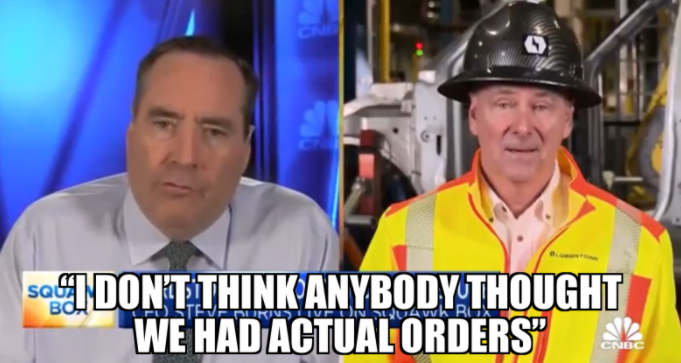
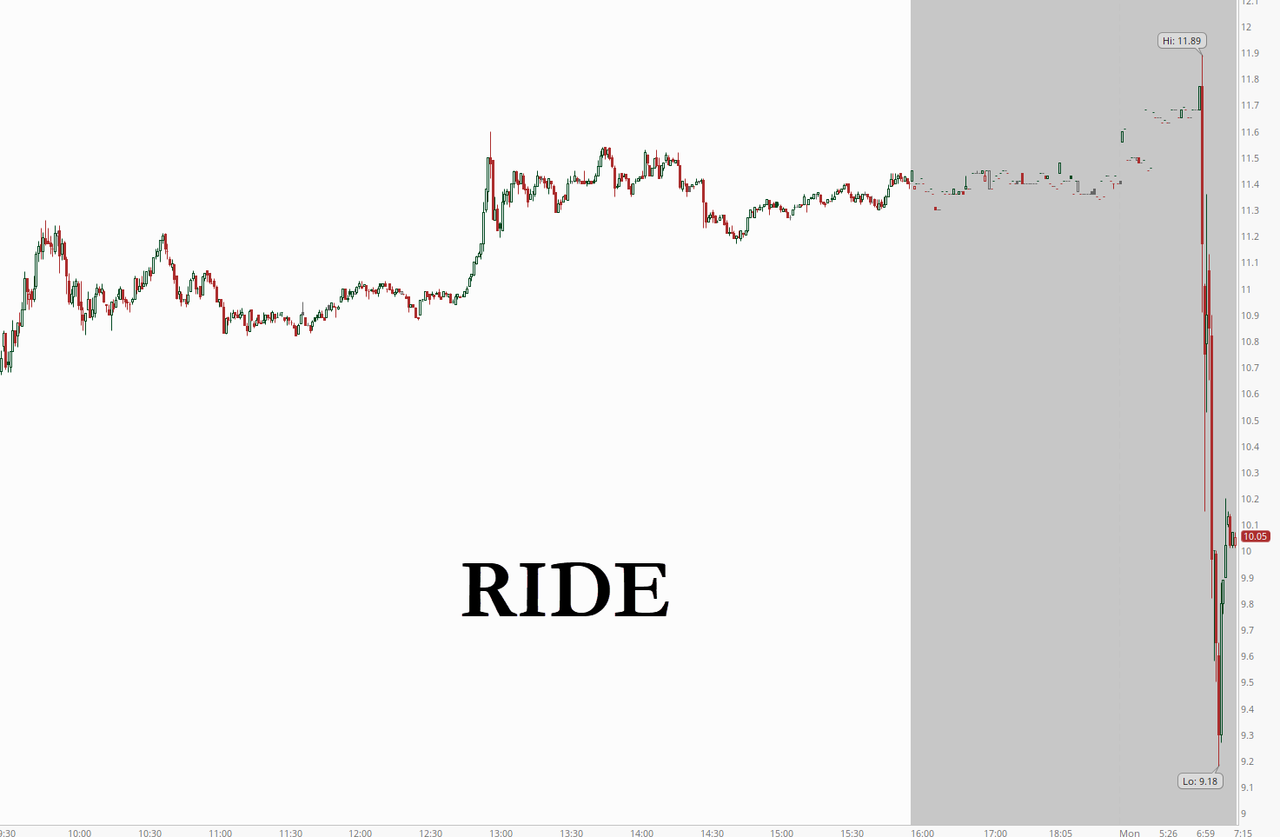
Shares of Lordstown Motors were hit in pre-market trading on Monday morning after Chief Executive Officer Steve Burns and Chief Financial Officer Julio Rodriguez resigned from the company, following the results of an internal investigation catalyzed by allegations by short seller Hindenburg Research back in May.

In a PR called “Lordstown Motors Announces Leadership Transition”, the company said the executive shuffle was due to a “transition from the R&D and early production phase to the commercial production phase of its business.” The company appointed Angela Strand executive chairwoman and Becky Roof as interim CFO, the release says:

To that end, Lordstown Motors Lead Independent Director Angela Strand has been appointed Executive Chairwoman of the Company, and will oversee the organization’s transition until a permanent CEO is identified, and Becky Roof, will serve as Interim Chief Financial Officer. Steve Burns has resigned as Chief Executive Officer and from the Company’s Board of Directors, and Chief Financial Officer Julio Rodriguez has also resigned. All changes are effective immediately and the Company has engaged an executive search firm to identify a permanent CEO and CFO.

In a separate PR called “Lordstown Motors Reports Results Of Special Committee Investigation Of Hindenburg Research Report”, the company released the findings of Sullivan & Cromwell LLP,  who was tasked with looking in Hindenburg’s allegations.

“The Special Committee’s investigation concluded that the Hindenburg Report is, in significant respects, false and misleading,” the PR reads, before admitting: “The investigation did, however, identify issues regarding the accuracy of certain statements regarding the Company’s pre-orders,” the PR reads. 

“Lordstown Motors made periodic disclosures regarding pre-orders which were, in certain respects, inaccurate,” the PR reads.

First, the company admitted that some of its pre-orders were to “influencers”.

“Lordstown Motors has stated on several occasions that its pre-orders were from, or “primarily” from commercial fleets. In fact, many pre-orders were obtained from (i) fleet management companies or other end users that indicated interest in purchasing Endurance trucks, similar to commercial fleets, and (ii) so-called “influencers” or other potential strategic partners that committed to attempt to secure pre-orders from other entities, but did not intend to purchase Endurance trucks directly.

And also stated that “One entity that provided a large number of pre-orders does not appear to have the resources to complete large purchases of trucks. Other entities provided commitments that appear too vague or infirm to be appropriately included in the total number of pre-orders disclosed.”

Recall, Lordstown was the target of short seller Hindenburg Research back in May of this year, who released a report called “The Lordstown Motors Mirage: Fake Orders, Undisclosed Production Hurdles, And A Prototype Inferno”, 

Hindenburg Research is best known for being the firm that called Nikola an “intricate fraud”, which led to the departure of the company’s founder and eventual probes by several regulatory bodies. 

The Lordstown report alleged that the company is an “EV SPAC with no revenue and no sellable product” which has “misled investors on both its demand and production capabilities”.

Hindenburg took specific exception with the company’s pre-orders, stating that their “conversations with former employees, business partners and an extensive document review show that the company’s orders are largely fictitious and used as a prop to raise capital and confer legitimacy.”

The report pointed out several examples:

  • For example, Lordstown recently announced a 14,000-truck deal from E Squared Energy, supposedly representing $735 million in sales. E Squared is based out of a small residential apartment in Texas that doesn’t operate a vehicle fleet.
  • Another 1,000-truck, $52.5 million order comes from a 2-person startup that operates out of a Regus virtual office with a mailing address at a UPS Store. We spoke with the owner who acknowledged it won’t actually order any vehicles, instead describing the “pre-order” as a mere marketing relationship.
  • Yet another firm that is supposedly set to buy 500 trucks from Lordstown told us: “…The letters of interest are non-binding. It’s not like you’d obligate yourself to a pre-order or that you would contractually bind yourself to buying this truck. That’s not what they are.”
  • Lordstown CEO Steve Burns has called these arrangements “very serious orders”. The actual customer agreements, which we present for the first time today, require no deposit and are non-binding. Many of the supposed customers do not operate fleets nor do many have the means to actually make the stated purchases.
  • One company rep that committed to buy 40 trucks through Climb2Glory told us: “…I’m not committed to anything, not to buying a single vehicle. I committed to consider buying vehicles. I’d have a lot of questions before I commit to anything.”
  • Others had similar remarks. “The commitment of that size (15) is totally impossible,” a representative for the City of Ravenna told us about its pre-order. We document numerous other “customers” that disclaim any intent to actually purchase vehicles.

The report also alleged that “a small consulting group called Climb2Glory was paid to generate pre-orders” for Lordstown. It claimed that “…in January 2021, Lordstown’s first street road test resulted in the vehicle bursting into flames 10 minutes into the test drive.”

Hindenburg also released a video called “The Lordstown Motors Mirage” with their report:


Tyler Durden
Mon, 06/14/2021 – 07:26

via ZeroHedge News https://ift.tt/3gk0K1i Tyler Durden

Biden’s Infrastructure Plan Confuses Costs for Benefits


topicspolicy

The list of things that President Joe Biden hopes to accomplish with his American Jobs Plan is nearly as impressive as its $2 trillion price tag. “It’s not a plan that tinkers around the edges,” Biden bragged during an April speech in Pittsburgh. “It’s a once-in-a-generation investment in America. It’ll create millions of jobs, good-paying jobs. It’ll grow the economy, make us more competitive around the world, promote our national security interest, and put us in a position to win the global competition with China.”

The president’s speech did not dwell on the specific projects he wants to fund or how he might go about delivering them in a cost-effective manner. He focused instead on all the money he plans to spend and its potential for stimulating the economy. For Biden, the actual impact of new roads and rail lines on commute times and shipping costs is less important than the gargantuan price. That attitude suggests Biden’s plan will buy a lot less infrastructure than it would if he prioritized efficiency.

Consistent with that prediction, Biden is not satisfied with creating jobs; he wants to create union jobs. “It’s about time [unions] get a piece of the action,” he said in Pittsburgh.

Thanks to the Davis-Bacon Act of 1931, which mandates that all infrastructure projects receiving federal funding pay “prevailing” (generally union) wages, organized labor has been getting a piece of the action for nearly a century. This requirement raises labor costs by as much as 22 percent, according to an analysis by Suffolk University’s Beacon Hill Institute.

The president’s insistence that he’ll sign off on a contract only if it’s with “an American company with American products all the way down the line and American workers” will raise costs even further. Existing “Buy American” provisions are a well-established driver of transportation project costs.

A 2019 report from the Congressional Research Service found that buying American steel costs around twice as much as importing it from China. Requiring road builders to use pricier domestic steel raised the cost of highway construction by about $2 billion from 2009 to 2011, back when then–Vice President Biden was overseeing the spending of stimulus dollars on infrastructure projects.

If the president’s goal were truly to “build, baby, build,” he would be making every effort to pare back regulations that raise the labor and material costs of federal infrastructure projects. Instead, Biden wants to double down on those rules.

Something similar could be said of the president’s focus on advancing racial equity, a $20 billion item in his American Jobs Plan. In March, the Biden administration deployed the 1964 Civil Rights Act to pause a highway widening in Houston so that it can examine that project’s potential racially discriminatory effects.

It is true that past federal infrastructure blitzes have torn through more than a few black neighborhoods with little regard for the people who lived there. But Biden’s novel use of civil rights law to hold up a project he doesn’t like could well backfire by creating a new avenue for activists to slow down lots of other infrastructure investments the administration actually wants. “What I fear is that we are opening a new front where civil rights law is being used with the same logic as environmental NIMBYism,” says Michael Hendrix, director of state and local policy at the Manhattan Institute.

Speaking of environmental NIMBYism, Biden is backtracking on the Trump administration’s reforms to the National Environmental Policy Act (NEPA), which requires federal agencies to assess the environmental impact of decisions like funding a bridge replacement or permitting an oil well. Activists of all stripes frequently use the law, and the power it gives them to sue federal agencies, to slow or stop infrastructure projects.

In 2020, the Trump administration finalized a rule aimed at narrowing the range of projects subject to NEPA and speeding up the reviews that would still be required. The Biden administration is now considering amending that rule and may even scrap it entirely.

Despite the president’s claim that his American Jobs Plan will be a generation-defining investment in the future, his administration remains committed to preserving outdated red tape that will inevitably impede whatever it ends up trying to build.

from Latest – Reason.com https://ift.tt/3pYxr7S
via IFTTT

What If Everyone Is Wrong About US Inflation’s Impact On Interest Rates?

What If Everyone Is Wrong About US Inflation’s Impact On Interest Rates?

By Nicholas Colas of Datatrek

Just one “Markets” topic today, but an important issue so it needs our full attention:

What if everyone is wrong about US inflation’s impact on interest rates? I (Nick) have never seen a stronger consensus around a macroeconomic topic in my +30-year career in finance. Fed money printing plus fiscal stimulus/debt issuance plus economic reopening is supposed to equal high and likely lasting inflation. The 10-year Treasury will go to at least 2 percent and maybe 3 percent or higher. And you can’t swing the proverbial dead cat without hitting even direr warnings …

But to paraphrase a bit of Yiddish wisdom: man plans, and markets laugh. The 2021 YTD high for 10-year Treasury yields was on March 19th, at 1.74 percent. Those broke 1.5 pct intraday today. And it is not just Treasuries turning their back on the global inflation narrative:

  • 10-year German bund yields topped out at -0.11 percent in mid-May and are now -0.25 pct

  • 10-year UK gilts hit a 2021YTD high in mid-May as well, at 0.89 pct, but are now 0.74 pct

  • 10-year Japanese Government Bonds hit a 5-year high in late February 2021 at 0.17 pct but are now 0.08 pct

You really can’t blame central bank intervention for these moves. Their bond buying programs have been constant over the past several months.

Nor can a rational investor just shrug and say “Oh, well, I’m early on the inflation/rate call, but I will be proven right in the end.” Early is the same thing as wrong. When the market doesn’t go in the direction you expect while all the headlines are in your favor (and, boy are they ever…), you have to stop and reassess your point of view. There is nothing wrong with being wrong. Continuing to stay wrong when the market says you’re wrong is, however, not a great idea. At the very least, one has to stop and reassess.

So, what is really going on with Treasuries? Our answer is that this is a much more of a “show me” market than many investors may realize. It takes its lead from long-run historical precedent, not present-day data.

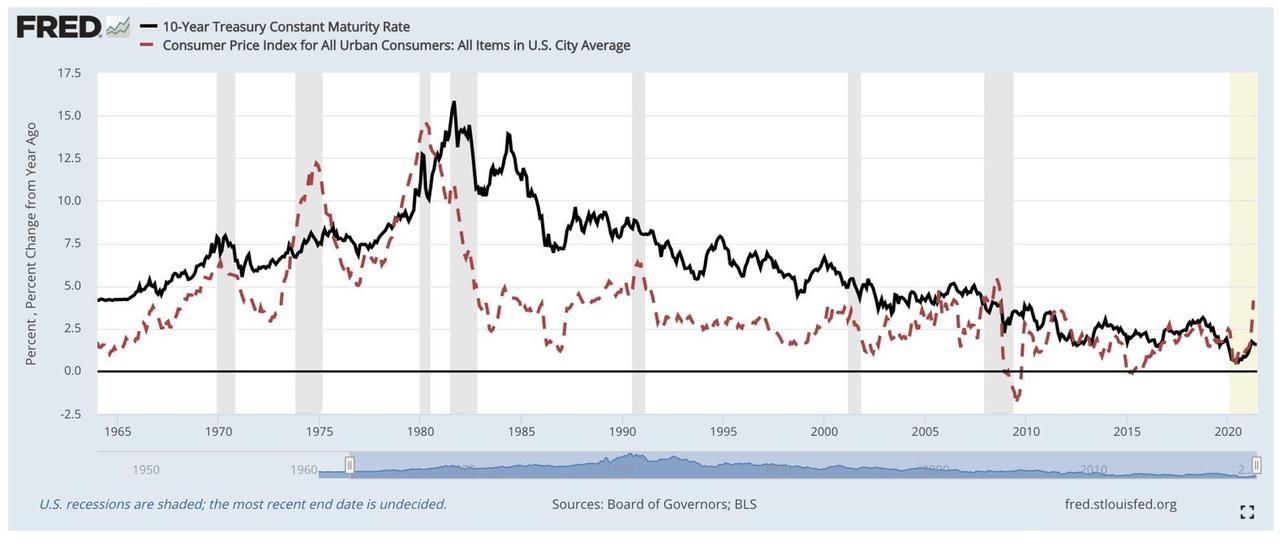
Consider this graph of 10-year Treasury yields (black solid line) and CPI headline inflation (red dotted line) from 1962 to the present:

Here’s what we see:

  • The left third of the chart was a period of rising US inflation due to the Vietnam War, Great Society spending, and easy monetary policy. Yields rose, although not exactly in line with inflation. For example, they remained largely the same even as inflation spiked during the 1973 oil shock (second gray recession bar from the left).

  • The middle part of the chart, from 1981 – 2007, shows that 10-year yields remained far higher than underlying inflation for 26 straight years. For a market that many consider to be the most efficient in the world, that is a remarkable mismatch of pricing versus reality.

  • Only in the rightmost part of the chart do we see Treasury yields more often line up with current inflation, especially at the start (2010 – 2011) and end (2017 – 2019) of the last cycle. After +2 decades of declining inflation, Treasuries were finally convinced the 1970s were over.

The lesson here, which seems to be playing out right now, is that 10-year Treasuries anchor their inflation expectations around long-run trends rather than any year or two of CPI reports. This market didn’t fully believe inflation was structurally higher than then-current day levels during the 1960s/1970s. After that, it took more than 2 decades for it to believe inflation was sustainably in decline. And now, it is looking back at the last decade and yawning at all the chatter about post-pandemic inflation.

Could this time around be different? Sure but …

  • The burden of proof is actually in the inflation camp to explain why Treasuries will break with decades of history and pivot to believing one or two years of inflation data signal a change in structural US inflation.

  • That’s possible, and Fed bond purchasing tapering – whenever it comes – may temporarily lift rates.

  • But remember that after rising from 2 to 3 percent in 2013 during the “tantrum”, they went right back to 2 percent through January 2015 when the tapering actually occurred.

This, by the way, is why we’re so leery of recommending a big Technology/Growth stock underweight even though we see more opportunities in cyclicals. If the idea that Treasuries need a lot more evidence about inflation before their yields noticeably rise proves correct, we could be in a 1.25 – 1.75 percent yield band for the next few years. That would support high-multiple stock valuations and Tech sector fundamentals in particular are excellent.

Takeaway: predicting inflation and calling bond yields are 2 different things. History shows Treasuries wave away short-term inflation and rely on longer-run trends. The last decade saw very low measured inflation, and that – not current day inflation – is what this market cares about most.

Tyler Durden
Mon, 06/14/2021 – 06:30

via ZeroHedge News https://ift.tt/3pP7KGJ Tyler Durden

Biden’s Infrastructure Plan Confuses Costs for Benefits


topicspolicy

The list of things that President Joe Biden hopes to accomplish with his American Jobs Plan is nearly as impressive as its $2 trillion price tag. “It’s not a plan that tinkers around the edges,” Biden bragged during an April speech in Pittsburgh. “It’s a once-in-a-generation investment in America. It’ll create millions of jobs, good-paying jobs. It’ll grow the economy, make us more competitive around the world, promote our national security interest, and put us in a position to win the global competition with China.”

The president’s speech did not dwell on the specific projects he wants to fund or how he might go about delivering them in a cost-effective manner. He focused instead on all the money he plans to spend and its potential for stimulating the economy. For Biden, the actual impact of new roads and rail lines on commute times and shipping costs is less important than the gargantuan price. That attitude suggests Biden’s plan will buy a lot less infrastructure than it would if he prioritized efficiency.

Consistent with that prediction, Biden is not satisfied with creating jobs; he wants to create union jobs. “It’s about time [unions] get a piece of the action,” he said in Pittsburgh.

Thanks to the Davis-Bacon Act of 1931, which mandates that all infrastructure projects receiving federal funding pay “prevailing” (generally union) wages, organized labor has been getting a piece of the action for nearly a century. This requirement raises labor costs by as much as 22 percent, according to an analysis by Suffolk University’s Beacon Hill Institute.

The president’s insistence that he’ll sign off on a contract only if it’s with “an American company with American products all the way down the line and American workers” will raise costs even further. Existing “Buy American” provisions are a well-established driver of transportation project costs.

A 2019 report from the Congressional Research Service found that buying American steel costs around twice as much as importing it from China. Requiring road builders to use pricier domestic steel raised the cost of highway construction by about $2 billion from 2009 to 2011, back when then–Vice President Biden was overseeing the spending of stimulus dollars on infrastructure projects.

If the president’s goal were truly to “build, baby, build,” he would be making every effort to pare back regulations that raise the labor and material costs of federal infrastructure projects. Instead, Biden wants to double down on those rules.

Something similar could be said of the president’s focus on advancing racial equity, a $20 billion item in his American Jobs Plan. In March, the Biden administration deployed the 1964 Civil Rights Act to pause a highway widening in Houston so that it can examine that project’s potential racially discriminatory effects.

It is true that past federal infrastructure blitzes have torn through more than a few black neighborhoods with little regard for the people who lived there. But Biden’s novel use of civil rights law to hold up a project he doesn’t like could well backfire by creating a new avenue for activists to slow down lots of other infrastructure investments the administration actually wants. “What I fear is that we are opening a new front where civil rights law is being used with the same logic as environmental NIMBYism,” says Michael Hendrix, director of state and local policy at the Manhattan Institute.

Speaking of environmental NIMBYism, Biden is backtracking on the Trump administration’s reforms to the National Environmental Policy Act (NEPA), which requires federal agencies to assess the environmental impact of decisions like funding a bridge replacement or permitting an oil well. Activists of all stripes frequently use the law, and the power it gives them to sue federal agencies, to slow or stop infrastructure projects.

In 2020, the Trump administration finalized a rule aimed at narrowing the range of projects subject to NEPA and speeding up the reviews that would still be required. The Biden administration is now considering amending that rule and may even scrap it entirely.

Despite the president’s claim that his American Jobs Plan will be a generation-defining investment in the future, his administration remains committed to preserving outdated red tape that will inevitably impede whatever it ends up trying to build.

from Latest – Reason.com https://ift.tt/3pYxr7S
via IFTTT

Russell Rebalance Looms – Goldman Forecasts Who’s In, Who’s Out

Russell Rebalance Looms – Goldman Forecasts Who’s In, Who’s Out

FTSE Russell recently announced this year’s annual Russell Index rebalance will take effect after the market close on Friday, June 25.

This report from Goldman Sachs’ David Kostin incorporates the official preliminary list of constituent changes, which remains subject to possible further revisions by the index sponsor during the next few weeks.

FTSE Russell’s preliminary changes to the Russell 3000 include 255 additions and 295 deletions. We incorporated these changes to update our list of potential additions and deletions to the Russell 1000 and Russell 2000 indices.

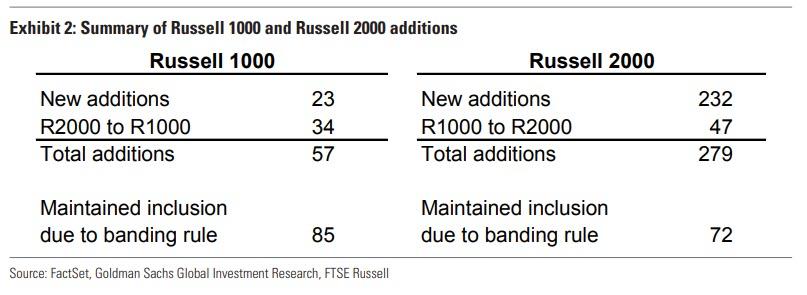
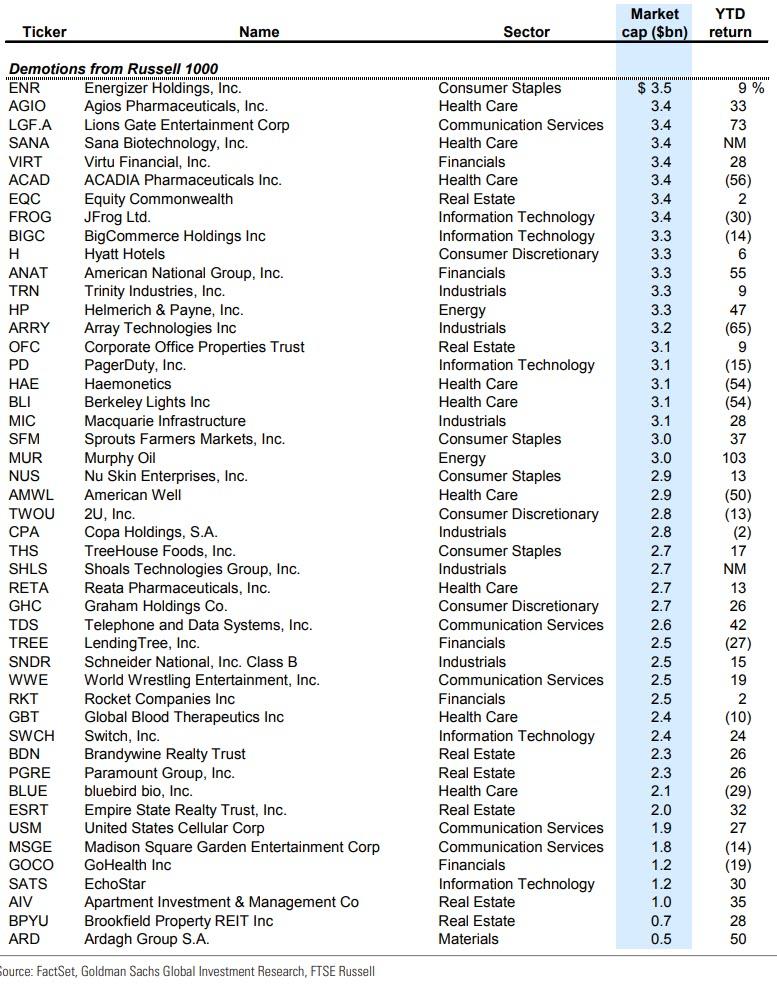
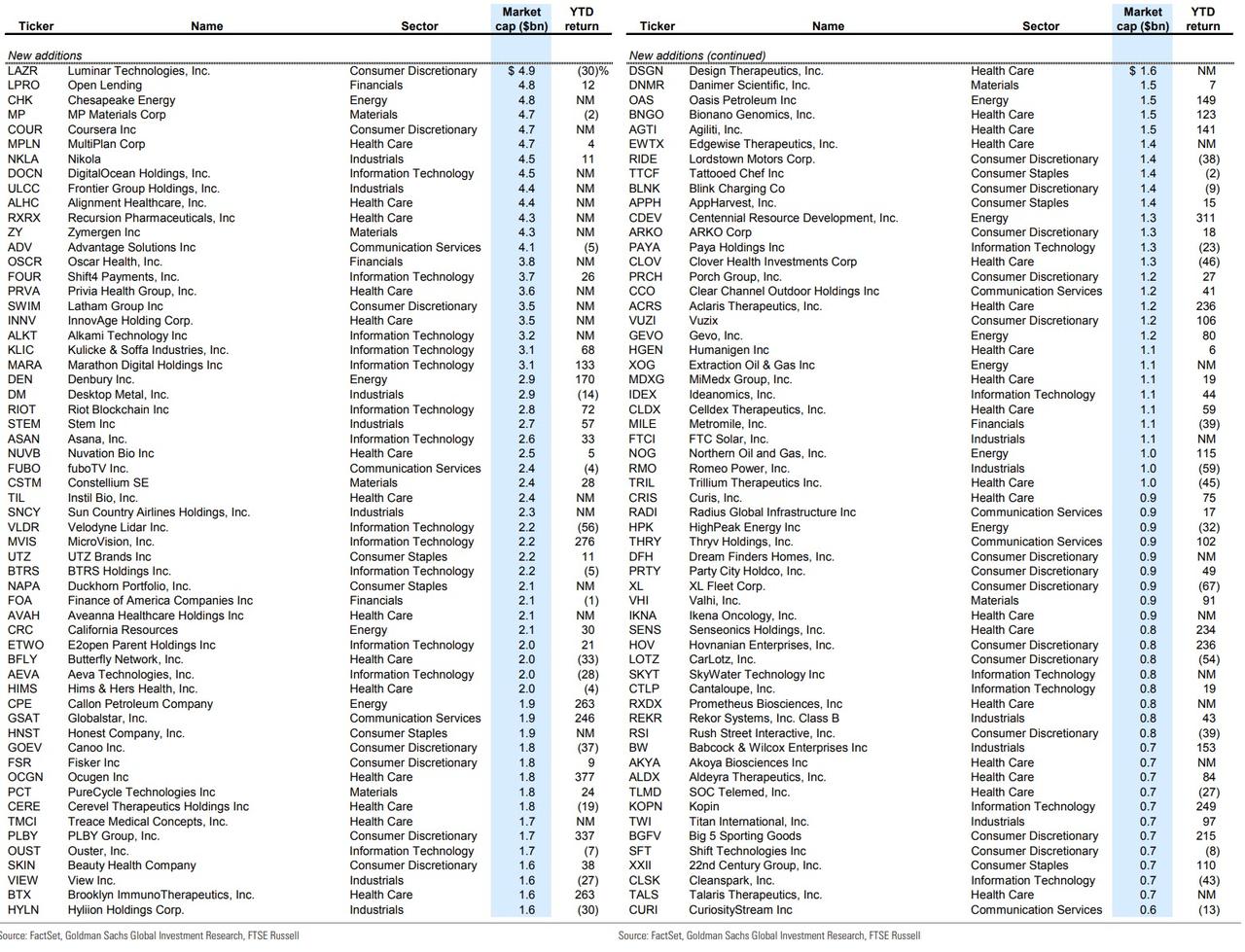
  • Russell 1000: Our analysis suggests 57 stocks will enter the Russell 1000 large-cap benchmark. These companies include 23 stocks new to the index as a result of IPOs, de-SPACs, or change in eligibility status, and 34 stocks currently in the Russell 2000 index that have appreciated in market cap enough to exceed the threshold for the large-cap benchmark (~$5 billion this year).

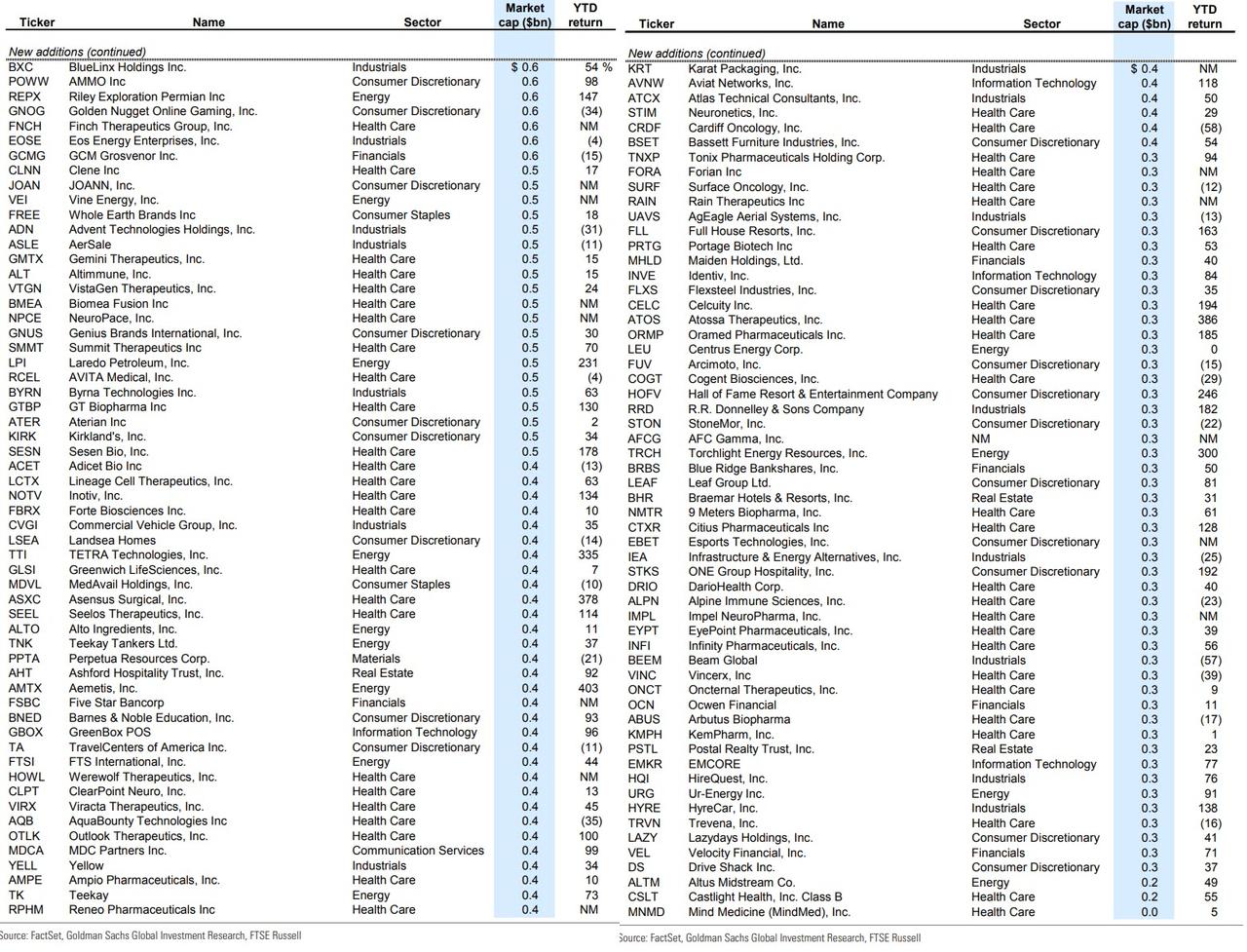
  • Russell 2000: We estimate that 279 stocks will enter the Russell 2000 index consisting of 232 constituents new to the index and 47 stocks demoted from the Russell 1000 to the smaller-cap benchmark.

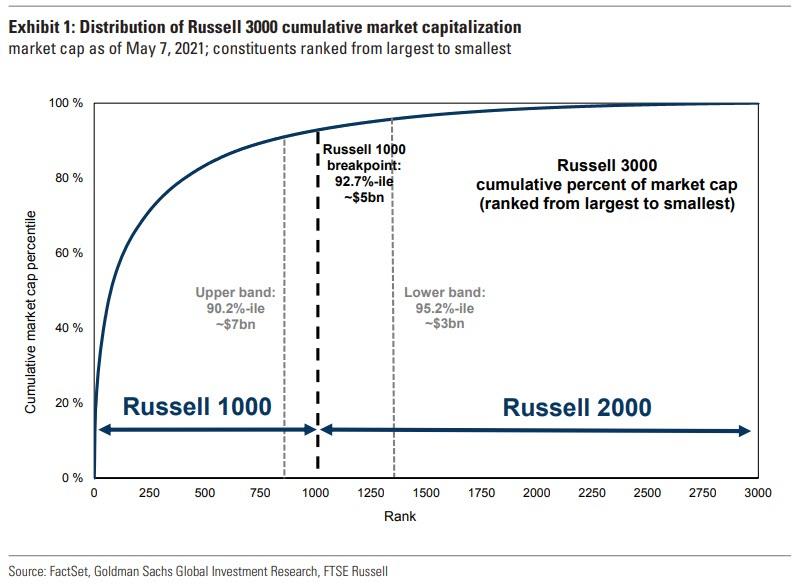
In general, stocks that have an equity market capitalization greater than the 1000th ranked company ($5.2 billion) are included in the Russell 1000 and stocks that rank below the 1000th stock are included in the Russell 2000.

However, existing constituents of the Russell 1000 and Russell 2000 indices are subject to a percentile banding rule and will remain in their current index if they fall within a cumulative +/-2.5% percentile band around the Russell 1000 market cap breakpoint. Therefore, a company currently in the Russell 2000 may fail to be promoted to the Russell 1000 even if it has an equity cap greater than the 1000th stock. Similarly, a current member of the Russell 1000 may not be demoted to the small-cap benchmark if it falls below the breakpoint threshold but is inside the band.

Exhibit 1 illustrates the banding rule…

…and Exhibit 2 summarizes the estimated constituent changes…

*  *  *

Potential Additions to the Russell 1000 Index

Potential Additions to the Russell 2000 Index

Investors can use the results of our analysis to anticipate potential price moves and buying/selling pressure for stocks being added to and deleted from the widely-followed large-cap and small-cap benchmark indices.

Tyler Durden
Mon, 06/14/2021 – 05:45

via ZeroHedge News https://ift.tt/3gqEgus Tyler Durden

Hackers Stole Nearly 26 Million User Login Credentials for Sites Like Amazon, Google, Facebook

Hackers Stole Nearly 26 Million User Login Credentials for Sites Like Amazon, Google, Facebook

Authored by Tom Ozimek via The Epoch Times,

Hackers using a custom Trojan-type malware stole nearly 26 million login credentials – emails or usernames and associated passwords – from almost a million websites over a two year period, including from such namesakes as Amazon, Facebook, and Twitter, according to cybersecurity provider NordLocker.

A hacker in China on Aug. 4, 2020. (Nicolas Asfouri/AFP via Getty Images)

The malware infiltrated over 3 million Windows-based computers between 2018 and 2020, with the cyber intruders making off with around 1.2 terabytes of personal information, according to a case study carried out by NordLocker in partnership with a third-party firm specializing in data breach analysis.

The 26 million stolen login credentials were across twelve different website types, including social media, online gaming, and email services. They included such household names as Google (1.54 million), Facebook (1.47 million), Amazon (0.21 million), Apple (0.13 million), Netflix (0.17 million), and PayPal (0.15 million).

An illustration file photograph shows the logos of Google, Apple, Facebook, Amazon, and Microsoft displayed on a mobile phone and a laptop screen. (Justin Tallis/AFP via Getty Images)

In addition to login credentials, the stolen data includes 1.1 million unique email addresses, over 2 billion cookies, and 6.6 million files that users were storing on their desktops and in their downloads folders.

The stolen cookies, which can in some cases give access to a victim’s online accounts, were sorted into five groups: online marketplace, online gaming, file sharing site, social media, and video streaming services.

The billions of stolen cookies were associated with such sites as YouTube (17.1 million), Facebook (8.1 million), Twitter (5.2 million), Amazon (3.5 million), MediaFire (3.2 million), and eBay (2 million).

The malware mainly targeted web browsers to steal the data, with the top three software sources for stolen email/usernames plus passwords being Google Chrome (19.4 million), Mozilla FireFox (3.3 million), and Opera (2 million).

Besides stealing files, the malware also took screenshots of infected computers and photos using its webcam.

The malware was transmitted by email and pirated software, including illegal versions of Adobe Photoshop 2018 and a number of cracked games.

The report comes amid warnings from administration officials that cyberattacks of various types are on the rise.

U.S. Secretary of Commerce Gina Raimondo said last week that the number of cyber intrusions will only increase in the future, and urged businesses to shore up their cybersecurity systems.

“We should assume and businesses should assume that these attacks are here to stay and if anything will intensify,” Raimondo said in an interview with ABC.

Her remarks followed a June 3 letter from Anne Neuberger, a cybersecurity adviser at the National Security Council, who warned business leaders about the growing risk of ransomware attacks and urged them to beef up security measures.

“The threats are serious and they are increasing,” Neuberger said in the letter obtained by media outlets.

The officials’ warnings come after a number of recent high-profile cyberattacks, including one targeting Colonial Pipeline last month, leading to a disruptive shutdown and gasoline shortages, and another targeting JBS, America’s biggest beef producer.

Tyler Durden
Mon, 06/14/2021 – 05:00

via ZeroHedge News https://ift.tt/3zoTI2T Tyler Durden

Brickbat: Just Sit There


restraints_1161x653

Georgia Gov. Brian Kemp has suspended Clayton County Sheriff Victor Hill after Hill was indicted on federal civil rights charges. Prosecutors say that in four separate incidents in 2020 Hill ordered deputies to place inmates in a restraint chair “for a period exceeding that justified by any legitimate non-punitive government purpose.” Kemp has suspended Hill “without further action pending the final disposition of the case or until the expiration of his term of office.”

from Latest – Reason.com https://ift.tt/3pOoUEt
via IFTTT

UK Charity Teaches Staff ‘White Women Reporting Rape By Black Men Support White Supremacy’

UK Charity Teaches Staff ‘White Women Reporting Rape By Black Men Support White Supremacy’

In the wake of sex scandals that have rocked the British charity, an Oxfam staff training document says “privileged white women” are supporting the root causes of sexual violence by wanting “bad men” imprisoned.

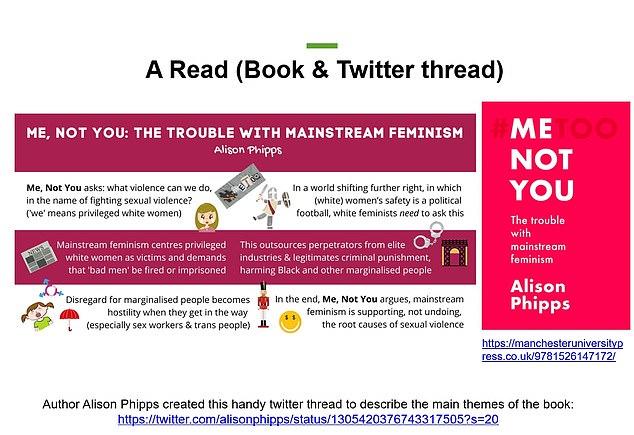
The Telegraph reports that the four-week ‘learning journey’ states that: “Mainstream feminism centres on privileged white women and demands that ‘bad men’ be fired or imprisoned”. Accompanied by a cartoon of a crying white woman, it adds that this “legitimises criminal punishment, harming black and other marginalised people”.

The PowerPoint recommends staff read Me Not You: The Trouble with Mainstream Feminism, a book by Alison Phipps, a professor of gender studies at Sussex University.

It then links to the academic’s Twitter account, including a thread which summarises the main themes of the book, including: “White feminist tears deploy white woundedness, and the sympathy it generates, to hide the harms we perpetuate through white supremacy.”

Alison Phipps told MailOnline today:

“I can’t comment on the Oxfam training materials as I haven’t seen them, but my book is grounded in a long tradition of feminist thought and politics that sees criminal punishment as part of the problem and not the solution… I would never tell a survivor of sexual violence what to do, but I would like us to have better choices than criminal punishment, media exposure, or silence.”

Summarising the book’s central premise, the Oxfam document says white feminists need to ask themselves whether they are causing harm when they fight sexual violence.

However, the charity was warned on Wednesday night that the document, compiled by its LGBT network and seen by The Telegraph, could breach equality laws as it suggests reporting rape is “contemptible”.

Naomi Cunningham, a discrimination and employment law barrister, says the document may breach the Equality Act, which bans harassment in the workplace on the basis of sex.

“The message seems to be that a woman who reports a rape or sexual assault to the police and presses charges is a contemptible ‘white feminist’,” said Ms Cunningham.

“I think any woman could make an arguable case that this has created or contributed to ‘an intimidating, hostile, degrading, humiliating or offensive environment’, which is how the Equality Act defines harassment.”

The Telegraph concludes with the following (rightly) furious words from feminist writer Julie Blindel:

Calling women who have been traumatised by male sexual violence or campaign against it “privileged” because they are white is staggeringly offensive. To further claim that white women give more power to the police by reporting their rapists loses sight of the fact that if sexual predators did not face serious consequences, they remain a danger to all women.

Does Phipps imagine that when “white, privileged” women demand that sexual harassers be removed from a workplace that they do not care if these men go on to rape impoverished black women?

In suggesting white women are “racist” or harm black and marginalised people when they speak out about rape is nothing more than a warning for them to shut up.”

Is nothing beyond this CRT-enthused madness?

Tyler Durden
Mon, 06/14/2021 – 04:15

via ZeroHedge News https://ift.tt/3iE0VWR Tyler Durden

Brickbat: Just Sit There


restraints_1161x653

Georgia Gov. Brian Kemp has suspended Clayton County Sheriff Victor Hill after Hill was indicted on federal civil rights charges. Prosecutors say that in four separate incidents in 2020 Hill ordered deputies to place inmates in a restraint chair “for a period exceeding that justified by any legitimate non-punitive government purpose.” Kemp has suspended Hill “without further action pending the final disposition of the case or until the expiration of his term of office.”

from Latest – Reason.com https://ift.tt/3pOoUEt
via IFTTT