The president of George Mason University wants to give minorities a big advantage in hiring until the faculty is as heavily minority as the school’s student body and the future, mostly non-white U.S. population. This is illegal, say lawyers and law professors….
Institutions can’t hire based on race to make their staff mirror society’s current racial composition, much less its future more heavily non-white racial composition. That would be “outright racial balancing, which is patently unconstitutional,” according to the Supreme Court….
Palladium Tops Record $3,000 Amid EV-Demand Surge, Supply Chain Pressure
Palladium futures climbed Friday to over $3,000 an ounce for the first time as the market is worried about a shortage of the precious metal used mainly by automakers in exhaust systems and green technologies such as hydrogen power.
Palladium briefly rose above $3,000 an ounce around 0445 ET. As of 0828 ET, palladium was up 1% at $2,981.
Prices have erupted since March 16, up more than 20% since Nornickel, a Russian nickel and palladium mining and smelting company, announced flooding at two of its mines.
Since the COVID low in March 2020, palladium prices have jumped more than 100%.
“Many people thought palladium at $1,000 was a bubble. Wow was that wrong,” R. Michael Jones, chief executive officer at Platinum Group Metals Ltd. PLG, told MarketWatch. “As the world economy emerges from a COVID economic lockdown, personal transport will almost certainly be very popular.”
Given that, “palladium looks very good here in the short and medium-term,” Jones said.” Long term new applications for palladium and the other platinum group metals look interesting” in terms of the energy transition from hydrogen to batteries, he added.
UBS analyst Giovanni Staunovo told Reuters that palladium has been in a “structural deficit for ten years. We have seen above ground inventories falling to very low levels.”
Lower inventories of the precious metal come as the global economy, supercharged by central banks and governments unleashing trillions of dollars into financial markets and real economies, has produced a demand surge from consumer and industrial goods.
Chris Blasi, president and chairman at Neptune Global, told MarketWatch that “increased automobile production directly drives increased demand for palladium, which is drawing on a strategic metal whose annual industrial demand has outstripped mine output for several years.”
Palladium is primarily used in catalytic converters in fossil fuel burning vehicles to help control emissions. Earlier this year, we noted catalytic converter thefts across the US skyrocketed as thieves take advantage of higher prices at scrap yards.
Platinum is another precious metal used in catalytic converters that have seen prices soar to a six-year amid supply shortages.
On a per announce basis, palladium is strongly outpacing gold in hopes that more stimulus will create a more robust industrial rebound.
So the combination of an actual shortage of the precious metal, an artificially supercharged global economy, a green transition for hydrogen technologies, and, of course, momentum traders and anyone trying to make a quick buck has pushed Palladium prices to the moon.
The president of George Mason University wants to give minorities a big advantage in hiring until the faculty is as heavily minority as the school’s student body and the future, mostly non-white U.S. population. This is illegal, say lawyers and law professors….
Institutions can’t hire based on race to make their staff mirror society’s current racial composition, much less its future more heavily non-white racial composition. That would be “outright racial balancing, which is patently unconstitutional,” according to the Supreme Court….
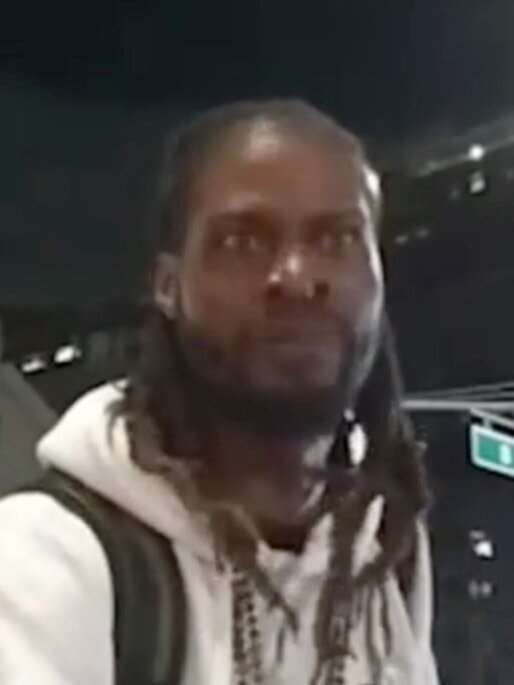
The case is Cheung v. Harper, and the video of the interaction is apparently this:
The audio isn’t great, but it sounds like a lot of personal insults (“motherfucker,” “suck my dick,” etc.) coupled with allusions to Cheung’s being Asian (“soy sauce,” “fucking Asian marts last week, how they treat dogs there, motherfuckers,” “dog food eater,” “cat eater” [?]). As is common with many such taunts, they don’t make much sense on their own terms, but just seem like attempts to get Cheung mad.
Mr. Harper said … the protest … was a weekly demonstration for transgender rights and “in solidarity with end Asian hate.” …
In interviews, [Terrell] Harper, 39, apologized for what he acknowledged were racist comments. He said the video had been taken out of context, and that he typically uses racist remarks as part of a broader explanatory monologue to demonstrate what racism looks and feels like.
“I’ve got to change my method, and I came out and apologized for that,” he said.
Obviously the lawsuit is primarily a political statement by the plaintiff; but of course that is not uncommon in similar lawsuits; so I thought I’d offer a bit of tentative legal analysis.
[1.] These sorts of personally targeted face-to-face insults generally fit within the “fighting words” exception to the First Amendment, whether they are bigoted or otherwise. New York courts do take the view that “[t]he ‘fightingwords’ doctrine under the First Amendment is even more narrowly applied in cases involving police officers than in cases between ordinary citizens ‘because a properly trained officer may reasonably be expected to exercise a higher degree of restraint than the average citizen.'” But they don’t seem to categorically preclude fighting words claims for face-to-face insults of police officers (or limit them to situations where the police officer responds by fighting). It may well be that a sustained rant such as this would qualify as fighting words even when said to an officer.
[2.] But the defendant is apparently not being prosecuted for this, and there’s no “fighting words” civil tort cause of action. Instead, the claim is that this constitutes “intentional infliction of emotional distress,” a notoriously vague (though generally narrow) cause of action:
Intentional infliction of emotional distress has the following elements: extreme and outrageous conduct; intent to cause, or disregard of a substantial probability of causing, severe emotional distress; a causal connection between the conduct and injury; and severe emotional distress. Liability for the tort is found only where the conduct has been so outrageous in character, and so extreme in degree, as to go beyond all possible bounds of decency, and to be regarded as atrocious, and utterly intolerable in a civilized community (see Howell v. New York Post Co.,81 N.Y.2d 115 [1993]). And, courts are reluctant to allow recovery under the banner of intentional infliction of emotional distress absent a deliberate, systematic and malicious campaign of harassment, intimidation, humiliation and abuse of plaintiff.
Some recent cases (such as the one I just quoted) do allow intentional-infliction-of-emotional-distress lawsuits over bigoted insults that would likely qualify as fighting words in criminal cases, at least when they are said by a business employee about a patron or by an employer about an employee. It’s not clear to me, though, whether the same would be as “so outrageous in character, and so extreme in degree, as to go beyond all possible bounds of decency, and to be regarded as atrocious, and utterly intolerable in a civilized community” outside this sort of business context.
[3.] If Cheung loses, on the grounds that this doesn’t fit within the emotional distress tort (or that it doesn’t qualify as fighting words, when said to a police officer), would he—or perhaps the police union, which appears to be backing this lawsuit—have to pay Harper’s legal fees? I’m glad you asked! The New York anti-SLAPP statute allows such recovery of fees by defendants for speech “in connection with an issue of public interest.” Query whether these sort of largely substance-free face-to-face personal insults, even if viewed as an expression of a political view (hostility to Asians) would be seen as sufficiently in connection with an issue of public interest; I doubt it, though the matter isn’t open and shut.
[4.] Cheung is also claiming that Terrell spit on him, “negligently, recklessly and carelessly, spit his saliva on the Plaintiff’s face and into the Plaintiff’s eyes”; I set that question (which I suspect is facially contested) aside in this post.
from Latest – Reason.com https://ift.tt/2R7KHtn
via IFTTT
The case is Cheung v. Harper, and the video of the interaction is apparently this:
The audio isn’t great, but it sounds like a lot of personal insults (“motherfucker,” “suck my dick,” etc.) coupled with allusions to Cheung’s being Asian (“soy sauce,” “fucking Asian marts last week, how they treat dogs there, motherfuckers,” “dog food eater,” “cat eater” [?]). As is common with many such taunts, they don’t make much sense on their own terms, but just seem like attempts to get Cheung mad.
Mr. Harper said … the protest … was a weekly demonstration for transgender rights and “in solidarity with end Asian hate.” …
In interviews, [Terrell] Harper, 39, apologized for what he acknowledged were racist comments. He said the video had been taken out of context, and that he typically uses racist remarks as part of a broader explanatory monologue to demonstrate what racism looks and feels like.
“I’ve got to change my method, and I came out and apologized for that,” he said.
Obviously the lawsuit is primarily a political statement by the plaintiff; but of course that is not uncommon in similar lawsuits; so I thought I’d offer a bit of tentative legal analysis.
[1.] These sorts of personally targeted face-to-face insults generally fit within the “fighting words” exception to the First Amendment, whether they are bigoted or otherwise. New York courts do take the view that “[t]he ‘fightingwords’ doctrine under the First Amendment is even more narrowly applied in cases involving police officers than in cases between ordinary citizens ‘because a properly trained officer may reasonably be expected to exercise a higher degree of restraint than the average citizen.'” But they don’t seem to categorically preclude fighting words claims for face-to-face insults of police officers (or limit them to situations where the police officer responds by fighting). It may well be that a sustained rant such as this would qualify as fighting words even when said to an officer.
[2.] But the defendant is apparently not being prosecuted for this, and there’s no “fighting words” civil tort cause of action. Instead, the claim is that this constitutes “intentional infliction of emotional distress,” a notoriously vague (though generally narrow) cause of action:
Intentional infliction of emotional distress has the following elements: extreme and outrageous conduct; intent to cause, or disregard of a substantial probability of causing, severe emotional distress; a causal connection between the conduct and injury; and severe emotional distress. Liability for the tort is found only where the conduct has been so outrageous in character, and so extreme in degree, as to go beyond all possible bounds of decency, and to be regarded as atrocious, and utterly intolerable in a civilized community (see Howell v. New York Post Co.,81 N.Y.2d 115 [1993]). And, courts are reluctant to allow recovery under the banner of intentional infliction of emotional distress absent a deliberate, systematic and malicious campaign of harassment, intimidation, humiliation and abuse of plaintiff.
Some recent cases (such as the one I just quoted) do allow intentional-infliction-of-emotional-distress lawsuits over bigoted insults that would likely qualify as fighting words in criminal cases, at least when they are said by a business employee about a patron or by an employer about an employee. It’s not clear to me, though, whether the same would be as “so outrageous in character, and so extreme in degree, as to go beyond all possible bounds of decency, and to be regarded as atrocious, and utterly intolerable in a civilized community” outside this sort of business context.
[3.] If Cheung loses, on the grounds that this doesn’t fit within the emotional distress tort (or that it doesn’t qualify as fighting words, when said to a police officer), would he—or perhaps the police union, which appears to be backing this lawsuit—have to pay Harper’s legal fees? I’m glad you asked! The New York anti-SLAPP statute allows such recovery of fees by defendants for speech “in connection with an issue of public interest.” Query whether these sort of largely substance-free face-to-face personal insults, even if viewed as an expression of a political view (hostility to Asians) would be seen as sufficiently in connection with an issue of public interest; I doubt it, though the matter isn’t open and shut.
[4.] Cheung is also claiming that Terrell spit on him, “negligently, recklessly and carelessly, spit his saliva on the Plaintiff’s face and into the Plaintiff’s eyes”; I set that question (which I suspect is facially contested) aside in this post.
from Latest – Reason.com https://ift.tt/2R7KHtn
via IFTTT
Can’t wait to hear the Chairman justify zero rate policy and deficit monetization with inflation roaring at > 5 percent. It would be entertaining, if it weren’t so damaging.
The price of Lumber is 5x higher than it was 10 years ago.
Here’s a pretty good theoretical model (follow the entire thread) estimating that U.S. inflation may reach double digits by Q1 2022. One of the premises is that monetary authorities have no way out of this rabbit hole and are constrained by the risk of severely disrupting financial markets in an asset dependent economy.
Recall our view that deflation/inflation is a corner solution and Wall Street’s “Goldilocks” scenario is still just a marketing gimmick. Deflation as markets try to move back to mean valuations – a lot lower – or inflation, and lots of it.
19/n
What this simulation tells us is that we should see a very, very sharp increase in US inflation in the coming months and inflation could be heading above 12% by the end of the year.
Anyone with a better model, lay it on the table. Stop with the “fake news” or “don’t worry” nonsense. CPI prints > 4 percent in May and you heard it here first.
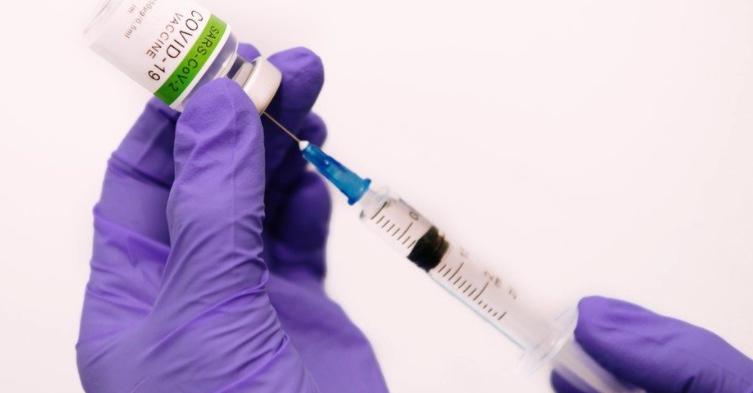
UK Study Finds Pfizer Vaccine Doesn’t Offer “Full Protection” From Mutant COVID Strains
As shortages of COVID-19 vaccine supplies force more countries stretch the time between the first and second vaccine doses to try and vaccinate more people, the latest data out of a UK study of vaccination rates has stumbled on a disturbing finding: the study found that people who have had one dose are still at risk from mutated strains of the virus.
The study, published Friday afternoon in London by Imperial College London and published in the journal Science, examined the immune responses of health-care workers following their first dose of the Pfizer jab.
It found that people who had previously been infected saw significantly enhanced protection against mutant strains of the virus typically referred to as “variants”. Those who only received the jab, but weren’t previously infected, showed an immune response that was “less strong after a first dose, potentially leaving them at risk from variants.” The findings show that those who have received the Pfizer jab aren’t “fully protected” from COVID-19 variants.
Professor Rosemary Boyton, Professor of Immunology and Respiratory Medicine at Imperial College London, who led the research, said: “Our findings show that people who have had their first dose of vaccine, and who have not previously been infected with SARS-CoV-2, are not fully protected against the circulating variants of concern. This study highlights the importance of getting second doses of the vaccine rolled out to protect the population.”
Imperial College published the results in full on its website.
Meanwhile, another study released Friday came to a similar conclusion, showing that some patients who have received their first dose still wind up in the hospital with COVID symptoms.
The news appeared to weigh on US stocks, which tumbled to their lows of the session shortly after the news broke. Analysts claimed the study is a problem for the global growth outlook – which has already taken a hit thanks to to the latest data out of China – as countries like Canada aim to stagger doses by months to try and make the most out of limited supplies.
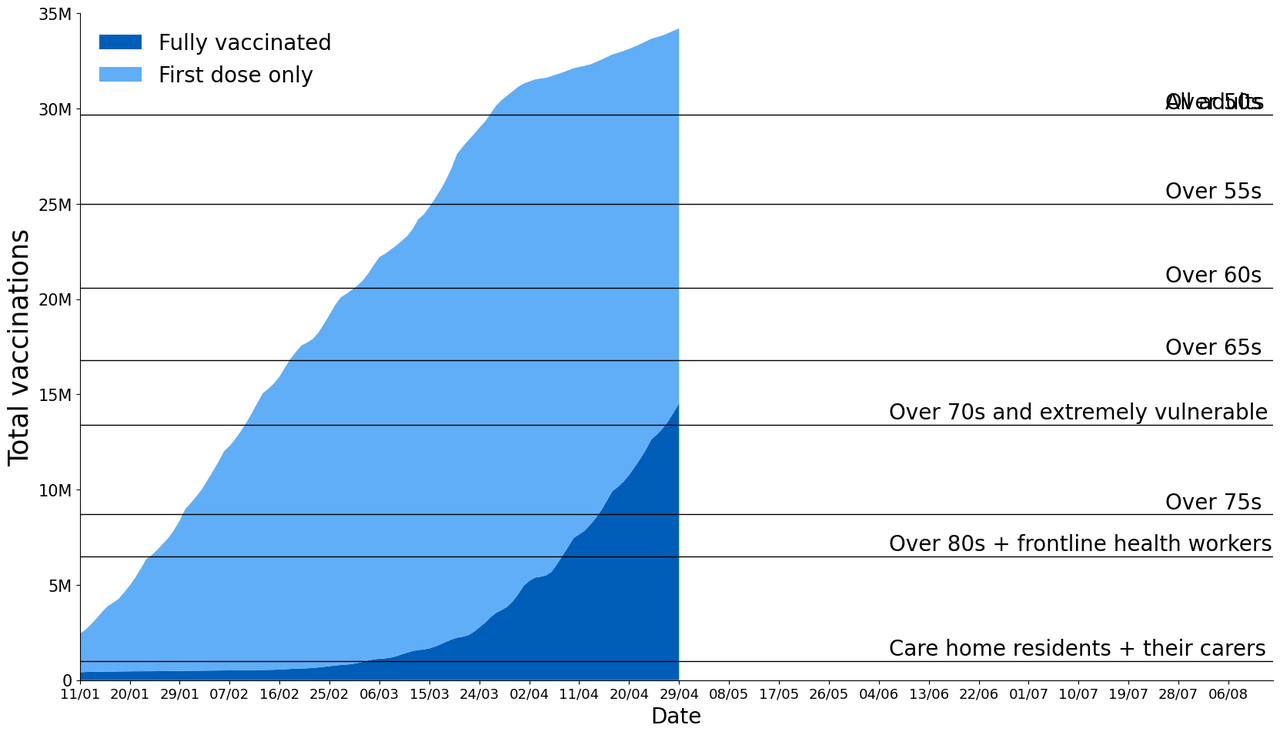
According to the latest data released on Friday, 65% of British adults have already received at least one dose, while 3,736,654 people were vaccinated in the past 7 days. More than 25% of adults in the country, meanwhile, have received both doses. 48,748,962 doses of COVID-19 vaccine have now been administered in the UK, while the US just announced that 100M Americans have now been fully vaccinated.
But the latest study data available suggests that patients who have received only one shot are still vulnerable. Researchers say the findings are reassuring because vaccines are never 100% perfect and failures are expected. But others have said that the most vulnerable patients may be letting their guard down too soon after one vaccine.
The study analyzed a quarter of all hospital patients in England, Scotland and Wales between early December and early April, and is one of the first to look at the impact of vaccinations on the numbers of people subsequently admitted to hospital.
Prof Calum Semple, study leader from the University of Liverpool, told the BBC that this data represented strong real-world evidence of few vaccine failures.
“It’s reassuring that the numbers admitted are very, very small – and mostly in those at risk of severe disease,” he said.
Meanwhile, Dr. Annemarie Docherty, a study co-author and honorary consultant in critical care, warned that this is just the latest sign that patients are assuming they’re “safe” immediately after being vaccinated, rather than weeks later.
“It’s entirely possible that elderly people will catch coronavirus again and may die,” she said.
In the study, 526 people who tested positive for coronavirus were admitted to hospital from 21 days after one vaccine dose, and 113 died – out of more than 3,500 hospitalised patients in the study. The data comes from the ISARIC/CO-CIN study, which has been presented to the government’s scientific advisers, Sage, but not yet reviewed by other experts. More complete NHS hospital data is set to be released in due course.
The Drowning opens with a quick series of scenes from a multi-generational family picnic at the lake, a sunny collage that quickly turns dark, and not from the weather. Four-year-old Tom is playing with a boat in the water, and then—after a series of artily discordant shots that show little but imply much—he’s not. The lake waters have seemingly claimed the boy, and, in a way, his family, too.
This spellbinding new series that aired on British television this spring and is now available from the streaming services Acorn TV and Sundance Now has plenty of victims, drowning not only in water but grief and guilt, too.
But—could it all be needless? Almost exactly a decade later, Tom’s mother Jodie sees a teenager walking along a downtown street with a stunning resemblance to her son, right down to the little half-moon scar underneath an eye. Trailing him first to his school and then his home, Jodie is increasingly certain that she’s found Tom. Is this a simple case of mistaken identity? Or something far more sinister?
Jodie (played by Jill Halfpenny, like most of the cast a Brit TV veteran little-known to American audiences) is the axis upon which The Drowning spins. Certain she’s found her son, who she’s always regarded as missing and not dead—his body was never found—she gets no sympathy from either police or her family. The reticence of the cops is perhaps understandable; she’s got little evidence beyond a mother’s conviction of physical likeness. And a none-too-stable mother at that: Besieged by bill collectors, her landscaping business swirling the drain, Jodie is visibly crumbling under the pressure.
But her family’s reluctance to get involved smacks more of inertia, a sense that Jodie’s quixotic quest will only destroy the fragile peace they’ve made with Tom’s death. “I don’t think I could go through it again,” confesses her ex-husband who, after the boy’s drowning, left Jodie for her best friend.
Infuriated but undeterred, Jodie declares herself a one-woman truth squad. Using forged credentials, she gets herself hired as music teacher at the look-alike boy’s school, then even wangles her way into a gig as his guitar tutor. Her seemingly casual conversations with Mark (a stony-faced Rupert Penry-Jones), the kid’s purported single dad, arouse suspicions; he’s oddly reluctant to share recollections of the boy’s early childhood.
But there’s also something unsettling about the ease with which Jodie sheds her identity as a hedge-clipper and pot-waterer to turn undercover operative. And her tactics—buying faked documents with embezzled money—set off a tumbling line of criminal dominoes that seem likely to crush everyone around her even if she’s right about the boy’s identity.
The Drowning may sound like a been-there-done-that detective yarn of no particular distinction. But, tightly shot and edited, it’s a marvel of efficient story-telling. And Halfpenny gives an absolutely riveting performance, adroitly peeling away the skins of lives unknown as she pursues her phantom (or not) child. Her glare could freeze a mouse in the middle of the Sahara; her smile, light a ballroom. She gives Jodie a laser intensity that defies restraint, even when it’s warranted. At a memorial service for her father, whose weakened heart did not survive Tom’s death, one of his golfing buddies is asked if he ever cheated. “Only when you took your eyes off him,” the man replies.Like father, like daughter.
from Latest – Reason.com https://ift.tt/3e5ZCNP
via IFTTT
JPM Does Not Expect Big Month-End Pension Selling Today
Unlike last quarter, when JPMorgan warned of up to $316BN in forced, month and quarter-end pension rebalance selling (which incidentally never materialized), this time around – now that we are at April month-end and some traders are worried that we may see a similar (if scaled down as it is just month, not quarter end) forced rebalance out of stocks and into bonds – JPMorgan sees no such threats.
In a month discussing the month-end rebalance, JPM writes that unlike March (and Q) equities have outperformed bonds by just 4% MTD, so based on the bank’s calculations there is just 50-75bps of equity underperformance into month-end due to pension rebalances, all else equak. So, according to JPM, “the rebalance flows are not expected to be big, they can be easily enough offset by fundamental buyers on reopening/earnings, and part of the rebalance is likely already out of the way (e.g. they may have contributed to the market weakness on Thursday morning).”
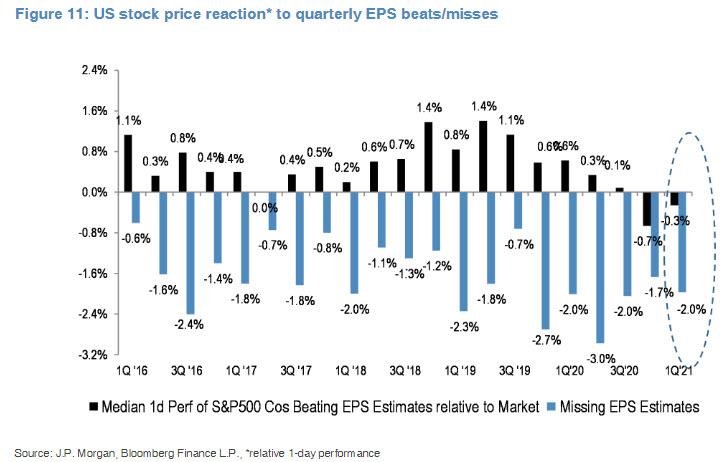
While month-end selling may not be an issue this time, another more troubling dynamic has emerged, one which we previewed two weeks ago when we wrote that “Q1 Earnings Will Be Stellar, But Are Fully Priced-In.” Confirming this, JPMorgan writes that companies which beat their EPS estimates – with 55% of companies reporting Q2 numbers, 85% have beat earnings and 78% beat revenue estimates – are seeing their stocks fall, on average, 30bps while companies that miss EPS estimates are seeing their stocks tumble 2%!
One can see that very clearly in AAPL’s recent earnings report which beat every metric and whisper number by a consider margin and increases its buyback by $90BN; yet the stock finished Thursday flat in a positive Tech tape and trhen slumped more on Friday.
As JPM observes, the strong, and improving, macro environment is filtering into earnings “and companies are not being rewarded”, which is hardly a surprise since all of the upside was already priced in heading into earnings. If we see NFP next Friday, JPM asks, does that give markets the boost that they are looking for?
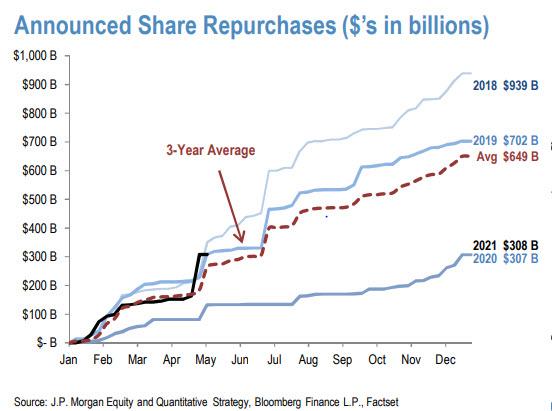
Probably not, but the real question is with buybacks accelerating – something else we discussed earlier this week now that 2021 is on pace to be a record breaking quarter for sotck buybacks…
… can corporate demand act as the incremental buyer if institutional investors pullback on their activity into the summer?
If 2018 and 2019 are any indication, the answer is a resounding yes.
The Drowning opens with a quick series of scenes from a multi-generational family picnic at the lake, a sunny collage that quickly turns dark, and not from the weather. Four-year-old Tom is playing with a boat in the water, and then—after a series of artily discordant shots that show little but imply much—he’s not. The lake waters have seemingly claimed the boy, and, in a way, his family, too.
This spellbinding new series that aired on British television this spring and is now available from the streaming services Acorn TV and Sundance Now has plenty of victims, drowning not only in water but grief and guilt, too.
But—could it all be needless? Almost exactly a decade later, Tom’s mother Jodie sees a teenager walking along a downtown street with a stunning resemblance to her son, right down to the little half-moon scar underneath an eye. Trailing him first to his school and then his home, Jodie is increasingly certain that she’s found Tom. Is this a simple case of mistaken identity? Or something far more sinister?
Jodie (played by Jill Halfpenny, like most of the cast a Brit TV veteran little-known to American audiences) is the axis upon which The Drowning spins. Certain she’s found her son, who she’s always regarded as missing and not dead—his body was never found—she gets no sympathy from either police or her family. The reticence of the cops is perhaps understandable; she’s got little evidence beyond a mother’s conviction of physical likeness. And a none-too-stable mother at that: Besieged by bill collectors, her landscaping business swirling the drain, Jodie is visibly crumbling under the pressure.
But her family’s reluctance to get involved smacks more of inertia, a sense that Jodie’s quixotic quest will only destroy the fragile peace they’ve made with Tom’s death. “I don’t think I could go through it again,” confesses her ex-husband who, after the boy’s drowning, left Jodie for her best friend.
Infuriated but undeterred, Jodie declares herself a one-woman truth squad. Using forged credentials, she gets herself hired as music teacher at the look-alike boy’s school, then even wangles her way into a gig as his guitar tutor. Her seemingly casual conversations with Mark (a stony-faced Rupert Penry-Jones), the kid’s purported single dad, arouse suspicions; he’s oddly reluctant to share recollections of the boy’s early childhood.
But there’s also something unsettling about the ease with which Jodie sheds her identity as a hedge-clipper and pot-waterer to turn undercover operative. And her tactics—buying faked documents with embezzled money—set off a tumbling line of criminal dominoes that seem likely to crush everyone around her even if she’s right about the boy’s identity.
The Drowning may sound like a been-there-done-that detective yarn of no particular distinction. But, tightly shot and edited, it’s a marvel of efficient story-telling. And Halfpenny gives an absolutely riveting performance, adroitly peeling away the skins of lives unknown as she pursues her phantom (or not) child. Her glare could freeze a mouse in the middle of the Sahara; her smile, light a ballroom. She gives Jodie a laser intensity that defies restraint, even when it’s warranted. At a memorial service for her father, whose weakened heart did not survive Tom’s death, one of his golfing buddies is asked if he ever cheated. “Only when you took your eyes off him,” the man replies.Like father, like daughter.
from Latest – Reason.com https://ift.tt/3e5ZCNP
via IFTTT