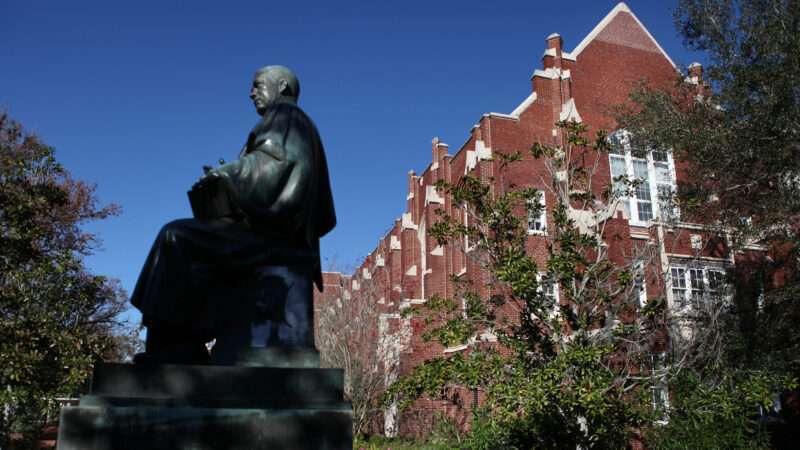
Dismissing Appointed Volunteer City Board Member for Her Speech (or Refusal to Speak) Doesn’t Violate First Amendment

From Lathus v. City of Huntington Beach, decided by Judge Stanley Blumenfeld (C.D. Cal.) on Sept. 29, but just posted on Westlaw:

Plaintiff Shayna Lathus was appointed to the Citizen Participation Advisory Board of the City of Huntington Beach (CPAB) by former City Councilwoman Kim Carr, who is now the mayor of Huntington Beach. {On April 27, 2019, Plaintiff attended a rally in support of immigrant rights. After the rally, Carr called Plaintiff to inform her that Carr had seen a photograph of Plaintiff at the rally “standing near individuals dressed in black that Carr identified as ‘Antifa’ members.” Carr “instructed” Plaintiff to denounce Antifa…. Plaintiff then wrote a social media post stating that “she supports law enforcement officers, she also supports immigrants’ rights, she was not aware that people identifying as Antifa would be present at the rally, and she did not engage with people identified as Antifa.” Carr told Plaintiff that her social media post was “not enough” because Plaintiff did not “denounce” Antifa.} … Carr dismissed Plaintiff from the CPAB, citing a lack of shared values….

Plaintiff is a resident of Huntington Beach. Plaintiff and Carr ran for City Council in 2018. Carr won a seat; Plaintiff did not. Soon after the election, Carr appointed Plaintiff as a member of the CPAB. Carr “had final policymaking authority on the decision to hire and fire” Plaintiff. Plaintiff accepted the appointment to “participate in local government [ ] and gain experience and name recognition locally as a springboard to further a career in politics and within Huntington Beach ….”

The CPAB is a part of city government. It consists of seven members, each of whom is appointed by one city council member. The members of the CPAB have “differing political views [and] affiliations.” The CPAB’s stated purpose is:

[T]o provide citizen participation and coordination in the City’s planning processes for the Community Development Block Grant Program administered by the Federal Department of Housing and Urban Development (HUD). The board shall assess the needs of the community, particularly that of low and moderate income households, evaluate and prioritize projects pertaining to the required plans and provide recommendations to City Council on such plans and projects. The board may hold public hearings to obtain citizen input on community needs, plans or proposals. The board shall provide specific recommendations regarding the projects reviewed by the board to the City Council….

Blair v. Bethel Sch. Dist. (9th Cir. 2010) noted that the political context distinguished [such cases] from the ordinary retaliation case because “more is fair in electoral politics than in other contexts.” That is, political officials are expected to act politically, which includes voting against candidates who express differing views, as this is part of “the regular functioning of the political process.” This principle applies here…. Carr was politically entitled, as a prerogative of her position as a council member, to appoint the person who would best represent her views and interests. To that end, “Carr had final policymaking authority on the decision to hire and fire [Plaintiff].” Under Blair, Carr was permitted to consider the political ramifications not only when she decided to appoint Plaintiff but also when she later elected to remove her from the public position….

[T]he Ninth Circuit [also] found it “significant” in Blair that the First Amendment rights of the plaintiff’s fellow board members also were at stake. The fellow board members had voted to place the plaintiff in the executive position; and their vote, to some extent, attached them politically to the plaintiff. Those voting members had the right to “communicate[ ] to [the plaintiff] and to the public” their disapproval of the plaintiff’s views, and the board had a legitimate interest in seeking “to distance itself” from the plaintiff’s views. Id. The removal of the plaintiff from the position to which the disapproving board members had appointed him constituted their public expression of disapproval and disassociation.

The existence of competing First Amendment rights in the context of political appointees who serve in a public role in the political arena is a particularly weighty consideration here. Carr was solely responsible for selecting Plaintiff to the CPAB. And by accepting the appointment, Plaintiff became a publicly visible figure in the local community. Plaintiff recognized this fact and welcomed the appointment “because it presented her with an opportunity to help her fellow Huntington Beach residents, participate in local government, and gain experience and name recognition locally as a springboard to further a career in politics.”

While Plaintiff’s actions as a public figure directly reflected upon her, they also could be seen as a reflection upon Carr. Carr’s selection of Plaintiff to the CPAB was a political act, and, like all political acts, subject to political attack. As a publicly elected official, Carr was accountable to the public for her political decisions, including her appointments. Of course, Plaintiff had the right to speak out on issues of concern to her and to freely associate within the full boundaries of the law. But Plaintiff also had to realize that, by accepting the appointment, she was no longer the only person politically accountable for her public actions. The political act of appointment had the political consequence of linking the appointor and appointee. By the appointment process, Plaintiff could therefore be viewed as a political extension of the person who had the sole authority to appoint her. {The principles articulated in Blair preclude Plaintiff from relying on authority applicable [to ordinary government employees].}

In short, when Plaintiff decided to engage in public protest, she was expressing her views and showing support for a cause in association with other like-minded individuals. In doing so, Plaintiff unquestionably was exercising her constitutional rights. However, such exercise “does not … immunize [her] from the political fallout” of her actions. Contrary to the thrust of Plaintiff’s lawsuit, Carr was not politically powerless to disassociate herself from Plaintiff’s public actions through a process that authorized appointment and removal in Carr’s sole discretion….

[T]he Blair analysis is [also ]applicable to [Plaintiff’s] claim of compelled speech. Carr presented Plaintiff with a choice: provide a statement denouncing Antifa or resign. From a First Amendment standpoint, the option of a compelled statement or forced resignation was no worse than no option at all (i.e., forced resignation). Or, at least, Plaintiff has not provided any reason to suggest that being presented with an option in her circumstances changes the constitutional calculus. Nor would it appear to have that effect. The principles applied in Blair do not seem to rest on any distinction between restricted and compelled speech. It is the context of appointing an individual to a political post for which the appointing politician is publicly accountable that makes the difference….

Lathus has appealed to the Ninth Circuit, but I expect the decision will be affirmed.

from Latest – Reason.com https://ift.tt/3k4XxnM
via IFTTT

A Truck Driver With a Few Thousand Bucks and an iPhone Just Toppled New Jersey’s Most Powerful Lawmaker


thumbnail (1)

It is not hyperbole to say that Edward Durr, a 58-year-old truck driver from New Jersey, just pulled off one of the biggest political upsets in American history.

With a bare-bones campaign that reportedly cost less than $6,000 (some earlier reports claimed that Durr spent just $153 on the race, but Durr later clarified that was not a full accounting), Durr ousted New Jersey Senate President Steve Sweeney (D–West Deptford) in Tuesday’s election. After previously calling the race for Sweeney and then withdrawing that call, the Associated Press called the race for Durr on Thursday morning. He has a lead of over 2,000 votes with 99 percent of precincts reporting.

Sweeney, who was seeking a seventh term in the Senate, is widely regarded as a kingpin in New Jersey politics and one of the most powerful men in the state. He has been president of the state Senate since 2010, the longest tenure in state history. He was expected to be a front-runner in the 2025 gubernatorial race and this year’s election was “never considered more than an afterthought,” according to NJ.com. After all, Sweeney had survived one of the most expensive legislative races in American history in 2017—when teachers unions had bucked their usual political alignment to spend heavily in support of Sweeney’s Republican challenger.

But Sweeney was no match for Durr, a political novice who drives a delivery truck for a regional chain of furniture stores.

“I don’t know if I truly am fearless or stupid. Because who in their right mind would take on a person with that kind of power and clout?” Durr told NJ.com. “But his power, his clout, did not scare me.”

If that’s not the most fundamentally American political statement, I don’t know what is.

Durr’s homemade campaign ads featured him climbing down from his trucking rig, driving a motorcycle, and promising to support cutting taxes. The production value of his online ads was possibly even lower. It didn’t matter, because he got more votes than the polished, besuited Sweeney.

It’s dangerous to make sweeping conclusions about state legislative races, which by their nature are fundamentally local affairs even in an age when political narratives are routinely nationalized. Durr’s victory could be a startling signal that residents of reliably blue southwestern New Jersey are fed up with Democratic leadership in Washington, D.C., and Trenton. More likely, it’s part of an ongoing backlash against mask mandates, COVID-19 lockdowns, and other destructive policies that emerged during the pandemic. In his ads and other public comments, Durr stressed that Sweeney did not do enough to push back against Gov. Phil Murphy’s COVID-19 policies. (Murphy, a Democrat, narrowly won reelection this week in a closer-than-expected race.)

“You have the debacle of unemployment. The masking of the kids in school. You have Senator Sweeney trying to take away peoples’ [sic] medical freedom rights,” Durr told Politico. He went on to say that he sees himself as a “constitutional conservative” and that he became interested in politics after trying to navigate New Jersey’s strict gun control laws in order to secure a concealed carry permit.

Here’s one conclusion you can decisively draw about Durr’s incredible upset: It wasn’t about money. Durr’s victory is another reminder that for all the pearl clutching about money in politics, contemporary American campaigns are less determined by big piles of cash—to pay for massive ad blitzes, expensive consultants, and the like—than ever. Social media and the internet have leveled the playing field, allowing old-school retail politics to evolve in new ways. You can now take down one of the most powerful men in state politics with a campaign ad filmed on an iPhone.

Durr just did it.

from Latest – Reason.com https://ift.tt/2ZV7Y6l
via IFTTT

Dismissing Appointed Volunteer City Board Member for Her Speech (or Refusal to Speak) Doesn’t Violate First Amendment

From Lathus v. City of Huntington Beach, decided by Judge Stanley Blumenfeld (C.D. Cal.) on Sept. 29, but just posted on Westlaw:

Plaintiff Shayna Lathus was appointed to the Citizen Participation Advisory Board of the City of Huntington Beach (CPAB) by former City Councilwoman Kim Carr, who is now the mayor of Huntington Beach. {On April 27, 2019, Plaintiff attended a rally in support of immigrant rights. After the rally, Carr called Plaintiff to inform her that Carr had seen a photograph of Plaintiff at the rally “standing near individuals dressed in black that Carr identified as ‘Antifa’ members.” Carr “instructed” Plaintiff to denounce Antifa…. Plaintiff then wrote a social media post stating that “she supports law enforcement officers, she also supports immigrants’ rights, she was not aware that people identifying as Antifa would be present at the rally, and she did not engage with people identified as Antifa.” Carr told Plaintiff that her social media post was “not enough” because Plaintiff did not “denounce” Antifa.} … Carr dismissed Plaintiff from the CPAB, citing a lack of shared values….

Plaintiff is a resident of Huntington Beach. Plaintiff and Carr ran for City Council in 2018. Carr won a seat; Plaintiff did not. Soon after the election, Carr appointed Plaintiff as a member of the CPAB. Carr “had final policymaking authority on the decision to hire and fire” Plaintiff. Plaintiff accepted the appointment to “participate in local government [ ] and gain experience and name recognition locally as a springboard to further a career in politics and within Huntington Beach ….”

The CPAB is a part of city government. It consists of seven members, each of whom is appointed by one city council member. The members of the CPAB have “differing political views [and] affiliations.” The CPAB’s stated purpose is:

[T]o provide citizen participation and coordination in the City’s planning processes for the Community Development Block Grant Program administered by the Federal Department of Housing and Urban Development (HUD). The board shall assess the needs of the community, particularly that of low and moderate income households, evaluate and prioritize projects pertaining to the required plans and provide recommendations to City Council on such plans and projects. The board may hold public hearings to obtain citizen input on community needs, plans or proposals. The board shall provide specific recommendations regarding the projects reviewed by the board to the City Council….

Blair v. Bethel Sch. Dist. (9th Cir. 2010) noted that the political context distinguished [such cases] from the ordinary retaliation case because “more is fair in electoral politics than in other contexts.” That is, political officials are expected to act politically, which includes voting against candidates who express differing views, as this is part of “the regular functioning of the political process.” This principle applies here…. Carr was politically entitled, as a prerogative of her position as a council member, to appoint the person who would best represent her views and interests. To that end, “Carr had final policymaking authority on the decision to hire and fire [Plaintiff].” Under Blair, Carr was permitted to consider the political ramifications not only when she decided to appoint Plaintiff but also when she later elected to remove her from the public position….

[T]he Ninth Circuit [also] found it “significant” in Blair that the First Amendment rights of the plaintiff’s fellow board members also were at stake. The fellow board members had voted to place the plaintiff in the executive position; and their vote, to some extent, attached them politically to the plaintiff. Those voting members had the right to “communicate[ ] to [the plaintiff] and to the public” their disapproval of the plaintiff’s views, and the board had a legitimate interest in seeking “to distance itself” from the plaintiff’s views. Id. The removal of the plaintiff from the position to which the disapproving board members had appointed him constituted their public expression of disapproval and disassociation.

The existence of competing First Amendment rights in the context of political appointees who serve in a public role in the political arena is a particularly weighty consideration here. Carr was solely responsible for selecting Plaintiff to the CPAB. And by accepting the appointment, Plaintiff became a publicly visible figure in the local community. Plaintiff recognized this fact and welcomed the appointment “because it presented her with an opportunity to help her fellow Huntington Beach residents, participate in local government, and gain experience and name recognition locally as a springboard to further a career in politics.”

While Plaintiff’s actions as a public figure directly reflected upon her, they also could be seen as a reflection upon Carr. Carr’s selection of Plaintiff to the CPAB was a political act, and, like all political acts, subject to political attack. As a publicly elected official, Carr was accountable to the public for her political decisions, including her appointments. Of course, Plaintiff had the right to speak out on issues of concern to her and to freely associate within the full boundaries of the law. But Plaintiff also had to realize that, by accepting the appointment, she was no longer the only person politically accountable for her public actions. The political act of appointment had the political consequence of linking the appointor and appointee. By the appointment process, Plaintiff could therefore be viewed as a political extension of the person who had the sole authority to appoint her. {The principles articulated in Blair preclude Plaintiff from relying on authority applicable [to ordinary government employees].}

In short, when Plaintiff decided to engage in public protest, she was expressing her views and showing support for a cause in association with other like-minded individuals. In doing so, Plaintiff unquestionably was exercising her constitutional rights. However, such exercise “does not … immunize [her] from the political fallout” of her actions. Contrary to the thrust of Plaintiff’s lawsuit, Carr was not politically powerless to disassociate herself from Plaintiff’s public actions through a process that authorized appointment and removal in Carr’s sole discretion….

[T]he Blair analysis is [also ]applicable to [Plaintiff’s] claim of compelled speech. Carr presented Plaintiff with a choice: provide a statement denouncing Antifa or resign. From a First Amendment standpoint, the option of a compelled statement or forced resignation was no worse than no option at all (i.e., forced resignation). Or, at least, Plaintiff has not provided any reason to suggest that being presented with an option in her circumstances changes the constitutional calculus. Nor would it appear to have that effect. The principles applied in Blair do not seem to rest on any distinction between restricted and compelled speech. It is the context of appointing an individual to a political post for which the appointing politician is publicly accountable that makes the difference….

Lathus has appealed to the Ninth Circuit, but I expect the decision will be affirmed.

from Latest – Reason.com https://ift.tt/3k4XxnM
via IFTTT
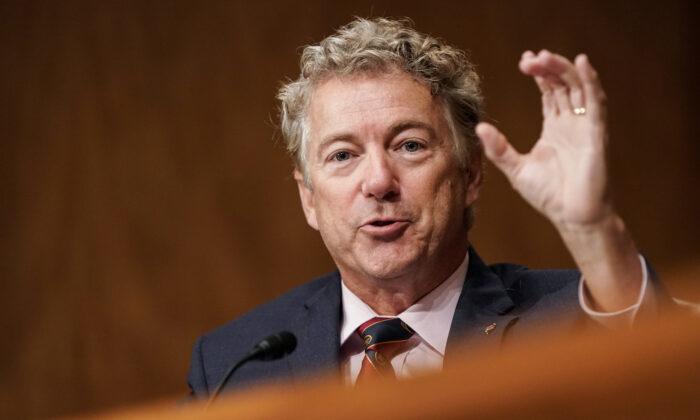
“They Put Their Life At Risk”: Sen. Paul Decries Firing Of Frontline Workers Over Vaccine Mandates

“They Put Their Life At Risk”: Sen. Paul Decries Firing Of Frontline Workers Over Vaccine Mandates

Authored by Zachary Stieber via The Epoch Times,

Firefighters, nurses, and other so-called frontline workers are being fired or facing termination across the country for not complying with COVID-19 vaccine mandates.

That’s wrong, Sen. Rand Paul (R-Ky.) says.

“It’s a great disservice to fire people—nurses, doctors, firemen, policemen—who put their life at risk when there was no vaccine at all,” he told NTD’s “The Beau Show.”

Officials in New York City and other locales that have imposed vaccine requirements say they will help decrease community spread of the virus that causes COVID-19, though the effectiveness of the COVID-19 vaccines against infection has dropped sharply in recent months.

“In terms of COVID, we are one of the safest places in America, because we have one of the highest levels of vaccination,” Mayor Bill de Blasio, a Democrat, told reporters on Wednesday.

Paul disagrees, particularly because many mandates lack opt-outs for those who have had COVID-19 and recovered. That means they have some level of protection against the CCP (Chinese Communist Party) virus, many studies have shown.

“Many of them got COVID while taking care of people. The doctors and nurses caught COVID from their patients. Most of them survived, fortunately. They now have immunity and all the science—102 studies—show that you have immunity if you’ve had the disease naturally,” he told NTD.

NTD is part of the Epoch Media Group.

The Centers for Disease Control and Prevention acknowledges natural immunity, or protection bestowed by having COVID-19, but asserts even those with it should get a vaccine for an extra boost.

“We do know that after nearly all infectious diseases, you have some protection from getting that infection again, but we don’t really know how long that lasts or how robust it is,” Dr. Rochelle Walensky, the agency’s head, told reporters on Wednesday.

Critics argue those points are largely the same for vaccines and note that many of the studies suggest the level of protection is similar to or even superior to vaccination.

“What kind of discriminatory policies do we have in place that are excluding someone like me from the workplace when I’m 99.8 percent protected against reinfection, whereas someone who got the Johnson & Johnson vaccine, by the company’s own data that they submitted to the FDA, is 67 percent protective against COVID infection?” Dr. Aaron Kheriaty, who was suspended by the University of California, Irvine for not getting a vaccine, told The Epoch Times last month.

Paul, a doctor, said that “nothing’s perfect, but your immunity is as good as the vaccine.”

“And there’s no reason for the government to be mandating a vaccine, particularly on people who’ve already had the disease,” he added.

Tyler Durden
Thu, 11/04/2021 – 13:39

via ZeroHedge News https://ift.tt/3EIULwq Tyler Durden

A Truck Driver With a Few Thousand Bucks and an iPhone Just Toppled New Jersey’s Most Powerful Lawmaker


thumbnail (1)

It is not hyperbole to say that Edward Durr, a 58-year-old truck driver from New Jersey, just pulled off one of the biggest political upsets in American history.

With a bare-bones campaign that reportedly cost less than $6,000 (some earlier reports claimed that Durr spent just $153 on the race, but Durr later clarified that was not a full accounting), Durr ousted New Jersey Senate President Steve Sweeney (D–West Deptford) in Tuesday’s election. After previously calling the race for Sweeney and then withdrawing that call, the Associated Press called the race for Durr on Thursday morning. He has a lead of over 2,000 votes with 99 percent of precincts reporting.

Sweeney, who was seeking a seventh term in the Senate, is widely regarded as a kingpin in New Jersey politics and one of the most powerful men in the state. He has been president of the state Senate since 2010, the longest tenure in state history. He was expected to be a front-runner in the 2025 gubernatorial race and this year’s election was “never considered more than an afterthought,” according to NJ.com. After all, Sweeney had survived one of the most expensive legislative races in American history in 2017—when teachers unions had bucked their usual political alignment to spend heavily in support of Sweeney’s Republican challenger.

But Sweeney was no match for Durr, a political novice who drives a delivery truck for a regional chain of furniture stores.

“I don’t know if I truly am fearless or stupid. Because who in their right mind would take on a person with that kind of power and clout?” Durr told NJ.com. “But his power, his clout, did not scare me.”

If that’s not the most fundamentally American political statement, I don’t know what is.

Durr’s homemade campaign ads featured him climbing down from his trucking rig, driving a motorcycle, and promising to support cutting taxes. The production value of his online ads was possibly even lower. It didn’t matter, because he got more votes than the polished, besuited Sweeney.

It’s dangerous to make sweeping conclusions about state legislative races, which by their nature are fundamentally local affairs even in an age when political narratives are routinely nationalized. Durr’s victory could be a startling signal that residents of reliably blue southwestern New Jersey are fed up with Democratic leadership in Washington, D.C., and Trenton. More likely, it’s part of an ongoing backlash against mask mandates, COVID-19 lockdowns, and other destructive policies that emerged during the pandemic. In his ads and other public comments, Durr stressed that Sweeney did not do enough to push back against Gov. Phil Murphy’s COVID-19 policies. (Murphy, a Democrat, narrowly won reelection this week in a closer-than-expected race.)

“You have the debacle of unemployment. The masking of the kids in school. You have Senator Sweeney trying to take away peoples’ [sic] medical freedom rights,” Durr told Politico. He went on to say that he sees himself as a “constitutional conservative” and that he became interested in politics after trying to navigate New Jersey’s strict gun control laws in order to secure a concealed carry permit.

Here’s one conclusion you can decisively draw about Durr’s incredible upset: It wasn’t about money. Durr’s victory is another reminder that for all the pearl clutching about money in politics, contemporary American campaigns are less determined by big piles of cash—to pay for massive ad blitzes, expensive consultants, and the like—than ever. Social media and the internet have leveled the playing field, allowing old-school retail politics to evolve in new ways. You can now take down one of the most powerful men in state politics with a campaign ad filmed on an iPhone.

Durr just did it.

from Latest – Reason.com https://ift.tt/2ZV7Y6l
via IFTTT

Ethiopians Told To Defend Capital As Tigray Rebels Encroach; US Embassy Evacuating Staff Amid ‘State Of Emergency’ 

Ethiopians Told To Defend Capital As Tigray Rebels Encroach; US Embassy Evacuating Staff Amid ‘State Of Emergency’ 

The war between the Ethiopian government and Tigray rebels, which intensified in the past months, is now threatening to descend of the capital of Addis Ababa – resulting in authorities declaring a state of emergency, and with the US Embassy beginning to initiate non-essential staff departures. The US State Department has further warned all US citizens to evacuate the country immediately.

“Our country is facing a grave danger to its existence, sovereignty and unity. And we can’t dispel this danger through the usual law enforcement systems and procedures,” Justice Minister Gedion Timothewos said Tuesday in announcing the six month state of emergency which essentially imposes martial law on the population. The government has also called on all residents in Addis Ababa to prepare to defend their neighborhoods ahead of a potential rebel assault, which is looking imminent.

Airstrike aftermath in Tigray region, via AP

Residents can gather in their locality and safeguard their surroundings. Those who have weapons but can’t take part in safeguarding their surroundings are advised to hand over their weapons to the government or their close relatives or friends,” an emergency government announcement stated. Government authorities are now in the process of overseeing the registration of citizens’ private arms in preparation for a possible breach of the city.

While up to now the fighting has been concentrated in the country’s northern Tigray region, especially since a national army offensive against the breakaway ethnic enclave in November 2020, this is the first time the sprawling capital city of about five million could be thrown into turmoil. 

After the rebel group Tigray People’s Liberation Front (TPLF) captured the key towns of Dessie and Kombolcha this week, which lie 250 miles from the capital, the fighters have been reportedly making a rapid advance southward toward the seat of the national government

Some rebel commanders are now claiming to have forces positioned a mere 15 miles from the center of Addis Ababa, though this hasn’t been confirmed on the ground, CNN reports. The war which has been intensifying and ongoing for the past year has been largely stalemated, and has included allegations of horrific human rights abuses by both sides in the Tigray region. 

UN General-Secretary António Guterres and Western leaders have urged an immediate ceasefire, and on Thursday US Special Envoy for Horn of Africa Jeffrey Feltman is en route to Ethiopia in an attempt to broker an agreed halt in fighting. So far the conflict has killed many thousands, but the war coming to the densely populated capital would result in the country’s unraveling. 

On Wednesday Ethiopian Prime Minister Abiy Ahmed vowed in a televised state broadcast to bury his government’s enemies “with our blood”, Reuters reported. The chilling message was advanced via official social media channels as well, with Facebook announcing that it promptly deleted the post as it was an incitement to violence. 

Since taking power in 2018, Abiy Ahmed was initially celebrated in the West as a unifier, reformer and human rights champion. He was awarded the Nobel Peace Prize in October 2019 for making peace with neighboring Eritrea after two decades of war; however, the current crisis has earned him widespread criticism and condemnation for the ruthlessness with which government forces have sought to stamp out the ethnic minority Tigray rebellion. Ironically it was his peace treaty with Eritrea that helped inflame the anger of Tigrayans – who are concentrated on the northern Eritrean border – with the national government. 

Earlier this week President Biden slammed the Ethiopian government’s “gross violations of internationally recognized human rights” and cut the country from a key US trade program, the African Growth and Opportunity Act – which gave it duty-free access to US goods. The move is seen as paving the way for further and more far-reaching sanctions, which would likely target top Ethiopian officials who are overseeing the war.

* * *

A brief BBC review of the origins of the conflict is as follows:

“The conflict started on 4 November, when Ethiopian Prime Minister Abiy Ahmed ordered a military offensive against regional forces in Tigray. He said he did so in response to an attack on a military base housing government troops there.

The escalation came after months of feuding between Mr Abiy’s government and leaders of Tigray’s dominant political party. For almost three decades, the party was at the centre of power, before it was sidelined by Mr Abiy, who took office in 2018 after anti-government protests.

Mr Abiy pursued reforms, but when Tigray resisted, the political crisis erupted into war.”

Tigray area of northern Ethiopia. Map: Associated Press

Tyler Durden
Thu, 11/04/2021 – 13:19

via ZeroHedge News https://ift.tt/3qflUmu Tyler Durden

University of Florida Bans Professors From Testifying Against State Voting Law


zumaamericasfive373751

The University of Florida forbade three of its professors from testifying as expert witnesses in a lawsuit challenging a new Florida voting law, according to documents filed by the plaintiffs in the lawsuit.

The law in question, S.B. 90, was one of a glut of new laws passed earlier this year in Republican-led states. Among other things, S.B. 90 put new limitations on voting by mail and ballot drop boxes. Florida Gov. Ron DeSantis signed the bill into law in May. The same month, a group of voting rights advocates sued to block it, saying that it violated the Voting Rights Act and would disproportionately harm people of color.

To bolster their case against the law, the plaintiffs sought to enlist the testimony of three professors from the University of Florida (UF): Daniel Smith, Michael McDonald, and Sharon Austin, experts in election law, voting behaviors, and voting rights. The university, however, denied the professors’ requests, saying in part, “Outside activities that may pose a conflict of interest to the executive branch of the State of Florida create a conflict for the University of Florida.” As a public university, UF receives state funding, but consequently, it also has First Amendment obligations to its students and faculty that a private university would not have. The denial was news to the professors—in fact, as The New York Times reported, Smith had previously “testified with the University of Florida’s permission in two voting rights lawsuits against Florida’s Republican-led government in 2018.”

Over the weekend, UF President Kent Fuchs and Provost Joe Glover jointly issued a statement, affirming the university’s dedication to academic freedom and freedom of speech, announcing the appointment of a “task force” to “review” the university’s policy on conflicts of interest for “consistency and fidelity,” and further clarifying that “if the professors wish to testify pro bono on their own time without using university resources, they are free to do so.”

However, as McDonald tweeted last week, “Our compensation was not given as a reason in the original disapproval” from the university. Smith declined Reason‘s request for comment, citing possible litigation. However, in a statement to Fuchs that was provided to Reason, David O’Neill and Paul Donnelly, attorneys representing the three professors, assert that “Prohibiting Professors from giving standard expert testimony, and instead only allowing pro bono testimony, undermines their credibility as expert witnesses and chills their speech.”

Smith’s C.V., linked on the school’s website, lists multiple pages of experience as a consultant, lead author, or expert witness on behalf of plaintiffs, including several filed against the state of Florida. In only three total cases does he list himself as having appeared pro bono. Jennifer Garrett, media strategist for the American Civil Liberties Union of Florida (one of the plaintiffs referenced on Smith’s C.V.), confirmed to Reason that Smith was compensated for his work with them.

In theory, it is entirely possible for a government entity to restrict the ways in which its employees speak out in their capacity as employees. National Review‘s Dan McLaughlin writes that even though “academics are not bound by a code of ethics or a duty of loyalty to their employers,” they do still serve as state employees, and they should not be able to use “the imprimatur of their status as state-university professors to make the case against the state before a judge or jury.”

However, as the Foundation for Individual Rights in Education (FIRE) said in a letter to the school, the Supreme Court ruled in Lane v. Franks (2014) that “Truthful testimony under oath by a public employee outside the scope of his ordinary job duties is speech as a citizen for First Amendment purposes.” In a press release, FIRE said: “It doesn’t matter if the professors are paid for their labor, or if the labor is provided pro bono. They have a right to testify.”

On Tuesday, a fourth UF professor came forward claiming that he had been prevented from providing expert testimony. As reported by The Chronicle of Higher Education, Jeffrey Goldhagen, a professor of pediatrics at the UF College of Medicine in Jacksonville, was asked to provide expert testimony this summer in a series of cases regarding DeSantis’ ban on mask mandates. Despite assurances that he did not expect to be paid, and that he “would be participating as a private citizen, and not as a UF faculty member,” Goldhagen’s requests were denied on the basis that because “UF is an extension of the state as a state agency, litigation against the state is adverse to UF’s interests.”

Critics of UF’s actions have blamed the DeSantis administration, pointing out that the chairman of UF’s Board of Trustees, Morteza Hosseini, is a DeSantis adviser. DeSantis’ office has denied any involvement with UF’s decision. Either way, it’s unclear how professors providing testimony on specific state policies within their respective areas of expertise could be “adverse to [the] interests” of the university, unless the university feared some kind of retaliation from the DeSantis administration.

It remains to be seen whether the school’s policy is unconstitutional, but at the very least, it is counter to the promotion of free speech on college campuses. As FIRE attorney Aaron Terr wrote in a letter to Fuchs, “The notion that a government actor such as UF can suppress truthful testimony in court out of a general concern that the testimony would be ‘adverse’ to the government’s interests is completely alien to the First Amendment and harmful to the administration of justice.”

from Latest – Reason.com https://ift.tt/3EHPdCo
via IFTTT

Coking Coal Has A Branding Problem

Coking Coal Has A Branding Problem

Submitted by Doomberg

I’m sorry to bang on about coal, but it makes you look a little bit weaselly not answering the coal question.” – Justin Rowlatt

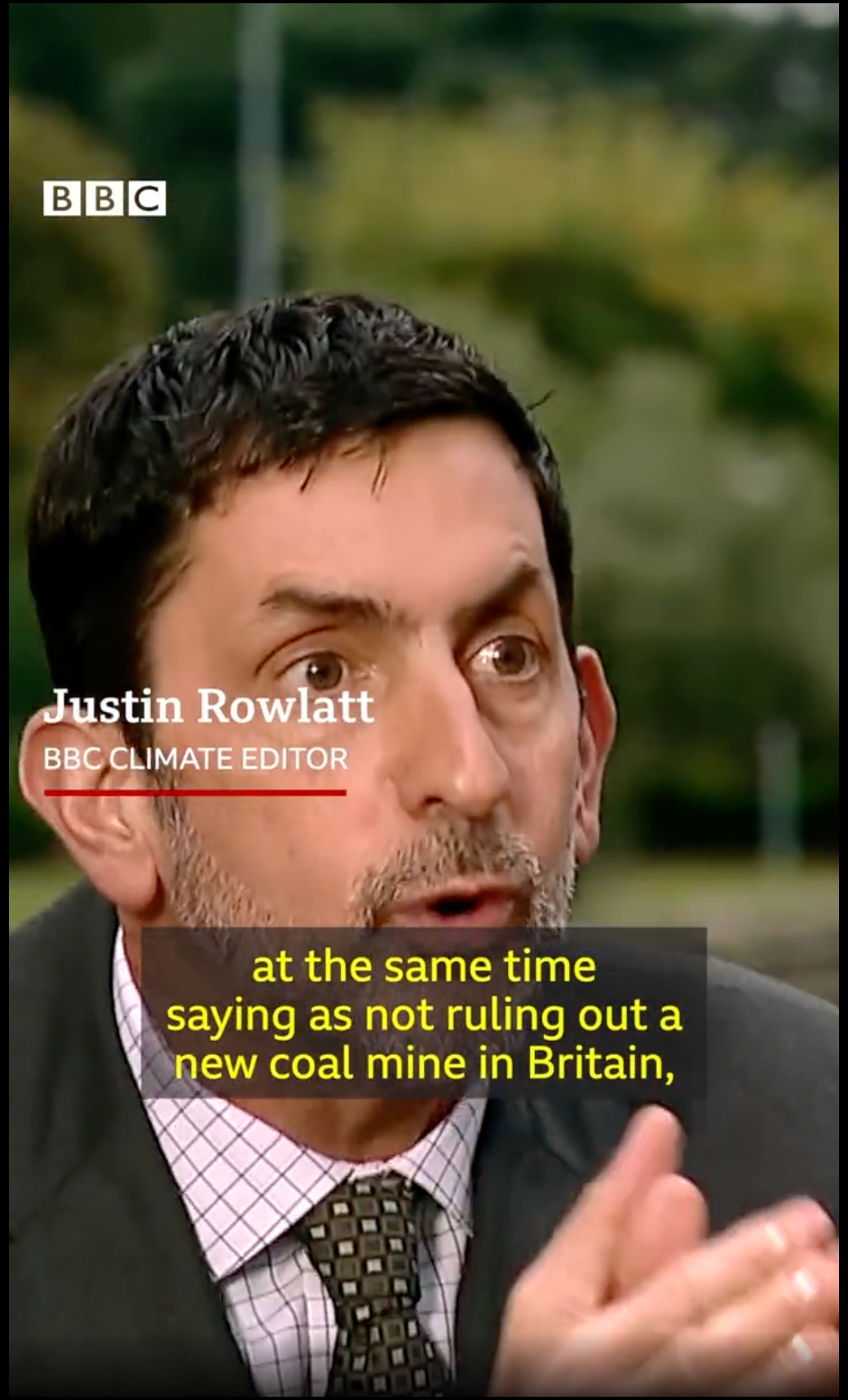
The world has gathered in Glasgow for COP26, and on the opening morning we were treated to quite the spectacle on the BBC. Justin Rowlatt, the BBC’s climate editor, took British Prime Minister Boris Johnson to task for not doing enough to rule out a new coal mine currently under consideration in the UK. That’s Rowlatt below, foaming with total indignation that Johnson could even fathom allowing such a project to proceed.

Flustered by the line of attack, Johnson retreated to citing statistics about how coal has become almost irrelevant to the UK power grid:

When I was a kid, 80% of our power came from coal. When I was mayor of London, it was 40%. It’s now 1%.

Not satisfied with that answer, Rowlatt interrupts Johnson:

Let’s talk about coal and I know everybody asks you this question. But you’re going to China, you’re going to India, you’re going to the developing world saying, ‘phase out coal,’ at the same time saying as not ruling out a new coal mine in Britain, a new coal mine in Britain! We started the industrial revolution, we should have closed the mines!

I’m not sure what’s more hysterical (horrifying?) – that the climate editor for the BBC seems to have no earthly idea what he is talking about or that the British Prime Minister seems to have no earthly idea what he is talking about.

The coal mine at issue would have been in Cumbria and it was to produce coking coal, not thermal coal (we use the past tense because it is clear this mine is never opening). Coking coal is not burned to make electricity. Coking coal is used along with iron ore to make steel. If the world cannot produce steel, much of the world economy grinds to a halt.

Unfortunately for coking coal, it has coal in its name. Unfortunately for the renewable power industry, they’re going to need a lot of coking coal. This seems like quite the conundrum.

For example, it is well-known that the production of wind turbines consumes a lot of steel. At least we thought it was well-known. The picture below shows a popular tubular steel tower design. It’s a similar story with electric vehicles and all manner of stuff required to enable the green revolution. There is no path to meaningfully reduced CO2 emissions that doesn’t involve the use of massive amounts of steel.

Is the production of steel a dirty business? Absolutely! It accounts for nearly 8% of global CO2 emissions. Are there ways to reduce that impact and should they be implemented? No doubt! Is China’s steel industry measurably dirtier than mills in the United States and Europe? Unquestionably! Think they care what we do? Nope!

The world will keep mining coking coal and making steel as it always has, it’ll just be much more expensive and less environmentally friendly than it could otherwise have been, which will further impede the implementation of the renewable energy revolution. Coking coal mines in Russia and China will continue cranking out product with far fewer environmental protections than Cumbria would have implemented. Huge dry bulk cargo ships will meander around the globe, packed with coking coal from exporting countries like Canada and Australia, polluting the oceans in the process.

As with many fundamental commodities, the price of coking coal has soared to eye-watering levels in the past few months, albeit for reasons mostly unrelated to the Cumbria standoff. We were already writing a piece on arbitrage in the coking coal market when the BBC clip crossed our Twitter feed – we hope to get that one done before too long.

Critics will point out that the production of green steel – an innovative set of technologies that rely on hydrogen instead of coal – is just over the horizon. We certainly hope so, but we note that the hydrogen will have to come from fossil fuels or (gasp!) nuclear power, because otherwise the production of green hydrogen at scale will rely on the very same yet-to-be-built renewable energy infrastructure that will consume massive amounts of steel. How’s that for the circle of life?

We don’t doubt that steam reforming natural gas to produce the hydrogen necessary to make green steel a reality would lead to substantial reductions in CO2 emissions. After listening to that BBC interview, we have grave doubts using natural gas for this process will be considered acceptable. It’s a fossil fuel, after all, and better isn’t better when only zero will do.

Anyway, that mine is never getting permitted and – to borrow a phrase from a former British Prime Minister with a little more shrewdness than Mr. Johnson – we shall continue attempting to lift ourselves out of the bucket we are currently standing in by pulling on the handle.

If you enjoy Doomberg, subscribe and share a link with your most paranoid friend!

Tyler Durden
Thu, 11/04/2021 – 13:00

via ZeroHedge News https://ift.tt/3whakZg Tyler Durden

University of Florida Bans Professors From Testifying Against State Voting Law


zumaamericasfive373751

The University of Florida forbade three of its professors from testifying as expert witnesses in a lawsuit challenging a new Florida voting law, according to documents filed by the plaintiffs in the lawsuit.

The law in question, S.B. 90, was one of a glut of new laws passed earlier this year in Republican-led states. Among other things, S.B. 90 put new limitations on voting by mail and ballot drop boxes. Florida Gov. Ron DeSantis signed the bill into law in May. The same month, a group of voting rights advocates sued to block it, saying that it violated the Voting Rights Act and would disproportionately harm people of color.

To bolster their case against the law, the plaintiffs sought to enlist the testimony of three professors from the University of Florida (UF): Daniel Smith, Michael McDonald, and Sharon Austin, experts in election law, voting behaviors, and voting rights. The university, however, denied the professors’ requests, saying in part, “Outside activities that may pose a conflict of interest to the executive branch of the State of Florida create a conflict for the University of Florida.” As a public university, UF receives state funding, but consequently, it also has First Amendment obligations to its students and faculty that a private university would not have. The denial was news to the professors—in fact, as The New York Times reported, Smith had previously “testified with the University of Florida’s permission in two voting rights lawsuits against Florida’s Republican-led government in 2018.”

Over the weekend, UF President Kent Fuchs and Provost Joe Glover jointly issued a statement, affirming the university’s dedication to academic freedom and freedom of speech, announcing the appointment of a “task force” to “review” the university’s policy on conflicts of interest for “consistency and fidelity,” and further clarifying that “if the professors wish to testify pro bono on their own time without using university resources, they are free to do so.”

However, as McDonald tweeted last week, “Our compensation was not given as a reason in the original disapproval” from the university. Smith declined Reason‘s request for comment, citing possible litigation. However, in a statement to Fuchs that was provided to Reason, David O’Neill and Paul Donnelly, attorneys representing the three professors, assert that “Prohibiting Professors from giving standard expert testimony, and instead only allowing pro bono testimony, undermines their credibility as expert witnesses and chills their speech.”

Smith’s C.V., linked on the school’s website, lists multiple pages of experience as a consultant, lead author, or expert witness on behalf of plaintiffs, including several filed against the state of Florida. In only three total cases does he list himself as having appeared pro bono. Jennifer Garrett, media strategist for the American Civil Liberties Union of Florida (one of the plaintiffs referenced on Smith’s C.V.), confirmed to Reason that Smith was compensated for his work with them.

In theory, it is entirely possible for a government entity to restrict the ways in which its employees speak out in their capacity as employees. National Review‘s Dan McLaughlin writes that even though “academics are not bound by a code of ethics or a duty of loyalty to their employers,” they do still serve as state employees, and they should not be able to use “the imprimatur of their status as state-university professors to make the case against the state before a judge or jury.”

However, as the Foundation for Individual Rights in Education (FIRE) said in a letter to the school, the Supreme Court ruled in Lane v. Franks (2014) that “Truthful testimony under oath by a public employee outside the scope of his ordinary job duties is speech as a citizen for First Amendment purposes.” In a press release, FIRE said: “It doesn’t matter if the professors are paid for their labor, or if the labor is provided pro bono. They have a right to testify.”

On Tuesday, a fourth UF professor came forward claiming that he had been prevented from providing expert testimony. As reported by The Chronicle of Higher Education, Jeffrey Goldhagen, a professor of pediatrics at the UF College of Medicine in Jacksonville, was asked to provide expert testimony this summer in a series of cases regarding DeSantis’ ban on mask mandates. Despite assurances that he did not expect to be paid, and that he “would be participating as a private citizen, and not as a UF faculty member,” Goldhagen’s requests were denied on the basis that because “UF is an extension of the state as a state agency, litigation against the state is adverse to UF’s interests.”

Critics of UF’s actions have blamed the DeSantis administration, pointing out that the chairman of UF’s Board of Trustees, Morteza Hosseini, is a DeSantis adviser. DeSantis’ office has denied any involvement with UF’s decision. Either way, it’s unclear how professors providing testimony on specific state policies within their respective areas of expertise could be “adverse to [the] interests” of the university, unless the university feared some kind of retaliation from the DeSantis administration.

It remains to be seen whether the school’s policy is unconstitutional, but at the very least, it is counter to the promotion of free speech on college campuses. As FIRE attorney Aaron Terr wrote in a letter to Fuchs, “The notion that a government actor such as UF can suppress truthful testimony in court out of a general concern that the testimony would be ‘adverse’ to the government’s interests is completely alien to the First Amendment and harmful to the administration of justice.”

from Latest – Reason.com https://ift.tt/3EHPdCo
via IFTTT

Diversity Can’t Save Eternals. It’s a Cosmic Disaster.


eternals-useme2-full

More than anything, the key to the success of the Marvel Cinematic Universe (MCU) has been charisma. Robert Downey Jr.’s Iron Man had it. Chris Evans’ Captain America eventually found it. Chris Hemsworth’s Thor had the biceps and self-awareness to simulate it. Scarlett Johansson’s Black Widow started out with plenty, then somehow lost it. Tom Hiddleston’s Loki has so much of it that no one, including possibly Hiddleston, quite knows what to do. (Hence, more Lokis.) And supporting players ranging from Samuel L. Jackson to Florence Pugh to Don Cheadle to Awkwafina filled in the gaps with tremendous, broadly appealing screen presences of their own.

Yes, Marvel’s superhero movies delivered spectacle, and intergalactic stakes, and did-you-spot-that Easter eggs and lore for comic book fans. But first and foremost, they were built on the strength of lively, deeply appealing characters.

When the characters worked, the movies worked—even if everything else was kind of a mess.

So the fact that Eternals, the third major MCU installment to hit theaters this year, is kind of a mess, isn’t necessarily a deal breaker. No, the real problem with Eternals is that it’s a boring movie about boring people. It’s overlong, overdependent on barely comprehensible lore, underwhelming as a spectacle, and stuffed with uninteresting, unappealing characters who have all the charisma of a pair of marked-down pleated khakis. Eternals is a cosmic disaster.

It’s bad from minute one. The movie starts with a brutal text dump of cosmic lore garbage about Celestials and Deviants and the “six singularities” (which are never referenced again) and a big robot-looking space god something-or-other named Arishem who, whatever, because none of this really matters.

This material derives from Jack Kirby’s foundational work on the cosmic side of Marvel’s comic book universe. To the extent that it worked on the page, it worked because it was delivered in the context of Kirby’s jaw-dropping artwork, which took the trippy weirdness of circa-1970s Marvel comics and reimagined it at interstellar scale. It didn’t matter if Kirby’s lore made sense or not—please, fellow dorks, do not try to explain the First Firmament or the Aspirants to me—it was so awe-inspiringly weird and grandiose that you just accepted it on the strength of its imaginative ridiculousness. Eternals, in contrast, gives it to us as a solemn introductory text, set on a black screen, like homework before a big exam.

Eventually, we do get to see a Celestial or two on screen, and sure, they look kind of neat. But the movie treats them too gingerly, as mystical totems to be revered in hushed tones rather than as the gaga sci-fi wonders of Kirby’s comic book panels.

Still, these planet-sized interstellar overlords are the film’s most powerful ideas and images—which is itself kind of a problem. By the end of the film, the only character I wanted to know more about was Arishem, the cosmically unknowable god-thing with the booming voice and too many eyes.

That’s because every single other person on the screen is an absolute bore. Yes, the movie has the requisite quippy banter and superheroes-are-normal-people shtick bits, including an entire scene built around jokes about beer fermented in spit, which is even less funny than it sounds. But the gags all play like mandatory box-checking exercises forced into the script in order to meet the now-expected comic demands of the Marvel movie formula.

Speaking of box checking, the characters themselves are even worse: None of them have recognizable personalities beyond “serious” or “comic.” (A misbegotten subplot in which Angelina Jolie’s warrior-Eternal Thena occasionally goes psychotic goes almost nowhere.) Instead, the team comes together as if it was assembled by following a corporate diversity consultant’s checklist. Eternals, which has marketed itself on the diversity of its cast and filmmakers, substitutes empty identity signifiers for relatability.

Some of this is a matter of mistaken casting choices: Scottish actor Richard Madden is particularly dull as the Superman-like Ikaris. But it’s more of a problem with the script, which gives these performers little to do except engage in weak banter until the bad guys show up and, inevitably, they have to start shooting computer-generated laser lights from their palms.

And when the light show does begin, nothing improves. Marvel movies often have a bland and same-y look, especially to their effects and action sequences. But far too often, Eternals just looks like green screen garbage. Long sequences are muddy and poorly lit; the computer-generated bad dudes look like they were rendered on a PlayStation 2.

One of the many ironies of Eternals is that it sometimes poses as a lesson about the goodness of humanity, and that goodness is premised on the human capacity to create things of awe-inspiring beauty. Director Chloé Zhao has certainly shown that she’s capable of creating such images: Her previous film, the Oscar-winning Nomadland, captured the desolate beauty of the modern American West with breathtaking grandeur. But there’s nothing remotely awesome here. Instead, Eternals limply gestures at her earlier work with a handful of depressingly ugly sequences set at a lonely farmhouse in the Dakotas.

Of course, it’s one thing to put up with cruddy-looking visuals if the action scenes are cleverly designed, and if the characters and story have real emotional stakes—or at least some winning protagonists and inspired humor. 

Indeed, it’s worth comparing Eternals to Shang-Chi and the Legend of the Ten Rings, the previous MCU feature. The big monster showdown at the end of Shang-Chi was similarly weightless and occasionally muddy. But the story was full of wonderfully weird beats, including an entire subplot about Ben Kingsley’s relationship with a psychic winged butt. (Unlike the spit-beer bit, this is even funnier than it sounds.) The energetic action scenes—some of the best in the MCU—balanced grace, cleverness, and knowing cinematic reference. And the main characters had connection, purpose, and personality. They had charisma, and thus so did the movie itself. Shang-Chi was a diverse film, and also a good one. Eternals only manages half the equation.

from Latest – Reason.com https://ift.tt/3BKGI7J
via IFTTT