Enraged Father Says School Covered Up Daughter’s Bathroom Rape; Trans Student Had Previous Incident

Enraged Father Says School Covered Up Daughter’s Bathroom Rape; Trans Student Had Previous Incident

A Virginia father who went viral after he was dragged out of a Loudon County school board meeting has revealed that he was protesting the school’s transgender policy after he and his attorney claims that his daughter was raped by a 14-year-old trans boy in the girls’ bathroom.

Scott Smith, 48, told the Daily Wire that his daughter, a 15-year-old freshman at Stone Bridge High School, was raped by the boy on May 28. He says he was called by school officials and only told that there had been a ‘physical altercation.’

After he arrived on scene, he learned that she had actually been sexually assaulted. He says the school staff said they wanted to handle the situation ‘internally,’ and chose not to call the police.

After Smith became furious and challenged their decision, officials called Loudon County Sheriff’s deputies.

“I went nuts. I called the principal a pussy. Six cop cars showed up like a fucking SWAT team,” said Smith, adding that he had “exploded with rage.”

Smith and the family’s attorney say a rape kit and other tests prove a sexual assault occurred. After presenting the evidence to the police, a case was opened.

“Thank God that I drew enough attention to it, without getting arrested, that we got an escort to the hospital and they administered a rape kit that night,” he said.

Two months after the incident, the boy was arrested for forced sodomy along with other counts, according to the family’s attorney.

Three weeks after the alleged rape, Smith attended a school board meeting on June 22, where a discussion on a proposal to protect transgender students was on the agenda. After he was dragged out of the meeting, he was ridiculed on social media, and painted as a right-wing anti-trans bigot by the left.

The family has established a GoFundMe account.

“My wife and I are gay- and lesbian-friendly,” Smith told the Daily Wire. “We’re not into this children transgender stuff. The person that attacked our daughter is apparently bisexual and occasionally wears dresses because he likes them. So this kid is technically not what the school board was fighting about. The point is kids are using it as an advantage to get into the bathrooms.”

Cover-up?

During the June 22 meeting, school board member Beth Barts claimed not to know of any assaults happening in bathrooms or locker rooms during the trans student discussion. Superintendent Scott Ziegler echoed that sentiment, saying “To my knowledge, we don’t have any record of assaults occurring in our restrooms,” adding “the predator transgender student or person simply does not exist.”

He went on to quote Time magazine research that he said disproved the notion transgender kids might sexually attack cisgender kids, and said: ‘I think it’s important to keep our perspective on this, we’ve heard it several times tonight from our public speakers but the predator transgender student or person simply does not exist.’ 

Smith said he became irate. He started arguing with another woman at the meeting, labeling her a ‘b***h’ after she allegedly denied his daughter’s claim. 

He was then charged with disorderly conduct and resisting arrest. –Daily Mail

Smith told the Wire that he was attacked by an activist who insisted his daughter was not assaulted, during which an officer came over.

“The next thing I know, I’m getting touched from all over the place. I didn’t know who was touching me, who was grabbing me. I turn around, the police are grabbing me and next thing I know, I’m tackled to the ground. I’m just shocked and horrified,” Smith told Fox News on Tuesday.

Repeat offender

According to the Epoch Times, the same boy allegedly, after transferring to another school, was charged with sexual battery in October after being accused of inappropriately touching a 15-year-old in Ashburn.

Meanwhile, Newsweek reports that the same trans boy was reportedly under court-ordered electronic surveillance for a previous sexual assault charge.

A Loudoun County, Virginia, high school student—identified by police as a male and accused of assaulting a girl in a school bathroom while wearing a skirt—was reportedly under court-ordered electronic monitoring for a previous assault charge when the bathroom incident occurred.

It’s unclear why the student was allowed back onto school property as he had previously been charged with sexually assaulting another student on school grounds five months earlier.

At the time, the student was already under electronic monitoring by police due to being charged with sexually assaulting a young girl in a bathroom in an Ashburn high school in May, Loudoun County Commonwealth’s Attorney Buta Biberaj told WTOP.

More via the Epoch Times:

The arrest was widely reported and was cited by the National School Boards Association in its recent letter to President Joe Biden urging him to take action to combat incidents the board likened to domestic terrorism.

Several days later, Attorney General Merrick Garland announced federal officials would be targeting people who harass, intimidate, or threaten school board members and others who work with or at public schools.

A Loudoun County Public Schools (LCPS) spokesman told The Epoch Times in an email that it is aware of reports concerning the alleged sexual assaults at two high schools in the district and declined to provide details. However, the district said the sheriff’s office was contacted within minutes of the earlier assault.

“Once a matter has been reported to law enforcement, LCPS does not begin its investigation until law enforcement advises LCPS that it has completed the criminal investigation. To maintain the integrity of the criminal investigation, law enforcement requested that LCPS not interview students until their investigation is concluded,” the spokesman said.

“LCPS has cooperated and continues to cooperate with law enforcement. Furthermore, LCPS is prohibited from disciplining any student without following the Title IX grievance process, which includes investigating complaints of sexual harassment and sexual assault. LCPS does impose interim measures to protect the safety of students involved in the original incident, deter retaliation, and preserve the integrity of the investigation and resolution process. LCPS has complied and continues to comply with its obligations under Title IX,” it added.

The district also said that members of the school board were not aware of the assaults until this week.

The board approved the transgender-friendly policy in August.

Tyler Durden
Thu, 10/14/2021 – 11:37

via ZeroHedge News https://ift.tt/3AEmCvf Tyler Durden

The Moment Whan ‘Everything Solid Melts Into Air’ Is Near

The Moment Whan ‘Everything Solid Melts Into Air’ Is Near

Authored by Charles Hugh Smith via OfTwoMinds blog,

That the neofeudal lords and their lackeys offer the debt-serfs “choices” of forced labor would be comic if the results weren’t so tragic.

We know we’re close to the moment when Everything Solid Melts into Air when extraordinary breakdowns are treated as ordinary and the “news” quickly reverts to gossip. So over 4 million American workers up and quit every month, month after month after month, and the reaction is ho-hum, labor shortage, blah, blah, blah, toy shortage for Christmas, oh, the horror, blah, blah, blah.

These are large numbers. Over 10 million job openings and 6 million hires and 6 million “separations,” i.e. layoffs and the 4.3 million voluntary quits.

The happy story promoted by the corporate media is that this enormous churn is the result of shiny, happy people moving up the work food chain to better paying jobs. We know we’re close to the moment when Everything Solid Melts into Air when every breakdown is instantly reworked into a happy story in which everything is getting better every day, in every way.

The reality nobody in power wants to acknowledge, much less address, is that millions of workers are opting out or burning out and they’re not coming back. Another happy story promoted by the corporate media is that once all the gummit freebies ended, the lazy no-good workforce would be forced to take whatever wretched job the billionaires need done at low pay and zero benefits. (But hey, you qualify for food stamps, so it’s all good!)

A substantial share of the workforce has declared “up yours” and another share has been so burned out by overwork and constant pressure that they’re done: they can no longer work at this pace and for that many hours.

This enrages the lackeys, toadies, apparatchiks and apologists of the billionaires: how dare you escape from forced labor! The whole economy is based on the bleak choice of take the job we offer or starve.

The “innovation” (pay attention, neofeudal lords) from SillyCon Valley is to offer an illusion of “choice” in this forced labor system: in the gig economy, you get to “choose” between Gulag Camp One (low pay, long hours, zero benefits and zero security) and Gulag Camp Two (low pay, long hours, zero benefits and zero security).

Wow! Who knew “choice” was so life-changing? In a similar fashion, when you can no longer afford rent, utilities, etc., then you get a “choice” of living in your car, if you have one, or fashioning a crate-tent “home” or taking over the ruined camper left by the guy who made the one-way trip to the morgue.

That the neofeudal lords and their lackeys offer the debt-serfs “choices” of forced labor would be comic if the results weren’t so tragic. The neofeudal status quo is so busy chasing down escapees from the forced-work Gulags that it won’t notice its Wile E. Coyote moment when Everything Solid Melts into Air.

*  *  *

If you found value in this content, please join me in seeking solutions by becoming a $1/month patron of my work via patreon.com.

My recent books:

A Hacker’s Teleology: Sharing the Wealth of Our Shrinking Planet (Kindle $8.95, print $20, audiobook $17.46) Read the first section for free (PDF).

Will You Be Richer or Poorer?: Profit, Power, and AI in a Traumatized World (Kindle $5, print $10, audiobook) Read the first section for free (PDF).

Pathfinding our Destiny: Preventing the Final Fall of Our Democratic Republic ($5 (Kindle), $10 (print), ( audiobook): Read the first section for free (PDF).

The Adventures of the Consulting Philosopher: The Disappearance of Drake $1.29 (Kindle), $8.95 (print); read the first chapters for free (PDF)

Money and Work Unchained $6.95 (Kindle), $15 (print) Read the first section for free (PDF).

Tyler Durden
Thu, 10/14/2021 – 11:15

via ZeroHedge News https://ift.tt/2YMJADO Tyler Durden

WTI Slides After Biggest Crude Build Since March

WTI Slides After Biggest Crude Build Since March

Oil prices are higher this morning after a mixed picture from API (big crude build offset by big gasoline draw) and helped by comments from IEA that shortages of natural gas in Europe and Asia are boosting demand for crude

API

  • Crude +5.213mm (+900k exp)

  • Cushing -2.275mm

  • Gasoline -4.575mm (+600k exp)

  • Distillates -2.707mm (-1.1mm exp)

DOE

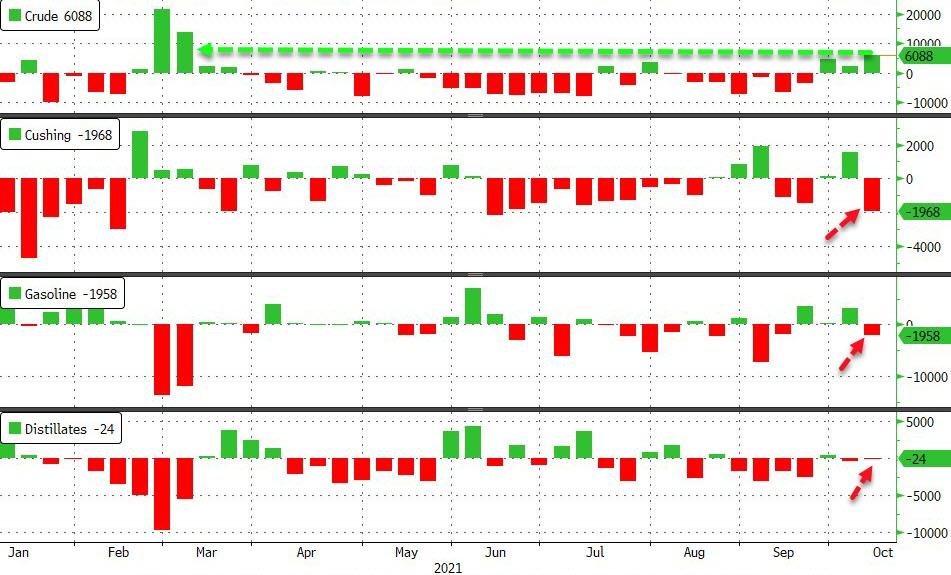
  • Crude +6.008mm (+900k exp)

  • Cushing -1.968mm

  • Gasoline -1.958mm (+600k exp)

  • Distillates -24k (-1.1mm exp)

Crude stocks rose by the most since March last week – the 3rd weekly build in a row – but the draw in gasoline and distillates was modest…

Source: Bloomberg

US Crude production continued to rebound, almost back to pre-IDA levels…

Source: Bloomberg

WTI hovered around $81.20 ahead of the official DOE print but slid back below $81 on the big crude build…

Bloomberg’s Michael Jeffers notes that retail fuel prices are at a seven-year high and the 3-2-1 crack is trading at levels normally seen in the summer during peak driving season. That’s probably one reason that refiners are running to close to 90% during a time of year when they usually shut for maintenance.

Diesel demand is highest it’s been since 2018 for this time of year. At the same time stockpiles are lower than usual ahead of winter due to a combination of trucking demand natural disasters that forced refineries to shut down for extended outages earlier this. More distillates are expected to be used for heating this winter due to surging natural gas prices. 

Bloomberg Intelligence Energy Analyst Fernando Valle notes that divergence in gasoline and diesel trends appears poised to extend in coming weeks, we believe, amid lingering energy-supply concerns in Europe and Asia, which may spur diesel-buying as an insurance policy. But port congestion in the U.S. and China are a headwind for diesel, as shipping demand is thwarted by impacts on trade. Ongoing consumer-price inflation may start to hurt gasoline demand, adding to the effects from an end to the busy summer season. Refinery maintenance may help balance supply, but we still expect to see some buildup in coming weeks, especially for gasoline.

Tyler Durden
Thu, 10/14/2021 – 11:04

via ZeroHedge News https://ift.tt/3DI9c3c Tyler Durden

Watch: Fauci Claims No “True Basis” In Concerns Over Long-Term COVID Vax Side Effects

Watch: Fauci Claims No “True Basis” In Concerns Over Long-Term COVID Vax Side Effects

Authored by Steve Watson via Summit News,

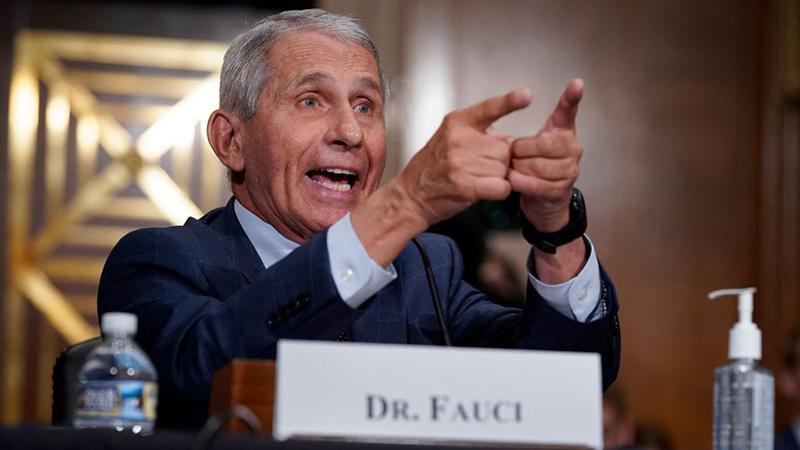
In another display of ignorance on the science, Anthony Fauci declared Wednesday that there are is no “true basis” for concerns over potential long term side effects of COVID vaccines, despite there being no long term studies to take data from.

While speaking on a virtual call in concert with CDC Director Dr. Rochelle Walensky and U.S. Surgeon General Vivek Murthy, Fauci was asked by a caller if pilots have any ‘valid concerns’ after it was suggested that many are remaining unvaccinated to avoid potential long term side effects that may infringe on their ability to fly.

“Pilots at American and Southwest Airlines in particular are arguing that some pilots may be reluctant to get vaccinated because of potential of career-ending side effects,” the caller stated, adding…

“They’re concerned that there could be long-term side effects that could cause them to then lose their medical certification and also lose their jobs and their livelihoods. So is this a valid concern?”

Fauci responded:

“Well, right now on the basis of literally hundreds and hundreds of millions of vaccinations that we’ve had, the safety of these vaccines have been clearly established.”

Or perhaps there just isn’t any empirical long term data yet?

He continued, “The long-term effects that the people are apparently concerned about really have — I’m sure there is a very, very, very rare exception — but the long-term effects are really actually non-existent, in the sense of anything that has been a red flag on the part of the follow-up of these individuals.”

So although one, I guess, can theoretically say, ‘I’m concerned about a long-term effect,’ the fact of the safety and the follow-up over a considerable period of time, over a year as so many individuals, we have not really seen that. So we don’t really see any true basis in that concern.”

Watch:

Fauci’s comments come amid the ongoing saga of pilots resisting airlines attempting to institute vaccine mandates, with hundreds of flights still being cancelled as workers engage in apparent ‘sick-outs’.

*  *  *

Brand new merch now available! Get it at https://www.pjwshop.com/

In the age of mass Silicon Valley censorship It is crucial that we stay in touch. We need you to sign up for our free newsletter here. Support our sponsor – Turbo Force – a supercharged boost of clean energy without the comedown. Also, we urgently need your financial support here.

Tyler Durden
Thu, 10/14/2021 – 10:50

via ZeroHedge News https://ift.tt/3vehyMV Tyler Durden

Furious Republicans Demand DoJ Stop “Interfering” With Texas Abortion Law

Furious Republicans Demand DoJ Stop “Interfering” With Texas Abortion Law

In response to a federal district judge’s decision to file a temporary injunction to stop the new Texas abortion law from being enforced while the Biden Administration challenges it in the courts, a group of GOP-led states have written a letter to the DoJ demanding that the federal government immediately cease its interference in a state issue.

Here’s the situation: the DoJ has asked a federal appeals court on Monday to halt Texas’ abortion law (which has infuriated progressives and feminists, in particular) from being implemented, requesting that the 5th Circuit Court of Appeals deny a stay against an injunction blocking the law from going into effect. The move comes days after a three-judge panel on the 5th Circuit decided last week to temporarily reinstate the abortion law, placing an administrative stay on the lower court’s injunction while it considers Texas’ argument for why the law is doesn’t break from precedent, or the Constitution. The original injunction was granted by a federal judge in Austin, who said the Texas law’s restrictions on abortion were “contrived”.

If the temporary injunction blocking enforcement of Texas’s law is reinstated, the Republicans argue, the DoJ will have emboldened Democratic judges to file similar suits in the future. 18 states signed the letter included in a filing at the federal appeals court in New Orleans Wednesday.

According to the letter, the injunction “threatens to expose every State in the Union to suit by the federal government whenever the US Attorney General deems a state law to violate some constitutional right of someone, somewhere,” the states said.

“The Attorney General has no authority to act as a roving reviser of state law, challenging as unconstitutional any rule with which he disagrees.”

The appeals court that blocked the injunction last week will hear arguments on Texas’s bid for why it’s law, which relies on a novel enforcement mechanism specifically to prevent public officials from being sued. Instead, any member of the public is entitled to bring a complaint against a woman believed to have had an abortion, and anybody who helped her (even the Uber driver who may have driven her to the clinic). All could be eligible for fines up to $10K.

In response, practically every clinic in Texas has shut down, while women in need of abortion “services” are quietly scrambling to nearby states with less-restrictive laws.

However, as GOP officials in several Republican-controlled states have already heavily suggested, Texas wasn’t the first state to adopt a heartbeat bill, and it likely won’t be the last, now that a strong conservative majority on the Supreme Court of the United States has arguably given the GOP the best opportunity in decades.

Tyler Durden
Thu, 10/14/2021 – 10:33

via ZeroHedge News https://ift.tt/3p6aC3w Tyler Durden

Wells Fargo Tumbles After Another Ugly Quarter: Loans Shrink Again As Home Lending Tumbles

Wells Fargo Tumbles After Another Ugly Quarter: Loans Shrink Again As Home Lending Tumbles

In a day when the big banks reported generally stellar earnings (especially Bank of America and Morgan Stanley on the back of record advisory fees), easing the bitter aftertaste from yesterday’s disappointing report from JPMorgan, even perennial Wall Street disappointment Wells Fargo managed to beat expectations with net Interest margin posting a much awaited bounce, although there was the usual “but” of higher expenses and failure to post an increase in loan growth..

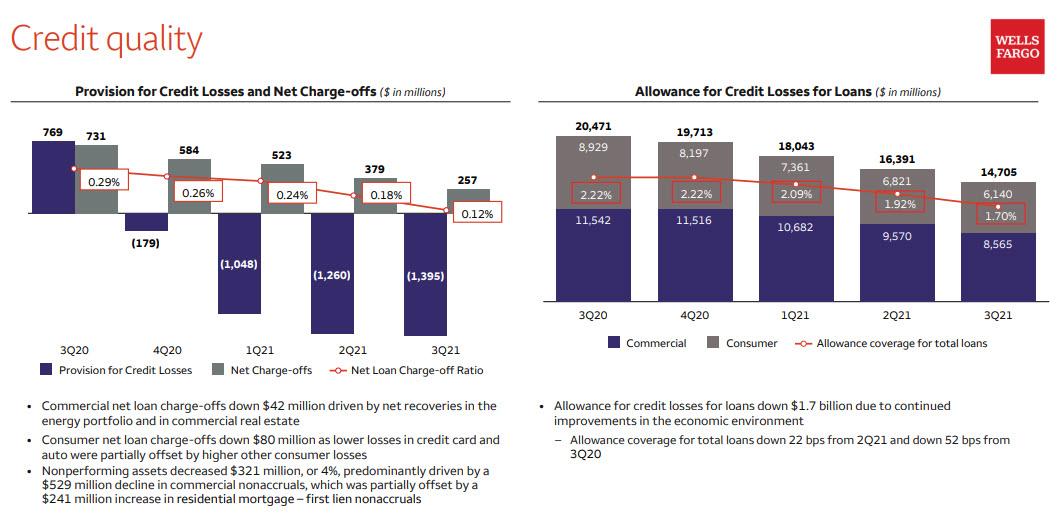
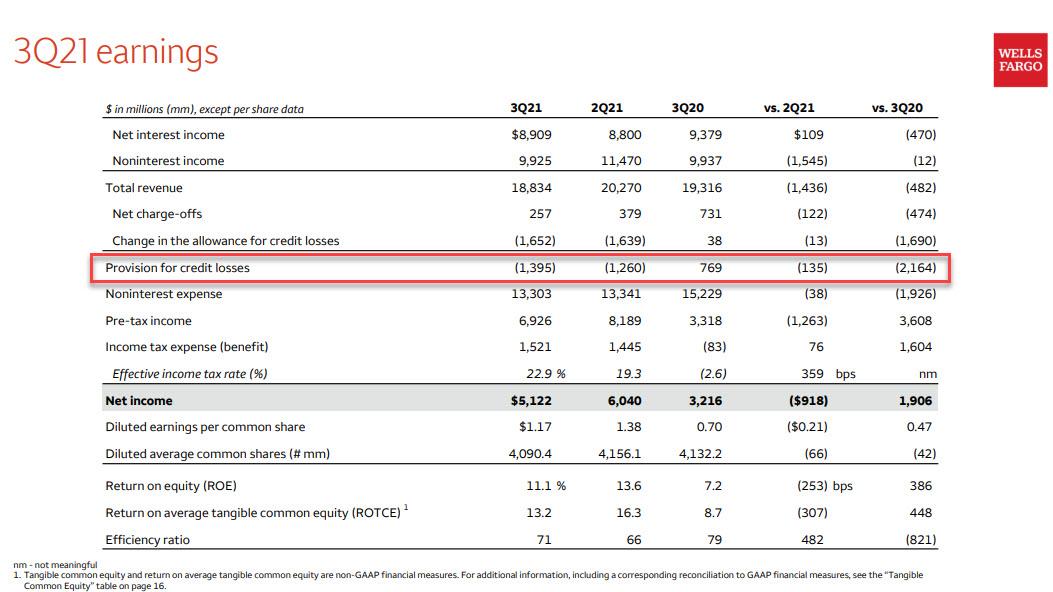
Wells Fargo reported EPS of $1.17, beating expectations of $0.99, thanks to revenue of $18.83BN, also stronger than the $18.37Bn expected. This translated into income of $5.1 billion, which however was padded by a $1.7 billion reserve release “due to continued
improvements in the economic environment”, resulting in an allowance coverage for total loans down 22 bps from 2Q21 and down 52 bps from 3Q20. 

The firm also took a $250 million charge related to its latest regulatory order, which drove costs higher than analysts expected.  

The company’s earnings summarized:

There was some much awaited good news on the Net Interest front, where both net interest income and margin posted a modest sequential improvement, rising $109MM or 1% from Q1, due to rising yields in Q3. Still, on a Y/Y basis, net interest income decreased $470 million or 5%, “reflecting the impact of lower loan balances due to soft demand and elevated prepayments, and the impact of lower yields on earning assets, partially offset by a decline in long-term debt and lower mortgage-backed securities (MBS) premium amortization.”  In any case, since Wells Fargo is the most net interest income-reliant bank in the US, the reversal in NIM was certainly good news.

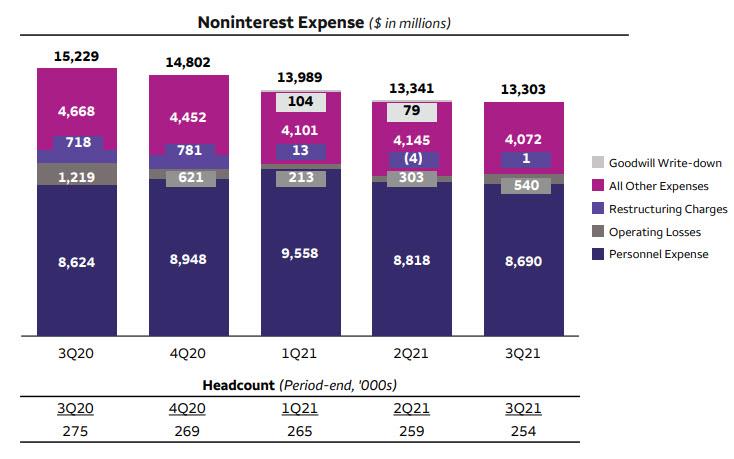
With NIM down Y/Y, expenses followed and the bank reported that noninterest expense (which consists mostly of personnel expenses) was flat sequentially and down 12.6% from a year ago, though analysts had expected a 14% drop. And even though headcount fell to 253,871, from 259,196 at the end of June, personnel expenses actually rose 1% from a year ago “as lower salaries expense driven by reduced headcount reflecting efficiency initiatives was more than offset by higher incentive and revenue-related compensation.”

But perhaps the most important, and disappointing aspect of Wells’ results was that total average loans shrank again, and while commercial loans posted a small increase sequentially of $1.2BN to $478.2BN, Consumer Loans dropped by almost $2BN from $377.7BN to $375.9BN in Q3, and down a whopping $58.1BN from a year ago.

The total average loan yield of 3.29%, was down 4 bps from 2Q21 and down 12 bps YoY reflecting the repricing impacts of lower interest rates, as well as lower consumer real estate loans.

Meanwhile, as we have been discussing for the past 5 quarters, average deposits – a proxy for the Fed’s QE – were up $51.9 billion, or 4%, YoY “as growth across most businesses was partially offset by targeted actions to manage to the asset cap, primarily in Corporate Treasury and Corporate and Investment Banking.” The good news it that this remains the cheapest funding possible for Wells – at an average deposit cost of 3 bps, it was stable with 2Q21 and down 6 bps YoY reflecting the lower interest rate environment.

The biggest U.S. banks have been struggling with weak loan growth as consumers and businesses, bolstered by massive government stimulus programs during the pandemic, refrained from borrowing. The rise of the delta variant has also delayed a return to normal and slowed economic activity. Average loans fell 8%, Wells Fargo said.

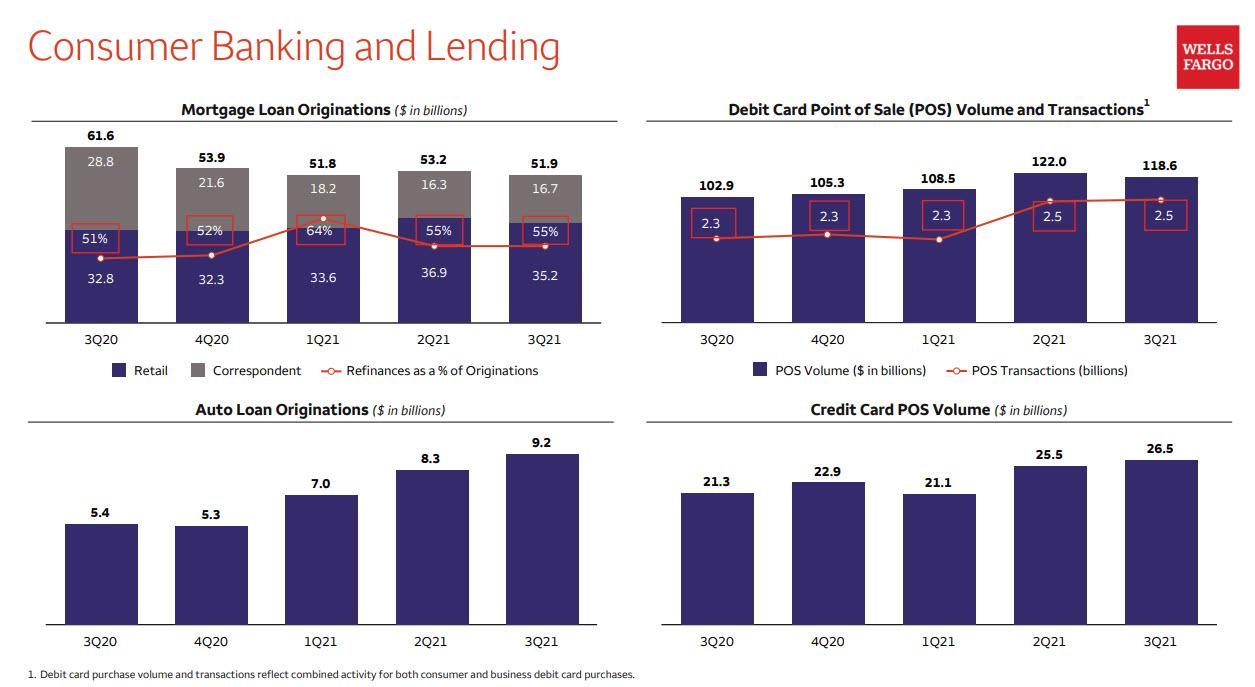
There was more bad news in the bank’s consumer banking and lending group, where total revenue was down 4% YoY. Some more details:

  • CSBB up 2% YoY primarily due to an increase in consumer activity, including higher debit card transactions, and lower COVID-19-related fee waivers; up 2% from 2Q21 primarily driven by higher deposit-related fees and higher net interest income on higher deposits
  • Credit Card up 4% YoY on higher point-of-sale volume and lower customer accommodations and fee waivers provided in response to COVID-19
  • Auto up 10% YoY and up 7% from 2Q21 on higher loan balances

What was most disappointing was that Home Lending – where Wells Fargo once dominated the market – was down 20% YoY primarily due to lower mortgage banking income on lower gain on sale margins, origination volumes, and servicing fees, as well as lower net interest income on lower loans outstanding. In short, it is the biggest housing bubble in US history – bigger even that 2007- and Wells still can’t capitalize on it!

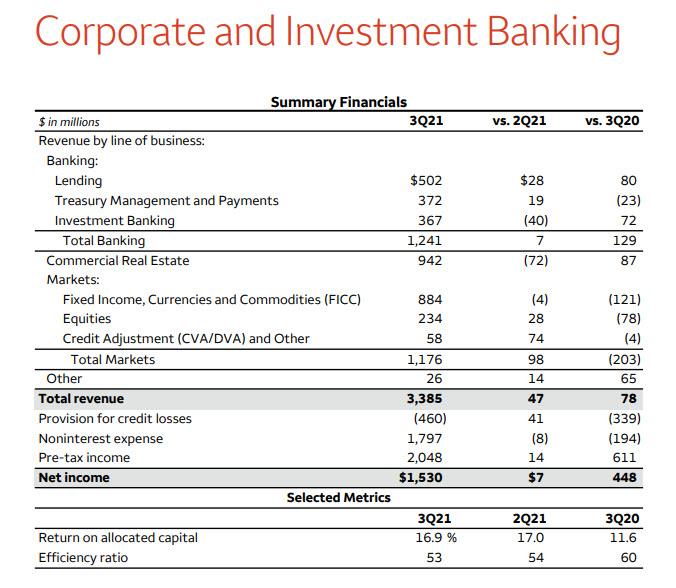
Finally, while for Wells, Banking and Sales and Trading are mostly an afterthought – after all, who would pick the trading desk at Wells over, well, anyone else – and the bank is not even close in the same ballpark as its bigger peers, it did post a modest, 2% increase in corporate and ibanking revenue to $3.385 billion, which was also up 1%, or $47MM, from last quarter.

  • Banking revenue was up 12% YoY “on higher advisory and equity origination fees, and higher loan balances, partially offset by lower deposit balances predominantly due to actions taken to manage under the asset cap”
  • Commercial Real Estate revenue up 10% YoY reflecting higher commercial servicing income, loan balances, and capital markets results on stronger commercial mortgage gain on sale volumes and margins and higher underwriting fees; down 7% from 2Q21 on lower capital markets volumes and commercial mortgage servicing income

Yet here too there was a disappointment, as markets revenue dropped 15% YoY to just $1.176BN on “lower trading activity across most asset classes primarily due to market conditions”

As Bloomberg notes, the mixed results were a reminder that challenges remain for Scharf, who took the helm of Wells Fargo in 2019. The bank has been cutting jobs and slashing costs as Scharf seeks to boost the firm’s profitability after years of scandals, which have continued this year as the bank has seen several settlements with regulators, a sordid legacy of its ugly past.

“The significant deficiencies that existed when I arrived must remain our top priority,” Scharf said in the statement. “We are a different company today and the operational and cultural changes we’ve made are enabling us to execute with significantly greater discipline than we have in the past.”

Or not: during the quarter, Wells Fargo was hit with a new regulatory action and a $250 million fine over its lack of progress addressing long-standing problems — a topic that is sure to come up on the bank’s analyst call. The firm is also still under a Federal Reserve-imposed asset cap, which limits its balance sheet.

Bottom line: another swing and another miss, with Wells shares the worst performing of all banks this morning.

Tyler Durden
Thu, 10/14/2021 – 10:19

via ZeroHedge News https://ift.tt/3mUOs1C Tyler Durden

Rabobank: The Problem Is No Central Bank Can Bail Out The Physical Economy From Shortages

Rabobank: The Problem Is No Central Bank Can Bail Out The Physical Economy From Shortages

By Michael Every of Rabobank

Back in the days before infinite liquidity and markets being in love with the idea of being big just for the sake of it, there used to be discussion about the difference between extensive and intensive growth. Put simply, extensive growth is achieved by adding more inputs to get more output; intensive growth is achieved by getting more output from existing inputs – what we call ‘productivity’. Back in the old days, we used to have that too.

Extensive vs. intensive comes to mind on the back of yet another stronger-than-expected US inflation print (0.4% m/m, 5.4% y/y; 0.2% m/m core, 4.0% y/y). This was followed by the White House announcing early results of its supply chain task force. The longshoreman and the short is: the Port of LA is expanding to 24/7 operation; the union has announced they are willing to work extra shifts; and large US companies are announcing they will use expanded hours to move more cargo off the docks, so ships can come to shore faster. So, crisis over?

Not at all, in the view of supply-chain experts. Well before this announcement they had pointed out –as did we, in ‘In Deep Ship’— that simply getting containers out of the terminal at LA achieves very little if you don’t the solve chassis crisis; if the containers sit there waiting for trucks; or for truckers; or for rail. All you do is move the logjam from sea to shore – and that can potentially make matters worse. The Transportation Secretary running this task force is a vocal opponent of the ‘so build a bigger road’ mentality that ends up with bigger roads and the same traffic logjam. This is the same policy idea without even spending on the cement and asphalt.

Some are also asking why the White House bafflingly still hasn’t appointed a US Maritime Administrator yet. Others are asking how trying to facilitate more imports into the US, rather than banging the drum for localization and ‘just in case’, is compatible with Build Back Better and resiliency. But there is bipartisanship in failing to understand what is going wrong, and how to solve it. Florida Governor De Santis is offering his state’s ports as an alternative to LA when it isn’t practical; and a Californian Republican just introduced the SHIP Act to Congress to “ban cargo ships from idling or anchoring in the coastal waters of Southern California for the next 180 days”, so forcing dozens of vessels to hang around in the ocean for months rather than safely offshore.

In short, we are seeing a lot of moving faster, and very little moving smarter. The Grinch will easily steal Xmas, and far more, at this rate.   

Sailing on regardless, the FOMC minutes from the September 21-22 meeting said that an illustrative path of QE tapering designed to be simple to communicate and entailing a gradual, fixed reduction in net asset purchases of $10bn Treasuries and $5bn agency MBS, ending around the middle of next year, is seen as providing a straightforward and appropriate template that policymakers might follow. Of course, the Fed also noted that it could adjust the pace of tapering if economic developments were to differ substantially from what they expected – like both inflation and employment has so far, to no effect. In short, the Fed announced tapering in just a few weeks (November 3), and then actually start to taper from either mid-November or mid-December. Isn’t that fitting in a way? After all, there will almost certainly be far less *stuff* circulating in the US economy, so shouldn’t we match that with far less liquidity? Before you say yes, if you believe the Fed actually think like that, I have a port in New Mexico to sell you. They clearly have stock portfolios to worry about instead.

Meanwhile, it wouldn’t be a day ending in a y without a new global supply-chain disruption. This time China is to stop exporting refined fuel. This is just as the rest of Asia is set to consume more, as it begins to open up again. As Bloomberg puts it, quoting Oilchem: “State-owned refiners are earning more from local sales”. Which is where arguments about localization and resiliency begin to re-emerge, for some.

Staying with energy, Chinese coal prices are hitting new highs again, with this now set to be passed on to industry; by contrast, the EU are talking about tax cuts to help industry and consumers cope with rising electricity prices! Isn’t this strategy, albeit via wage increases, what we tried and failed with in the 1970s? It’s not that this is necessarily the wrong thing to do to avoid recession risks and social unrest – but it will only push prices even higher, and strain supply chains even more. Indeed, while all the headlines about the IEA’s annual energy report yesterday are naturally that we need to more than redouble our efforts to shift towards renewables, if you read the nastier details, there is also a need for massive investment in fossil fuels through to 2030. If that doesn’t arrive, high energy prices are here to stay, seems to be the message: like Xmas gifts, is it on the way though? And to some places, or everywhere?

After slowing loan growth yesterday in China, and another far-higher-than-expected trade surplus, today saw Chinese inflation data. CPI came in at 0.7% y/y vs. 0.8% last month and the same expected for this. More importantly, PPI came in at 10.7% y/y vs. 9.5% last month and 10.5% expected. Recall that coal prices alone will push this series much, much higher ahead in theory.

Staying with China, Bloomberg says At this point, it’s no longer about salvaging the troubled China Evergrande Group or its billionaire chairman Hui Yan Ka from the debt crisis. It’s jobs, growth and, ultimately, social stability that are at stake. In other words, a bailout of the indebted developer may not be enough to underpin one of the world’s second-largest economy as payment defaults become contagious, a sales slump spreads to the whole sector, and more players see their ratings cut.” The argument is naturally parroted by Wall Street: sure, *pretend* to deal with asset bubbles, but you cannot really deal with them “because markets!” Yet Bloomberg also notes loosening policy slightly won’t change consumer psychology, and Beijing has made clear house prices are no longer going to be allowed to keep going up – so why buy a 2nd, 3rd, 4th home, etc., which accounted for 85% of recent home sales?

So, we are looking at both deflation and inflation in China, vs. just inflation everywhere else. Moreover, we are back to extensive vs. intensive growth, which Wall Street no longer understands; just as it now fails to grasp Schumpeter; just as it utterly fails to read Marx. Don’t let that all stop the Street, or Chinese markets, perpetually pricing in bailouts and hockey sticks and “transitory” and Xmas every day, however. It’s all a generation of traders have known both East and West, so who can blame them? The problem is no central bank can bail out the physical economy from shortages.

To wrap up, Aussie jobs data showed a -138K print, yet where unemployment went down to 4.6%, and only part-time jobs were apparently lost, not full-time. Extensive or intensive takes on such partial data are not really worth too much of anyone’s time. They certainly won’t be moving the RBA from not moving.

Tyler Durden
Thu, 10/14/2021 – 10:10

via ZeroHedge News https://ift.tt/3j1XcSd Tyler Durden

Are Biden Administration’s Offshore Wind Plans Just a Fantasy?

The Department of the Interior plans to auction off leases for offshore wind development all along the nation’s coastline.  From a New York Times report:

Speaking at a wind power industry conference in Boston, Interior Secretary Deb Haaland said that her agency will begin to identify, demarcate and hope to eventually lease federal waters in the Gulf of Mexico, Gulf of Maine and off the coasts of the Mid-Atlantic States, North Carolina and South Carolina, California and Oregon, to wind power developers by 2025.

The announcement came months after the Biden administration approved the nation’s first major commercial offshore wind farm off the coast of Martha’s Vineyard in Massachusetts and began reviewing a dozen other potential offshore wind projects along the East Coast. On the West Coast, the administration has approved opening up two areas off the shores of Central and Northern California for commercial wind power development.

Taken together, the actions represent the most forceful push ever by federal government to promote offshore wind development.

This may be “the most forceful push ever” for offshore wind, but it will take far more than offering offshore leases to actually get meaningful amounts of offshore wind development. Offering leases for commercial wind development is but the first step in a long, and often quite expensive and conflict-ridden process.

there is no guarantee that companies will lease space in the federal waters and build wind farms. Once the offshore areas are identified, they will be subject to lengthy federal, state and local reviews. If the potential sites could harm endangered species, conflict with military activity, damage underwater archaeological sites, or harm local industries such as tourism, the federal government could deem them unsuitable for leasing.

As they have in response to other offshore wind farms, commercial fishing groups and coastal landowners will likely try to stop the projects. In the Gulf of Mexico, where oil and gas exploration is a major part of the economy, fossil fuel companies could fight the development of wind energy as a threat to not only their local operations but their entire business model.

In 2002, federal regulators said that the Cape Wind project in Nantucket Sound would have all its necessary permits within three years, but it never happened. Local NIMBY activists and other project opponents tied the proposal up in knots for years. Eventually, in 2017, the project’s funders gave up. Over fifteen years of investments and efforts could not navigate the regulatory permitting process when faced with concerted opposition.

The news is better here in Ohio, where it looks like LEEDCo’s Icebreaker wind project in Lake Erie is nearing the finish line, but it is absurd that this small project, envisioned over a decade ago, has taken so much time and effort. Again, an onerous regulatory environment that makes it easy for project opponents to gum up the works is largely to blame.

To the Administration’s credit, a January Executive Order on climate policy identified the need to “review siting and permitting processes on public lands and in offshore waters to identify . . . steps that can be taken, consistent with applicable law, to increase renewable energy production on those lands and in those waters.” The new announcement said little about this, beyond pledging to “facilitate a pipeline of projects that will establish confidence for the offshore wind industry.” More is necessary.

If meaningful amounts of offshore wind or other renewable energy development, and associated infrastructure, is going to get built, there needs to be far greater attention to the regulatory and permitting processes that delay and obstruct energy projects, including from Congress. Though well-intentioned, these processes are easily weaponized by project opponents. Fostering delay is often enough to kill a project, and to discourage investors from pursuing new ventures. There is also only so much federal agencies can do to fix the problem.

For all the talk about “Building Back Better” and funding green technology through a “Green New Deal,” policymakers (and legislators in particular) have given too little attention to the regulatory environment in which such investments will be made. If the Biden Administration wants to truly be effective at fostering investment in and deployment of low-carbon technologies, it will need to devote greater attention to reform of permitting processes, streamlining and rationalizing NEPA reviews, and limiting the ability of small organized groups to throw sand in the regulatory gears.  Indeed, if there were enough attention to making the permitting process more streamlined and certain, there would be more private investment in such projects, and less need for federal government largesse.

In the end, we will know whether Congress is serious about offshore wind and fostering investment in low-carbon energy based on the degree to which it addresses the permitting and regulatory environment. Without such a focus, the rest will just be for show, and we will have little clean energy to show for it.

from Latest – Reason.com https://ift.tt/3j0Pw2T
via IFTTT

Keeping Warm This Winter Could Be More Costly As Inflation Heats Up


dreamstime_xl_106695879

Rising inflation and higher demand for fuel mean most Americans will see big increases in their winter heating bills this year, the U.S. Department of Energy warns in a report released Wednesday.

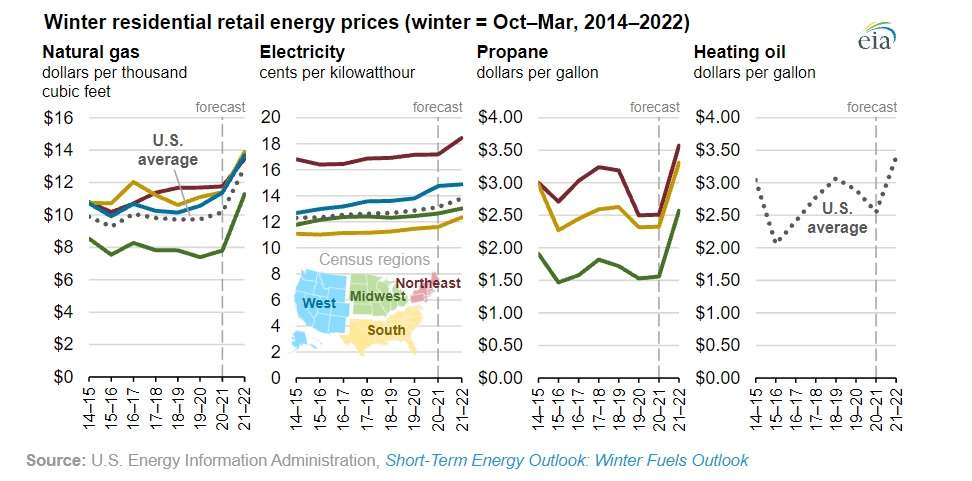
About half of American households rely on natural gas for heat, and they will pay about 30 percent more for heat than last year—and perhaps as much as 50 percent more if the winter is 10 percent colder than expected, the department estimates. That means the average family that relies on natural gas to stay warm this winter will shell out $746 between October and March, up from an average of about $570 last year. Homes heated with propane or heating oil, which account for about 9 percent of U.S. households, will also see costs rise by more than 40 percent, while homes heated with electricity can expect a smaller increase of about 6 percent over last year.

“The looming increase, on top of rising prices for many consumer goods and commodities, is likely to cause stress for Americans at many income levels. Economists warn that the larger utility bills are most likely to affect those households still hobbled by the Covid-19 pandemic,” reports The Wall Street Journal.

The sharp increase in expected home-heating costs is partially a function of lower-than-normal prices last year, as the pandemic caused demand for fuels of all types to fall during 2020 and prices slid downward accordingly. But the forecasts for the coming winter expect prices to be well above their 2019 baselines too:

Fuel costs are one of the driving factors behind the stubbornly high levels of inflation the country is facing right now. Wednesday’s monthly report of the consumer price index showed year-over-year inflation of 5.4 percent, with energy prices up more than 24 percent in the past 12 months.

High energy prices are a global problem right now. In Europe, the price of gasoline has soared in recent months and energy prices as a whole are rising—though part of the problem is a complex pricing scheme imposed by the European Union that disrupts price signals to consumers, the Financial Times notes. The entire country of Lebanon was without electricity last weekend as the state-run electrical grid collapsed temporarily.

Anne Bradbury, CEO of the American Exploration & Production Council, a trade association representing energy companies, said in a statement that the situation in Europe should be a warning to the Biden administration as it considers plans for higher taxes and new regulations that will only keep increasing energy prices. “By pursuing policies that restrict supply and make it harder to produce oil and natural gas here in America, Americans will have to pay more for their energy,” she said.

There’s a lot of speculation that current levels of inflation are actually undercounting what’s happening in the economy right now. So-called shadow inflation is occuring in ways that might not show up in the consumer price index—instead of raising prices, for example, some businesses might cut back on services or simply take longer to get things done.

“The 2021 version of many services isn’t quite the same as the 2019 version. But statisticians have treated them as the same, even though some of them have gotten dramatically worse, because they don’t have a rigorous way to measure how much worse they’ve gotten,” writes Alan Cole, a former senior economist with the Joint Economic Committee of Congress, in his Full Stack Economics newsletter. “The result has been extra inflation on an unmeasured quality dimension: rather than paying more for the same good, in many places, you instead pay the same for something less than what it used to be.”

Shadow inflation can’t really happen in the energy sector, so Americans are feeling the full brunt of rising prices. Now, we’re facing an expensive winter. Even without any added burdens from federal policy makers who hike prices or crimp supply, fuel prices serve as a stark reminder that rising inflation—which could be here to stay for longer than anyone would like—has serious consequences for just about everyone.


FREE MINDS

Field Trip, a Canadian startup, is betting that more Americans would be willing to try psychotherapy with drugs like MDMA and psilocybin. The company runs clinics in Los Angeles, New York City, and Toronto, but has ambitious plans to open 75 other locations over the next three years, Vox reports:

Although ketamine is legal if prescribed by a doctor, the Drug Enforcement Agency (DEA) lists psychedelics like psilocybin and MDMA in schedule 1 of the Controlled Substance Act, which says they have no medical value and a high potential for abuse. But there’s also growing evidence that psychedelics could lead to game-changing medications and, when combined with conventional therapy, may help people who aren’t seeing results through currently available treatments. Several US cities have already decriminalized psilocybin, the active ingredient in magic mushrooms, and the Food and Drug Administration (FDA) is overseeing clinical trials into using psychedelics to treat PTSD and depression.

This potentially revolutionary approach to mental health also represents a tremendous commercial opportunity for health care and pharmaceutical companies. But despite promising, privately funded studies into psychedelics, current government regulations prevent the wider availability of psychedelic therapy.

And read Reason‘s Nick Gillespie on how the slow-rolling legalization of MDMA and other psychedelic drugs is creating opportunities for investors and individuals who want to expand their perspectives.


FREE MARKETS

There is no simple solution to the problems plaguing supply chains right now, but the Jones Act is only making things worse:


QUICK HITS

• The Food and Drug Administration will vote Thursday on whether to recommend an emergency authorization for COVID-19 booster shots for people who got the Moderna vaccine. A vote on Johnson & Johnson vaccine boosters is expected on Friday.

• Katie Couric admits she’s a hack.

• Former President Donald Trump has a bold strategy for the 2022 and 2024 elections:

• Czech voters defeat a populist.

• Playing video games isn’t correlated with a drop in personal well-being:

• There may be more shoes to drop after NFL coach Jon Gruden’s firing over homophobic remarks made in emails. The NFL players union is asking the league to make public more than 650,000 emails that it collected during an investigation into workplace misconduct.

• Captain Kirk went to space yesterday and was profoundly moved by the experience.

• Nokia will re-release its classic “brick” cellphone in honor of the device’s 20th anniversary. Yours probably still works.

from Latest – Reason.com https://ift.tt/3oWEboe
via IFTTT

Putin Praises Crypto As Possible ‘Weaponized’ Dollar Replacement

Putin Praises Crypto As Possible ‘Weaponized’ Dollar Replacement

Update (0920ET): Morgan Stanley CEO James Gorman piled on the mockery of JPMorgan’s CEO Jamie Dimon’s dismissal of crypto by stating on this morning’s earnings call that “We’re not directly trading crypto” for retail clients but:

“I don’t think crypto’s a fad. I don’t think it’s going to go away. I don’t know what the value of Bitcoin should or shouldn’t be. These things aren’t going away.”

*  *  *

Russian President Vladimir Putin further rattled American financial officials after hinting that while he considers cryptocurrency “crude and under-developed,” it could “some day” be used instead of the US dollar to trade with.

The Russian president discussed potential use cases of cryptocurrencies in a Thursday CNBC interview following a plenary session of the ​​Russian Energy Week forum.

“I believe that it has value,” Putin told CNBC at the Russian Energy Week event in Moscow on Wednesday, when asked whether bitcoin or cryptocurrencies can be used in place of the US dollar.

“But I don’t believe it can be used in the oil trade.”

According to the interviews the Kremlin’s official website, Putin said that private cryptocurrencies “can act as a unit of account” but they are “very unstable.”

“Cryptocurrency oil contracts? It’s too early to talk about it. It works for transferring funds from one place to another, but in terms of trading, especially when it comes to energy resources, it is still premature in my opinion,” the president stated.

The Russian government has been closely monitoring the cryptocurrency market, Putin said, adding that he believes it’s possible crypto could simply become a “means of accumulation.”

“We see how his market fluctuates. It’s a bit early today.”

Right now, cryptocurrencies aren’t backed by “anything yet,” Putin said. But when asked whether he considers the crypto holdings by Tesla CEO Elon Musk to be “worthless,” Putin said no, explaining that he meant to explore crypto’s viability as a unit of account for the energy market.

Later in the interview, Putin reiterated his criticisms about how Washington’s abuse of the dollar’s dominance is tantamount to brandishing an “economic weapon”, and remains keen to ditch dollar-denominated payments.

“I believe the US makes a huge mistake in using the dollar as a sanction instrument,” he said.

“We are forced. We have no other choice but to move to transactions in other currencies.”

“In this regard, we can say the United States bites the hand that feeds it,” the world leader added.

“This dollar is a competitive advantage. It is a universal reserve currency, and the United States today uses it to pursue political goals, and they harm their strategic and economic interests as a result.”

“We aren’t interested in cutting off dollar payments completely, and we are so far satisfied with payments for energy resources in dollars, primarily for oil,” he added.

Finally, in a distinct break from China, which has worked to suppress crypto mining and trading on its mainland, Putin went on to say that “everything evolves” and “has the right to exist.”

Tyler Durden
Thu, 10/14/2021 – 09:55

via ZeroHedge News https://ift.tt/3BJ6vxN Tyler Durden