The FDA Wants To Take Your Salt Away


dreamstime_xl_85580358

The Food and Drug Administration has issued voluntary guidance that aims to limit the amount of sodium that restaurants and grocery manufacturers put in the foods you buy so that you won’t consume more than 3,000 milligrams per day (mg/day). Most of the sodium we consume comes from table salt. Currently, Americans consume about 3,400 mg/day of sodium. As justification for its guidance, the FDA points to the U.S. Department of Agriculture’s Dietary Guidelines for Americans, which advises individuals 14 years and older to limit their consumption to 2,300 mg/day. That amounts to a little over one teaspoon of salt per day.

The FDA doesn’t want to go quite that far. The agency explains:

This guidance aims to help Americans reduce average sodium intake to 3,000 mg/day by encouraging food manufacturers, restaurants, and food service operations to gradually reduce sodium in foods over time. Although we recognize that a reduction to 3,000 mg/day still would be higher than the recommended sodium limit of 2,300 mg/day, the 2.5-year goals are intended to balance the need for broad and gradual reductions in sodium and what is publicly known about technical and market constraints on sodium reduction and reformulation.

The ostensible goal of limiting salt consumption is to reduce the incidence of high blood pressure and heart disease in Americans. The FDA states that there is a consensus among nutrition researchers that such limits will achieve those goals. In fact, that “consensus” is a highly contested area of research which a great deal of recent data contradicts.

For example, a June 2021 study in the European Heart Journal looked at average sodium intake in 181 countries and reported that higher daily per capita consumption correlated with longer life expectancy and lower rates of all-cause mortality.

An accompanying editorial noted that more than a dozen recent epidemiological studies have shown that the low sodium intake recommended by the FDA compared with the current average consumption is “not associated with lower risk of cardiovascular events and mortality, and may even be associated with an increased risk.” Specifically, one study found that a moderate intake of between 3,000 and 5,000 mg/day was optimal while lower and higher consumption was associated with greater risk of mortality and cardiovascular disease. As the editorial observes, the results of a few randomized trials of sodium restriction are expected later this year that “will hopefully clarify whether or not sodium reduction should be recommended and, if so, the optimal range of sodium intake compatible with human health.”

Keep firmly in mind that this study is reporting observational evidence at the population level. Ample research backs the finding that reducing sodium intake will reduce blood pressure, especially in people with hypertension. It is most likely the case that some subset of Americans may be especially salt sensitive and would benefit from consuming less. Better tests should be devised to identify such people so that the rest of us can consume our sodium in peace. As always folks, if your goal is to protect your health, strive for moderation in what you eat and drink.

from Latest – Reason.com https://ift.tt/3peBOgP
via IFTTT

Goldman Picks Winners And Losers In Battle For $20 Billion COVID Antiviral Market

Goldman Picks Winners And Losers In Battle For $20 Billion COVID Antiviral Market

Ten days have passed since Merck dropped its bombshell announcement about Molnupiravir, its “revolutionary” anti-viral that purports to lessen severe COVID and death by half in vulnerable unvaccinated patients.

But as scientists warn about potential unexamined safety issues with molnupirvavir, analysts at Goldman Sachs are reminding clients that Merck is hardly alone in the race to produce an effective antiviral that could function like the Tamiflu of COVID.

Looking ahead to Q42021 and on to Q12022, Goldman is looking forward to drug readouts from Roche, Pfizer, Shionogi and others developing oral antivirals. Goldman’s discussions with clients about the potential influence of antiviralls “…indicate that key questions about oral antivirals largely center on: 1) clinical differentiation among the various programs; 2) data and approval timelines, supply, and pricing; and 3) the potential for pediatric and prophylactic use. Within, we size up the market potential and TAM with our market model and frame key upcoming readouts for the late stage programs. We also provide a list of upcoming catalysts in the category.”

For investors seeking “exposure to the antiviral theme”, Goldman recommends 1) Roche, as preclinical data for its AT-5227 suggest “differentiation” vs. molnupiravir, 2) Shionogi, whose S-217622 represents an alternative to RNA polymerase therapies, and 3) Divi’s Labs, which will ride molnupiravir’s coattails.

As for the losers, Goldman sees Eli Lilly and Regeneron, who produced antibody treatments that never really caught on.

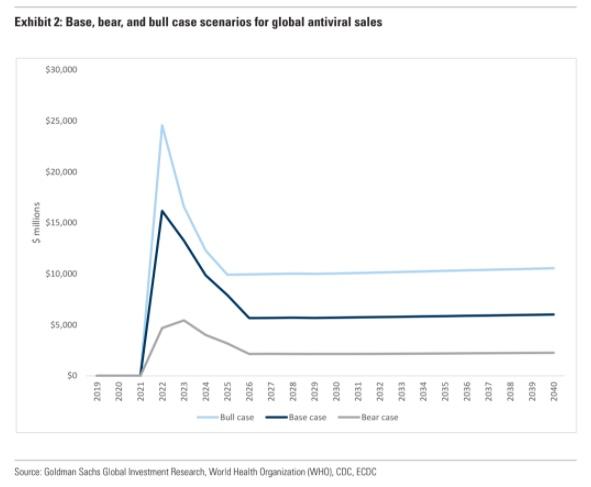
Using the 10MM molnupiravir courses expected to be on the market for $700/course (40x what it costs to produce), Goldman estimates that the “commercial opportunity” for COVID antivirals is between “$15 billion and $20 billion.” That figure represents near-term sales; over time, Goldman estimates the market for COVID antivirals to be around $5 billion/$6 billion. Although the analysts look for prices to decline as more competitors are approved and enter the market.

Although Goldman’s team focuses on the “commercial” aspects of antivirals, its analysts note that their success could lead to significant “cultural” changes. If people were confident that COVID could easily be treated without a trip to the hospital, they would be less incentivized to wear masks and observe social distancing and other new features of the COVID era.

Goldman’s analysts put together a table showing their expectations for the timing of each drug’s approval.

Goldman’s assessment about the TAM for COVID antivirals is based on the following assumptions:

  1. COVID-19 becomes endemic in perpetuity, thereby requiring the maintenance of a vaccinated population as well as the use of effective therapies to treat those who are unvaccinated, immunocompromised, and breakthrough cases.
  2. That following a relative peak of infections in the acute phase of the pandemic (starting late 2019 and still continuing) that the rate of infections will settle at a relatively consistent endemic level.
  3. A relatively consistent vaccination rate in perpetuity that assumes maintained protection, boosters, and/or updated vaccines that experience the same relative uptake.
  4. A lower rate of high-risk patients in the EU and ROW vs. the US. Generally, average BMI and hypertension rates are lower in the EU and Asia.
  5. An average of 2 potential post-exposure prophylactic patients per infection, and that all major oral antiviral candidates will be approved in this indication.
  6. That the post-exposure prophylactic population will be given an extended course of treatment compared to the primary treatment population as observed on both the Tamiflu and Relenza labels (e.g., 10 days vs. 5 days).
  7. That the oral antivirals will significantly erode the antibody therapeutic market in the near term, particularly in the post-exposure prophylaxis setting due to their relative convenience and cost savings.
  8. An initial price of ~$700/course in the US based on the previously announced government tender offer for 1.2mn courses of molnupiravir, and that prices will be relatively lower in the EU ($500) and ROW ($150).

As far as sales, Goldman outlines its bull, bear and base cases in a chart.

As far as what we know about molnupiravir so far is from a Phase 2/3 analysis with unvaccinated high risk patients.

Looking at opportunities for distribution abroad, Goldman notes that Divi’s Labs should benefit from molnupiravir due to its ability to manufacture generic anti-retroviral API and finished doses. Citing data from – of all places – the Clinton health access initiative – Goldman says the overall market size in Low and Middle Income Countries is roughly $1.7 billion.

Bottom line: in the coming weeks, the outlook for COVID anti-virals will become increasingly important to the market.

* * *
Source: Goldman Sachs

Tyler Durden
Wed, 10/13/2021 – 17:05

via ZeroHedge News https://ift.tt/3vmBaPn Tyler Durden

Now A US Govt Official Is Telling Us That Supply Chain Nightmares Could Potentially Last For “Years”

Now A US Govt Official Is Telling Us That Supply Chain Nightmares Could Potentially Last For “Years”

Authored by Michael Snyder via The Economic Collapse blog,

The truth is starting to come out, and a lot of people aren’t going to like it.  When the supply chain problems and the shortages began, government officials repeatedly assured us that they would just be temporary, and most of us believed them.  But now it has become clear that they aren’t going to be temporary at all.  In fact, during a recent interview with Bloomberg, U.S. Transportation Secretary Pete Buttigieg admitted that some of the supply chain problems that we are currently facing could last for “years and years”.  I don’t know about you, but to me “years and years” sounds like a really long time.

Of course that is not the only time that Buttigieg has made such a claim.  During another recent interview, he used the words “long term” to describe what we are facing…

Buttigieg has said in recent interviews that “it’s an incredibly complicated situation,” but the government is holding virtual “roundtables” with port operators, labor unions and private companies. Nevertheless, he told MSNBC last Thursday, the “challenges” will continue, not only “going into the next year or two, but going into the long term.”

Isn’t it remarkable how the outlook for our economic future has changed so dramatically in just a matter of a few months?

Earlier this year, we were told that we would soon be entering a new golden era of prosperity.

But now inflation and shortages are causing chaos everywhere we look.

Earlier today, I came across a Daily Mail article that boldly declared that “stores across America have empty shelves” right now…

Stores across America have empty shelves thanks to a series in supply chain problems that are prolonging inflation and could stretch into the new year, with some retailers like Costco and Walmart limiting the amount of toilet paper in some stores.

More than 60 cargo ships are waiting to dock in California, carrying hundreds of thousands of containers, and may be stuck for months in a traffic jam after arriving from China and Asia. Millions of dollars of American goods are still sitting in warehouses in China, awaiting shipment.

In addition to the unprecedented backlogs that we are witnessing at our major ports, it has also become far, far more expensive to send products across the Pacific Ocean.

Just check out these numbers

The Washington Post reported the median cost of shipping a standard container from China to the U.S. West Coast hit a record $20,586. That’s nearly twice what it cost in July, which was twice what it cost in January, according to the Freightos index.

“Consumers are confronting higher prices and shortages of cars, children’s shoes and exercise gear, as the holiday shopping season looms,” the Post said.

That is crazy.

And now the emerging global energy crisis is going to make it even more expensive to move stuff around the planet.  On Monday, the price of gasoline in the United States hit a new seven-year high

The national average price for gasoline hit a fresh seven-year high of $3.27 a gallon on Monday, up by 7 cents in the past week alone, according to AAA. Gas has nearly doubled since bottoming at $1.77 in April 2020.

High gas prices will only exacerbate elevated inflation, squeeze the budgets of American families and hurt President Joe Biden’s political fortunes.

In addition, we just learned that U.S. stockpiles of heating oil have hit a 20 year low

The U.S. may be heading into winter with the lowest stockpiles of heating oil to meet surging demand in more than two decades.

Inventories of distillates — used as diesel for both transportation and heating oil — are enough to meet 31.2 days of demand, according to the Energy Information Administration. That’s the tightest it has been for this time of the year since 2000.

Unfortunately, global energy supplies are going to get even tighter and prices are going to go even higher in the months ahead.

Needless to say, the big corporations are going to feel forced to pass on rising costs to consumers.  In fact, the head of Kraft Heinz says that his company is already doing this

Miguel Patricio said the international food giant, which makes tomato sauce and baked beans, was putting up prices in several countries.

Unlike in previous years, he said, inflation was “across the board”.

The cost of ingredients such as cereals and oils has pushed global food prices to a 10-year high, according to the UN Food and Agriculture Organisation.

If you are reading this article and you are thinking that this is perfectly setting the stage for many of the scenarios that I have described in my books, you would be 100 percent correct.

We are entering a period of inflation that is going to absolutely shock most people.

In fact, the UN says that the global price of food has already risen more than 32 percent over the past year…

The United Nation’s Food and Agriculture Organization (FAO)’s September food price index – a measure of monthly changes in global food prices – reached 130 points, a level not seen since 2011.

It represents a 32.8 percent increase from September 2020.

I realize that I have thrown a lot of information at you very quickly in this article.

Things are starting to move quite rapidly now, and we are being warned that conditions are going to continue to deteriorate in the months ahead.

And as conditions deteriorate, the American people are going to becoming increasingly restless.  Already, polls are showing that Americans are quite dissatisfied with the current state of affairs.  Here is one example

Just 37% of Americans rate the economy as very or fairly good – the lowest percentage since March, and for the second straight month, more than half feel the economy is in bad shape. And most Americans are not convinced that the Biden administration’s domestic agenda would improve the economy.

As I discussed yesterday, our economy is starting to break down on a very basic level.

We have become so dependent on an efficient flow of goods and services, but these days there are breakdowns all over the system.

I would like to tell you that things will get better soon, but I can’t do that.

More supply chain problems are ahead, and some of them are going to be exceptionally painful.

*  *  *

It is finally here! Michael’s new book entitled “7 Year Apocalypse” is now available in paperback and for the Kindle on Amazon.

Tyler Durden
Wed, 10/13/2021 – 16:45

via ZeroHedge News https://ift.tt/3BFk8OC Tyler Durden

WTI Shrugs At Mixed Inventory Data: Crude Build, Gasoline Draw

WTI Shrugs At Mixed Inventory Data: Crude Build, Gasoline Draw

Oil prices were flat today after accelerating up to multi-year highs late last week and early this week as OPEC sounded a cautious note on the strength of oil demand (trimming its forecast for 2021 demand growth to 5.8mm b/d, down from its previous projection of 5.96mm b/d), while EIA raised its price forecasts for 2022.

“Despite positive assumptions on oil demand going into the final quarter of the year, supported by seasonal petrochemical and heating fuel demand as well as the potential of switching from natural gas to oil,” actual data on consumption earlier in the year was weaker than expected, OPEC’s Vienna-based secretariat said in the report.

It advised producers “to maintain a vigilant watch over market fundamentals.”

However, the next leg one way or the other will likely be triggered by the latest inventory data as analysts expected a 3rd weekly build in a row for crude, throwing some cold water on the recovery/demand hype.

API

  • Crude +5.213mm (+900k exp)

  • Cushing -2.275mm

  • Gasoline -4.575mm (+600k exp)

  • Distillates -2.707mm (-1.1mm exp)

A big build in crude stocks was offset from a market perspective by the big gasoline draw in the prior week…

Source: Bloomberg

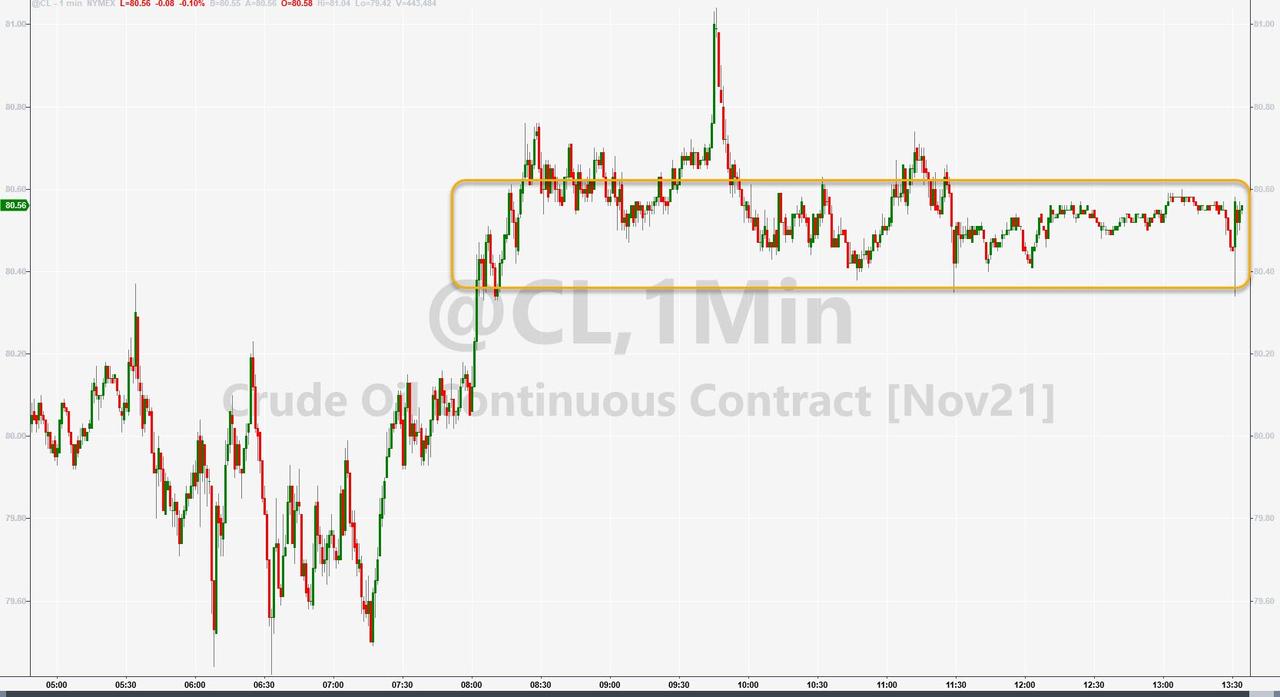
WTI hovered around $80.50 ahead of the print and went basically nowhere after the mixed data…

Finally, in Russia, President Vladimir Putin said oil prices could reach $100 a barrel, as The White House has been speaking with U.S. oil and gas producers about helping to bring down rising fuel costs.

Tyler Durden
Wed, 10/13/2021 – 16:35

via ZeroHedge News https://ift.tt/3oUhIIq Tyler Durden

Don’t Use the Term ‘Trap House’ in Your Party Invite at Yale Law School


thumbnail (2)

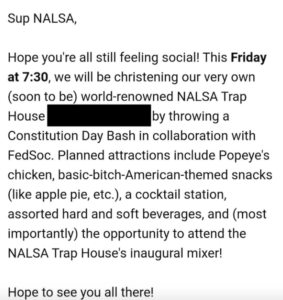
At Yale Law School, a second-year student who is part Cherokee has come under fire from administrators and some black students for sending a message via an online forum inviting others to a party hosted by the Federalist Society and the Native American Law Students Association (NALSA). As Washington Free Beacon‘s Aaron Sibarium first reported, the issue stemmed from students objecting to the use of the word “trap house” when promoting the party, with critics from the Black Law Students Association alleging the party supports “black face” and that the conservative Federalist Society “has historically supported anti-Black rhetoric.” Administrators received nine complaints about the party invite, and promptly summoned the student in question to their office.

Once there, Ellen Cosgrove, an associate dean, and Yaseen Eldik, diversity director, hectored the student (who Free Beacon did not name), telling him that the use of the word “trap” and the mention of fried chicken was “triggering” to other students, in addition to the “email’s association with FedSoc.” Eldik told the student that “FedSoc belongs to political affiliations that are oppressive to certain communities,” mentioning the “LGBTQIA community and black communities and immigrant communities” specifically. Both administrators insinuated that if the student did not apologize, this incident could negatively affect his chances of passing the bar exam, which allows administrators to weigh in on matters of character, with Eldik even going so far as to draft an apology for the student to send. (The student ultimately declined to do so, instead writing in an online forum that he welcomed questions from those who had complained or taken offense.)

“As a man of color, there probably isn’t as much scrutiny of you as there might be of a white person in the same position,” Eldik told the student, per the Free Beacon‘s reporting. “I just want to acknowledge that there’s a complexity to that too.” This tacit acknowledgment from Eldik that the student’s racial background would be taken into account when determining how offensive the act was, and what type of punishment it deserves, is preposterous; people who are themselves members of minority groups are not immune from holding bigoted beliefs (though we do not have strong evidence to indicate that is the case here).

Contra Free Beacon‘s explanation, though, the term “trap house” did not rise to prominence due to its titular use by the popular podcast Chapo Trap House. Trap houses have long been a fixture of rap lyrics (the term long predates even Gucci Mane’s use of the term for his 2005 album), normally used to describe seedy run-down houses where drugs like crack are sold and used. The word worked its way into mainstream use over time, with 2 Chainz’s pink trap house in Atlanta even becoming Instagram fodder. It now just means something roughly akin to “place with a fun party.” While use of the term does imply that a party will not be a particularly elegant or sophisticated affair, it does not at all imply that people should show up in blackface. (Ethics of doing so aside, you’d have to be quite naive to show up to a party in blackface as a 24-year-old aspiring lawyer, in an era of iPhone cameras, in the year 2021, making it even more risible that this was the party host’s intention.)

Even if you hate the idea of a Federalist Society member using slang that originated with a different ethnic group and has deep roots in rap and hip hop music, it should be far more concerning for those who care about academic freedom that administrators attempted to force an apology over the phrase from a grown adult, while also implying that they could sink the student’s chances at passing the bar if he refused. Debra Kroszner, the managing director at Yale’s Office of Public Affairs, tells Reason that “while any person may report concerns about a lawyers’ character and fitness to the Bar, the Law School has a longstanding policy of reporting only formal disciplinary action to the Bar Association. Any media reporting to the contrary is false,” clarifying that the student did not receive formal disciplinary action but that the administration merely “tries to help students talk to one another and resolve their disagreements.” But if the Free Beacon‘s reporting is true, Yale’s administrators did not just make evenhanded attempts at helping students resolve a dispute. While it’s good that the student was not formally sanctioned for his speech, his alleged treatment by university administrators is nonetheless troubling. You don’t need to formally punish edgy speech in order to make students feel as if they can’t speak freely.

It’s also highly disturbing that tomorrow’s lawyers and academics believe a person’s affiliation with the Federalist Society—a conservative professional group that has launched the legal careers of many a Supreme Court justice—precludes them from a presumption of innocence. The students who will soon be entrusted with defending criminal defense in our courts of law surely recognize the value of an intellectual culture that doesn’t attempt to rain down punishment for the supposed sin of being a conservative who sends out edgy party invitations.

from Latest – Reason.com https://ift.tt/2YMNXhr
via IFTTT

Amnesty International brief against right to bear arms


shutterstock_1307648458

As the U.S. Supreme Court considers whether to enforce the Second Amendment right to “bear arms” in New York State Rifle & Pistol Association v. Bruen, an amicus brief from Amnesty International argues that doing so would violate international law. In this post, I’ll examine the arguments in the AI brief.

Back in the days when I was a monthly donor to AI, the group was known for its work in supporting political prisoners around the world. But for a long time AI has involved itself in many other issues, including global gun prohibition. Today, the leading international anti-gun organization is Control Arms, which was cofounded in 2003 by Amnesty International, Oxfam, and the International Action Network on Small Arms (IANSA).

For these groups, a complete embargo on all arms sales to Israel is a longstanding priority. See, e.g., Control Arms, Arms Without Borders: Why a Global Trade Needs Global Controls, Oct. 2006. To prevent Israel from manufacturing its own arms, the groups also favor a ban on commerce in arms-making materials, such as titanium.

It’s not just Israelis whom AI wants to disarm. The group enthusiastically supported  hard left Brazilian president Lula da Silva’s 2005 ballot referendum to ban all gun sales. (The ban was defeated 64%-36%).

Even some ardent opponents of civilian gun ownership in general acknowledge that defensive arms are legitimate for people who are the targets of an active genocide campaign. AI disagrees.

The group did a good job of documenting how easy it was for the Islamist government in Sudan to use disarmement to perpetrate genocide against the African Darfuri tribes. Much of the killing was carried out by Arab gangs, the Janjaweed, who were armed by the Sudanese government. As AI reported, the majority of the Janjaweed had five or six guns per person. AI quoted a Darfuri villager: “none of us had arms and we were not able to resist the attack.” In the words of another villager, “I tried to take my spear to protect my family, but they threatened me with a gun, so I stopped. The six Arabs then raped my daughter in front of me, my wife and my other children.” Amnesty International, Sudan: Arming the Perpetrators of Grave Abuses in Darfur, Nov. 16, 2004.

The Pittsburgh Tribune-Review asked Amnesty International’s Trish Katyoka, director of Africa Advocacy for the group, whether the Darfur victims should be armed. Dimitri Vassilaros, “Gun Control’s Best Friend,” Pittsburgh Tribune-Review, Apr. 1, 2005. She answered in the negative:

“We at Amnesty International are not going to condone escalation of the flow of arms to the region.” Indeed, “You are empowering (the victims) to create an element of retaliation.” “Whenever you create a sword-fight by letting the poor people fight back and give them arms, it creates an added element of complexity. You do not know what the results will be.” In sum, “Fighting fire with fire is not the solution to genocide. It is a dangerous proposition to arm the minorities to fight back.”

AI’s position conflates self-defense against murder with “retaliation,” which is revenge after the fact. It’s true that armed victims may add “complexity” to a situation—especially for attackers who used to straightforwardly murdering helpless victims. When the victims are unarmed, you do “know what the results will be”: the victims will be exterminated. Adding complexity to avoid certain mass murders is a life-saving choice.

Charming Betsy

Part I of the AI amicus brief argues that judicial interpretation of the U.S. Constitution, including the Second Amendment, must subordinate interpretation of the Constitution to what AI claims to be international law. The argument is an extravagant extrapolation of a longstanding rule of statutory interpretation, namely the “Charming Betsy Canon.”

In the 1804 U.S. Supreme Court case Murray v. Schooner Charming Betsy, 6 U.S. (2 Cranch) 64 (1804), Chief Justice Marshall wrote: “an act of Congress ought never to be construed to violate the law of nations, if any other possible construction remains.” The Charming Betsy ship was originally owned by an American but was later sold in St. Thomas to a Dane who sent it on a commercial voyage to the French island of Guadeloupe. The issue before the Court was whether the ship was forfeitable under a congressional statute that forbade American trade with France, which at the time had been engaged in the undeclared naval Quasi-War against the United States. The Marshall Court construed the statute narrowly, so as not to run counter to international law, which allows wartime trade by neutrals (such as Denmark).

In statutory construction, the Charming Betsy canon has been applied by American courts ever since. It has never been applied as a doctrine of constitutional interpretation. If it were, the First Amendment would be a certain casualty. Few if any nations and international treaties interpret “the freedom of speech, or of the press,” or “the free exercise” of religion as strongly as do American courts. Indeed, for most of American history judicial review of the constitutionality of legislation had very few counterparts  in the world. Harvard Law Professor Vicki C. Jackson’s 2009 book Constitutional Engagement in a Transnational Era (2009) argues for use of international law in interpreting some constitutional provisions, but not the Second Amendment, which has the “specificity or distinctiveness . . . that makes transnational sources irrelevant.”

AI argues that “The Constitution was . . . drafted with international law as a set of background norms, and this Court should construe the Constitution accordingly.” However, none of the alleged “background norms” that AI cites existed in 1791 when the Second Amendment was ratified, or in 1868 when the Fourteenth Amendment made it enforceable against the states.

Indeed, the Constitution, including the Bill of Rights, was drafted and ratified an intent to counter contemporary norms. For example, while many nations allowed (and still allow) censorship, the Constitution generally forbids it. While unlimited arms control was (and still is) the norm in much of the world, America’s Framers wanted to ensure that government didn’t have a monopoly on the implements of violence because they knew, based on experience, that government could not be trusted with such a monopoly. Whatever the harmful consequences of preventing a government monopoly of force, the Founding Fathers (in 1789) and Founding Sons (in 1868) believed that the alternative was far worse.

Even if the U.S. Senate had ratified an international gun control treaty, “No agreement with a foreign nation can confer power on the Congress, or on any other branch of Government, which is free from the restraints in the Constitution” Reid v. Covert, 354 U.S. 1, 16 (1957) (Black, J.) (plurality op.).

Along the way, AI accurately cites the 1897 case Robertson v. Baldwin, 165 U.S. 275, 283-86 (1897) for the proposition that the Court sometimes looks at the laws of other nations. In Robertson, a merchant seaman who had jumped ship argued that being forced to complete his labor contract amounted to involuntary servitude in violation of the Thirteenth Amendment. Citing the historic sea laws of Rhodes, Germany, the United Kingdom, and other nations, the Court observed that the laws forbade sailors to desert while in port. Notably absent from AI’s brief is what Robertson said about the Second Amendment: all of the Bill of Rights—and by extension the Thirteenth Amendment–contained implicit exceptions that were well-known at the time, and incorporated into those Amendments. For example, the First Amendment freedom of speech and of the press does not prohibit laws against libel; the Fifth Amendment prohibition on double jeopardy does not forbid retrial after a hung jury; that Amendment’s prohibition on compelled self-incrimination does not apply if the relevant statute of limitations has expired. And “the right of the people to keep and bear arms (Art. II) is not infringed by laws prohibiting the carrying of concealed weapons.” Id. at 282-83.

This indicates that the right to carry unconcealed weapons is part of the Second Amendment right. Or pursuant to the state cases favorably cited in Heller‘s more detailed examination of the Second Amendment, a legislature has the discretion to require that arms be carried openly, or that they be carried concealed; the legislature can choose the mode of carry, but cannot prohibit carry. (See Part V of my amicus brief in this case for detail.)

An empirical mix-up

Part II of the AI brief is the core argument for why international law is said to compel the Court to rule that the plaintiffs have no right to be issued a license to carry a firearm for lawful self-defense. The brief offers a hodgepodge of empirical studies, hardly any of which are relevant to the case at bar—such as a study arguing that Connecticut’s laws for purchasing handguns are better than Missouri’s.

Many of the studies have nothing to do with carrying guns, but instead involve claims that more firearms possession in a society necessarily lead to more criminal violence. While all these studies are debatable, even if they were conclusively accepted as true, they make an argument against the Second Amendment itself.

The lone specific citation in the AI brief about bearing arms is of a “fact sheet” by Professor Daniel Webster, of the Bloomberg School of Public Health at Johns Hopkins University, Concealed Carry of Firearms: Fact vs. Fiction. The link in the AI brief is broken, but you can find the fact sheet here. It argues that guns are ineffective for self-defense and rarely used for self-defense. The specific issue is right to carry laws is addressed on a single page, which cites three studies saying that such laws have harmful effects.

The claim is indirectly called into doubt by another article cited in the AI brief: Julian Santaella-Tenorio et al., What Do We Know About the Association Between Firearm Legislation and Firearm-Related Injuries?, 38 Epidemiologic News [sic, Epidemiologic Reviews] 140 (2016). According to AI, the study shows that “gun violence deaths in the United States are preventable through the adoption of reasonable gun safety laws,” which “include provisions such as New York’s ‘proper cause’ requirement for obtaining and carrying a firearm.”

In fact, Figure 2 of the study presents a summary of 25 studies of “Shall Issue” laws—that is, laws specifying that a person who passes a background check and safety training may not be denied a carry permit simply because a government official thinks the person does not “need” to carry a defensive arm. Almost all U.S. States already have such a law. Of the 25 cited studies, 11 reported that Shall Issue laws are associated with increased homicide, while 14 reported an association with decreased homicide.

Critics of the above article wrote that the article had omitted seven peer-reviewed studies in the relevant time period, all of which showed Shall Issue leading to reduced violent crime. Further, the authors had “consistently picked results that were the most favorable single result for gun control in the papers they surveyed” and had “picked results that the authors of those papers rejected.” John Lott, Carlisle E. Moody, and John E. Whitley, Re: “What Do We Know A bout the Association Between Firearm Legislation and Firearm-Related Injuries?” Epidemiologic Reviews, June 2016 (letter). Prof. Santaella-Tenorio and her colleagues subsequently published a 30-item correction to the original article. 39 Epidemiologic Reviews 171 (2017).

There are other amicus briefs that get into more depth about the pro/con empirical issues of bearing arms. I will write about them in a future post. Dissenting in District of Columbia v. Heller, Justice Breyer summarized the pro/con evidence about the benefits and dangers of handgun ownership in the home. He concluded that since there was lots of evidence on both sides, the Court should defer to the judgement of the D.C. Council. Justice Scalia’s majority opinion responded:

The very enumeration of the right takes out of the hands of government—even the Third Branch of Government—the power to decide on a case-by-case basis whether the right is really worth insisting upon. A constitutional guarantee subject to future judges’ assessments of its usefulness is no constitutional guarantee at all. Constitutional rights are enshrined with the scope they were understood to have when the people adopted them, whether or not future legislatures or (yes) even future judges think that scope too broad. . . . [T]he enshrinement of constitutional rights necessarily takes certain policy choices off the table.

The same point applies to the right to bear arms. The pro/con empirical interest balancing was performed by the American people when they ratified the Second Amendment. A licensing law, like that applied to the plaintiffs in the instant case, that makes it impossible for the vast majority of the population to exercise an enumerated right at all is a prohibition, not a regulation. It is straightforwardly a violation of the constitutional text.

International law

As for the actual “international law” the AI brief’s introduction promised, it turns out to be rather thin. The United States has ratified the International Covenant on Civil and Political Rights (ICCPR), and has also ratified the International Convention on the Elimination of All Forms of Racial Discrimination (CERD). The texts of these documents protect the right to life, the right to personal security, the special rights of children to protection, and the rights of all people against racial or sexual discrimination.

AI cites documents from United Nations committees asserting that the above documents create affirmative duties on governments to protect people from private violations of their rights. For example, according to the UN’s Human Rights Committee, to comply with the ICCPR, a government must not merely refrain from killing people (with certain exceptions, such as war); the government must affirmatively protect people from being murdered by private individuals.

However, the only documents that are part of American law are the treaties that were ratified by the Senate. Senate ratification does not compel the U.S. Supreme Court—or anyone else—to comply with the subsequent declarations by the U.N. bureaucracy.

Indeed, the U.S. Supreme Court has already ruled directly to the contrary. In Gonzales v. Castle Rock, 544 U.S. 478 (2005), the Court reaffirmed the longstanding doctrine that governments have no affirmative duty to protect citizens from private violence. Arguments that the Court was compelled by international law to adopt a contrary rule were presented in that case, but were not successful.

To whatever extent that the ICCPR and CERD texts are relevant to New York State Rifle and Pistol Association v. Bruen, they militate in favor of the petitioners. When a person is attacked by violent criminals in a public place, the government has already breached its (arguable) duty to protect people from private violence. In such a situation, some governments make the victims even worse off than they would be if there were no government at all—for the governments forbid the victims from carrying the tools necessary for the victims to defend themselves.

Consider the impunity with which gangs attack people in some European cities for wearing a yarmulke or a short skirt. Or the impunity of repeat violent predators on the streets and subways of New York City. By forbidding peaceable defensive carry, governments that prohibit lawfully bearing arms have affirmatively guaranteed the safety of gangsters and the violently insane to have their way with their victims.

The U.N. Human Right Committee

The AI amicus brief heavily relies on statements by the U.N.’s infamous Human Rights Council. The brief mistakenly refers to that body as the “Human Rights Committee.” To be precise, the predecessor of the U.S. Human Rights Council was the U.S. Committee on Human Rights, which the U.N. abolished in 2006 because its anti-right and anti-Semitic agenda had become intolerable. However, the new Council continues the misconduct of the old Committee.

The “Human Rights Council” proclaims: “With membership on the Council comes a responsibility to uphold high human rights standards.” One can assess the Council’s credibility by considering its actual current members, such as China, Eritrea, Pakistan, the Russian Federation, Sudan, and Venezuela—all of which are criminal thugocracies that rule by attempting to disarm their victim populations.

AI cites a 2006 report to the Committee on Human Rights by University of Minnesota Law Professor Barbara Frey.  According to the Frey Report, a state’s failure to restrict self-defense is itself a human rights violation. The report states that a government has violated the human right to life to the extent that a state allows the defensive use of a firearm “unless the action was necessary to save a life or lives.” Thus, firearms “may be used defensively only in the most extreme circumstances, expressly, where the right to life is already threatened or unjustifiably impinged.” In other words, a government that allows the use of deadly force to defend against rape, arson, carjacking, or armed robbery has violated the criminal’s right to life. By the Frey theory, every U.S. state government and the federal government are and always have been violators of violent criminals’ right to life.

The Frey report states that it is a human rights violation for persons to be allowed to possess a firearm without a permit, and the permit should enumerate “specific purposes” for which the gun could be used. Today, no U.S. jurisdiction is compliant with this standard. Most states do not require a permit to possess a handgun, and hardly any require a permit for a long gun. Anyone who may lawfully own a gun may keep it at home for self-defense, may take it to a target range, hunt with it (for which a hunting license is usually required), or use the gun for any other lawful purpose. So even the severe gun control laws of New York State are human rights violations, according to the Frey report and its adoption by U.N. committee. In New York, you can buy a shotgun upon passing a background check, and you can then keep the gun for self-defense, skeet shooting, or other purposes, with no specific permission.

I have argued elsewhere that the Frey report omits many sources of international law that recognize the inherent human right of self-defense, and that the report misdescribes some sources of international law by claiming that they treat self-defense as a mere excuse and not justification. The Human Right of Self-Defense, 22 BYU Journal of Public Law 43 (2008).

The racial angle

The third and final part of the AI amicus brief essentially retreads the arguments in Part II, but this time with special reference to racial discrimination. As the brief’s statistics show, black people in the United States are disproportionately harmed by violent armed criminals and often receive insufficient police protection. Indeed, the problem has grown much worse in the past few years. The existence of the serious problem does not prove  that the U.S. Supreme Court would violate international law if the Court respected the right of a law-abiding black woman or man to carry a handgun for protection. Indeed, an amicus brief by the Black Attorneys of Legal Aid, the Bronx Defenders, and the Brooklyn Defenders points out the New York’s arbitrary handgun licensing law is now and always has been enforced with discriminatory severity against people of color.

That brief recognizes that firearms have controversial public safety implications. But:

. . . New York’s licensing requirements—which cause criminal penalties for unlicensed
possession—themselves have controversial public safety implications. It is not safe to be approached by police on suspicion that you possess a gun without a license. It is not safe to have a search warrant executed on your home. It is not safe to be caged pretrial at Rikers Island. It is not safe to lose your job.
It is not safe to lose your children. It is not safe to be sentenced to prison. And it is not safe to forever be branded as a “criminal,” or worse, as a “violent felon. In sum, New York’s licensing requirements are not safe.

The Court must not “stand by idly” while New York denies its people the right to keep and bear arms, “particularly when their very lives may depend on it.” Peruta v. California, 137 S. Ct. 1995, 2000 (2017) (Thomas, J., dissenting from the denial of certiorari). It must create a rule that will in fact protect the Second Amendment rights of “all” the people. See McDonald [v. City of Chicago], 561 U.S. at 773. Achieving that goal requires that the Court answer the question presented by holding for the
Petitioners and reasoning that New York’s licensing regime violates the right to keep and bear arms

(some citations omitted).

Thus, to whatever extent that international treaties about the right to life and nondiscrimination influence U.S. constitutional interpretation, these treaties militate in favor of the Court ruling against the New York law that fosters racial discrimination and forbids the lawful defense of one’s life outside the home.

At the least, the differing implications that may be drawn from the international treaties, and the differing results of the empirical studies cast doubt on the claims of Amnesty International and its allies in the United Nations bureaucracy that international law plainly forbids the United States to allow the use of firearms against violent felony attackers.


from Latest – Reason.com https://ift.tt/3p520KJ
via IFTTT

Could This Be A Blow-Off Top For Tyranny?

Could This Be A Blow-Off Top For Tyranny?

Submitted by Mark Jeftovic, Co-founder & CEO, easyDNS Technologies ,

Could This be a Blow-Off Top for Tyranny?

King John’s military failure at the Battle of Bouvines triggered the barons’ revolt, but the roots of their discontent lay much deeper. King John ruled England in a ruthless manner at a time when the instruments of government and the practices of the courts were becoming consolidated. Eventually the barons could no longer abide the unpredictable ruling style of their kings. Their discontent came to a head during John’s reign.

Magna Carta, Muse and Mentor


There was a lot of defeatism evident in the comments on my recent series of posts, Why the West can’t ban Bitcoin, How we know Bitcoin is a force for good and No-Coiners don’t get that it’s not up to the government.  The overall timbre being that governments are all-powerful and that they will simply ban or outlaw emergent phenomenon that doesn’t suit their purposes.

For awhile this was also my concern. When I wrote Domestic Terror is a Government Without Constraints it was motivated from a place of angst and hopelessness. However as we’ve all been watching events unfold, my mindset around this has been shifting. I have been coming across instance after instance of historical accounts on how seemingly unassailable and despotic regimes were swept away in mere moments of time, when it was least expected, when they seemed to be at the height of their power and poised to consolidate it even more.

It is in these inflection points where nobody is aware of their existence, a grain of sand shifts somewhere and suddenly a geopolitical Minsky Moment ensues. Then it’s all over:

  • The fall of the 300-year old Romanov dynasty and 800 year line of Tsars in a weekend over 1917 a few months after an obscure prince named Felix Yusopov murdered a peasant scoundrel named Rasputin

  • The collapse of the Soviet Eastern Bloc in 1989 after gateway between Austria and Hungary was opened one weekend during a Pan-European picnic. It led to the collapse of the USSR after a failed hardliner coup in 1991.

  • In 1945, the government of Haiti was overthrown in an uprising three days after the French writer and revolutionary Andre Breton gave a speech on Surrealism in Port-Au-Prince.

Back in the days of William Buckler’s The Privateer newsletter, there was another, lesser known but just good newsletter by Mark Rostenko called The Sovereign Strategist (I have to admit modelling The Crypto Capitalist on both). Rostenko once wrote: “Nothing is bigger than the market. Nothing.”

Rostenko quit in disgust and moved to the wilderness, I had brief communications with him over the years including this interview on my old blog. But my last couple emails to him have gone unanswered.

What Rostenko may have lost faith in, for the moment, was that “the market” is really another word for The People. Every individual should be free to conduct their daily affairs in a way that serves their rational self-interest. I can hear the collectivists shrieking at that statement. To them I would simply dismiss their claims on everyone else’s autonomy by saying that when particular self-interested behaviours begin to adversely impact on the commons of everybody, then in an undistorted,  free market we would see it in rising costs or other market signals that would change the incentive structure and with it, everybody’s behaviours would adjust.

Example: in a truly catastrophic global pandemic with a Black Plague, Ebola or Spanish Flu level of lethality, nobody would have be compelled to wear a mask, stay off the streets or queue up for a vaccine.

In my piece that government can’t ban crypto, the naysayers converged around two objections:

  1. FDR’s gold ban of 1932 and

  2. Communist Centralist China now.

FDR’s Gold Ban of 1933

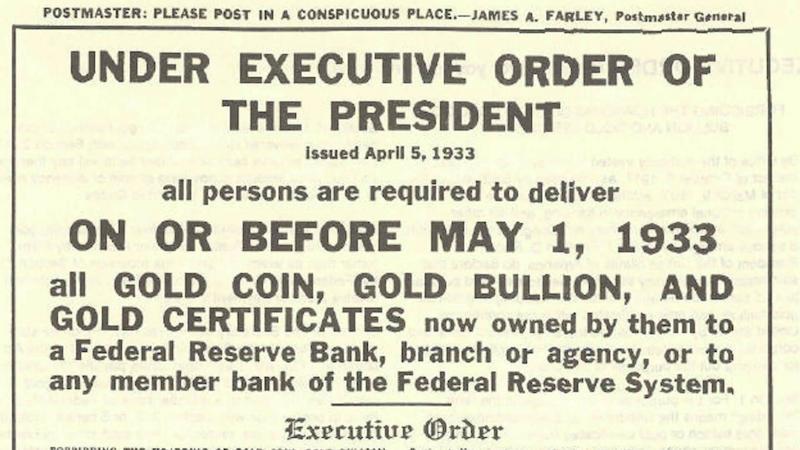
This is one of those episodes in history where people simply don’t look beyond the headline. All they know that is in 1933 a series of executive orders were passed to remove the ability to hold gold privately or specify it as a payment method in contracts and they assume that was it: in a puff of edict, all privately held gold simply disappeared from the public’s hands (“checkmate, Bitcoin cultist”).

Everybody is expecting one of these for a specialized area of mathematics called Bitcoin.

But that isn’t what happened.

In Kenneth R. Ferguson’s “Confiscation: Gold as Contraband 1933-1975” we get a more nuanced look at what the effect and implications of the gold ban were, including the haunting parallels to today’s Lockdown Society and it’s war on small business and the middle class.

Our lack of insight into this era…

“gives short change to the legitimate concerns of the people who were most opposed to President Roosevelt’s gold policies—farmers, blue collar workers, small business proprietors—and who believed democracy had been circumvented. Just a few years earlier, in the late 1920s, the mere thought of gold confiscation would have been inconceivable to everyone, including those who later supported it.”

The gold ban came after FDR and the Democrats ran a campaign premised on a balanced budget and reduced government spending (yes, really). By the time he came into office the Great Depression was in full swing, the S&P had come off 80% from its 1929 high, unemployment was at 25%. England was forced to abandon its gold standard in 1931 and 25 other countries followed suit within the year.

The newly elected president came into office facing a wave of  bank runs and took over the entire financial sector on his second day in office, “emergency executive control over all banking and currency transactions.”

FDR blamed gold hoarding for the nation’s banking crisis, however:

He failed to explain hoarding as a way of protecting a life savings in the face of frequent and increasing bank insolvency coupled with no depositor insurance, or to identify speculative activity abroad as foreigners exchanging their dollar assets for gold in anticipation of dollar devaluation. Most people would understand these choices as rational, but Roosevelt labeled them “unwarranted” and “speculative” in an emotional appeal to wrongdoing.

The emphasis is added, because it highlights our main assertion: at some point rational self-interest creates an environment that incentivizes certain behaviours in spite of those that the government is attempting to induce. In fact, the harder the government may try to impose behaviours that are against the rabble’s own interests, the more vigorously they may adapt the discouraged behaviour  (also see: Bitcoin).

FDR’s administration escalated the war on savers by ratcheting up the restrictions against gold:

“The gold policies of President Roosevelt over a ten-month period provided a classic example of a political slippery slope. On April 5, the President declared “hoarding” to be illegal, and on August 28 the crime was elevated to “holding.” On December 28, 1933, the Secretary of the Treasury finalized the mandate by “requiring the delivery of gold coin, gold bullion, and gold certificates to the Treasurer of the United States” (that is, from the theoretically-temporary hands of the banks into the more permanent possession of the government itself.) This is the definition of confiscation; it merely took ten months to be so stated.”

Ferguson’s book does a masterful job detailing the machinations of this chapter in US and economic history, in details far exceeding my available bandwidth here.

So what actually did happen?

Compliance turned out to be low: it was estimated that $287 million USD of gold was in the public hands at the time of the ban. This excludes gold already exported out of the country by those who saw it coming (Canada was a favourite destination and waypoint) and the wealthy who were speculating against a USD currency devaluation using gold held offshore.

Of that remaining stash in US public hands, compliance was estimated to be less than 50% by some tallies. The total face value of all gold coinage surrendered between 1933 and 1965 was less than $12 million USD, or approximately 4% of outstanding gold coinage.

China’s Bitcoin Ban

From my latest Crypto Capitalist letter, I cover the general situation in China:

China’s crypto ban is actually less about crypto and more about state control over everything. There are rumours that China will soon break up Alipay, the overarching pattern is that China perceives Big Tech and decentralized tech as threats to the CCP hegemony, and they are moving to crush all opposition.

Only by moving to outlaw entire industries, especially the ones poised to inherit the future, China may be repeating the same error that made over 500 years ago, when they ceded passage over the open seas to Europe, who went on to shape the trajectory of the world while China atrophied into centuries of internal strife and conflict:

“More than five centuries ago, three ancient civilizations made three crucial decisions that largely preordained their subsequent collapse. As always, during periods of stress, these choices were not perceived as either critical or damaging. Indeed on the contrary, they were viewed positively as constructive responses to the contemporary problems that helped to strengthen their respective societies. In a matter of several decades between 1433 and 1485, China, Russia and the Ottomans independently decided that interactions with foreigners, trade, innovation, civil and property rights, education, and freedom to exchange views were contrary to the interests of the state and social cohesion”

— Victor Shvets, The Great Rupture

Is China making the same mistake now?

We can already see that an outright ban on Bitcoin and crypto-currencies in China has had no effect on them globally. Zero. Think about that.

Also note that reminiscent of how gold was exported from the US ahead of the gold ban in 1932 (not because anybody saw the ban coming per se, but because a devaluation of the USD was seen as likely), the largest Chinese crypto exchanges have been exiting China since 2017. Binance is still operating full-tilt having moved their HQ from Hong Kong to Bahamas, which is quite literally a page from The Sovereign Individual playbook – moving from a jurisdiction hostile to your interests to one accommodating to them. 

Binance has its own exchange token (BNB) which at a $64B market cap makes it the 5th largest crypto currency in the world, and a Layer 1 blockchain (Binance Smartchain) that currently has a little under $20B TVL in DeFi, which definitely puts it somewhere on the Network State / Crypto-clave spectrum.

Something similar happened with Chinese miners, who are moving to the West or other Asian jurisdictions.

Interestingly, most of the crypto entities that arose there and then fled, came up in Hong Kong, which has had a taste of free market capitalism until the big rug pull in that respect in recent years.

In mainland China itself, they’ve always been living under totalitarianism and the population is inculcated to it. But even there, how long can the Chinese people, catching glimpses through the Great Firewall of far  more marginally freer people, especially those in Hong Kong, abide by tyranny? How long can that centralized, top-down repression truly continue for?

Life in liberal democracies is traditionally supposed to be anything goes except that which is expressly illegal. But we’ve had two years of rule by edict and that which is not explicitly permitted is forbidden.

How long can this continue for?

On a local level, some restaurants in Toronto are deciding not to enforce vax mandates. The longer the mandates continue, I expect more restaurants to begin eschewing them, because their economic self-interest is served by doing so. Even fully vaxxed people are curbing their outings because dinner and a movie feels more like internment into a gulag than a family night out.

Venues that help people regain that sense of normalcy and comfort will attract the business, not the ones who force you to show “your papers please” on the way in.

In Australia, the peasants are revolting, and even if the civil aviation authority is trying to ban drones from capturing the footage of these occurrences, they are still occurring and footage is getting out nonetheless.

Varying US states ruling against vaccine and mask mandates, people are setting up job boards for those who aren’t vaxxed (or those who are but don’t want to work for companies that require it). The transportation system is grinding to a halt as air traffic controllers, air crew and pilots are calling in sick, resulting in mass flight cancelations, who knows where it will spread next. Why? The MSM is trying hard not to find out, but guys like Ron Paul suspect vaccine mandates.

Right now we’re in civil disobedience, nullification and secessionist territory, but when I think about escalation: as the financial crisis that seemed imminent before COVID seems to be edging back into the frame (inflation, energy costs, supply chain constraints, cascading debt collapses: Evergrande and now the entire Chinese bond market) governments who seized on the COVID opportunity to introduce emergency measures may see a need for doubling down.

After chasing the goalposts for almost two years now, I’m not sure the rabble is going to take it much longer. And if it doesn’t, what would that mean?

#WorldWarWe

In a recent podcast I was listening to (I think it was Sahill Bloom on Bankless, but it’s possible I’m misremembering and I’m sorry if so), he said something almost off-handedly:

He said, in effect, “the next world war will be unlike anything we’ve ever seen” – and I expected him to talk about non-conventional warfare, such as bio-weapons, information warfare, and economics (“war by other means”), but instead he said

“World War III will be everybody against their own governments”

When you think about it, one realizes that today’s technology, with decentralization, cryptography, 3-D printing and drones could actually make this a possibility.

In David Hambling’s Swarm Troopers: How Small Drones Can Conquer the World, he outlines how governments, whose military used to have technologies 20 years ahead of the general populace, have become so bureaucratized and sclerotic that they now move at a fraction of the pace of the highly competitive private sector:

“If a commercial product goes through a generation every two years and the military cycle takes six years per generation, then in twelve years the military product goes from being four times as powerful as the competition to a quarter as powerful.”

An example of this dynamic we can already see having played out is the Internet, which came out of the military industrial complex and in its day, was light-years ahead of anything the general public had (Compuserve, GEnie).

But the “genie” did indeed get out of the bottle, and once the private sector got onto it and ran with it, it changed the fundamental architecture of power. The groundwork was laid for the evolution of societies in ways that would challenge, and will inevitably overwhelm the nation states that let it out. Say hello to the Network State and crypto claves.

So now that we’re here in The Jackpot, do we honestly believe that the slowest, most bureaucratic, rigid an inflexible entities (governments) are actually going to win the race for primacy in a rapidly decentralizing world? When the gargantuan imbalances they created over the last century finally experience their all-encompassing, self-induced Global Minsky Moment?

It was under FDR’s gold ban that dissenting Supreme Court Justice McReynolds ruminated that it meant the demise of the US Constitution:

It is impossible to fully estimate the result of what has been done. The Constitution as many of us have understood it, the instrument that has meant so much to us, is gone. The guarantees heretofore supposed to protect against arbitrary action
have been swept away. The powers of Congress have been so enlarged that now no man can tell their limitations.

Guarantees heretofore supposed to prevent arbitrary action are in the discard… Shame and humiliation are upon us now.

Moral and financial chaos may confidently be expected.

While in those days the ban on gold was ineffective and compliance less than half, it did succeed in stripping the US citizenry of constitutional protections which has only escalated into the present day.

We have all been treating what happened under COVID as something unprecedented. But if you think of Lockdown Society and The New Normal not as the implementation of a quasi-one-world government , ushering in a global police state, but instead as the crescendo, of a roughly century long process of creeping tyranny…. one of those infamous blow-off tops that are unrecognizable to us now because we are immersed in it, still experiencing it.

Despite the overwhelming arsenals of governments, the militarization of civilian police forces, and near ubiquitous surveillance capabilities, there’s never been a time in history when the people have the means to rebel, both within the system and without.

Especially here in North America, where to avoid retyping all this, allow me to simply excerpt a passage from the most recent edition of The Crypto Capitalist letter….

“The Future of Life Institute made docudrama short-film called “Slaughterbots”, it’s 7 minutes long and nothing short of chilling, but we’d be fools to think that if technology has this capability already, it won’t be used. By somebody:

Mexican cartels are already using drones to smuggle drugs, not to mention weaponized drones in combat with each other and on at least one occasion used them to attack the police.

It’s still under-appreciated how significant a change this is. On par with the gunpowder revolution and aerial warfare, autonomous weapons and drones are yet another technology in the process of changing the rules of the game. This brings us to the important part: we can already see that these technologies won’t just change the nature of conflict between governments. Drones are also accessible to non-state actors, perhaps even more-so. They will alter the relationship of power across society as a whole.

When also you factor in their close cousin, 3-D printed weapons, we really begin to understand what a fundamental shift in the landscape decentralization and digital technology really implies.

One of the defining characteristics that makes America, and certain other countries so different from, say, China, or even Australia, is the level to which the citizenry is armed. Especially in North America. The US and Mexico are two of the only three countries in world where gun ownership is a Constitutional right (the third is Guatemala) while even here in Canada, where it isn’t, we have one of the higher per-capita levels of gun ownership (somewhere around 34 guns per 100 people).

Imagine a future in which all these gun owners have the capability and incentives to print up their own weapons on 3- D printers. Then deploying them via drones, possibly swarms of them, for whatever purpose. There is no technological barrier from them doing so, and doing so right now. What scenarios or conditions would have to exist to galvanize that kind of behaviour en masse? How close are we to those conditions now? Are we moving toward those conditions or away from them? Most importantly, do you think whoever is in government could stop it?

If you consider this, then we can get a sense of why governments and policymakers are so eager to assert their authority now and to appear to be unassailable and omnipotent. I think it’s fear.”

To be clear: I am not advocating an armed rebellion against incumbent governments. I’m observing how decentralization and cryptography have changed the architecture of power and asking what kind of incentives would have to be in place to make what I describe inevitable.

The Bitcoin and the cryptocurrency movements were the second half of the one-two punch that set all this in motion. The Internet freed the flow of information, and in a world where “whosoever controls the monetary system, controls society (Zarlenga)”, cryptos have taken the punch-bowl of monetary control away from the State in a truly Promethean manner, and open-sourced it. Who controls money now? Everybody.

There is a point beyond which the citizenry will stop viewing each other as enemies (left vs right) and start viewing their own governments as the enemy (overlords vs rabble). If that happens, then the incentives and conditions will be in place for #WorldWarWe.

Coda:

As per the comment from Matt below, I am deeply saddened to learn that Mark Rostenko passed away July 26, 2020. We never met, but I considered him an internet friend and I respected him a lot.

Tyler Durden
Wed, 10/13/2021 – 16:20

via ZeroHedge News https://ift.tt/3BE1sP7 Tyler Durden

Don’t Use the Term ‘Trap House’ in Your Party Invite at Yale Law School


thumbnail (2)

At Yale Law School, a second-year student who is part Cherokee has come under fire from administrators and some black students for sending a message via an online forum inviting others to a party hosted by the Federalist Society and the Native American Law Students Association (NALSA). As Washington Free Beacon‘s Aaron Sibarium first reported, the issue stemmed from students objecting to the use of the word “trap house” when promoting the party, with critics from the Black Law Students Association alleging the party supports “black face” and that the conservative Federalist Society “has historically supported anti-Black rhetoric.” Administrators received nine complaints about the party invite, and promptly summoned the student in question to their office.

Once there, Ellen Cosgrove, an associate dean, and Yaseen Eldik, diversity director, hectored the student (who Free Beacon did not name), telling him that the use of the word “trap” and the mention of fried chicken was “triggering” to other students, in addition to the “email’s association with FedSoc.” Eldik told the student that “FedSoc belongs to political affiliations that are oppressive to certain communities,” mentioning the “LGBTQIA community and black communities and immigrant communities” specifically. Both administrators insinuated that if the student did not apologize, this incident could negatively affect his chances of passing the bar exam, which allows administrators to weigh in on matters of character, with Eldik even going so far as to draft an apology for the student to send. (The student ultimately declined to do so, instead writing in an online forum that he welcomed questions from those who had complained or taken offense.)

“As a man of color, there probably isn’t as much scrutiny of you as there might be of a white person in the same position,” Eldik told the student, per the Free Beacon‘s reporting. “I just want to acknowledge that there’s a complexity to that too.” This tacit acknowledgment from Eldik that the student’s racial background would be taken into account when determining how offensive the act was, and what type of punishment it deserves, is preposterous; people who are themselves members of minority groups are not immune from holding bigoted beliefs (though we do not have strong evidence to indicate that is the case here).

Contra Free Beacon‘s explanation, though, the term “trap house” did not rise to prominence due to its titular use by the popular podcast Chapo Trap House. Trap houses have long been a fixture of rap lyrics (the term long predates even Gucci Mane’s use of the term for his 2005 album), normally used to describe seedy run-down houses where drugs like crack are sold and used. The word worked its way into mainstream use over time, with 2 Chainz’s pink trap house in Atlanta even becoming Instagram fodder. It now just means something roughly akin to “place with a fun party.” While use of the term does imply that a party will not be a particularly elegant or sophisticated affair, it does not at all imply that people should show up in blackface. (Ethics of doing so aside, you’d have to be quite naive to show up to a party in blackface as a 24-year-old aspiring lawyer, in an era of iPhone cameras, in the year 2021, making it even more risible that this was the party host’s intention.)

Even if you hate the idea of a Federalist Society member using slang that originated with a different ethnic group and has deep roots in rap and hip hop music, it should be far more concerning for those who care about academic freedom that administrators attempted to force an apology over the phrase from a grown adult, while also implying that they could sink the student’s chances at passing the bar if he refused. Debra Kroszner, the managing director at Yale’s Office of Public Affairs, tells Reason that “while any person may report concerns about a lawyers’ character and fitness to the Bar, the Law School has a longstanding policy of reporting only formal disciplinary action to the Bar Association. Any media reporting to the contrary is false,” clarifying that the student did not receive formal disciplinary action but that the administration merely “tries to help students talk to one another and resolve their disagreements.” But if the Free Beacon‘s reporting is true, Yale’s administrators did not just make evenhanded attempts at helping students resolve a dispute. While it’s good that the student was not formally sanctioned for his speech, his alleged treatment by university administrators is nonetheless troubling. You don’t need to formally punish edgy speech in order to make students feel as if they can’t speak freely.

It’s also highly disturbing that tomorrow’s lawyers and academics believe a person’s affiliation with the Federalist Society—a conservative professional group that has launched the legal careers of many a Supreme Court justice—precludes them from a presumption of innocence. The students who will soon be entrusted with defending criminal defense in our courts of law surely recognize the value of an intellectual culture that doesn’t attempt to rain down punishment for the supposed sin of being a conservative who sends out edgy party invitations.

from Latest – Reason.com https://ift.tt/2YMNXhr
via IFTTT

Amnesty International brief against right to bear arms


shutterstock_1307648458

As the U.S. Supreme Court considers whether to enforce the Second Amendment right to “bear arms” in New York State Rifle & Pistol Association v. Bruen, an amicus brief from Amnesty International argues that doing so would violate international law. In this post, I’ll examine the arguments in the AI brief.

Back in the days when I was a monthly donor to AI, the group was known for its work in supporting political prisoners around the world. But for a long time AI has involved itself in many other issues, including global gun prohibition. Today, the leading international anti-gun organization is Control Arms, which was cofounded in 2003 by Amnesty International, Oxfam, and the International Action Network on Small Arms (IANSA).

For these groups, a complete embargo on all arms sales to Israel is a longstanding priority. See, e.g., Control Arms, Arms Without Borders: Why a Global Trade Needs Global Controls, Oct. 2006. To prevent Israel from manufacturing its own arms, the groups also favor a ban on commerce in arms-making materials, such as titanium.

It’s not just Israelis whom AI wants to disarm. The group enthusiastically supported  hard left Brazilian president Lula da Silva’s 2005 ballot referendum to ban all gun sales. (The ban was defeated 64%-36%).

Even some ardent opponents of civilian gun ownership in general acknowledge that defensive arms are legitimate for people who are the targets of an active genocide campaign. AI disagrees.

The group did a good job of documenting how easy it was for the Islamist government in Sudan to use disarmement to perpetrate genocide against the African Darfuri tribes. Much of the killing was carried out by Arab gangs, the Janjaweed, who were armed by the Sudanese government. As AI reported, the majority of the Janjaweed had five or six guns per person. AI quoted a Darfuri villager: “none of us had arms and we were not able to resist the attack.” In the words of another villager, “I tried to take my spear to protect my family, but they threatened me with a gun, so I stopped. The six Arabs then raped my daughter in front of me, my wife and my other children.” Amnesty International, Sudan: Arming the Perpetrators of Grave Abuses in Darfur, Nov. 16, 2004.

The Pittsburgh Tribune-Review asked Amnesty International’s Trish Katyoka, director of Africa Advocacy for the group, whether the Darfur victims should be armed. Dimitri Vassilaros, “Gun Control’s Best Friend,” Pittsburgh Tribune-Review, Apr. 1, 2005. She answered in the negative:

“We at Amnesty International are not going to condone escalation of the flow of arms to the region.” Indeed, “You are empowering (the victims) to create an element of retaliation.” “Whenever you create a sword-fight by letting the poor people fight back and give them arms, it creates an added element of complexity. You do not know what the results will be.” In sum, “Fighting fire with fire is not the solution to genocide. It is a dangerous proposition to arm the minorities to fight back.”

AI’s position conflates self-defense against murder with “retaliation,” which is revenge after the fact. It’s true that armed victims may add “complexity” to a situation—especially for attackers who used to straightforwardly murdering helpless victims. When the victims are unarmed, you do “know what the results will be”: the victims will be exterminated. Adding complexity to avoid certain mass murders is a life-saving choice.

Charming Betsy

Part I of the AI amicus brief argues that judicial interpretation of the U.S. Constitution, including the Second Amendment, must subordinate interpretation of the Constitution to what AI claims to be international law. The argument is an extravagant extrapolation of a longstanding rule of statutory interpretation, namely the “Charming Betsy Canon.”

In the 1804 U.S. Supreme Court case Murray v. Schooner Charming Betsy, 6 U.S. (2 Cranch) 64 (1804), Chief Justice Marshall wrote: “an act of Congress ought never to be construed to violate the law of nations, if any other possible construction remains.” The Charming Betsy ship was originally owned by an American but was later sold in St. Thomas to a Dane who sent it on a commercial voyage to the French island of Guadeloupe. The issue before the Court was whether the ship was forfeitable under a congressional statute that forbade American trade with France, which at the time had been engaged in the undeclared naval Quasi-War against the United States. The Marshall Court construed the statute narrowly, so as not to run counter to international law, which allows wartime trade by neutrals (such as Denmark).

In statutory construction, the Charming Betsy canon has been applied by American courts ever since. It has never been applied as a doctrine of constitutional interpretation. If it were, the First Amendment would be a certain casualty. Few if any nations and international treaties interpret “the freedom of speech, or of the press,” or “the free exercise” of religion as strongly as do American courts. Indeed, for most of American history judicial review of the constitutionality of legislation had very few counterparts  in the world. Harvard Law Professor Vicki C. Jackson’s 2009 book Constitutional Engagement in a Transnational Era (2009) argues for use of international law in interpreting some constitutional provisions, but not the Second Amendment, which has the “specificity or distinctiveness . . . that makes transnational sources irrelevant.”

AI argues that “The Constitution was . . . drafted with international law as a set of background norms, and this Court should construe the Constitution accordingly.” However, none of the alleged “background norms” that AI cites existed in 1791 when the Second Amendment was ratified, or in 1868 when the Fourteenth Amendment made it enforceable against the states.

Indeed, the Constitution, including the Bill of Rights, was drafted and ratified an intent to counter contemporary norms. For example, while many nations allowed (and still allow) censorship, the Constitution generally forbids it. While unlimited arms control was (and still is) the norm in much of the world, America’s Framers wanted to ensure that government didn’t have a monopoly on the implements of violence because they knew, based on experience, that government could not be trusted with such a monopoly. Whatever the harmful consequences of preventing a government monopoly of force, the Founding Fathers (in 1789) and Founding Sons (in 1868) believed that the alternative was far worse.

Even if the U.S. Senate had ratified an international gun control treaty, “No agreement with a foreign nation can confer power on the Congress, or on any other branch of Government, which is free from the restraints in the Constitution” Reid v. Covert, 354 U.S. 1, 16 (1957) (Black, J.) (plurality op.).

Along the way, AI accurately cites the 1897 case Robertson v. Baldwin, 165 U.S. 275, 283-86 (1897) for the proposition that the Court sometimes looks at the laws of other nations. In Robertson, a merchant seaman who had jumped ship argued that being forced to complete his labor contract amounted to involuntary servitude in violation of the Thirteenth Amendment. Citing the historic sea laws of Rhodes, Germany, the United Kingdom, and other nations, the Court observed that the laws forbade sailors to desert while in port. Notably absent from AI’s brief is what Robertson said about the Second Amendment: all of the Bill of Rights—and by extension the Thirteenth Amendment–contained implicit exceptions that were well-known at the time, and incorporated into those Amendments. For example, the First Amendment freedom of speech and of the press does not prohibit laws against libel; the Fifth Amendment prohibition on double jeopardy does not forbid retrial after a hung jury; that Amendment’s prohibition on compelled self-incrimination does not apply if the relevant statute of limitations has expired. And “the right of the people to keep and bear arms (Art. II) is not infringed by laws prohibiting the carrying of concealed weapons.” Id. at 282-83.

This indicates that the right to carry unconcealed weapons is part of the Second Amendment right. Or pursuant to the state cases favorably cited in Heller‘s more detailed examination of the Second Amendment, a legislature has the discretion to require that arms be carried openly, or that they be carried concealed; the legislature can choose the mode of carry, but cannot prohibit carry. (See Part V of my amicus brief in this case for detail.)

An empirical mix-up

Part II of the AI brief is the core argument for why international law is said to compel the Court to rule that the plaintiffs have no right to be issued a license to carry a firearm for lawful self-defense. The brief offers a hodgepodge of empirical studies, hardly any of which are relevant to the case at bar—such as a study arguing that Connecticut’s laws for purchasing handguns are better than Missouri’s.

Many of the studies have nothing to do with carrying guns, but instead involve claims that more firearms possession in a society necessarily lead to more criminal violence. While all these studies are debatable, even if they were conclusively accepted as true, they make an argument against the Second Amendment itself.

The lone specific citation in the AI brief about bearing arms is of a “fact sheet” by Professor Daniel Webster, of the Bloomberg School of Public Health at Johns Hopkins University, Concealed Carry of Firearms: Fact vs. Fiction. The link in the AI brief is broken, but you can find the fact sheet here. It argues that guns are ineffective for self-defense and rarely used for self-defense. The specific issue is right to carry laws is addressed on a single page, which cites three studies saying that such laws have harmful effects.

The claim is indirectly called into doubt by another article cited in the AI brief: Julian Santaella-Tenorio et al., What Do We Know About the Association Between Firearm Legislation and Firearm-Related Injuries?, 38 Epidemiologic News [sic, Epidemiologic Reviews] 140 (2016). According to AI, the study shows that “gun violence deaths in the United States are preventable through the adoption of reasonable gun safety laws,” which “include provisions such as New York’s ‘proper cause’ requirement for obtaining and carrying a firearm.”

In fact, Figure 2 of the study presents a summary of 25 studies of “Shall Issue” laws—that is, laws specifying that a person who passes a background check and safety training may not be denied a carry permit simply because a government official thinks the person does not “need” to carry a defensive arm. Almost all U.S. States already have such a law. Of the 25 cited studies, 11 reported that Shall Issue laws are associated with increased homicide, while 14 reported an association with decreased homicide.

Critics of the above article wrote that the article had omitted seven peer-reviewed studies in the relevant time period, all of which showed Shall Issue leading to reduced violent crime. Further, the authors had “consistently picked results that were the most favorable single result for gun control in the papers they surveyed” and had “picked results that the authors of those papers rejected.” John Lott, Carlisle E. Moody, and John E. Whitley, Re: “What Do We Know A bout the Association Between Firearm Legislation and Firearm-Related Injuries?” Epidemiologic Reviews, June 2016 (letter). Prof. Santaella-Tenorio and her colleagues subsequently published a 30-item correction to the original article. 39 Epidemiologic Reviews 171 (2017).

There are other amicus briefs that get into more depth about the pro/con empirical issues of bearing arms. I will write about them in a future post. Dissenting in District of Columbia v. Heller, Justice Breyer summarized the pro/con evidence about the benefits and dangers of handgun ownership in the home. He concluded that since there was lots of evidence on both sides, the Court should defer to the judgement of the D.C. Council. Justice Scalia’s majority opinion responded:

The very enumeration of the right takes out of the hands of government—even the Third Branch of Government—the power to decide on a case-by-case basis whether the right is really worth insisting upon. A constitutional guarantee subject to future judges’ assessments of its usefulness is no constitutional guarantee at all. Constitutional rights are enshrined with the scope they were understood to have when the people adopted them, whether or not future legislatures or (yes) even future judges think that scope too broad. . . . [T]he enshrinement of constitutional rights necessarily takes certain policy choices off the table.

The same point applies to the right to bear arms. The pro/con empirical interest balancing was performed by the American people when they ratified the Second Amendment. A licensing law, like that applied to the plaintiffs in the instant case, that makes it impossible for the vast majority of the population to exercise an enumerated right at all is a prohibition, not a regulation. It is straightforwardly a violation of the constitutional text.

International law

As for the actual “international law” the AI brief’s introduction promised, it turns out to be rather thin. The United States has ratified the International Covenant on Civil and Political Rights (ICCPR), and has also ratified the International Convention on the Elimination of All Forms of Racial Discrimination (CERD). The texts of these documents protect the right to life, the right to personal security, the special rights of children to protection, and the rights of all people against racial or sexual discrimination.

AI cites documents from United Nations committees asserting that the above documents create affirmative duties on governments to protect people from private violations of their rights. For example, according to the UN’s Human Rights Committee, to comply with the ICCPR, a government must not merely refrain from killing people (with certain exceptions, such as war); the government must affirmatively protect people from being murdered by private individuals.

However, the only documents that are part of American law are the treaties that were ratified by the Senate. Senate ratification does not compel the U.S. Supreme Court—or anyone else—to comply with the subsequent declarations by the U.N. bureaucracy.

Indeed, the U.S. Supreme Court has already ruled directly to the contrary. In Gonzales v. Castle Rock, 544 U.S. 478 (2005), the Court reaffirmed the longstanding doctrine that governments have no affirmative duty to protect citizens from private violence. Arguments that the Court was compelled by international law to adopt a contrary rule were presented in that case, but were not successful.

To whatever extent that the ICCPR and CERD texts are relevant to New York State Rifle and Pistol Association v. Bruen, they militate in favor of the petitioners. When a person is attacked by violent criminals in a public place, the government has already breached its (arguable) duty to protect people from private violence. In such a situation, some governments make the victims even worse off than they would be if there were no government at all—for the governments forbid the victims from carrying the tools necessary for the victims to defend themselves.

Consider the impunity with which gangs attack people in some European cities for wearing a yarmulke or a short skirt. Or the impunity of repeat violent predators on the streets and subways of New York City. By forbidding peaceable defensive carry, governments that prohibit lawfully bearing arms have affirmatively guaranteed the safety of gangsters and the violently insane to have their way with their victims.

The U.N. Human Right Committee

The AI amicus brief heavily relies on statements by the U.N.’s infamous Human Rights Council. The brief mistakenly refers to that body as the “Human Rights Committee.” To be precise, the predecessor of the U.S. Human Rights Council was the U.S. Committee on Human Rights, which the U.N. abolished in 2006 because its anti-right and anti-Semitic agenda had become intolerable. However, the new Council continues the misconduct of the old Committee.

The “Human Rights Council” proclaims: “With membership on the Council comes a responsibility to uphold high human rights standards.” One can assess the Council’s credibility by considering its actual current members, such as China, Eritrea, Pakistan, the Russian Federation, Sudan, and Venezuela—all of which are criminal thugocracies that rule by attempting to disarm their victim populations.

AI cites a 2006 report to the Committee on Human Rights by University of Minnesota Law Professor Barbara Frey.  According to the Frey Report, a state’s failure to restrict self-defense is itself a human rights violation. The report states that a government has violated the human right to life to the extent that a state allows the defensive use of a firearm “unless the action was necessary to save a life or lives.” Thus, firearms “may be used defensively only in the most extreme circumstances, expressly, where the right to life is already threatened or unjustifiably impinged.” In other words, a government that allows the use of deadly force to defend against rape, arson, carjacking, or armed robbery has violated the criminal’s right to life. By the Frey theory, every U.S. state government and the federal government are and always have been violators of violent criminals’ right to life.

The Frey report states that it is a human rights violation for persons to be allowed to possess a firearm without a permit, and the permit should enumerate “specific purposes” for which the gun could be used. Today, no U.S. jurisdiction is compliant with this standard. Most states do not require a permit to possess a handgun, and hardly any require a permit for a long gun. Anyone who may lawfully own a gun may keep it at home for self-defense, may take it to a target range, hunt with it (for which a hunting license is usually required), or use the gun for any other lawful purpose. So even the severe gun control laws of New York State are human rights violations, according to the Frey report and its adoption by U.N. committee. In New York, you can buy a shotgun upon passing a background check, and you can then keep the gun for self-defense, skeet shooting, or other purposes, with no specific permission.

I have argued elsewhere that the Frey report omits many sources of international law that recognize the inherent human right of self-defense, and that the report misdescribes some sources of international law by claiming that they treat self-defense as a mere excuse and not justification. The Human Right of Self-Defense, 22 BYU Journal of Public Law 43 (2008).

The racial angle

The third and final part of the AI amicus brief essentially retreads the arguments in Part II, but this time with special reference to racial discrimination. As the brief’s statistics show, black people in the United States are disproportionately harmed by violent armed criminals and often receive insufficient police protection. Indeed, the problem has grown much worse in the past few years. The existence of the serious problem does not prove  that the U.S. Supreme Court would violate international law if the Court respected the right of a law-abiding black woman or man to carry a handgun for protection. Indeed, an amicus brief by the Black Attorneys of Legal Aid, the Bronx Defenders, and the Brooklyn Defenders points out the New York’s arbitrary handgun licensing law is now and always has been enforced with discriminatory severity against people of color.

That brief recognizes that firearms have controversial public safety implications. But:

. . . New York’s licensing requirements—which cause criminal penalties for unlicensed
possession—themselves have controversial public safety implications. It is not safe to be approached by police on suspicion that you possess a gun without a license. It is not safe to have a search warrant executed on your home. It is not safe to be caged pretrial at Rikers Island. It is not safe to lose your job.
It is not safe to lose your children. It is not safe to be sentenced to prison. And it is not safe to forever be branded as a “criminal,” or worse, as a “violent felon. In sum, New York’s licensing requirements are not safe.

The Court must not “stand by idly” while New York denies its people the right to keep and bear arms, “particularly when their very lives may depend on it.” Peruta v. California, 137 S. Ct. 1995, 2000 (2017) (Thomas, J., dissenting from the denial of certiorari). It must create a rule that will in fact protect the Second Amendment rights of “all” the people. See McDonald [v. City of Chicago], 561 U.S. at 773. Achieving that goal requires that the Court answer the question presented by holding for the
Petitioners and reasoning that New York’s licensing regime violates the right to keep and bear arms

(some citations omitted).

Thus, to whatever extent that international treaties about the right to life and nondiscrimination influence U.S. constitutional interpretation, these treaties militate in favor of the Court ruling against the New York law that fosters racial discrimination and forbids the lawful defense of one’s life outside the home.

At the least, the differing implications that may be drawn from the international treaties, and the differing results of the empirical studies cast doubt on the claims of Amnesty International and its allies in the United Nations bureaucracy that international law plainly forbids the United States to allow the use of firearms against violent felony attackers.


from Latest – Reason.com https://ift.tt/3p520KJ
via IFTTT

Bitcoin & Bullion Bounce As Bonds Signal Fed Faux-Pas Imminent

Bitcoin & Bullion Bounce As Bonds Signal Fed Faux-Pas Imminent

Policy makers have “generally navigated the economic side of the COVID crisis decently well,” though they seem to have fallen “behind the curve in the last six months, or so,” Rieder said in a Wednesday note.

“It would be greatly disappointing to see the central bank not only not `stick the landing’ but in fact stumble in a way that injures the recovery.”

Well, judging by today’s CPI print, FOMC Minutes, and bond, bullion, and bitcoin market action, they are well on their way to more than a stumble.

A fifth straight month of high consumer price inflation suggests this is anything but transitory and traders are starting to bet that The Fed will have to act sooner rather than later.

The market is now pricing in a 90% chance of a Sept 2022 rate-hike (and a July 2022 end to the taper), followed by another hike becoming more priced-in for Dec 2022…

Source: Bloomberg

On the week (with Monday being a holiday), 30Y Yields are down around 12bps (helped by a well-bid auction today) while 2Y yields are up around 5bps…

Source: Bloomberg

As the yield curve begins to price in a massive policy error by The Fed (more aggressive rate-hikes not ending well)…

Source: Bloomberg

The inflation fears showed up in crypto with bitcoin surging back above $57k…

Source: Bloomberg

And gold spiking up to $1800…

Testing and breaking several key technical levels…

Source: Bloomberg

As fears of a policy error and flip-flop back to more easing sent the dollar down hard for the day – its worst day since August

Source: Bloomberg

Oil prices were flatish for a change…

Stocks were mixed on the day with Nasdaq the best performer and The Dow the biggest laggard. Things were going so well into the open and then everything puked which reflexively brought in the dip-buyers…

The S&P 500 algos managed to push it back to the 100DMA (again)…

Utes led the S&P sectors today while Financials lagged (after JPM’s results)…

Source: Bloomberg

Meanwhile, TSLA is in melt-up mode again…

But, The SMART Money ain’t buying it…

Source: Bloomberg

Finally, U.S. households lack the kind of confidence that usually goes along with higher stock prices, according to Morgan Stanley Wealth Management. The firm drew the conclusion in a report Monday after comparing 12-month changes in the Conference Board’s consumer confidence index and the S&P 500 Index.

“If consumer sentiment doesn’t quickly improve, it could be a signal of market weakness” as people choose to spend less and save more, the firm wrote.

Tyler Durden
Wed, 10/13/2021 – 16:00

via ZeroHedge News https://ift.tt/3azCAMF Tyler Durden