As McConnell Rebuffs Yellen Over Debt Limit Limbo, Democrat Infighting Risks Delaying $3.5 Trillion Package By ‘Weeks Or Months’

As McConnell Rebuffs Yellen Over Debt Limit Limbo, Democrat Infighting Risks Delaying $3.5 Trillion Package By ‘Weeks Or Months’

On Monday we noted how Goldman sounded a red alert over the debt limit debate brewing in Congress – which has a “drop dead date” sometime between late October and early November.

As repo expert Scott Skyrm said, “for the past several years, Congress always reached a compromise before the possibility of a “technical default” creeped into the markets. This year, as we get closer to the “drop dead date” (which hasn’t yet been determined) the markets will start pricing in distortions.

Well, it appears things are headed in that direction with Thursday morning news from Bloomberg that Senate Minority Leader Mitch McConnell (R-KY) told Treasury Secretary Janet Yellen to pound sand over working with Democrats to raise the federal debt ceiling.

“The leader repeated to Secretary Yellen what he has said publicly since July: This is a unified Democrat government, engaging in a partisan reckless tax and spending spree,” said McConnell spokesman Doug Andres on Thursday. “They will have to raise the debt ceiling on their own and they have the tools to do it.”

Adding further pressure to the situation is Democratic infighting over their $3.5 trillion economic blueprint, which Bloomberg noted on Wednesday risks delaying things “by weeks or months” as moderate and progressive Democrats argue over taxes, health care and other unresolved issues. Chief among them, the size of the package – with Democratic Sens. Joe Manchin (WV) and Kyrsten Sinema (AZ) balking at the cost. Last week Manchin called for a ‘strategic pause‘ in negotiations amid soaring debt and rising inflation. Progressive Democrats, however – whose votes are necessary for passage, say the $3.5 trillion is the minimum amount necessary to achieve their priorities.

“It’s going to take some time,” said Sen. Ben Cardin (D-MD), adding that “as you put out one area, another one crops up.

The expansive $3.5 trillion package entails much of Biden’s first-year agenda and includes a mix of tax increases on the wealthy and corporations, as well as greater spending in areas including child care, health care and climate change. 

With Republicans unified in opposition, Democrats are pushing it through the Senate using a process called reconciliation that lets them skirt a GOP filibuster. But with the slimmest of majorities in both chambers, Democrats will have to be unified in support.

The differences among Democrats manifested themselves as the House panels finished their work. The Ways and Means Committee deferred action on raising the limit on the state and local tax deductions, or SALT, and a sweeping proposal to regulate drug prices failed to win approval in the Energy and Commerce Committee. It will be up to party leaders to decide whether those provisions can be inserted later in the process and still muster the votes needed to pass the final bill. -Bloomberg

Biden met with Sinema and Manchin at the White House on Wednesday, however all parties were mum about the talks aside from Sinema’s office calling them “productive” and White House spox Jen Psaki saying there would be “ongoing discussions.” 

Meanwhile, the delays are putting House Speaker Nancy Pelosi in a bind – as she promised moderates a vote on a $550 billion infrastructure plan by Sept. 27. Progressive Democrats including Rep. Alexandria Ocasio-Cortez (D-NY), however, have warned that they won’t support that bill unless the $3.5 trillion package is agreed to by both chambers first.

More disagreements exist over the level of taxation on the wealthy – with Sen. Finance Chairman Ron Wyden pushing for an inheritance tax, energy tax credits tied to carbon emissions, and levies on stock buybacks and partnerships. In addition, House Democrats have yet to agree amongst themselves on SALT – the ability for wealthy people to write off state and local taxes on their federal returns, which was capped during the Trump years at $10,000. House Democrats from New York, New Jersey and California are pushing to remove the cap – a handout to their wealthy constituents, while progressives are set to oppose it.

Ongoing issues also include drug price regulation – which was thrown in jeopardy on Tuesday after three Democrats on the House Energy and Commerce Committee voted against a proposal which would allow the US Govt. to demand lower drug prices while tying future price increases to inflation. According to the report, “The savings to the government derived from the plan are slated to help pay for a large portion of the economic package. Without them, the measure would be as much as $600 billion short.”

In short, be on the look out for ‘distortions’ as we approach the drop-dead date for the debt ceiling, and the economic package potentially drags on for ‘weeks or months.’

Tyler Durden
Thu, 09/16/2021 – 09:48

via ZeroHedge News https://ift.tt/2Z4TccI Tyler Durden

A Win for Devin Nunes in Lawsuit Over Journalist Ryan Lizza’s Tweet


dpaphotosfive043571

Tweeting article after Nunes called it defamatory could count as “actual malice,” court says. In a disturbing ruling for fans of free speech, a federal court has partially sided with Rep. Devin Nunes (R–Calif.) in his lawsuit against journalist Ryan Lizza. Nunes has accused Lizza and Hearst Magazine Media, which publishes Esquire, of defamation and conspiracy.

Back in 2018, Esquire published an article by Lizza headlined “Devin Nunes’s Family Farm Is Hiding a Politically Explosive Secret.” The article suggested that Nunes had hidden the fact that his family had moved their dairy farm from California to Iowa. It also accused the farm of relying on undocumented labor. In addition, the article accuses Nunes of improper political activities, saying he used his position as chairman of the House Permanent Select Committee on Intelligence “to spin a baroque theory about alleged surveillance of the Trump campaign that began with a made-up Trump tweet” about former President Barack Obama tapping Trump Tower and “to discredit the Russia investigation and protect Donald Trump at all costs.”

Nunes sued, but a federal district court granted Lizza and Hearst’s motion to dismiss his claims. Among other things, it concluded that even if some information in the article was defamatory, it did not meet the standard required for a defamation claim against a public figure: actual malice. So Nunes appealed.

In its September 15 ruling, the U.S. Court of Appeals for the 8th Circuit agreed that there was no actual malice involved in the original publication of the article.

The Supreme Court’s interpretation of the First Amendment requires a public official to prove that defamatory statements or implications are made with ‘actual malice,’ meaning ‘with knowledge that it was false or with reckless disregard of whether it was false or not,'” notes the court. “In this context, ‘reckless conduct is not measured by whether a reasonably prudent man would have published.’ Instead, ‘the defendant must have made the false publication with a high degree of awareness of . . . probable falsity, or must have entertained serious doubts as to the truth of his publication.’…We agree with the district court that the complaint is insufficient to state a claim of actual malice as to the original publication.”

But a later Lizza tweet sharing the article could rise to that standard, the court said.

Tweeting a link to the article could be considered “republication,” the court explained, noting that “there is a distinction in defamation law between an original publication and a republication.” And republication could imply actual malice.

Lizza’s tweet came on November 20, 2019, several weeks after Nunes initially filed his defamation claim. “I noticed that Devin Nunes is in the news. If you’re interested in a strange tale about Nunes, small-town Iowa, the complexities of immigration policy, a few car chases, and lots of cows, I’ve got a story for you,” tweeted Lizza.

“The complaint here adequately alleges that Lizza intended to reach and actually reached a new audience by publishing a tweet about Nunes and a link to the article,” ruled the appeals court. “Although we agree that there are insufficient allegations of express defamation, we conclude that the complaint does state a claim for defamation by implication as to a republication of the article. We thus affirm in part, reverse in part, and remand for further proceedings.”

Whether the republication here rises to the level of defamation will still have to be decided.

But under the appeals court’s logic, a politician may declare something defamatory and sue in court and—whether there is merit to the original claim or not—the journalist or publication who so much as draws attention to the contested article could become guilty.

It could also have implications beyond a journalist or publication responsible for a piece accused of defamation. “One curious aspect of the ruling is that it appears to open the door to lawsuits against anyone who tweeted or retweeted the original story with knowledge of Nunes’ lawsuit, and to similar claims over members of the public or those with significant social media followings tweeting or retweeting stories after learning that the subject of the story is disputing it in some way,” notes Politico.


FREE MINDS


FREE MARKETS

Studies link luxury rentals and affordable housing. For a certain sort of misguided activist and policy wonk, new apartment buildings featuring fancy pads aren’t just irrelevant to people who can’t afford them, but actively harmful. Their theory is that it speeds up gentrification and causes rents to rise. But empirical research—including a new paper out of Finland—challenges this assumption. It suggests instead that expanding “luxury” rental housing stock actually helps create affordable housing, too, by creating “moving chains” and freeing up older places where lower-income renters can afford to live. “For each 100 new, centrally located market-rate units, roughly 60 units are created in the bottom half of neighborhood income distribution through vacancies,” and 29 units in the bottom quintile, suggests the Finnish paper.

“What about in the United States?” asks Timothy B. Lee in the Full Stack Economics newsletter.

Over the last couple of years, Notre Dame economist Evan Mast has been doing similar research in American cities, and he published his latest results in July (his 2021 paper is paywalled; you can read a preliminary version from 2019 here).

Mast looked at housing markets in 12 of the largest American cities. The US doesn’t have the kind of government population register they have in Finland, so instead Mast obtained data from a private marketing database called Infutor Data Solutions. But he used the same basic methodology as the Finnish economists and got similar—if a bit less dramatic—results. Thanks to moving chains, a new luxury apartment building created vacant units in a wide range of neighborhoods.

Mast found that 67 percent of people who moved into a new luxury apartment building came from another apartment in the same metropolitan area. Of these, only 20 percent of the people who moved into luxury apartment buildings came directly from neighborhoods with below-average incomes. But that set off a moving chain that was more likely to reach lower-income neighborhoods. By the sixth link in the chain, 40 percent of movers were coming from neighborhoods with below-average incomes.


QUICK HITS

• Treasury Secretary Janet Yellen and IRS Commissioner Charles Rettig are fighting for more information about American bank accounts.

• The U.S. Court of Appeals for the 5th Circuit has “overturned a judge’s order blocking the Department of Homeland Security (DHS) from shifting its immigration enforcement priorities, delivering a significant victory for the Biden administration,” reports The Hill. The court “unanimously ruled to stay a district court judge’s injunction against DHS from enforcing a January policy memo that directed authorities to scale back the Trump-era crackdown on undocumented immigrants. The policy included an initial effort to enact a 100-day moratorium on deportations.”

• In more good immigration news: “Senators introduced a bipartisan bill on Wednesday that would create a pathway to citizenship for some children and young adults who were raised in the United States but face deportation at age 21. “

• Los Angeles County will start requiring proof of vaccination for indoor bars, wineries, breweries, and clubs. “The mandate, which will be issued by Friday, will require patrons and employees to have at least one vaccine dose by Oct. 7 and be fully vaccinated by Nov. 4,” according to the Los Angeles Times.

• L.A. isn’t the only place to put new COVID-19 rules in place this week. Gov. Kathy Hochul yesterday announced new rules for New York schools and child care centers:

• Vape store owners aren’t sure they can survive a new tax hike.

from Latest – Reason.com https://ift.tt/3Eyu9z9
via IFTTT

Chinese Brokers Drop Currency Forecasts To Avoid Angering Regulators

Chinese Brokers Drop Currency Forecasts To Avoid Angering Regulators

By Michael Every of Rabobank

Yesterday’s Chinese data were a real shock. In particular, retail sales were up only 2.5% y/y in August vs. 7.0% expected and only 3.0% 2y/y. This is hardly what one calls a robust consumer recovery – and given industrial production was only slightly weaker than projected, explains why China is running such large trade surpluses: supply is up, demand is flat. Enter ‘Common prosperity’ – which Wall Street is still struggling to understand given it will read anything else but the actual instruction manual. Yet there was another report out yesterday –beyond Evergrande, which today just suspended all its onshore bonds — just as shocking in some ways, and which Wall Street is not only refusing to read, but apparently to print. Reuters reported: “EXCLUSIVE China brokers drop yuan forecasts to avoid regulators’ ire”.

It claims Brokerages in China have dropped detailed currency forecasts from their research notes, or have restricted access to them, underlining the growing sensitivity in the financial sector to a regulatory clampdown on speculative investment. Their disappearance follows pressure to avoid stockmarket forecasts as well as a ban by authorities on publishing commodity prices, amid a series of sprawling crackdowns that are re-shaping China’s economy and upending financial markets….analysis of months of notes from four brokers in China shows once-detailed forecasts for the Chinese currency against the dollar have now vanished or grown fuzzy, with precise predictions replaced by ranges or vague statements.”

Reuters notes: “It also comes at a delicate moment for the yuan, which China has sought to promote as a global reserve currency but which is tightly managed by the central bank and has been stubbornly firm recently despite a broadly strong dollar. The market effect of publishing only generalised forecasts is unclear, particularly as foreign institutions continue to offer precise ones.” Also, Chinese clients can apparently access FX projections *privately*. Yet are those two gaps –foreign/domestic, private/public– to remain or close, and if so in which direction?

For alexic Wall Street, dual exchange rates were common in Soviet economies. After initial demonetisation, Lenin’s pro-market New Economic Plan shifted to sovznaks (paper currency) and chervonetz (gold-backed currency, supported by a positive balance of payments). Guess what? Capital markets liked the latter: money is money. Under Stalin, the USSR walked away from Wall Street, not vice versa, and shifted to a command economy where the Soviet ruble –not fully-fungible domestically– had a dual exchange rate: high on official markets, which only a privileged few could use; and very low on the unofficial black market.

We are very far from this situation today. Indeed, unlike the post-Lenin USSR, and its own recent wobbles, China is flush with dollars right now on the back of capital inflows and Covid-related trade surpluses. So why the avoidance of FX forecasts? Reuters suggests that the aim is to avoid Chinese corporates, with dollar holdings of nearly $1 trillion –meaning official FX reserves of $3.2 trillion are artificially low— coming to any FX consensus and taking a counterparty view against the PBOC. If they all decided to either buy or sell the dollar, it would push the USD/CNY exchange rate around hugely. In short, the aim is for stability over all else, even if that means opacity.

Or, it could perhaps mean there could be a sharp devaluation, or appreciation, ahead: opacity is exactly the space in which these kinds of speculation will occur, especially on the back of recent weak data suggesting the need for more stimulus in a debt-constrained economy. Indeed, there is an obvious trade-off for this FX stability: it won’t help internationalize CNY. Foreign firms and CFOs are not going to enjoy FX opacity when doing their balance-sheet planning. Even if they continue to forecast CNY, if their Chinese counterparties have very different views due to an information gap, this will ironically create potential FX volatility!

Logically, the best way to keep long-run FX stability and to internationalize CNY is to make sure the currency is trading in line with its fundamentals. Yet even that implies volatility, because fundamentals change. For example, there are valid arguments CNY is too weak right now given the trade and capital inflows being seen – yet China does not seem to want a stronger currency for a variety of reasons; and there are equally valid views CNY will be much weaker in the future given the pressing domestic and external issues China is grappling with – but not too far, or too fast, it would seem. Which means the remaining logical conclusion if you want a stable, international currency is to make sure the fundamentals are favorable for its strength. Yet this is both a domestic and an external issue, and they are linked.

On that external front, and linked to FX markets even if FX markets can’t yet link to it, see the front page of the Financial Times: “US Builds Bulwark Against China with UK-Australia Security Pact; or, as the Guardian puts it: “US, UK and Australia forge military alliance to counter China”. In short, we now have a new global security pact “AUKUS”, which will see deep military integration between $22.7trn US GDP/331m people, $3.1trn UK GDP/68m people, and $1.6trn Aussie GDP/25m people. The pact includes Australia dropping a 2017 contract with France to build diesel-powered subs in favour of US nuclear-powered ones to be built in Adelaide. There will also be deep trilateral co-operation on new technologies such as cyber, AI, and Quantum, and no doubt across a growing number of other industrial sectors, as well as regional foreign policy. Might Canada also sign up after its looming election? Meanwhile, on 24 September the White House is holding an in-person Quad meeting with Japan ($5.4trn GDP/126m people) and India ($3.1trn GDP/1,381m people) joining in.

Yes, AUKUS (+Japan+India) is no integrated bloc like the EU, which saw an ebullient State of the Union address yesterday talking about building a domestic semiconductor ecosystem. Yet once again ‘precise predictions were replaced by ranges or vague statements’, and that EU goal will require a shift to industrial policy and protectionism just as AUKUS (+Japan+India) opens the door to larger-scale military-industrial policy, which is where all the cutting edge R&D actually occurs.  

“The world is a jungle,” the former French ambassador to Washington, Gérard Araud, observed on Twitter. “France has just been reminded this bitter truth by the way the US and the UK have stabbed her in the back in Australia. C’est la vie.” When the rest of the EU sees the Indo-Pacific is where US and UK military energies are now focused, not Europe/Russia, they will no doubt agree. One would imagine China’s retort will be sharper – and fuzzier to forecast for Wall Street(?)

And in the region, today saw a bumper 2.7% q/q, if lopsided, Q2 Kiwi GDP number, which is some consolation for them not being invited to join AUKUS. It also suggests the RBNZ may indeed start to hike rates ahead despite the wobbles in Chinese retail (and in shares of infant milk formula firms), which will make the AUD/NZD cross interesting if so. We also had the always-fuzzy Aussie jobs number, which saw a print of -146K under lockdown vs. -80K expected, but with the unemployment rate confusingly dropping to just 4.5%. There were far worse whisper numbers out there – but this is not a rate-hiking number. At least there is the prospect of lots of maritime/engineering jobs in Adelaide ahead to help diversify and fortify the economy.

Tyler Durden
Thu, 09/16/2021 – 09:31

via ZeroHedge News https://ift.tt/3tMXy3B Tyler Durden

Cathie Wood’s Funds Have Sold $266 Million In Tesla This Month, Despite Her $3,000 Price Target On The Company

Cathie Wood’s Funds Have Sold $266 Million In Tesla This Month, Despite Her $3,000 Price Target On The Company

If only we had access to the fantastic brain of Cathie Wood, we might be able to answer our own question as to why the fund manager keeps selling large chunks of her magnum opus investment in Tesla.

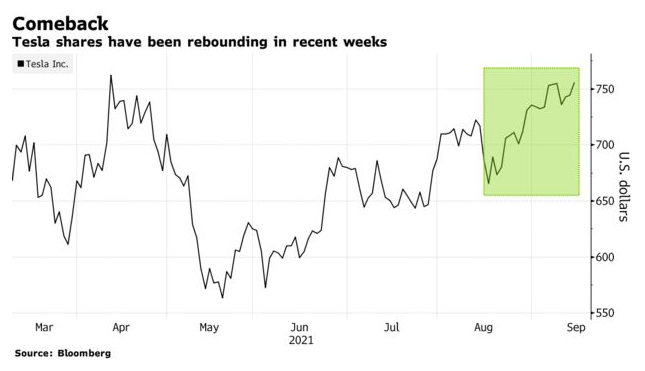
It seems odd not only because of how frequently Wood crows about Tesla and Elon Musk’s brilliance, but also because the fund manager has a $3,000 price target on the name. Surely only the foolish would be selling a stock priced at $750 when it’s on its way to $3,000, right?

The sales that prompted these questions took place this week: Wood has sold about $266 million in Tesla stock this month alone, spread across all of her ETFs.

Wood’s ARK Innovation and ARK Next Generation Internet ETFs sold over 81,600 shares in Tesla – worth about $62 million – on Wednesday, Bloomberg reported Thursday morning. So far in September, her funds have sold more than 350,000 Tesla shares as the price of the automaker bounces back toward $750 per share.

“Our estimate for Tesla’s success has gone up. The main reason for that is their market share. Instead of going down from year-end 2017 to today, it has actually gone up fairly dramatically,” Wood said just days ago to Yahoo Finance

$3,000 marked the target for her “base case” for Tesla, the Yahoo report said.

When asked about selling some Tesla last year, Wood told CNBC that it was “wise portfolio management” to trim some of your winners to invest in other companies.

Tesla remains ARK’s single largest holding still, Bloomberg reported.

Tyler Durden
Thu, 09/16/2021 – 09:15

via ZeroHedge News https://ift.tt/3AiR9zl Tyler Durden

Leaked Zoom Video Exposes Hospital Officials Discussing COVID-19 Scare Tactics

Leaked Zoom Video Exposes Hospital Officials Discussing COVID-19 Scare Tactics

Authored by Matt McGregor via The Epoch Times,

A leaked Zoom conference reveals a doctor questioning how to increase the count of COVID-19 patient numbers on the hospital’s dashboard report.

The media outlet National File said it obtained the recording from an “internal source” at the Novant Health System that includes New Hanover Regional Medical Center in Wilmington, North Carolina.

National File posted the video on its Twitter feed on Sept. 10.

National File and other local media outlets that reported on the leak identified the people in the video as Mary Kathryn Rudyk, a physician at the medical center, who is asking Carolyn Fisher, the hospital’s director of marketing, how to inflate the number of people classified as COVID-19 patients for the purpose of generating fear in the unvaccinated.

“I think we have to be more blunt, we have to be more forceful – we have to say something coming out – if you don’t get vaccinated, you know you are going to die,” Rudyk said in the video.

“Let’s just be really blunt to these people.”

The video begins with Fisher explaining how her department is communicating “meaningful numbers”—the percentage of the unvaccinated, vaccinated, and percentage of deaths in the Intensive Care Unit (ICU)—to the public.

Rudyk then asked how post-COVID cases can be included in the number of people hospitalized for COVID-19.

“My feeling at this point in time is that maybe we need to be completely a little bit more scary for the public,” Rudyk said.

“There are many people still hospitalized that we’re considering post-COVID, but we are not counting in those numbers, so how do we include those post-COVID people in the numbers of patients we have in the hospital?”

Fisher asked if she meant every patient who has been in the hospital “since the beginning of COVID?”

Rudyk answered, “Well, that are still in, and that’s something I can take to someone else, but I think those are important numbers: the patients that are still in the hospital, that are off the COVID floor, but still are occupying the hospital for a variety of reasons.”

Also on the Zoom conference call was Shelbourn Stevens, president of New Hanover Regional Medical Center, who said those patients are classified as “recovered.”

“But I do think, from our standpoint, we would still consider them a COVID patient because they’re still healing,” Stevens said.

Rudyk said she thinks those patients need to be “highlighted as well, because once they’re off isolation, they drop from the COVID numbers,” prompting Stevens to say that they can later talk offline about “how we can run that up to marketing.”

Novant Health Response

In response to questions asking for confirmation on if people in the video were employees of New Hanover Regional Medical Center and what the context of the video was, a spokesperson for Novant Health told The Epoch Times that staff involved in the excerpt of the video are seeing the “highest levels of COVID-19 hospitalizations and deaths so far in this pandemic, despite having safe and effective vaccines widely available.”

“This was a frank discussion among medical and communications professionals on how we can more accurately convey the severity and seriousness of what’s happening inside of our hospitals and throughout our communities,” the spokesperson said. “Specifically, the data we have been sharing does not include patients who remain hospitalized for COVID-19 complications even though they are no longer on COVID-19 isolation, so it does not provide a complete picture of the total impact of COVID-19 on our patients and on our hospitals.”

The hospital continues to be concerned with misinformation, the spokesperson said, and that it strives “to be transparent and tell the whole story.”

Tyler Durden
Thu, 09/16/2021 – 08:54

via ZeroHedge News https://ift.tt/3CfGOVy Tyler Durden

Ida Sends Number Of Americans On The Dole Back Above 12 Million

Ida Sends Number Of Americans On The Dole Back Above 12 Million

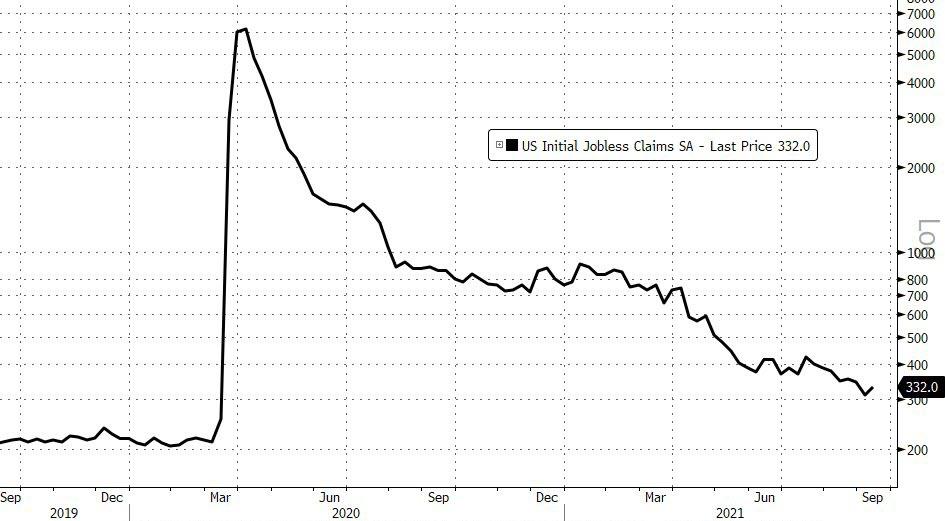
Initial jobless claims rose last week (potentially impacted by Hurricane Ida), up from 312k to 332k…

Source: Bloomberg

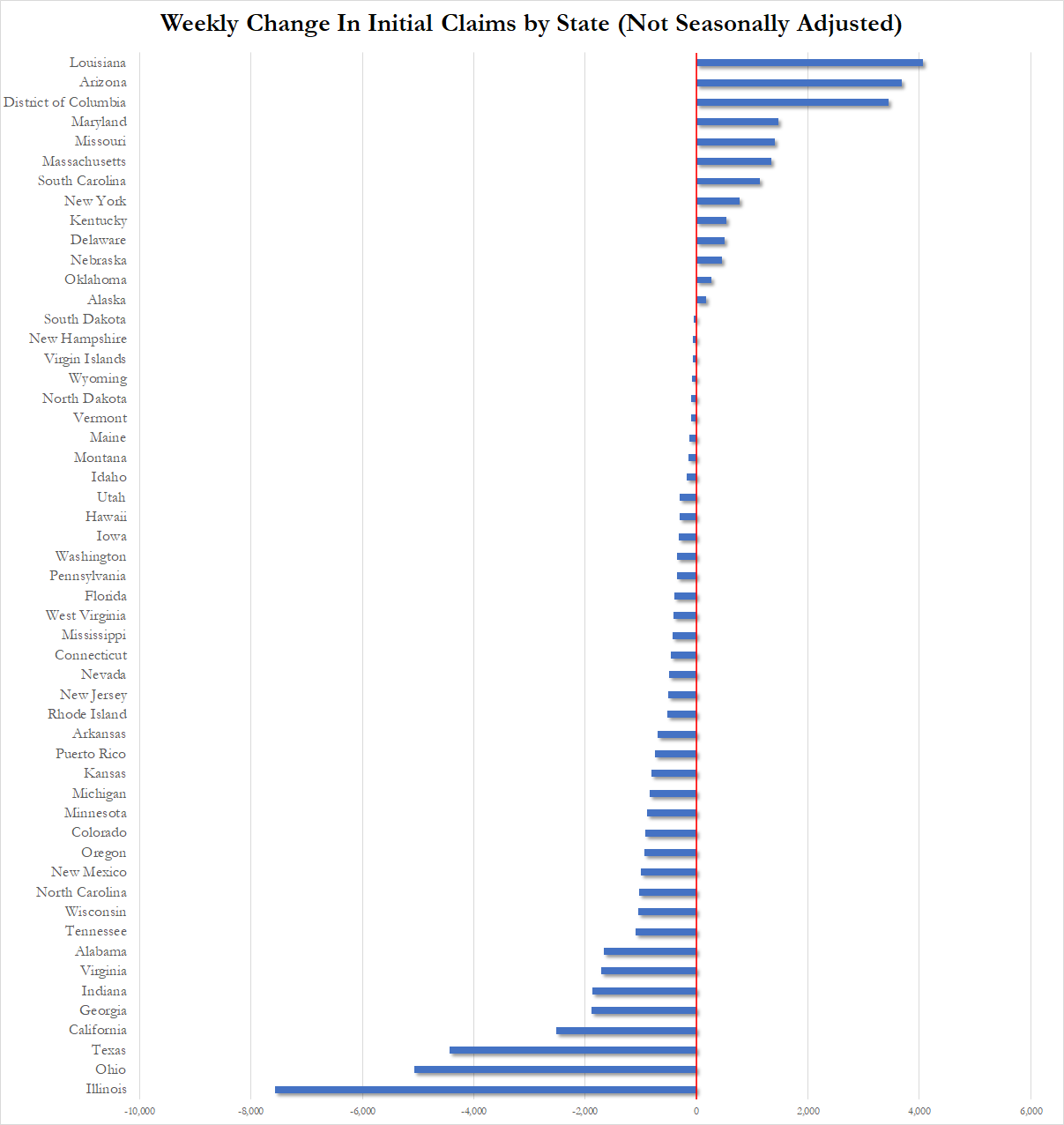
Louisiana (Ida!?), Arizona, and DC saw the biggest increases in claims while Illinois, Ohio, and Texas saw the biggest decreases…

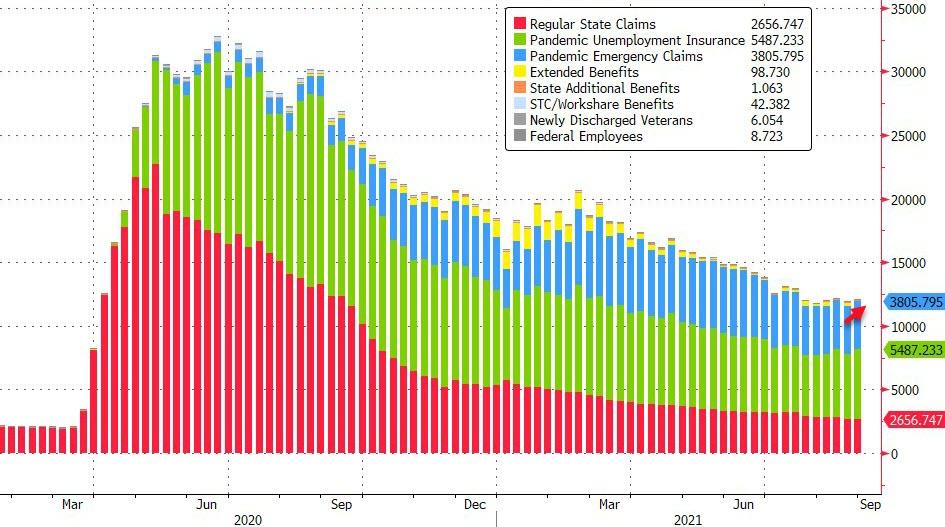
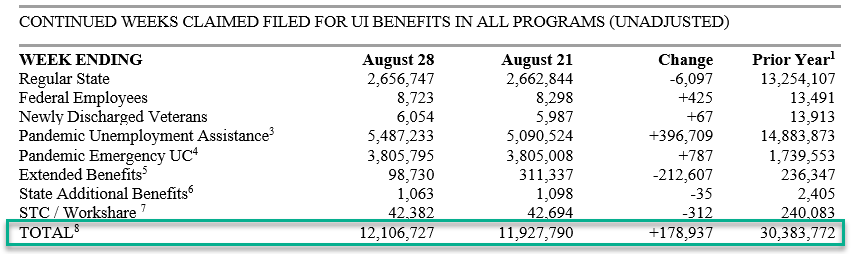
And it appears the impact of Ida has sent the number of Americans on some form of government dole back above 12 million…

…with Pandemic claims rising?…

So retail sales rose but the labor market worsened… a goldilocks report for The Fed next week, maybe?

Tyler Durden
Thu, 09/16/2021 – 08:44

via ZeroHedge News https://ift.tt/3AgyR1z Tyler Durden

US Retail Sales Unexpectedly Rebound In August, Despite Slump In Car Sales

US Retail Sales Unexpectedly Rebound In August, Despite Slump In Car Sales

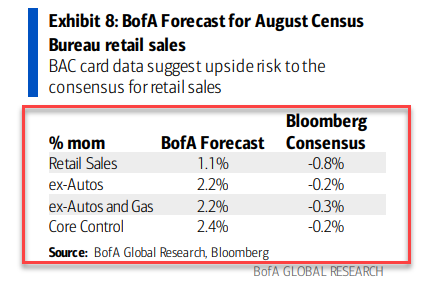
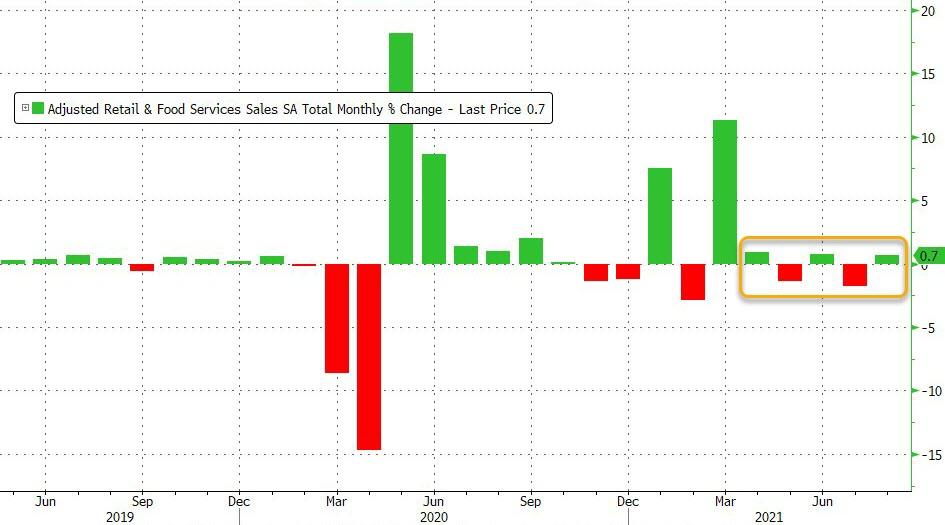
Having flip-flopped between expansion and contraction for the last four months – post-stimmy – analysts expected retail sales to drop in August for the second straight month as Delta fearmongering tamped down any recovery enthusiasm (though we note that BofA expected a rebound – and they have been spot on with their guesses all year).

And once again they were right as August retail sales jumped 0.7% MoM (completely smashing the expectation of 0.7% MoM drop), but we do temper our enthusiasm by the fact that July’s data was revised dramatically lower (from -1.1% MoM to -1.8% MoM)…

Source: Bloomberg

The rest of the retail sales data also smashed expectations

  • Retail Sales Ex Autos +1.8% MoM vs 0.0% Exp

  • Retail Sales Ex Auto and Gas +2.0% MoM vs 0.0% Exp

  • Retail Sales Control Group +2.5% vs 0.0% Exp.

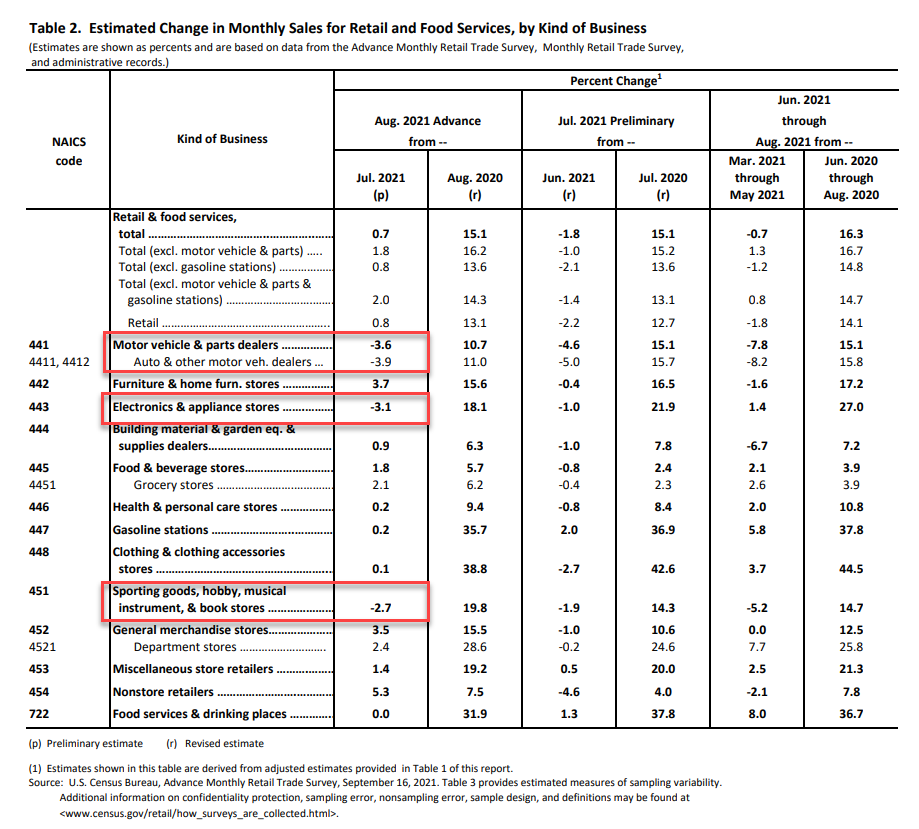
Despite the beat, Motor Vehicles, Electronics, and Sporting Goods all saw sales plunge MoM…


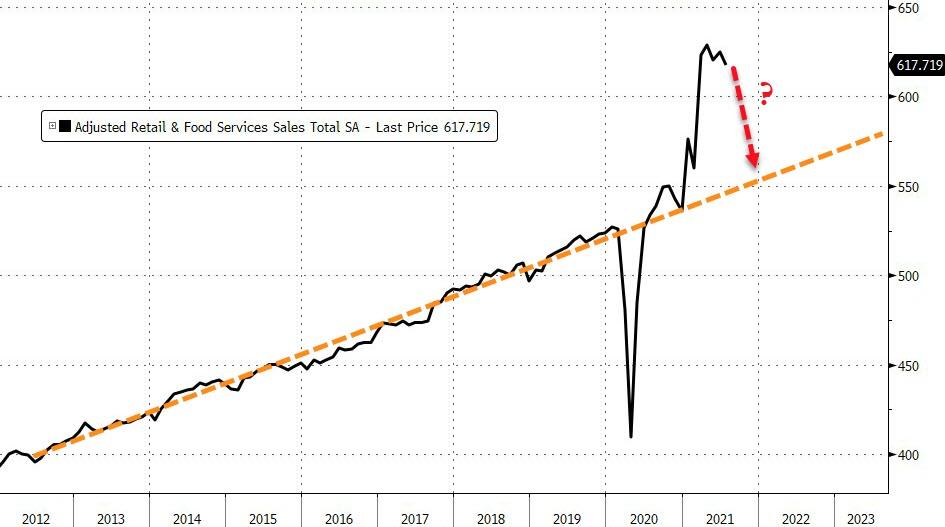
With stimmies having dried up, the question is whether the post-COVID-lockdown surge in retail sales will inevitably suffer a hangover return to trend?

Source: Bloomberg

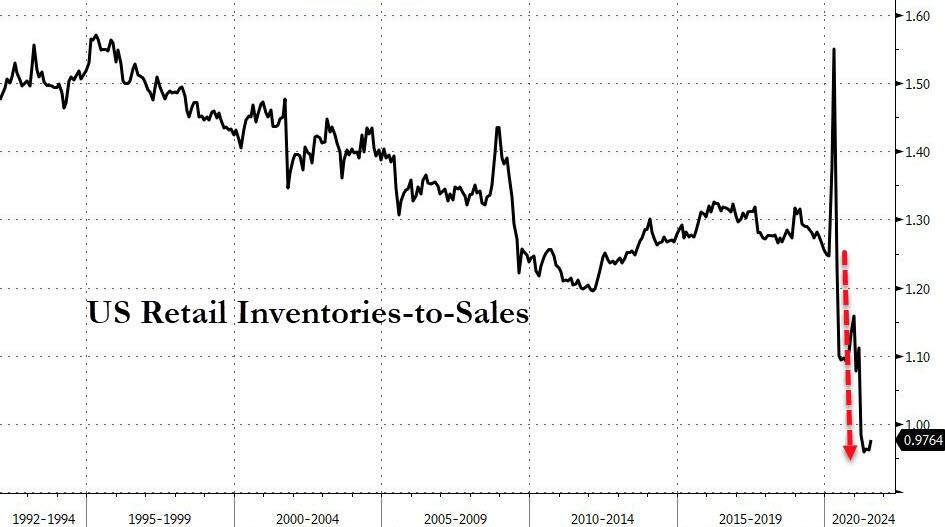
Finally, we note that the retail inventory-to-sales ratio has completely decoupled from anything that has come before…

Source: Bloomberg

How does this resolve itself? Pent-up demand-driven surge in inventories – which sparks even more inflation – or reversion-to-the-norm retail sales as stimmies run dry?

Tyler Durden
Thu, 09/16/2021 – 08:37

via ZeroHedge News https://ift.tt/3CfE3na Tyler Durden

After Two Recalls, GM Finally Just Tells Bolt EV Owners: “Don’t Park Your Car Within 50 Feet Of Another Car”

After Two Recalls, GM Finally Just Tells Bolt EV Owners: “Don’t Park Your Car Within 50 Feet Of Another Car”

After a series of recalls that we have documented here on Zero Hedge, General Motors looks to be taking its precautions with the Chevy Bolt one step further: the automaker is asking Bolt owners to park “at least 50 feet” from other vehicles if you’re going to leave your car in a parking deck. 

GM spokesman Dan Flores, who we’re sure isn’t getting paid enough to deliver this line with a straight face, said this week: “In an effort to reduce potential damage to structures and nearby vehicles in the rare event of a potential fire, we recommend parking on the top floor or on an open-air deck and park 50 feet or more away from another vehicle. Additionally, we still request you do not leave your vehicle charging unattended, even if you are using a charging station in a parking deck.”

“We are aware of 12 GM confirmed battery fires that have been investigated involving Bolt EVs vehicles in the previous and new recall population,” he continued, telling The Detroit News. “We’re still working with LG around the clock to resolve the issue. Both companies understand the urgency to move as quickly as possible, but, again, the most important thing here is we have to get this right.”

Recall, back in July, General Motors issued their second recall for the Chevy Bolt after it announced that two Bolts had caught fire without impact and that at least one of the two was related to the battery and happened despite the owner getting a fix from a previous recall.

The second recall included all Bolt EVs from 2017 to 2019, encompassing 68,000 vehicles. 50,925 of those vehicles were located in the U.S. and they have batteries that are produced at LG Chem’s Ochang, South Korea, facility, the report notes.

A spokesman for GM said earlier this summer: “As part of GM’s commitment to safety, experts from GM and LG have identified the simultaneous presence of two rare manufacturing defects in the same battery cell as the root cause of battery fires in certain Chevrolet Bolt EVs. As part of this recall, GM will replace defective battery modules in the recall population. We will notify customers when replacement parts are ready.” 

GM, at the time, was recommending that owners: 

  • Return the vehicle to the 90% state of charge limitation using Hilltop Reserve mode (for 2017-2018 model years) or Target Charge Level mode (for 2019 model year), or visit a dealer to make that change.
  • Charge the vehicle after each use and avoid depleting the battery below  70 miles of remaining range.  
  • Park the vehicle outside immediately after charging and do not leave the vehicle charging overnight.
  • Customers who have not received the advanced diagnostics software should visit their dealer to get the update.  After obtaining the software, limit the state of charge to 90% and follow the advice above.

We’re guessing those rules still run concurrent with the new “50 foot” rule. 

Back in November of 2020, tens of thousands of Chevrolet Bolt vehicles were first recalled after the company became aware of “five fires involving the cars” that resulted in two injuries from smoke inhalation.

A notice was issued in November for 50,932 of the vehicles in the U.S. dating from 2017 to 2019. General Motors said the battery could “catch fire when charged to full or nearly full capacity,” at the time.

As a temporary fix, the company said it would be reprogramming its battery’s “hybrid propulsion control module 2” to only allow charging to 90%.

“This fix clearly looks as though it didn’t work and the company will likely now be forced to take more drastic measures.” we said about the recall in July. Apparently, we were right. 

GM CFO Paul Jacobson commented last Friday at an RBC conference: “The number one focus right now obviously is to get the production line fixed, the manufacturing process cleaned up and get back into cell production and ultimately get a path for these vehicles to be repaired and … do what’s right for our customers.”

Tyler Durden
Thu, 09/16/2021 – 08:20

via ZeroHedge News https://ift.tt/3nExkza Tyler Durden

Futures Fall Ahead Of Another Disappointing Retail Sales Number

Futures Fall Ahead Of Another Disappointing Retail Sales Number

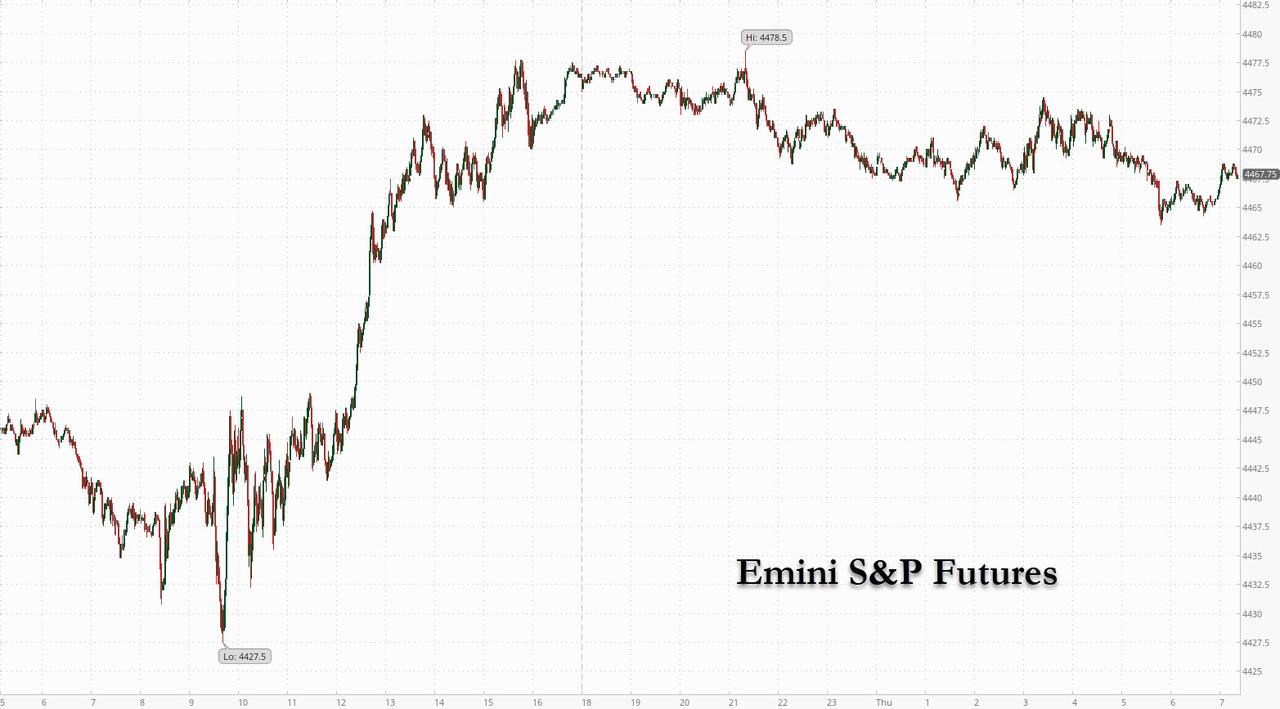
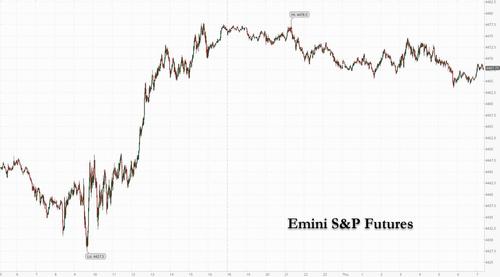
US equity futures slid, fading Wednesday’s torried one-day rally, as investors awaited data on jobless claims and retail sales which are expected to show another decline as US consumers retrench.  European markets were solidly in the green while Asian stocks fell after the ongoing debt crisis at Evergrande – which halted all bond trades for the day – and China’s latest push to rein in private industries hurt sentiment. The dollar gained as Treasuries dipped while Bitcoin was little changed as gold and oil fell. S&P 500 E-minis were down 8.75 points, or 0.19% at 730 am ET, Dow E-minis were down 14 points, or 0.04%, while Nasdaq 100 E-minis were down 34.25 points, or 0.22%.
Once again, US-listed Chinese stocks extended losses in the premarket with Beijing’s regulatory overhaul of gambling in Macau coming as the latest source of consternation for a sector already hurt by crackdowns on technology and education services. Casino operators such as Las Vegas Sands, Wynn and MGM Resorts again fell 1-3% before the opening bell, extending this week’s declines following an announcement from Macau officials seeking tighter restrictions on operators. Among other movers, videogame publisher EA rose nearly 2%, as it maintained its guidance despite delaying the launch of its widely anticipated “Battlefield 2042” title by a month. Here are some of the other notable movers today:

  • IronNet (IRNT US) shares rise 34% in U.S. premarket trading, adding to the past two sessions of gains for the stock amid retail-trader touts for the cyber-security company.
  • Electronic Arts (EA US) rises 2.2% in premarket trading, on track to recoup some of Wednesday’s losses after co. confirmed delaying the launch of Battlefield 2042 to Nov. 19, which some analysts said wouldn’t be a surprise.
  • MedAvail Holdings (MDVL US) rose 21% in Wednesday postmarket trading after signing a pact with IMA Medical Group to roll out four new SpotRx locations this year in central Florida
  • Beyond Meat (BYND US) shares off 2.6% in premarket trading after Piper Sandler says retail trends are running below levels needed to support consensus shipment expectations for 3Q21, and potentially 4Q21, downgrading to underweight
  • Travere Therapeutics (TVTX US) slipped 5.4% in extended trading from Wednesday after it reported a joint collaboration and licensing agreement with Vifor Pharma for the commercialization of sparsentan in Europe, Australia and New Zealand
  • Aerie Pharmaceuticals (AERI US) shares dropped 18% in postmarket trading on Wednesday, after a Phase 2b study of the company’s experimental treatment for dry eye disease failed to meet the main goal of the trial
  • Atyr Pharma (LIFE US) slid 7.3% postmarket Wednesday before recovering some ground following a discounted share offering, the move comes on the back of 76% jump in the last one month
  • ION Geophysical Corp. (IO US) shares soared 27% in extended trading after it said its board had initiated a process to evaluate a range of strategic alternatives
  • Ashford Hospitality Trust (AHT US) falls 0.7% in extended trading after the hotel REIT said revenue per available room (RevPAR) fell 11% in August compared to July
  • Carver (CARV US) fell 12% postmarket after registering a mix of securities for potential sale

Wall Street indexes enjoyed strong gains on Wednesday on the back of Microsoft’s $60 billion stock buyback, with economically sensitive cyclical stocks benefiting the most from a rally in oil prices and data suggesting that factory activity growth remained steady in the country. Data also showed a dip in import prices, which coupled with a recent reading that showed consumer prices were slowing, implied that inflation had likely peaked and would fall to more manageable levels eventually.

“We have an unusual situation where the overall market is sideways to lower but with a risk-on trend underneath and that’s down to signs the Delta variant may be peaking in the U.S., which is driving people into reflation and recovery plays,” said Kiran Ganesh, head of cross asset at UBS Global Wealth Management. “At the same time there are concerns about fiscal consolidation and worries about China moving to lockdowns. We’ll need 3-4 months of quiet before people start moving back (to buy Chinese stocks). Big tech companies more exposed to social issues – whether property or education – are subject to regulatory risks.”

Focus is now on U.S. data on weekly jobless claims and August retail sales, both of which are due at 8:30 AM ET.

“Retail sales figures are expected to have fallen in August,” Saxo Bank’s chief investment officer, Steen Jakobsen, wrote in a note to clients. “Although the drop is largely priced in the market, it could still support US Treasuries pushing yields down by a couple of basis points. Yet, we expect yields to remain rangebound between 1.25% and 1.35% until next week’s FOMC meeting.”

Europe’s STOXX 600 was up 0.8% on the day, reversing all the previous day losses, having fallen 0.8% on Wednesday and gained 0.2% so far this week; FTSE MIB outperforms, rising as much as 1.3%. Travel is the best performing sector, up as much as 3.25%. Miners, utilities and autos underperform. Energy companies also advanced as crude oil hovered near a six-week high. Here are some of the biggest European movers today:

  • Ryanair shares jump as much as 6.7% after it lifted its growth target to 50% over the next five years, planning expansion at European airports
  • CNH shares gain as much as 4.1% after analysts note new details on plan for On-Highway spinoff reported by Il Sole 24 Ore
  • Inditex shares rise as much as 3.6% after Kepler Cheuvreux upgrades stock to buy, citing a V-shaped earnings recovery and rich cash position
  • Acciona shares lose as much 5.6% as Spain announces a gas clawback that risks the legal certainty of renewables development in the country, RBC says in a note
  • Games Workshop shares fall as much as 4% after it said it’s seen pressure on freight costs and currency exchange rates
  • THG shares decline as much as 3.8% after the e-commerce company reported 1H results in which sales and Ebitda both missed consensus estimates

Earlier in the session, Asian stocks dropped, as a sell-off in technology shares across the region more than offset gains in energy names with oil prices hovering near a six-week high. The MSCI Asia Pacific Index dropped as much as 0.8%, with TSMC, Alibaba Group and Keyence being the biggest contributors to the declines. Hong Kong’s Hang Seng Index led losses among the region’s stock gauges, while Japanese equities extended their drop from a peak of more than three decades into a second day. Fear that China Evergrande Group’s debt woes may spill over into Chinese property sector, combined with Beijing’s move to tighten grips on Macau casino operators, has pulled down Asian stocks this week. The real estate sector was the second-worst performer in the region on Thursday as Evergrande’s onshore property unit suspended bond trading for a day. Evergrande Market Fallout Grows as Local Unit Halts Bond Trading “The ongoing issues surrounding Evergrande could be weighing on investor sentiment” and impacting broadly in the region, said Hajime Sakai, chief fund manager at Mito Securities Co. in Tokyo. “It will loom over investors’ minds, especially if the problem bleeds into Chinese real estate market overall.” Asia’s benchmark stock gauge has fallen 1.8% so far this week, on pace to snap a three-week winning streak. It is lagging behind S&P 500, which has gained 0.5% in the same period. Elsewhere, Korean stock benchmark declined 0.7% as tech names like Samsung SDI dragged the Kospi Index. Philippine stocks were the region’s best performer of the day, gaining as virus restrictions were eased in the Manila capital region. Australia’s S&P/ASX 200 Index advanced despite the country’s disappointing employment data.

Japanese stocks declined, erasing earlier gains, as the yen headed for a three-day advance against the dollar.  The Topix fell 0.3% to 2,090.16 at the 3 p.m. close in Tokyo, while the Nikkei 225 slid 0.6% to 30,323.34. Out of 2,184 shares in the index, 891 rose and 1,183 fell, while 110 were unchanged. The yen rose 0.1% to 109.31 per dollar. Stocks also dropped after a finance ministry report showed gains in Japanese exports slowed for a third month in August as a delta-driven wave of the coronavirus weighed on the global trade recovery. “Japanese stocks may be in a corrective mood for a while,” said Hajime Sakai, the chief fund manager at Mito Securities Co. in Tokyo.

In rates, Treasuries were marginally cheaper across the curve following muted price action during Asia and early European sessions. 10-year TSYs yield 1.3124% is ~1bp cheaper vs Wednesday’s close with curves marginally steeper; gilts cheapen further vs Treasuries — 10-year spread approaching YTD low 51bp — as Goldman Sachs predicts BOE will lift rates to 1% by end of 2023. Gilts underperformed, in a continuation of Wednesday’s strong U.K. inflation data, while bunds marginally outperform Treasuries.

In FX, the Bloomberg Dollar Spot Index advanced and the dollar was steady or higher against all of its Group-of-10 peers apart from the New Zealand dollar. The kiwi rallied after New Zealand GDP data exceeded all estimates. The economy expanded 2.8% in the second quarter from the first, compared to economists forecast for a 1.1% rise. Overnight indexed swaps are now pricing a 44% probability of a 50-basis-point hike next month, up from around 10% on Wednesday. Australia’s dollar dropped toward a two-week low after jobs data showed that Australian employment dived in August as coronavirus lockdowns in Sydney and Melbourne forced businesses to lay off workers and slash hours.

The yen stayed near a one- month high as a weak risk sentiment supported demand for havens. Bonds fell after a lukewarm 20-year debt sale. The offshore yuan weakened the most in nearly a month as concern on China Evergrande Group’s debt crisis and Beijing’s latest push to rein in private industries hurt market sentiment.

In commodities, gas and power prices pared losses in Europe as supply concerns remain ahead of the winter season and worries grow that costs will pressure profit marginsfor companies. The world is facing high energy prices for the foreseeable future, Chevron Corp.’s top executive said in a Bloomberg interview on Wednesday. Iron ore headed for its longest run of losses in more than three years as declining Chinese steel output threatened to push futures back below $100 a ton. WTI is little changed near $72.67, Brent drifts near $75.60. Spot gold trades poorly, dropping ~$12 to the worst levels this week near $1,781/oz. Base metals are also under pressure with LME copper and nickel the worst performers.

Looking at the day ahead now, and data releases include US retail sales for August, the Philadelphia Fed’s business outlook for September, and the weekly initial jobless claims. Otherwise from central banks, we’ll hear from ECB President Lagarde and the ECB’s Rehn.


Market Snapshot

  • S&P 500 futures little changed at 4,483.00
  • STOXX Europe 600 up 0.64% to 466.86
  • MXAP down 0.6% to 203.16
  • MXAPJ down 0.7% to 649.46
  • Nikkei down 0.6% to 30,323.34
  • Topix down 0.3% to 2,090.16
  • Hang Seng Index down 1.5% to 24,667.85
  • Shanghai Composite down 1.3% to 3,607.09
  • Sensex up 0.5% to 59,044.46
  • Australia S&P/ASX 200 up 0.6% to 7,460.21
  • Kospi down 0.7% to 3,130.09
  • Brent Futures down 0.12% to $75.37/bbl
  • Gold spot down 0.53% to $1,784.58
  • U.S. Dollar Index up 0.18% to 92.72
  • German 10Y yield little changed at -0.307%
  • Euro down 0.3% to $1.1775

Top Overnight News from Bloomberg

  • China slammed a move by the U.S. and U.K. to help Australia build nuclear submarines, saying the new partnership will stoke an “arms race” as tensions heat up in Asia-Pacific waters
  • The economic outlook of the euro area is overshadowed by production bottlenecks and the prospect of a worsening pandemic, European Central Bank Governing Council Member Olli Rehn says
  • A new Japanese prime minister due to be installed in the coming weeks is unlikely to change fiscal or other policies sufficiently to force the central bank to amend its monetary settings, a Bloomberg survey showed
  • Rallying energy prices are stoking concerns about a challenging stagflation-like environment for markets of elevated price pressures and a slowing economic recovery
  • Europe’s energy crunch has forced a major fertilizer maker to shut down two U.K. plants, the first sign that a record rally in gas and power prices is threatening to slow the region’s economic recovery
  • Winter blackouts are now a real possibility after a fire took out a key cable that ships electricity to the U.K. from France. Electricity is now so scarce in Britain that any more grid mishaps or unexpected plant outages could leave millions without power
  • About 40% of respondents said their living costs have increased since the onset of the pandemic, according to a YouGov survey of 18,983 people conducted in 17 countries. That proportion was closer to half in the U.K. and U.S., compared to just a fifth of Danes and Swedes
  • An outbreak of Covid-19 inside the Kremlin has sickened dozens of people working close to Vladimir Putin, the Russian president said Thursday, highlighting the scale of the outbreak in one of the country’s most carefully guarded areas
  • India’s monetary policy makers cannot cut interest rates further because of elevated inflation, but there’s a need to keep borrowing costs low and liquidity ample to help the economy as it recovers from the pandemic’s fallout, a central banker said

A more detailed look at global markets courtesy of newsquaw

Asian equity markets traded mostly lower as the region failed to sustain the momentum from Wall St where all major indices finished higher after risk appetite was spurred by stronger than expected NY Fed Manufacturing data and with plenty of attention on a bullish note from JPMorgan which expects the SPX to reach 4,700 by the end of 2021 and surpass 5,000 in 2022 on better-than-expected earnings. The ASX 200 (+0.6%) was led higher by the energy sector following similar outperformance stateside after oil prices surged by more than 3% during the prior session amid the constructive mood across risk assets and recent bullish inventory data, with Australian defence contractor Austal among the biggest gainers in the local benchmark after the US, UK and Australia announced a new security partnership for the Indo-Pacific region in which the US will provide Australia with the capability to deploy nuclear-powered submarines in an effort to counter China. The Nikkei 225 (-0.6%) failed to hold on to early gains with sentiment dampened by recent currency strength and weaker than expected Exports data, while the KOSPI (-0.7%) was pressured following hawkish rhetoric from North Korea concerning the recent missile launch which was from a new railway-borne missile system and reportedly serves as an efficient counter strike weapon to threatening forces. The Hang Seng (-1.5%) and Shanghai Comp. (-1.3%) declined with Hong Kong pressured by underperformance in the property sector and with several casino names extending on yesterday’s slump amid regulatory concerns. Sentiment was also clouded by the recent ‘AUKUS’ partnership to counter China and ongoing Evergrande default woes with Co. shares at decade lows and its onshore bonds suspended after Chinese authorities told lenders not to expect any interest payments due next week and following the credit rating downgrade by S&P due to depleted liquidity. Finally, 10yr JGBs were kept rangebound as headwinds from the selling in USTs were offset by the lacklustre risk appetite in Asia and with demand also sapped by weaker metrics from this month’s 20yr JGB auction.

Top Asian News

  • China Has Fully Vaccinated More Than 1 Billion People
  • Credit Suisse Rejigs Asia Investment Bank, Veterans Step Aside
  • Battery- Swapping Startup Gogoro to Go Public in SPAC Merger
  • Evergrande Market Fallout Grows as Local Unit Halts Bond Trading

Stocks in Europe have conformed to a more constructive risk mood (Euro Stoxx 50 +0.7%; Stoxx 600 +0.6%) after experiencing a mixed open, which followed on from a varied APAC session that saw Mainland China and Hong Kong under pressure. US equity futures, meanwhile, have seen a divergence from Europe and trade modestly softer ahead of US retail sales. Back to Europe, bourses experience broad-based gains with marginal underperformance in the FTSE 100 (+0.5%) – weighed on by the underperforming Basic Resources sector (the only sector in the red) as base metals remain pressured. On the flip side, Travel & Leisure stands as the outperformer amid tailwinds from a Ryanair (+6.3%) traffic growth guidance update, alongside reports that UK ministers are to announce that vaccinated travellers will no longer be required to take a COVID test before entering England under new proposals – also supporting the likes of easyJet (+3.3%) and IAG (+2.7%). Banks are bolstered by the higher yield environment whilst Oil & Gas continue to cheer oil prices north of USD 70/bbl. Overall, the sectors do portray somewhat of an anti-defensive bias. In terms of individual movers, Continental (-11%) listed its drive division, Vitesco Technologies, on the Dax 30 today. Vitesco will be listed as an additional value on the Dax for today only, after which it will not be eligible for a regular place in the bourse and will be demoted accordingly. Elsewhere, Thales (+1.3%) and Safran (+2.6%) have shrugged reports that Australia terminated its submarine programme with France.

Top European News

  • Swedish IPO Rush Intensifies With Storskogen’s Listing Plan
  • U.K. Faces Winter Blackouts Risk After Fire Knocks Out Cable
  • Stagflation Fears Cast Longer Shadow on Markets as Energy Surges
  • Atlantic Sapphire Plunges 29% After Fire at Denmark Facility

In FX, bears have been prowling and knocking hard on the door for a while in Eur/Usd following a couple of dead cat bounces, but no material recovery rallies beyond 1.1850 and the pressure has finally told as underlying bids around 1.1800 are filled or pulled. Moreover, the headline pair has breached technical support just shy of the round number in the form of 21 and 50 DMAs that align at 1.1798 today and is now probing new post-ECB lows around 1.1766 amidst almost all round Euro weakness that has pushed Eur/Gbp down towards a double bottom around 0.8510 and Eur/Jpy through 129.00. Conversely, the Buck has regrouped and recharged after another retreat below 92.500 in the index, albeit shallower in wake of Wednesday’s strong NY Fed manufacturing survey that helped to erase post-CPI losses and more. Indeed, the DXY has rebounded further towards Monday’s current w-t-d peak (92.887) to 92.794 and cleared a couple of chart hurdles along the way, including its 50 and 21 DMAs, at 92.635 and 92.694 respectively. Ahead, jobless claims, retail sales and the Philly Fed.

  • CHF – The major casualty or loser in the face of the Greenback revival, as Usd/Chf retests recent 0.9240+ highs, but the Franc is not benefiting from Euro weakness given that the Eur/Chf cross is holding firmly above 1.0850, and this could be a sign of official intervention or simply caution ahead of next Thursday’s Quarterly SNB policy review.
  • AUD/GBP/CAD – All unable to evade the clutches of their US counterpart, and the Aussie also labouring within a 0.7347-09 range in wake of a disappointing jobs report that only beat consensus in unemployment rate terms due to a fall in labour market participation caused by COVID-19 lockdowns. Meanwhile, Sterling is back under the 200 DMA and hovering near 1.3800 irrespective of the aforementioned outperformance against the Euro and another bank revising its BoE rate outlook to forecast an earlier hike on the back of yesterday’s hot UK inflation data (GS now seeing tightening in May 2022). Elsewhere, the Loonie has stalled on approach to 1.2600 alongside a pull-back in crude and now eyeing Canadian housing starts before wholesale trade following similarly frothy CPI prints on Wednesday.
  • NZD/JPY – The Kiwi is bucking the overall trend and still clinging to the 0.7100 handle, while consolidating gains vs its Antipodean peer around 1.0300 with bullish impetus from NZ Q2 GDP surpassing expectations significantly to ensure the domestic economy entered pandemic restrictions on a very solid footing. Conversely, the Yen has broadly overlooked a much wider than anticipated Japanese trade deficit impacted by exports missing the mark by some distance, as Usd/Jpy meanders between 109.46-21 parameters, albeit off midweek lows closer to 109.00.

In commodities, WTI and Brent front month futures are choppy and essentially flat intraday at the time of writing, with the former around USD 72.50/bbl (72.34-99 range) and the latter around USD 75.50/bbl (75.21-87). News flow for the sector has been relatively light, but prices remain elevated near recent highs. The morning saw constructive commentary from Ryanair, which feeds into jet fuel demand. On the flip side, Libya’s NOC announced the resumption of crude exports from the Sidra and Ras Lanuf ports following protests. It’s also worth being cognizant of potential Chinese intervention at these levels via the release of state reserves, as Chinese PPI last month remained elevated partially on crude prices – and Beijing also pledged continued efforts to stabilise prices if needed. On that note, China announced the release of another batch of copper, aluminium and zinc from state reserves to guide prices gradually lower to a reasonable range. As such, LME metals are mostly lower but off worst levels, although copper remains under USD 9,500/t. Turning to precious metals, spot gold and silver are on the backfoot as they fall victim to the firmer Dollar, with the former losing further ground under USD 1,800/oz (1,796-81 range) and the latter back to levels around USD 23.50/oz (23.96-54 range).

US Event Calendar

  • 8:30am: Sept. Initial Jobless Claims, est. 322,000, prior 310,000
  • 8:30am: Sept. Continuing Claims, est. 2.74m, prior 2.78m
  • 8:30am: Aug. Retail Sales Advance MoM, est. -0.7%, prior -1.1%
  • 8:30am: Aug. Retail Sales Ex Auto MoM, est. 0%, prior -0.4%
  • 8:30am: Aug. Retail Sales Control Group, est. 0%, prior -1.0%
  • 8:30am: Sept. Philadelphia Fed Business Outl, est. 18.9, prior 19.4
  • 9:45am: Sept. Langer Consumer Comfort, prior 57.9
  • 10am: July Business Inventories, est. 0.5%, prior 0.8%
  • 4pm: July Total Net TIC Flows, prior $31.5b

DB’s Jim Reid concludes the overnight wrap

It’s my daughter7s 6th birthday today. How am I celebrating? By having major knee surgery and possibly not being back from the hospital in time to see her. It’s been a grave oversight on my behalf dates wise (he has little other operating space over the next few weeks) so I’ll be sweet talking the surgeon this morning to get me near the top of the list to ensure that I’m not late home. It’ll be crutches and no weight bearing for me for the next 6 weeks which again is going to make me very unpopular at home with three hyperactive kids and one wayward dog. In terms of before and after see the front cover of “Fiat, fifty and frail” for how I look now (right) and how I intend to look by November (left).

Markets were also a little bit frail for most of yesterday in European hours but a rally in the US after Europe went home turned the day around. Indeed the S&P 500 (+0.85%) rose by its most in nearly 3 weeks as cyclical industries and technology stocks combined to take the index back to within 1.3% of its all-time highs. Energy stocks were the best performers (+3.81%), which came amidst a further sharp rise in commodities. Indeed by the close of trade, Bloomberg’s Commodity Spot index was up +1.76% at a fresh high for the decade, which just emphasises how there are still inflationary pressures in the pipeline, even if a few specific commodities have moved lower in recent months. Looking at the moves, Brent Crude (+2.53%) rose to $75.46/bbl, having now bounced back by more than $10 since its closing low of $65.18/bbl less than a month ago, whilst WTI (+3.05%) was also up to $72.61/bbl.

Staying on energy, yesterday witnessed even further advances for natural gas prices, with European futures up another +7.52% as they marked their 8th consecutive rise. And there were also growing concerns in the UK as a cable bringing power in from France was knocked out by a fire, which will put it out of action until at least October 13, possibly into 2022 for full capacity. Indeed, I looked at this issue in my chart of the day yesterday (link here), which demonstrates the astonishing surge we’ve seen over recent weeks and months. Tight supplies that haven’t been replenished as much as expected after a cold winter are partly responsible, but there’s also a lack of coal options as increasing numbers of plants are phased out, and Russia has sent less supplies to Europe than expected. We also speculate that this might be a dress rehearsal for ESG issues further down the line.

While we’re on the topic of inflation, there may have been a weaker-than-expected reading from the US on Tuesday, but yesterday saw fresh support for those believing in higher inflation thanks to upside surprises from the UK and Canada. Here in the UK, headline CPI rose to +3.2% (vs. +2.9% expected), which is also above the BoE’s staff estimate of +3.0% back in their August monetary policy report. That saw investors bring forward their expectations for future BoE rate hikes, which in turn sent short-dated gilt yields to their highest levels in over a year. By the close, the 2yr yield (+3.2bps) had hit a post-pandemic high of 0.263%, whilst the 5yr yield (+3.4bps) was similarly at a post-pandemic high of 0.453%. For Canada, with just 4 days left until their federal election on Monday, CPI rose to +4.1% (vs. +3.9% expected), marking the highest reading since 2003.

Given that inflation concerns were resurfacing again, sovereign bonds lost ground on both sides of the Atlantic yesterday, with 10yr US Treasury yields up +1.5bps to 1.299%, mostly thanks to higher inflation breakevens (+1.5bps). Europe saw more prominent moves, with yields on 10yr bunds up +3.4bps to -0.31%, their highest level in 2 months, as German 10yr breakevens rose (+1.6bps) for the ninth time in the last ten sessions and ended just off their 8 year highs. Meanwhile, yields on 10yr OATs (+4.3bps) and BTPs (+5.5bps) also moved higher.

Before the US rally, European indices lost ground as the session went on, as the STOXX 600 (-0.80%) fell to its lowest closing level since late July. Nearly 80% of constituents and every major sector in the index moved lower with the exception of energy, with bourses underperforming their US counterparts across the continent. As mentioned at the top, the S&P 500 (+0.85%) rallied later in the session and turned positive on the week. The rise was led by energy as discussed but other cyclicals such as banks (+1.31%) and capital goods (+1.29%) also rallied. However, the equity gains were broad based as software (+1.21%) and media (+0.78%) caused the NASDAQ (+0.82%) to finish higher for the first time in six sessions.

Sentiment is weak in Asia with the Nikkei (-0.81%), Hang Seng (-1.97%), CSI (-0.75%), Shanghai Comp (-0.68%) and Kospi (-0.66%) all losing ground. There are no new drivers behind the move besides the risks associated with China’s ongoing regulatory crackdown, the recent spike in covid cases there, and the indebtedness of China’s Evergrande group’s which has led to one of its onshore real estate unit suspending bond trading. Futures on the S&P 500 are only a touch lower at -0.08% but those on the Stoxx 50 are up +0.13% as they catch up with yesterday’s late move in US markets.

On the pandemic, Pfizer announced that data from the US and Israel point to waning efficacy of its vaccine over time, and that the additional booster shot was both safe and effective. The data will be submitted to outside advisers to the US FDA on Friday. Overnight, the New England Journal of Medicine published research based on data from short-term analysis in Israel stating that a third dose of the Pfizer/ BioNTech’s Covid vaccine can dramatically reduce rates of Covid-related illness in people 60 and older. The analysis stated that starting 12 days after the extra dose, confirmed infection rates were 11 times lower in the booster group compared with a group that got the standard two doses and added that rates of severe illness were almost 20 times lower in the booster group.

Winding up now and back to yesterday, on the data front, US industrial production rose by +0.4% in August (vs. +0.5% expected), with the Fed estimating that shutdowns related to Hurricane Ida held down the reading by 0.3 percentage points.

To the day ahead now, and data releases include US retail sales for August, the Philadelphia Fed’s business outlook for September, and the weekly initial jobless claims. Otherwise from central banks, we’ll hear from ECB President Lagarde and the ECB’s Rehn.
Tyler Durden
Thu, 09/16/2021 – 08:06

via ZeroHedge News https://ift.tt/3lwKkUB Tyler Durden

Swollen Balls And Censorship? Nicki Minaj Story Gets Even Weirder

Swollen Balls And Censorship? Nicki Minaj Story Gets Even Weirder

Rapper Nicki Minaj’s cousin’s friend’s allegedly swollen testicles are at the center of a free speech controversy, the likes of which we never saw coming.

On Wednesday, Minaj told her 157 million Instagram followers that she’s been placed in “Twitter jail,” because “They didn’t like what I was saying over there.”

The alleged ban came after Minaj spent the day trading barbs with people over Covid-19 vaccinations and free speech, after she claimed on Monday that her cousin’s friend’s testicles became swollen following the Covid-19 vaccine, causing his fiancee to call off their wedding. “Make sure you’re comfortable with ur decision, not bullied.”

Minaj also revealed on Monday that she wouldn’t be going to the Met gala because she didn’t want to travel due to her child and she’s unvaccinated, adding that she’ll take the jab “once I feel I’ve done enough research.”

Minaj’s opinions set off a free speech row  – with everyone from MSNBC‘s Joy Reid to MSM outlets suddenly turning her into rapper non grata.

On Wednesday, Minaj tweeted a clip of Tucker Carlson defending her – specifically, saying she’s receiving hate because she’s telling people to make up their own minds about getting vaccinated. Minaj also claimed that the White House invited her to visit, where she’ll “ask questions on behalf of the ppl who have been made fun of for simply being human.”

While Minaj claims Twitter has put her in ‘jail’ (presumably unable to post), her tweets are still viewable as of this writing.

Twitter, meanwhile, has denied banning the rapper, while the White House says they only offered ‘a call‘ with Minaj.

Testiclegate

Minaj’s claim about her cousin’s friend’s balls was ‘debunked’ by both Dr. Anthony Fauci and Trinidad and Tobago Minister of Health, Terrence Deyalsingh.

“There’s no evidence that it happens, nor is there any mechanistic reason to imagine that it would happen,” Fauci told CNN‘s Jake Tapper onThe Lead, adding “These claims may be innocent on her part. I’m not blaming her for anything. But she should be thinking twice about propagating information that really has no basis except a one-off anecdote. That’s not what science is all about.”

Devalsingh, meanwhile, said in a statement that “Claims are being made. One of the reasons we could not respond in real time to Ms. Minaj is because we had to check and make sure that what she was claiming was either true or false. Unfortunately, we wasted so much time yesterday running down this false claim.”

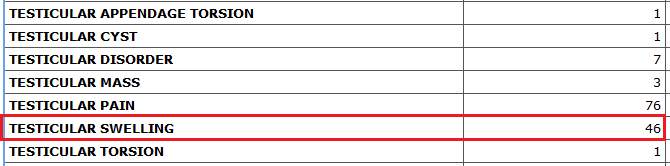
That said, at least 46 claims of post-vax swollen testicles have been reported for the Covid-19 jab to the VAERS database of adverse reactions, though it’s unknown if any of them resulted in a canceled wedding.

And there you have it… If you’ve read this far you deserve to watch this.

Tyler Durden
Thu, 09/16/2021 – 07:30

via ZeroHedge News https://ift.tt/39bxzsV Tyler Durden