Bank Of Canada Hikes Rates As Expected, Says Ukraine “Major Source Of Uncertainty”

Bank Of Canada Hikes Rates As Expected, Says Ukraine “Major Source Of Uncertainty”

The Bank of Canada begins its tightening cycle by lifting interest rates by 25bps – as expected – and signaled more hikes to come in its attempts to tamp inflation down from a three-decade high.

“The policy rate is the Bank’s primary monetary policy instrument. As the economy continues to expand and inflation pressures remain elevated, the Governing Council expects interest rates will need to rise further.

BoC played up economic strength, flagging yesterday’s stronger-than-expected 6.7% fourth quarter GDP growth rate.

“This is stronger than the Bank’s projection and confirms its view that economic slack has been absorbed.”

But admitted Inflation is a bigger problem than expected…

Inflation is now expected to be higher in the near term than projected in January. Persistently elevated inflation is increasing the risk that longer-run inflation expectations could drift upwards,” the statement said. “The Bank will use its monetary policy tools to return inflation to the 2% target and keep inflation expectations well-anchored.”

However, no details were offered about the BoC’s plan to wind-down its bond holdings.

In a likely taste of what is to come from Powell and his pals at The Fed, BoC added the following to their statement:

“The unprovoked invasion of Ukraine by Russia is a major new source of uncertainty.”

Specifically on Ukraine, BoC notes:

“Prices for oil and other commodities have risen sharply. This will add to inflation around the world, and negative impacts on confidence and new supply disruptions could weigh on global growth. Financial market volatility has increased. The situation remains fluid and we are following events closely.”

The excuses for a pause are being set.

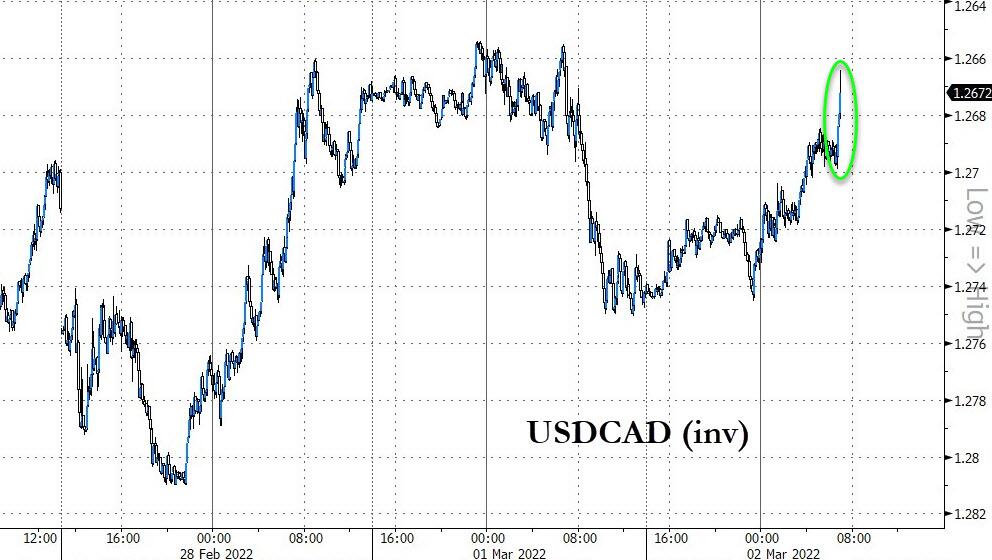
The reaction in the Loonie is very modest (small rise)…

Source: Bloomberg

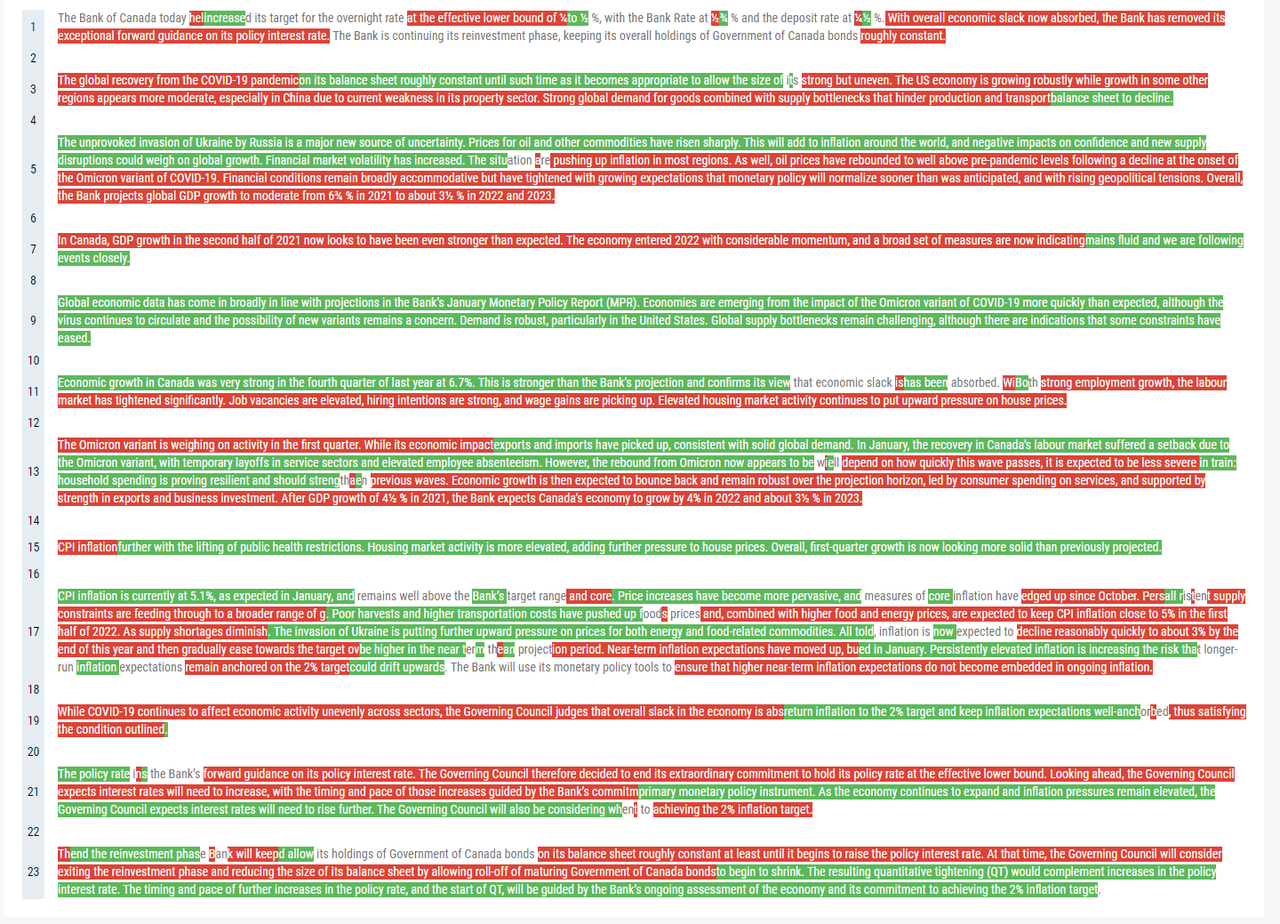
Here is BoC’s full redline (quite a dramatic difference)…

courtesy of Newsquawk

Tyler Durden
Wed, 03/02/2022 – 10:10

via ZeroHedge News https://ift.tt/9MNoGqa Tyler Durden

Rabobank: War May Delay, But Should Not Derail Central Banks’ Plans

Rabobank: War May Delay, But Should Not Derail Central Banks’ Plans

From Michael Every of Rabobank

A common enemy

Nothing unites people like a common enemy. Putin is learning that lesson the hard way. His plans to turn Ukraine into a Belarus-style puppet state and avoid NATO expanding east so far seems to have achieved the polar opposite. The West stands united, and Putin’s actions are driving countries that have been neutral to date into the arms of the Western alliance.

The Finnish attitude towards NATO membership is shifting rapidly since Russia invaded Ukraine, and a petition for a referendum on joining NATO forced parliament to discuss the matter yesterday. The debate did not lead to an immediate exercise of Finland’s option to join the alliance, but Prime Minister Marin stated that these discussions “will continue in an organized, calm, measured and considered manner.” She added that “We all felt that the security situation has changed significantly,” and “are seeking the most sensible way forward for Finnish security.” The fact that the possibility of joining NATO is actively being considered is still a major shift in thinking from a Finland that has historically held off on the idea out of fear that it might anger Russia.

Similarly, Ukrainian President made an emotional appeal to MEPs to join the European Union through an accelerated procedure. Moving as his speech was, it is not up to the European Parliament, but the heads of state, to decide on these matters. Eight of them –including Poland and the Baltics– have already backed Zelensky’s request to become an EU member. Not all countries may be as eager to accept Ukraine’s application, though. One obvious concern is the implication that accession would have in terms of the EU’s mutual defense clause, considering that Ukraine is currently at war. No one will sell you insurance while your house is already burning either. However, Zelensky’s haste is understandable: considering that it can easily take a decade for countries to become EU members, the house may already be burnt to the ground!

Even without Article 42.7 of the Lisbon Treaty, some countries may prefer to tread lightly. Putin’s entire campaign was designed around the goal to avoid that Ukraine joins the Western alliance. The Russian president is already resorting to much more drastic measures after the Russian army met a much fiercer resistance than they had probably anticipated.

And while the West unites, Russia finds itself increasingly isolated. China has been trying to balance its relationships with both sides of the conflict to safeguard its own interests. However, the country now officially referred to the conflict as a ‘war’, a word China had carefully avoided so far, and Beijing expressed “extreme concern” about the potential for civilian casualties.

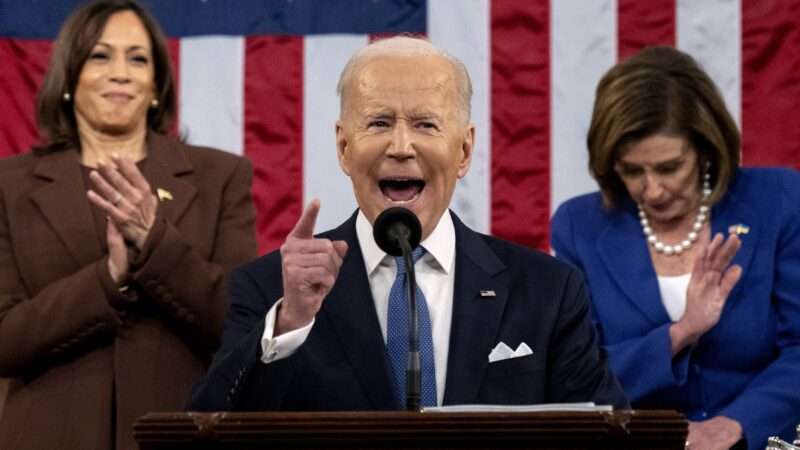
Speaking to Ukraine’s foreign minister, China also indicated that it is willing to mediate in the conflict. China may see the current crisis as an opportunity to present itself as a ‘defender of the current world order’ (if only to buy time for itself), as the US has –over the past decade– taken a less prominent role when it comes to policing the world. That process seems to have taken a turn now with the recent sanctions on Russia and President Biden’s strong remarks regarding the situation in Ukraine in his State of the Union Address (which even drew unusual applause). Still, the fact that the US has already chosen a side in this conflict could also hamper it as being able to provide the Russian leadership an off-ramp in this situation which –thus far– has only escalated. Secondly, the President also has big fish to fry in his own country, as underlined in that same speech. Despite the global importance of the war in Ukraine, Biden spoke just 10 minutes of his hour-address on the subject. The US President spent the majority of his speech on domestic affairs like his “Build Back Better” initiatives that have basically hit the rocks.

Back to markets and the impact of recent sanctions, Bloomberg finds that amidst all this, Russia ETFs have seen inflows last week. Like Bloomberg’s Cameron Crise, I can’t help but wonder who can stomach that risk now. Sure, an entire generation of investors has now been conditioned to believe that monetary policy will always come to the rescue during a dip, but it’s hard to see how the Central Bank of Russia can save equity investors from sanctions and boycotts. For the same reasons, Russian equities don’t seem to be the next ‘Gamestonk’ that can be propped back up purely by willpower and memes. Moreover, I highly doubt that Russian assets can expect the same sympathy as some of the Main Street names a year or so ago. In fact, that sympathy may be reserved for Ukraine, which sold USD 277 million in war bonds yesterday. Redditors are looking to buy [warning – strong language] while meme-ishly suggesting that they might be able to “name some tanks” as if this were a crowdfunding campaign.

Meanwhile, the rest of the market is more concerned with the economic fallout of the war, resulting in a sharp selloff of equities, as investors flocked back into fixed income. 10y Bund yields dropped more than 20bps between the open and close. The growing prospects of a more protracted war and increasingly brutal tactics employed by the Russian military are casting doubts over the economic outlook. Over the past few weeks we have written extensively about the potentially stagflationary combination of higher inflation and lower growth as a result of the conflict – piling on to the headache that central banks were already facing. For several central banks this may come down to choosing the lesser of two evils.

Crucially, though, the war has not fundamentally changed the choice between fighting inflation or supporting growth; it only exacerbates the potential extremes of the two outcomes. Of course, uncertainty weighs in as well, and central banks may be wary of potential liquidity stress – even if that seems less likely than in previous crises. On the other hand, prospects of less hawkish central bankers may also reignite investors’ concerns about the high inflation rates. Despite the sharp rise in consumer price indices around the globe, they haven’t even nearly kept up with the increased costs faced by producers. Should demand slow more sharply in the face of war-related uncertainty, this could also weigh on the prospects for corporate margins and thus force a more cautious stance from investors.

So we believe that the war may delay, but should not derail central banks’ plans. After some dovish remarks from the ECB’s Rehn, markets pared back their rate hike expectations for 2022 completely. And the fact that not only Bunds, but also peripheral yields dropped sharply indicates that traders may also have reassessed the prospect of more protracted asset purchases – or at the very least that they have priced out the possibility that Lagarde will announce that the ECB will end its net purchases more quickly.

Day Ahead

Similarly, markets also lowered their expectations for a potential 50bp move by the Fed this month, even though the economic damage will probably be less in the US than in Europe. Fed Chair Powell testifies to the House today, so it may be his turn to reassure markets that the Fed will not lose sight of inflation.

Tyler Durden
Wed, 03/02/2022 – 09:45

via ZeroHedge News https://ift.tt/xZXJWbR Tyler Durden

Bullard Says Fed Must Follow Through With “Rapid Withdrawal Of Accommodation” Or Risk Losing Credibility

Bullard Says Fed Must Follow Through With “Rapid Withdrawal Of Accommodation” Or Risk Losing Credibility

One day after markets freaked out that the Fed’s tightening plans had suffered irreparable damage at the hands of Vladimir Putin, whose incursion into Ukraine would mean not only sharply higher inflation but a much greater global slowdown than many had feared, prompting several ECB talking heads to hint at a pause in normalization, moments ago one of the Fed’s most notable hawks, St Louis Fed president Jim Bulllard, tried to ease market fears by calling for a “rapid withdrawal of policy accommodation” and emphasized policy makers must follow through with rate hikes and balance sheet runoff or risk damaging the central bank’s credibility.  

Speaking at a a meeting of Greater St. Louis, Bullard said that while inflation “has surprised substantially to the upside”, the current situation “calls for rapid withdrawal of policy accommodation in order to preserve the best chance for a long and durable expansion”, even though the best chance for preserving the expansion would have been a rate hike some time in late 2020 early 2021 and now many wonder if it’s not already too late.

Repeating a familiar mantra which may have been accurate last quarter but is now woefully out of date, especially after the Atlanta Fed’s GDP Nowcast showed that Q1 GDP is trending at 0.0%, Bullard said that the U.S. economy is “doing better in terms of inflation-adjusted consumption than it would have been without the pandemic”, pointing to the trend line drawn from 2011, adding that the real economy has more than fully recovered from the pandemic recession.

Bullard then said something that is somewhat accurate, namely that “the FOMC must now follow through with policy rate increases and balance sheet runoff or risk squandering policy credibility”, although it still remains unclear just how the Fed will alleviate supply-driven inflation which is where the bulk of the commodity price bottleneck is right now. To be sure, oil isn’t trading at $111 because of demand considerations.

Bullard also said that “the FOMC may have to move more aggressively going forward if inflation increases or does not moderate as much as expected”, although how more “aggressive” tightening will not send the broader US economy into a recession is unclear.

The regional Fed president also said Fed policy settings are “putting upward pressure on inflation, exacerbating the inflation problem.”

Addressing the Russia-Ukraine war, Bullard said it will have to be monitored closely but will likely impact Europe more directly than the US, even though as we explained previously, the US will certainly be adversely impacted as well. Bullard also said that global energy markets will be impacted over the short-to-medium term, which may lead to increased U.S. production of oil and natural gas.

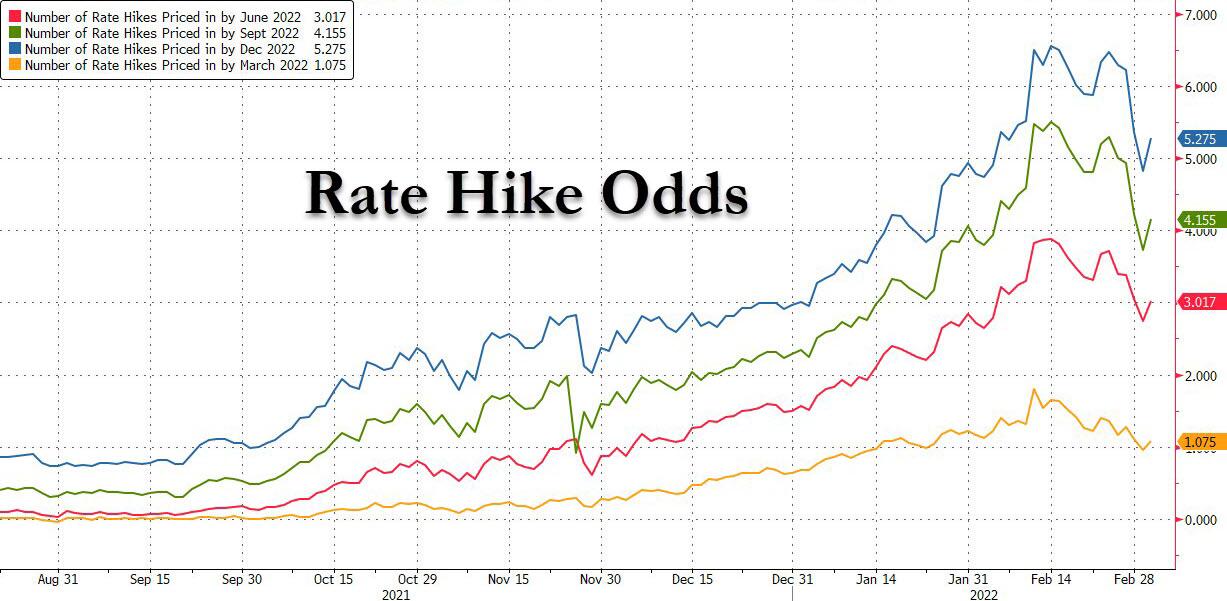
Following the publication of Powell’s prepared remarks earlier, and Bullard’s hawkish commentary, Eurodollars have whipsawed again, sliding to session lows of 98.335, and translating into a fully priced in 25bps rate hike in March and 8% odds of a 50bps rate hike, while for the full year 2022 the market is now again pricing in more than 5 rate hikes, or 5.275 to be precise.


Tyler Durden
Wed, 03/02/2022 – 09:44

via ZeroHedge News https://ift.tt/Asf1C30 Tyler Durden

Biden’s State of the Union Highlights Absurd Reach of Federal Government


maphotosnine557893

President Joe Biden gave his second State of the Union Address last night. It was, above all, a testament to the ridiculous breadth of issues we expect our executive branch to be involved in and the absurd reach of the federal government into all aspects of American life.

Biden delved into everything from the price of insulin to protecting Roe v. Wade, safeguarding kids from social media ads, lowering consumer prices, getting more Americans mental health services, ensuring better patient treatment at nursing homes, raising the minimum wage, subsidizing childcare, stopping drug trafficking, helping young transgender people reach their potential, creating manufacturing jobs, combating cancer, and more. (You can read the whole thing here.)

One of the most notable—and libertarian-friendly—sections of the speech related to COVID-19 and the pandemic, with Biden (in a test of new Democratic messaging on the issue?) promising a return to normalcy. “COVID-19 need no longer control our lives,” he declared, while still touting the efficacy of vaccines, the importance of testing, and the need to stay vigilant about new variants.

“Most Americans in most of the country can now be mask free,” said Biden, pointing to new Centers for Disease Control and Prevention guidelines. He also commented: “Our schools are open. Let’s keep it that way.”

But Biden’s State of the Union hit way too many notes that would’ve been right at home in an address from former President Donald Trump. He called for more police funding, talked about the need to strengthen our southern border, and went on at length about America-first trade policies and buying American.

“This is more a populist than a left-wing speech: trade protection, business subsidies, transfer payments, more money for police, secure the border,” commented Cato Institute’s Executive Vice President David Boaz.

Here’s more State of the Union analysis from Reason writers:

Criminal Justice Campaign Promises Absent From Biden’s State of the Union Speech

Biden Says No Troops to Ukraine, Is Silent on Ukrainian and Russian Refugees

• Biden’s State of the Union Offers More Useless Solutions to Gun Violence

If COVID-19 Is Over for Congress, It Should Be Over for School Children Too

Biden Praises Ukrainian ‘Iron Will’, Refuses To Use Ukrainian Iron in Infrastructure Projects

Biden Tries To Twist His Domestic Agenda Into a Form Joe Manchin Will Support


FREE MINDS 

Politician can block people on personal Facebook pages. A federal appeals court ruled that it doesn’t violate the First Amendment for a New Mexico politician to block someone on his personal Facebook page. The case involves Otero County Commissioner (and Cowboys for Trump co-founder) Couy Griffin and whether his personal Facebook page counted as a public forum for free speech purposes.

“Three judges from the appeals court ruled unanimously that plaintiff Jeff Swanson, chairman of the Otero County Democratic Party, failed to show that the law has determined when a personal social media profile becomes a public forum, with 1st Amendment protections,” reports the Associated Press. Swanson had argued that “elected leaders should not be able to shut out the electorate from political conversations on social media,” after being blocked from Griffin’s personal Facebook profile after criticizing the commissioner.


FREE MARKETS

Getting cryptocurrency wrong. In which Sen. Elizabeth Warren (D–Mass.) and The New York Times get everything about cryptocurrency and Ukraine/Russia exactly backward:

Cryptocurrencies are much more likely to help out ordinary Russians and Ukrainians than “Putin and his cronies.”

“Crypto is a lifeline for ordinary people in countries like Venezuela and Russia, not a means to evade sanctions,” comments the Niskanen Center’s Samuel Hammond. “On the contrary. Russia is trying to minimize the cost of sanctions through draconian capital controls. Access to crypto markets *hurts* Russia more than it helps.”

And—as Hammonds and many others have pointed out—cryptocurrency transactions come with a record. “An immutable ledger is simply not a smart way for nation states or large corporations to evade sanctions,” comments Hammond. “There are two sides to every transaction. You really think Volkswagen could just illegally export vehicles to Russia and it not be noticed just because they paid in Bitcoin?”


QUICK HITS

• Russia’s attacks on major Ukrainian cities “accelerated on Wednesday, with the Russian military claiming that its forces were fully in control of Kherson, a port near the Black Sea,” The New York Times reports, adding that “Ukrainian officials disputed Russia’s claim.” Russian forces also bombed a government building in Kharkiv yesterday, surrounded the port city of Mariupol, and continued advancing on Kyiv.

• “Don’t pour your Russian vodka down the drain,” writes Jack Shafer in Politico, and don’t kick Russian students Out of the U.S.

• Why a no-fly zone over Ukraine is a bad move.

• A new poll finds Democrats more supportive than Republicans of U.S. intervention in Ukraine:

• How Texas abortion restrictions are putting women’s health at risk.

• The American Civil Liberties Union (ACLU) is suing over a Texas directive that sex reassignment surgery, puberty blockers, or hormone treatments for minors should be considered child abuse.

• The Washington Post looks at different visions for the American right, as embodied by three conservative conferences that took place last weekend.

• “Is libertarianism a specifically political philosophy whose only legitimate concern is the role of the state and its use of force vis a vis the people it rules? Or does libertarianism, properly understood, also entail a variety of cultural commitments that range far beyond arguments over the size, scope, and spending of government?” Reason‘s Nick Gillespie and Stephanie Slade discuss.

• Professor and writer Paul Cantor—author of The Invisible Hand in Popular Culture: Liberty vs. Authority in American Film and TV and an occasional contributor to Reason—has died.

The post Biden's State of the Union Highlights Absurd Reach of Federal Government appeared first on Reason.com.

from Latest https://ift.tt/LbUiIJf
via IFTTT
Biden’s State of the Union Highlights Absurd Reach of Federal Government


maphotosnine557893

President Joe Biden gave his second State of the Union Address last night. It was, above all, a testament to the ridiculous breadth of issues we expect our executive branch to be involved in and the absurd reach of the federal government into all aspects of American life.

Biden delved into everything from the price of insulin to protecting Roe v. Wade, safeguarding kids from social media ads, lowering consumer prices, getting more Americans mental health services, ensuring better patient treatment at nursing homes, raising the minimum wage, subsidizing childcare, stopping drug trafficking, helping young transgender people reach their potential, creating manufacturing jobs, combating cancer, and more. (You can read the whole thing here.)

One of the most notable—and libertarian-friendly—sections of the speech related to COVID-19 and the pandemic, with Biden (in a test of new Democratic messaging on the issue?) promising a return to normalcy. “COVID-19 need no longer control our lives,” he declared, while still touting the efficacy of vaccines, the importance of testing, and the need to stay vigilant about new variants.

“Most Americans in most of the country can now be mask free,” said Biden, pointing to new Centers for Disease Control and Prevention guidelines. He also commented: “Our schools are open. Let’s keep it that way.”

But Biden’s State of the Union hit way too many notes that would’ve been right at home in an address from former President Donald Trump. He called for more police funding, talked about the need to strengthen our southern border, and went on at length about America-first trade policies and buying American.

“This is more a populist than a left-wing speech: trade protection, business subsidies, transfer payments, more money for police, secure the border,” commented Cato Institute’s Executive Vice President David Boaz.

Here’s more State of the Union analysis from Reason writers:

Criminal Justice Campaign Promises Absent From Biden’s State of the Union Speech

Biden Says No Troops to Ukraine, Is Silent on Ukrainian and Russian Refugees

• Biden’s State of the Union Offers More Useless Solutions to Gun Violence

If COVID-19 Is Over for Congress, It Should Be Over for School Children Too

Biden Praises Ukrainian ‘Iron Will’, Refuses To Use Ukrainian Iron in Infrastructure Projects

Biden Tries To Twist His Domestic Agenda Into a Form Joe Manchin Will Support


FREE MINDS 

Politician can block people on personal Facebook pages. A federal appeals court ruled that it doesn’t violate the First Amendment for a New Mexico politician to block someone on his personal Facebook page. The case involves Otero County Commissioner (and Cowboys for Trump co-founder) Couy Griffin and whether his personal Facebook page counted as a public forum for free speech purposes.

“Three judges from the appeals court ruled unanimously that plaintiff Jeff Swanson, chairman of the Otero County Democratic Party, failed to show that the law has determined when a personal social media profile becomes a public forum, with 1st Amendment protections,” reports the Associated Press. Swanson had argued that “elected leaders should not be able to shut out the electorate from political conversations on social media,” after being blocked from Griffin’s personal Facebook profile after criticizing the commissioner.


FREE MARKETS

Getting cryptocurrency wrong. In which Sen. Elizabeth Warren (D–Mass.) and The New York Times get everything about cryptocurrency and Ukraine/Russia exactly backward:

Cryptocurrencies are much more likely to help out ordinary Russians and Ukrainians than “Putin and his cronies.”

“Crypto is a lifeline for ordinary people in countries like Venezuela and Russia, not a means to evade sanctions,” comments the Niskanen Center’s Samuel Hammond. “On the contrary. Russia is trying to minimize the cost of sanctions through draconian capital controls. Access to crypto markets *hurts* Russia more than it helps.”

And—as Hammonds and many others have pointed out—cryptocurrency transactions come with a record. “An immutable ledger is simply not a smart way for nation states or large corporations to evade sanctions,” comments Hammond. “There are two sides to every transaction. You really think Volkswagen could just illegally export vehicles to Russia and it not be noticed just because they paid in Bitcoin?”


QUICK HITS

• Russia’s attacks on major Ukrainian cities “accelerated on Wednesday, with the Russian military claiming that its forces were fully in control of Kherson, a port near the Black Sea,” The New York Times reports, adding that “Ukrainian officials disputed Russia’s claim.” Russian forces also bombed a government building in Kharkiv yesterday, surrounded the port city of Mariupol, and continued advancing on Kyiv.

• “Don’t pour your Russian vodka down the drain,” writes Jack Shafer in Politico, and don’t kick Russian students Out of the U.S.

• Why a no-fly zone over Ukraine is a bad move.

• A new poll finds Democrats more supportive than Republicans of U.S. intervention in Ukraine:

• How Texas abortion restrictions are putting women’s health at risk.

• The American Civil Liberties Union (ACLU) is suing over a Texas directive that sex reassignment surgery, puberty blockers, or hormone treatments for minors should be considered child abuse.

• The Washington Post looks at different visions for the American right, as embodied by three conservative conferences that took place last weekend.

• “Is libertarianism a specifically political philosophy whose only legitimate concern is the role of the state and its use of force vis a vis the people it rules? Or does libertarianism, properly understood, also entail a variety of cultural commitments that range far beyond arguments over the size, scope, and spending of government?” Reason‘s Nick Gillespie and Stephanie Slade discuss.

• Professor and writer Paul Cantor—author of The Invisible Hand in Popular Culture: Liberty vs. Authority in American Film and TV and an occasional contributor to Reason—has died.

The post Biden's State of the Union Highlights Absurd Reach of Federal Government appeared first on Reason.com.

from Latest https://ift.tt/LbUiIJf
via IFTTT
Nearly 1 Million Refugees Flee Ukraine As Russia Warns NATO ‘Stay Out’

Nearly 1 Million Refugees Flee Ukraine As Russia Warns NATO ‘Stay Out’

Ukraine’s Presidential Office has said the second round of talks with Russia are moving forward, after there were prior doubts on whether they would happen. “Now it’s official. The second round of talks between Ukraine and the occupier will take place today,” a statement said. “The delegations will be in the same composition,” it added, while stressing Ukraine will “hold its ground“. 

The West has ratcheted up the pressure on Russia as heavy fighting and bombardment is still centered on Ukraine’s second largest city of Kharkiv. On Tuesday city authorities said a Russian cruise missile hit and destroyed the city council building – though there were no immediate reports of casualties. Feeling the pressure of the US and EU-led economic war which seeks to severely punish Moscow short of actual military intervention, the Kremlin issued a statement Wednesday saying it “hopes NATO has the good sense to avoid conflict.”

As of Tuesday, a UN report cited at least 536 civilians killed, among these 13 children. Refugees have continued fleeing, mostly across borders leading West, with the UN’s High Commissioner for Refugees announcing that since last Thursday’s (Feb.24) start of the invasion, it’s counted 835,928 refugees who have fled. “More than half of them (453,982) fled via Poland. Another 116,348 went to Hungary, according to the UNHCR,” CNN cites a new report as saying. 

Additionally the organization counted 96,000 refugees who fled into the Russian Federation from the breakaway republics Donetsk and Luhansk. This occurred between February 18 and 23rd. Though the New York Times and others have opted to label anyone escaping the fighting into Russia as “migrants” – this makes almost one million total refugees who fled the war-torn chaos by the first week’s close.

According to the latest broad update on where the bulk of the fighting is taking place, CNN describes:

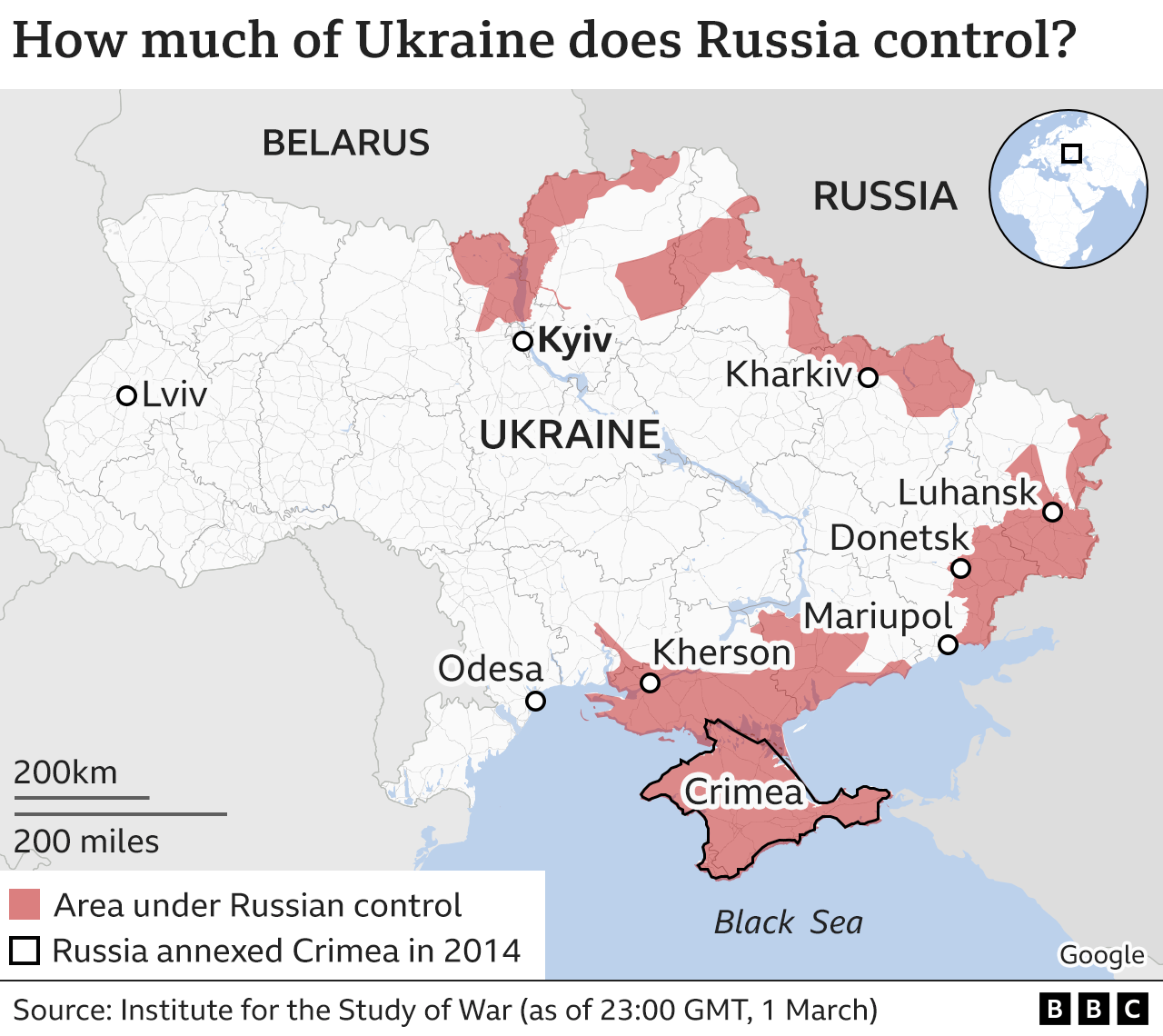
Russia’s military appears to be steadily advancing on key southern cities. Russia’s Ministry of Defense said its forces now fully held Kherson, though Ukrainian authorities denied it, saying “some parts are under our control.”

Fighting also continues in nearby Mariupol, where heavy shelling left dozens injured, its mayor said. Russian troops and Russian-backed separatist have surrounded the city on three sides. The Kremlin hopes to take Mariupol to complete a land corridor that would link the Crimea, which Russia illegally annexed Crimea in 2014 from Ukraine, with southern Russia. 

At the completion of one full week since the invasion kicked off, BBC summarizes the latest big ground-level developments as follows:

  • Russian paratroopers have landed in Kharkiv, Ukraine’s second-largest city
  • Russia’s defence ministry claims to have captured southern city Kherson
  • People in Kyiv told to leave by Russia before planned air strikes
  • Russia’s 40-mile-long convoy remains just to the north of Kyiv

Addressing the crisis, President Biden devoted about the first 12 minutes of his State of the Union address Tuesday night to warning Russia and outlining what the US would and wouldn’t do. Importantly, he emphasized that he would not send American troops to enter conflict with Russia, but is committed to defending current NATO territory and allies.

“Throughout our history we’ve learned this lesson — when dictators do not pay a price for their aggression, they cause more chaos,” Biden said. “They keep moving. And the costs and threats to America and the world keep rising.”

“Let me be clear. Our forces are not engaged and will not engage in the conflict with Russian forces in Ukraine. Our forces are not going to Europe to fight Ukraine, but to defend our NATO allies in the event that Putin decides to keep moving west.” He said this of additional thousands of troops recently deployed to Germany as well as NATO ‘Eastern flank’ countries. 

Among the new US punitive measures unveiled in the speech included joining European countries in closing airspace to Russian flights. “Today I’m announcing that we are joining our allies and closing off the American airspace to all Russian flights,” he said. The White House has also since said that targeting oil exports is “not off the table”.

Also notable was this bizarre moment, when the president referred to Ukrainians as “Iranians”…

Really a not so inconsequential gaffe considering the high stakes of the crisis in a time of war…

At the same time the West has continued ratcheting the economic war to further isolate and punish Russia, with on Wednesday the EU disconnecting seven Russian banks from the SWIFT international payment settlement system.

While the countries largest bank, Sberbank, has been spared from this latest action, the following major lenders were given 10 days to halt all SWIFT operations: VTB, Rossiya, Otkritie, Novikombank, Promsvyazbank, Sovcombank, and VEB.RF – according to the list confirmed in Russian media. Notably VTB is Russia’s second largest bank. 

“All these banks that we have listed under SWIFT… are all [included] based on their connection to the state and the implicit connection to the war effort. We have not gone for a blanket ban across the whole banking system,” a European Union official told Reuters

Tyler Durden
Wed, 03/02/2022 – 09:26

via ZeroHedge News https://ift.tt/xE2jlG5 Tyler Durden

Ford Shares Pop On Company’s Plans To Separate Its ICE And EV Segments

Ford Shares Pop On Company’s Plans To Separate Its ICE And EV Segments

It may not be the spin-off that Wall Street was hoping for, but Ford is slated to announce that it is going to undergo a re-organization wherein it will separate its internal combustion engine (ICE) segments and its EV segments. 

Ford shares are up about 4% heading into the open on Wednesday. 

The move is to help “fast track” the company’s growth in EVs, the company said on Wednesday. The divisions will have separate names, but will both be part of Ford, according to Reuters. Ford is planning on naming executives t0 lead each portion of the business individually, the report says. 

Eventually, the company will separate financial results for the two businesses. 

Ford spokesman T.R. Reid told Reuters: “We’re focused on carrying out our Ford+ plan to transform the company and thrive in this new era of electric and connected vehicles.”

Chief Executive Jim Farley last week addressed rumors of an EV spin-off, stating: “We know our competition is Nio and Tesla, and we have to beat them, not match them. And we also have to beat the best of the ICE players.”

He continued, stating about the company’s ICE business last week: “We have too many people, we have too much investment, we have too much complexity and we don’t have expertise in transitioning our assets. That’s the simple answer. There’s waste.”

“We are going all in, creating separate but complementary businesses that give us start-up speed and unbridled innovation,” he said Wednesday. The company now plans on producing “2 million electric vehicles annually by 2026, building on its plan to manufacture 600,000 plug-in models a year by 2024,” Bloomberg reported. 

Investors have hoped that a spin-off could unlock the same absurd valuation that many other EV makers, like Lucid, Tesla and Rivian, have been afforded over the past year.

The separation could wind up being in preparation for an eventual spin-off, but the company has yet to comment on such plans, should they exist. 


Tyler Durden
Wed, 03/02/2022 – 09:16

via ZeroHedge News https://ift.tt/xWuFMXR Tyler Durden

Introducing the 4th Edition of the Barnett & Blackman Constitutional Law Casebooks

I am proud to announce the Fourth Edition of the Barnett & Blackman Constitutional Law Casebooks. Yes, Casebooks plural. We have three versions of the text: the full casebook and two splits.

  1. The Casebook: More than 200 cases in the constitutional canon, including foundational and modern decisions on structure and rights.
  2. The Structure “Split”: Paperback edition perfectly-sized for a one-semester course on constitutional structure.
  3. The Rights “Split”: Paperback edition perfectly-sized for a one-semester course on constitutional rights.


These books come with access to our full twelve-hour video library. No other product on the market includes so many resources for students and professors.

We have shared our Teacher’s Manual, Powerpoint Slides, and sample chapters. If you are interested in requesting a review copy, please email me. (jblackman at stcl dot edu).

You can learn more about all our books ConLaw.us, and see a preview of our new book, Slavery and the Constitution.

The post Introducing the 4th Edition of the Barnett & Blackman Constitutional Law Casebooks appeared first on Reason.com.

from Latest https://ift.tt/G6VEWmj
via IFTTT

Introducing the 4th Edition of the Barnett & Blackman Constitutional Law Casebooks

I am proud to announce the Fourth Edition of the Barnett & Blackman Constitutional Law Casebooks. Yes, Casebooks plural. We have three versions of the text: the full casebook and two splits.

  1. The Casebook: More than 200 cases in the constitutional canon, including foundational and modern decisions on structure and rights.
  2. The Structure “Split”: Paperback edition perfectly-sized for a one-semester course on constitutional structure.
  3. The Rights “Split”: Paperback edition perfectly-sized for a one-semester course on constitutional rights.


These books come with access to our full twelve-hour video library. No other product on the market includes so many resources for students and professors.

We have shared our Teacher’s Manual, Powerpoint Slides, and sample chapters. If you are interested in requesting a review copy, please email me. (jblackman at stcl dot edu).

You can learn more about all our books ConLaw.us, and see a preview of our new book, Slavery and the Constitution.

The post Introducing the 4th Edition of the Barnett & Blackman Constitutional Law Casebooks appeared first on Reason.com.

from Latest https://ift.tt/G6VEWmj
via IFTTT

Peter Schiff: Russia Is The New “Excuse Variant” For The Fed

Peter Schiff: Russia Is The New “Excuse Variant” For The Fed

Via SchiffGold.com,

The Russian invasion of Ukraine has completely changed the market dynamics. In his podcast, Peter talked about the impact the situation is having on the markets and the global economy. He also looked ahead, saying Russia can now serve as a convenient excuse for the Fed to back off its planned monetary tightening. Of course, that will have consequences of its own.

Last week, there was optimism in the markets that the economic fallout from Russia’s invasion of Ukraine wouldn’t be too bad. The trends that were in place before the invasion remained in place.  But that shifted over the weekend with the US imposing far more harsh sanctions, including cutting off select Russian banks from the SWIFT system.

Of course, this has had a significant impact on the Russian economy. But it is also rippling through the global economy, hurting any company with any relationship with Russia.

Before the invasion, there was a rotation in the stock market. Investors were moving out of speculative momentum stocks and into value-oriented businesses that generate earnings and pay dividends. This was due to high inflation and the rising interest rate environment. Peter said what we’re seeing now is a correction in that trend. But he doesn’t think the trend is over.

While stock prices have gotten hammered. Commodity prices continue to rise. Oil rose above $101 a barrel on Tuesday.

Gold has inched higher but hasn’t broken out. That led to some criticism of the yellow metal. Critics say the fact that it hasn’t gone much higher proves that gold is losing relevance. It’s no longer a safe haven or an inflation hedge. Peter called this “a gift-horse gold-buying opportunity.

This is like a deer in a headlight. The price of gold, I think, is going to move in a major way. The only question is what’s the catalyst that’s going to spark the rise? But it is coming. And it is coming soon. And the people who are questioning why gold is not going up should just be buying gold right now with both hands.”

Looking at the broader economy, Peter said he thinks it’s pretty clear the US is heading toward a recession.

So, how will all of this impact Fed monetary policy? The markets seem to think the central bank will pivot back to a more dovish stance. In fact, they have already priced out two of the projected rate hikes for this year.

As the market is backing rate hikes out of its expectations – and I believe more hikes are going to get backed out as the situation continues to get worse for the global economy – that is also what is behind this correction in that trend where people are selling these real businesses that have real earnings that are impacted by Russian connections and a weakening economy, and they’re moving money back into the broken down momentum stocks.”

These tech companies don’t tend to be as connected to Russia. More significantly, people think they will go back up because the Fed is not going to hike as much as war originally anticipated.

Peter called the Russian invasion the latest variant that the Fed will use as an excuse to ease monetary policy.

First, we have COVID. Then we had the delta variant. And then we had omicron.  The world is really getting tired of COVID. It’s COVIDed out. But the Fed needs another excuse. So, if it’s not going to be COVID, what’s it going to be? And Russia is the gift from heaven. This is exactly what the Fed needed.”

Peter said the Fed needed a way to save face. It needed a way to dial back the expectations of all these rate hikes. Or maybe even an excuse not to hike rates at all.

If it’s clear the US economy is headed to, or is already in recession by mid-March, will the Fed actually pull the trigger on rates? Will the Fed deliberately make a recession worse with rate hikes? Because if Americans are already struggling with surging energy prices and surging food prices, does the Fed really want to increase the burden with rising interest rates?”

A Fed rate hike would impact interest rates throughout the economy. It would push up mortgage rates, credit card rates and auto loan rates. That means more pain for the consumer.

That is a reason the Fed may not hike at all. Or if it does hike, it may indicate to the market that it’s one-and-done for a while. That it’s data-dependent. That it wants to see how the markets absorb that hike before it delivers another one. And, I think it’s the anticipation of this easing of monetary policy that is blowing some air back into these deflating tech bubbles.”

Peter said he doesn’t think easing monetary policy is going to work this time.

It may create a small rally, but it’s not sending the markets to new highs like we had under COVID because this time it really is different because we have a huge inflation problem that the markets can’t ignore.”

Central bankers and government officials have a new scapegoat for inflation – Russia. They will blame further price increases on the invasion.

It’s going to be an excuse to allow rising inflation. Just like they claimed it was transitory because of supply chain bottlenecks, well, now they can pull that transitory card out again. Only this time it’s because of Russia. The supply chain problems are now because of Russia and the Ukraine. It has nothing to do with the Fed. It’s got nothing to do with monetary policy. In fact, the Fed needs a more expansionary monetary policy to counteract the damage being done to the economy.”

Peter said he thinks the next step could be price controls and rationing.

I don’t see the Fed doing what Paul Volker did in the 1980s — not in the vulnerable position the US economy is now in. And that is why it’s different this time.”

Peter said we are at the end of our rope.

Tyler Durden
Wed, 03/02/2022 – 09:01

via ZeroHedge News https://ift.tt/q0MaAQ6 Tyler Durden