Black Friday Bedlam Means Kiss The Taper Goodbye

Black Friday Bedlam Means Kiss The Taper Goodbye

Submitted by QTR’s Fringe Finance

It’s semi-hilarious that when Covid first occurred at the beginning of 2020, I couldn’t get a single soul to listen to me when I warned that the market would eventually react negatively.

Now, entire continents stop all travel, immediately consider lockdowns and markets sell off 2% every time a new variant makes its way into the news cycle. 

Just hours after Goldman Sachs made the dumbass move of predicting a quicker than expected taper, index futures are getting destroyed on news of a new Covid variant out of South Africa – days after I warned that the market could wind up getting its salad tossed heading into the new year. That prediction was for reasons other than another Covid variant, but I stand by my analysis. Just three days ago, I wrote:

I’m often one of the first people to joke about how nonsensical the idea of a Santa Claus rally is, but it puts the idea of a rising market over the holidays into everybody’s head, every year. Obviously, it’s just made up bullshit-lingo used to provide an excuse for people to buy overvalued money losing crap in the market, but it seems like a good year to remind market participants that a rally doesn’t always have to happen.

You can read that article here: The Market Could Collapse Heading Into The Holidays

Additionally, I had already detailed several reasons why I believed the NASDAQ could be on the verge of a collapse without warning here: Why We Could Be Staring Down The Barrel of A Catastrophic NASDAQ Crash And Not Even Know It

As mentioned, the overnight panic has been due to a scary sounding report of a new Covid variant out of South Africa. The variant may evade immunity, reports say, but is still being evaluated by scientists. Newsweek summed up the hysteria:

Scientists have voiced concern about a new COVID variant that has a “really awful” combination of mutations that could possibly cause the virus to evade immunity.

The variant, now called B.1.1.529, was reported on just days ago after a small cluster of cases were spotted by Tom Peacock, a virologist at Imperial College London in the U.K.

As of Wednesday this week, the variant had been detected in Botswana, South Africa, and Hong Kong, and there were only 10 cases reported, The Guardian newspaper reported.

Despite the low number of cases, B.1.1.529 has some experts worried due to the mutations it has.

In a Twitter thread on Tuesday, Peacock said the variant had a number of notable mutations such as K417N, S477N and E484A among several others associated with the virus’ spike protein. The virus uses this protein to enter human cells.

Peacock wrote: “Worth emphasising this is at super low numbers right now in a region of Africa that is fairly well sampled, however it very very much should be monitored due to that horrific spike profile (would take a guess that this would be worse antigenically than nearly anything else about).”

As of this morning, the new variant has already been detected in Israel and is likely going to wind up spreading globally, so it’s probably a good idea to just accept that fact now.

While the significance of this variant as it relates to people’s actual health remains to be seen, its significance in terms of macroeconomic policy and certainly today’s trading session shouldn’t be overlooked. If you want to know more about the science, Zero Hedge did an excellent job of summing up the key points of what we know about the new variant in their overnight coverage.

Here’s my wild-ass guess at the path this new variant is going to take us: more than likely back to all time highs, but not before we hit some (potentially large) bumps in the road first. While I happen to think this will be the Delta variant part 2 (in that it drums up a lot of hysteria and then everyone eventually ignores it), that doesn’t mean the government and markets won’t overreact to the news.

Remember, scary sounding words like “mutation”, “spike protein” and “variant” are a prompt to act like hysterical hyenas and usurp power unilaterally for those on the left side of the aisle (read: our entire government right now).

We will have more information over the coming days as to what the government’s response is going to be globally, but if the U.S. follows the lead of the U.K. and the EU overnight, its looking like travel bans, mandates and lockdowns could all once again be on their way.

If the government uses this variant as a an excuse to assert even more control over the country and lock down again:

  1. You can kiss any plans to taper goodbye for the time being. This’ll create political turmoil, as tapering seems to be the only “solution” politicians have explored to inflation running rampant in the country. Expect prices to continue to rip higher and the market to potentially react positively.

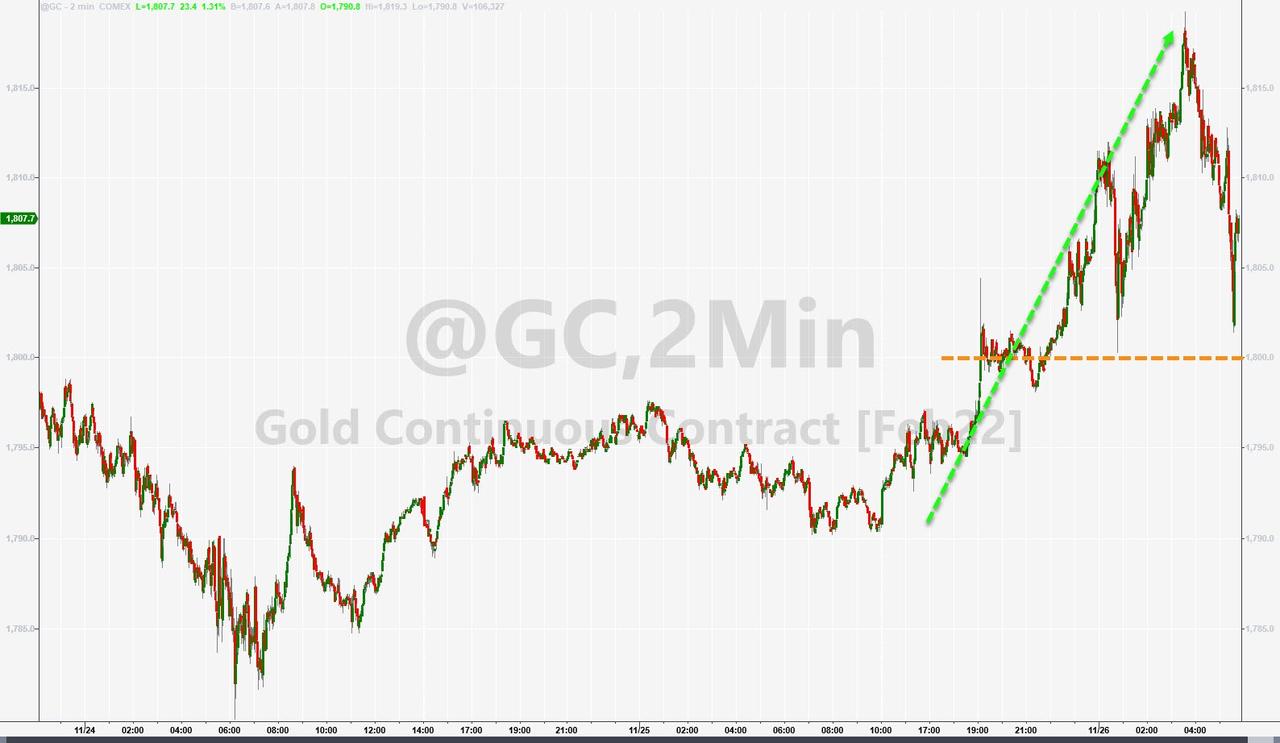
  2. We can eventually expect more stimulus checks, as we head further down the path to stagflation and universal basic income. The additionally stimmies will throw a wet blanket onto job growth and make the nation’s labor shortage worse. This should be a massive tailwind for gold, which is up about $25/oz. as of the time of this writing. Bitcoin selling off like a risk asset this morning leads me to believe my long held thesis that BTC is a risk-asset and not a hedge may be correct. I’ll keep looking for rotation from BTC (risk on) to gold (risk off) in the event of deleveraging. Remember, gold also sold off in early 2020 prior to ripping to all-time highs. When margin calls come in, people sell whatever they can get their hands on.

  3. Travel stocks could get pasted and stay-at-home stocks could rip. Of particular interest is oil, which has had a monstrous run over the last 6 months. Even though President Numb-Nuts is failing at actively trying to micromanage the oil market (as the Saudis look on and laugh), oil could still pull back further as perceived demand would crumble in the event of a lockdown. Also of note are names like Peloton (PTON) and Zoom (ZM) – both of which are more than 50% off their Covid-catalyzed highs.

  4. Pfizer, Moderna and Johnson & Johnson could have a heyday again, especially if the new variant spreads (it will) and can evade current vaccines (undetermined). One has to think about whether or not the new variant will be able to evade the vaccines on the market. Should this turn out to be the case, it would not only be the impetus for another round of unilateral power grabs by the government, but could also send the stocks of Pfizer, Johnson & Johnson and Moderna into the stratosphere as it would almost ensure, at the very least, new booster shots, and at the very most, an entire new round of vaccines.

And if the government decides to do nothing about the new variant, we likely wind up going back to all time highs in 2022 anyways, as it’ll probably still be used as an excuse to delay the taper.

I think the only thing that could send the markets moving much lower in very fast fashion would be a lockdown style attitude from the government without clear messaging from the Fed that they’re going to back off the gas when it comes to the taper.

The odds of this are low, in my opinion, but it would be your classic lose/lose scenario.

I’d love to be able to tell my subscribers that I know exactly where the market is going to go today, and in the week ahead, but the fact of the matter is that I don’t, but for my prediction that we could see volatility heading into the end of the year.

With so many unknowns at play (the severity of the variant, how governments and the Fed will react), I’d rather be honest with you and tell you it’s too early to try and analyze than make up some shit to justify why I charge for analysis behind a pay wall to begin with.

The only one true honest inclination that I’ve had so far this morning has been that Gold rising just $20 on this news doesn’t seem like quite enough. It had already started to feel like sentiment was shifting back towards gold as an inflation hedge over the last couple months. A brand new round of stimulus from the government would only act as a tailwind for that thesis. Lockdowns that keep production and labor suppressed would also act as a tailwind, as they’d keep a bid under consumer prices.

If I had to make any bet, I’d say this headline too will pass. And even if it doesn’t, Covid is already over for me in my head – an attitude I suggested many should gift themselves heading into the holidays.

Enjoy your Thanksgiving leftovers, and your long weekend.

*  *  *

Read more from QTR:

1. Covid Is Over (If You Want It)

2. Two Reasons The Market Could Collapse Heading Into The Holidays

3. When The Global Monetary Reset Happens, Don’t Forget Who To Blame

4. Pride Goeth Before The Bitcoin Fall

5. Cathie Wood’s Sweet Superficial Success

This was a free preview of paid content from QTR’s Fringe Finance. Zerohedge readers always get 10% off a subscription to my blog for life by using this link.

Tyler Durden
Fri, 11/26/2021 – 09:40

via ZeroHedge News https://ift.tt/3nUnJnp Tyler Durden

That Time Mikhail Gorbachev Appeared in a Pizza Hut Commercial


thumbnail 2

There may not be a more striking metaphor for capitalism’s victory over the Soviet Union than a 60-second Pizza Hut ad that originally aired more than 20 years ago but continues to get passed around the internet as a fascinating tidbit of 1990s political commentary.

The ad, filmed in November 1997, features former (and final) Soviet president Mikhail Gorbachev visiting a Pizza Hut ostensibly located in the middle of Moscow. Gorbachev does not speak a single line of dialogue in the ad—nor does he take a bite of pizza, as he reportedly agreed to do the spot with the condition that he would not have to eat on-camera—but he is undeniably the star, as other patrons in the restaurant notice their fallen comrade and debate his significance to Russia, freedom, and pizza.

It’s not hard to see the ad as a notable bit of now-quaint 1990s commentary on the supposed “end of history” and American hegemony—and perhaps an overly optimistic view of how Russia would evolve in the post-Soviet era. If nothing else, it says, capitalism provides cheap pizza for the masses—and that’s far more than communism could ever do.

But there are layers of meaning that extend well beyond the obvious political commentary. Gorbachev agreed to appear in Pizza Hut’s ad, according to The New York Times, because he was hard-up for cash six years after stepping down as the leader of a global superpower. He was paid an undisclosed amount that was rumored to be near $1 million, according to the Times’ contemporaneous report.

“I thought that it is a people’s matter—food,” he told the paper.

According to University of Massachusetts political science professor Paul Musgrave’s detailed recap of how the ad came to be, filming took place on Thanksgiving—fitting, since the holiday is a quintessentially American celebration of food and the surpluses made possible by capitalism. Musgrave calls the final product “a beautiful short film and a very weird advertisement.”

It is definitely both of those things, but the most interesting and significant part of the ad has little to do with Gorbachev or pizza. During the Soviet era, Russians were not likely to gather over a warm meal and freely discuss politics. As Reason‘s Liz Wolfe details in the December issue of the magazine, much of the social structure of Soviet life was designed to prevent exactly that sort of thing: “Prior to the revolution, families could speak their minds comfortably while preparing and sharing a meal. But Stalin felt privacy created far too much space for dissent to take root and multiply. His solution was to abolish familial intimacy as much as possible. In his new kommunalkas, you would never be far from the watchful eye of a compatriot who might snitch.”

Even after Gorbachev liberalized parts of the economy, restaurant culture took a long time to bounce back from how it had atrophied under restrictive Soviet rule. Yes, the demise of the Soviet system allowed Russians to finally enjoy Pizza Hut, but also everything else that comes with enjoying a nice meal prepared in a restaurant.

The post That Time Mikhail Gorbachev Appeared in a Pizza Hut Commercial appeared first on Reason.com.

from Latest – Reason.com https://ift.tt/30X7PjJ
via IFTTT

A Scared Nu World: Here’s What We Know About The New COVID Strain

A Scared Nu World: Here’s What We Know About The New COVID Strain

Summarizing of our post from last might (which we urge everyone to read) for those who are just now waking up to the global chaos resulting from the B.1.1.529 variant, which later today is expected to be named with the Greek letter Nu, here is what we know, courtesy of Newsquawk, Credit Suisse and Citi.

Background

  • Regarded as the most heavily mutated variant of the Coronavirus, thus far, as it has 32 mutations in the spike protein and 50 overall. More specifically, scientists have highlighted that there are 10 mutations vs 2 in the Delta variant regarding the receptor binding domain, which is the portion of the virus that makes initial contact with cells.

  • The Nu variant was identified 5 days ago initially in Botswana with subsequent confirmation and sequencing in South Africa with about 100 confirmed cases. Cases have been detected in Israel and Hong Kong and as of this morning, in Belgium.

  • Sequencing data suggests 8.1.1.529 has a different evolutionary pathway, but shares a few common mutations with the C.1.2, Beta and Delta variants.

  • That said, as we cautioned last night, a significant number of mutations may not necessarily be a ‘negative’ as it is dependent on how these mutations function, which scientists are yet to establish. Then again, since it is the job of science to fearmonger so that Pfizer can buy an even bigger yacht, assume it will be “very very horrifying” until proven innocuous.

Is it more deadly

  • It is currently too early to determine if the new variant has higher mortality than previous variants. Reported cases only started rising in South Africa on 19 November, so any impact on hospitalizations and COVID-related deaths will not have yet emerged.

Testing and Detectability

  • Tulio de Oliveria, the Director of the Centre for Epidemic Response & innovation (CERI), South Africa, has written that the variant can be detected by a normal PCR test and as such it will be “easy for the world to track it”. It wasn’t immediately clear if this is one of those “excess false positive PCR tests” but it’s safe to assume for now that it is.

  • According to Credit Suisse, “one silver lining may come in the ease of identifying this variant via qPCR tests. B.1.1.529 has a deletion within the s-gene which can be identified easily via widely-used PCR tests. More complex sequencing analysis is needed to differentiate the delta variant. This will help track the spread of B.1.1.529, both within Southern Africa and across the globe.”

Transmission

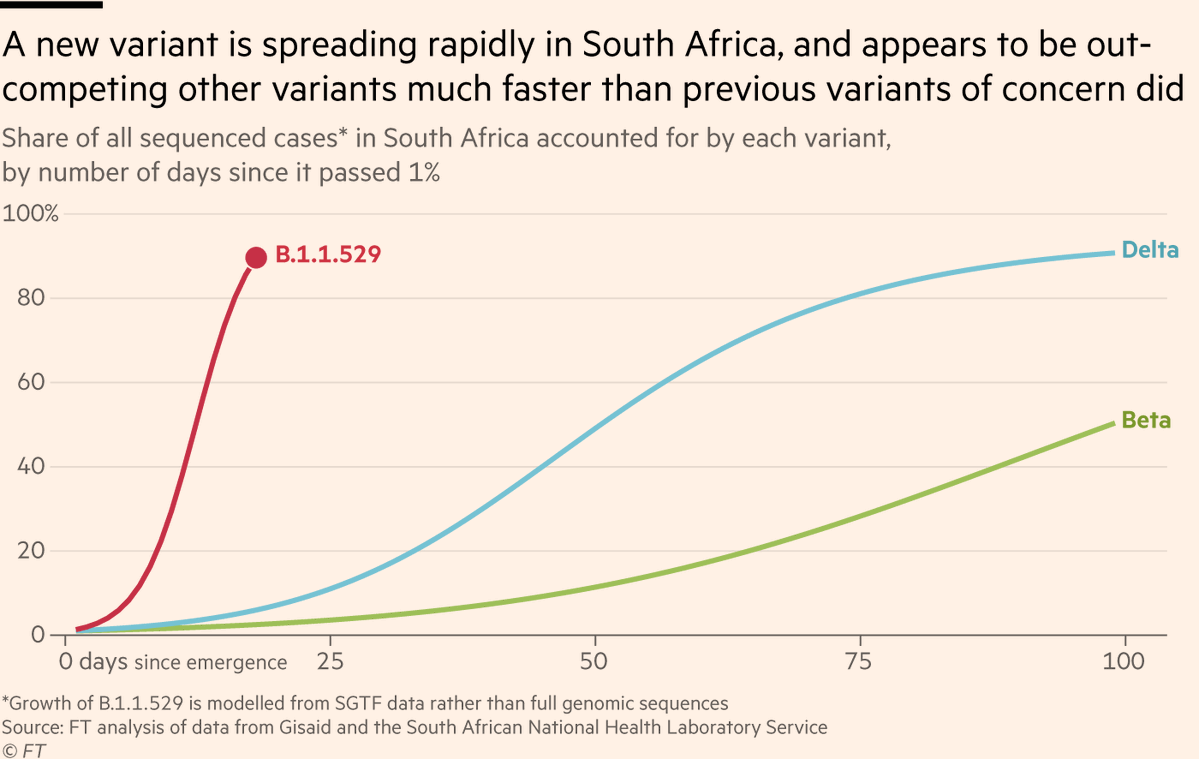
  • Oliveria, explains that the new variant is spreading very quickly, in under two-weeks it is now dominating all infections in South Africa following the Delta waves domination – writing that it the variant is “now at 75% of last genomes and soon to reach 100%”.

  • Additionally, the virus contains mutations that have been seen in other variants and appear to make transmission easier.

  • Outside of Africa, two cases have been reported in Hong Kong, one from a traveller from the region and another who was quarantining in the adjacent hotel room. Most recently, a case has been reported in Israel.

  • In response to this, the UK has placed much of southern Africa on the red list, with Israel India, Japan and Singapore also taking similar measures. Additionally, EU Commission President von der Leyen is to propose activation of the emergency air brake, to halt travel from southern Africa.

Vaccines

  • It is too early to accurately determine the vaccine response to the new variant. However, the significant number of variants increase the likelihood that current vaccines, which were designed with the original COVID-19 strain in mind, may be less effective.

  • Known variants include those that make it more challenging for antibodies to recognise their presence.

  • Laboratory testing is already underway according to the South Africa National Institute for Communicable Diseases Initial thoughts from the institute are that partial immune escape is likely, a view that seems possible given the numerous mutations in comparison to the sequence that existing vaccines were designed against. The first view on this to be from in vitro immunogenicity test or perhaps from computer modelling of the sequence. Credit Suisse estimates initial lab data could take less than 1 week to generate given the sequence is already known and work is already ongoing.

New Vaccine Would be Available in 100 days

  • According to Pfizer, if a vaccine-escape variant emerges, the company expects to develop, produce a tailor-made vaccine against that variant in 100 days.

Impact of efficacy of existing drugs antibodies is unknown.

  • There have been significant advances in treatment of COVID since it emerged in the disease waves of 2020: the use of widely-available steroids, and anti-inflammatory drugs, such as Roche’s Actemra have significantly improved survival outcomes.

  • More recently, antibody therapies targeting COVID (LLY, REGN/Roche, AZN) have significantly improved outcomes against COVID variants to date. It will need to be seen if their efficacy is equal against the new B1.1.529 variant.

  • Lastly the recent positive data from oral anti-viral agents (PFE, MRK/Ridgeback) may also have the potential to slow the spread of any new waves of COVID. The effectiveness of these treatments against new variants of concern will need to be tested, but lab results should be expected relatively quickly. In-human studies should also yield results relatively quickly if they are run in areas where the prevalence of 8.1.1.529 is high.

What’s next

  • According to Citi, concern over Nu needs to be balanced against the failure of other concerning variants such as Beta (also first identified in Africa) to out-compete delta.

  • The next two weeks will be critical to: (i) determine whether Nu outcompetes delta in high delta prevalence countries (2-3 weeks), (ii) engineered pseudoviruses for Nu to determine neutralization by serum of vaccination and previously infected patients (2-4 weeks), and (iii) real world data to determine rates of hospitalisation and death (c. 6-8 weeks). The implementation of travel restrictions and public health measures may push back some of the above timeline estimates. Novel oral anti-virals should retain activity against Nu but resistance may emerge with time.

Tyler Durden
Fri, 11/26/2021 – 09:20

via ZeroHedge News https://ift.tt/3CWm5Gn Tyler Durden

Pfizer CEO Warns New Vaccine To Combat Heavily-Mutated Coronavirus Could Take 100 Days

Pfizer CEO Warns New Vaccine To Combat Heavily-Mutated Coronavirus Could Take 100 Days

Several countries — including Britain, France, Israel, Italy, and Singapore are moving fast to restrict travel from South Africa and other countries after a new coronavirus variant with mutations was discovered five days ago. The new variant is so concerning that Pfizer’s CEO confirmed a new vaccine would take more than three months to develop. 

According to a research note published by Citi analyst Andrew Baum, the Nu variant, referred to as B.1.1529, was discovered in Botswana with at least 100 confirmed cases in South Africa and detection in Israel and Hong Kong. We noted Friday morning Belgium, the first European country, has documented cases of the new strain. 

Baum said the next few weeks of testing would be essential to determine whether Nu is more aggressive than delta. Lab tests could conclude BioNTech, Pfizer would have to reformulate their vaccine. 

He noted one Hongkonger who was double Pfizer vaccinated experienced a breakthrough infection with Nu. The breakthrough cases are concerning as waning immunity from the COVID-19 vaccine continues as governments offer booster shots. 

So here’s the most troubling part.

Baum spoke with Pfizer’s CEO, Albert Bourla, who said it could take scientists 100 days to develop a novel variant vaccine to combat Nu. 

In the meantime, global stock and futures markets are plunging as treasury yields sink lower. Brent and WTI dropped more than 5%. Already, countries are halting flights from South Africa and Botswana as the new variant appears to be spreading. 

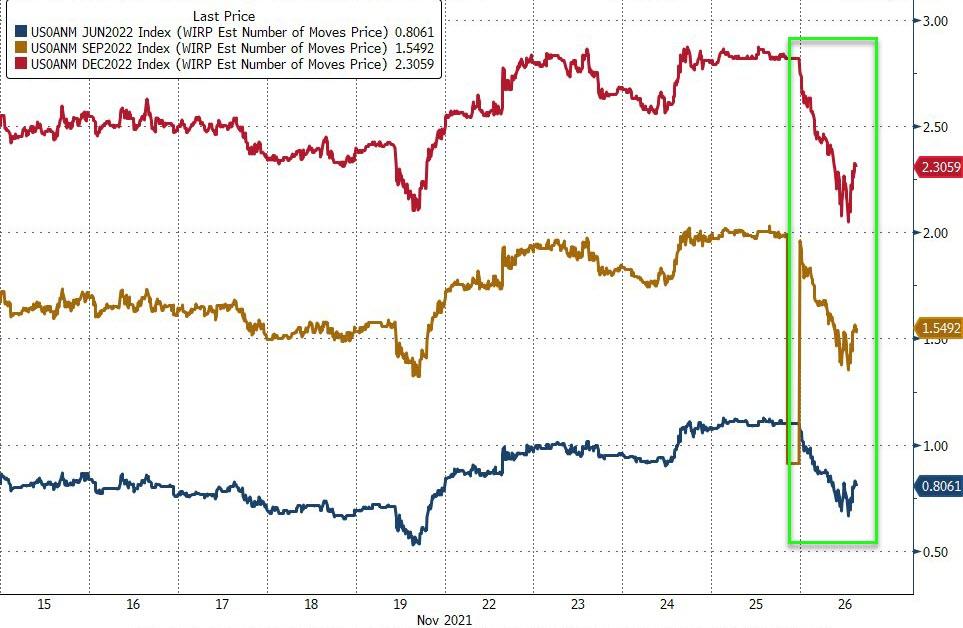
Talk about perfect timing for central bankers who were embarking on the most aggressive tapering and rate hike cycle in years to curb out-of-control inflation. US money markets show traders are pushing back their tightening wagers. 

Peter Chatwell, head of the multi-asset strategy at Mizuho International, offered his thoughts on Nu in a new research note

So the question heading into the weekend is if bad news is good news (delays the taper so BTFD!), or if bad news is bad news (Fed is cornered and can’t re-up QE due to inflation, the vaccine premium in the market needs to come out). 

Tyler Durden
Fri, 11/26/2021 – 09:03

via ZeroHedge News https://ift.tt/3E0rzB6 Tyler Durden

That Time Mikhail Gorbachev Appeared in a Pizza Hut Commercial


thumbnail 2

There may not be a more striking metaphor for capitalism’s victory over the Soviet Union than a 60-second Pizza Hut ad that originally aired more than 20 years ago but continues to get passed around the internet as a fascinating tidbit of 1990s political commentary.

The ad, filmed in November 1997, features former (and final) Soviet president Mikhail Gorbachev visiting a Pizza Hut ostensibly located in the middle of Moscow. Gorbachev does not speak a single line of dialogue in the ad—nor does he take a bite of pizza, as he reportedly agreed to do the spot with the condition that he would not have to eat on-camera—but he is undeniably the star, as other patrons in the restaurant notice their fallen comrade and debate his significance to Russia, freedom, and pizza.

It’s not hard to see the ad as a notable bit of now-quaint 1990s commentary on the supposed “end of history” and American hegemony—and perhaps an overly optimistic view of how Russia would evolve in the post-Soviet era. If nothing else, it says, capitalism provides cheap pizza for the masses—and that’s far more than communism could ever do.

But there are layers of meaning that extend well beyond the obvious political commentary. Gorbachev agreed to appear in Pizza Hut’s ad, according to The New York Times, because he was hard-up for cash six years after stepping down as the leader of a global superpower. He was paid an undisclosed amount that was rumored to be near $1 million, according to the Times’ contemporaneous report.

“I thought that it is a people’s matter—food,” he told the paper.

According to University of Massachusetts political science professor Paul Musgrave’s detailed recap of how the ad came to be, filming took place on Thanksgiving—fitting, since the holiday is a quintessentially American celebration of food and the surpluses made possible by capitalism. Musgrave calls the final product “a beautiful short film and a very weird advertisement.”

It is definitely both of those things, but the most interesting and significant part of the ad has little to do with Gorbachev or pizza. During the Soviet era, Russians were not likely to gather over a warm meal and freely discuss politics. As Reason‘s Liz Wolfe details in the December issue of the magazine, much of the social structure of Soviet life was designed to prevent exactly that sort of thing: “Prior to the revolution, families could speak their minds comfortably while preparing and sharing a meal. But Stalin felt privacy created far too much space for dissent to take root and multiply. His solution was to abolish familial intimacy as much as possible. In his new kommunalkas, you would never be far from the watchful eye of a compatriot who might snitch.”

Even after Gorbachev liberalized parts of the economy, restaurant culture took a long time to bounce back from how it had atrophied under restrictive Soviet rule. Yes, the demise of the Soviet system allowed Russians to finally enjoy Pizza Hut, but also everything else that comes with enjoying a nice meal prepared in a restaurant.

The post That Time Mikhail Gorbachev Appeared in a Pizza Hut Commercial appeared first on Reason.com.

from Latest – Reason.com https://ift.tt/30X7PjJ
via IFTTT

‘Nu’-ked: Gold Gains As Crude & Crypto Carnage Continues

‘Nu’-ked: Gold Gains As Crude & Crypto Carnage Continues

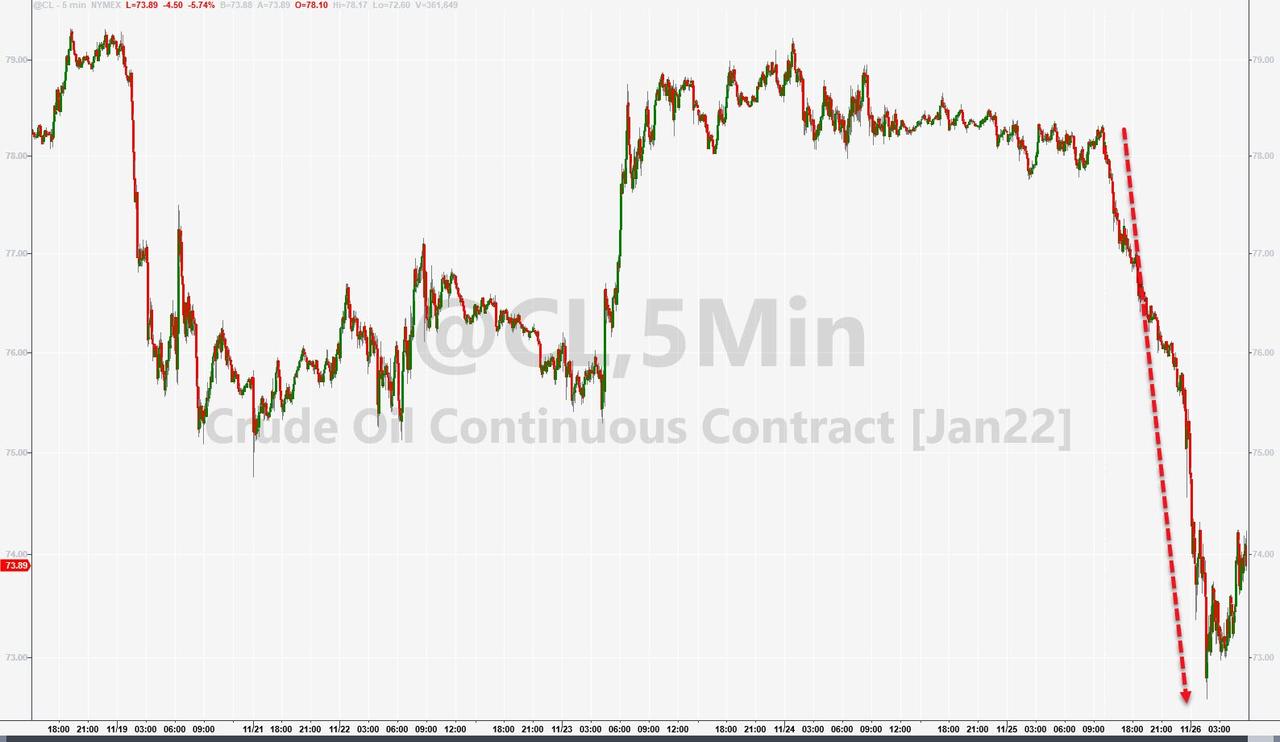
The emergence of ‘nu’ has sparked demand anxiety in the crude complex and oil prices are collapsing.

WTI is down 5.5% testing a $72 handle, the lowest in over 2 months….

That is a 2 month low… Will Biden take credit for this?

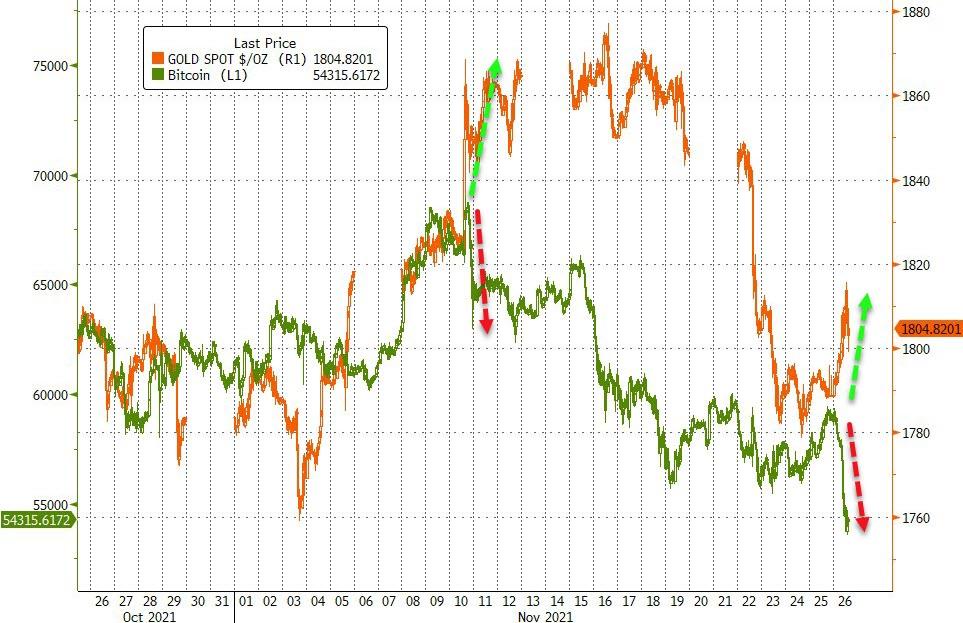
Gold appears to be the safe-haven today…

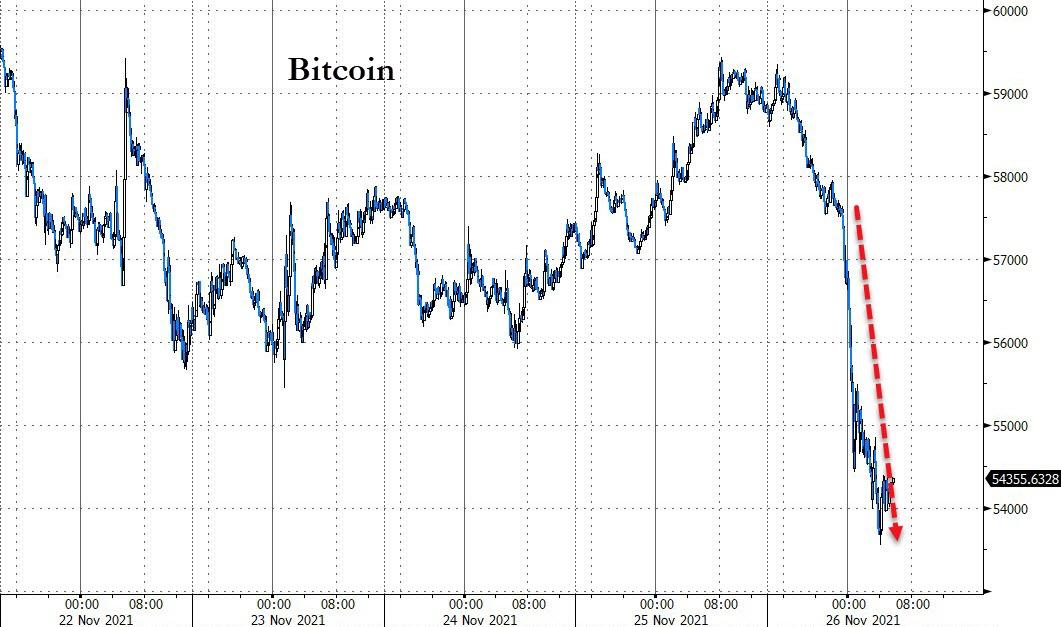
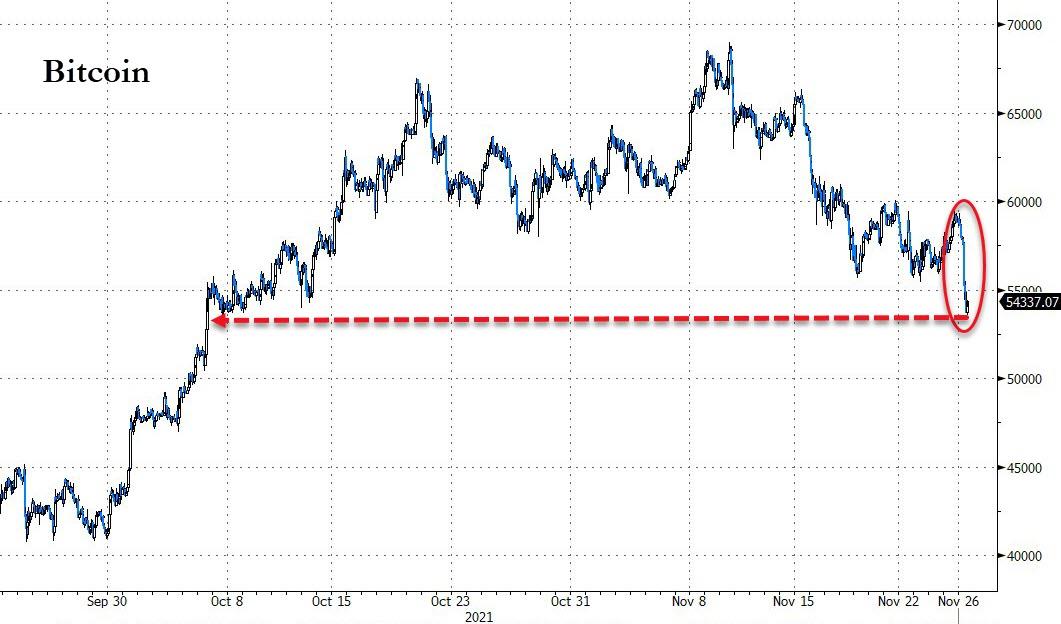
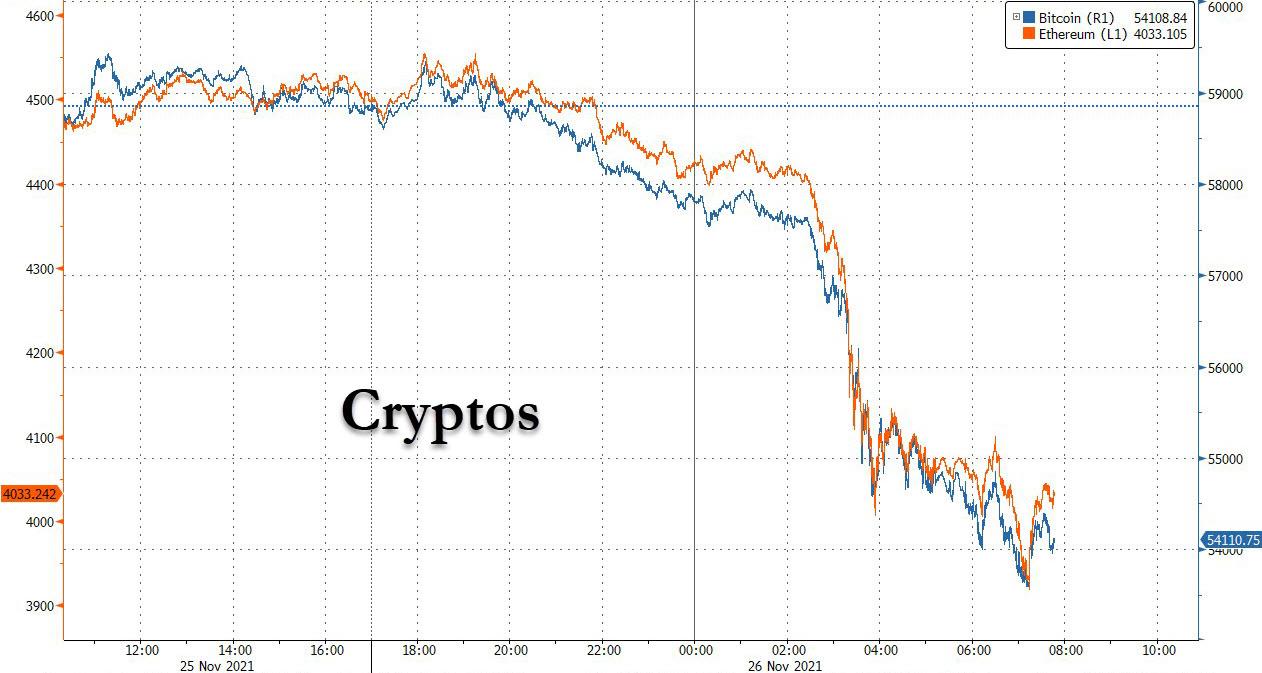
Crypto is a bloodbath with Bitcoin hitting a $53,000 handle…

That is the lowest for BTC since early October…

But gold is gaining from safe-haven flows…

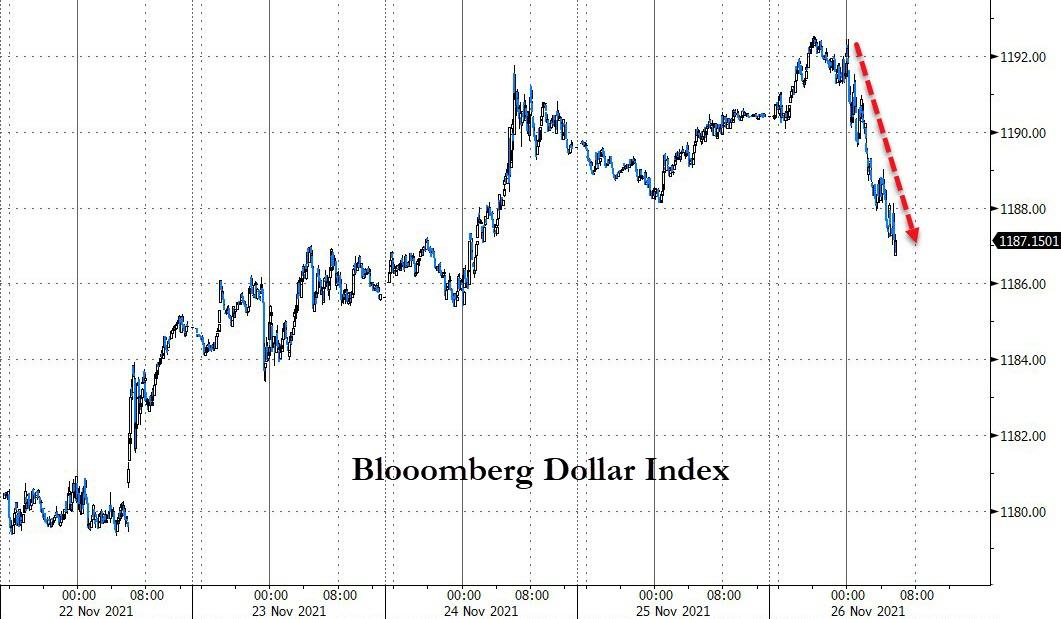
As the dollar sinks…

Rate-hike odds are plunging…

Is this the ‘event’ central bankers have been betting on to stem the inflationary tsunami?

Tyler Durden
Fri, 11/26/2021 – 08:51

via ZeroHedge News https://ift.tt/3nSMxw4 Tyler Durden

No Mass Transit Grants for California, Biden Administration Rules


amogh-manjunath-HksFlo1t8iA-unsplash

In terms of entertaining political news, it’s hard to top the latest events from the Biden administration. Democrats are devouring each other as the president’s approval ratings slip into Jimmy Carter territory. There’s that video of Vice President Kamala Harris talking about “zee plan” with scientists in Paris—seemingly in a fake French accent.

Then on Thursday the House of Representatives censured loony GOP congressman Paul Gosar for circulating “a manipulated video on his social media accounts depicting himself killing Representative Alexandria Ocasio-Cortez and attacking…Biden.” It’s quite the circus.

Yet arguably the week’s most-enjoyable D.C. story involves a bureaucratic interpretation of an arcane federal statute and its intersection with a 2013 California law. It’s a chuckle-inducing dispute once you delve into the complex backstory—and look at the unhinged reactions of California officials who are being hoisted on their own union-built petard.

We just learned that the U.S. Department of Labor has denied California $12 billion in transit funding, including grants from the recently signed infrastructure bill. The reason? A 1964 federal law requires the labor department to certify that the state agencies seeking any mass-transit grants are “protecting the interests of any affected employees,” The Fresno Bee reported.

So, the Biden administration is claiming that California—the state that provides its public employees with unparalleled pay and pension benefits, and provides collective-bargaining rights unheard of anywhere else—is being mean to its “affected” public employees because the state passed a 2013 law, authored by Democrats, that infinitesimally reined in pension benefits.

As SFist summarized, “Biden is withholding giant amounts of federal money from California public transit because the state’s public-employee pension system is apparently not paying people enough.” Labor-allied California politicians—facing a reduction in funds for beloved transit programs—are so angry they’re almost sounding sensible. You see why I’m laughing?

For instance, Gov. Gavin Newsom penned an artfully written letter on Nov. 10 to Labor Secretary Marty Walsh blasting the funding cut off. In it, he laments that the department’s grant-denial decision “is a complete reversal of (the agency’s) final determination in 2019 that California’s statewide pension reform legislation…’does not present a bar to certification.'”

The labor-friendly governor is furious at the labor-friendly Biden administration for adopting a labor-friendly position. Adding to my delight, Newsom favorably cites the previous administration, which, as noted, determined that the pension law does not harm state workers. Yes, Newsom is citing a Trump appointee to overturn his Biden-administration replacement.

It gets better. Pension-reform critic Newsom makes a powerful argument defending the 2013 pension-reform law, known as the Public Employees’ Pension Reform Act: “After multiple years of litigation, the reviewing federal court found in California’s favor three times, and the department did not pursue appeals. The department’s own lawyers noted that the federal court’s decisions were ‘thoroughly reasoned’ … That should conclude the matter.”

As a refresher, Gov. Jerry Brown led the charge for PEPRA. The state was facing budget shortfalls and pension costs were obliterating local budgets (they still are, actually). It pared back some of the most generous pension formulas for new hires and eliminated pension-spiking schemes such as “air time,” which allowed public employees to buy future retirement credits for pennies on the dollar.

The law in no way impaired collective-bargaining rights. In fact, the main purpose of PEPRA was political. It helped Brown convince the public that he was serious about reforming the budget process—and PEPRA’s passage softened up voters enough to pass the Proposition 30 tax hike.

Any perusal of Transparent California will show the eye-popping compensation packages that California public employees still receive. No other governor or Legislature hands out such lush benefits to public employees—and yet the Biden administration is punishing California for a Democratic-sponsored law that imposed only the slightest restraint.

In an act of hubris, some California public-employee unions sued over PEPRA—and claimed the rollback of pension-spiking gimmicks violated the California Rule. There is no actual rule, but a series of court interpretations concluded that governments cannot reduce pensions going forward unless they provide something of equal value.

Admirably, Brown defended PEPRA in court—and made a broader argument for rolling back that blasted California Rule, which prevents cities from limiting overly generous pension formulas that are obliterating their budgets.

Brown pointed to a lower-court ruling that said that public employees have the right to a reasonable pension—”not an immutable entitlement to the most optional formula of calculating the pension.” The California Supreme Court upheld the pension-reform law, but punted on the California Rule. That should indeed be the end of the matter, but the feds still are smarting over any effort to reform pensions.

I’m not bemoaning the potential loss of transit funds given they tilt heavily toward climate-change folderol. It is funny, however, watching California Democrats get tripped up by their own union allies.

This column was first published in The Orange County Register.

The post No Mass Transit Grants for California, Biden Administration Rules appeared first on Reason.com.

from Latest – Reason.com https://ift.tt/3CSSD3R
via IFTTT

Belgium First European Nation To Confirm Spread Of “Nu” Variant

Belgium First European Nation To Confirm Spread Of “Nu” Variant

In what is becoming a nightmare for thousands of traders (and an even larger number of public health officials, we imagine), the latest COVID variant to elicit a hysterical response – the ironically named “nu” variant” – has just been confirmed in Belgium, the first European country to confirm cases of the new strain.

Two suspected cases of the new variant have been detected and confirmed in Belgium, according to local media reports. The strain was initially found in South Africa, Hong Kong, Botswana and Israel.

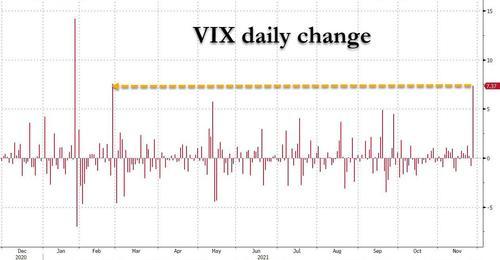
The variant has elicited major surges in infections, and on Friday, panic about a more chaotic outlook for interest rates and the broader global economy has sent the VIX surging premarket on an otherwise quiet post-Thanksgiving Friday.

The Nu variant, formerly referred to as B.1.1529, was initially identified five days ago, first in Botswana, with subsequent confirmation and sequencing in South Africa where 100 cases have been confirmed. The variant has also spread to Israel and Hong Kong, according to Citi analyst Andrew Baum.

Of course, all of this comes with a pretty big asterisk: The analyst believes concern over Nu needs to be balanced against the failure of other concerning variants such as Beta to out-compete delta.

One trader has some pretty interesting thoughts about where this is all going.

Tyler Durden
Fri, 11/26/2021 – 08:34

via ZeroHedge News https://ift.tt/3nTF7J1 Tyler Durden

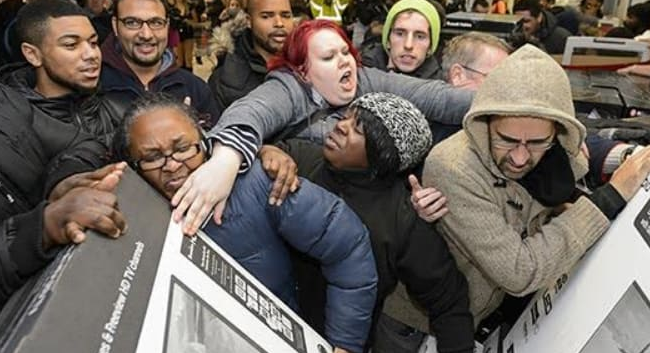
Black Friday Turns Red On “Terrible News” – Global Markets Crater On “Nu Variant” Panic

Black Friday Turns Red On “Terrible News” – Global Markets Crater On “Nu Variant” Panic

The Friday after thanksgiving is called black Friday because that’s when retailers finally turn profitable for the year. Not so much for market, however, because this morning it’s red as far as the eye can see. The culprit: the same one we discussed late last night – the emergence of a new coronavirus strain detected in South Africa, known as B.1.1.529, which reportedly carries an “extremely high number” of mutations and is “clearly very different” from previous incarnations, which may drive further waves of disease by evading the body’s defenses according to South African scientists, and soon, Anthony Fauci.

British authorities think it is the most significant variant to date and have hurried to impose travel restrictions on southern Africa, as did Japan, the Czech Republic and Italy on Friday. The European Union also said it aimed to halt air travel from the region.

“Markets have been quite complacent about the pandemic for a while, partly because economies have been able to withstand the impact of selective lockdown measures. But we can see from the new emergency brakes on air travel that there will be ramifications for the price of oil,” said Chris Scicluna, head of economic research at Daiwa.

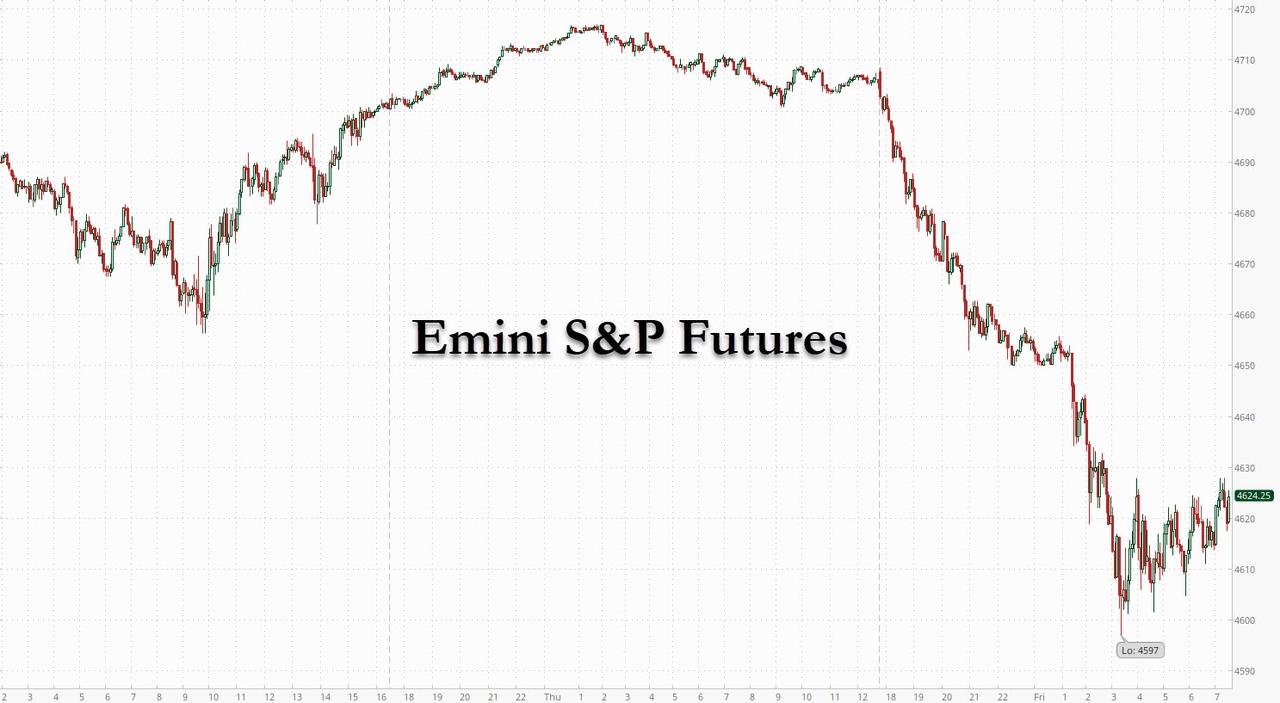
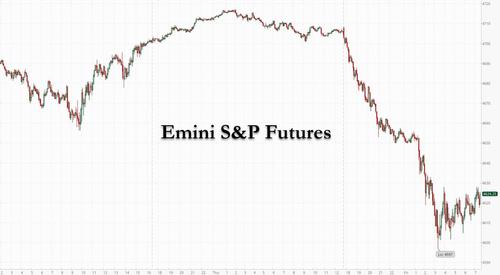
As a result, what was initially just a 1% drop in US index futures, has since escalated to a plunge of as much as 2% with eminis dropping the most since September, at one point dropping below 4,600 after closing on Wednesday above 4,700 as a post-Thanksgiving selloff spread across global markets amid mounting concerns the new B.1.1.529 coronavirus variant – which today will be officially called by the Greek lettter Nu – could derail the global economic recovery.  Russell 2000 contracts sank as much as 5.4%. Technology shares may be caught in the net too as Nasdaq 100 futures slid. The CBOE Volatility Index, or VIX, increased as much as 9.4 vols to 28.
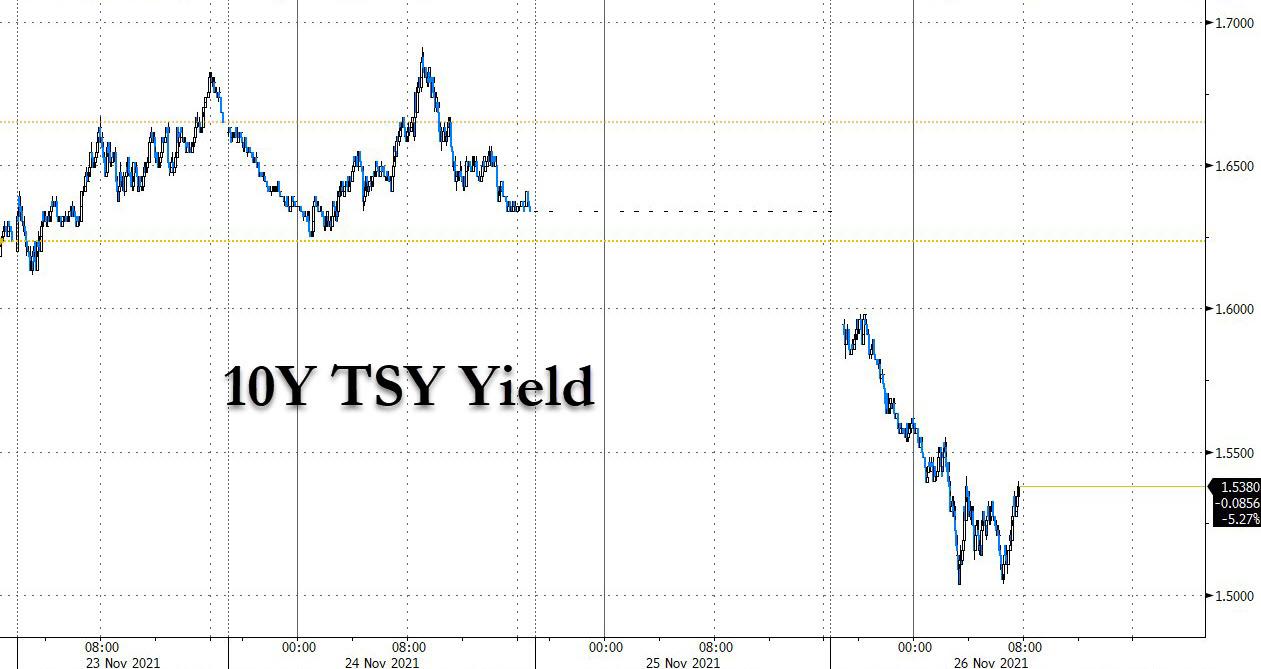
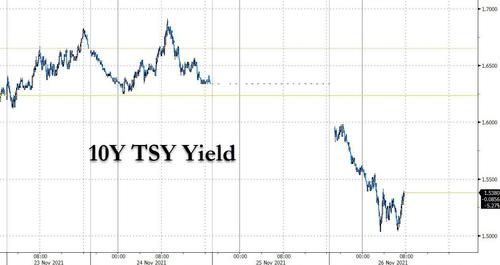
Amid the panicked flight to safety, 10Y TSY yields tumbled as traders slashed bets on monetary tightening by the Federal Reserve (just hours after Goldman predicted that the Fed would double the pace of its taper and hike 3 times in 2022, oops) …
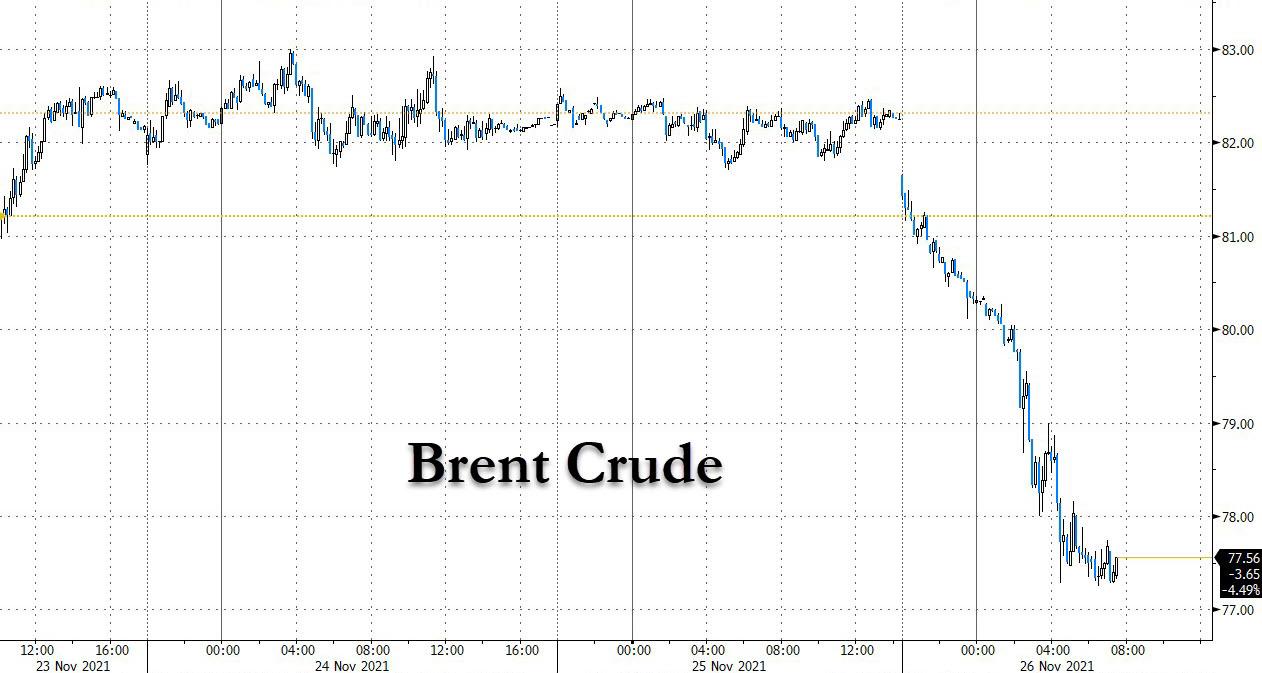
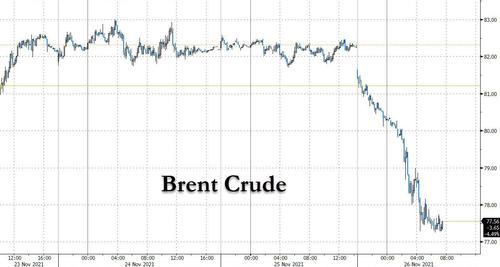
… as did oil amid fears new covid lockdowns will lead to a collapse in crude demand (they will also certainly force OPEC+ to put on pause their plans to keep hiking output by 400K every month).
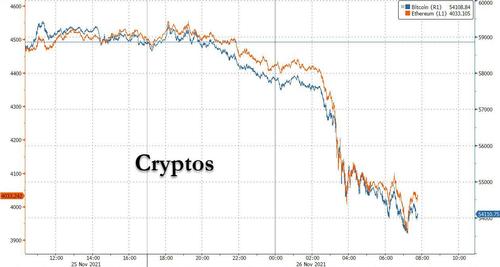
Paradoxically, even cryptos are tumbling, which is surprising since even the dumbest algos should realize by now that a new covid outbreak means more dovish central banks, no tightening, and if nothing else, more QE and more liquidity which is precisely what cryptos need to break out to new all time highs.
Cruise ship operator Carnival slumped 9.1% in premarket trading and Boeing slid 5.8% as travel companies tumbled worldwide. Stay-at-home stocks such as Zoom Video rallied.  Didi Global shares fell after Chinese regulators reportedly asked the ride-hailing giant to delist from U.S. bourses. Here are some of the other big premarket movers:

  • Airlines and other travel stocks slumped in premarket trading on growing concern about a new Covid-19 variant identified in southern Africa. The European Union is proposing to halt air travel from several countries in the area and the U.K. will temporarily ban flights from the region.
  • United Airlines (UAL US) fell 8.9%, Delta Air (DAL US) -7.9%, American Airlines (AAL US) -6.7%; cruiseline-operator Carnival (CCL US) -12%; hotelier Marriott (MAR US) -6.1%; lodging company Airbnb (ABNB US) -6.9%.
  • Stay-at-home stocks that benefit from higher demand in lockdowns rose in premarket, with Zoom Video (ZM US) gaining 8.5% and fitness equipment group Peloton (PTON US) +4.7%.
  • Vaccine stocks surged in premarket, while Pfizer and BioNTech got an added boost after their coronavirus shot won European Union backing for expanded use in children. Moderna (MRNA US) rose 8.8%, Novavax (NVAX US) +6.2%, Pfizer (PFE US) +5.1%, BioNTech (BNTX US) +6.4%.
  • Small biotech stocks gained in premarket as investors sought havens. Ocugen (OCGN US) added 22%, Vir Biotechnology (VIR US) +7.8%, Sorrento Therapeutics (SRNE US) +5%.
  • Cryptocurrency-exposed stocks fell as Bitcoin dropped as investors dumped risk assets. Marathon Digital (MARA US) declined 9%, Riot Blockchain (RIOT US) -8.8%, Coinbase (COIN US) -4.6%.
  • Didi Global (DIDI US) declined 6% in premarket after Chinese regulators were said to have asked the ride-hailing giant to delist from U.S. bourses.
  • Selecta Biosciences (SELB US) dropped 13% in Wednesday’s postmarket ahead of Thursday’s Thanksgiving closure, after saying the U.S. FDA placed a clinical hold on a trial.
  • Quotient Technology (QUOT US) gained 3.9% in Wednesday’s postmarket on news that a board member bought $150,000 of shares.

What happens next will matter and so, all eyes are on the opening bell for the U.S. markets, set to return from the holiday for a shortened trading session. Tumbling futures and a soaring VIX signaled that the rout in Asia and Europe won’t spare New York equities, while lack of liquidity will only make the pain worse. The Japanese yen emerged as the main haven currency of the day, with the dollar languishing.

“Every trader in New York will be rushing to the office now,” said Salm-Salm & Partner portfolio manager Frederik Hildner, adding that news of the new variant could mean the end of the inflation and tapering debate.

The worsening pandemic poses a dilemma for central banks that are preparing to tighten monetary policy to curb elevated price pressures, according to Ipek Ozkardeskaya, senior analyst at Swissquote.

“It’s terrible news,” Ipek Ozkardeskaya, a senior analyst at Swissquote, said in emailed comments. “The new Covid variant could hit the economic recovery, but this time, the central banks won’t have enough margin to act. They can’t fight inflation and boost growth at the same time. They have to choose.”

“We now have a new Covid variant that’s ‘very’ different from the ones we knew so far, a rising inflation, and a market bubble,” she said.  “The only encouraging news is the easing oil prices, which could tame the inflationary pressures and give more time to the central banks before pulling back support.”

In the meantime, the World Health Organization and scientists in South Africa were said to be working “at lightning speed” to ascertain how quickly the B.1.1.529 variant can spread and whether it’s resistant to vaccines. The new threat adds to the wall of worry investors are already contending with in the form of elevated inflation, monetary tightening and slowing growth.

In Europe, the Stoxx 600 index headed for the biggest drop in 13 months plunging 2.7%; travel and banking industries led the Stoxx Europe 600 Index down as much as 3.7%, the biggest intraday drop since June 2020. Airbus slumped 8.6% in Paris and British Airways owner IAG tumbled 12% in London, while food-delivery stocks gained.  Here are some of the biggest European movers today:

  • Stay-at-home stocks and Covid testing firms such as TeamViewer and DiaSorin are among the biggest gainers as worries over a new Covid variant send the Stoxx 600 tumbling on lockdown fears
  • TeamViewer and DiaSorin rise as much as 6% and 7%, respectively
  • On the down side, travel and leisure stocks plunge, with the likes of IAG, Lufthansa and Carnival posting double- digit falls
  • IAG drops as much as 21%
  • Software AG shares rise as much as 9.5% after Bloomberg reported that the firm is exploring strategic options, including a potential sale, with Morgan Stanley saying the company’s biggest headwinds are behind it.
  • Evolution gains as much as 4.6%, recouping part of Thursday’s 16% plunge, with Bank of America saying the share price’s “crazy time” amounts to a good buying opportunity.
  • Skistar rises as much as 3.7%, bucking steep declines for travel and leisure stocks, after Handelsbanken upgraded the stock, saying bookings for the Scandinavian ski resort operator are “set to surge.”
  • Telecom Italia climbs as much as 2.8% following a Bloomberg report that private equity firms KKR and CVC are considering teaming up on a bid for the company.
  • ING Groep falls as much as 11% after Goldman Sachs analyst Jean-Francois Neuez cut his recommendation to neutral from buy.
  • Getlink drops as much as 6% as French fishermen start protests aimed at stepping up pressure on the U.K. in a post-Brexit fishing dispute.

Earlier in the session, MSCI’s index of Asian shares outside Japan fell 2.2%, its sharpest drop since August. Casino and beverage shares were hammered in Hong Kong, while travel stocks dropped in Sydney and Tokyo. Japan’s Nikkei skidded 2.5% and S&P 500 futures were last down 1.8%.

Giles Coghlan, chief currency analyst at HYCM, a brokerage, said the closure of the U.S. market for the Thanksgiving holiday on Thursday had exacerbated moves. “We need to see how transmissible this variant is, is it able to evade the vaccines – this is crucial,” Coghlan said. “I expect this story to drag on for a few days until scientists have a better understanding of it.”

Indian stocks plunged as the detection of a new coronavirus strain rattled investor sentiment globally, raising concerns over a likely setback to the nascent economic recovery.  The S&P BSE Sensex lost 2.9%, the most since mid-April, to 57,107.15 in Mumbai, taking its loss this week to 4.2%, the biggest weekly drop since January. The NSE Nifty 50 Index declined by a similar magnitude on Friday. Reliance Industries was the biggest drag on both measures and declined 3.2%.  “There is fear of this new variant spreading to other countries which might again derail the global economy,” said Hemang Jani, head of equity strategy at Motilal Oswal Financial Services Ltd.   Of the 30 shares in the Sensex index, 26 fell and 4 gained. All but one of 19 sub-indexes compiled by BSE Ltd. retreated, led by a index of realty companies. The S&P BSE Healthcare index was the only sub-index to gain, surging 1.2%. While researchers are yet to determine whether the new virus variant is more transmissible or lethal than previous ones, authorities around the world have been quick to act. The European Union, U.K., Israel, and Singapore placed emergency curbs on passengers from South Africa and the surrounding region.

Travel stocks were among the hardest hit. InterGlobe Aviation Ltd. fell 8.9%, Spicejet Ltd. slipped 6.7% and Indian Hotels Co. Ltd. plunged 11.2%, the most since March 2020.  “Nervousness on the new variant of coronavirus and expectations of the U.S. Fed increasing the pace of tapering have led to recent market weakness,” Amit Gupta, fund manager for portfolio management services at ICICI Securities Ltd. said. “This trend may take some time to recover as the WHO meeting on the new mutant variant impact and hospitalization rates in US and Europe will be watched by the market very closely.”

Crude oil to emerging markets completed this picture of mayhem.

In rates, fixed income was firmly bid as Treasuries extended their advance led by the belly of the curve, outperforming bunds, while money markets pared rate-hike bets amid fears that a new coronavirus strain may spread globally, slowing economic growth. Cash Treasuries outperformed, richening 12-14bps across the short end, with Thursday’s closure exacerbating the optics. As shown above, 10Y Treasury yields shed as much as 10 basis points while the Japanese yen jumped the most since investors’ March 2020 rush for safety. Yields across the curve are lower by more than 8bp at long end, 13bp-15bp out to the 7-year point, moves that if sustained would be the largest since at least March 2020 and in some cases since 2009. Short-term interest rate futures downgraded the odds of Fed rate increases. Gilts richened 10-11bps across the curve, outperforming bunds by 4-5bps. Peripheral and semi-core spreads widen. In FX, JPY and CHF top the G-10 scoreboard with havens typically bid.

In FX, the Bloomberg Dollar Spot Index was little changed after earlier touching a fresh cycle high, and the greenback was mixed versus its Group-of-10 peers as the yen and the Swiss franc led gains while the Canadian dollar and Norwegian krone were the worst performers as commodity prices plunged. Traders pushed back the timing of a 25-basis-point rate increase by the Federal Reserve to July from June, with only one further hike expected for the remainder of 2022. It’s a similar story in the U.K. where the Bank of England is now expected to tighten policy in February instead of next month. Wagers that the ECB will raise its deposit rate by the end of next year have also been slashed, with only a six basis-point increase priced in, half of that seen earlier this week. The European Union is proposing to follow the U.K. in halting air travel from southern Africa after the new Covid-19 variant was identified there. The yen is at the epicenter of skyrocketing currency volatility as the new virus variant shakes markets. The cost of hedging against swings in the Japanese currency over the next week, which captures the release of the next U.S. payrolls report, is the most expensive in more than a year.

In commodities, crude futures are hit hard. WTI drops over 7% before finding support near $73, Brent drops over 5% before recovering near $78. Spot gold grinds higher, adding $21 to trade near $1,809/oz. Base metals are sharply offered with much of the complex off as much as 3%.

Looking at the otherwise quiet day ahead, data releases include French and Italian consumer confidence for November, as well as the Euro Area M3 money supply for October. Otherwise, central bank speakers include ECB President Lagarde, Vice President de Guindos, and the ECB’s Visco, Schnabel, Centeno, Panetta and Lane, and BoE chief economist Pill.

Market Snapshot

  • S&P 500 futures down 1.9% to 4,607.50
  • STOXX Europe 600 down 2.8% to 468.04
  • MXAP down 1.8% to 193.33
  • MXAPJ down 2.2% to 628.97
  • Nikkei down 2.5% to 28,751.62
  • Topix down 2.0% to 1,984.98
  • Hang Seng Index down 2.7% to 24,080.52
  • Shanghai Composite down 0.6% to 3,564.09
  • Sensex down 2.7% to 57,234.83
  • Australia S&P/ASX 200 down 1.7% to 7,279.35
  • Kospi down 1.5% to 2,936.44
  • Brent Futures down 5.8% to $77.46/bbl
  • Gold spot up 0.9% to $1,805.13
  • U.S. Dollar Index down 0.33% to 96.46
  • German 10Y yield little changed at -0.31%
  • Euro up 0.4% to $1.1259

Top Overnight News from Bloomberg

  • The European Union is proposing to halt air travel from southern Africa over growing concern about a new Covid-19 variant that’s spreading there, as the U.K. said it will also temporarily ban flights from the region
  • Those close to the Kremlin say the Russian president doesn’t want to start another war in Ukraine. Still, he must show he’s ready to fight if necessary in order to stop what he sees as an existential security threat: the creeping expansion of the North Atlantic Treaty Organization in a country that for centuries had been part of Russia
  • Bitcoin tumbled 20% from record highs notched earlier this month as a new variant of the coronavirus spurred traders to dump risk assets across the globe
  • Germany’s Greens tapped their two co- leaders to run the foreign ministry and take charge of an influential portfolio overseeing economy and climate protection in the country’s next government under Social Democrat Olaf Scholz

A more detailed breakdown of global markets courtesy of Newsquawk

Asian equity markets declined and US equity futures were also on the backfoot on reopen from the prior day’s Thanksgiving lull with markets spooked by new COVID variant concerns related to the B.1.1.529 variant in South Africa that was first detected in Botswana. The new variant showed a high number of mutations and was said to be the most evolved strain ever which spurred fears it could be worse than Delta and is prompting both the UK and Israel to halt flights from several African nations. ASX 200 (-1.7%) was negative with heavy losses in energy and broad underperformance in cyclicals leading the downturn across all sectors, while the much better than expected Australian Retail Sales data was largely ignored. Nikkei 225 (-2.5%) underperformed and gave up the 29k status as selling was exacerbated by detrimental currency inflows and with SoftBank shares among the worst hit on reports that China is said to have asked Didi to delist from US exchanges on security fears, which doesn’t bode well for SoftBank given that its Vision Fund is the top shareholder in the Chinese ride hailing group with a stake of more than 20%. Hang Seng (-2.5%) and Shanghai Comp. (-0.7%) conformed to the risk aversion with the mood not helped by ongoing geopolitical concerns after a Chinese Defense Ministry spokesperson noted they are ready to crush Taiwan independence bid “at any time”, while China also said it opposes US sanctions on its companies and will take all necessary measures to firmly defend the rights of Chinese companies. Beijing interference further contributed to the headwinds amid the request by China for Didi to delist from US which reports stated regulators could backtrack on and with Tencent subdued after some Chinese state-run companies restricted the use of Tencent’s messaging app.

Top Asian News

  • Stocks in Asia Set for Worst Day Since March on Virus Woes
  • Mizuho CEO Steps Down After Regulator Hit on System Issues
  • Meituan 3Q Revenue Meets Estimates
  • Japan’s Kishida Delivers $316 billion Extra Budget for Recovery

European equities are trading markedly lower (Stoxx 600 -2.9%) with losses in the Stoxx 600 extending to 3.8% WTD. Sentiment throughout the week has been hampered by various lockdown measures imposed across the region with the latest leg lower accelerated by new COVID variant concerns related to the B.1.1.529 variant in South Africa. The new variant has shown a high number of mutations and is said to be the most evolved strain so far. This has spurred fears it could be worse than Delta and has prompted multiple nations to halt flights from several African nations.The handover from the overnight session was an equally downbeat one with the Nikkei 225 (-2.5%) dealt a hammer blow by the risk environment and unfavourable currency flows. Stateside, futures are lower across the board with the RTY the clear laggard with losses of 4.2% compared to the ES -1.8%, whilst the tech-heavy NQ is faring better than peers but ultimately still lower on the session to the tune of 1.6%. Note, early closures in the US and subsequent liquidity conditions could exacerbate some of the moves throughout the session. With the macro calendar light, focus for the session is likely to centre on various nations preventing travel from South Africa whilst potentially imposing more stringent COVID measures domestically. Any further clarity on the spread of the variant and its potential to evade vaccines will be of great interest to the market and likely be the main driving force of price action today. Sectors in Europe are lower across the board with the Stoxx 600 Banking (-5.1%) sector bottom of the pile amid the declines seen in global bond yields as markets scale back expectations of central bank tightening (e.g. pricing now assigns a 63% chance of a 15bps hike by the BoE next month vs. 93% a week ago). Oil & Gas names (-4.8%) are suffering on account of the declines in the crude space with WTI crude in freefall with losses of 6.7% given the potential impact of travel restrictions on demand. Travel restrictions on South Africa (from UK, Israel, EU et al) and the potential for further announcements has crushed the Travel & Leisure sector (-5.7%) with airline names dealt a hammer blow; IAG (-13.5%), easyJet (-11%), Deutsche Lufthansa (-12%), Air France (-9.5%). Elsewhere, there are a whole raft of other laggards which are very much in-fitting with the March 2020 playbook but there are simply too many to list for the purpose of this report. Defensives and Tech are faring better than peers but ultimately still lower on the session to the tune of 1% and 1.9% respectively. Finally, for anyone wanting some positivity from today’s session, the potential for further lockdowns has proved to be beneficial for the likes of HelloFresh (+3.2%), Ocado (+2.1%) and Delivery Hero (+1.9%).

Top European News

  • Airlines Skid on South Africa Travel Bans Tied to Variant
  • German Coalition Proposes a Combustion-Car Ban Without Saying So
  • Putin Pushes Confrontation With NATO as Hardliners Prevail
  • Siemens Is Said to Kick Off Sale of Postal Logistics Business

In FX, the index has been under pressure in the risk-averse environment amid a slump in yields and gains in its basket components – namely the JPY, CHF, EUR (see below) – and with liquidity also thinned by Thanksgiving. From a technical perspective, the index has declined from its 96.787 overnight high, through the 96.500 mark, to a low of 96.332 – with the weekly trough at 96.035. Ahead, the US calendar is once again light, with the US also poised for an early Thanksgiving closure; thus, impulses will likely be derived from the macro environment.

  • JPY, CHF, EUR – Haven FX JPY and CHF are the clear outperformers as a function of risk-related inflows. USD/JPY has retreated from a 115.37 peak and fell through its 21 DMA (114.15) to a base around 113.66 – with the current weekly low around 113.64. USD/CHF retreated from 0.9360 to 0.9260 – with the 50 and 100 DMAs seen at 0.9234 and 0.9219, respectively, ahead of 0.9200. EUR/USD meanwhile gains on what is seemingly an unwind of the carry trade amid a spike in volatility. EUR/USD found support near 1.1200 before rebounding to a current 1.1288 peak.
  • AUD, NZD, CAD, GBP – The non-US Dollar risk currencies bear the brunt of the latest market downturn, with losses across industrial commodities not helping. The Loonie has taken the spot as the biggest G10 loser as hefty COVID-induced losses in the oil complex keep the currency suppressed. USD/CAD trades towards the top of a current 1.2647-2774 range. AUD is also weighed on by softer base metal prices – AUD/USD fell from a 0.7200 overnight high to a current low at 0.7110. On that note, Westpac sees AUD/USD pushed down to 0.7000 by Jun 2022 (prev. 0.7700) amid rate differentials with the US; Westpac made significant changes to its FOMC policy forecast and now expect consecutive increases in the fed funds rate in Jun, Sept, and Dec 2022. NZD/USD is slightly more cushioned amid smaller exposure to commodities, and as the AUD/NZD cross takes aim at 1.0450 to the downside. GBP, meanwhile, was initially among the losers amid its high-beta status but thereafter nursed losses in a move that coincided with EUR/GBP rejecting an upside breach of its 21 DMA at 0.8475.
  • EM – The ZAR is the standout laggard given the new South African COVID variant – B.1.1.529 COVID-19 variant (expected to be named Nu) – which is said to be the most evolved strain so far and thus prompted several countries to halt travel to the country of origin. USD/ZAR currently trades within a 15.9375-16.3630 intraday band. Meanwhile, the downturn oil sees USD/RUB north of 75.00 and closer to 76.00 from a 74.2690 base. The Lira also feels some contagion despite the lower oil prices (Turkey being a large net oil importer) – USD/TRY is back on a 12.00 handle and within 11.92-1226 parameters at the time of writing.

In commodities, the crude complex has been hit by compounding COVID fears which in turn triggered various travel restrictions and subsequently took its toll on global crude demand prospects. The new and more evolved South African variant prompted the UK, Singapore, and Israel to expand their travel red lists to include some African nations (Israel reported its first case of the new COVID-19 variant known as B.1.1.529). Japan also imposed tighter border restrictions. China’s Shanghai city see flights impacted by its own outbreak. Europe also tackles its surge in daily cases – German Green Party’s Baerbock (incoming Foreign Minister) does not rule out a German lockdown, according to Spiegel. EU Commission President von der Leyen is also to propose activation of the emergency air brake, to halt travel from southern Africa due to the B.1.1.529 COVID-19 variant. Losses in oil have exacerbated – with WTI Jan and Brent Feb now under USD 74/bbl (vs high 78.65/bbl) and USD 77/bbl (vs high 80.42/bbl), -6.0% and -5.0% respectively. This comes ahead of the OPEC+ confab next week, whereby OPEC watchers have suggested that oil prices will be a large contributor to the final decision. It is difficult to see how OPEC+ will increase output to the levels the US et al. will be content with, with the latest COVID downturn building the case for a pause in planned output hikes. Elsewhere, haven demand sees spot gold extend on gains above USD 1,800/oz after topping the 100 DMA (1,792.95/oz), 200 DMA (1,791.38/oz), 50 DMA (1,790.13/oz) overnight. Base metals are softer across the board amid the risk aversion. LME copper posts losses of around 3% at the time of writing, as prices threaten a more convincing downside breach of USD 9,500/t.

US Event Calendar

  • Nothing major scheduled

DB’s Jim Reid concludes the overnight wrap

Things have escalated on the covid front quite rapidly over the last 12 hours. Yesterday new covid variant B.1.1.529 was slowly starting to gather increasing attention but overnight it has begun to dominate markets and has caused a notable flight to quality with 10 year USTs -8bps lower. It was originally identified in Botswana and is starting to spread rapidly in Africa. The South African Health Minister has said it is “of serious concern”. Almost 100 cases have already been identified in South Africa and the UK moved to put the country back (along with 5 other African nations) on a reinstated red travel list last night with others following this morning. The variant is said to be the most heavily mutated version yet and the WHO will meet today to decide if it is a variant of interest or a variant of concern. So a lot of eyes will be on how severe it is and whether it completely evades vaccines. At this stage very little is known. Mutations are often less severe so we shouldn’t jump to conclusions but there is clearly a lot of concern about this one. Also South Africa is one of the world leaders in sequencing so we are more likely to see this sort of news originate from there than many countries. Suffice to say at this stage no one in markets will have any idea which way this will go.

Overnight in Asia all benchmarks are trading lower on the news with the Shanghai Composite (-0.50%), CSI (-0.64%), KOSPI (-1.27%), Hang Seng (-2.13%) and the Nikkei (-2.90%) all lower. Airlines and other travel stocks have obviously fallen heavily. Hong Kong has detected two confirmed cases of the new variant just as Hong Kong and China were considering quarantine-free travel. S&P 500 (-0.93%) and DAX (-1.82%) futures are also much weaker. Elsewhere, in Japan, CPI rose +0.5% year-on-year (+0.4% consensus and +0.1% previously), on the back of 16-month high fuel prices.

With the US out on holiday for Thanksgiving, there wasn’t much going on yesterday after a very quiet day in markets. The variant news was only slowly creeping into the news flow so it hardly impacted trading. But in keeping with the theme of recent days, both inflation and the latest covid wave in Europe remained very much in the picture as jitters continue to increase that we could see further lockdowns as we move towards Christmas.

Starting with the headline moves, European equities did actually show signs of stabilising yesterday, with the STOXX 600 up +0.42% thanks to a broad-based advance across the continent. In fact that’s actually the index’s best daily performance in over three weeks, although that’s not reflecting any particular strength, but instead the fact the index inched steadily but persistently towards a record high before selling off again a week ago. Other indices moved higher across the continent too, with the FTSE 100 (+0.33%), the CAC 40 (+0.48%) and the DAX (+0.25%) all posting similar advances. These will all likely reverse this morning.

One piece of news we did get came from the ECB, who released the account of their monetary policy meeting for October. Something the minutes stressed was the importance that the Governing Council maintain optionality in their policy settings, with one part acknowledging the growing upside risks to inflation, but also saying “it was deemed important for the Governing Council to avoid an overreaction as well as unwarranted inaction, and to keep sufficient optionality in calibrating its monetary policy measures to address all inflation scenarios that might unfold.”

Against this backdrop, 10yr bond yields moved lower across multiple countries, with those on bunds (-2.3ps), OATs (-2.3bps) and BTPs (-1.9bps) all declining. There was also a flattening in all 3 yield curves as well, with the 2s10s slope in Germany (-3.0bps), France (-3.7bps) and Italy (-2.8bps) shifting lower. And the moves also coincided with a continued widening in peripheral spreads, with both the Spanish and the Greek spreads over 10yr bund yields widening to their biggest levels in over a year.

Of course, one of the biggest concerns in Europe right now remains the pandemic, and yesterday saw a number of fresh measures announced as policymakers seek to get a grip on the latest wave. In France, health minister Veran announced various measures, including the expansion of the booster rollout to all adults, and a reduction in the length of time between the initial vaccination and the booster shot to 5 months from 6. Meanwhile in the Czech Republic, the government declared a state of emergency and approved tighter social distancing measures, including the closure of restaurants and bars at 10pm. And in Finland, the government have said that bars and restaurants not using Covid certificates will not be able to serve alcohol after 5pm. All this came as the European Medicines Agency recommended that the Pfizer vaccine be approved for children aged 5-11, which follows the decision to approve the vaccine in the US. Their recommendation will now go to the European Commission for a final decision.

There wasn’t much in the way of data at all yesterday, though German GDP growth in Q3 was revised down to show a +1.7% expansion (vs. +1.8% previous estimate). Looking at the details, private consumption was the only driver of growth (+6.2%), with government consumption (-2.2%), machinery and equipment (-3.7%) and construction (-2.3%) all declining over the quarter.

To the day ahead now, and data releases include French and Italian consumer confidence for November, as well as the Euro Area M3 money supply for October. Otherwise, central bank speakers include ECB President Lagarde, Vice President de Guindos, and the ECB’s Visco, Schnabel, Centeno, Panetta and Lane, and BoE chief economist Pill.
Tyler Durden
Fri, 11/26/2021 – 08:12

via ZeroHedge News https://ift.tt/3xrSZNZ Tyler Durden

No Mass Transit Grants for California, Biden Administration Rules


amogh-manjunath-HksFlo1t8iA-unsplash

In terms of entertaining political news, it’s hard to top the latest events from the Biden administration. Democrats are devouring each other as the president’s approval ratings slip into Jimmy Carter territory. There’s that video of Vice President Kamala Harris talking about “zee plan” with scientists in Paris—seemingly in a fake French accent.

Then on Thursday the House of Representatives censured loony GOP congressman Paul Gosar for circulating “a manipulated video on his social media accounts depicting himself killing Representative Alexandria Ocasio-Cortez and attacking…Biden.” It’s quite the circus.

Yet arguably the week’s most-enjoyable D.C. story involves a bureaucratic interpretation of an arcane federal statute and its intersection with a 2013 California law. It’s a chuckle-inducing dispute once you delve into the complex backstory—and look at the unhinged reactions of California officials who are being hoisted on their own union-built petard.

We just learned that the U.S. Department of Labor has denied California $12 billion in transit funding, including grants from the recently signed infrastructure bill. The reason? A 1964 federal law requires the labor department to certify that the state agencies seeking any mass-transit grants are “protecting the interests of any affected employees,” The Fresno Bee reported.

So, the Biden administration is claiming that California—the state that provides its public employees with unparalleled pay and pension benefits, and provides collective-bargaining rights unheard of anywhere else—is being mean to its “affected” public employees because the state passed a 2013 law, authored by Democrats, that infinitesimally reined in pension benefits.

As SFist summarized, “Biden is withholding giant amounts of federal money from California public transit because the state’s public-employee pension system is apparently not paying people enough.” Labor-allied California politicians—facing a reduction in funds for beloved transit programs—are so angry they’re almost sounding sensible. You see why I’m laughing?

For instance, Gov. Gavin Newsom penned an artfully written letter on Nov. 10 to Labor Secretary Marty Walsh blasting the funding cut off. In it, he laments that the department’s grant-denial decision “is a complete reversal of (the agency’s) final determination in 2019 that California’s statewide pension reform legislation…’does not present a bar to certification.'”

The labor-friendly governor is furious at the labor-friendly Biden administration for adopting a labor-friendly position. Adding to my delight, Newsom favorably cites the previous administration, which, as noted, determined that the pension law does not harm state workers. Yes, Newsom is citing a Trump appointee to overturn his Biden-administration replacement.

It gets better. Pension-reform critic Newsom makes a powerful argument defending the 2013 pension-reform law, known as the Public Employees’ Pension Reform Act: “After multiple years of litigation, the reviewing federal court found in California’s favor three times, and the department did not pursue appeals. The department’s own lawyers noted that the federal court’s decisions were ‘thoroughly reasoned’ … That should conclude the matter.”

As a refresher, Gov. Jerry Brown led the charge for PEPRA. The state was facing budget shortfalls and pension costs were obliterating local budgets (they still are, actually). It pared back some of the most generous pension formulas for new hires and eliminated pension-spiking schemes such as “air time,” which allowed public employees to buy future retirement credits for pennies on the dollar.

The law in no way impaired collective-bargaining rights. In fact, the main purpose of PEPRA was political. It helped Brown convince the public that he was serious about reforming the budget process—and PEPRA’s passage softened up voters enough to pass the Proposition 30 tax hike.

Any perusal of Transparent California will show the eye-popping compensation packages that California public employees still receive. No other governor or Legislature hands out such lush benefits to public employees—and yet the Biden administration is punishing California for a Democratic-sponsored law that imposed only the slightest restraint.

In an act of hubris, some California public-employee unions sued over PEPRA—and claimed the rollback of pension-spiking gimmicks violated the California Rule. There is no actual rule, but a series of court interpretations concluded that governments cannot reduce pensions going forward unless they provide something of equal value.

Admirably, Brown defended PEPRA in court—and made a broader argument for rolling back that blasted California Rule, which prevents cities from limiting overly generous pension formulas that are obliterating their budgets.

Brown pointed to a lower-court ruling that said that public employees have the right to a reasonable pension—”not an immutable entitlement to the most optional formula of calculating the pension.” The California Supreme Court upheld the pension-reform law, but punted on the California Rule. That should indeed be the end of the matter, but the feds still are smarting over any effort to reform pensions.

I’m not bemoaning the potential loss of transit funds given they tilt heavily toward climate-change folderol. It is funny, however, watching California Democrats get tripped up by their own union allies.

This column was first published in The Orange County Register.

The post No Mass Transit Grants for California, Biden Administration Rules appeared first on Reason.com.

from Latest – Reason.com https://ift.tt/3CSSD3R
via IFTTT