The Mayflower Subcompact

I have stayed at the Mayflower Hotel many times. For nearly a century, the Hotel has been a landmark in D.C. It is one of my favorite places to stay. The Mayflower is also home for the Federalist Society National Convention. On any given day, the hotel bustled with energy. The concierge lounge brimmed with movers and shakers. It was a place to be. But no more.

Yesterday, I checked into the Mayflower for the first time since the pandemic began. It is not the same place. The concierge lounge on the tenth floor is closed. The front desk clerk told me there was not enough capacity to justify keeping it open. Marriott Platinum members receive a $27 credit for breakfast at Edgar’s, which will not cover a full breakfast with tax and tip. Moreover, there is no room service. I got in late, so I ordered Dominos. The hotel is also quite dead. There was no conference going on. The grand hall was empty. I felt like I was in a bizarro world.

Alas, this full service hotel no longer has full service. I hope things improve for November, when the National Lawyers Convention will be held.

from Latest – Reason.com https://ift.tt/3adFJBy
via IFTTT

A.G. Merrick Garland Tells FBI To Investigate Parents Who Yell at School Officials About Critical Race Theory


upiphotostwo820085

Taking note of a supposed “spike” in harassment and intimidating behavior directed at public school officials, Attorney General Merrick Garland has instructed the FBI to be on the lookout for angry parents demanding accountability at school board meetings.

On Monday, Garland sent a memo to the federal law enforcement agency directing it to coordinate with the nation’s 14,000 school districts. This action comes after the Biden administration received a plea from the National School Boards Association (NSBA) to protect schools from the “imminent threat” of parents sending “threatening letters and cyberbullying” school officials. The association considers such activities to be akin to “domestic terrorism.”

“As these acts of malice, violence, and threats against public school officials have increased, the classification of these heinous actions could be the equivalent to a form of domestic terrorism and hate crimes,” wrote the NSBA.

Has some great number of teachers, principals, and district leaders come under violent attack? Of course not. What both the Justice Department and the concerned school boards are really talking about it is the increased number of recent community meetings that have featured angry feedback from parents. These parents are sick of COVID-19 mitigation efforts that have relegated actual students to afterthought status within the education department: the farce of virtual learning, mandatory closure when asymptomatic cases are detected, ceaseless masking. Young people who have the least to fear from the pandemic—the severe disease and death rate for the under-18 crowd is extremely low—have been forced to make tremendous educational and social sacrifices to bend the curve of COVID-19. Families are fed up with a public education system that puts the needs of students last, and they are speaking up about it.

Many parents are also increasingly concerned about the curriculum in their schools. Garland’s memo garnered widespread attention in conservative media circles yesterday after it was shared on Twitter by Christopher Rufo, a senior fellow at the Manhattan Institute who works to expose what he has termed “critical race theory.” As I wrote previously, whether or not CRT is literally being taught in many K-12 schools hinges in part on a semantics argument. CRT, the obscure academic theory positing that the structures of U.S. society are racist to their core—and thus it is impossible to separate or ignore racism when confronting other issues—is not exactly sweeping U.S. kindergartens; but CRT—the tendency to reduce individuals to crude racial stereotypes that is pushed by divisive and misguided anti-whiteness gurus like Robin DiAngelo and Ibram X. Kendi—has certainly become an important component of corporate and university diversity training, and is, to some extent, trickling down to K-12 instruction.

Parents should be forgiven for not wanting their kids to be taught from the perspective that “objectivism,” “individuality,” and “a sense of urgency,” are aspects of whiteness, and that black students struggle to think analytically for racial and cultural reasons. These are racist assumptions; they are false, and they do not belong in schools. Yet they were elements of “Characteristics of White Supremacy Culture,” an instructional document that has drawn plenty of citations in educational settings. To the extent that the phrase critical race theory is shorthand for this sort of thing, the outrage about it seems justified.

But even if it were not, parents should still enjoy the right to speak up at school board meanings and demand a say in their children’s education. Virginia Gov. Terry McAuliffe, a Democrat, recently lashed out at anti-CRT efforts, asserting that “I don’t think parents should be telling schools what they should teach.”

He must have forgotten that the public school system is supposed to serve the needs of families, and not the other way around. Direct meddling in the day-to-day teaching decisions of teachers can be burdensome and counterproductive, but these parents aren’t monitoring the classrooms: They’re showing up to public meetings to exercise their First Amendment rights and participate in the democratic process of managing a public institution. And they often encounter furious resistance from public officials, who have turned off microphones, ended comment periods early, and occasionally mocked parents behind their backs.

It’s true that some school board meetings have turned raucous, and undoubtedly there are examples of parents overreacting, or even engaging in harassment. But there’s no evidence whatsoever that this represents some great danger necessitating the involvement of the FBI.

from Latest – Reason.com https://ift.tt/2WKc4wG
via IFTTT

Rabobank: The Surge In Commodity Prices Is Not Led By Bullishness, But By Panic

Rabobank: The Surge In Commodity Prices Is Not Led By Bullishness, But By Panic

By Michael Every of Rabobank

Blessed are the cheese-makers?

Bloomberg markets informs me this morning that “inflation, not stagflation” is back. As they put it: stocks went up again yesterday to match bond yields; both energy and broader commodities are spiking; and the US ISM services PMI was firm at 61.9, with prices paid at 77.5. To be honest, that view is similar to the one you get from the back of a large crowd when you can’t actually see or hear the speaker properly: (“Speak up!”)

Market were likewise optimistic because Senator “Stonewall” Manchin –who is not the one to focus on, Senator “Bathroom” Sinema is– allegedly said: “I’m not going to rule things out” vis-à-vis the $3.5trn reconciliation package, suggesting the fiscal logjam can be broken and the debt ceiling dealt with. Except, as @lindsaywise tweets, the Hill journalist pool consensus is that he actually said “I’m not going to say anything about it.” Our hi-tech 24/7 global markets are the “Blessed are the cheese-makers” Python skit. Also note the content of the $3.5trn bill (green, Hyde amendment) is as divisive as the price-tag. Moreover, Republicans are united in blocking a debt-ceiling increase with a Senate filibuster because this forces the Democrats to use reconciliation to pass it, using up ammunition that cannot then be steered to Progressive-favoured spending. So, will the Greek inherit the earth? (“Oh, it’s the meek! Blessed are the meek! Oh, that’s nice, isn’t it? I’m glad they’re getting something, ’cause they have a hell of a time.”)

More broadly, the surge in commodity prices we are seeing is not led by bullishness, but by panic as energy prices spike and supply chains threaten to collapse. In China –despite a national holiday– the China Banking and Insurance Regulatory Commission has asked relevant lenders to safeguard the “reasonable financing needs” of coal mining, power, iron, and steel, and to “do everything possible” to increase support for securing supply, stabilizing commodity prices, safeguarding people’s basic livelihoods, and a “smooth operation of the economy”. This includes loan extensions with “controllable risks”, increasing regulatory tolerance for non-performing loans, prohibiting loan withdrawal and cutting-off of credit, and preventing “campaign-styled” carbon reductions – with the exception of firms with overcapacity. Now combine this kitchen sink credit policy with “at any cost” energy imports.

Global firms are also responding to the energy surge and shipping-price spike by hoarding. What happens when stocks have been built up enough? Deflation. (And note the Atlanta Fed GDPNow tracker is already down to 1.3% q/q annualized while some expectations for China are flat GDP q/q). Let’s be clear, the structural change in shipping costs and physical unavailability of goods means supply-side inflation will stay high for a long time ahead, and stockpiling will be very difficult to do. But where we do see surges in purchases, it is this dynamic at play, not “inflation”.

The only way it is inflationary is if wages rise. This is happening in pockets as the labor market is restructured post-Covid. Yet even where the trend is most evident, in the post-Brexit UK, the government is presiding over what we dubbed last year as “central planning with no plan”. And there, as elsewhere, if central banks and governments stimulate again without new supply chains or energy sources we are just back to stagflation.

Talking of central bank stimulus, Senator Warren attacked the Fed again yesterday, saying FOMC Chair Powell has “failed as a leader” and that there are “legitimate questions about conflicts of interest and insider trading,” as a further Fed member was suggested to be involved. Regardless, President Biden has said that he has “confidence” in Powell. In British politics, that is usually a precursor to a ministerial resignation in order to spend more time with their family.

Meanwhile, market bullishness was also triggered by the SEC’s Gensler saying he won’t ban crypto, like China. (“Well, obviously, this is not meant to be taken literally. It refers to any manufacturers of dairy products.”) No, the SEC won’t ban it: they will just regulate and tax it, so the market serves state power. That’s how you deal with what billionaire Ken Griffin calls a “jihadist call” against the US dollar.

The RBNZ, as expected, today took the decision to hike rates 25bp to 0.50% despite a large slice of the economy being in lockdown, and its largest trading partner being in energy meltdown (and a Common Prosperity crackdown and a property break-down). It noted: “Headline CPI inflation is expected to increase above 4% in the near term before returning towards the 2% midpoint over the medium term. The near-term rise in inflation is accentuated by higher oil prices, rising transport costs and the impact of supply shortfalls. These immediate relative price shocks risk leading to more generalised price rises. At this time, measures of core inflation and medium-term inflation expectations remain close to 2%. The Committee noted that further removal of monetary policy stimulus is expected over time, with future moves contingent on the medium-term outlook for inflation and employment.” The Bank also added that the “level of house prices is unsustainable” – implying more tightening or macro-prudential measures to deal with it, or just a warning of a crash? Let’s now watch how raising rates against a massive supply-shock works out for a trade-and-housing dependent economy with low unemployment and a backdrop of fiscal stimulus. Blessed are the manufacturers of dairy products, or not?

Geopolitically, today sees the first of what are likely to be fruitless rounds of US-China security pow-wows, this one in Switzerland. That is as: the US bans the export of some nuclear materials to China; the Biden administration reveals how many nukes it has –less than thought– removing strategic ambiguity (why not their locations too?); John Kerry suggests President Biden was unaware of either the AUKUS deal or the fall-out with France; the CIA admits dozens of its operatives around the world have been killed of late; and Taiwan’s president writes a pleading letter to the world in Foreign Affairs. You know, a normal day in modern markets.

Moreover, Poland has agreed to buy US F-35 jets, suggesting integration into the US (and UK) defense umbrella, as well as its separate move towards US LNG networks over Russian – autonomia strategiczna. That leaves any potential EU army in “the year of defense” that is 2022 looking very French, when all the financial muscle is German. If national-security muscle is going to mean more realpolitik control over purse strings ahead, and “they shall beat their ploughshares into swords, and their pruning hooks into spears”, will the EU’s top cheese-makers be blessed and inherit the earth?

Tyler Durden
Wed, 10/06/2021 – 10:45

via ZeroHedge News https://ift.tt/3Bh4fxL Tyler Durden

WTI Holds Losses After Surprise Crude, Gasoline Inventory Builds

WTI Holds Losses After Surprise Crude, Gasoline Inventory Builds

Oil prices are tumbling this morning, pressured by the broad weakness in stocks, a surprise build in crude stocks reported by API, and some positive headlines from Putin over the EU gas situation which may remove some upward pressure on oil prices from rotation.

Jeffrey Halley, analyst at brokerage OANDA, said both crude contracts looked overbought based on a widely followed technical indicator, the relative strength index.

“That may signal some daily pullbacks this week but does not change the underlying bullish case for oil,” he said.

Some downward pressure came from the API’s figures showing signs of slowing fuel demand and all eyes are on the official data to see if that is confirmed.

API

  • Crude +951k (-300k exp)

  • Cushing +1.999mm

  • Gasoline +3.682mm

  • Distillates +345k

DOE

  • Crude +2.345mm (-300k exp)

  • Cushing  +1.548mm

  • Gasoline +3.256mm

  • Distillates -396k

Official DOE data showed a big crude build last week, confirming API’s data, for the second straight week of rising inventories – not what the market expected from ‘recovery’. Gasoline stocks also jumped higher…

Source: Bloomberg

Crude production is rebounding finally from Hurricane Ida’s impact, though remains below pre-Ida levels…

Source: Bloomberg

After almost tagging $80 overnight, WTI was trading around $77.50 ahead of the official DOE data and held those losses after the crude/gasoline builds…

Bloomberg Intelligence Energy Analyst Fernando Valle lays out the environment: The energy crisis in Europe and China is sparking optimism across the oil and gas value chain. Crack spreads and oil prices are both up sharply, even after the increase in inventories for the period ended Sept. 24. Natural gas has seen the largest gains, which may help gas-to-diesel switching if there’s a cold winter in the Northern Hemisphere. Still, higher oil prices and ongoing issues in China may hurt consumption in coming months, especially if inflation of other commodities remains a drag on disposable income. Refinery utilization may not see another large boost as operators start maintenance season, delayed after Hurricane Ida. Shell’s Norco plant, which has been offline since the storm, is expected to restart by mid-October and reach capacity within a month.

Tyler Durden
Wed, 10/06/2021 – 10:35

via ZeroHedge News https://ift.tt/306qjNX Tyler Durden

The Mayflower Subcompact

I have stayed at the Mayflower Hotel many times. For nearly a century, the Hotel has been a landmark in D.C. It is one of my favorite places to stay. The Mayflower is also home for the Federalist Society National Convention. On any given day, the hotel bustled with energy. The concierge lounge brimmed with movers and shakers. It was a place to be. But no more.

Yesterday, I checked into the Mayflower for the first time since the pandemic began. It is not the same place. The concierge lounge on the tenth floor is closed. The front desk clerk told me there was not enough capacity to justify keeping it open. Marriott Platinum members receive a $27 credit for breakfast at Edgar’s, which will not cover a full breakfast with tax and tip. Moreover, there is no room service. I got in late, so I ordered Dominos. The hotel is also quite dead. There was no conference going on. The grand hall was empty. I felt like I was in a bizarro world.

Alas, this full service hotel no longer has full service. I hope things improve for November, when the National Lawyers Convention will be held.

from Latest – Reason.com https://ift.tt/3adFJBy
via IFTTT

Biden Sows Confusion By Claiming He Spoke To President Xi About The “Taiwan Agreement”

Biden Sows Confusion By Claiming He Spoke To President Xi About The “Taiwan Agreement”

Amid what Taiwan’s defense minister Chiu Kuo-cheng has just described as the worst tensions with China in 40 years following four days of consecutive PLA jet incursions into contested airspace near Taiwan, President Biden apparently sought to defuse tensions in his Tuesday call with Chinese President Xi Jinping.

Last month we warned that, for the people of Taiwan, it is officially “time to worry” about the prospect of an invasion, or another act of aggression, by Beijing to try and bring the independently governed island under the PROC’s control – one of President Xi’s loftiest geopolitical objectives as he prepares for an unprecedented third term as China’s paramount leader. President Xi has been very clear with his rhetoric: Taiwan belongs to China (just like Hong Kong), and any foreign power that would meddle in the relationship (as the US is obligated to do, by treaty) could face the full military wrath of China.

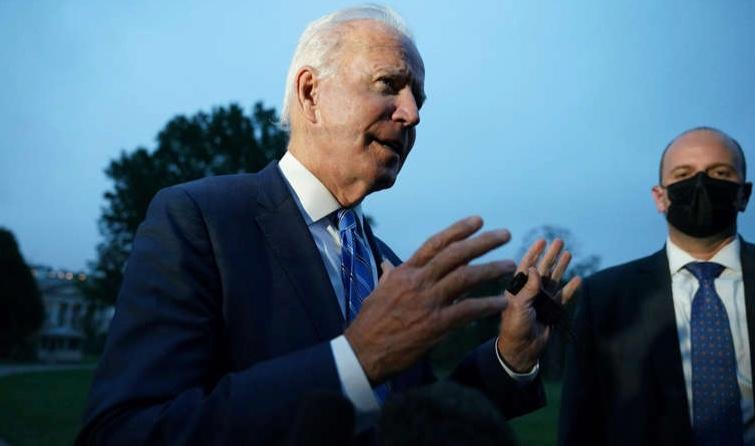
As a series of increasingly aggressive military drills ratchets up tensions between Beijing and Taipei, President Biden – preoccupied with the battle at home over his domestic agenda – threw reporters for a loop late Tuesday when he told them after a long day of stumping behind the domestic agenda that he had spoken to President Xi about Taiwan and that they had agreed to abide by the “Taiwan agreement”.

“I’ve spoken with Xi about Taiwan. We agree…we’ll abide by the Taiwan agreement,” he said. “We made it clear that I don’t think he should be doing anything other than abiding by the agreement.”

Reuters’ Vincent Lee quickly pointed out that Biden appeared to be referencing a conversation from more than a month ago (not a recent call, as he seemed to imply) while also pointing out that there is no “Taiwan Agreement”.

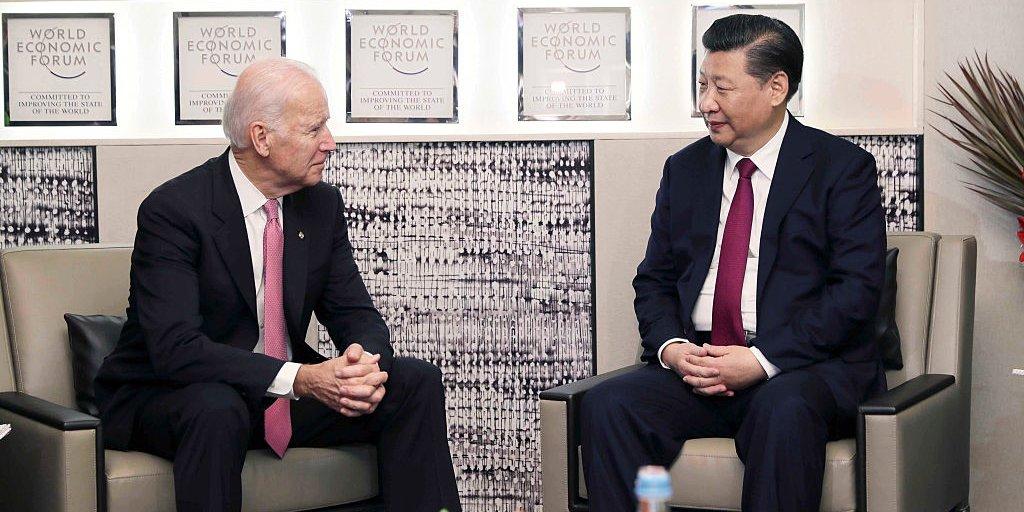
2017 then-Vice President Joe Biden meets with Xi in Davos, Xinhua/Getty Images

It surmised that Biden appeared to be referring to the Taiwan Relations Act, which binds the US to establish diplomatic relations with Beijing, not Taipei (while obligating the US to supply Taiwan with the means to defend itself).

Over the last couple of years, Beijing has made a stink about arms sales to Taiwan under the Trump Administration, with more deals expected under Biden and his successors.

Earlier this week, White House Press Secretary Jen Psaki urged China on Monday to cease its “provocative military activity near Taiwan,” saying the action is “destabilizing, risks miscalculations and undermines regional peace and stability.”

Biden’s remarks on the call were brief but clear while talking to reporters on the White House lawn…

Taiwan’s Foreign Ministry said Wednesday that it had sought “clarification” from the US about Biden’s comments, and was reassured that American policy toward Taiwan had not changed, and that the US commitment to them was “rock solid” – including the obligation to help maintain its military defense.

“Facing the Chinese government’s military, diplomatic and economic threats, Taiwan and the United States have always maintained close and smooth communication channels,” Taiwan’s Foreign Ministry said, noting recent US comments of concern about China’s activities.

Biden spoke to reporters about China after returning from a trip to Michigan to stump for his domestic agenda, which is presently caught in the middle of a bitter partisan fight among the Democrats.

Following the military drills over the weekend, the US on Sunday urged Beijing to stop with its provocative military “drills”.

“The United States is very concerned by the People’s Republic of China’s provocative military activity near Taiwan, which is destabilizing, risks miscalculations, and undermines regional peace and stability,” State Department spokesperson Ned Price said in a statement on Sunday.

But China is currently in the middle of its ‘National Day’ holiday. We wouldn’t be surprised to see more “patriotic” demonstrations of China’s rising military strength in the coming days. Meanwhile, Jake Sullivan, Biden’s top NatSec advisor, is presently meeting a Chinese counterpart in Zurich.

Tyler Durden
Wed, 10/06/2021 – 10:20

via ZeroHedge News https://ift.tt/3D8pZMK Tyler Durden

A.G. Merrick Garland Tells FBI To Investigate Parents Who Yell at School Officials About Critical Race Theory


upiphotostwo820085

Taking note of a supposed “spike” in harassment and intimidating behavior directed at public school officials, Attorney General Merrick Garland has instructed the FBI to be on the lookout for angry parents demanding accountability at school board meetings.

On Monday, Garland sent a memo to the federal law enforcement agency directing it to coordinate with the nation’s 14,000 school districts. This action comes after the Biden administration received a plea from the National School Boards Association (NSBA) to protect schools from the “imminent threat” of parents sending “threatening letters and cyberbullying” school officials. The association considers such activities to be akin to “domestic terrorism.”

“As these acts of malice, violence, and threats against public school officials have increased, the classification of these heinous actions could be the equivalent to a form of domestic terrorism and hate crimes,” wrote the NSBA.

Has some great number of teachers, principals, and district leaders come under violent attack? Of course not. What both the Justice Department and the concerned school boards are really talking about it is the increased number of recent community meetings that have featured angry feedback from parents. These parents are sick of COVID-19 mitigation efforts that have relegated actual students to afterthought status within the education department: the farce of virtual learning, mandatory closure when asymptomatic cases are detected, ceaseless masking. Young people who have the least to fear from the pandemic—the severe disease and death rate for the under-18 crowd is extremely low—have been forced to make tremendous educational and social sacrifices to bend the curve of COVID-19. Families are fed up with a public education system that puts the needs of students last, and they are speaking up about it.

Many parents are also increasingly concerned about the curriculum in their schools. Garland’s memo garnered widespread attention in conservative media circles yesterday after it was shared on Twitter by Christopher Rufo, a senior fellow at the Manhattan Institute who works to expose what he has termed “critical race theory.” As I wrote previously, whether or not CRT is literally being taught in many K-12 schools hinges in part on a semantics argument. CRT, the obscure academic theory positing that the structures of U.S. society are racist to their core—and thus it is impossible to separate or ignore racism when confronting other issues—is not exactly sweeping U.S. kindergartens; but CRT—the tendency to reduce individuals to crude racial stereotypes that is pushed by divisive and misguided anti-whiteness gurus like Robin DiAngelo and Ibram X. Kendi—has certainly become an important component of corporate and university diversity training, and is, to some extent, trickling down to K-12 instruction.

Parents should be forgiven for not wanting their kids to be taught from the perspective that “objectivism,” “individuality,” and “a sense of urgency,” are aspects of whiteness, and that black students struggle to think analytically for racial and cultural reasons. These are racist assumptions; they are false, and they do not belong in schools. Yet they were elements of “Characteristics of White Supremacy Culture,” an instructional document that has drawn plenty of citations in educational settings. To the extent that the phrase critical race theory is shorthand for this sort of thing, the outrage about it seems justified.

But even if it were not, parents should still enjoy the right to speak up at school board meanings and demand a say in their children’s education. Virginia Gov. Terry McAuliffe, a Democrat, recently lashed out at anti-CRT efforts, asserting that “I don’t think parents should be telling schools what they should teach.”

He must have forgotten that the public school system is supposed to serve the needs of families, and not the other way around. Direct meddling in the day-to-day teaching decisions of teachers can be burdensome and counterproductive, but these parents aren’t monitoring the classrooms: They’re showing up to public meetings to exercise their First Amendment rights and participate in the democratic process of managing a public institution. And they often encounter furious resistance from public officials, who have turned off microphones, ended comment periods early, and occasionally mocked parents behind their backs.

It’s true that some school board meetings have turned raucous, and undoubtedly there are examples of parents overreacting, or even engaging in harassment. But there’s no evidence whatsoever that this represents some great danger necessitating the involvement of the FBI.

from Latest – Reason.com https://ift.tt/2WKc4wG
via IFTTT

Instagram’s Effect on Teens Gives Congress the Latest Pretext To Put Tech on Trial


covphotos168732

Congress continues its power grab for the internet. The pretext this time was the mental health of teenagers who use Instagram. But U.S. lawmakers these days don’t really need much impetus for intervention. Every few weeks—and sometimes more frequently—Congress holds new “Big Tech” hearings, designed to give them opportunities for showboating and pushing the same grab bag of internet regulations.

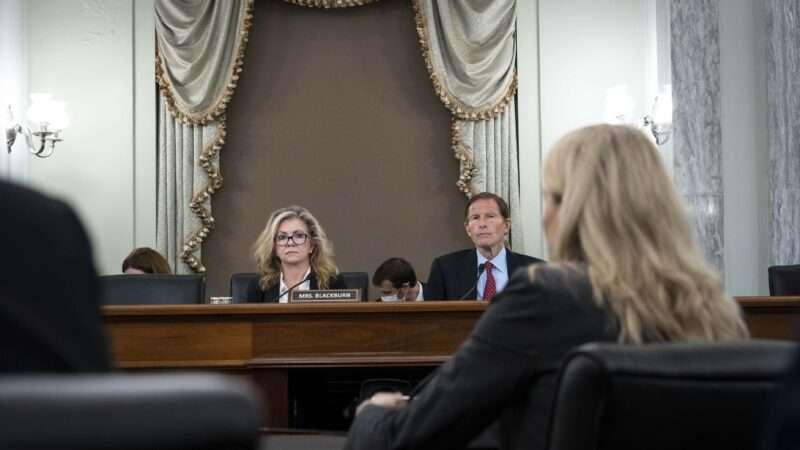
Yesterday’s Senate subcommittee hearing on Facebook was no different. Led by Sen. Richard Blumenthal (D–Conn.) and Sen. Marsha Blackburn (R–Tenn.), members of the Subcommittee on Consumer Protection, Product Safety, and Data Security spewed the same old pre-packaged talking points—algorithms are bad, technology is addictive, think of the children, this legislation I introduced will save democracy—with little regard for the actual facts (or witnesses) at hand.

Much of it was clearly just senators wanting a dramatic soundbite of themselves condemning Facebook and technology. “Facebook and Big Tech are facing a Big Tobacco moment,” opined Blumenthal, before reminiscing about his days suing cigarette companies. Earlier this week Facebook had a service outage, “but for years it has had a principles outage” said Sen. Ed Markey (D–Mass.). “The children of America are hooked on their product,” said Sen. Roger Wicker (R–Miss.).

Again and again, senators posed broad and often absurd accusations against Facebook as questions to the hearing’s witness, former Facebook employee Frances Haugen. Isn’t CEO Mark Zuckerberg “the algorithm designer in chief?” asked Blumenthal, as if Facebook’s head is personally programming Instagram to show teens certain content. Doesn’t Facebook want to hook kids young because then their “lifetime value as a user” is greater? asked Blackburn, despite admitting that a Facebook staffer had said under oath last week that’s not how they thought about it.

Haugen was adept at saying sympathetic-sounding things without actually agreeing to these statements (i.e., no, Zuck doesn’t personally write Instagram algorithms, but he did create a culture where metrics matter…) and sometimes even outright denied them (no, to her knowledge, Facebook did not keep kids’ data after deleting their accounts, she said). But Haugen did her own fair share of grandstanding about how Facebook puts profits before “safety” with surprisingly little concrete information for someone being touted as a “whistleblower.

The biggest “bombshell” that she disclosed is that some of Facebook’s internal research showed teenagers, especially teen girls, felt negative after using Instagram. This news is being treated like some sort of major revelation in the press and by lawmakers, who conveniently ignore the fact that feeling lonely, socially competitive, and insecure is an unfortunate fact of being a teenager for many kids.

But there’s scant evidence Instagram is uniquely bad on this front compared to other social media and/or countless non-internet enabled factors (fashion magazines, celebrity culture, high school in general, etc.). Nor do we have reason to think that getting teens off Instagram would leave them without an online trigger for these same feelings. There are hundreds of apps teens can use to keep up (or feel like they’re failing to) with one another, and there are plenty of places teens can easily seek out information independent of Facebook’s algorithms.

Senators yesterday made a big deal about teens finding extreme dieting content on Instagram. But easily accessible “pro-ana” content has been a feature of the internet since I was a teen, and I’m now almost 40 years old.

Nonetheless, senators yesterday did their now-typical hand-wringing about algorithms (“There is a question … if there is such a thing as a safe algorithm,” said Blumenthal in opening statements). They also pulled the common but incredibly disingenuous trick of condemning a company for prohibiting the very underage users it says it will prohibit.

Again and again, Blackburn kept coming back to the fact that Facebook had booted hundreds of thousands of under-13 users, in accordance with its minimum age rules. That’s what we should want, right? But oh no—in Blackburn’s warped logic, the very fact that these kids (lied about their age and) created accounts in the first place is Facebook’s fault. The company should’ve somehow known their true ages.

Often, it seems the only thing that will satisfy lawmakers is for tech companies to have magical powers. But there’s a frightening underlying point to such shenanigans. By having such unrealistic expectations for tech companies—expectations that they try to convince the public are just common sense—lawmakers can easily pivot to suggesting that a failure to meet these expectations (to magically divine user ages or whatever other absurd thing is being touted) necessitates giving more control to legislators, censoring more speech, collecting more private information about users, etc.

In this case, the only way to be sure no 11- or 12-year-olds join Instagram is if every user of every age must submit a government issued ID to join.

Killing internet anonymity is something that crops up frequently on lawmaker wish lists. So does weakening Section 230, which would let lawmakers severely threaten companies that don’t do whatever they ask. And so do making tech companies share more user data with regulators, letting Congress decide what sorts of content can be seen on social media, and giving regulatory agencies more room to put tech companies on trial— a cross-agency fishing expedition that will hopefully turn up something senators can use to justify all the time they’ve wasted on this.

Yesterday’s hearing had all of these solutions offered, with little to suggest they would actually solve the problems people have with Facebook and everything to suggest this is about lawmakers getting their way.

In a statement after the hearing, Zuckerberg decried what he described as “the false picture of the company that is being painted” and pushed back on many of the senators’ allegations:

Many of the claims don’t make any sense. If we wanted to ignore research, why would we create an industry-leading research program to understand these important issues in the first place? If we didn’t care about fighting harmful content, then why would we employ so many more people dedicated to this than any other company in our space—even ones larger than us? If we wanted to hide our results, why would we have established an industry-leading standard for transparency and reporting on what we’re doing? And if social media were as responsible for polarizing society as some people claim, then why are we seeing polarization increase in the US while it stays flat or declines in many countries with just as heavy use of social media around the world?

At the heart of these accusations is this idea that we prioritize profit over safety and well-being. That’s just not true. For example, one move that has been called into question is when we introduced the Meaningful Social Interactions change to News Feed. This change showed fewer viral videos and more content from friends and family—which we did knowing it would mean people spent less time on Facebook, but that research suggested it was the right thing for people’s well-being. Is that something a company focused on profits over people would do?

The argument that we deliberately push content that makes people angry for profit is deeply illogical. We make money from ads, and advertisers consistently tell us they don’t want their ads next to harmful or angry content. And I don’t know any tech company that sets out to build products that make people angry or depressed. The moral, business and product incentives all point in the opposite direction.

In a post earlier this week, the company also pushed back on the idea that its research showed Instagram was purely negative for teens:

The research actually demonstrated that many teens we heard from feel that using Instagram helps them when they are struggling with the kinds of hard moments and issues teenagers have always faced. In fact, in 11 of 12 areas on the slide referenced by the Journal—including serious areas like loneliness, anxiety, sadness and eating issues—more teenage girls who said they struggled with that issue also said Instagram made those difficult times better rather than worse.

Take all of that for what you will. But one needn’t totally buy the company’s self-serving logic (or agree with everything it does) to see that Congress are working their own self-serving angle here, too.


FREE MINDS

California can’t limit private prisons. “A divided federal appeals court panel ruled on Tuesday that a California state law aimed at phasing out private detention facilities in the state cannot be enforced because it is likely to unconstitutionally intrude on the federal government’s power over immigration,” reports Politico. “The 2-1 decision from the 9th U.S. Circuit Court of Appeals overturns a District Court ruling that upheld the 2019 California legislation, known as AB 32.”


FREE MARKETS

Treasury Secretary defends Biden’s bank snooping proposal. The administration’s plan would make banks report to the IRS the annual inflow and outflow of all bank, loan, and investment accounts either containing more than $600 or conducting more than $600 in transactions during the year. The proposal “is widely seen as an unprecedented invasion of privacy,” notes the New York Post. But Treasury Secretary Janet Yellen dismissed this concern, saying on CNBC yesterday that “it’s just a few pieces of information about individual bank accounts” and not a privacy violation.

Yellen’s argument seems to rest on the idea that because banks wouldn’t report the specifics of transactions, filling the IRS in on everyone’s bank balances is no big deal.

“It is not reporting of individual transactions or anything of the like,” said Yellen. “And it would be a simple thing for banks and other payment providers to provide along with the other information they’re already providing.”


QUICK HITS

• A new date has been set for the trial of former Backpage executives after a mistrial was declared last month. The new trial will start on February 9, 2022.

• Jacob Sullum takes a look at everyone’s favorite new myth about Halloween candy dangers: that marijuana edibles are being handed out to children. “Police are still pushing this discredited scare, but it seems fewer people are falling for it,” Sullum writes.

• John McWhorter defends the use of they as a gender-neutral singular pronoun.

• “There is no plausible explanation for the words ‘pig’, ‘pigs’, ‘copper’, and ‘jerk’ being on the State Police’s list of additional bad words [filtered out from comments on the State Police’s Facebook page] other than impermissible viewpoint discrimination,” a federal court has ruled.

• The U.S. Supreme Court has declined to hear Louisiana’s defense of its law that branded SEX OFFENDER across people’s driver’s licenses. The state’s Supreme Court rejected the law last year.

• Gen X is getting richer.

Wealthy people’s perceptions of themselves as not that wealthy helps drive their support for progressive taxation policies, finds a new study:

from Latest – Reason.com https://ift.tt/3mvBE1f
via IFTTT
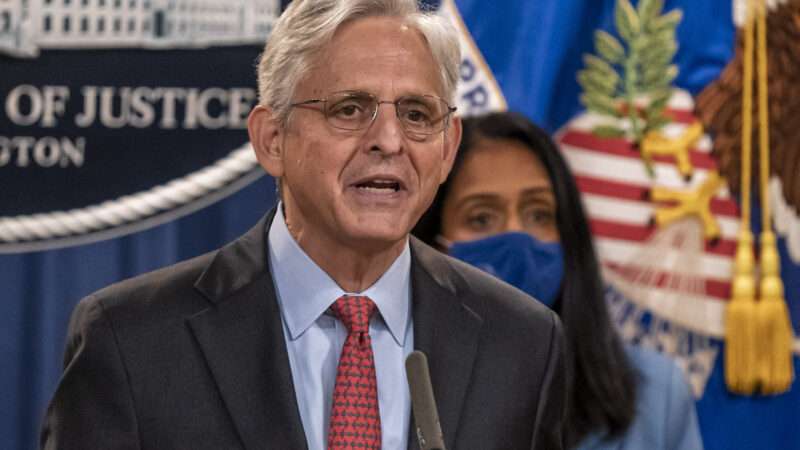

Conflict Of Interest? AG Garland’s Family Getting Rich Selling Critical Race Theory Materials To Schools

Conflict Of Interest? AG Garland’s Family Getting Rich Selling Critical Race Theory Materials To Schools

When it comes to conflicts of interest, Attorney General Merrick Garland appears to have a huge one.

Merrick’s daughter, Rebecca Garland, is married to the co-founder of an education resource company that pushes critical race theory – which angry parents across the country are protesting. Taking matters into his own hands, AG Garland tapped the FBI on Monday to huddle with local leaders to address a “disturbing spike in harassment, intimidation, and threats of violence” against teachers and school board members.

As the Conservative Treehouse writes:

Well, well, well… This is interesting.  U.S. Attorney General Merrick Garland recently instructed the FBI to begin investigating parents who confront school board administrators over Critical Race Theory indoctrination material. The U.S. Department of Justice issued a memorandum to the FBI instructing them to initiate investigations of any parent attending a local school board meeting who might be viewed as confrontational, intimidating or harassing.

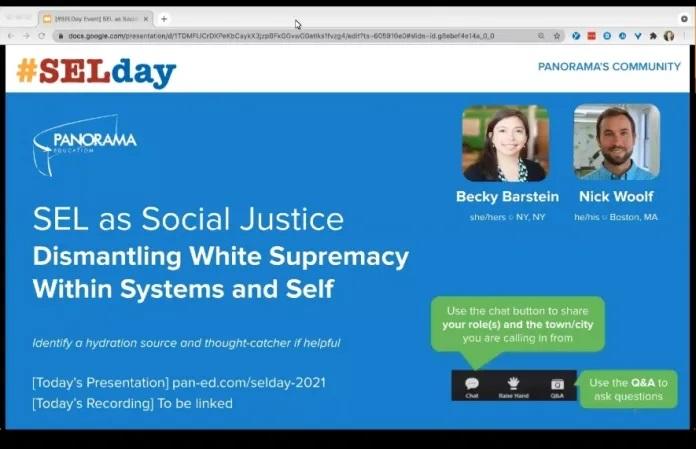
Attorney General Merrick Garland’s daughter is Rebecca Garland.  In 2018 Rebecca Garland married Xan Tanner [LINK].  Mr. Xan Tanner is the current co-founder of a controversial education service company called Panorama Education. [LINK and LINK]  Panorama Education is the “social learning” resource material provider to school districts and teachers that teach Critical Race Theory.

Conflict of interest much?

Yes, the Attorney General is instructing the FBI to investigate parents who might pose a financial threat to the business of his daughter’s husband.

Screen-grabs and citations below:

(New York Times LINK)
(Panorama Education Services Link)

[ZH: More on Panorama]

In June, several meeting attendees and newly elected board members at the Moore County School District in North Carolina pushed back against continuing their contract with Panorama – with one calling it an “indoctrination platform” which aims to mold students into “social justice warriors.”

Those claims are based more on the company’s webinars and virtual workshops for teachers than the surveys Moore County Schools plans to conduct over the three-year term of the contract. The district would pay $184,300 for Panorama’s services over that time period.

Before starting in on their business agenda Monday night, the board heard from about 10 speakers who opposed the contract extension. At the core of the debate is resistance to the idea that public schools might teach Critical Race Theory: in short, the hypothesis that racism has persisted in American institutions throughout history to the detriment of minorities and still does.

Board members Robert Levy and David Hensley pointed to one of the company’s leaders having done economic development work in Cuba, and online webinars dealing with things like “equity, care, and connection” and “dismantling white supremacy” to suggest that Panorama is a vehicle for what Levy termed “really hardcore Critical Race Theory.” –The Pilot

In May, the Johnston County Report – a local North Carolina outlet – did a deep dive on Panorama in an article entitled “Activists In Our Schools: Big Data” in which they described Panorama as a “Big Data company that collects and performs analytics. Data Analytics takes in raw data and formulates it to make process decisions.”

I came across a Twitter post from Johnston County Public School (JCPS) Student Service Counseling Office – Social Emotional Learning (SEL). It was a graphic with a bunch of buzzwords like Restorative Justice, Adult SEL, Staff Equity Committees, and Panorama. All of the terms were familiar to me, but not Panorama. I had no idea what it meant or just how deep the well would go with that one word.

From a 2013 interview in Inc. “Feuer says it was the promise of Panorama’s social impact, not its financial return, that first caught Zuckerberg’s eye.” Zuckerberg’s foundation called Startup:Education infused $4 million dollars into Panorama in 2013. Panorama has found multiple social change and educational technology equity partners including; Spark Capital a San Francisco Bay area company- capital funders behind Twitter and Tumblr, Emerson Collective a Palo Alto company self described as a social change organization, and Owl Ventures, the world’s largest holder of education technology with $1.2 billion in assets- based out of Silicon Valley founded in 2014. By 2017 Panorama Education had raised $32 million in venture capital to data mine children and implement social transformation into schools.

The rolling out of Panorama as an educational tool that measured feelings, observable behaviors, and thought perception was timed perfectly with the implementation of the 2015 Every Student Succeeds Act (ESSA) which replaced No Child Left Behind. The Obama era Act gave a new opening to measure emotions as an academic category. Under ESSA federal public school funding was more able to be funneled directly to school counseling programs. The schools had money and Panorama was ready to provide service.

Panorama charges between $500 to $3,000 per school for their basic data tools and Playbook. Just the annual survey screener for the Chapel Hill- Carrboro City Schools was $29,000 for a one year contract. Through a records request it was disclosed in 2020-2021 JCPS paid $214,000 for a one year contract with Panorama Education. 

Meanwhile, Panorama officially took a ‘stand against systemic racism‘ in the wake of the George Floyd murder – in which they say “Decisively: Black people matter. Black students matter. Black educators matter. Black teammates matter. Black lives matter.”

“We attack racism, discrimination, and oppression, and work towards justice, equality, and opportunity,” the statement continues.

And for any parent who has a problem with this, daddy Garland just activated the FBI.

Tyler Durden
Wed, 10/06/2021 – 09:59

via ZeroHedge News https://ift.tt/3DktqQi Tyler Durden

Instagram’s Effect on Teens Gives Congress the Latest Pretext To Put Tech on Trial


covphotos168732

Congress continues its power grab for the internet. The pretext this time was the mental health of teenagers who use Instagram. But U.S. lawmakers these days don’t really need much impetus for intervention. Every few weeks—and sometimes more frequently—Congress holds new “Big Tech” hearings, designed to give them opportunities for showboating and pushing the same grab bag of internet regulations.

Yesterday’s Senate subcommittee hearing on Facebook was no different. Led by Sen. Richard Blumenthal (D–Conn.) and Sen. Marsha Blackburn (R–Tenn.), members of the Subcommittee on Consumer Protection, Product Safety, and Data Security spewed the same old pre-packaged talking points—algorithms are bad, technology is addictive, think of the children, this legislation I introduced will save democracy—with little regard for the actual facts (or witnesses) at hand.

Much of it was clearly just senators wanting a dramatic soundbite of themselves condemning Facebook and technology. “Facebook and Big Tech are facing a Big Tobacco moment,” opined Blumenthal, before reminiscing about his days suing cigarette companies. Earlier this week Facebook had a service outage, “but for years it has had a principles outage” said Sen. Ed Markey (D–Mass.). “The children of America are hooked on their product,” said Sen. Roger Wicker (R–Miss.).

Again and again, senators posed broad and often absurd accusations against Facebook as questions to the hearing’s witness, former Facebook employee Frances Haugen. Isn’t CEO Mark Zuckerberg “the algorithm designer in chief?” asked Blumenthal, as if Facebook’s head is personally programming Instagram to show teens certain content. Doesn’t Facebook want to hook kids young because then their “lifetime value as a user” is greater? asked Blackburn, despite admitting that a Facebook staffer had said under oath last week that’s not how they thought about it.

Haugen was adept at saying sympathetic-sounding things without actually agreeing to these statements (i.e., no, Zuck doesn’t personally write Instagram algorithms, but he did create a culture where metrics matter…) and sometimes even outright denied them (no, to her knowledge, Facebook did not keep kids’ data after deleting their accounts, she said). But Haugen did her own fair share of grandstanding about how Facebook puts profits before “safety” with surprisingly little concrete information for someone being touted as a “whistleblower.

The biggest “bombshell” that she disclosed is that some of Facebook’s internal research showed teenagers, especially teen girls, felt negative after using Instagram. This news is being treated like some sort of major revelation in the press and by lawmakers, who conveniently ignore the fact that feeling lonely, socially competitive, and insecure is an unfortunate fact of being a teenager for many kids.

But there’s scant evidence Instagram is uniquely bad on this front compared to other social media and/or countless non-internet enabled factors (fashion magazines, celebrity culture, high school in general, etc.). Nor do we have reason to think that getting teens off Instagram would leave them without an online trigger for these same feelings. There are hundreds of apps teens can use to keep up (or feel like they’re failing to) with one another, and there are plenty of places teens can easily seek out information independent of Facebook’s algorithms.

Senators yesterday made a big deal about teens finding extreme dieting content on Instagram. But easily accessible “pro-ana” content has been a feature of the internet since I was a teen, and I’m now almost 40 years old.

Nonetheless, senators yesterday did their now-typical hand-wringing about algorithms (“There is a question … if there is such a thing as a safe algorithm,” said Blumenthal in opening statements). They also pulled the common but incredibly disingenuous trick of condemning a company for prohibiting the very underage users it says it will prohibit.

Again and again, Blackburn kept coming back to the fact that Facebook had booted hundreds of thousands of under-13 users, in accordance with its minimum age rules. That’s what we should want, right? But oh no—in Blackburn’s warped logic, the very fact that these kids (lied about their age and) created accounts in the first place is Facebook’s fault. The company should’ve somehow known their true ages.

Often, it seems the only thing that will satisfy lawmakers is for tech companies to have magical powers. But there’s a frightening underlying point to such shenanigans. By having such unrealistic expectations for tech companies—expectations that they try to convince the public are just common sense—lawmakers can easily pivot to suggesting that a failure to meet these expectations (to magically divine user ages or whatever other absurd thing is being touted) necessitates giving more control to legislators, censoring more speech, collecting more private information about users, etc.

In this case, the only way to be sure no 11- or 12-year-olds join Instagram is if every user of every age must submit a government issued ID to join.

Killing internet anonymity is something that crops up frequently on lawmaker wish lists. So does weakening Section 230, which would let lawmakers severely threaten companies that don’t do whatever they ask. And so do making tech companies share more user data with regulators, letting Congress decide what sorts of content can be seen on social media, and giving regulatory agencies more room to put tech companies on trial— a cross-agency fishing expedition that will hopefully turn up something senators can use to justify all the time they’ve wasted on this.

Yesterday’s hearing had all of these solutions offered, with little to suggest they would actually solve the problems people have with Facebook and everything to suggest this is about lawmakers getting their way.

In a statement after the hearing, Zuckerberg decried what he described as “the false picture of the company that is being painted” and pushed back on many of the senators’ allegations:

Many of the claims don’t make any sense. If we wanted to ignore research, why would we create an industry-leading research program to understand these important issues in the first place? If we didn’t care about fighting harmful content, then why would we employ so many more people dedicated to this than any other company in our space—even ones larger than us? If we wanted to hide our results, why would we have established an industry-leading standard for transparency and reporting on what we’re doing? And if social media were as responsible for polarizing society as some people claim, then why are we seeing polarization increase in the US while it stays flat or declines in many countries with just as heavy use of social media around the world?

At the heart of these accusations is this idea that we prioritize profit over safety and well-being. That’s just not true. For example, one move that has been called into question is when we introduced the Meaningful Social Interactions change to News Feed. This change showed fewer viral videos and more content from friends and family—which we did knowing it would mean people spent less time on Facebook, but that research suggested it was the right thing for people’s well-being. Is that something a company focused on profits over people would do?

The argument that we deliberately push content that makes people angry for profit is deeply illogical. We make money from ads, and advertisers consistently tell us they don’t want their ads next to harmful or angry content. And I don’t know any tech company that sets out to build products that make people angry or depressed. The moral, business and product incentives all point in the opposite direction.

In a post earlier this week, the company also pushed back on the idea that its research showed Instagram was purely negative for teens:

The research actually demonstrated that many teens we heard from feel that using Instagram helps them when they are struggling with the kinds of hard moments and issues teenagers have always faced. In fact, in 11 of 12 areas on the slide referenced by the Journal—including serious areas like loneliness, anxiety, sadness and eating issues—more teenage girls who said they struggled with that issue also said Instagram made those difficult times better rather than worse.

Take all of that for what you will. But one needn’t totally buy the company’s self-serving logic (or agree with everything it does) to see that Congress are working their own self-serving angle here, too.


FREE MINDS

California can’t limit private prisons. “A divided federal appeals court panel ruled on Tuesday that a California state law aimed at phasing out private detention facilities in the state cannot be enforced because it is likely to unconstitutionally intrude on the federal government’s power over immigration,” reports Politico. “The 2-1 decision from the 9th U.S. Circuit Court of Appeals overturns a District Court ruling that upheld the 2019 California legislation, known as AB 32.”


FREE MARKETS

Treasury Secretary defends Biden’s bank snooping proposal. The administration’s plan would make banks report to the IRS the annual inflow and outflow of all bank, loan, and investment accounts either containing more than $600 or conducting more than $600 in transactions during the year. The proposal “is widely seen as an unprecedented invasion of privacy,” notes the New York Post. But Treasury Secretary Janet Yellen dismissed this concern, saying on CNBC yesterday that “it’s just a few pieces of information about individual bank accounts” and not a privacy violation.

Yellen’s argument seems to rest on the idea that because banks wouldn’t report the specifics of transactions, filling the IRS in on everyone’s bank balances is no big deal.

“It is not reporting of individual transactions or anything of the like,” said Yellen. “And it would be a simple thing for banks and other payment providers to provide along with the other information they’re already providing.”


QUICK HITS

• A new date has been set for the trial of former Backpage executives after a mistrial was declared last month. The new trial will start on February 9, 2022.

• Jacob Sullum takes a look at everyone’s favorite new myth about Halloween candy dangers: that marijuana edibles are being handed out to children. “Police are still pushing this discredited scare, but it seems fewer people are falling for it,” Sullum writes.

• John McWhorter defends the use of they as a gender-neutral singular pronoun.

• “There is no plausible explanation for the words ‘pig’, ‘pigs’, ‘copper’, and ‘jerk’ being on the State Police’s list of additional bad words [filtered out from comments on the State Police’s Facebook page] other than impermissible viewpoint discrimination,” a federal court has ruled.

• The U.S. Supreme Court has declined to hear Louisiana’s defense of its law that branded SEX OFFENDER across people’s driver’s licenses. The state’s Supreme Court rejected the law last year.

• Gen X is getting richer.

Wealthy people’s perceptions of themselves as not that wealthy helps drive their support for progressive taxation policies, finds a new study:

from Latest – Reason.com https://ift.tt/3mvBE1f
via IFTTT