
No, Tennessee Isn’t Hoarding Monoclonal Antibody Treatment for the Unvaccinated


zumaamericasthirty824815

A widely reported rumor suggests that Tennessee will only offer promising monoclonal antibody treatments to COVID-19 patients who are unvaccinated. The idea is spawning outrage, since it implies that people who took personal precautions (and public health officials’ advice) are being deliberately disadvantaged if sick, while those who chose not to receive a life-saving vaccine are getting special privileges. There’s just one problem: It’s not true.

That hasn’t stopped the “news” of Tennessee’s unvaccinated-only treatment-rationing from being touted in a number of national headlines. For instance: “Tennessee will now DENY vaccinated COVID-19 patients access to monoclonal antibody treatments as federal government begins limiting shipments of the drugs,” the Daily Mail says.

OK, but that’s the notoriously tabloidy Daily Mail. Let’s check in with a mainstream news publication like USA Today or NBC News or Insider and…. oh. “Tennessee limiting monoclonal antibody treatment to unvaccinated residents,” reads an NBC News headline. “Tennessee Recommends Vaccinated Residents Lose Access to Monoclonal Antibody Treatment,” claims USA Today. “Tennessee to reserve monoclonal antibody treatment for unvaccinated,” touts an Insider headline.

What’s really going on?

The state simply issued guidelines about monoclonal antibody treatment prioritization should a shortage arise. This guidance recommends prioritizing people most likely to suffer severe COVID-19 cases leading to hospitalization.

This is a group that could include people with compromised immune systems, those over 65 years old, pregnant women, people who are vulnerable due to underlying health conditions—and, yes, the unvaccinated. But it’s in no way limited to the unvaccinated, nor is anyone suggesting they should automatically get priority.

Here’s what the Tennessee Department of Health actually said:

Our recommendation to monoclonal antibody providers or individual facilities across the state is if they need to prioritize distribution of the treatment, the NIH (National Institutes of Health) guidelines are the recommended approach for that prioritization, including prioritizing those who are most likely to be hospitalized. Ultimately, this comes down to providers’ clinical judgment to ensure those most at risk are receiving this treatment.

NIH guidelines on monoclonal antibody treatment, issued September 3, recommended monoclonal antibodies “for the treatment of mild to moderate COVID-19 and for post-exposure prophylaxis (PEP) of SARS-CoV-2 infection in individuals who are at high risk for progression to severe COVID-19.”

At the moment, there is no shortage of monoclonal antibody treatment—in Tennessee, or nationally, according to the NIH website—although the agency does warn that “logistical constraints (e.g., limited space, not enough staff who can administer therapy) can make it difficult to administer these agents to all eligible patients.”

Should it become necessary “to triage eligible patients,” the agency suggests prioritizing people who already have the disease, “unvaccinated or incompletely vaccinated individuals who are at high risk of progressing to severe COVID-19,” and “vaccinated individuals who are not expected to mount an adequate immune response (e.g., immunocompromised individuals).”

NIH also notes that “providers should use their clinical judgment when prioritizing treatment” and stresses that “when there are no logistical constraints for administering therapy, these considerations should not limit the provision of anti-SARS-CoV-2 monoclonal antibodies.” (Emphasis theirs.)

The prospect of treatment rationing comes in the wake of the Biden administration changing how states may get their hands on monoclonal antibodies. The Department of Health and Human Services (HHS) will now allocate monoclonal antibody supplies to state health departments based on state need and “on COVID-19 case burden,” rather than letting states order directly from its supplier, it said.

The move is “an effort to more evenly distribute the 150,000 doses that the government makes available each week,” reports Politico. “Demand from a handful of southern states has exploded since [August], state and federal officials said, raising concerns they were consuming a disproportionate amount of the national supply. Seven states — Texas, Florida, Mississippi, Tennessee, Georgia, Louisiana, and Alabama—accounted for 70 percent of all orders in early September.”


FREE MINDS

Internet freedom continues to backslide. Globally, internet freedom is at an 11-year low, according to the latest annual report from Freedom House:

The environment for human rights online deteriorated in 30 countries this year, while only 18 countries registered net gains. The largest decline occurred in Myanmar, followed by Belarus and Uganda. Ecuador experienced the largest improvement, followed by The Gambia. The United States ranked 12th overall, while Iceland was once again the top performer. For the seventh consecutive year, China was found to have the worst conditions for internet freedom.

Freedom on the Net is an annual study of human rights in the digital sphere. The project assesses internet freedom in 70 countries, accounting for 88 percent of the world’s internet users. This report, the 11th in its series, covered developments between June 2020 and May 2021.

[…] Free expression is under unprecedented strain around the world. In 56 countries, a record 80 percent of those covered by Freedom on the Net, people were arrested or convicted for their online speech.

The U.S. saw its fifth consecutive year of a dropping digital freedom ranking.


FREE MARKETS

Charter schools gain from traditional public schools’ pandemic problems. There’s been evidence that homeschooling and private school enrollment have ticked up since the start of the COVID-19 pandemic. Now, a new report from the National Alliance for Public Charter Schools suggests charter school enrollment has grown, too.

“Based on data collected and analyzed by the National Alliance for Public Charter Schools, during the first full school year of the COVID pandemic, the charter sector is likely to have experienced the largest rate of increase in student enrollment increase in half a decade,” says the group’s new report. “Public charter school enrollment increased during the 2020-21 school year in at least 39 states, the only segment of the public education sector to grow during the COVID-19 pandemic, according to new data compiled by the National Alliance. All told, nearly 240,000 new students enrolled in charter schools during that period, a 7% year-over-year increase.”

You can read the full report here.


FOLLOWUP

Lawyer behind abortion lawsuit speaks up. The man suing a Texas physician for performing an abortion describes himself as a libertarian who is bringing the lawsuit because he respects what the doctor (who very publicly admitted to his action) is doing.

Proponents of the Texas abortion ban “wanted to insulate a legislative enactment from judicial review, and I think that’s just wrong. I think it’s totally wrong,” said Oscar Stilley, the man behind one of two new lawsuits against abortion doctor Alan Braid. “[Braid has] got some principle. I like that. And I respect that. I see what he’s doing. He wants somebody filing a lawsuit,” Stilley told KXAN Austin.

Texas Right to Life—which championed the law allowing people to sue abortion doctors—is not pleased.

Meanwhile: Texas enacts another abortion-limiting law. This one—slated to take effect December 2—bans the prescription of abortion-inducing drugs at seven weeks of pregnancy. The cutoff was previously 10 weeks.


QUICK HITS

• A new Government Accountability Office report looks at federal efforts to influence American diets. “The federal government is trying to help with more than 200 efforts to address these diet-related health conditions, such as diabetes and cardiovascular disease,” it says. “But there is little government-wide coordination between agencies and programs.”

• Democrats are trying to pass an eviction moratorium law.

• Los Angeles is banning protests within 300 feet of a protest target’s home.

• The U.S. has filed an antitrust lawsuit against American Airlines and JetBlue Airways.

• A ban on school mask mandates in Texas is drawing an investigation by the U.S. Department of Education Office for Civil Rights. The office “is investigating the Texas Education Agency after deeming that its guidance prohibiting mask mandates in schools last week may be ‘preventing school districts in the state from considering or meeting the needs of students with disabilities,'” according to the Texas Tribune.

• A court says North Carolina’s voter ID law is unconstitutional. “A three-judge panel of the Wake County Superior Court ruled 2-1 that North Carolina’s voter ID law violates the state constitution” and “blocked enforcement of the law,” Ballotpedia News reports. “The court’s order represents its final judgment on the matter.”

• Cathy Young chronicles the transgender bathroom access controversy at a Los Angeles spa.

• In which the American Civil Liberties Union explicitly supports restrictions on civil liberties.

from Latest – Reason.com https://ift.tt/3u2ELBk
via IFTTT
No, Tennessee Isn’t Hoarding Monoclonal Antibody Treatment for the Unvaccinated


zumaamericasthirty824815

A widely reported rumor suggests that Tennessee will only offer promising monoclonal antibody treatments to COVID-19 patients who are unvaccinated. The idea is spawning outrage, since it implies that people who took personal precautions (and public health officials’ advice) are being deliberately disadvantaged if sick, while those who chose not to receive a life-saving vaccine are getting special privileges. There’s just one problem: It’s not true.

That hasn’t stopped the “news” of Tennessee’s unvaccinated-only treatment-rationing from being touted in a number of national headlines. For instance: “Tennessee will now DENY vaccinated COVID-19 patients access to monoclonal antibody treatments as federal government begins limiting shipments of the drugs,” the Daily Mail says.

OK, but that’s the notoriously tabloidy Daily Mail. Let’s check in with a mainstream news publication like USA Today or NBC News or Insider and…. oh. “Tennessee limiting monoclonal antibody treatment to unvaccinated residents,” reads an NBC News headline. “Tennessee Recommends Vaccinated Residents Lose Access to Monoclonal Antibody Treatment,” claims USA Today. “Tennessee to reserve monoclonal antibody treatment for unvaccinated,” touts an Insider headline.

What’s really going on?

The state simply issued guidelines about monoclonal antibody treatment prioritization should a shortage arise. This guidance recommends prioritizing people most likely to suffer severe COVID-19 cases leading to hospitalization.

This is a group that could include people with compromised immune systems, those over 65 years old, pregnant women, people who are vulnerable due to underlying health conditions—and, yes, the unvaccinated. But it’s in no way limited to the unvaccinated, nor is anyone suggesting they should automatically get priority.

Here’s what the Tennessee Department of Health actually said:

Our recommendation to monoclonal antibody providers or individual facilities across the state is if they need to prioritize distribution of the treatment, the NIH (National Institutes of Health) guidelines are the recommended approach for that prioritization, including prioritizing those who are most likely to be hospitalized. Ultimately, this comes down to providers’ clinical judgment to ensure those most at risk are receiving this treatment.

NIH guidelines on monoclonal antibody treatment, issued September 3, recommended monoclonal antibodies “for the treatment of mild to moderate COVID-19 and for post-exposure prophylaxis (PEP) of SARS-CoV-2 infection in individuals who are at high risk for progression to severe COVID-19.”

At the moment, there is no shortage of monoclonal antibody treatment—in Tennessee, or nationally, according to the NIH website—although the agency does warn that “logistical constraints (e.g., limited space, not enough staff who can administer therapy) can make it difficult to administer these agents to all eligible patients.”

Should it become necessary “to triage eligible patients,” the agency suggests prioritizing people who already have the disease, “unvaccinated or incompletely vaccinated individuals who are at high risk of progressing to severe COVID-19,” and “vaccinated individuals who are not expected to mount an adequate immune response (e.g., immunocompromised individuals).”

NIH also notes that “providers should use their clinical judgment when prioritizing treatment” and stresses that “when there are no logistical constraints for administering therapy, these considerations should not limit the provision of anti-SARS-CoV-2 monoclonal antibodies.” (Emphasis theirs.)

The prospect of treatment rationing comes in the wake of the Biden administration changing how states may get their hands on monoclonal antibodies. The Department of Health and Human Services (HHS) will now allocate monoclonal antibody supplies to state health departments based on state need and “on COVID-19 case burden,” rather than letting states order directly from its supplier, it said.

The move is “an effort to more evenly distribute the 150,000 doses that the government makes available each week,” reports Politico. “Demand from a handful of southern states has exploded since [August], state and federal officials said, raising concerns they were consuming a disproportionate amount of the national supply. Seven states — Texas, Florida, Mississippi, Tennessee, Georgia, Louisiana, and Alabama—accounted for 70 percent of all orders in early September.”


FREE MINDS

Internet freedom continues to backslide. Globally, internet freedom is at an 11-year low, according to the latest annual report from Freedom House:

The environment for human rights online deteriorated in 30 countries this year, while only 18 countries registered net gains. The largest decline occurred in Myanmar, followed by Belarus and Uganda. Ecuador experienced the largest improvement, followed by The Gambia. The United States ranked 12th overall, while Iceland was once again the top performer. For the seventh consecutive year, China was found to have the worst conditions for internet freedom.

Freedom on the Net is an annual study of human rights in the digital sphere. The project assesses internet freedom in 70 countries, accounting for 88 percent of the world’s internet users. This report, the 11th in its series, covered developments between June 2020 and May 2021.

[…] Free expression is under unprecedented strain around the world. In 56 countries, a record 80 percent of those covered by Freedom on the Net, people were arrested or convicted for their online speech.

The U.S. saw its fifth consecutive year of a dropping digital freedom ranking.


FREE MARKETS

Charter schools gain from traditional public schools’ pandemic problems. There’s been evidence that homeschooling and private school enrollment have ticked up since the start of the COVID-19 pandemic. Now, a new report from the National Alliance for Public Charter Schools suggests charter school enrollment has grown, too.

“Based on data collected and analyzed by the National Alliance for Public Charter Schools, during the first full school year of the COVID pandemic, the charter sector is likely to have experienced the largest rate of increase in student enrollment increase in half a decade,” says the group’s new report. “Public charter school enrollment increased during the 2020-21 school year in at least 39 states, the only segment of the public education sector to grow during the COVID-19 pandemic, according to new data compiled by the National Alliance. All told, nearly 240,000 new students enrolled in charter schools during that period, a 7% year-over-year increase.”

You can read the full report here.


FOLLOWUP

Lawyer behind abortion lawsuit speaks up. The man suing a Texas physician for performing an abortion describes himself as a libertarian who is bringing the lawsuit because he respects what the doctor (who very publicly admitted to his action) is doing.

Proponents of the Texas abortion ban “wanted to insulate a legislative enactment from judicial review, and I think that’s just wrong. I think it’s totally wrong,” said Oscar Stilley, the man behind one of two new lawsuits against abortion doctor Alan Braid. “[Braid has] got some principle. I like that. And I respect that. I see what he’s doing. He wants somebody filing a lawsuit,” Stilley told KXAN Austin.

Texas Right to Life—which championed the law allowing people to sue abortion doctors—is not pleased.

Meanwhile: Texas enacts another abortion-limiting law. This one—slated to take effect December 2—bans the prescription of abortion-inducing drugs at seven weeks of pregnancy. The cutoff was previously 10 weeks.


QUICK HITS

• A new Government Accountability Office report looks at federal efforts to influence American diets. “The federal government is trying to help with more than 200 efforts to address these diet-related health conditions, such as diabetes and cardiovascular disease,” it says. “But there is little government-wide coordination between agencies and programs.”

• Democrats are trying to pass an eviction moratorium law.

• Los Angeles is banning protests within 300 feet of a protest target’s home.

• The U.S. has filed an antitrust lawsuit against American Airlines and JetBlue Airways.

• A ban on school mask mandates in Texas is drawing an investigation by the U.S. Department of Education Office for Civil Rights. The office “is investigating the Texas Education Agency after deeming that its guidance prohibiting mask mandates in schools last week may be ‘preventing school districts in the state from considering or meeting the needs of students with disabilities,'” according to the Texas Tribune.

• A court says North Carolina’s voter ID law is unconstitutional. “A three-judge panel of the Wake County Superior Court ruled 2-1 that North Carolina’s voter ID law violates the state constitution” and “blocked enforcement of the law,” Ballotpedia News reports. “The court’s order represents its final judgment on the matter.”

• Cathy Young chronicles the transgender bathroom access controversy at a Los Angeles spa.

• In which the American Civil Liberties Union explicitly supports restrictions on civil liberties.

from Latest – Reason.com https://ift.tt/3u2ELBk
via IFTTT
Things are Getting Messy

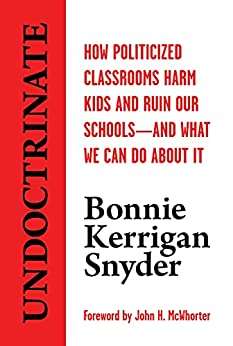
Rising frustration with heavy-handed ideology in K-12 education is quickly spilling over into the legal realm. Parents, teachers, and even an entire school have explored or filed actions, and this trickle of cases could easily swell to a flood — if not a tidal wave. These suits raise an array of questions regarding teacher discretion, employer authority, the protection of minors, parental rights and family autonomy, and contractual obligations.

Simultaneously, legislators have attempted to regulate the concepts that may be taught in schools in more than half the states…so far, which we previously discussed at some length in FIRE’s analysis of so-called “divisive concept” bills.

Perhaps the most prominent case, and one of the first, involves a biracial student in Nevada who refused to confess his privilege as directed by his teacher and who, according to the suit filed by his mother, was also instructed to “‘unlearn‘ the basic Judeo-Christian principles she imparted to him” in his public school classroom.

In Illinois, a public school teacher alleges that she was subjected to race-conscious training, policies and curriculum that she alleges violate federal law through “conditioning individuals to see each other’s skin color first and foremost, then pitting different racial groups against each other.” The complaint claims that the district has used teacher training sessions to segregate and impugn white people, calling them inherently racist and privileged, and has compelled teachers to pass on those lessons to children.

The Supreme Court of Virginia upheld a lower court ruling that ordered the temporary reinstatement of a northern Virginia gym teacher who said he won’t refer to transgender students by their preferred pronouns, which he refuses to do citing his religious convictions, as would be required by a new policy. What made the initial suspension particularly troubling was that his comments indicating unwillingness to obey were given at a school board meeting — the exact forum that should be used to discuss school policies. While this action only addressed the teacher’s suspension for his public comments, a revised complaint — with additional teachers as plaintiffs — will now move forward to challenge the now-enacted school’s policy forcing all of the district’s students and staff to to refer to “gender-expansive or transgender” students using whatever gender pronoun is chosen by the student.

A group of parents in Maryland is suing their public school district, on behalf of their minor children, for advocating “a radicalized political agenda disguised as ‘social justice’ and ‘equity'” in an effort to “create social justice activists and cause racial division” among the student body. They object to curricular messaging implying that students must accept the idea that due to their race, they are internally racist, whether conscious or unconscious, and to become an anti-racist, they must zealously pursue this ideology.

Meanwhile, a lawsuit filed in California against the state Department of Education alleges that the state’s model ethnic studies curriculum violates the religious clauses of the state constitution, while another suit asserts that teacher training in San Diego amounts to unlawful racial discrimination. Educators in Missouri have also filed a case making similar allegations about training they are required to undergo.

We’ve seen conscience-based resignations by educators unwilling to participate in heavily ideological programming, in both private and public institutions. There’s the predictable backlash to statewide legislative action from some teachers, while some subject-based organizations — such as in social studies — have opposed so-called anti-CRT bills on the grounds that they transgress their pedagogical prerogatives. Even though, as we have explained, when it comes to elementary and secondary education, states do have the authority to set the curriculum since teacher speech in a public classroom is considered an extension of government speech. But just because you can do something doesn’t mean you necessarily should. After all, banning something often has the unintended effect of making the banned thing more desirable — a frequent byproduct of heavy-handed censorship.

Because K-12 decisions often lead to higher education ramifications, FIRE is paying attention to these cases and awaiting their outcomes. It’s easy to imagine that we will one day look back on this era of K-12 litigation as a momentous and groundsetting one in education law.

from Latest – Reason.com https://ift.tt/3u1Az4F
via IFTTT

Things are Getting Messy

Rising frustration with heavy-handed ideology in K-12 education is quickly spilling over into the legal realm. Parents, teachers, and even an entire school have explored or filed actions, and this trickle of cases could easily swell to a flood — if not a tidal wave. These suits raise an array of questions regarding teacher discretion, employer authority, the protection of minors, parental rights and family autonomy, and contractual obligations.

Simultaneously, legislators have attempted to regulate the concepts that may be taught in schools in more than half the states…so far, which we previously discussed at some length in FIRE’s analysis of so-called “divisive concept” bills.

Perhaps the most prominent case, and one of the first, involves a biracial student in Nevada who refused to confess his privilege as directed by his teacher and who, according to the suit filed by his mother, was also instructed to “‘unlearn‘ the basic Judeo-Christian principles she imparted to him” in his public school classroom.

In Illinois, a public school teacher alleges that she was subjected to race-conscious training, policies and curriculum that she alleges violate federal law through “conditioning individuals to see each other’s skin color first and foremost, then pitting different racial groups against each other.” The complaint claims that the district has used teacher training sessions to segregate and impugn white people, calling them inherently racist and privileged, and has compelled teachers to pass on those lessons to children.

The Supreme Court of Virginia upheld a lower court ruling that ordered the temporary reinstatement of a northern Virginia gym teacher who said he won’t refer to transgender students by their preferred pronouns, which he refuses to do citing his religious convictions, as would be required by a new policy. What made the initial suspension particularly troubling was that his comments indicating unwillingness to obey were given at a school board meeting — the exact forum that should be used to discuss school policies. While this action only addressed the teacher’s suspension for his public comments, a revised complaint — with additional teachers as plaintiffs — will now move forward to challenge the now-enacted school’s policy forcing all of the district’s students and staff to to refer to “gender-expansive or transgender” students using whatever gender pronoun is chosen by the student.

A group of parents in Maryland is suing their public school district, on behalf of their minor children, for advocating “a radicalized political agenda disguised as ‘social justice’ and ‘equity'” in an effort to “create social justice activists and cause racial division” among the student body. They object to curricular messaging implying that students must accept the idea that due to their race, they are internally racist, whether conscious or unconscious, and to become an anti-racist, they must zealously pursue this ideology.

Meanwhile, a lawsuit filed in California against the state Department of Education alleges that the state’s model ethnic studies curriculum violates the religious clauses of the state constitution, while another suit asserts that teacher training in San Diego amounts to unlawful racial discrimination. Educators in Missouri have also filed a case making similar allegations about training they are required to undergo.

We’ve seen conscience-based resignations by educators unwilling to participate in heavily ideological programming, in both private and public institutions. There’s the predictable backlash to statewide legislative action from some teachers, while some subject-based organizations — such as in social studies — have opposed so-called anti-CRT bills on the grounds that they transgress their pedagogical prerogatives. Even though, as we have explained, when it comes to elementary and secondary education, states do have the authority to set the curriculum since teacher speech in a public classroom is considered an extension of government speech. But just because you can do something doesn’t mean you necessarily should. After all, banning something often has the unintended effect of making the banned thing more desirable — a frequent byproduct of heavy-handed censorship.

Because K-12 decisions often lead to higher education ramifications, FIRE is paying attention to these cases and awaiting their outcomes. It’s easy to imagine that we will one day look back on this era of K-12 litigation as a momentous and groundsetting one in education law.

from Latest – Reason.com https://ift.tt/3u1Az4F
via IFTTT

Don’t Import Vaccine Mandates for Domestic Travel


zumaglobalten791040

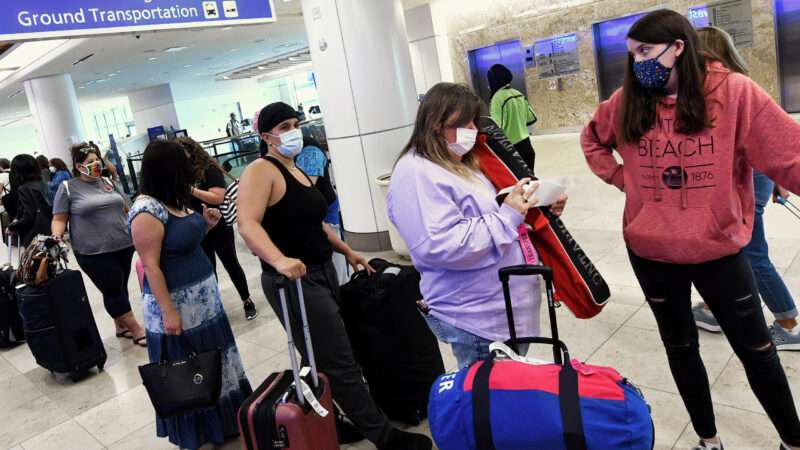
As frustrating as it is to those of us who believe in the right to freely roam, international travel is treated as a privilege subject to regulations, document checks, and the whims of government officials. Those restrictions tightened during the pandemic, meaning that the White House’s plan to allow entry to travelers who have been vaccinated and tested for COVID-19 constitute an easing of rules for visitors from other countries. But that’s not enough for some people who want to impose similar requirements on domestic travel, making movement within the country as conditional as that across borders.

“We’re very proud of the fact that we’ve been able to develop a protocol that will permit travel by individuals and families and business people from the E.U. and the UK, as well as from Brazil and India and other countries, to the United States with proof of vaccination,” the White House announced this week.

The key word here is “permit” which is something that applies, in our world, to international travelers. Permission to cross a national border can be granted or withheld. But that’s not a consideration that’s supposed to apply inside the United States—unless you’re a politician who sees opportunity.

“This is a smart decision,” Rep. Don Beyer (D-Va.) tweeted in response to the White House move. “I’m also glad to see the Administration is considering extending this requirement to domestic travel, which is what my bill, the Safe Travel Act, would do. I strongly encourage them to make that happen—it would be a major step towards safer travel.”

Beyer’s bill would “require certain passengers, employees, contractors, and subcontractors of Amtrak and air carriers to provide proof of vaccination against COVID-19 or a negative test for COVID-19 for certain transportation or employment.”

The Biden administration is debating the issue as its chief medical advisor, Anthony Fauci, endorses the idea. Whether or not the White House mandates proof of vaccination for domestic travelers may depend on the fate of the president’s order that private-sector businesses with more than 100 employees require vaccination. While the move draws majority support in polling, it could be kneecapped by a determined minority. Or, the effort could prevail, clearing the way for further top-down commands. That’s unfortunate, because the freedom to move is a right, not a privilege.

“Freedom of movement within and between states is constitutionally protected. The right of Americans to travel interstate in the U.S. has never been substantially judicially questioned or limited,” Meryl Justin Chertoff, executive director of the Georgetown Project on State and Local Government Policy and Law, wrote last year as public health concerns rapidly eroded people’s freedom to travel. “In a public health emergency, as in wartime, executive authorities to interfere with those rights is at a zenith. It is not a blank check, though. The president’s emergency powers allow him to limit entry from outside the country to stop the spread of disease; it also provides some control over interstate activity.”

How much emergency power the president has to regulate domestic travel may well be tested if a vaccine mandate becomes a reality.

Raising concerns about vaccine mandates isn’t the same thing as objecting to vaccination. Control freaks like to conflate the two, as if every good idea should be forced on the unwilling by threats of fines and imprisonment. But it’s perfectly reasonable to endorse vaccination and the near-complete protection it provides against severe illness while accepting that people have the right to decide for themselves; that’s how free societies work. Converting rights (such as making a living and traveling from place to place) into privileges in order to compel compliance is not how free societies work. But officials always find it easy to make excuses for fettering the public, and for throwing roadblocks in the way of travel to make it conditional on bureaucratic approval

“As a general rule, until 1941, U.S. citizens were not required to have a passport for travel abroad,” according to the National Archives. The now-ubiquitous documents weren’t introduced to make life more convenient for us.

“Passports … were invented not to let us roam freely, but to keep us in place—and in check,” pointed out Atossa Araxia Abrahamian in a 2018 piece for The New York Review of Books. “They represent the borders and boundaries countries draw around themselves, and the lines they draw around people, too.”

Also intended to keep us in place and in check are REAL ID requirements, which essentially implement internal passports for federally regulated activities, including domestic air travel.

“Beginning May 3, 2023 every state and territory resident will need to present a REAL ID compliant license/ID, or another acceptable form of identification, for accessing federal facilities, entering nuclear power plants, and boarding commercial aircraft,” the Department of Homeland Security warns in its current guidance. Granted, the slipping deadline for the policy is a running joke, but the standardized ID requirement has taken on an air of semi-competent inevitability.

The COVID-19 pandemic has eased the way for government officials who have never been comfortable with a mobile population to further tighten conditions on going from place to place. A vaccine mandate for domestic travel, with the documentation it implies, would join passports and REAL ID as conditions placed on mobility that are likely to become permanent features. Overall, the pandemic has been a bonanza for those who would turn activities that once concerned only the parties to transactions (such as entering gyms and restaurants, as well as travel) into revocable privileges. We’re well on our way to a permission society in which we’re required to beg the indulgence of officialdom and have our identities recorded in order to do almost anything.

Supporters of vaccine mandates no doubt think they’re making the world a safer place by conditioning our movements on yet one more government requirement on top of those that went before. But our freedom certainly isn’t safe when we’re required to ask permission and show documents to go about our lives.

from Latest – Reason.com https://ift.tt/2XDAVCo
via IFTTT

Don’t Import Vaccine Mandates for Domestic Travel


zumaglobalten791040

As frustrating as it is to those of us who believe in the right to freely roam, international travel is treated as a privilege subject to regulations, document checks, and the whims of government officials. Those restrictions tightened during the pandemic, meaning that the White House’s plan to allow entry to travelers who have been vaccinated and tested for COVID-19 constitute an easing of rules for visitors from other countries. But that’s not enough for some people who want to impose similar requirements on domestic travel, making movement within the country as conditional as that across borders.

“We’re very proud of the fact that we’ve been able to develop a protocol that will permit travel by individuals and families and business people from the E.U. and the UK, as well as from Brazil and India and other countries, to the United States with proof of vaccination,” the White House announced this week.

The key word here is “permit” which is something that applies, in our world, to international travelers. Permission to cross a national border can be granted or withheld. But that’s not a consideration that’s supposed to apply inside the United States—unless you’re a politician who sees opportunity.

“This is a smart decision,” Rep. Don Beyer (D-Va.) tweeted in response to the White House move. “I’m also glad to see the Administration is considering extending this requirement to domestic travel, which is what my bill, the Safe Travel Act, would do. I strongly encourage them to make that happen—it would be a major step towards safer travel.”

Beyer’s bill would “require certain passengers, employees, contractors, and subcontractors of Amtrak and air carriers to provide proof of vaccination against COVID-19 or a negative test for COVID-19 for certain transportation or employment.”

The Biden administration is debating the issue as its chief medical advisor, Anthony Fauci, endorses the idea. Whether or not the White House mandates proof of vaccination for domestic travelers may depend on the fate of the president’s order that private-sector businesses with more than 100 employees require vaccination. While the move draws majority support in polling, it could be kneecapped by a determined minority. Or, the effort could prevail, clearing the way for further top-down commands. That’s unfortunate, because the freedom to move is a right, not a privilege.

“Freedom of movement within and between states is constitutionally protected. The right of Americans to travel interstate in the U.S. has never been substantially judicially questioned or limited,” Meryl Justin Chertoff, executive director of the Georgetown Project on State and Local Government Policy and Law, wrote last year as public health concerns rapidly eroded people’s freedom to travel. “In a public health emergency, as in wartime, executive authorities to interfere with those rights is at a zenith. It is not a blank check, though. The president’s emergency powers allow him to limit entry from outside the country to stop the spread of disease; it also provides some control over interstate activity.”

How much emergency power the president has to regulate domestic travel may well be tested if a vaccine mandate becomes a reality.

Raising concerns about vaccine mandates isn’t the same thing as objecting to vaccination. Control freaks like to conflate the two, as if every good idea should be forced on the unwilling by threats of fines and imprisonment. But it’s perfectly reasonable to endorse vaccination and the near-complete protection it provides against severe illness while accepting that people have the right to decide for themselves; that’s how free societies work. Converting rights (such as making a living and traveling from place to place) into privileges in order to compel compliance is not how free societies work. But officials always find it easy to make excuses for fettering the public, and for throwing roadblocks in the way of travel to make it conditional on bureaucratic approval

“As a general rule, until 1941, U.S. citizens were not required to have a passport for travel abroad,” according to the National Archives. The now-ubiquitous documents weren’t introduced to make life more convenient for us.

“Passports … were invented not to let us roam freely, but to keep us in place—and in check,” pointed out Atossa Araxia Abrahamian in a 2018 piece for The New York Review of Books. “They represent the borders and boundaries countries draw around themselves, and the lines they draw around people, too.”

Also intended to keep us in place and in check are REAL ID requirements, which essentially implement internal passports for federally regulated activities, including domestic air travel.

“Beginning May 3, 2023 every state and territory resident will need to present a REAL ID compliant license/ID, or another acceptable form of identification, for accessing federal facilities, entering nuclear power plants, and boarding commercial aircraft,” the Department of Homeland Security warns in its current guidance. Granted, the slipping deadline for the policy is a running joke, but the standardized ID requirement has taken on an air of semi-competent inevitability.

The COVID-19 pandemic has eased the way for government officials who have never been comfortable with a mobile population to further tighten conditions on going from place to place. A vaccine mandate for domestic travel, with the documentation it implies, would join passports and REAL ID as conditions placed on mobility that are likely to become permanent features. Overall, the pandemic has been a bonanza for those who would turn activities that once concerned only the parties to transactions (such as entering gyms and restaurants, as well as travel) into revocable privileges. We’re well on our way to a permission society in which we’re required to beg the indulgence of officialdom and have our identities recorded in order to do almost anything.

Supporters of vaccine mandates no doubt think they’re making the world a safer place by conditioning our movements on yet one more government requirement on top of those that went before. But our freedom certainly isn’t safe when we’re required to ask permission and show documents to go about our lives.

from Latest – Reason.com https://ift.tt/2XDAVCo
via IFTTT

Archives: October 2021


archives

15 years ago

October 2006

“The regulations are so onerous that principals rarely even try to fire a teacher. Most just put the bad ones in pretend-work jobs, or sucker another school into taking them. (They call that the ‘dance of the lemons.’) The city payrolls include hundreds of teachers who have been deemed incompetent, violent, or guilty of sexual misconduct. Since the schools are afraid to let them teach, they put them in so-called ‘rubber rooms’ instead. There they read magazines, play cards, and chat, at a cost to New York taxpayers of $20 million a year.”
John Stossel
“How To Fire an Incompetent Teacher”

“Beyond the issues of race and guns, beyond even the question of Cory Maye’s guilt or innocence, the death of Ron Jones illustrates the dangers of an increasingly literal war on drugs featuring unnecessarily aggressive, militaristic tactics that regularly lead to tragedies for police officers and civilians alike.”
Radley Balko
“The Case of Cory Maye”

25 years ago

October 1996

“Congress did not mean to censor political speech, and the courts have for years attempted to restrain the commission’s regulatory reflexes. Rather, the [Federal Election Commission] is a case study in the growth and transformation of oversight power. It begins with the reform of political financing, develops into ever more complex regulation of political activities, and finally matures into attempts to control political speech itself.”
Allison Hayward and Steven Hayward
“Gagging on Political Reform”

“Ultimately, the defining political characteristic of the religious right is its concern with moral issues. Economic conservatives can and should work with the religious right to achieve common aims. But libertarians should never fool themselves. There remain profound disagreements between the two groups.”
Charles Oliver
“Coalition Politics”

35 years ago

October 1986

“Even some leftists are beginning to notice that rent control hasn’t helped poor people. Earlier this year, the Center for Community Change, an Oakland-based organization that provides housing aid to low-income tenants, released a study entitled ‘Who Benefits from Rent Control?’ It concludes that the principal beneficiaries have been middle-class people who could afford market rents and now spend their money on such luxuries as gourmet food and stereos. And it declares that rent control, notably in Santa Monica and Berkeley, has driven away landlords and cut off new construction. All, it notes, without protecting the ‘elderly, poor, or minorities from unreasonable rents.'”
Jeff Riggenbach
“Berkeley’s Radical Slumlords”

“Hindsight is not 20/20; it can provide a clear but incomplete, and therefore misleading, picture. The story of U.S. involvement in Vietnam wasn’t simply one of black hats and white hats; it wasn’t simply a story of a noble cause. And in the telling today, a real tragedy is too often obscured. Fifty-eight thousand American soldiers were killed. Fifty-eight thousand vital young men. Fifty-eight thousand brothers and friends and fathers. Fifty-eight thousand sons. And still no one gives a good reason why.”
Greg Todd
“Duty, Honor, Country—but No Draft”

“Man’s ignorance and arrogance makes him think that just because he managed to split the atom and travel to the moon, he can easily accomplish ‘trivial’ tasks like managing the family….We cannot know all of the unknown and possibly unknowable web of social interrelationships that lead to and sustain that spontaneous order known as the family. The evidence available suggests that all government intervention can do for the institution of the family is weaken it.”
Walter Williams
“What Went Wrong With the War on Poverty”

45 years ago

October 1976

“The early days of foreign aid were marked by high hopes and what must now seem absurd optimism. In the 1950s, prominent American economists argued that limited aid over a few years would ensure the self-sustaining economic development of the recipients and thus would remove the need for external assistance. But now aid is envisaged as a practically open-ended commitment extending into the indefinite future. Incredible as it may seem, multinational aid even goes to the oil states of the Middle East and North Africa.”
P.T. Bauer
“Foreign Aid Hasn’t Worked….and It Never Will”

“Newspapers are on the firmest ground when they contend that government regulation of the press would operate tyrannically and incompetently. Censorship is wrong both for philosophical and pragmatic reasons. It is not a device reserved solely for the press, however. Government regulators who decide what can be produced in the economic market, and where, and make aesthetic judgments—as, for example, zoning authorities continually do—carry out essentially the role of a censor. The most persuasive rationale for press freedom, accordingly, applies equally to other sectors of society.”
Bernard Siegan
“If the Press Is Free, Why Aren’t We?”

from Latest – Reason.com https://ift.tt/3nU98cb
via IFTTT

Archives: October 2021


archives

15 years ago

October 2006

“The regulations are so onerous that principals rarely even try to fire a teacher. Most just put the bad ones in pretend-work jobs, or sucker another school into taking them. (They call that the ‘dance of the lemons.’) The city payrolls include hundreds of teachers who have been deemed incompetent, violent, or guilty of sexual misconduct. Since the schools are afraid to let them teach, they put them in so-called ‘rubber rooms’ instead. There they read magazines, play cards, and chat, at a cost to New York taxpayers of $20 million a year.”
John Stossel
“How To Fire an Incompetent Teacher”

“Beyond the issues of race and guns, beyond even the question of Cory Maye’s guilt or innocence, the death of Ron Jones illustrates the dangers of an increasingly literal war on drugs featuring unnecessarily aggressive, militaristic tactics that regularly lead to tragedies for police officers and civilians alike.”
Radley Balko
“The Case of Cory Maye”

25 years ago

October 1996

“Congress did not mean to censor political speech, and the courts have for years attempted to restrain the commission’s regulatory reflexes. Rather, the [Federal Election Commission] is a case study in the growth and transformation of oversight power. It begins with the reform of political financing, develops into ever more complex regulation of political activities, and finally matures into attempts to control political speech itself.”
Allison Hayward and Steven Hayward
“Gagging on Political Reform”

“Ultimately, the defining political characteristic of the religious right is its concern with moral issues. Economic conservatives can and should work with the religious right to achieve common aims. But libertarians should never fool themselves. There remain profound disagreements between the two groups.”
Charles Oliver
“Coalition Politics”

35 years ago

October 1986

“Even some leftists are beginning to notice that rent control hasn’t helped poor people. Earlier this year, the Center for Community Change, an Oakland-based organization that provides housing aid to low-income tenants, released a study entitled ‘Who Benefits from Rent Control?’ It concludes that the principal beneficiaries have been middle-class people who could afford market rents and now spend their money on such luxuries as gourmet food and stereos. And it declares that rent control, notably in Santa Monica and Berkeley, has driven away landlords and cut off new construction. All, it notes, without protecting the ‘elderly, poor, or minorities from unreasonable rents.'”
Jeff Riggenbach
“Berkeley’s Radical Slumlords”

“Hindsight is not 20/20; it can provide a clear but incomplete, and therefore misleading, picture. The story of U.S. involvement in Vietnam wasn’t simply one of black hats and white hats; it wasn’t simply a story of a noble cause. And in the telling today, a real tragedy is too often obscured. Fifty-eight thousand American soldiers were killed. Fifty-eight thousand vital young men. Fifty-eight thousand brothers and friends and fathers. Fifty-eight thousand sons. And still no one gives a good reason why.”
Greg Todd
“Duty, Honor, Country—but No Draft”

“Man’s ignorance and arrogance makes him think that just because he managed to split the atom and travel to the moon, he can easily accomplish ‘trivial’ tasks like managing the family….We cannot know all of the unknown and possibly unknowable web of social interrelationships that lead to and sustain that spontaneous order known as the family. The evidence available suggests that all government intervention can do for the institution of the family is weaken it.”
Walter Williams
“What Went Wrong With the War on Poverty”

45 years ago

October 1976

“The early days of foreign aid were marked by high hopes and what must now seem absurd optimism. In the 1950s, prominent American economists argued that limited aid over a few years would ensure the self-sustaining economic development of the recipients and thus would remove the need for external assistance. But now aid is envisaged as a practically open-ended commitment extending into the indefinite future. Incredible as it may seem, multinational aid even goes to the oil states of the Middle East and North Africa.”
P.T. Bauer
“Foreign Aid Hasn’t Worked….and It Never Will”

“Newspapers are on the firmest ground when they contend that government regulation of the press would operate tyrannically and incompetently. Censorship is wrong both for philosophical and pragmatic reasons. It is not a device reserved solely for the press, however. Government regulators who decide what can be produced in the economic market, and where, and make aesthetic judgments—as, for example, zoning authorities continually do—carry out essentially the role of a censor. The most persuasive rationale for press freedom, accordingly, applies equally to other sectors of society.”
Bernard Siegan
“If the Press Is Free, Why Aren’t We?”

from Latest – Reason.com https://ift.tt/3nU98cb
via IFTTT