How To Speed Up the Search for Cures Through a Change in Probability Theory


A collage with a needle and syringe in the foreground in front of small vials and a yellow background. | Illustration: Adani Samat/Midjourney

Marty Makary was appointed commissioner of the Food and Drug Administration (FDA) in 2025. The prominent surgeon, medical researcher, bestselling author, and critic of the medical establishment—including the FDA and the Centers for Disease Control and Prevention—has made the incendiary claim that medical errors are the third-leading cause of death in the United States, roughly equal to the next four causes combined: smoking-related lung disease, suicide, firearms, and automobile accidents.

In January 2026, the FDA issued a draft for public comment advocating more use of Bayesian statistics in drug approvals and other FDA actions. “Bayesian methodologies help address two of the biggest problems of drug development: high costs and long timelines,” Makary wrote. “Providing clarity around modern statistical methods will help sponsors bring more cures and meaningful treatments to patients faster and more affordably.” The proposal also claims a Bayesian approach would result in more accurate and nuanced advice for patient subgroups. 

This move would be roughly analogous to regulators moving away from rigid rules specifically defining mandated and forbidden behavior and toward trying to achieve the same regulatory goals with sometimes market-based tools to help nudge people’s behavior, such as auctions, subsidies, and taxes. 

Rather than central planners making one-size-fits-all choices for people they never met, don’t understand, and wouldn’t like if they did meet, that approach allows individuals to choose for themselves in individualized reaction to the carrots and sticks wielded by planners. It’s a kinder, gentler central planning.

The public health/medical complex is a battleship, and it takes more than one commissioner waving a draft proposal to change its direction. Makary’s proposal is incremental, not revolutionary. While the FDA’s DNA is what statisticians call “frequentist,” Bayesian methods have been sneaking in through the back door for decades. The Makary proposal is to open the front door for them, but to watch them carefully so they don’t steal the frequentist silver. Only Bayesian tools are permitted entry, not Bayesian theory. 

A key theoretical divide runs between Bayesians and frequentists. Frequentists define probability as the long-run frequency of repeated independent trials. There are some severe philosophical issues with that, but it does seem to make some sense for events such as coin flips, dice rolls, and roulette spins. It’s harder to apply that method to things that happen once, like the probability of rain tomorrow or of the Seattle Mariners winning the 2026 World Series. 

Bayesians define probability as subjective belief—loosely speaking, the value you would place on a bet. For example, according to recent odds posted at FanDuel, a claim that pays $100 if the Mariners win the World Series is worth $5.78 today, and FanDuel will sell you one for $7.14 (the difference is FanDuel’s expected profit). Now that’s a betting line offered by a commercial venture, not any individual’s subjective belief, but it suggests a reasonable Bayesian estimate of the probability of the Mariners winning is 5.78 percent if you have no strong knowledge on the subject to outguess the bookies.

Frequentist vs. Bayesian Reasoning in COVID-19 Vaccine Studies

To see the difference between the two methods played out in medical science, consider how the Moderna COVID-19 vaccine was approved. The FDA negotiated with Moderna to enroll 30,420 healthy adults in the Phase 3 clinical trials. The volunteers had no history of COVID-19 but were at high risk of exposure. Earlier phases involved animal and smaller-scale human testing to establish safety and some evidence of efficacy. Half the volunteers were given the vaccine, half a placebo. 

Neither the volunteers nor the medical staff evaluating the results knew which ones got which. The trial was to continue until at least 151 participants had contracted symptomatic COVID-19. If at that point, fewer than 63 of the treatment group had had COVID-19, the vaccine would be approved. 

By the end of the trial, 196 cases had arisen among the study participants, 185 in the placebo group and only 11 in the treatment group. The trial was deemed a spectacular success for the vaccine.

I have omitted reams of details and technicalities here to focus on the basic idea. This trial was conducted under the new rules of Operation Warp Speed, which cut the vaccine development and testing time from an average of 10 to 20 years to under one year.

The numbers involved—30,240 subjects, 151 events, 63 treatment events—came from frequentist calculations. But the important point is that every detail of the test was set in advance. All patients in the treatment group got the same two vaccine doses at the same two-week intervals. The primary decision depended on a binary criterion—either fewer than 63 subjects got symptomatic COVID-19 or more than 63 did. (There were important secondary considerations, including the severity of cases and side effects, but I’m focused on the basics.)

A pure Bayesian test would be run differently. You would begin by using all information from prior phases, theory, similar vaccines, and other sources to identify the best patients to begin with—those with the most chance of being helped relative to current alternatives, the least likely to be harmed, and the ones whose outcomes would provide the most useful information. 

A much smaller number of initial patients would be tested with a much larger number of investigators, because each patient would be carefully selected and watched by multiple people—not just a head researcher or specialist staff members but multiple caregivers, the patient herself, and perhaps friends and family. Doses, timing, and supportive therapies would be adjusted by trial and error. All aspects of patients’ reactions would be recorded and considered.

The more you learned, the broader the range of patients would be tested by additional researchers. Conclusions could be nuanced for different patient groups and different individual preferences, such as between longevity and quality of life. There is no fixed goal as in the frequentist study, which was estimating the percentage reduction in COVID-19 infections from two fixed doses of the vaccine two weeks apart. 

You might end up discovering the treatment was beneficial for something other than the initial purpose or for different types of patients in different ways. There’s no sharp distinction between study and practice. You use the treatment for more things as you learn more about it, with continual learning and improvement.

Perhaps most importantly, the end goal is not an approved/not-approved decision but a compendium of information that allows individual patients and doctors to apply what is known to their specific circumstances and make their own choices. 

This is, in idealized form, what happens after a treatment is approved by the FDA. It’s also how traditional medicine evolves. In real life, not every patient and caregiver is observant, not all data are recorded or shared, lots of bad information creeps in, and lots of good information is suppressed for various reasons. The process has many failures—worthless or harmful traditional remedies, and medical disasters of the sort Makary documented in his book Blind Spots. But it’s also the main way medical practice advances. It’s far more influential than official decisions by the FDA or conclusions of academic medical research.

The Likelihood of the Bayesian Advantage

The Bayesian approach has many advantages over the frequentist approach. It’s faster and cheaper. Patient care improves continuously, not just in a jump at the end of the study. Every patient is given the best available treatment given the state of knowledge at the time. Bayesians use all available information, not just the narrow data that are the primary focus of frequentist testing. 

Bayesians can test any kind of holistic or complex treatment, whereas frequentist methods work best for single-ingredient drugs with known dosage patterns that work independently of other treatments. The frequentist approach can be modified for treatments that cannot be double-blinded—such as massage therapy—or ones that have many free parameters to calibrate, but these complications can rapidly increase its expense and reduce its reliability. Often, treatments not amenable to straightforward frequentist testing are ignored in favor of simpler treatments for regulatory convenience rather than optimal medicine.

The Bayesian approach has its flaws as well. It opens the door to human prejudices, biases, wishful thinking, and delusion. These are precisely the things frequentism was invented to combat, with the goal of making science objective. 

The double-blind, controlled, frequentist trial is still the gold standard for getting objective answers to narrow questions, such as if 1,000 people are chosen at random to get a specific vaccine dose regime, how many of them will get severe COVID-19 in the subsequent six months compared to a matched random sample of people without the vaccine? That question may be relevant to a greatest-good-of-the-greatest-number public-health collectivist. It might seem less so to an individualist libertarian. 

The question is not whether the Bayesian approach is better or worse overall than the frequentist, but at which points in the medical research process should we apply each technique, each with its own dangers and benefits? In the current system, researchers use Bayesian approaches to come up with new conjectures and candidate therapies to be tested with simulations, laboratory work, and animals. 

But once humans are being tested, medical science has traditionally required strict frequentism until a regulator says the medicine is permitted. After that, doctors and patients are free to experiment with approved treatments, and other researchers do frequentist studies to continue monitoring safety and effectiveness.

The Makary FDA report suggesting a more Bayesian approach does not advocate switching to pure Bayesian clinical trials. Rather, these new proposals would allow more Bayesian-flavored methodologies within what remains a basically frequentist process. The idea is to incorporate more human judgment into the process—making it less objective—to get cheaper, faster, and better results for a wider variety of treatment types. 

But the proposal describes a system with sober negotiations between researchers and regulators on what judgments to credit, resulting in committee decisions, not crediting pure individual subjective belief as Bayesian theory demands.

The difference in the two approaches in medicine can be described like this: Frequentists want to estimate the long-term frequency of patients who will benefit from a treatment, while Bayesians want to price bets on outcomes for individual patients. This leads to profoundly different regulatory goals. Frequentists imagine an infinite series of faceless patients without volition or preferences. The researcher is not one of the patients, but an expert above them, reading arcane entrails to make a choice for all of them, maximizing the regulator’s opinion of aggregate benefit.

Frequentists reason in this inhuman abstraction because it allows rigorous, objective decision making. It bears no relation to reality. Whether or not a treatment will benefit you is not a random event. It depends on your precise condition, your genetics, and other factors. It can be hard to predict, but it’s not random.

Bayesians accept that a patient’s response to a treatment is not random, just unknown. Bayesians are like bookies. They want to hand patients a list of bets they can make with different payouts—cure, death, unpleasant side effects, no change, etc.—and prices attached. Patients can consult with doctors and other experts to choose good bets based on their own additional information, if any, and their personal preferences. Importantly, the Bayesian statistician considers herself one of the people for whom she gives advice—she bets for herself and her loved ones using the same odds she quotes for the public.

Most people who work with data are agnostics, however. They use whatever tools seem to work for different applications without worrying much about the underlying philosophy. Most of the time, the data speak for themselves, and frequentists and Bayesian methods give similar answers; and two frequentists or two Bayesians are as likely to disagree with each other as a frequentist is to disagree with a Bayesian.

If the FDA follows through with the proposed guidelines, and they are not fatally twisted by pressure from the medical establishment and health care industry, it should bring fresh air and sunlight into the approval process. It should save money and speed innovation, with better health outcomes.

Most ideal would be an FDA with Bayesian DNA that left room for some double-blind, controlled frequentist studies to provide a skeleton to the Bayesian flesh of medical practice. This kind of regulation would focus on empowering patients with information and choice, rather than using information about outcomes in a narrowly conceived experiment to make choices for others.

The post How To Speed Up the Search for Cures Through a Change in Probability Theory appeared first on Reason.com.

from Latest – Reason.com https://ift.tt/TCBN8FA
via IFTTT

The Super Bowl Is an Awesome Celebration of Capitalism


A collage of a Seattle Seahawks player, Bad Bunny singing into a microphone, a drawing of the Golden Gate Bridge, a $100 bill getting passed between hands, and the lower part of the Vince Lombardi Trophy. | Credit: Ramon "Tonito" Zayas/Joe Robbins/Icon Sportswire 573/Joe Robbins/Icon Sportswire/Newscom/Midjourney/NFL

Hello and welcome to another edition of Free Agent! Don’t be afraid to drop the gloves outside this week, even if it is cold out there.

We’ve got a great one for you today, covering everything from the Super Bowl to the Olympics to the Epstein files. Let’s get right into it.

Locker Room Links

The Capitalism Bowl

Since the first Super Bowls that I remember—John Elway’s back-to-back titles in the late ’90s—even non-sports fans have been excited for the commercials. Back then, about 80 million to 90 million Americans tuned in, and now it’s usually above 110 million, with the last Super Bowl setting a record American audience of 127.7 million viewers.

Many of those viewers are football fans, of course. They’d watch even if the commercials were the same repetitive ads they see every time they watch sports. But a lot of people tune in for the commercials and companies are now paying $10 million for the privilege of having your attention for 30 seconds.

Sometimes, people even enjoy watching the halftime show (to my fellow enjoyers of “white dude” music who haven’t really liked a show since the three-year run of Tom Petty, Bruce Springsteen, and The Who: Sorry, but you’re already tuning in anyway—the halftime show is supposed to bring in other viewers). That, too, is an ad that Apple pays $50 million a year for. The performer gets paid in exposure, not dollars, with the assumption that demand for their music, concert tickets, and merchandise will rise.

Tickets to the game itself are expensive. But for everyone else watching on TV, we’re basically getting paid by advertisers to enjoy the show they’re putting on for us. Advertisers bear the cost, we get to watch for free (albeit as part of our cable or streaming plan).

Then there’s the game: Competition within a defined set of rules that are (hopefully) fairly and evenly enforced. (Although the NFL’s off-field rules aren’t very capitalist, with its salary cap, a draft to redistribute talent to worse teams, and stiff speech rules.)

There’s also the food. The Super Bowl is not a time for your garden-grown lettuce and eggs from your free range chickens. The Super Bowl is for pizza and wings you got from the delivery place down the street, the awesome cheese dip that your friend makes from grocery store ingredients, and beers that are probably brewed in America but in breweries owned by multinational corporations.

Finally, the parties. Don’t show up to a Super Bowl party empty-handed. You should be engaging in informal “trade” with your host—they’ve cleaned their house and provided some food for you, so bring some other food and drinks in return.

The Super Bowl is a capitalist bonanza, and that’s what makes it great. (If only the game wasn’t being played in a government-owned stadium!)

The Super Bowl is not the best thing about capitalism—that would be the pathways out of poverty capitalism provides to millions of people every year. But the Super Bowl is a healthy byproduct of capitalism. The bigger it gets, the better, by bringing us all together to enjoy and appreciate it.

Flag on the Files

There are a lot of people in the Justice Department’s files involving Jeffrey Epstein! Here are the biggest sports-related names I could find. 

Steve Tisch: The co-owner of the New York Giants shows up in the files at least 440 times, according to ESPN. His emails seem to be the most damning, with messages back and forth about various women. Tisch said in a statement that he and Epstein “had a brief association where we exchanged emails about adult women, and in addition, we discussed movies, philanthropy, and investments.” He claims he never took Epstein up on “any of his invitations.” The NFL is going to “look into the matter to understand the facts.” Even if he didn’t commit a crime, he could face a fine for “conduct detrimental to the integrity of and public confidence in” the league.

Ron Burkle: Formerly part owner of the Penguins and women’s soccer’s San Diego Wave, Burkle allegedly knew of Epstein’s interest in underage girls and an FBI tip suggests investigating him.

Todd Boehly: The co-owner of the Los Angeles Dodgers, Lakers, and Sparks—as well as soccer clubs Chelsea and Strasbourg—met Epstein at least twice. Boehly’s interactions, as far as we know, were strictly business. But these meetings were after Epstein served 13 months after pleading guilty to prostitution-related crimes.

Casey Wasserman: Wasserman is the head of the 2028 Los Angeles Olympics committee. He doesn’t appear to have a direct Epstein association—but he was all too connected to Epstein’s recruiter and onetime girlfriend Ghislaine Maxwell, sending her saucy messages.

Josh Harris: The owner of the Commanders, 76ers, Devils, and a future WNBA franchise seems to have had the weakest links to Epstein of anyone listed here. It’s unclear if Harris and Epstein ever met, and Harris claims he always rebuffed Epstein. But in at least one email Harris sought to meet with Epstein, asking him “U around any time from now to sunday?

Of course, just showing up in the files is not proof of wrongdoing—but these cases are not a great look. Front Office Sports has a longer list of names, most with even more tenuous connections, including Dan Snyder, Sammy Sosa, Kristaps Porzingis, and Robert Kraft.

Miracle on TV

The new Netflix documentary about the Miracle on Ice, called Miracle: The Boys of ’80, is quite good.

It starts by setting the scene very well: Two superpower countries coming together on the ice. One a dominant team full of seasoned professionals (who were listed as students or soldiers to get around the amateurism rules), the other a team of actual amateurs from Minnesota, New England, and the Midwest. Washington Post columnist George Will does well explaining the geopolitical stakes in the documentary.

As Al Michaels said early on in an interview, “What could top this?…Nothing.” That’s worth pondering: It’s hard to imagine a similar scenario right now where America could come off as the underdog against a team from a geopolitical superpower like China or Russia, at least in a sport Americans find worth watching (sorry, table tennis). It’s easy to imagine other countries using America as their sporting and geopolitical foil, though—thanks to President Donald Trump’s Greenland dreams, the men’s hockey game between the U.S. and Denmark on February 14 could be a bit of a trap game for the Americans.

The documentary details the six months of training, preparation, and roster-cutting that the U.S. team went through before the Olympics. New interviews with 16 of the 20 players on the roster drive home how much Herb Brooks was responsible for the team’s success, through off-ice organization (more games and long training camps), an emphasis on fitness through his famous “suicide” drills, and tactical acumen.

The documentary adds to the legend with archival footage of the games that even the players hadn’t seen before, and the crew did a great job finding news clips from the time and weaving them into the story.

The film is an easily digestible 100 minutes long. If you have time to watch it before the first U.S. men’s hockey game at the Olympics on February 12, I recommend it.

Super Survey Results

Many thanks to all the readers who responded to our survey on the Super Bowl! Turns out 72 percent of you are rooting for the Seahawks, with the Patriots getting just over a quarter of your support.

Based on the additional written responses, it seems like half of the Seahawks supporters are pro-Seahawks (“Lifelong Seahawks fan. I remember when 4-12 was considered a decent year.”) and the other half are just anti-Patriots (“I would root for Lucifer himself over the Pats.”).

Patriots supporters mostly seemed to be locals, though I thought this response was interesting: “I get sick of people, all over the U.S. (especially red states) ‘dumping’ on Boston, Massachusetts, & New England. And it’s not just sports!” Sam Darnold still had one hater, too: “I hate the Seahawks and USC. QB is a Trojan.”

Shoutout to the person who wrote “as a Michigan State fan, it would [be] great to see Kenneth Walker, Super Bowl champion.” Same, dude. Walker winning MVP is probably my best-case scenario.

There’s still time to vote before Sunday if you haven’t already! Heck, this isn’t scientific so vote again if you want.

Replay of the Week

With all due respect to another goalie fight, instead we’re going with a goalie goal to keep the team alive. Incredible stuff.

That’s all for this week. Enjoy watching the real game of the week—not the Olympics or the Super Bowl, but Florida Gulf Coast University club hockey’s Senior Night against Northeastern. I don’t think that’s actually viewable anywhere except in-person, so instead enjoy watching mixed doubles curling on Wednesday.

The post The Super Bowl Is an Awesome Celebration of Capitalism appeared first on Reason.com.

from Latest – Reason.com https://ift.tt/ZtLeyTz
via IFTTT

Jeffrey Epstein Brokered Secret Meeting Between Qatari and Israeli Leaders


Jeffrey Epstein wears traditional Arab garb in an undated photo. | House Oversight Committee

Qatar and Israel are bitter rivals. While the Israeli government blames Qatar for backing “hatred, antisemitism and terror,” the Qatari monarch accuses Israel of “genocide.” And the war of words briefly became a hot war last year, as Israeli warplanes bombed Qatar to kill Hamas officials living there.

But in 2018, leaders from the two Middle Eastern states were brought together by one man: Jeffrey Epstein.

The late sex predator arranged an unreported meeting between former Qatari Prime Minister Hamad bin Jassim bin Jaber Al Thani and former Israeli Prime Minister Ehud Barak in 2018, files released by the U.S. Department of Justice on Friday revealed. (Al Thani, better known as HBJ, is a member of the Qatari royal family.) The meeting came as Epstein worked behind the scenes to resolve the 2017 crisis in the Persian Gulf.

In June 2017, Saudi Arabia and the United Arab Emirates blockaded and reportedly threatened to invade Qatar over its support for Islamist rebels and its hosting of Turkish troops, pitting U.S. partners against U.S. partners. Epstein, who cultivated extensive ties to leaders across the Middle East, tried to insert himself into back-channel negotiations to resolve it.

Neither Barak nor the Qatari embassy responded to a request for comment. Although HBJ, Barak, and other figures Epstein talked to about the crisis were out of government, Epstein clearly believed that they still had influence in the Gulf.

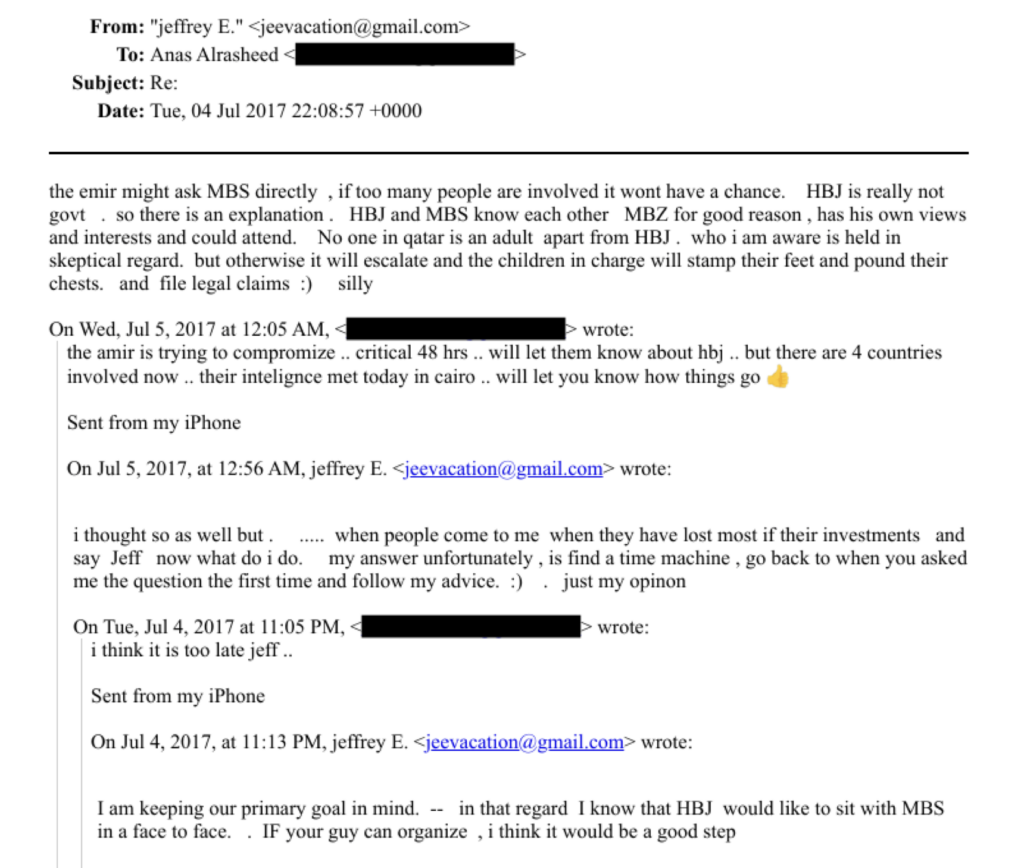
“I am keeping our primary goal in mind. in that regard I know that HBJ would like to sit with MBS in a face to face. . IF your guy can organize, i think it would be a good step,” Epstein wrote in a July 2017 email to Anas al-Rasheed, a Kuwaiti professor who used to be a cabinet minister. (MBS is the nickname of Saudi Crown Prince Mohammad bin Salman.) That “goal” seems to have been an end to the split among Gulf states.

U.S. Department of Justice

In a follow-up email, Epstein clarified that HBJ wasn’t officially speaking for the Qatari government but was the only “adult” left in the Qatari elite. It’s not clear from the emails whether the meeting between HBJ and MBS went through. Al-Rasheed did not respond to a request for comment.

“I think qatar should stop kicking and arguing.. let the heat come down a bit,” Epstein wrote to Jabor Y., a man who had previously managed Epstein’s meetings with HBJ, in July 2017. Epstein implied that courting Israel could be the key to breaking out of Qatar’s isolation.

Jabor Y. also appears under the name Jabor Al Thani in some emails. The files released by the Department of Justice include a permit request from Jabor Yousef Jassim Al Thani, a businessman and member of the royal family, for Epstein’s private jet to land in Qatar. The same royal appears with Epstein in a set of photos released by congressional investigators last year. He did not respond to a request for comment.

“The Indian Prime minisiter modi took advice. and danced and sang in israel for the benefit of the US president. they had met a few weeks ago.. IT WORKED.!” Epstein added in that email. Indian Prime Minister Narendra Modi was visiting Israel at the time the email was written, a few weeks after Modi visited the United States. In other emails released on Friday, an Indian businessman with ties to Modi asked Epstein for help connecting India’s “leadership” to figures in the Trump administration ahead of Modi’s visit.

U.S. Department of Justice


Epstein, who died while awaiting trial for sex trafficking in 2019, was similarly well connected to all sides of the Gulf. He befriended the influential Emirati businessman Sultan Ahmed bin Sulayem, who even ordered DNA test kits for the royal family of Dubai using Epstein’s address. MBS reportedly gave Epstein a Bedouin tent as a welcome gift during a visit to Saudi Arabia. The emails released Friday show that Epstein was having real estate discussions with HBJ, who retired as Qatar’s prime minister in 2013. 

One of Epstein’s close business partners was Barak, a decorated general who served as prime minister of Israel from 1999 to 2001 and as defense minister from 2007 to 2013. Epstein wrote to Barak in 2015 about his personal interest in the intersection between the business, military, and intelligence worlds.

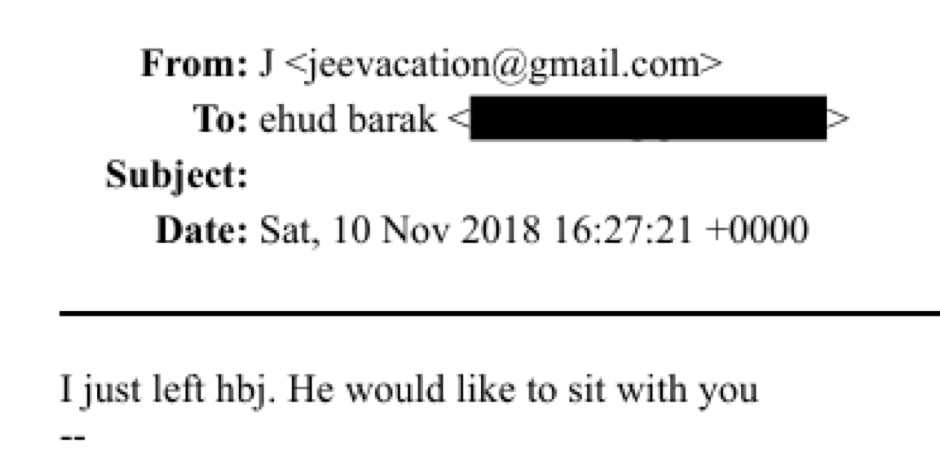
A little over a year into the Gulf crisis, Epstein brokered the meeting between HBJ and Barak. In November 2018, Epstein wrote to Barak: “just left hbj. He would like to sit with you.” Then he wrote an email introducing Barak and Jabor Al Thani.

U.S. Department of Justice

“So many=fascinating and disturbing events following each other on the global and o=r regional arenas. And so much to discuss,” Barak wrote to Jabor Al Thani, noting that he had met HBJ in the past and was eager “to find a way to resume contact.”

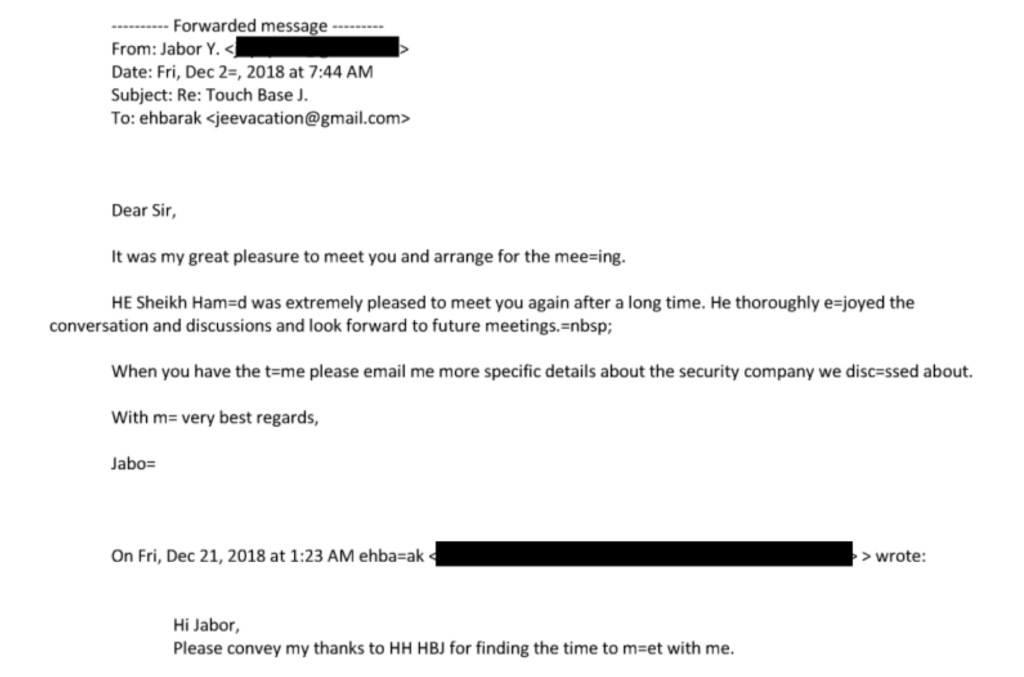
The group agreed that Barak would meet HBJ—without Epstein—on December 20 at One Hyde Park, an ultra-posh apartment building in London partially owned by HBJ. After the meeting, Jabor Al Thani wrote a thank-you note to Barak and CC’d it to Epstein. The only clue to the content of the discussion was Jabor Al Thani asking for “more specific details about the security company” they discussed.

U.S. Department of Justice

At the time, Barak and Epstein were working together on a security tech startup called Carbyne, which promises to integrate emergency dispatchers with real-time location tracking and video surveillance feeds sourced from citizens’ phones. (Barak left Carbyne in 2020.) Separately, Epstein was talking to bin Sulayem, the Emirati businessman, about expanding Carbyne into Dubai and having bin Sulayem join as an investor.

Yet the relationship was not just about making money; Barak and Epstein also used their business ties to set up diplomatic back channels. Blurring the lines between business deals, political leverage, and personal companionship was how Epstein operated. In 2010, when Epstein asked an unnamed associate about buying a Syrian or Lebanese bank, the associate wrote back, “I have a good contact in Syria…but sex better in Lebanon.”

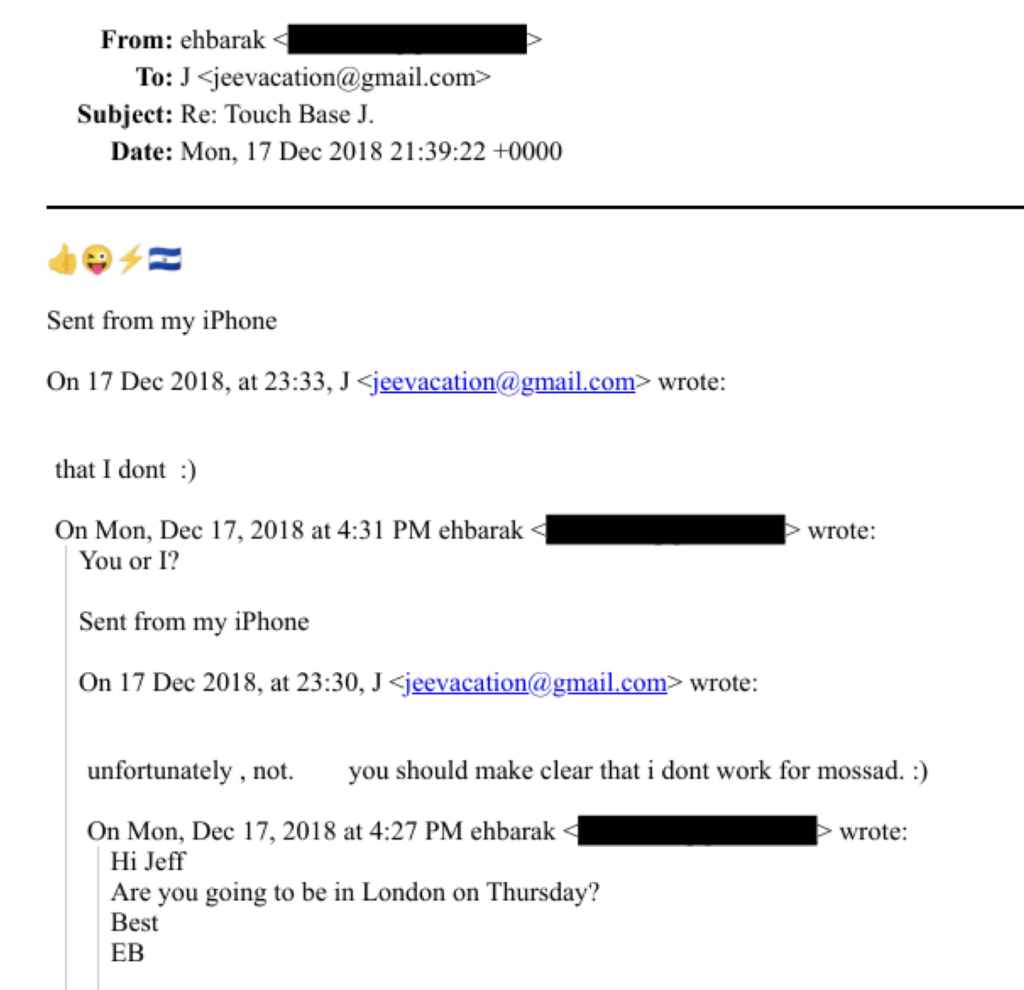
In emails leading up to the Barak-HBJ meeting, Epstein gestured toward the persistent rumors that he was a spy. He asked Barak to “make clear” to the Qatari side “that i dont work for mossad,” the Israeli foreign intelligence agency. Epstein added a smiley face to the end of the message. Barak responded with a series of emojis: thumbs up, tongue sticking out, lightning bolt, and Israeli flag.

U.S. Department of Justice

“Epstein tried to aggrandize his role and his activities and so on. I regret ever meeting him. I was introduced to him in 2003 in a public event with [the late Israeli Prime Minister] Shimon Peres and with hundreds of Americans,” Barak told an audience at the Halifax International Security Forum in November 2025, in response to a question about Epstein’s role in Israeli politics.

While Epstein was joking with Barak about being a Mossad agent, he was also working to cultivate some goodwill for Qatar with Steve Bannon, who had served as the Trump administration’s chief strategist from January 2017 to August 2017. Bannon secretly met with Saudi and Emirati leaders just before they launched their blockade, and he publicly attacked Qatar after leaving the White House.

But he seemed receptive to Epstein’s overtures on Qatar’s behalf. “When you see Jabor you can tell him, I told you he is my arab brother. And tell HBJ that I told you that he and Ehud Barak are head and shoulders above the rest. They will then know you are family,” Epstein wrote in a November 2018 text message to Bannon. “Done,” Bannon replied.

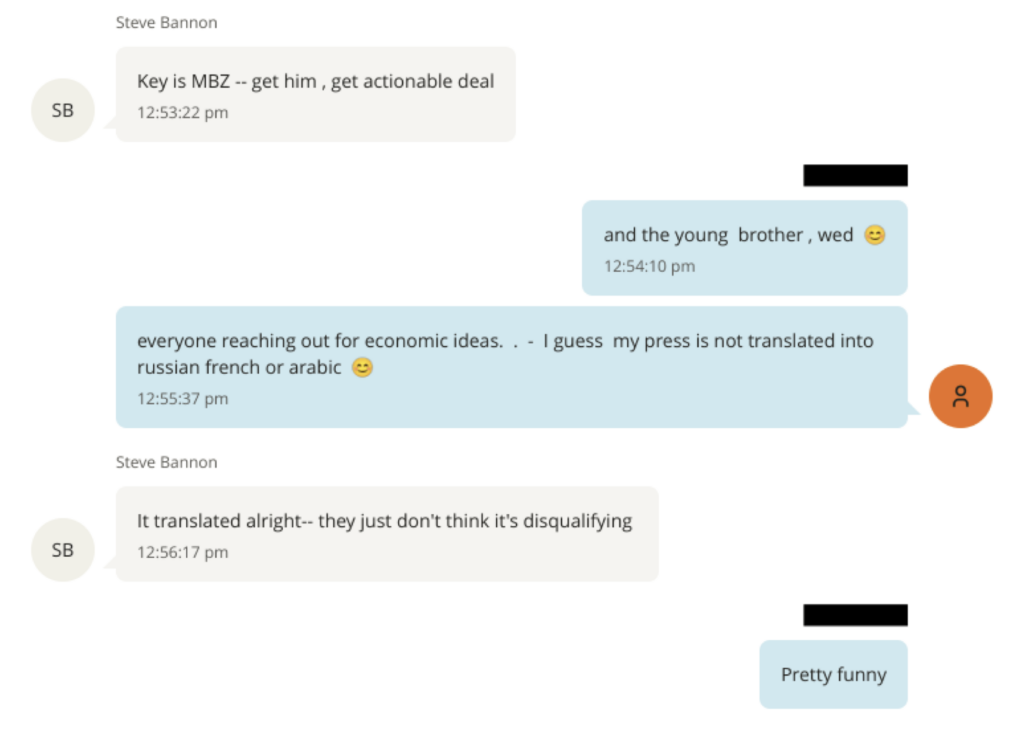
On December 11, 2018, Epstein asked Bannon to “explain to your boys that the lynchpin in the middle east is Qatar , blockade lifted. they can help on many fronts. many.” Bannon responded that Emirati President Mohammed bin Zayed is the “key” to an “actionable deal.”

Epstein noted that “everyone reaching out for economic ideas” and joked that “my press is not translated into russian french or arabic,” apparently referring to the mounting sex abuse allegations against him.

“It translated alright– they just don’t think it’s disqualifying,” Bannon replied. He did not respond to Reason‘s request for an interview.

U.S. Department of Justice

The post Jeffrey Epstein Brokered Secret Meeting Between Qatari and Israeli Leaders appeared first on Reason.com.

from Latest – Reason.com https://ift.tt/oNq5rtX
via IFTTT

‘Billionaire’ Tax is a Bait-and-Switch To Gouge the Middle Class


Rolled up dollar bills on fishhooks | Envato

Supporters of a “billionaire tax”—an idea being pushed both nationally and in California—claim it will impact only those who can “easily afford it.” In fact, it’s a Trojan horse. The next step will be to come after middle-class retirement funds and middle-class homes.

By exploiting working people’s frustrations—”Mark Zuckerberg bought 11 homes so his family can have privacy, I can’t afford a down payment on one!”—concentrated media campaigns are baiting us to cheer on the creation of an entirely new tax system. Under the cover of “soaking the rich,” we are at risk of giving Uncle Sam permission to inventory every item in our possession and claim a percentage of that value every year.

That would be seismic. It would usher in a new relationship between the American people and the Internal Revenue Service (IRS).

The United States has historically taxed income and transactions: what you earn, what you buy, what you realize when you sell. A net-worth tax moves the target to ownership itself. Everything you own, from your family farm to your retirement nest egg to your grandfather’s pocketwatch to your Pokémon collection, would become a potential revenue stream for the state.

In case you’re under the impression that this rule will apply to Bill Gates and Jeff Bezos but not to your parents and your neighbors, remember how politicos sold us the income tax. 

In 1895, the Supreme Court struck down one attempt at a federal income tax, saying it was forbidden by the Constitution, after Congress assessed a two-percent flat tax on incomes over $4,000 a year (less than 1 percent of the population at the time, situated similarly to millionaires today). To allow Congress to tax our income directly, the Constitution had to be modified—hence the Sixteenth Amendment in 1913.

From 1914 through 1917, Congress expanded the pool of taxpayers from fewer than 400,000 to 3.5 million and doubled the tax rate on the lowest eligible incomes. The top bracket, who’d been told they would pay only 3 percent, paid an effective rate 5 times that high.

Don’t think a wealth tax would undergo a similar expansion? The expansion is the whole point. The total net worth of U.S. billionaires is roughly $8 trillion. There are around 1,000 of them, depending on market conditions. That’s enough money to run the federal government for less than 9 months before being completely exhausted. You would have obliterated that money’s productive potential (not to mention the market devastation from dissolving huge chunks of public companies)—and the ravenous spending machine still wouldn’t be satisfied.

But the tools that made the $8 trillion in billionaires’ assets accessible to the IRS could also be turned on the middle class and everyone else. Our collective net worth, after all, is $170 trillion—20 times that of billionaires.

For a Congress addicted to spending and allergic to fiscal accountability, the honeypot of middle-class ownership will be irresistible. The average middle-class household owned $490,000 in wealth in the second quarter of 2025 (the most recent data from the Federal Reserve), including homes, retirement accounts, and college savings.

We know how the bait-and-switch works. Launch a new tax at the very top, codify the authority, normalize the compliance regime, and then gradually lower the thresholds, broaden the base, and expand the reach. When proponents say, “Don’t worry, this is only for the ultra-rich,” understand that as rhetorical cover—a “Look over there, at his wedding and his yacht!” so you won’t notice the sucking straw snaking into your own back pocket.

An asset tax establishes a precedent. The government would get to appraise people’s property and send them a bill for the privilege of not having it taken. Every American life would be transformed into a perpetual valuation case file, ripe for mining whenever the nation’s most drunken spenders want to up their ante.

The post 'Billionaire' Tax is a Bait-and-Switch To Gouge the Middle Class appeared first on Reason.com.

from Latest – Reason.com https://ift.tt/UyOkQo2
via IFTTT

Thawing ICE


IMG_4987 | Photo US Border Patrol

Some good news on immigration enforcement for the first time in what feels like a very long time comes in the form of two court orders restricting Trump administration policies and a body cam announcement from Department of Homeland Security (DHS) Secretary Kristi Noem.

The first court order came Monday morning, in a case filed against Immigration and Customs Enforcement (ICE) by Rep. Joe Neguse (D–Colo.) and 12 other Democratic members of Congress. Their complaint centered on a new rule requiring members of Congress to give seven days’ notice before they could enter an ICE detention facility.

The Trump administration first issued an advance-notice policy last June, saying that members of Congress must provide three days’ notice before being allowed entry into ICE field offices and 24 hours’ notice in order to enter an ICE detention facility. Twelve Democrats—all of whom said they were blocked from unannounced visits to immigration facilities—sued, noting that under a rider attached to the DHS’ annual funding bill, they have the right to conduct oversight visits to DHS facilities without prior notice. In December, Judge Jia M. Cobb of the U.S. District Court for the District of Columbia temporarily barred enforcement of the advance-notice rule.

Then, on January 8, Noem issued a memo saying members of Congress must provide seven days’ notice to enter immigration detention facilities. (If at first you don’t succeed….) So, Democrats sued again, and here we are.

In yesterday’s ruling, Cobb once again issued a temporary stay on enforcing the prior notice requirement. “The Court has already found that DHS’s promulgation, implementation, and enforcement of a nearly identical requirement qualified as Defendants ‘us[ing]’ funds ‘to prevent’ Members of Congress from entering facilities as is prohibited,” she wrote.

Noem’s rationale for the new memo was that it was OK because the DHS would only enforce it using funds from the One Big Beautiful Bill Act (OBBBA) and not the annual appropriations bill. But “evidence in the form of testimony by a former DHS and ICE legal and budgeting official stating that it would be logistically difficult, if not impossible, for DHS to identify and segregate the relevant expenditures to ensure that only funds from the OBBBA were used to first promulgate and enforce the January 8 policy or will be used to enforce it going forward,” noted Cobb. And ICE provided “almost no details or specifics as to how DHS and ICE would accomplish this task in the face of the practical challenges.”

Which means: Nope! The January 8 Noem memo and the seven-day advance notice rule likely won’t cut it, either, and their enforcement is temporarily blocked as the case plays out.

Fast forward to Monday night, and an even bigger blow to the Trump administration’s immigration policy was delivered.


A judge temporarily blocked the administration’s effort to end temporary protected status (TPS) for Haitians. Ending the program for Haitians, as the government was set to do this week, would mean that many people who came here legally—albeit with no path to citizenship—would suddenly be subject to deportation.

Even if you don't have time to read all 83 pages of Judge Reyes's opinion barring the Trump administration from rescinding Temporary Protected Status for 350,000+ Haitians, please at least check out the four-page introduction. It's a tour de force:storage.courtlistener.com/recap/gov.us…

Steve Vladeck (@stevevladeck.bsky.social) 2026-02-03T01:06:19.093Z


The TPS designation “allowed hundreds of thousands of migrants to live and work in the United States,” as Reason‘s Fiona Harrigan explained last year. It “offered legal status and work authorization to Cubans, Haitians, Nicaraguans, and Venezuelans (CHNV) who passed security screenings and secured U.S.-based financial sponsors” and was used by hundreds of thousands of people.

In the ruling, Judge Ana C. Reyes of the U.S. District Court for the District of Columbia paused the ending of TPS status for Haitians as a lawsuit challenging the policy plays out.

It is “substantially likely” that Noem was influenced to end Haitians’ TPS status based on “hostility to nonwhite immigrants,” opined Reyes, citing Noem’s assertion that we need a travel ban from Haiti and “every damn country that has been flooding our nation with killers, leeches, and entitlement junkies.”

“In addition to the migrants from Haiti, Noem has terminated protections for about 600,000 Venezuelans, 60,000 people from Honduras, Nicaragua and Nepal, more than 160,000 Ukrainians and thousands of people from Afghanistan and Cameroon,” notes NPR.

“This 11th hour reprieve is, of course, welcome,” said Lynn Tramonte, executive director of the Ohio Immigrant Alliance, of Reyes’ recent ruling. “But people can’t live their lives like this, pegging their families’ futures to a court case.”


The rulings come as congressional debates over ICE oversight and funding rage. These debates have been at the heart of a struggle to end a government shutdown, which may come to a close today.

One of the main issues here has been that Democrats don’t want to pass a government funding bill that gives more money to the DHS, which oversees ICE. And as of yesterday, it wasn’t clear that Republicans in the House would have enough votes to pass the five-bill package passed by the Senate last week.

That package funds the DHS at existing levels for two weeks, giving lawmakers time to hash out a more long-term arrangement that is acceptable to both parties. It also funds many other federal departments through September 30.

President Donald Trump yesterday urged House Republicans to get it passed now as is:

Perhaps with an eye toward this effort, Noem yesterday announced a policy change that Democrats have been pushing for.

“Effective immediately we are deploying body cameras to every officer in the field in Minneapolis,” she said. “As funding is available, the body camera program will be expanded nationwide. We will rapidly acquire and deploy body cameras to DHS law enforcement across the country.”


Scenes from Ohio: Hundreds of people gathered at a Springfield, Ohio, church yesterday to protest the ending of temporary protected status for Haitian migrants. Springfield has a large Haitian population and was rumored to be a major target of ICE enforcement efforts this week. (It was also the city that the Trump campaign in 2024 spread misinformation about immigrants eating dogs and cats.)


QUICK HITS

  • Whistleblower complaint against Director of National Intelligence Tulsi Gabbard:

• The DHS’ narrative around a Border Patrol officer shooting two Venezuelans in Oregon earlier this month is falling apart. According to the DHS, Border Patrol agents were in the midst of a “targeted” stop targeting members of the Venezuelan gang Tren de Aragua and the driver “weaponized their vehicle against” officers. “But court records obtained by the Guardian reveal a Department of Justice prosecutor later directly contradicted DHS’ Tren de Aragua statements in court,” the paper reports, and an FBI affidavit also contradicts DHS statements.

• Is panhandling protected speech? Alabama is asking the Supreme Court to end First Amendment protections for begging.

• California Gov. Gavin Newsom is pledging to review TikTok’s content moderation policies. It’s as unconstitutional as when Florida and Texas tried to control tech platform moderation policies, Mike Masnick writes. “For the Governor of California to jump from ‘some rando users reported upload problems during a technical outage’ to ‘we must investigate whether this violates California law’ is… not how any of this should work.” Of course, “even if every single one of these reports were accurate—even if TikTok were deliberately, systematically moderating content to favor Trump—that would be totally legal under the First Amendment.”

• In case you need a primer on Moltbook—essentially Reddit for robots—and the claims that AI agents are plotting against us there.

The post Thawing ICE appeared first on Reason.com.

from Latest – Reason.com https://ift.tt/9YPniox
via IFTTT

‘Billionaire’ Tax is a Bait-and-Switch To Gouge the Middle Class


Rolled up dollar bills on fishhooks | Envato

Supporters of a “billionaire tax”—an idea being pushed both nationally and in California—claim it will impact only those who can “easily afford it.” In fact, it’s a Trojan horse. The next step will be to come after middle-class retirement funds and middle-class homes.

By exploiting working people’s frustrations—”Mark Zuckerberg bought 11 homes so his family can have privacy, I can’t afford a down payment on one!”—concentrated media campaigns are baiting us to cheer on the creation of an entirely new tax system. Under the cover of “soaking the rich,” we are at risk of giving Uncle Sam permission to inventory every item in our possession and claim a percentage of that value every year.

That would be seismic. It would usher in a new relationship between the American people and the Internal Revenue Service (IRS).

The United States has historically taxed income and transactions: what you earn, what you buy, what you realize when you sell. A net-worth tax moves the target to ownership itself. Everything you own, from your family farm to your retirement nest egg to your grandfather’s pocketwatch to your Pokémon collection, would become a potential revenue stream for the state.

In case you’re under the impression that this rule will apply to Bill Gates and Jeff Bezos but not to your parents and your neighbors, remember how politicos sold us the income tax. 

In 1895, the Supreme Court struck down one attempt at a federal income tax, saying it was forbidden by the Constitution, after Congress assessed a two-percent flat tax on incomes over $4,000 a year (less than 1 percent of the population at the time, situated similarly to millionaires today). To allow Congress to tax our income directly, the Constitution had to be modified—hence the Sixteenth Amendment in 1913.

From 1914 through 1917, Congress expanded the pool of taxpayers from fewer than 400,000 to 3.5 million and doubled the tax rate on the lowest eligible incomes. The top bracket, who’d been told they would pay only 3 percent, paid an effective rate 5 times that high.

Don’t think a wealth tax would undergo a similar expansion? The expansion is the whole point. The total net worth of U.S. billionaires is roughly $8 trillion. There are around 1,000 of them, depending on market conditions. That’s enough money to run the federal government for less than 9 months before being completely exhausted. You would have obliterated that money’s productive potential (not to mention the market devastation from dissolving huge chunks of public companies)—and the ravenous spending machine still wouldn’t be satisfied.

But the tools that made the $8 trillion in billionaires’ assets accessible to the IRS could also be turned on the middle class and everyone else. Our collective net worth, after all, is $170 trillion—20 times that of billionaires.

For a Congress addicted to spending and allergic to fiscal accountability, the honeypot of middle-class ownership will be irresistible. The average middle-class household owned $490,000 in wealth in the second quarter of 2025 (the most recent data from the Federal Reserve), including homes, retirement accounts, and college savings.

We know how the bait-and-switch works. Launch a new tax at the very top, codify the authority, normalize the compliance regime, and then gradually lower the thresholds, broaden the base, and expand the reach. When proponents say, “Don’t worry, this is only for the ultra-rich,” understand that as rhetorical cover—a “Look over there, at his wedding and his yacht!” so you won’t notice the sucking straw snaking into your own back pocket.

An asset tax establishes a precedent. The government would get to appraise people’s property and send them a bill for the privilege of not having it taken. Every American life would be transformed into a perpetual valuation case file, ripe for mining whenever the nation’s most drunken spenders want to up their ante.

The post 'Billionaire' Tax is a Bait-and-Switch To Gouge the Middle Class appeared first on Reason.com.

from Latest – Reason.com https://ift.tt/UyOkQo2
via IFTTT

Thawing ICE


IMG_4987 | Photo US Border Patrol

Some good news on immigration enforcement for the first time in what feels like a very long time comes in the form of two court orders restricting Trump administration policies and a body cam announcement from Department of Homeland Security (DHS) Secretary Kristi Noem.

The first court order came Monday morning, in a case filed against Immigration and Customs Enforcement (ICE) by Rep. Joe Neguse (D–Colo.) and 12 other Democratic members of Congress. Their complaint centered on a new rule requiring members of Congress to give seven days’ notice before they could enter an ICE detention facility.

The Trump administration first issued an advance-notice policy last June, saying that members of Congress must provide three days’ notice before being allowed entry into ICE field offices and 24 hours’ notice in order to enter an ICE detention facility. Twelve Democrats—all of whom said they were blocked from unannounced visits to immigration facilities—sued, noting that under a rider attached to the DHS’ annual funding bill, they have the right to conduct oversight visits to DHS facilities without prior notice. In December, Judge Jia M. Cobb of the U.S. District Court for the District of Columbia temporarily barred enforcement of the advance-notice rule.

Then, on January 8, Noem issued a memo saying members of Congress must provide seven days’ notice to enter immigration detention facilities. (If at first you don’t succeed….) So, Democrats sued again, and here we are.

In yesterday’s ruling, Cobb once again issued a temporary stay on enforcing the prior notice requirement. “The Court has already found that DHS’s promulgation, implementation, and enforcement of a nearly identical requirement qualified as Defendants ‘us[ing]’ funds ‘to prevent’ Members of Congress from entering facilities as is prohibited,” she wrote.

Noem’s rationale for the new memo was that it was OK because the DHS would only enforce it using funds from the One Big Beautiful Bill Act (OBBBA) and not the annual appropriations bill. But “evidence in the form of testimony by a former DHS and ICE legal and budgeting official stating that it would be logistically difficult, if not impossible, for DHS to identify and segregate the relevant expenditures to ensure that only funds from the OBBBA were used to first promulgate and enforce the January 8 policy or will be used to enforce it going forward,” noted Cobb. And ICE provided “almost no details or specifics as to how DHS and ICE would accomplish this task in the face of the practical challenges.”

Which means: Nope! The January 8 Noem memo and the seven-day advance notice rule likely won’t cut it, either, and their enforcement is temporarily blocked as the case plays out.

Fast forward to Monday night, and an even bigger blow to the Trump administration’s immigration policy was delivered.


A judge temporarily blocked the administration’s effort to end temporary protected status (TPS) for Haitians. Ending the program for Haitians, as the government was set to do this week, would mean that many people who came here legally—albeit with no path to citizenship—would suddenly be subject to deportation.

Even if you don't have time to read all 83 pages of Judge Reyes's opinion barring the Trump administration from rescinding Temporary Protected Status for 350,000+ Haitians, please at least check out the four-page introduction. It's a tour de force:storage.courtlistener.com/recap/gov.us…

Steve Vladeck (@stevevladeck.bsky.social) 2026-02-03T01:06:19.093Z


The TPS designation “allowed hundreds of thousands of migrants to live and work in the United States,” as Reason‘s Fiona Harrigan explained last year. It “offered legal status and work authorization to Cubans, Haitians, Nicaraguans, and Venezuelans (CHNV) who passed security screenings and secured U.S.-based financial sponsors” and was used by hundreds of thousands of people.

In the ruling, Judge Ana C. Reyes of the U.S. District Court for the District of Columbia paused the ending of TPS status for Haitians as a lawsuit challenging the policy plays out.

It is “substantially likely” that Noem was influenced to end Haitians’ TPS status based on “hostility to nonwhite immigrants,” opined Reyes, citing Noem’s assertion that we need a travel ban from Haiti and “every damn country that has been flooding our nation with killers, leeches, and entitlement junkies.”

“In addition to the migrants from Haiti, Noem has terminated protections for about 600,000 Venezuelans, 60,000 people from Honduras, Nicaragua and Nepal, more than 160,000 Ukrainians and thousands of people from Afghanistan and Cameroon,” notes NPR.

“This 11th hour reprieve is, of course, welcome,” said Lynn Tramonte, executive director of the Ohio Immigrant Alliance, of Reyes’ recent ruling. “But people can’t live their lives like this, pegging their families’ futures to a court case.”


The rulings come as congressional debates over ICE oversight and funding rage. These debates have been at the heart of a struggle to end a government shutdown, which may come to a close today.

One of the main issues here has been that Democrats don’t want to pass a government funding bill that gives more money to the DHS, which oversees ICE. And as of yesterday, it wasn’t clear that Republicans in the House would have enough votes to pass the five-bill package passed by the Senate last week.

That package funds the DHS at existing levels for two weeks, giving lawmakers time to hash out a more long-term arrangement that is acceptable to both parties. It also funds many other federal departments through September 30.

President Donald Trump yesterday urged House Republicans to get it passed now as is:

Perhaps with an eye toward this effort, Noem yesterday announced a policy change that Democrats have been pushing for.

“Effective immediately we are deploying body cameras to every officer in the field in Minneapolis,” she said. “As funding is available, the body camera program will be expanded nationwide. We will rapidly acquire and deploy body cameras to DHS law enforcement across the country.”


Scenes from Ohio: Hundreds of people gathered at a Springfield, Ohio, church yesterday to protest the ending of temporary protected status for Haitian migrants. Springfield has a large Haitian population and was rumored to be a major target of ICE enforcement efforts this week. (It was also the city that the Trump campaign in 2024 spread misinformation about immigrants eating dogs and cats.)


QUICK HITS

  • Whistleblower complaint against Director of National Intelligence Tulsi Gabbard:

• The DHS’ narrative around a Border Patrol officer shooting two Venezuelans in Oregon earlier this month is falling apart. According to the DHS, Border Patrol agents were in the midst of a “targeted” stop targeting members of the Venezuelan gang Tren de Aragua and the driver “weaponized their vehicle against” officers. “But court records obtained by the Guardian reveal a Department of Justice prosecutor later directly contradicted DHS’ Tren de Aragua statements in court,” the paper reports, and an FBI affidavit also contradicts DHS statements.

• Is panhandling protected speech? Alabama is asking the Supreme Court to end First Amendment protections for begging.

• California Gov. Gavin Newsom is pledging to review TikTok’s content moderation policies. It’s as unconstitutional as when Florida and Texas tried to control tech platform moderation policies, Mike Masnick writes. “For the Governor of California to jump from ‘some rando users reported upload problems during a technical outage’ to ‘we must investigate whether this violates California law’ is… not how any of this should work.” Of course, “even if every single one of these reports were accurate—even if TikTok were deliberately, systematically moderating content to favor Trump—that would be totally legal under the First Amendment.”

• In case you need a primer on Moltbook—essentially Reddit for robots—and the claims that AI agents are plotting against us there.

The post Thawing ICE appeared first on Reason.com.

from Latest – Reason.com https://ift.tt/9YPniox
via IFTTT

Disney Names Parks Head Josh D’Amaro As Next CEO, Replacing Bob Iger

Disney Names Parks Head Josh D’Amaro As Next CEO, Replacing Bob Iger

Walt Disney, after a more than two-year saga, has landed on its next CEO: Josh D’Amaro, head of the company’s theme parks and consumer products division.

D’Amaro, 54, will take over the top job at Disney from current CEO Bob Iger, who cumulatively has served in the post for nearly two decades, having been CEO from 2005 to 2020 when he we replaced by Bob Chapek, only to return in 2022). The Disney board on Tuesday announced the selection of D’Amaro, currently chairman of Disney Experiences, capping the media giant’s extended and closely watched succession drama

D’Amaro, a 28-year-veteran of the company, will succeed Iger effective March 18, the Burbank, California-based company said Tuesday in a statement. He has been with Disney since 1998, starting out at Disneyland. He has worked across a range of business, marketing and operations posts within Disney, from CFO of Disney Consumer Products Global Licensing to president of Disneyland Resort and president of Walt Disney World Resort. He was promoted to his current post as head of Disney parks and cruises, consumer products and Walt Disney Imagineering in May 2020. 

D’Amaro is seen as CEO in the classic Disney mold with nearly 30 years of experience on the retail side of Disney, giving him an intimate understanding of how children and families interact with the Mouse House brand, according to Variety. D’Amaro at present steers a $60 billion investment in an expansion of Disney’s theme parks around the world, including a new destination coming to Abu Dhabi. Before joining Disney, D’Amaro worked in Gillette’s finance department. He holds a bachelor’s degree in business administration/marketing from Georgetown University.

According to Bloomberg, the head of Disney’s Experiences division, by far the company’s biggest source of profit, D’Amaro, 54, was chosen from among several internal candidates who were in line to succeed Iger. They included Dana Walden, co-chair of entertainment and head of TV; Alan Bergman, also co-chair of entertainment and head of film; and Jimmy Pitaro, ESPN’s chairman.

Iger has been personally mentoring potential replacements, according to the company, an attempt by the board to ensure succession goes smoothly after botched efforts in the past.

Disney’s board of directors, led by chairman James Gorman, was under pressure to execute a strong succession plan this time around — after the debacle that ensued when Iger previously handed the CEO baton to Bob Chapek, a Disney veteran who was promoted from the same perch that D’Amaro now holds. Chapek took over as CEO in February 2020, just weeks before the COVID pandemic turned global markets upside down and forced immediate and drastic changes in the way Disney operated. Iger stepped down as CEO but remained chairman overseeing creative matters for the company. That set the stage for an epic clash of strategic visions and executive egos that culminated in the Disney board ousting Chapek in November 2022 and Iger reclaiming the CEO role. 

But Iger’s return had a time limit from the start. In October 2024, the Disney board committed to naming a CEO successor by early 2026. After the Chapek fiasco and increasing investor scrutiny on corporate governance issues (of which CEO succession planning is paramount), Disney’s board has little margin for error this time around.

 In announcing Disney’s year-end 2025 quarterly results on Monday, Iger said there was “healthy competition” between D’Amaro’s parks division and entertainment business, led by Walden and co-chair Alan Bergman.

“We have a healthy competition now at our company in terms of which of those two businesses is going to essentially prevail as the No. 1 driver of profitability for the company,” Iger said. “But I’m confident that both have that ability, meaning both have the ability to grow nicely into the future, given all the investments that we’ve made and the trajectory that we’re on.”

Iger also offered his thoughts on the next Disney CEO’s agenda. “In the world that changes as much as it does… trying to preserve the status quo is a mistake, and I’m certain that my successor will not do that,” he said. “So [the new CEO will] be handed, I think, a good hand in terms of the strength of the company, a number of opportunities to grow and also the exhortation that in a world that changes, you also have to continue to change and evolve as well.”

Tyler Durden
Tue, 02/03/2026 – 08:43

via ZeroHedge News https://ift.tt/V1I2v6G Tyler Durden

PayPal Suffers Worst Drop In Four Years After Profit Miss, CEO Set To Exit

PayPal Suffers Worst Drop In Four Years After Profit Miss, CEO Set To Exit

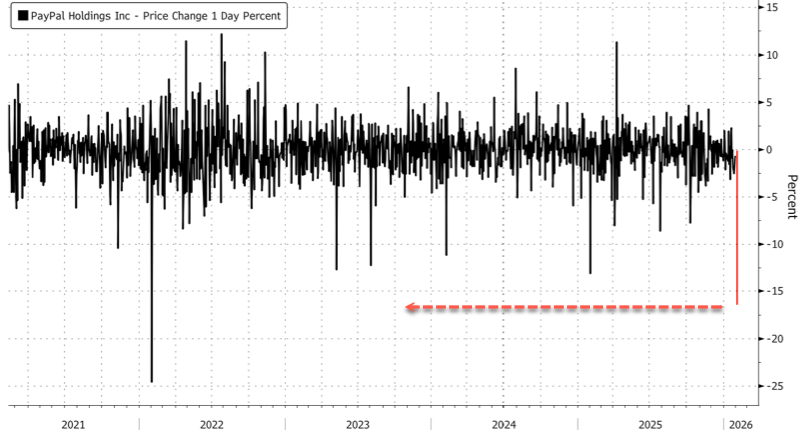
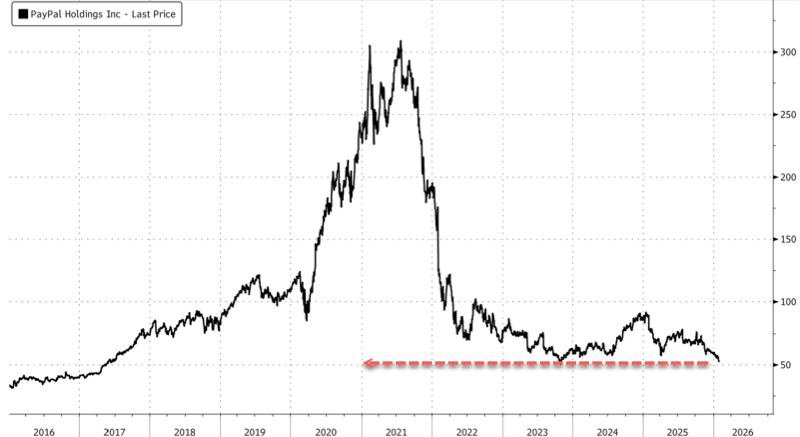
PayPal shares in New York premarket trading plunged 17%. If the losses hold through the cash session, this would mark the largest decline in four years. The selloff was sparked after the payments company reported adjusted profit and revenue that fell short of Bloomberg Consensus estimates, along with news that CEO Alex Chriss will be replaced.

CFO Jamie Miller will serve as interim CEO until HP CEO Enrique Lores replaces Chriss. Newly appointed board chair David Dorman said that execution under the current CEO has failed to meet board expectations (translation: share price is too low), despite some progress.

While some progress has been made in a number of areas over the last two years, the pace of change and execution was not in line with the Board’s expectations,” Dorman told investors.

Fourth-quarter earnings missed the average analyst estimates tracked by Bloomberg, with the payments company highlighting weakness from US retail spending and headwinds abroad.

Important to note that fourth-quarter EPS of $1.23 and revenue of $8.68 billion both missed expectations, while full-year EPS of $5.31 fell below prior guidance of $5.35 to $5.39. Adding to investor concern, signs of softening consumer spending emerged as growth in PayPal-branded online checkouts slowed sharply to 1%, down from 6% a year earlier.

CFO Miller warned in October that worsening macroeconomic headwinds (a K-shaped economy) would affect the firm’s ability to achieve its longer-term targets. She and other executives have struggled to monetize the company’s payment services.

Here’s a snapshot of fourth quarter earnings (courtesy of Bloomberg):

Adjusted EPS $1.23 vs. $1.19 y/y, estimate $1.28 (Bloomberg Consensus)

  • Net revenue $8.68 billion, +3.7% y/y, estimate $8.79 billionTransaction revenue $7.82 billion, +3% y/y, estimate $7.95 billion

  • Other value added services revenue $857 million, +10% y/y, estimate $838.8 million

Transaction margin dollars $4.03 billion, +2.5% y/y, estimate $4.07 billion

Total payment volume $475.14 billion, +8.5% y/y, estimate $471.51 billion

  • Venmo total payment volume $85.79 billion, +13% y/y, estimate $84.05 billion

Payment transactions 6.75 billion, +2% y/y, estimate 6.72 billion

Active customer accounts 439 million, +1.2% y/y, estimate 439.04 million

Adjusted operating income $1.55 billion, +3.2% y/y, estimate $1.59 billion

Adjusted operating margin 17.9% vs. 18% y/y, estimate 18.1%

Adjusted free cash flow $2.10 billion, -0.1% y/y, estimate $2.03 billion

US revenue y/y growth 4%

International revenue y/y growth 1%

Total operating expenses $7.17 billion, +3.5% y/y, estimate $7.26 billion

As for the outlook, PayPal is guiding to muted growth and margin pressure in the near term

First Quarter Forecast

  • Sees mid-single digit decline in adjusted EPS growth y/y

  • Sees roughly flat transaction margin dollars

Year Forecast

  • Sees low-single digit decline to slightly positive in adjusted EPS growth y/y

  • Sees roughly flat transaction margin dollars

  • Sees adjusted free cash flow above $6 billion

  • Sees capital expenditure about $1 billion, estimate $997.8 million

The combination of the fourth quarter miss and the CEO being replaced sent shares tumbling in premarket trading, down about 17% around 0800 ET – the largest decline since the 25% crash on Feb. 2, 2022.

What is this stock pattern called?

What happens to PayPal shares when X Payments goes live?

Tyler Durden
Tue, 02/03/2026 – 08:40

via ZeroHedge News https://ift.tt/m4o9v3G Tyler Durden

Futures Rise As Tech Gains On Palantir’s “Cosmic Reward”

Futures Rise As Tech Gains On Palantir’s “Cosmic Reward”

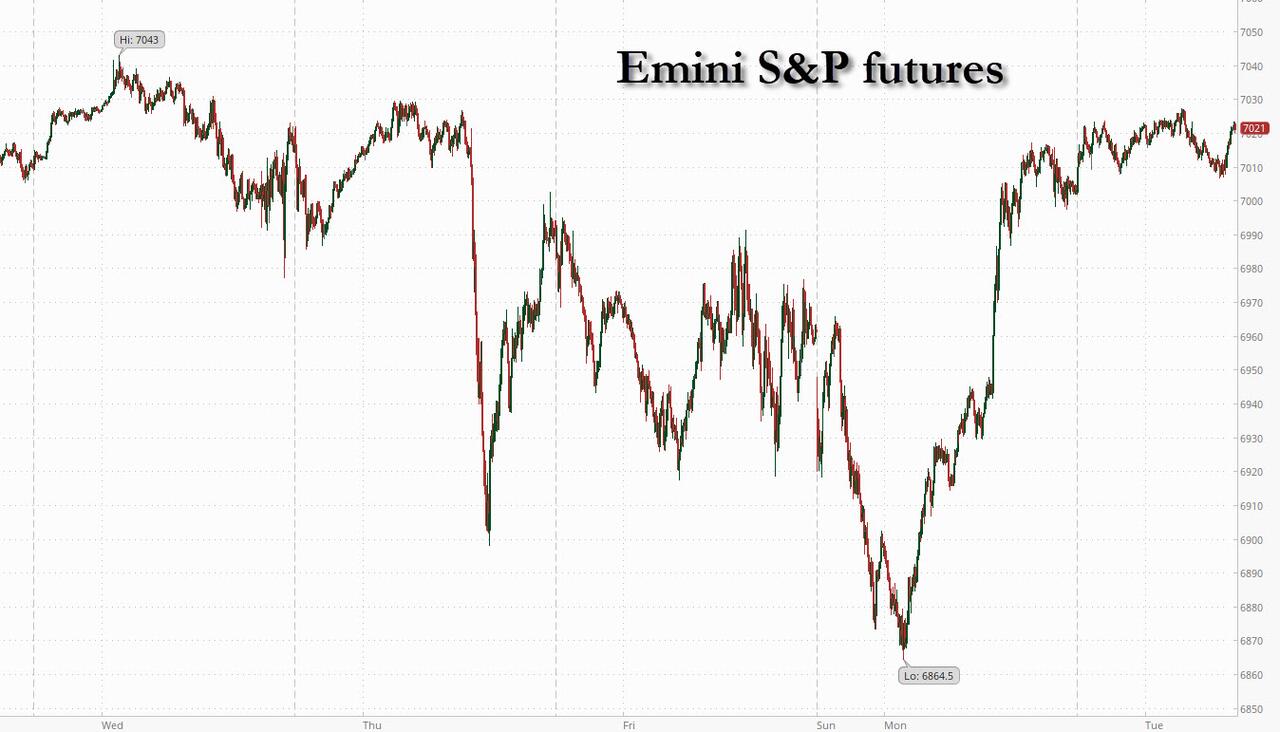
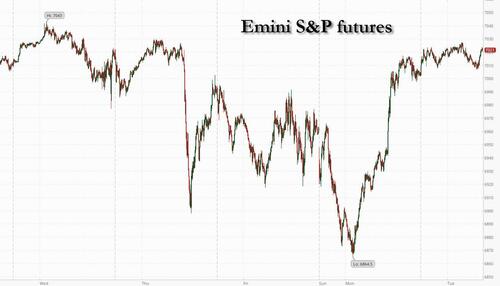
Stock futures are higher, led by tech, while metals rebound and global markets more than retrace Friday/Monday losses. Only bitcoin continues to slide on laughable fears that Kevin Warsh will somehow shrink the Fed’s balance sheet. As of 8:00am ET, S&P futures are up 0.3% and Nasdaq futures gain 0.5% after blockbuster results from Palantir renewed the AI trade. Pre-market, Mag7 names are all higher ex-AAPL with PLTR the standout which should aid the Software reboot. Palantir’s forecast for 61% sales growth this year is helping the AI narrative, with CEO Alexander Karp describing the company’s accelerating revenue as “a cosmic reward” for the data analytics firm’s shareholders. Energy, healthcare, and Staples are weaker pre-mkt as all other sectors are big higher. European stocks briefly traded into record territory, while technology stocks led gains in Asia as South Korea’s chipmakers are surging again. Elsewhere, dip-buyers are crowding into metals: gold is +5.5%, silver +9.4% with WTI flat and Ags bid. Bond yields are flat to +1bp with USD flat. Today’s macro focus is on the vote to reopen the government, where Trump told GOP not to block the deal; we also get the January vehicle sales update. NFP / JOLTS have been delayed with release dates to be updated after the gov’t reopens. Earnings remain front and center, with PepsiCo, Pfizer and AMD due today. . Bitcoin remained under pressure.
In premarket trading, Mag 7 stocks are all higher ex-Apple which is again depressed by soaring memory prices (Alphabet +1.2%, Tesla +1.1%, Amazon +0.7%, Microsoft +0.2%, Nvidia +0.7%, Meta +0.1%, Apple -0.7%)

  • Gold and silver miners including Newmont (NEM) gain as precious metal prices climb out of a three-day slide. Newmont rises 4%.
  • AES Corp. (AES) rises 8% after BlackRock Inc.’s Global Infrastructure Partners is said to team up with EQT AB in a bid to acquire the power company.
  • Eaton Corp. (ETN) falls 5% after the power equipment company forecast adjusted earnings per share for 2026 of $13.00 to $13.50, a range with a midpoint below analysts’ expectations.
  • Fabrinet (FN) falls 4% after the engineering and manufacturing services company’s results showed component constraints pressuring the datacom business. However, analysts are broadly positive on the prospects going forward.
  • HP Inc. (HPQ) slips 2% as CEO Enrique Lores stepped down to lead PayPal Holdings.
  • Palantir Technologies Inc. (PLTR) rises 11% after the company forecast revenue for fiscal 2026 that significantly exceeded Wall Street expectations, a boost for the data analytics company after its shares have gotten off to a lackluster start so far this year.
  • PayPal Holdings (PYPL) falls 15% after the fintech reported profit and revenue that fell short of expectations. The company also said Chief Executive Officer Alex Chriss will be replaced by HP Inc. CEO Enrique Lores.
  • Rambus (RMBS) slides 8% after analysts note that a supply chain hiccup weighed on the semiconductor device company’s first-quarter outlook. The stock has performed strongly of late, rising about 24% so far this year.
  • SoFi Technologies (SOFI) climbs 3% after JPMorgan upgraded to overweight. The bank is positive about the company’s execution and “more tenable valuation.”
  • Teradyne (TER) soars 20% after the semiconductor manufacturing company forecast revenue for the first quarter that exceeded the average analyst estimate.

In corporate news, Elon Musk confirmed the combination of SpaceX and xAI in a deal that values the enlarged entity at $1.25 trillion, with the company said to still be planning an IPO later this year. Musk’s rationale is that the least expensive way to do AI computations within two to three years will be in space. Bloomberg estimates that xAI is burning through ~$11 billion in cash in 2025, constraining its ability to seek outsized funding rounds similar to OpenAI. In other corporate news, Uber is rolling out its ride-hailing service in the Chinese gambling hub of Macau, expanding into a new Asian market for the first time in years. Watch shares of professional publishers after Anthropic released an AI-powered productivity tool for companies’ in-house legal teams.

Traders’ appetite for risk rebounded after a steep drop in precious metals triggered a pullback from stocks and crypto at the end of last week. Strong US manufacturing data added to optimism, showing that the economy is on a sound footing as the earnings season rolls on. 

There is a lot of liquidity out there and it’s remaining committed to financial assets,” said Guy Miller, chief strategist at Zurich Insurance. “It’s rotating within the markets, and the macro backdrop is supportive of that continuing.”

In politics, Republican opposition to Trump’s deal with Democrats to end the partial government shutdown began to crumble late Monday as two conservative holdouts agreed to end their threatened blockade. And an analysis of results from a state senate district vote in the Fort Worth area showed that a Texas Democrat’s shock win was powered by big shifts among Latino voters.

Looking at earnings season, out of the 178 S&P 500 companies that have reported so far, 79% have managed to beat analyst forecasts, while 16% have missed. PepsiCo reported better-than-expected fourth-quarter profit and announced a $10 billion share buyback. Merck’s forecast for 2026 sales and profit missed Wall Street’s expectations. 

Investors will now turn their attention Tuesday to a slate of earnings, including Advanced Micro Devices Inc., after a favorable reception to Palantir’s report. Traders are watching for signs that AMD is challenging Nvidia Corp.’s dominance in the market for artificial-intelligence accelerators as they look more broadly than the Magnificent Seven for winners of the AI trade. AMD has rallied more than 50% since October, while Nvidia remained largely flat.

In Europe, the Stoxx 600 is up 0.2%, having surrendered most of an earlier advance that took the index to an all-time peak. Miners outperform, tracking a rebound in precious metals. Meanwhile, a drop in Publicis Groupe weighed on media shares. Here are the biggest movers Monday:

  • Amundi shares advanced as much as 6.4% to a fresh high after Europe’s largest asset manager reported what RBC says is a “solid” update and announced a €500m share buyback
  • The Stoxx 600 Basic Resources Index gained 2.4%, with gold and silver advancing as dip buyers crowded into precious metals following an abrupt unwinding of a record-breaking rally
  • Plus500 shares rise as much as 8.5%, climbing to a new all-time high, after the trading platform announced its entry into the US retail prediction markets through a deal struck with Kalshi Exchange
  • ING Groep shares gain as much as 3.1%, hitting a fresh 2007-high, after analysts at Deutsche Bank upgraded the bank and significantly increased their estimates
  • Swatch shares gain as much as 3.2% after Bank of America upgraded to neutral from underperform on optimism that the worst of the decline is over for watchmakers
  • R&S jumps as much as 24%, the most on record, after the Swiss transformers manufacturer posted order intakes for the full year that surpassed the consensus estimate
  • Demant shares plunge as much as 12% to the lowest in three years after the Danish hearing-aid maker provided guidance for 2026 that was below expectations
  • Publicis shares drop as much as 9%. Despite strong results for the fourth quarter and for the full year, analysts note the advertising agency’s conservative growth guidance for 2026 implies a slowdown
  • Zalando shares fall as much as 8.5% as Morgan Stanley warned the clothing retailer continued to face risks stemming from social commerce
  • Siltronic shares slide as much as 6.8% after the silicon wafer manufacturer warned the challenging market is expected to persist in 2026, which analysts at Jefferies believe will weigh on expectations
  • Schaeffler shares drop as much as 4.5% after UBS downgraded the stock to sell from neutral, warning its current market cap reflects far more ambitious adoption curves and economics for its humanoid robots than he sees likely
  • Sartorius shares drop as much as 3.6% in Frankfurt, reversing an earlier 4.6% gain. Barclays analysts said it expected “some slight share price weakness today on implied downside risk to consensus estimates”
  • De Nora drops as much as 10% as Kepler Cheuvreux trimmed its price target on the Italian water technologies specialist, noting 2026 will be a lackluster year,

Asian stocks extended a rally on Tuesday, more than erasing the previous session’s decline, on a rebound in precious metals and resurgent excitement around artificial intelligence. The MSCI Asia Pacific Index rose as much as 3.1%, and was on pace for the best day since April 10. Most regional markets were in the green, with South Korean’s Kospi surging 6.8% as Samsung Electronics and SK Hynix helped lead the broader Asian benchmark higher. Stocks also rose more than 3% in Japan, and closed higher in Taiwan and Australia as well. Hong Kong shares edged down. Indian equities also rallied after President Donald Trump announced tariff cuts on the country’s goods. Risk sentiment broadly recovered on Tuesday, with investors piling back into semiconductors and AI-related shares. Palantir Technologies  forecast fiscal 2026 revenue that significantly beat expectations, while Elon Musk’s SpaceX confirmed a $1.25 trillion merger with xAI.

The rout in metals prices is disruptive for equities in the short term and has “created some spillover effects from a liquidity perspective,” Kinger Lau, chief China equity strategist at Goldman Sachs, said in a Bloomberg Television interview. Equities are expected to continue rising this year, driven by AI implementation and investment that will support earnings growth, he added

In FX, the dollar pared an earlier fall with the yen now the weakest of the G-10 currencies, down 0.2%. The Aussie is still leading after the RBA hiked interest rates.

In rates,treasuries posted a small retreat, with the 10-year yield up one basis point at 4.29%. European government bonds also dip.

In commodities, oil prices are steady with WTI crude futures near $62 a barrel. Spot silver is up 8% to about $86/oz while gold is near $4,900/oz.

Looking at today’s calendar, Wards total vehicle sales are expected during the day. JOLTS jobs data for December was on the schedule but has been delayed by the partial government shutdown. Fed speaker slate includes Barkin (8am) and Bowman (9:40am)

Market Snapshot

  • S&P 500 mini +0.1%
  • Nasdaq 100 mini +0.4%
  • Russell 2000 mini +0.1%
  • Stoxx Europe 600 +0.3%
  • DAX +0.4%, CAC 40 +0.1%
  • 10-year Treasury yield +1 basis point at 4.29%
  • VIX -0.1 points at 16.24
  • Bloomberg Dollar Index little changed at 1190.87
  • euro little changed at $1.1789
  • WTI crude +0.1% at $62.22/barrel

Top Overnight News

  • Republican opposition to Trump’s deal with Democrats to end the partial US government shutdown began to crumble late Monday. The president told House holdouts via social media to pass the measure “IMMEDIATELY!” A chamber vote is expected today. BBG
  • Elon Musk is merging SpaceX and xAI in a deal valuing the new entity at $1.25 trillion, with SpaceX still planning an IPO later this year, according to people familiar. BBG
  • Reports out Monday afternoon said OpenAI is unsatisfied with some of Nvidia’s latest artificial intelligence chips, and it has sought alternatives since last year, eight sources familiar with the matter said, potentially complicating the relationship between the two highest-profile players in the AI boom. RTRS
  • US President Trump said announcing the creation of US strategic critical minerals reserve. We are launching Project Vault today. USD 2bln from the private sector. USD 10bln funding from US Exim Bank.
  • Australia’s central bank has lifted interest rates for the first time since 2023,one of the first big economies to tighten its monetary policy, in an effort to combat inflation. The Bank increased rates by 25bps to 3.85%. FT
  • China has let the interest rate on a one-year policy loan to banks drop to a record low, according to people familiar with the situation, lowering funding costs so as to revive economic growth. BBG
  • Demand softened at Japan’s 10-year bond auction as investors grew cautious ahead of a snap election, keeping yields elevated amid equity gains and ongoing fiscal concerns. BBG
  • Ukraine has agreed with western partners that persistent Russian violations of any future ceasefire agreement would be met by a coordinated military response from Europe and the US. FT
  • French inflation fell more sharply than expected last month to a 5 year low, raising further possibility that eurozone inflation could be below the European Central Bank’s target for longer this year. Consumer prices were 0.4% higher than in January 2025, down from a 0.7% increase in December. WSJ
  • Euro-zone banks unexpectedly tightened corporate credit standards at the end of 2025, the ECB said in its quarterly Bank Lending Survey. BBG
  • President Trump said he is seeking USD 1bln of damages from Harvard.
  • House Rules panel advances the Senate funding package.

Trade/Tariffs

  • Kremlin’s Spokesperson said Russia have not heard any statement from India about halting Russian oil purchases, adding that they intend to continue developing their relations with India.

Earnings

  • NXP Semiconductors NV (NXPI) Q4 2025 (USD): Adj. EPS 3.35 (exp. 3.31), Revenue 3.34bln (exp. 3.31bln). Q1 Guidance:. EPS 2.77-3.17 (exp. 2.99). Revenue 3.05-3.15bln (exp. 3.09bln).
  • OpenAI has determined it needs alternatives to NVIDIA’s (NVDA) latest AI chips in some cases, has sought alternatives since last year. OpenAI is unsatisfied with the speed at which NVIDIA’s hardware can spit out answers to ChatGPT users for complex problems.
  • Palantir Technologies Inc. (PLTR) Q4 2025 (USD): Adj. EPS 0.25 EPS (exp. 0.23), Revenue 1.41bln (exp. 1.34bln). Said sales to US businesses in 2026 are expected to grow at least 115% to more than USD 3.14bln.Outlook:. FY revenue 7.182-7.198bln (exp. 6.3bln). FY adj. operating income 4.126-4.142bln (exp. 3.14bln). Q1 adj. operating income 870-874mln (exp. 641mln). Q1 revenue 1.532-1.536bln (exp. 1.33bln).

A more detailed look at global markets courtesy of Newsquawk

APAC stocks were mostly higher with several bourses firmly recovering from the prior day’s sell-off, as the region took impetus from the positive handover from Wall Street, where markets rallied after a strong ISM Manufacturing report. ASX 200 climbed higher with tech and miners leading the advances, although further upside was capped as the focus turned to the RBA which hiked rates for the first time in over two years and sounded hawkish on inflation. Nikkei 225 surged following recent currency weakness and gained a firm footing above 54,000 to hit a record intraday high. KOSPI outperformed in a turnaround from the prior day’s bloodbath with the Korea Exchange activating a sidecar earlier in the session to briefly halt program trading after a sharp rise in the local benchmark. Hang Seng and Shanghai Comp initially lagged with early pressure seen across tech stocks, despite no immediate obvious catalysts, and with some attributing it to VAT hike concerns, while the Hang Seng TECH Index briefly re-entered bear market territory after dropping more than 20% from its October high. However, Chinese markets then pared their losses alongside the broad rally in Asia.

Top Asian News

  • China’s No1/central document includes plans to improve and consolidate soybean production. Intend to stabilise food and oil output. To diversify agricultural product imports.
  • Earthquake of magnitude 5.0 hits near the east coast of Honshu, Japan.
  • Japanese Finance Minister Katayama continues to refrain from commenting on intervention data and said PM Takaichi talked about FX benefits as a general fact, and didn’t specifically emphasise merits in a weak yen.
  • Nintendo (7974 JT) President said memory price rises not having a major impact on earnings.
  • Nintendo (7974 JT) – Q3 (JPY): Operating income 155.21bln (exp. 180.7bln), 9M switch sales -66% Y/Y; sees FY net sales 2.25tln (exp. 2.37tln).

European bourses (+0.4%) opened entirely in the green, but sentiment has since waned a touch off best levels, with a couple of indices now slightly in the red. European sectors opened with a positive bias but are now mixed. Basic Resources outperform, led higher by strength in underlying metals prices. Media lags, pressured by losses in Publicis (-7.4%) and ProSiebenSat.1 Media (-2.2%) post-earnings.

Top European News

  • French Finance Minister said the G7 needs to agree on a joint instrument to address global macroeconomic imbalances. Joint instruments can have a sectoral focus, such as rare earths.
  • French Finance Minister Lescure said that the 2026 budget will reduce the deficit to 5.0% from 5.4%, GDP growth of 1% so far in 2026 is a good start.

FX

  • DXY resumed trade overnight on a softer footing following yesterday’s post-ISM recovery (which printed its first expansion in 12 months and at the fastest pace since 2022). The index gradually pared those losses as the morning progressed, to now trade flat, and at the upper end of a 97.34-97.62 range. On the data front, it was also announced that the BLS has delayed the December JOLTS report due today and the January NFP report that was scheduled for Friday owing to the partial government shutdown. With a House vote expected as early as today, the data could be published next week if the vote passes, ING posits.
  • Antipodeans are firmer with outperformance in the AUD amid the rebound in risk appetite and metal prices, while further upside was seen after the RBA meeting, where the central bank hiked the Cash Rate by 25bps to 3.85%, as expected, and stated inflation is likely to remain above target for some time. Governor Bullock declined to provide any forward guidance on the future path of interest rates. AUD/USD has come off best levels amid the aforementioned recovery in the DXY but still holds onto most of its gains in a 0.6945-0.7050 current daily range.
  • Other G10s are flat/lower against the USD, with EUR & GBP flat whilst the JPY lags a touch. For the latter, there was some commentary via Japanese Finance Minister Katayama who reiterated that PM’s Takaichi latest commentary on a weak JPY was a general fact and didn’t specifically emphasise merits in a weak JPY. Focus now on the Japanese snap election, where discussions regarding an LDP “supermajority” is getting more attention. Elsewhere, EUR digested a cooler-than-expected prelim French HICP report which had little impact on the single currency.

Central Banks

  • RBA hikes the Cash Rate by 25bps to 3.85%, as expected, with the decision unanimous, while it stated that inflation is likely to remain above target for some time. A wide range of data confirms inflation has picked up materially. Broad measures of wage growth continue to be strong. Uncertainty in the global economy remains significant but has so far not affected Australia. Job market conditions are a little tight. Capacity pressures are greater than previously assessed. Private-sector demand is growing faster than expected. There are uncertainties about the outlook for domestic economic activity and inflation and the extent to which monetary policy is restrictive. Quarterly Statement on Monetary Policy:. Underlying inflation is higher than expected. Underlying inflation rose to 3.4% over the year to the December quarter, which was higher than expected three months ago and substantially higher than expected in the August Statement. GDP growth has continued to pick up, with private demand growth surprisingly strong. GDP grew by 2.1% over the year to the September quarter, which was around our estimate of the economy’s potential growth rate. Labour market conditions have been stable. The unemployment rate has been broadly stable at around 4.25% in recent quarters.
  • RBA Governor Bullock said does not know if this will be a tightening cycle and cannot rule anything out or in.
  • RBA Governor Bullock said pulse of inflation is too strong and that high inflation hurts all Australians. said:. Board thinks inflation will take longer to return to the target. We cannot allow inflation to get away from us. Will not give forward guidance and the board will remain focused on data. Did not discuss a 50bps rate increase.
  • US President Trump said Fed chair nominee will do good and that investigation into Fed Chair Powell should be taken to the end.
  • ECB Bank Lending Survey (Q4) : Overall credit terms and conditions tightened for loans to firms and consumer credit, while they eased for housing loans.
  • BOK Minutes suggests one board member said further rate cuts should only be considered after risks related to FX and housing markets ease.
  • ECB Bank Lending Survey (Jan): Banks tightened credit standards for firms, citing higher perceived risks amid lower risk tolerance; Credit standards eased slightly for housing loans, but tightened further for consumer credit.

Fixed Income

  • JGBs spent the overnight session under modest pressure, with losses of just under 15 ticks at most in a narrow 131.41-60 band. Specifics for Japan are a little light as markets count down to Sunday’s election, and the narrative is increasingly pointing to a convincing LDP victory, with a ‘super majority’ featuring more in discussions around the potential outcome.
  • USTs are under modest pressure after contained APAC trade. Pressure that is most pronounced at the short end, with yields bid across the curve and flattening as things stand, in a marginal extension on the post-ISM flattener. Today’s docket has been trimmed by the US shutdown, as the BLS will not be updating until there is a resolution and as such, JOLTS will not print. While a funding deal should pass very shortly, Friday’s NFP will also be pushed until at least next week. Currently, USTs trade at the low-end of 111-15 to 111-20+ parameters, at a WTD low, taking out last week’s trough by half a tick but clear of the 111-09 YTD base.
  • Bunds came under pressure early doors, directionally in-fitting with the above, but with magnitudes a little more pronounced in limited newsflow and light volumes. A move that was perhaps a function of the constructive European risk tone at the time. Bunds as low as 127.74 at the time and currently hold a handful of ticks above that trough with losses of c. 15 ticks on the session. Data-wise, French prelim. HICP came in cooler-than-expected across the board, lifting EGBs generally at the time. A series that works to offset some of the hawkish impulses from the prelim. Thereafter, a 2035 Green Bund auction had little impact on the benchmark.
  • Gilts gapped lower by 12 ticks, acknowledging the above. UK specifics are very light aside from a well received 2035 auction, which garnered a b/c above the 3x mark. Focus now turns to the BoE on Thursday, where rates are expected to be kept unchanged.
  • UK sold GBP 4.25bln 4.75% 2035 Gilt: b/c 3.63x (prev. 3.26x), average yield 4.585% (prev. 4.456%), tail 0.2bps (prev. 0.3bps).
  • Germany sells EUR 1.35bln vs exp. EUR 1.5bln 2.50% 2035 Green Bund: b/c 2.01x (prev. 2.2x), average yield 2.79% (prev. 2.52%), retention 10.0% (prev. 4.2%)
  • Ireland’s NTMA raises EUR 5bln from the sale of its new 10 year benchmark bond.
  • South Korea is to sell 3-year and 5-year USD-denominated bonds.
  • Italy’s Tesoro opens book to sell new 15-year BTP bond via syndication, with guidance seen +10bps to 2040 BTP.

Commodities

  • Crude benchmarks continued to extend on Monday’s losses, with WTI and Brent nearing USD 61/bbl and USD 65/bbl, respectively. Oil prices traded muted throughout the APAC session but were pressured following comments by Russia’s Deputy PM Novak, saying they have a surplus in fuel supplies. Since, benchmarks have edged a little higher to now trade flat on the session.
  • Nat Gas futures continue to fall, with Dutch TTF returning to EUR 32/MWh as concerns over the Arctic storm affecting gas production ease.
  • Precious metals have brushed off the recent tarnish following the aggressive selloff in recent sessions. Spot gold has regained the USD 4900/oz handle as being as low as USD 4400/oz in Monday’s session. Investors have been highlighting that the selloff is just a correction and that underlying drivers for gold, mainly central bank buying and ETF inflows, remain strong.
  • 3M LME Copper continues to rebound, alongside precious metals, as the red metal extends to a session high of USD 13.48k/t. The bounce from the recent selloff comes amid a broader reversal of the risk tone and reports that China could expand its strategic copper reserves. China maintains stockpiles of major base metals such as copper and cobalt to stabilise commodity prices and ease raw material cost pressures. The expansion of the reserves comes amid the recent volatility of metals prices.
  • Russian Deputy PM Novak said oil demand and supply are in balance.
  • Kuwait Petroleum Corp. intends to invite global oil firms to assist Kuwait Oil in the development of offshore fields, Bloomberg reported.
  • China raises its gas and diesel prices by CNY 205 and 195 respectively, effective February 4th.
  • Russia’s Deputy PM Novak said they have a surplus in fuel supplies, adding that domestic diesel and gas supplies are sufficient.
  • Shanghai Gold Exchange to adjust margin rations to 17% (prev. 16%) for some gold and silver contracts, and widen the daily price limit to 16% (prev. 15%) as of the 4th February settlement.
  • China could expand its strategic copper reserves and explore a commercial reserve system with state-owned firms.

Geopolitics: Ukraine

  • Russian Deputy PM Novak said oil demand and supply are in balance.
  • Kremlin’s Spokesperson said Russia have not heard any statement from India about halting Russian oil purchases, adding that they intend to continue developing their relations with India.
  • Russia’s Deputy Foreign Minister Ryabkov said the modernisation of their nuclear triad is at a very advanced stage.
  • Russia’s Deputy PM Novak said they have a surplus in fuel supplies, adding that domestic diesel and gas supplies are sufficient.
  • Russia and China held new round of stability talks to support multilateralism.
  • Ukraine agrees multi-tier plan for enforcing any ceasefire with Russia, according to FT.
  • reported note that witnesses say loud explosions heard in Ukraine’s capital of Kyiv.
  • US President Trump said doing very well with Ukraine and Russia and think we’ll have some good news. said:. Putin agreed to no missiles going into Kyiv. We are talking with Iran and we’ll see how that goes.

Geopolitics: Middle East

  • Iran’s Vice President said a new chapter of Iran’s nuclear achievements will be unveiled.
  • Iranian official said that a US aircraft carrier has retreated and is now near Yemen.

Geopolitics: Other

  • Russia and China held new round of stability talks to support multilateralism.
  • Venezuela’s Interim President Rodriguez met with US Envoy Loro Dogu.

US Event Calendar

  • 8:00 am: Fed’s Barkin Speaks on US Economy
  • 9:40 am: Fed’s Bowman in Moderated Conversation

DB’s Jim Reid concludes the overnight wrap

Markets have seen a huge turnaround over the last 24 hours, with the S&P 500 (+0.54%) closing just shy of its record high, with another +0.25% gain in futures this morning after being over -2% lower than current levels this time yesterday. The recovery had several drivers, but the biggest was the ISM manufacturing index, which unexpectedly surged to its highest level since 2022. So that led to growing optimism on the 2026 outlook, along with a classic risk-on move. Meanwhile in Europe, it was a similar story as the STOXX 600 (+1.03%) hit another all-time high, whilst the sharp decline in oil prices helped to ease concern on the inflation side. So it was generally a strong day, with precious metals still the obvious exception, as gold prices (-4.76%) fell to $4,661/oz, whilst silver (-6.96%) saw a fresh plunge that left it down by nearly a third in the last two sessions. However, the yo-yo moves in precious metals have seen gold (+3.46%) and silver (+5.40%) erase most of yesterday’s losses overnight.

That ISM manufacturing print was critical, because it cemented the prevailing narrative of strong data resilience, which has supported markets despite the array of surprising headlines in recent weeks. Indeed, the headline print was back in expansionary territory at 52.6 in January (vs. 48.5 expected), placing it above every economist’s estimate on Bloomberg. And the details were also very strong, with the new orders component surging to 57.1, up +9.7pts on the December print, making it the sharpest monthly jump since June 2020 and the Covid recovery. Clearly it’s only one piece of data, but it’s one of the first we have covering 2026, and it confirmed the robust signals from other sources like the PMIs and the weekly jobless claims.

One of the clearest reactions to the ISM was in US Treasury markets, with yields moving higher as investors priced out the chance of Fed rate cuts. For instance, futures had been pricing in an 87% chance of another rate cut by the June FOMC (which would be Warsh’s first as Chair if confirmed), but that was down to 70% by the close. And in turn, the 2yr yield (+4.9bps) rose to 3.57%, whilst the 10yr yield (+4.2bps) rose to 4.28%. That was particularly noticeable among real yields too, as the 2yr real yield rose by +9.1bps. Higher yields supported the dollar index (+0.66%), which has had its best two-day run since last spring.

Yields were little changed after the latest quarterly borrowing estimates from the US Treasury, which came in at $574bn for Q1 and $109bn for Q2. The Q2 figure was a bit higher than expected, but this was mostly due to an increased end-of-June cash balance target of $900bn, which our strategists expect to be met with higher bill issuance.

While yesterday’s US data delivered positive news, we heard that the BLS will not be releasing the January jobs report on Friday as scheduled due to the partial government shutdown that started last Saturday. In the latest on the shutdown, Trump called on House Republicans to immediately pass the funding deal that was approved by the Senate late last week. Trump’s intervention came as House Speaker Johnson has sought to avoid a push for amendments by conservative Republicans, with a House vote on the package expected today.

Although precious metals are rallying back this morning it’s worth highlighting Friday and Monday’s losses in aggregate. Gold was down a further -4.76% yesterday, which left them down -13.28% in total over the last 2 sessions, making it the biggest 2-day plunge since 2013, and the second biggest since the 1980s. For silver there was an even bigger slide, with prices down -6.96% to $79.27/oz, which brought the 2-day slide to an historic -31.48%. Indeed, that 2-day move for silver is the biggest fall since Bloomberg’s daily data starts back in 1950, so this is genuinely unparalleled in any of our careers unless you’re reading this in your 90s. If you are, then a special hello this morning.

Meanwhile for oil, yesterday also brought some big declines as investor concern eased about geopolitical risk. In part, that followed Trump’s weekend comments that was hopeful about some sort of deal with Iran. And then yesterday, Axios reported that the US Special Envoy Steve Witkoff would meet Iranian foreign minister Abbas Araghchi in Istanbul on Friday. So that helped to take out some of the geopolitical risk premium, and it marked a sharp turnaround from January when Brent crude saw its biggest monthly jump in 4 years. So by the close, Brent crude fell -4.36% to $66.30/bbl, and WTI was down -4.71% to $62.14/bbl. Moreover, that eased investor concern on the inflation side too, with the US 2yr inflation swap down -4.7bps on the day to 2.55%, its biggest daily drop of 2026 so far.

Against that backdrop, it was a strong day for equities on both sides of the Atlantic. So the S&P 500 (+0.54%) recovered from a run of 3 consecutive declines last week, closing just -0.03% below its record high from last Tuesday. Admittedly, the Mag 7 (-0.10%) continued to struggle, posting a 3rd consecutive decline, but small-caps had a very strong performance, with the Russell 2000 up +1.02%, while consumer staples (+1.58%) and industrials (+1.26%) sectors led the gains for the S&P 500.

Meanwhile, we had news of fresh tariff relief, as Trump posted that the US would cut the main tariff on India from 25% to 18%, while also removing the additional 25% tariff the US imposed on India last August citing its purchases of Russian oil. Trump said India would stop purchases of Russian oil, buy “over $500 BILLION DOLLARS of U.S. Energy, Technology, Agricultural, Coal, and many other products” and remove tariff and non-tariff barriers against the US, though the official details of the pact are not yet clear.

Earlier in Europe, the STOXX 600 (+1.03%) and the FTSE 100 (+1.15%) both hit record highs, whilst Italy’s FTSE MIB (+1.05%) closed at its highest level since 2000. That came as the final PMI readings in Europe were revised in a positive direction, with the Euro Area manufacturing PMI up to 49.5 (vs. flash 49.4), alongside upward revisions in Germany, France and the UK. 

Asian equity markets are experiencing a significant rebound this morning, with the KOSPI (+6.13%) seeing a stunning surge in AI-related shares, while the Nikkei (+3.89%) is also witnessing a notable increase, supported by a weaker yen. The S&P/ASX 200 (+0.90%) saw its gains trimmed after the RBA raised the key rate to address rising price pressures (details below). In other areas, Chinese stocks are underperforming compared to their regional counterparts, with the Hang Seng flat and the Shanghai Comp +0.64%. As well as S&P futures (+0.25%) being higher as discussed at the top, Nasdaq futures are half a percent higher as I type.

Returning to the RBA, they raised their benchmark cash target rate by 25 basis points to 3.85%, up from 3.65%, in a unanimous decision by the rate-setting board. The central bank anticipates further potential hikes to address what it perceives as persistently high inflation. This decision follows a resurgence in Australian inflation observed in late 2025, which has also seen core inflation rise above the RBA’s annual target of 2% to 3%. Furthermore, the RBA’s economic outlook, as outlined in its monetary policy statement, now projects headline inflation to reach 4.2% by mid-year, significantly higher than earlier expectations. Additionally, it anticipates that underlying inflation—a trimmed mean measure closely monitored by the RBA—will accelerate to 3.7% by June, up from the current rate of 3.4%. In the short term, the RBA has revised its forecast for economic growth to 2.1% by June this year, an increase from the previous estimate of 1.9%. Following this decision, the Australian dollar (+0.86%) is gaining strength after two consecutive sessions of declines, trading at 0.7008 against the US dollar, while yields on the policy-sensitive 3-year government bonds have risen by +6.9 basis points to 4.31%, marking the highest level since November 2023. Meanwhile, 10-year yields have increased by +3.7 basis points to reach 4.84% as we finalise this report.

Against this background, markets have raised their expectations for a rate increase in May to 79%, with the market anticipating a cumulative tightening of 36 basis points this year.

Looking at the day ahead, data releases include the January flash CPI print from France, along with the US JOLTS report of job openings for December. From central banks, we’ll hear from the Fed’s Barkin and Bowman, and also get the ECB’s Bank Lending Survey. Finally, today’s earnings include AMD and Pfizer.


Tyler Durden
Tue, 02/03/2026 – 08:32

via ZeroHedge News https://ift.tt/KTGqyLz Tyler Durden