A Month Of Shock And Awe: These Were The Best And Worst Performing Assets In January

A Month Of Shock And Awe: These Were The Best And Worst Performing Assets In January

Earlier today, Deutsche Bank’s Henry Allen released his monthly performance review looking at how markets performed in January. As Jim Reid writes, “January managed to both shock and awe in various ways, yet still delivered broad based gains across all global assets in our monthly performance review when measured in USD terms—a genuinely rare occurrence. It was perhaps fitting then, that the month ended with extraordinary volatility: silver saw its largest daily fall since 1980 (36% at the intraday lows,  26.3% at the close), while Gold recorded its biggest one day decline since 2013 ( 8.95%).”

We’ll do a more detailed summary below, but here are the highlights:

  • The most striking feature in January was the breadth of the rally. Despite an array of risks around Venezuela, Iran, Greenland and Fed independence, nearly every major asset was still in positive territory.

  • Equities did well across the board, as positive data surprises continued to power risk assets. Indeed, the ISM services index hit a 14-month high, whilst the US jobs report showed unemployment ticking lower. In turn, the S&P 500 (+1.4% in total return terms) briefly poked above 7,000 for the first time, whilst the MSCI EM index (+8.9%) had its best monthly performance since November 2022.

  • Most notably, it was a historic and extraordinary month for precious metals, even with the late pullback. In fact, gold (+13.3%) saw its best monthly performance since September 1999, and silver (+18.9%) posted a 9th consecutive monthly gain.

  • Other commodities did very well, and the geopolitical risk pushed Brent crude oil (+16.2%) to $70.69/bbl, marking its biggest monthly jump in four years.

  • Bitcoin was one of the few major assets to end the month lower, down -10.8% to $78,197. That’s a 4th consecutive monthly decline for Bitcoin, which hasn’t happened since before the pandemic.

  • The US Dollar also struggled, particularly after Trump was asked about the decline, and he said “No, I think it’s great”. So the US Dollar weakened against every other G10 currency, and the dollar index also saw its worst 4-day slide since the Liberation Day turmoil last April.

  • Finally, there were some huge moves in Japan, where a snap election was announced for February 8. JGBs sold off amidst election pledges for more consumption tax cuts, with the 10yr yield up +18bps on the month, and the 30yr yield up another +24bps.

So January was an action-packed month. With all that’s going on, February is unlikely to be quiet.
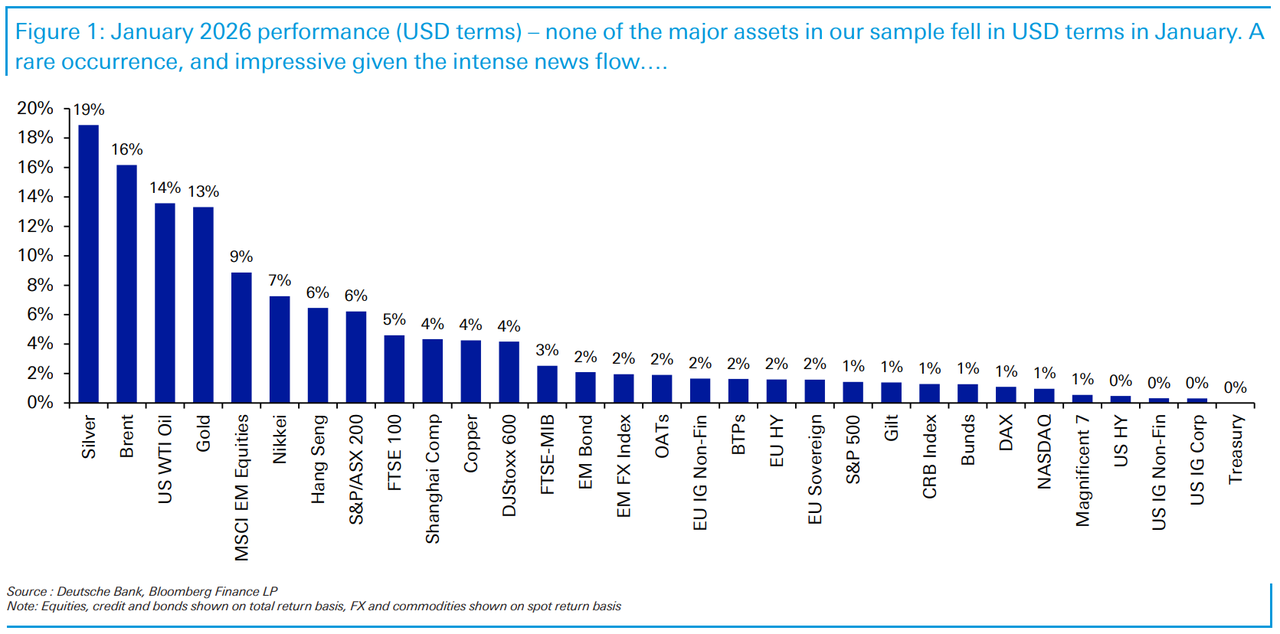
With summary in mind, here are the details: 

Markets put in a strong performance in January, as positive data surprises continued to power risk assets, with the S&P 500 briefly poking above 7,000 for the first time. But just as we saw in 2025, those headline gains masked significant volatility under the surface, as geopolitical risk rose significantly, including over Venezuela, Iran and Greenland. So that meant Brent crude oil (+16.2%) saw its biggest monthly jump in 4 years, particularly after Trump warned that a “massive Armada” was heading to Iran, which raised speculation about a US strike.

Moreover, precious metals had their biggest surge in decades, with gold prices (+13.3%) seeing their biggest monthly jump since September 1999, despite the sharp pullback at the end of the month. All that came amidst growing pressure on the US Dollar, which saw its biggest 4-day decline since the Liberation Day turmoil last year, weakening against every other G10 currency in January.

Month in Review – The high-level macro overview

Geopolitics dominated the headlines in January, with the year getting off to an eventful start. The first major event was on January 3, as Venezuelan President Nicolás Maduro was captured by US forces and taken to New York. There were immediately questions about what the market implications would be, as the US EIA have said that Venezuela has the largest proven crude oil reserves in the world, with 17% of the global total. So investors had to assess whether supply disruption in the short term might be outweighed by higher production in the long term. But outside of Venezuelan assets and some US oil companies, the wider market reaction was fairly limited.

However, events in Iran led to a much clearer oil price reaction, with Brent crude ending the month above $70/bbl again. That came as speculation mounted about some kind of US strike on Iran, and Trump himself posted on Jan 13 that he had cancelled all meetings with Iranian officials, whilst calling on protestors to take over the institutions. Then on Jan 14, Reuters reported that some personnel had been advised to leave the US military’s Al Udeid Air Base in Qatar. That was significant because the base previously saw an Iranian missile attack last June, so the story added to fears that some sort of escalation might take place imminently. However, Trump later downplayed the magnitude of tensions, saying “we’ve been told that the killing in Iran is stopping — it’s stopped… And there’s no plan for executions”. However, while this led to a brief pullback in oil prices, they then resumed their ascent as trump posted on Jan 28 that a “massive Armada is heading to Iran.” So by the end of January, Brent crude was up +16.2% to $70.69/bbl, having seen its biggest monthly jump since January 2022.

The other major geopolitical story surrounded Greenland, which escalated as the month went on. For instance on Jan 14, Trump posted that “The United States needs Greenland for the purpose of National Security.” Then on Jan 17, Trump threatened a 10% tariff on several European countries from Feb 1, which would rise to 25% in June, unless “a Deal is reached for the Complete and Total purchase of Greenland”. That led to a serious risk-off move, with the S&P 500 down -2.1% on the following session. There was even speculation about more serious European retaliation, with German finance minister Lars Klingbeil said that “We are constantly experiencing new provocations, we are constantly experiencing new antagonism, which President Trump is seeking, and here we Europeans must make it clear that the limit has been reached”. However, on Jan 21, Trump then posted that “we have formed the framework of a future deal with respect to Greenland and, in fact, the entire Arctic Region.” He also said that the Feb 1 tariffs wouldn’t proceed. So that led to a market recovery, with the S&P 500 hitting another all-time high again on Jan 27, and still ending the month +1.4% higher in total return terms 

Otherwise, the Federal Reserve were in the spotlight in January, particularly after the Department of Justice began a criminal investigation that revived questions around central bank independence. That also added to the upward pressure on precious metals, with gold prices moving higher throughout the month, ultimately closing up +13.3% in its best monthly performance since September 1999. If anything, that underplays the volatility, as gold prices hit an all-time intraday record of $5,595/oz on Jan 29, before pulling back sharply to close the month at $4,894/oz, including its biggest daily decline on Jan 30 (-8.95%) since April 2013. That surge in gold prices also occurred alongside a fresh move lower for the US Dollar, with the dollar index down -1.4% in January, which included the biggest 4-day slide since the Liberation Day turmoil last April. That accelerated after Trump himself was asked about the decline, and he said “No, I think it’s great”. However, the moves stabilised after Treasury Secretary Bessent reiterated the “strong dollar policy” the next day in a CNBC appearance. Finally on Jan 30, it was also announced that Kevin Warsh had been nominated by Trump to become the next Chair of the Federal Reserve.

Despite the volatility of global events in January, risk assets still put in a strong performance overall. In part, that was thanks to upbeat global data, which was still broadly robust. For instance in the US, the ISM services index hit a 14-month high of 54.4 in December. Then the jobs report showed that the unemployment rate ticked down to 4.4% in December. Meanwhile in Europe, inflation was a bit weaker than expected, which meant expectations rose that the ECB might deliver another rate cut this year. And Euro Area growth for Q4 also surprised on the upside, at a +0.3% pace. So most of the major global equity indices still advanced in January.

Finally in Japan, there were further significant market moves. That came as a snap election was announced for February 8, with JGBs selling off amidst election pledges for more consumption tax cuts. That led to a surge in long-end yields, with the 30yr yield closing at 3.86% on Jan 20, its highest since that maturity was first launched, before coming down to end the month at 3.63%. The 10yr yield also reached its highest since 1999, closing at 2.35% on Jan 20 as well, before ending the month at 2.24%. But even with the pullback, the 10yr yield was still up +18bps on the month, and the 30yr yield was up +24bps. Meanwhile, the Bank of Japan delivered a somewhat hawkish-leaning decision, as they kept rates on hold, but they also raised their inflation outlook, whilst the outlook report reiterated their desire to keep hiking rates.

Which assets saw the biggest gains in January?

  • Precious metals: It was a historic month for precious metals, with gold (+13.3%) rising to $4,894/oz, in its strongest monthly performance since September 1999. Meanwhile, silver (+18.9%) rose to $85.20/oz.
  • Oil and gas: Geopolitical risks meant Brent crude oil moved up +16.2% in January, rising to $70.69/bbl. That reversed a run of 5 consecutive monthly declines, and was the biggest monthly jump since January 2022. Natural gas also rose, with US natural gas futures up +18.2%, whilst European natural gas futures were up +39.5%, their biggest monthly jump since June 2022.
  • Equities: It was another strong month for global equities, with the S&P 500 (+1.4%), the STOXX 600 (+3.2%), the Nikkei (+5.9%) and the MSCI EM index (+8.9%) all rising in total return terms. For the MSCI EM index, it was the best monthly performance since November 2022.
  • Euro sovereigns: With inflation surprising on the downside and markets pricing a growing likelihood of an ECB rate cut this year, Euro sovereigns were up +0.7% in total return terms.

Which assets saw the biggest losses in January?

  • US Dollar: The dollar index fell -1.4% in January, with the dollar itself weakening against every other G10 currency. At one point in January, the Euro moved above $1.20 for the first time since 2021, before ultimately closing at $1.185.

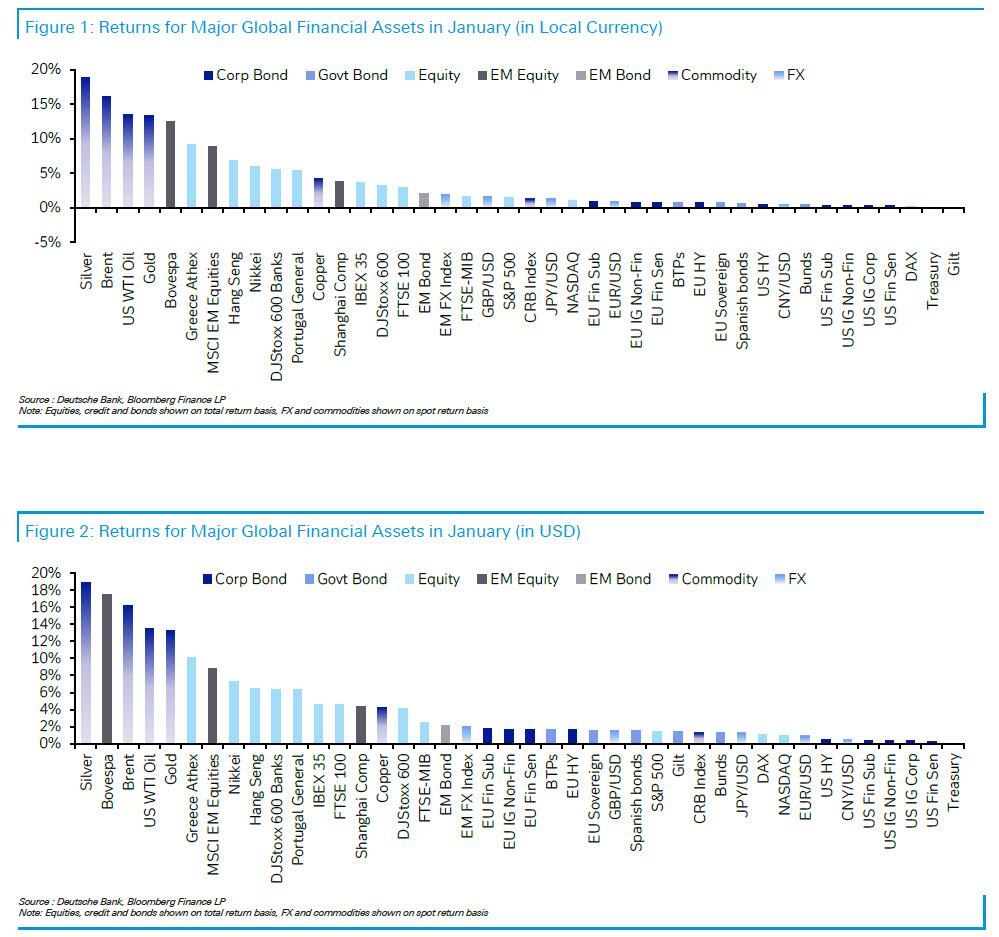
And visually (note bitcoin is not among the assets tracked by DB or it would have been ugly);
More in the full note available to pro subs.

Tyler Durden
Tue, 02/03/2026 – 08:20

via ZeroHedge News https://ift.tt/ouhxm81 Tyler Durden

Musk’s X Office In Paris Raided By Cybercrime Unit As Brussels Becomes More Unhinged

Musk’s X Office In Paris Raided By Cybercrime Unit As Brussels Becomes More Unhinged

One week after the European Commission opened a new formal investigation into Elon Musk’s X under the Digital Services Act (DSA) and expanded a separate probe launched in December 2023, X’s Paris office was raided by France’s cybercrime unit as part of an investigation into the distribution of sexual deepfakes and Holocaust denial content.

“A search is being carried out at the French premises of X by the cybercrime unit of the Paris public prosecutor’s office, together with @CyberGEND and @Europol , as part of the investigation opened in January 2025,” the Paris prosecutors’ office wrote on X early Tuesday.

The Paris public prosecutor’s office also said it is leaving the X platform and will post exclusively on Reid Hoffman’s LinkedIn and Meta-owned Instagram.

In a statement, the public prosecutor’s office said that both Elon Musk and Linda Yaccarino (former X CEO) had been summoned for voluntary questioning “in their capacity as de facto and de jure managers of the X platform at the time of the events.”

The prosecutor’s office set the date for April 20, a day frequently associated with Musk, suggesting the activists chose it as a pointed jab.

Back to the X message: “Find us on Lkd and Insta.” What a ridiculous statement from the prosecutor’s office. It only reinforces the idea that this is pure political theater, emblematic of Europe’s left-wing, unhinged censorship regime targeting a U.S. billionaire who has done more to uphold free speech than anyone else in the West.

X previously described the probe’s widening last year as “politically-motivated”… The prosecutor’s office said it was examining “alleged complicity” in offences related to the platform, including the spreading of child abuse images and sexually explicit deepfakes via the AI chatbot on X called “Grok.”

Yet, no investigation into other chatbots? 

Musk has been outraged by the Brussels bureaucrats …

It only appears that the censorship cartel in the EU has borrowed ideas from 20th-century Nazi dictator Adolf Hitler

Within the Trump administration, Secretary of State Marco Rubio and other officials have criticized EU internet policies.

“The EU should be supporting free speech, not attacking American companies over garbage,” Vice President JD Vance recently said.

Rubio has warned the left-wing Brussels bureaucrats that “days of censoring Americans online are over.”

With President Trump and Musk now buddies again, we suspect the president will fire off a Truth Social post about Brussels bureaucrats, and Musk will be commenting on X.

It’s clear what the Europeans are trying to do…

What’s happening in Europe is regulatory overreach that targets American free-speech innovation, and in the world of the Trump era, Brussels and its censorship cartel must be defeated.

Tyler Durden
Tue, 02/03/2026 – 08:05

via ZeroHedge News https://ift.tt/QDuRo5x Tyler Durden

Nintendo Profit Misses As Soaring Memory Prices Could Become Major Headache

Nintendo Profit Misses As Soaring Memory Prices Could Become Major Headache

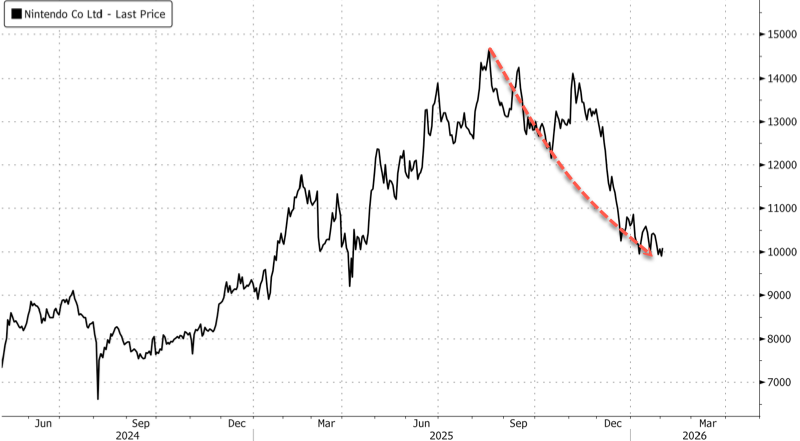
Dark storm clouds have gathered over Nintendo since the start of December, as investor concerns mount over tariffs, rising memory prices, and chatter about soft US holiday sales. The stock in Tokyo remains about one-third below its August peak.

Earnings on Tuesday reconfirmed the gloom after Nintendo reported third-quarter operating income that missed the average Wall Street estimate tracked by Bloomberg.

Switch 2 sold 7.01 million units in the December quarter, beating Bloomberg Consensus estimates, but the operating income of 155.21 billion yen, versus the 180.7 billion expected, raised investor concern.

Trade tariffs, combined with rising component costs, especially the explosion in the price of high-bandwidth memory (HBM), are pressuring thin hardware margins for the electronics company.

Goldman analyst Maho Kamiya warned clients in late Decemeber that concerns about rising memory prices and the absence of top-down tailwinds have sent Nintendo shares spiraling. The stock has yet to recover since the warning…

We have outlined a growing list of electronics companies pressured by soaring memory prices, even prompting industry insiders to tell consumers that front-running purchases of PCs, TVs, and other devices that use HBM should be “done now” because the memory shortage, caused by data center buildouts, will only get worse from here.

Snapshot of the third quarter (courtsey of Bloomberg):

  • Operating income 155.21 billion yen, +23% y/y, estimate 180.7 billion yen (Bloomberg Consensus)

  • Net income 159.93 billion yen, +24% y/y, estimate 147.5 billion yen

  • Net sales 806.32 billion yen, +86% y/y, estimate 815.7 billion yen

“Switch 2 sales figures can be seen as okay, but it would be hard to call them solid,” Toyo Securities analyst Hideki Yasuda wrote in a note.

Yasuda said, “Looking ahead, concerns such as rising component prices remain, and how the company will once again control costs will be the key point to watch.”

According to research firm TrendForce, HBM shortages are fueling major risks for Nintendo as chipmakers prioritize AI data-center memory, potentially limiting console production.

Hence, our most recent note:

Nintendo maintained full-year guidance:

  • Sees FX assumption 150 yen/USD, saw 140

  • Sees FX assumption 170 yen/EUR, saw 160

  • Still sees operating income 370.00 billion yen, estimate 419.16 billion yen

  • Still sees net income 350.00 billion yen, estimate 412.42 billion yen

  • Still sees net sales 2.25 trillion yen, estimate 2.37 trillion yen

  • Sees Switch 2 hardware sales 19.00 million units

  • Sees Switch 2 software sales 48.00 million units

  • Still sees original Switch hardware sales 4.00 million units

  • Still sees original Switch software sales 125.00 million units

  • Still sees dividend 181.00 yen, estimate 204.14 yen

While it may be a golden time for memory makers as prices skyrocket, it is only a matter of time before consumer electronics see price surges and even the risk of limited production. Welcome to the era of AI data centers: the HBM shortage is expected to persist into 2027.

Tyler Durden
Tue, 02/03/2026 – 07:45

via ZeroHedge News https://ift.tt/jIJDxLQ Tyler Durden

Ban on AI-Generated “Biased, Offensive, or Harmful Content” in Law Practice Passes California Senate, 39-0

The proposal would add a new Business and Professions Code section that would say, in relevant part (emphasis added):

It is the duty of an attorney using generative artificial intelligence to practice law to ensure … [that r]easonable steps are taken to do … [r]emove any biased, offensive, or harmful content in any generative artificial intelligence material used, including any material prepared on their behalf by others.

But legitimate advocacy, whether in court or “provided to the public,” may well include content that some view as “biased, offensive, or harmful” (e.g., emotionally distressing, advocating for bad ideas or bad people, etc.). An attorney may well reasonably think that it’s in his client’s interest to engage in such advocacy.

As I understand it, there are no legal ethics rules forbidding such advocacy—indeed, they may mandate it, if that’s what it takes to serve the client’s interest. Indeed, even the proposed Rule 8.4(g), which would have forbidden certain “derogatory or demeaning” speech “based upon race, sex, religion, …,” and which some courts have rejected on First Amendment grounds, at least expressly excluded “advice or advocacy consistent with [the] Rules [or Professional Conduct.” This proposed statute doesn’t have such an exclusion (though even if it did have such an exclusion, I think it would still be improper).

I’m not sure how the law can then forbid the lawyer from using AI to express those views. Indeed, I think such a requirement would be an unconstitutional viewpoint-based speech restriction, especially since “practic[ing] law” often involves not just creating court filings but also creating public statements on a client’s behalf. And even when it comes to court filings, where various restrictions (perhaps including some viewpoint-based ones) may be permissible, it strikes me that this restriction would be highly unwise.

Likewise, under the bill a lawyer would have the duty to ensure that

The use of generative artificial intelligence does not unlawfully discriminate against or disparately impact individuals or communities based on age, ancestry, color, ethnicity, gender, gender expression, gender identity, genetic information, marital status, medical condition, military or veteran status, national origin, physical or mental disability, political affiliation, race, religion, sex, sexual orientation, socioeconomic status, and any other classification protected by federal or state law.

But what does it mean for generative AI in an attorney’s work product to “unlawfully discriminate against or disparately impact individuals or communities” based on those criteria? For instance, say that the attorney uses AI to generate an argument that sharply condemns people who have a particular affiliation—is that forbidden, because it “disparately impact[s]” that “communit[y]”? Or is that OK because it’s not an “unlawful[]” disparate impact? If so, what exactly would be an unlawful disparate impact of the use of generative AI (as opposed to, say, a hiring decision by the lawyer’s client).

Similar rules have already been implemented as part of California State Judicial Administration Standard 10.80, but that has to do with rules for judicial officers “within their adjudicative role.” Such restrictions placed on the state’s own judges are a quite different matter than ones that bind all lawyers “practic[ing] law.”

The post Ban on AI-Generated "Biased, Offensive, or Harmful Content" in Law Practice Passes California Senate, 39-0 appeared first on Reason.com.

from Latest – Reason.com https://ift.tt/1YlsDZ5
via IFTTT

Ban on AI-Generated “Biased, Offensive, or Harmful Content” in Law Practice Passes California Senate, 39-0

The proposal would add a new Business and Professions Code section that would say, in relevant part (emphasis added):

It is the duty of an attorney using generative artificial intelligence to practice law to ensure … [that r]easonable steps are taken to do … [r]emove any biased, offensive, or harmful content in any generative artificial intelligence material used, including any material prepared on their behalf by others.

But legitimate advocacy, whether in court or “provided to the public,” may well include content that some view as “biased, offensive, or harmful” (e.g., emotionally distressing, advocating for bad ideas or bad people, etc.). An attorney may well reasonably think that it’s in his client’s interest to engage in such advocacy.

As I understand it, there are no legal ethics rules forbidding such advocacy—indeed, they may mandate it, if that’s what it takes to serve the client’s interest. Indeed, even the proposed Rule 8.4(g), which would have forbidden certain “derogatory or demeaning” speech “based upon race, sex, religion, …,” and which some courts have rejected on First Amendment grounds, at least expressly excluded “advice or advocacy consistent with [the] Rules [or Professional Conduct.” This proposed statute doesn’t have such an exclusion (though even if it did have such an exclusion, I think it would still be improper).

I’m not sure how the law can then forbid the lawyer from using AI to express those views. Indeed, I think such a requirement would be an unconstitutional viewpoint-based speech restriction, especially since “practic[ing] law” often involves not just creating court filings but also creating public statements on a client’s behalf. And even when it comes to court filings, where various restrictions (perhaps including some viewpoint-based ones) may be permissible, it strikes me that this restriction would be highly unwise.

Likewise, under the bill a lawyer would have the duty to ensure that

The use of generative artificial intelligence does not unlawfully discriminate against or disparately impact individuals or communities based on age, ancestry, color, ethnicity, gender, gender expression, gender identity, genetic information, marital status, medical condition, military or veteran status, national origin, physical or mental disability, political affiliation, race, religion, sex, sexual orientation, socioeconomic status, and any other classification protected by federal or state law.

But what does it mean for generative AI in an attorney’s work product to “unlawfully discriminate against or disparately impact individuals or communities” based on those criteria? For instance, say that the attorney uses AI to generate an argument that sharply condemns people who have a particular affiliation—is that forbidden, because it “disparately impact[s]” that “communit[y]”? Or is that OK because it’s not an “unlawful[]” disparate impact? If so, what exactly would be an unlawful disparate impact of the use of generative AI (as opposed to, say, a hiring decision by the lawyer’s client).

Similar rules have already been implemented as part of California State Judicial Administration Standard 10.80, but that has to do with rules for judicial officers “within their adjudicative role.” Such restrictions placed on the state’s own judges are a quite different matter than ones that bind all lawyers “practic[ing] law.”

The post Ban on AI-Generated "Biased, Offensive, or Harmful Content" in Law Practice Passes California Senate, 39-0 appeared first on Reason.com.

from Latest – Reason.com https://ift.tt/1YlsDZ5
via IFTTT

Trump vs. Scalia on Sanctuary Cities and the Minneapolis Immigration Crackdown


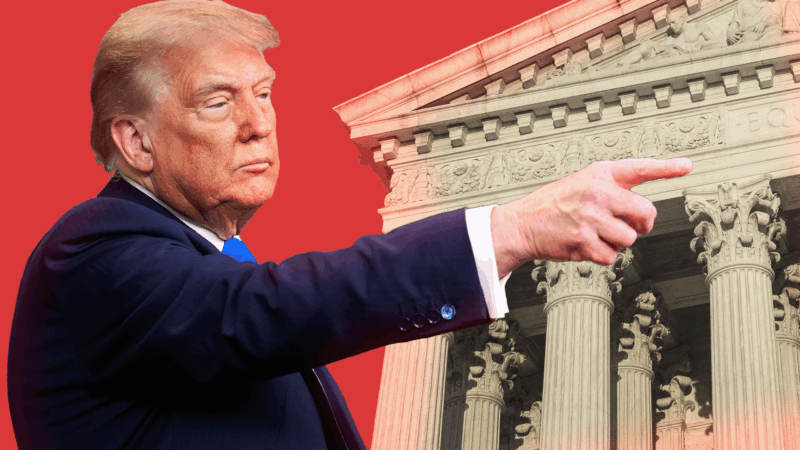
Trump-SCOTUS-26 | Credit: CNP/AdMedia/Graeme Sloan/Sipa USA/Newscom

According to President Donald Trump, Minneapolis Mayor Jacob Frey endorsed “a very serious violation of the Law” last week when Frey said that “Minneapolis does not, and will not, enforce federal immigration law.”

But it is Trump whose understanding of the law is seriously impaired. Under both constitutional principle and judicial precedent, state and local authorities may decline to participate in the enforcement of a federal regulatory scheme. So-called sanctuary city policies that either limit or prohibit local enforcement of federal immigration law are themselves lawful.

Why? Just ask the conservative legal hero Justice Antonin Scalia.

“The Federal Government may neither issue directives requiring the States to address particular problems,” Scalia wrote in the 1997 Supreme Court case of Printz v. United States, “nor command the States’ officers, or those of their political subdivisions, to administer or enforce a federal regulatory program.”

The Printz case centered on a provision of the 1993 Brady Handgun Violence Prevention Act that required state and local police to enforce federal gun control laws. But such “federal commandeering of state governments,” Scalia held, violated the constitutional principles of federalism that were safeguarded by the 10th Amendment.

Trump’s attack on Frey thus runs counter to the Scalia-penned precedent elucidating the anti-commandeering doctrine. In this matter, the 10th Amendment trumps Trump.


In Other Legal News

Do you like April Fool’s Day jokes? Me neither. So here’s one for you anyway: The U.S. Supreme Court has announced that it will hear oral arguments on April 1 in the case about Trump’s executive order purporting to deny the constitutional guarantee of birthright citizenship to millions of U.S.-born children. It’s a fitting date, I suppose, since Trump is trying to make a laughingstock out of the original meaning of the Fourteenth Amendment.

The continuing silence from the Supreme Court about the fate of Trump’s tariffs has led to worrying speculation among some of the president’s critics that the longer it takes for the Court’s tariffs decision to come out, the better it is for the White House. Writing in The Washington Post, for example, Jason Willick argues that while “Trump is the underdog” in the legal dispute, “the longer the case drags on without resolution, the less likely it is that the president got licked.” Willick bases this fretful view on the idea that “the longer a status quo stays in place, all else being equal, the less likely the Supreme Court is to disturb it.” And Trump’s tariffs, needless to say, have now been in place for some time.

On the other hand, as Amy Howe points out at SCOTUSblog, there are plausible reasons to think that “even if the justices do strike down some or all of the tariffs, that might still not be enough to spur them to issue an opinion soon.” For instance, Howe notes, a ruling against Trump could still “leave the question of refunds for the lower courts, in which case—at least in the justices’ view—an additional month or two to finalize their ruling might not make much of a difference.” Alternately, she adds, the justices could also “decide that the tariffs are invalid but hold either that they will not apply going forward (ruling out refunds for tariffs that had already been paid) or delay the implementation of their ruling, giving Congress time to enact a solution.”

Either way, as the unsung legal philosopher Tom Petty might have put it, waiting for SCOTUS “is the hardest part.”

The post Trump vs. Scalia on Sanctuary Cities and the Minneapolis Immigration Crackdown appeared first on Reason.com.

from Latest – Reason.com https://ift.tt/S2x3gQt
via IFTTT

4 Ways Trump Is Reshaping the U.S. Immigration Bureaucracy


An illustration of the American flag with the red stripes furling up to illustrate bureaucratic red tape | Photo: iStock

Dramatic scenes have come to define the second Donald Trump administration’s immigration policy: federal troops patrolling the streets of American cities, agents snatching international students on video, hundreds of Venezuelan migrants disappeared to a brutal Salvadoran prison.

Behind those scenes, Trump is reshaping the country’s immigration bureaucracy. In just its first 100 days, the second Trump administration had “taken 181 immigration-specific executive actions,” found the nonpartisan Migration Policy Institute (MPI), “a sixfold increase over the fewer than 30 actions during the same period in Trump’s first term.” Visa processing and bureaucratic rulemaking don’t grab as much attention as harsh, highly visible enforcement actions, but they’re making it harder for immigrants to work, learn, and live in the United States.

De-Documenting Immigrants

In October, the Trump administration ended the automatic extension of employment authorization for certain immigrants. “For nearly a decade,” U.S. Citizenship and Immigration Services (USCIS) “automatically extended work permits for 180 days, which was later increased to 540 days, to provide relief from massive backlogs and delays in government processing,” noted American Immigration Lawyers Association President Jeff Joseph. The rule change means that “individuals who have already been deemed legally authorized to work will lose their jobs for no other reason than the government choosing not to process their paperwork in time,” argued over 70 members of Congress in a letter to USCIS.

The Trump administration has terminated temporary protected status (TPS) designations meant to help people from several ailing countries, including Venezuela, Nepal, Honduras, Nicaragua, Afghanistan, Cameroon, Syria, and South Sudan. That leaves nationals of those countries vulnerable to deportation, and it also effectively turns them into undocumented immigrants without work authorization. Some of those revocations are tied up in the courts. But as of October, over 680,000 individuals living in the U.S. saw their legal status jeopardized by the administration’s TPS revocations, according to the National Immigration Forum.

Removing Relief

Officials have made it almost impossible for migrants to access asylum. Rather than screening for asylum (which provides an eventual pathway to citizenship), Department of Homeland Security agents at the U.S.-Mexico border “are only conducting screenings for Convention Against Torture protection, a subsidiary and nonpermanent status that allows citizens to be removed to third countries,” reported the MPI. The administration has paused TPS holders’ “applications for more durable statuses such as asylum and green cards,” and “has instructed immigration judges to close ‘legally deficient’ asylum cases without holding a hearing,” the MPI found.

Vulnerable people around the world might not make it to the United States at all thanks to the administration’s changes to refugee processing. Trump suspended refugee resettlement the day he took office “and since then only a trickle have entered the country, mostly white South Africans,” according to the Associated Press. In FY 2026, the U.S. will welcome up to 7,500 refugees, “primarily” Afrikaners from South Africa. That is the lowest cap in 45 years of the country’s refugee program. Trump has also eliminated an innovative and successful refugee resettlement pathway by ending the Welcome Corps program, which let Americans sponsor newcomers.

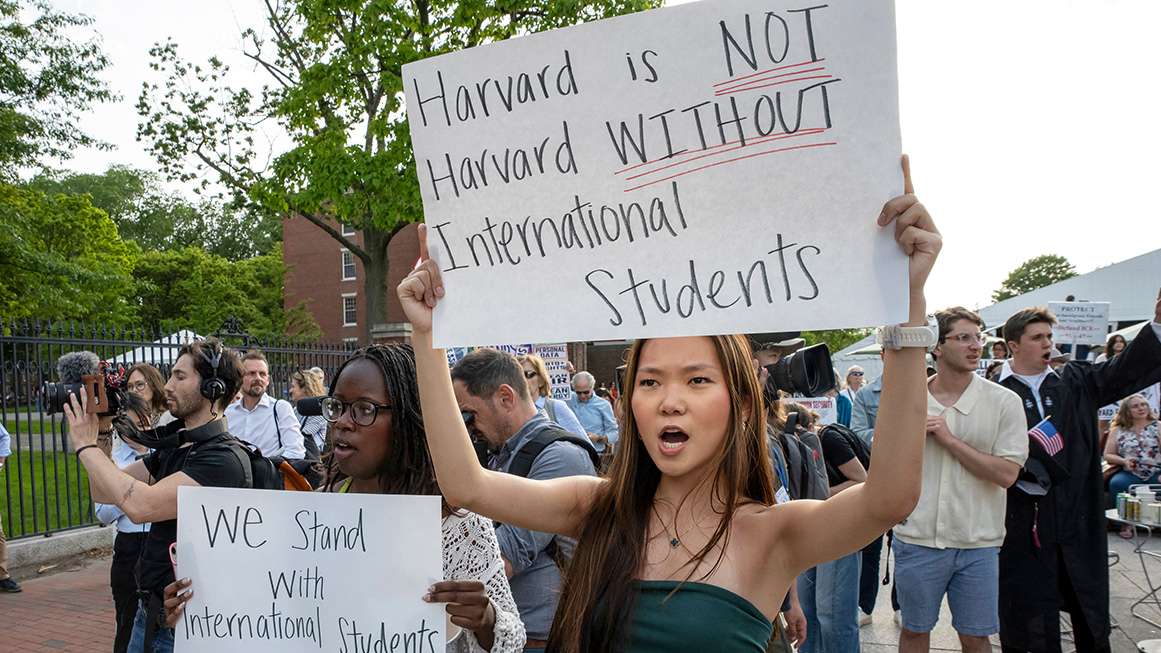
Photo: Protester in Cambridge, Massachusetts, May 27, 2025; Rick Friedman/AFP/Getty

Confused Contradictions

Despite Trump’s November comments defending Chinese students in the U.S., officials are trying to make it harder for foreigners to study at American universities. The State Department had revoked over 6,000 student visas by August, citing “overstays,” “breaking the law,” and “a small number for ‘support for terrorism,'”
Reuters reported. That effort has been messy, reportedly targeting students for offenses as minor as speeding tickets. Last spring, Trump ordered consulates and embassies to stop arranging interviews with student visa applicants so agencies could expand “required social media screening and vetting.” An impending rule could “end or restrict” Optional Practical Training, one of the main ways international students stay to work in the United States after graduation, per Forbes.

Trump has been two-minded on high-skilled immigration, at times conceding
that the H-1B visa program is useful because it “bring[s] in talent” that the American-born labor force doesn’t have, even as his administration cracks down on those foreign workers. In September, he announced that new H-1B visa applications would carry a $100,000 fee—”127 times higher than the US visa fees for workers without a high school degree,” observed Michael A. Clemens, a George Mason University economist. The policy is likely to send jobs overseas and keep talented workers from contributing to the American economy.

Building the [Bureaucracy] Wall

America’s immigration bureaucracy is becoming more unwelcoming—and more militarized. USCIS, the agency normally tasked with processing immigration paperwork, now has “its own police force” that is authorized “to arrest people for immigration violations or other criminal charges” and “carry guns,” The Wall Street Journal reported in September.

Trump may have run for his first presidential term on his promise to build a wall along the U.S.-Mexico border, but the actions he took to build a wall around the legal immigration system were far more detrimental to immigrants. “The administration massively expanded the amount of paperwork in immigration forms by double or, in some cases, triple,” wrote David J. Bier, the Cato Institute’s director of immigration studies, in 2018. Though the administration called it “extreme vetting,” it amounted to “nothing more than extreme bureaucracy,” said Bier. By 2019, “the denial rate for all applications—everything from travel and work authorizations to petitions for foreign workers—[had] risen every quarter except one under the Trump administration,” according to Cato.

Those barriers seem likely to regrow under the second Trump administration. USCIS currently has 11.3 million pending
applications, “the largest immigration backlog in its history,” reported Newsweek in November. While officials say green card and visa processing are getting faster, “agency data from January through March shows that processing times for several key immigration forms have continued to rise, leaving applicants waiting months or even years longer than expected.” The “closure of consulates abroad” and “planned firing of State Department staff,” the MPI noted in April, were also “expected to lengthen visa wait times.”

Ripping peaceful immigrants from their families and communities is inconsistent with America’s tradition of welcome. So is crushing newcomers under an ever-growing immigration bureaucracy.

The post 4 Ways Trump Is Reshaping the U.S. Immigration Bureaucracy appeared first on Reason.com.

from Latest – Reason.com https://ift.tt/hQdBaO5
via IFTTT

Chinese Oil Firms Turn To Iran To Replace Venezuelan Crude

Chinese Oil Firms Turn To Iran To Replace Venezuelan Crude

Via The Cradle

China’s teapot refiners are buying discounted Iranian crude to replace the loss of supplies from Venezuela following Washington’s violent takeover of the South American nation’s oil, Reuters reported Monday.

“The drawdown of Iranian oil held in storage is making up for the drop in Venezuelan supply to the world’s largest crude importer,” the news agency wrote, citing two people with knowledge of the matter.

via Reuters

Venezuelan oil shipments to China have fallen drastically since US President Donald Trump imposed a blockade on Venezuelan oil tankers attempting to leave the country in December.

On January 3rd, US forces bombed the Venezuelan capital, abducted Venezuelan President Nicholas Maduro, and took control of the country’s oil. Washington announced it was placing Venezuela’s oil revenues in accounts in Qatar under White House control.

Trump has allowed global trading firms Vitol and Trafigura to sell up to 50 million barrels of Venezuelan oil. However, Beijing-owned firm PetroChina has halted its oil purchases from Caracas amid the uncertainty.

Beijing’s independent refiners have responded by stepping up purchases of Iranian heavy crude stored in bonded storage tanks in China and on ships at steep discounts, the sources told Reuters.

Additional Chinese purchases of Iranian Heavy and Pars crude grades are expected in February and March, one of the two sources added. The refiners can purchase Iranian Heavy crude at discounts of about $12 per barrel, as Iran is faced with few willing buyers due to US sanctions.

Russian Urals trade at a discount of $11 to $12 per barrel, also due to US sanctions. With Washington’s permission, Vitol is offering Chinese buyers discounts of roughly $5 per barrel for Venezuelan crude.

China’s imports of Venezuelan crude averaged 394,000 barrels per day (bpd), around four percent of Beijing’s total seaborne crude imports, before the US takeover.

On Saturday, Trump said India will begin buying Venezuelan oil, helping to replace the loss of Russian supplies amid US tariff threats. “We’ve already made that deal, the concept of the deal,” Trump told reporters while traveling aboard Air Force One.

Last year, after Trump imposed a 25 percent tariff on countries buying Venezuelan oil, New Delhi stopped buying oil from Caracas. India and China have been forced to shift their purchases of oil in recent years due to aggressive sanctions on Russia, Venezuela, and Iran.

Tyler Durden
Tue, 02/03/2026 – 07:20

via ZeroHedge News https://ift.tt/98RyxvX Tyler Durden

Former UK Cabinet Minister Accused Of Leaking Bombshell Financial Data To Epstein

Former UK Cabinet Minister Accused Of Leaking Bombshell Financial Data To Epstein

Former U.K. Cabinet minister Peter Mandelson – who was fired last September from his new role as ambassador to the United States due to his ties to Jeffrey Epstein – is facing mounting political and legal pressure following disclosures that he may have shared market-sensitive government information with Epstein during the global financial crisis.

Keir Starmer, right, with Peter Mandelson, left. The prime minister is likely to face renewed questions over his judgment in appointing Mandelson as US ambassador.

Documents released Friday by the U.S. Department of Justice as part of the so-called Epstein files appear to show that Mandelson, then business secretary in the Labour government of Prime Minister Gordon Brown, forwarded confidential policy discussions and draft plans to the disgraced financier while the government was grappling with the collapse of global credit markets.

As the Guardian notes, emails forwarded to Epstein from the very top of the UK government include:

  • A confidential UK government document outlining £20bn in asset sales.
  • Mandelson claiming he was “trying hard” to change government policy on bankers’ bonuses.
  • An imminent bailout package for the euro the day before it was announced in 2010.
  • A suggestion that the JPMorgan boss “mildly threaten” the chancellor.
  • Epstein asked Mandelson to confirm a €500bn bailout – which the then business secretary said would be announced that evening. The following day, Mandelson also appeared to give Epstein an early tipoff about Gordon Brown’s resignation.

The revelations have prompted Prime Minister Keir Starmer to order an investigation by the cabinet secretary and to demand that Mandelson resign from the House of Lords. Brown has separately asked the cabinet secretary, Chris Wormald, to investigate the alleged disclosures.

Opposition parties have escalated the matter further. The Scottish National Party and Reform UK have reported Mandelson to police, alleging misconduct in a public office. Emily Thornberry, Labour’s chair of the foreign affairs select committee, said the allegations should be examined as a potential criminal matter.

The Metropolitan Police confirmed it had received several reports relating to alleged misconduct and was assessing whether they meet the threshold for a criminal investigation.

“The reports will all be reviewed to determine if they meet the criminal threshold for investigation,” said Commander Ella Marriott. “As with any matter, if new and relevant information is brought to our attention we will assess it, and investigate as appropriate.”

Sensitive Information Shared

According to the disclosures, emails forwarded to Epstein from senior levels of the British government included a confidential document outlining £20 billion in potential asset sales, discussions about changing policy on bankers’ bonuses, details of an imminent eurozone bailout package ahead of its public announcement in 2010, and references to pressuring the chancellor through senior banking executives.

In one email sent on June 13, 2009, Nick Butler, then a special adviser to Brown, circulated a memo detailing policy measures under consideration and suggesting that the government had £20 billion in saleable assets. Mandelson forwarded the message to Epstein, writing, “Interesting note that’s gone to the PM.”

Epstein replied asking, “what salable (sic) assets?” A response from a redacted email address stated: “Land, property I guess.” Four months later, the government announced plans to sell surplus real estate in a bid to raise £16 billion.

Butler said he was considering reporting the matter to police. “We worked on the basis of trust, which allowed us to float ideas,” he told the Times. “I am disgusted by the breach of trust, presumably intended to give Epstein the chance to make money.”

Another email from May 9, 2010 shows Epstein asking Mandelson to confirm a €500 billion eurozone bailout, which Mandelson indicated would be announced that evening. The following day, Mandelson appeared to give Epstein advance notice of Brown’s impending resignation.

In separate correspondence days later, Epstein asked whether JPMorgan chief Jamie Dimon should contact the chancellor, Alistair Darling. Mandelson replied that Dimon should “mildly threaten” him.

BBC economics editor Faisal Islam said he understood from discussions with Darling that such calls from senior bankers, including Dimon, did subsequently take place.

Financial Ties Under Question

The disclosures have also revived questions about Mandelson’s financial relationship with Epstein. Documents released earlier this week suggest that Epstein paid a total of $75,000 into bank accounts of which Mandelson, then a Labour MP, was believed to be a beneficiary. It is also alleged that Epstein sent £10,000 in September 2009 to Mandelson’s partner—now his husband—Reinaldo Avila da Silva, to help fund an osteopathy course and other expenses.

A former adviser described Mandelson’s conduct to the Guardian as “treacherous,” adding: “You can imagine the sense of betrayal that those of us who worked every hour of the day during that crisis are feeling.”

Brown said he had previously asked the cabinet secretary to investigate potential leaks in September but was told there was insufficient evidence at the time. “This is shocking new information that has come to light,” Brown said Monday, calling for “a wider and more intensive enquiry” into the disclosure of government papers during the crisis.

Political Fallout

Starmer, who has no direct authority to strip Mandelson of his peerage, is facing renewed scrutiny over his decision to appoint Mandelson as U.S. ambassador and his proximity to senior Labour figures, including chief of staff Morgan McSweeney and Health Secretary Wes Streeting. Mandelson resigned his Labour Party membership on Sunday.

Downing Street has written to the House of Lords authorities urging urgent reform of disciplinary procedures to allow for the removal of peers in cases of serious misconduct. A Lords source said there is currently little guidance on how such reforms would be implemented, despite their inclusion in Labour’s manifesto.

Chief Secretary to the Treasury Darren Jones told Parliament that “no government minister of any political party should have, nor ever should behave in this way,” and suggested Mandelson may have misrepresented his interests before taking up his ambassadorial role. “When someone lies in their declaration of interests, there must be a consequence,” Jones said.

There is no modern precedent for removing an individual from the House of Lords, a step that would require primary legislation. The last such action occurred during the First World War, when a group of peers aligned with Britain’s enemies were stripped of their titles.

No timetable has been set for the Cabinet Office review, and Downing Street has not confirmed whether its findings will be made public. The inquiry may involve examining archived government documents and interviewing Mandelson and other senior officials who served in Downing Street during the period in question.

Tyler Durden
Tue, 02/03/2026 – 06:55

via ZeroHedge News https://ift.tt/4A2akNX Tyler Durden