The European Union’s plan to ban LNG imports from Russia will prompt a surge in demand for LNG carriers to the tune of 30 new vessels, a senior Vortexa analyst said ahead of the LNG Qatar gathering that starts today.
According to Ashley Sherman, senior LNG analyst at the company, if the EU sanctions leave currently unsanctioned Yamal LNG free to deliver liquefied gas to European buyers, at least 30 new low ice-class or non-ice-class LNG carriers to satisfy demand for the fuel from the second-largest importing region after Asia.
In December last year, the European Union agreed a legally binding, gradual reduction in both LNG and pipeline gas imports from Russia, eventually resulting in a full ban on these exports, with the deadlines set for the end of 2026 for LNG and the autumn of 2027 for pipeline gas.
It also gave EU members until March to “prepare national plans to diversify gas supplies and identify potential challenges in replacing Russian gas.”
Hungary and Slovakia have protested the move on the grounds it would raise their energy costs to unacceptable levels.
The Yamal LNG facility, operated by Novatek, has been excluded from direct sanctions so far due to the Europea Union’s strong demand for gas, but the EU has sanctioned vessels loading from the Western Siberian LNG plant.
Novatek’s second LNG plant, however, Arctic LNG 2, along with Gazprom’s Portovaya LNG plant, are under Western sanctions.
They still export liquefied gas to China, despite the sanctions on both production facilities and LNG carriers servicing them.
Meanwhile, the EU imported record volumes of LNG last month amid harsh winter weather, with the total calculated at 12.7 billion cu m, Russia’s TASS news agency reported, citing figures from Gas Infrastructure Europe.
Cuban Missile Crisis 2.0? …May Involve Russian Drones With Crosshairs On US Homeland
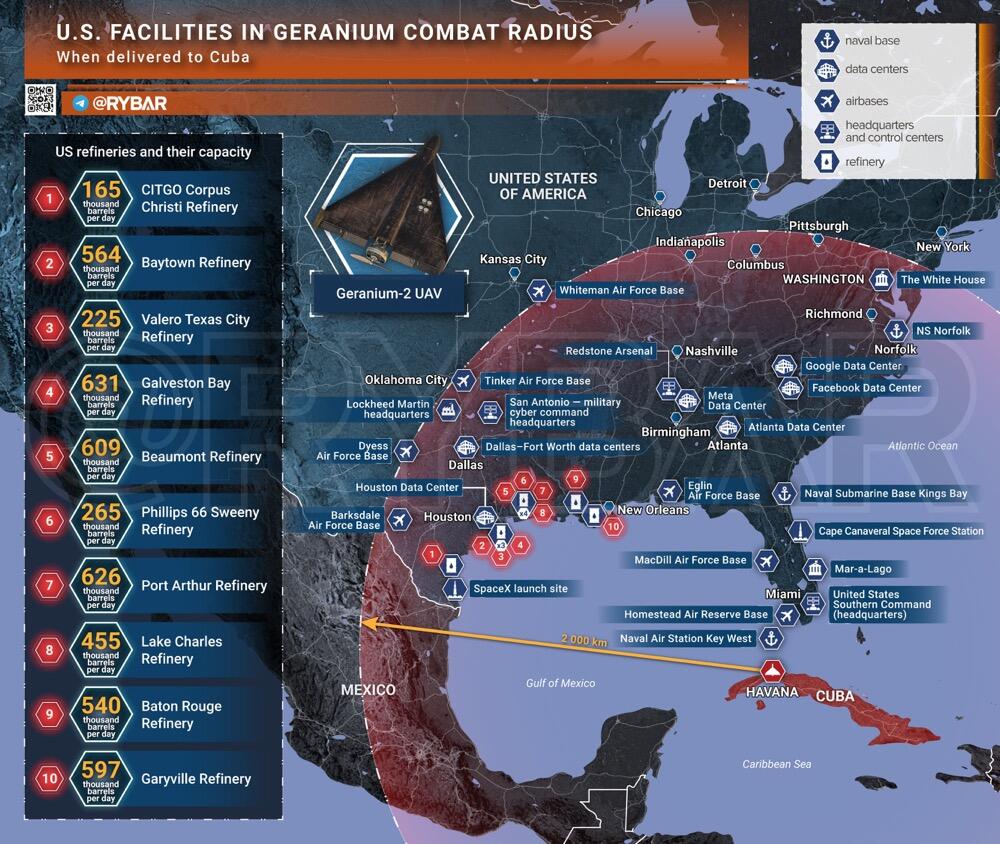
A Russian military-focused Telegram channel, Rybar, published an assessment that warned President Donald Trump’s gunboat diplomacy and the re-posturing of the U.S. Department of War toward the Western Hemisphere could generate drone threat risks to the US Homeland
“Given how the Americans are acting now, the main question is not whether the United States will strike Cuba, but when and how it will do so. Cuba, along with Venezuela and Nicaragua, has long stood as an anti-American stronghold in the Caribbean region, and after the takeover of Maduro, U.S. interest has increased,” Rybar wrote on its Telegram channel.
Rybar then laid out a scenario that, to us, suggests a Cuban Missile Crisis 2.0 in the making, in which it asked: “But what would the Cubans do in the event of a conflict? Let us hypothetically imagine that Havana decides to resist the Americans and chooses to fight. In that case, the already world-famous Geran strike drones could come to their aid.”
Russia may deploy Geranium strike drones in Cuba, a move that could reshape deterrence and force Trump to reconsider his options. pic.twitter.com/ujYKnqzcAf
To bring readers up to speed, Russian-made Geranium drones are a family of long-range loitering munitions, most commonly referring to the Geran-2, which is a version of Iran’s Shahed-136. We have detailed how Russia has established domestic manufacturing plants to ramp up production, as well as the next iteration of these drones (read here).
The Geran-2 has a range of roughly 1,500 to 2,000 kilometers, carries a 30- to 50-kg high-explosive warhead, and is cheaper to produce than cruise missiles. One distinctive signature Ukrainians have learned to recognize is its sound: the drones are often described as lawn mowers in the sky.
Rybar noted the potential strike radius of the Geran-2 if such systems were positioned in Cuba, concluding that under this scenario that major oil and gas refineries, key military bases, data centers, and even Washington, DC would fall within the drone’s strike envelope, representing a highly destabilizing escalation risk.
Rybar’s Geran-2 threat map will likely cause major concern at State Department and DoW …
We warned in recent days that trillions in dollars in CapEx will be spent on data centers worldwide, as per Morgan Stanley analyst Vishwanath Tirupattur‘s forecast, but Wall Street analysts largely end their analysis at the financing and construction of next-generation data centers, with limited discussion about modern security architecture required once these facilities are built and become instant high-value targets for non-state actors or foreign adversaries (read here).
“Future wars will be wars of attrition, where autonomous systems fight one another, overwhelming technologically superior but low-inventory expensive systems. Protecting cities will require mass-produced, cost-comparable, networked solutions,” Cameron Rowe of counter-UAS interceptor startup Sentradel told us.
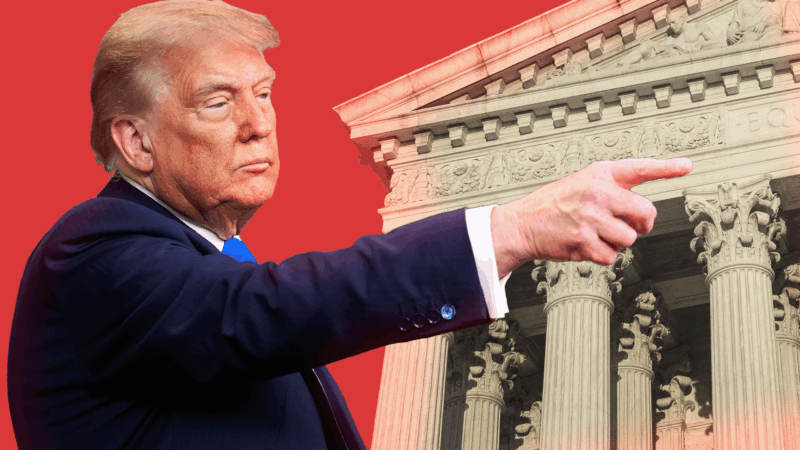
According to President Donald Trump, Minneapolis Mayor Jacob Frey endorsed “a very serious violation of the Law” last week when Frey said that “Minneapolis does not, and will not, enforce federal immigration law.”
But it is Trump whose understanding of the law is seriously impaired. Under both constitutional principle and judicial precedent, state and local authorities may decline to participate in the enforcement of a federal regulatory scheme. So-called sanctuary city policies that either limit or prohibit local enforcement of federal immigration law are themselves lawful.
Why? Just ask the conservative legal hero Justice Antonin Scalia.
“The Federal Government may neither issue directives requiring the States to address particular problems,” Scalia wrote in the 1997 Supreme Court case of Printz v. United States, “nor command the States’ officers, or those of their political subdivisions, to administer or enforce a federal regulatory program.”
The Printz case centered on a provision of the 1993 Brady Handgun Violence Prevention Act that required state and local police to enforce federal gun control laws. But such “federal commandeering of state governments,” Scalia held, violated the constitutional principles of federalism that were safeguarded by the 10th Amendment.
Trump’s attack on Frey thus runs counter to the Scalia-penned precedent elucidating the anti-commandeering doctrine. In this matter, the 10th Amendment trumps Trump.
In Other Legal News
Do you like April Fool’s Day jokes? Me neither. So here’s one for you anyway: The U.S. Supreme Court has announced that it will hear oral arguments on April 1 in the case about Trump’s executive order purporting to deny the constitutional guarantee of birthright citizenship to millions of U.S.-born children. It’s a fitting date, I suppose, since Trump is trying to make a laughingstock out of the original meaning of the Fourteenth Amendment.
The continuing silence from the Supreme Court about the fate of Trump’s tariffs has led to worrying speculation among some of the president’s critics that the longer it takes for the Court’s tariffs decision to come out, the better it is for the White House. Writing in The Washington Post, for example, Jason Willick argues that while “Trump is the underdog” in the legal dispute, “the longer the case drags on without resolution, the less likely it is that the president got licked.” Willick bases this fretful view on the idea that “the longer a status quo stays in place, all else being equal, the less likely the Supreme Court is to disturb it.” And Trump’s tariffs, needless to say, have now been in place for some time.
On the other hand, as Amy Howe points out at SCOTUSblog, there are plausible reasons to think that “even if the justices do strike down some or all of the tariffs, that might still not be enough to spur them to issue an opinion soon.” For instance, Howe notes, a ruling against Trump could still “leave the question of refunds for the lower courts, in which case—at least in the justices’ view—an additional month or two to finalize their ruling might not make much of a difference.” Alternately, she adds, the justices could also “decide that the tariffs are invalid but hold either that they will not apply going forward (ruling out refunds for tariffs that had already been paid) or delay the implementation of their ruling, giving Congress time to enact a solution.”
Either way, as the unsung legal philosopher Tom Petty might have put it, waiting for SCOTUS “is the hardest part.”
Dramatic scenes have come to define the second Donald Trump administration’s immigration policy: federal troops patrolling the streets of American cities, agents snatching international students on video, hundreds of Venezuelan migrants disappeared to a brutal Salvadoran prison.
Behind those scenes, Trump is reshaping the country’s immigration bureaucracy. In just its first 100 days, the second Trump administration had “taken 181 immigration-specific executive actions,” found the nonpartisan Migration Policy Institute (MPI), “a sixfold increase over the fewer than 30 actions during the same period in Trump’s first term.” Visa processing and bureaucratic rulemaking don’t grab as much attention as harsh, highly visible enforcement actions, but they’re making it harder for immigrants to work, learn, and live in the United States.
De-Documenting Immigrants
In October, the Trump administration ended the automatic extension of employment authorization for certain immigrants. “For nearly a decade,” U.S. Citizenship and Immigration Services (USCIS) “automatically extended work permits for 180 days, which was later increased to 540 days, to provide relief from massive backlogs and delays in government processing,” noted American Immigration Lawyers Association President Jeff Joseph. The rule change means that “individuals who have already been deemed legally authorized to work will lose their jobs for no other reason than the government choosing not to process their paperwork in time,” argued over 70 members of Congress in a letter to USCIS.
The Trump administration has terminated temporary protected status (TPS) designations meant to help people from several ailing countries, including Venezuela, Nepal, Honduras, Nicaragua, Afghanistan, Cameroon, Syria, and South Sudan. That leaves nationals of those countries vulnerable to deportation, and it also effectively turns them into undocumented immigrants without work authorization. Some of those revocations are tied up in the courts. But as of October, over 680,000 individuals living in the U.S. saw their legal status jeopardized by the administration’s TPS revocations, according to the National Immigration Forum.
Removing Relief
Officials have made it almost impossible for migrants to access asylum. Rather than screening for asylum (which provides an eventual pathway to citizenship), Department of Homeland Security agents at the U.S.-Mexico border “are only conducting screenings for Convention Against Torture protection, a subsidiary and nonpermanent status that allows citizens to be removed to third countries,” reported the MPI. The administration has paused TPS holders’ “applications for more durable statuses such as asylum and green cards,” and “has instructed immigration judges to close ‘legally deficient’ asylum cases without holding a hearing,” the MPI found.
Vulnerable people around the world might not make it to the United States at all thanks to the administration’s changes to refugee processing. Trump suspended refugee resettlement the day he took office “and since then only a trickle have entered the country, mostly white South Africans,” according to the Associated Press. In FY 2026, the U.S. will welcome up to 7,500 refugees, “primarily” Afrikaners from South Africa. That is the lowest cap in 45 years of the country’s refugee program. Trump has also eliminated an innovative and successful refugee resettlement pathway by ending the Welcome Corps program, which let Americans sponsor newcomers.
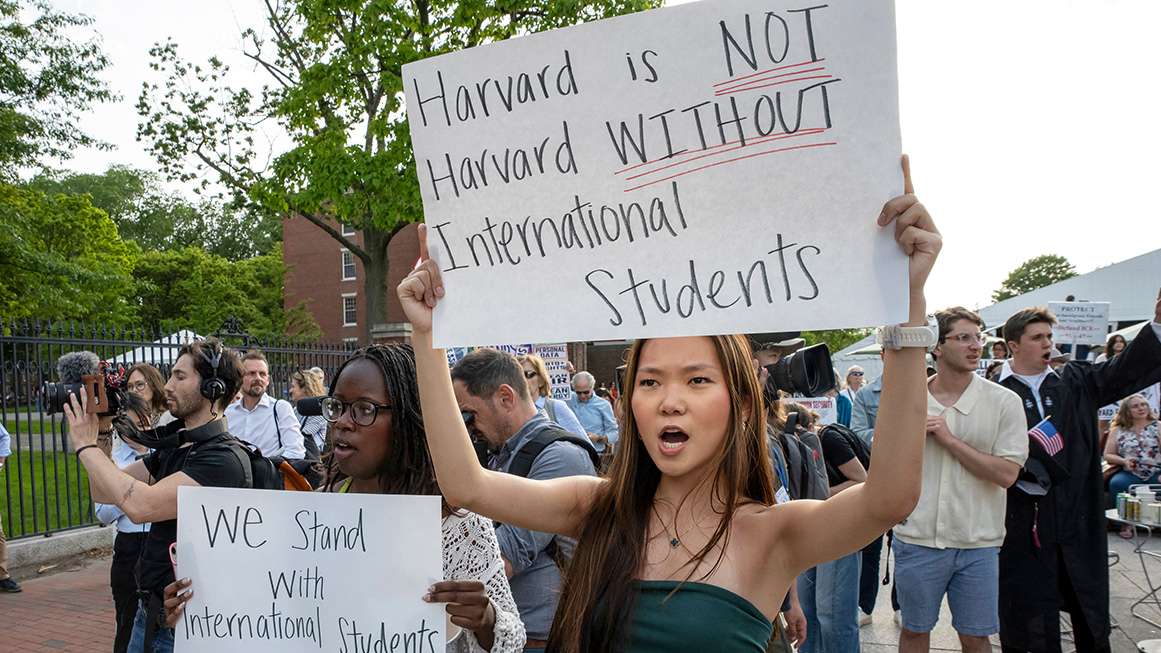
Photo: Protester in Cambridge, Massachusetts, May 27, 2025; Rick Friedman/AFP/Getty
Confused Contradictions
Despite Trump’s November comments defending Chinese students in the U.S., officials are trying to make it harder for foreigners to study at American universities. The State Department had revoked over 6,000 student visas by August, citing “overstays,” “breaking the law,” and “a small number for ‘support for terrorism,'” Reuters reported. That effort has been messy, reportedly targeting students for offenses as minor as speeding tickets. Last spring, Trump ordered consulates and embassies to stop arranging interviews with student visa applicants so agencies could expand “required social media screening and vetting.” An impending rule could “end or restrict” Optional Practical Training, one of the main ways international students stay to work in the United States after graduation, per Forbes.
Trump has been two-minded on high-skilled immigration, at times conceding that the H-1B visa program is useful because it “bring[s] in talent” that the American-born labor force doesn’t have, even as his administration cracks down on those foreign workers. In September, he announced that new H-1B visa applications would carry a $100,000 fee—”127 times higher than the US visa fees for workers without a high school degree,” observed Michael A. Clemens, a George Mason University economist. The policy is likely to send jobs overseas and keep talented workers from contributing to the American economy.
Building the [Bureaucracy] Wall
America’s immigration bureaucracy is becoming more unwelcoming—and more militarized. USCIS, the agency normally tasked with processing immigration paperwork, now has “its own police force” that is authorized “to arrest people for immigration violations or other criminal charges” and “carry guns,” The Wall Street Journal reported in September.
Trump may have run for his first presidential term on his promise to build a wall along the U.S.-Mexico border, but the actions he took to build a wall around the legal immigration system were far more detrimental to immigrants. “The administration massively expanded the amount of paperwork in immigration forms by double or, in some cases, triple,” wrote David J. Bier, the Cato Institute’s director of immigration studies, in 2018. Though the administration called it “extreme vetting,” it amounted to “nothing more than extreme bureaucracy,” said Bier. By 2019, “the denial rate for all applications—everything from travel and work authorizations to petitions for foreign workers—[had] risen every quarter except one under the Trump administration,” according to Cato.
Those barriers seem likely to regrow under the second Trump administration. USCIS currently has 11.3 million pending applications, “the largest immigration backlog in its history,” reported Newsweek in November. While officials say green card and visa processing are getting faster, “agency data from January through March shows that processing times for several key immigration forms have continued to rise, leaving applicants waiting months or even years longer than expected.” The “closure of consulates abroad” and “planned firing of State Department staff,” the MPI noted in April, were also “expected to lengthen visa wait times.”
Ripping peaceful immigrants from their families and communities is inconsistent with America’s tradition of welcome. So is crushing newcomers under an ever-growing immigration bureaucracy.
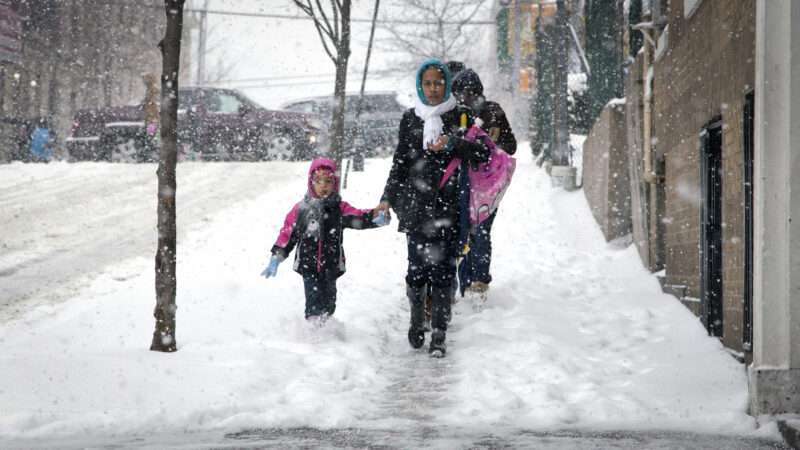
A recent snow storm left long stretches of New York City’s public sidewalks covered in snow and ice, making them more difficult for people to walk on safely, because the city doesn’t automatically clear its own walkways—even though it requires private property owners to shovel the sidewalks in front of their buildings within a set time or face fines. City officials say they’ll monitor and respond to complaints and sometimes send crews to clear trouble spots, but they note that government workers aren’t fined or forced to clear their own snow.
The markets have been rocked by news of a possible intervention to control the Japanese yen slump, after it reached a forty-year low relative to the US dollar. Fixing the yen and any other fiat currency is simple: Implement an Austrian approach; eliminate constant deficit spending and monetization of government outlays; and implement clear, sound money policies that support the purchasing power of the currency.
Letting rates float and having zero deficit would help.
However, no government seems to want to control spending and eliminate constant artificial currency creation, even knowing that, by doing so, they would limit the risk of financial crises, excessive risk-taking, and erosion of citizens’ wage purchasing power.
The best a citizen can expect today is a mild form of Keynesianism that aims for lower taxes, relatively lower spending, and a constant expansion of money supply as the driver of economic growth. Even this “lesser evil” approach ends with malinvestment, financial crises, and more politicians demanding “public investment” as the solution.
Governments avoid sound money and controlling spending because these choices can hurt them politically right away, while using inflation and interventionist methods allows them to take a lot of wealth from citizens and give it to themselves and their favored industries.
Governments refer to the constant issuance of new currency that exceeds private sector demand as the “social use of money.” Inflationism is a tool to create dependency and limit individuals’ financial freedom.
Inflation is not an accident; it is a policy. The erosion of the purchasing power of the currency makes governments more powerful; they present themselves as the solution to the problems their policies create, and citizens have fewer tools to gain financial independence.
Governments and their “experts” constantly try to blame inflation on anything except what really creates it: monetary excess preceded by fiscal irresponsibility and uncontrolled deficit spending. Politicians point to “greedy companies,” “supply shocks,” or “external factors,” even to wage growth, as causes of inflation to hide the simple fact that issuing more currency than the private sector demands inevitably destroys its purchasing power.
Inflation is a de facto slow default and signals a constant loss of fiscal credibility for governments. High taxes and inflation become two sides of the same policy: controlling citizens and making them servants to an ever-rising bureaucratic power that rewards a few private enablers in the process.
This erosion is not neutral. It is a permanent, silent tax on real wages and savings that benefits the state, the most indebted agent in the economy, which can spend more than it receives. When governments double down on spending and central banks accommodate with quantitative easing and artificially low rates, there is a simple calculated transfer of wealth from the middle class to the public sector.
Central banks have become tools to maintain the government debt bubble rather than defenders of price stability, especially when they view such stability in an annual inflation increase based on a carefully selected basket that masks the true extent of currency debasement. The Fed’s panic in 2020-2024 is a clear signal of a monetary authority subordinating its mandate to the needs of the Treasury.
The ECB has followed a similar path, maintaining its anti-fragmentation tools, rolling over massive holdings of sovereign bonds and giving permanent support for highly indebted states such as France and Spain. Central banks will not oppose the government; instead, they will transfer the burden to consumers.
Governments never end inflation because they benefit from it.
High nominal growth, fueled by money printing and deficit spending, inflates tax revenues and masks the deterioration of real wages, while the real value of outstanding public debt is gradually dissolved.
Sound money, balanced budgets, and structural reforms require the elimination of clientelist spending, politically protected programs, and subsidy‑dependent sectors.
Sound money benefits the private sector and citizens. Inflationism makes the state larger and more powerful at the expense of families and businesses. Politicians consistently pledge “free” benefits, which ultimately result in increased inflation, reduced growth, and diminished productivity.
This is why, even as headline inflation moderates, citizens feel poorer and angrier. Governments created the inflation shock with massive stimulus at the peak of the cycle, then forced central banks to tighten late and aggressively, placing the full burden of adjustment on families, small businesses, and productive investment while public sectors remained largely untouched. The result is stagnation with high taxation and persistent inflation expectations—a slow‑motion confiscation of the middle class.
Refusing to adopt sound money is not an intellectual mistake but a political choice. Governments and central banks have built a framework that systematically sacrifices citizens’ real wages, savings, and freedom to preserve an ever‑larger, ever‑more‑indebted state. You pay.
US-Sanctioned Russian Military Transport Plane Touches Down At Cuban Airfield
In a development which sounds reminiscent of the most dangerous moments of the Cold War, a Russian military cargo plane has been observed landing in Cuba, just as Havana is in Washington’s regime change crosshairs.
The Ilyushin Il-76, operated by the government-linked airline Aviacon Zitotrans, is reportedly under US sanctions as it has a well-documented history of ferrying military gear to Latin America. It touched down late Sunday at a Cuban military airfield.
The same aircraft – registered RA-78765 – logged flights to Venezuela, Nicaragua, and Cuba in October amid rising tensions between Washington and Caracas.
Flight-tracking records show the aircraft stopped in St. Petersburg and Sochi in Russia; Mauritania, Africa; and the Dominican Republic. Each landing would have required approval from host governments, offering a window into which countries are continuing to permit Russian military-linked aviation activity despite Western sanctions.
The large, long range aircraft can carry up to 50 tons of cargo or roughly 200 personnel.
The US Treasury first added the company to its sanctions list in January 2023. The statement said, “Aviacon Zitotrans has shipped military equipment such as rockets, warheads, and helicopter parts all over the world,. Aviacon Zitotrans has shipped defense materiel to Venezuela, Africa, and other locations.”
Whether this latest delivery involved weapons, equipment or infrastructure parts remains unclear. What is clear is that sanctioned Russian military logistics are once again operating in the Caribbean’s airspace.
However, from Havana’s viewpoint, it should be allowed to maintain alliances and routing business and transactions – even if on the military front, with a large power like Russia.
Days ago, Russian Ambassador to the UN Vassily Nebenzia vowed that there will be no repeat of the Venezuelan scenario in Cuba.
An Aviacon Zitotrans IL-76 cargo plane that has previously been used to deliver military related cargoes from Russia to Venezuela crossed the Atlantic for the first time this year, but this time its destination was Cuba. pic.twitter.com/74lxpJLOKa
“There has undoubtedly been betrayal in Venezuela, this is being said quite openly. Some high-ranking officials have, in fact, betrayed the president. This scenario will not work in Cuba. I think that the Americans, despite the rhetoric they have been using against Cuba lately, are still just rhetoric. Because there will be no easy ride in Cuba if they want to repeat something like what happened in Venezuela,” Nebenzia told a Russian TV channel.
China has also lately called out the US over its threats against Cuba, with the Chinese Foreign Ministry on Friday stating, “China stands firmly against inhumane practices and moves that deprive the Cuban people of their rights to subsistence and development.”
Polish President Karol Nawrocki is prioritizing nuclear power in the Polish energy mix, avoiding the transitional inclusion of gas, with the government focused on building the first nuclear power plant in Lubiatów-Kopalin.
Before his trip to Davos, Nawrocki had met with entrepreneurs to discuss Poland’s accession to the G20. In his speech, he presented his vision for Poland’s future energy mix. At the beginning of the year, the Sejm (lower house of parliament) almost unanimously passed a law to support the construction of the first nuclear power plant in Lubiatów-Kopalin, Pomerania, with over PLN 60 billion (€14 billion).
Negotiations on the contract for the construction of Poland’s first nuclear power plant (EPC) are expected to be completed by mid-year. Preliminary work on the plant’s construction site and the preparation of associated infrastructure are also scheduled for this year.
Furthermore, in the first quarter, PEJ will soon submit an application to the National Atomic Energy Agency for a permit to build a nuclear power facility, Deputy Minister of Energy Wojciech Wrochna told Business Insider.
Experts confirm the long-term energy efficiency of nuclear power compared to other sources, such as renewables or coal.
Marcin Izdebski, an expert at the Center for Development Strategies, told the portal: “Renewable energy installations operate for 15-25 years. Nuclear power has a much longer lifespan, lasting 60-80 years. Furthermore, nuclear power doesn’t require balancing like renewable energy, which increases its economic efficiency. It’s most justified to build nuclear power plants where coal-fired units currently operate. Otherwise, these locations face economic collapse.”
“The government has a very rational and pragmatic approach to energy. We are by no means ideological about any source—neither coal, renewable energy, nor nuclear power. We are pursuing a policy aimed at achieving three goals: energy security, reducing CO2 emissions, and economic competitiveness. We view Poland’s future energy mix solely through the prism of these three issues,” Wrochna explained.
Construction of the first reactor of the Lubiatowo-Kopalino nuclear power plant is set to begin in 2028, while the plant is scheduled to become operational in 2036.
One source close to President Nawrocki also told Business Insider that he hopes to avoid natural gas altogether.
“The president’s goal is for us not to make a hasty transition by replacing coal with gas, but to immediately switch from coal to nuclear power. For the head of state, stability is paramount, as it is not just an economic issue but also a component of national security.”
Wojciech Dąbrowski, former president of the Polish Energy Group under PiS, pointed to the risks of gas reliance.
“Some point to gas, but it’s a fuel highly susceptible to various geopolitical turmoils. This must not be forgotten, as we don’t have sufficient gas resources of our own and must import about 80 percent of it. Therefore, gas can only be a useful supplement.”
A recent snow storm left long stretches of New York City’s public sidewalks covered in snow and ice, making them more difficult for people to walk on safely, because the city doesn’t automatically clear its own walkways—even though it requires private property owners to shovel the sidewalks in front of their buildings within a set time or face fines. City officials say they’ll monitor and respond to complaints and sometimes send crews to clear trouble spots, but they note that government workers aren’t fined or forced to clear their own snow.