Stocks, Crypto, & Bond Yields Surge Amid Commodity Purge

Stocks, Crypto, & Bond Yields Surge Amid Commodity Purge

An odd day.

While China PMIs were ugly, US PMIs signaled record-breaking inflation is on its way to the end-user (and supply chain disruptions means it won’t ease anytime soon)…

Source: Bloomberg

And that came after the House passed Biden’s $1.9 trillion stimulus.

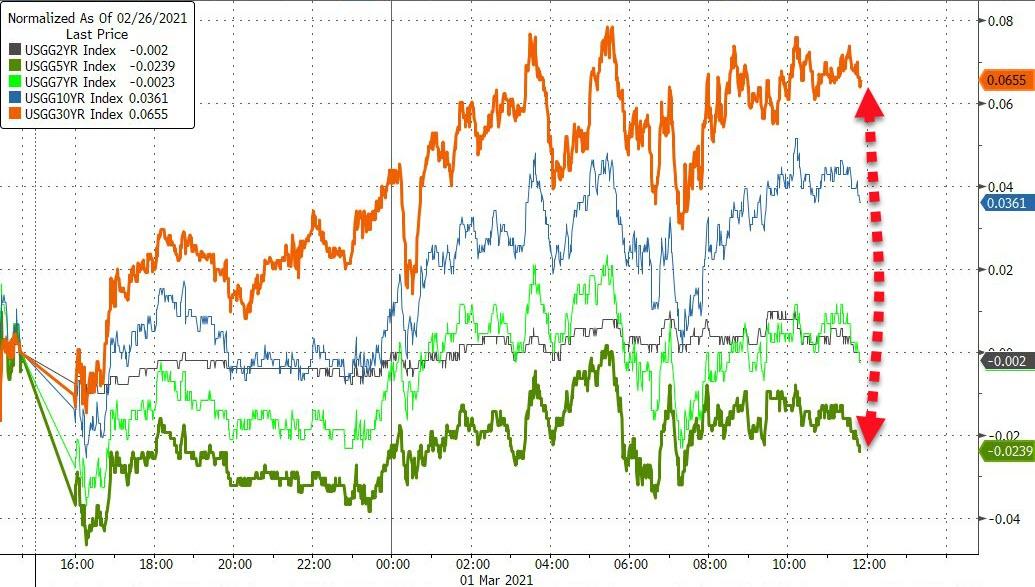
Bond yields rose at the long-end (makes sense – inflation/growth etc), but compressed in the belly (will The Fed say something? The ECB did today)…

Source: Bloomberg

10Y yield rose back to the 1.45% line in the sand…

Source: Bloomberg

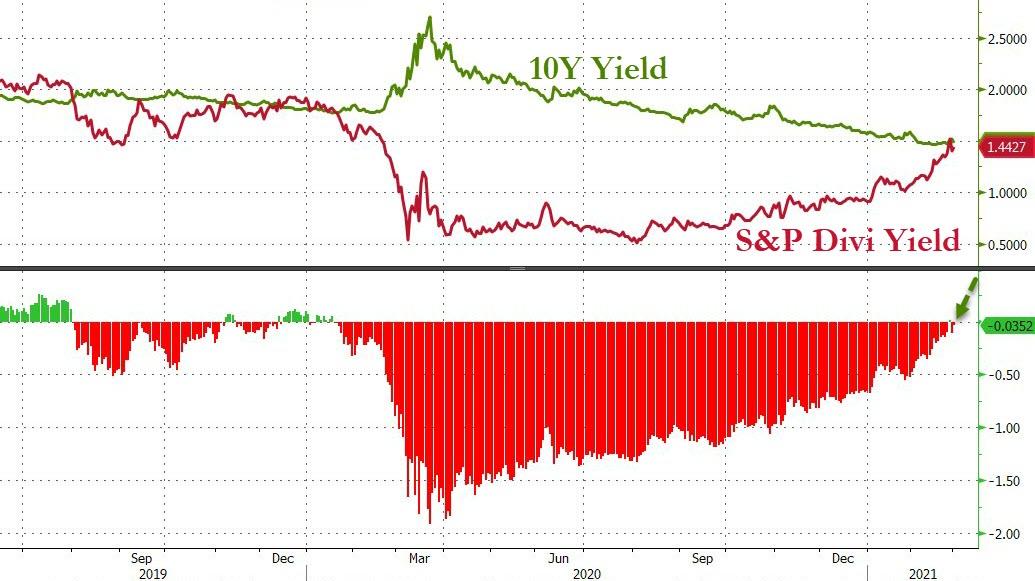
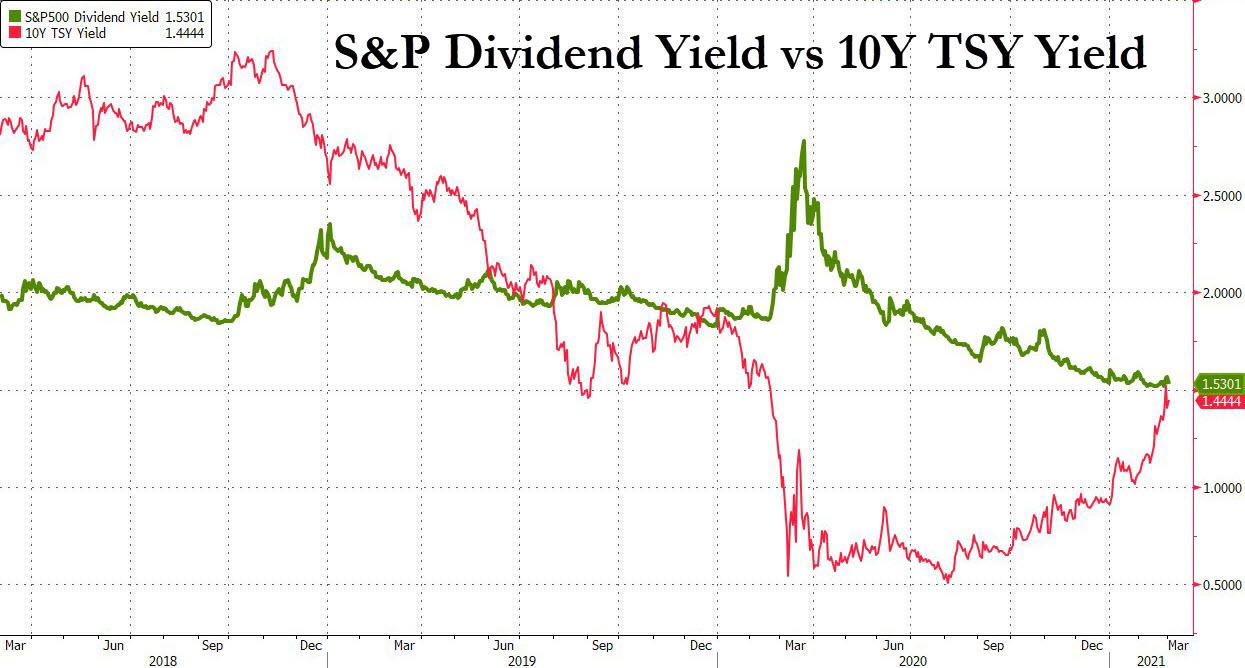
With dividend yields and treasury yields back in line…

Source: Bloomberg

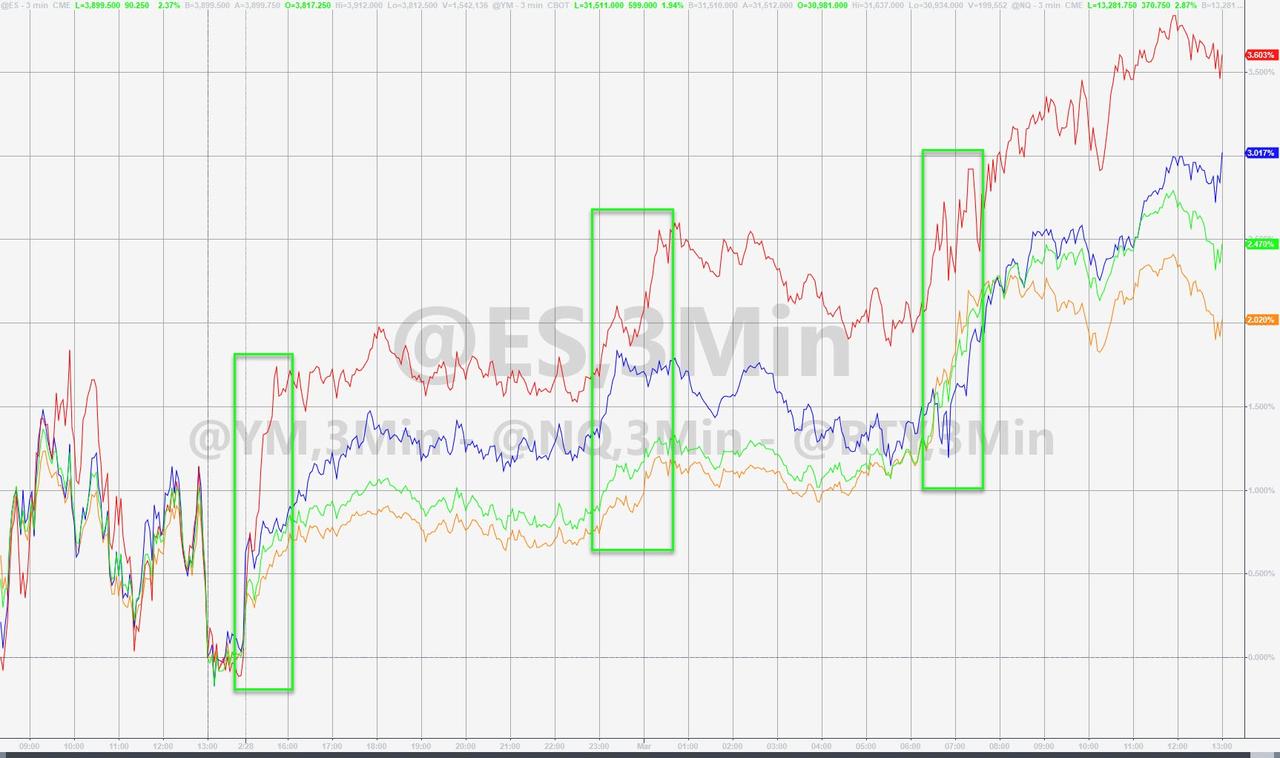
Stocks soared (month-start flows and growth/stimmy hope)… Small Caps and Nasdaq had their best day since the election/vaccine day in early Nov…

NOTE the late day puke on Friday was quickly erased at the futures open but the moves didnt really accelerate until Europe opened.

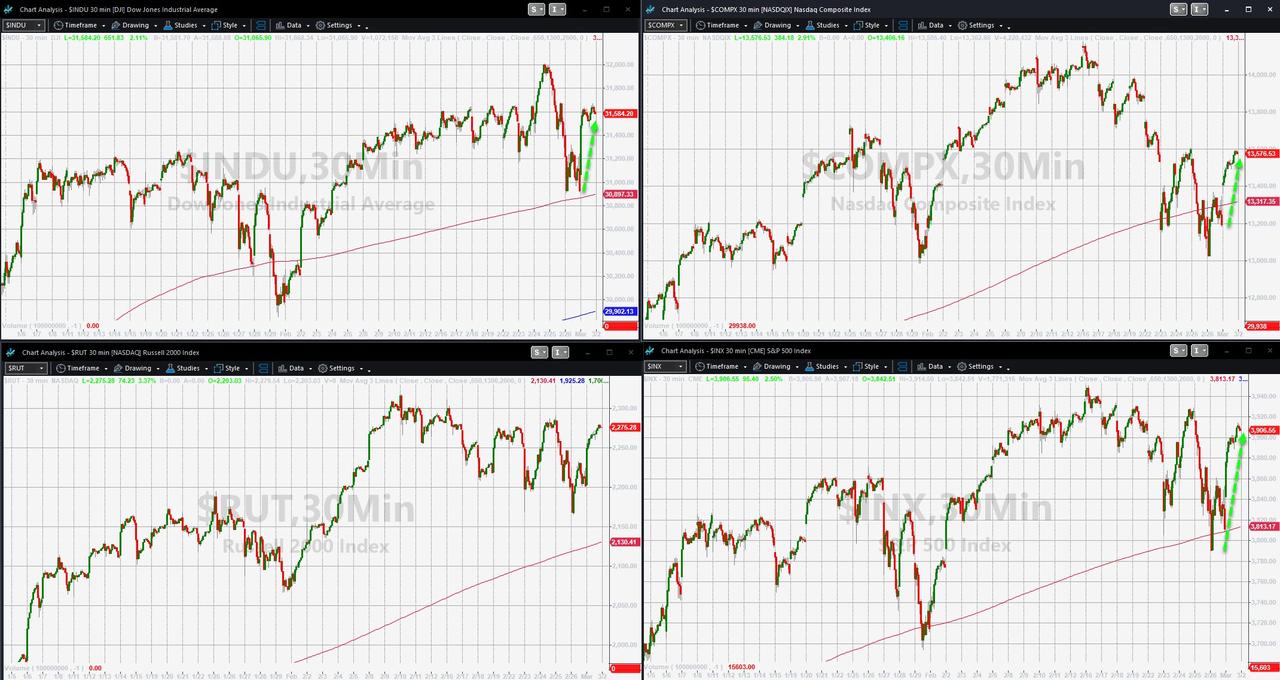
All the major indices bounced off their 50DMAs…

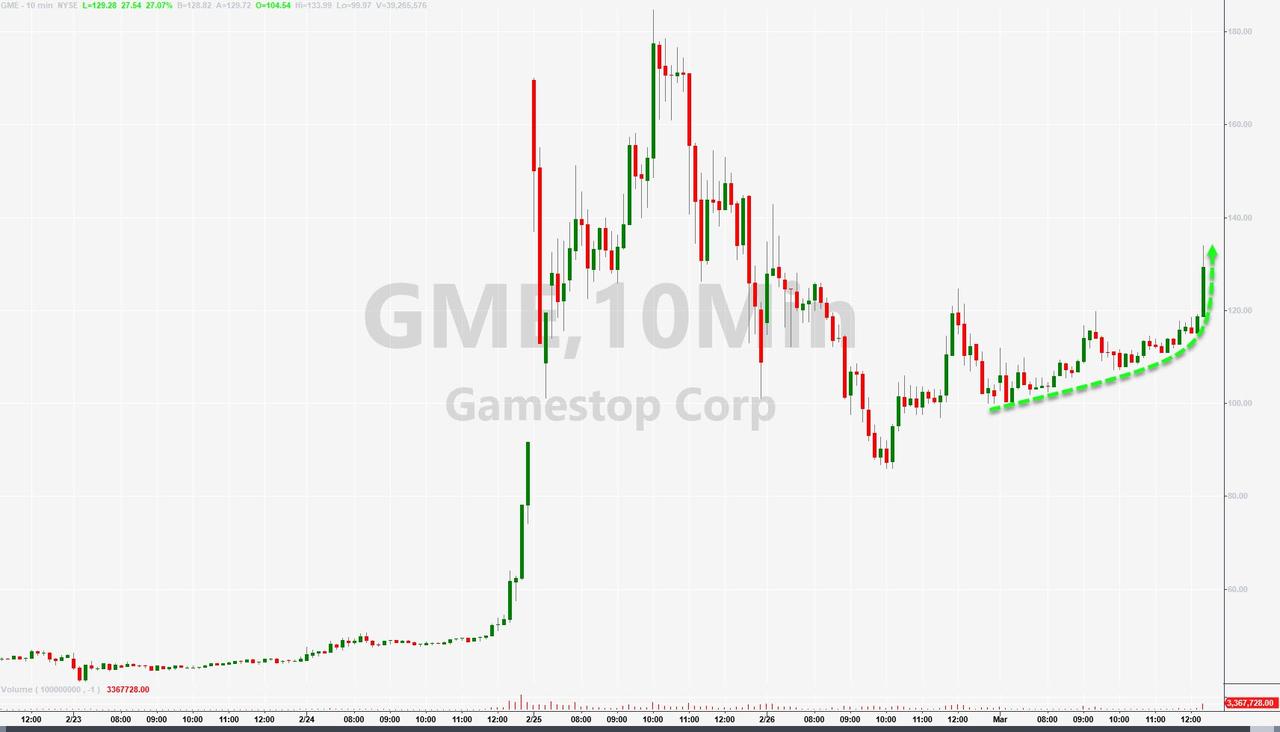
GME was up 30%… just because…

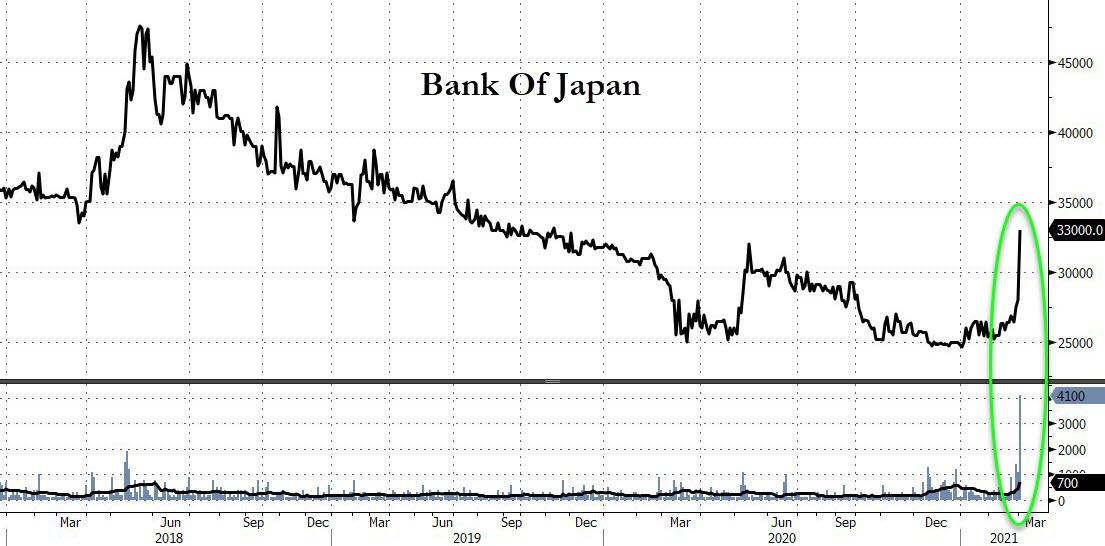
Meanwhile, before we leave equity land, there’s this malarkey. The Bank of Japan (yes the central bank trades publicly), which trades on the Tokyo Stock Exchange’s Jasdaq section, surged by the daily limit of 18%, the most since 2005 on massive volume. The shares, or subscriber certificates as they’re technically called, have no real benefit, with no voting rights and offering very limited dividends.

Source: Bloomberg

But “short-term retail investors don’t care about dividends, they’re looking just for capital gains,” said Tomoichiro Kubota, a senior market analyst at Matsui Securities Co. “They’ll see it as attractive so long as the share price keeps rising and there are buyers.”

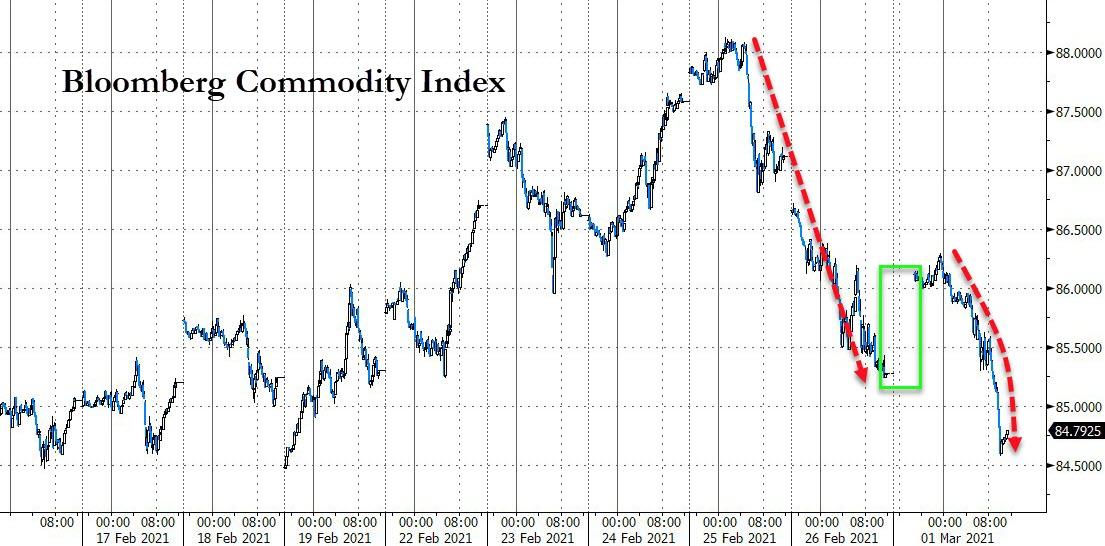
But commodities tumbled (growth/inflation doubts?)…

Source: Bloomberg

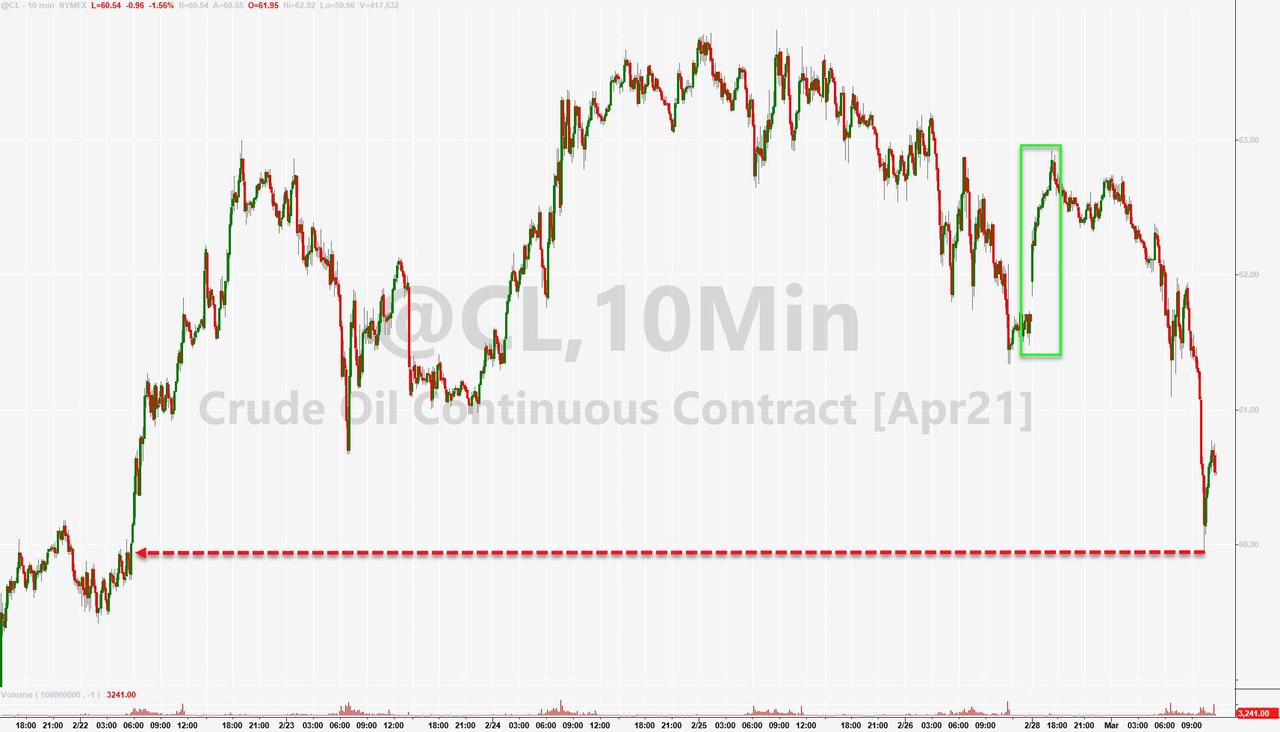
Led by oil (OPEC+ anxiety, China PMI demand fears, and scary virus headlines)…

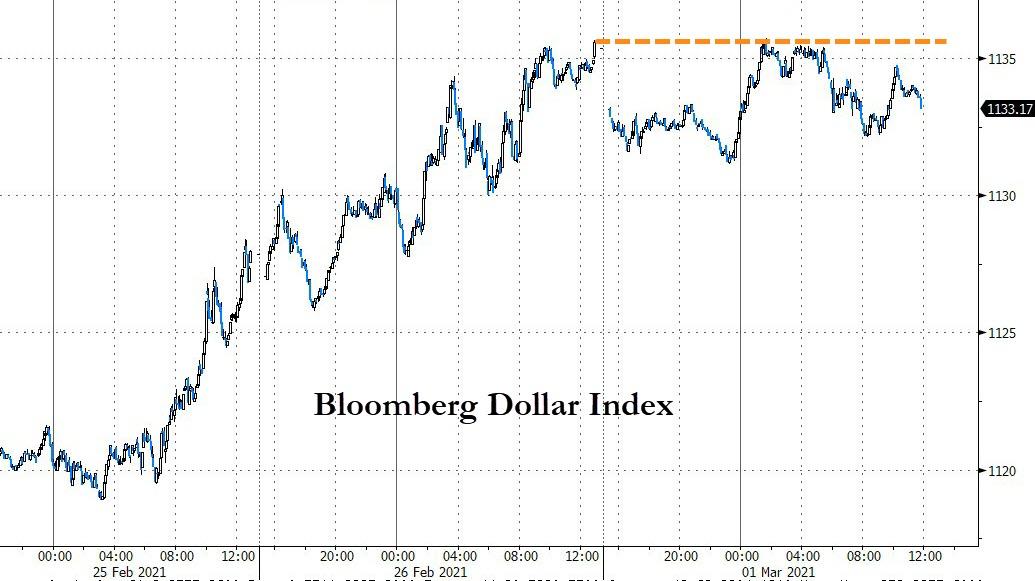
The dollar was flat to lower…

Source: Bloomberg

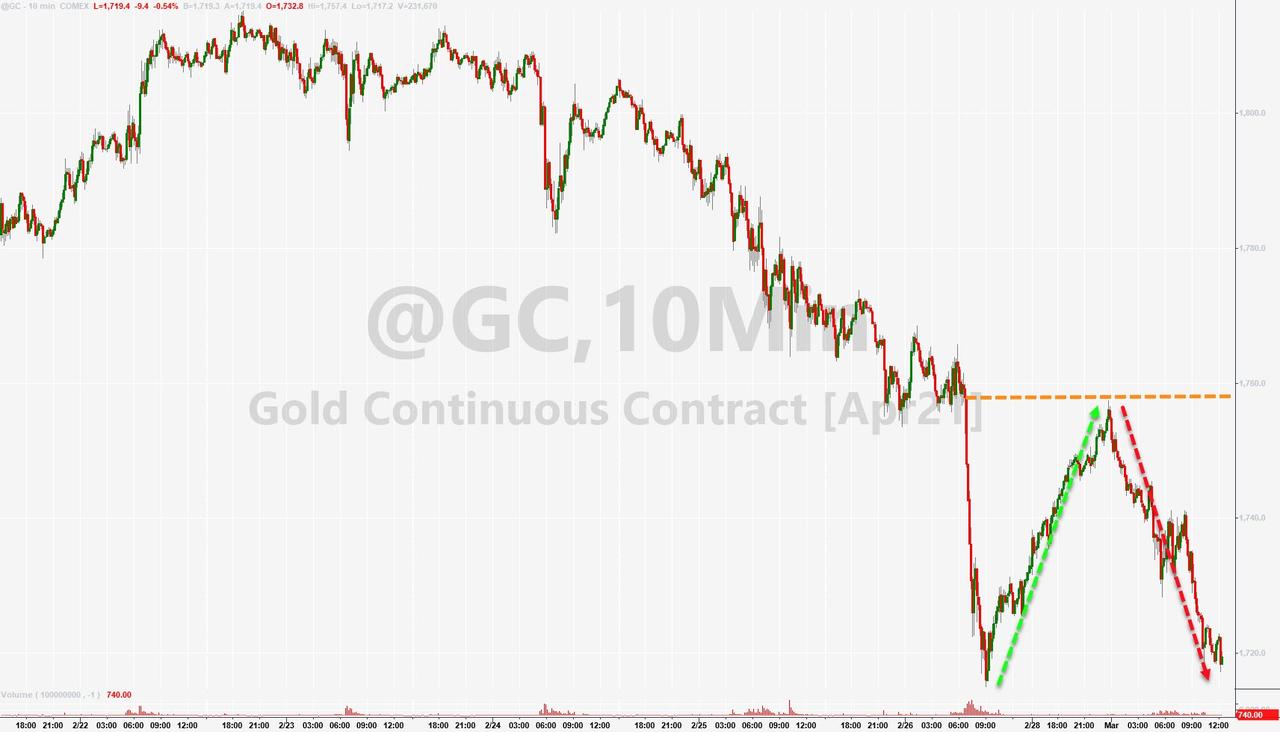
But Gold was dumped…

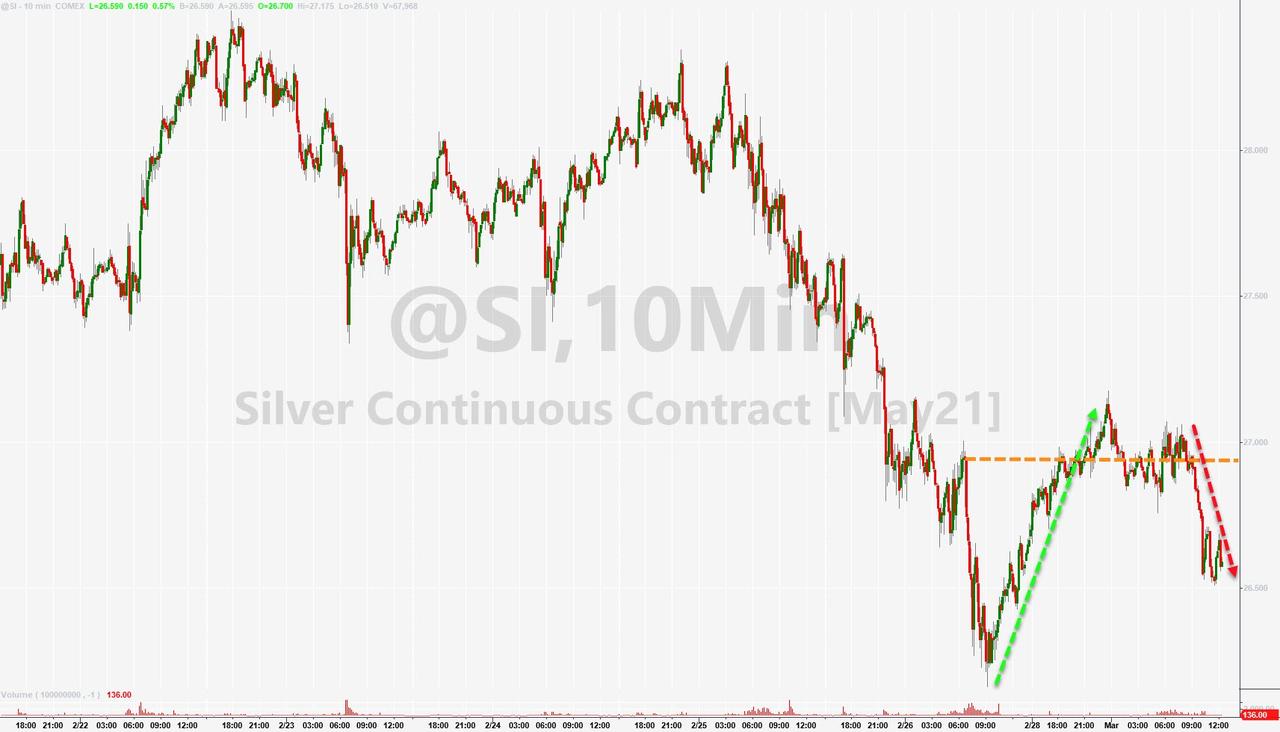
And while silver slipped lower late on, it managed to hold some gains…

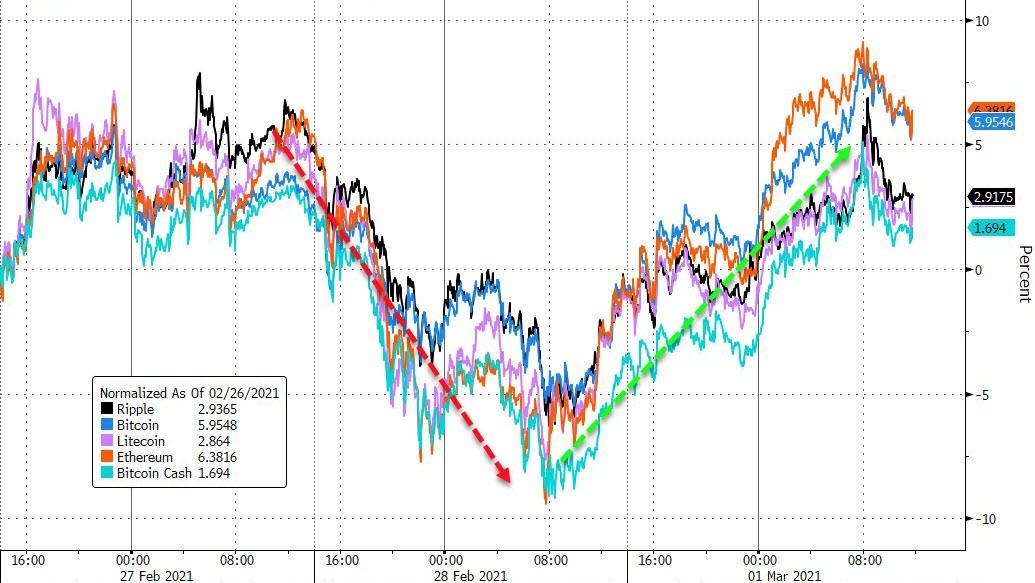
And Crypto was aggressively bid off weak weekend dip lows…

Source: Bloomberg

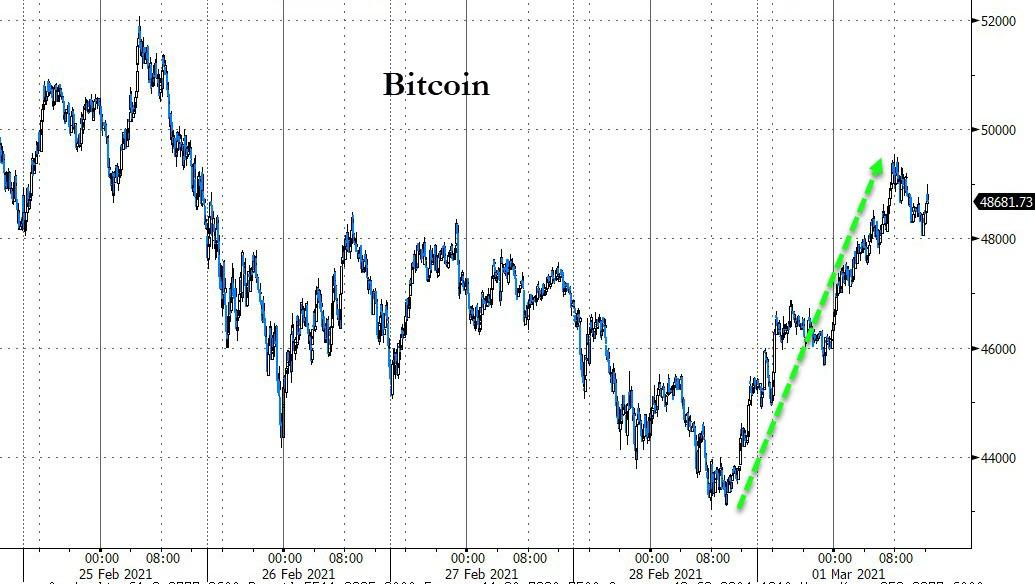
A positive sentiment Citi note sent Bitcoin back up near $50k…

Source: Bloomberg

And Ethereum jumped after Mark Cuban’s comments…

Source: Bloomberg


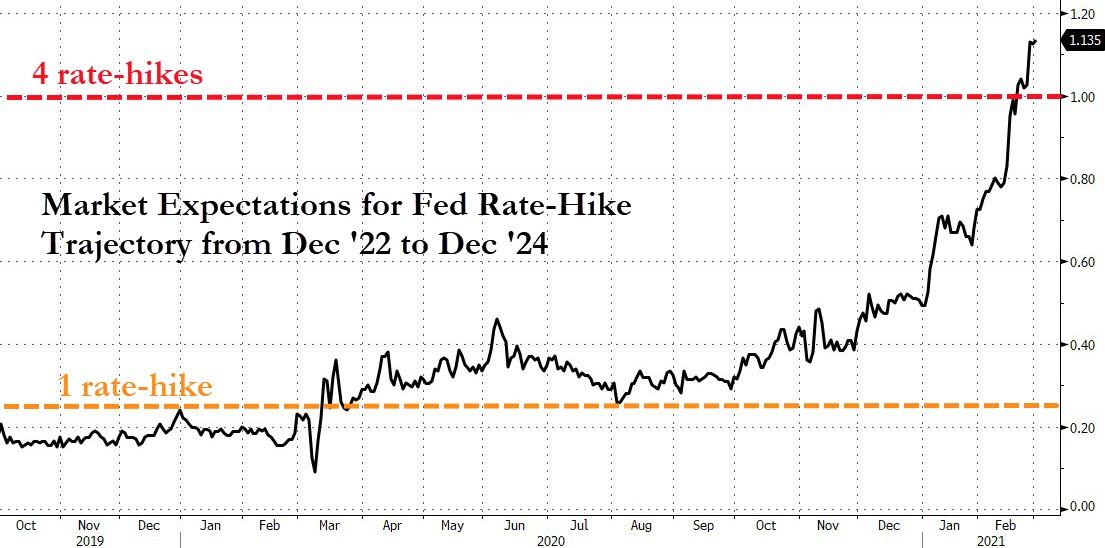
Finally, we note that the market is now pricing in some serious tightening by The Fed over the next few years…

Source: Bloomberg

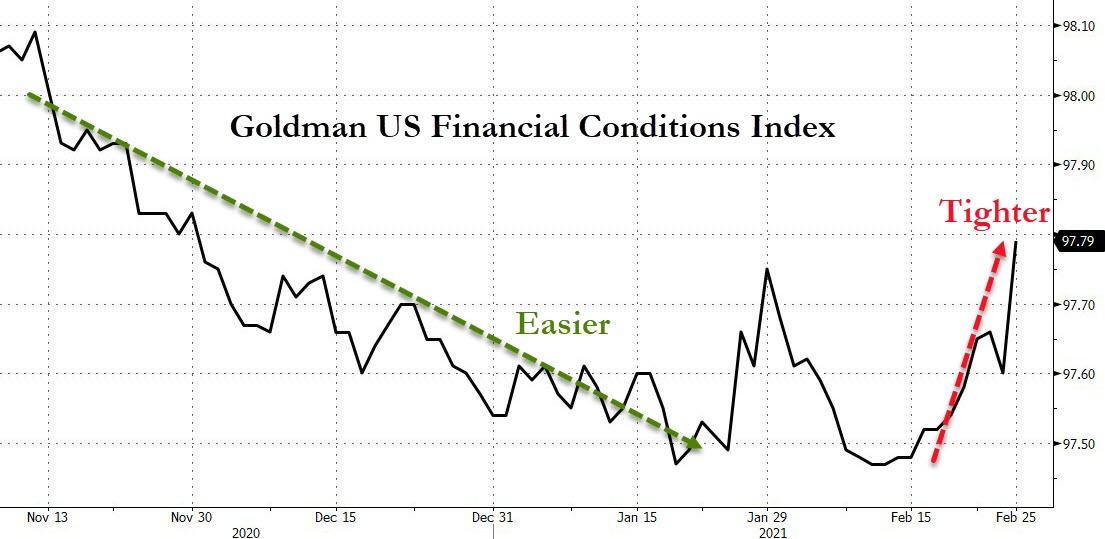
And as rates rise, financial conditions are tightening in the US (now at their tightest in 3 months)

Source: Bloomberg

Get back to work Mr.Powell!

Tyler Durden
Mon, 03/01/2021 – 16:00

via ZeroHedge News https://ift.tt/3uGtnei Tyler Durden

BofA: 1.75% Is The “Tipping Point” For Bonds

BofA: 1.75% Is The “Tipping Point” For Bonds

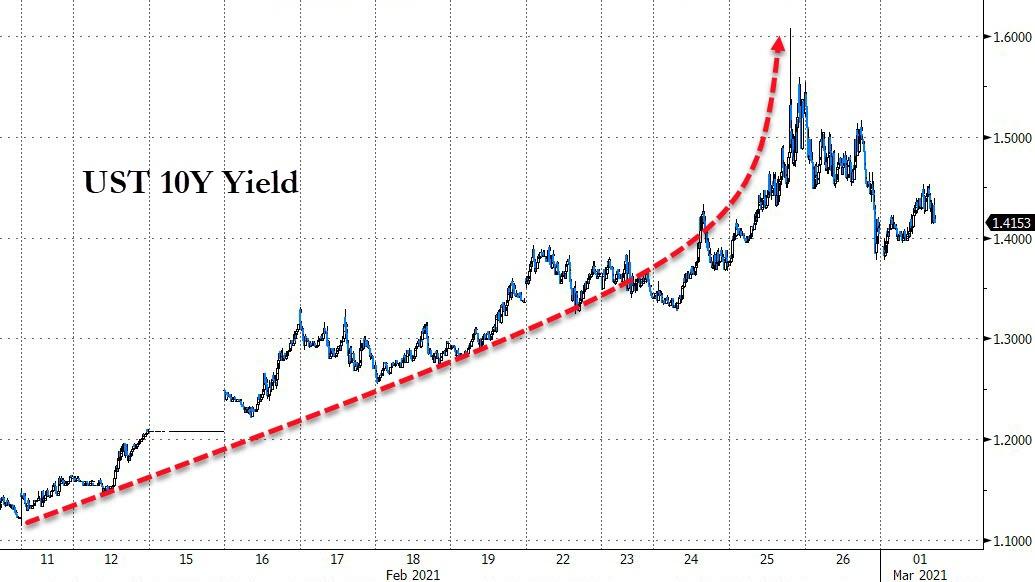
Almost two months ago, Nomura correctly predicted that once the 10Y breaches 1.50%, stocks would freak out and sure enough that’s precisely what happened (with Nomura’s forecast becoming self-fulfilling and sparking a stop loss cascade one the 10Y hit 1.50% last Thursday, sending the 10Y as high as 1.61% in a matter of seconds following last week’s dismal 7Y auction).

So now that 1.50% is yesterday’s news, Wall Street is scrambling to define the next critical level for 10Ys beyond which there will be blood. As a reminder, yesterday Goldman hinted that 2.10% is what traders should be looking at, but that seems a lot, especially with many far more accurate forecasters saying that the Fed will have to engage YCC around 2.0%, and for that to happen stocks would need to crash first. Therefore, the next critical level is likely one between 1.50% and 2.0%.

One such level was proposed by BofA’s chief equity strategist, Savita Subramanian who today writes that “history suggests that 1.75% on the 10-yr (the house forecast and ~25bp above current levels) is the tipping point at which asset allocators begin to shift back to bonds” and thus sell stocks in the next wave of aggressive liquidations.

Why 1.75%? Because that yield on the 10Y is decisively above the S&P’s dividend yield, and where according to BofA “there is an alternative to stocks”, or TIAA.

As Bloomberg notes, TIAA would represent a reversal to a mantra popularized in recent years as yields on Treasuries fell to historic lows and inflation stayed muted. For many, TINA – “there is no alternative” to stocks – helped rationalize a turn to riskier assets and justified S&P 500 valuations that are near their highest in two decades.

So after last week’s fireworks, will bonds continue to rise from the current level of 1.43%, and how fast until they reach the new “tipping point”? Well, after last week’s historic rout, which culminated the 2nd worst bear market for bonds in the past 40 years…
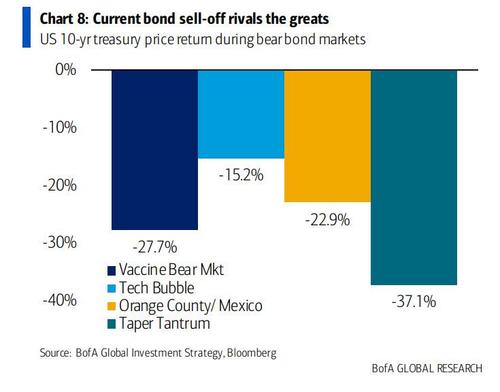
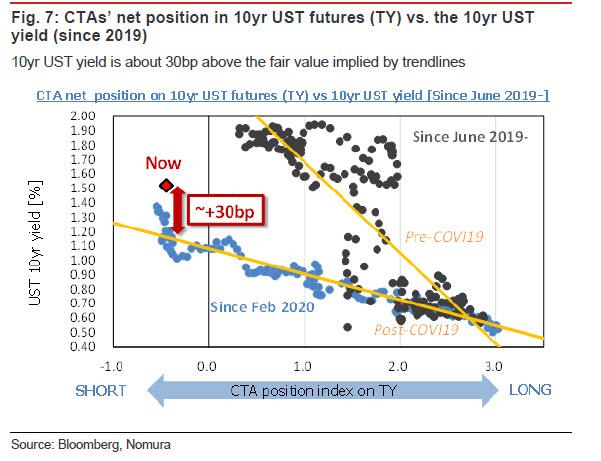
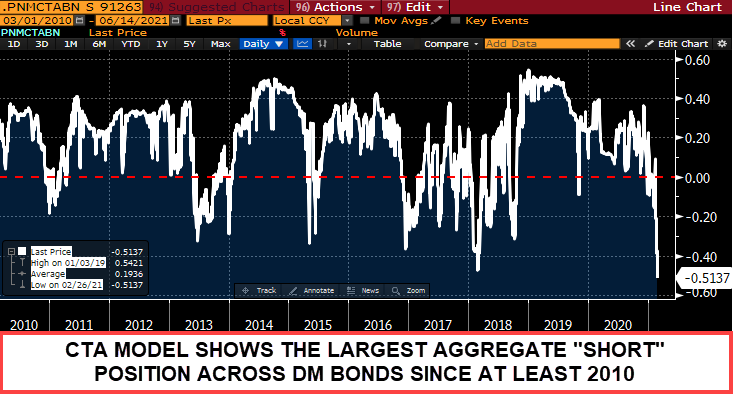
…. CTAs had been the most bearish on long-dated bonds since 2018, but as Nomura pointed out they had started to cover their shorts, usually an early indicator that yields have topped out for the time being and are set to drop, with Nomura estimating that the 10yr UST yield is currently about 30bp above the fair-value yield implied by trend-following strategies. Short-covering by CTAs and other speculators for the sake of locking in profits may serve the purpose of reeling the 10yr UST yield back in.”

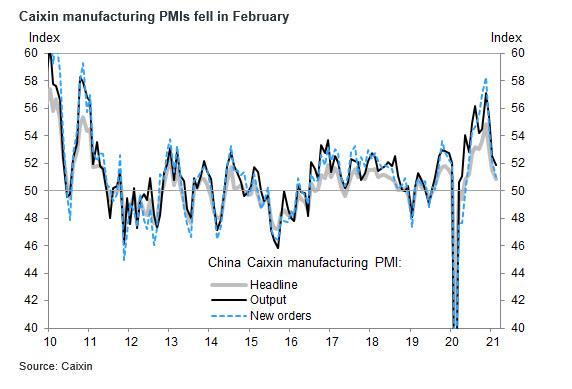
Separately, rising growth expectations have also fueled huge gains for commodities with the likes of corn and soybeans up roughly 50% in the past year. On a six-month rolling basis, both offered higher risk-adjusted returns, or Sharpe ratios, than the famously high-flying Bitcoin, according to Quantica. However, in an ominous reversal, over the weekend China reported disappointing PMI prints…
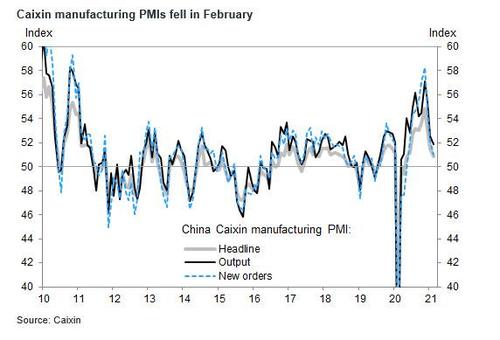
… which suggest that the global reflation trade sparked by the world’s biggest credit dynamo, Beijing, could be starting to fizzle.

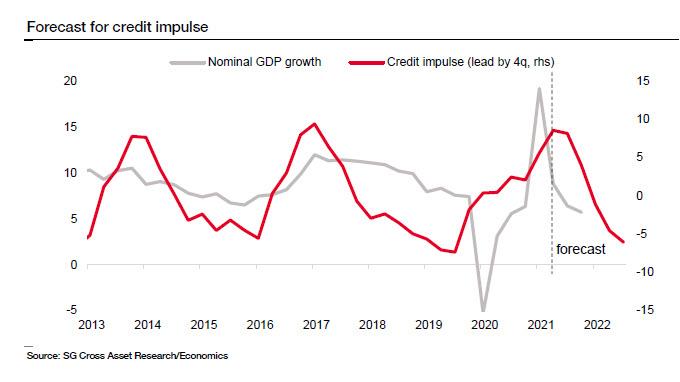
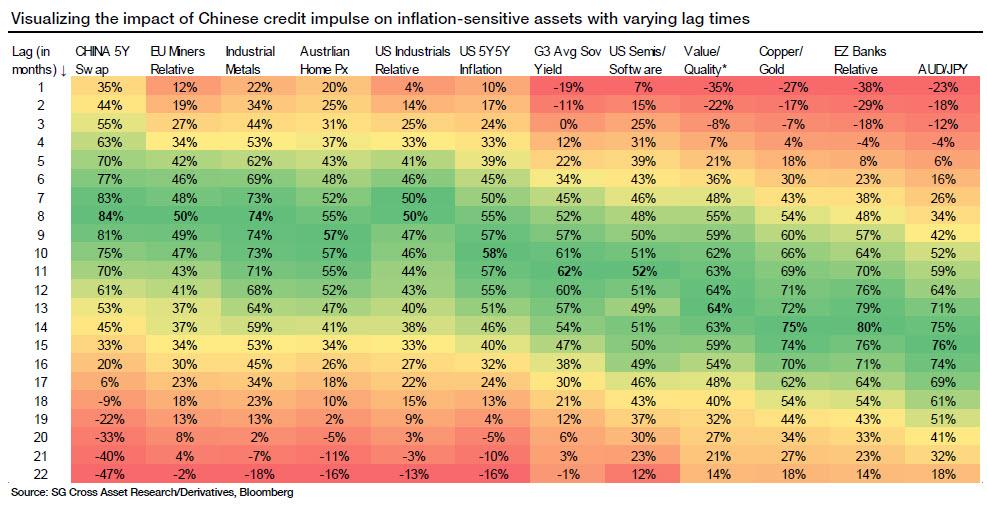
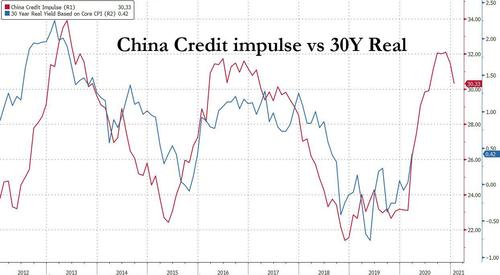
What’s worse, the propagation of the slowing Chinese credit impulse would have adverse consequences on all inflation-sensitive assets.

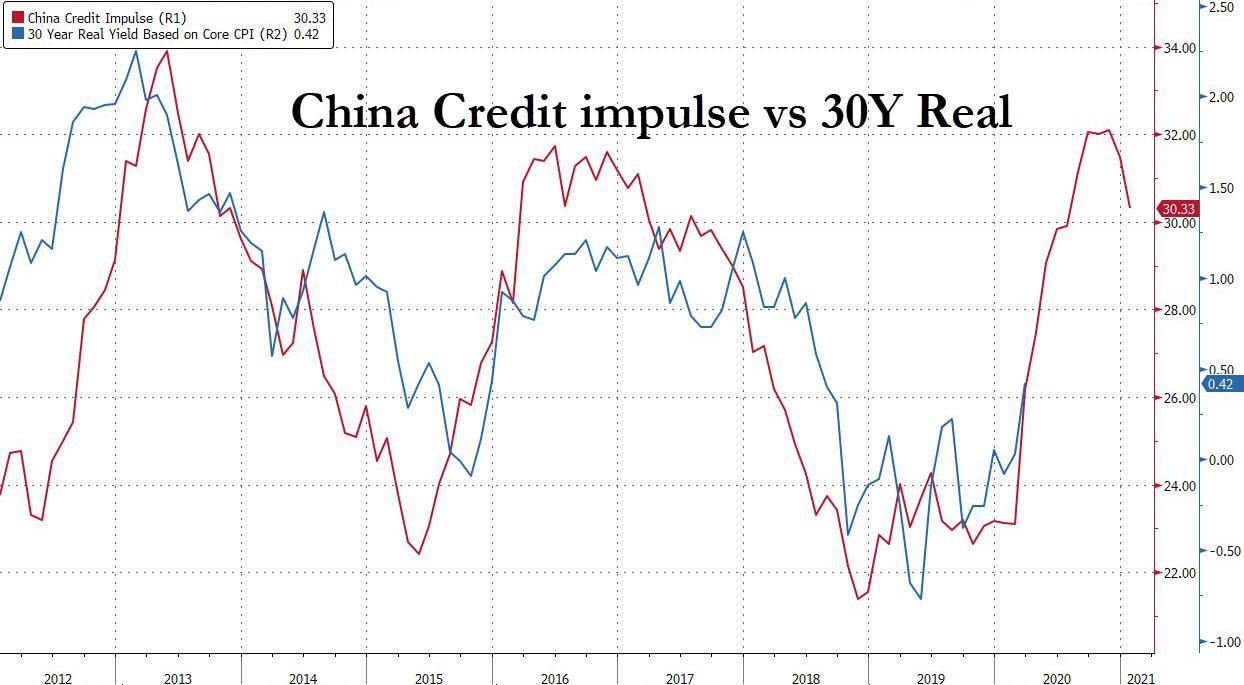
The only question is how long before China’s credit slowdown is manifest in real yields. And here, according to one of our favorite charts, we probably have another 6-9 months of real yield upside before yields come crashing down again.
Indeed, after last week’s freakout, some Treasury bulls have emerged, and according to Jim Paulsen, chief investment strategist at the Leuthold Group, the 1.75% level may be further away than it seems. Paulsen believes that the spike in bond yields could take a pause around 1.5% before embarking on another leg higher. Among the reasons he cites is the recent bout of colder weather, which could result in weaker economic data – including slower retail sales – in the next month. That will dampen anxieties over economic overheating, he wrote in a note.

“Yields still have further to rise this year,” said Paulsen. “But, if they do it a bit more slowly and intermittently, rather than all at once, the impact on the economy and the stock market should be far-less damaging.”

Of course, others disagree. One among them is Sonal Desai, Franklin Templeton’s fixed-income chief who is back with another big bet that rising inflation will prolong the slump in U.S. Treasuries. As Bloomberg notes, Desia says the 10-year yield could jump above 1.75% by the end of the year, compared with around 1.43% currently.

“Inflation could easily overshoot under the approving eye of the Fed,” wrote the chief executive officer of the debt division with around $155 billion in a note. She cited price pressures including accelerating growth, the vaccine rollout, massive fiscal stimulus and the historic growth in money supply.

To be sure, one could simply respond that Desai, along with her colleague Michael Hasenstab, have been broken records, predicting the end of the bond rally for years. Worse, he track record is rather dismal: her previous predictions about the Treasury market have fallen flat, amid relentless investor demand, and unexpected economic shocks including trade frictions and the pandemic itself. In October 2019 she projected that the 10-year yield would rise to 3% within 12 months. It peaked at 1.9% over that period before dropping to as low as 0.5%.

Misfiring bearish bets have hit Hasenstab’s Templeton Global Bond Fund with $15 billion in assets, which was forced last year to unwind a multi-year short position on Treasuries. The fund still maintains low duration, according to filings, though that stance still hasn’t spared it from a 1.9% loss so far this year.

That has not stopped Desai, who helps oversee everything from credit to money markets, to put her investors’ money where her mouth is, and she says she is trading her conviction on higher Treasury yields by being selective in high yield and emerging-market investments. She also favors securities in the floating-rate loan market, according to the note.

“Both the Fed and the European Central Bank have reiterated their reassurance that monetary policy will remain supportive, but markets may be challenging central bank credibility,” Desai wrote. “Given the underlying strength of the economy, I think widening spreads will offer opportunities in short duration fixed income assets in the coming weeks.”

Here’s the problem: Desai may well be right and central bank credibility could soon be completely gone. However, in that case, the first people out of a job will be asset managers such as Desai and all her peers at Franklin Templeton as the ensuing historic crash will guarantee that total losses on everything else dwarf what little profits the bond manager can make on its Treasury short.

Tyler Durden
Mon, 03/01/2021 – 15:40

via ZeroHedge News https://ift.tt/3r6GdjZ Tyler Durden

“Judgment” or “Judgement”?

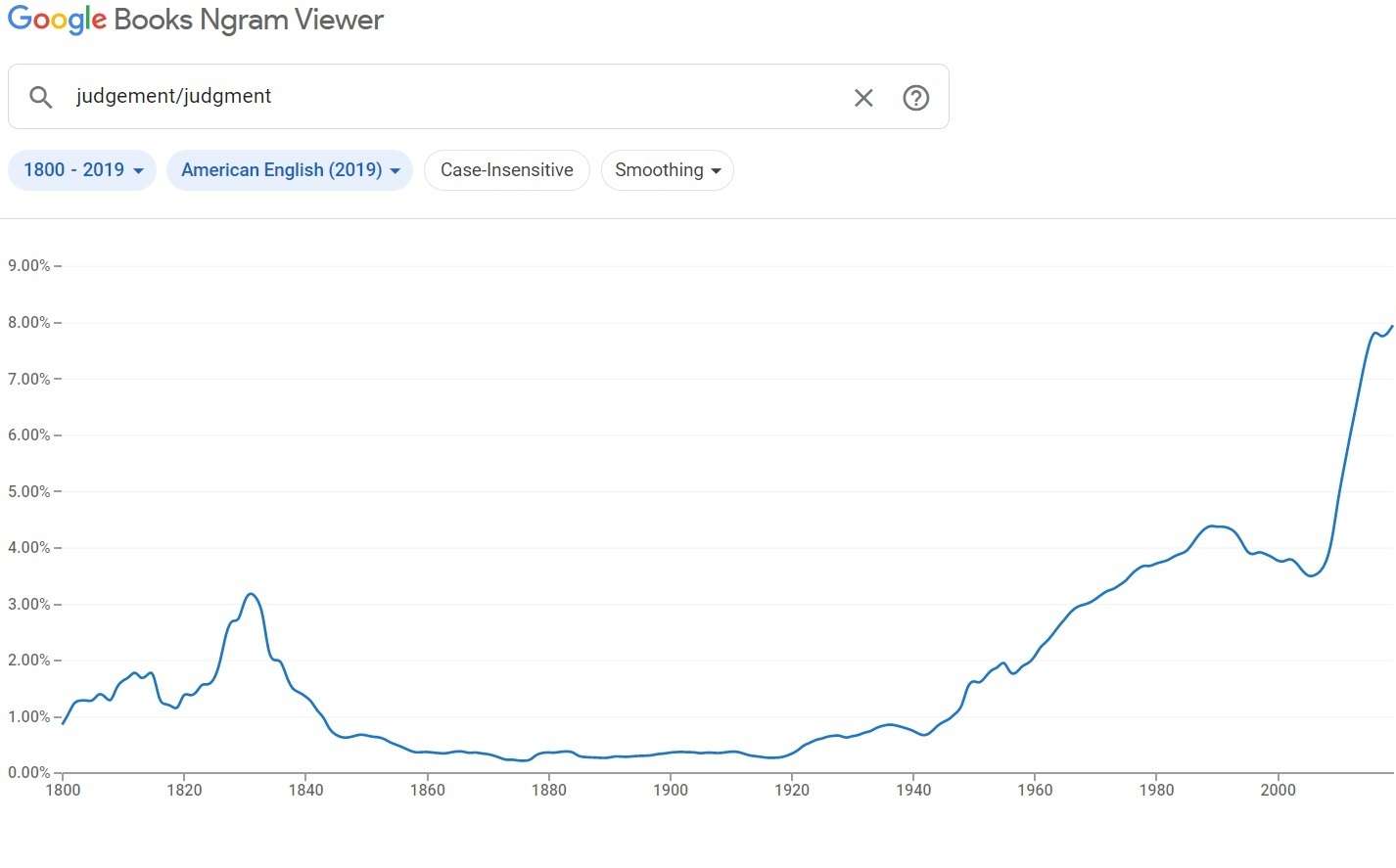
In America, “judgment” remains the sharply dominant spelling, by a factor of more than 10 to 1. The divide was even greater before about 2010:

(The graph shows the ratio of uses of “judgement” divided by the uses of “judgment,” and it’s under 10%.) The divide is likewise stark in American legal sources; a quick Westlaw search over the last week reported 2800 cases mentioning “judgment” and 72 “judgement.”

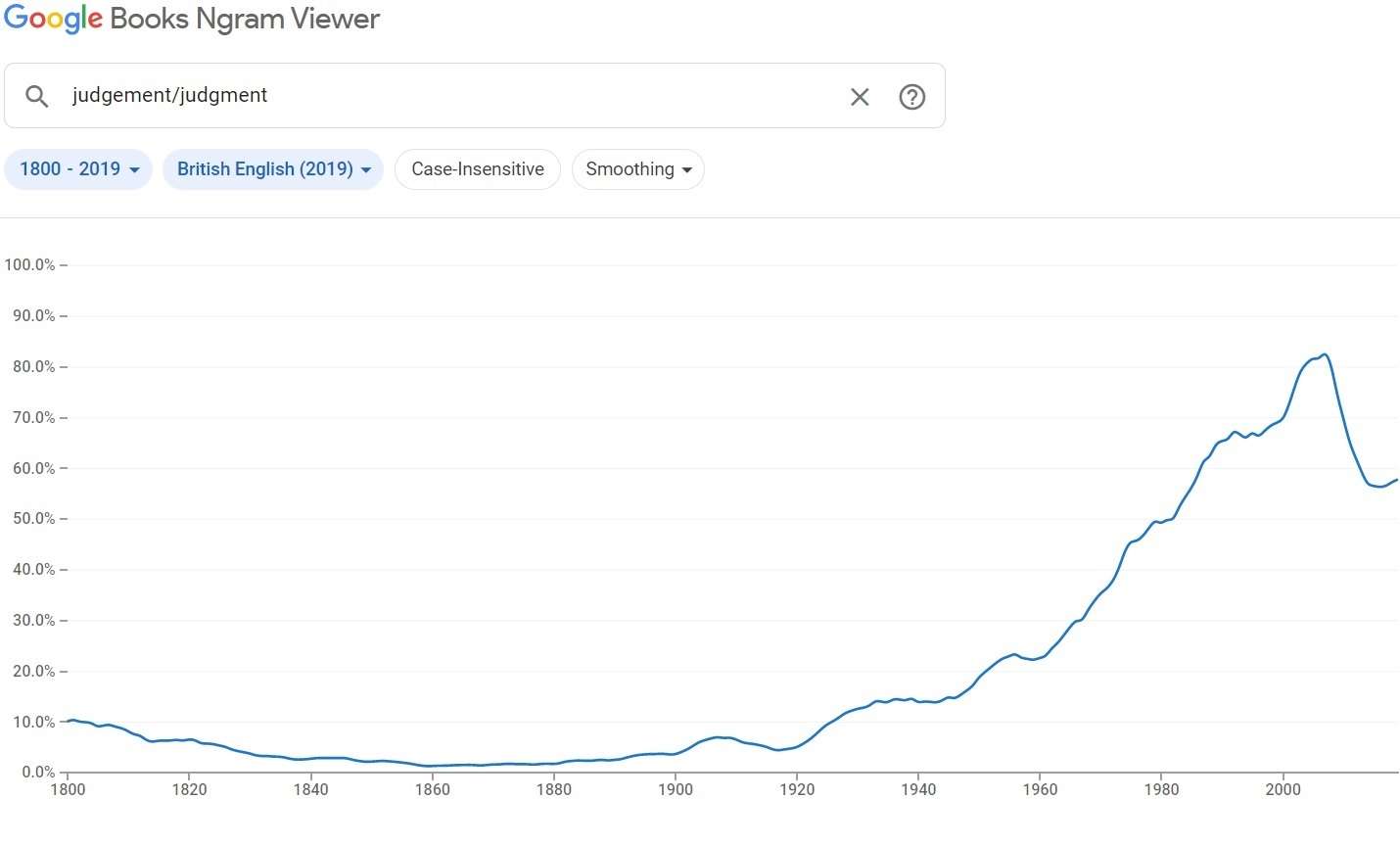
Curiously, in England, “judgement” has recently become a pretty common variant, being used for a few decades at at least half the rate of “judgment” (so that, of uses of both, a third are with the extra “e”).

I suspect that makes both standard in normal British English (I can’t speak to British legalese), much as “grey” and “gray” are both standard equivalents. But that’s only in Britain; in America, “judgment,” unusually spelled as it may be, is the dominant form, and using the spelling “judgement” is particularly likely to be seen as a mistake.
from Latest – Reason.com https://ift.tt/380EEwd
via IFTTT

How Congress Could Send Bigger Stimulus Checks, Fund School Reopening, and Save $1 Trillion

rollcallpix133086

President Joe Biden’s $1.9 trillion COVID-19 relief bill took its first major step toward passage over the weekend. But political circumstances and the current state of the pandemic suggest that Congress ought to reconsider this approach.

In comments to reporters on Saturday, Biden urged the Senate to take “quick action” to pass the bill after the House of Representatives passed it in the early morning hours that same day.

“We have no time to waste,” Biden said, according to a pool report. “If we act now decisively, quickly, and boldly, we can finally get ahead of this virus. We can finally get our economy moving again. And the people of this country have suffered far too much for too long. We need to relieve that suffering.”

Biden has been pushing this message since before he was inaugurated—the basic framework of this $1.9 trillion stimulus bill was announced in early January. He and congressional Democrats have touted the package as an urgently needed response to a still-out-of-control pandemic, a necessary step to getting schools reopened, and a way to help jobless Americans make ends meet until a full recovery is achieved.

That message is at odds with much of the bill itself, which is larded up with things like an increase to the federal minimum wage, funding for a new subway in San Jose, California, and billions of dollars in supposedly urgent school funding that wouldn’t actually be used for years to come. About $312 billion of the bill’s overall spending has nothing to do with the pandemic at all, according to an analysis by the nonpartisan Committee for a Responsible Federal Budget (CRFB), including changes to tax credit programs for parents and an expansion of the Affordable Care Act’s health insurance subsidies.

The package would also spend about $500 billion bailing out state and local governments, far in excess of what would repair COVID-19 budget holes. The American Enterprise Institute, a conservative think tank, estimates that states and local governments need about $100 billion in direct aid, while the Center for Budget and Policy Priorities, a progressive think tank, has called for $225 billion in aid. Part of the discrepancy is due to the fact that the Biden plan was built around the assumption that state budgets would be facing an 8 percent decline in revenue this year. The Wall Street Journal reports that state tax revenue declined by a mere 1.6 percent instead.

Beyond all that, a clear-eyed assessment of how the federal government should respond to COVID-19 in March 2021 must also take into account the fact that the pandemic is clearly ebbing. This weekend saw new daily records for vaccinations and the approval of a third vaccine by the Food and Drug Administration, a development that promises even more vaccine supply in the weeks and months ahead. New cases, current hospitalizations, and daily deaths have fallen to levels not seen in months. It’s not over yet, of course, but the current situation seems significantly different from where things stood in early January.

Senate Democrats appear willing to make some changes to the bill before putting it up for a vote. The much-discussed minimum wage increase is likely to be removed now that Senate Parliamentarian Elizabeth MacDonough has ruled that the wage hike could not be passed with a simple majority via the reconciliation process. Meanwhile, CNBC reported on Monday that Senate Democrats are abandoning plans to include a backdoor minimum wage hike that could have been accomplished by revoking tax breaks from businesses that pay workers less than $15 per hour.

It’s good to remove a job-killing proposal that’s completely unrelated to the pandemic. Still, more could be done. Given current economic and COVID trends, Congress could revisit a smaller, bipartisan proposal that Democratic leaders rejected in early February for being insufficiently expensive. That earlier plan would have spent about $618 billion, with the funding focused on direct payments to many Americans, expanded unemployment benefits, and money aimed at reopening schools.

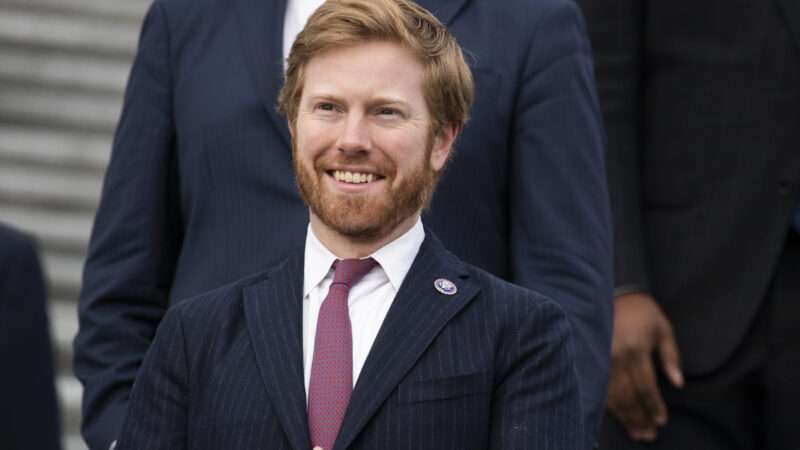
Now Rep. Peter Meijer (R–Mich.) is touting a revamped version of that proposal as the Direct Dollars Over Government Excess (DOGE) plan. (Yes, it’s named for that dog meme.) Meijer contrasts it with the Biden bill, which he calls a “grab bag of gifts for special interests.”

Meijer’s plan would send direct payments of up to $2,400 to individuals who earned less than $50,000 last year and households that earned less than $100,000. That’s $1,000 more per person than the Biden plan would provide, but with payments phasing out at lower levels. The DOGE plan would also extend the boosted federal unemployment payments of $200 per week (down from the current level of $300 per week and Biden’s proposal of $400 per week) through the end of July.

Meijer says his proposal would cost about $992 billion. That means removing the chaff from the House-passed relief bill could save as much as $1 trillion from being added to the national debt—and every little bit helps, considering that COVID-19 emergency spending has already added about $3.3 trillion to the deficit, according to the CRFB.

Needless to say, Senate Democrats are unlikely to seriously consider any alternative to the House-passed bill at this stage. We’re likely instead to see some much more modest tinkering, after which the Senate will send the Biden plan back to the House, which will then pass the new version and send it to the president’s desk.

And you can expect that to happen pretty quickly now. The longer Congress delays, the more apparent it will become that the need for a major bill has evaporated.

from Latest – Reason.com https://ift.tt/2PjmQG5
via IFTTT

How Congress Could Send Bigger Stimulus Checks, Fund School Reopening, and Save $1 Trillion

rollcallpix133086

President Joe Biden’s $1.9 trillion COVID-19 relief bill took its first major step toward passage over the weekend. But political circumstances and the current state of the pandemic suggest that Congress ought to reconsider this approach.

In comments to reporters on Saturday, Biden urged the Senate to take “quick action” to pass the bill after the House of Representatives passed it in the early morning hours that same day.

“We have no time to waste,” Biden said, according to a pool report. “If we act now decisively, quickly, and boldly, we can finally get ahead of this virus. We can finally get our economy moving again. And the people of this country have suffered far too much for too long. We need to relieve that suffering.”

Biden has been pushing this message since before he was inaugurated—the basic framework of this $1.9 trillion stimulus bill was announced in early January. He and congressional Democrats have touted the package as an urgently needed response to a still-out-of-control pandemic, a necessary step to getting schools reopened, and a way to help jobless Americans make ends meet until a full recovery is achieved.

That message is at odds with much of the bill itself, which is larded up with things like an increase to the federal minimum wage, funding for a new subway in San Jose, California, and billions of dollars in supposedly urgent school funding that wouldn’t actually be used for years to come. About $312 billion of the bill’s overall spending has nothing to do with the pandemic at all, according to an analysis by the nonpartisan Committee for a Responsible Federal Budget (CRFB), including changes to tax credit programs for parents and an expansion of the Affordable Care Act’s health insurance subsidies.

The package would also spend about $500 billion bailing out state and local governments, far in excess of what would repair COVID-19 budget holes. The American Enterprise Institute, a conservative think tank, estimates that states and local governments need about $100 billion in direct aid, while the Center for Budget and Policy Priorities, a progressive think tank, has called for $225 billion in aid. Part of the discrepancy is due to the fact that the Biden plan was built around the assumption that state budgets would be facing an 8 percent decline in revenue this year. The Wall Street Journal reports that state tax revenue declined by a mere 1.6 percent instead.

Beyond all that, a clear-eyed assessment of how the federal government should respond to COVID-19 in March 2021 must also take into account the fact that the pandemic is clearly ebbing. This weekend saw new daily records for vaccinations and the approval of a third vaccine by the Food and Drug Administration, a development that promises even more vaccine supply in the weeks and months ahead. New cases, current hospitalizations, and daily deaths have fallen to levels not seen in months. It’s not over yet, of course, but the current situation seems significantly different from where things stood in early January.

Senate Democrats appear willing to make some changes to the bill before putting it up for a vote. The much-discussed minimum wage increase is likely to be removed now that Senate Parliamentarian Elizabeth MacDonough has ruled that the wage hike could not be passed with a simple majority via the reconciliation process. Meanwhile, CNBC reported on Monday that Senate Democrats are abandoning plans to include a backdoor minimum wage hike that could have been accomplished by revoking tax breaks from businesses that pay workers less than $15 per hour.

It’s good to remove a job-killing proposal that’s completely unrelated to the pandemic. Still, more could be done. Given current economic and COVID trends, Congress could revisit a smaller, bipartisan proposal that Democratic leaders rejected in early February for being insufficiently expensive. That earlier plan would have spent about $618 billion, with the funding focused on direct payments to many Americans, expanded unemployment benefits, and money aimed at reopening schools.

Now Rep. Peter Meijer (R–Mich.) is touting a revamped version of that proposal as the Direct Dollars Over Government Excess (DOGE) plan. (Yes, it’s named for that dog meme.) Meijer contrasts it with the Biden bill, which he calls a “grab bag of gifts for special interests.”

Meijer’s plan would send direct payments of up to $2,400 to individuals who earned less than $50,000 last year and households that earned less than $100,000. That’s $1,000 more per person than the Biden plan would provide, but with payments phasing out at lower levels. The DOGE plan would also extend the boosted federal unemployment payments of $200 per week (down from the current level of $300 per week and Biden’s proposal of $400 per week) through the end of July.

Meijer says his proposal would cost about $992 billion. That means removing the chaff from the House-passed relief bill could save as much as $1 trillion from being added to the national debt—and every little bit helps, considering that COVID-19 emergency spending has already added about $3.3 trillion to the deficit, according to the CRFB.

Needless to say, Senate Democrats are unlikely to seriously consider any alternative to the House-passed bill at this stage. We’re likely instead to see some much more modest tinkering, after which the Senate will send the Biden plan back to the House, which will then pass the new version and send it to the president’s desk.

And you can expect that to happen pretty quickly now. The longer Congress delays, the more apparent it will become that the need for a major bill has evaporated.

from Latest – Reason.com https://ift.tt/2PjmQG5
via IFTTT

Ayanna Pressley Revives Justin Amash’s Bill To End Qualified Immunity

admphotostwo716533

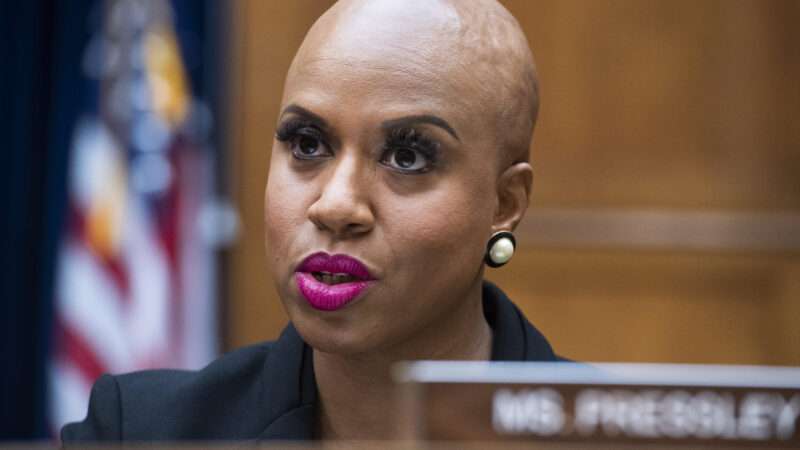
Rep. Ayanna Pressley (D–Mass.) has reintroduced a bill to end qualified immunity, a legal doctrine that makes it difficult for the public to hold government officials accountable for alleged misconduct.

Former Rep. Justin Amash (L–Mich.) originally unveiled the Ending Qualified Immunity Act in June 2020 after the police killing of George Floyd. Pressley signed on as cosponsor a few days after, though the bill died without ever receiving a vote.

The Ending Qualified Immunity Act of 2021, which Sens. Ed Markey (D–Mass.) and Elizabeth Warren (D–Mass.) are cosponsoring in the Senate, endeavors to do the exact same thing as its predecessor: abolish qualified immunity for all state actors.

The American public maintains the right to sue civil servants who violate their rights under Section 1983 of Title 42 of the U.S. Code. But the Supreme Court has radically limited that right over the years. First, there was the decision in Pierson v. Ray (1967), which held that public officials may avoid civil suits if constitutional violations were made in “good faith.” In Harlow v. Fitzgerald (1982), the high court took that a step further: Victims may not sue state actors for misbehavior unless that misbehavior was “clearly established” in previous case law.

In other words, in order to have the right to bring a case before a jury, a plaintiff must be able to point to a court precedent that explicitly describes the situation in question to a tee. Qualified immunity has protected two cops who stole $225,000 while executing a search warrant, a cop who damaged a man’s eye after allegedly kneeing him 20 to 30 times after he had been subdued, a prison guard who hid while an inmate raped a nurse, two cops who beat and arrested a man for standing outside of his house, a cop who ruined a man’s vehicle during a bogus drug search, a cop who shot a 10-year-old, and a cop who shot a 15-year-old.

In all of those cases, the victims were left with no avenue for recompense.

“It is the sense of the Congress that we must correct the erroneous interpretation” of Section 1983, the bill says, “and reiterate the standard found on the face of the statute, which does not limit liability on the basis of a defendant’s good faith beliefs or on the basis that the right was not ‘clearly established’ at the time of the violation.”

The Supreme Court has demurred at the opportunity to fundamentally reevaluate the doctrine. But it has started to send messages to the lower courts that the current application of qualified immunity no longer cuts it. In November, it overturned an appeals court decision that awarded qualified immunity to a group of correctional officers who forced a naked inmate into two deplorable cells, one teeming with sewage and the other with “massive amounts” of human feces. And just last month, it reversed another appeals court decision that gave qualified immunity to a prison guard who had pepper-sprayed an inmate without provocation.

Lawmakers are poised to vote soon on the Justice in Policing Act, a reform bill that would end qualified immunity for cops. Pressley’s bill eliminates it for all public officials—a relevant tidbit, when considering that the last two SCOTUS decisions on the issue pertained to correctional officers, not police officers. Moderate Democrats have begun backing away from that provision, however, in some cases because they face tough re-election challenges and want support from police unions.

Meanwhile, the GOP has largely resisted such reforms. Sen. Mike Braun (R–Ind.) did introduce a bill last summer that would have effectively paralyzed qualified immunity, but he abandoned it after scuffling with Fox News host Tucker Carlson. Amash’s bill only boasted one Republican cosponsor, Rep. Tom McClintock (R–Calif.).

But the American public is on board. The majority of the country supports reform, with high-profile attempts gaining steam. Citing Reason‘s reporting on the issue, players from the NFL, MLB, and NBA urged Congress to support Amash’s bill last June.

One big hurdle at the time was then-President Donald Trump, who said that qualified immunity reform would merit an automatic veto. Will President Joe Biden, who has said that he isn’t ready to end the doctrine, be any better? His national press secretary told me during the campaign that he wants to see it “severely reined in.” He did not provide details as to what that meant.

from Latest – Reason.com https://ift.tt/3b4kmE0
via IFTTT

“U.S. Excess Savings Will Be A Massive Economic Boost From 2Q”

“U.S. Excess Savings Will Be A Massive Economic Boost From 2Q”

Submitted by Christophe Barraud

U.S. personal incomes soared in January as Americans received another batch of pandemic-relief checks, resulting in a spike of total excess personal savings.

According to the Commerce Department report, incomes increased by 10% MoM, the largest gain in nine months. The January jump came after the $900 billion pandemic aid package passed in December. As a reminder, the bill included $600 stimulus checks per American, including adults and children. However, the size of the payment decreased for people who earned more than $75,000 in the 2019 tax year. The check disappeared altogether for those who earned more than $99,000. In addition, the legislation supplemented jobless benefits with an extra $300 a week payment.

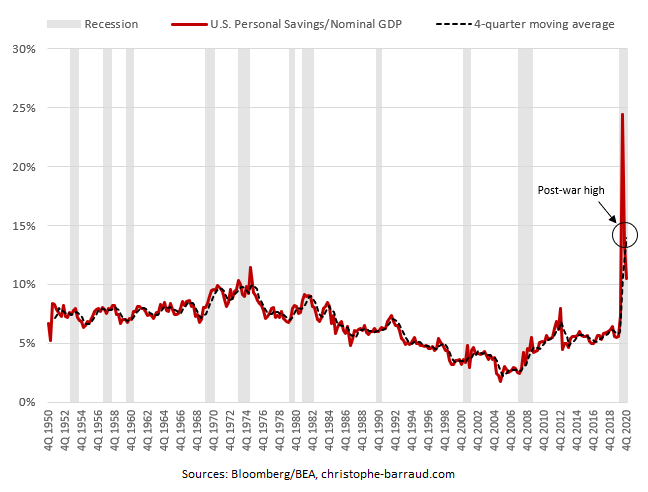
Meanwhile, purchases increased 2.4% MoM, pushing personal saving rate up to 20.5%, the highest since May 2020. In this context, U.S. personal savings as a share of nominal GDP will rise again in 1Q21, after reaching a post-war high at the end of 2020 on a 4-quarter moving average basis.

In the meantime, the level of total excess personal savings accumulated since the beginning of the Covid-19 crisis (March 2020) kept skyrocketing. According to my estimates, it reached $1.681 trillion in January (7.8% of nominal GDP).

This huge amount will grow again in the coming months and could even top the $2 trillion mark (9.3% of nominal GDP) as soon as March (if the next Federal stimulus is disbursed in time, otherwise it will be in April). The fact is that, this week, California legislators approved a $7.6-billion COVID-19 package, including $600 stimulus checks. An estimated 5.7 million checks will go to low-income Californians, including families with children enrolled in CalWORKS, as well as elderly, blind and disabled recipients of Supplemental Security Income or the state’s Cash Assistance Program for Immigrants.

Lastly, another federal stimulus is likely to be passed before March 14, when key programs buoying millions of jobless Americans expire. Among other details, the plan contains:

  • A $400 per week unemployment insurance supplement and an extension of programs expanding jobless benefits to millions more Americans through Aug. 29
  • $1,400 direct payments to most Americans and the same sum for dependents
  • Payments to families of up to $3,600 per child over a year

In my opinion, a part of this total excess personal savings will probably flood the economy from 2Q21 as economic confidence returns. As I already noted, the health situation has improved significantly since mid-January. Moreover, latest data and the recent approval of Johnson & Johnson’s vaccine suggests that the U.S. will be able to vaccinate all of its over-65s and health workers by the end of May (at the latest). Therefore, it is very likely that most of states will ease restrictions supporting economic activity and labour market confidence. Note that hiring intentions of companies in the most affected sectors have already improved.

To conclude, a part of total excess personal savings will probably flood the economy from 2Q21 as economic confidence returns progressively to normal. In addition, most of economists underprice the “consumer revenge” effect which reinforces my forecast that U.S. growth will exceed expectations in 2021 (recently revised upward to +4.9% according to the Bloomberg consensus).

Tyler Durden
Mon, 03/01/2021 – 15:25

via ZeroHedge News https://ift.tt/3kAgoGk Tyler Durden

Bond Market Calls Fed’s Bluff With Biggest Short Ever…

Bond Market Calls Fed’s Bluff With Biggest Short Ever…

The last few weeks have seen the short-end of the yield curve panic, pricing in more than 4 rate-hikes from Dec 2022 to Dec 2024…

Source: Bloomberg

And Bond yields have screamed higher in recent days as fears of rampant inflation and a Fed on the sidelines prompts selling…

Source: Bloomberg

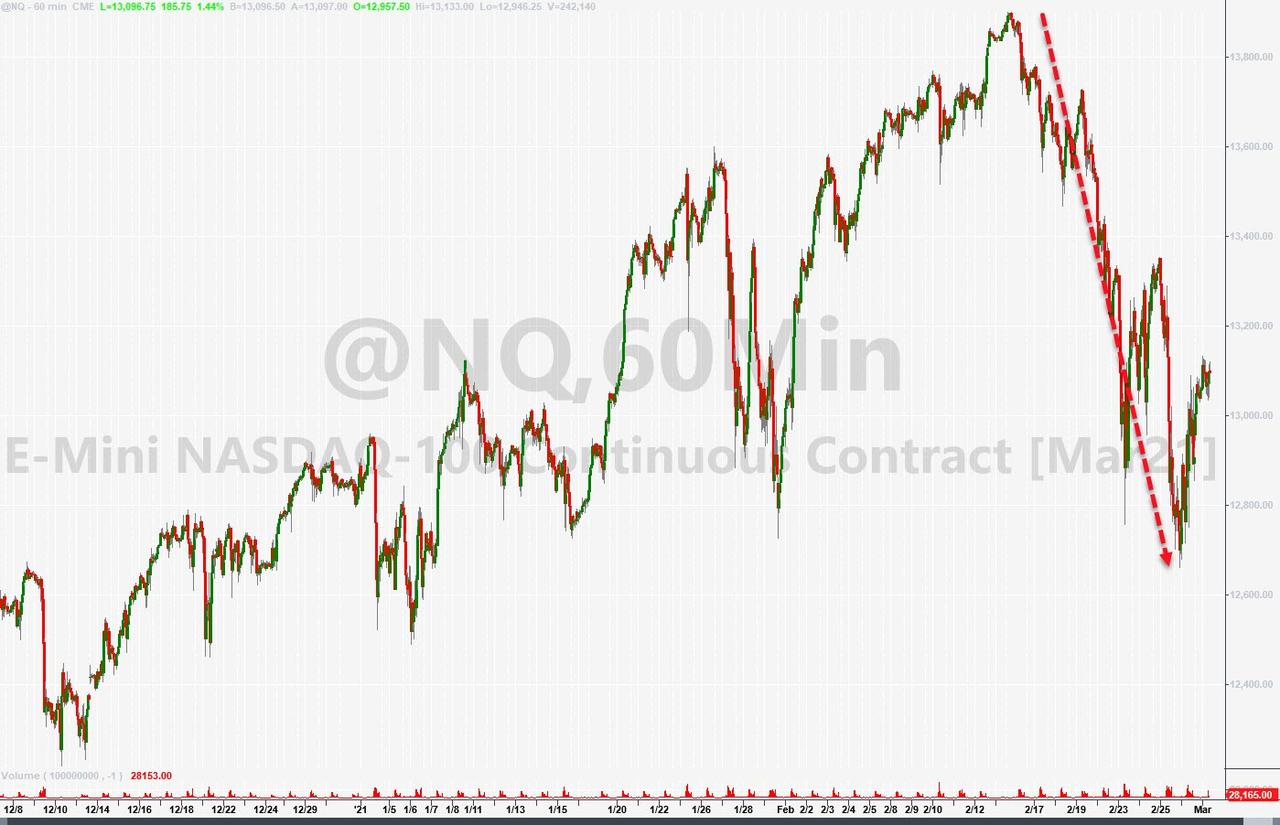
And as bond yields rose so growthy big-tech was monkey-hammered lower…

So, are market participants calling The Fed’s bluff and demanding they step in with even more dovish easing to rescue rates (and thus big tech)? How else will the government afford the $1.9 trillion ‘stimmy’ absent low rates and a will Fed buyer.

As Nomura’s Charlie McElligott notes, a reversal “squeeze” in USTs could come FAST – especially in-light of the magnitude of the aggregate “Short” position in Global Fixed-Income across CTA Trend universe, with the Nomura QIS CTA model showing the largest “Short” position in both TY and Global DM Bonds in our model history, dating-back to 2010…

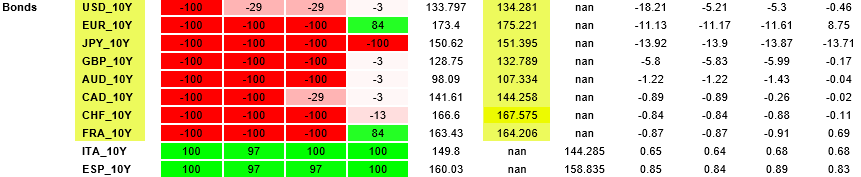
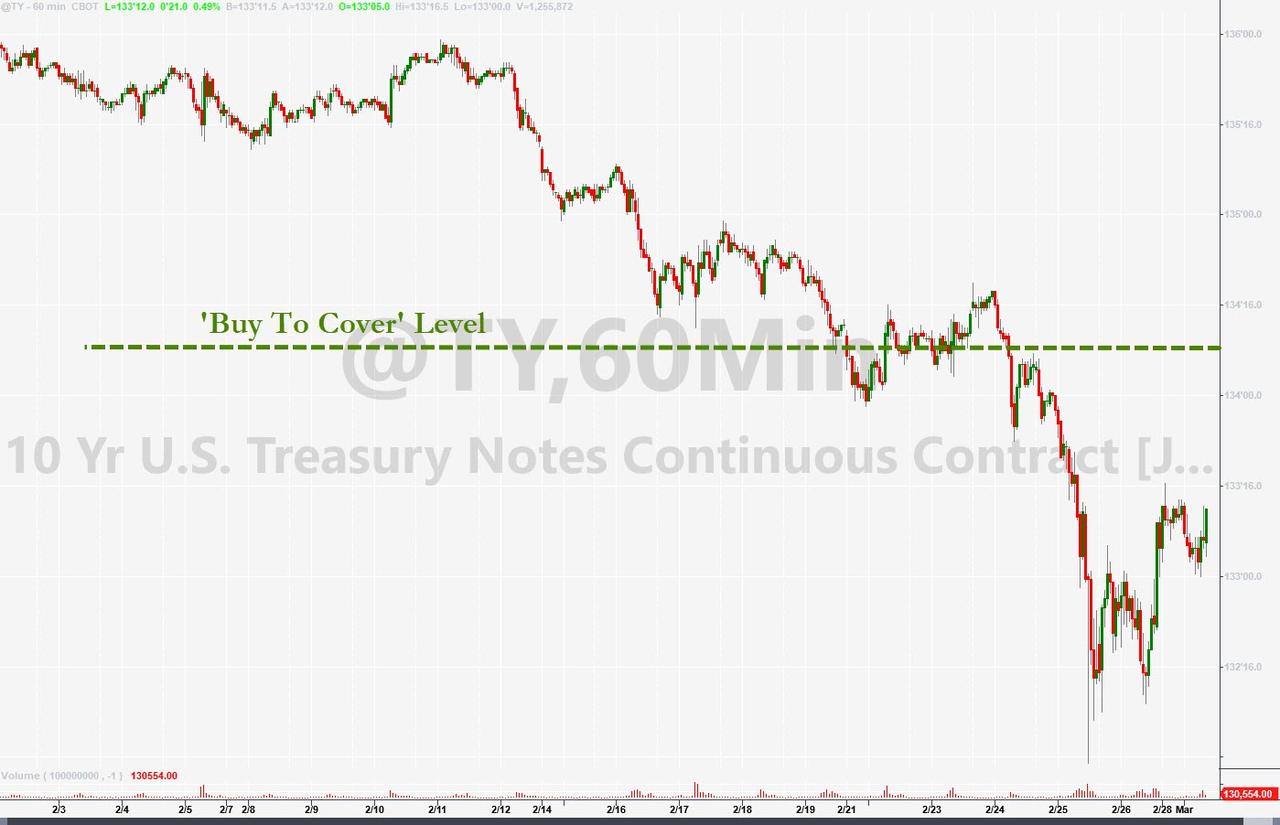
This “big short” from CTAs in Global DM Bonds dynamic then has created the kindling for a blast of “mechanical” buy-to-cover flow into a potential Rates rally on Fed jawboning on Financial Conditions (which have tightened recently)…

…or say, SLR clarity…

The potential for a policy announcement from the Fed regarding Banks supplementary leverage ratio (SLR) rule—the window is shrinking for the Fed to address very seriously market “plumbing” concerns about the complete opacity surrounding the forward-path of the SLR exemption for Banks—meaning the Fed need to clarify to the market whether the SLR relief is going to be extended, while at the same time state whether Treasuries, Reserves or both (!) will be exempted again; this shocking lack of “market feel” from the Fed (as seen last week in Chairman Powell’s complete avoidance of the issue in testimony to Congress)  is contributing to the Treasury selloff, as Banks lack visibility whether they can continue to expand their balance sheets with purchases of USTs…or conversely, need to shed balance-sheet, deposits and USTs

…and if Bonds rip higher and Rate vol collapses, legacy long-term “Momentum” longs in bond-proxy Nasdaq and Mega-Cap Tech would likely see explosive moves higher again too.

For now however, Rates / USTs path of least resistance continues WEAKER until we hear from the Fed as we await this week’s potential Rates “inflection catalysts”; but here are today’s estimated “buy-to-cover” levels for CTAs in said current Global DM Bond “shorts” of note:

What could get bonds up there? Feb jawboning…

Perhaps that is why there is a SIGNIFICANT amount of Fed-speak this week, coming ahead the blackout kicking-off this Saturday (Brainard today, tomorrow), Evans (Wednesday), Powell (Thursday at noon EST) along with Williams, Bostic, Kaskari, Mester, Daly and Harker sprinkled throughout as well. As Nomura’s Rob Dent notes, this obviously comes at a critical time for the Rates space, with timing which would allow them to push-back against the Rates move with enhanced “forward guidance,” under the guise of “tightening in financial conditions” – perhaps even “Operation Twist” trial balloons?

Tyler Durden
Mon, 03/01/2021 – 15:10

via ZeroHedge News https://ift.tt/381lma5 Tyler Durden

Cuomo Hires Criminal Defense Attorney, Avoids Public As Scandals Mount

Cuomo Hires Criminal Defense Attorney, Avoids Public As Scandals Mount

Update (1525ET): The WSJ was incorrect in claiming Abramowitz was representing Cuomo’s office for his sexual harassment scandal, telling Bloomberg that he’s only representing the nursing home scandal.

“My firm and I are representing the Executive Chamber on the Nursing Home matter. We have not been retained on the sexual harassment matter,” he said in an email.

*  *  *

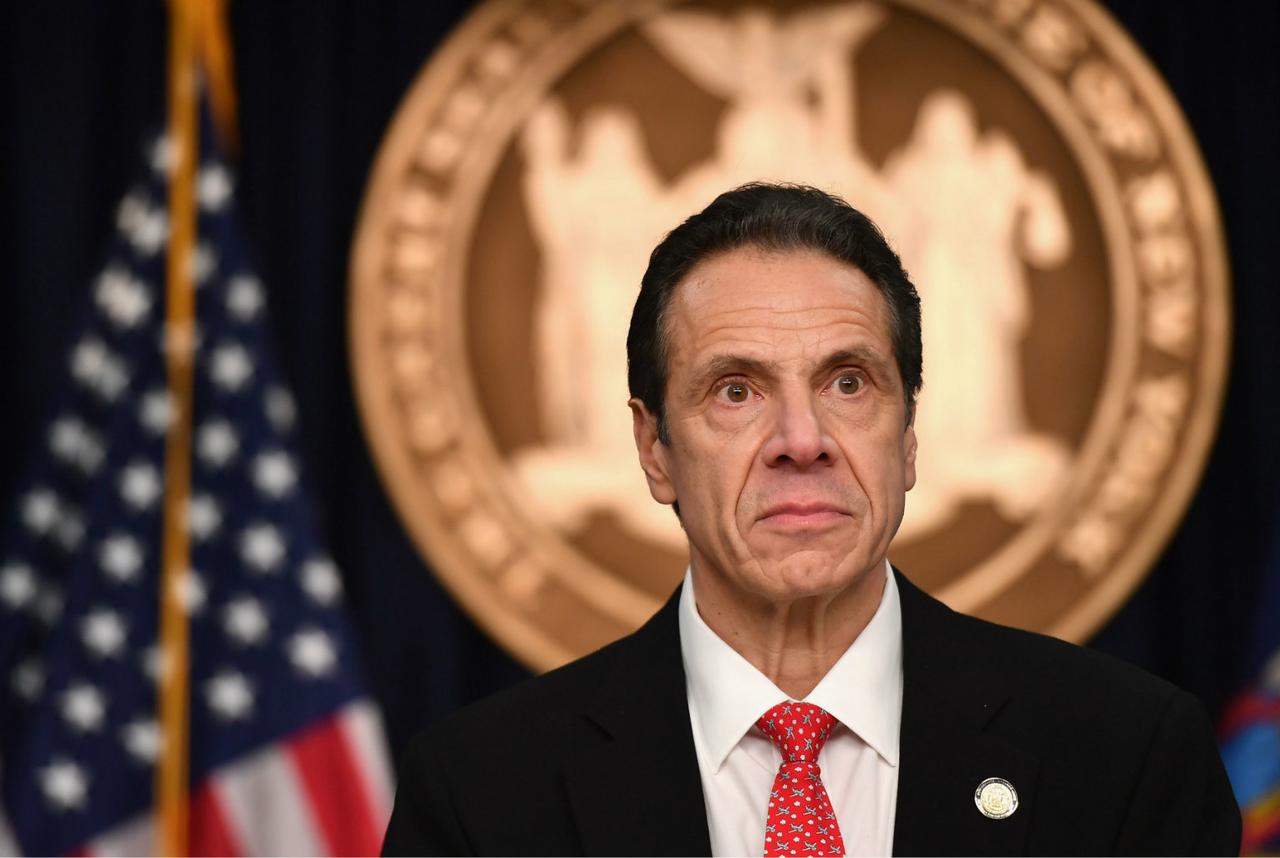
New York Governor Andrew Cuomo’s administration has retained a prominent white-collar defense attorney following allegations of sexual harassment and Justice Department inquiries over COVID-19 nursing home deaths, according to the Wall Street Journal.

Attorney Elkan Abramowitz – a former federal prosecutor – confirmed with the Journal that he is now representing Cuomo’s ‘executive chamber’, which includes the governor and his closes aides. Abramowitz is dealing with both scandals as New York Attorney General Letitia James joins the DOJ in investigating the embattled New York bigwig.

New York Attorney General Letitia James (Photo: Peter Foley, Bloomberg)

The Democratic governor faces an investigation overseen by State Attorney General Letitia James into whether he sexually harassed women who previously worked in his administration. Mr. Cuomo acknowledged he had sometimes been overly personal while interacting with staff and said he was sorry if anyone mistook it for unwanted flirtation.

Two women have accused Cuomo of sexual harassment ranging from inappropriate questions, to touching, to forcibly kissing. One accuser says Cuomo clearly wanted to sleep with her.

Over the weekend, Cuomo denied forcibly kissing former aide Lindsey Boylan, who said the governor would also go out of his way to touch her “on my lower back, arms and legs.” He did, however, seemingly admit to using inappropriate language.

Cuomo also said last week that the state is cooperating with three inquiries from the US Attorney’s Office in the Eastern District of New York located in Brooklyn, as well as the DOJ’s Civil Rights and Civil divisions based in Washington. Brooklyn prosecutors have requested data on the number of people who died in New York nursing homes during the pandemic.

Meanwhile, the governor has stepped out of the public spotlight – last making a televised pandemic briefing on Feb. 19, while his public schedule remains empty according to Bloomberg.

Cuomo’s uncharacteristic silence comes a day after he agreed to an independent probe by a special investigator after a second former aide accused him of sexual harassment. Cuomo stopped short of having New York Attorney General Letitia James lead the probe, a move championed by dozens of other lawmakers.

On Monday, state Senator Todd Kaminsky introduced a bill that would allow the attorney general to conduct a criminal investigation without a referral from the governor, a move he said would strengthen independent oversight of the governor and other state officials.

“Clearly where the governor is involved there is a conflict,” said Kaminsky.

Veteran Democratic consultant Hank Sheinkopf told Bloomberg: “The problem is he’s being squeezed on the left and the right, and if there are more accusations of sexual harassment or governmental incompetence or corruption, he’s going to have a very difficult time surviving,” adding “He has very few friends.

Tyler Durden
Mon, 03/01/2021 – 14:54

via ZeroHedge News https://ift.tt/3uDAwMx Tyler Durden

4 Arrested In Texas On 150 Counts Of Voter Fraud

4 Arrested In Texas On 150 Counts Of Voter Fraud

Authored by Isabel von Brugen via The Epoch Times,

Four people were arrested in Texas last month on 150 counts of voter fraud dating back to the 2018 Medina County Primary Election, according to reports.

The Texas attorney general’s Election Fraud Unit on Feb. 11 arrested Medina County Justice of the Peace Tomas Ramirez, and earlier detained Leonor Rivas Garza, Eva Ann Martinez and Mary Balderrama on election fraud allegations, News4SA reported.

According to a release from Texas Attorney General Ken Paxton’s office, the case involved allegations of vote harvesting at assisted living centers in Medina County in the 2018 Medina County Primary Election.

Ramirez faces one count of organized election fraud, one count of assisting voter voting ballot by mail, and 17 counts of unlawful possession of a ballot or ballot envelope, according to the news outlet.

Balderrama is charged with one count of organized election fraud, nine counts of illegal voting, two counts of unlawful possession of ballot or ballot envelope, one count of mail ballot application, two counts of unlawfully assisting voter voting by mail, two counts of tampering with government record, and eight counts of election fraud.

Garza faces a single count of organized election fraud, two counts of illegal voting, eight counts of unlawful possession of a ballot or ballot envelope, two counts of election fraud and four counts of fraudulent use of an absentee ballot by mail.

Martinez is charged with a single count of organized election fraud, nine counts of illegal voting, 28 counts of unlawful possession of ballot or ballot envelope, three counts of purportedly acting as an agent, five counts of tampering with government record, 14 counts of election fraud, and four counts of fraudulent mail ballot application, according to News4SA.

The Texas attorney general’s office didn’t immediately respond to a request for comment by The Epoch Times.

In a separate incident, Raquel Rodriguez, a Texas woman who bragged about being able to deliver thousands of votes for tens of thousands in cash was arrested in January on charges including election fraud and illegal voting.

Rodriguez was filmed during an undercover project by Project Veritas, an investigative journalism nonprofit. She was recorded in footage released last year that she could deliver “at least 5,000” votes “county-wide” for $55,000 in cash and that it would hire her “entire team.” She acknowledged what she was discussing could land her prison time.

Based on the footage, Paxton, a Republican, opened an investigation. That probe led to the arrest, Paxton announced on Jan. 13.

Rodriguez faces a prison sentence of up to 20 years if convicted.

Tyler Durden
Mon, 03/01/2021 – 14:40

via ZeroHedge News https://ift.tt/3dXNgHZ Tyler Durden