China Rattled After Taiwan Pledges Help For Fleeing Hong Kongers

China Rattled After Taiwan Pledges Help For Fleeing Hong Kongers

Tyler Durden

Thu, 05/28/2020 – 11:35

A furious Beijing denounced Taiwan’s Thursday promise to settle displaced Hong Kong residents who flee the city for political reasons, saying that the ruling Democratic Progressive Party was seeking to “loot a burning house” and sow discord, according to Channel News Asia.

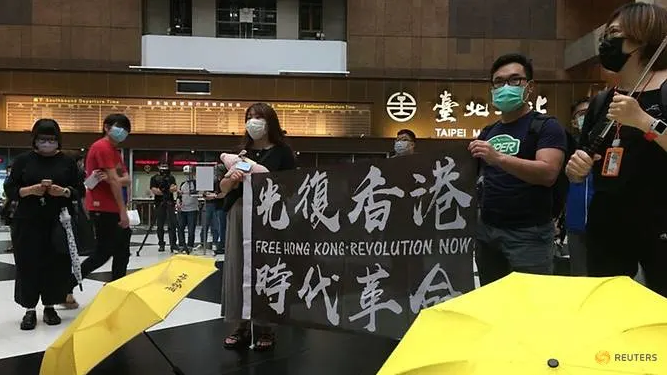
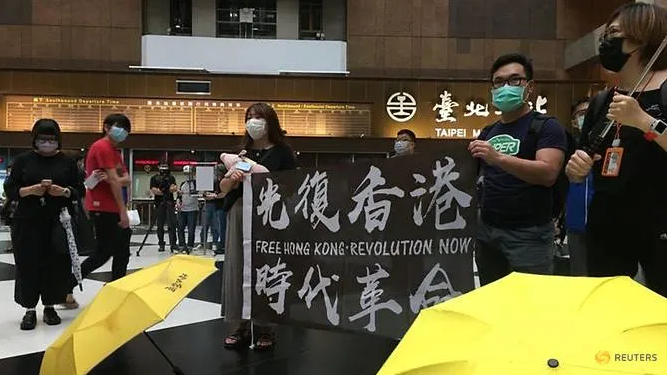
Protesters holding a banner in support of Hong Kong pro-democracy demonstrators at Taipei main train station in Taiwan on May 23, 2020. (Photo: Reuters/Ben Blanchard)

The move comes as Hong Kong protesters have taken to the streets in opposition to new security legislation which would allow Chinese intelligence services to operate on Hong Kong soil, increasing Beijing’s grip on the semi-autonomous city and targeting secession, subversion, terrorism and foreign interference – terms used by China to describe last year’s protests across the city sparked by a now-shelved extradition treaty.

Taiwan President Tsai Ing-wen this week became the first world leader to step up and pledge specific help to Hong Kong residents who wish to leave over the new legislation.

According to Taiwan’s top China-policy maker at the Mainland Affairs Council, Chen Ming-tong, the government will establish a “humanitarian relief” organization that will include employment and settlement assistance in a joint effort with activist groups – adding that counseling services would also be provided for Hong Kongers – some of whom have participated in often-violent pro-democracy protests in Hong Kong.

“Many Hong Kongers want to come to Taiwan. Our goal is to give them settlement and care,” said Chen, urging the public not to call people “refugees” as it could be “emotionally harmful” to people from the city.

Bringing black, violent forces into Taiwan will bring disaster to Taiwan’s people,” warned China’s Taiwan Affairs Office.

Hong Kong’s demonstrators have won widespread sympathy in democratic Taiwan, which China considers as its territory to be taken by force, if necessary. Taiwan has shown no interest in being ruled by autocratic China.

Help for Hong Kong has won rare bipartisan support in politically polarised Taiwan and three opposition parties have introduced bills to make it easier for Hong Kongers to live in Taiwan if they have to leave the city due to political reasons.

Taiwan has no law on refugees that could be applied to protesters seeking asylum, but its laws promise to help Hong Kongers whose safety and liberty are threatened for political reasons. –Channel News Asia

 Some Taiwan lawmakers say Tsai’s government isn’t moving fast enough with relief efforts.

“Please come up with details of the humanitarian relief at the soonest. Don’t wait until people shed blood like water,” said opposition lawmaker from the Kuomintang party.

CNA notes that Taiwan has granted residency to 2,383 Hong Kong citizens in the first four months of 2020, an increase of 150% vs. one year ago. Meanwhile, university applications to Taiwan from Hong Kong have spiked 62% in 2020 vs. last year – while Taiwan’s education ministry announced this week that it would raise the quota for students from Hong Kong.


via ZeroHedge News https://ift.tt/3ddT0tN Tyler Durden

UK uses Feudal System law to seize £150 million from bank accounts

During the summer of 1215 in a riverfront meadow near London, some of England’s top barons gathered to confront King John and force him to sign a contract guaranteeing their rights and freedoms.

The contract became known as the Magna Carta. And one of its key provisions (#43) gave the Barons protection against something called ‘escheat’.

In medieval times, ‘escheat’ referred to the property being forcibly passed to the King if its original owner died without heirs.

So if a Baron passed away without a son, his domain would pass by escheat back to the crown.

Over time, kings vastly expanded the use of escheat; anyone convicted of a crime would have their property seized by escheat. Occasionally someone’s son or daughter could be pressed into servitude by escheat.

It was like a medieval version of Civil Asset Forfeiture: the King took whatever he wanted, for any reason, and people had no rights.

By 1215, England’s noblemen were sick and tired of it, and they successfully forced King John to sign the Magna Carta.

Unfortunately for the other 99.9% of England’s population, most of the Magna Carta’s guarantees only applied to Barons and other noblemen.

Plain ole’ regular serfs still had their meager property plundered by the King, and by the noblemen themselves who had just fought to preserve their own rights at the expense of everyone else’s.

So if a feudal serf in England died without an heir, or was convicted of a crime, all his property was escheated to the local Lord, or to the King.

This became such big business in England that the government appointed special agents called ‘escheators’ in every single English county to oversee property confiscation every time someone passed away.

If there was any doubt at all whether or not the deceased had valid heirs, the escheator would seize the property immediately.

Amazingly enough, this ridiculous feudal custom still exists. And not just in England– in many countries around the world.

In just about every state in the Land of the Free, for example, your possessions, real estate, etc. are forfeited to the government if you die without heir.

Even bank accounts that are left dormant for some period of time– usually a few years– can be confiscated by the government.

But this is totally bizarre, because ‘dormant bank account’ rules can be incredibly loose. In many jurisdictions, for example, simply having some savings stashed away in a bank account that doesn’t have any other activity can put your funds at risk of being seized.

They actually still use the same word– escheat. So money in dormant bank accounts is escheated to the state.

To be fair, this practice has been relatively rare… until Covid. But now governments are starting to look at every source of funding they can get their hands on, including the medieval ones.

The British government recently announced that they had “unlocked” £150 million from dormant bank accounts, with cooperation from some of the biggest banks in the UK, all to help fight World War Covid.

And now the UK is looking to expand the practice beyond bank accounts; they’d like to be able to seize unclaimed financial assets (including stocks and bonds), insurance proceeds, and even dormant pension accounts.

As one UK government official put it, “I look forward to the potentially millions more we can unlock for good causes through expanding the Dormant Assets Scheme.”

This is a practice that literally dates back to the feudal system. And it reinforces a simple truth: you don’t really own anything if the government has the authority to take it.

I have no doubt the bureaucrats who came up with this idea have very good intentions.

After all, what nobler cause is there in this bizarre world of ours but to wage an endless crusade against the Coronavirus, no matter the cost?

They’re willing to do whatever it takes, spend whatever it takes, print as much money as it takes, and yes, even confiscate people’s private property, to rid the world of the virus.

This is our new reality: medieval serfdom.

Source

from Sovereign Man https://ift.tt/2ZKU2K0
via IFTTT

Will the Faithless Electors Cases “Do Grave Damage to Originalism”?

Earlier this month, the Supreme Court heard oral argument in the so-called “faithless electors” cases, Chiafalo v. Washington and Colorado Department of State v. BacaProfessor John McGinnis worries that originalists on the Court may let pragmatic concerns trump original meaning altogether.

John compares these cases to Noel Canning: these cases lack any controlling precedent, and can be decided without regard to stare decisis.

The cases’ significance for originalism stems from the absence of controlling Court precedent on the question of a presidential elector’s discretion. Most Supreme Court cases have prior cases that arguably dispose of the issue, but these do not. The only case about the obligations imposed on electors, Ray v. Blair, concerned moral pledges that parties required of the electors, not the very different question of whether the electors’ choice can be disciplined by law. In their lack of controlling precedents, these new cases resemble NLRB v. Noel Canning, in which the Court had to address, for the first time in its jurisprudence, certain important questions about the scope of the Recess Appointments Clause.

I analogize Noel Canning to originalism in “precedential open fields, as opposed to deep in the thicket.” There are no institutional constraints to follow some wayward precedent from the Warren Court. Here, the faint-hearted originalists can’t hide behind stare decisis.

Instead, McGinnis warns, they’ll hide behind precedent-by-another name: call it the “chaos” theory of constitutional law:

Unfortunately, if the oral argument for the cases about presidential electors is any indication, the Court may do grave damage to originalism by suggesting that the bad consequences of a constitutional provision or practice subsequent to the time of its enactment can override its original meaning….

And in oral argument, some justices who might be thought to harbor originalist sympathies openly appealed to consequentialist arguments. For instance, Justice Kavanaugh suggested that when it is a “close call” on meaning, the Court might consider avoiding the “chaos” that he implied might follow from a decision allowing electoral discretion.

John explains that the Justices’ concerns for “slippery slopes” will always trump original meaning;

Furthermore, who is to decide how “close” the case must be to permit the consideration of consequences? That is a slippery slope that will allow the original meaning to become merely one consideration among many. For instance, assume that the question of whether the Second Amendment protects an individual right to bear arms is close, even if the better view tips in its favor. Kavanaugh’s approach would authorize judges to decide the case based on their assessment of the consequences of various gun control measures.

At bottom, a ruling against the electors could “bury originalism.”

As Mike Rappaport and I have argued, it is constitutional for judges to follow Court precedent rather than original meaning. It is even warranted in certain, limited circumstances. Originalists need to frame better-reticulated rules about what those circumstances are. But inviting judges to consider the consequences of their decisions or the recent practice of other governmental actors as guides to interpretation threatens to bury originalism.

Seth Barrett Tillman and I had similar concerns after oral arguments. We wrote two posts about how to properly characterize electors as a matter of original public meaning: we think they hold “public trusts under the United States.” But we acknowledged that some of the Justices worried about that “chaos” that could result in a judgment for the electors. As a result, we offered a middle-ground approach to help reconcile the original public meaning of the Constitution with pragmatic concerns. If the Court is truly motivated by a desire to avoid “chaos,” and cannot rule that electors have discretion, our approach helps to avoid originalism’s burial.

from Latest – Reason.com https://ift.tt/3er2m5B
via IFTTT

Retail Store Closures Have Huge Impact On Communities

Retail Store Closures Have Huge Impact On Communities

Tyler Durden

Thu, 05/28/2020 – 11:15

Authored by Bruce Wilds via Advancing Time blog,

Abandoned Malls, A Canary In The Coal Mine

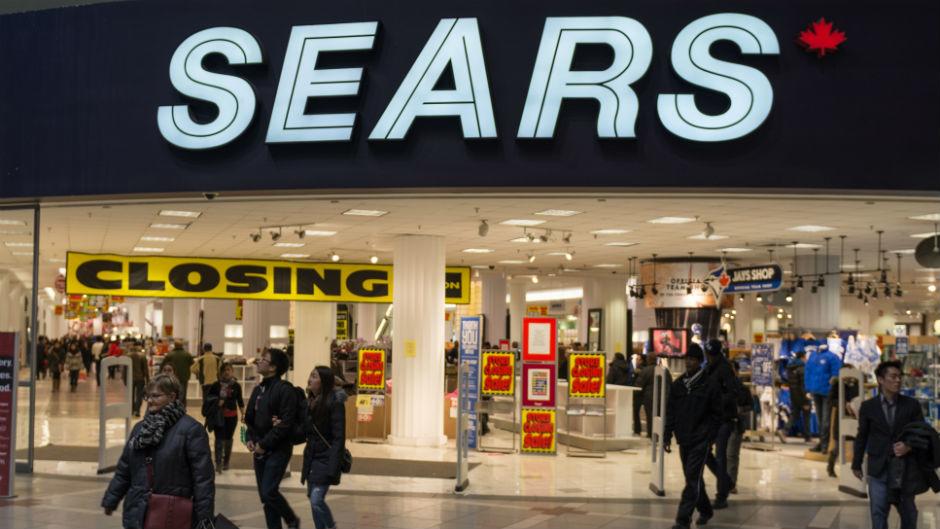
Across America many buildings stand empty or under-leased. They once housed thriving businesses that provided Americans with good-paying jobs. Over the last several years retailers have been closing stores and as the carnage rapidly accelerates this will be back in the news bigger than ever. The impact of these store closings all across America will be huge and take a huge toll on communities with a great number of jobs being lost forever. Much of this is linked to small businesses having its clock cleaned when forced to shutdown because of Covid-19, however, a lot is related to paying higher wages, complying with new government regulations, and being forced to compete with big businesses backed by Wall Street money.

Retail closures come with a hidden cost to society that the average person fails to internalize. Retail closings will result in lots of other small businesses closing their doors. Not only will the retail employees lose their jobs but these stores support many local businesses. People often forget that the brick and mortar stores suffer several expenses not fostered upon online companies. All these constitute a sort of tax on these stores which benefits the community in which they are located.

These costs rapidly add up and include such things as maintaining landscaping, ensuring safe ingress and egress, or providing a parking lot for customers. Staffing for longer hours, for the convenience of customers, often results in being open when foot traffic would indicate a store should be closed. Dealing with security and shoplifters is another expensive burden. Over the last few years, stores such as Target and Macy’s have even had to face a slew of dishonest shoppers trying to sneak defectives products purchased online back as exchanges and trading them for a fresh unbroken product. I have seen this costly abuse recommended by several online shoppers that see this as an “easy fix” on how to handle defective merchandise.

Large retailers as a group are collectively set to lock the doors for the last time at thousands of stores this year. In the past I have written about how we should think about what kind of community and world we wish to live in and how best to preserve the nature and quality of the life we seek. I have even gone as far as to suggest consideration be given to levying an online transaction fee to level the playing field. The revenue from such a fee would be sent to local governments in the area where the sale originated or goods are shipped. The ugly reality that store closures are a cancer will soon be clear to those that have rushed to buy from online retailers. All this flows into what we will soon witness as rents fall, mortgages go unpaid, commercial real estate values fall, and the local tax base shrinks away. Defaults on loans and bonds in conjunction with the reduced property taxes for local communities now appears in the cards.

A Great Example Of  “And Its Gone!’

Even before Covid-19 struck, Credit Suisse predicted 25 percent of shopping malls might have to shutter their doors by 2022 if shoppers continued to move online and mall traffic declined. Now, Bloomberg, reports that landlords have been sending out thousands of default notices to tenants. These businesses have experienced a collapse in foot traffic, sales and cash flow due to the COVID-19 pandemic are simply unable to pay their debt obligations.

Restaurants, department stores, apparel merchants and specialty chains have in some cases gone as long as three months without paying rent. With many traditional brick-and-mortar retailers having very heavy debt loads and looking at nearly $1 trillion of debt coming due over the next 3 to 5 years if the economy turns south these closings might only be the tip of the iceberg. We are about to see a slew of empty buildings blighting our landscape and driving down the value of properties across the nation. This is occurring while online retailing giant Amazon continues to acquire a more significant share of the consumption pie.

Sadly, most politicians have a poor grasp of business and are more interested in pandering for votes than trying to create more sustainable communities. Washington lawmakers have shown little interest in addressing the issue of how online shopping plays into the overall economy other than initially granting it some rather large advantages. This has been followed by state and local officials going over the top in competing for what they call new industries and jobs. This often results in special tax breaks, deals, or incentives for companies such as Amazon in exchange for investing or locating a facility in their area. In the long run, this hurts and weakens companies already located and competing in their market but that often gets brushed aside.

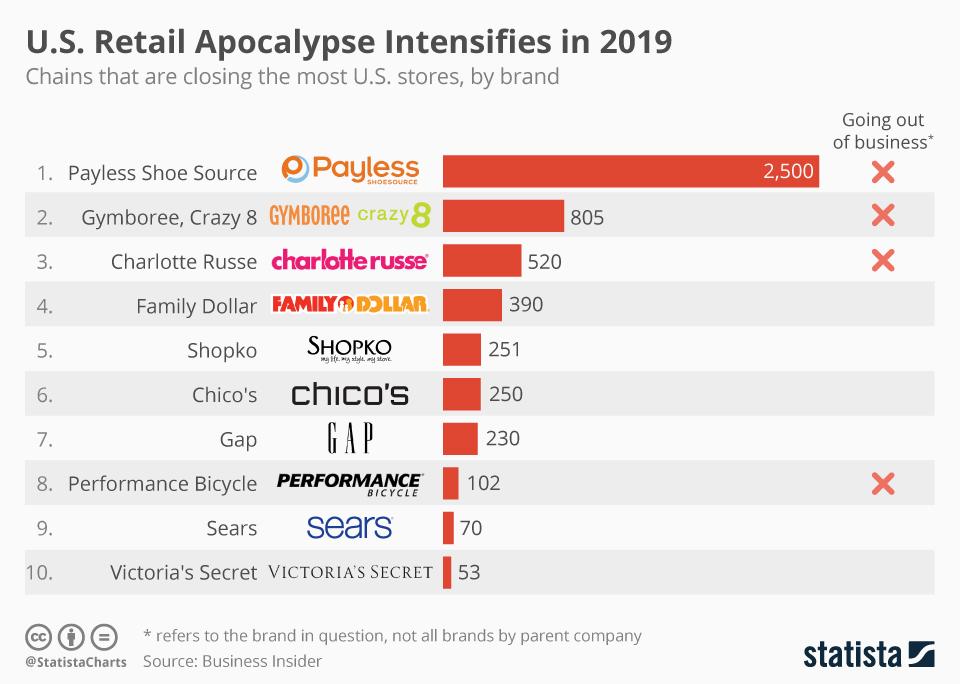
In the last few years, department stores like Kmart, Macy’s, Sears, and JCPenney, and retailers including Best Buy, Payless, BCBG, Abercrombie & Fitch, and Bebe have decided to close dozens of locations. Some have even slid into bankruptcy or vanished completely. The fall of the once massive Toys ‘R’ Us name in 2018, should have drawn more attention. With more than 700 U.S. stores the Toys “R” Us chain was a prime example of just how much retail has changed in just the last decade. When KKR & Co., Bain Capital, and Vornado Realty Trust took over the company in 2005, the buyers justified the $7.5 billion price, in large part based on the supposedly valuable properties that came with the deal. If current trends continue, the drop in the value of these properties has only started and in the future will have a gigantic effect on the economy.

Much of this space is located in the large shopping malls that once flourished in commercial zones of suburbia and many now sit empty and abandoned. While some of the empty storefronts will be re-purposed many will not. Sadly, America has created a bureaucratic obstacle course to rehabbing buildings by adding a great deal to the cost. This makes demolition more appealing. Between meeting new regulations and codes dealing with the Americans with Disabilities Act (ADA) and other issues building owners often choose to simply tear down the structure and rip up the parking lot which is also required as part of the demolition. This reduces the often huge tax burden while they try to recoup part of their investment by selling off the land.

US retail vacancy rates were at 10.2% in the fourth quarter of 2018, but are expected to go through the roof. America has far more retail space than it needs. The country now has roughly 24 square feet of retail space per capita, more than twice that of Australia and 5 times that of the UK. Much of it has been built in recent years using low-interest money as investors rushed to build malls and shopping centers under the premise that if they built it “they would come.” The shift to buying from online retailers such as Amazon and overbuilding has broken retail’s decade-old profit formula. The culling of unprofitable stores and bankruptcies has added to the number of empty storefronts and malls. Do not expect retail construction to recover anytime soon.

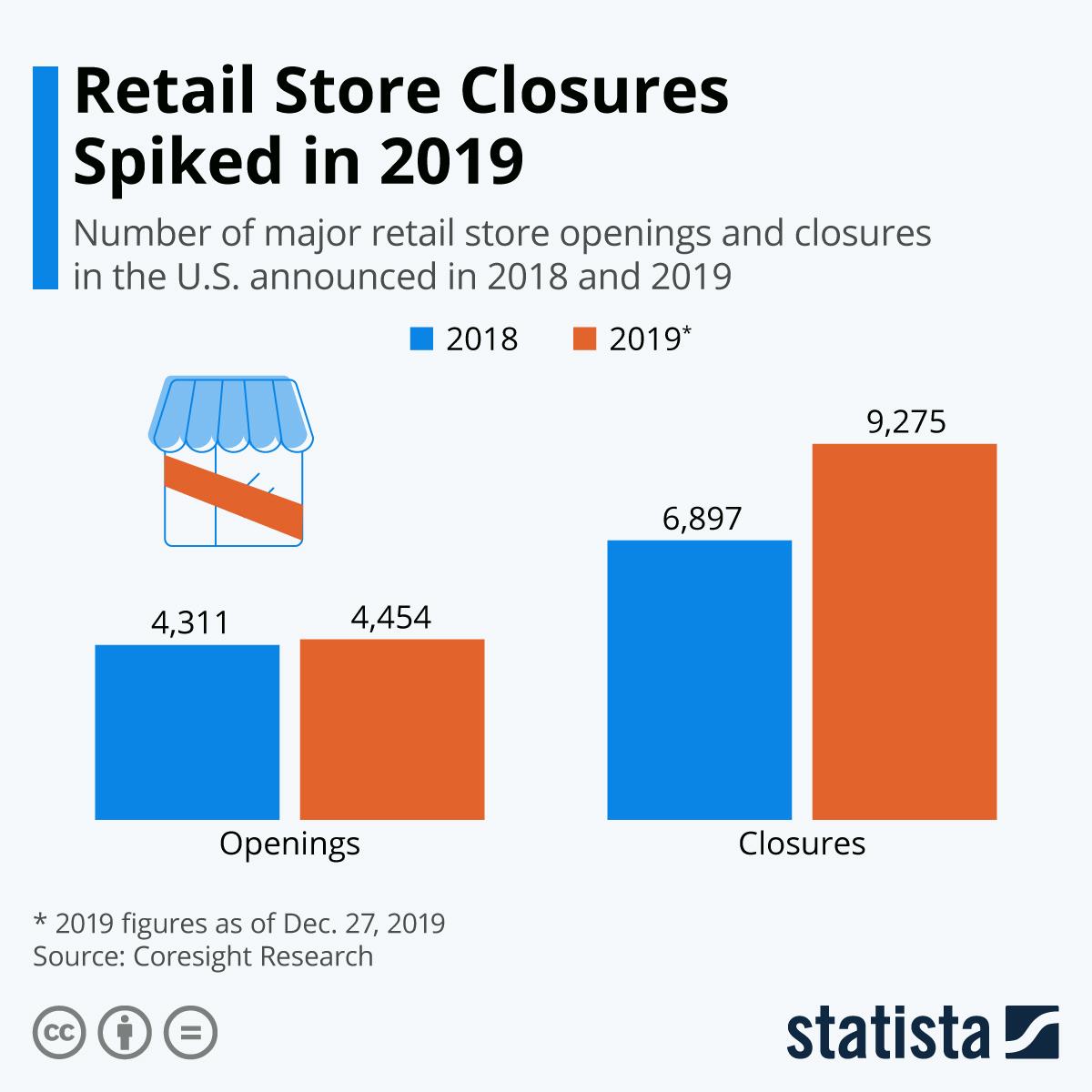
Last year more than 9,275 stores closed their doors while only 4,454 stores that opened in the same time period. While some people make the argument this is all part of “creative destruction”  where new technologies and better ways of doing things simply crowd out the old, something more sinister is going on here. Retail is in full-fledged liquidation mode as a result of being monkey hammered into submission by a wave of new reality sweeping across America. Not only have they been battered by online retailers such as Amazon but paying employees more so they can spend the money “elsewhere” simply does not work.

There are a number of trends at work behind America’s retail apocalypse such as retailers taking on too much debt and our government giving online retailers special tax treatment. in the past, state and local governments have put packages together with special incentives to lure Amazon to build in their areas oblivious to the future damage this will cause. This is a company that often pays no taxes but sells billions of dollars worth of foreign-made goods and services to our government. Even the United States Postal Service has joined in this effort which destroys small local businesses by making deals to deliver goods at below their cost even on weekends. Add to this state and local governments that burden brick and mortar businesses with taxes and fees it is no wonder things are in such a sorry state. 

Consumers might someday regret throwing their communities under the bus for the promise of free overnight shipping. The closing businesses, both large and small are often viewed as the bedrock of our communities and with the closing of each one, a little bit of us goes with them. Consider this post a reminder of the massive amount of real estate taxes these stores pay. This money flows directly into the support of local police and fire departments as well as maintaining roads and such is a big disservice to the companies that also employ our friends and neighbors. These stores are where we go when we need something fast or that has to fit just right. As a final argument as to why we should support local stores, remember, that we the people will be forced to pony up more dollars in local real estate taxes as their contributions drop and local services are cut.

via ZeroHedge News https://ift.tt/3c7nyfz Tyler Durden

WTI Slides After Official Data Confirms Big Crude Build

WTI Slides After Official Data Confirms Big Crude Build

Tyler Durden

Thu, 05/28/2020 – 11:05

Oil prices rebounded (after a phone call between Saudi Arabia’s Crown Prince and Russia on Wednesday was described by The Kremline as positive) from their ugly reaction to a surprising (and large) crude inventory build reported by API but remained lower ahead of the DOE data on the heels of investor anxiety over Russia’s willingness to extend production cuts.

“Crude oil looks like it has reached a consolidation stage,” said Ole Hansen, head of commodities strategy at Saxo Bank.

“The global economic outlook and risk of new pockets of Covid-19 outbreaks will dictate the speed of demand recovery.”

Things could escalate quickly if API’s surge in stocks is echoed by the EIA. Crude inventories have recently posted declines, something that was considered a sign of demand recovery in the oil market and extrapolated to match a rebound in the economy. Today’s EIA data is crucial in determining whether that rising crude demand continues or if it was just a fluke.

API

  • Crude +8.731mm (-2.32mm exp)

  • Cushing -3.37mm

  • Gasoline +1.12mm (-675k exp)

  • Distillates +6.907mm (+2.55mm exp)

DOE

  • Crude +7.928mm (-2.32mm exp)

  • Cushing -3.395mm

  • Gasoline -724k (-675k exp)

  • Distillates +5.495mm (+2.55mm exp)

Official DOE data confirmed API’s surprise surge in crude stocks with a 7.93mm build (and distillates saw their 8th weekly build in a row)…

Source: Bloomberg

As rig counts collapse near series lows, US crude production continues to plunge…

Source: Bloomberg

As Bloomberg’s Vincent Piazza notes, fears about oil storage filling up are abating with wells shut in 2Q, while optimism for a recovery in demand increases as the U.S. begins to reopen regions affected by Covid-19. Still, we anticipate uncertainty as wells coming back on-line would boost imbalances with WTI rising above $30 a barrel

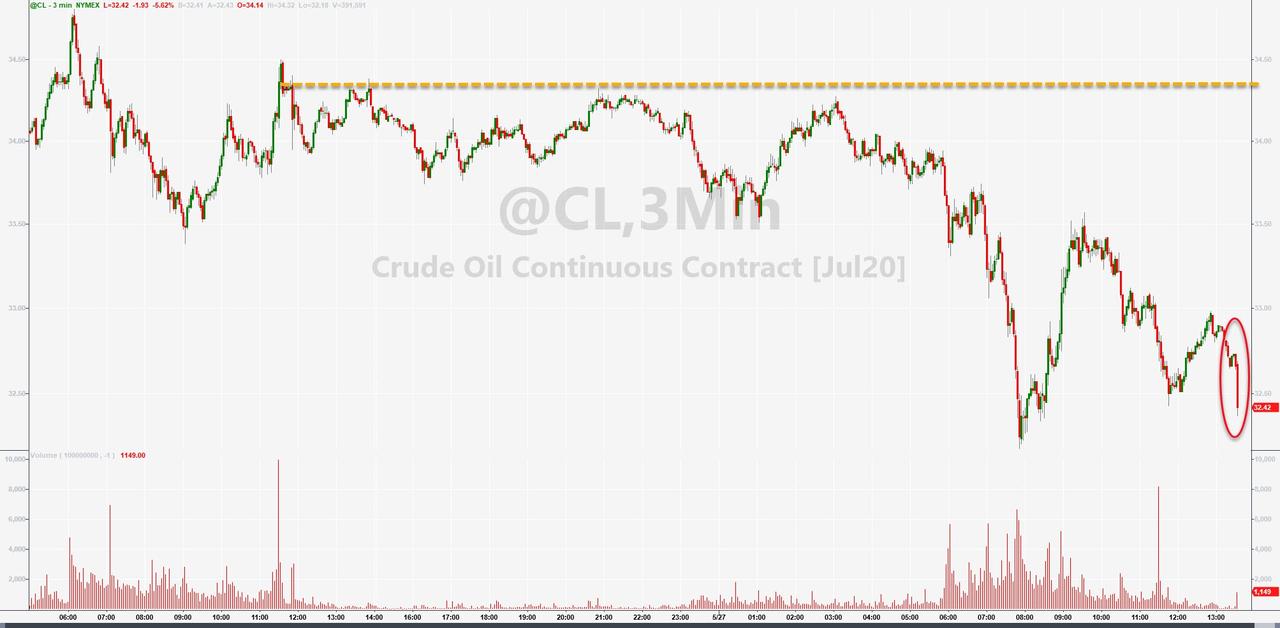
Oil is up about 70% this month, the most since at least the early 1980s, and July WTI is hovering around $32.75 ahead of the official inventory data…

Notably, warning signals remain. Demand for gasoline fell 25% to 35% from a year earlier over the U.S. Memorial Day weekend, which usually heralds the start of the summer driving season and the peak of fuel consumption.

WTI (July 2020) was hovering between $32.50 and $33 ahead of the print and extended losses down to a $31 handle…

Separately, as Bloomberg reports, the U.S. is considering a range of sanctions to punish China for its crackdown on Hong Kong, including controls on transactions and freezing assets of Chinese officials and businesses. Additionally, the U.S. certified Wednesday that Hong Kong is no longer politically autonomous from China. The deteriorating relationship between the world’s two largest economies could complicate the market’s comeback from a historic demand crash.

via ZeroHedge News https://ift.tt/2M9dIiF Tyler Durden

US Lawmakers Propose Total Ban On STEM Visas For Chinese Students

US Lawmakers Propose Total Ban On STEM Visas For Chinese Students

Tyler Durden

Thu, 05/28/2020 – 10:45

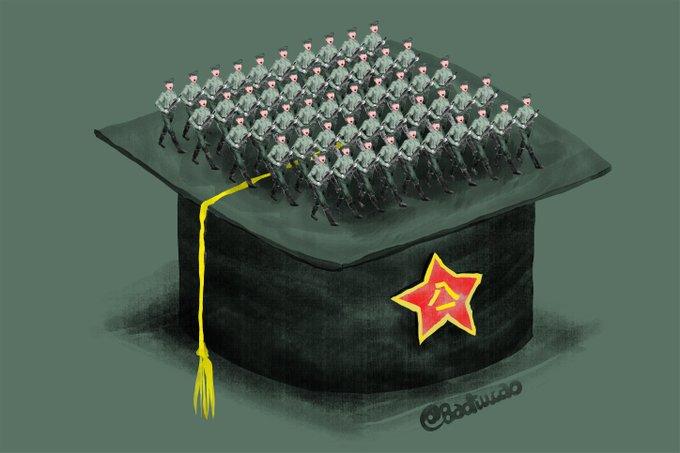
As the White House prepares to eject Chinese graduate students with ties to the PLA, three US lawmakers are taking things a step further – proposing a bill which would ban mainland Chinese students from studying STEM subjects in the United States.

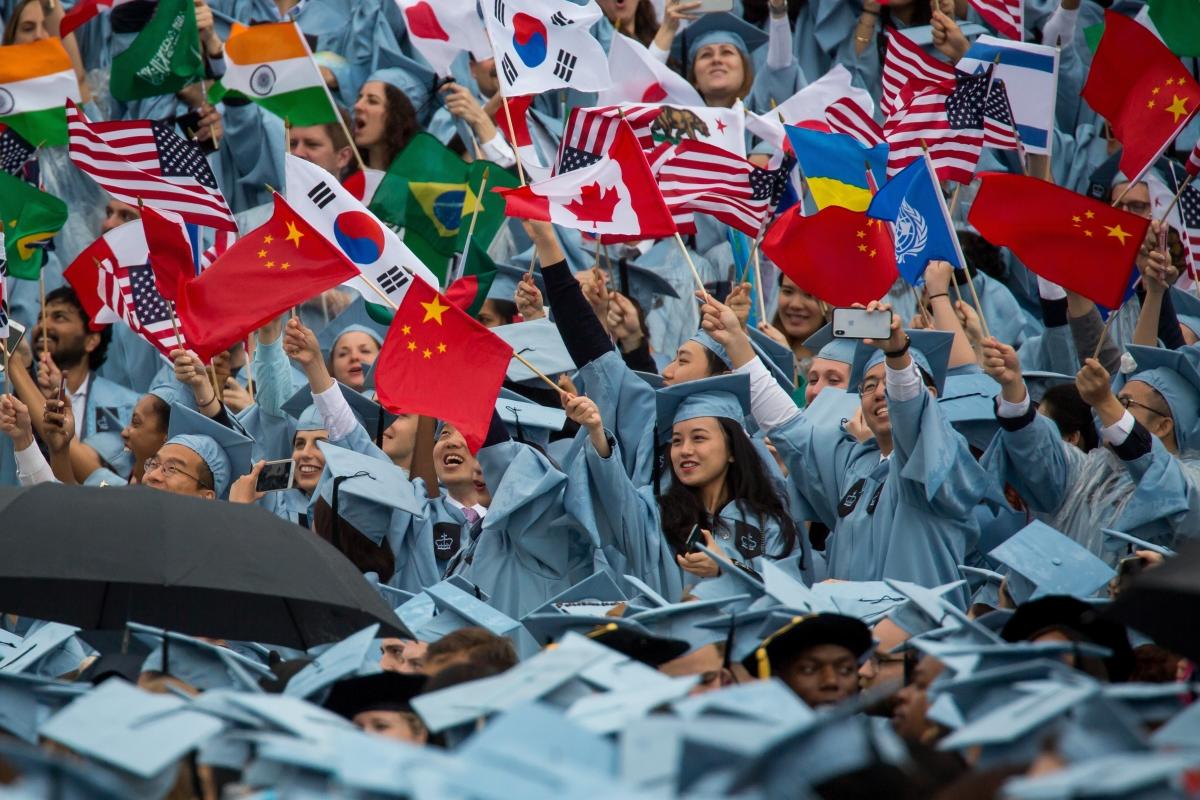
Chinese and other international students wave flags at 2018 Columbia University commencement ceremony.

Two senators and one House member said on Wednesday that the Secure Campus Act would bar Chinese nationals from obtaining visas for graduate or postgraduate studies in science, technology, engineering and mathematics. Students from Taiwan and Hong Kong would be exempt, according to SCMP.

“The Chinese Communist Party has long used American universities to conduct espionage on the United States,” said Sen. Tom Cotton (R-AK), one of the bill’s sponsors, adding “What’s worse is that their efforts exploit gaps in current law. It’s time for that to end.”

“The Secure Campus Act will protect our national security and maintain the integrity of the American research enterprise.”

The proposed legislation comes as diplomatic relations have fractured between the world’s two largest economies. The fissures started to show during a trade war that has been rumbling on for almost two years and have only widened amid accusations about the handling of the Covid-19 disease outbreak , and the treatment of ethnic minority groups in China.

Hong Kong is the latest flashpoint after Beijing drew up a national security law that Washington says tramples on the city’s mini-constitution. The US threatened retaliation over the move. -SCMP

The bill will also tackle China’s efforts to recruit talent overseas through their Thousand Talents Program, an operation launched in 2008 by the CCP which seeks out international experts in scientific research, innovation and entrepreneurship. It proposes that participants in China’s recruitment of foreigners be made to register under the Foreign Agents Registration Act (FARA), and would prohibit Chinese nationals and those participating in China-sponsored programs from receiving federal grants or working on federally funded R&D in STEM fields.

Any university, research institute or laboratory receiving federal funding would be required to attest that they are not knowingly employing participants in China’s recruitment programs – a list of which the US Secretary of State would publish.

US law enforcement and educational agencies have raised red flags about undisclosed ties between federally funded researchers and foreign governments. A crackdown has included indictments and dismissals.

In January, Charles Lieber, 60, chairman of the chemistry and chemical biology department at Harvard University, was arrested and charged for lying about his involvement in the Thousand Talents Programme. -SCMP

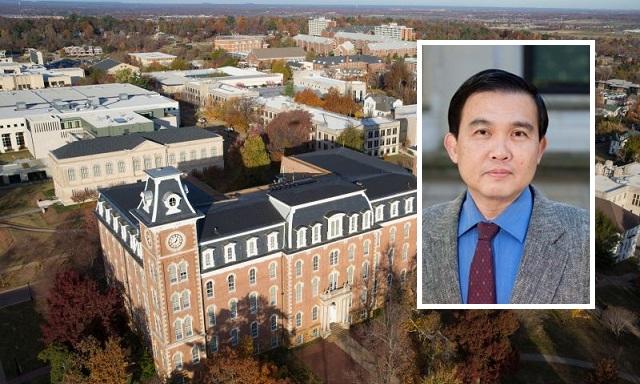
Meanwhile, earlier this month a professor at the University of Arkansas who received millions of dollars in research grants, including $500,000 from NASA, was arrested and charged with one count of wire fraud.

According to the FBI, Ang failed to disclose that he was getting paid by a Chinese university and Chinese companies in violation of university policy. He is accused of making false statements while failing to disclose his extensive ties to China as a member of the “Thousand Talents Scholars” program.

63-year-old Simon Saw-Teong Ang is the director of the school’s High Density Electronics Center, which received funding from the National Science Foundation (NSF), Department of Energy (DOE), Department of Defense (DOD) and NASA. Since 2013, Ang has been the primary investigator or co-investigator on US government-funded grants totaling over $5 million, according to the Washington Examiner.

In November, the Senate Permanent Subcommittee on Investigations chaired by Sen. Rob Portman (R-OH) released a 109-page bipartisan report which concluded that foreign nations “seek to exploit America’s openness to advance their own national interests,” the most ambitious of which “has been China,” according to the Examiner. According to the report, Chinese academics involved in their so-called ‘Thousand Talents’ program have been exploiting access to US research labs.

Backlash

According to SCMP, members of the US scientific community see the US as unfairly targeting Chinese colleagues, and that the campaigns will discourage talented individuals from pursuing studies at US universities.

“While we must be vigilant to safeguard research, we must also ensure that the US remains a desirable and welcoming destination for researchers from around the world,” wrote members of 60 groups – including the American Association for the Advancement of Science and the Federation of American Scientists, in a 2019 letter to science policy officials.

The US lawmakers’ proposal follows China’s March decision to revoke the press credentials for US journalists from three major US newspapers – declaring five US media outlets to be foreign government proxies. In February, the Trump administration labeled five Chinese state media groups as “foreign missions” (via SCMP).

via ZeroHedge News https://ift.tt/36F3P5S Tyler Durden

Will the Faithless Electors Cases “Do Grave Damage to Originalism”?

Earlier this month, the Supreme Court heard oral argument in the so-called “faithless electors” cases, Chiafalo v. Washington and Colorado Department of State v. BacaProfessor John McGinnis worries that originalists on the Court may let pragmatic concerns trump original meaning altogether.

John compares these cases to Noel Canning: these cases lack any controlling precedent, and can be decided without regard to stare decisis.

The cases’ significance for originalism stems from the absence of controlling Court precedent on the question of a presidential elector’s discretion. Most Supreme Court cases have prior cases that arguably dispose of the issue, but these do not. The only case about the obligations imposed on electors, Ray v. Blair, concerned moral pledges that parties required of the electors, not the very different question of whether the electors’ choice can be disciplined by law. In their lack of controlling precedents, these new cases resemble NLRB v. Noel Canning, in which the Court had to address, for the first time in its jurisprudence, certain important questions about the scope of the Recess Appointments Clause.

I analogize Noel Canning to originalism in “precedential open fields, as opposed to deep in the thicket.” There are no institutional constraints to follow some wayward precedent from the Warren Court. Here, the faint-hearted originalists can’t hide behind stare decisis.

Instead, McGinnis warns, they’ll hide behind precedent-by-another name: call it the “chaos” theory of constitutional law:

Unfortunately, if the oral argument for the cases about presidential electors is any indication, the Court may do grave damage to originalism by suggesting that the bad consequences of a constitutional provision or practice subsequent to the time of its enactment can override its original meaning….

And in oral argument, some justices who might be thought to harbor originalist sympathies openly appealed to consequentialist arguments. For instance, Justice Kavanaugh suggested that when it is a “close call” on meaning, the Court might consider avoiding the “chaos” that he implied might follow from a decision allowing electoral discretion.

John explains that the Justices’ concerns for “slipper slopes” will always trump original meaning;

Furthermore, who is to decide how “close” the case must be to permit the consideration of consequences? That is a slippery slope that will allow the original meaning to become merely one consideration among many. For instance, assume that the question of whether the Second Amendment protects an individual right to bear arms is close, even if the better view tips in its favor. Kavanaugh’s approach would authorize judges to decide the case based on their assessment of the consequences of various gun control measures.

At bottom, a ruling against the electors could “bury originalism.”

As Mike Rappaport and I have argued, it is constitutional for judges to follow Court precedent rather than original meaning. It is even warranted in certain, limited circumstances. Originalists need to frame better-reticulated rules about what those circumstances are. But inviting judges to consider the consequences of their decisions or the recent practice of other governmental actors as guides to interpretation threatens to bury originalism.

Seth Barrett Tillman and I had similar concerns after oral arguments. We wrote two posts about how to properly characterize electors as a matter of original public meaning: we think they hold “public trusts under the United States.” But we acknowledged that some of the Justices worried about that “chaos” that could result in a judgment for the electors. As a result, we offered a middle-ground approach to help reconcile the original public meaning of the Constitution with pragmatic concerns. If the Court is truly motivated by a desire to avoid “chaos,” and cannot rule that electors have discretion, our approach helps to avoid originalism’s burial.

from Latest – Reason.com https://ift.tt/3er2m5B
via IFTTT

Trump’s Executive Order on Twitter Is a Total Mess

Disrespected by Twitter, President Donald Trump is throwing a tantrum in the form of an executive order that declares Twitter and Facebook are the “functional equivalent of a traditional public forum” and should “not infringe on protected speech.” The president seems to have bypassed the typical interagency review process in issuing his new rule. This means the insanely overreaching order (read the leaked draft here) wasn’t written with an eye toward conforming to federal law or constitutional protections of speech and commerce. And make no mistake: the draft order, when it manages to be coherent, is insanely unconstitutional.

But maybe the order having teeth isn’t the point here. Trump’s mandate might not hold up in court, but just by issuing it, Trump sends a not-so-subtle threat to Twitter, Facebook, and other internet companies. Remember, the apparent impetus for this order was Twitter posting a fact check after one of Trump’s tweets.

Should social media companies be getting into the fact-checking game? It’s a bad idea, if you ask me. But it’s a perfectly legal thing for them to do.

The standard Republican talking point on this right now is that affixing fact-checking links to some tweets makes Twitter a “publisher” instead of a “platform” or “forum.” It might make for an interesting semantic distinction, but the legally significant issue is whether Twitter is the speaker or creator of Donald Trump’s tweets. If not, it is not legally liable for them. (The same goes for every other user of Twitter, too.)

If you’re thinking, “But, but, what about when Twitter creates a fact-check link and presents it after a user’s posts?” Courts have routinely ruled that a digital company’s decisions about how to present content (or what content to present at all) do not transform it into the speaker of user content.

But back to Trump’s new order: It’s an Orwellian document, defining federal government regulation of Americans’ speech as “free speech” and private questioning of government authority as “censorship.” In Trump’s formulation, private companies can censor the most powerful person in the country but not the other way around.

Interestingly, after years of downplaying the idea that foreign actors used social media in an attempt to influence the 2016 election, Trump now opportunistically claims that the U.S. government must have power over these platforms to stop the scourge of “disinformation from foreign governments.”

But his biggest complaint is about alleged ideological bias by private companies. Despite previously rallying around the rights of conservative businesses to choose who they do business with and decline to display liberal messages (think florists and bakers), Trump now says that private businesses should have to be totally content-neutral conduits of whatever messages that customers want to broadcast.

To justify his position that the feds can compel companies to display messages from private citizens and government officials alike, Trump turns to a mangled conception of the federal law known as Section 230. This is the 1990s statute stipulating that online platforms and publishers are not to be treated as the speaker of user-generated content (i.e., if I defame someone on Facebook, Facebook isn’t on the hook for defamation).

The order erroneously suggests that Section 230 only applies if online companies moderate content in ways that are explicitly laid out in their terms of service, though nothing in Section 230 comes close to saying this.

It complains that Twitter has been “restricting online content” for reasons other than those laid out as permissible reasons in Section 230(c)(2). This is the part of the statute saying companies don’t become liable for all user content by virtue of moderating content that is “obscene, lewd, lascivious, filthy, excessively violent, harassing or otherwise objectionable.”

But “otherwise objectionable” is a completely discretionary standard and can encompass just about anything.

The order relies heavily on conservatives’ victimhood conspiracy du jour: that social media companies are colluding to suppress conservative voices. It’s an objectively untrue viewpoint, as countless booted and suspended liberal, libertarian, and apolitical accounts can tell you. But even if it were true that Twitter or Facebook only takes action against conservatives—or if we take the more believable assertion that current content moderation policies tend to hit some political viewpoints harder than others—it would still not fall outside the bounds of Section 230(c)(2) moderation, which requires only that the moderator find some speech to be “objectionable.”

Somehow, out of Trump’s several paragraphs of paraphrasing Section 230 with random erroneous asides, federal officials are supposed to intuit a new paradigm and “apply section 230(c) according to the interpretation set out in this section.”

The document also instructs the Federal Communications Commission (FCC) to define concepts that Trump just made up for this order and then propose ways to tell if companies are running afoul of them. Trump wants the FCC to determine the conditions under which content moderation will be considered “deceptive, pretextual, or inconsistent with a provider’s terms of service”—but then what? Nothing in Section 230 says a company can’t moderate in ways “inconsistent with” their terms of service. And it’s laughable to think that bureaucrats will be able to tell whether thousands of individual content moderators are making decisions based on the right reasons or on secretly “deceptive” grounds.

The FCC is also tasked with defining this bit of Trumpian gobbledygook: the conditions under which content moderation will be considered “the result of inadequate notice, the product of unreasoned explanation, or having been undertaking without a meaningful opportunity to be heard.”

One of the most concrete parts of the executive order, and perhaps the only feasible part, is a bit saying that all federal agencies must review and submit (within 30 days) a report on the amount of money they spend on social media advertising. It comes in a section titled “Prohibition on Spending Federal Taxpayer Dollars on Advertising with Online Platforms That Violate Free Speech Principles.”

Insofar as this order helps keep stupid government propaganda campaigns off social media and reduces what the public pays for those campaigns, great! Alas, Trump doesn’t really have any clue what the criteria for preventing these ads might be and didn’t bother finding out whether he has the statutory authority to require this before writing the order. It actually asks the heads of each executive department and agency to independently review “the viewpoint-based speech restrictions imposed by each online platform” and then tell Trump “the statutory authorities available to restrict advertising dollars to online platforms.”

The second-to-last part of the order is another bit that sounds vaguely weighty but is actually just a bunch of big words sort of strung together in the way that might fool random Trump fans into thinking he’s taking action. He declares that Facebook and Twitter are “the functional equivalent of a traditional public forum”—which would essentially mean that they are the “functional equivalent” of government property.

But of course, Trump has no authority to simply seize these private companies via executive order. And even if he could just declare that Twitter and Facebook were the digital equivalent of the National Mall, this would mean that government actors would face serious hurdles to restricting speech on them. Bottom line: Unless government officials are going to completely take over Twitter and Facebook content moderation, invoking public forums here is just bluster.

Ultimately, the order’s lack of standard review very much shows.

It seems the White House apparently didn’t consult with the Federal Communications Commission about the order, which would mean it did not go through the standard interagency review process.

“Worth remembering that with prior WH attempts to draft an executive order targeting social media companies, the FCC and FTC (which are led by Republican chairmen) privately pushed back on being deputized to police political speech on social platforms,” noted CNN tech reporter Brian Fung on Twitter.

“Much of the order could quickly get bogged down in a thicket of legal and constitutional questions,” Fung added. “Just for example, the FTC reports to Congress, not the WH.”


FREE MINDS

Some positive signs on secret surveillance:


FREE MARKETS

Americans still wary of many outside-the-home activities: 


QUICK HITS

  • Less than half of tests that show positives for COVID-19 antibodies are correct in some areas, the Centers for Disease Control and Prevention says.
  • One person was killed and several buildings were set on fire in Minneapolis last night following protests over the police killing of George Floyd.

  • This doesn’t seem like it will end well for the state:

  • “The average millennial has experienced slower economic growth since entering the workforce than any other generation in U.S. history,” writes Andrew Van Dam at The Washington Post.
  • On the rise of One America News.

from Latest – Reason.com https://ift.tt/3ewyDIn
via IFTTT
Trump’s Executive Order on Twitter Is a Total Mess

Disrespected by Twitter, President Donald Trump is throwing a tantrum in the form of an executive order that declares Twitter and Facebook are the “functional equivalent of a traditional public forum” and should “not infringe on protected speech.” The president seems to have bypassed the typical interagency review process in issuing his new rule. This means the insanely overreaching order (read the leaked draft here) wasn’t written with an eye toward conforming to federal law or constitutional protections of speech and commerce. And make no mistake: the draft order, when it manages to be coherent, is insanely unconstitutional.

But maybe the order having teeth isn’t the point here. Trump’s mandate might not hold up in court, but just by issuing it, Trump sends a not-so-subtle threat to Twitter, Facebook, and other internet companies. Remember, the apparent impetus for this order was Twitter posting a fact check after one of Trump’s tweets.

Should social media companies be getting into the fact-checking game? It’s a bad idea, if you ask me. But it’s a perfectly legal thing for them to do.

The standard Republican talking point on this right now is that affixing fact-checking links to some tweets makes Twitter a “publisher” instead of a “platform” or “forum.” It might make for an interesting semantic distinction, but the legally significant issue is whether Twitter is the speaker or creator of Donald Trump’s tweets. If not, it is not legally liable for them. (The same goes for every other user of Twitter, too.)

If you’re thinking, “But, but, what about when Twitter creates a fact-check link and presents it after a user’s posts?” Courts have routinely ruled that a digital company’s decisions about how to present content (or what content to present at all) do not transform it into the speaker of user content.

But back to Trump’s new order: It’s an Orwellian document, defining federal government regulation of Americans’ speech as “free speech” and private questioning of government authority as “censorship.” In Trump’s formulation, private companies can censor the most powerful person in the country but not the other way around.

Interestingly, after years of downplaying the idea that foreign actors used social media in an attempt to influence the 2016 election, Trump now opportunistically claims that the U.S. government must have power over these platforms to stop the scourge of “disinformation from foreign governments.”

But his biggest complaint is about alleged ideological bias by private companies. Despite previously rallying around the rights of conservative businesses to choose who they do business with and decline to display liberal messages (think florists and bakers), Trump now says that private businesses should have to be totally content-neutral conduits of whatever messages that customers want to broadcast.

To justify his position that the feds can compel companies to display messages from private citizens and government officials alike, Trump turns to a mangled conception of the federal law known as Section 230. This is the 1990s statute stipulating that online platforms and publishers are not to be treated as the speaker of user-generated content (i.e., if I defame someone on Facebook, Facebook isn’t on the hook for defamation).

The order erroneously suggests that Section 230 only applies if online companies moderate content in ways that are explicitly laid out in their terms of service, though nothing in Section 230 comes close to saying this.

It complains that Twitter has been “restricting online content” for reasons other than those laid out as permissible reasons in Section 230(c)(2). This is the part of the statute saying companies don’t become liable for all user content by virtue of moderating content that is “obscene, lewd, lascivious, filthy, excessively violent, harassing or otherwise objectionable.”

But “otherwise objectionable” is a completely discretionary standard and can encompass just about anything.

The order relies heavily on conservatives’ victimhood conspiracy du jour: that social media companies are colluding to suppress conservative voices. It’s an objectively untrue viewpoint, as countless booted and suspended liberal, libertarian, and apolitical accounts can tell you. But even if it were true that Twitter or Facebook only takes action against conservatives—or if we take the more believable assertion that current content moderation policies tend to hit some political viewpoints harder than others—it would still not fall outside the bounds of Section 230(c)(2) moderation, which requires only that the moderator find some speech to be “objectionable.”

Somehow, out of Trump’s several paragraphs of paraphrasing Section 230 with random erroneous asides, federal officials are supposed to intuit a new paradigm and “apply section 230(c) according to the interpretation set out in this section.”

The document also instructs the Federal Communications Commission (FCC) to define concepts that Trump just made up for this order and then propose ways to tell if companies are running afoul of them. Trump wants the FCC to determine the conditions under which content moderation will be considered “deceptive, pretextual, or inconsistent with a provider’s terms of service”—but then what? Nothing says a company can’t moderate in ways “inconsistent with” their terms of service. And it’s laughable to think that bureaucrats will be able to tell whether thousands of individual content moderators are making decisions based on the right reasons or on secretly “deceptive” grounds.

The FCC is also tasked with defining this bit of Trumpian gobbledygook: the conditions under which content moderation will be considered “the result of inadequate notice, the product of unreasoned explanation, or having been undertaking without a meaningful opportunity to be heard.”

One of the most concrete parts of the executive order, and perhaps the only feasible part, is a bit saying that all federal agencies must review and submit (within 30 days) a report on the amount of money they spend on social media advertising. It comes in a section titled “Prohibition on Spending Federal Taxpayer Dollars on Advertising with Online Platforms That Violate Free Speech Principles.”

Insofar as this order helps keep stupid government propaganda campaigns off social media and reduces what the public pays for those campaigns, great! Alas, Trump doesn’t really have any clue what the criteria for preventing these ads might be and didn’t bother finding out whether he has the statutory authority to require this before writing the order. It actually asks the heads of each executive department and agency to independently review “the viewpoint-based speech restrictions imposed by each online platform” and then tell Trump “the statutory authorities available to restrict advertising dollars to online platforms.”

The second-to-last part of the order is another bit that sounds vaguely weighty but is actually just a bunch of big words sort of strung together in the way that might fool random Trump fans into thinking he’s taking action. He declares that Facebook and Twitter are “the functional equivalent of a traditional public forum”—which would essentially mean that they are the “functional equivalent” of government property.

But of course, Trump has no authority to simply seize these private companies via executive order. And even if he could simply declare that Twitter and Facebook were the digital equivalent of the National Mall, this would mean that government actors would face serious hurdles to restricting speech on them. Bottom line: Unless government officials are going to completely take over Twitter and Facebook content moderation, invoking public forums here is just bluster.

Ultimately, the order’s lack of standard review very much shows.

It seems the White House apparently didn’t consult with the Federal Communications Commission about the order, which would mean it did not go through the standard interagency review process.

“Worth remembering that with prior WH attempts to draft an executive order targeting social media companies, the FCC and FTC (which are led by Republican chairmen) privately pushed back on being deputized to police political speech on social platforms,” noted CNN tech reporter Brian Fung on Twitter.

“Much of the order could quickly get bogged down in a thicket of legal and constitutional questions,” Fung added. “Just for example, the FTC reports to Congress, not the WH.”


FREE MINDS

Some positive signs on secret surveillance:


FREE MARKETS

Americans still wary of many outside-the-home activities: 


QUICK HITS

  • Less than half of tests that show positives for COVID-19 antibodies are correct in some areas, the Centers for Disease Control and Prevention says.
  • One person was killed and several buildings were set on fire in Minneapolis last night following protests over the police killing of George Floyd.

  • This doesn’t seem like it will end well for the state:

  • “The average millennial has experienced slower economic growth since entering the workforce than any other generation in U.S. history,” writes Andrew Van Dam at The Washington Post.
  • On the rise of One America News.

from Latest – Reason.com https://ift.tt/3ewyDIn
via IFTTT

Do You Feel $9,000 Richer, Punk?

As Congress squabbles over the next multitrillion-dollar phase of coronavirus relief, it’s worth asking the question: Do you feel $9,000 richer since March?

Unless you were an early investor in the vaccine-chasing Moderna Therapeutics, the answer is likely “no.” And yet the estimated $3 trillion price tag on the first four batches of COVID-19 stimulus, divided by 330 million increasingly underemployed U.S. residents, equals $9,000 per capita, which has ended up where government payouts usually go: to entities with better connections than you.

There was the $50 billion to airline companies—$25 billion in loan guarantees, $25 billion in grants—which promptly slashed worker hours while burning fuel on empty flights at the government’s request. There were the concierge-service clients of banking behemoths Citibank, U.S. Bank, and J.P. Morgan Chase, who got to the front of the line for the feds’ $349 billion loan program for small businesses. And don’t forget the Federal Reserve, which is propping up Wall Street by doing what Fed Chair Jerome Powell recently characterized on 60 Minutes as “a multiple of the programs that were done during the last crisis.”

You would think that politicians and other elites would have learned from their never-popular response to the 2008-2009 financial crisis. Back then, the bailout/stimulus combo averaged out to a little less than $7,000 per U.S. resident, not that normies saw much of it. With few exceptions, the money went toward propping up banks, socializing the losses of private capitalists, and backfilling the fiduciary irresponsibility of states.

If the federal government didn’t pass a huge emergency bailout, then-President George W. Bush warned in September 2008, “More banks could fail, including some in your community. The stock market would drop even more, which would reduce the value of your retirement account. The value of your home could plummet. Foreclosures would rise dramatically. And if you own a business or a farm, you would find it harder and more expensive to get credit. More businesses would close their doors, and millions of Americans could lose their jobs.”

Well, all of that happened anyway, as did the most anemic recovery in post-war history. As a direct consequence, so did populist anti-bailout political movements on both the right (Tea Party) and left (Occupy Wall Street). If the response to the 2008 financial crisis helped bring us Donald Trump and the rise of Sen. Bernie Sanders (I–Vt.), what might an even bigger and less effective response to the more injurious coronavirus bring?

“Millions of Americans are seeing that the government spent trillions of dollars and still didn’t get it right,” Rep. Justin Amash (L–Mich.) told me last month, during his brief flirtation with the Libertarian Party presidential nomination. “They didn’t get help to the people who need it most. Instead, most of the assistance went to people who have great connections, who run big corporations. Those people, they got it really fast.”

Why does this happen every time? As economists like to say, incentives matter. Sure, Congress could have just mailed us each a $9,000 check—or maybe $7,000, spending the rest on medical system capacity. But then the two major parties wouldn’t have been able to go back to their favored and most supportive constituencies and brag about their special treatment. Sure, there might be an eventual backlash, but as President Trump once said (before COVID-19) about a future debt crisis, “Yeah, but I won’t be here.”

New York Gov. Andrew Cuomo (D), that inexplicable media darling, complained in a recent press conference that all these helicopters full of money—government spending in the U.S. has doubled over just the past two decades—hasn’t managed to, you know, produce anything. “Every president has talked about the need to rebuild our infrastructure, our roads, our bridges, our airports,” Cuomo said. “Our country doesn’t build airports anymore….We haven’t built a new airport in 25 years.”

Governments, unlike businesses, have guaranteed (if fluctuating) revenue streams, in the form of taxes. The federal government has the added leeway of borrowing, apparently without limits. The more of GDP that gets soaked up and spit out by this process, the more that economic and political activity will be about directing and capturing the flow to line the pockets of bankers, corporate executives, and union bosses.

We can no longer build fancy bridges or even new subway stops, but we sure as heck can pad the pensions of transit employees and make sure the Lakers get a loan.

So what does Congress do for an encore? House Speaker Rep. Nancy Pelosi (D–Calif.) wants to double down on another $3 trillion. No, we’ll need $10 trillion to stave off another great depression, they tell us in The Atlantic.

Maybe by the time they reach eleventy trillion, we might see more than a $1,200 check. But I wouldn’t bet on it.

from Latest – Reason.com https://ift.tt/3gp3zMy
via IFTTT