BofA: 1.75% Is The “Tipping Point” For Bonds

BofA: 1.75% Is The “Tipping Point” For Bonds

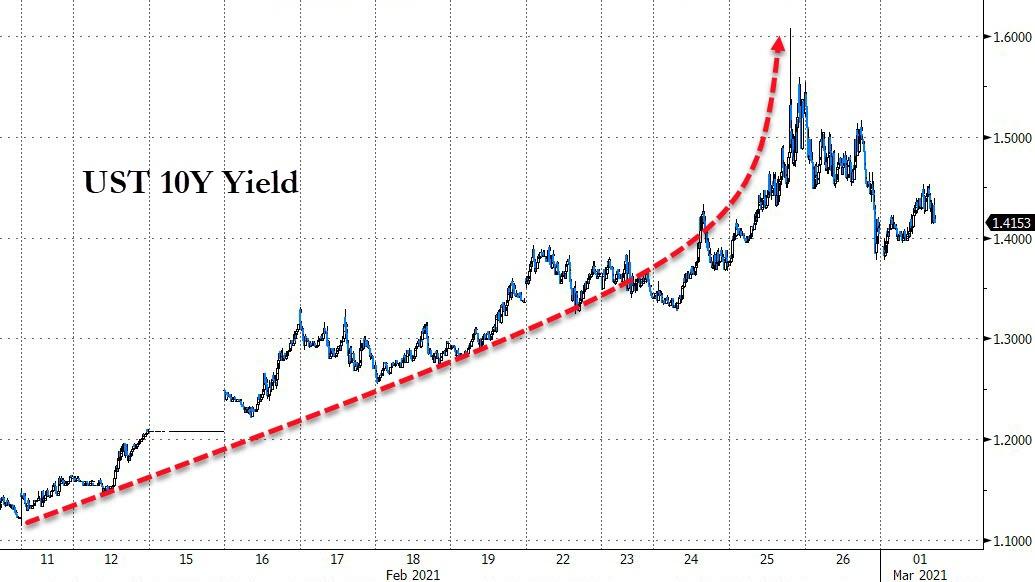
Almost two months ago, Nomura correctly predicted that once the 10Y breaches 1.50%, stocks would freak out and sure enough that’s precisely what happened (with Nomura’s forecast becoming self-fulfilling and sparking a stop loss cascade one the 10Y hit 1.50% last Thursday, sending the 10Y as high as 1.61% in a matter of seconds following last week’s dismal 7Y auction).

So now that 1.50% is yesterday’s news, Wall Street is scrambling to define the next critical level for 10Ys beyond which there will be blood. As a reminder, yesterday Goldman hinted that 2.10% is what traders should be looking at, but that seems a lot, especially with many far more accurate forecasters saying that the Fed will have to engage YCC around 2.0%, and for that to happen stocks would need to crash first. Therefore, the next critical level is likely one between 1.50% and 2.0%.

One such level was proposed by BofA’s chief equity strategist, Savita Subramanian who today writes that “history suggests that 1.75% on the 10-yr (the house forecast and ~25bp above current levels) is the tipping point at which asset allocators begin to shift back to bonds” and thus sell stocks in the next wave of aggressive liquidations.

Why 1.75%? Because that yield on the 10Y is decisively above the S&P’s dividend yield, and where according to BofA “there is an alternative to stocks”, or TIAA.
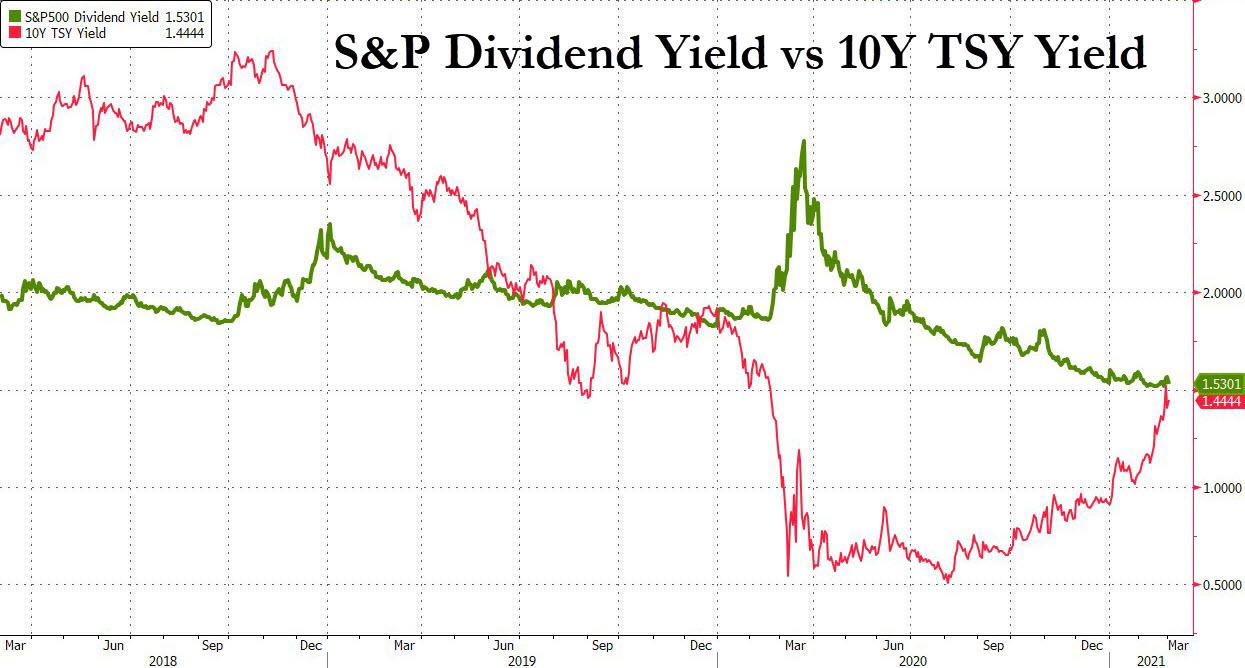
As Bloomberg notes, TIAA would represent a reversal to a mantra popularized in recent years as yields on Treasuries fell to historic lows and inflation stayed muted. For many, TINA – “there is no alternative” to stocks – helped rationalize a turn to riskier assets and justified S&P 500 valuations that are near their highest in two decades.

So after last week’s fireworks, will bonds continue to rise from the current level of 1.43%, and how fast until they reach the new “tipping point”? Well, after last week’s historic rout, which culminated the 2nd worst bear market for bonds in the past 40 years…

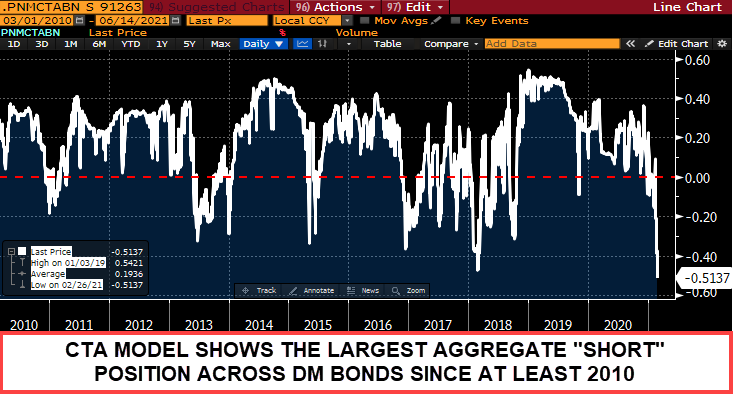
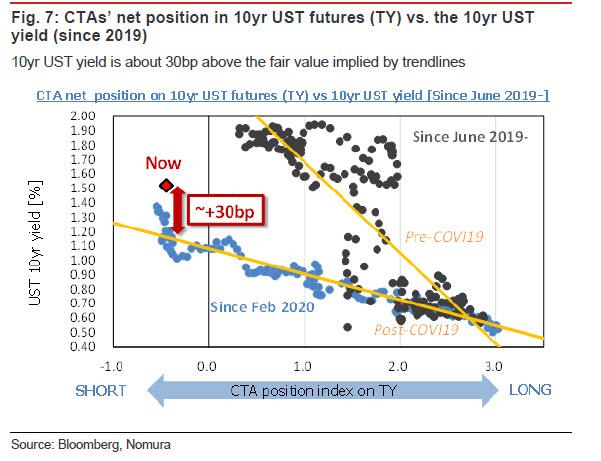
…. CTAs had been the most bearish on long-dated bonds since 2018, but as Nomura pointed out they had started to cover their shorts, usually an early indicator that yields have topped out for the time being and are set to drop, with Nomura estimating that the 10yr UST yield is currently about 30bp above the fair-value yield implied by trend-following strategies. Short-covering by CTAs and other speculators for the sake of locking in profits may serve the purpose of reeling the 10yr UST yield back in.”
Separately, rising growth expectations have also fueled huge gains for commodities with the likes of corn and soybeans up roughly 50% in the past year. On a six-month rolling basis, both offered higher risk-adjusted returns, or Sharpe ratios, than the famously high-flying Bitcoin, according to Quantica. However, in an ominous reversal, over the weekend China reported disappointing PMI prints…
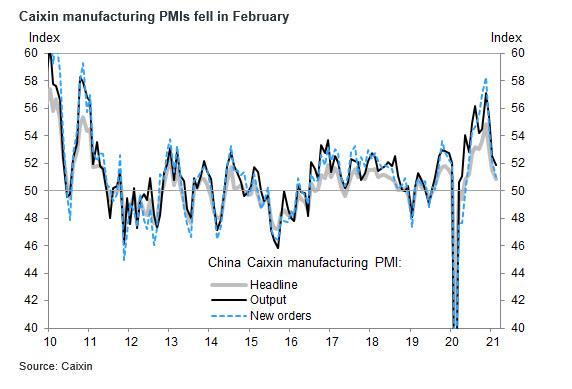
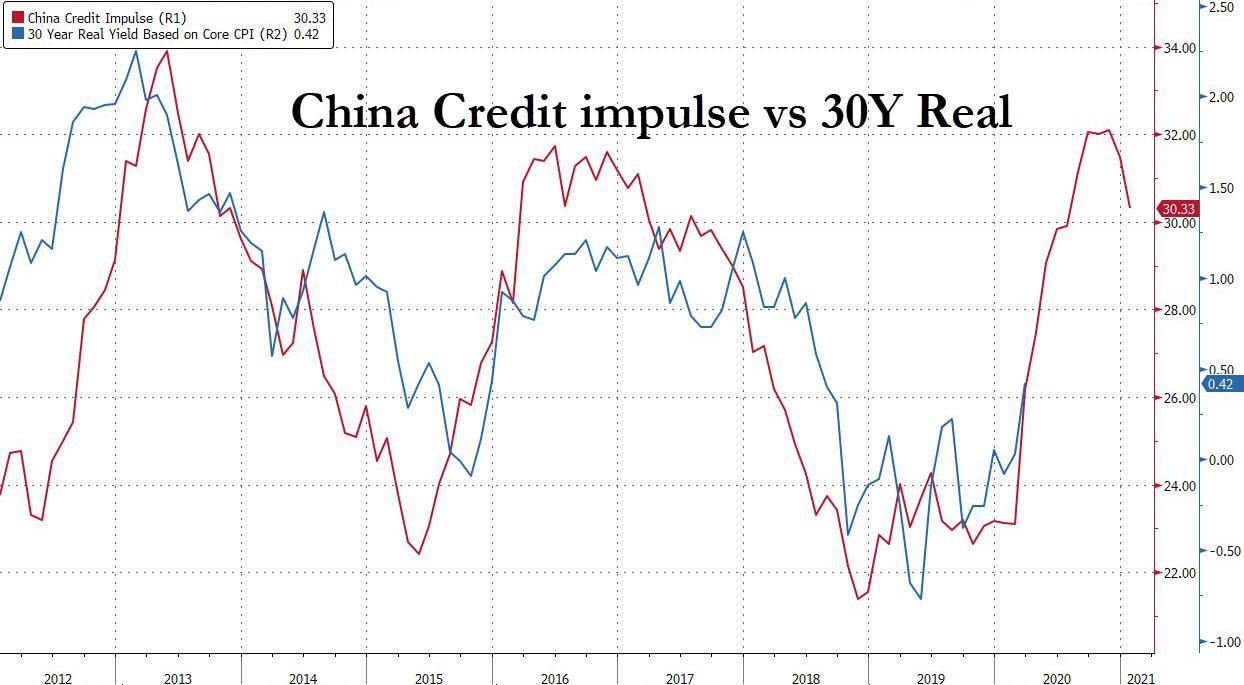
… which suggest that the global reflation trade sparked by the world’s biggest credit dynamo, Beijing, could be starting to fizzle.
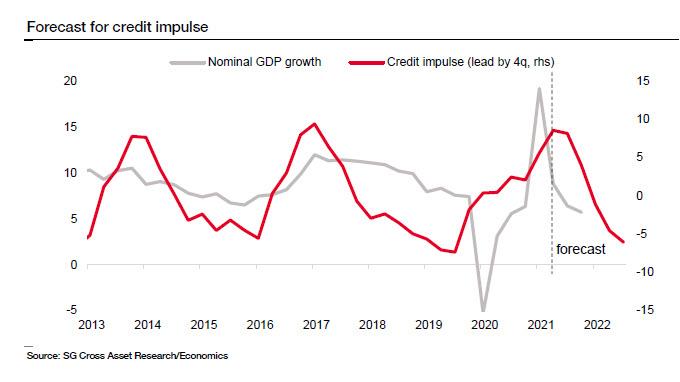
What’s worse, the propagation of the slowing Chinese credit impulse would have adverse consequences on all inflation-sensitive assets.
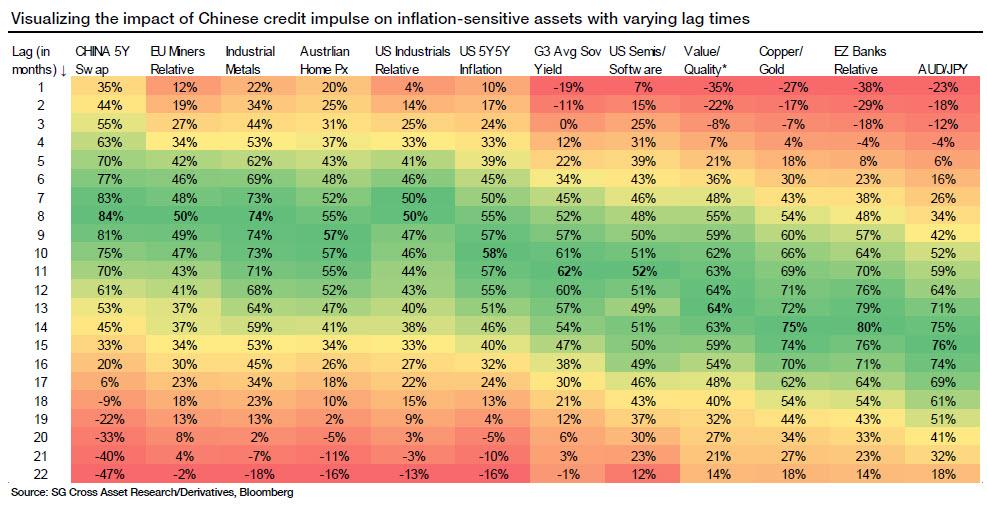
The only question is how long before China’s credit slowdown is manifest in real yields. And here, according to one of our favorite charts, we probably have another 6-9 months of real yield upside before yields come crashing down again.
Indeed, after last week’s freakout, some Treasury bulls have emerged, and according to Jim Paulsen, chief investment strategist at the Leuthold Group, the 1.75% level may be further away than it seems. Paulsen believes that the spike in bond yields could take a pause around 1.5% before embarking on another leg higher. Among the reasons he cites is the recent bout of colder weather, which could result in weaker economic data – including slower retail sales – in the next month. That will dampen anxieties over economic overheating, he wrote in a note.

“Yields still have further to rise this year,” said Paulsen. “But, if they do it a bit more slowly and intermittently, rather than all at once, the impact on the economy and the stock market should be far-less damaging.”

Of course, others disagree. One among them is Sonal Desai, Franklin Templeton’s fixed-income chief who is back with another big bet that rising inflation will prolong the slump in U.S. Treasuries. As Bloomberg notes, Desia says the 10-year yield could jump above 1.75% by the end of the year, compared with around 1.43% currently.

“Inflation could easily overshoot under the approving eye of the Fed,” wrote the chief executive officer of the debt division with around $155 billion in a note. She cited price pressures including accelerating growth, the vaccine rollout, massive fiscal stimulus and the historic growth in money supply.

To be sure, one could simply respond that Desai, along with her colleague Michael Hasenstab, have been broken records, predicting the end of the bond rally for years. Worse, he track record is rather dismal: her previous predictions about the Treasury market have fallen flat, amid relentless investor demand, and unexpected economic shocks including trade frictions and the pandemic itself. In October 2019 she projected that the 10-year yield would rise to 3% within 12 months. It peaked at 1.9% over that period before dropping to as low as 0.5%.

Misfiring bearish bets have hit Hasenstab’s Templeton Global Bond Fund with $15 billion in assets, which was forced last year to unwind a multi-year short position on Treasuries. The fund still maintains low duration, according to filings, though that stance still hasn’t spared it from a 1.9% loss so far this year.

That has not stopped Desai, who helps oversee everything from credit to money markets, to put her investors’ money where her mouth is, and she says she is trading her conviction on higher Treasury yields by being selective in high yield and emerging-market investments. She also favors securities in the floating-rate loan market, according to the note.

“Both the Fed and the European Central Bank have reiterated their reassurance that monetary policy will remain supportive, but markets may be challenging central bank credibility,” Desai wrote. “Given the underlying strength of the economy, I think widening spreads will offer opportunities in short duration fixed income assets in the coming weeks.”

Here’s the problem: Desai may well be right and central bank credibility could soon be completely gone. However, in that case, the first people out of a job will be asset managers such as Desai and all her peers at Franklin Templeton as the ensuing historic crash will guarantee that total losses on everything else dwarf what little profits the bond manager can make on its Treasury short.

Tyler Durden
Mon, 03/01/2021 – 15:40

via ZeroHedge News https://ift.tt/3r6GdjZ Tyler Durden
“U.S. Excess Savings Will Be A Massive Economic Boost From 2Q”

“U.S. Excess Savings Will Be A Massive Economic Boost From 2Q”

Submitted by Christophe Barraud

U.S. personal incomes soared in January as Americans received another batch of pandemic-relief checks, resulting in a spike of total excess personal savings.

According to the Commerce Department report, incomes increased by 10% MoM, the largest gain in nine months. The January jump came after the $900 billion pandemic aid package passed in December. As a reminder, the bill included $600 stimulus checks per American, including adults and children. However, the size of the payment decreased for people who earned more than $75,000 in the 2019 tax year. The check disappeared altogether for those who earned more than $99,000. In addition, the legislation supplemented jobless benefits with an extra $300 a week payment.

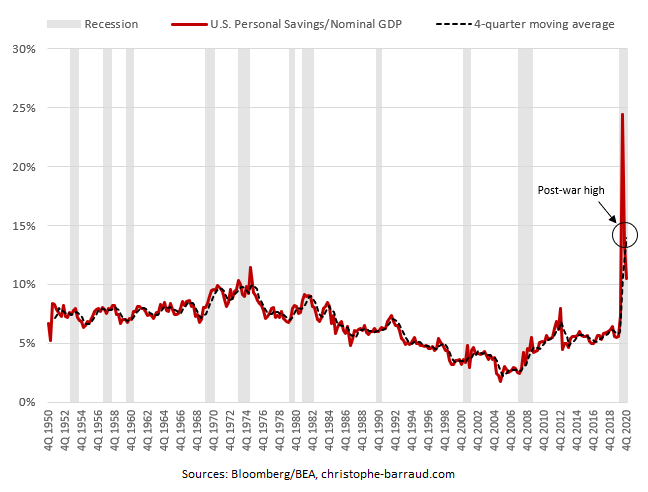
Meanwhile, purchases increased 2.4% MoM, pushing personal saving rate up to 20.5%, the highest since May 2020. In this context, U.S. personal savings as a share of nominal GDP will rise again in 1Q21, after reaching a post-war high at the end of 2020 on a 4-quarter moving average basis.

In the meantime, the level of total excess personal savings accumulated since the beginning of the Covid-19 crisis (March 2020) kept skyrocketing. According to my estimates, it reached $1.681 trillion in January (7.8% of nominal GDP).

This huge amount will grow again in the coming months and could even top the $2 trillion mark (9.3% of nominal GDP) as soon as March (if the next Federal stimulus is disbursed in time, otherwise it will be in April). The fact is that, this week, California legislators approved a $7.6-billion COVID-19 package, including $600 stimulus checks. An estimated 5.7 million checks will go to low-income Californians, including families with children enrolled in CalWORKS, as well as elderly, blind and disabled recipients of Supplemental Security Income or the state’s Cash Assistance Program for Immigrants.

Lastly, another federal stimulus is likely to be passed before March 14, when key programs buoying millions of jobless Americans expire. Among other details, the plan contains:

  • A $400 per week unemployment insurance supplement and an extension of programs expanding jobless benefits to millions more Americans through Aug. 29
  • $1,400 direct payments to most Americans and the same sum for dependents
  • Payments to families of up to $3,600 per child over a year

In my opinion, a part of this total excess personal savings will probably flood the economy from 2Q21 as economic confidence returns. As I already noted, the health situation has improved significantly since mid-January. Moreover, latest data and the recent approval of Johnson & Johnson’s vaccine suggests that the U.S. will be able to vaccinate all of its over-65s and health workers by the end of May (at the latest). Therefore, it is very likely that most of states will ease restrictions supporting economic activity and labour market confidence. Note that hiring intentions of companies in the most affected sectors have already improved.

To conclude, a part of total excess personal savings will probably flood the economy from 2Q21 as economic confidence returns progressively to normal. In addition, most of economists underprice the “consumer revenge” effect which reinforces my forecast that U.S. growth will exceed expectations in 2021 (recently revised upward to +4.9% according to the Bloomberg consensus).

Tyler Durden
Mon, 03/01/2021 – 15:25

via ZeroHedge News https://ift.tt/3kAgoGk Tyler Durden

Bond Market Calls Fed’s Bluff With Biggest Short Ever…

Bond Market Calls Fed’s Bluff With Biggest Short Ever…

The last few weeks have seen the short-end of the yield curve panic, pricing in more than 4 rate-hikes from Dec 2022 to Dec 2024…

Source: Bloomberg

And Bond yields have screamed higher in recent days as fears of rampant inflation and a Fed on the sidelines prompts selling…

Source: Bloomberg

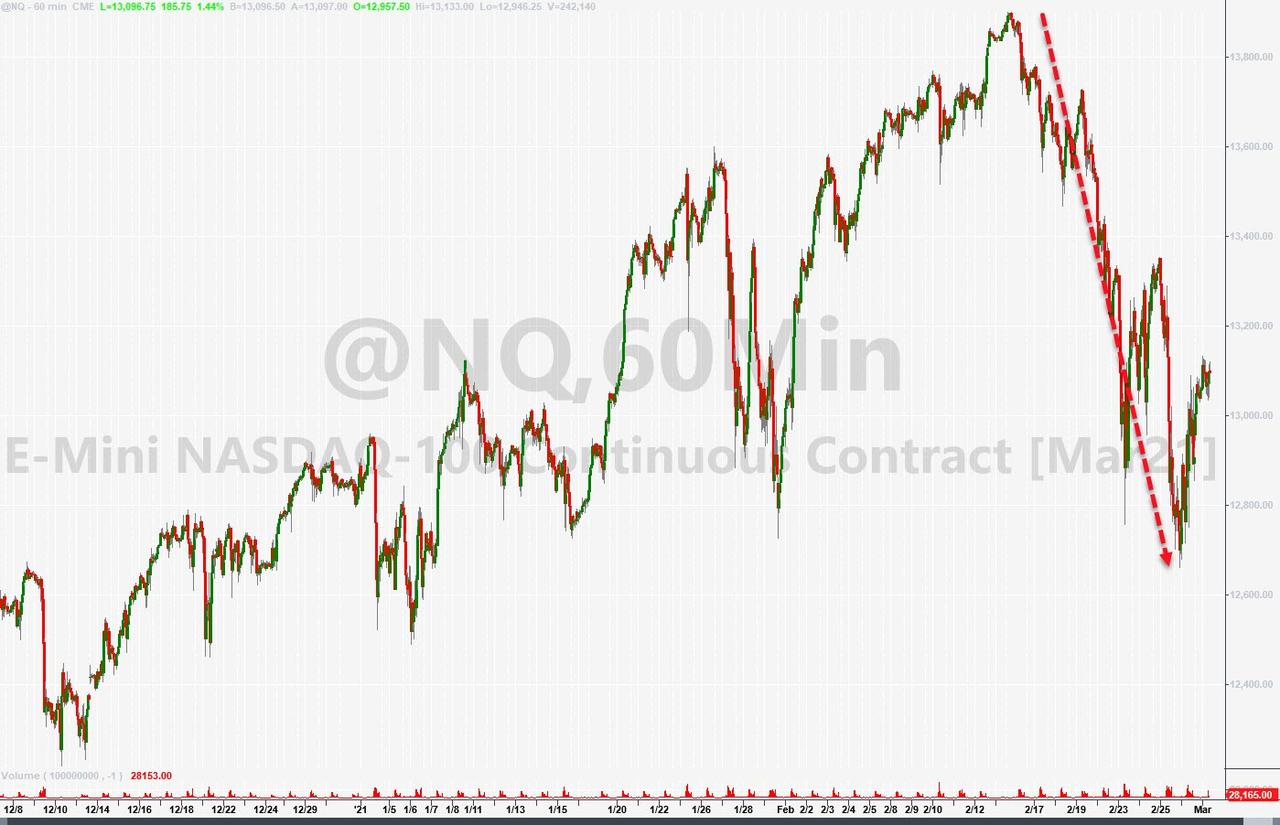
And as bond yields rose so growthy big-tech was monkey-hammered lower…

So, are market participants calling The Fed’s bluff and demanding they step in with even more dovish easing to rescue rates (and thus big tech)? How else will the government afford the $1.9 trillion ‘stimmy’ absent low rates and a will Fed buyer.

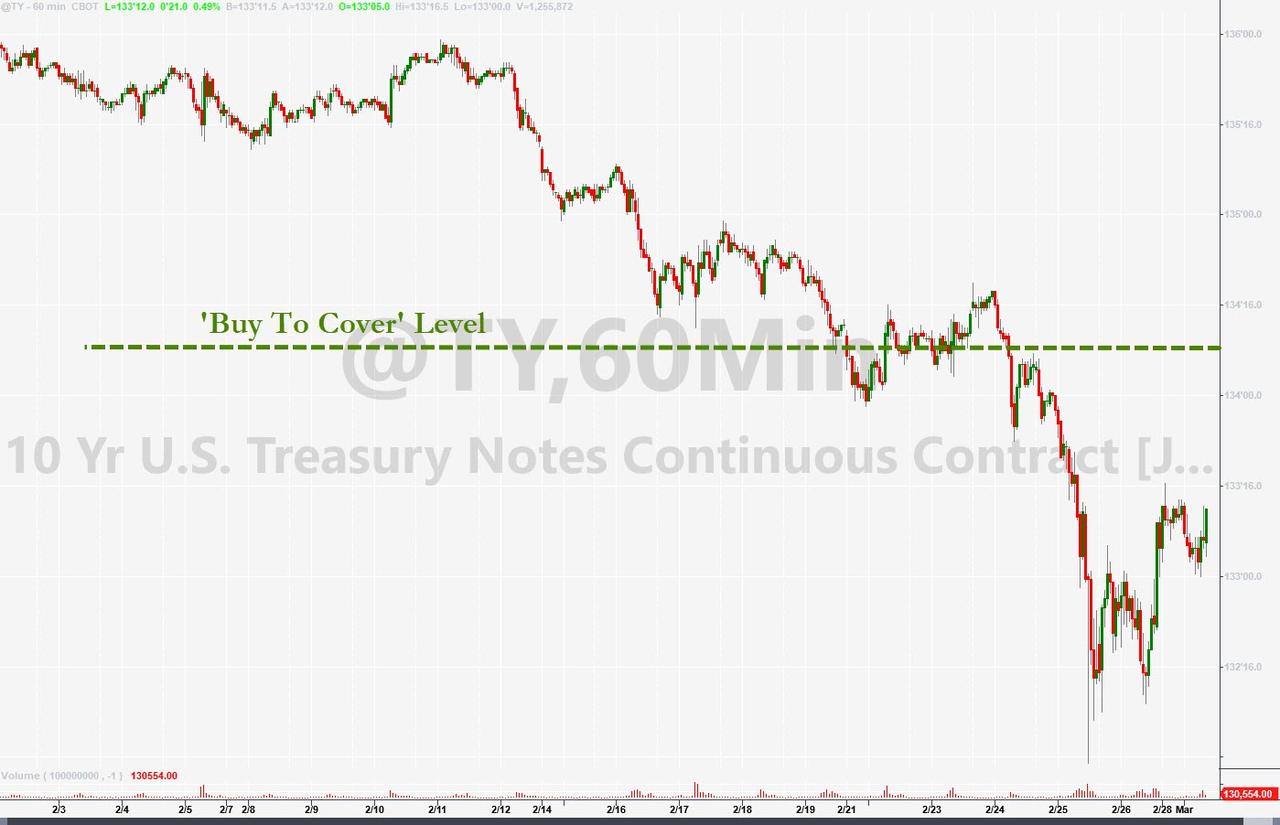
As Nomura’s Charlie McElligott notes, a reversal “squeeze” in USTs could come FAST – especially in-light of the magnitude of the aggregate “Short” position in Global Fixed-Income across CTA Trend universe, with the Nomura QIS CTA model showing the largest “Short” position in both TY and Global DM Bonds in our model history, dating-back to 2010…

This “big short” from CTAs in Global DM Bonds dynamic then has created the kindling for a blast of “mechanical” buy-to-cover flow into a potential Rates rally on Fed jawboning on Financial Conditions (which have tightened recently)…

…or say, SLR clarity…

The potential for a policy announcement from the Fed regarding Banks supplementary leverage ratio (SLR) rule—the window is shrinking for the Fed to address very seriously market “plumbing” concerns about the complete opacity surrounding the forward-path of the SLR exemption for Banks—meaning the Fed need to clarify to the market whether the SLR relief is going to be extended, while at the same time state whether Treasuries, Reserves or both (!) will be exempted again; this shocking lack of “market feel” from the Fed (as seen last week in Chairman Powell’s complete avoidance of the issue in testimony to Congress)  is contributing to the Treasury selloff, as Banks lack visibility whether they can continue to expand their balance sheets with purchases of USTs…or conversely, need to shed balance-sheet, deposits and USTs

…and if Bonds rip higher and Rate vol collapses, legacy long-term “Momentum” longs in bond-proxy Nasdaq and Mega-Cap Tech would likely see explosive moves higher again too.

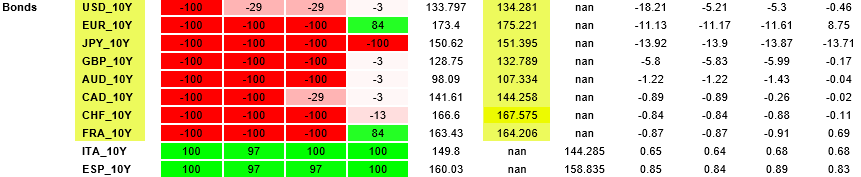
For now however, Rates / USTs path of least resistance continues WEAKER until we hear from the Fed as we await this week’s potential Rates “inflection catalysts”; but here are today’s estimated “buy-to-cover” levels for CTAs in said current Global DM Bond “shorts” of note:

What could get bonds up there? Feb jawboning…

Perhaps that is why there is a SIGNIFICANT amount of Fed-speak this week, coming ahead the blackout kicking-off this Saturday (Brainard today, tomorrow), Evans (Wednesday), Powell (Thursday at noon EST) along with Williams, Bostic, Kaskari, Mester, Daly and Harker sprinkled throughout as well. As Nomura’s Rob Dent notes, this obviously comes at a critical time for the Rates space, with timing which would allow them to push-back against the Rates move with enhanced “forward guidance,” under the guise of “tightening in financial conditions” – perhaps even “Operation Twist” trial balloons?

Tyler Durden
Mon, 03/01/2021 – 15:10

via ZeroHedge News https://ift.tt/381lma5 Tyler Durden

Cuomo Hires Criminal Defense Attorney, Avoids Public As Scandals Mount

Cuomo Hires Criminal Defense Attorney, Avoids Public As Scandals Mount

Update (1525ET): The WSJ was incorrect in claiming Abramowitz was representing Cuomo’s office for his sexual harassment scandal, telling Bloomberg that he’s only representing the nursing home scandal.

“My firm and I are representing the Executive Chamber on the Nursing Home matter. We have not been retained on the sexual harassment matter,” he said in an email.

*  *  *

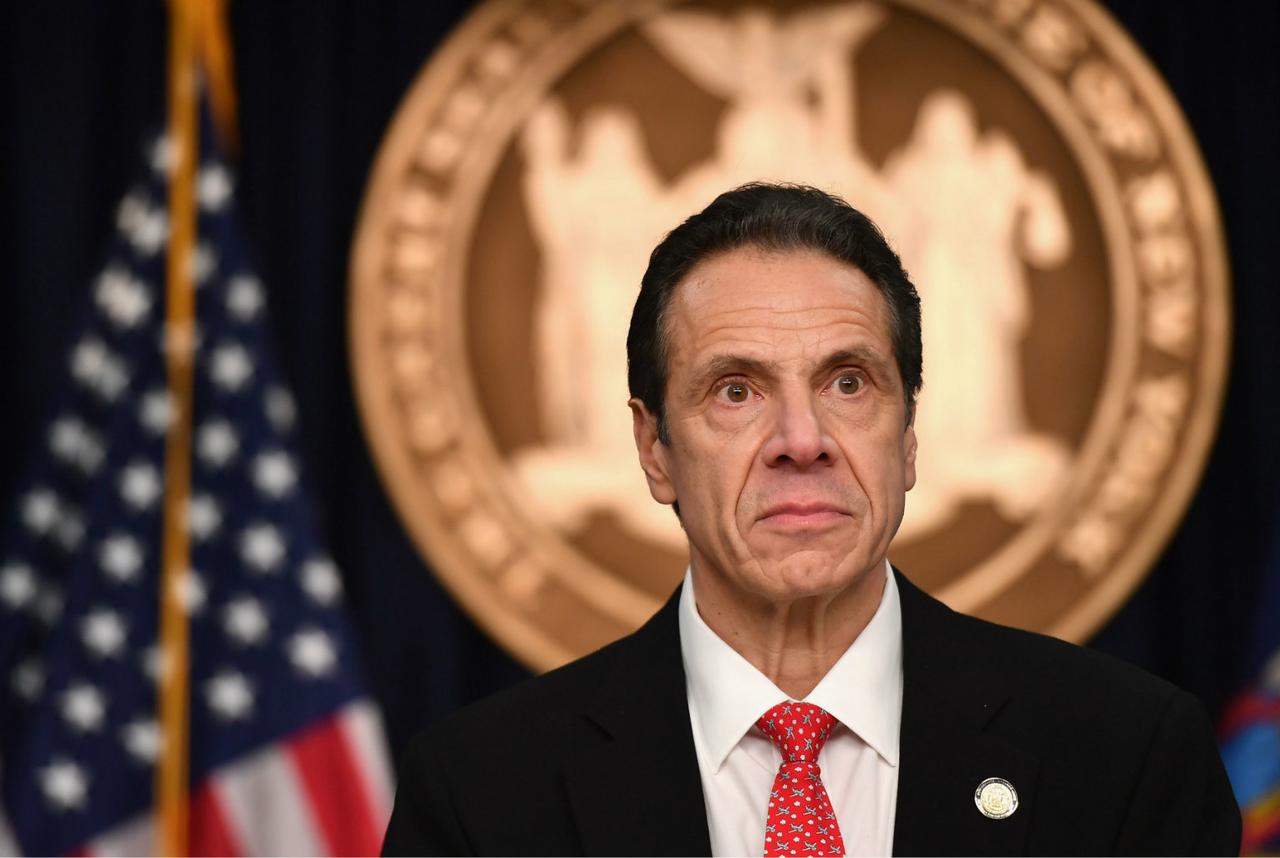
New York Governor Andrew Cuomo’s administration has retained a prominent white-collar defense attorney following allegations of sexual harassment and Justice Department inquiries over COVID-19 nursing home deaths, according to the Wall Street Journal.

Attorney Elkan Abramowitz – a former federal prosecutor – confirmed with the Journal that he is now representing Cuomo’s ‘executive chamber’, which includes the governor and his closes aides. Abramowitz is dealing with both scandals as New York Attorney General Letitia James joins the DOJ in investigating the embattled New York bigwig.

New York Attorney General Letitia James (Photo: Peter Foley, Bloomberg)

The Democratic governor faces an investigation overseen by State Attorney General Letitia James into whether he sexually harassed women who previously worked in his administration. Mr. Cuomo acknowledged he had sometimes been overly personal while interacting with staff and said he was sorry if anyone mistook it for unwanted flirtation.

Two women have accused Cuomo of sexual harassment ranging from inappropriate questions, to touching, to forcibly kissing. One accuser says Cuomo clearly wanted to sleep with her.

Over the weekend, Cuomo denied forcibly kissing former aide Lindsey Boylan, who said the governor would also go out of his way to touch her “on my lower back, arms and legs.” He did, however, seemingly admit to using inappropriate language.

Cuomo also said last week that the state is cooperating with three inquiries from the US Attorney’s Office in the Eastern District of New York located in Brooklyn, as well as the DOJ’s Civil Rights and Civil divisions based in Washington. Brooklyn prosecutors have requested data on the number of people who died in New York nursing homes during the pandemic.

Meanwhile, the governor has stepped out of the public spotlight – last making a televised pandemic briefing on Feb. 19, while his public schedule remains empty according to Bloomberg.

Cuomo’s uncharacteristic silence comes a day after he agreed to an independent probe by a special investigator after a second former aide accused him of sexual harassment. Cuomo stopped short of having New York Attorney General Letitia James lead the probe, a move championed by dozens of other lawmakers.

On Monday, state Senator Todd Kaminsky introduced a bill that would allow the attorney general to conduct a criminal investigation without a referral from the governor, a move he said would strengthen independent oversight of the governor and other state officials.

“Clearly where the governor is involved there is a conflict,” said Kaminsky.

Veteran Democratic consultant Hank Sheinkopf told Bloomberg: “The problem is he’s being squeezed on the left and the right, and if there are more accusations of sexual harassment or governmental incompetence or corruption, he’s going to have a very difficult time surviving,” adding “He has very few friends.

Tyler Durden
Mon, 03/01/2021 – 14:54

via ZeroHedge News https://ift.tt/3uDAwMx Tyler Durden

4 Arrested In Texas On 150 Counts Of Voter Fraud

4 Arrested In Texas On 150 Counts Of Voter Fraud

Authored by Isabel von Brugen via The Epoch Times,

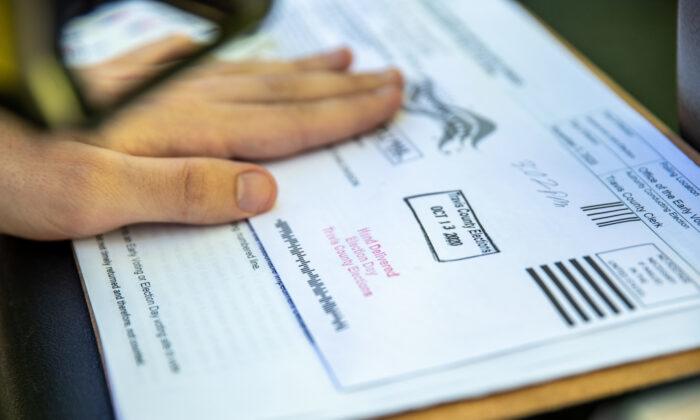
Four people were arrested in Texas last month on 150 counts of voter fraud dating back to the 2018 Medina County Primary Election, according to reports.

The Texas attorney general’s Election Fraud Unit on Feb. 11 arrested Medina County Justice of the Peace Tomas Ramirez, and earlier detained Leonor Rivas Garza, Eva Ann Martinez and Mary Balderrama on election fraud allegations, News4SA reported.

According to a release from Texas Attorney General Ken Paxton’s office, the case involved allegations of vote harvesting at assisted living centers in Medina County in the 2018 Medina County Primary Election.

Ramirez faces one count of organized election fraud, one count of assisting voter voting ballot by mail, and 17 counts of unlawful possession of a ballot or ballot envelope, according to the news outlet.

Balderrama is charged with one count of organized election fraud, nine counts of illegal voting, two counts of unlawful possession of ballot or ballot envelope, one count of mail ballot application, two counts of unlawfully assisting voter voting by mail, two counts of tampering with government record, and eight counts of election fraud.

Garza faces a single count of organized election fraud, two counts of illegal voting, eight counts of unlawful possession of a ballot or ballot envelope, two counts of election fraud and four counts of fraudulent use of an absentee ballot by mail.

Martinez is charged with a single count of organized election fraud, nine counts of illegal voting, 28 counts of unlawful possession of ballot or ballot envelope, three counts of purportedly acting as an agent, five counts of tampering with government record, 14 counts of election fraud, and four counts of fraudulent mail ballot application, according to News4SA.

The Texas attorney general’s office didn’t immediately respond to a request for comment by The Epoch Times.

In a separate incident, Raquel Rodriguez, a Texas woman who bragged about being able to deliver thousands of votes for tens of thousands in cash was arrested in January on charges including election fraud and illegal voting.

Rodriguez was filmed during an undercover project by Project Veritas, an investigative journalism nonprofit. She was recorded in footage released last year that she could deliver “at least 5,000” votes “county-wide” for $55,000 in cash and that it would hire her “entire team.” She acknowledged what she was discussing could land her prison time.

Based on the footage, Paxton, a Republican, opened an investigation. That probe led to the arrest, Paxton announced on Jan. 13.

Rodriguez faces a prison sentence of up to 20 years if convicted.

Tyler Durden
Mon, 03/01/2021 – 14:40

via ZeroHedge News https://ift.tt/3dXNgHZ Tyler Durden

JPMorgan Promotes Marko Kolanovic To Chief Global Markets Strategist Amid Burst Of Departures

JPMorgan Promotes Marko Kolanovic To Chief Global Markets Strategist Amid Burst Of Departures

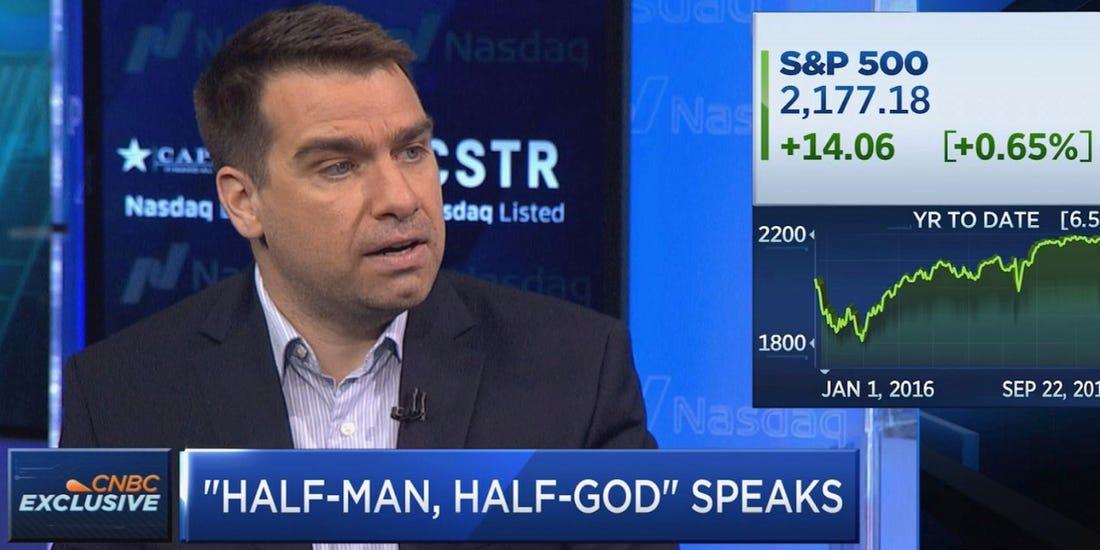
Back in September 2015, Bloomberg first discovered a little known JPM quant named Marko Kolanovic, and wrote that “You know you’re a straight-up baller when Zero Hedge writes in a non-ironic way about your prediction.” After that, it didn’t take a long time for Marko – whose market analysis at the time was indeed second to none – to become a household name, and in some cases, a Tolkienesque name, with some TV channels fawning at the quant they dubbed “Gandalf”, while others went all out, calling the eastern european “half man, half god.”

Since then – as we have extensively profiled – Marko’s predictive and analytical track record got somewhat spotty, which was to be expected when coupled with several high level promotions the Croat was tasked with not just providing objective, impartial analysis but more importantly, toeing the perpetually bullish line promoted by JPMorgan thus eroding some of his hard-earned “street cred”, but it didn’t matter: by now everyone on Wall Street knew his name.

And so, one thing led to another, and with Marko making increasingly more frequent TV appearances and capitalizing on the rampant inflation hitting all assets and commodities, this morning we witnessed some title inflation as well, because as Bloomberg reports, the largest US commercial bank promoted Marko “Gandalf” Kolanovic to a new role as chief global markets strategist and named several executives to the bank’s global research leadership team under new head Jeremy Barnum.

Kolanovic, previously global head of macro quantitative and derivatives strategy, will now oversee research for cross-asset, equity strategy and quantitative and derivatives strategy, according to a memo sent to staffers Monday and seen by Bloomberg. He’ll continue to sit on the bank’s global research leadership team and will report to Barnum, who was appointed to a new role as global head of research in a reshuffle a month ago.

Marko’s promotion appears to be necessitated by a sudden burst of the departures within JPM’s top research ranks. The bank’s two former global heads of research, both equity and fixed income, are out: Nicole Grainger, global equity research head, and Matt Jozoff, co-head of FICC research – who were both on the bank’s research leadership team – have decided to pursue other opportunities, according to the memo. It wasn’t clear which firm they are going to. Sunil Garg, who ran international equity research, is also pursuing “new opportunities” but will stay on for a transitional period and join Barnum’s research leadership team on an interim basis, according to the memo.

In addition to Kolanovic, the bank named several new leaders to its global research leadership team, all of whom will report to Barnum:

  • Steve Dulake, global head of credit research
  • Gloria Kim, global head of index research
  • Pedro Martins, head of Latin America equity research
  • Nick Rosato, who runs North America equity research

Bloomberg also notes that Bruce Kasman, global head of economic and policy research, and Luis Oganes, global head of emerging markets, currencies and commodities research, will remain on the research leadership team, as will Hussein Malik, global head of rates, securitized products and public finance research.

In 2020, the global research “team showed exceptional thought leadership, helping clients navigate the most complex and dynamic market environment in recent memory,” Barnum wrote in the memo. “I believe these individuals, in partnership with Joyce Chang, will enable us to bring the best of our expertise to clients and deliver the JPMorgan platform with maximum impact.” Chang is chair of global research.

Tyler Durden
Mon, 03/01/2021 – 14:20

via ZeroHedge News https://ift.tt/3uIvI8C Tyler Durden

Peter Schiff: The Only Thing The Economy Has Going for It Is The Fed

Peter Schiff: The Only Thing The Economy Has Going for It Is The Fed

Via SchiffGold.com,

Last week, Peter Schiff appeared on NDT News to talk about the Federal Reserve’s increasing dovishness. He said despite all of the assurances from Jerome Powell that the central bank’s monetary policy isn’t stoking inflation, the economy and the dollar are both at risk for collapse. The Fed is the only thing standing in the way and it can’t stand there forever.

During this interview, Peter also touched on his recent Twitter debate with Elon Musk about bitcoin.

Jerome Powell claims that the Federal Reserve is not blowing up bubbles, there is no inflation threat, and that its easy money policy will continue for years. Peter said Powell gets more and more dovish every time he talks.

I think it’s a necessity because the US economy is in need of more artificial support every time he speaks because the only thing the economy has got going for it is the Fed. Because it’s a phony economy. It’s not real. And it’s completely dependent on increasing levels of inflation. So, the Fed keeps on printing money while pretending it has no effect on interest rates, no effect on asset prices, and claiming that the market doesn’t even need its help.”

During his testimony on Capitol Hill, Powell even claimed the Fed’s bond-buying programs weren’t having any impact on interest rates. He thinks there is plenty of demand for US Treasuries without the central bank’s intervention into the market. Never mind that the Fed now holds a record percentage of US debt.

If that were true, why is the Fed buying all these bonds in the first place? The truth is that’s the only thing standing between us and complete economic collapse – is the Fed. But the only thing standing between the Fed and collapse is the value of the dollar.”

The Fed has also expanded the money supply by a record amount. Powell says that doesn’t really matter either and claimed that there is no longer any relationship between the supply of dollars and the value of those dollars.

Well, the laws of supply and demand are still in effect. And if Powell keeps printing dollars, eventually there’ll be no demand, and the value, the price, is going to collapse. And that’s when it all hits the fan.”

Peter also addressed his Twitter battle with Elon Musk about bitcoin. Musk purchased about $1.5 billion of bitcoin through Tesla.

Once you own bitcoin, you’re really obligated to talk your book because the only way to prop up the price is to con other people into buying it.”

In one tweet, Musk said, “Money is just data that allows us to avoid the inconvenience of barter. That data, like all data, is subject to latency and error. The system will evolve to that which minimizes both.” Peter said Musk doesn’t seem to understand money.

He said to me that money is just data and it’s not. That’s not what money is. Data can represent money, but money is a commodity like gold and silver. That’s money. What we use today, Federal Reserve notes, or people that use euros, or Japanese yen, those are what you call money substitutes. They’re not actual money. In fact, when the Federal Reserve issued notes backed by gold and silver, the gold and silver was the money. The notes were currency. And what gave the currency value was the money, the gold, that backed it up. So, currency is also a money substitute. But what we have now is a substitute for legitimate currency and that’s fiat currency. The difference between real currency and fiat currency is real currency is backed by actual money whereas fiat currency is backed by nothing. The dollar is fiat currency. Bitcoin is fiat digital currency. But the problem is it doesn’t even function as a currency. So, it’s really nothing. What bitcoin really is is a digital token. And you have people who are collecting bitcoin and you have people who are trading bitcoin. So, it has a price, but that price is a function of all the speculation. But at the end of the day, these bitcoin collections are going to have no value because there’s nothing unique or scarce about bitcoin and the price is going to collapse.”

Tyler Durden
Mon, 03/01/2021 – 14:00

via ZeroHedge News https://ift.tt/3q0zKWg Tyler Durden

Michael Burry Slams “Out Of Touch, Rich White Man” Bill Gates

Michael Burry Slams “Out Of Touch, Rich White Man” Bill Gates

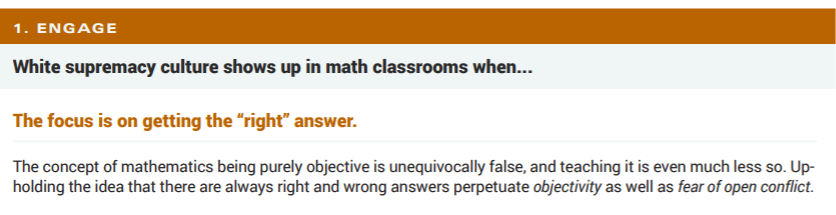
Less than two weeks ago, we reported on the fact that The Bill & Melinda Gates Foundation is bankrolling an activist educational group that believes math is racist and that arriving at an objective answer is an example of “white supremacy.”

Yes, really.

Specifically, as Summit News noted at the time, a conglomerate of 25 educational organizations called A Pathway to Equitable Math Instruction asserts that asking students to find the correct answer is an “inherently racist practice.”

The organization’s website lists the Bill & Melinda Gates Foundation as its only donor.

“In fact, over the past decade, the Bill & Melinda Gates Foundation has awarded over of $140 million to a variety of groups associated with Pathway. Their “antiracist resources” are at the epicenter of a new training course for teachers offered by the Oregon Department of Education throughout the state,” reports National File.

“Three of the most prominent organizations receiving grant money from the Gates’ are The Education Trust, Teach Plus, and WestEd, all non-profit 501c organizations.”

A guidebook for teachers produced by Pathway called ‘Dismantling Racism in Mathematics Instruction’ ludicrously claims that mathematics “is used to uphold capitalist, imperialist, and racist views.”

Teachers are instructed to blame non-white students getting answers wrong on “white supremacist practices,” which are truly to blame for the “underachievement” of minorities.

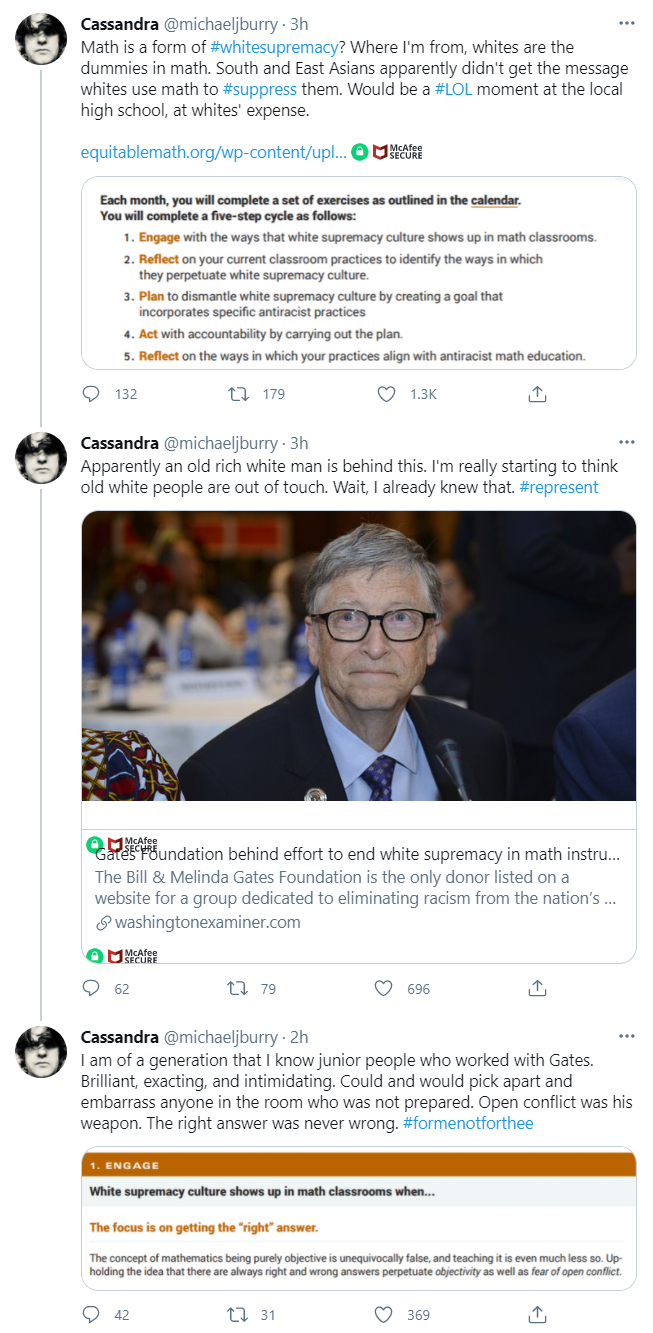
This liberal, progressive insanity appears to have triggered Michael “Big Short” Burry who unleashed his usual acerbic, and entirely accurate, wit on Gates and the entire concept of math being racist…

“Math is a form of #whitesupremacy? Where I’m from, whites are the dummies in math. South and East Asians apparently didn’t get the message whites use math to #suppress them. Would be a #LOL moment at the local high school, at whites’ expense. “

Burry went on:

“Apparently an old rich white man is behind this. I’m really starting to think old white people are out of touch. Wait, I already knew that…”

The outspoken market savant concluded:

I am of a generation that I know junior people who worked with Gates. Brilliant, exacting, and intimidating. Could and would pick apart and embarrass anyone in the room who was not prepared. Open conflict was his weapon. The right answer was never wrong.

Ending with the all too telling hashtag: #formenotforthee

Tyler Durden
Mon, 03/01/2021 – 13:42

via ZeroHedge News https://ift.tt/3kyuV5k Tyler Durden

Oil Plunges Below $60 After Brazil-Variant Virus Headlines

Oil Plunges Below $60 After Brazil-Variant Virus Headlines

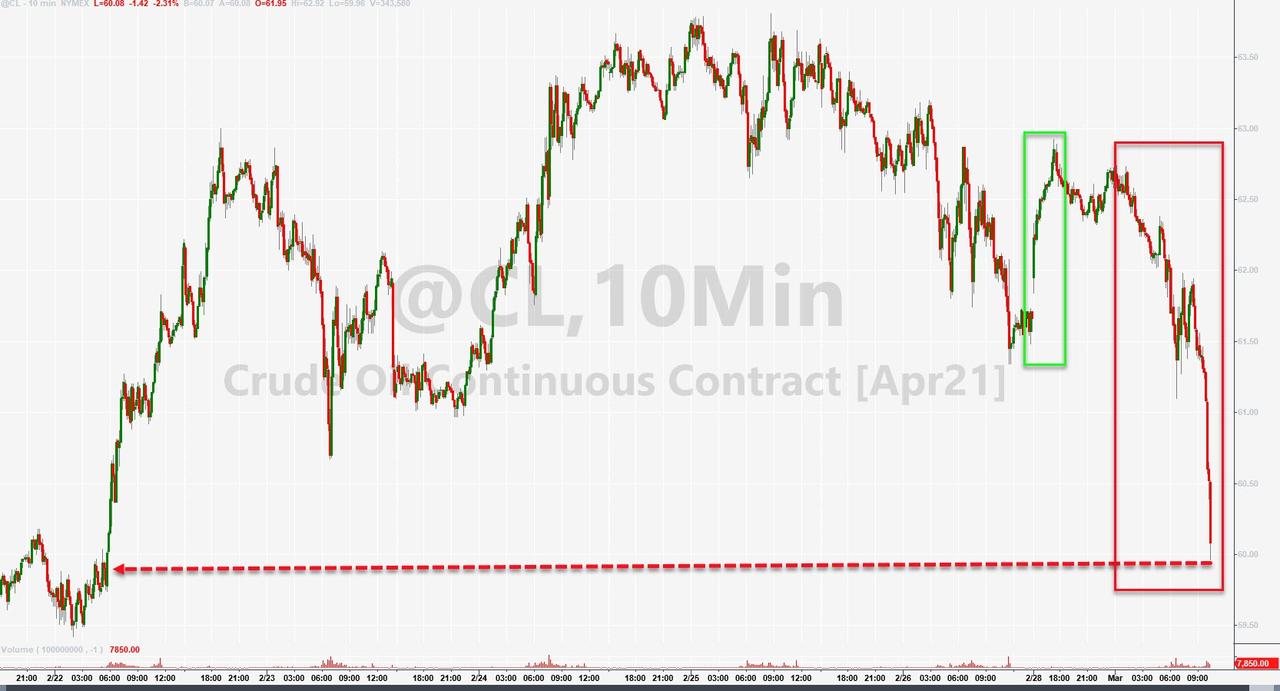
WTI has suddenly crashed from a strong overnight open up to $63, down to below $60 this morning.

While the catalyst is unclear, a number of market participants are pointing to a story in The Financial Times that warns the Brazil-variant of the virus has been found to evade natural immunity.

The P. 1 Covid-19 variant that originated in Brazil and has spread to more than 25 countries is around twice as transmissible as some other strains and is more likely to evade the natural immunity people usually develop from prior infection, according to a new international study.

It was also “able to evade 25-61 per cent of protective immunity elicited by previous infection” with any earlier variant, the researchers found, in a sign that current vaccines could also be less effective against it.

Those headlines do not fit well with the ‘almost back to normal’ narrative being pumped around the world, which was shaken this morning as China’s factory activity growth slipped to a nine-month low in February, sounding alarms over Chinese crude buying

“One negative is more and more talk about Chinese oil demand maybe faltering, that they bought all the oil that they’re going to need for a while,” said Phil Flynn, senior analyst at Price Futures Group in Chicago.

“There’s some talk that their strategic reserves are filled up, and so some people are betting against the Chinese continuing to drive oil prices.”

OPEC+ meet on Thursday and could discuss allowing as much as 1.5 million barrels per day of crude back into the market. ING analysts said OPEC+ needs to avoid surprising traders by releasing too much supply.

“There is a large amount of speculative money in oil at the moment, so they will want to avoid any action that will see (those investors) running for the exit,” the analysts said.

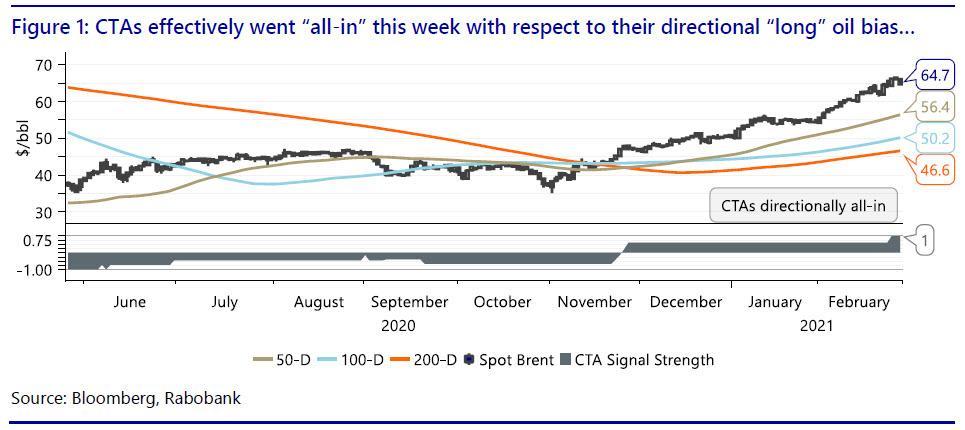
The big question is, will this be enough to reverse the momentum as we warned yesterday that CTAs had gone “all-in” on oil


Get ready for the next round of lockdowns and the next leg down in demand expectations.

Tyler Durden
Mon, 03/01/2021 – 13:20

via ZeroHedge News https://ift.tt/3q7Psie Tyler Durden

Goldman Restarts Cryptocurrency Trading Desk

Goldman Restarts Cryptocurrency Trading Desk

2018 was not a good year for bitcoin, and for cryptos in general: after hitting an all time high in December of 2017, much of the remainder of 2018 was spent with the crypto bubble deflating, with early crypto investors first casually than fervently taking profits and dragging the price of cryptos ever lower. The punchline came in September, when as we reported at the time Goldman – clearly disappointed with the lack of upside momentum – suspended its fledgling crypto trading desk plans

… sending bitcoin tumbling back below $7000.

Well, fast forward a little over two years forward when following the 7-fold increase in the price of bitcoin since Goldman’s cowardly exit, the bank – which has lost some of its top executives in recent weeks – has made a less than triumphant return and according to Reuters, has restarted its cryptocurrency trading desk and will begin dealing bitcoin futures and non-deliverable forwards for clients from next week.

As before, the team will sit within the U.S. bank’s Global Markets division, the Reuters source said, which means that while Goldman is putting on one trade for its prop traders, it will be using its flow desk to have clients to the opposite.

The desk is part of Goldman’s activities within the fast-growing digital assets sector, which also includes projects involving blockchain technology and central bank digital currencies, the person said.

Reuters adds that as part of this renewed bitcoin trading effort, the bank is also exploring the potential for a bitcoin exchange traded fund and has issued a request for information to explore digital asset custody.  The trading desk reboot comes amid growing interest by institutions in bitcoin, which has exploded more than 470% over the past year, outperforming any asset class pitched by Goldman’s research desk.

Of course, the real reason why Goldman is interested in getting back to bitcoin is due to its wild volatility, which while painful for holders is extremely valuable for prop traders, and makes both the underlying token and related derivatives attractive for investors willing to take riskier long or short positions as they hunt for yield in a record-low interest rate environment.

As Reuters reminds us, since the first unsuccessful attempt by Goldman to launch a trading desk in 2018, market infrastructure for bitcoin and other large cryptocurrencies has significantly matured, with many established financial institutions offering products and services, including CME Group Inc, Intercontinental Exchange Inc and Fidelity. The developments have helped to attract more mainstream companies to the sector, ranging from those offering crypto services to retail or institutional investors, to companies opting to hold bitcoin on their balance sheets

Last month, Tesla said it had bought $1.5 billion worth of bitcoin, while Bank of New York Mellon Corp said it had formed a new unit to help clients hold and transfer digital assets.

Then, on Monday morning, hedge-fund billionaire Dan Loeb took to Twitter to share his thoughts on the subject. “I’ve been doing a deep dive into crypto lately,” he said. “It is a real test of being intellectually open to new and controversial ideas.”

Loeb’s comments were in response to a blog post titled “NFTs and a Thousand True Fans” by Chris Dixon, a general partner at the venture-capital firm Andreessen Horowitz. In Dixon’s post, he expounds upon the role that non-fungible tokens will have on digital creators.

Meanwhile, crypto continued to win over the world’s biggest financial institutions. As reported earlier, Citigroup laid out a case for Bitcoin to play a bigger role in the global financial system, saying it could become “the currency of choice for international trade” in the years ahead.

Bitcoin was 8.4% at just over $49,000 on Monday, despite the latest attempt by the NY Attorney General to spark a selloff: New York’s top law enforcement officer issued a scathing statement on the market and warned consumers about its susceptibility to “speculative bubbles” and abuse by criminals. “Cryptocurrencies are high-risk, unstable investments that could result in devastating losses just as quickly as they can provide gains,” Attorney General Letitia James said Monday in an investor alert.

Well, of course they are, and it’s because of their massive risk that they provide just as massive returns, something which has not been lost on all those who held on to the token for the past several years and are now extremely rich thanks to it.

Tyler Durden
Mon, 03/01/2021 – 13:00

via ZeroHedge News https://ift.tt/3bOzkxg Tyler Durden