Pentagon Reveals Trump’s “Super-Duper” Hypersonic Missile 

Pentagon Reveals Trump’s “Super-Duper” Hypersonic Missile 

Tyler Durden

Fri, 07/17/2020 – 23:05

Rising Sino-US tensions aren’t going away, not tomorrow, not next month or next year. There’s a geopolitical rivalry at play, or as we’ve explained before: Thucydides Trap

China’s rapid military expansion in the Pacific has been a wake-up call to Washington. Beijing has also spent the last decade modernizing its military with the latest war technology, including fifth-generation fighters and hypersonic weapons

President Trump, the Pentagon, and the military-industrial complex recognize a conflict is ahead; otherwise, why would the president plow $2 trillion into modernizing the military over the last couple of years?

When it comes to hypersonic technology, the US is behind the curve in the deployment of these super-fast weapons onto the modern battlefield. On the other hand, China and Russia have already claimed they’ve fielded these missiles that can travel multiples of the speed of sound. 

President Trump boasted Ameria’s hypersonic capabilities in May, saying a “super-duper” missile in development can travel 17-times faster, though the Pentagon at the time was unwilling to confirm. 

“We are building, right now, incredible military equipment at a level that nobody has ever seen before. We have no choice. We have to do it — with the adversaries, we have out there. We have a — I call it the ‘super-duper missile.’ And I heard the other night, 17 times faster than what they have right now,” Trump said in May. 

Now there’s more color on the hypersonic missile the president was touting. A senior defense official told CNN this week, President Trump has taken “special interest” in hypersonics revealing that the new missile can travel “17 times faster” than the speed of sound.

h/t CNN 

The defense official is referring to a “hypersonic glide body” test over the Pacific in March. 

“What he was referring to, really, was the recent flight test that we’ve performed in March where we flew 17 times the speed of sound,” the senior defense official said.

CNN noted the US won’t have hypersonic missiles fielded until 2023 while China and Russia already have there’s in the field. 

As China challenges America’s predominance, a new Cold War is already underway. The rise of China and the stumbling of the US is one that could suggest tensions between both countries will continue until there’s a conflict. 

via ZeroHedge News https://ift.tt/3hcPWQd Tyler Durden

Testing Will Begin In Africa For Biometric ID, “Vaccine Records”, & “Payment Systems”

Testing Will Begin In Africa For Biometric ID, “Vaccine Records”, & “Payment Systems”

Tyler Durden

Fri, 07/17/2020 – 22:45

Authored by Mac Slavo via SHTFplan.com,

Testing will soon begin in poverty-stricken parts of Africa for a biometric ID which will also be your payment system and vaccine record. The biometric digital identity platform that “evolves just as you evolve” is backed by none other than the Bill Gates-backed GAVI vaccine alliance, Mastercard, and the AI-powered “identity authentication” company, Trust Stamp.

The GAVI Alliance, which is largely funded by the Bill and Melinda Gates and Rockefeller Foundations, as well as allied governments and the vaccine industry, is principally concerned with improving “the health of markets for vaccines and other immunization products,” rather than the health of individuals, according to its own website. Similarly, Mastercard’s GAVI partnership is directly linked to its “World Beyond Cash” effort, which mainly bolsters its business model that has long depended on a reduction in the use of physical cash.

Reducing the use of cash is needed. Cash is impossible to track, but if you use centralized digital currency, the ruling class has complete control over what you can spend.

The program, which was first launched in late 2018, will see Trust Stamp’s digital identity platform integrated into the GAVI-Mastercard “Wellness Pass,” a digital vaccination record and identity system that is also linked to Mastercard’s click-to-play system that powered by its AI and machine learning technology called NuDataMastercard, in addition to professing its commitment to promoting “centralized record keeping of childhood immunization” also describes itself as a leader toward a “World Beyond Cash,” and its partnership with GAVI marks a novel approach towards linking a biometric digital identity system, vaccination records, and a payment system into a single cohesive platform. The effort, since its launch nearly two years ago, has been funded via $3.8 million in GAVI donor funds in addition to a matched donation of the same amount by the Bill and Melinda Gates Foundation. –Activist Post

In early June, GAVI reported that Mastercard’s Wellness Pass program would be adapted in response to the coronavirus (COVID-19) pandemic. Around a month later, Mastercard announced that Trust Stamp’s biometric identity platform would be integrated into Wellness Pass as Trust Stamp’s system is capable of providing biometric identity in areas of the world lacking internet access or cellular connectivity and also does not require knowledge of an individual’s legal name or identity to function. The Wellness Program involving GAVI, Mastercard, and Trust Stamp will soon be launched in West Africa and will be coupled with a COVID-19 vaccination program once a vaccine becomes available.

What is perhaps most alarming about this new “Wellness Pass” initiative, is that it links these “dual use” digital solutions to cashless payment solutions that could soon become mandated as anything over than touchless, cashless, methods of payment have been treated as potential modes for contagion by GAVI-aligned groups like the World Health Organization, among others, since the pandemic was first declared earlier this year. –Activist Post

Do you get it yet? It’s all tied into the same thing, and the plandemic is an excuse to roll this out. Wake up. They are not coming to save you, quite the opposite, actually.

For those stuck on the line of thinking that President Donald Trump said this “vaccine will be voluntary,” you are probably correct. It’ll be “voluntary” all right. And if you don’t get it and participate in the new biometric ID program, you won’t be able to buy or sell anything, including food. That sounds nothing like the definition of voluntary to me, but believe in whatever religion you wish and put your trust in whomever you want. I’ll rely on myself instead of some politician to save me.

Oh, just what does Trump need 300 million doses of the vaccine for if it’s going to be “voluntary?” We are in for a “dark winter” as they have already told us several times. It’s time to apply critical thinking and stop falling for all of these psyops.

Those Who Planned The Enslavement of Mankind Warn Of “A Dark Winter” For Us

This doesn’t mean you shouldn’t remain vigilant and know what’s going on. Get your preps in order. Do another audit, buy some more food, and improve your water storage.  This system is here and it will not be voluntary in any sense of the word.  It’s similar to our “voluntary tax” system. Go ahead and choose to not pay, and men with guns will come to your house to make you pay. Yep, that’s how voluntary interaction works (note: that was sarcasm). Believe any politician you want, but they are all puppets for the Federal Reserve, and their takeover is imminent unless we wake up and stand together.

The entire breakdown of this new beast system can be read by clicking here.

Don’t just trust my word. Look into these issues for yourself. Everything is linked above, and better yet, find your own information. I would implore all of you to not just believe what you are being told by anyone, including Trump or myself. Research, read, learn, and prepare.

via ZeroHedge News https://ift.tt/2DOez7m Tyler Durden

ACLU Sues Federal Agents Deployed in Portland

fed-riot-cops

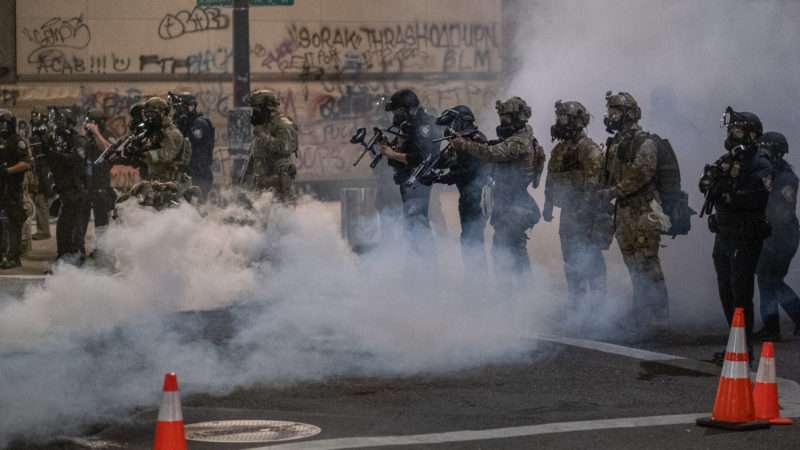
The American Civil Liberties Union (ACLU) of Oregon filed the first of what it says will be many lawsuits today over the Trump administration’s use of federal law enforcement to violently quell weeks-long protests and unrest in Portland, Oregon, over the police killing of George Floyd.

The ACLU of Oregon’s lawsuit, filed in the U.S. District Court for the District of Oregon, seeks a temporary restraining order against Department of Homeland Security (DHS) agents and U.S. Marshals deployed to Portland from assaulting press and legal observers.

“This is a fight to save our democracy,” Kelly Simon, interim legal director with the ACLU of Oregon. “Under the direction of the Trump administration, federal agents are terrorizing the community, risking lives, and brutally attacking protesters demonstrating against police brutality. This is police escalation on top of police escalation. These federal agents must be stopped and removed from our city. We will continue to bring the full fire power of the ACLU to bear until this lawless policing ends.”

DHS Acting Secretary Chad Wolf, who visited Portland on Thursday, says the federal law enforcement officers are protecting the city’s federal courthouse and other property from “violent anarchists.”

“The city of Portland has been under siege for 47 straight days by a violent mob while local political leaders refuse to restore order to protect their city,” Wolf said in a lengthy statement issued by DHS Thursday. “Each night, lawless anarchists destroy and desecrate property, including the federal courthouse, and attack the brave law enforcement officers protecting it.” 

However, news reports and videos from the protest have raised significant civil liberties concerns. Oregon Public Broadcasting (OPB) reported yesterday that federal law enforcement agents wearing camouflage uniforms—and lacking any identifying insignia—were driving around Portland in unmarked vehicles, grabbing protesters off the street, and detaining them.

Last weekend, federal law enforcement officers shot a protester in the head with a non-lethal munition, fracturing his skull. The man was hospitalized and required facial reconstruction surgery.

The agents are reportedly from the U.S. Marshals Service and CBP’s BORTAC team, which the Trump administration has deployed under a June 26 executive order to protect monuments. 

Democratic Oregon officials, including Portland Mayor Ted Wheeler and Gov. Kate Brown, have denounced the actions of federal law enforcement agents and demanded the Trump administration withdraw them.

“I told the acting secretary that my biggest immediate concern is the violence federal officers brought to our streets in recent days, and the life-threatening tactics his agents use,” Wheeler said. “We do not need or want their help.”

Brown called Trump’s deployment of federal agents “political theater” and a “blatant abuse of power by the federal government.”

Democratic Oregon lawmakers in Congress—Sens. Jeff Merkley and Ron Wyden, with Reps. Earl Blumenauer and Suzanne Bonamici—also called today for the DHS Office of Inspector General to investigate what Wyden called “paramilitary assaults.”

“It’s painfully clear this administration is focused purely on escalating violence without answering my repeated requests for why this expeditionary force is in Portland and under what constitutional authority,” Wyden said in a press release. “Simply put, the Office of Inspector General must investigate Trump’s assault on Americans’ constitutional rights now.” 

The U.S. Attorney for the District of Oregon, Billy Williams, a Trump appointee, has also called for an inspector general investigation into the action of the agents.

“Based on news accounts circulating that allege federal law enforcement detained two protesters without probable cause, I have requested the Department of Homeland Security Office of the Inspector General to open a separate investigation directed specifically at the actions of DHS personnel,” Williams said in a statement.

The ACLU of Oregon’s lawsuit says federal law enforcement attacked two journalists, Mathieu Lewis-Rolland and Garrison Davis, with non-lethal rounds, despite their being clearly marked as press.

“They also chased away legal observers affiliated with the National Lawyers’ Guild by threatening to beat them with batons,” the lawsuit says.

The ACLU of Oregon argues that the same court already issued an identical temporary restraining order on July 2 against the Portland Police Department.

“The federal agents are aware of the Court’s TRO, but have taken the position that they need not comply, which has once again placed press and legal observers in peril,” the lawsuit says.

CBP declined to comment on the ACLU’s lawsuit.

from Latest – Reason.com https://ift.tt/3fGt775
via IFTTT

Discussing the Supreme Court on “Supreme Myths” with Eric Segall

Last week, I was a guest on Professor Eric Segall’s new video/podcast interview show, “Supreme Myths.” We discussed a range of constitutional law and Supreme Court-related subjects and (given how we tend to go at it on Twitter) had a surprising amount of agreement.

https://mediaspace.gsu.edu/embed/secure/iframe/entryId/1_hcazyfm1/uiConfId/31355121

His prior episodes featured Jack Balkin and Nancy Leong. The podcast is available on Spotify, and is coming soon to other platforms.

from Latest – Reason.com https://ift.tt/2OzV7NT
via IFTTT

ACLU Sues Federal Agents Deployed in Portland

fed-riot-cops

The American Civil Liberties Union (ACLU) of Oregon filed the first of what it says will be many lawsuits today over the Trump administration’s use of federal law enforcement to violently quell weeks-long protests and unrest in Portland, Oregon, over the police killing of George Floyd.

The ACLU of Oregon’s lawsuit, filed in the U.S. District Court for the District of Oregon, seeks a temporary restraining order against Department of Homeland Security (DHS) agents and U.S. Marshals deployed to Portland from assaulting press and legal observers.

“This is a fight to save our democracy,” Kelly Simon, interim legal director with the ACLU of Oregon. “Under the direction of the Trump administration, federal agents are terrorizing the community, risking lives, and brutally attacking protesters demonstrating against police brutality. This is police escalation on top of police escalation. These federal agents must be stopped and removed from our city. We will continue to bring the full fire power of the ACLU to bear until this lawless policing ends.”

DHS Acting Secretary Chad Wolf, who visited Portland on Thursday, says the federal law enforcement officers are protecting the city’s federal courthouse and other property from “violent anarchists.”

“The city of Portland has been under siege for 47 straight days by a violent mob while local political leaders refuse to restore order to protect their city,” Wolf said in a lengthy statement issued by DHS Thursday. “Each night, lawless anarchists destroy and desecrate property, including the federal courthouse, and attack the brave law enforcement officers protecting it.” 

However, news reports and videos from the protest have raised significant civil liberties concerns. Oregon Public Broadcasting (OPB) reported today that federal law enforcement agents wearing camouflage uniforms—and lacking any identifying insignia—were driving around Portland in unmarked vehicles, grabbing protesters off the street and detaining them.

Last weekend, federal law enforcement officers shot a protester in the head with a non-lethal munition, fracturing his skull. The man was hospitalized and required facial reconstruction surgery.

The agents are reportedly from the U.S. Marshals Service and CBP’s BORTAC team, which the Trump administration has deployed under a June 26 executive order to protect monuments. 

Democratic Oregon state officials, including Portland Mayor Ted Wheeler and Gov. Kate Brown, have denounced the actions of federal law enforcement agents and demanded the Trump administration withdraw them.

“I told the acting secretary that my biggest immediate concern is the violence federal officers brought to our streets in recent days, and the life-threatening tactics his agents use,” Wheeler said. “We do not need or want their help.”

Brown called Trump’s deployment of federal agents “political theater” and a “blatant abuse of power by the federal government.”

Democratic Oregon lawmakers in Congress—Sens. Jeff Merkley and Ron Wyden, with Reps. Earl Blumenauer and Suzanne Bonamici—also called today for the DHS Office of Inspector General to investigate what Wyden called “paramilitary assaults.”

“It’s painfully clear this administration is focused purely on escalating violence without answering my repeated requests for why this expeditionary force is in Portland and under what constitutional authority,” Wyden said in a press release. “Simply put, the Office of Inspector General must investigate Trump’s assault on Americans’ constitutional rights now.” 

The U.S. Attorney for the District of Oregon, Billy Williams, a Trump appointee, has also called for an inspector general investigation into the action of the agents.

“Based on news accounts circulating that allege federal law enforcement detained two protesters without probable cause, I have requested the Department of Homeland Security Office of the Inspector General to open a separate investigation directed specifically at the actions of DHS personnel,” Williams said in a statement.

The ACLU of Oregon’s lawsuit says federal law enforcement attacked two journalists, Mathieu Lewis-Rolland and Garrison Davis, with non-lethal rounds, despite their being clearly marked as press.

“They also chased away legal observers affiliated with the National Lawyers’ Guild by threatening to beat them with batons,” the lawsuit says.

The ACLU of Oregon argues that the same court already issued an identical temporary restraining order on July 2 against the Portland Police Department.

“The federal agents are aware of the Court’s TRO, but have taken the position that they need not comply, which has once again placed press and legal observers in peril,” the lawsuit says.

CBP declined to comment on the ACLU’s lawsuit.

from Latest – Reason.com https://ift.tt/3fGt775
via IFTTT

Discussing the Supreme Court on “Supreme Myths” with Eric Segall

Last week, I was a guest on Professor Eric Segall’s new video/podcast interview show, “Supreme Myths.” We discussed a range of constitutional law and Supreme Court-related subjects and (given how we tend to go at it on Twitter) had a surprising amount of agreement.

https://mediaspace.gsu.edu/embed/secure/iframe/entryId/1_hcazyfm1/uiConfId/31355121

His prior episodes featured Jack Balkin and Nancy Leong. The podcast is available on Spotify, and is coming soon to other platforms.

from Latest – Reason.com https://ift.tt/2OzV7NT
via IFTTT

Record Number Of Americans Died From Drug Overdoses In 2019 As Fentanyl Moved West

Record Number Of Americans Died From Drug Overdoses In 2019 As Fentanyl Moved West

Tyler Durden

Fri, 07/17/2020 – 22:25

Activists and the White House who were hoping that the decline in drug overdose deaths seen in 2018 – the first such decline in nearly three decades – might have continued into 2019 are about to be disappointed.

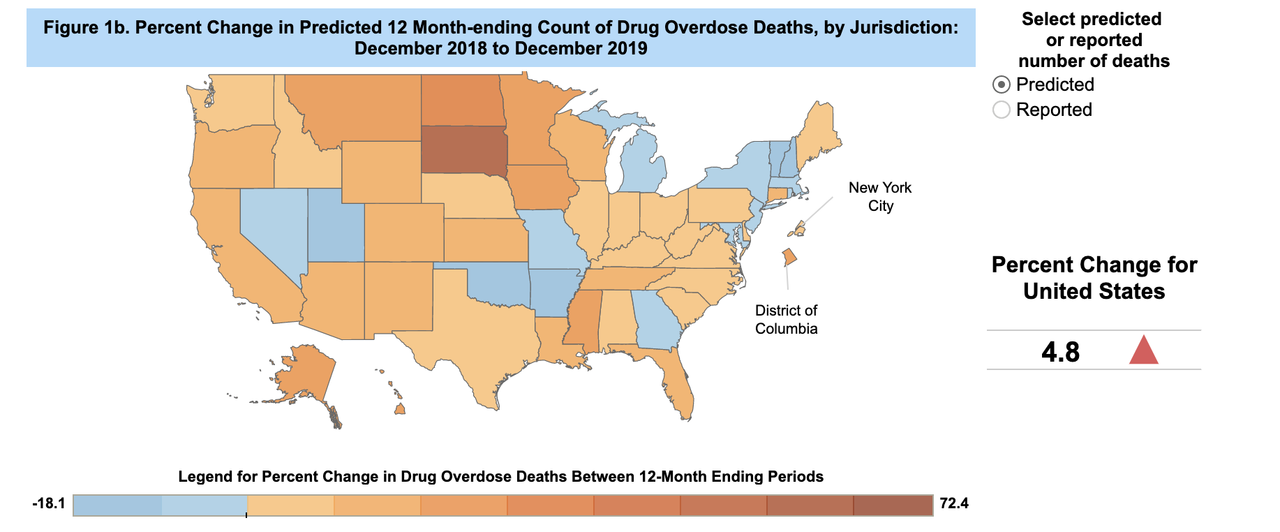
Yesterday, the CDC released its preliminary data on drug overdose deaths (the final report won’t land until December), and the organization found that the total for 2019 was 5% higher than the total from 2018. The data also topped the 2017 total, the last record number for annual overdose deaths, by just a few hundred deaths to mark a new annual record for drug-related deaths in the US.

Nearly 71,000 Americans died from drug overdoses last year, per the CDC data. 70,980 died last year, per the preliminary data. That’s compared with 70,699 from 2017, the last record high, the CDC reports.

Soaring overdose deaths in the US have helped drag down average life expectancy for 3 straight years, and by the looks of it, No. 4 might be right around the corner.

Opioids led the pack once again, thanks largely to the deadly synthetic opioid fentanyl. So far this year, deaths are on track to surpass their totals from last year.

Drug deaths have risen an average of 13 percent so far this year over last year, according to mortality data from local and state governments collected by The New York Times, covering 40 percent of the U.S. population. If this trend continues for the rest of the year, it will be the sharpest increase in annual drug deaths since 2016, when a class of synthetic opioids known as fentanyls first made significant inroads in the country’s illicit drug supply.

One of the most important trends, per the NYT, is the fact that deadly fentanyl is moving west.

Fentanyl had been confined mostly to New England and other parts of the East, where it was generally found as an adulterant in powdered heroin. But in recent years, fentanyl and other potent synthetic opioids have been blamed for an increasing number of overdose deaths in California, Arizona and other Western states.

Ironically, the New York Times reported that the number of drug-related deaths has probably continued to climb in 2020 as the pandemic cuts off access to needle-exchange vans and other resources that hand out fresh needles and the overdose-reversal medication naloxone.

With the pandemic disrupting treatment centers, syringe exchanges and other places that help people with drug addiction, there may also be less naloxone — the overdose-reversing medication that has brought back thousands from the brink of death — on the streets. And there is at least anecdotal evidence that with the nation’s borders closed because of the pandemic, the illicit drug supply has been disrupted and has become less predictable. Constant changes in potency make it harder for people to judge the strength of the drugs they’re using.

“The inconsistency of our drug supply right now is at an all-time high,” said Chad Sabora, the co-founder and executive director of the Missouri Network for Opiate Reform and Recovery.

Here’s how the number of drug deaths changed across the country. While the northeast (with the notable exception of hard-hit Connecticut) has seen drug deaths ebb, the midwest and the mountain west are still in trouble.

The biggest percentage increase across the US was found in South Dakota, with a more than 50% increase (though, keep in mind, it’s South Dakota, so percentage change isn’t as meaningful as the overall number of new cases.

via ZeroHedge News https://ift.tt/3h5sJ2i Tyler Durden

The Lost Boys? The White Working Class Is Being Left Behind

The Lost Boys? The White Working Class Is Being Left Behind

Tyler Durden

Fri, 07/17/2020 – 22:05

Authored by Christopher Snowdon via Spectator USA,

You can argue about the merits of pulling down statues, but it’s hard to make the case that mass protests serve no useful purpose. At the very least, they provoke debate and draw attention to uncomfortable topics that it might otherwise be easier to ignore. The recent protests have forced everyone to have difficult discussions about race, class, poverty and attainment. Any serious examination of the statistics shows that we’re pretty far from equal, but what the figures also show is that it’s wrong-headed and damaging to lump very different groups together.

In these discussions politicians often lazily assume that all BAME (Black, Asian and Minority Ethnic) people are the same, and that all white groups are equally privileged. But a proper look at the data shows not just that there are striking difference within BAME groups, but that the very worst-performing group of all are white working-class boys — the forgotten demographic.

It might seem divisive to compare different groups, but attainment in education and in life is relative and if we’re to help the worst off, we have to know who they are. We should help everyone who needs it — but it is vital to be able to compare groups to know who’s falling behind, relative to their peers. In the UK, Bangladeshi-Brits earn 20 percent less than whites on average, for instance, but those with Indian heritage are likely to earn 12 percent more. Black Britons on average earn 9 percent less, but Chinese earn 30 percent more. What these differences tell us is that employers aren’t systematically discriminating between people on the basis of their skin color, and that we have to look elsewhere to see the roots of inequality.

Ucas, the British university admissions service, can provide unique insight into these issues: it is the only outfit in the world to gather detailed information on all university applicants, including their age, gender, neighborhood and school type. This is collected along with data on who applied for which courses and who was accepted, and it is renewed in huge detail every year.

Much of the data shows predictable results: there is a gap between rich and poor, as you might expect in a UK state system where the best schools tend to be located in the most expensive areas. But there are surprising discoveries too: nearly half the children eligible for free school meals in inner London go on to higher education, but in the country outside London as a whole it is just 26 percent.

Black African British children outperform white children, whereas black Caribbean children tend to do worse. Poor Chinese girls (that is to say, those who qualify for free school meals) do better than rich white children. But, interestingly, the ethnic group least likely to get into university are whites. With the sole exception of Gypsy/Roma, every ethnic group attends university at a higher rate than the white British and, of the white British who do attend, most are middle class and 57 percent are female.  The least likely group to go on to higher education are poor white boys. Just 13 percent of them go on to higher education, less than any black or Asian group.

This is a trend that can also be seen in the GCSE data; only 17 percent of white British pupils eligible for free school meals achieve a strong pass in English and maths. Students categorized as Bangladeshi, Black African and Indian are more than twice as likely to do so. In 2007, the state sector saw 23 percent of black students go on to higher education; this was true for 22 percent of whites. So about the same. But at the last count, in 2018, the gap had widened to 11 points (41 percent for black students, 30 percent for whites). The children of the white working class are falling away from their peers, in danger of becoming lost.

Going to university is not the golden ticket it once was, but it requires stupefying naivety to believe that seven out of eight poor white boys take a sober look at the economics of higher education and choose to set up their own businesses instead. The trail of hard evidence runs cold once they leave school, but the prospects for those who can barely read and write are dreadful and we can get some idea of the consequences by looking at the ‘left behind’ areas where unemployment, crime and ‘deaths of despair’ are significantly higher than the national average.

Angus Deaton, a Nobel Laureate based at Princeton University, came up with the phrase ‘deaths of despair’ when he looked at the demographics of those suffering from alcoholism, depression and drug abuse. Suicides among whites, he found, was soaring and those who took their own lives tended to be poor and low-educated. His recently-published book on the subject (Deaths of Despair and the Future of Capitalism, co-written with Anne Case) tells the devastating story of what he calls ‘the decline of white working-class lives over the last half-century’.

Yet while white working-class males are the largest disadvantaged minority, their cause is the least fashionable. In the intersectional pyramid of victimhood, white males are at the bottom, tarnished by ideas of ‘toxic masculinity’ and ‘white privilege’ despite the fact that in Britain class has always been the most significant indicator of true privilege. It’s worrying, then, that any who attempt ‘positive action’ on behalf of poor white boys face a hostile reaction. Last year, Dulwich and Winchester colleges turned down a bequest of more than £1 million ($1.25 million) because the donor, Sir Bryan Thwaites, wanted the money ring-fenced for scholarships for white working-class boys. Peter Lampl, founder of the Sutton Trust, a charity whose stated mission is to improve social mobility, described Thwaites’s offer as ‘obnoxious’.

When Ben Bradley, the Conservative MP for Mansfield, tried to ask an ‘Equalities’ question about working-class white boys in parliament earlier this year, he was turned down by the Table Office because they do not have any ‘protected characteristics’. The concept of ‘protected characteristics’ was wheeled into UK law by Harriet Harman’s Equality Act, 10 years ago, and the Tories, then in opposition, took the rare step of voting for it. The nine protected characteristics include ‘race’, ‘sex’ and ‘sexual orientation’, but the Table Office is not alone in interpreting these as ‘non-white’, ‘female’ and ‘gay’.

Under the Equality Act, ‘positive discrimination’ remains technically unlawful, but the barely indistinguishable concept of ‘positive action’ is explicitly legal. Firms cannot have quotas, but they can set targets. Employers cannot refuse to look at job applications from people who lack protected characteristics, but by stating that ‘applications are particularly welcome’ from BAME, female or LBGTQ+ candidates they send a message that some need not apply.

In 2016 the BBC pledged that half its workforce and leadership would be female by 2020 despite less than 40 percent of Britain’s full-time workers being women. It also set an 8 percent target for LGBT employees, although only around 2 percent of the population identify as LGBT. This target has been comfortably exceeded, as has been the target of having 15 percent of employees from a BAME background. In the wake of the Black Lives Matter protests last month, the corporation raised this target to 20 per cent.

The BBC admits that people from ‘low and intermediate income households’ are hugely underrepresented in its workforce. But what does it do about it? Earlier this month Oxford University proudly reported that it was making ‘steady progress’ in its efforts to make its campuses ‘representative of wider society’. Of its most recent intake of British students, only 14 percent came from the poorest 40 percent of households.

This fits a pattern: at a push, we can hear acknowledgement of the ‘poor white male’ problem. But that’s as far as it ever goes. The underperformance of white boys and men is not considered to be a problem worth solving. When figures come out showing the stunning attainment gaps between boys and girls, the interest lasts for about a day. ‘It always got a few headlines,’ says Mary Curnock Cook, the former head of Ucas. ‘Where it never got any traction at all was in policy-making in government. I began to think that the subject of white boys is just too difficult for them, given the politicization of feminism and women’s equality.’

When I asked a teacher why white working-class boys have fallen so far behind, he gave me a short answer: girls are better behaved and immigrant parents are stricter. This is a generalization but nonetheless interesting: if it is the case that parenting is the problem, then it’s not clear how much the UK government can do. Perhaps the reluctance to discuss the subject stems from fear that such a discussion would lead to difficult territory about family structure, quality of parenting and — in short — culture. Perhaps politicians think it better to let the problem fester, and the children suffer, than to risk discussing it.

Last month, the British government announced that its commission on racial inequality would include an examination into the underperformance of working-class white boys at schools. Will it look deep into the causes? It might look at recent studies that suggest poor reading levels in schools is a huge part of the problem. And it might ask whether ‘positive action’ in the name of diversity has left white working-class boys behind.

via ZeroHedge News https://ift.tt/2CPWogY Tyler Durden

New US Diet Guidelines Will Limit Men To One Alcoholic Drink Per Day

New US Diet Guidelines Will Limit Men To One Alcoholic Drink Per Day

Tyler Durden

Fri, 07/17/2020 – 21:45

The US government already controls almost every aspect of your daily life. Soon, it will “instruct” you to drink less as well.

With most Americans suffering from one or more chronic diet-related health conditions, including obesity, heart disease, and certain cancers, an advisory panel told government agencies that it will endorse limiting alcoholic drink to one a day when alcohol is consumed. That’s the new advice experts are recommending for the U.S. Dietary Guidelines for Americans, which are scheduled to be updated later this year for the first time in five years. The guidelines now say men should limit themselves to two drinks a day, and that women should limit themselves to one. That advice has been in place since 1990.

The Dietary Guidelines Advisory Committee proposed federal departments should also recommend reducing consumption of added sugars from 10% of caloric intake to less than 6%, and that children younger than 2 shouldn’t drink sugar-sweetened beverages.

In the report released Wednesday, a committee of experts noted there isn’t adequate evidence to support different alcohol recommendations for men and women, and that research supports tightening the limit for men. U.S. health agencies that issue dietary guidelines aren’t required to adopt the committee’s recommendations.

“As a nation, our collective health would be better if people generally drank less,” said Dr. Timothy Naimi, an alcohol researcher at Boston University and one of the experts on the committee convened by federal officials.

The proposed advice shouldn’t be interpreted to mean that not having a drink on Thursday means you can have two on Friday, Naimi said. One drink is the equivalent of about one 12-ounce can of beer, a 5-ounce glass of wine or a shot of liquor.

The advice is based on links that researchers observed between drinking habits and all causes of death, including heart disease, cancer and car accidents, rather than a specific physical harm that alcohol might have. While such observational studies, common in food and nutrition science, do not establish a cause-and-effect relationship, they are often the best evidence available, so experts use them to give guidance.

With alcohol, Naimi said two drinks a day was associated with an increased risk of death compared with one drink a day. While the increase was modest, he said that it was notable enough for the committee to recommend updating the advice.

Whether the proposed new advice would influence behavior isn’t clear. Many Americans already exceed the current advice on alcohol limits, Naimi noted. Still, he said most people could generally benefit from any reduction in alcohol, even if they’re not within the advised limits.

The report noted that the guidelines may be aspirational, but are important for “stimulating thought around behavior change.”

The guidelines are based on the overall health of a population, and an individual’s risk from drinking could vary depending on a variety of factors and health habits, said Dr. Dariush Mozaffarian, a professor of nutrition at Tufts University.

Mozaffarian also noted that many people misinterpret the current advice to mean they should have one or two drinks a day. The limits are meant for people who already drink. Hilarious, he felt the need to explain that the guidelines do not recommend that people who do not drink alcohol to start doing so.

Even if most Americans aren’t familiar with the details of the U.S. Dietary Guidelines, they’re subject of intense lobbying because of their power to shape the advice dispensed by doctors and what’s served in federal food programs, including school lunches, as federal food assistance programs, military rations, and doctors’ dietary recommendations reflect the guidelines.

Federal officials are expected to issue the updated guidelines by the end of the year, after considering public comments and input from other agencies. We expect they will be substantially “watered down” by the time of the final draft.

via ZeroHedge News https://ift.tt/3eECD9I Tyler Durden

Michigan Supreme Court Rules Government Can’t Seize Entire Value of House over Property Tax Delinquency Worth $8.41

Rafaeli

In an important decision issued earlier today, the Michigan Supreme Court unanimously concluded that a county government many not seize the entire value of a house in order to collect $8.41 in delinquent property taxes. In Rafaeli, LLC v. Oakland County, the court concluded that such a tax “forfeiture” qualifies as a taking under the Michigan state constitution, and the government therefore must pay the owners compensation equal to “any proceeds from the tax-foreclosure sale in excess of the delinquent taxes, interest, penalties, and fees reasonably related to the foreclosure and sale of the property—no more, no less.” The court’s ruling  is an important victory for constitutional property rights—and also for basic decency and fairness.

The figure in the previous paragraph is not a typo. Oakland County really did seize an entire house, sell it, and kept all the money for itself, over a mere $8.41 in unpaid taxes. That’s $8.41, not $841 or $8410. The Pacific Legal Foundation, which represented the property owners in the case, has a helpful description of the facts:

In 2014, Oakland County, Michigan foreclosed on a home owned by Uri Rafaeli’s business—Rafaeli, LLC—over an $8.41 tax debt. The County sold the property for $24,500, and kept profits. Ditto for Andre Ohanessian, when the County seized and sold his property for $82,000, and pocketed every penny left over from the $6,000 tax debt. While most states refund the surplus, Michigan is among a handful of states that allow property theft to fill government coffers. PLF asked the Michigan Supreme Court to strike down this bureaucratic theft and restore our clients’ constitutional rights.

In 2011, Uri Rafaeli’s business—Rafaeli, LLC—purchased a modest rental property in Southfield, Michigan for $60,000. Rafaeli inadvertently underpaid the property’s 2011 taxes. He paid his 2012, 2013 taxes in full. After learning he owed money for 2011, Rafaeli tried to pay the full 2011 tax debt in January, 2013. But he mistakenly did not factor in interest growing on the debt, and underpaid by $8.41. The County foreclosed on the property, sold it for $24,500, and pocket the massive windfall at Rafaeli’s expense.

Similarly, Andre Ohanessian owed $6,000 in taxes, penalties, interest, and fees when the County foreclosed and sold his property for $82,000. As with Rafaeli, the County kept all profits from the sale, rather than reimbursing Ohanessian.

As the PLF summary notes, the Rafaeli case (which involved the $8.41 delinquency) as paired with a less extreme, but still egregious, case where the County seized the entire value of a property worth $82,000 in order to pay off a $6000 delinquency.

The majority opinion, joined by six of the seven justices on the Court, concluded that the seizure is a taking of private property requiring just compensation for the following reasons:

[E]arly in Michigan’s statehood, it was commonly understood that the government could not collect more in taxes than what was owed, nor could it sell more land than necessary to collect unpaid taxes.

Further, in the context of eminent domain, it was axiomatic that the government shall take no more property than necessary for the particular public use for which the taking was done….

[T]hese fundamental principles—that the government shall not collect more taxes than are owed, nor shall it take more property than is necessary to serve the public—protect taxpayers and property owners alike from government overreach.

The majority opinion carefully traces these limitations on government’s power to seize property to pay delinquent taxes all the way back to the Magna Carta and early English common law. The owner’s entitlement to the residual value of the property is, accordingly, a property right protected by the takings clause of the state constitution, and perhaps also by the federal Takings Clause of the Fifth Amendment, though the court did not rule on the basis of the latter, and carefully noted that “we must keep in mind that Michigan’s Takings Clause has been interpreted to afford property owners greater protection than its federal counterpart when it comes to the state’s ability to take private property for a public use under the power of eminent domain.”

People who are not experts in takings law can be forgiven for thinking that all of the above should be obvious. Of course it is unconstitutional for the government to seize the entire value of a $24,000 home to pay off $8.41 in delinquent taxes. Seizing the entire value of an $82,000 house to pay off a $6000 delinquency is only slightly less awful.

Reaching these obvious conclusions shouldn’t require a state supreme court decision with almost 100 pages of majority and concurring opinions! Moreover, a reasonable local government should never  have tried to seize a house over a mere $8.41 in the first place—even if its lawyers advised them they might be able to get away with it. It’s the kind of case that gives lawyers —and taxes—a bad name.

I sympathize with such reactions. In fairness, however, the legal issue in the case is not as simple as it should be, because the seizure of the property was legally classified as a tax “forfeiture.” In its ill-advised 1996 ruling in Bennis v. Michigan, the US Supreme Court ruled that civil asset forfeitures do not qualify as takings, and therefore don’t require compensation under the Takings Clause of the Fifth Amendment. There are similar rulings under the takings clauses of many state constitutions. The lower court ruling in favor of the government relied heavily on Bennis.

The Michigan Supreme Court distinguishes Bennis and other similar decisions on the following grounds:

 [T]he panel majority erred by relying on Bennis v Michigan, a case involving civil-asset forfeiture, to conclude that no taking occurred in this case.

First, the [state General Property Tax Act] makes clear that “forfeiture” simply permits defendants to seek a judgment of foreclosure. Forfeiture does not affect title, nor does it give the county treasurer…  any rights, titles, or interests to the forfeited property. Therefore, we reject the premise that plaintiffs “forfeited” all rights, titles, and interests they had in their properties by failing to pay their real-property taxes.

Second, Bennis is distinguishable because the purpose of civil-asset forfeiture is
different than the purpose of the GPTA provisions at issue here. Bennis recognized that
civil-asset forfeiture “serves, at least in part, to punish the owner” of property… But the
GPTA is not punitive in nature. Its aim is to encourage the timely payment of property
taxes and to return tax-delinquent properties to their tax-generating status, not necessarily to punish property owners for failing to pay their property taxes……

We conclude that Bennis is distinguishable and provides us little guidance as it relates to plaintiffs’ takings claim. The Court’s holding in Bennis focused narrowly on forfeited property that was used as an instrumentality for criminal activity and the government’s interest in deterring illegal activity. In this case, plaintiffs did not use their properties for illicit purposes. They simply failed to pay their property taxes, which is not a criminal offense.

These are reasonable distinctions. But it’s worth noting that civil asset forfeiture laws in many states do not require the government to prove that the owner had actually committed a crime, or even charge her with one.  They  therefore often allow law enforcement agencies to seize property without compensation even if the owner did nothing wrong, and had no idea that their property might have been used for an illicit purpose. Like excessive tax forfeitures, asset forfeitures disproportionately victimize the poor, small businesses, ethnic minorities, and others who may lack the knowledge and resources to conduct a prolonged legal battle against difficult odds.

Thus, while the majority is right to emphasize the distinction between forfeiture laws intended to deter and punish “criminal activity” and those whose purpose is only to secure payment of delinquent taxes, the difference between the two is not as great as it may at first seem. Indeed, in the tax forfeiture case, the government is at least required to show that the owner really is delinquent on his or her taxes before seizing any property. By contrast, civil asset forfeiture can be used to seize property even if the owner was never shown to have violated any laws.

To my mind, all of this underscores the wrongness of Bennis and the need for tighter enforcement of constitutional constraints on civil asset forfeiture. Important progress has been made on that front in recent years, but not enough. The Michigan Supreme Court have ruled that Bennis’ interpretation of the federal Takings Clause doesn’t govern Michigan’s state Takings Clause, which—as they noted—offers stronger protection for property rights. I can understand, however, that they may have preferred not to make such a far-reaching decision in a case where a narrower ruling limited to tax forfeitures was possible.

In a concurring opinion, Justice David Viviano agreed with the conclusion that a taking had occurred, but took issue with the majority’s reasoning, and also with its analysis of how much compensation is owed. I disagree with some of his reasoning. But I do agree on the fundamental point that the majority took an overly narrow view of the scope of the owners’ property rights:

[T]he majority’s focus on the surplus proceeds as the relevant property, and thus the postsale retention as the taking, produces puzzling results. Because “a property owner has a claim for a violation of the Takings Clause as soon as a government takes his property for public use without paying for it”,… under the majority’s theory, no constitutional issues occur until the surplus proceeds are retained. It does not matter that once title has vested in the government without chance of redemption, the taxpayer’s property—his or her equity—has been taken. Consequently, the majority’s view of the case would seemingly be that if the property does not sell at auction and is simply transferred to a governmental unit, the taxpayer is out of luck: no proceeds, let alone a surplus, have been produced or retained by the government…. Perhaps worse still, governmental units have numerous opportunities to purchase the property for the minimum bid, i.e., for the debt (and costs), and thus obtain it for an amount that will usually be much less than fair market value. Yet in those cases, too, because no surplus would result, the majority leaves the taxpayer without a remedy. The better view, under the law described above, is that the property taken is the taxpayer’s equity and that this occurs when title vests in the government with no opportunity for redemption.

As Viviano explains, the property right lost by the owner is not simply a right to the proceeds of a foreclosure sale, but the “equity” he holds in the property as a whole. This in turn means that he or she is owed compensation equal to the fair market value of that right (minus the value of the tax delinquency and related fines and expenses), not merely whatever money a foreclosure auction brings in over and above the tax delinquency.

Justice Viviano is also right to worry that, under the majority’s approach, the state or local government conducting the auction will have an incentive to take low-ball bids or otherwise proceed in a way that denies the owner the full value of the land in question. After all, they have little if any incentive to try to maximize profits in the way that an owner selling her own property would typically do. To the contrary, the county’s goal will usually be to get the money it is entitled to, as quickly as possible. In the process, they could easily shortchange the owner.

For these reasons, the Rafaeli case will not end all tax forfeiture shenanigans in Michigan. In addition, as the majority notes, courts in several other states have ruled that their local governments are entitled to the full value of any property seized through a tax forfeiture, even if it is greater than necessary to pay off the tax delinquency in question. The Michigan decision doesn’t apply to these other jurisdictions.

Despite these limitations, the Rafaeli decision is an important victory for property rights, and a valuable tool for curbing abusive tax forfeitures. Hopefully, courts in other states with similar policies will begin to follow Michigan’s example. They would also do well to adopt Viviano’s analysis of the property rights at stake, rather than the majority’s.

NOTE: As pointed out above, this case was litigated by the Pacific Legal Foundation. My wife Alison Somin took a position at PLF earlier this year, though she has no involvement in the Rafaeli case. My own involvement in takings issues dates back many years, long before I even met Alison. Nevertheless, I am attaching a disclosure like this one to all posts about cases litigated by PLF, so that no one can claim I am somehow hiding a conflict of interest.

from Latest – Reason.com https://ift.tt/2ZH0Ise
via IFTTT