Inflation Expectations Have Become Unanchored

Inflation Expectations Have Become Unanchored

Via SchiffGold.com,

American consumers aren’t buying the transitory inflation narrative.

Even after five straight months of annual CPI increases over 5%, Jerome Powell continues to insist inflation is “transitory” and the result of a “supply chain problem.” But according to the New York Federal Reserve Survey of Consumer Expectations, people aren’t buying this story. They expect inflation to be running at 5.7% a year from now. And in three years, they still expect the inflation rate to be at 4.2%.

In its most recent FOMC statement, the Fed claimed: “the Committee will aim to achieve inflation moderately above 2% for some time so that inflation averages 2% over time and longer‑term inflation expectations remain well-anchored at 2%.”

As WolfStreet put it, inflation isn’t anchored at all. It’s totally unanchored and spiking to high heaven.

In March 2022, consumers expected inflation to be at 3.2%. It’s clear that expectations for higher and higher prices are rising. As WolfStreet explained, as actual prices have surged, consumers can see where this is going.

They can see that even the Fed is starting to back off its mantra that this red-hot inflation is just ‘temporary,’ and they’re not fooled by some Fed officials’ efforts to redefine ‘temporary’ to mean the opposite of temporary. It’s at the point when consumers think inflation will remain high that they change their behavior and contribute to even higher inflation.”

Inflation expectations play into the inflationary spiral. In theory, when consumers expect prices to rapidly rise, it impacts their behavior. They begin to push purchases forward to avoid higher prices later. They also become willing to accept higher prices rather than walking away. This altered behavior can theoretically increase inflationary pressure in the future.

Consumer inflation expectations a year from now for many important categories are even higher than 5.7%.

  • Rent: +10.0% (new record)

  • Food prices: +9.1% (new record)

  • Gasoline prices: +9.4%

  • Health care: +9.4%

  • College education: +7.4%.

Meanwhile, the Fed refuses to take any responsibility for inflationary pressure. There is no acknowledgment that trillions in money printing might be contributing to rising prices.

In the 20 months since March 2020, the Fed has increased the assets on its balance sheet by $4.2 trillion. It’s nearly doubled its total assets to $8.6 trillion. Meanwhile, the US government unleashed over $5 trillion in deficit spending. That totals nearly $10 trillion in stimulus.

It was, by definition, trillions in inflation.

In one sense, the Fed and the mainstream pundits are right. Consumer demand is up and Americans are spending a lot of money. But they are right for the wrong reason, as Mises Institute managing editor Ryan McMaken pointed out.

If we look at the immense amount of new money created over the past eighteen months, we should absolutely expect people to have more money sloshing around. But this also means a lot more pressure on the logistical infrastructure as people buy up more consumer goods. The idea that supply chain problems are ‘driving inflation’ gets the causation backward. It’s money supply inflation that’s causing much of the supply chain’s problems. Not the other way around.”

Regardless, Americans aren’t buying the Fed’s transitory narrative. They can see the writing on the price tags. Inflation expectations are unanchored. This is just one more brick in the inflationary wall.

Tyler Durden
Tue, 11/09/2021 – 11:22

via ZeroHedge News https://ift.tt/3Hgj9rs Tyler Durden

Linda Greenhouse Asks If Amy Coney Barrett is “Living Phyllis Schlafly’s Unrealized Dream”

Noah Feldman, who has been getting a lot of play recently in the New York Times, reviewed Linda Greenhouse’s new book, Justice on the Brink. He flagged a passage in which Greenhouse compares Justice Barrett to Phyllis Schlafly. I caved and downloaded the Kindle version of the book. Here is the passage:

Forty years later, more than a few people looked at Amy Coney Barrett and saw Phyllis Schlafly. And how could they not, given the similarities in the two women’s biographies? That Schlafly and Barrett, one in death and one striding toward a bright future, both filled the public screen in 2020 was just a coincidence—or was it? Seen from one perspective, it was Phyllis Schlafly who made Amy Coney Barrett possible.

During Barrett’s confirmation hearing, Lindsey Graham served her a softball question: “People say that you’re a female Scalia. What would you say?” Barrett began her answer with her now familiar phrases about Scalia’s approach to constitutional and statutory interpretation. Then she caught herself. “I want to be careful to say,” she told Graham, “that if I’m confirmed, you would not be getting Justice Scalia. You would be getting Justice Barrett.” No one could doubt the validity of that statement. Justice Barrett, not Justice Scalia. Justice Barrett, not Justice Ginsburg. Or Justice Barrett, living Phyllis Schlafly’s unrealized dream?

Feldman opines:

Maybe because it’s hard to write a drama in which the villain hasn’t done anything terrible yet, Greenhouse makes an uncharacteristic misstep in a brief excursus that compares the new justice to the late Phyllis Schlafly. To be sure, Schlafly was an important figure in the early anti-abortion movement. But her anti-feminist crusade against women in the workplace sits oddly with Barrett’s lifelong pursuit of a full-time career as a law professor and judge while raising seven (no, that’s not a typo) children. The only motivation for the invocation of Schlafly seems to be that, as Greenhouse notes, she was the subject of a television mini-series in 2020, and that both were lawyers with large families. “Forty years later, more than a few people looked at Amy Coney Barrett and saw Phyllis Schlafly,” Greenhouse writes, with no indication of who those people were. “And how could they not, given the similarity in the two women’s biographies?” This isn’t even guilt by association. It’s guilt by free association.

I’ll try to review the book later.

from Latest – Reason.com https://ift.tt/3H8wqSy
via IFTTT

Linda Greenhouse Asks If Amy Coney Barrett is “Living Phyllis Schlafly’s Unrealized Dream”

Noah Feldman, who has been getting a lot of play recently in the New York Times, reviewed Linda Greenhouse’s new book, Justice on the Brink. He flagged a passage in which Greenhouse compares Justice Barrett to Phyllis Schlafly. I caved and downloaded the Kindle version of the book. Here is the passage:

Forty years later, more than a few people looked at Amy Coney Barrett and saw Phyllis Schlafly. And how could they not, given the similarities in the two women’s biographies? That Schlafly and Barrett, one in death and one striding toward a bright future, both filled the public screen in 2020 was just a coincidence—or was it? Seen from one perspective, it was Phyllis Schlafly who made Amy Coney Barrett possible.

During Barrett’s confirmation hearing, Lindsey Graham served her a softball question: “People say that you’re a female Scalia. What would you say?” Barrett began her answer with her now familiar phrases about Scalia’s approach to constitutional and statutory interpretation. Then she caught herself. “I want to be careful to say,” she told Graham, “that if I’m confirmed, you would not be getting Justice Scalia. You would be getting Justice Barrett.” No one could doubt the validity of that statement. Justice Barrett, not Justice Scalia. Justice Barrett, not Justice Ginsburg. Or Justice Barrett, living Phyllis Schlafly’s unrealized dream?

Feldman opines:

Maybe because it’s hard to write a drama in which the villain hasn’t done anything terrible yet, Greenhouse makes an uncharacteristic misstep in a brief excursus that compares the new justice to the late Phyllis Schlafly. To be sure, Schlafly was an important figure in the early anti-abortion movement. But her anti-feminist crusade against women in the workplace sits oddly with Barrett’s lifelong pursuit of a full-time career as a law professor and judge while raising seven (no, that’s not a typo) children. The only motivation for the invocation of Schlafly seems to be that, as Greenhouse notes, she was the subject of a television mini-series in 2020, and that both were lawyers with large families. “Forty years later, more than a few people looked at Amy Coney Barrett and saw Phyllis Schlafly,” Greenhouse writes, with no indication of who those people were. “And how could they not, given the similarity in the two women’s biographies?” This isn’t even guilt by association. It’s guilt by free association.

I’ll try to review the book later.

from Latest – Reason.com https://ift.tt/3H8wqSy
via IFTTT

Michael Burry Claims Musk Selling Tesla Shares To Cover Personal Debts

Michael Burry Claims Musk Selling Tesla Shares To Cover Personal Debts

Famous short seller Michael Burry of The Big Short game briefly emerged from a his latest self-imposed twitter exile to offer his thoughts on why Elon Musk might now all of a sudden be in the mood to start selling stock. Shortly thereafter, on Tuesday, Tesla shares plunged 10% in just minutes, leading many to speculate as to whether or not Elon Musk had started selling his personal stock. 

Burry jabbed at Musk this week, suggesting that the Tesla CEO may need to sell his shares because he had 88 million of them pledged as loan collateral. 

“Regarding what @elonmusk NEEDS to sell because of the proposed unrealized gains tax, or to #solveworldhunger, or … well, there is the matter of the tax-free cash he took out in the form of personal loans backed by 88.3 million of his shares at June 30th,” Burry wrote in a now deleted Tweet that was captured by the Business Insider tabloid

Burry also suggested that Musk’s narratives about “solving world hunger” or “unrealized tax gains” are diversions from the real reason the Tesla CEO is selling stock. Instead, the iconic investor insinuated that Musk needs to service the loans he took out against his shares.

Musk had 41% of his shares pledged as collateral as of December 2020 and 48% as of June 2020, Insider reported.

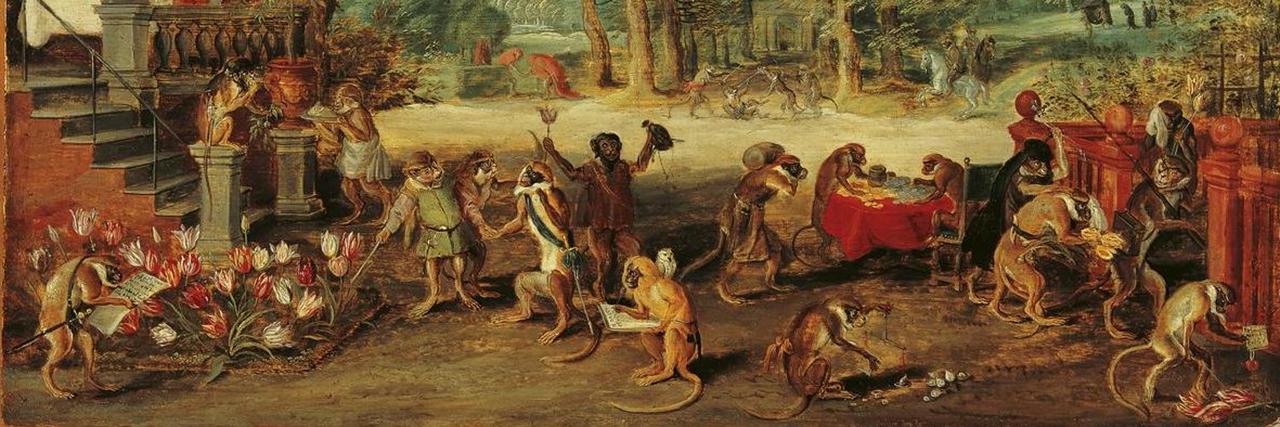
As he usually does, Burry also drew comparisons between today’s market and the Dutch Tulip bubble. He has made his Twitter header a Brueghel painting called “Satire of the Tulip Mania,” which shows tulip “investors” as monkeys, speculating, taking on debt, and fighting – all over the “mania” in tulips that took place. 

Burry has been vocal about warning about our current stock market bubble.

“People say I didn’t warn last time. I did, but no one listened. So I warn this time. And still, no one listens. But I will have proof I warned,” he Tweeted about markets about a year ago. 

He also commented on Tesla golden child Cathie Wood, earlier in the year, Tweeting: “It is too early, she is too hot, and, today, short sellers are timid, but Wall Street will be ruthless in the end.”

Burry, recall, revealed a huge Tesla short earlier in 2021 but as of one month ago he was no longer betting against Tesla and said that his position was just a trade.

Burry has also been vocal warning against a bitcoin bubble. Of course, if he was also short the crypto space in addition to TSLA, his losses in 2021 could be Jess Livermore-sized….


Tyler Durden
Tue, 11/09/2021 – 11:03

via ZeroHedge News https://ift.tt/3kof1vx Tyler Durden

Rabobank: We All Know That If Stocks Slump, The Fed Will Boost QE To Push Them Back Up

Rabobank: We All Know That If Stocks Slump, The Fed Will Boost QE To Push Them Back Up

By Michael Every of Rabobank

The Fed’s bi-annual Financial Stability Report is making headlines: “Prices of risky assets keep rising, making them more susceptible to perilous crashes if the economy takes a turn for the worse.” It also notes asset prices remain vulnerable to significant declines should investor risk sentiment deteriorate, or if progress on containing the virus disappoints. Presumably the latter is why the White House insists businesses proceed with its vaccine mandate despite a court ruling the process be halted: Think of the stocks, man, think of the stocks!

Except, of course, we all know that if stocks slump, the Fed will increase QE again to push them back up, because stocks are what it cares about. FOMC members themselves play the markets and would lose out personally if they let asset-prices crash. Moreover, how did asset prices get to such risky levels? Did a financialized, asset-based economy ‘just happen’? I recall Alan Greenspan warning about “excessive exuberance” once upon a time too.

Even if the Fed isn’t venal, it is political. Powell may or may not get reappointed as Chair, but today he is attending a conference presenting “research about diversity and inclusion in economics, finance, and central banking.” Is that a backdrop against which the Fed could pivot towards cracking down on financial excesses, when such hairshirt policy could be decried as running counter to demands for higher public spending and social justice? In short, it looks another reason for the Fed to stay loosey-goosey, even if this asset-based approach is actually driving massive economic inequality across all of society. Indeed, the Report notes:

  • Leverage continued to be high by historical standards at life insurance companies, and hedge fund leverage remained somewhat above its historical average.” – and who regulates financial leverage?

  • Structural vulnerabilities persist in some types of MMFs and other cash-management vehicles as well as in bond and bank loan mutual funds.” – and who regulates MMFs and mutual funds?

  • There are also funding-risk vulnerabilities in the growing stablecoin sector.” – and, yes, it’s the SEC who seem to have acted a little on crypto….because the Fed has sat there while a $3 trillion ‘print- your-own-money’ fest has happened right under its nose. Bitcoin is now at another record high of$67,000. And IOU Chicken, man, IOU Chicken.

Only in one area do we see a fire the Fed didn’t start or watch burn, as they note: “stresses in the real estate sector in China caused in part by China’s ongoing regulatory focus on leveraged institutions, as well as a sharp tightening of global financial conditions, especially in highly indebted emerging market economies (EMEs), could pose some risks to the US financial system. If realized, the effects of near-term risks could be amplified through the financial vulnerabilities identified in this report.”

Yet can argue China’s US-style housing-bubble driven economy is the underlying problem, not its attempt to finally deal with it in a way the US would never dream of. (Prompting further ‘green’, i.e., no debt red-lines crossed, Chinese developers’ bonds to suddenly collapse in normal trading.) The Fed is thus warning other people not to firefight for it!

The Report also noted that while corporate balance sheets are sound, “the expiration of government support programs and uncertainty over the course of the pandemic may still pose significant risks to households.” Time to get back to those low-wage jobs then, rather than hold out for better pay, or to pass the $1.75 trillion Build Back Better bill? We can guess which Janet Yellen, who often speaks as if she were running both Treasury and Fed, would prefer.

The Report also warns that “difficult-to-predict” volatility like the meme-‘stonks’ frenzy could become more frequent as “social media influences trading”: that, not ludicrous liquidity, “I see no ships” regulatory oversight, and a socio-economic paradigm which does not reward work, just asset speculation. The Fed don’t appear to mention the “difficult-to-predict” volatility in bond markets after their “We are going to take away the punchbowl – ooh, look, here’s a big bottle of Absinthe, drink up!” approach to monetary policy.

In short, it’s a worrying Fed headline. But burn after reading, because the arsonists are doing the firefighting. If you don’t believe that, ask yourself what the Fed is now going to do about any of the points it has listed. Even optimists should watch the final scene from the Cohen brothers’ Burn After Reading for guidance.

And ask the markets. US stock futures were happily in the green at time of writing, and “CALM” was the Bloomberg daybreak headline, which sums it up nicely. I am not sure how many dollars, crypto, or stonks the yacht pictured on a placid sea in the accompanying Bloomberg graphics is worth, but I am sure the majority of the Bloomberg readership, and the Fed, are far better acquainted with these kinds of social niceties than I am.

Meanwhile, the arsonists are also firefighting in geopolitical terms too. On top of a long and growing global list of potentially dangerous flashpoints, Belarus is now creating a refugee border crisis with Poland, Lithuania, and Latvia, playing with fire there, like someone else is in the Balkans. Poland is already doubling the size of its army: the EU are just doubling the size of their rhetoric. Von der Leyen warns sanctions could be placed on Belarus and “third-country airlines,” but this was already threatened in mid-October by Borrell and hasn’t happened – and where was the appropriate EU response to the Belarus plane incident back in May? Hypothetically, what happens if this is soon all linked to critical Russian gas or Belarussian potash exports to the EU? Nice way to divide it even more, if so.

Tyler Durden
Tue, 11/09/2021 – 10:40

via ZeroHedge News https://ift.tt/31ELNlv Tyler Durden

Tim Cook Admits Owning Crypto, Says “Reasonable Holding In A Diversified Portfolio”

Tim Cook Admits Owning Crypto, Says “Reasonable Holding In A Diversified Portfolio”

Apple CEO Tim Cook was interviewed by Andrew Ross Sorkin this morning as part of the DealBook Conference.

He revealed that he owns some crypto personally, says “he’s been interested in it for a while” and “thinks it’s reasonable to own it as part of a diversified portfolio.”

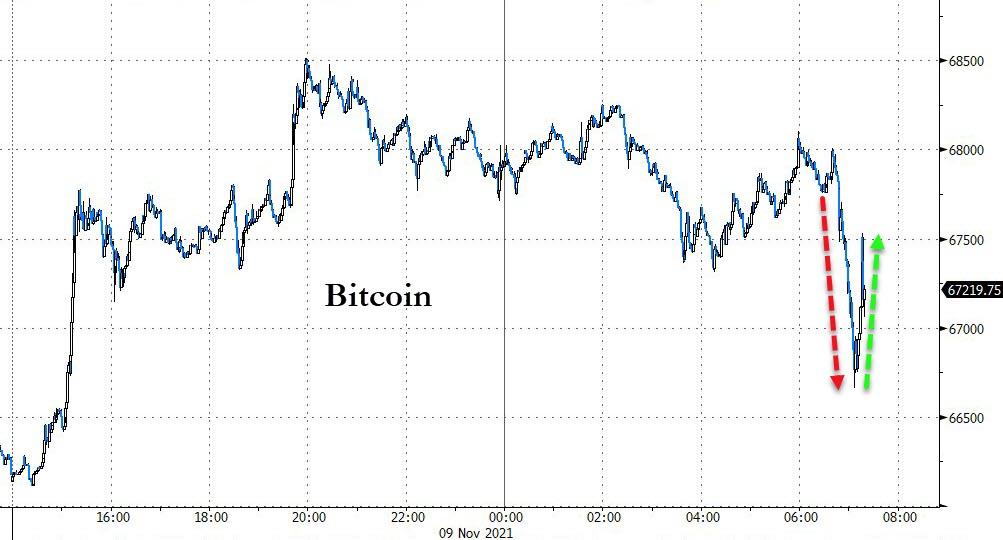
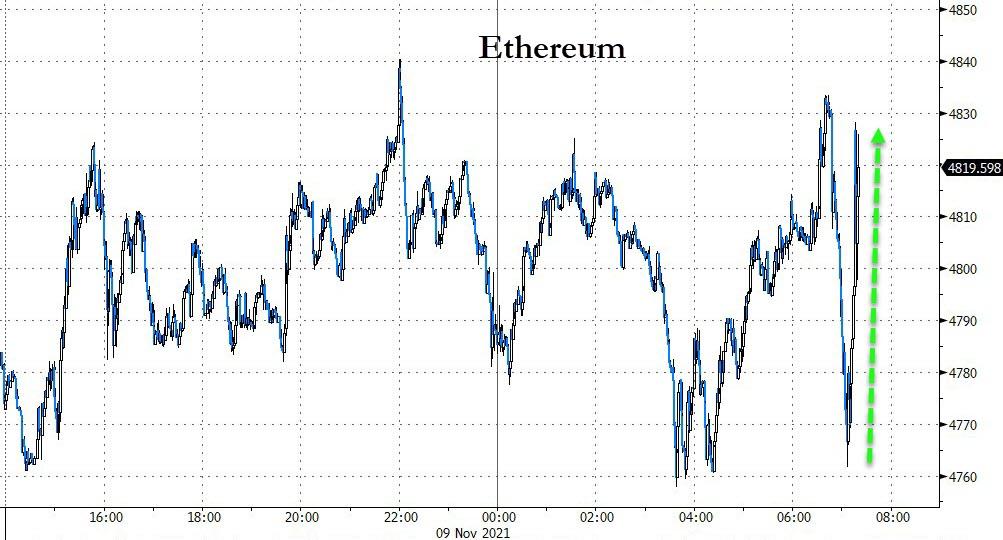
Crypto responded quickly (after getting hammered briefly before as TSLA shares tumbled).

Bitcoin and Ethereum both bounced back fast…

Cook clarified that his interest was from a “personal point of view” and dismissed suggestions that that Apple might take cryptocurrency in exchange for products as tender.

The tech-giant’s CEO also rejected the possibility of Apple buying cryptocurrency with corporate funds as an investment.

“I wouldn’t go invest in crypto, not because I wouldn’t invest my own money, but because I don’t think people buy Apple stock to get exposure to crypto,” Cook said.

Cook also noted that while Apple was looking at cryptocurrency technology, it’s “not something we have immediate plans to do.”

Tyler Durden
Tue, 11/09/2021 – 10:28

via ZeroHedge News https://ift.tt/3ouU0Rl Tyler Durden

Robinhood Down, Users Unable To Transfer Money Out

Robinhood Down, Users Unable To Transfer Money Out

Just hours after admitting that 5 million users’ email addresses were hacked, Robinhood is in trouble again.

DownDetector reports that a number of users are reporting outages on the system:

But perhaps more troublesome, it appears there are issues with money transfers, vis Robonhood’s status page:

Investigating – We’re investigating reports that some customers are experiencing issues transferring money in and out of Robinhood. We’re working to resolve this as soon as possible.

The outages and the money transfer blockage appears to have coincided with the crash in Tesla shares.

Tyler Durden
Tue, 11/09/2021 – 10:15

via ZeroHedge News https://ift.tt/31Mswif Tyler Durden

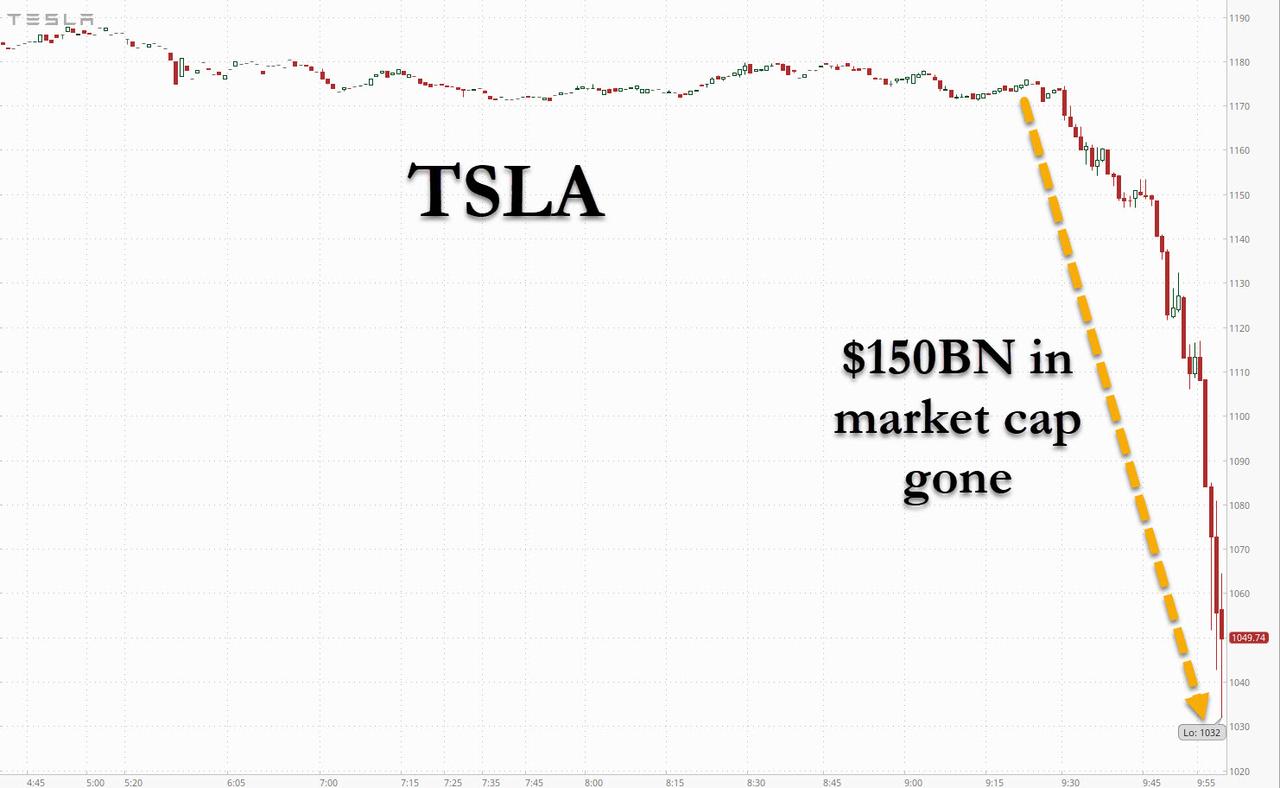
TSLA Plummets: $150BN In Market Cap Gone In Minutes; Did Elon Start Selling?

TSLA Plummets: $150BN In Market Cap Gone In Minutes; Did Elon Start Selling?

Many traders were confused by yesterday’s TSLA action where the stock rebounded and nearly closed green on Monday despite Musk’s rather explicit advance notice over the weekend that he would sell 10% of his TSLA holdings (after a twitter poll told him to do so). Well, maybe it has finally dawned on the market just how big the impact of Musk’s sale would be, or alternatively, he just started dumping because moments ago TSLA stock tumbled moments after the open, plunging more than 10%, and wiping away $150 billion in market cap.

Developing

Tyler Durden
Tue, 11/09/2021 – 10:01

via ZeroHedge News https://ift.tt/3oj1l6q Tyler Durden

Buchanan: Did Glasgow Deliver “Blah, Blah, Blah”?

Buchanan: Did Glasgow Deliver “Blah, Blah, Blah”?

Authored by Pat Buchanan,

At the end of the first week of the Glasgow climate summit, 100,000 protesters marched to denounce the attendees as phonies who will never honor their commitments to curb carbon emissions.

Despite pledges by 100 nations to reduce methane emissions by 30% by 2030, and by 20 nations, including the U.S., to end financing of new international fossil-fuel power plants, teenage climate superstar activist Greta Thunberg says the COP26 summit is a con:

“Two weeks of business as usual, blah, blah, blah!”

Thunberg has a point.

Commitments made in Scotland are not binding upon governments that, be they autocratic or democratic, do not subordinate their national interests to pledges ostentatiously made in global forums.

This Glasgow summit calls to mind the Kellogg-Briand Pact, which won a Nobel Peace Prize for Secretary of State Frank Kellogg,

On Aug. 27, 1928, 15 High Contracting Parties signed on to renounce war as an instrument of national policy. The signatories that day were the United States, Britain, Germany, Italy, Japan, France, Poland, Belgium, Czechoslovakia, Canada, South Africa, Australia, New Zealand, Ireland and India. Within 15 years, all 15 nations, Ireland alone excepted, were ensnared in the greatest war in history.

Like the pledges at the climate summit, the Kellogg-Briand Pact provided for no means of enforcement or sanctions against nations that failed to live up to their commitment.

Consider. China is the world’s largest emitter of carbon emissions, Russia the fourth largest, and Brazil the seventh largest worldwide.

Yet President Xi Jinping of China, President Vladimir Putin of Russia and President Jair Bolsonaro of Brazil did not show up at the summit. And President Joe Biden of the United States and Prime Minister Boris Johnson of Britain both fell asleep during the proceedings.

Glasgow is destined to fail because national interests invariably triumph over globalism. The demands of the people who keep regimes in power will be heard and heeded before the claims of the transnationals.

Biden, faced with a threat by Sen. Joe Manchin to sink his Build Back Better bill, summarily dropped a measure that would have imposed rising carbon taxes on fossil fuel plants and provided monetary rewards for clean energy facilities. Biden dropped it because his own and his party’s fortunes depend on enacting the legislation.

The protests in Scotland this weekend were far more colorful than the yearlong “yellow vest” protests in France. Yet, the French protests proved more effective and successful.

That movement originated with French motorists from rural areas who had long commutes and were protesting an increase in fuel taxes that was real and immediate. The French protests had a specific goal, and they succeeded in bringing about a reduction in the fuel taxes.

“King coal is dead!” we heard from the summit.

Really?

Coal is a foundational resource in Asia, and demand for coal grows as the populations and economies of Asia expand.

Coal accounts for 60-65% of the electricity generation in China and 68-73% in India, two nations that represent more than a third of the world’s population. Nations such as Australia depend upon the sale and shipment of coal as essential components of their exports.

Consider Scotland itself. Should it move to secede from Britain, will it gladly forfeit the North Sea oil and gas deposits that have proven so beneficial to Britain?

As America transitions to clean energy and electric vehicles, our own reliance upon China will grow. For China is today the world’s principal supplier of solar panels and the rare earth minerals vital to the batteries of electric cars.

To get to Glasgow, delegates, journalists and activists had to travel by commercial or private jet, and every restaurant, bar, hotel room and conference hall had to be lighted and heated by electricity generated by the kind of gas-, oil- and coal-fired plants that global elites want on the chopping block by midcentury. The carbon footprint of the Glasgow summit was not inconsiderable.

Now that the presidents and prime ministers have departed the global summit in its second and final week, we’re going to get down to the lick-log.

Writes the Washington Post: “In coming days … negotiators from nearly 200 countries will haggle over every word in every line of an agreement that could shape … how the rich countries of the world deliver on promises to help more vulnerable nations.”

Specifically, who will pony up the $100 billion per year promised to poor and developing nations at previous climate summits and never fully delivered? And who will pay the reparations for the “loss and damage” suffered by the poor and developing countries, previously caused by the industrialized nations of the world?

At root, almost every globalist and transnational institution and summit has a common feature: the endless transfer of wealth from the First World, the historic oppressors, to their alleged Third World victims.

These gatherings are to determine how much in reparations the latter can extort from a conscience-stricken West.

Will the GOP reject the shakedown?

Tyler Durden
Tue, 11/09/2021 – 09:55

via ZeroHedge News https://ift.tt/3D0kobH Tyler Durden

The Prosecution Had a Very Bad Day in the Kyle Rittenhouse Trial


rtrlthirteen028124

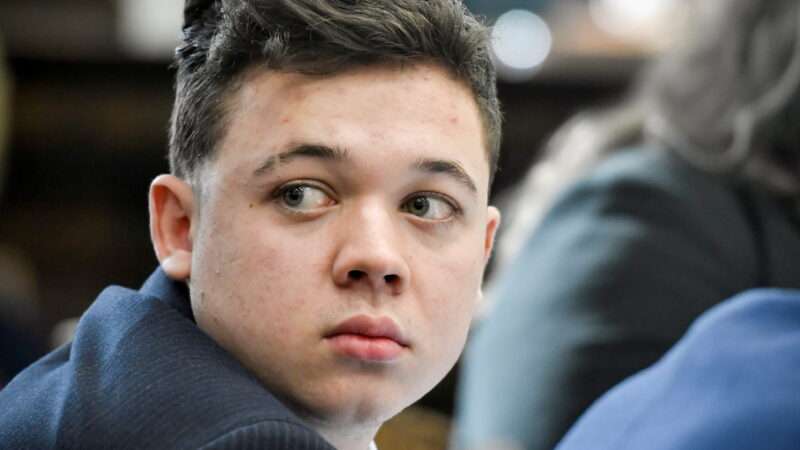
The trial of Kyle Rittenhouse—the 17-year-old who shot and killed two men and grievously injured a third during the riots in Kenosha, Wisconsin, following the police shooting of Jacob Blake last summer—entered its second week on Monday. The prosecution called to the stand Gaige Grosskreutz, who was shot by Rittenhouse but survived.

This did not go as planned, as Grosskreutz was very effectively cross-examined by Rittenhouse’s attorney, Corey Chirafisi. If anything, it seems likely that Grosskreutz’s answer would tend to support Rittenhouse’s contention that he acted in self-defense. Indeed, while the most anyone can do is speculate, there are good reasons to think the trial might culminate in an acquittal—a verdict that could cause a mass meltdown within the mainstream media and among Democratic politicians, who have already branded Rittenhouse a domestic terrorist.

Rittenhouse was 17 years old at the time of the shootings, and lived in Antioch, Illinois, a mile south of the Wisconsin border. On August 23, 2020, Kenosha police had shot Blake, a black man, during a confrontation with his girlfriend. Blake, who had a warrant out for his arrest on sexual assault charges, disobeyed police orders and instead walked over to his girlfriend’s vehicle; police claimed they feared he was reaching for a weapon and opened fire. Blake survived the encounter, but was paralyzed.

Coming just a few weeks after the police shooting of George Floyd, the Blake incident generated mass protests and considerable violence in Kenosha, with protesters settings cars and buildings on fire. By the night of August 25, armed militia groups were patrolling the city in an attempt to stop the riots.

Rittenhouse ventured into Kenosha, armed with a medical kit and an AR-15 that had been acquired for him by a friend, since Rittenhouse was too young to buy it. His stated purpose was to defend small businesses that were under threat of arson and looting; he was eventually surrounded by protesters during a series of encounters. Video footage of the encounters showed Rittenhouse trying to move away from them, but after a warning shot was fired by another man, Rittenhouse turned back and engaged Joseph Rosenbaum, a protester who tried to grab his gun. Rittenhouse shot him four times, killing him.

Rittenhouse was then chased by protesters, tripped and fell, and was attacked by a man named Anthony Huber, who struck him with a skateboard. Rittenhouse shot and killed him as well. He then shot Grosskreutz, who was armed with a gun and moving toward him.

Rittenhouse was charged with reckless homicide, intentional homicide, and attempted homicide for the three shootings. His attorneys have argued that he acted in self-defense, and rationally feared for his life in each of the three instances.

Grosskreutz may have inadvertently made that argument more plausible for the jury. When cross-examined by the defense on Monday, he confirmed that Rittenhouse did not shoot him until after he had pointed his own handgun at Rittenhouse.

“It wasn’t until you pointed your gun at him, advanced on him…that he fired, right?” asked Chirafisi.

“Correct,” Grosskreutz replied.

Many in the media have focused the case against Rittenhouse on the fact that he foolishly chose to inject himself into a chaotic situation where trouble was assured: He didn’t belong there, and thus he bears responsibility for the deaths. It’s perfectly fine to scrutinize Rittenhouse’s rationale, and to lay moral blame for what happened at his feet. But his self-defense claim has absolutely nothing to do with any of that—it is only about whether he reasonably believed he was in danger at the moment he fired those shots. Grosskreutz’s testimony gives significant credence to Rittenhouse’s contention that such a belief was valid.

It’s impossible to say for certain how the trial will conclude, of course. But if Rittenhouse is acquitted, it will not necessarily be because the justice system is dead, but rather, because the prosecution failed to establish beyond a reasonable doubt that Rittenhouses’s actions were unreasonable at the moments they occurred.


FREE MINDS

Bari Weiss’ Substack announced an interesting venture on Monday: a brand new university. Pano Kanelos, formerly the president of St. John’s College, will serve as the inaugural president at the University of Austin, which was born of conversations between Weiss, Niall Ferguson, Arthur Brooks, Joe Lonsdale, and other figures who have long criticized the ideological conformity and crisis of free expression on modern college campuses.

According to Kanelos:

We count among our numbers university presidents: Robert Zimmer, Larry Summers, John Nunes, and Gordon Gee, and leading academics, such as Steven Pinker, Deirdre McCloskey, Leon Kass, Jonathan Haidt,  Glenn Loury, Joshua Katz, Vickie Sullivan, Geoffrey Stone, Bill McClay, and Tyler Cowen.

We are also joined by journalists, artists, philanthropists, researchers, and public intellectuals, including Lex Fridman, Andrew Sullivan, Rob Henderson, Caitlin Flanagan, David Mamet, Ayaan Hirsi Ali, Sohrab Ahmari, Stacy Hock, Jonathan Rauch, and Nadine Strossen.

We are a dedicated crew that grows by the day. Our backgrounds and experiences are diverse; our political views differ. What unites us is a common dismay at the state of modern academia and a recognition that we can no longer wait for the cavalry. And so we must be the cavalry.

It will surely seem retro—perhaps even countercultural—in an era of massive open online courses and distance learning to build an actual school in an actual building with as few screens as possible. But sometimes there is wisdom in things that have endured.

Weiss wrote on Twitter that the university will “welcome witches who refuse to burn.”

To learn more about who and what is involved, watch the video below:


FREE MARKETS

The Biden administration defended its vaccine mandate for private employers in court on Monday, arguing that the requirement is necessary to save lives. According to Politico:

The Biden administration told a federal court Monday that a stay of its vaccinate-or-test requirement for private employers “would likely cost dozens or even hundreds of lives per day.”

Responding to a temporary stay imposed by the Fifth Circuit Court of Appeals on Saturday, the administration argued that the Occupational Safety and Health Administration was well within its authority to issue the requirements requiring employees at large businesses to be vaccinated against Covid-19 or tested weekly.

The states, businesses and religious groups that requested the stay aren’t likely to succeed given earlier court rulings, federal law and “the considerable evidence that OSHA analyzed and discussed when issuing” the requirement, attorneys for OSHA and the Labor Department told the court.

“Nor have petitioners shown that their claimed injuries outweigh the harm of staying a Standard that will save thousands of lives and prevent hundreds of thousands of hospitalizations,” the filing added.

The administration also argued there aren’t grounds for “emergency” relief because the effects of the mandate won’t be in place for another month.

The mandate—an ill-considered and likely unconstitutional expansion of federal authority—is slated to take effect on January 4.


QUICK HITS

• Any Democrats who are still in denial about the role that COVID-related school closures played in handing the Virginia gubernatorial election to the Republican challenger, Glenn Youngkin, ought to read this Twitter thread. Danny Barefoot, a Democratic strategist, conducted a focus group with female Virginians who voted for President Joe Biden in the 2020 presidential election and then for Youngkin last week. Their responses confirm that former Gov. Terry McAuliffe lost significant points because he rejected the right of parents to be substantially involved in their kids’ education while elevating American Federation of Teachers President Randi Weingarten, the avatar of school closures.

• Rep. Marjorie Taylor Greene (R–Ga.) recently toured the Washington, D.C., jail, and found herself drawn to the Nation of Islam due to the group’s pro-ivermectin slant.

• The House committee investigating the events of January 6 has subpoenaed Michael Flynn, John Eastman, and others.

• Alec Baldwin wants police on movie sets to monitor guns.

• Green Bay Packers quarterback Aaron Rodgers says he didn’t expect blowback for his vaccine stance.

from Latest – Reason.com https://ift.tt/3H6o9yD
via IFTTT