What the Briefs in Jackson Women’s Health (Don’t) Say about Same-Sex Marriage

Eugene’s re-posting of Professor Stephen Gilles’ argument about Obergefell v. Hodges in the Mississippi abortion case this Term prompted me to take a quick look at what the other briefs in Dobbs v. Jackson Women’s Health are saying (and mostly not saying) about the landmark same-sex marriage decision.

There were 81 briefs on the petitioners’ side (supporting Mississippi) filed in late July.  Many of them unabashedly compare Roe and Casey to decisions like Dred Scott and Lochner v. New York as examples of constitutionally unsound results that caused harm and injustice.

By my count, only 11 of the 81 briefs even cite Obergefell. Of those 11, eight simply refer to a dissent in Obergefell, most commonly the one from Chief Justice Roberts, for the proposition that judges should be careful about declaring unenumerated rights lest they circumscribe too many democratic choices. But the briefs do not directly criticize the outcome or otherwise critique the reasoning of Obergefell. (Of course, I do not mean to suggest that the amicus brief authors support same-sex marriage. Many are among the most prominent opponents of it as a matter of policy and constitutional law.)

Of the three briefs that deal with the substance of Obergefell, two can be classified as relatively favorable. One is the brief from Professor Gilles. He writes: “Roe and Casey were not rightly decided under the ‘reasoned judgment’ approach as described and applied in Obergefell. The right to elective abortion was adopted and reaffirmed on the basis of specious arguments, question-begging assumptions, and inconsistent reasoning, not reasoned judgment.” (p. 7) In his view, Roe and Casey misrepresented Anglo-American history and traditions related to abortion and failed to engage the applicable precedents with “principled consistency.” The implication is that Obergefell was a defensible application of the fundamental right to marry while Roe was an ugly excrescence on constitutional doctrine.

The second of the three briefs dealing substantively with Obergefell is the one for Mississippi itself.  The petitioners’ brief seemingly concedes the very formulation of the constitutional issue asserted by the gay couples in Obergefell.

Nor can a right to abortion be justified under Obergefell v. Hodges, 576 U.S. 644 (2015), which recognized a fundamental right to marry. Obergefell applied the understanding that when a right “is fundamental as a matter of history and tradition”—like marriage—then a State must have “a sufficient justification for excluding the relevant class” from exercising it. Id. at 671. That understanding has no relevance here, where the question is not “who [may] exercise[ ]” a fundamental right to abortion but whether the Constitution protects such a right at all. (p. 13)

The challenge for gay couples in Obergefell was to get the Court to see the claimed constitutional right in exactly this way: as the logical and experience-based affirmation of an old right (the right to marry), rather than as the a priori concoction of something new (the right to same-sex marriage).

Similarly, Mississippi posits a world of doctrinal difference between abortion and same-sex marriage (and homosexual conduct) when it comes to harm:

Nowhere else in the law does a right of privacy or right to make personal decisions provide a right to destroy a human life. Cf. Obergefell, 576 U.S. at 679 (“[T]hese cases involve only the rights of two consenting adults whose marriages would pose no risk of harm to themselves or third parties.”); Lawrence v. Texas, 539 U.S. 558, 578 (2003) (similar).

Perhaps Mississippi felt it had to adopt these perspectives on Obergefell because the Court itself adopted them. There is a difference between accepting premises for the sake of argument and actually believing those premises. Abortion opponents are already asking the Court for a monumental reversal. There’s no need to add yet more to that burden.

Nobody supposes Mississippi’s lawyers suddenly awoke to the merits of a constitutional right to gay marriage. And few gay marriage supporters will take much comfort in the comparative silence about Obergefell coming from Mississippi’s 80 amici. Prominent LGBT rights groups and advocates warned in an amicus brief filed yesterday that overruling Roe and Casey “cannot be reconciled with this Court’s decisions affirming the fundamental equality of women and of LGBTQ people.” (p. 18)

But the effect of the argument being made by Professor Gilles and Mississippi is to offer the Court a way to do precisely that: overrule Roe and Casey without threatening other important precedents. Whether such efforts to distinguish Roe/Casey from Obergefell could be successful is a subject for another day.

There is, however, one notable brief supporting Mississippi that squarely takes on Obergefell–and much more besides. I’ll have more to say about that in a separate post.


from Latest – Reason.com https://ift.tt/2Xy9n1m
via IFTTT
Stocks Pump’n’Dump As Crypto Slumps Ahead Of Taper-Talk, Debt-Ceiling Doubts

Stocks Pump’n’Dump As Crypto Slumps Ahead Of Taper-Talk, Debt-Ceiling Doubts

“…it’s that time of the month…”

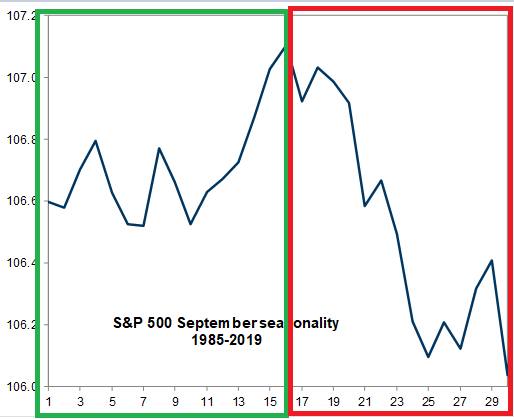
As infamous market-seer, W.D. Gann once noted, September 22nd (the Autumnal Equinox) is the most important date in markets – when markets are more likely to reverse than any other day of the year. For some reason, stocks, commodities and currencies have a curious tendency to make major tops or bottoms on this day.

Source: Bloomberg

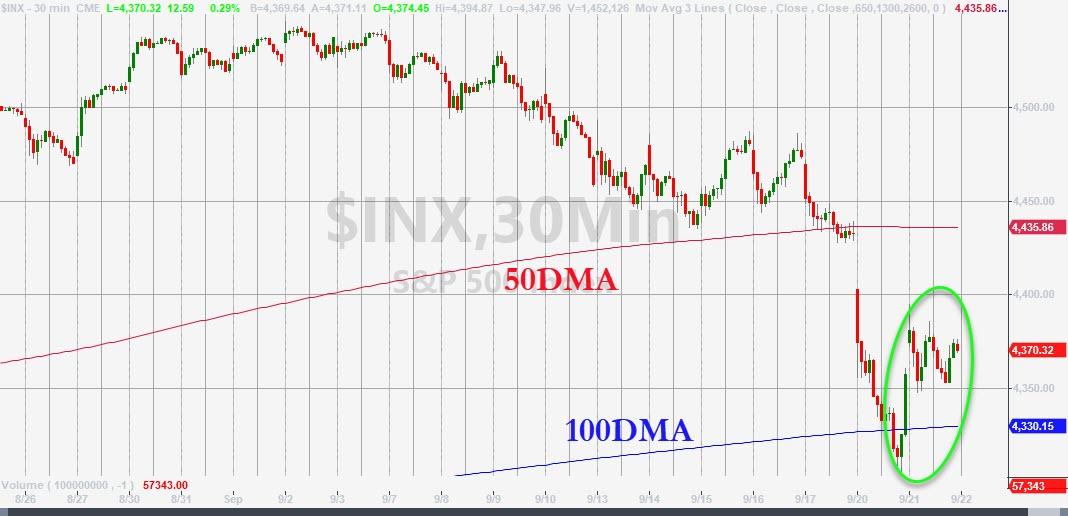
Yesterday’s late-day panic-bid off the 100DMA (S&P)…

…extended during the overnight session (extreme low liquidity in Asia due to holidays), then started to fade as Europe opened and plunged into the red as US opened. The European close sparked some renewed buying and then algos kept things green in the last hour. Dow and S&P ended the day in the red with Nasdaq and Small Caps marginally higher…

So much for Turnaround Tuesday!

“Most Shorted” Stocks were unable to hold yesterday’s late-day squeeze-fest

Source: Bloomberg

Scott Minerd, Guggenheim Investments’ chief investment officer, warned that Monday’s selloff was a “clear crack” in recent upward trend that could see the S&P 500 Index fall 10% decline to around 4,050, and as much as 20%, adding that Assets across the board are “richly priced” and that the market is ripe for a correction.

Citing uncertainties around the impact of the Evergrande credit fallout and the potential for disappointing earnings and economic data as risk factors for an extended market pullback, Minerd told BloombergTV that “the next question we have to ask ourselves: How much further could it go if we get there?”

“When you look at the technicals, you look at the charts, you look at the prospects that we’re going to disappoint on the earnings front because of the Covid slowdown, we’re ripe for a correction.”

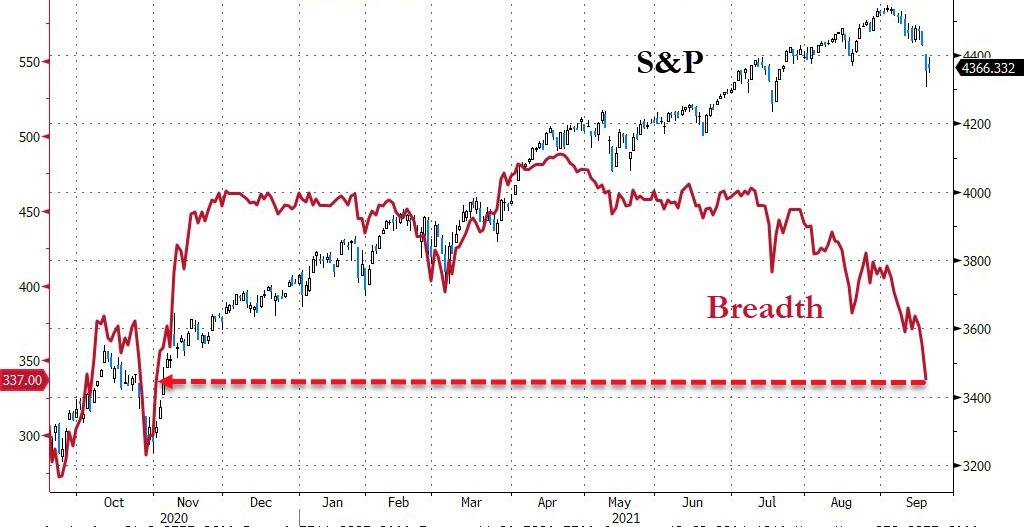
Breadth (% of S&P < 200DMA) has been a bloodbath...

Source: Bloomberg

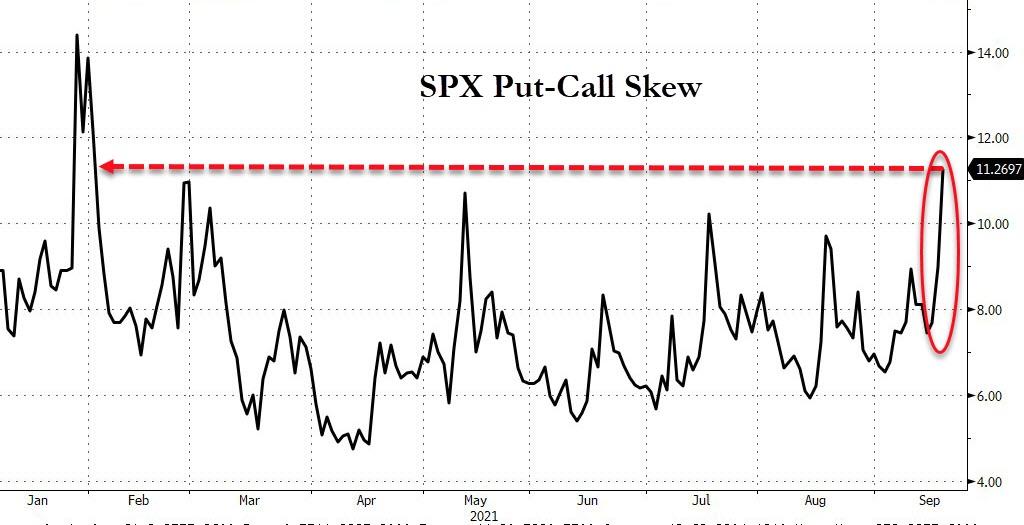
That may help explain the surge in ‘crash’ protection…

Source: Bloomberg

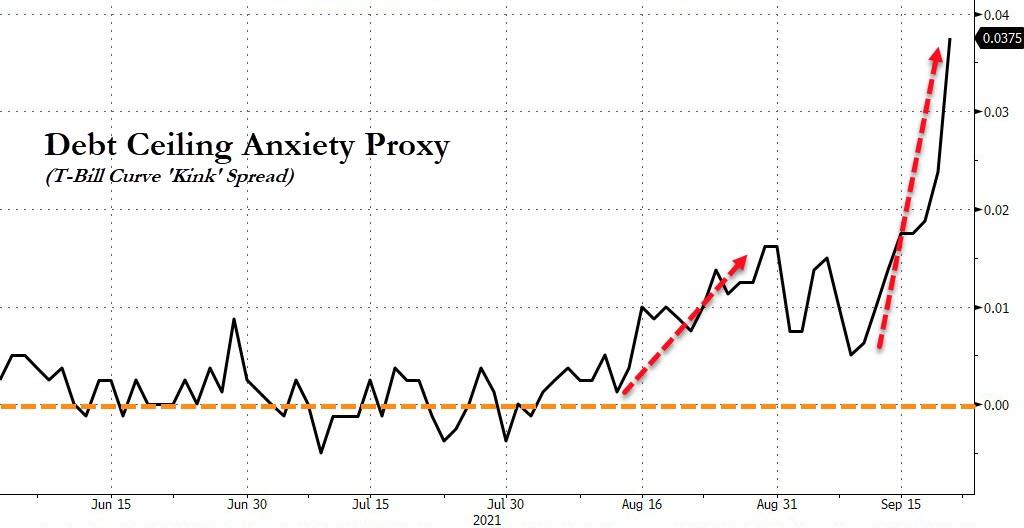
While all eyes are anticipating tomorrow’s Fed statement, Dot-Plot, and presser; today saw more pressure on the Dems to act alone on the debt ceiling and the market did not like it as the ‘kink’ in the T-Bill curve increased significantly…

Source: Bloomberg

Seasonals, Debt-Ceiling Doubts, a Taper-Tantrum, and Evergrande uncertainty…

Treasuries were quiet today, ending basically unchanged across the curve, so the long-end remains around 4bps lower on the week, and short-end unch…

Source: Bloomberg

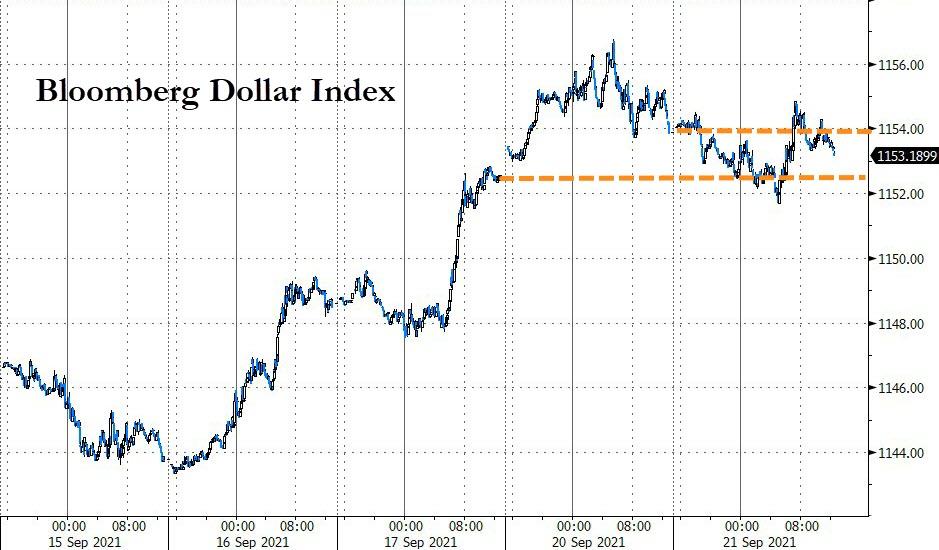
The Dollar traded in a narrow range today, ending the day very marginally lower…

Source: Bloomberg

Cryptos were monkeyhammered again today…

Source: Bloomberg

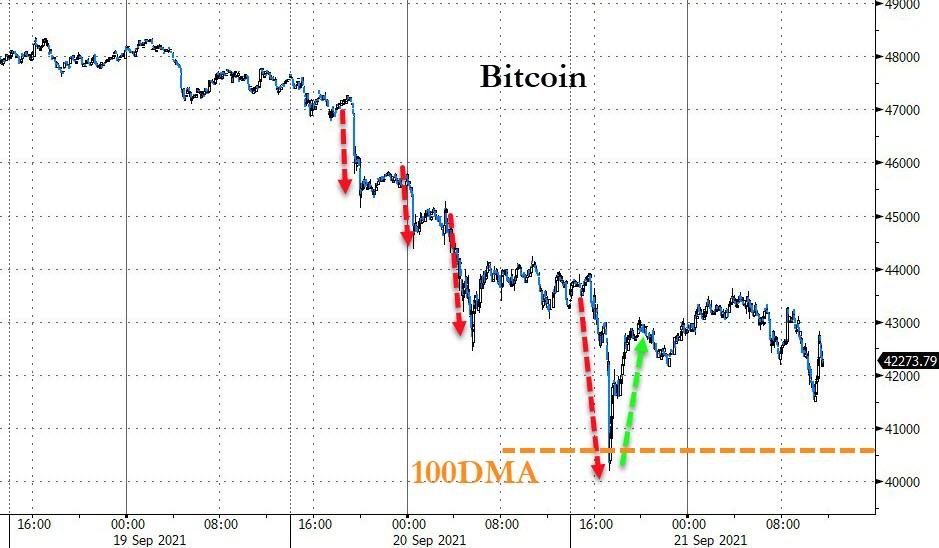
Bitcoin tested down to its 100DMA today, plunging to its lowest since early August…

Source: Bloomberg

…and then bounced notably…

Source: Bloomberg

Precious metals extended gains today as crude and copper slipped lower…

Source: Bloomberg

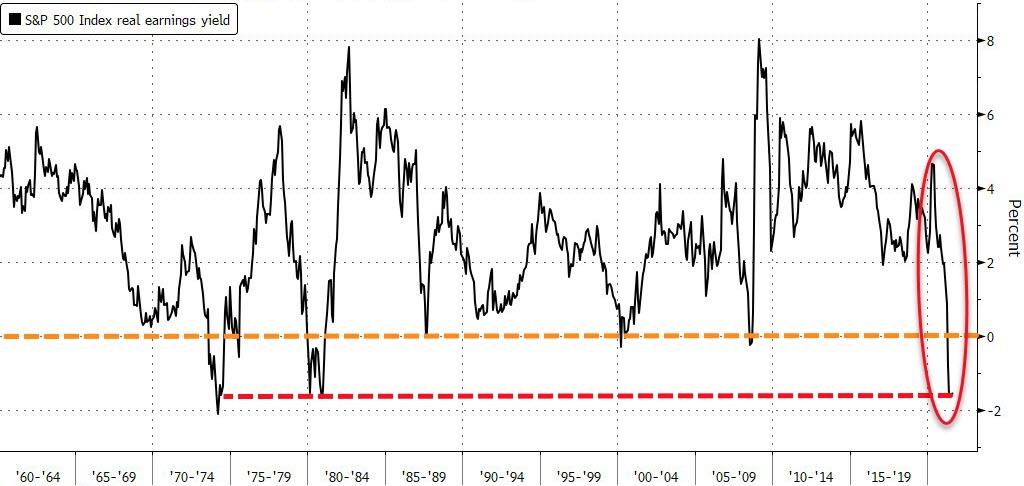
Finally, this week’s slide in U.S. stocks may help reset a historical tie between earnings and inflation that has been out of whack for months. As Bloomberg notes, the relationship is based on the S&P 500 Index’s earnings yield and the annual rate of change in the U.S. consumer-price index. While the yield is typically higher, the opposite has been true since April, according to monthly data compiled by Bloomberg. 

Source: Bloomberg

Real yields for the last four months were about minus 1.6% — the lowest level since 1980 and half a percentage point away from another low, set in 1974.

Tyler Durden
Tue, 09/21/2021 – 16:01

via ZeroHedge News https://ift.tt/3kvLkJE Tyler Durden

Watch: New Orleans’ Superdome Catches Fire

Watch: New Orleans’ Superdome Catches Fire

A thick column of black smoke and flames were reported on the roof of the Caesar’s Superdome on Tuesday afternoon in New Orleans. 

ASM Global, the company that manages the football stadium, told local news WWLTV that the fire began around 1235 local time after a pressure washer used to clean the roof caught fire. From the ground, workers could be seen scrambling to extinguish the blaze. 

New Orleans EMS said one person was taken to a local hospital with minor burns. 

Doug Thorton, the vice president of stadiums for ASM Global, said the fire didn’t damage the structure of the building. Local reports indicate the fire was brought under control around 1305. 

There is no word if the fire will affect any future games for the New Orleans Saints. 

Tyler Durden
Tue, 09/21/2021 – 15:55

via ZeroHedge News https://ift.tt/3zwTYvz Tyler Durden

What the Briefs in Jackson Women’s Health (Don’t) Say about Same-Sex Marriage

Eugene’s re-posting of Professor Stephen Gilles’ argument about Obergefell v. Hodges in the Mississippi abortion case this Term prompted me to take a quick look at what the other briefs in Dobbs v. Jackson Women’s Health are saying (and mostly not saying) about the landmark same-sex marriage decision.

There were 81 briefs on the petitioners’ side (supporting Mississippi) filed in late July.  Many of them unabashedly compare Roe and Casey to decisions like Dred Scott and Lochner v. New York as examples of constitutionally unsound results that caused harm and injustice.

By my count, only 11 of the 81 briefs even cite Obergefell. Of those 11, eight simply refer to a dissent in Obergefell, most commonly the one from Chief Justice Roberts, for the proposition that judges should be careful about declaring unenumerated rights lest they circumscribe too many democratic choices. But the briefs do not directly criticize the outcome or otherwise critique the reasoning of Obergefell. (Of course, I do not mean to suggest that the amicus brief authors support same-sex marriage. Many are among the most prominent opponents of it as a matter of policy and constitutional law.)

Of the three briefs that deal with the substance of Obergefell, two can be classified as relatively favorable. One is the brief from Professor Gilles. He writes: “Roe and Casey were not rightly decided under the ‘reasoned judgment’ approach as described and applied in Obergefell. The right to elective abortion was adopted and reaffirmed on the basis of specious arguments, question-begging assumptions, and inconsistent reasoning, not reasoned judgment.” (p. 7) In his view, Roe and Casey misrepresented Anglo-American history and traditions related to abortion and failed to engage the applicable precedents with “principled consistency.” The implication is that Obergefell was a defensible application of the fundamental right to marry while Roe was an ugly excrescence on constitutional doctrine.

The second of the three briefs dealing substantively with Obergefell is the one for Mississippi itself.  The petitioners’ brief seemingly concedes the very formulation of the constitutional issue asserted by the gay couples in Obergefell.

Nor can a right to abortion be justified under Obergefell v. Hodges, 576 U.S. 644 (2015), which recognized a fundamental right to marry. Obergefell applied the understanding that when a right “is fundamental as a matter of history and tradition”—like marriage—then a State must have “a sufficient justification for excluding the relevant class” from exercising it. Id. at 671. That understanding has no relevance here, where the question is not “who [may] exercise[ ]” a fundamental right to abortion but whether the Constitution protects such a right at all. (p. 13)

The challenge for gay couples in Obergefell was to get the Court to see the claimed constitutional right in exactly this way: as the logical and experience-based affirmation of an old right (the right to marry), rather than as the a priori concoction of something new (the right to same-sex marriage).

Similarly, Mississippi posits a world of doctrinal difference between abortion and same-sex marriage (and homosexual conduct) when it comes to harm:

Nowhere else in the law does a right of privacy or right to make personal decisions provide a right to destroy a human life. Cf. Obergefell, 576 U.S. at 679 (“[T]hese cases involve only the rights of two consenting adults whose marriages would pose no risk of harm to themselves or third parties.”); Lawrence v. Texas, 539 U.S. 558, 578 (2003) (similar).

Perhaps Mississippi felt it had to adopt these perspectives on Obergefell because the Court itself adopted them. There is a difference between accepting premises for the sake of argument and actually believing those premises. Abortion opponents are already asking the Court for a monumental reversal. There’s no need to add yet more to that burden.

Nobody supposes Mississippi’s lawyers suddenly awoke to the merits of a constitutional right to gay marriage. And few gay marriage supporters will take much comfort in the comparative silence about Obergefell coming from Mississippi’s 80 amici. Prominent LGBT rights groups and advocates warned in an amicus brief filed yesterday that overruling Roe and Casey “cannot be reconciled with this Court’s decisions affirming the fundamental equality of women and of LGBTQ people.” (p. 18)

But the effect of the argument being made by Professor Gilles and Mississippi is to offer the Court a way to do precisely that: overrule Roe and Casey without threatening other important precedents. Whether such efforts to distinguish Roe/Casey from Obergefell could be successful is a subject for another day.

There is, however, one notable brief supporting Mississippi that squarely takes on Obergefell–and much more besides. I’ll have more to say about that in a separate post.


from Latest – Reason.com https://ift.tt/2Xy9n1m
via IFTTT

George Will vs.1619 Project: The U.S. Founding Is ‘the Best Thing That Ever Happened


merlin_159312933_f4721c53-666a-4f12-b9b7-98e9176da426-superJumbo

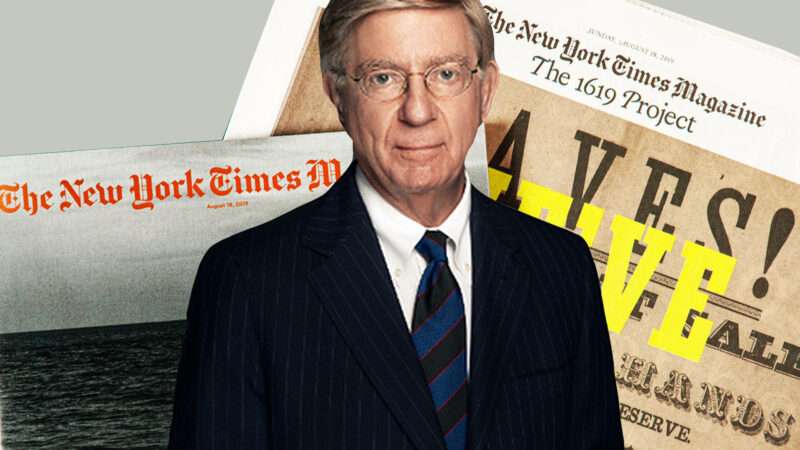
“History is made by intense, compact minorities,” says Washington Post columnist George Will, who believes that Rep. Alexandria Ocasio-Cortez (D–N.Y.) “and her squad or cohort have the energy in the Democratic Party. A lot of people say, ‘Gee whiz, I did not know Joe Biden was this far left. He’s not left, not a progressive, he’s a Democrat. And he goes where his party is being pulled.” Will says that starting in the mid-1960s, followers of Sen. Barry Goldwater (R–Ariz.) had the same effect on the Republican Party, eventually leading the recasting of the GOP as the party of small government and the election of President Ronald Reagan in 1980.

In 1973, Will was a young academic coming off a stint as a Senate staffer when he began writing columns for National Review and The Washington Post. Since then he has churned out “6,000 or so” pieces (his count) on a weekly schedule, calling to mind the longevity and endurance of Cal Ripken Jr., who played more consecutive baseball games than anyone in history and whose work ethic was lionized by Will in his 1990 bestseller, Men at Work: The Craft of Baseball.

Will’s newest book is American Happiness and Discontents, a collection of columns from 2008–2020 that covers the Great Recession and the Obama years to what he calls the crybaby presidency of Donald Trump and the rise of identity politics as a major force in contemporary America. Of special interest are his columns drawing complicated lessons from the World War II era, when the country triumphed over authoritarianism and genocide abroad even as it practiced racial apartheid at home. Will’s analysis of and love for America is unabashedly patriotic but it is never jingoistic or untroubled by tough historical truths.

Though he started out firmly on the conservative right, Will has become more and more libertarian, especially in his insistence that mere politics should never be the all-consuming passion of human endeavor and that America remains a place dedicated to a future that is better than the present. “If we can rein in our appetite for government to dispense benefits,” he says, and replace it with a government “that defends the shores, fills the potholes, and otherwise gets out of the way, we’re going to see again, the creativity of the American people.”

Photo Credits: Gage Skidmore from Peoria, AZ, United States of America, CC BY-SA 2.0, via Wikimedia Commons; Photo by SpaceX on Unsplash; Reason, 1978; Photo by Luke Stackpoole on Unsplash; Albin Lohr-Jones/ZUMA Press/Newscom; Albin Lohr-Jones/ZUMA Press/Newscom; Jeff Malet Photography/Newscom; Steve Sanchez/Pacific Press/Newscom; GEORGE BRIDGES/KRT/Newscom; Jeff Malet Photography/Newscom; William Reagan/ZUMAPRESS/Newscom; Everett Collection/Newscom; Tom Williams/Roll Call/Newscom; Roger L. Wollenberg UPI Photo Service/Newscom; 1987 Commercial—Mrs. Smith’s “Pie in Minutes”; Photo by Nelson Ndongala on Unsplash

Music Credit: “December,” by Still Life

from Latest – Reason.com https://ift.tt/3lIFy6N
via IFTTT

George Will vs.1619 Project: The U.S. Founding Is ‘the Best Thing That Ever Happened


merlin_159312933_f4721c53-666a-4f12-b9b7-98e9176da426-superJumbo

“History is made by intense, compact minorities,” says Washington Post columnist George Will, who believes that Rep. Alexandria Ocasio-Cortez (D–N.Y.) “and her squad or cohort have the energy in the Democratic Party. A lot of people say, ‘Gee whiz, I did not know Joe Biden was this far left. He’s not left, not a progressive, he’s a Democrat. And he goes where his party is being pulled.” Will says that starting in the mid-1960s, followers of Sen. Barry Goldwater (R–Ariz.) had the same effect on the Republican Party, eventually leading the recasting of the GOP as the party of small government and the election of President Ronald Reagan in 1980.

In 1973, Will was a young academic coming off a stint as a Senate staffer when he began writing columns for National Review and The Washington Post. Since then he has churned out “6,000 or so” pieces (his count) on a weekly schedule, calling to mind the longevity and endurance of Cal Ripken Jr., who played more consecutive baseball games than anyone in history and whose work ethic was lionized by Will in his 1990 bestseller, Men at Work: The Craft of Baseball.

Will’s newest book is American Happiness and Discontents, a collection of columns from 2008–2020 that covers the Great Recession and the Obama years to what he calls the crybaby presidency of Donald Trump and the rise of identity politics as a major force in contemporary America. Of special interest are his columns drawing complicated lessons from the World War II era, when the country triumphed over authoritarianism and genocide abroad even as it practiced racial apartheid at home. Will’s analysis of and love for America is unabashedly patriotic but it is never jingoistic or untroubled by tough historical truths.

Though he started out firmly on the conservative right, Will has become more and more libertarian, especially in his insistence that mere politics should never be the all-consuming passion of human endeavor and that America remains a place dedicated to a future that is better than the present. “If we can rein in our appetite for government to dispense benefits,” he says, and replace it with a government “that defends the shores, fills the potholes, and otherwise gets out of the way, we’re going to see again, the creativity of the American people.”

Photo Credits: Gage Skidmore from Peoria, AZ, United States of America, CC BY-SA 2.0, via Wikimedia Commons; Photo by SpaceX on Unsplash; Reason, 1978; Photo by Luke Stackpoole on Unsplash; Albin Lohr-Jones/ZUMA Press/Newscom; Albin Lohr-Jones/ZUMA Press/Newscom; Jeff Malet Photography/Newscom; Steve Sanchez/Pacific Press/Newscom; GEORGE BRIDGES/KRT/Newscom; Jeff Malet Photography/Newscom; William Reagan/ZUMAPRESS/Newscom; Everett Collection/Newscom; Tom Williams/Roll Call/Newscom; Roger L. Wollenberg UPI Photo Service/Newscom; 1987 Commercial—Mrs. Smith’s “Pie in Minutes”; Photo by Nelson Ndongala on Unsplash

Music Credit: “December,” by Still Life

from Latest – Reason.com https://ift.tt/3lIFy6N
via IFTTT

Jim Rogers Warns The “Worst Bear Market Of Our Lifetime” Is Fast Approaching

Jim Rogers Warns The “Worst Bear Market Of Our Lifetime” Is Fast Approaching

Via Wealthion.com,

Legendary investor Jim Rogers has seen more market ups and downs than most people alive today.

And he has successfully made money – a LOT of money – in the process.

But given today’s macro-environment, he’s more concerned about the market’s future prospects than he’s ever been before. In fact, he confidently predicts we will experience a massive economic and financial correction that will result in the biggest bear market of our lifetime.

Too much debt. Rising inflation. Currency debasement. Malinvestment. Central bank intervention. Geopolitical stress. The current macroeconomic environment has it all.

Rogers predicts collapse will begin in the weaker countries/companies first, and then cascade it way towards the US, eventually plunging the entire system into deep recession, if not a downright Depression.

Here in Part 1 of our interview with Jim, he explains how bad he thinks things will get and why. Using his international viewpoint, he also unpacks China’s future prospects given its current challenges (including Evergrande) and the potential for greater competition from an opening of commerce between South and North Korea.

And in Part 2,  Jim offers his advice to prudent investors looking to survive the coming bear market he predicts, and provides his outlook on a number of different commodities, including oil, uranium, farmland and precious metals.

“I caution all of you, it’s been 11 years since we’ve had a serious bear market… and I would suggest to you that maybe next time when we have a serious bear market it’s going to be the worst in my lifetime,Rogers previously told an international forum hosted by Russia.

Reflecting on the piling-on of more and more debt by policymakers to paper over every crack in any economy or market, Rogers previously noted that “eventually, the market is going to say: ‘We don’t want this, we don’t want to play this game anymore, and we don’t want your garbage paper anymore’.”

And when that happens, Rogers warns that central banks will print even more and buy even more assets.

“And that’s when we will have very serious problems… We all are going to pay a horrible price someday but in the meantime it’s a lot of fun for a lot of people.”

*  *  *

Global investor Jim Rogers co-founded the Quantum Fund, a global-investment partnership. During the next 10 years, the portfolio gained 4200%, while the S&P rose less than 50%. Rogers then decided to retire – at age 37 – and has been sharing his wisdom with investors ever since, as well as having some pretty amazing life adventures.

Tyler Durden
Tue, 09/21/2021 – 15:39

via ZeroHedge News https://ift.tt/3hS5H1C Tyler Durden

Our Kind of People Serves Up an All-Too-Familiar Class War Soap Opera


OurKind_1161x653

Our Kind of People. Fox. Tuesday, September 21, 9 p.m.

Two ancient and thoroughly regrettable television themes recur tonight as broadcast TV’s anemic fall roll-out of new shows continues. One is the inexplicable CBS affection on dullard police-procedural shows about the FBI. The addition of FBI: International makes three of them on the air at the moment. Advance screener episodes weren’t provided to critics, so I can’t say with absolute authority that it’s a dog—but anytime a network turns down free publicity for one of its shows, it’s a strong indicator of canine DNA.

The other elderly chestnut being reroasted tonight is that of costume dramas about the tragic problems of the one-percenters. From Dallas to Downton Abbey, from Succession to Billions, TV keeps trying to expand upon F. Scott Fitzgerald’s oh-so-insightful remark, “Let me tell you about the very rich. They are different from you and me.” (Rather less effort has been expended on Ernest Hemingway’s rejoinder, “Yes, they have more money.”) This has mutated from a trend to an obsession: There’ve been five versions or spinoffs of Beverly Hills 90210, four of Dynasty, and various incarnations of Upstairs, Downstairs tyrannized the BBC for more than four decades.

Admittedly, some of these expeditions into gilt and glitter have been fun. I watched both The O.C. and the original Gossip Girl to their Jordache-ripping finales. Alas, Fox’s new addition to the genre, Our Kind of People, doesn’t quite rise (or is it sink?) to that level. Its main appeal is novelty—the show’s cast is entirely black. That may win it some audience loyalty, but better plotting and more interesting characters would have been a better approach.

Fox’s publicity for the show says it’s based on Lawrence Otis’ sociological study Our Kind of People: Inside America’s Black Upper Class. Actually, a more direct influence was probably ABC’s 2011-2015 drama Revenge, in which a trailer-trash teenager infiltrates the idle-rich beach resorts of the Hamptons to wreak bloody havoc on a family she thinks framed her father for a crime that sent him to prison.

The infiltrator in this case is Angela Vaughan (Yaya DaCosta, a veteran of all three of Fox’s Chicago-brand cop and medical dramas), who plays an aggressive black hair-care entrepreneur who comes to the posh black beach resort of Oak Bluffs in Martha’s Vineyard in hopes of joining an influential business sorority that will help her launch her new products. Vaughan claims her mother used to be a plutocratic summertime regular in the Bluffs, though the ladies know better: The mom was actually a maid with a rap sheet.

That runs Vaughan head-on into the new president of the sorority, corporate ball-buster Leah Franklin-Dupont (Nadine Ellis, BET’s Let’s Stay Together), who has just ruthlessly ousted her own father from the family business. Put off by Vaughan’s naked ambition and correctly sensing that her own family is somehow a target, Franklin-Dupont accelerates into full bitch mode in record time.

There are plenty of annoying distractions in Our Kind of People, particularly the heavy and pointless use of 1970s cop-show camera gimmicks like wipes and split screens. It can also feel more than a little schoolmarmish. Is it really necessary for Vaughan to deliver a lecture on the ethnic importance of hair care (“A black woman’s relationship with her hair starts well before she can even walk”) directly into the face of Franklin-Dupont—who is herself black? And a lot of Vaughan aphorisms are just plain idiotic, like “A woman who can do her own hair is not dependent on anybody.” Try telling that to somebody in the middle of a blood transfusion.

But mostly the problem with Our Kind of People is its silly parlor-game sensibility. A woman with a zillion-dollar new process for black hairdos would rushing it into the marketplace rather than trying to muscle her way into the Cool Girls Club. As Alexis Colby once said when an enemy called her a bitch, “If I am, take a lesson from me. You may need it in life.”

from Latest – Reason.com https://ift.tt/3EDDc1s
via IFTTT

Our Kind of People Serves Up an All-Too-Familiar Class War Soap Opera


OurKind_1161x653

Our Kind of People. Fox. Tuesday, September 21, 9 p.m.

Two ancient and thoroughly regrettable television themes recur tonight as broadcast TV’s anemic fall roll-out of new shows continues. One is the inexplicable CBS affection on dullard police-procedural shows about the FBI. The addition of FBI: International makes three of them on the air at the moment. Advance screener episodes weren’t provided to critics, so I can’t say with absolute authority that it’s a dog—but anytime a network turns down free publicity for one of its shows, it’s a strong indicator of canine DNA.

The other elderly chestnut being reroasted tonight is that of costume dramas about the tragic problems of the one-percenters. From Dallas to Downton Abbey, from Succession to Billions, TV keeps trying to expand upon F. Scott Fitzgerald’s oh-so-insightful remark, “Let me tell you about the very rich. They are different from you and me.” (Rather less effort has been expended on Ernest Hemingway’s rejoinder, “Yes, they have more money.”) This has mutated from a trend to an obsession: There’ve been five versions or spinoffs of Beverly Hills 90210, four of Dynasty, and various incarnations of Upstairs, Downstairs tyrannized the BBC for more than four decades.

Admittedly, some of these expeditions into gilt and glitter have been fun. I watched both The O.C. and the original Gossip Girl to their Jordache-ripping finales. Alas, Fox’s new addition to the genre, Our Kind of People, doesn’t quite rise (or is it sink?) to that level. Its main appeal is novelty—the show’s cast is entirely black. That may win it some audience loyalty, but better plotting and more interesting characters would have been a better approach.

Fox’s publicity for the show says it’s based on Lawrence Otis’ sociological study Our Kind of People: Inside America’s Black Upper Class. Actually, a more direct influence was probably ABC’s 2011-2015 drama Revenge, in which a trailer-trash teenager infiltrates the idle-rich beach resorts of the Hamptons to wreak bloody havoc on a family she thinks framed her father for a crime that sent him to prison.

The infiltrator in this case is Angela Vaughan (Yaya DaCosta, a veteran of all three of Fox’s Chicago-brand cop and medical dramas), who plays an aggressive black hair-care entrepreneur who comes to the posh black beach resort of Oak Bluffs in Martha’s Vineyard in hopes of joining an influential business sorority that will help her launch her new products. Vaughan claims her mother used to be a plutocratic summertime regular in the Bluffs, though the ladies know better: The mom was actually a maid with a rap sheet.

That runs Vaughan head-on into the new president of the sorority, corporate ball-buster Leah Franklin-Dupont (Nadine Ellis, BET’s Let’s Stay Together), who has just ruthlessly ousted her own father from the family business. Put off by Vaughan’s naked ambition and correctly sensing that her own family is somehow a target, Franklin-Dupont accelerates into full bitch mode in record time.

There are plenty of annoying distractions in Our Kind of People, particularly the heavy and pointless use of 1970s cop-show camera gimmicks like wipes and split screens. It can also feel more than a little schoolmarmish. Is it really necessary for Vaughan to deliver a lecture on the ethnic importance of hair care (“A black woman’s relationship with her hair starts well before she can even walk”) directly into the face of Franklin-Dupont—who is herself black? And a lot of Vaughan aphorisms are just plain idiotic, like “A woman who can do her own hair is not dependent on anybody.” Try telling that to somebody in the middle of a blood transfusion.

But mostly the problem with Our Kind of People is its silly parlor-game sensibility. A woman with a zillion-dollar new process for black hairdos would rushing it into the marketplace rather than trying to muscle her way into the Cool Girls Club. As Alexis Colby once said when an enemy called her a bitch, “If I am, take a lesson from me. You may need it in life.”

from Latest – Reason.com https://ift.tt/3EDDc1s
via IFTTT

“We Hit Headwinds” – Disney Shares Tumble After CEO Says Subscriber Growth Slowed

“We Hit Headwinds” – Disney Shares Tumble After CEO Says Subscriber Growth Slowed

Walt Disney Co. shares tumbled as much as 5.4% on Tuesday afternoon after CEO Bob Capek said streaming subscribers for the quarter ending September 2021, which is Disney’s FY Q4 2021, could only increase by the “low single-digit millions” during a Goldman Sachs conference, according to Variety

Speaking at the Goldman Sachs Communacopia conference, Capek said the Disney+ subscription service will continue to grow, but “we hit some headwinds.” 

For Disney+, “the quarter-to-quarter business is not linear,” Chapek said. “What we are finding out, as you’ve seen from our last several quarters in terms of our earnings, is that these numbers tend to be a lot noisier than a straight line.”

He cited some reasons for the slowdown in subscription growth are primarily due to COVID-induced production delays. 

Chapek’s disclosure that Disney+ subscriptions will slow down in the current quarter comes after a rebound in the second quarter this year that exceeded Wall Street estimates. As of July 3, the online streaming platform had 116 million users worldwide. 

Other reasons for the slowdown could be due to people rediscovering what normal life is outside the house in a post-COVID world.

Tyler Durden
Tue, 09/21/2021 – 15:23

via ZeroHedge News https://ift.tt/3ExcgR0 Tyler Durden