White House Transfers Its First Gitmo Detainee To Morocco In Effort To Shut Down Facility

White House Transfers Its First Gitmo Detainee To Morocco In Effort To Shut Down Facility

On Monday the Biden White House announced its first transfer of a detainee from Guantanamo Bay as part of previously reported plans to “quietly” pursue a permanent closure of the high secure military prison which since 9/11 has controversially housed ‘terror masterminds’ as well as suspects rounded up in the wake of the 2001 invasion of Afghanistan. 

The Hill identified 56-year old Abdul Latif Nasir as the detainee who has been repatriated to Morocco after in 2016 the Periodic Review Board (PRB) deemed that his detention “no longer remained necessary to protect against a continuing significant threat to the national security of the United States.” 

Abdul Latif Nasir

Despite this 2016 judgement, no action was taken to move Nasir out of Gitmo either during Obama’s final year in office, or Trump’s four years. The number of detainees at Gitmo is now at 39. Military documents alleged that Nasir had “traveled to Afghanistan for jihad” and engaged in combat actions against US troops. Trump had previously accused the Obama administration of “returning terrorists to the battlefield” for efforts to send inmates back to their countries of origin.

“The United States is also extremely grateful for the Kingdom’s willingness to support ongoing U.S. efforts to close the Guantanamo Bay Detention Facility,” the Pentagon said in reference to Morocco. Presumably other repatriations to foreign countries are currently being negotiated.

Of those 39, a whopping 28 have yet to be charged with war crimes or specific criminal or terroristic acts despite being there for two decades. The Bush administration had argued that ‘War on Terror’ captives were not subject to the Geneva conventions and so could be held indefinitely without trial.

State Department spokesperson Ned Price issued the following statement confirming prior reporting that Biden has reprioritized shutting down Gitmo for good: The president is “dedicated to following a deliberate and thorough process focused on responsibly reducing the detainee population of the Guantanamo facility while also safeguarding the security of the United States and its allies,” Price said.

Inside Gitmo, Getty Images

Biden’s approach will reportedly be centered on a plan to transfer most of the remaining 39 detainees to foreign countries for these host countries to deal with them legally. This would not, however, include the most infamous prisoner at Gitmo Khalid Sheikh Mohammed and the group dubbed the “9/11 five” – believed to be directly behind the 9/11 terror attacks which killed about 3,000 Americans.

The “five” were supposed to stand trial in January 2021 but controversy over transferring them to the continental United States has seen any such request blocked by Congress. This also after Trump previously signed an executive order to keep Gitmo open.

A top former Biden administration official privy to the ongoing discussions said in June of the Biden White House and its “quiet” approach to closing Gitmo: “They don’t want it to become a dominant issue that blows up,” and further “They don’t want it to become a lightning rod. They want it to be methodical, orderly.” 

Tyler Durden
Mon, 07/19/2021 – 20:20

via ZeroHedge News https://ift.tt/3BkIv4w Tyler Durden

Government Persuasion vs. Government Coercion: The Employer Speech Analogy

Here’s a highly tentative idea that I wanted to flag: As the post on “When Government Urges Private Entities to Restrict Others’ Speech” (and the caselaw it cites) reflects, government speech can often be subtly coercive because of the government’s background power over the public. As the Seventh Circuit mentioned in Backpage.com, LLC v. Dart, in finding that a sheriff’s letter to Mastercard and Visa demanding that they stop doing business with Backpage because of its sex-related advertisements:

Imagine a letter that was similar to Sheriff Dart’s but more temperate (no “demand,” no “compels,” no “sever [all] ties”) and sent to a credit card company by a person who was not a law-enforcement officer. The letter would be more likely to be discarded or filed away than to be acted on. For there is evidence that the credit card companies had received such complaints from private citizens, yet it was Dart’s letter that spurred them to take immediate action to cut off Backpage. For that was a letter from a government official containing legal threats and demands for quick action and insisting that an employee of the recipient be designated to answer phone calls or respond to other communications from the sheriff.

Indeed, even if letter from a private citizen contained demands, a large company would likely have felt less pressure than from a letter that comes from a government official who has enforcement power, and the ear of colleagues who have still more enforcement power. A business that gets even a “request” from a sheriff or a prosecutor or the President may “pick up intended implications … that might be more readily dismissed” if the requester lacked power over the business.

That last quote, as it happens, isn’t from a government speech case; it’s from an employer speech case, NLRB v. Gissel Packing Co. (1969), in which the Court reaffirmed that

  1. employers have the First Amendment right to speak to their employees about the possible costs of unionization,
  2. employers don’t have the First Amendment right to threaten employees with reprisals for unionizing, and
  3. in drawing the line between (1) and (2), the employer’s power to fire employees needs to be taken into account.

Here is the broader quote:

[A]n employer’s free speech right to communicate his views to his employees is firmly established and cannot be infringed by a union or the Board. Thus, § 8(c) [of the NLRA] merely implements the First Amendment by requiring that the expression of “any views, argument, or opinion” shall not be “evidence of an unfair labor practice,” so long as such expression contains “no threat of reprisal or force or promise of benefit” in violation of § 8(a)(1). Section 8(a)(1), in turn, prohibits interference, restraint or coercion of employees in the exercise of their right to self-organization.

Any assessment of the precise scope of employer expression, of course, must be made in the context of its labor relations setting. Thus, an employer’s rights cannot outweigh the equal rights of the employees to associate freely, as those rights are … protected by § 8(a)(1) and the proviso to § 8(c).

And any balancing of those rights must take into account the economic dependence of the employees on their employers, and the necessary tendency of the former, because of that relationship, to pick up intended implications of the latter that might be more readily dismissed by a more disinterested ear. Stating these obvious principles is but another way of recognizing that what is basically at stake is the establishment of a nonpermanent, limited relationship between the employer, his economically dependent employee and his union agent, not the election of legislators or the enactment of legislation whereby that relationship is ultimately defined and where the independent voter may be freer to listen more objectively and employers as a class freer to talk.

As best I can tell, the courts have taken seriously all three elements on the list I gave above. Post-Gissel do recognize the right of employers (and unions) to speak. They do recognize the right of employees to be free of coercion by employers and unions when it comes to unionization votes. And they do take into account employers’ (and unions’) power over employees in deciding whether a statement is unduly coercive. See, e.g., Roper Corp. v. NLRB, 712 F.2d 306, 311 (7th Cir. 1983); In re Perry, 859 F.2d 1043 (1st Cir. 1988); NLRB v. Douglas Div., 570 F.2d 742, 747 (8th Cir. 1978); Sheet Metal Workers Int’l Ass’n v. Burlington N.R.R. Co., 736 F.2d 1250, 1253 (8th Cir. 1984); Dow Chem. Co. v. NLRB, 660 F.2d 637, 644-45 (5th Cir. Unit A Nov. 1981); NLRB v. Proler Int’l Corp., 635 F.2d 351, 355-56 (5th Cir. Unit A Jan. 1981); Florida Steel Corp. v. NLRB, 587 F.2d 735, 750-53 (5th Cir. 1979); J.P. Stevens & Co. v. NLRB, 449 F.2d 595, 597 (4th Cir. 1971). (I put this list together in 1991, and haven’t updated it since, but my sense is that more recent cases take the same approach.)

So my tentative proposal: Perhaps in drawing the line between permissible urging by government officials and forbidden implicit threats, the labor speech caselaw might be helpful. To be sure, that caselaw doesn’t provide a sharp line, but I’m not sure that there can be such a sharp line; and at least it offers a useful and substantial body of precedent  to which courts and lawyers can turn.

But, again, this is just a tentative thought; I’d love to hear what others say about it.

from Latest – Reason.com https://ift.tt/3eCVzs3
via IFTTT

“It’s Not A Conspiracy”

“It’s Not A Conspiracy”

Authored by James Rickards via DailyReckoning.com,

Philosophers and analysts use a principle called Occam’s Razor (sometimes Ockham’s Razor) to solve difficult problems. It says that when you are confronted with two possible solutions to a problem, one complicated and one simple, it’s usually better to select the simple solution.

There’s always some attraction to the complicated solution because humans like intrigue and plot twists. But statistically, the simple solution is more likely to be correct and therefore the one that analysts should prefer unless contrary evidence presents. This approach is useful in dealing with conspiracy theories.

Yes, real conspiracies exist (such as the plot to assassinate JFK), and analysts must be alert to the possibility. But most so-called conspiracies have much simpler explanations that are more likely to be correct.

One of the most potent drivers of coordinated political action is not a deep, dark conspiracy. It’s usually just the result of like-minded individuals cooperating to achieve the same goal.

It’s Groupthink, Not Conspiracy

If the political players all think alike and agree on goals, you don’t need a conspiracy. Just let them go to work every day and communicate with each other, and you’ll get the coordinated result without the inevitable twists and turns of a conspiracy.

That’s a good thing to bear in mind when considering the current administration. 23, top Biden administration officials all worked at the same consulting firm called WestExec Advisors. These officials include Press Secretary Jen Psaki, Secretary of State Tony Blinken and Director of National Intelligence Avril Haines.

For those who may be unfamiliar, “WestExec” is a reference to West Executive Avenue, a non-public road that runs between the West Wing of the White House and the Eisenhower Executive Office Building.

The West Wing is not that large and only has a few choice offices plus the Situation Room, the Roosevelt Room (for larger meetings) and the Cabinet Room, which is smaller. Most officials who say they “work in the White House” actually work in the Eisenhower Building, which means they walk across West Executive Avenue when they have meetings with top Biden officials.

The WestExec Advisors name is a play on that kind of insider status of the long list of former WestExec principals who are now running the country. (Don’t look to Biden as the source of power; he’s not mentally competent and does what the WestExec crowd or the rest of the Biden family tell him to do).

A Threat to National Security

So, with all of this power emerging from one firm, does that mean there’s a conspiracy among the alums to control the world?

Not really. But, it points to a bigger problem, which is the lack of cognitive diversity. The WestExec crowd all went to top schools, had top jobs in previous administrations, exhibit high IQs, and boast lots of credentials.

If you look at their resumes, you’ll see they all went to the same schools, had the same professors and pursued the same career paths. With few exceptions, it’s all Harvard, Yale and Columbia with a small dose of Stanford or Chicago for good measure.

They all went to law school or got PhDs and worked for the same small set of law firms or consulting firms. Then they all worked in a small set of government agencies, including the State Department, National Security Council or the Intelligence Community.

They all think alike. That’s an acute weakness because if they all look at things the same way, they will all miss the real dangers coming that don’t fit into their mental molds. Lack of cognitive diversity is a fatal weakness.

As a leader, you should always be willing to lower the average IQ if it means you can increase the range of viewpoints. At least someone might point out it’s raining to a group that’s too buried in briefing books to look out the window. This uniform mindset is itself a danger to national security. Sooner than later, a threat will arise that none of them will see coming.

On the Verge of the Most Destructive War Since WWII?

And there’s no shortage of threats in the world. Perhaps the most pressing right now is China’s aggressive posturing in East Asia. It’s not just China and the U.S.

The world’s three largest economies — the U.S., China and Japan — may be squaring off for the most destructive and costly war since the end of World War II.

The main protagonists will be China and the U.S. The cause of war will be a Chinese invasion of Taiwan, which may be coming much sooner than the world expects.

China would start the war with an invasion across the Taiwan Strait. The U.S. would be obliged to come to the defense of Taiwan and take measures to disable the Chinese fleet and its air support. But, Japan is no bystander.

A glimpse at a map shows that if Taiwan were in Communist China’s hands, Japan’s own sea lanes would be threatened, including its access to imported oil. Japan has its own island disputes with China. If China were to capture Taiwan, Japan’s islands in the East China Sea would likely be the next to fall.

The U.S. could fall back to a line of islands, including Guam, Hawaii and the Aleutians, but no fallback is possible for Japan. If China seizes Taiwan and the U.S. falls back, Japan would be under the thumb of China, and they know it.

Of course, a fallback by the U.S. would be an enormous blow to U.S. credibility, as well as its economic power. That’s why an alliance of the U.S. and Japan against China to defend Taiwan (along with Taiwan’s own formidable defense capability) is the most likely response to a Chinese amphibious assault.

“Wolf Warrior” Diplomacy

The question for the world is whether China will get the message and refrain from attacking Taiwan. Unfortunately, signs point in the opposite direction. China has left its non-threatening style of diplomacy in the past.

Today, China pursues “Wolf Warrior diplomacy,” named after a popular Chinese movie that features aggressive Navy SEAL-style tactics as practiced by Peoples’ Liberation Army commandos.

China has come out of its shell and seeks regional hegemony to be followed by global hegemony. It is aggressively pushing on its neighbors in India, Myanmar, and the six nations that surround the South China Sea. Taiwan is the prize, and China is preparing to seize it.

This attack will be Xi Jinping’s legacy and his attempt to rival the reputation of Mao Zedong. Will Team Biden be able to see it coming?

U.S. investors should not take Chinese restraint for granted. Allocations to cash, gold and U.S. Treasury notes will preserve wealth when the worst happens.

Tyler Durden
Mon, 07/19/2021 – 20:00

via ZeroHedge News https://ift.tt/3BmDMPK Tyler Durden

Watch: Two Dams In China’s Inner Mongolia Collapse After Heavy Rain 

Watch: Two Dams In China’s Inner Mongolia Collapse After Heavy Rain 

Two dams collapsed in China’s northwestern region of Inner Mongolia after heavy rains, Reuters reports, citing a statement from the water ministry on Monday. 

Both dams were located in the Inner Mongolian city of Hulunbuir and collapsed on Sunday. There were more than 1.6 trillion cubic feet of water capacity between both dams. 

On July 18, the dams on the open spillway of Yong’an Reservoir and Xinfa Reservoir in the Daur Autonomous Banner of Morin Dawa, were breached and collapsed as the water level of the Nuomin River continued to rise because of heavy rain, according to People’s Daily.

The dam collapse reportedly affected 16,660 people, flooded 325,622 mu (21708.1 hectares) of farmland, and destroyed 22 bridges, 124 culverts, and 15.6 kilometers of highways.

At 8 pm on Sunday, the national flood control administration issued a third-level emergency response and sent a working group to the scene to guide and assist local emergency management.

Local citizens were evacuated to safe places before the collapse, and no casualties have been reported as of press time. –Global Times

Footage posted on social media shows the collapse and subsequent flooding downstream. 

The collapse of the dams highlights the safety risks posed by aging infrastructure during the summer flood season. 

During this time last year, the Three Gorges Dam was suspected to be on the edge of failure after water levels at the world’s largest dam were at extreme levels. 

Severe weather has been seen worldwide, with floods in Europe and Asia and heatwaves in North America. 

Tyler Durden
Mon, 07/19/2021 – 19:40

via ZeroHedge News https://ift.tt/3BugFTx Tyler Durden

Critical Race Enthusiasts Should Learn The Lesson Of “Defund The Police”

Critical Race Enthusiasts Should Learn The Lesson Of “Defund The Police”

By Frederick M. Hess, director of education policy studies at the American Enterprise Institute, via Real Clear Policy,

A year ago, “defund the police” activists were having quite a time. Outlets like CNN and Vox were publishing fawning profiles. Social media sensations like Reps. Alexandria Ocasio-Cortez and Ilhan Omar were leading the parade. Cities like Los Angeles, Minneapolis, and Austin even approved partial defundings. It was a juggernaut.

Now? A tough-on-crime former cop just won the Democratic mayoral nomination in Bill de Blasio’s New York. Former President Barack Obama is warning fellow Democrats, “You lost a big audience the minute you say [‘defund the police’].” Sen. Bernie Sanders has rejected calls for “no more policing.” And White House Press Secretary Jen Psaki, a few weeks ago, bizarrely claimed that it was not Democrats but Republicans who wanted to defund the police (because they opposed President Biden’s $1.9 trillion stimulus bill).

What happened? Intoxicated by a few policy wins in deep blue cities, enthusiasm in the left-leaning Twitter echo chamber, and their viselike grip on the national media, “defund” activists overlooked one important detail: Their agenda was deeply unpopular with most Americans. A summer 2020 YouGov poll found that just 16 percent of adults wanted to cut police funding — much less “defund” the police. Indeed, 81 percent of black Americans wanted police to spend as much or more time in their communities. During a year when major American cities saw an unnerving increase in homicides, after years of declines, that reaction was not just understandable, it was wholly predictable.  

As a result, Democrats squandered an opportunity to build consensus around meaningful police reform. After all, in the wake of the George Floyd murder, there was broad national agreement supporting a range of reforms. Prominent Republicans like Sen. Tim Scott were eager to negotiate. Sen. Ted Cruz, sitting on a panel alongside Houston’s Democratic mayor, insisted it was time for “all of us together to look at ways to make sure that our justice system is more fair.” Rather than pressing an advantage where most Americans were with them, though, Democrats got suckered by a woke fringe into embracing a deeply unpopular agenda.

Those who embrace the stew of “anti-racist” policies and practices loosely referred to as “Critical Race Theory” should take note. As with policing, there’s broad-based support for practical efforts to address persistent inequalities. For instance, while residential attendance zones lock many black and brown children into schools that fail to provide crucial supports, set high expectations, or deliver first-rate instruction, the nation’s parents support school choice policies by hefty margins.

Moreover, there’s widespread agreement that schools can do better talking about race. There’s broad sympathy for the notion that schools have, at times, taught a white-washed version of history that minimizes our failings and overlooks the contributions of minority communities to American commerce and culture. If Democrats want to tackle such concerns in a practical manner, they have the wind at their back.+

As with the self-destructive push to “defund the police,” though, those intent on tackling such problems have stood by as their efforts have been overtaken by ideologues in thrall to a vision of “anti-racist” education that is noxious to the vast majority of Americans.

Take, for instance, the “anti-racist” insistence that universal values are actually hallmarks of “white supremacy” culture. The famed KIPP charter schools announced last summer that the chain was abandoning its slogan “Work Hard, Be Nice” as an “anti-racist” blow against “white supremacy” culture. The Smithsonian published a guide asserting that “hard work,” “self-reliance,” and “be[ing] polite” are all a product of the “white dominant culture.” Bellevue School District in Washington state paid for “aspiring white antiracist leaders” to attend a class called “Humble & Brave,” where educators learn that these traits “go against the white norm.”

It should come as no great surprise that all of this is out of step with what the lion’s share of Americans believe. If one asks parents — of any race — what values they want their kids to learn, more than 4 out of 5 will endorse concepts like “hard work,” “being well-mannered,” and “being responsible.” In fact, Black parents are slightly more likely than white parents to say that these traits are important. It’s not that hard to understand why Black, Latino, or Asian parents might resent the notion that “hard work” or “responsibility” are somehow alien to their culture. As one parent put it, “We did not immigrate to this country for our children to be taught in taxpayer-funded schools that punctuality and hard work are white values.”

The woke fringe cheered earlier this spring when the Biden Department of Education held up as a model of civic education the 1619 Project, which teaches that America was founded as a “slavocracy” and is a nation where “anti-black racism runs in the very DNA of this country.” Most Americans reject this cartoonish narrative of their country, with more than two-thirds of adults opposed to having schools tell students that America was founded on racism.

And yet, Democratic officials have blithely gone along as progressive pundits, union leaders, and advocates have raced to defend even the most noxious goings-on against the critics of Critical Race Theory.

Look, there’s much of value in today’s efforts to make education more effective, responsive, and just. Indeed, there are plenty of places where people of goodwill can find common ground on school improvement. But, if Democrats intent on school improvement follow the woke fringe down the same Twitter-inspired, navel-gazing rabbit hole that swallowed police reform, they oughtn’t be unduly surprised when they look up in the heat of the 2022 midterm elections to see Jen Psaki insisting that Critical Race Theory was really a Trumpian scheme all along

Tyler Durden
Mon, 07/19/2021 – 19:20

via ZeroHedge News https://ift.tt/3zjE0Fx Tyler Durden

Scramble Into Treasurys Could Spark Month-End Reverse Repo Chaos

Scramble Into Treasurys Could Spark Month-End Reverse Repo Chaos

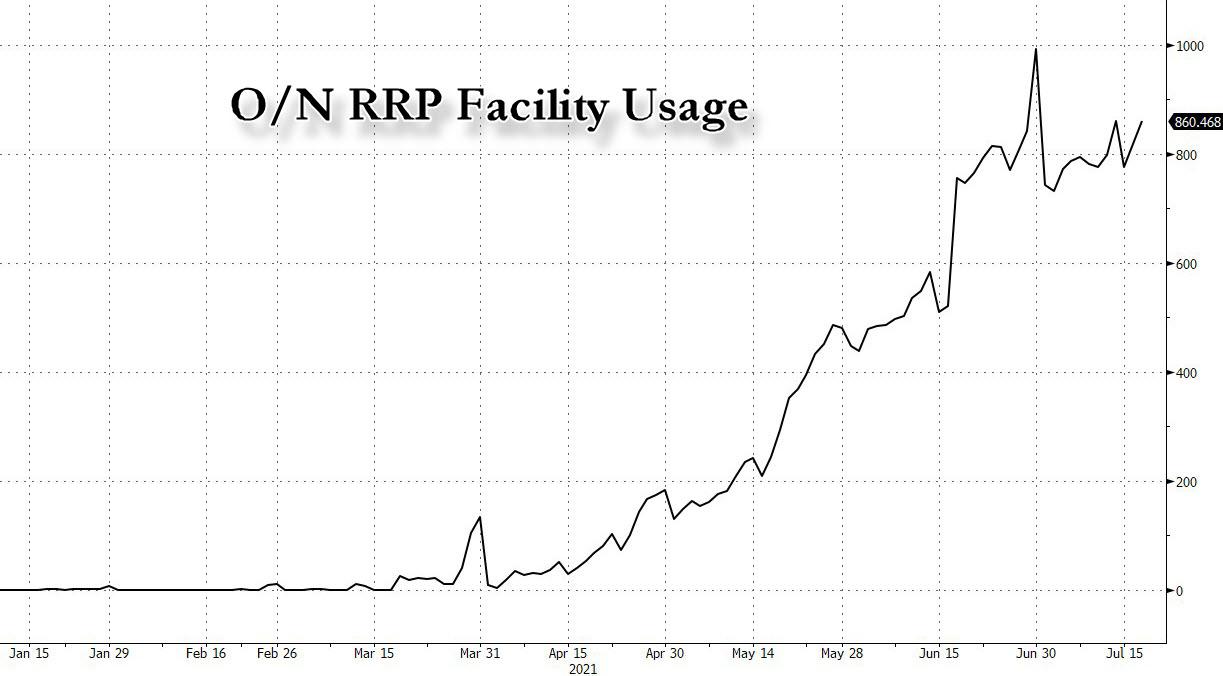
In the days following the quarter-end burst to almost $1 trillion, usage of the Fed’s infamous overnight reverse repo facility had shrunk by roughly $200BN, gravitating in the $750BN – $800BN range, until today when 71 counterparties parked $860.5BN worth of reserves at the Fed, the second highest amount on record.

But despite renewed expectations that this latest push will finally send total RRP activity above $1 trillion as banks seek to park excess reserves/deposits anywhere but in the economy and/or markets, Curvature’s Scott Skyrm disagrees, pointing to one notable change: the surge in yields.

As Skyrm writes in his latest Repo Market Commentary “with the stock market sell-off and the bond market rally, it only means one thing! A flight-to-quality.” This matters because traditionally “a flight-to-quality will affect the Repo market by removing securities from the market.”

And as “end buyers” purchase Treasurys and pack them away in their portfolios, “it means less collateral in the market” (reserves, i.e., cash, is what banks use to buy TSYs with, or – in the case of JPMorgan not buy TSYs with as discussed earlier).  Skyrm then writes that historically a large percentage of the securities purchased are the on-the-run issues, so “given the slow summer weeks and large issue sizes, I don’t expect Repo market activity to increase substantially.”

However, after a sleepy August, if volatility continues into the refunding and if yields reverse course and collateral is once again dumped, Skyrm warns that “we could have a pretty active August.”

Not everyone agrees with this take: according to interbroker dealer Wrightson ICAP, RRP volumes could return to the $900 billion level by Wednesday or Thursday.

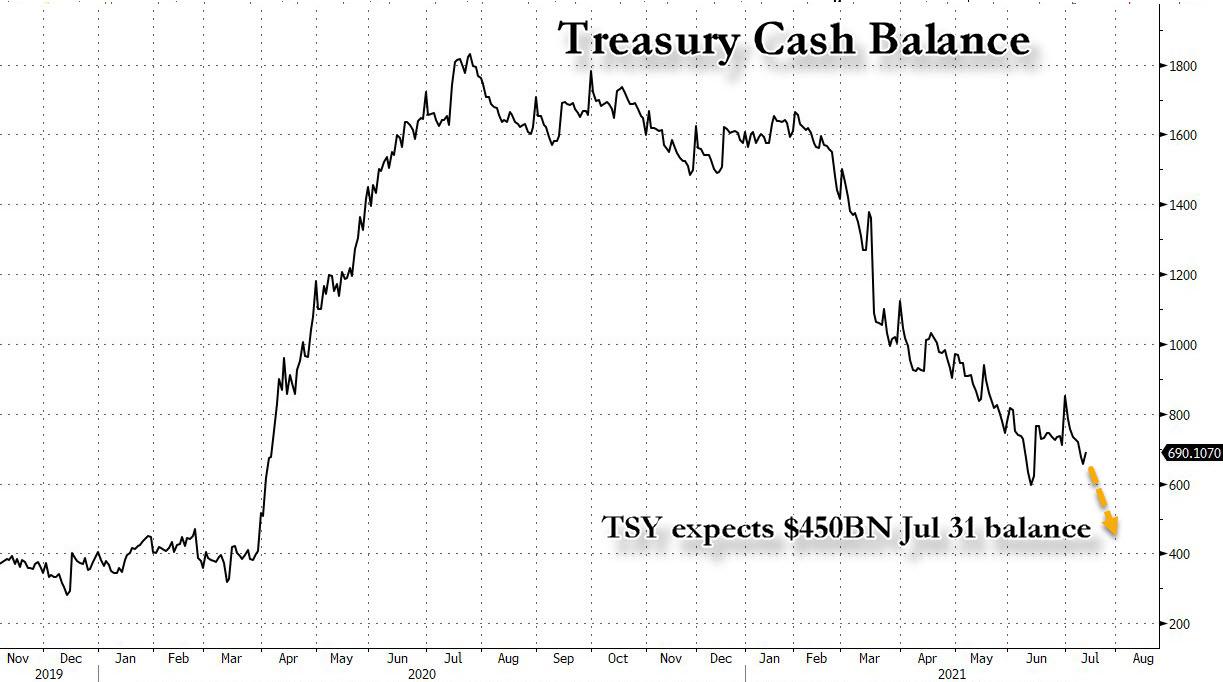
But the biggest reason why many expect the RRP balance to explode in the next 10 days is because in May, the Treasury forecast that its cash balance on July 31 will drop to $450 billion; it was $698 billion on July 16, meaning that the Treasury will have to drain $250 billion in cash from the Treasury General Account, with the resultant reserves likely getting parked immediately at the Fed’s repo facility…

… unless of course the Fed makes equities eligible for CET1 coverage, encouraging banks to use Fed reserves to buy stocks outright instead of through market intermediaries.

Tyler Durden
Mon, 07/19/2021 – 19:00

via ZeroHedge News https://ift.tt/3wPXcZU Tyler Durden

SCOTUS Restores Rule 33.1 For Printed Copies of Briefs

In April 2020, I praised the Supreme Court for loosening Rule 33.1. This rule creates a byzantine regime for printing copies of briefs. It is difficult and expensive to comply with. At the end of my post, I hoped that the pandemic might yield permanent changes in the Court’s practices.

The Supreme Court’s electronic filing system is excellent–far better than CM/ECF, which the lower courts use. And it is free to the public. Kudos to the Court for developing this system. These changes should be permanent as well. No one will miss these antiquated rules. . . .

It will be difficult for the Court to go back to normal. I like the new normal.

Once again, my predictions about the Court were wrong. It apparently is very easy to go back to the old processes.

Today the Court issued a two-page order. The Court rescinded its March 19, 2020 and April 15, 2020 orders, subject to a few caveats. In short, after September 1, all of the requirements of Rule 33.1 go back into effect.

IT IS FURTHER ORDERED that the requirement of Rule 33.1 that 40 copies of documents be submitted in booklet format will go back into effect as to covered documents filed on or after September 1, 2021. For submissions pursuant to Rule 33.2, the requirement of Rule 39 that an original and 10 copies be submitted, where applicable, will also go back into effect as to covered documents filed on or after September 1, 2021. The authorization to file a single copy of certain documents on 8½ x 11 inch paper, as set forth in the Court’s April 15, 2020 order, will remain in effect only as to documents filed before September 1, 2021.

This order does not bode well for those hoping that live-streamed oral arguments continue. I think we will go back to the stone age.

from Latest – Reason.com https://ift.tt/3eTeUph
via IFTTT

Victor Davis Hanson: The American Descent Into Madness

Victor Davis Hanson: The American Descent Into Madness

Authored by Victor Davis Hanson via AmGreatness.com,

America went from the freest country in the world in December 2019 to a repressive and frightening place by July 2021. How did that happen?

Nations have often gone mad in a matter of months. The French abandoned their supposedly idealistic revolutionary project and turned it into a monstrous hell for a year between July 1793 and 1794. After the election of November 1860, in a matter of weeks, Americans went from thinking secession was taboo to visions of killing the greatest number of their fellow citizens on both sides of the Mason-Dixon line. Mao’s China went from a failed communist state to the ninth circle of Dante’s Inferno, when he unleashed the Cultural Revolution in 1966.

In the last six months, we have seen absurdities never quite witnessed in modern America. Madness, not politics, defines it. There are three characteristics of all these upheavals. One, the events are unsustainable. They will either cease or they will destroy the nation, at least as we know it. Two, the law has largely been rendered meaningless. Three, left-wing political agendas justify any means necessary to achieve them.

Citizenship as Mere Residency

Two million people are anticipated to cross the southern border, en masse and illegally, over a 12-month period. If that absurdity were to continue, we would be adding the equivalent of a major U.S. city every year. The new arrivals have three things in common: Their first act was to break U.S. law by entering the country. Their second was to break the law by residing here illegally. And their third will be to find false identification or other illegal means to continue breaking the law. One does not arrive as a guest in a foreign country and immediately violate the laws of his host—unless one holds those laws in contempt.

Arrivals now cross a border that had been virtually closed to illegal immigration by January 2021. In the cynical and immoral logic of illegal immigration (that cares little for the concerns either of would-be legal immigrants or U.S. citizens), arrivals will be dependent upon the state and thus become constituents of progressives who engineered their arrival.

Yet the issue is not illegal immigration per se. If protests were to continue in Cuba, and 1 million Cubans boated to Miami, the Biden Administration would stop the influx, in terror that so many anti-Communists might tip Florida red forever.

How strange that the U.S. government is considering going door-to-door to bully the unvaccinated, even as it ignores the daily influx of thousands from Mexico and Latin America, without worrying whether they are carrying or vaccinated for COVID-19. Meanwhile, the progressive media shrilly warns that the new Delta Variant of the virus is exploding south of the border. Note how the administration applies standards to its own citizens that it does not apply to foreign nationals illegally entering the country.

Crime as Construct

Crime is another current absurdity. There exists a mini-industry of internet videos depicting young people, disproportionately African American males, stealing luxury goods from Nieman-Marcus in San Francisco, clearing a shelf from a Walgreens with impunity, or assaulting Asian Americans. These iconic moments may be unrepresentative of reality, but given the mass transfers and retirements of police, and the frightening statistics of large increases in violent crime in certain cities, the popular conception is now entrenched that it is dangerous to walk in our major metropolises, either by day or at night. Chicago has turned into Tombstone or Dodge City in the popular imagination.

Scarier still is the realization that if one is robbed, assaulted, or finds one’s car vandalized, it is near certain the miscreant will never be held to account. Either the police have pulled back and find arrests of criminals a lose-lose situation, or radical big-city district attorneys see the law as a critical legal theory construct, and thus will not enforce it. Or the criminal will be arrested and released within hours.

So a subculture has developed among Americans, of passing information about where in the country it is safe, where it is not, and where one can go, where one cannot. This is clearly not America, but something bizarre out of Sao Paulo, Durban, or Caracas.

The Campus Con

The universities over the past 40 years were intolerant, hard Left, and increasingly anti-constitutional. But they also fostered a golden-goose confidence scheme that administrators dared not injure, given the precious eggs of federally guaranteed student loans that ensured zero academic accountability and sent tuition costs into the stratosphere. There was an unquestioned supposition that a degree of any sort, of any major, was the ticket to American success. In cynical fashion, we shrugged that most prestigious institutions were little more than cattle branders that stamped graduates with imprints that gave them unearned privilege for life.

Yet universities now have both hands around their golden goose’s neck and are determined to strangle it. The public is becoming repulsed at the woke McCarthyite culture on campus, and will be more turned off when campuses open in the fall in 2019-style. At the Ivy League or major state university campuses, admissions are no longer based on proportional representation in the context of affirmative action, but are defined increasingly by a reparatory character.

Grades, test scores, and “activities” of the white and Asian male college applicants are growing less relevant. Only “privileged” white males with sports skills, connections, or families who give lots of money are exempt from the new racial reparation quotas. The new woke admission policy ironically is targeting the liberal suburban professional family, the Left’s constituency, whose lives are so fixated on whether children graduate from Yale, Princeton, Harvard, Stanford, or like campuses.

Given the radical change in incoming student profiles, the faculty increasingly will have to choose between accusations of racism, or grading regardless of actual performance, given thousands of new enrollees do not meet the entrance standards of just two or three years ago. Remember that since wokeism was always a top-down elite industry, minority progressives still will fight it out with white leftists in intramural scraps over titles, salaries, and managerial posts.

The public has had enough. For the first time, people will ask why are we subsidizing student loans, why are multibillion-dollar endowments not taxed, and why do we think a B.A. in sociology or psychology or gender studies is an “investment” that prepares anyone for anything?

Commissars and Jacobins

The critical race theory craze is reaching peak woke, or is already on the downslope. No complex and sophisticated society is sustainable with a Maoist creed of cannibalizing citizens for thought crimes. Commissars do not produce anything or serve anybody, but only monitor thoughts and speech to ascertain the purity of diversity, equity, and inclusion. They are not just a drain on the productive sector but will insidiously destroy it, since their currency is to ensure a timid, obsequiousness and banal orthodoxy.

We know from the failed Soviet system and from the French Revolution that the most mediocre in society became its most eager auditors of correct behavior. The arbiters of proper thought—the self-righteous paid toady, the perpetual victim employed in service to government payback, the freelancing snitch—were always the villains of freedom, productivity, and humanity, whether we read of the killing off of Alexander the Great’s inner circle, the forced suicides of the Neronian circle, the Jacobin murder spree, or the nightmarish world described by Aleksandr Solzhenitsyn.

That the Biden Administration has now joined with Silicon Valley to hunt down on social media any dissenters from this month’s official policy on vaccinations and mask-wearing was not so shocking as to be expected from a media that banned coverage of Hunter Biden’s laptop. In Cuban-fashion, millions of judge-jury-executioner online snitches, with government encouragement, will help root out incorrect thoughts at light speed.

Inflation Is a Mere Construct

We used to know what inflation was, its pernicious role in past civilizations, and how to combat it. The danger of worthless currency is a staple of classical literature from Aristophanes to Procopius. The scary fact is not just that we are destroying the value of our money—the exploding price of gas, food, appliances, lumber, power, and housing are overwhelming even Joe Biden’s entitlement machine—but that we are constructing pseudoeconomics to justify the nihilism.

Right now, we witness a multitrillion-dollar fight over borrowing beyond our $30 trillion debt to build “infrastructure,” a word that has been expanded to include mostly anything but roads and bridges. What exactly is so liberal about the farmworker paying $5 a gallon for gas to commute to the fields, the small contractor doing a remodeling job with plywood at $80 a sheet, or the young couple whose loan qualification is always a month behind the soaring price of a new home?

Our People’s Military

Americans during this entire descent in madness sighed, “Well, at least there is the military left.” By that, I think they meant John Brennan had all but wrecked the CIA, while James Comey, Andrew McCabe, Kevin Clinesmith, Peter Strzok, and Lisa Page, et al. had weaponized the FBI. But the military was still a bastion of traditional, nonpartisan service, whose prime directive was to defend the country, win any war it was ordered to fight, and to maintain deterrence against opportunistic enemies. It was not envisioned as a “people’s army.” It was not a revolutionary Napoleonic “nation in arms.” And it was not a “liberation army.” The Constitution, 233 years of tradition, and the Uniform Code of Military Justice all reassured America of its wonderful defense forces.

And now? We are in the process of a massive reeducation and indoctrination campaign. The revamping not only draws scarce resources away from military readiness, but targets, without evidence, the white working class, and defames it as insurrectionary—the very same cohort that disproportionately died in Afghanistan and Iraq.

If only General Mark Milley, chairman of the Joint Chiefs of Staff, and Admiral Michael Gilday, chief of naval operations, had been as animated, as combative, and as fired up in congressional testimony about winning in Afghanistan or deterring the Chinese in the waters off Taiwan as they were in defense of their recommended lists of Marxist-inspired critical race theory texts!

One purpose of the Uniform Code of Military Justice was not to prevent retired top brass from attacking beloved presidents, or even blasé ones. Its aim was to remind the country that it is the business of civilians, not pensioned retired military subject to recall in times of crisis, to galvanize opinion against loudmouth unpopular presidents like Harry Truman, Richard Nixon, or Donald Trump.

The reason why the “revolving door” became a bipartisan worry was that four-star officers had mastered the navigation of Pentagon procurement. They possessed a rare skill easily—and hugely—monetized upon retirement, and thus its use was to be discouraged wholeheartedly.

And now?

The code is a mere construct. The revolving door is an advertisement for advancing to high rank. Policing the thoughts of American soldiers is apparently more important than fathoming the minds of our enemies on the battlefield.

Keep Cuba Castroite?

What was so hard about understanding that Cuba since 1959 has been a Communist gulag, antithetical to human freedom and consensual government? What was so difficult about conceding that Cuba had been an ally of the nuclear Soviet Union, always egging it on to war against the United States?

Yet here we are with protestors against a failed, evil state in the streets of Havana, and our own government, media, and professional classes are worried that ossified Communism in Cuba may fall.

After opening the U.S. southern border to pseudo-political refugees, the Biden Administration is terrified that thousands of real ones might come to Miami in the fashion it invited millions to storm into Texas. The Biden Administration, and the Left in general, finally revealed what many of us have known: it had no real ideological view on illegal immigration. Its immigration policy was entirely utilitarian and hinged only on whether illegal immigration altered the demography of the electorate in the correct way.

The United Nations Über Alles

Finally, almost all Americans used to agree that the U.S. Constitution was unique and guaranteed personal freedom in a way the United Nations charter could not. Dozens of fascist, Communist, totalitarian, and authoritarian regimes, usually the majority of governments on earth, ensured that any General Assembly or U.N. committee ruling would parrot the views of its illiberal and corrupt members.

Not anymore. Biden’s secretary of state, Antony Blinken, has invited in the U.N. to assess whether the United States meets global standards of justice or, in fact, is racist and in need of global censure: “I urge all U.N. member states to join the United States in this effort, and confront the scourge of racism, racial discrimination, and xenophobia,” he said last week.

That is like asking Libya in 2001 to assess whether our airline pilot training met proper standards or having China adjudicate the conditions in U.S. prisons.

America went from the freest country in the world in December 2019 to a repressive, and frightening place by July 2021. It went not so much hard-Left, as stark-raving mad.

That abrupt descent, too, is not workable and millions will collectively decide they have no choice but to push back and conclude, “In the 233rd year of our republic, we tens of millions are not going to cede freedom of thought and expression to thousands of Maoists. Sorry, no can do.”

Tyler Durden
Mon, 07/19/2021 – 18:40

via ZeroHedge News https://ift.tt/3xQIwLn Tyler Durden

SCOTUS Restores Rule 33.1 For Printed Copies of Briefs

In April 2020, I praised the Supreme Court for loosening Rule 33.1. This rule creates a byzantine regime for printing copies of briefs. It is difficult and expensive to comply with. At the end of my post, I hoped that the pandemic might yield permanent changes in the Court’s practices.

The Supreme Court’s electronic filing system is excellent–far better than CM/ECF, which the lower courts use. And it is free to the public. Kudos to the Court for developing this system. These changes should be permanent as well. No one will miss these antiquated rules. . . .

It will be difficult for the Court to go back to normal. I like the new normal.

Once again, my predictions about the Court were wrong. It apparently is very easy to go back to the old processes.

Today the Court issued a two-page order. The Court rescinded its March 19, 2020 and April 15, 2020 orders, subject to a few caveats. In short, after September 1, all of the requirements of Rule 33.1 go back into effect.

IT IS FURTHER ORDERED that the requirement of Rule 33.1 that 40 copies of documents be submitted in booklet format will go back into effect as to covered documents filed on or after September 1, 2021. For submissions pursuant to Rule 33.2, the requirement of Rule 39 that an original and 10 copies be submitted, where applicable, will also go back into effect as to covered documents filed on or after September 1, 2021. The authorization to file a single copy of certain documents on 8½ x 11 inch paper, as set forth in the Court’s April 15, 2020 order, will remain in effect only as to documents filed before September 1, 2021.

This order does not bode well for those hoping that live-streamed oral arguments continue. I think we will go back to the stone age.

from Latest – Reason.com https://ift.tt/3eTeUph
via IFTTT

When Government Urges Private Entities to Restrict Others’ Speech

Say the government urges various intermediaries—bookstores, billboard companies, payment processors, social media platforms—to stop carrying certain speech. The government isn’t prosecuting them or suing them, just asking them. (This is in the news both with regard to the Biden Administration “flagging problematic posts for Facebook that spread disinformation” and Donald Trump’s lawsuits against Facebook, Twitter, and YouTube, to the extent they claim government officials’ speech pressured those platforms into blocking him.) Is such government urging constitutional?

[A.] Generally speaking, courts have said “yes, that’s fine,” so long as the government speech doesn’t coerce the intermediaries by threatening prosecution, lawsuit, or various forms of retaliation. (Indeed, I understand that government officials not uncommonly ask newspapers, for instance, not to publish certain information that they say would harm national security or interfere with an ongoing criminal investigation.) Here’s a sample of appellate cases so holding:

[1.] A New York City official sent a letter urging department stores not to carry “a board game titled ‘Public Assistance—Why Bother Working for a Living.'” The letter said the game “does a grave injustice to taxpayers and welfare clients alike,” and closes with, “Your cooperation in keeping this game off the shelves of your stores would be a genuine public service.” Not unconstitutional, said the Second Circuit in Hammerhead Enterprises, Inc. v. Brezenoff (1983):

[T]he record indicates that Brezenoff’s request to New York department stores to refrain from carrying Public Assistance was nothing more than a well-reasoned and sincere entreaty in support of his own political perspective…. Where comments of a government official can reasonably be interpreted as intimating that some form of punishment or adverse regulatory action will follow the failure to accede to the official’s request, a valid claim can be stated…. [But] appellants cannot establish that this case involves either of these troubling situations.

[2.] The Attorney General’s Commission on Pornography sent letters to various corporations (such as 7-Eleven) urging them not to sell pornographic magazines:

The Attorney General’s Commission on Pornography has held six hearings across the United States during the past seven months on issues related to pornography. During the hearing in Los Angeles, in October 1985, the Commission received testimony alleging that your company is involved in the sale or distribution of pornography. The Commission has determined that it would be appropriate to allow your company an opportunity to respond to the allegations prior to drafting its final report section on identified distributors.

You will find a copy of the relevant testimony enclosed herewith. Please review the allegations and advise the Commission on or before March 3, 1986, if you disagree with the statements enclosed. Failure to respond will necessarily be accepted as an indication of no objection.

Please call Ms. Genny McSweeney, Attorney, at (202) 724-7837 if you have any questions. Thank you for your assistance.

Not unconstitutional, said the D.C. Circuit in Penthouse Int’l v. Meese (1991):

In our case, the Advisory Commission had no … tie to prosecutorial power nor authority to censor publications. The letter it sent contained no threat to prosecute, nor intimation of intent to proscribe the distribution of the publications…. And the Supreme Court has never found a government abridgement of First Amendment rights in the absence of some actual or threatened imposition of governmental power or sanction….

We do not see why government officials may not vigorously criticize a publication for any reason they wish. As part of the duties of their office, these officials surely must be expected to be free to speak out to criticize practices, even in a condemnatory fashion, that they might not have the statutory or even constitutional authority to regulate.  If the First Amendment were thought to be violated any time a private citizen’s speech or writings were criticized by a government official, those officials might be virtually immobilized.

[3.] A New York state legislator and a New York Congressman accused X-Men Security, a security organization connected to the Nation of Islam, of various conspiracies, ” asked government agencies to conduct investigations into its operations, questioned X-Men’s eligibility for an award of a contract supported by public funds, and advocated that X-Men not be retained.” X-Men lost certain security contracts as a result. Not unconstitutional, said the Second Circuit in X-Men Security, Inc. v. Pataki (1999):

[J]ust as the First Amendment protects a legislator’s right to communicate with administrative officials to provide assistance in securing a publicly funded contract, so too does it protect the legislator’s right to state publicly his criticism of the granting of such a contract to a given entity and to urge to the administrators that such an award would contravene public policy. We see no basis on which X-Men could properly be found to have a constitutional right to prevent the legislators from exercising their own rights to speak.

[B.] On the other hand, where courts find that the government speech implicitly threatened retaliation, rather than simply exhorting or encouraging third parties to block speech, that’s unconstitutional. The Supreme Court case on that is Bantam Books, Inc. v. Sullivan (1963), where a state commission threatened to prosecute stores that sold books that it viewed as pornography (including books that were actually protected by the First Amendment). And lower court cases have applied that even absent express threat of prosecution, for instance:

[1.] The mayor and a trustee of a New York town sent a letter to a newspaper demanding to learn more about who was involved in an article critical of local officials. Potentially unconstitutional, the Second Circuit held in Rattner v. Netburn (1991):

Though the district court characterized the Netburn letter as simply a plea to the Chamber to rid itself of political affiliations, that letter stated that the recent Gazette “raises significant questions and concerns about the objectivity and trust which we are looking for from our business friends,” and it asked “[w]ho wrote” the questions and requested “a list of those members who supported the inclusion of this ‘article’.” Further, the record includes evidence that, when questioned about the letter, Netburn also stated that he had made a list of the local businesses at which he regularly shopped. The district court’s ruling that the language of the Netburn letter, either standing alone or in all the circumstances, is not a veiled threat of boycott or reprisal does not view that language in the light most favorable to Rattner as the nonmoving party….

[And] a threat was perceived and its impact was demonstrable. Several Chamber directors testified at their depositions that they viewed the letter as reminiscent of McCarthyism, threatening them with boycott or discriminatory enforcement of Village regulations if they permitted the publication of additional statements by Rattner; the Chamber member who had been “in charge of” the Gazette testified that following receipt of the Netburn letter, he had actually lost business and had been harassed by the Village.

Further, the Netburn letter caused the Chamber to cease publication of the Gazette; and it advised Rattner of this decision while concealing from him the fact that another issue would be forthcoming, in order to avoid having to publish in that issue material for which he had already paid. Thus, the fact that Netburn’s letter and statement “were not followed up with unannounced visits by police personnel” should hardly have been deemed dispositive since the Chamber immediately capitulated to what may reasonably be viewed as an implicit threat.

[2.] The President of the Borough of Staten Island sent a letter to a billboard company urging it to take down an anti-homosexuality billboard, which closed with:

Both you and the sponsor of this message should be aware that many members of the Staten Island community, myself included, find this message unnecessarily confrontational and offensive. As Borough President of Staten Island I want to inform you that this message conveys an atmosphere of intolerance which is not welcome in our Borough.

P.N.E. Media owns a number of billboards on Staten Island and derives substantial economic benefits from them. I call on you as a responsible member of the business community to please contact Daniel L. Master, my legal counsel and Chair of my Anti-Bias Task Force … to discuss further the issues I have raised in this letter.

Potentially unconstitutional, the Second Circuit held in Okwedy v. Molinari (2003):

In the present case, a jury could find that Molinari’s letter contained an implicit threat of retaliation if PNE failed to accede to Molinari’s requests. In his letter, Molinari invoked his official authority as “Borough President of Staten Island” and pointed out that he was aware that “P.N.E. Media owns a number of billboards on Staten Island and derives substantial economic benefits from them.” He then “call[ed] on” PNE to contact Daniel L. Master, whom he identified as his “legal counsel and Chair of my Anti-Bias Task Force.”

Based on this letter, PNE could reasonably have believed that Molinari intended to use his official power to retaliate against it if it did not respond positively to his entreaties. Even though Molinari lacked direct regulatory control over billboards, PNE could reasonably have feared that Molinari would use whatever authority he does have, as Borough President, to interfere with the “substantial economic benefits” PNE derived from its billboards in Staten Island.

[3.] The Sheriff of Cook County (Illinois) sent letters to Mastercard and Visa saying,

As the Sheriff of Cook County, a father and a caring citizen, I write to request that your institution immediately cease and desist from allowing your credit cards to be used to place ads on websites like Backpage.com [which hosted ads for sex-related services].

Potentially unconstitutional, the Seventh Circuit held in Backpage.com, LLC v. Dart (2015); the court went through the Sheriff’s letter in detail, and concluded:

And here’s the kicker: “Within the next week, please provide me with contact information for an individual within your organization that I can work with [harass, pester] on this issue.” The “I” is Sheriff Dart, not private citizen Dart — the letter was signed by “Thomas Dart, Cook County Sheriff.”

And the letter was not merely an expression of Sheriff Dart’s opinion. It was designed to compel the credit card companies to act by inserting Dart into the discussion; he’ll be chatting them up.

Further insight into the purpose and likely effect of such a letter is provided by a strategy memo written by a member of the sheriff’s staff in advance of the letter. The memo suggested approaching the credit card companies (whether by phone, mail, email, or a visit in person) with threats in the form of “reminders” of “their own potential liability for allowing suspected illegal transactions to continue to take place” and their potential susceptibility to “money laundering prosecutions … and/or hefty fines.” Allusion to that “susceptibility” was the culminating and most ominous threat in the letter.

[C.] Does it matter whether the government acts systematically, setting up a pipeline for requests to the media? One can imagine courts being influenced by this, as they are in some other areas of the law; but I know of no First Amendment cases so holding.

[D.] Now in some other areas of constitutional law, this question of government requests to private actors is treated differently, at least by some courts. Say that you rummage through a roommate’s papers, find evidence that he’s committing a crime, and send it to the police. You haven’t violated the Fourth Amendment, because you’re a private actor. (Whether you might have committed some tort or crime is a separate question.) And the police haven’t violated the Fourth Amendment, because they didn’t perform the search. The evidence can be used against the roommate.

But say that the police ask you to rummage through the roommate’s papers. That rummaging may become a search governed by the Fourth Amendment, at least in the eyes of some courts: “the government might violate a defendant’s rights by ‘instigat[ing]’ or ‘encourag[ing]’ a private party to search a defendant on its behalf.”

Likewise, “In the Fifth Amendment context, courts have held that the government might violate a defendant’s rights by coercing or encouraging a private party to extract a confession from a criminal defendant.” More broadly, the Supreme Court has said that “a State normally can be held responsible for a private decision only when it has exercised coercive power or has provided such significant encouragement, either overt or covert, that the choice must in law be deemed to be that of the State.”

So maybe there’s room for courts to shift to a model where the government’s mere encouragement of private speech restrictions is enough to constitute a First Amendment violation on the government’s part.

[E.] One more twist, relevant to the Trump lawsuits: Say that the government is found to have coerced a private entity into restricting plaintiff’s speech. Can plaintiff sue the private entity, or can he just sue the government?

It might be quite sensible to say that the private entity is the victim of government coercion, and shouldn’t be blamed for going along with it. After all, if you are free to do something on your own, and you do it, you couldn’t be sued. Why should the government’s coercion that forces you to do something that you have the right to do on your own make you liable (as opposed to making the government liable)?

Yet there’s at least a plausible argument that the coerced intermediary could indeed be sued. See Adickes v. S.H. Kress & Co. (1970) (concluding that “the decision of an owner of a restaurant to discriminate on the basis of race under the compulsion of state law offends the Fourteenth Amendment”); Skinner v. Railway Labor Executives’ Ass’n (1989) (“A railroad that complies with the provisions of Subpart C of the regulations [requiring drug testing of certain employees] does so by compulsion of sovereign authority, and the lawfulness of its acts is controlled by the Fourth Amendment.”); Carlin Communications, Inc. v. Mountain States Tel. & Tel. Co. (9th Cir. 1987) (“With this threat [of prosecuting defendant for allowing plaintiff’s dial-a-porn], Arizona ‘exercised coercive power’ over Mountain Bell and thereby converted its otherwise private conduct into state action for purposes of § 1983”). There’s a lot more that can be said about the matter, but I just thought that I’d note here that such liability for the intermediary is at least potentially available.

from Latest – Reason.com https://ift.tt/3zgqfHo
via IFTTT