Taibbi: Biden’s Troubles Aren’t Bernie’s Fault… Or A Media Mirage

Taibbi: Biden’s Troubles Aren’t Bernie’s Fault… Or A Media Mirage

Authored by Matt Taibbi via TK News Substack,

A recent column by Colbert King in the Washington Post read as follows:

A president and Congress seen united and fighting for people will be a team that gets rewarded at the polls. Accomplishing that calls for less selfish and self-serving political behavior – from Sen. Joe Manchin III (D-W.Va.) to Sen. Bernie Sanders (I-Vt.) – and more care toward making life better for Americans.

Entitled, “Where Will Democratic Infighting Lead? History’s Answer is Clear,” King’s piece essentially blames Bernie Sanders for the recent Supreme Court thinking on abortion.

Intramural debate, which he calls “infighting,” lead in his mind to poor electoral results for mainstream Democrats, who for all their other faults are consistent on the abortion issue and therefore deserve the frictionless political existence Sanders denied them.

King’s piece is penned as a warning, that not only Republican opposition “inspired by Trump” but “left-wing complaints of ‘corporate Democrats’ beholden to corrupt businesses, Big Pharma and the ultra-wealthy” have left Joe Biden with “slumping poll numbers.” As a result, he says, “Joe Biden is on the path to a one-term presidency.”

On the same day, in the same paper, Dana Milbank wrote an editorial, apparently not intended as satire, entitled, “The media treats Biden as badly as — or worse than — Trump. Here’s proof.”

After listing headlines like “Does the WH owe Larry Summers an apology?” and “No BIF bump for Biden” as anecdotal evidence of this savagery, Milbank turned to the hard “proof”: data from a company called “FiscalNote.”

The firm did a “sentiment analysis” of 200,000 articles and apparently found that “Biden’s press for the past four months has been as bad as — and for a time worse than — the coverage Trump received for the same four months of 2020.”

I struggle to conceive of the brain that would believe such a thing to be true, but that’s a separate matter.

Milbank believed it, and concluded, “My colleagues in the media are serving as accessories to the murder of democracy.”

So they doubled and tripled down, soon congratulating themselves for substituting terms like “lie” for “untruth” and “white supremacist” for “racist” or “race-baiting,” and so on.

To read the rest, click here and subscribe…

Tyler Durden
Sun, 12/05/2021 – 14:32

via ZeroHedge News https://ift.tt/3lDZB6Z Tyler Durden

Here’s Who Bought The Crypto Dip, And Why A Gamma Squeeze May Be On Deck

Here’s Who Bought The Crypto Dip, And Why A Gamma Squeeze May Be On Deck

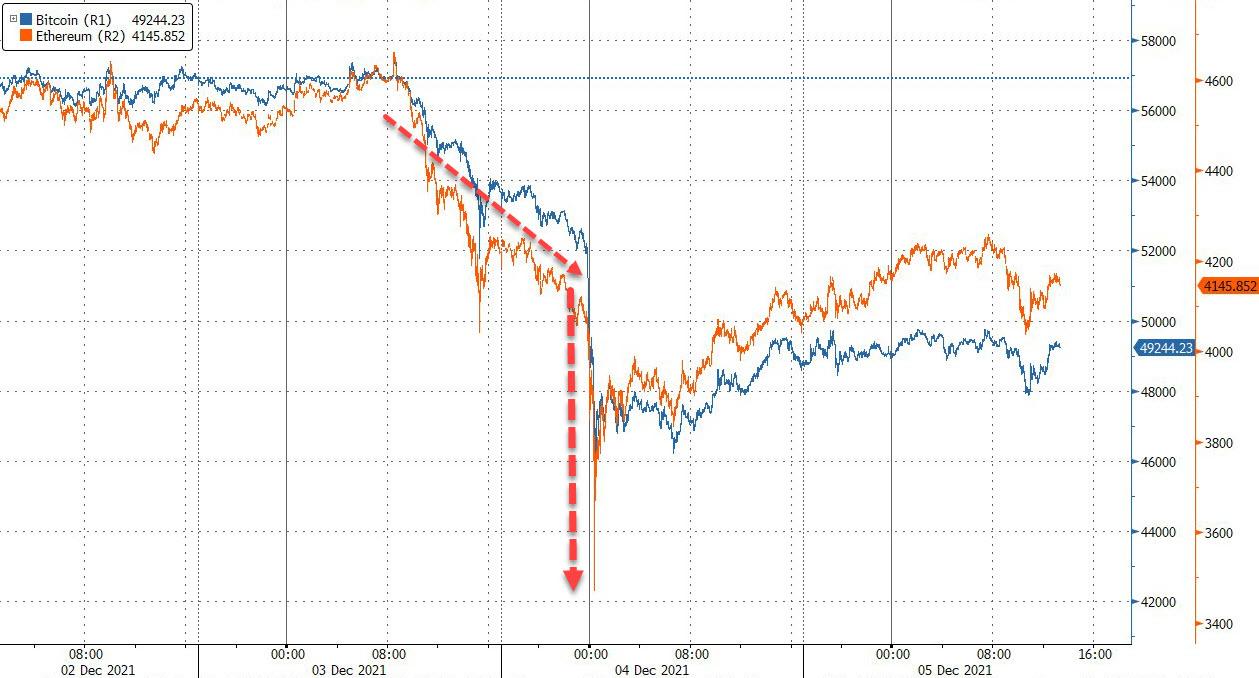
The past 3 days have been a rollercoaster for cryptocurrencies, which slumped alongside risk assets on Friday, only to see a wave of margined liquidations kick in during the Asian session on Friday into Saturday, leading to  crash in prices and a plunge of almost 30% in bitcoin and the rest of the crypto space, before a rebound lifted much of the space on Saturday and Sunday as a wave of dip buyers emerged.

Commenting on the move lower, UBS strategist led by Moritz Diller write that Crypto’s cons and pros have been underscored by the past fortnight. Sated long-term demand and signs of tighter regulation were weighing before Omicron. The knee-jerk reaction then caused prices to lurch lower as pro-risk and particularly inflation correlations made their presence felt.

But dip-buyers soon emerged to pick up BTC and ETH, largely at the expense of more leveraged recent coins and perhaps emboldened by
the prospect of renewed lockdowns spurring fresh retail inflows.

So who was buying?

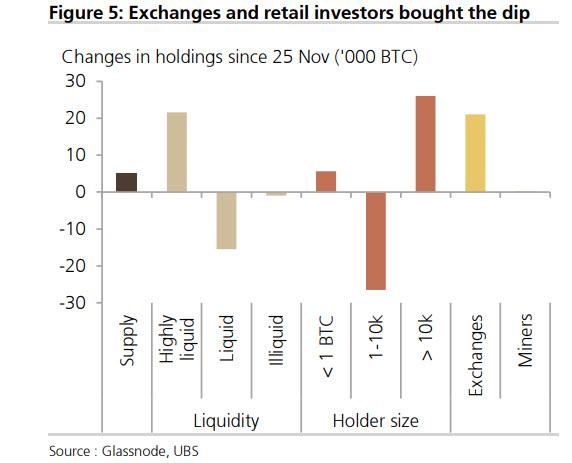
According to UBS analysis of Glassnode on-chain data, the dip was bought by the smallest and the largest holder cohorts as well as crypto exchanges. In other words, both retail and whale were waving it in, as medium-sized clients were actively shorting. This sets the scene for the next short squeeze.

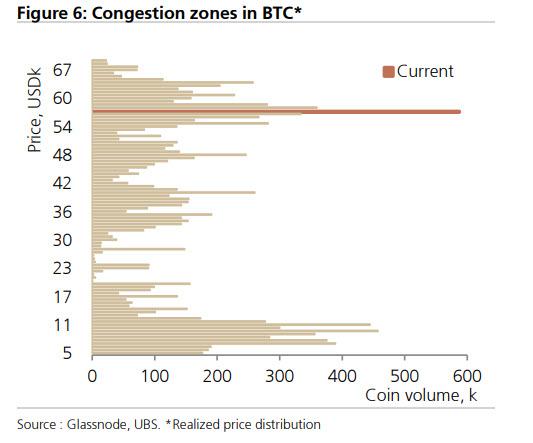
As UBS also notes, the realized price distribution chart for BTC has reinforced the 55,000-65,000 technical congestion zone, consequently

Meanwhile, ether’s price action has been firmer still, which comes as no surprise given building enthusiasm about next year’s shift to Proof of Stake and a fresh focus on bringing down transaction costs—witness Vitalik Buterin’s latest EIP-4488 proposal. ETH got back within striking distance of its all-time high as a result and the BTC/ETH cross just fell through its May low, triggering profit-taking.

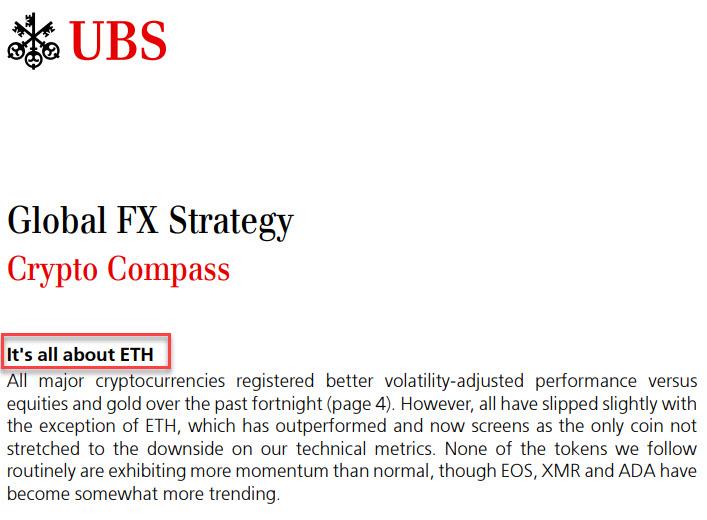
And speaking of ether, even UBS admits that it is now “all about ETH”…

… and goes on to explain why crypto shorts have been so persistent in preventing ethereum from rising above $5,000, which would be a new all time high: as UBS explains, “ETH options for the March 2022 expiry are dominated by a single large 15k strike worth around USD400m in premium.”

“This setup suggests a reacceleration above all-time highs could create a gamma-driven surge. However, prices stalling or falling would add to the high decay bill and instead open up further downside given the insignificant amount of protection left outstanding into year-end.”

In other words, over the next few weeks we will likely witness an epic clash over ETH hitting a new ATH around $5,000 and if the shorts finally allow that to happen, the move from there to $15,000 will be fast and furious.

Tyler Durden
Sun, 12/05/2021 – 14:00

via ZeroHedge News https://ift.tt/31yUUV8 Tyler Durden

Will The Fed Break The Economy (Again)?

Will The Fed Break The Economy (Again)?

Authored by Steven Van Metre via The Epoch Times,

Last week, the Fed was handed an unexpected gift as first-time jobless claims fell to the lowest level since 1969, which gives the Federal Reserve the green light to continue tapering its $120 billion monthly purchases of U.S. Treasury and mortgage-backed securities. Given the Fed’s dual mandate of maximum employment and stable prices, low unemployment claims along with a low unemployment rate allow the Fed to focus on combating inflation.

To fight inflation, the Fed only has two policy tools. The Fed can raise the federal funds rate, which is currently at 0 percent, and it can taper or reduce the size of its balance sheet. While those two tools are good at fighting monetary inflation, or rising prices associated with money printing, neither are useful for fighting supply-chain inflation.

The Fed isn’t concerned about how inflation manifests itself but only its ability to fight inflation. At the Federal Open Market Committee’s Nov. 3 press conference, Fed Chair Jerome Powell announced the committee has decided it was appropriate to reduce its asset purchases.

Starting in mid-November, the Fed would reduce its purchases of U.S. Treasury and mortgage-backed securities from $120 billion per month to $105 billion per month. In mid-December, the Fed will further reduce its asset purchases to $90 billion per month. Many pundits believe the Fed will increase the pace of its reductions at its Dec. 15 press conference, which will mark the last Federal Open Market Committee meeting for 2021.

For the Fed, the need to slow the rate of inflation is a matter of maintaining credibility. Congress has assigned the role of maintaining stable prices to the Fed, which has determined that 2 percent annualized inflation is a reasonable target. With the Consumer Price Index rising at a rate of 6.2 percent on a seasonally adjusted rate in October, there are serious political ramifications for Congress should the Fed be unable to control inflation.

Politicians are nervous about the upcoming November 2022 midterm elections as voters tend to have a negative reaction to inflation—particularly when wages are running below the rate of inflation, which they currently are. As of October, total private average hourly earnings of all employees rose at an annualized rate of 4.9 percent, falling well short of the annualized increase in consumer prices.

The problem for politicians is that voters tend to place the blame on those in power by voting them out of office. With President Joe Biden’s renomination of Powell to chair the Fed for another term, he’s placing his party’s future on Powell’s ability to control inflation. While Powell will slow the rate of inflation, the outcome isn’t one either political party wants.

Quantitative easing has been largely responsible for the growth rate of the money supply by forcing commercial banks to purchase U.S. Treasury and mortgage-backed securities with customer deposits. While there’s little evidence to support that an increase in money supply has a direct correlation to an increase in consumer prices, reducing the growth rate of the money supply will slow the rate of consumer price inflation.

Historically, the M2 Money Supply, which includes cash, checking deposits, and easily convertible short-term money, grows at an annualized rate of approximately 6 percent per year. At its height during the pandemic, the M2 money supply rose more than 27 percent annualized and as of October has slowed to 13 percent annualized.

As the Fed reduces its asset purchases, which require an increase in commercial bank deposits, the growth rate of the money supply will fall below its trend rate of 6 percent per year. With less money being created by the financial system, consumers will be unable to afford higher prices. By rejecting higher prices through lower consumption, consumer prices will fall.

In the short term, due to continued supply-chain disruptions, consumer prices are likely to stay elevated. Food, energy, and rents remain high, which will have a direct impact on cash-strapped consumer budgets. Consumers will be forced to reduce their discretionary spending as a larger percentage of their budgets gets allocated to food, energy, and rents.

This is a similar story to that which led up to the Great Financial Crisis, where consumer price inflation outpaced wage growth and the growth rate of the money supply slowed. Consumers then were unable to afford higher prices, which in turn led to a reduction in consumption along with the inability to keep the red-hot real estate market rising. What followed was a financial crisis that nearly destroyed the global financial markets.

While the Fed will be focused on fighting inflation by reducing its asset purchases in the months to come, Powell and his committee seem unaware of how they’re keeping the economy afloat. As the Fed reduces its asset purchases, the growth rate of the money supply will fall below trend, and the economy will likely find itself mired in another financial crisis.

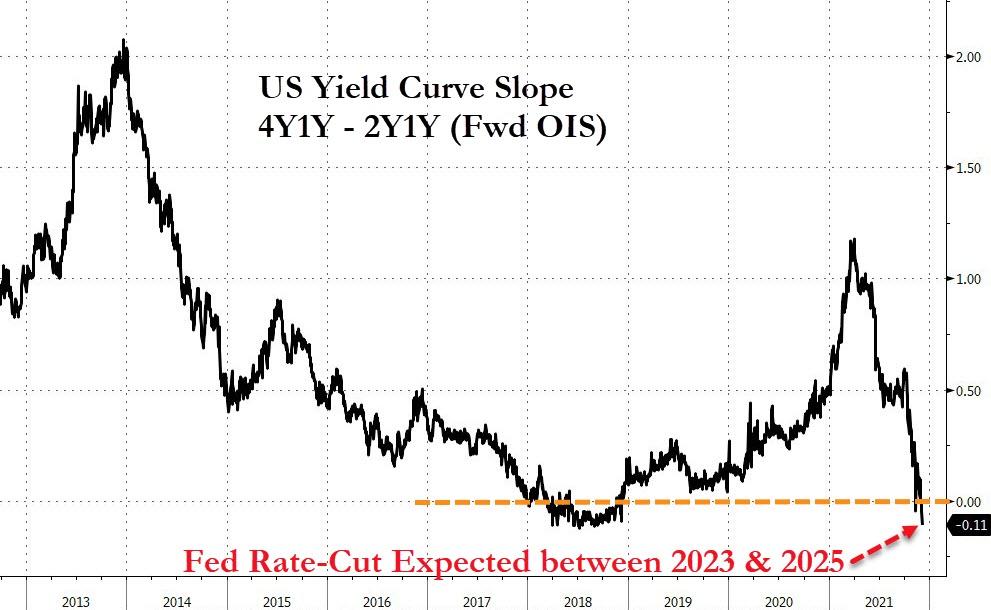
[ZH: Do not forget that the market is already expecting a major policy mistake (or flip-flop), pricing-in a rate-cut between 2023 and 2025…]

Just like the Great Financial Crisis triggered a deflationary crash, the next financial crisis will do the same. While many politicians and the Fed are worried about inflation, as long as the Fed continues to reduce its asset purchases, inflation will be the least of its concerns.

In the meantime, the Fed has the green light to proceed, and you can expect it to until something breaks.

Tyler Durden
Sun, 12/05/2021 – 13:29

via ZeroHedge News https://ift.tt/31AJgbZ Tyler Durden

Sparks Fly At Bridgewater Over Dalio’s Pro-China Stance

Sparks Fly At Bridgewater Over Dalio’s Pro-China Stance

American attitudes towards China remain extremely mixed (and apparently stratified by ‘wealth’). As we first noted some time ago, Negative views of China have increased substantially since 2018: “Today, 67% of Americans have “cold” feelings toward China on a “feeling thermometer,” rating the country less than 50 on a 0 to 100 scale. This is up from just 46% who said the same in 2018.”

The picture is very different on the corporate side of America with most recent examples including Jamie Dimon flip-flopping and bending the knee to Beijing about a ‘joke‘, NBA and LeBron James ignoring Enes Kanter Freedom’s warnings about Uyghur genocide, and Ray Dalio – founder of the world’s largest hedge fund – who this week drew an odd equivalence between China and US when asked about investing in the communist nation amid human-rights’ abuses:

“I look at the United States, and I say, well, what’s going on in the United States and should I not invest in the United States” because of “our own human-rights issues, or other things?”

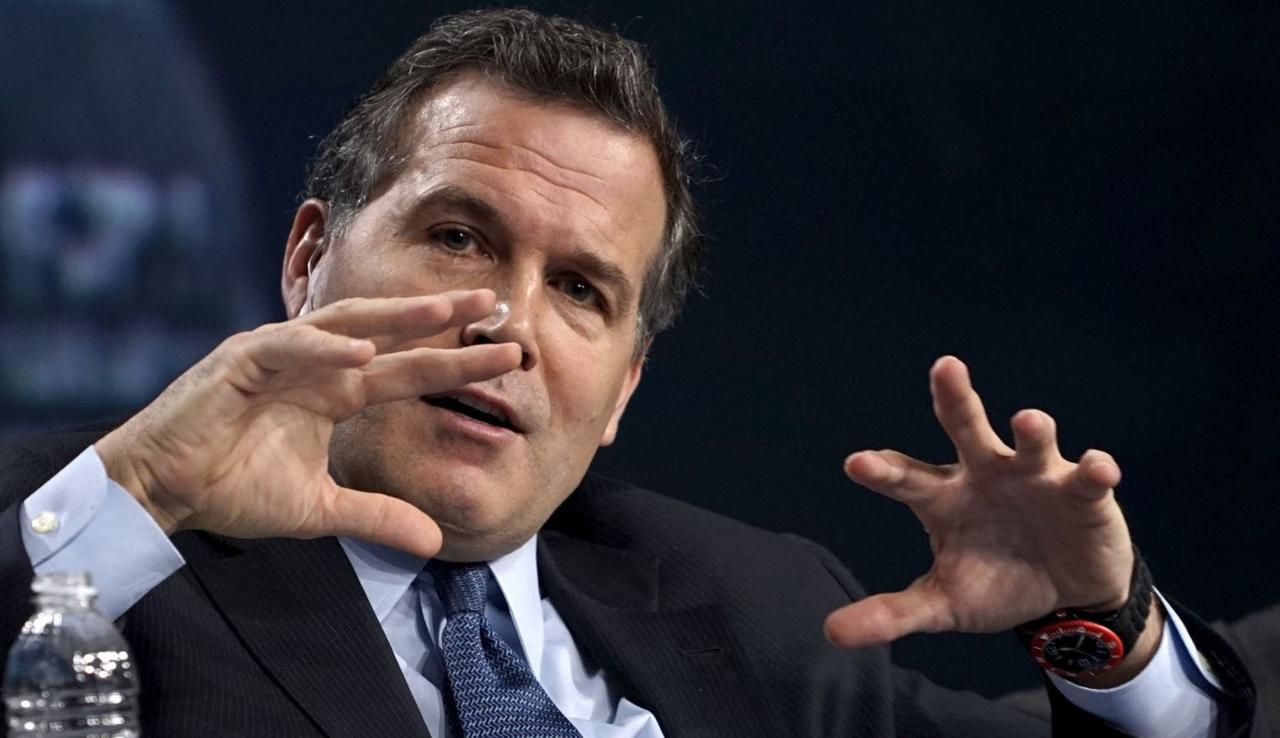
This remark triggered both silence and outrage among the two pro/anti-China camps, and prompted Bridgewater CEO David McCormick, who also happens to be considering a US Senate run as a Republican candidate, to make it clear that he disagrees with Dalio’s views.

During a company-wide call, McCormick addressed the controversial remarks that Dalio had made this week on television. As Bloomberg reports citing people with knowledge of the matter, McCormick told staff he’s had lots of arguments about China over the years with Dalio and that he disagrees with the billionaire’s views (not that it has stopped him from investing in China, that is).

The fact of the matter is that Dalio is not an idealist, but a pragmatic capitalist (who unlike so many of his Wall Street peers does not preach and moralize on the topic of China while doing precisely the opposite) and wants simply to put his capital to work in the place where it will garner the best return adjusted for risk. To him, it appears China is among those opportunities for growth – never mind the genocide, ‘disappearances’, totalitarianism, and increasingly weak property right. In other words, he is merely looking after his own and his investors interests.

Of course,  this ‘Wall Street’ perspective is verboten in a world of political correctness and SWJness, which makes Dalio’s public expression of ‘greed uber alles’ all the more notable in a world seemingly tearing itself apart over wealth inequality, income inequality, outcome inequality… and willing to virtue-signal left, right, and center in order to achieve sainthood even as the money into China keeps flowing to a record degree!

As The Wall Street Journal writes, this is the sort of comment that sours Americans on Wall Street and opens executives to accusations of being “citizens of the world” before they are Americans. Mr. Dalio wants freedom to invest where he pleases, but if Wall Street titans convey contempt for America’s system of government, then voters will curtail their prerogatives through the political process.

Finally, do not forget that in November, Bridgewater raised 8 billion yuan ($1.3 billion) for a new private fund in China. That brought the firm’s total onshore assets under management to more than 10 billion yuan.

Meanwhile, most Wall Street firms are similarly investing aggressively in China, while turning a blind eye to China’s epic human rights violations even as they continue to preach and lecture the world on what not to do in the US.

Tyler Durden
Sun, 12/05/2021 – 13:00

via ZeroHedge News https://ift.tt/31mEDmt Tyler Durden

Slip Of The Tongue Temporarily Derails Ghislaine Maxwell Trial

Slip Of The Tongue Temporarily Derails Ghislaine Maxwell Trial

Authored by Dave Paone via The Epoch Times,

In an effort to protect the anonymity of the alleged victims in the Ghislaine Maxwell sex trafficking trial, Judge Alison Nathan instructed the lawyers and witnesses to refer to them either solely by their first names or a made-up one.

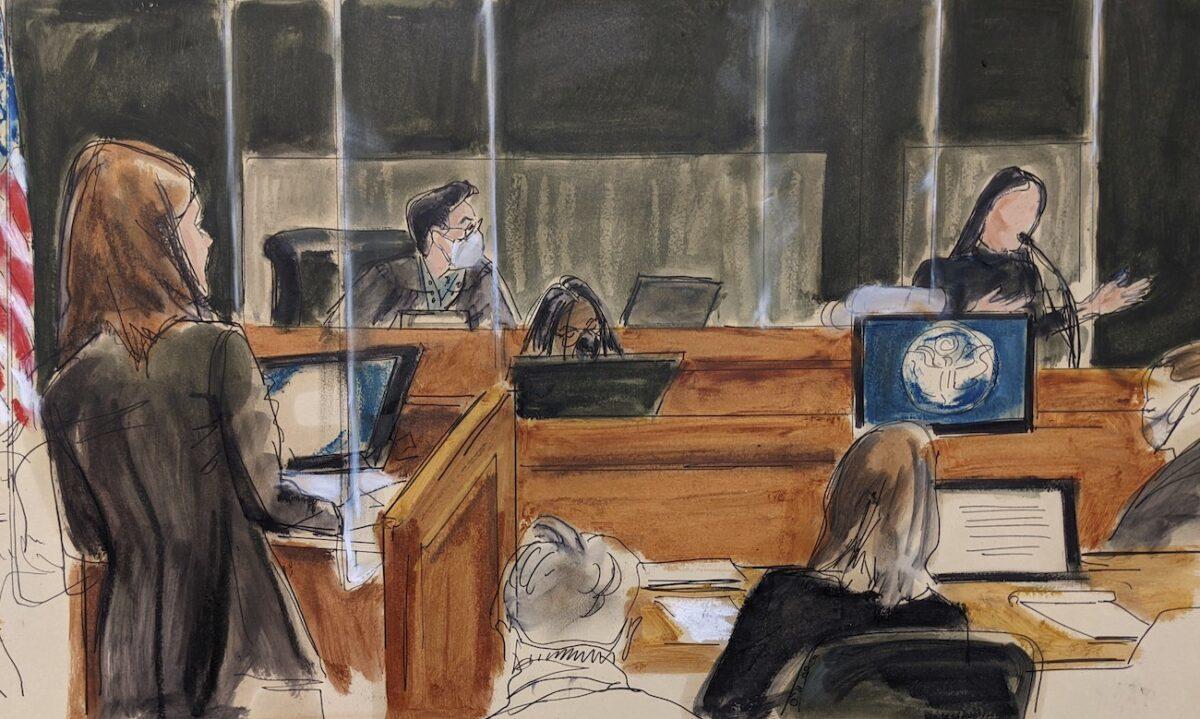
Ghislaine Maxwell sits as the jurors are sworn in at the start of her trial on charges of sex trafficking, in a courtroom sketch in New York City on Nov. 29, 2021. (Jane Rosenberg/Reuters)

Earlier this week, one such witness was “Jane,” and any evidence with her actual name on it was submitted under seal. The public was not told her name.

That all changed on Friday, when defense attorney Jeffery Pagliuca accidentally said a woman’s first name when referring to Jane.

Pagliuca caught his faux pas immediately but the damage had been done.

“You are admonished to abide by my rules,” Nathan said to Pagliuca, and then she called a sidebar.

Pagliuca had stated just moments before that her name had been blacked out on the documents from which he was reading.

The error occurred about a half hour into the day.

Prior to this, Pagliuca was cross examining Juan P. Alessi, who managed the blue-collar workers at Jeffrey Epstein’s Palm Beach estate.

On Thursday, Alessi testified that he had returned to Epstein’s house after his employment had ended, snuck in and stole $6,300 in cash, citing “financial and marital problems.”

He claimed he was confronted by Epstein, who called it a “loan,” and Alessi paid it back.

Alessi also claims he went to the police regarding the matter on his own, and Epstein did not file charges.

Under cross, Pagliuca reminded Alessi that yesterday he said, “I will tell the truth,” referring to details of the incident.

“But you didn’t tell the truth yesterday, did you Mr. Alessi?” Pagliuca asked.

He went on to claim Alessi actually entered the house on another occasion, looking for a gun, but stole $1,900 instead.

“Not true,” said Alessi.

Ghislaine Maxwell, the Epstein associate accused of sex trafficking, watches as Lawrence Visoski, longtime pilot of the late Jeffrey Epstein, is cross examined during her trial in a courtroom sketch in New York City, on Nov. 30, 2021. (Jane Rosenberg/Reuters)

Pagliuca read excerpts from a police transcript in which Alessi spoke about both robberies. Alessi didn’t recall giving the deposition, but verified his signature on it.

On Thursday, Alessi testified he met Jane in 1994.

However, Pagliuca read from another deposition, taken when Alessi met with Virginia Roberts, another alleged victim, and her lawyer. In it, Alessi stated he met Jane in 1999 or 2000.

Alessi said he may have confused Jane and another girl.

Pagliuca referred to a third deposition, from 2016, when a lawyer for Jane contacted Alessi in July 2020.

Referring to the document, Pagliuca asked, “Do you remember you made a sworn statement?” to which Alessi replied, “I don’t know what you’re talking about.”

However, once again he confirmed it was his signature.

Pagliuca continued to read excerpts from the depositions that contradicted Alessi’s previous testimony.

Alessi agreed when Pagliuca stated that no massage therapists ever performed a massage on Epstein against their will, there were never any signs of distress, and they left after they were paid. When asked if the massage therapists were of legal age, Alessi replied, “I believe so.”

In this courtroom sketch, assistant U.S. attorney Alison Moe questions an unidentified victim “Jane” about her experiences with Jeffery Epstein and Ghislaine Maxwell, in New York, on Nov. 30, 2021. (AP Photo/Elizabeth Williams)

U.S. Attorney Maurene Comey called the prosecution’s next witness, Gregory Parkinson, a retired crime scene manager and police officer for Palm Beach.

Parkinson testified he had been at Epstein’s house twice: once in 2003 for one of Alessi’s thefts, and again in 2005, when a search warrant was executed for the estate.

At the end of the search, evidence was brought back to the Palm Beach Police Department headquarters and then transferred to the FBI in 2006.

As part of the search warrant’s execution, Parkinson shot video of the interior of the house. The 39-minute video was viewed in court by Parkinson and the jury, but not the public.

Parkinson pointed out that there was one photo on the wall of Epstein and Fidel Castro, and another one of Epstein and Pope John Paul II. He gave details of each room he viewed in the video, as well as from still photos.

A physical piece of evidence, a massage table taken in the search, was presented to the jury. Parkinson viewed several photos of photos from the house, which were submitted under seal.

Defense attorney Christian Everdell cross examined Parkinson.

Parkinson confirmed the first time he was at the Epstein house was in 2003 and the second time in 2005.

Everdell contended that with all the time that passed between 1994 (when the sexual abuse of Jane is purported to have started) and 2005 (when the video and photographs were taken) that Parkinson can have no knowledge of what the house actually looked like in 1994.

“I have no way of knowing that,” said Parkinson.

Additionally, when Parkinson was at the house in 2003, he saw blueprints and material swatches, either for carpets or drapes, giving him reason to believe the house was going to be renovated soon after.

Everdell said the “bottom line” is there is no way to know what the house looked like 11 years prior.

The final witness for the week was Sgt. Michael Dawson, a detective in the Palm Beach Police Department. Dawson was part of the Oct. 20, 2005 search, but was not part of Parkinson’s team.

He testified he found monitors and keyboards without towers, phone message books (which were discussed in Alessi’s testimony on Thursday), two massage tables, photos of nude females, and two “Twin Torpedo” sex toys.

Comey provided Dawson with three message books, but he could not say with complete confidence they were the ones he seized.

On cross, Everdell asked Dawson if he was involved with Alessi’s burglaries. He answered, “I don’t recall.”

Dawson provided a document that confirmed he was.

Dawson’s testimony contradicted Alessi’s, where Alessi said he went to the police on his own. According to Dawson, they went looking for him and found him first. Dawson also confirmed Alessi stole cash twice.

Cross examination will continue on Monday.

The first week of the trial ended with the prosecution calling its first nine witnesses. Only Jane’s had the potential of causing damage to Maxwell, although none of the damaging parts have been corroborated by an eyewitness as of yet.

Tyler Durden
Sun, 12/05/2021 – 12:34

via ZeroHedge News https://ift.tt/3rDDIZd Tyler Durden

With Inflation Emerging As Biden’s Biggest Nightmare, One Strategist Counters: “Inflation, Like Greed, Is Good”

With Inflation Emerging As Biden’s Biggest Nightmare, One Strategist Counters: “Inflation, Like Greed, Is Good”

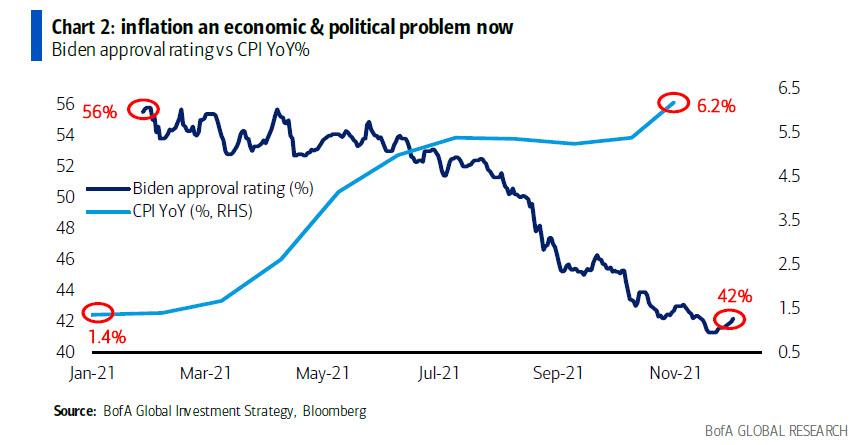
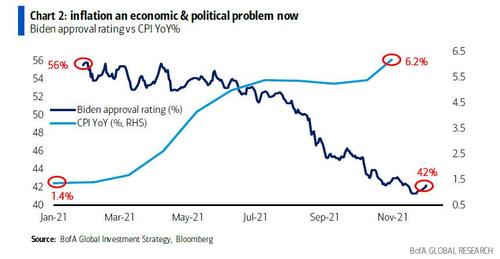
Now that inflation is up from 1.4% to 6.2%, and even Powell admits it is no longer “transitory“, BofA’s CIO Michael Hartnett pointed out in his latest Flow Show note what was obvious to most, namely that inflation is rapidly emerging as an economic and political problem, as he points to a chart showing Biden’s approval rating sliding from 56% to 42% YTD as inflation has soared, or as the BofA strategist summarizes, in the context of “inflation, politics (midterms Nov22), and credibility, the Fed set to be very hawkish next 6 months” something the market is finally freaking out over with high-duration (read growth and tech) names tumbling.
Yet while Biden will do everything in his power to crush consumer inflation ahead of the midterms, perhaps even nuking the market in the process (only to force the fed to launch the biggest and probably last monetary stimulus shortly after), some like Academy Securities strategist Peter Tchir take the other side and in a note published overnight in which he channels his inner Gordon Gekko wrties that “Inflation, Like Greed, is Good.

Paraphrasing the best Wall Street movie made, Tchir writes that “Greed, in all of its forms…has marked the upward surge of mankind” and adds that “while I may not believe everything that I write today, it seems as though inflation, much like greed, is in dire need of someone to champion it.

This topic is relevant because, as we first showed on Friday and as Tchir writes today “some of Friday’s price action could be linked to markets pricing in monetary policy mistakes. The shape of the yield curve and the sectors that underperformed all fit into a narrative that could encompass a monetary policy mistake (and is also partly due to the market trying to adapt to The Training Wheels are Off).”

The Academy strategist next makes the point that “the politicization of inflation is the biggest reason that we might get a monetary policy mistake!” and goes on to note that “it is the politicization of inflation (which could lead to monetary policy mistakes), that leads me to take up the mantle and defend inflation.”

As Tchir lays out in further detail in his full note below, here are the core tenets behind his argument:

Inflation is Good

We start by examining what central banks have been trying to achieve, what they’ve achieved, and why they aren’t taking victory laps.

Stagflation is Bad

We agree that stagflation is bad and through a series of charts focusing on jobs and wages, we demonstrate that we are nowhere close to stagflation and the economy is outpacing inflation.

What About Gas?

Somehow inflation always seems to come back to gasoline, and we address some of the absurdity around this issue. We also introduce the concept of carbon offsets and where this fits into the inflation argument.

Hedonic Adjustments

If you didn’t think that we could make an argument that rising gas prices aren’t actually rising, you are in for a pleasant surprise. In all seriousness, thinking about hedonic adjustments for products and processors that are sustainable isn’t as strange as it might sound.

What is Driving Inflation?

It is difficult to argue whether inflation is good or bad if we don’t examine what is driving it:

  • Jobs and wage growth.
  • Supply Chain issues.
  • ESG.
    • Transition plans.
    • Supply chain repatriation.
  • Monetary policy.

Tchir summarizes his controversial argument as follows, “Maybe Inflation Isn’t “Good” But It is Necessary: At this moment in time, I do not see any way of achieving our goals without generating inflation. So long as inflation is accompanied by job and wage growth, who really cares about it?”

Bottom Line: Don’t bet on a policy mistake. Bet on cyclical, domestic growth. As Bud Fox says, “Life all comes down to a few moments” and I think that we need the courage to ride this paradigm shift through and accept inflation as just a part of that goal!

* * *

Tchir’s full note is below:

Inflation, Like Greed, Is Good!

Today, I will channel my inner Gordon Gekko, who told us that “Greed is Good.” That “Greed, in all of its forms…has marked the upward surge of mankind.” While I may not believe everything that I write today, it seems as though inflation, much like greed, is in dire need of someone to champion it.

For purposes of this report, there are a few things to clarify:

  • If I had been Chair of the Fed (please stop laughing), I would have finished with bond purchases a long time ago. I don’t necessarily agree with the path that the Fed took, or some of their inflation goals, but we will play this hand with the cards we’ve been dealt.
  • I’m reasonably on board with carbon and climate efforts, though want to highlight a few caveats, which might get lost in this report as today’s goal is to justify inflation rather than fixate on the details of carbon and climate initiatives:
    • We need a transition plan. I’ve harped on this and we see the harsh reality in Europe almost every day. Without a well thought out transition plan we put ourselves at risk.
    • Incentives and rules are ripe for manipulation. Any policy or rule instantly creates a cottage industry for those trying to get around it (and for those trying to take advantage of it). It may well be that the goals are laudable enough that we can tolerate or even benefit from this behavior, but ignoring this reality doesn’t help us much.
    • Acting without China’s full cooperation is a very serious issue. The climate is global, so without China, a massive contributor to the world’s carbon issues (including plastics, and other nasty environmental issues), we run the risk of not only failing to fix the problem, but getting left behind economically and in terms of global power (not power, like energy, but power like might).

This topic is relevant because some of Friday’s price action could be linked to markets pricing in monetary policy mistakes. The shape of the yield curve and the sectors that underperformed all fit into a narrative that could encompass a monetary policy mistake.

The politicization of inflation is the biggest reason that we might get a monetary policy mistake! It is the politicization of inflation (which could lead to monetary policy mistakes) that leads me to take up the mantle and defend inflation.

Inflation is Good

Whenever I focus on a topic, I try and figure out what the smart people are thinking. What do the people who live and breathe inflation think about it? Well, until about a month ago, every single major central bank was fixated on generating inflation. Generating sustained inflation (at an acceptable level) has been one of the main goals of monetary policy across the globe for years (if not decades).

So, we have a group of very intelligent people from across the globe who’ve fought to create inflation for years (which I take as one sign that it might be a reasonable goal). Does their sudden aversion to inflation represent a real shift in their thinking? Or are they bowing to political pressure?

It seems somewhat odd that this group has finally started to achieve their goal and rather than doing victory laps, they are barely defending their actions. It is this behavior that sparks my fear that we could get a policy mistake – not because they think their policies are wrong, but because they face intense political pressure to adjust their policies.

We will come back to why inflation is good in a moment, but let’s address why it isn’t bad.

Stagflation is Bad

We can all agree that stagflation is bad. That slow growth coupled with high inflation is bad. Thankfully that is NOT what we have right now! We have inflation (I’d argue more medium than high), but we have STRONG growth!

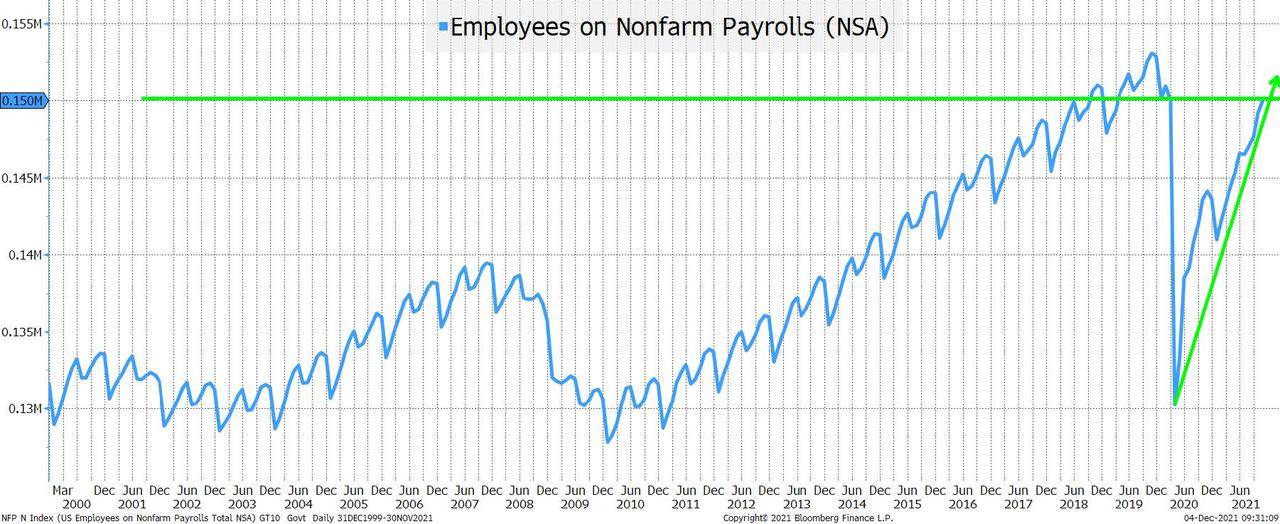
While not quite back to pre-pandemic levels, the number of people employed in the U.S. is at a level that has only been better for a few months in the entire history of the country.
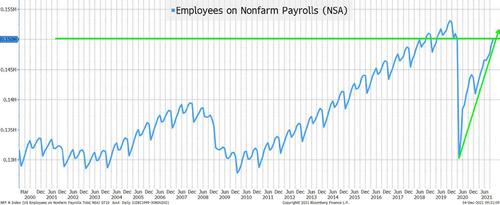
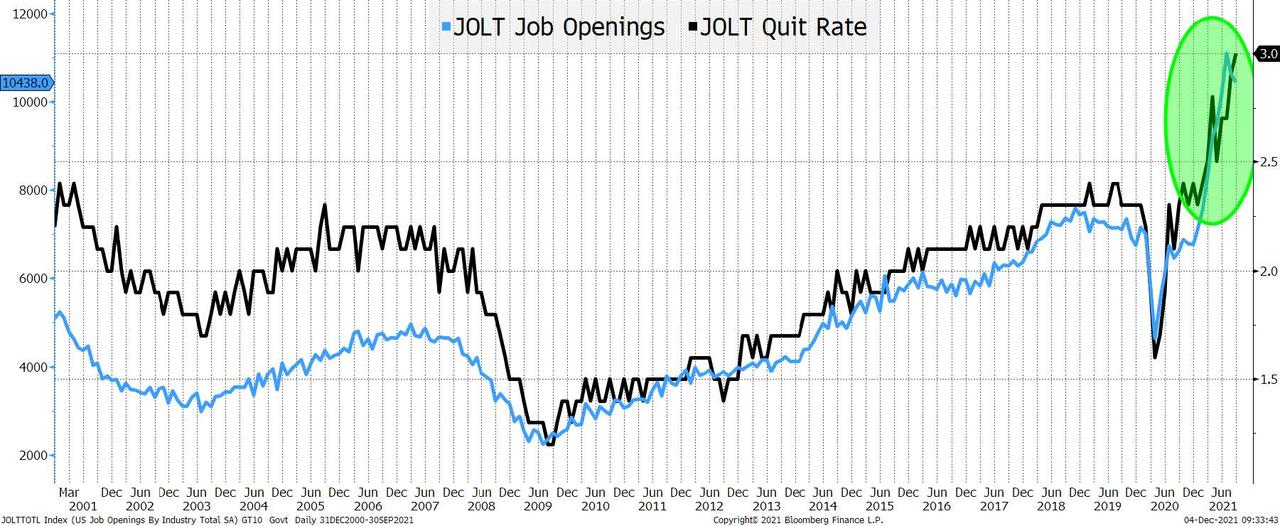
I went with the non-seasonally adjusted version since I think that the seasonal adjustment this year will turn out to be incorrect. At the same time, we have a record number of job openings and people are extremely comfortable quitting their jobs!
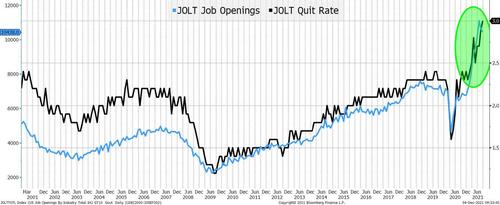
From a job’s perspective, the economy looks pretty darn good! This is the jobs picture without any form of infrastructure spending getting passed (which should only increase the outlook for jobs). It will also increase inflation, but isn’t that worth it?

Not only are there jobs, but the pay is pretty darn good!
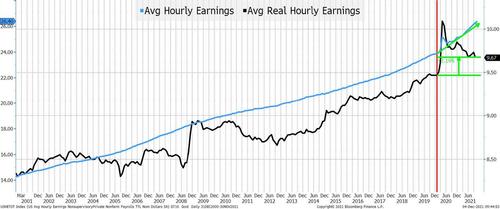
Average hourly earnings are now much higher than they were pre-pandemic and are at their highest levels ever. The average hourly pay just before the pandemic was $23.88 and is now $26.40, almost $3 per hour higher, and that will buy a lot of gas (more on that later).

Even adjusted for inflation, they are 2.2% higher than they were before the pandemic started. This doesn’t even attempt to account for all the benefits that have been paid to people over the past few years, including the signing bonuses many are getting. If anything, the official wage data understates the total income people are receiving.

So, jobs are coming back with a vengeance and they are paying more. Heck, the pay is keeping workers ahead of inflation, and while I do not think inflation is transitory, I do think it will settle into a range between 2% and 4%, which should be low enough (if we can maintain growth) that almost everyone who is working will be better off!

What About Gas?

Somehow inflation always seems to come back to gasoline. I’m not sure about you, but I probably use less than 10 gallons of gasoline a week. I checked and according to the U.S. Department of Transportation’s Federal Highway Administration, the average American drives 13,500 miles per year (higher than me but seems reasonable). They choose to use Ford F-150’s average miles per gallon (which seems conservative) to come up with 562 gallons a year (weirdly, not much above my guess of 10, which means that on average, Americans buy less than 2 gallons of gas a day!)

So, for all the handwringing about gasoline prices (something sensationalized by the media, which has sparked interest from politicians), most people can pay for their extra cost of gas with 1 hour of their higher pay. Seems like a reasonable trade-off.
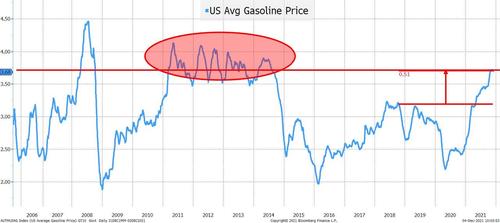
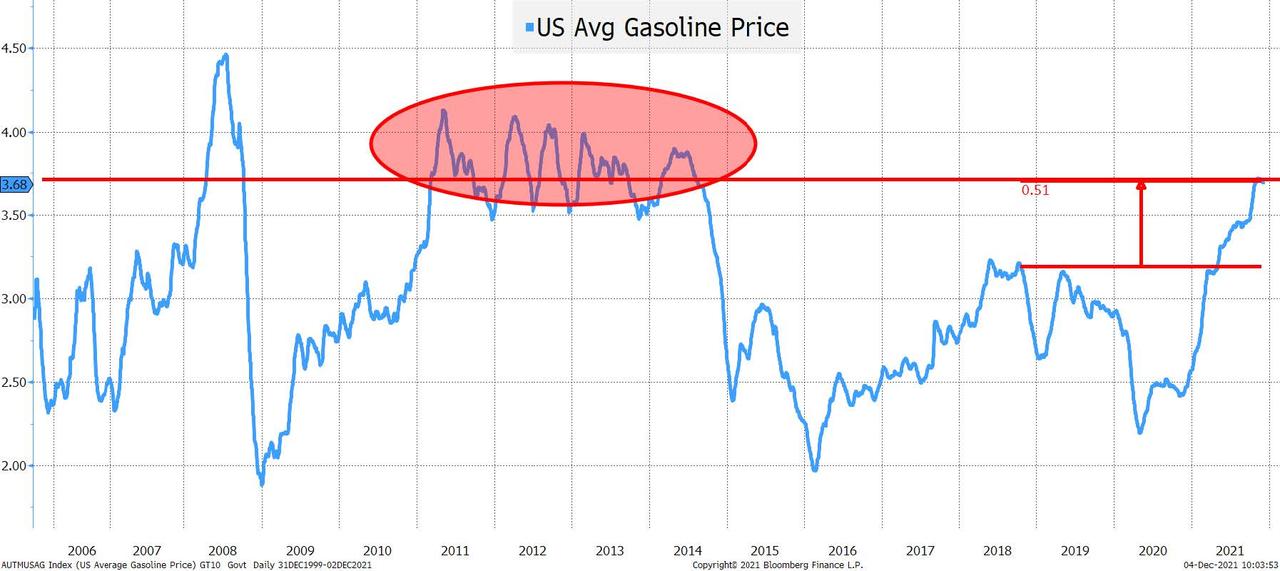
While this data series only goes back to 2006, average gasoline prices were higher for several years as we emerged from the GFC. They are up about 51 cents per gallon since late 2018 (so $1 a day for the average American).

There are huge differences by state. According to AAA, California is at the higher end at $4.68/gallon, while New York is $3.54 and Virginia is $3.22. Not all states had similar moves in gasoline prices and we shouldn’t ignore various state rules that cause their gas prices to be different.

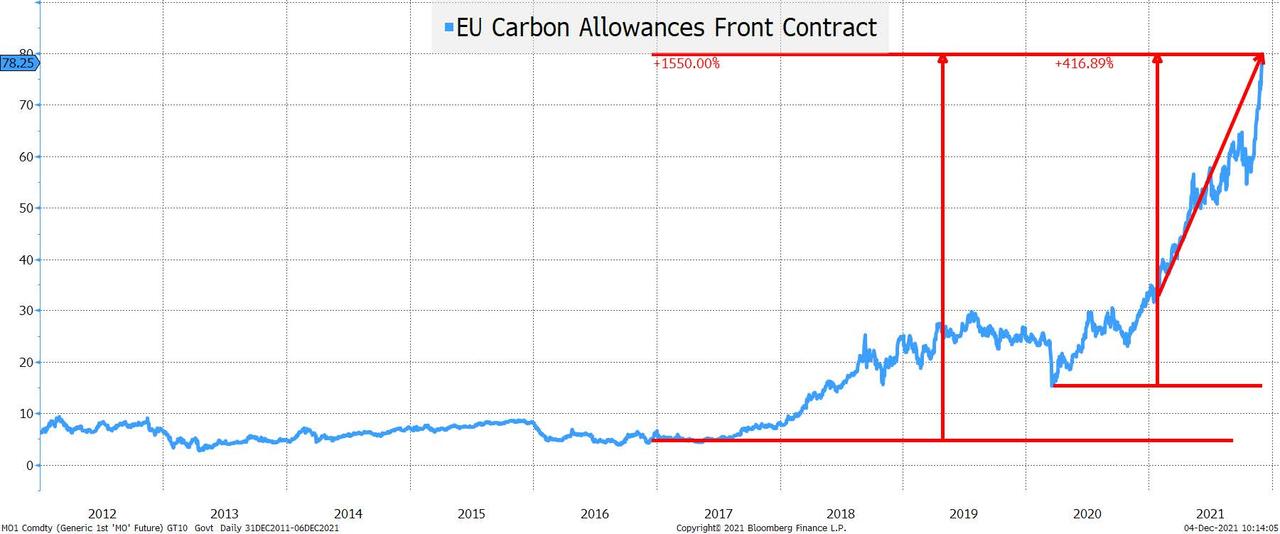
While I’m not here to argue about European gas prices, I cannot help but bring up the following chart, as I think it is crucial to the inflation is “good” argument.
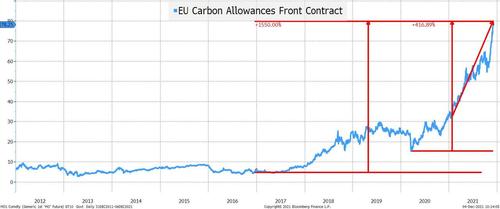
This is the EUA carbon allowances front contract. My understanding is that refiners, amongst others, are forced to buy offsets to their carbon footprint. The rise in prices would make even the crypto market green with envy!

Hedonic Adjustments

For some reason, I want to call them “hedonistic adjustments” when the BLS adjusts prices to account for quality.

It is something that they have done for a long time. It is questioned by many, but it is a tool that they use to try and reflect large changes in quality that can affect prices over time.

So, if you have gasoline that protects the environment (because the refiner had to offset their carbon usage), did the price go up? That sounds weird at first, but that is the nature of hedonic adjustments.

Is gasoline that will “save the planet” better than gasoline that doesn’t offer that? For this portion, I’m going all in on the carbon/climate side of things.

The price will go up because the offsets are a cost and some of that will get passed on to the consumer, but if you are willing to believe that 2,000,000 pixels are so much better than 2,000 pixels and the price of that “thing” hasn’t really gone up, then why not accept that products that are made more sustainably or have purchased carbon offsets are better? Please go back to my caveats from earlier, I haven’t forgotten them, I’m just getting on a roll here.

This all gets tricky (I don’t have any answers) and this gets a little bit away from the “inflation is good argument”, but this is tied to it because it would be a reason to accept higher prices.

What is Driving Inflation?

Whether we are going to hedonically adjust for prices or not, let’s look at what is driving inflation:

  • Jobs, wage growth, and government payments (though these are less important now than during the worst parts of the pandemic). Plain and simple, jobs and wages are boosting inflation and I don’t see that as a problem. Should we not try and rebuild our often-decrepit infrastructure and not create jobs and demand for raw materials that would increase inflation? That seems silly to me.
  • Supply Chain issues. Trying to address some of these. Whether it is overtime at the ports or flying goods in, etc., both have a real cost. Much of this will dissipate over time as countries across the globe figure out what the new post pandemic normal is. This should somewhat take care of itself and is somewhat out of our control.
  • ESG. I’m not going to spend much time on this as I’ve written so much about the subject over the past year, but I want to highlight a few things:
    • Any transition plan will call for massive investment in new things, but there will be maintenance investment required for old things for some time (i.e., more money will be spent than if we weren’t transitioning). That will be inflationary, but I don’t see how to avoid it (or why we’d want to avoid it).
    • Supply chain repatriation. Some of the existing supply chain “issues” will be resolved by shifting where things are made (including domestically). Some industries, like anything related to healthcare, will feel intense pressure to produce in areas where we have complete faith in the jurisdiction and quality of the products as well as access when we need them most. This will have a cost, but will create jobs, so again, I’m not sure why we wouldn’t accept inflation as a cost of this.
    • Monetary policy. I didn’t even bold this, because quite frankly, when I think about what is causing inflation, monetary policy isn’t high on my list. Which is why I’m so concerned that we could see a monetary policy mistake as the politicians weigh in.

Maybe Inflation Isn’t “Good” But It is Necessary

At this moment in time, I do not see any way of achieving our goals without generating inflation.

If national health and safety is a goal, then how do we achieve that without inflation?

If carbon reduction and sustainability is a goal, I don’t see how we achieve that without inflation?

So long as inflation is accompanied by job and wage growth, who really cares about it?

Again, I’m not sure I want to go down these paths, but if people are correct and this is saving the planet, maybe it’s not inflationary at all compared to the cost of not doing it. Okay, that statement is a bit out of my comfort zone, but there are many who adamantly argue this point.

I think that the stupidest thing we could do right now is cut off our growth trajectory because a few politicians can’t do basic math, can’t understand that there will be some trade-offs, and are pandering to some audience who isn’t more than benefiting from the economic growth being generated as we make massive changes to our economy and how we compete globally.

So, what the heck, inflation is good while accompanied by growth and it would be a policy mistake to kill that growth too early (especially when monetary policy isn’t what is driving inflation in the first place).

Bottom Line

Don’t bet on a policy mistake. Bet on cyclical, domestic growth. Credit spreads should do fine from here. Yields should drive higher and steeper and while I think that some recent market excesses and extreme positioning will continue to work themselves out (bitcoin is below $50k as I type this), the end to the recent volatility is coming closer.

As Bud Fox says, “Life all comes down to a few moments” and I think that we need the courage to ride this paradigm shift through and accept inflation as just a part of that goal! Be vigilant for signs of stagflation, but don’t kowtow to ill-informed soundbites.
Tyler Durden
Sun, 12/05/2021 – 12:00

via ZeroHedge News https://ift.tt/3lDbaeD Tyler Durden

Hedge Funds Are Driving Price Action In The Gold Market

Hedge Funds Are Driving Price Action In The Gold Market

Via SchiffGold.com,

Looking at the data, it appears hedge funds are currently driving price action in the gold market

Please note: the COTs report was published 12/3/2021 for the period ending 11/30/2021. “Managed Money” and “Hedge Funds” are used interchangeably.

The Commitment of Traders analysis last month showed that selling had been exhausted and hedge funds were going long again. It highlighted the trouble gold faced at the $1,800 level. After the October Jobs and Inflation data, hedge funds went big into the market driving prices solidly through $1,800 before the market ran out of steam at $1,870.

The multiple attempts on $1,870 in rapid succession looked like another resistance would fall and send gold up through $1,900, especially if Brainard was nominated as Fed chair. Unfortunately, resistance held strong and a Powell nomination sent gold back through newly established support, which proved much more fragile on the way down vs the way up.

Gold is trapped below $1,800 again. A very weak jobs report provided only enough fuel to keep gold flat on the week. Will a hot inflation report next week be perceived as a “hawkish fed trade” or a “wealth preservation trade?” It all depends on managed money. The hedge funds are in complete control of this market at the moment as the data below shows.

Gold

Current Trends

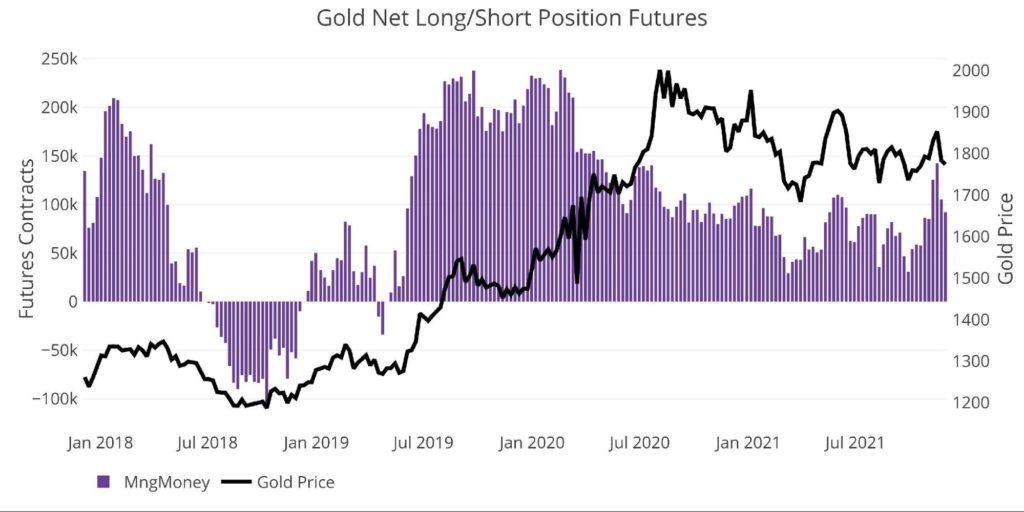
Managed Money/Hedge Funds Net Longs increased slightly since last month, from 86k to 92k in November. On Nov 16, net longs peaked at 142k. This positioning accounts for the round trip gold took during November.

As the chart below shows, the November peak in longs did not see the same price appreciation as earlier this year. For example, in June of 2021 aggregate Net Longs were reaching 250k and the price of gold was at $1898. November saw net longs peak at 287k vs a price peak of $1853 on the same day (note: the price did reach $1879 but not on the same day as CFTC reporting).

Figure: 1 Net Notional Position

While “Other” has stayed relatively flat over the last several weeks with healthy long positions, Hedge Funds have been in and out. To see the strength of the correlation, the chart below zooms in on only Hedge Funds but extends back to Jan 2018. Hedge Funds have taken back control of the market. Their positioning is driving the price action each week. The peaks and valleys are perfectly aligned.

Figure: 2 Managed Money Net Notional Position

Putting actual numbers shows the true effect. Below lists the year and the Hedge Fund correlation vs “Other” correlation:

  • 2017 .87 vs -.73

  • 2018 .94 vs -.74

  • 2019 .96 vs .57

  • 2020 -.8 vs .64

  • 2021 .82 vs -.02 (YTD)

  • 2021 .85 vs -.43 (July – Nov)

The Hedge Funds lost control of the market in 2020. This is when Other actually drove the market higher. The group was helped by strong ETF flows and record delivery requests at the Comex. 2020 created a new baseline price in the metal. For example, in April 2019 Managed Money Net longs stood at 37k with a gold price of $1,303. On Sept 28, 2021, gold net longs reached 30k vs a price of $1735. At the moment $1750 is showing as strong support just as $1800 proves hard resistance.

Correlation does not prove causation, but the data makes a compelling case for Hedge Funds driving price action. Bottom line: the “weak hands” of Hedge Funds are dominating the short-term price movements of gold, but the physical demand keeps the market trending upwards.

Weak Hands at Work

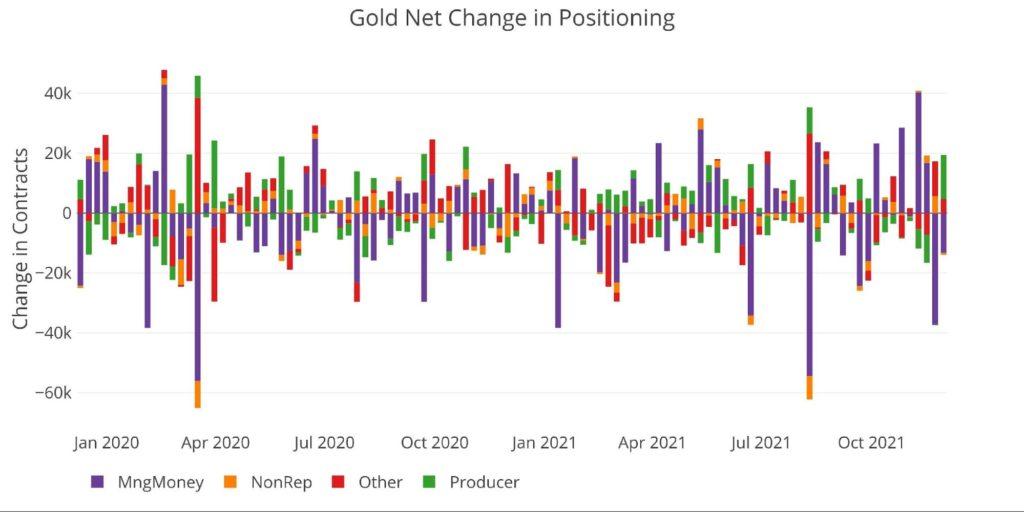
The chart below shows the week-over-week change by holder. The Hedge Funds spent 4 weeks building long positions followed by two weeks of hard selling. The traders are not in the market because of the fundamental reasons supporting the case for gold. They are jumping in and out, trading the news to make quick money in highly levered positions.

True investors should ignore this short-term movement and recognize the power of physical metal as insurance against government ineptitude.

Figure: 3 Silver 50/200 DMA

Still, for investors frustrated by the price movement, looking at the Hedge Fund trading provides a clear explanation. The table below has detailed positioning information. A few things to highlight:

  • The Managed Money Net Long monthly increase was driven primarily by shorts

    • Shorts have moved lower from 55k to 45k

    • Longs fell over the month from 141k to 137k

  • Other the past week, the move was primarily long liquidation from 152k to 137k

  • “Other”, which still represents the biggest Net Longs, was also driven by shorts closing

    • Longs were flat over the month at 172k

    • Shorts decreased from 44k to 39k, all of which came in the most recent week

It looks like there is “dry powder” on both sides of the equation. The monthly move was driven by shorts closing, but the weekly move was driven by longs closing.

Figure: 4 Gold Summary Table

Historical Perspective

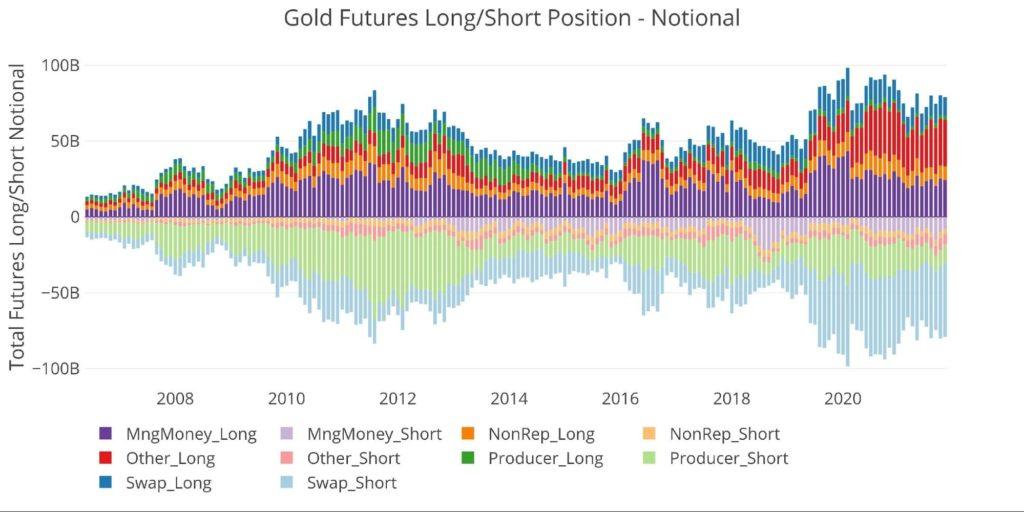
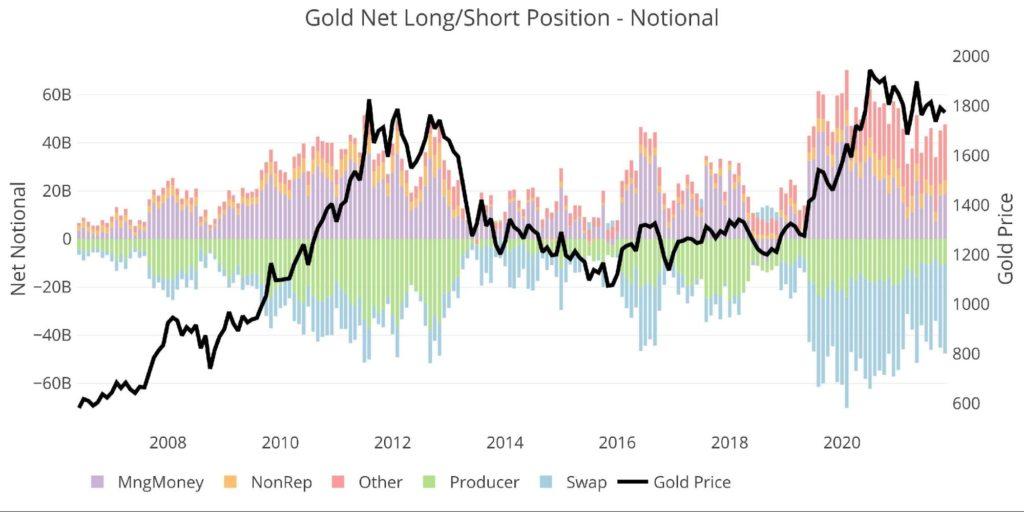
Looking over the full history of the COTs data by month produces the chart below (please note values are in dollar/notional amounts, not contracts). The chart shows the last run-up in price in 2011, followed by the slow fall into 2015 until the new bull market started in 2016. The response to the Trump election (gold sold off hard) can be seen clearly in the sharp drop-off in late 2016.

This chart also shows how big the “Other” category has become on the long side. In 2011, Other Long had $8.6B in gross long vs $30.6B in the most recent period.

Figure: 5 Gross Open Interest

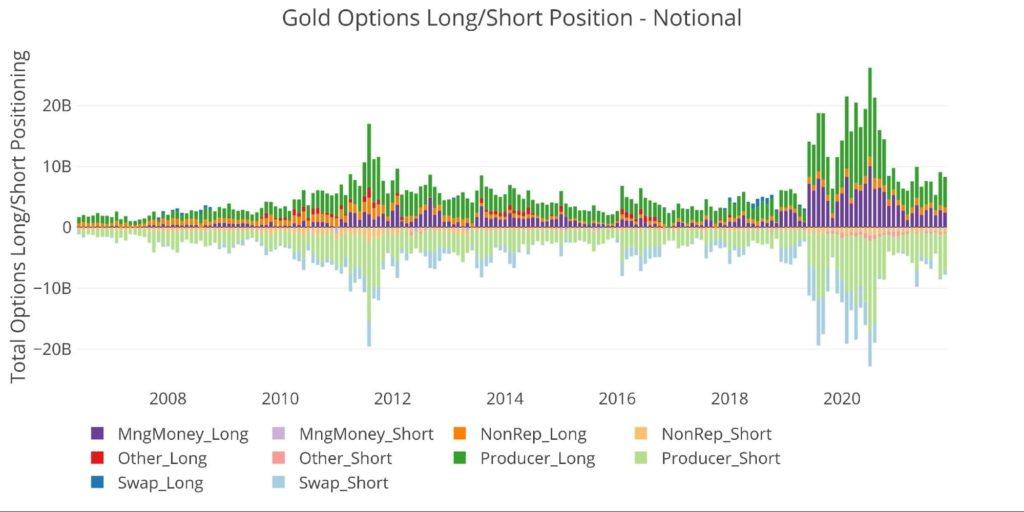
The CFTC also provides Options data. This has mainly been dominated by Producers, but recently Managed Money has played a larger role within the market. The current period shows a similar trend with Managed Money Longs decreasing from $2.8B to $2.4B during November.

Figure: 6 Options Positions

Finally, looking at historical net positioning shows the correlation of Managed Money positioning with price. The peaks and valleys in price are mirrored in the open interest. The correlation did strongly diverge last year after the March 2020 sell-off. Hedge Funds continued reducing net long positions even while the price rose dramatically. This was probably due to strong ETF buying which won’t show up in the futures.

Note: The correlation will look stronger because price is half of the Notional value equation

Figure: 7 Net Notional Position

Silver

Current Trends

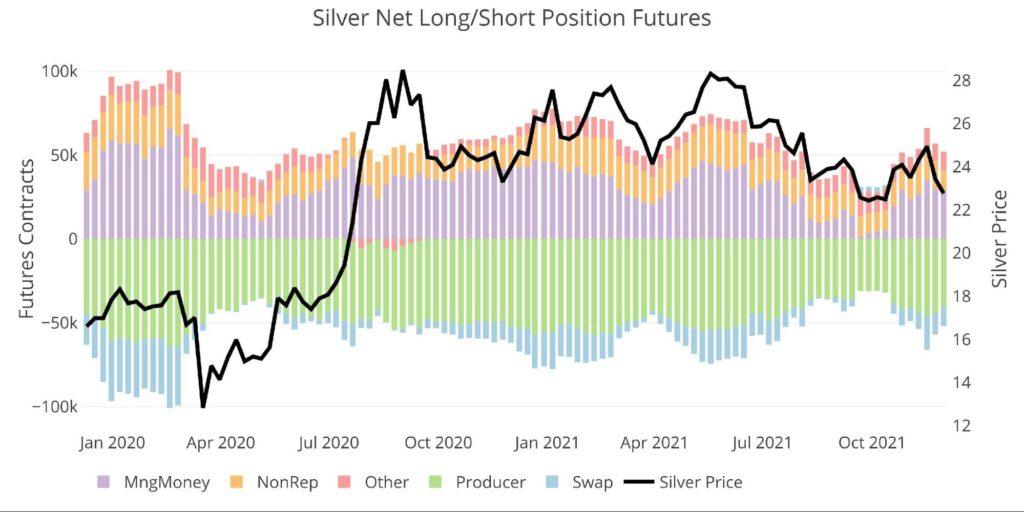
The most recent move in silver was actually driven by Non-Reportables rather than Managed Money. While Hedge Funds were responsible for the drubbing silver took in September, their current net longs stayed relatively stable compared to Non-Reportables.

Figure: 8 Net Notional Position

This can be seen more clearly in the weekly chart. While Hedge Funds did liquidate the last two weeks, they only unwound some of their recent positions. Non-Reportables unwound their entire new position and then some.

Figure: 9 Net Change in Positioning

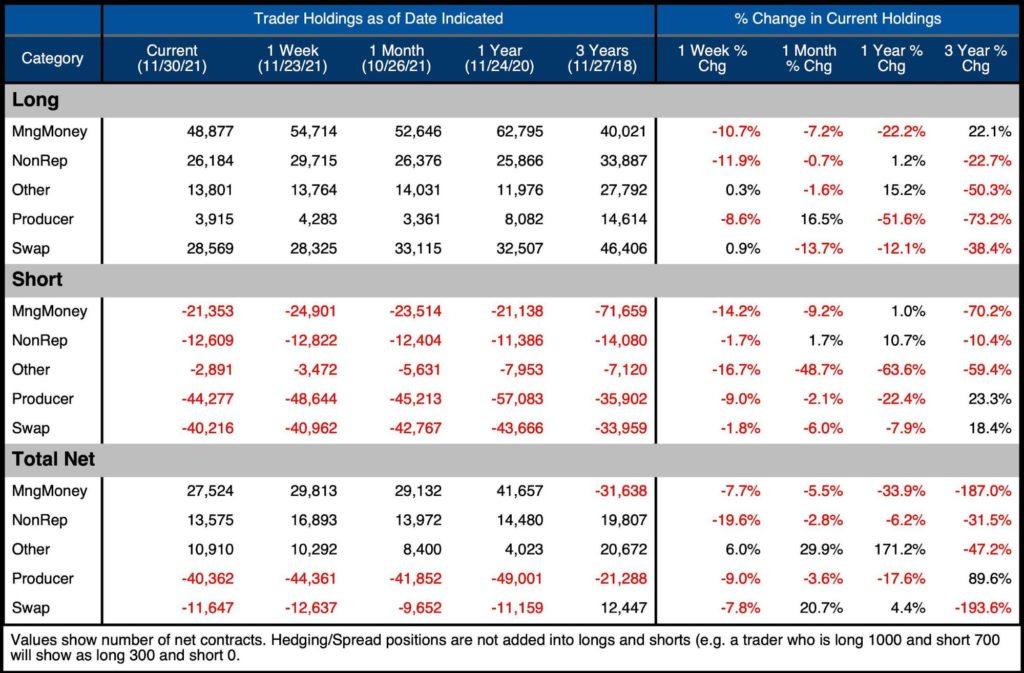
The table below shows a series of snapshots in time. This data does NOT include options or hedging positions. Important data points to note:

  • Within Managed Money, the monthly change was a modest 1600 decrease and was even positive last week

    • Longs drove most of the move, going from 52k to 54k last week and down to 48k this week

  • As of last week, NonRep had increased net longs by 3k contracts, 4x the movement of Hedge Funds

    • Longs went from 13.9k to 16.9k and down to 13.5k

Figure: 10 Silver Summary Table

Historical Perspective

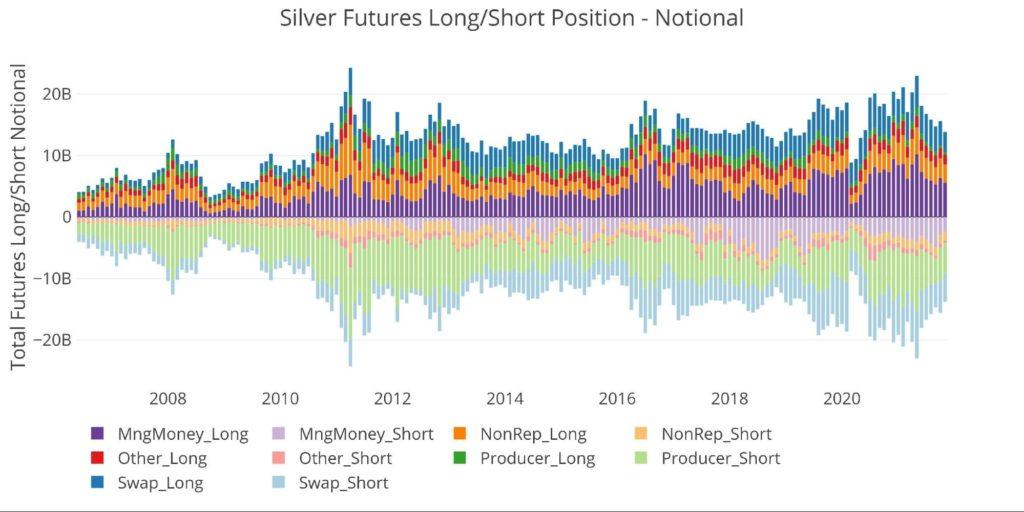
Looking over the full history of the COTs data by month produces the chart below. The chart shows the last run-up in price in 2011, followed by the slow fall into 2015. The price collapse in silver in 2020 is clearly visible in this chart. As can be seen, gross longs are still well above the 2020 lows.

Figure: 11 Gross Open Interest

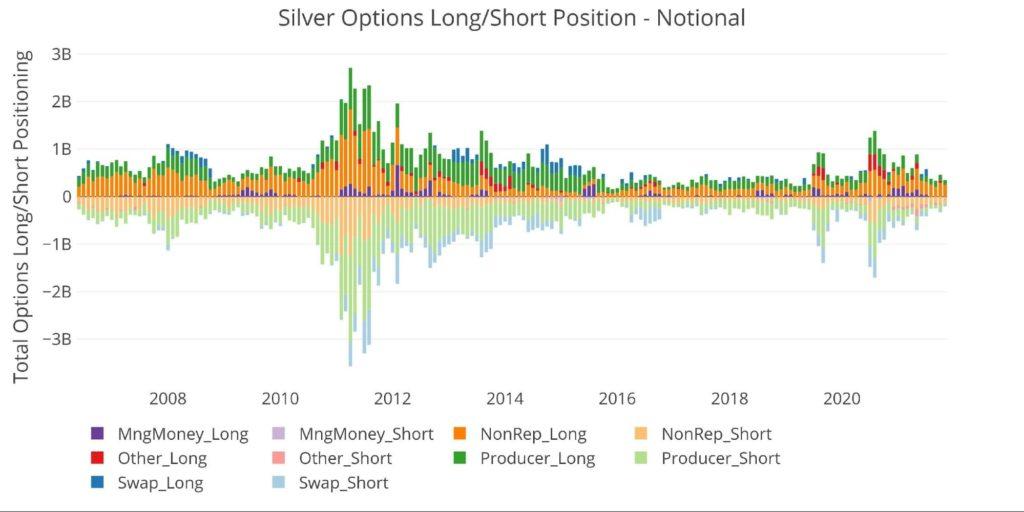
The CFTC also provides Options data. This has mainly been dominated by Non-Reportables, exceeding even Producers. Options have fallen off significantly from the spike last July and is still well below the peak in 2011.

Figure: 12 Options Positions

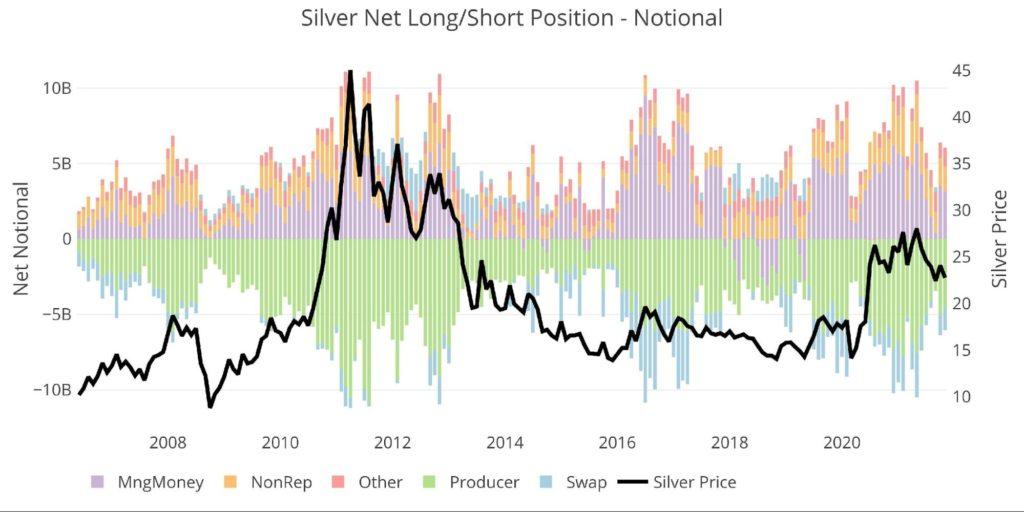
Finally, looking at historical Net positioning shows the correlation of positioning with price. Similar to gold, the peaks and valleys in price are mirrored in the open interest. Again, the latest pop did not generate the price increase that would have been expected given the magnitude of the move.

Figure: 13 Net Notional Position

Conclusion: How Will Hedge Funds Respond to the Fed?

Hedge Funds certainly trade using technical analysis, which is why Fib targets and round numbers (e.g. $1,800) prove to be such difficult resistance points. Over time, the physical market has pushed prices up, but the short-term move is dominated by hot money. How long until Hedge Funds call the Fed’s bluff? More importantly, how long until there isn’t any physical to back the paper contracts because it’s been delivered and then removed from the vault?

Astute investors should keep the long-term picture in mind. The short-term gyrations can be immensely frustrating, but gold and silver are not Bitcoin. They are not vehicles to get rich quick because that would disqualify them as safe-havens. Remember, what goes up quickly, can come down quickly. Stay the course, trust the fundamentals, use the CFTC analysis to explain the short-term price movements, and understand the protection provided by physical precious metals.

Tyler Durden
Sun, 12/05/2021 – 11:30

via ZeroHedge News https://ift.tt/3lEil6i Tyler Durden

Tennessee Court Holds That Black Defendant Did Not Receive A Fair Trial Because Jury Deliberated In Room With Confederate Flag and Portrait of Jefferson Davis

Last year, a state judge in Virginia made headlines by removing judicial portraits from his courtroom. The judge reasoned that the portraits depicted white men. Thus, the mere presence of these portraits could deprive non-whites of fair trials.

At the time, I didn’t have any intrinsic objections to this decision. Judges have certain inherent powers over their courtrooms, including decor. Rather, I raised a concern. If, in fact, the mere presence of these portraits could render a trial unfair, then defendants convicted in those courtrooms could object to their convictions in those courtrooms.

If Judge Bernhard is correct, could an African-American defendant previously convicted in that courtroom file a motion to set aside his conviction, on the ground that trial was inherently biased?

Thousands of defendants who were convicted in those courtrooms could challenge their convictions. Those arguments could be raised on direct or even on collateral appeal.

Now, the Tennessee Court of Appeals has taken a first step towards that outcome. For more than four decades, juries in Giles County have deliberated in a room named after the United Daughters of the Confederacy. The room is decorated with a Confederate flag and a portrait of Jefferson Davis. A jury that deliberated in that room convicted a black defendant of aggravated assault. The defendant objected that the jury could not hold fair deliberations in that room. The trial court rejected the claim, but the appellate court agreed. Here is a summary of the arguments presented:

The defendant next contends that having the grand and petit juries deliberate “in an inherently prejudicial Confederate Jury Room violated” his constitutional right “to a fair trial, his right to an impartial jury, his right to due process, and right to equal protection of the law,” arguing that the jury room utilized in Giles County violates the 14th Amendment’s “protection against state-sponsored racial discrimination” and the 6th Amendment’s “right to a jury trial”; violates the state and federal constitutional right to trial by “an impartial jury”; violates “evidentiary standards”; “constitutes extraneous prejudicial information and improper outside influence”; and “violates the trial court’s duty of judicial impartiality.” The State asserts only that the defendant has waived plenary consideration of this issue by failing to challenge the conditions of the jury room prior to trial. In its amicus brief, the Tennessee Association of Criminal Defense Lawyers (“TACDL”), noting that “[m]ultiple courts have recognized the racially hostile and disruptive nature of the Confederate flag,” argues that “a jury’s exposure to Confederate Icons denies the defendant a fair trial free of extraneous prejudicial information and improper outside influence.”

The court ordered that the defendant must be retried.

In consequence, the weight of the evidence adduced at trial does not support a conclusion that the State rebutted the presumption of prejudice created by the jury’s exposure to extraneous communication in this case. Because the defendant established that the jury was exposed to extraneous information or improper outside influence and because the State failed to sufficiently rebut the presumption of prejudice, the defendant is entitled to a new trial.

The Court did not decide if Giles County had to remove the confederate symbols from the room.

The question whether the U.D.C. Room should remain in the Giles County Courthouse and in its current condition is not before this court. It is sufficient that we have concluded that permitting the jury to deliberate in the U.D.C. Room resulted in the jury’s being exposed to extraneous information and that the State failed to rebut the presumption of prejudice flowing therefrom.

Presumably, Giles County will take a hint and redecorate. But what next?

Juries have deliberated in this room for more than four decades. Presumably, every black defendant convicted in that courtroom can now object and secure a new trial. The Court did not address this issue. And other courts in the state, and probably throughout the south, may have similar deliberation rooms, or even courtrooms. If these opinions catch on, countless convictions will be vacated. The consequences of this decision would make the fallout of McGirt seem tame.

The post Tennessee Court Holds That Black Defendant Did Not Receive A Fair Trial Because Jury Deliberated In Room With Confederate Flag and Portrait of Jefferson Davis appeared first on Reason.com.

from Latest – Reason.com https://ift.tt/3DkrXt2
via IFTTT

Tennessee Court Holds That Black Defendant Did Not Receive A Fair Trial Because Jury Deliberated In Room With Confederate Flag and Portrait of Jefferson Davis

Last year, a state judge in Virginia made headlines by removing judicial portraits from his courtroom. The judge reasoned that the portraits depicted white men. Thus, the mere presence of these portraits could deprive non-whites of fair trials.

At the time, I didn’t have any intrinsic objections to this decision. Judges have certain inherent powers over their courtrooms, including decor. Rather, I raised a concern. If, in fact, the mere presence of these portraits could render a trial unfair, then defendants convicted in those courtrooms could object to their convictions in those courtrooms.

If Judge Bernhard is correct, could an African-American defendant previously convicted in that courtroom file a motion to set aside his conviction, on the ground that trial was inherently biased?

Thousands of defendants who were convicted in those courtrooms could challenge their convictions. Those arguments could be raised on direct or even on collateral appeal.

Now, the Tennessee Court of Appeals has taken a first step towards that outcome. For more than four decades, juries in Giles County have deliberated in a room named after the United Daughters of the Confederacy. The room is decorated with a Confederate flag and a portrait of Jefferson Davis. A jury that deliberated in that room convicted a black defendant of aggravated assault. The defendant objected that the jury could not hold fair deliberations in that room. The trial court rejected the claim, but the appellate court agreed. Here is a summary of the arguments presented:

The defendant next contends that having the grand and petit juries deliberate “in an inherently prejudicial Confederate Jury Room violated” his constitutional right “to a fair trial, his right to an impartial jury, his right to due process, and right to equal protection of the law,” arguing that the jury room utilized in Giles County violates the 14th Amendment’s “protection against state-sponsored racial discrimination” and the 6th Amendment’s “right to a jury trial”; violates the state and federal constitutional right to trial by “an impartial jury”; violates “evidentiary standards”; “constitutes extraneous prejudicial information and improper outside influence”; and “violates the trial court’s duty of judicial impartiality.” The State asserts only that the defendant has waived plenary consideration of this issue by failing to challenge the conditions of the jury room prior to trial. In its amicus brief, the Tennessee Association of Criminal Defense Lawyers (“TACDL”), noting that “[m]ultiple courts have recognized the racially hostile and disruptive nature of the Confederate flag,” argues that “a jury’s exposure to Confederate Icons denies the defendant a fair trial free of extraneous prejudicial information and improper outside influence.”

The court ordered that the defendant must be retried.

In consequence, the weight of the evidence adduced at trial does not support a conclusion that the State rebutted the presumption of prejudice created by the jury’s exposure to extraneous communication in this case. Because the defendant established that the jury was exposed to extraneous information or improper outside influence and because the State failed to sufficiently rebut the presumption of prejudice, the defendant is entitled to a new trial.

The Court did not decide if Giles County had to remove the confederate symbols from the room.

The question whether the U.D.C. Room should remain in the Giles County Courthouse and in its current condition is not before this court. It is sufficient that we have concluded that permitting the jury to deliberate in the U.D.C. Room resulted in the jury’s being exposed to extraneous information and that the State failed to rebut the presumption of prejudice flowing therefrom.

Presumably, Giles County will take a hint and redecorate. But what next?

Juries have deliberated in this room for more than four decades. Presumably, every black defendant convicted in that courtroom can now object and secure a new trial. The Court did not address this issue. And other courts in the state, and probably throughout the south, may have similar deliberation rooms, or even courtrooms. If these opinions catch on, countless convictions will be vacated. The consequences of this decision would make the fallout of McGirt seem tame.

The post Tennessee Court Holds That Black Defendant Did Not Receive A Fair Trial Because Jury Deliberated In Room With Confederate Flag and Portrait of Jefferson Davis appeared first on Reason.com.

from Latest – Reason.com https://ift.tt/3DkrXt2
via IFTTT

COVID Outbreak On US Cruise Ship Despite Fully Vaxxed Passengers

COVID Outbreak On US Cruise Ship Despite Fully Vaxxed Passengers

Despite every cruise line requiring passengers and crew to be fully vaccinated before boarding, a cruise ship returning from a sail across the Gulf of Mexico and the Caribbean Sea with thousands of passengers onboard detected an outbreak of COVID-19, according to AP News

Norwegian Breakaway, owned by Norwegian Cruise Line Holdings Ltd, departed from the Port of New Orleans on Nov. 28 and sailed to Belize, Honduras, and Mexico, with more than 3,000 people on board. 

Ahead of returning to its homeport in New Orleans, the cruise line detected ten COVID infections among its guest and crew. Those who were infected were fully vaccinated and were forced into quarantine. 

Governor John Bel Edwards, the City of New Orleans, and the Port of New Orleans were notified about the incident and contacted the CDC. The infected passengers and crew will either travel directly to their homes or self-isolate at an undisclosed location. 

According to the vessel-tracking website CruiseMapper, Norwegian Breakaway docked in New Orleans early Sunday morning. All passengers and crew will be subjected to a COVID test before exiting the ship. 

Despite a 100% vaccination rate on the vessel, there was still an outbreak of COVID, suggesting that vaccine effectiveness is severely waning. 

A recent study of the three primary COVID vaccines showed a ‘dramatic‘ drop in efficacy over six months. So as cruise ship operators begin hitting the high seas with only fully vaxxed passengers and crews that have waning defenses against the virus, one would suspect additional outbreaks on ships as new infections surge across the US. 

Even in Europe, where vaccine passport schemes and high vaccination rates are highly enforced, countries are experiencing a surge in infections. 

So what are cruise ship operators going to do now? Only allow passengers and crew who are not just fully vaccinated but have their booster shots? 

Tyler Durden
Sun, 12/05/2021 – 11:00

via ZeroHedge News https://ift.tt/3xSMuE0 Tyler Durden