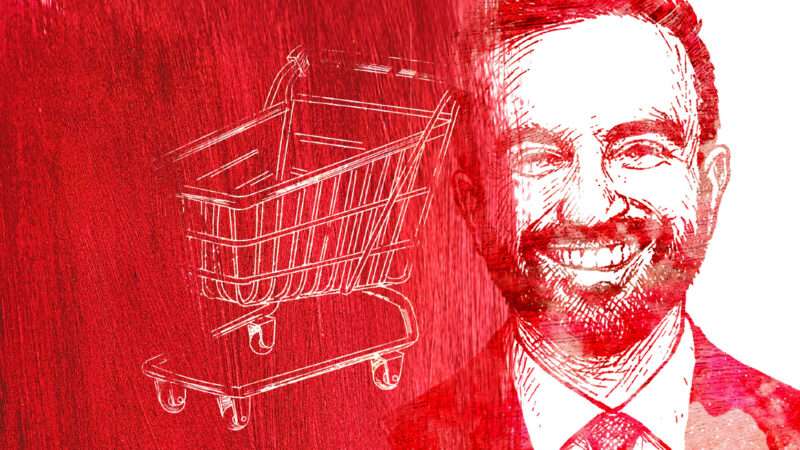
In the February/March 2026 issue of Reason, we explore Mayor-elect Zohran Mamdani’s policy goals and what they mean for New York City. Click here to read the other entries.
Zohran Mamdani’s campaign for mayor of New York City was defined by a single word: affordability. Mamdani repeated the word, almost robotically, in every imaginable setting, no matter the question or context.
In a debate with former Gov. Andrew Cuomo, Mamdani contrasted his approach with his opponent’s, insisting that Cuomo offered fear, whereas he would deliver affordability. When journalist Jorge Ramos asked Mamdani about whether he’d call Latin American authoritarians dictators, Mamdani demurred, saying he was more focused on affordability for the five boroughs. Mamdani’s campaign was bolstered by clever social media, and one of his most memorable and effective videos was a complaint about the high price of takeout meals from halal food carts, which were suffering from “halalflation.” On Mamdani’s campaign website, the top of the platform page that lists and summarizes his main policy proposals is emblazoned with bold letters that say: “New York is too expensive. Zohran will lower costs and make life easier.”
Don’t get your hopes up.
Mamdani’s promise was that, as mayor, he would defeat high prices. But many of Mamdani’s signature ideas are variations on price controls. Take a deeper look at his policies, and it becomes clear that he ran against prices, period.
It’s not surprising that a self-declared socialist would make price controls a central part of his economic program. The conceit at the heart of socialism is that when it comes to the economy, politicians and bureaucrats know best. But prices, when they are allowed to work, are signals that provide decentralized information. Price controls don’t solve economic problems; they disguise them, making it harder to know what’s happening. Prices are messages, and Mamdani wants to shoot the messenger.
Consider one of Mamdani’s most notorious ideas, a pilot program to set up five city-run grocery stores because “food prices are out of control.” Mamdani pitched those stores as a way to alleviate high food prices by exempting them from rent—and by eliminating markups and profits. As he put it, these stores would be prohibited from “price gouging.” That’s just another way of saying that, in addition to tax and infrastructure advantages, they would be prohibited from charging market prices, especially in emergencies and times of great need.
Price gouging laws already exist in many states, often targeted at emergency situations such as natural disasters. When they are enforced, they tend to result in shortages. After a hurricane, for example, it can be difficult to get food, water, and generators into an impacted area. When prices are capped by law, there’s no market incentive to make an extra effort to increase supply.
Charging higher prices in times of extreme demand isn’t a form of exploitation. It’s a way of allocating scarce resources more efficiently, and bringing more supply online.
It’s no surprise that when localities have experimented with municipal grocery stores, they’ve struggled. KC Sun Fresh, a government-backed grocery store in Kansas City, Missouri, has faced perpetual shortages, a declining customer base, and millions in losses. It’s likely to close at any point. A store that isn’t open solves no problems for anyone.
Yet this sort of uneconomic thinking defines Mamdani’s approach to policy. He wants to freeze the rent on all rent-stabilized homes, accounting for nearly half of the apartments in the city. Rent control might sound like a fix for high housing costs, but it has a long and well-documented history of constraining supply in ways that can drive housing prices upward. Similarly, he wants to provide “no cost child care” for every New York child starting at the age of 6 weeks. And at the same time, he wants to increase pay for child care workers, making “free” care even more expensive.
Mamdani also wants to increase the city’s minimum wage to $30 an hour—a price regulation on labor. “When working people have more money in their pocket, the whole economy thrives,” his platform states. Yet in California, a recent increase in the minimum wage for fast-food workers to $20 an hour led to the loss of about 18,000 jobs, according to a July 2025 working paper published by the National Bureau of Economic Research. When working people can’t find work, the economy doesn’t thrive.
Mamdani’s most notable departure from price-control orthodoxy has been on housing supply. Longstanding constraints on homebuilding have created shortages and helped increase housing costs in New York, and Mamdani has said that “we urgently need more housing to be built across the five boroughs.” But he’s paired this with an insistence on union labor, which drives up the cost of construction, and on so-called affordable housing mandates, where rents are capped or regulated.
Mamdani is right that the cost of living in New York is too high. But the city can’t afford his warped vision of affordability.
The post Zohran Mamdani Didn't Run on 'Affordability.' He Ran Against Prices. appeared first on Reason.com.
from Latest – Reason.com https://ift.tt/29DwTpa
via IFTTT