Is “Impeding Travel for Many Students” as Part of a Protest First Amendment-Protected Speech?

Eugene has already blogged about Stand With Us v. MIT, a recent case in which the First Circuit Court of Appeals upheld the dismissal of a hostile environment claim against MIT brought on behalf of Jewish students.

Eugene’s post focused on the question of whether a university can be required to suppress speech intensely hostile to Israel and/or Zionists to avoid hostile environment liability. The court said “no,” Eugene approves, and as a general matter, I agree.

However, the court went well beyond that holding, into what I consider bizarre, obviously incorrect legal reason. I was particularly struck by this passage:

Our conclusion that plaintiffs have failed to allege actionable racial harassment consists of three parts. To begin, most of the conduct about which plaintiffs complain is speech protected by the First Amendment, and we do not construe Title VI as requiring a university to quash protected speech. Furthermore, by gathering together in groups on campus, disrupting campus tranquility, and impeding travel for many students, the protestors did not render their speech antisemitic, much less unprotected.

Wait, what? Of course, the fact that the students broke MIT rules by, e.g., occupying parts of buildings and building an illicit encampment (“disrupting campus tranquility” and “impeding travel for many students”) did not render related protected speech unprotected. But the actions themselves were unprotected, right?

Not according to the court. Here is the key passage:

Here, the student protestors engaged in speech on a matter of public concern — the conflict in Gaza — while on the campus of a private university in which they were enrolled. MIT chose to restrict that speech in part and allow it to continue in part. Now, plaintiffs seek to hold MIT liable, under a federal statute, for its failure to curtail that speech even further.

The theory seems to be that if students were breaking campus rules, and the law, on a private campus while engaging in a protest, that their protest nevertheless constituted protected speech activity unless and until the private university, MIT, ordered them to stop.

That doesn’t make any sense to me. Let’s say a group of protestors converge on the  public sidewalk at the corner of my block, engaging in protected speech. Then, a subgroup of them peel off, and camp out in my driveway, and chant slogans there. For whatever reason, I choose not to ask them to leave my property, nor do I call the police–but I also don’t tell them they are permitted to stay. The protestors are still breaking the law, and their “speech,” i.e., their protest on my lawn, is not protected by the First Amendment.

I suppose one could argue that I have implicitly given permission by not calling the police, but that strikes me as incorrect. And it seems egregiously in the context of the MIT protest, because not only were the protestors breaking MIT rules, not only were they trespassing and thus violating the law, but “impeding travel for many students” may well be a violation of the 1871 Civil Rights Act (the KKK Act), which bans conspiracies to deprive individuals of their civil rights. MIT can’t waive that violation, constructively or otherwise.

The court goes on to suggest that while MIT could, as a private university, restrict student speech, it can’t be obligated to do so under Title VI because the speech was pro-Palestinian or anti-Israel.

That’s true, but the court completely ignores the menacing nature of the actions taken by the protestors. According the facts alleged in the complaint, which the court was required to accept as true at this stage of the litigation, at the encampment students chanted, in Arabic, slogans that included: “From water to water, Palestine is Arab!”; “Palestine is free, Israel out”; “We want to talk about the obvious, we don’t want to see Zionists”; “The iron gates of Al Aqsa, open for the martyr!”; and “From water to water, death to Zionism!”

Also according to the complaint, a Jewish student had previously been assaulted by a masked protestor during the occupation of a building lobby. That protest was sufficiently menacing that MIT Hillel sent out a warning to its email list cautioning students to avoid the area.

The encampment, meanwhile, took place across from Hillel. The court acknowledged that

its impact on Jewish students was plausibly heightened. Indeed, plaintiffs allege that they moved a scheduled Passover seder “to an alternate location” because MIT had not yet cleared the encampment and thus students did not feel comfortable attending the seder at Hillel. But plaintiffs allege no facts to plausibly indicate that the protestors chose Kresge Lawn for their encampment because of its proximity to Hillel rather than for its prominent location and preferred terrain for tents.

The court here seems to entirely miss the point. The question is not whether the encampment intentionally placed next to Hillel. Rather, it’s whether a reasonable Jewish student was being subject to a hostile environment sufficiently pervasive so as to be deprived of educational opportunities.

That question must be considered in context, and in context the question is whether when you have (a) masked students chanting violent slogans; (b) a history of at least one assault by in a related protest; (c) an national environment in which other Jewish students were being assaulted by anti-Israel protestors; and (d) an encampment that violated pre-existing campus rules, the encampment created a reasonable fear of violence such that the university was obligated to enforce its own rules to avoid creation of a hostile environment for Jewish students.

The plaintiffs presented tangible evidence of that fear, the fact that they moved their Passover Seder from the Hillel building and thus away from the encampment. The court treats this as if the encampment simply made the students feel uncomfortable due to the encampment’s message, rather than acknowledging that the students feared at best having their religious ceremony disrupted by masked protestors, and moreover that any such disruption would include violence.

The plaintiffs also alleged that because of intimidation and threats they were unable to attend classes, lectures, and Hillel events. The court argues, in turn, that the hostile speech experience by the students could not be deemed sufficiently severe and pervasive to constitute a hostile environment.

In doing so, the court makes the error of considering violent and occasional overtly antisemitic rhetoric, the violence and looming threats thereof, and the disruptions caused by the violations of unenforced campus rules and the law independently, as opposed to as a holistic environment.

A recent article in the Harvard Law Review Forum makes the same error. In a response I will soon be posting online, I conclude:

Professors Eidelson and Hellman correctly remind us that the First Amendment limits the extent to which universities may restrict political expression, even when it is grossly offensive. But their analysis undervalues the contextual dimension that makes certain rhetoric—such as calls to “globalize the intifada” or to achieve “liberation by any means necessary”—qualitatively different from mere advocacy or protest. When such slogans (1) are shouted in concert by masked demonstrators affiliated with organizations credibly tied to groups that glorify or sponsor violence, and when these chants (2) coincide with a measurable surge of physical assaults, arson, and death threats directed at Jewish students and American Jews more generally, and the chants (3) are accompanied by illicit campus behavior by a subgroup of the chanters, against whom preexisting rules are not enforce, they operate as components of a broader campaign of intimidation that materially interferes with Jewish students’ ability to learn, assemble, and participate fully in university life.

Title VI’s “reasonable person” standard must be applied with fidelity to that social reality. Courts .. should recognize that fear of violence, when grounded in contemporaneous incidents and credible threats, constitutes a legitimate and legally cognizable injury. Universities, for their part, may not invoke free-speech principles as a shield for inaction when the protected expression is intertwined with rule-breaking, harassment, or violence. Courts may not transform the First Amendment from a safeguard of discourse into an instrument of impunity for rioting, vandalism, building takeovers and other actions that create the sort of disorder from which violent antisemitism naturally springs.

The post Is "Impeding Travel for Many Students" as Part of a Protest First Amendment-Protected Speech? appeared first on Reason.com.

from Latest – Reason.com https://ift.tt/rPKg7ux
via IFTTT

Seventh Circuit: District Court Order to Federal Immigration Official “Infringes on the Separation of Powers”

From today’s order in In re Noem (7th Cir.):

After the district court issued a temporary restraining order affecting some aspects of immigration-law enforcement in the Chicago area, the judge on her own motion entered a further order requiring Gregory Bovino, a Chief Patrol Agent at U.S. Customs and Border Protection, to appear in court at 5:45 p.m. every weekday “to report on the use of force activities for each day.” The judge justified this order by stating that she had seen videos that led her to question whether the TRO was being obeyed. The order was not, however, a response to any motion by counsel for the plaintiffs (and the videos to which the judge referred apparently do not deal with behavior involving any of the plaintiffs).

The federal defendants seek a writ of mandamus with respect to this aspect (and only this aspect) of the district court’s rulings. We issued a stay of the order requiring Chief Bovino to appear and report daily, and we now GRANT the petition for mandamus.

While this litigation presents very challenging circumstances, the district court’s order has two principal failings. First, it puts the court in the position of an inquisitor rather than that of a neutral adjudicator of the parties’ adversarial presentations. Second, it sets the court up as a supervisor of Chief Bovino’s activities, intruding into personnel management decisions of the Executive Branch.

These two problems are related and lead us to conclude that the order infringes on the separation of powers. Review by appeal at the end of the case would not solve the problems created in the interim, which justifies review by a prerogative writ. See In re Commodity Futures Trading Commission, 941 F.3d 869 (7th Cir. 2019). Cf. Cheney v. United States District Court, 542 U.S. 367 (2004).

Thanks to Glenn Reynolds (Instapundit) for the pointer.

The post Seventh Circuit: District Court Order to Federal Immigration Official "Infringes on the Separation of Powers" appeared first on Reason.com.

from Latest – Reason.com https://ift.tt/tVNh9nI
via IFTTT

The Real Ghost Of Halloween: Inflation

The Real Ghost Of Halloween: Inflation

Data from the National Retail Federation shows that some $13 billion will be spent on Halloween in the United States this year, whether that’s in the form of nightmarish costumes, spooky decorations for the house or candy for trick-or-treaters.

As Statista’s Katharina Buchholz details below, compared to 2023, this is an increase of about $1 billion, showing how consumer spending patterns are back on track after a comparatively quiet Halloween in the pandemic year of 2020 as well as in 2024.

Infographic: The Real Ghost of Halloween: Inflation | Statista

You will find more infographics at Statista

Yet, while expenditure was up in 2025, it actually hasn’t risen significantly when taking inflation into account. Halloween spending is expected to hit $13.1 billion in 2025, but adjusted for inflation, this is closer to 8.7 billion in 2009 dollars, about the same as in 2023.

While Halloween originated in Ireland, a highly commercialized and lucrative version of the tradition has been embraced in the U.S., with around seven in 10 adults saying they would be celebrating Halloween this year, whether that’s through dressing up, pumpkin carving or going out at trick-or-treating.

Tyler Durden
Fri, 10/31/2025 – 18:50

via ZeroHedge News https://ift.tt/D71EMX6 Tyler Durden

Congress Members Fuming, Left Unsatisfied By Classified Pentagon Briefing On Drug Boat Strikes

Congress Members Fuming, Left Unsatisfied By Classified Pentagon Briefing On Drug Boat Strikes

Authored by Dave DeCamp via AntiWar.com,

US War Department officials don’t know the identities of the 61 people who have been extra-judicially executed in US military strikes on boats in the waters near Venezuela and in the Eastern Pacific Ocean, Politico reported on Thursday, citing House Democrats who attended a classified briefing on the campaign.

“[The department officials] said that they do not need to positively identify individuals on these vessels to do the strikes, they just need to prove a connection to smuggling,” said Rep. Sara Jacobs (D-CA). “When we tried to get more information, we did not get satisfactory answers.”

Screen grab: Donald J. Trump/Truth Social

While the Trump administration has cited overdose deaths in the US related to fentanyl to justify the bombing campaign, lawmakers were told in the briefing that the boats that have been targeted were allegedly smuggling cocaine, though the Pentagon has not provided evidence to back up its claims about what the vessels were carrying.

“They argued that cocaine is a facilitating drug of fentanyl, but that was not a satisfactory answer for most of us,” Jacobs said.

The briefing on Thursday came after the Pentagon shut out Democrats from another briefing it held with Republicans a day earlier, which left Democratic senators fuming. Democrats who attended Thursday’s briefing said Pentagon lawyers were pulled from the meeting at the last minute.

Am I leaving satisfied? Absolutely not. And the last word that I gave to the admiral was, ‘I hope you recognize the constitutional peril that you are in and the peril you are putting our troops in,’” Rep. Seth Moulton (D-MA) told reporters after the briefing, according to CNN.

Jacobs said that, based on what she was told, even if Congress authorized the bombing campaign, it would still be illegal. “[T]here’s nothing that we heard in there that changes my assessment that this is completely illegal, that it is unlawful and even if Congress authorized it, it would still be illegal because there are extrajudicial killings where we have no evidence,” she said.

Criticism of the US bombing campaign has also come from Republicans, most prominently from Sen. Rand Paul (R-KY). “No one said their name, no one said what evidence, no one said whether they’re armed, and we’ve had no evidence presented,” Paul said this week of the people who have been targeted. “They summarily execute people without presenting evidence to the publicso it’s wrong.”

Paul has joined Senate Democrats in introducing a War Powers Resolution aimed at preventing the Trump administration from starting a war with Venezuela amid threats of US strikes on the country aimed at ousting President Nicolas Maduro and a major US military buildup in the region. A vote on the bill is expected to happen next week.

Tyler Durden
Fri, 10/31/2025 – 18:25

via ZeroHedge News https://ift.tt/CodWqyt Tyler Durden

Is “Impeding Travel for Many Students” as Part of a Protest First Amendment-Protected Speech?

Eugene has already blogged about Stand With Us v. MIT, a recent case in which the First Circuit Court of Appeals upheld the dismissal of a hostile environment claim against MIT brought on behalf of Jewish students.

Eugene’s post focused on the question of whether a university can be required to suppress speech intensely hostile to Israel and/or Zionists to avoid hostile environment liability. The court said “no,” Eugene approves, and as a general matter, I agree.

However, the court went well beyond that holding, into what I consider bizarre, obviously incorrect legal reason. I was particularly struck by this passage:

Our conclusion that plaintiffs have failed to allege actionable racial harassment consists of three parts. To begin, most of the conduct about which plaintiffs complain is speech protected by the First Amendment, and we do not construe Title VI as requiring a university to quash protected speech. Furthermore, by gathering together in groups on campus, disrupting campus tranquility, and impeding travel for many students, the protestors did not render their speech antisemitic, much less unprotected.

Wait, what? Of course, the fact that the students broke MIT rules by, e.g., occupying parts of buildings and building an illicit encampment (“disrupting campus tranquility” and “impeding travel for many students”) did not render related protected speech unprotected. But the actions themselves were unprotected, right?

Not according to the court. Here is the key passage:

Here, the student protestors engaged in speech on a matter of public concern — the conflict in Gaza — while on the campus of a private university in which they were enrolled. MIT chose to restrict that speech in part and allow it to continue in part. Now, plaintiffs seek to hold MIT liable, under a federal statute, for its failure to curtail that speech even further.

The theory seems to be that if students were breaking campus rules, and the law, on a private campus while engaging in a protest, that their protest nevertheless constituted protected speech activity unless and until the private university, MIT, ordered them to stop.

That doesn’t make any sense to me. Let’s say a group of protestors converge on the  public sidewalk at the corner of my block, engaging in protected speech. Then, a subgroup of them peel off, and camp out in my driveway, and chant slogans there. For whatever reason, I choose not to ask them to leave my property, nor do I call the police–but I also don’t tell them they are permitted to stay. The protestors are still breaking the law, and their “speech,” i.e., their protest on my lawn, is not protected by the First Amendment.

I suppose one could argue that I have implicitly given permission by not calling the police, but that strikes me as incorrect. And it seems egregiously in the context of the MIT protest, because not only were the protestors breaking MIT rules, not only were they trespassing and thus violating the law, but “impeding travel for many students” may well be a violation of the 1871 Civil Rights Act (the KKK Act), which bans conspiracies to deprive individuals of their civil rights. MIT can’t waive that violation, constructively or otherwise.

The court goes on to suggest that while MIT could, as a private university, restrict student speech, it can’t be obligated to do so under Title VI because the speech was pro-Palestinian or anti-Israel.

That’s true, but the court completely ignores the menacing nature of the actions taken by the protestors. According the facts alleged in the complaint, which the court was required to accept as true at this stage of the litigation, at the encampment students chanted, in Arabic, slogans that included: “From water to water, Palestine is Arab!”; “Palestine is free, Israel out”; “We want to talk about the obvious, we don’t want to see Zionists”; “The iron gates of Al Aqsa, open for the martyr!”; and “From water to water, death to Zionism!”

Also according to the complaint, a Jewish student had previously been assaulted by a masked protestor during the occupation of a building lobby. That protest was sufficiently menacing that MIT Hillel sent out a warning to its email list cautioning students to avoid the area.

The encampment, meanwhile, took place across from Hillel. The court acknowledged that

its impact on Jewish students was plausibly heightened. Indeed, plaintiffs allege that they moved a scheduled Passover seder “to an alternate location” because MIT had not yet cleared the encampment and thus students did not feel comfortable attending the seder at Hillel. But plaintiffs allege no facts to plausibly indicate that the protestors chose Kresge Lawn for their encampment because of its proximity to Hillel rather than for its prominent location and preferred terrain for tents.

The court here seems to entirely miss the point. The question is not whether the encampment intentionally placed next to Hillel. Rather, it’s whether a reasonable Jewish student was being subject to a hostile environment sufficiently pervasive so as to be deprived of educational opportunities.

That question must be considered in context, and in context the question is whether when you have (a) masked students chanting violent slogans; (b) a history of at least one assault by in a related protest; (c) an national environment in which other Jewish students were being assaulted by anti-Israel protestors; and (d) an encampment that violated pre-existing campus rules, the encampment created a reasonable fear of violence such that the university was obligated to enforce its own rules to avoid creation of a hostile environment for Jewish students.

The plaintiffs presented tangible evidence of that fear, the fact that they moved their Passover Seder from the Hillel building and thus away from the encampment. The court treats this as if the encampment simply made the students feel uncomfortable due to the encampment’s message, rather than acknowledging that the students feared at best having their religious ceremony disrupted by masked protestors, and moreover that any such disruption would include violence.

The plaintiffs also alleged that because of intimidation and threats they were unable to attend classes, lectures, and Hillel events. The court argues, in turn, that the hostile speech experience by the students could not be deemed sufficiently severe and pervasive to constitute a hostile environment.

In doing so, the court makes the error of considering violent and occasional overtly antisemitic rhetoric, the violence and looming threats thereof, and the disruptions caused by the violations of unenforced campus rules and the law independently, as opposed to as a holistic environment.

A recent article in the Harvard Law Review Forum makes the same error. In a response I will soon be posting online, I conclude:

Professors Eidelson and Hellman correctly remind us that the First Amendment limits the extent to which universities may restrict political expression, even when it is grossly offensive. But their analysis undervalues the contextual dimension that makes certain rhetoric—such as calls to “globalize the intifada” or to achieve “liberation by any means necessary”—qualitatively different from mere advocacy or protest. When such slogans (1) are shouted in concert by masked demonstrators affiliated with organizations credibly tied to groups that glorify or sponsor violence, and when these chants (2) coincide with a measurable surge of physical assaults, arson, and death threats directed at Jewish students and American Jews more generally, and the chants (3) are accompanied by illicit campus behavior by a subgroup of the chanters, against whom preexisting rules are not enforce, they operate as components of a broader campaign of intimidation that materially interferes with Jewish students’ ability to learn, assemble, and participate fully in university life.

Title VI’s “reasonable person” standard must be applied with fidelity to that social reality. Courts .. should recognize that fear of violence, when grounded in contemporaneous incidents and credible threats, constitutes a legitimate and legally cognizable injury. Universities, for their part, may not invoke free-speech principles as a shield for inaction when the protected expression is intertwined with rule-breaking, harassment, or violence. Courts may not transform the First Amendment from a safeguard of discourse into an instrument of impunity for rioting, vandalism, building takeovers and other actions that create the sort of disorder from which violent antisemitism naturally springs.

The post Is "Impeding Travel for Many Students" as Part of a Protest First Amendment-Protected Speech? appeared first on Reason.com.

from Latest – Reason.com https://ift.tt/rPKg7ux
via IFTTT

Seventh Circuit: District Court Order to Federal Immigration Official “Infringes on the Separation of Powers”

From today’s order in In re Noem (7th Cir.):

After the district court issued a temporary restraining order affecting some aspects of immigration-law enforcement in the Chicago area, the judge on her own motion entered a further order requiring Gregory Bovino, a Chief Patrol Agent at U.S. Customs and Border Protection, to appear in court at 5:45 p.m. every weekday “to report on the use of force activities for each day.” The judge justified this order by stating that she had seen videos that led her to question whether the TRO was being obeyed. The order was not, however, a response to any motion by counsel for the plaintiffs (and the videos to which the judge referred apparently do not deal with behavior involving any of the plaintiffs).

The federal defendants seek a writ of mandamus with respect to this aspect (and only this aspect) of the district court’s rulings. We issued a stay of the order requiring Chief Bovino to appear and report daily, and we now GRANT the petition for mandamus.

While this litigation presents very challenging circumstances, the district court’s order has two principal failings. First, it puts the court in the position of an inquisitor rather than that of a neutral adjudicator of the parties’ adversarial presentations. Second, it sets the court up as a supervisor of Chief Bovino’s activities, intruding into personnel management decisions of the Executive Branch.

These two problems are related and lead us to conclude that the order infringes on the separation of powers. Review by appeal at the end of the case would not solve the problems created in the interim, which justifies review by a prerogative writ. See In re Commodity Futures Trading Commission, 941 F.3d 869 (7th Cir. 2019). Cf. Cheney v. United States District Court, 542 U.S. 367 (2004).

Thanks to Glenn Reynolds (Instapundit) for the pointer.

The post Seventh Circuit: District Court Order to Federal Immigration Official "Infringes on the Separation of Powers" appeared first on Reason.com.

from Latest – Reason.com https://ift.tt/tVNh9nI
via IFTTT

James Comey Says His Grudge-Driven Prosecution Is Unconstitutional Retaliation for His Criticism of Trump


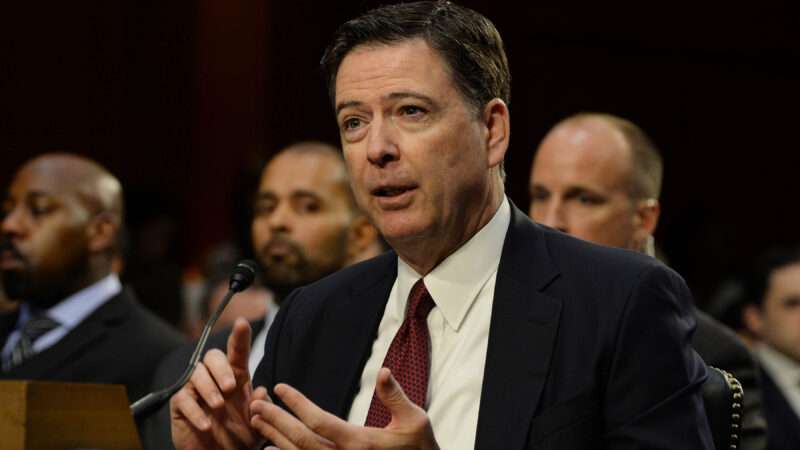
Former FBI Director James Comey testifies before the Senate Judiciary Committee in 2017 | Christy Bowe/Zuma Press/Newscom

A year after Donald Trump fired him, former FBI Director James Comey published a memoir that compared his former boss to a mafioso, portraying him as “a deeply flawed person and leader” who “either didn’t know” or “didn’t care” that federal law enforcement officials have a higher duty than obedience to the president’s whims. The grudge-driven criminal case against Comey reinforces that assessment.

In recent motions challenging his perjury and obstruction indictment, Comey argues that he is a victim of vindictive and selective prosecution, that the interim U.S. attorney who obtained the indictment was improperly appointed, and that the charges against him are legally deficient. All three claims stem from Trump’s open determination to punish Comey based on a personal vendetta. Trump’s own statements therefore provide the strongest evidence in Comey’s favor.

Trump fired Comey on May 9, 2017, out of anger at the FBI’s investigation of alleged ties between his presidential campaign and the Russian government. “I just fired the head of the FBI,” Trump bragged to Russian officials. “He was crazy, a real nut job….I faced great pressure because of Russia. That’s taken off.”

After his dismissal, Comey continued to irritate Trump. His 2018 book described Trump’s presidency as “a continuing frontal assault on the truth—on the very notion of ‘truth,'” beginning with “the lie about his inauguration crowd being larger than Barack Obama’s.” While promoting the book, Comey described Trump as “untethered to truth,” “unethical,” “morally unfit to be president,” and a “person who sees moral equivalence in Charlottesville, who talks about and treats women like they’re pieces of meat, and who lies constantly about matters big and small.”

Unsurprisingly, Comey’s public criticism magnified Trump’s animosity toward him. Trump described Comey as “a proven LEAKER & LIAR,” a “weak and untruthful slime ball” who “should be prosecuted.” He complained that “Shadey [sic] James Comey can Leak and Lie and make lots of money from a third rate book (that should never have been written).” He accused Comey of “illegally leak[ing] CLASSIFIED INFORMATION,” saying he was “either very sick or very dumb.”

Comey continued to criticize Trump, condemning his coziness with Russian President Vladimir Putin (“a murderous lying thug”) and remarking that, although “the United States should be a shining light for the world, modeling a democracy that values truth,” Trump was “dimming that light.” According to John F. Kelly, Trump’s former chief of staff, the president mused about siccing the IRS on Comey, saying he should not be “making money” by bashing his former boss.

Comey publicly opposed Trump’s reelection, saying Americans deserved “a president who will reflect the core values of honesty and decency that are the lifeblood or our nation and its institutions.” Trump responded by reposting social media messages calling Comey “a corrupt piece of garbage,” “a disgraced lier [sic] & leaker,” and a “weasel” who should “be in jail.”

In May 2024, Comey warned that electing Trump to a second term would have “serious” implications “for the Justice Department and the FBI, because Trump is coming for those institutions.” Two days later, Trump complained that “the Worst FBI Director in History,” who had committed “horrors,” was “going around LYING” about Trump’s legal troubles.

After he was elected, Trump suggested he was ready to deliver on his threats against Comey, telling reporters last July that the former FBI director was “dishonest,” “truly bad,” and “corrupt as hell.” The president said “maybe” Comey would “have to pay a price for that,” adding, “whatever happens, happens.”

Toward that end, Trump pressured Erik Siebert, the interim U.S. attorney for the Eastern District of Virginia, to prosecute Comey. Trump had nominated Siebert to be the permanent U.S. attorney. But after Siebert proved insufficiently enthusiastic about prosecuting Comey and another Trump nemesis, New York Attorney General Letitia James, the president forced him out in favor Lindsey Halligan, a former Trump lawyer with no prosecutorial experience.

On September 19, Trump publicly demanded that Attorney General Pam Bondi take action against Comey, James, and Sen. Adam Schiff (D–Calif.), saying his supporters believed “they’re all guilty as hell” and worried that “nothing is going to be done.” Trump’s marching orders were clear. “We can’t delay any longer,” he told Bondi. “JUSTICE MUST BE SERVED, NOW!!!”

Halligan took office two days later and obtained the Comey indictment later that week, just a few days before the statutory deadline. Notably, no other prosecutors joined Halligan in signing the indictment, which reflected internal skepticism about the case. Bondi herself reportedly had doubts, but Trump got what he wanted anyway.

That background, Comey’s lawyers argue in a motion filed on October 20, shows that the case against him amounts to retaliation for his criticism of Trump. “The government has singled out Mr. Comey for prosecution because of his protected speech and because of President Trump’s personal animus toward Mr. Comey,” they say. “Such a vindictive and selective prosecution violates the First Amendment, [the] Due Process Clause, and equal protection principles.”

The Fifth Amendment’s Due Process Clause “protects all persons against federal
government action designed to penalize protected speech or to wield government power based on animus,” the motion says. “Those protections are at their zenith when the government invokes the criminal process to deprive a person of liberty. Established due process principles therefore prohibit vindictive prosecutions to punish the assertion of rights or to express animus. Similarly, established equal protection principles prohibit selective prosecutions that invidiously impose penalties based on arbitrary classifications. The circumstances of the charging decision in this case—a last-minute retaliatory charge after a torrent of personal invective by a President who expressly sought charges regardless of the facts—warrant dismissal with prejudice on both vindictive and selective prosecution grounds.”

The indictment accuses Comey of “willfully and knowingly” making “a materially false, fictitious, and fraudulent statement” during testimony before the Senate Judiciary Committee on September 30, 2020. Under 18 USC 1001(a)(2), that’s a felony punishable by up to five years in prison. The indictment also alleges a related felony, subject to the same maximum penalty, under 18 USC 1505, which applies to someone who “corruptly” attempts to “influence, obstruct, or impede” a congressional proceeding.

To reinforce the selective prosecution claim, Comey’s lawyers note that “similar allegations” with “a much stronger evidentiary basis” were “raised against at least four other individuals who served as heads of agencies during President Trump’s first term.” The examples include demonstrably inaccurate congressional testimony by former Attorney General Jeff Sessions, former Environmental Protection Agency Administrator Scott Pruitt, former Secretary of Health and Human Services Tom Price, and former Treasury Secretary Steve Mnuchin. “None of them were charged,” the motion notes.

In another motion filed the same day, Comey’s lawyers argue that Halligan’s appointment was illegal. Under 28 USC 546, they note, the attorney general “may appoint a United States attorney for the district in which the office of United States attorney is vacant.” Such interim appointments are limited to 120 days, meaning that Siebert’s term expired on May 21. His tenure was extended under a provision that allows the judges of the district to “appoint a United States attorney to serve until the vacancy is filled.” But after Trump demanded Siebert’s resignation, the motion argues, the attorney general was not allowed to start the clock again by appointing Halligan as interim U.S. attorney.

“If the Attorney General could make back-to-back sequential appointments of interim U.S. Attorneys, the 120-day period would be rendered meaningless, and the Attorney General could indefinitely evade the alternate procedures that Congress mandated,” Comey’s lawyers say. “The text thus precludes an additional appointment by the Attorney General after the expiration of that 120-day period.”

Like the claim of vindictive and selective prosecution, this one flows from Trump’s desperation to punish Comey. Because the U.S. attorney he had nominated did not think there was a solid basis to charge Comey, Trump picked a more compliant replacement at the last minute because “we can’t delay any longer.”

Halligan obtained the indictment on September 25, nearly five years after the testimony on which it is based. By the end of the month, it would have been barred by the statute of limitations.

In a motion filed on Thursday, Comey’s lawyers address the legal merits of the indictment. That is no easy task, because the skimpy, two-page document is vague about exactly how he allegedly violated the two statutes it cites.

The indictment says Comey “falsely stat[ed]” that he “had not ‘authorized someone else at the FBI to be an anonymous source in news reports’ regarding an FBI investigation concerning PERSON 1.” That statement was false, it says, because Comey “then and there knew” that he “in fact had authorized PERSON 3 to serve as an anoymous source in news reports regarding an FBI investigation of PERSON 1.”

That charge alludes to an exchange between Comey and Sen. Ted Cruz (R–Texas), who referred to what Comey had said during a Senate Judiciary Committee hearing on May 3, 2017, less than a week before Trump fired him. Comey answered “no” when Sen. Charles Grassley (R–Iowa) asked if he had “ever authorized someone else at the FBI to be an anonymous source in news reports about the Trump investigation or the Clinton investigation.”

Grassley was referring, respectively, to the Russia probe and the inquiry into Hillary Clinton’s use of a private email server as secretary of state. But Cruz’s questions to Comey three years later focused on a third FBI investigation, involving the Clinton Foundation.

Andrew McCabe, Comey’s deputy, had authorized the disclosure of information about that investigation to The Wall Street Journal, which mentioned it in a story published on October 30, 2016. After that story ran, McCabe later claimed, he told Comey about the disclosure, and Comey expressed his approval. Comey said that never happened, and a February 2018 report from the Justice Department’s Office of the Inspector credited his account.

“McCabe did not tell Comey on or around October 31 (or at any other time) that he (McCabe) had authorized the disclosure of information about the [Clinton Foundation] Investigation to the WSJ,” the report said. It added that “had McCabe done so, we believe that Comey would have objected to the disclosure.”

Cruz latched onto that dispute during the 2020 Senate Judiciary Committee hearing. McCabe, Cruz said, “has publicly and repeatedly stated that he leaked information to The Wall Street Journal and that you were directly aware of it and that you directly authorized it.” That was a mischaracterization, since McCabe claimed only that Comey had expressed approval of the anonymous disclosure after the fact, not that Comey had “directly authorized” it.

Cruz nevertheless insisted that “what Mr. McCabe is saying and what you testified to this committee [in 2017] cannot both be true; one or the other is false.” His question: “Who’s telling the truth?”

Comey did not offer a direct answer. “I can only speak to my testimony,” he said. “I stand by…the testimony you summarized that I gave in May of 2017.”

Cruz tried again. “So your testimony is you’ve never authorized anyone to leak, and Mr. McCabe, when…he says [the] contrary, is not telling the truth,” he said. “Is that correct?”

Comey still did not want to talk about his factual dispute with McCabe. “Again, I’m not going to characterize Andy’s testimony,” he said, “but mine is the same today.”

In standing by his earlier testimony, the indictment claims, Comey lied. But about what exactly?

The indictment says Comey knew he “in fact had authorized PERSON 3 to serve as an anoymous source in news reports regarding an FBI investigation of PERSON 1.” It was clear from a count the grand jury rejected that “PERSON 1” was Hillary Clinton. Given the context of Cruz’s questions, it seemed likely that “PERSON 3” was McCabe. But according to Comey’s motion, “the government confirmed to the defense” on October 15—nearly three weeks after the indictment—”that ‘PERSON 1’ refers to Hillary Clinton and ‘PERSON 3’ refers to Daniel Richman.”

Richman, a “good friend” of Comey’s, is a Columbia law professor who also served the FBI as an unpaid “special government employee” during Comey’s tenure there. In June 2017, Comey admitted that, after he was fired, he asked Richman to provide memos about Comey’s meetings with Trump to The New York Times.

The indictment implies that Comey also used Richman as a conduit for information about an FBI investigation of Clinton, although it is not clear exactly which leak(s) Halligan has in mind. The New York Times reports that prosecutors interviewed Richman in early September, but his statements “were not helpful in their efforts to build a case.” In any event, Halligan apparently is arguing that Comey lied to Congress by implicitly denying that he had authorized Richman to act as an anonymous source.

That claim is pretty puzzling, given that the exchange with Cruz focused on McCabe, not Richman. “Senator Cruz’s focus on Mr. McCabe is alone sufficient to establish fundamental ambiguity when measured against the government’s current apparent interpretation,” Comey’s lawyers argue. They add that “when Senator Cruz referenced Senator Grassley’s question about whether Mr. Comey authorized ‘someone else at the FBI’ to serve as anonymous source, there was no reason to assume that he was referring to anyone but full-time employees like Mr. McCabe—who were stationed at the FBI—as opposed to someone like Mr. Richman, who was a Special Government Employee living fulltime in New York.”

The motion also argues that Comey’s answers to Cruz were “literally true” because he truthfully said he stood by his 2017 testimony. The gist of the perjury claim, by contrast, is that Comey lied to Grassley in 2017 and reiterated the lie three years later. And while it was too late to prosecute Comey for the earlier testimony, Halligan managed, just barely, to meet the deadline for charging him based on the 2020 hearing.

The second count of the indictment is even harder to parse, since it does not say exactly how Comey obstructed a congressional proceeding. If that count refers to the same statements as the perjury count, it is debatable for the same reasons. But as it stands, the motion says, the obstruction charge’s “lack of specificity renders it inherently and separately defective for failing to provide adequate notice to Mr. Comey of the charge against which he must defend.”

Given the lack of clarity about exactly what Cruz was asking, how Comey interpreted his questions, the meaning of his responses, and his intent in reaffirming his 2017 testimony, it is not hard to see why Siebert and his underlings did not think the case was worth pursuing. But Trump was determined to get Comey one way or another.

That much is clear from Trump’s public statements about Comey, which never specified exactly what crime he thought Comey had committed. It is also clear from the way that FBI Director Kash Patel portrayed the indictment: as a response to the “Russiagate hoax.” Legally speaking, the charges against Comey have nothing to do with the Russia probe, which is relevant only insofar as it illuminates Trump’s motivation. Trump conflates justice with revenge, and his underlings have to follow suit if they want to keep their jobs.

The post James Comey Says His Grudge-Driven Prosecution Is Unconstitutional Retaliation for His Criticism of Trump appeared first on Reason.com.

from Latest – Reason.com https://ift.tt/JKwZvgO
via IFTTT

California Couple Faces $1 Million in Fines for Code Violations Committed by Their Home’s Previous Owner


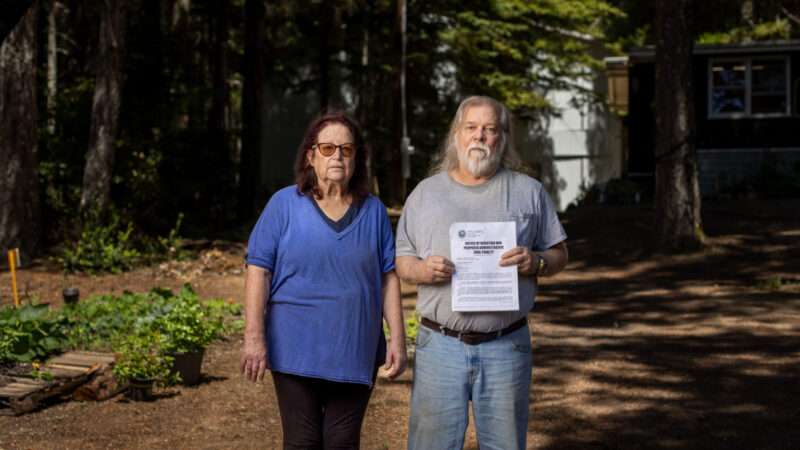
Corinne and Doug Thomas on their property | Institute for Justice

A California couple is staring down stratospheric fines after their property allegedly ran afoul of local cannabis code violations. The kicker, however, is that the previous owner is to blame for the infractions.

That has not deterred Humboldt County, California, from levying $1 million in civil penalties against Corrine and Doug Thomas, who bought the home in the Northern California redwood forest after their home in Los Angeles County was destroyed by a wildfire. Six days after moving in, the government sent the property a notice—addressed to the former owner, Summerville Creek LLC—outlining violations pertaining to a structure in the Thomas’ backyard. According to court documents, that included “violation of the commercial cannabis land use ordinance; construction of a building or structure in violation of building, plumbing, and electrical codes; and, facilities or activities in violation of the commercial cannabis land use ordinance.”

The county assessed penalties at $12,000 a day for up to 90 days. To circumvent that, the couple would have to demolish the problematic structure in question, which would cost them $180,000, plus fines and fees. The couple appealed. But per county policy, the fines pile up while they wait for a hearing, which can take years. After a 10-day window, the 90-day clock starts, with penalties ballooning as time goes by.

So how does the county know who has allegedly broken the law? “Humboldt implemented a system to enforce cannabis-permitting violations that relies primarily on grainy satellite images,” wrote attorneys for Thomas in a writ of certiorari to the Supreme Court. The effort, they say, is part of the government’s desire to cash in on cannabis after the state legalized the drug.

“Code-enforcement officers scour the images for what looks like unpermitted development on a property (e.g., a greenhouse, a building, a graded flat of land, or trees removed without a permit on record),” they write. “The County then presumes, without any evidence or further investigation, that the landowner must have developed their property without a permit because they were growing cannabis. In Humboldt’s view, there’s just no other reason that someone might not buy a permit before building a shed, a barn, or a greenhouse in the rural countryside.” 

In that vein, the Institute for Justice, a public interest law firm, is also representing Blu Graham, who was hit with fines for cannabis-related violations when he says the only thing he’s ever grown on his property are vegetables for his restaurant; as well as Rhonda Olson, who faces $7.4 million in fines—also for a previous owner’s conduct—on a $60,000 property she bought to develop housing.

Most recently, the plaintiffs asked the Supreme Court to reconsider one of the major roadblocks to achieving a just outcome in Humboldt County: the Seventh Amendment right to a jury trial in civil cases, which the government is not providing here, and which the Supreme Court long ago ruled is not enforceable against the States. Instead, the government conducts administrative hearings, where the odds are grim.

The Court this month declined to intervene, though Justice Neil Gorsuch released a statement urging that the justices should consider the issue at some point down the line. “Surely, those who founded our Nation,” he wrote, “considered the right to trial by jury a fundamental part of their birthright.” Meanwhile, the plaintiffs’ fight will continue in the lower court after the U.S. Court of Appeals for the 9th Circuit revived the suit late last year citing the Eighth Amendment, which prohibits excessive fines and fees.

The post They Face $1 Million in Fines—for Someone Else's Code Violations appeared first on Reason.com.

from Latest – Reason.com https://ift.tt/vqQuWVR
via IFTTT

James Comey Says His Grudge-Driven Prosecution Is Unconstitutional Retaliation for His Criticism of Trump


Former FBI Director James Comey testifies before the Senate Judiciary Committee in 2017 | Christy Bowe/Zuma Press/Newscom

A year after Donald Trump fired him, former FBI Director James Comey published a memoir that compared his former boss to a mafioso, portraying him as “a deeply flawed person and leader” who “either didn’t know” or “didn’t care” that federal law enforcement officials have a higher duty than obedience to the president’s whims. The grudge-driven criminal case against Comey reinforces that assessment.

In recent motions challenging his perjury and obstruction indictment, Comey argues that he is a victim of vindictive and selective prosecution, that the interim U.S. attorney who obtained the indictment was improperly appointed, and that the charges against him are legally deficient. All three claims stem from Trump’s open determination to punish Comey based on a personal vendetta. Trump’s own statements therefore provide the strongest evidence in Comey’s favor.

Trump fired Comey on May 9, 2017, out of anger at the FBI’s investigation of alleged ties between his presidential campaign and the Russian government. “I just fired the head of the FBI,” Trump bragged to Russian officials. “He was crazy, a real nut job….I faced great pressure because of Russia. That’s taken off.”

After his dismissal, Comey continued to irritate Trump. His 2018 book described Trump’s presidency as “a continuing frontal assault on the truth—on the very notion of ‘truth,'” beginning with “the lie about his inauguration crowd being larger than Barack Obama’s.” While promoting the book, Comey described Trump as “untethered to truth,” “unethical,” “morally unfit to be president,” and a “person who sees moral equivalence in Charlottesville, who talks about and treats women like they’re pieces of meat, and who lies constantly about matters big and small.”

Unsurprisingly, Comey’s public criticism magnified Trump’s animosity toward him. Trump described Comey as “a proven LEAKER & LIAR,” a “weak and untruthful slime ball” who “should be prosecuted.” He complained that “Shadey [sic] James Comey can Leak and Lie and make lots of money from a third rate book (that should never have been written).” He accused Comey of “illegally leak[ing] CLASSIFIED INFORMATION,” saying he was “either very sick or very dumb.”

Comey continued to criticize Trump, condemning his coziness with Russian President Vladimir Putin (“a murderous lying thug”) and remarking that, although “the United States should be a shining light for the world, modeling a democracy that values truth,” Trump was “dimming that light.” According to John F. Kelly, Trump’s former chief of staff, the president mused about siccing the IRS on Comey, saying he should not be “making money” by bashing his former boss.

Comey publicly opposed Trump’s reelection, saying Americans deserved “a president who will reflect the core values of honesty and decency that are the lifeblood or our nation and its institutions.” Trump responded by reposting social media messages calling Comey “a corrupt piece of garbage,” “a disgraced lier [sic] & leaker,” and a “weasel” who should “be in jail.”

In May 2024, Comey warned that electing Trump to a second term would have “serious” implications “for the Justice Department and the FBI, because Trump is coming for those institutions.” Two days later, Trump complained that “the Worst FBI Director in History,” who had committed “horrors,” was “going around LYING” about Trump’s legal troubles.

After he was elected, Trump suggested he was ready to deliver on his threats against Comey, telling reporters last July that the former FBI director was “dishonest,” “truly bad,” and “corrupt as hell.” The president said “maybe” Comey would “have to pay a price for that,” adding, “whatever happens, happens.”

Toward that end, Trump pressured Erik Siebert, the interim U.S. attorney for the Eastern District of Virginia, to prosecute Comey. Trump had nominated Siebert to be the permanent U.S. attorney. But after Siebert proved insufficiently enthusiastic about prosecuting Comey and another Trump nemesis, New York Attorney General Letitia James, the president forced him out in favor Lindsey Halligan, a former Trump lawyer with no prosecutorial experience.

On September 19, Trump publicly demanded that Attorney General Pam Bondi take action against Comey, James, and Sen. Adam Schiff (D–Calif.), saying his supporters believed “they’re all guilty as hell” and worried that “nothing is going to be done.” Trump’s marching orders were clear. “We can’t delay any longer,” he told Bondi. “JUSTICE MUST BE SERVED, NOW!!!”

Halligan took office two days later and obtained the Comey indictment later that week, just a few days before the statutory deadline. Notably, no other prosecutors joined Halligan in signing the indictment, which reflected internal skepticism about the case. Bondi herself reportedly had doubts, but Trump got what he wanted anyway.

That background, Comey’s lawyers argue in a motion filed on October 20, shows that the case against him amounts to retaliation for his criticism of Trump. “The government has singled out Mr. Comey for prosecution because of his protected speech and because of President Trump’s personal animus toward Mr. Comey,” they say. “Such a vindictive and selective prosecution violates the First Amendment, [the] Due Process Clause, and equal protection principles.”

The Fifth Amendment’s Due Process Clause “protects all persons against federal
government action designed to penalize protected speech or to wield government power based on animus,” the motion says. “Those protections are at their zenith when the government invokes the criminal process to deprive a person of liberty. Established due process principles therefore prohibit vindictive prosecutions to punish the assertion of rights or to express animus. Similarly, established equal protection principles prohibit selective prosecutions that invidiously impose penalties based on arbitrary classifications. The circumstances of the charging decision in this case—a last-minute retaliatory charge after a torrent of personal invective by a President who expressly sought charges regardless of the facts—warrant dismissal with prejudice on both vindictive and selective prosecution grounds.”

The indictment accuses Comey of “willfully and knowingly” making “a materially false, fictitious, and fraudulent statement” during testimony before the Senate Judiciary Committee on September 30, 2020. Under 18 USC 1001(a)(2), that’s a felony punishable by up to five years in prison. The indictment also alleges a related felony, subject to the same maximum penalty, under 18 USC 1505, which applies to someone who “corruptly” attempts to “influence, obstruct, or impede” a congressional proceeding.

To reinforce the selective prosecution claim, Comey’s lawyers note that “similar allegations” with “a much stronger evidentiary basis” were “raised against at least four other individuals who served as heads of agencies during President Trump’s first term.” The examples include demonstrably inaccurate congressional testimony by former Attorney General Jeff Sessions, former Environmental Protection Agency Administrator Scott Pruitt, former Secretary of Health and Human Services Tom Price, and former Treasury Secretary Steve Mnuchin. “None of them were charged,” the motion notes.

In another motion filed the same day, Comey’s lawyers argue that Halligan’s appointment was illegal. Under 28 USC 546, they note, the attorney general “may appoint a United States attorney for the district in which the office of United States attorney is vacant.” Such interim appointments are limited to 120 days, meaning that Siebert’s term expired on May 21. His tenure was extended under a provision that allows the judges of the district to “appoint a United States attorney to serve until the vacancy is filled.” But after Trump demanded Siebert’s resignation, the motion argues, the attorney general was not allowed to start the clock again by appointing Halligan as interim U.S. attorney.

“If the Attorney General could make back-to-back sequential appointments of interim U.S. Attorneys, the 120-day period would be rendered meaningless, and the Attorney General could indefinitely evade the alternate procedures that Congress mandated,” Comey’s lawyers say. “The text thus precludes an additional appointment by the Attorney General after the expiration of that 120-day period.”

Like the claim of vindictive and selective prosecution, this one flows from Trump’s desperation to punish Comey. Because the U.S. attorney he had nominated did not think there was a solid basis to charge Comey, Trump picked a more compliant replacement at the last minute because “we can’t delay any longer.”

Halligan obtained the indictment on September 25, nearly five years after the testimony on which it is based. By the end of the month, it would have been barred by the statute of limitations.

In a motion filed on Thursday, Comey’s lawyers address the legal merits of the indictment. That is no easy task, because the skimpy, two-page document is vague about exactly how he allegedly violated the two statutes it cites.

The indictment says Comey “falsely stat[ed]” that he “had not ‘authorized someone else at the FBI to be an anonymous source in news reports’ regarding an FBI investigation concerning PERSON 1.” That statement was false, it says, because Comey “then and there knew” that he “in fact had authorized PERSON 3 to serve as an anoymous source in news reports regarding an FBI investigation of PERSON 1.”

That charge alludes to an exchange between Comey and Sen. Ted Cruz (R–Texas), who referred to what Comey had said during a Senate Judiciary Committee hearing on May 3, 2017, less than a week before Trump fired him. Comey answered “no” when Sen. Charles Grassley (R–Iowa) asked if he had “ever authorized someone else at the FBI to be an anonymous source in news reports about the Trump investigation or the Clinton investigation.”

Grassley was referring, respectively, to the Russia probe and the inquiry into Hillary Clinton’s use of a private email server as secretary of state. But Cruz’s questions to Comey three years later focused on a third FBI investigation, involving the Clinton Foundation.

Andrew McCabe, Comey’s deputy, had authorized the disclosure of information about that investigation to The Wall Street Journal, which mentioned it in a story published on October 30, 2016. After that story ran, McCabe later claimed, he told Comey about the disclosure, and Comey expressed his approval. Comey said that never happened, and a February 2018 report from the Justice Department’s Office of the Inspector credited his account.

“McCabe did not tell Comey on or around October 31 (or at any other time) that he (McCabe) had authorized the disclosure of information about the [Clinton Foundation] Investigation to the WSJ,” the report said. It added that “had McCabe done so, we believe that Comey would have objected to the disclosure.”

Cruz latched onto that dispute during the 2020 Senate Judiciary Committee hearing. McCabe, Cruz said, “has publicly and repeatedly stated that he leaked information to The Wall Street Journal and that you were directly aware of it and that you directly authorized it.” That was a mischaracterization, since McCabe claimed only that Comey had expressed approval of the anonymous disclosure after the fact, not that Comey had “directly authorized” it.

Cruz nevertheless insisted that “what Mr. McCabe is saying and what you testified to this committee [in 2017] cannot both be true; one or the other is false.” His question: “Who’s telling the truth?”

Comey did not offer a direct answer. “I can only speak to my testimony,” he said. “I stand by…the testimony you summarized that I gave in May of 2017.”

Cruz tried again. “So your testimony is you’ve never authorized anyone to leak, and Mr. McCabe, when…he says [the] contrary, is not telling the truth,” he said. “Is that correct?”

Comey still did not want to talk about his factual dispute with McCabe. “Again, I’m not going to characterize Andy’s testimony,” he said, “but mine is the same today.”

In standing by his earlier testimony, the indictment claims, Comey lied. But about what exactly?

The indictment says Comey knew he “in fact had authorized PERSON 3 to serve as an anoymous source in news reports regarding an FBI investigation of PERSON 1.” It was clear from a count the grand jury rejected that “PERSON 1” was Hillary Clinton. Given the context of Cruz’s questions, it seemed likely that “PERSON 3” was McCabe. But according to Comey’s motion, “the government confirmed to the defense” on October 15—nearly three weeks after the indictment—”that ‘PERSON 1’ refers to Hillary Clinton and ‘PERSON 3’ refers to Daniel Richman.”

Richman, a “good friend” of Comey’s, is a Columbia law professor who also served the FBI as an unpaid “special government employee” during Comey’s tenure there. In June 2017, Comey admitted that, after he was fired, he asked Richman to provide memos about Comey’s meetings with Trump to The New York Times.

The indictment implies that Comey also used Richman as a conduit for information about an FBI investigation of Clinton, although it is not clear exactly which leak[s] Halligan has in mind. The New York Times reports that prosecutors interviewed Richman in early September, but his statements “were not helpful in their efforts to build a case.” In any event, Halligan apparently is arguing that Comey lied to Congress by implicitly denying that he had authorized Richman to act as an anonymous source.

That claim is pretty puzzling, given that the exchange with Cruz focused on McCabe, not Richman. “Senator Cruz’s focus on Mr. McCabe is alone sufficient to establish fundamental ambiguity when measured against the government’s current apparent interpretation,” Comey’s lawyers argue. They add that “when Senator Cruz referenced Senator Grassley’s question about whether Mr. Comey authorized ‘someone else at the FBI’ to serve as anonymous source, there was no reason to assume that he was referring to anyone but full-time employees like Mr. McCabe—who were stationed at the FBI—as opposed to someone like Mr. Richman, who was a Special Government Employee living fulltime in New York.”

The motion also argues that Comey’s answers to Cruz were “literally true” because he truthfully said he stood by his 2017 testimony. The gist of the perjury claim, by contrast, is that Comey lied to Grassley in 2017 and reiterated the lie three years later. And while it was too late to prosecute Comey for the earlier testimony, Halligan managed, just barely, to meet the deadline for charging him based on the 2020 hearing.

The second count of the indictment is even harder to parse, since it does not say exactly how Comey obstructed a congressional proceeding. If that count refers to the same statements as the perjury count, it is debatable for the same reasons. But as it stands, the motion says, the obstruction charge’s “lack of specificity renders it inherently and separately defective for failing to provide adequate notice to Mr. Comey of the charge against which he must defend.”

Given the lack of clarity about exactly what Cruz was asking, how Comey interpreted his questions, the meaning of his responses, and his intent in reaffirming his 2017 testimony, it is not hard to see why Siebert and his underlings did not think the case was worth pursuing. But Trump was determined to get Comey one way or another.

That much is clear from Trump’s public statements about Comey, which never specified exactly what crime he thought Comey had committed. It is also clear from the way that FBI Director Kash Patel portrayed the indictment: as a response to the “Russiagate hoax.” Legally speaking, the charges against Comey have nothing to do with the Russia probe, which is relevant only insofar as it illuminates Trump’s motivation. Trump conflates justice with revenge, and his underlings have to follow suit if they want to keep their jobs.

The post James Comey Says His Grudge-Driven Prosecution Is Unconstitutional Retaliation for His Criticism of Trump appeared first on Reason.com.

from Latest – Reason.com https://ift.tt/JKwZvgO
via IFTTT

Stark Irony: Iran Angrily Condemns Trump’s Call To Resume US Nuclear Testing

Stark Irony: Iran Angrily Condemns Trump’s Call To Resume US Nuclear Testing

In a stark irony, Iran has condemned and lashed out at President Trump’s call to return the United States to nuclear weapons testing “on an equal basis” with other countries like Russia and China.

Iranian Foreign Minister Abbas Araghchi called out the move as both “regressive” and “irresponsible”. Iran has of course remained under harsh and expansive US-led sanctions over its nuclear program, which has involved no warheads or other testing, and which Tehran has long insisted is only for peaceful nuclear energy purposes.

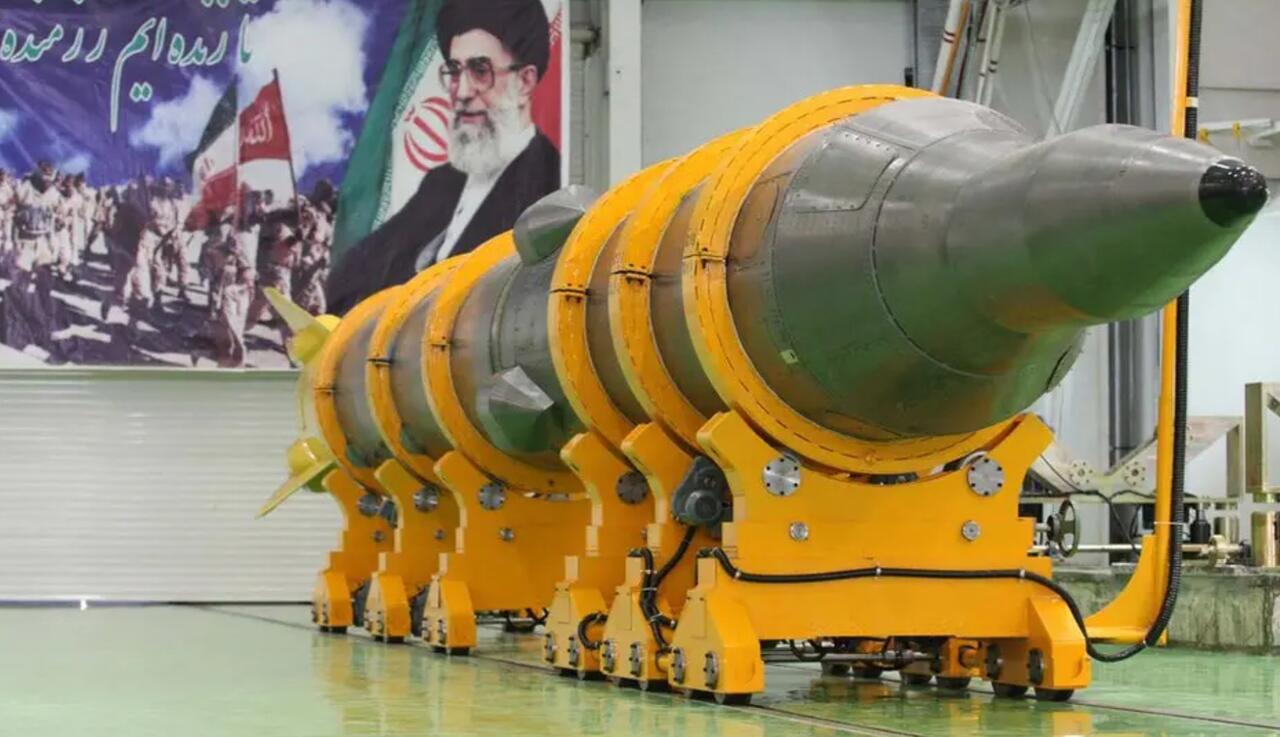
Iran has a serious ballistic missile arsenal. via AFP

“Having rebranded its ‘Department of Defense’ as the ‘Department of War,’ a nuclear-armed bully is resuming testing of atomic weapons,” Araghchi wrote on X late Thursday.

The same bully has been demonizing Iran’s peaceful nuclear program and threatening further strikes on our safeguarded nuclear facilities, all in blatant violation of international law,” he said.

Trump’s surprise announcement on Truth Social came earlier that same day just before meeting with Chinese President Xi Jinping in South Korea on the sidelines of the Asia-Pacific Economic Cooperation (APEC) summit.

The has media widely assumed that Trump just ordered explosives tests of nuclear warheads, which hasn’t been done by the US since 1992. But the reality is that Trump’s wording was ambiguous enough to also mean simply the testing of nuclear delivery weapons and not detonating bombs themselves.

Moon of Alabama astutely points out that A Nuclear Delivery Vehicle Is Not A Nuclear War Head:

However Trumps next sentence is not about testing nuclear warheads. It is about testing of carrier systems that can deploy nuclear warheads.

Trump says: “Because of other countries testing programs,…”

No country has recently exploded a nuclear bomb or warhead for testing or other purposes. The last known nuclear test was done by North Korea in 2017.

It is important to distinguish between testing a carrier designed to deliver a nuclear war head and testing, i.e. exploding, the nuclear war head itself. A nuclear carrier can be a bomber, a land based (intercontinental) missile or a submarine based missile or torpedo.

Still, this is how the world is interpreting it, given The Washington Post and many others gave it precisely that meaning. But given Trump was aiming all of this at Russia to condemn its own tests within the last week of no less than two cutting-edge nuclear delivery weapons, the ambiguity is perhaps intentional and having its effect.

As for Iran, despite the June war and the at this point total and official end of the JCPOA, it is unlikely to give up its nuclear program. After being attacked by Israel and Washington, with its nuke sites heavily bombed, it likely feels more incentivized than ever to achieve nuclear weapons, or other capable WMD deterrent.

Tyler Durden
Fri, 10/31/2025 – 17:20

via ZeroHedge News https://ift.tt/huFYS9A Tyler Durden