Mainstream Expectations: Hope Vs. Potential Risk

Mainstream Expectations: Hope Vs. Potential Risk

Authored by Lance Roberts via RealInvestmentAdvice.com,

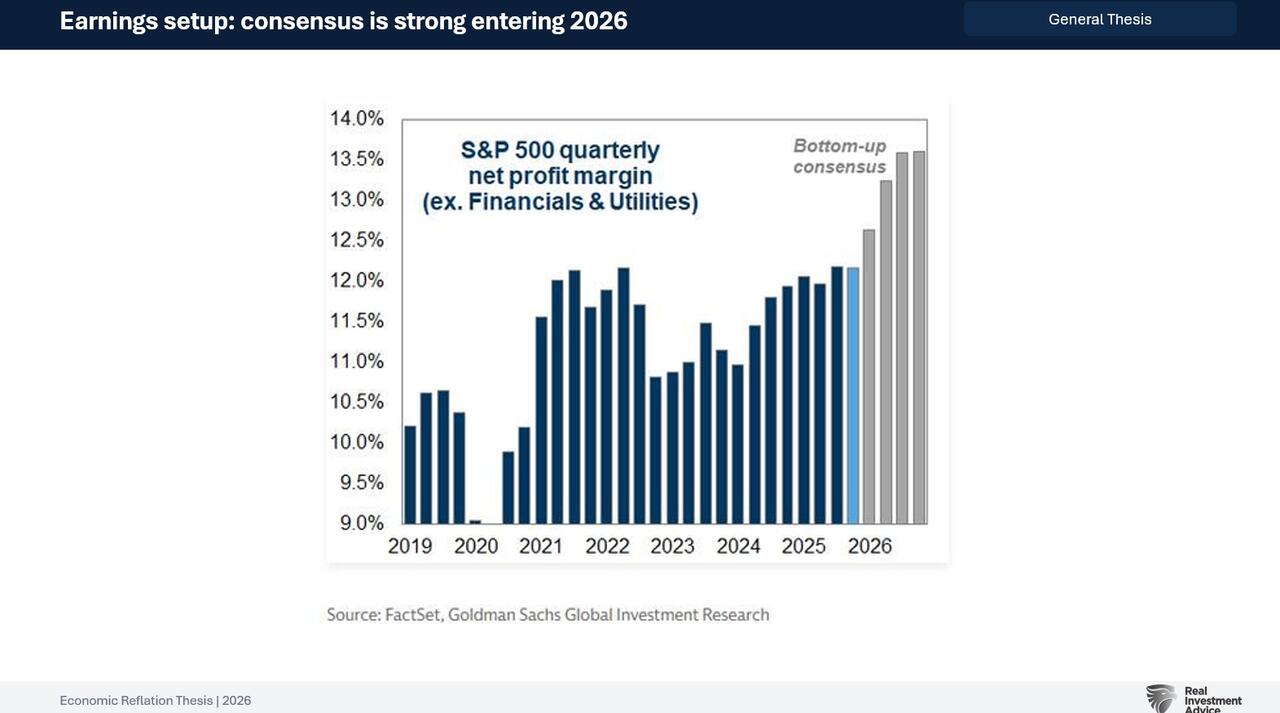
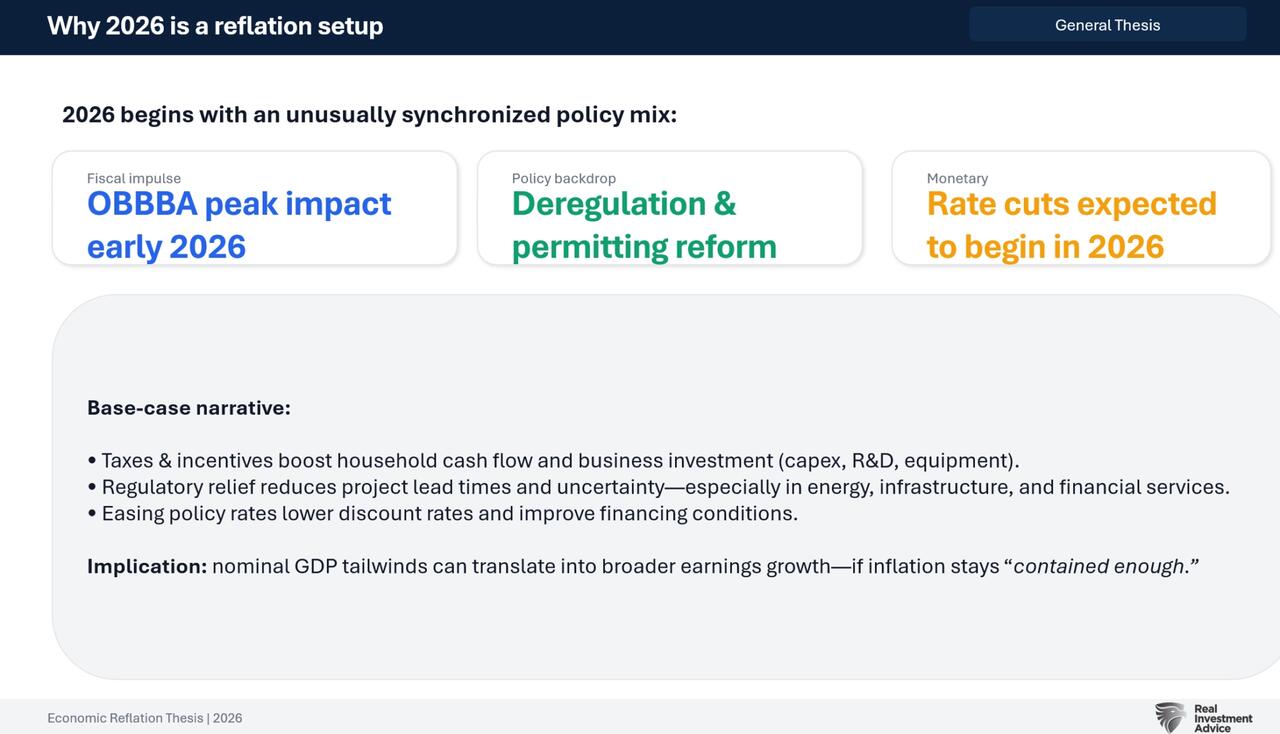
Mainstream expectations, those from Wall Street, economists, and corporate strategists, have congealed around a bullish economic outlook for 2026. Most forecasts project stronger economic growth, with contained inflation, and continued investment in technology and capital expenditure. As such, many institutional investors interpret this as a year of opportunity for markets and corporate earnings.That was a point we discussed at this year’s Investment Summit with the following slide.
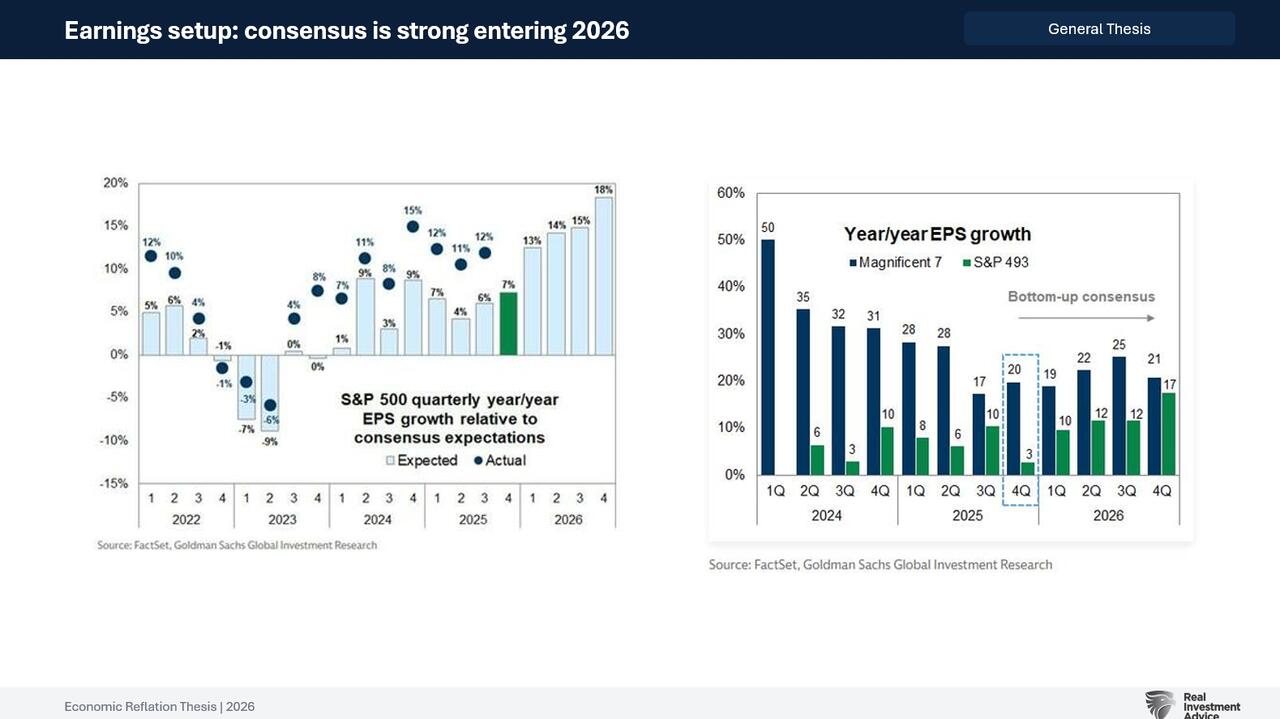
But it isn’t just earnings that are expected to rise, but due to productivity increases (AI = Less Employment) corporate profit margins are expected swell to historic records.
However, whenever I see Wall Street becoming universally bullish, the contrarian investor in me is always reminded of Bob Farrell’s Rule #9:

“When all experts agree, something else will happen.”

As I noted in that linked article:

“Excesses are built by everyone on the same side of the trade. Ultimately, when the shift in sentiment occurs – the reversion is exacerbated by the stampede going in the opposite direction.”
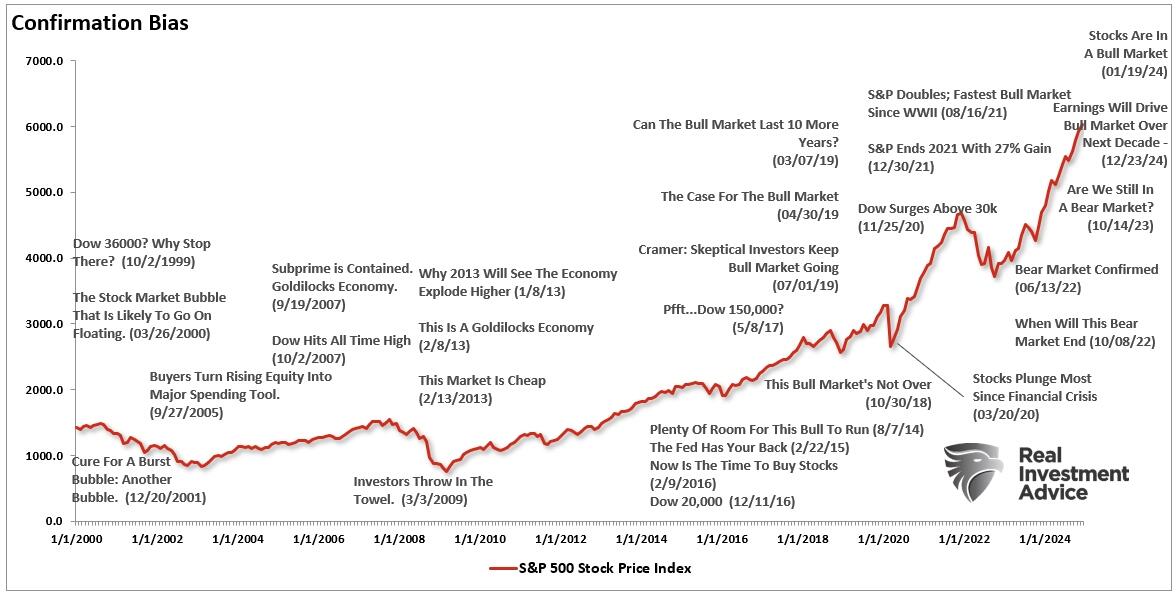
Yet the broader risk landscape is significant as consensus optimism obscures important vulnerabilities. When investors anchor on expected outcomes and overlook low‑probability but high‑impact risks, those risks become amplified. History shows that markets rarely transition smoothly from one year to the next without shocks to inflation, monetary policy, geopolitics, or credit conditions. For example, on January 1st, no one expected President Trump to slap additional tariffs on Europe over the potential purchase of Greenland.

But it happened.

So with that, let’s review mainstream expectations for 2026, and detail the “low probability, high impact risks,” that could derail the complacent expectations of investors.

US Economic Growth: Resilience or Fragile Expansion?

Mainstream Expectation: Most economists expect the US economy to grow above trend in 2026. Goldman Sachs forecasts U.S. GDP expanding about 2.6% year‑over‑year in 2026 compared to consensus estimates of roughly 2.0%. Their team sees above‑consensus growth and a strong rebound from 2025.
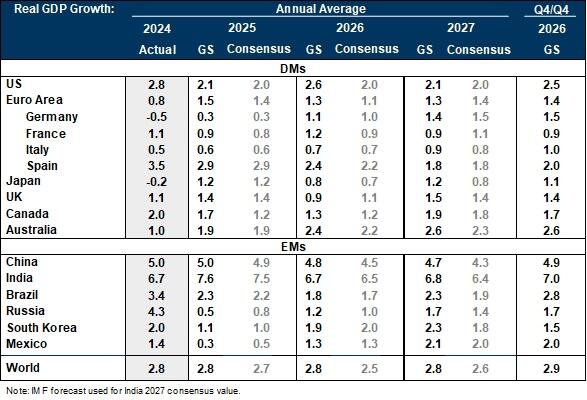
Other analysts and institutions, including PwC and RSM US, forecast similar growth in the 2.1% – 2.5% range, driven by consumer spending, corporate investment, and broader economic resilience.

Risk to That View: Growth forecasts assume stability in consumer demand, labor markets, and capital spending. But several risks could undermine this:

  • Labor market fragility: Employment growth has slowed sharply in late 2025, and with a declining working‑age population due to lower immigration, net job creation may stay weak. Early data shows average monthly employment growth collapsing to levels historically consistent with labor market stress.

  • Tariff and trade uncertainty: The recent threat of higher tariffs on Europe, and continued trade tensions that emerged in 2025, introduce volatility in production and pricing in supply chains. Increased tariffs across major trading partners historically correlate with lower output.

  • Global headwinds: The World Bank warns that while global growth remains resilient, fading dynamism and policy uncertainty could reduce demand for U.S. exports.

Our view is that the most critical risk on 2026 is further weakness in the labor market or trade disruptions worsen which could cause growth to fall short of expectations.

Inflation and Monetary Policy: Tame or Sticky?

Mainstream Expectation: Consensus forecasts generally expect inflation to moderate through 2026, with core measures heading toward the Federal Reserve’s 2% target. Goldman Sachs projects core inflation close to 2.1% by the end of 2026.
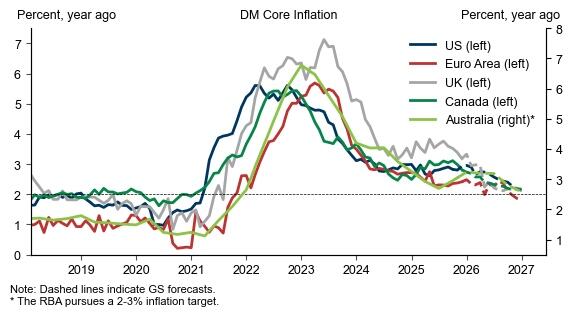
Some money managers expect the Fed to cut rates one or two times in 2026, assuming inflation continues its downward trend and consumer spending remains resilient.
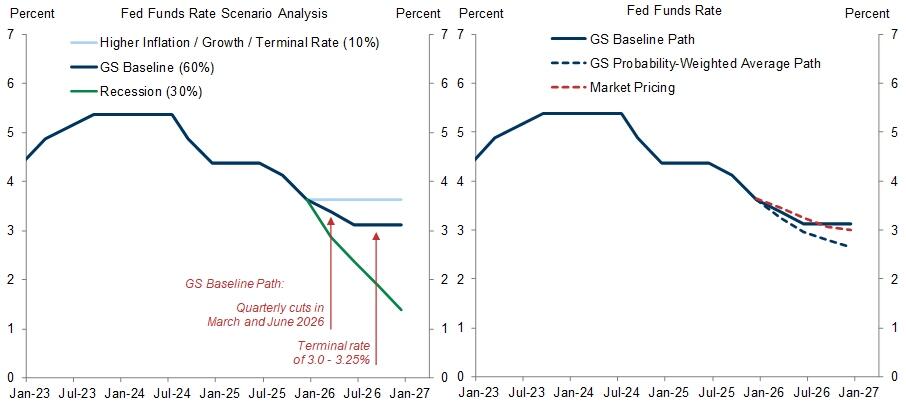
Risk to That View: Given that inflation is a function of economic supply and demand, a “run it hot economy” could keep inflation “sticky” or slightly higher.

  • Sticky core inflation: Some forecasts warn that core inflation may stay above target due to tariff pass‑through, wage pressures, or service inflation. Vanguard’s model suggests core inflation could remain above 2.5% if tariffs and labor tightness persist.

  • Monetary policy divergence: J.P. Morgan’s economist predicts the Fed may actually hold rates steady or even raise them in 2027, due to sticky inflation and labor market strength despite market expectations for cuts.

  • Fed independence risks: Intensified concerns over central bank autonomy could cause further disruptions and uncertainty over future monetary policy direction.

If inflation proves more persistent than expected or if policy credibility erodes, interest rates may stay elevated weighing on valuations and economic activity.

AI and Corporate Investment: Growth Catalyst or Market Excess?

Mainstream Expectation: Most forecasts see continued strong investment in artificial intelligence and related infrastructure as a driver of both corporate capex and productivity. Most analysts highlight AI’s role in lifting corporate spending and supporting economic expansion.
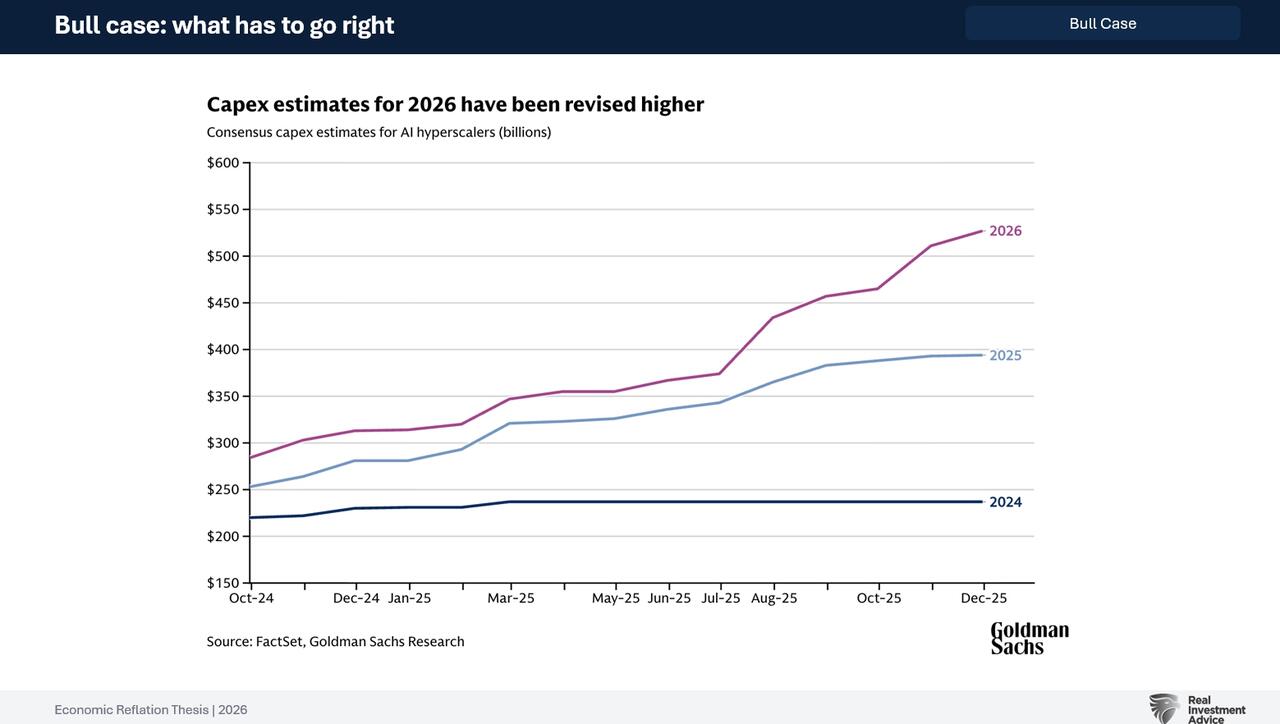
U.S. corporate bond issuance is also projected to surge, much of it to fund AI data centers, advanced computing infrastructure, and next‑generation platforms.

Risk to That View: The growth from AI investment is uneven and concentrated:

  • Concentration of benefits: A relatively small group of mega‑cap firms capture most of the AI investment gains, which can create sector concentration risk in markets and overstate the breadth of economic benefit.

  • Corporate debt buildup: Higher bond issuance tied to capex, especially for large tech projects, increases leverage risk, especially if growth slows or credit markets retrench.

  • Market pricing risk: A strong investment narrative can inflate asset prices beyond fundamentals, meaning corrections may be abrupt if earnings disappoint.

AI spending is real, but it is not a universal engine for all sectors. Most critically, the overreliance on it for aggregate growth forecasts underestimates broader economic weak spots.

Consumer Spending: Supported or Overstated?

Mainstream Expectation: Analysts expect consumer resilience to remain a backbone of 2026 growth. Strong household balance sheets, robust savings for certain income groups, and wage gains support consumption forecasts. These assumptions pervade GDP models showing above‑trend expansion.
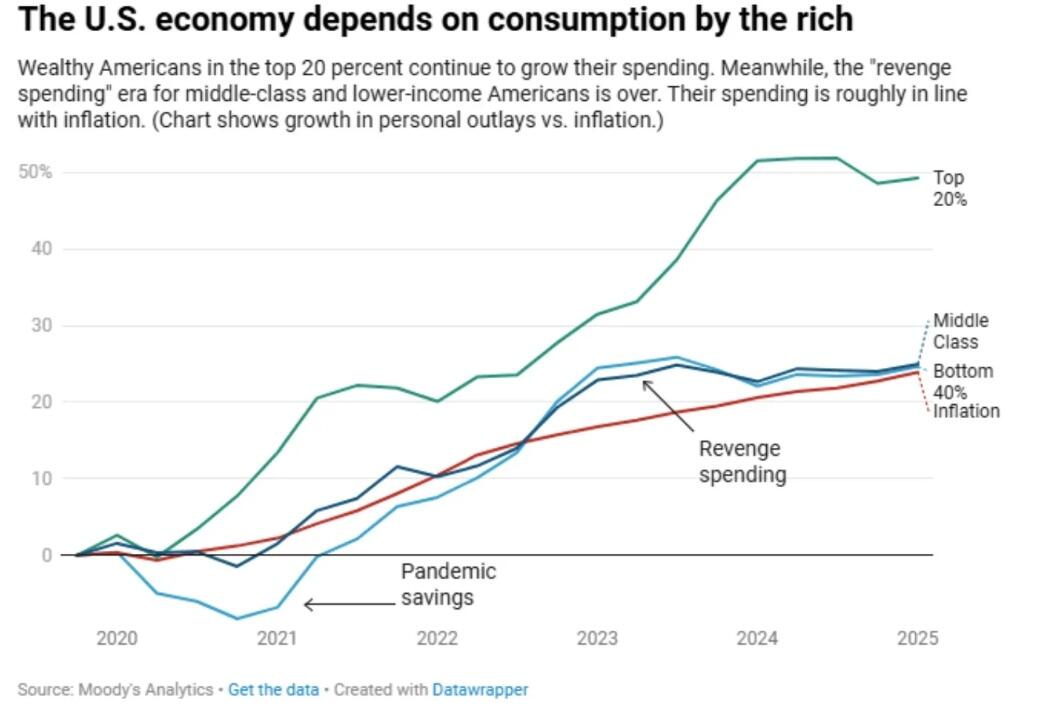
Risk to That View: Consumer dynamics can shift suddenly:

  • Wealth inequality in consumption: Wealth effects are most pronounced among higher‑income households. Median consumers without significant asset holdings may reduce spending if jobs or real income weaken.
  • Debt and credit stress: Higher interest rates increase borrowing costs for households which could depress discretionary spending.

Consumer spending may remain resilient on average, but broad‑based weakness could emerge quietly before appearing in headline data.

The Dollar and Foreign Exchange: Weakening or Volatile?

Mainstream Expectation: Many strategists anticipate a modest depreciation of the U.S. dollar in 2026. As such, a weaker dollar would boosts export competitiveness and corporate earnings abroad.
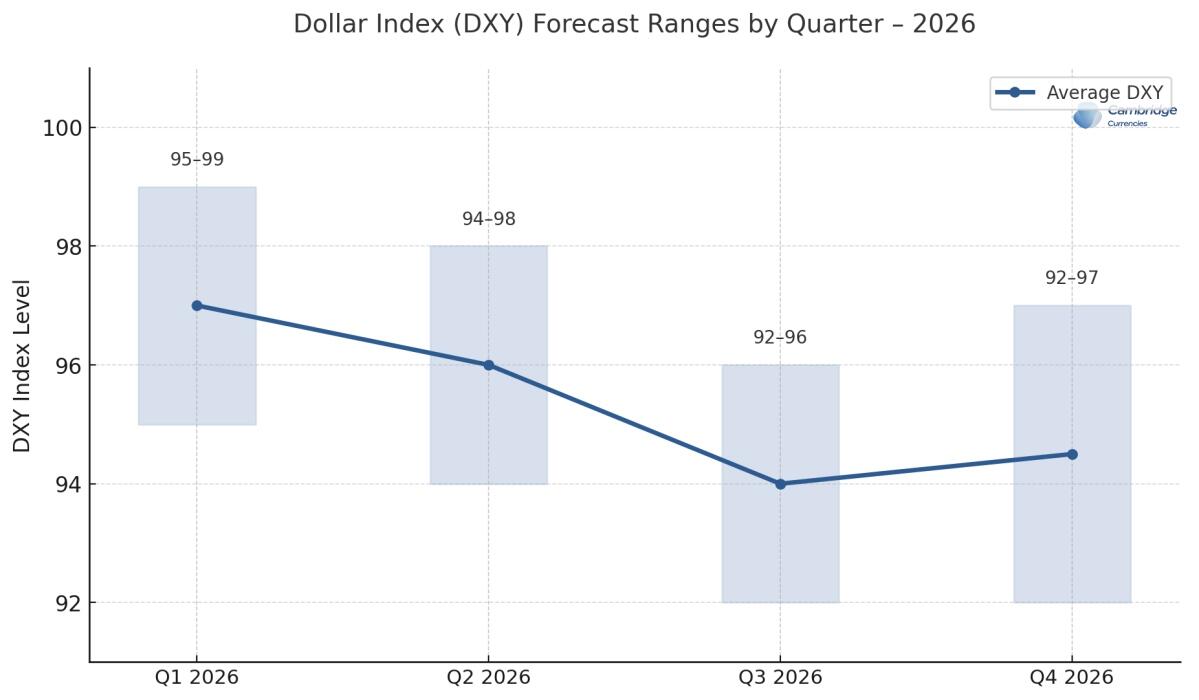
Risk to That View: Currency markets are driven by relative risk and capital flows, not just growth differentials:

  • Growth risk: Stronger economic growth will attract foreign inflows into dollar-denominated assets for higher yields and relative safety.

  • Safe‑haven demand: In times of geopolitical tension or financial stress, the dollar strengthens due to its liquidity and safety. Such would potentially hurt U.S. export competitiveness.

A dollar that strengthens through risk aversion or economic growth would undercut the export growth assumptions embedded in current forecasts.

Tax Policy and Fiscal Stimulus: The Reflation Narrative

Mainstream Expectation: New tax measures, including expanded investment credits and incentives, are expected to boost consumer incomes and corporate spending in 2026. Forecasts incorporate these fiscal tailwinds into growth and profitability models.
Risk to That View: Tax benefits often provide short‑lived effects:

  • Timing and bias: Households may smooth additional tax savings into future consumption rather than immediately spend them. Corporations might repatriate savings or use them for share repurchases rather than investing.

  • Dependence Risk: The outlook for increased capex, spending, and earnings are all dependent on economic growth strengthening into 2026. However, as discussed, there are many risks to that view.

Tax incentives are supportive, but they should be viewed as marginal boosts rather than transformational drivers of long‑term growth.

Portfolio Tactics for Investors in 2026

The purpose of this article is not to suggests that Wall Street analysts, and market participants, are wrong. The purpose is to suggest there are risks to investor portfolios when “everyone is bullish on everything all at once.”

Therefore, given the range of possible outcomes, investors should employ adaptive, risk‑aware strategies. Rather than assuming a base‑case forecast will materialize, use portfolio tactics to help navigate uncertainty:

  • Diversification Beyond Tech and Growth: Hold a mix of sectors including value, energy, and financials to reduce concentration risk. Consider allocations to fixed income to offset volatility risks.

  • Inflation and Rate Risk Hedging: Maintain allocations to short‑duration bonds to reduce sensitivity to potential rate volatility.

  • Dollar and Currency Exposure Management: Hedge currency risk for international holdings. A stronger dollar could undermine international growth outlooks.

  • Energy and Commodity Positions: Commodities are subject to economic growth. If growth slows, commodities become a higher risk asset.

  • Quality and Balance Sheet Strength: Tilt toward companies with strong balance sheets and stable free cash flow to weather cyclical shocks. Favor dividends and cash returns in uncertain environments.

  • Liquidity Reserves: Maintain higher levels of cash or cash equivalents to capitalize on market dislocations. Liquid reserves provide flexibility should growth disappoint.

  • Tactical Hedging Strategies: Use options or inverse instruments selectively to protect portfolios against sharp downturns. Volatility may rise unpredictably; structured hedges can provide protection without full market timing.

  • Monitoring Macro Signals Actively: Track inflation metrics, labor market data, and Fed communications closely. Be ready to adjust strategies in response to shifts in inflation, policy, or geopolitical developments.

The mainstream outlook for 2026 is cautiously optimistic, grounded in forecasts of steady growth, stable inflation, and continued technology‑led investment. Those expectations are reasonable as base cases. However, investors should not mistake forecasts for outcomes. Each major economic assumption carries material risks. Persistent inflation, monetary policy uncertainty, geopolitical shocks, and uneven growth dynamics could all lead to outcomes well outside consensus expectations.

Prudent investors will build portfolios that protect capital first, anticipate volatility, and adapt rapidly to changing economic realities. The probability distribution of 2026 outcomes is wide, and mistakes can be costly when “all the experts agree.”

Tyler Durden
Sat, 01/31/2026 – 17:30

via ZeroHedge News https://ift.tt/hvFqkSO Tyler Durden

Palmer Luckey One-Shots Jason Calacanis Over Epstein Ties

Palmer Luckey One-Shots Jason Calacanis Over Epstein Ties

The beef between Anduril founder Palmer Luckey and Silicon Valley angel investor Jason Calacanis goes back nearly a decade – when Calacanis joined a media circus slamming Luckey for a $10,000 donation to a pro-Trump group in 2016. The donation sparked widespread backlash among Silicon Valley’s liberal elite, and resulted in calls to boycott Luckey’s Oculus VR (which he founded and sold to Facebook in 2014 for $2 billion), along with his eventual ouster from Facebook.

Image: Peter H. Diamandis

In 2022, Luckey confronted Calacanis – co-host of the ‘All-In’ podcast, at the VC’s own event over what he characterized as “NPC thinking” (non-playable characters, aka idiots who follow their party’s ‘current thing’).

Last year, Luckey said, “Jason just lies to his followers whenever he feels embarrassed, always blocking replies from anyone who doesn’t give him money. For example, accusing my cofounder of photoshopping his fat mug – in reality, it is a screenshot from his CNBC interview!”

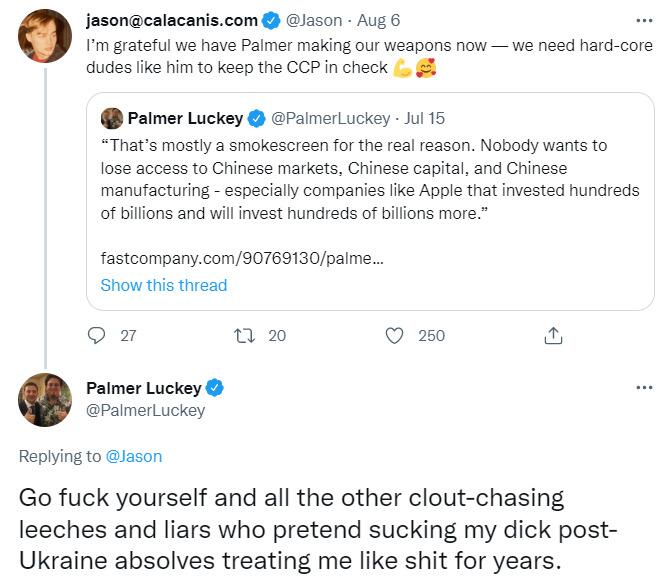
In August, 2022, two months after Luckey smoked him at the All-In event, Jason attempted to mend fences after Anduril started landing government contracts, writing “I’m grateful we have Palmer making our weapons now – we need hard-core dudes like him to keep the CCP in check” followed by flexing arm + in love emojis.

Luckey told him to “Go fuck yourself and all the other clout-chasing leeches and liars who pretend sucking my dick post-Ukraine absolves treating me like shit for years.”

h/t C2

Indeud… 

Epstein and Calacanis

While Calacanis was busy taking potshots at Luckey for supporting Trump, it turns out he had a longstanding relationship with Jeffrey Epstein – having first met in the 1990s while trying to fundraise for a dot-com magazine, Silicon Alley ReporterThe two met at Epstein’s New York townhouse for a discussion allegedly lasting around 30 minutes according to Calacanis. 

Epstein offered some advice; ‘think bigger.’ 

“He gave me some advice at his townhouse once when I was raising money for the magazine,” Calacanis told fa-mag. “He thought I should think bigger.” 

Following Epstein’s July 2019 arrest on sex-trafficking charges, Calacanis reiterated that his contact was confined to the 1990s fundraising meeting, and denied ever flying on Epstein’s plane, visiting pedo island (Little St. James), or attending parties. 

Calacanis notably appears in Epstein’s ‘black book’ – despite insisting the two had limited contact.

Hey Pal…

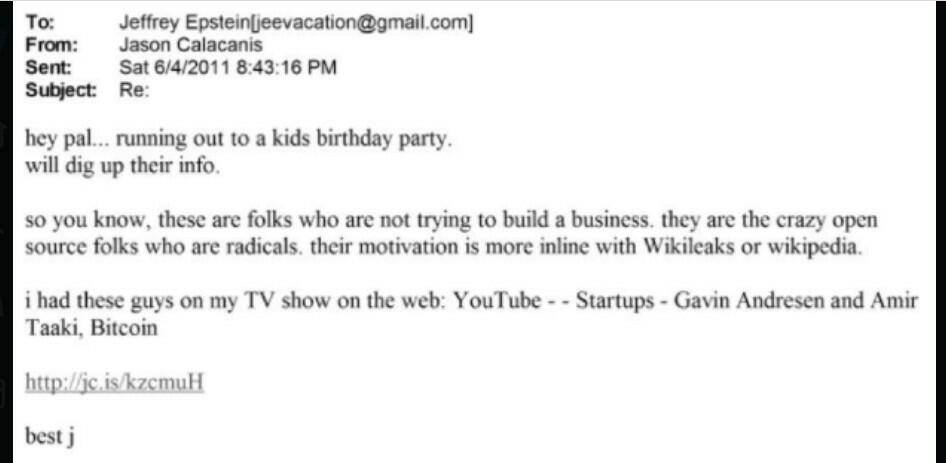
Turns out, not quite… A Friday release of 3 million Epstein files reveals that Calacanis introduced Epstein to early Bitcoin developers Gavin Andresen (a key contributor to Bitcoin’s core software) and Amir Taaki (an open-source advocate involved in Bitcoin and related projects) in 2011.

Via DOJ

In his initial email to Epstein, Calacanis addresses Epstein casually, writing “hey pal,” and mentions he’s “running out to a kids birthday party,” but will “dig up their info” on Andresen and Taaki, who he describes as “crazy open source folks” who are “motivated by the same things as wikileaks.”

Calacanis offers to facilitate connections, noting he had recently featured them on his podcast or show.

The exchange continues, with Epstein eventually emailing Andresen directly.

“Calacanis offers to facilitate connections, noting he had recently featured them on his podcast or show.”

Luckey Lays it Out

Palmer took to X following the email release to call out Calacanis over the revelations. 

Man starts VR company, donates to Trump: “Total moron, no moral compass!”

Man rapes children: “hey pal!”

See below;

And of course…

And that….’s the rest of the story. 

Tyler Durden
Sat, 01/31/2026 – 16:55

via ZeroHedge News https://ift.tt/jYItrXh Tyler Durden

Iranians Seal Windows & Store Food, Water As They Prepare For Attack

Iranians Seal Windows & Store Food, Water As They Prepare For Attack

Via Middle East Eye

As night fell on Friday, a tense sense of dread settled over Iranians at home and abroad, with rumors of an imminent US military strike took hold across Iran.

“I kept waiting for it to hit. I couldn’t sleep until morning. I was waking up and straining to hear any sound of explosions. Let’s see what happens tonight,” Milad*, a 43-year-old engineer living in the capital Tehran, said about that night. Shohreh, a 68-year-old woman, goes to a park near her home in east Tehran every morning for group exercise. When she returned home on the morning of 31 January, she said, “Today, all my friends were saying that it would hit tonight.

Shohreh, who opposes a foreign attack on Iran, said people seemed to be losing their minds. “They think that if the US strikes, everything will be fine,” she said. “Because of the killings committed by the Islamic Republic, people are becoming desperate. They no longer know what is in their interest and what is against them.”

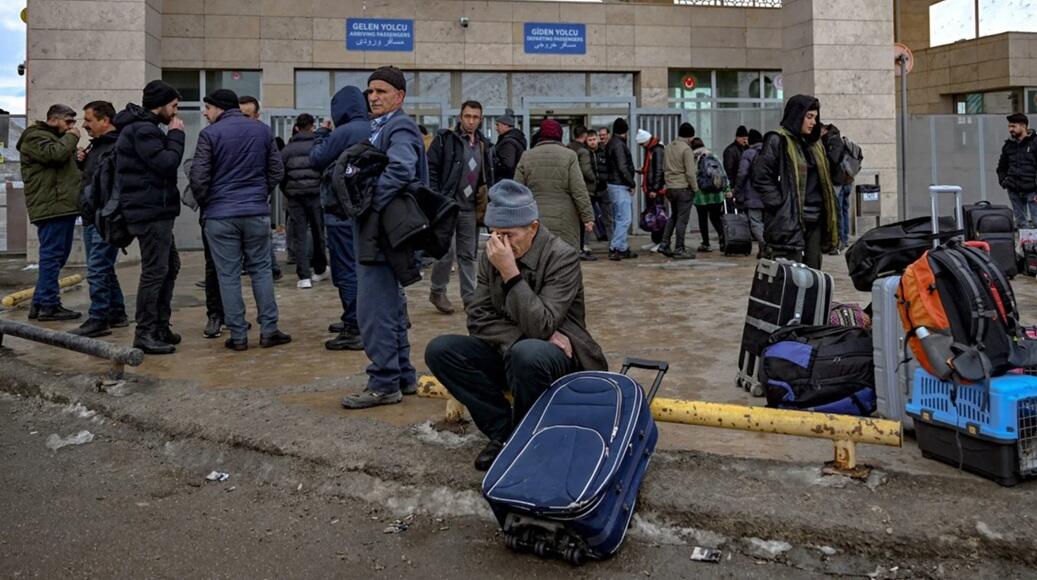
Iranians wait for minibuses after arriving at the Razi-Kapikoy border crossing in north-eastern Turkey on January 31, 2026 (AFP)

For the past week, as Washington has once again beaten the drum of war against Iran, the prospect of conflict has become a real and present fear for Iranians. The movement of a large US military fleet to the Middle East has not only triggered a new multibillion-dollar arms deal with Saudi Arabia and Israel; for Iranians, it has brought confusion, psychological pressure, and fear of a disastrous future.

Iranians are still in shock following the establishment’s bloody crackdown on protests that erupted on December 28 in Tehran’s bazaar over the economic crisis and quickly spread to cities across the country.

According to government sources, 3,117 people, mostly security forces, were killed in the crackdown. However, human rights groups outside Iran believe the number is much higher, with some putting it at more than 6,500 people, the majority of them civilians. No international fact-finding mission has yet been established to verify the figures.

‘Seal the windows’

Arzoo, a 32-year-old government employee opposed to the establishment, described a quiet anxiety among people. Many avoid talking about the deadliest aspects of war, which are all too familiar after last summer’s brutal war with Israel, and try to stay calm. But everyone is waiting for the first explosion.

“My neighbour across the street, in the building where I live, has sealed his windows,” Arzoo told Middle East Eye. “He said, ‘Seal the windows. When they bomb, there will be no difference between the regime and the opposition.’

Beneath the fragile calm that Iranian society clings to, perhaps as a way to manage its own mental strain, lurks a persistent question: what to do when war begins? Social media, which became accessible again after a three-week internet blackout during the crackdown on protests, is now filled with advice on how to survive missile attacks and bombs.

The list of precautions is long: stock enough food and water for 10 days; keep a first-aid kit within reach; place identification and essential documents in a bag for quick evacuation; keep emergency exits clear; move to open spaces at the sound of an explosion; lie on the ground next to a wall. Dozens of similar tips circulate on Persian-language platforms.

The sources of much of this advice are unclear. It is also unknown whether the same bots active during the June Israeli-US strikes – promoting Reza Pahlavi, the son of the deposed Shah – are behind it. Whoever is behind these posts has an evident impact.

Arzoo said she has seen the messages and has stored “10 bottles of drinking water and a few cans of food at home, just in case”.

Amin, a 75-year-old retiree with kidney disease, said he bought a three-month supply of medication last week and is keeping it at home. “Some of this advice may be media manipulation,” he said, “but I bought my essentials anyway, out of caution. No one knows what will happen tomorrow.

Amin, who lived through the eight-year Iran-Iraq war and last year’s 12-day war, said he is deeply saddened to see his country on the brink of another war.

A leftist activist who has opposed the theocratic rulers since the 1979 revolution, he said: “This regime executed my closest comrades after the revolution and is now killing our children. I have no sympathy for it. But I also hate war. War will destroy everything left for us.”

These fears and preparations are not limited to those inside Iran. They are shared by the Iranian diaspora, estimated at around four million people. Many fear another nationwide internet blackout, like those during the 12-day war and last month’s crackdown, that would disconnect them from their loved ones. They also fear for the lives of their families.

Fatemeh, who lives in Finland with her husband and son, worries about her elderly parents in Tehran. During the war with Israel, her parents could not leave the city because they had no access to transportation. 

“I asked my parents to leave Tehran before a new war started,” Fatemeh said. “They answered they wouldn’t go anywhere. They said they had nowhere to go, which is true. That’s why I asked a close friend to visit them and buy basic supplies and medicines during these days.”

‘A fool like Donald Trump’

Across Iran, cities remain calm, at least for now. There are no long lines at gas stations. Shops are open. People are going to work as usual. Early in the morning, schoolchildren wait outside their homes for the school bus.

Still, the sense of alarm is widespread. Soroush, a 27-year-old student, moved with his family to a city in northern Iran during the war to escape Israeli missiles. He said while the panic of that period is no longer visible, the fear of another war runs through everyday conversations.

“The vibe is not like the collective panic of the 12-day war,” he said. “It feels like people are mentally prepared. Before the Israeli attack, we had no idea what war would look like. Now we have an image in front of us. We know what we will face.”

Soroush feels that the lives of Iranians have turned into a game for the country’s leaders and for Western powers. He points to the betting website Polymarket, where many have bet thousands of dollars on a US strike on the night of 31 January. 

“Our lives and our deaths have become entertainment,” he said. “A game for others.

Saba, 41, spoke of her fear for the future of her eight-year-old daughter and 12-year-old son. She also described her frustration with the government’s repression, the self-interest of opposition figures abroad, and the US warmongering.

“What a miserable people we are,” she said. “Our rulers massacre people in the streets. Reza Pahlavi has become the face of our opposition abroad. And our enemy is a fool like Donald Trump.”

*Names have been changed for security reasons.

Tyler Durden
Sat, 01/31/2026 – 16:20

via ZeroHedge News https://ift.tt/zZ6m03n Tyler Durden

One Way to Think About the Don Lemon Prosecution

It’s a pretty obvious way to think about it, but I thought it might be the sort of obvious that was still worth making explicit:

Imagine a right-wing advocacy group is very upset about a mosque, because it thinks one of the imams is a supporter of anti-American Islamic extremism.

They go to the mosque in the middle of services, and start shouting “the time for Judgment had come,” blowing whistles, chanting “Muslim Extremists Out!,” “Remember 9/11!,” and the like. They approach the imam and congregants in a way that some perceive as menacing, and loudly berate the imam with questions about jihadism and Muslims wanting to implement Sharia.

They chant, “This ain’t God’s house. This is the house of the devil.” They approach a female congregant, who is there with two young children, and demand to know in an allegedly hostile manner why she doesn’t support the protesters. They call people “Nazis,” and ask children, “Do you know your parents are Nazis? They’re going to burn in hell.”

They block the stairs leading to the mosque’s childcare area and make it difficult and allegedly hazardous for parents to retrieve their children. After causing most of the congregants to flee, some of them chant, “Who shut this down? We shut this down!”

There’s a person accompanying them to livestream the events to his large audience. He’s generally politically aligned with their message, so there’s reason to think he shares their goals. He understands the whole point of what the other defendants were doing is to make things “traumatic and uncomfortable” for the congregants: He tells his viewers that “the whole point of [the operation] is to disrupt.”

While the intrusion is happening, he asks one of the disrupters, “Who is the person that we should talk to? Is there an imam or something?” He joins the others in approaching the imam and largely surrounding him, standing close to him and peppering him with questions. He doesn’t leave when the imam asks him to leave. He stands at the main door of the mosque, where he confronts some congregants and allegedly physically obstructs them as they try to exit the mosque to challenge them with what he says are “facts” about extremist Islam.

Before the incident, he had met all the other defendants for a pre-op briefing, during which the organizers advised the other defendants and him that their operation would target the mosque, and provide instruction on how the operation would be conducted. He is careful to maintain operational secrecy by reminding his driver not to disclose the target of the operation, and he steps away briefly during the planning session so his microphone wouldn’t accidentally divulge certain portions of what the planners are saying. He assures the other defendants that he won’t prematurely disclose the target of the operation.

Would you be inclined to think that the livestreamer is guilty of conspiring with others to physically obstruct the worship services? Or would you say that there isn’t enough evidence of conspiracy, which is to say (to oversimplify) an express or implied agreement to act in concert in order to accomplish the disruption?

As you might gather, the hypothetical facts above are closely drawn from the allegations (which of course at this point are just allegations) in the Don Lemon indictment (see here and here), but changed to reflect the hypothetical right-wing disruption of the mosque rather than a left-wing disruption of a church.

The post One Way to Think About the Don Lemon Prosecution appeared first on Reason.com.

from Latest – Reason.com https://ift.tt/i1zmoXb
via IFTTT

One Way to Think About the Don Lemon Prosecution

It’s a pretty obvious way to think about it, but I thought it might be the sort of obvious that was still worth making explicit:

Imagine a right-wing advocacy group is very upset about a mosque, because it thinks one of the imams is a supporter of anti-American Islamic extremism.

They go to the mosque in the middle of services, and start shouting “the time for Judgment had come,” blowing whistles, chanting “Muslim Extremists Out!,” “Remember 9/11!,” and the like. They approach the imam and congregants in a way that some perceive as menacing, and loudly berate the imam with questions about jihadism and Muslims wanting to implement Sharia.

They chant, “This ain’t God’s house. This is the house of the devil.” They approach a female congregant, who is there with two young children, and demand to know in an allegedly hostile manner why she doesn’t support the protesters. They call people “Nazis,” and ask children, “Do you know your parents are Nazis? They’re going to burn in hell.”

They block the stairs leading to the mosque’s childcare area and make it difficult and allegedly hazardous for parents to retrieve their children. After causing most of the congregants to flee, some of them chant, “Who shut this down? We shut this down!”

There’s a person accompanying them to livestream the events to his large audience. He’s generally politically aligned with their message, so there’s reason to think he shares their goals. He understands the whole point of what the other defendants were doing is to make things “traumatic and uncomfortable” for the congregants: He tells his viewers that “the whole point of [the operation] is to disrupt.”

While the intrusion is happening, he asks one of the disrupters, “Who is the person that we should talk to? Is there an imam or something?” He joins the others in approaching the imam and largely surrounding him, standing close to him and peppering him with questions. He doesn’t leave when the imam asks him to leave. He stands at the main door of the mosque, where he confronts some congregants and allegedly physically obstructs them as they try to exit the mosque to challenge them with what he says are “facts” about extremist Islam.

Before the incident, he had met all the other defendants for a pre-op briefing, during which the organizers advised the other defendants and him that their operation would target the mosque, and provide instruction on how the operation would be conducted. He is careful to maintain operational secrecy by reminding his driver not to disclose the target of the operation, and he steps away briefly during the planning session so his microphone wouldn’t accidentally divulge certain portions of what the planners are saying. He assures the other defendants that he won’t prematurely disclose the target of the operation.

Would you be inclined to think that the livestreamer is guilty of conspiring with others to physically obstruct the worship services? Or would you say that there isn’t enough evidence of conspiracy, which is to say (to oversimplify) an express or implied agreement to act in concert in order to accomplish the disruption?

As you might gather, the hypothetical facts above are closely drawn from the allegations (which of course at this point are just allegations) in the Don Lemon indictment (see here and here), but changed to reflect the hypothetical right-wing disruption of the mosque rather than a left-wing disruption of a church.

The post One Way to Think About the Don Lemon Prosecution appeared first on Reason.com.

from Latest – Reason.com https://ift.tt/i1zmoXb
via IFTTT

Over 185,000 Americans In The South Remain Without Power After Ice Storm

Over 185,000 Americans In The South Remain Without Power After Ice Storm

Authored by Jacki Thrapp via The Epoch Times,

Over 185,000 Americans were without power nearly one week after a deadly winter storm swept through two-thirds of the country.

States that faced ongoing power outages included Mississippi, Tennessee, Louisiana, and Texas.

The northern part of Mississippi had the most outages with nearly 80,000 utility customers in the dark as of 5 p.m. ET.

Officials at the North East Mississippi Electric Power Association said they weren’t sure when the lights would be back.

“I’m not quite prepared to give a real good estimate of when you might get power,” General Manager Keith Hayward said in a Jan. 29 video posted on X.

Tennessee experienced the second largest number of outages in the United States. The majority of affected customers resided in the heart of Nashville.

Davidson County, which covers a section of Nashville, had over 60,000 people without power as of 5 p.m ET, which is 85 percent of the outages reported in the state.

Nashville Electric Service said that the ice storm was worse than they expected and added that the provider has never had to deal with damage from a system like Winter Storm Fern.

“When we look at the trees that have exploded, when we drive around the community and are still working to get this restoration done, we have to see how severe this was,” said Brent Baker, Nashville Electric Service chief operations officer during a press conference on Jan. 29.

The delays restoring power have caused multiple groups and agencies to step up and help residents impacted.

Soldiers with the Tennessee Army National Guard’s 212th Engineer Company were called out to the streets of Nashville to remove debris and assist with road clearance on Friday.

Churches in the area started booking hotel rooms for people without power.

Trees are coated with ice as over 200,000 people in the Nashville area woke up without power on Jan. 25, 2026. Jacki Thrapp/The Epoch Times

Louisiana had over 32,000 outages by 5 p.m. ET.

“I have been in Washington, D.C., working side by side with [federal and local officials] to secure the resources and support Louisiana needs,” Gov. Jeff Landry (R-La.) wrote in an X post on Jan. 30.

“With more severe winter weather hitting our state, I am cutting my trip short and heading home now to continue leading our response efforts on the ground. Please remember to stay safe and stay warm!”

The National Weather Service is predicting a widespread storm will slam the East again this weekend.

“A rapidly deepening storm centered just off the North Carolina coast Friday night through Saturday night will produce widespread heavy snow and wind from the southern Appalachians across the Carolinas and southern Virginia,” the agency posted on X Jan. 29.

Tyler Durden
Sat, 01/31/2026 – 11:40

via ZeroHedge News https://ift.tt/k2AqFfB Tyler Durden

Connecticut School Cancels Event With Education Secretary Over Political Pressure

Connecticut School Cancels Event With Education Secretary Over Political Pressure

Authored by Jonathan Turley,

We have long discussed how educators are instilling viewpoint intolerance in students from the earliest grades. The latest example is the cancellation of a visit to McKinley Elementary School in Fairfield, Connecticut, by Secretary of Education Linda McMahon.

The students had the opportunity to speak and interact with a cabinet member, but the school cancelled the event due to political opposition from parents.

Reports indicated that the visit, part of McMahon’s “History Rocks” tour in celebration of the 250th anniversary of the Declaration of Independence, was cancelled due to a campaign by parents.

The parents rose up after McKinley Principal Christine Booth wrote them saying that the school was

“proud to offer this unique opportunity and… unforgettable experience for our McKinley students. Students will enjoy a dynamic, interactive assembly that brings American history and civic learning to life through fun, game show style activities, hands-on participation, and even prizes. This high energy experience is designed to spark curiosity, celebrate our country’s story, and make learning memorable for our students.”

Fairfield Superintendent of Schools Michael Testani folded immediately under the political pressure rather than stand firm that the school is a place for different ideas and voices:

“Following this evening’s announcement about the Secretary of Education’s planned visit to McKinley on Friday, we heard from many families who expressed concerns and shared that they were considering keeping their children home. Due to these circumstances, the Secretary of Education’s visit to Fairfield has been canceled.”

Those “circumstances” were the combination of political pressure from parents and a lack of principle by school officials.

These parents and officials have taught these students a terrible lesson: they should not be exposed to opposing views or speakers.

They are raising a generation of speech-phobics that reflects their own intolerance and bias.

Tyler Durden
Sat, 01/31/2026 – 10:30

via ZeroHedge News https://ift.tt/sEfzWOZ Tyler Durden

Latest Epstein Emails Reveal Bill Gates Slipped Wife Antibiotics For STD He Got From Russian Hookers

Latest Epstein Emails Reveal Bill Gates Slipped Wife Antibiotics For STD He Got From Russian Hookers

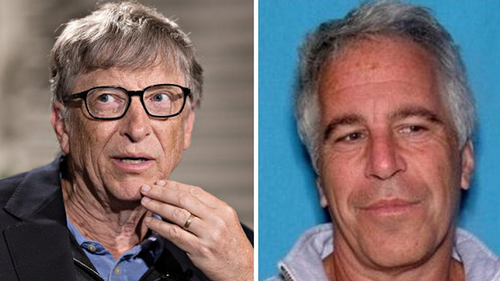
Democrats thought that the firehose release of Epstein files would “finally” bring down Trump. Instead, not only is that not happening (one can argue the latest batch of docs further cements Trump’s claim that he had distanced himself far enough from Esptein in recent decades as this admission from Epstein himself to his favorite scribe Michael Wolff reveals), but it is taking down Democratic “thought titans”, each one bigger than the next: first it was Larry Summers, then Bill Clinton, now it’s Bill Gates.

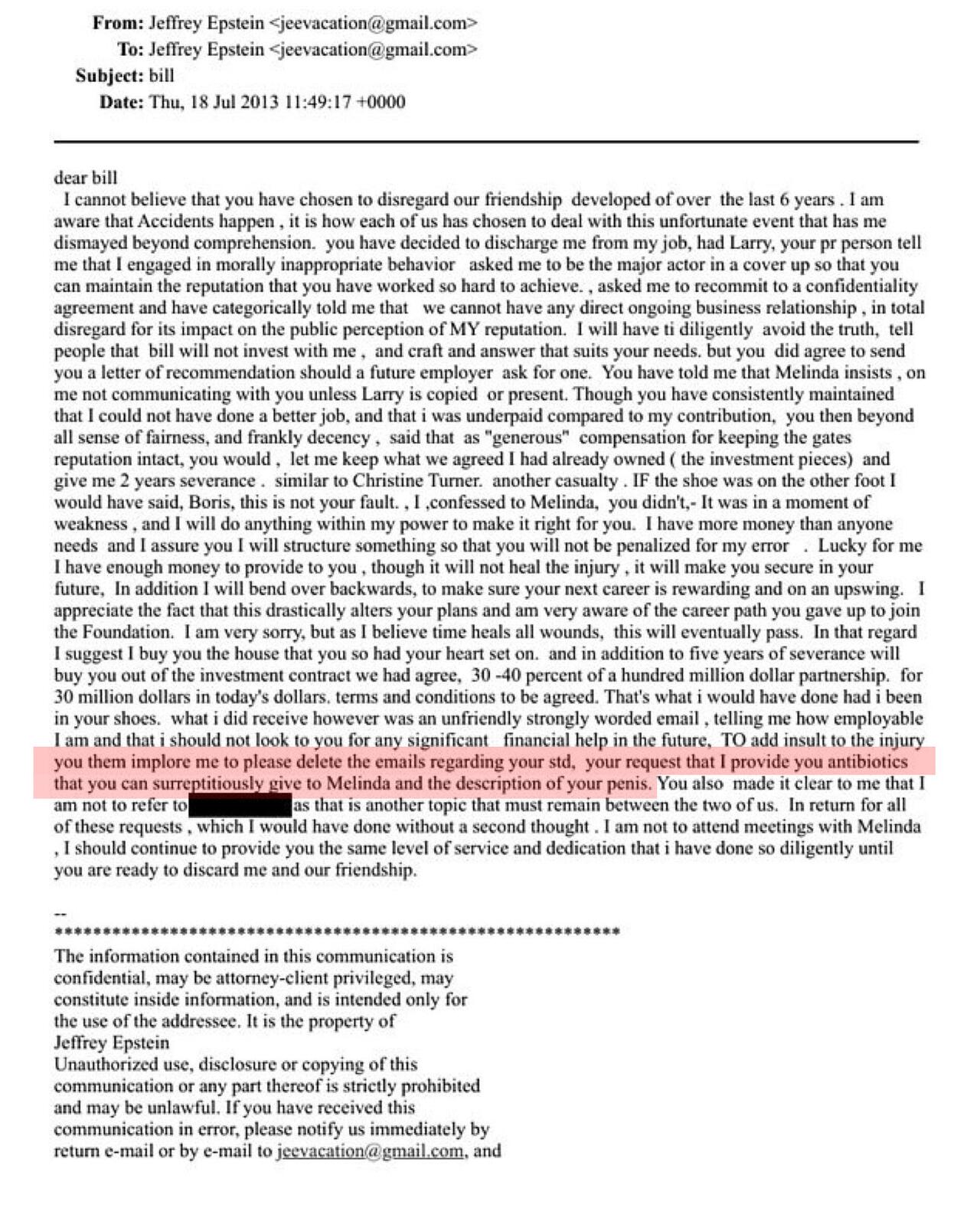
In what can only be described as the latest chapter in the never-ending saga of elite depravity, the DOJ coughed up over three million pages of Jeffrey Epstein’s sordid files – a treasure trove of smut, scandal, and schadenfreude that puts the spotlight squarely back on billionaire vaccine-pusher and Microsoft mogul Bill Gates. Released on Friday, these documents include draft emails from Epstein to himself, painting a picture of Gates as a man entangled in extramarital escapades involving “Russian girls,” desperate pleas for antibiotics to hide an STD from his then-wife Melinda, and even bizarre anatomical descriptions that no one asked for. Gates’ camp, predictably, is screaming “fake news” from the rooftops, but let’s dive into the dirt and see if this smells like another cover-up in the making.

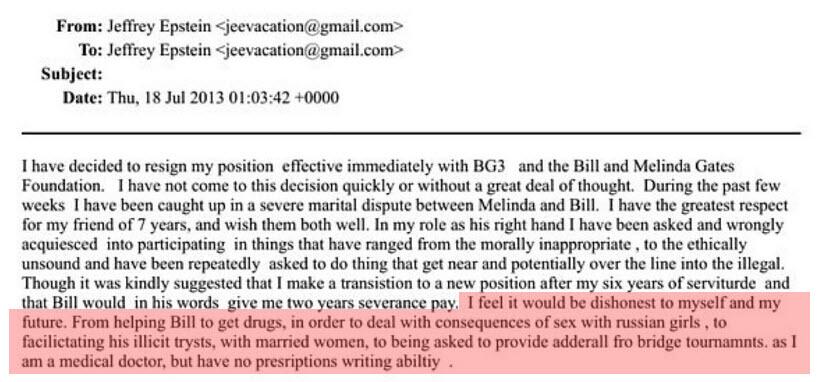
According to the newly unsealed emails, drafted in July18, 2013 but unclear if ever sent, Epstein rants about Gates severing ties with him, accusing the tech titan of hypocrisy after allegedly benefiting from his seedy network. “To add insult to injury you then subsequently with tears in your eyes, implore me to please delete the emails regarding your std, your request that I provide you with antibiotics that you can surreptitiously give to Melinda, and the description of your penis,” Epstein reportedly wrote in one typo-riddled tirade. He went on to claim he helped Gates “deal with consequences of sex with Russian girls,” implying Epstein played pimp in these alleged trysts. The only question for the FBI: were they underage?

Epstein, ever the aggrieved party in his own mind, positions himself as the jilted enabler who got Gates out of jams, only to be ghosted when the heat got too hot. “I have been caught up in a severe marital dispute between Melinda and Bill,” he laments in another note, adding that Gates asked him to partake in “things that have ranged from the morally inappropriate to the ethically unsound” and “potentially over the line into illegal.” This comes amid Epstein’s supposed resignation from roles tied to the Gates Foundation and BG3, Gates’ think tank.

And what’s this?

A spokesperson for Gates didn’t mince words in response: “These claims – from a proven, disgruntled liar – are absolutely absurd and completely false.” Fair enough, but let’s not forget Gates has been tap-dancing around his Epstein ties for years. He once called those dinners with the pedophile financier a “huge mistake” in a 2021 CNN interview, downplaying them as mere fundraising schmoozes.

Flashback to our 2019 exposé: “Bill Gates Was Much Closer To Jeffrey Epstein Than He Initially Let On,” where we detailed Gates’ flights on Epstein’s infamous ‘Lolita Express’, yes, after Epstein’s 2008 conviction for soliciting a minor. Then there was “Why Did Bill Gates Fly On Epstein’s ‘Lolita Express’ After Pedophile’s Prison Stint?” And who could forget this 2023 bombshell: “Bill Gates ‘Blackmailed’ By Jeffrey Epstein Over Affair With Russian Bridge Player,” revealing Epstein’s alleged leverage over Gates’ fling with Mila Antonova, a young Russian card shark introduced by none other than Epstein himself. That story tied into reports of Epstein paying for Antonova’s coding classes, only to later dangle the affair as blackmail fodder when Gates balked at a shady investment scheme.

Bill Gates

The Russian angle keeps popping up like a persistent virus, no pun intended. In our 2021 piece “‘Furious’ Melinda Gates Warned Bill Over Jeffrey Epstein Escapades,” we highlighted how Melinda was reportedly livid about Bill’s cozying up to Epstein, with meetings starting as early as 2011 and contributing to their 2021 divorce. Fast-forward to last year’s Go Talk To Bill Gates About Me”: How JP Morgan Enabled Jeffrey Epstein’s Crimes, Snagged Netanyahu Meeting,” which exposed Epstein name-dropping Gates to JPMorgan execs as a reference, further entangling the billionaire in Epstein’s web of influence-peddling.

This latest DOJ dump – which also drags in figures like former UK ambassador Lord Peter Mandelson (Epstein allegedly sent money to his husband post-prison), Prince Andrew (invited to the Palace amid fresh dirt), and even photos of Epstein hobnobbing with Trump, Clinton, and Gates – feels like the establishment’s reluctant confession booth. Deputy AG Todd Blanche announced the release more than a month after a December 19, 2025, deadline set by the Epstein Files Transparency Act, with much of it redacted or already public. But the Gates emails? Fresh meat for the conspiracy mill.

As we noted in “There Is No Epstein List, But We Got Names,” the real scandal isn’t a mythical “client list” – it’s the web of enablers and elites who skated free. Gates’ name keeps surfacing alongside heavyweights like Ehud Barak, Les Wexner, and Glenn Dubin, all fingered in past allegations. And let’s not overlook our recent “Never-Before-Seen Photos Inside Jeffrey Epstein’s Creepy Mansion,” which included a framed $1 bill scrawled with Gates’ handwriting: “I was wrong!” – prophetic, perhaps?

And while in “A Contrarian Take On The Epstein Case,” we questioned whether the whole blackmail ring was overhyped, these new emails suggest otherwise: Epstein wasn’t just a pervert; he was a grudge-holding chronicler of the powerful’s peccadilloes. Gates may dismiss this as the ravings of a “disgruntled liar,” but in the face of this new ‘release’ added to his history with Epstein, the denials ring hollow.

The question remains: How much longer can Gates play the philanthropist card – or rather how much longer will the world allow him to – while his Epstein skeletons keep rattling? Even Larry Summers was forced to exit polite society stage left after his batch of revelations hit last year.

As markets digest this elite drama, keep an eye on Microsoft stock – because if there’s one thing we’ve learned, it’s that scandals like these have a way of infecting even the bluest of blue chips. Stay tuned; this rabbit hole just got deeper.

Tyler Durden
Sat, 01/31/2026 – 09:56

via ZeroHedge News https://ift.tt/yjeNBtA Tyler Durden

Neil Young Encounters The Most Boomer Leftist Problem Imaginable

Neil Young Encounters The Most Boomer Leftist Problem Imaginable

Authored by Steve Watson via Modernity.News,

Aging rocker Neil Young has encountered perhaps the most boomer of leftist boomer issues, and of course it’s all President Trump’s fault.

He can no longer use his ancient flip phone because orange man bad.

In a rambling post on his website, Young details his epic struggle to ditch Verizon service, convinced that every dollar he spends fuels a “Trump Fascist regime.”

It’s peak boomer leftist TDS paranoia, where everyday consumer choices somehow morph into grand acts of resistance.

Young kicks off his diatribe with the revelation that his flip phone bears the Verizon logo. “Mornin’ folks….It’s a new day….a big day for my Flip phone. I noticed it says VERIZON on it. Of course I can’t use a Verizon phone. Verizon is a supporter of TRUMP with big $!” he writes, as if discovering a hidden swastika etched into the device. 

He floats the idea of switching to T-Mobile, only to immediately shoot it down. “I’m going to see if I can just drop Verizon and move to T-Mobile,” he muses, before adding, “But wait….T-MOBILE donated to TRUMP’s Ballroom, which has gone from 200 million to 400 million suddenly. Where is that money going? There is no accounting. So T-Mobile is apparently out.” 

The “ballroom” obsession is particularly unhinged; Young fixates on the White House renovation project, questioning “What favors? What companies are donating? Why?” as if uncovering a vast conspiracy. 

The absurdity escalates when Young realizes he’s typing on an Apple computer. “HEY THIS IS AN APPLE COMPUTER!—— I have to stop and re-assess. No more upgrades! That feeds Apple, Apple supports ‘The Regime’ with donations,” he exclaims.

He even calls his business manager mid-rant to halt any future Apple spending, decrying CEO Tim Cook for “kissing ass” at a White House event. 

Young then threatens to sue Apple if his computer stops working without upgrades, expressing a desire to cling to current versions of Pages and FaceTime because he likes them as they are and doesn’t want them to change.

It’s a hilarious snapshot of boomer tech illiteracy colliding with political zealotry—refusing modern conveniences to own the MAGA crowd.

Young ties it all back to his broader crusade, referencing a list of companies “backing the Fascist Trump Regime” on his website’s editorial page. 

“One by one, I am cancelling all contact with each of them. This is not easy, but the alternative – me giving money I got from you, for my music, to the Regime that backed the illegal killings of two Americans. That can’t happen,” he declares.

Young’s rants are getting more and more loony. As we previously covered, he pulled his music from Spotify in 2022 to protest Joe Rogan’s supposed “COVID disinformation,” only to slink back two years later when the pandemic froth died down.

Rogan mocked him mercilessly: “Great to know you got some ethics.” 

Now, Young’s Trump fixation has seeped into his music too—his recent songs obsess over the former president, and one of his latest videos is bizarrely fixated on White House renovation footage, as seen in this clip where he rails against the ballroom like it’s Watergate 2.0.

Young ends his post pondering his record label, Warner Brothers, hinting at more boycotts to come. “I’ll keep you posted folks,” he signs off, as if anyone’s waiting breathlessly for updates on his flip phone saga. 

Trump Derangement Syndrome has turned Young into a caricature, boycotting his way into irrelevance. Meanwhile, real Americans are focused on freedom, not phantom fascist ballrooms. 

If Young wants to live in the Stone Age to spite conservative Americans, that’s his prerogative—but it’s a stark reminder of how the left’s obsessions with Trump blind them to actual threats to freedom like tech censorship and surveillance overreach.

Your support is crucial in helping us defeat mass censorship. Please consider donating via Locals or check out our unique merch. Follow us on X @ModernityNews.

Tyler Durden
Sat, 01/31/2026 – 09:20

via ZeroHedge News https://ift.tt/MgAiezn Tyler Durden

Iran Hits Back At EU: Designates European Armies As ‘Terrorist Entities’

Iran Hits Back At EU: Designates European Armies As ‘Terrorist Entities’

Iran is saying two can play at the West’s game: on Friday the secretary of Iran’s Supreme National Security Council blasted the EU’s decision to designate the Islamic Revolutionary Guard Corps (IRGC) as a “terrorist organization,” warning that Europe’s own militaries would now be viewed through the same lens.

“The European Union certainly knows that… the armies of countries that have participated in the European Union’s recent resolution against the Islamic Revolutionary Guard Corps are considered terrorist entities,” Ali Larijani wrote in a post on X. He added bluntly: “Therefore, the consequences of that shall be borne by the European countries that undertook such an action.”

NurPhoto

However, there’s probably nothing in the way of European military assets for the Islamic Republic to sanction, so this ‘action’ by Tehran will remain largely symbolic. Iran does have assets held in various places of Europe though.

EU foreign ministers agreed on Thursday to formally classify the IRGC as a “terrorist organization” and urged member states to implement the designation without delay – after a few longtime holdouts flipped.

Among those recently changing their stance include France, Spain, and Italy – but apparently the recent deadly protests, and Trump’s pressure, had an impact.

One bit of irony is that the West has over the past year removed its designation of Syria’s Hayat Tahrir al-Sham (HTS), after Jolani took over Damascus. HTS is literally the founding al-Qaeda group in Syria.

The IRGC stands accused by the West of directing Iran’s crackdown of domestic unrest, after economic-driven protests took over town and city streets this month. 

Thousands died, but Iran officials have pointed to armed saboteurs being mixed in among the peaceful demonstrators, leading to mayhem and a high death toll.

The United States, Canada, and Australia had already blacklisted the IRGC, while Germany and the Netherlands have for years pressed the rest of the EU to follow suit.

But Tehran sees the Guard Corps as part of, or also chief safeguard of the nation’s security and military. It is envisioned as ‘protecting’ the ‘Islamic Revolution’ since 1979. In the past, some countries even gave top IRGC officials diplomatic credentials.

Tyler Durden
Sat, 01/31/2026 – 08:45

via ZeroHedge News https://ift.tt/BrjivYn Tyler Durden